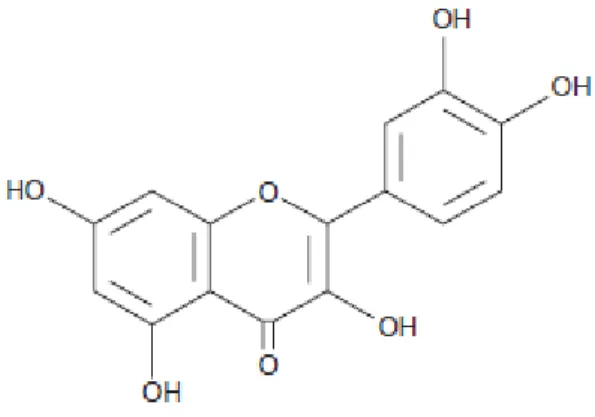
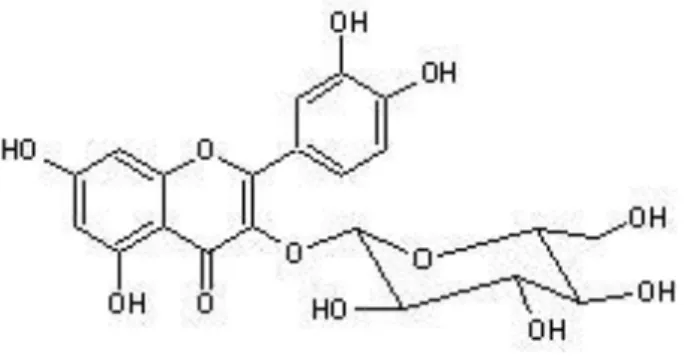
This study was supported by an Institutional Development Award (IDeA) Grant Number P20GM104932 from the National Institute of General Medical Sciences (NIGMS) and Project 3 of COBRE, a component of the National Institutes of Health (NIH). TRUONG: Development and Evaluation of Quercetin Nanoparticles and Hot Melt Cast Films for Retinal Neuroprotection. The aim of this study was to prepare optimized nanoparticles and hot melt cast films of quercetin and to investigate the release profile and permeability across corneal membranes.
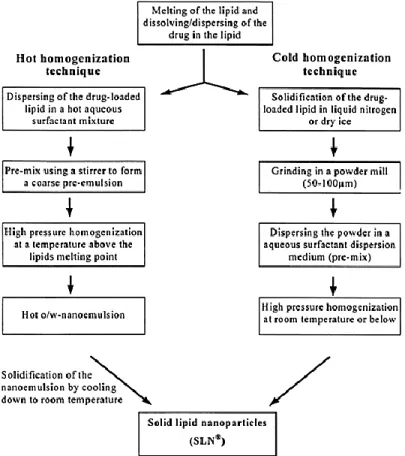
Quercetin dissolved in DMSO was mixed with glycerin and added to the lipid phase of glycerol monostearate or Miglyol 812® in combination with Compritol ATO 888®. The aqueous phase of Tween 80®, Poloxomer 188® and water was added and the premix was homogenized, sonicated and cooled to form nanoparticles. Quercetin and polyethylene oxide N10 were mixed and the mixture was compressed and melted to prepare films.
Physicochemical profiles for nanoparticles were analyzed and permeability through the rabbit cornea was studied for both formulations using side-by-side diffusion equipment. These results demonstrate that all formulations can be successfully used to deliver quercetin into the eye via the topical route of administration, with films exhibiting significantly improved transcorneal permeability.
INTRODUCTION
- SOLID LIPID NANOPARTICLES
- NANOSTRUCTURED LIPID CARRIERS
- HOT MELT CAST FILMS
- QUERCETIN
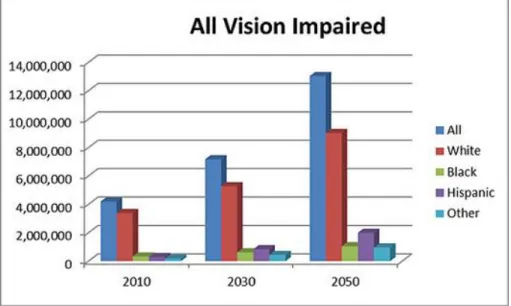
In the eye, ROS damage the cells of the retina, which plays an important role in converting visual images into electrical impulses that the brain interprets. The body produces some antioxidants endogenously, but they can also be obtained from outside the body. The retina is located in the posterior chamber of the eye, which is generally difficult to access (Kaufman, 2011).
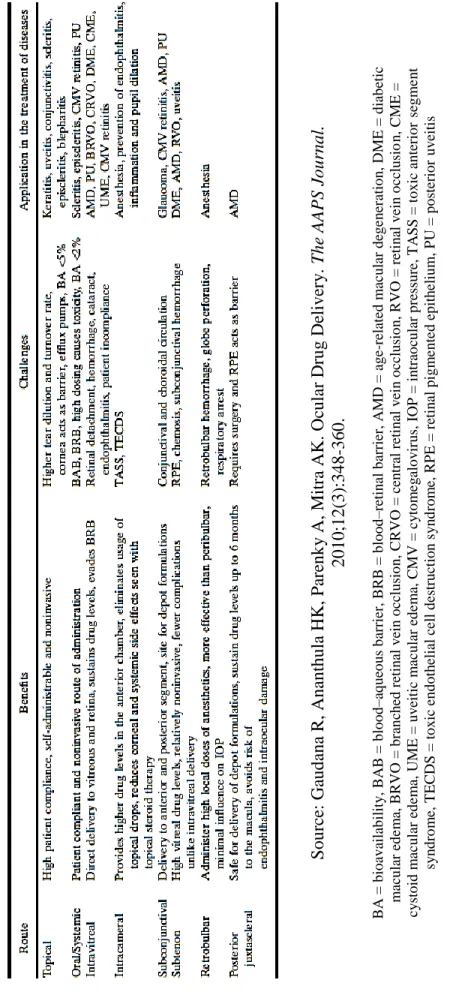
Low solubility negatively affects the rate of dissolution, limiting how much of the drug can be absorbed into the circulatory system. This is because there are several barriers preventing absorption towards the back of the eye. Thus, very little of the drug is in contact with the eye long enough to be absorbed, accounting for less than 5% of the applied dose.
These benefits in turn increase the bioavailability and therefore the action of the drug at the target site. In comparison, drug release via the solid lipid is slower and more limited than drug release via the liquid lipid, due to the lower solubility of the drug in the solid lipid (Dan, 2016). The incorporation of the liquid lipid improves drug solubility in the nanoparticles and increases the rate and amount of drug release, while still controlling how much is released into the body at a time.
Other preservation methods may be more favored and advised in this case, such as the use of a preservative while maintaining the water content of the formulation. The properties of the drug may also affect the functionality of other materials used in the formulation. The agent can negatively affect the formulation by lowering the viscosity or inhibiting the hardening of the matrix, resulting in a dosage form that will be poorly handled and unusable.
On the other hand, the drug could positively influence the formulation by lowering the glass transition temperature of the polymeric carrier. The physical and chemical properties of the carriers can also greatly influence drug release from the dosage form. Plasticizers used in the formulation should have good efficiency, stability, polymer-plasticizer compatibility and durability as these can affect the physical and mechanical properties as well as the drug release rate of the dosage form.
Finally, there are other processing aids, such as antioxidants, acid receptors and light absorbers, which can be used to improve the stability of the other components and the overall formulation. The main target parameters for melt-cast films are homogeneous distribution of the drug in the polymeric matrix, high stability of the drug, the polymer and any additives, and good rate and amount of drug release.
MATERIALS AND METHODS
MATERIALS
METHODS
The premix was homogenized with an Ultra-Turrax® at 16,000 rpm for 3 minutes to form a coarse emulsion. This coarse emulsion was then subjected to sonication at a pulse rate of 15 seconds for 3 minutes. The aqueous phase was added to the lipid phase while stirring at 600 rpm for 2 minutes.
The premix was homogenized with an Ultra-Turrax® at 16,000 rpm for 3 minutes to form a coarse emulsion, which was then subjected to probe sonication for 3 minutes at a 15-second pulse. Quercetin was dissolved in dimethyl sulfoxide (DMSO) to make a 1 mg/mL stock solution for the standards. Different volumes of the stock solution were diluted with the mobile phase to make standards of the following concentrations: 1 μg, 2 μg, 5 μg, 10 μg and 20 μg.
SLN and NLC formulations were diluted 500-fold with purified water and analyzed using a Zetasizer (Malvern Instruments, Ltd.) to determine particle size, polydispersity index, and zeta potential. 100 μL of the centrifuged filtrate was taken, diluted with 900 μL of mobile phase, and then vortexed to ensure thorough and homogeneous mixing. From this, 100 μL of supernatant was taken and diluted with 900 μL of mobile phase before vortexing to ensure thorough and homogeneous mixing.
Varying volumes of the stock solution were diluted with acetonitrile to make standards of the following concentrations: 1 μg, 2 μg, 5 μg, 10 μg, and 20 μg. The standards were analyzed using UV analysis at a wavelength of 369 nm to determine the calibration curve for quercetin against which the film samples will be compared. Samples of approx. 8 mg was cut from quercetin film and added to 2 ml of acetonitrile.
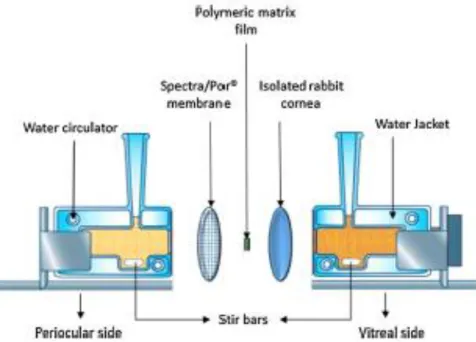
Both donor and recipient cells for film studies were filled with 3.2 ml of IPBS. For the NLC formulations and the control, which was 3 mg of pure quercetin mixed with IPBS, 3.2 mL of each formulation was added to their respective donor cells and 3.2 mL of IPBS was added to the recipient cells. After several washes to mix the receiving medium, 0.6 ml samples were taken from the recipient cell, except for films for which samples were collected from both donor and recipient cells, and 0.6 ml IPBS was added to the cells to replace the volume removed.
RESULTS
CHARACTERIZATIONS OF NANOPARTICLES AND FILMS
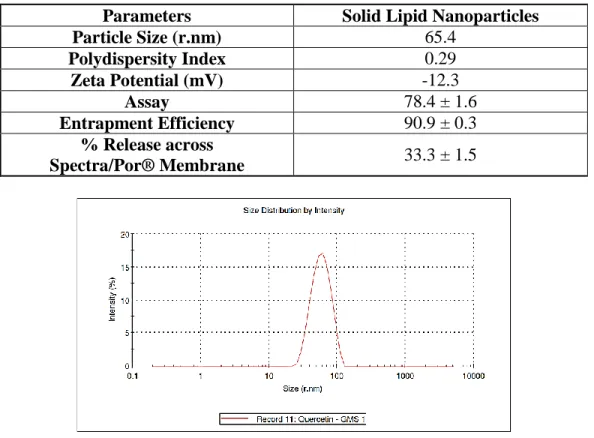
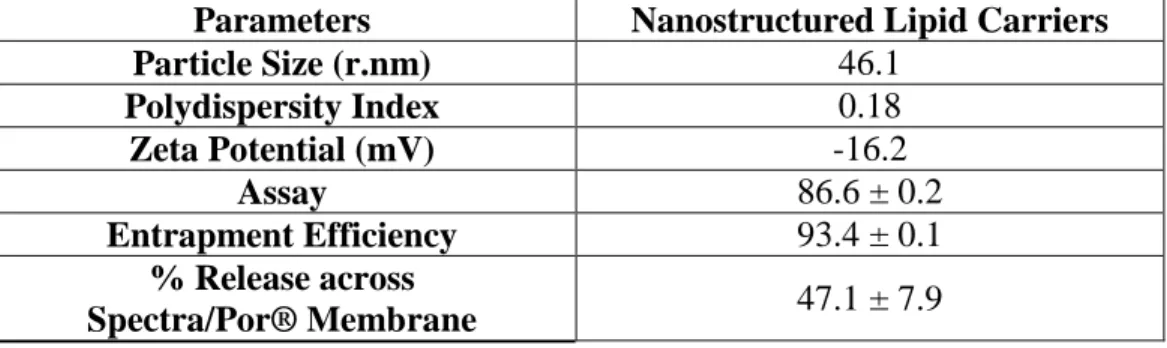
The nanostructured lipid carriers showed an average particle size of 46.1 r.nm, polydispersity index of 0.18 and zeta potential of -16.2 mV. These parameters are summarized below in Table 4 and the particle size distribution is shown below in Figure 9. The comparison of the particle size distributions for the SLN and NLC formulations is shown below in Figure 10.
Particle size, polydispersity index, zeta potential and entrapment efficiency are parameters designed more for nanoparticle systems and have not been evaluated with hot melt films.
CORNEAL PERMEABILITY STUDIES
DISCUSSION
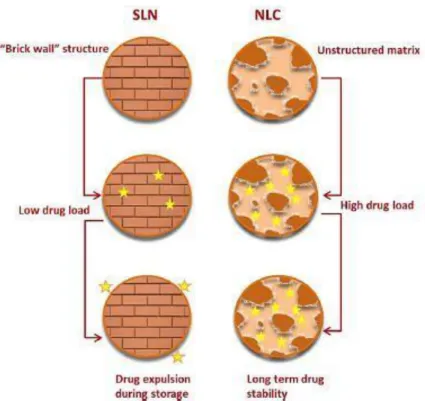
Specifically, this structure results in relatively low drug loading, limited drug release, and drug expulsion during storage. With nanostructured lipid carriers, on the other hand, the incorporation of a liquid lipid into the solid lipid matrix results in a broken and highly permeable nanoparticle shell. This structure allows for a higher drug loading, greater drug release and long-term drug stability.
Thus, from these differences (summarized in Figure 15), we would expect to see that the NLC formulation would exhibit better properties than the SLN formulation, which it did. To compare how well quercetin permeates from the melt-cast film across corneas as opposed to permeation from the nanoparticles, we used a control of pure quercetin in addition to the NLC formulation, which was chosen because it showed better parameters and physicochemical properties compared with SLNs. Rate was determined by how much drug, in micrograms (μg), crossed the cornea from donor to recipient cells, per minute, with concentrations extrapolated from the calibration curve based on the absorbance of the samples.
The rate of drug release permeation for the control was the slowest, and the rate for the films was the highest by a significant margin (7-14x higher), with the rate of the NLCs in between. Flux was calculated as the amount of drug in micrograms crossing the cornea per minute per area squared (area = 0.636 cm). Again, the flux for the control was the lowest, and the flux for the films was the highest by a good margin (4-5x higher).
Finally, permeability was calculated as assay-normalized flux and reported as centimeters per second. Control permeability across the cornea was lowest, drug permeability from NLC was second highest, and drug permeability from films was highest, again by a good margin (4-6x higher). In total, both formulations (NLCs and films) were more successful in controlling drug permeability across the cornea.
However, the hot melt casting film formulation showed significantly better parameters in all respects compared to both the control and NLC formulations.
CONCLUSION
Furthermore, the in vitro release and permeability values demonstrate that nanoparticles can be successfully used for the delivery of quercetin into the eye via the topical route of administration. The hot melt casting films were also shown to have good release and permeability profiles. These results demonstrate that hot-melt casting films can also be successfully used for ocular delivery of quercetin via the topical route of administration and may be a better delivery system for quercetin administration.
Specifically, drug delivery to living animals can be performed to test permeability and absorption across corneas under physiological conditions. A long-term study may also be conducted to test the extent of retinal neuroprotection that quercetin may have in protecting against damage from reactive oxidative species and consequent visual impairment. Topical ophthalmic lipid nanoparticle (sln,nlc) formulations of indomethacin for delivery to the posterior segment of ocular tissue.
Formulation development and systematic optimization of solid lipid quercetin nanoparticles for enhanced brain delivery. UV and hplc spectrophotometric method development of quercetin and curcumin in polyherbal churna and its validation.