
His research interests lie in the area of e-democracy and the use of ICT in state-citizen relations. In the next chapter, Griffin continues this exploration of the potential effect of ICT on accountability.
Introduction
Those involved in ICT should have easily realized that we have been here - several times.
Models of growth and maturity
Innovations and accompanying changes are themselves often personalized so that different individuals are seen as heroes or villains: Sometimes the same person can fulfill both roles - the prime example for our era would be Bill Gates. As an aside, it should be noted that the use of the maturity concept in the context of ICT can also be found in work stemming from Watts Humphrey's application of Crosby's quality framework [5] to IS/ICT; in particular in relation to software and systems development.
Having moved far past Beer's first question—false or inadequate—it seems we are now back where we started. The current socio-political context has been variously characterized - the information age, the knowledge society, the digital economy and the information form of capitalism; depends on which author you read.
Liquid modernity – flux and turbulence
Emery and Trist argued that in this context the dynamical processes themselves lead to the triggering of other dynamical processes, some of which emerge from the turbulent field itself: "The Earth is in motion." It also applies to the current global economic system; "Dynamic properties arise not simply.
Society and social institutions are not the solution, on the contrary, they are the core of the problem. In particular, it highlights the importance of the technological proliferation of myth, discourse and political rhetoric embedded in the public policy-making process.
The diffusion of closed circuit television: A surveillance revolution
By the mid-1990s, CCTV had become a central part of the government's law and order policy. A notable feature of the CCTV revolution is the extent to which the introduction of CCTV appears to have broad public support.
Technological perspectives of diffusion: The diffusion and social shaping approaches
In this account, the proliferation of CCTV is explained as a tool designed to help 'fight crime'. By minimizing or ignoring the importance of policy making in the diffusion process, both perspectives deny the most important impacts on society.
Explaining diffusion: Perspectives of the policy process
Therefore, to understand the policy process, we must first seek to understand the individual choices and motivations of the various actors involved in the process. The core idea underlying power perspectives of the policy process is that the development of policy reflects the underlying power structures in society.
Reconsidering the CCTV revolution: A policy-diffusion process
In the case of CCTV, these perspectives have shown that the governance processes are central to shaping and determining the development of the policy and the diffusion of the technology. The importance of the state, public bodies and politics to the spread of CCTV suggests that the diffusion process should be seen as a policy-diffusion process.
Conclusion
First, it describes the growing importance of the study of web technology in public administration. City councils are now at the rising end of the curve, when an increasing number of them are looking.
Benchmarking: origin and growth
In the third section, based on the analysis of benchmarking practices, we will draw some lessons for the future use of e-government benchmarks. The difference between these two forms of benchmarking is the focus of the benchmarking activities: do we study the result or the processes.
An analysis of 18 international e-government benchmarks
E-service delivery is indeed one of the most prominent features of e-governance, so. Environmental or 'readiness' indicators do not measure e-government as such, but measure some of the prerequisites for successful e-government.

Alternative approaches to e-government benchmarking: qualitative versus quantitative methods
These authors developed a quantitative approach to measure the integration progress of e-government projects. Second, they attempt to demonstrate the link between back office reorganization and the quality of public services.
Conclusion
Since quantitative and qualitative approaches to comparing e-government have their advantages and disadvantages, the best way to compare e-government practices is a combination of both methods. In 2004, two initiatives were undertaken in which back-end processes were the focus of attention.
From e-government to e-democracy
Ideas of democracy
The processes of democracy
In fact, it is unlikely that more than a relatively small percentage of voters will choose this method of voting [10]. Many who do not vote believe that the differences between the candidates are not significant and that their participation in the political process has no effect on the outcome or the policies that will be implemented.
Summary and conclusion
Certainly the events in the United Kingdom leading up to the Second Gulf War show that the government did not follow the will of the people. Another US supplier is Diebold see http://www.forbes.com Election-security-fraud-tech-security-.
Public accountability: a key concept in democratic governance
This type of responsibility shapes the relationship and exchange of information between managers and civil servants in government organizations. The introduction of ICT in government organizations has caused changes in the functioning of the government.
Hierarchical accountability
This information infrastructure controls the behavior of civil servants and also makes their behavior transparent to their superiors. He mentions that this ICT hinders hierarchical accountability because this ICT makes the behavior of civil servants less transparent to their superiors.
Professional accountability
LINUX and the open source movement can provide interesting models for public forms of professional accountability in the information age [13, 14]. Professional responsibility in the Open Source Movement is not based on membership in a professional association, but on proven (informal) knowledge and experience about a topic.
Political accountability
It seems likely that in the near future (information) professionals in government will be held accountable not only by professional peers, but – through the Internet – by 'amateurs' as well. In the context of government and ICT, direct accountability to citizens is the most debated form of political accountability [17].
Legal accountability
Empirical research seems to show that the legal quality of routine decision-making has increased due to the use of ICTs [20]. In this respect, the use of ICTs leads to a change from ex-post to ex-ante legal responsibility.
Administrative accountability
The high degree of formalization seems to mean that the use of ICT has little effect on this form of accountability. Nowadays, the use of e-mail messages and other forms of digital information is considered as normal as the use of paper documents and oral testimonies.
ICTs and public accountability: general trends
In the local government context, these stakeholders may include the service's customers and clients [5], local businesses and voluntary organizations [4]. One of the participants' CEO believed that residents would lack interest in what he perceived as 'mainly back office stuff.' The evidence gathered in this study suggests that the public is more likely to be interested in customer-facing services rather than the output. from e-government.

Active young citizens
The use of the internet and mobile phones by young people will then be considered. The combination of this information suggests that text messaging is a viable tool to use to engage young people.
![Figure 1. Trevorrow and Orange [3] model of active citizenship by young people](https://thumb-ap.123doks.com/thumbv2/123dok/11538854.0/149.892.245.574.752.937/figure-trevorrow-orange-model-active-citizenship-young-people.webp)
New digital media
Empirical research
New digital media and young citizens’ active participation in practice
Is text messaging a viable means of connecting young people and the government?
Can the provision of a new communication channel by the government promote demand from young people. The research presented here indicates that young people do not want to be involved and participate, or believe that any involvement will be effective, in which case technology is not the answer and other mechanisms are required to ensure active participation of young citizens.
An old question
Expenditure on e-government
Definitions
Further afield are areas such as healthcare, education, police and the military; all part of the public sector, but not entirely part of the government. The study of methods for allocating scarce resources in production, the distribution of the resulting output, and the effects of this allocation and distribution” [16].
Three Levels of Analysis
To illustrate some of the issues, the example of the Irish Department of Agriculture and Food (DAF) will be used below. DAF is one of the largest Irish government departments, employing over 4,000 administrative and professional staff.
There has been much debate in Ireland about the factors that led to the Celtic Tiger boom that began in the second half of the 1990s. The potential of this can be seen by looking at the impact of DAF computer systems on Irish agriculture and indeed the Irish Exchequer.
As in the case of the DAF, the true economic value may lie under the radar of traditional economic measurements. This can sometimes (although not always) mean that there is more resistance to change than would be the case in the private sector.
Much of the e-government debate takes place at a relatively superficial level (in the literal sense of the word: close to the surface), i.e. here one of the main problems of the pica economy arises, as the citizens who interact most with the state tend to be the poorest and (to a lesser extent) the richest.
Conclusion
A good understanding of the economics of e-government can only lead to a better allocation of resources, and the potential, as shown by some of the examples mentioned in this chapter, is enormous. Weehuizen, The Economics of e-Government: A Bird's Eye View, International Journal of Communications, Law and Policy,8 (2003), Winter.
ICT evaluation approaches
This method provides insight into the mediating role of processes in the relationship between ICT and performance. When costs and/or benefits can be expressed in money, the method provides an indicator that determines the value of the investment, e.g. net present value (NPV) or internal rate of return (IRR).
A broad perspective on evaluating ICT
The control orientation is based on a predictable relationship between outcomes (usually quantitative and easily measurable) and a defined strategy. While the meaningful orientation is useful when the relationship between actions and effects is predictable (tactical level), exploratory evaluation works when uncertainty characterizes both the objectives and the strategy to achieve them (strategic level).
An example of control evaluation: The use of telematics in treating oncology patients
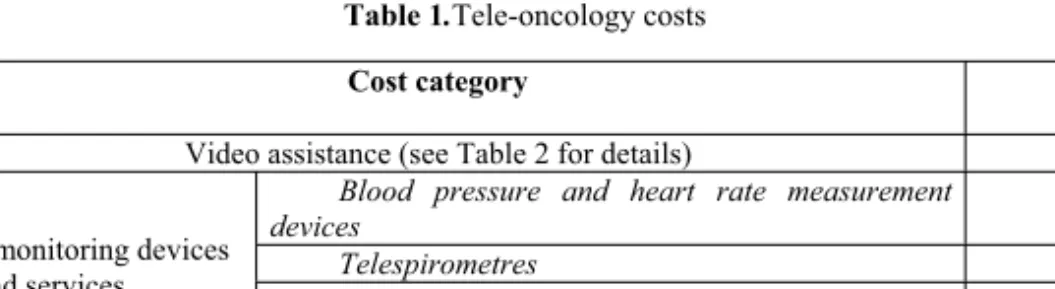
The cost of telephone traffic refers only to the video connection for monitoring the services perceived by each individual patient. Using the average daily hospitalization cost per patient (ie €465), the total hospitalization cost for this option is €1,092.
Blurring the line between control and social learning evaluation: Technology for paperless healthcare
The results of a randomly selected sample of patients who participated in the study are listed in Table 11. Characteristics of the sample of patients who participated in the study, before and after the technological innovation.

Theoretical models of consumer acceptance
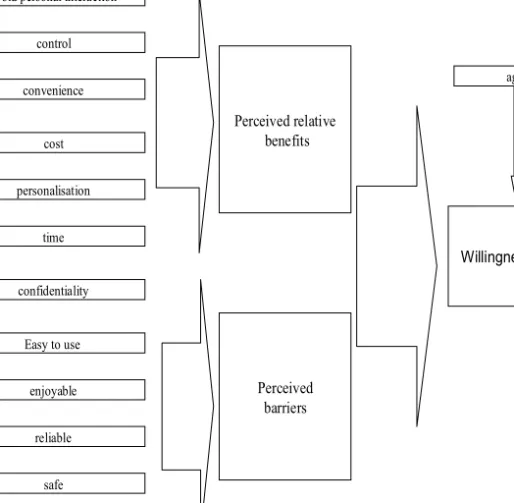
Thus, a number of extensions have been proposed to help explain an individual's use of the Web. An individual's decision whether to use technology is based on perceptions of technology such as relative advantage, compatibility, complexity, testability, and observability.
Importance of service quality
This is of particular importance in the current study as it is anticipated that individuals may find it difficult to assess the service quality of e-government services due to unfamiliarity with an e-delivery method. It is not difficult to imagine that the shift to a 'bottom-line' focus could affect citizen focus and the quality of e-government services.
Discussion
On the one hand, more pressure is being put on the local authorities to link e-government activity to the public service agreements of the state treasury'. The central government is now signaling that it wants a serious return on its e-government investment”.
Methodology
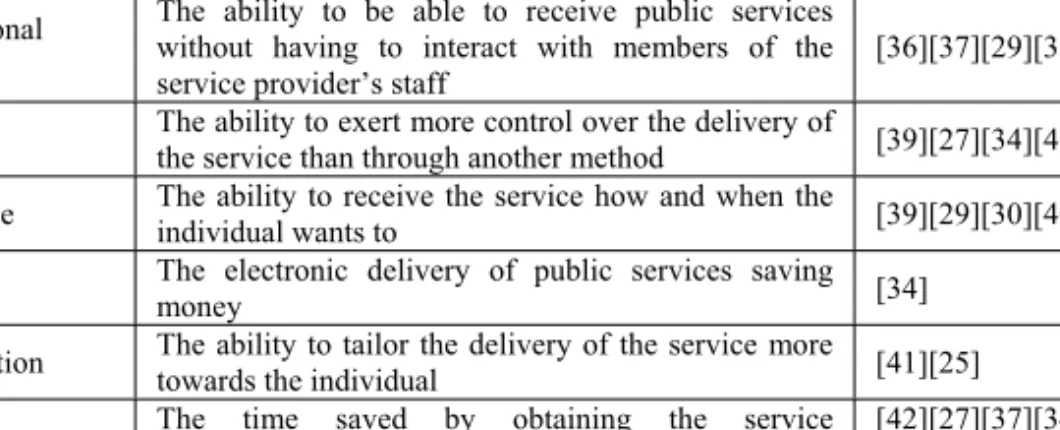
The ability to receive public services without having to interact with service provider staff members. The resulting questionnaire was then discussed in a focus group which included representatives of the wider Guildford public.
Analysis and Results
Although the nature of the data is ordinal (use of the Likert scale for each statement considered in isolation), the use of parametric tests is justified in accordance with previous research, as the underlying scale for each construct is continuous [48] . The repression result indicates that the linear combination of the factors is related to the willingness to use the online option, accounting for approximately 32% of the online options.
Discussion and conclusion