What are the necessary qualities that the institution must promote in order to move in the direction of democratization of the economy. The first question: "What are the necessary qualities that an institution must promote in order to move towards the democratization of the economy?" business. The Public and Its Problems by John Dewey addresses the state of American society in the post-Depression economy.
This state has increasingly created economic, social and political systems that are less responsive to the needs of the public. In his words, "communication alone can create a large community," the large community being a public better able to meet its needs (142). This is possible only through public association that requires the dissemination of knowledge, the recognition of specific consequences that affect the public.
A final key element for a healthy democracy in the face of technological progress is an attentive public (this concept is very similar to Dewey's notion of the public and the larger community). The history of the modern corporation illuminated how these economic institutions developed alongside the industrialization, specialization, and political environment of the 1900s. Gibson-Graham also blames the melancholia of the left for undermining the non-capitalist future.
In the same way that feminists fought "the ways of being in the world that we almost never think about", Gibson-Graham attempts to reconstruct economic thought (128). The economy is not a machine, but “the processes we all engage in as we go about securing what we need to function materially (Take Back the Economy 8). In The Public and Its Problems, Dewey emphasizes the need for public association to demand knowledge of the specific effects that affect it, since "Communication can alone create a great community" (142).
The Democratic Economy
Every political state is therefore an organization of the public carried out by officials to protect the interests shared by its members. From this we can derive Dewey's thesis about the nature of the public: “Those who are indirectly and seriously affected for good or for evil form a group sufficiently distinctive to need recognition and name. It seeks to solve the essential problem of government: what arrangements will prevent the rules from asserting their own interests at the expense of the governed.
By what political means shall we unite the interests of the governors with the governed (93). By examining the Deweyan conception of the democratic economy, I attempt to answer these questions and others. Then I will address how the concept of the democratic economy can be applied in practice.
Our economy is part of the spread of external effects that unite the public and encourage the emergence of a political state. Democracy and the economy have a two-way relationship, where our political institutions manage economic activity in reflection of the public interest and the economy. Just as GDP is a useful measure of a country's economic activity but does not capture small segments of the economy such as gifts and barter, the skills and knowledge that make up human capital capture all but a few small segments of human growth.
As much as practical skills and knowledge, communication is an economic concern for those in and out of the workforce. I feel it is important to note here that democratic economics does not ask for the avoidance of traditional economic goals, but simply the consideration of the human implications naturally attached to them. With the concept of the democratic economy, I will aim to make more clear the mechanisms through which these principles can be applied to the economy.
Since the principles of a democratic economy are set as a political goal, the question arises, "how an individual company can influence changes in the direction of this goal." Institutions are manifestations of the habits of the public and the codification of rules that the public formulates to regulate individual actions. Although these are only a few examples, the number of companies that make up this space is considerable, as shown in Figure 1.1, a sample of companies operating in the transport sector.
The Democratic Economy in Demographics, Wages, and Dynamic Pricing
Conclusions will be drawn from the comparative results of the size and quantity of the differences. The taxi industry also shows a greater representation rate of over 0.1% in 9 out of the 20 demographic categories. Uber's percentage of employees aged 18-29 and 30-39 was 10 percentage points greater than their taxi counterparts, and nearly 15 fewer aged 50-64.
In the area of education, Uber employed far more college-educated drivers, but fewer with only a high school education, than the taxi industry. It offers small increases in representation for those with children at home compared to the total workforce, but in demographic groups outside of the young, white, and well-educated, the taxi industry has higher employment rates. Data for Uber Driver-Partners was obtained from 18 of the 20 markets examined in the Benenson Survey Group survey.
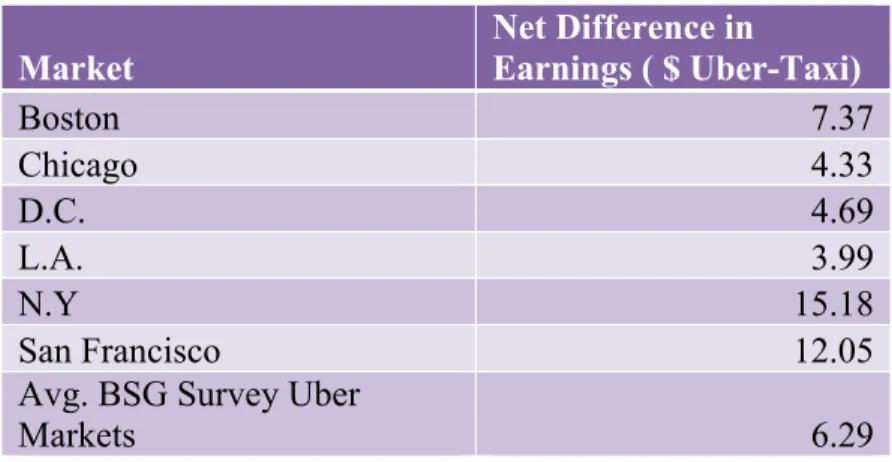
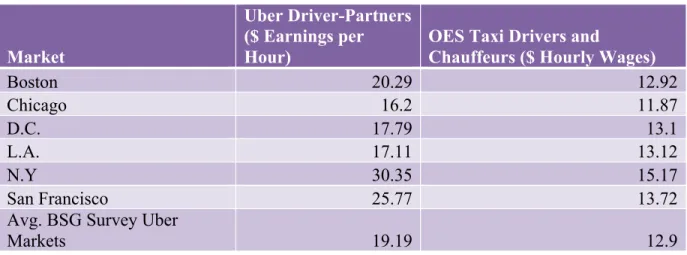
In the highlighted markets and the average of all markets, Uber drivers earn higher wages than their taxi driver counterparts. In fact, in 16 out of 18 total markets, Uber driver's hourly earnings exceeded taxi driver's hourly wages. Although the earnings for Uber drivers are net of the fee's Uber consumption, Uber drivers are not reimbursed for driving costs, such as gas, maintenance and cellular data.
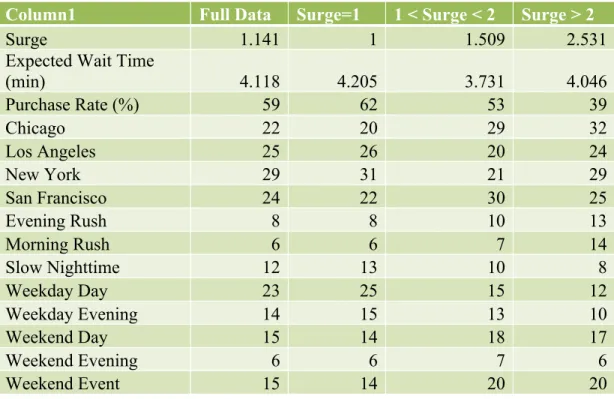
This data set consists of all Uber sessions from January 1-27, 2015 (excluding approximately 11.5% of sampled sessions) that received surge pricing controls in emergency and other scenarios, counting approximately individual sessions . As high prices are a unique feature of Uber services, this data set will not be analyzed against a similar metric from the taxi industry. Instead, these data will be used descriptively to examine the relationship between price increases and consumers' transportation purchase decisions, as measured by purchase rate.
One obvious thing here is that an increase in surge pricing leads to a decrease in the percentage of people who complete the purchase transaction. Consumers are able to actively see prices as they change, and are better able to make decisions about whether their trip is worth the expense; this is reflected in declining acquisition rates as growth multipliers increase. The conclusion of this analysis is that Uber makes at least moderate steps towards democratizing the economy.
Characterizing the Uber Experience Through Interviews In this chapter, I will use interviews of Uber drivers, Uber consumers, policy
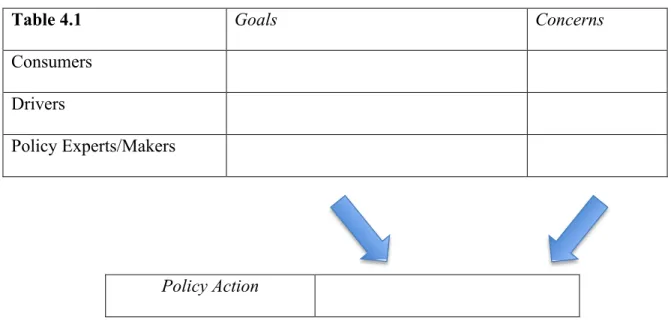
The ultimate task of the framework is then to use these goals to identify specific and actionable policy decisions. The whole process was also generally considered "more efficient" given the removal of the need to give directions or tips (Revord). At the other end of the spectrum, one respondent did not consider surge pricing in his decision until it hit 4x (Revord).
Uber consumers, at least in the 18-29 demographic, generally appreciate the cleanliness and service provided by Uber drivers, as well as the simple convenience of the app itself. In addition, while these consumers generally do not consider star ratings in driving decisions, they are sensitive to price changes such as Uber's dynamic price escalation system. Each of the interviewees had at least one year of experience driving for Uber, with the Chicago driver driving the longest at three years.
When asked, "why not?" The responses focused on the fact that they found it much easier to sign up for Uber compared to signing up to be a taxi driver. They informed me that according to Uber's community guidelines, there is a minimum star rating that each driver must maintain in order not to be removed from the service. Mayor Patterson presided over the city when Uber was first introduced to the city of Oxford and was responsible for municipal regulations and industry taxation, at a time when Uber's operation was a controversial issue.
Hall's view appeared to be influenced by the different experiences Uber has had in different areas of the country. This lack of alignment has led to numerous problems in the New York Uber market. In California, regulators have come to approve more flexible insurance plans and have consolidated licensing and background checks into the responsibility of the company that employs the drivers (Hall).
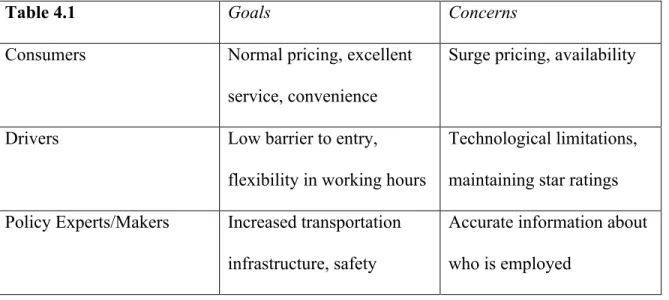
Mayor Pat Patterson's views are based on his experience with Uber's new operations in his city. The dichotomy in the goal here is to keep the barriers to entry low while ensuring that we can also keep drivers insured and consumers safe. The moves by the Mississippi Legislature to circumvent all municipal regulations were excessive, instead a slightly more collaborative approach is needed between Uber and municipalities that: create flexible insurance programs for drivers, reduce licensing requirements for Uber drivers and for.
Moving Forward
Additionally, Uber's surge pricing model proved to be effective in distributing rides to areas of greatest demand, allowing consumers and drivers to make more efficient decisions. Given its qualification in two of the three datasets, I concluded that Uber actually exhibited quite a few of these qualities needed to democratize the economy. The final question addressed was: "Should we make regulatory changes and to what extent to facilitate Uber's operation and expansion?".
In answering this question, I used interviews with Uber drivers, consumers, policymakers, and policy experts to characterize their experiences with Uber. From there, the benefits interviewees received from Uber were used as targets to focus on in the regulatory process. This framework and the insights of policymakers and experts have led to three policy recommendations.
Provide flexible insurance plans, keep licensing requirements relaxed and give municipalities access to the identity of drivers in their local area. John Dewey's theory of democracy and its relevance to the study of economic and social phenomena.