Journal of Genetic Engineering and Biotechnology
Editor-in-Chief: Mahmoud Saker View Editorial Board
Submit Your Paper Open Access View Articles Guide for Authors Abstracting/ Indexing Track Your Paper Journal Metrics
CiteScore: 1.58 ℹ
Source Normalized Impact per Paper (SNIP): 0.993 ℹ
SCImago Journal Rank (SJR): 0.375 ℹ
View More on Journal Insights Your Research Data
Share your research data
Visualize your data Society Links
Related Links
Author Stats ℹ
Researcher Academy
Author Services
Try out personalized alert features
Production and Hosting by Elsevier B.V. on behalf of Academy of Scientific Research and Technology
Peer Review under the responsibility of the National Research Center
Journal of Genetic Engineering and Biotechnology is devoted to rapid publication of full-length research papers that lead to significant contribution in advancing knowledge in genetic
engineering and biotechnology and provide novel perspectives in this research area. JGEB includes all major themes related to genetic engineering and recombinant DNA.
The areas of interest of JGEB include but not restricted to:
• Plant genetics,
• Animal genetics,
• Bacterial enzymes,
• Agricultural Biotechnology,
• Biochemistry,
• Biophysics,
• Bioinformatics,
• Environmental Biotechnology,
• Industrial Biotechnology,
• Microbial biotechnology,
• Medical Biotechnology,
• Bioenergy,
• Biosafety,
• Biosecurity,
• Bioethics,
• GMOS,
• Genomics,
• Proteomics
JGEB accepts research papers, short communications, reviews and mini-reviews.
Journal of Genetic Engineering and Biotechnology
Editorial Board
Editor-in-Chief Mahmoud Saker
Academy of Scientifc Research and Technology, National Research Center, Egypt Deputy Editor
Sameh Soror
Dept. of Genetic & Biotechnology, Helwan University, Cairo, Egypt Associate Editors
Yasser Abdel Fattah
City of Scientific Research and Technological Applications (SRTA-City), Egypt Nabila Abdel Maksoud
National Research Center, Egypt Desouky Abd-El-Haleem
City of Scientific Research and Technological Applications (SRTA-City), Egypt Adel Abolesoud
The Agricultural Research Center, Egypt Ahlam Abou Mossallam
National Research Center, Egypt Mai Allam
National Research Center, Egypt Shireen Assem
Agricultural Genetic Engineering Research Institute, Egypt Abdel Fattah Badr
Helwan University, Egypt Mahmoud Bahgat
National Research Center, Egypt Danila Carbonara
Università degli Studi di Pavia, Italy Sherif El-Khamisy
Zewail City of Science and Technology, Egypt Ahmed Gaballa
Cornell University, USA Yehia Zakaria Gad
National Research Center, Egypt Reda Gafaar
Tanta University, Egypt Hassan Ghareeb
National Research Center, Egypt Anil Grover
University of Delhi South Campus, India
Nada Hamza
Commission of Genetic Engineering & Biotechnology, Sudan Moemen Hanafy
National Research Center, Egypt Harrison Hughes
Colorado State University, USA Yehia Mahumoud
Tanta University, Egypt Hanan Malkawi
Hamdan Bin Mohammed Smart University, United Arab Emirates Osman El-Mahdy Osman
National Research Center, Egypt Mohamed Rady
National Research Center, Egypt Hala Ragab
National Research Center, Egypt Ewald Schnug
Julius Kühn-Institut, Germany Mohamed Shaba
Colorado State University, USA Michel Smith
Kansas State University, USA
Volume 16, Issue 2
Pages 239-776 (December 2018) Microbial/industrial Biotechnology Review article Open access
Quorum sensing intervened bacterial signaling: Pursuit of its cognizance and repression Kayeen Vadakkan, Abbas Alam Choudhury, Ramya Gunasekaran, Janarthanam Hemapriya, Selvaraj Vijayanand
Pages 239-252
Short communicationOpen access
Phylogenetic diversity and biotechnological potentials of marine bacteria from continental slope of eastern Arabian Sea
Arakkaveettil Kabeer Farha, Thasneem TR, Aswathy Purushothaman, Jaseetha Abdul Salam, Abdulla Mohamed Hatha
Pages 253-258
Research article Open access
Valorisation of chicken feathers for xanthan gum production using Xanthomonas campestris MO-03
Murat Ozdal, Esabi Basaran Kurbanoglu Pages 259-263
Research article Open access
Biolytic extraction of poly(3-hydroxybutyrate) from Bacillus megaterium Ti3 using the lytic enzyme of Streptomyces albus Tia1
Neetu Israni, Surabhi Thapa, Srividya Shivakumar Pages 265-271
Research article Open access
Purification and characterization of alkaline soda-bleach stable protease from Bacillus sp. APP- 07 isolated from Laundromat soil
I.K. Shaikh, P.P. Dixit, T.M. Shaikh Pages 273-279
Research article Open access
Improvement of cellulose degradation by cloning of endo-β-1, 3-1, 4 glucanase (bgls) gene from Bacillus subtilis BTN7A strain
Wafaa K. Hegazy, Mohamed S. Abdel-Salam, Azhar A. Hussain, Hoda H. Abo-Ghalia, Safa S.
Hafez
Pages 281-285
Research articleOpen access
Antibacterial activity of soil bacteria isolated from Kochi, India and their molecular identification
Davis Gislin, Dorairaj Sudarsanam, Gnanaprakasam Antony Raj, Kathirvelu Baskar
Pages 287-294
Research article Open access
Purification and characterization of alkaline protease with novel properties from Bacillus cereus strain S8
B.K.M Lakshmi, D. Muni Kumar, K.P.J Hemalatha Pages 295-304
Research article Open access
Enhancement of nematicidal potential through cloning and expression of chitinase gene from Bacillus subtilis subsp. Subtilis BTN7A strain
Mohamed S. Abdel-Salam, Hoda H. Ameen, Abdallah S.M. Kassab, Ahmed E.A. Mahgoob, Usama S. Elkelany
Pages 305-310
Research article Open access
Biodegradation of feather waste by keratinase produced from newly isolated Bacillus licheniformis ALW1
Azza M. Abdel-Fattah, Mamdouh S. El-Gamal, Siham A. Ismail, Mohamed A. Emran, Amal M.
Hashem Pages 311-318
Research article Open access
Study on the potential of cold-active lipases from psychrotrophic fungi for detergent formulation Sanjay Sahay, Deepak Chouhan
Pages 319-325
Research article Open access
Optimization of novel halophilic lipase production by Fusarium solani strain NFCCL 4084 using palm oil mill effluent
Kiptoo Geoffry, Rajeshwara N. Achur Pages 327-334
Research article Open access
Cloning and expression of MPT83 gene from Mycobacterium tuberculosis in E. coli BL21 as vaccine candidate of tuberculosis: A preliminary study
Ahyar Ahmad, Rosana Agus, Muh. Nasrum Massi, Rosdiana Natzir, ... Masugi Maruyama Pages 335-340
Research article Open access
Immobilization of thermostable exo-inulinase from mutant thermophilic Aspergillus tamarii-U4 using kaolin clay and its application in inulin hydrolysis
Emmanuel O. Garuba, Abiodun, A. Onilude Pages 341-346
Research article Open access
High level expression and purification of recombinant flounder growth hormone in E. coli Tae-Jin Choi, Temesgen Tola Geletu
Pages 347-355
Research article Open access
Screening of potential probiotic lactic acid bacteria and production of amylase and its partial purification
Tallapragada Padmavathi, Rayavarapu Bhargavi, Purushothama Rao Priyanka, Naige Ranganath Niranjan, Pogakul Veerabhadrappa Pavitra
Pages 357-362
Research article Open access
Partial purification and characterization of exoinulinase produced from Bacillus sp.
R. Ramapriya, A. Thirumurugan, T. Sathishkumar, D.R. Manimaran Pages 363-367
Research article Open access
Effect of vitamins and cell constructions on the activity of microbial fuel cell battery Dena Z. Khater, K.M. El-Khatib, Rabeay Y.A. Hassan
Pages 369-373
Research article Open access
Decolorization of Textile Reactive Dyes by Bacterial Monoculture and Consortium Screened from Textile Dyeing Effluent
Md. Ekramul Karim, Kartik Dhar, Md. Towhid Hossain Pages 375-380
Research article Open access
Optimization of quorum quenching mediated bacterial attenuation of Solanum torvum root extract by response surface modelling through Box-Behnken approach
Kayeen Vadakkan, Selvaraj Vijayanand, Abbas Alam Choudhury, Ramya Gunasekaran, Janarthanam Hemapriya
Pages 381-386
Research article Open access
Isolation and characterization of Bacillus sp. strain BC01 from soil displaying potent antagonistic activity against plant and fish pathogenic fungi and bacteria
Md Javed Foysal, Asura Khanam Lisa Pages 387-392
Research article Open access
Expression of Leptospira membrane proteins Signal Peptidase (SP) and Leptospira Endostatin like A (Len A) in BL-21(DE3) is toxic to the host cells
Padikara K. Satheeshkumar, Prasannan V. Anu, Mohmed I. Junaida, Madathiparambil G.
Madanan, ... Perumana R. Sudhakaran
Pages 393-398
Research article Open access
Scenedesmus obliquus: Antioxidant and antiviral activity of proteins hydrolyzed by three enzymes
Abd El-Moneim M.R. Afify, Gamal S. El Baroty, Farouk K. El Baz, Hanaa H. Abd El Baky, Soha A. Murad
Pages 399-408
Research article Open access
Statistical optimization of crude oil bio-degradation by a local marine bacterium isolate Pseudomonas sp. sp48
Soha Farag, Nadia A. Soliman, Yasser R. Abdel-Fattah Pages 409-420
Research article Open access
Influence of bioprocess variables on the production of extracellular chitinase under submerged fermentation by Streptomyces pratensis strain KLSL55
A. Shivalee, K. Lingappa, Divatar Mahesh Pages 421-426
Review article Open access
Recent advances in stem cells therapy: A focus on cancer, Parkinson’s and Alzheimer’s
Dalia Fleifel, Mai Atef Rahmoon, Abdelrahman AlOkda, Mostafa Nasr, ... Sherif F. El-Khamisy Pages 427-432
Research article Open access
In vitro differentiation of human multilineage differentiating stress-enduring (Muse) cells into insulin producing cells
Ali M. Fouad, Mahmoud M. Gabr, Elsayed K. Abdelhady, Mahmoud M. Zakaria, ... Ayman F.
Refaie
Pages 433-440
Research articleOpen access
Development and evaluation of latex agglutination test coating with recombinant antigen, LipL32 for serodiagnosis of human leptospirosis
Kotchakorn Thongsukkaeng, Rerngwit Boonyom Pages 441-446
Research article Open access
PNME – A gene-gene parallel network module extraction method Bikash Jaiswal, Kumar Utkarsh, D.K. Bhattacharyya
Pages 447-457
Research article Open access
Expression, purification and biological characterisation of recombinant human irisin (12.5 kDa) Kalpana Panati, Venkata Ramireddy Narala, Vydyanath R. Narasimha, Madhavi Derangula, ...
Suneetha Yeguvapalli
Pages 459-466
Research article Open access
Increased level of B cell differentiation factor in systemic lupus erythematosus patients Hala Zaki Raslan, Hiba Sibaii, Salwa Refat El- Zayat, Hagar Hassan, Mahitab El- Kassaby Pages 467-471
Research article Open access
Healthcare-associated (HA) and community-associated (CA) methicillin resistant Staphylococcus aureus (MRSA) in Bangladesh – Source, diagnosis and treatment
Md. Anowar Khasru Parvez, Rabeya Nahar Ferdous, Md. Shahedur Rahman, Sohidul Islam Pages 473-478
Research article Open access
Assessment of Ki-67 as a potential biomarker in patients with breast cancer
Halla Mohamed Ragab, Nervana Samy, Mie Afify, Nabila Abd El Maksoud, HebatAllah Mohamed Shaaban
Pages 479-484
Research article Open access
Kolaviron and selenium reduce hydrogen peroxide-induced alterations of the inflammatory response
Tebekeme Okoko Pages 485-490
Animal Biotechnology Research article Open access
Feline panleukopenia viral infection in cats: Application of some molecular methods used for its diagnosis
Romane A. Awad, Wagdy K.B. Khalil, Ashraf G. Attallah Pages 491-497
Research article Open access
Buffalo species identification and delineation using genetic barcoding markers
Amal Ahmed Mohamed Hassan, Esraa Aly Balabel, Hanaa Abdel Sadek Oraby, Samy Anwar Darwish
Pages 499-505
Research article Open access
Detection of myostatin gene MSTN in some goat breeds (Capra hircus) Y.A. Dowidar, M.A. El-Sayed, Aly M. Elrefy, Hytham E. Shoura Pages 507-512
Research article Open access
Five BoLA-DRB3 genotypes detected in Egyptian buffalo infected with Foot and Mouth disease virus serotype O
Othman E. Othman, Muhammad G. Khodary, Ayman H. El-Deeb, Hussein A. Hussein Pages 513-518
Research article Open access
Cytogenetic effects of silver and gold nanoparticles on Allium cepa roots
Priyanka Debnath, Arghadip Mondal, Amita Hajra, Chittaranjan Das, Naba Kumar Mondal Pages 519-526
Research article Open access
Synthesis of silver nanoparticles by Bacillus clausii and computational profiling of nitrate reductase enzyme involved in production
Koel Mukherjee, Rashmi Gupta, Gourav Kumar, Sarita Kumari, ... Padmini Padmanabhan Pages 527-536
Plant Biotechnology Review article Open access
Transgenic approaches for genetic improvement in groundnut (Arachis hypogaea L.) against major biotic and abiotic stress factors
Saikat Gantait, Suvendu Mondal Pages 537-544
Review article Open access
In vitro biotechnological advancements in Malabar nut (Adhatoda vasica Nees): Achievements, status and prospects
Saikat Gantait, Jitendriya Panigrahi Pages 545-552
Review article Open access
Elevated carotenoids in staple crops: The biosynthesis, challenges and measures for target delivery
Adebanjo Ayobamidele Badejo Pages 553-562
Review article Open access
In vitro culture, transformation and genetic fidelity of Milk Thistle M.R. Rady, M.M. Saker, M.A. Matter
Pages 563-572
Research article Open access
Cloning, transformation and expression of cell cycle-associated protein kinase OsWee1 in indica rice (Oryza sativa L.)
Frengky H.H. Prasetyo, Bambang Sugiharto, Netty Ermawati
Pages 573-579
Research article Open access
Optimization of indole acetic acid production by isolated bacteria from Stevia rebaudiana rhizosphere and its effects on plant growth
Sheela Chandra, Kazim Askari, Madhumita Kumari Pages 581-586
Research article Open access
Plant regeneration, developmental pattern and genetic fidelity of somatic embryogenesis derived Musa spp.
Natarajan Nandhakumar, Krish Kumar, Duraialagaraja Sudhakar, K. Soorianathasundaram Pages 587-598
Research article Open access
Population structure, morphological and genetic diversity within and among melon (Cucumis melo L.) landraces in Iran
Masoud Maleki, Abdolali Shojaeiyan, Sajad Rashidi Monfared Pages 599-606
Research article Open access
Influence of cold pretreatment on shoot regeneration from callus in date palm (Phoenix dactylifera L.) cv. ‘Barhee’
Ahmed Madi Waheed Al-Mayahi, Abdulminam Hussien Ali, Hussein J. Shareef Pages 607-612
Research article Open access
Screening of plant growth promoting traits in heavy metals resistant bacteria: Prospects in phytoremediation
N. Tirry, N. Tahri Joutey, H. Sayel, A. Kouchou, ... N. El Ghachtouli Pages 613-619
Research article Open access
Phytochemical analysis, antioxidant and antimicrobial activity of wild and in vitro derived plants of Ceropegia thwaitesii Hook – An endemic species from Western Ghats, India
S. Muthukrishnan, T. Senthil Kumar, A. Gangaprasad, F. Maggi, M.V. Rao Pages 621-630
Research article Open access
Molecular diversity of internal transcribed spacer among the monoconidial isolates of Magnaporthe oryzae isolated from rice in Southern Karnataka, India
D. Jagadeesh, M.K. Prasanna Kumar, R. Chandrakanth, N.S. Devaki Pages 631-638
Research articleOpen access
Production of biomass and flavonoid of Gynura procumbens (Lour.) Merr shoots culture in
temporary immersion system
Ayu Dewi Pramita, Alfinda Novi Kristanti, Sugiharto, Edy Setiti Wida Utami, Yosephine Sri Wulan Manuhara
Pages 639-643
Research article Open access
Callus mediated shoot organogenesis and regeneration of cytologically stable plants of Ledebouria revoluta: An ethnomedicinal plant with promising antimicrobial potency Sk Moquammel Haque, Avijit Chakraborty, Biswajit Ghosh
Pages 645-651
Research article Open access
Evaluation of the alleviative role of Chlorella vulgaris and Spirulina platensis extract against ovarian dysfunctions induced by monosodium glutamate in mice
Sekena H Abdel-Aziem, Heba A.M. Abd El-Kader, Faten M. Ibrahim, Hafiza A Sharaf, Aida I.
El makawy Pages 653-660
Research article Open access
Assessment of genetic diversity in Salvadora persica L. based on inter simple sequence repeat (ISSR) genetic marker
Mohammad Asadi Monfared, Davood Samsampour, Gholam Reza Sharifi-Sirchi, Fatemeh Sadeghi
Pages 661-667
Research article Open access
Micropropagation protocol for Antigonon leptopus an important ornamental and medicinal plant Zenna Fawzia Ghareeb, Lobna S. Taha
Pages 669-675
Research article Open access
Total phenolic and flavonoid contents and antioxidant activity of ginger (Zingiber officinale Rosc.) rhizome, callus and callus treated with some elicitors
Ammar Mohammed Ahmed Ali, Mawahib ElAmin Mohamed El-Nour, Sakina Mohamed Yagi Pages 677-682
Research article Open access
Physiological and molecular studies on the effect of gamma radiation in fenugreek (Trigonella foenum-graecum L.) plants
Rania Samy Hanafy, Samia Ageeb Akladious Pages 683-692
Research article Open access
Rice straw fermentation by Schizophyllum commune ARC-11 to produce high level of xylanase for its application in pre-bleaching
Archana Gautam, Amit Kumar, Amit Kumar Bharti, Dharm Dutt
Pages 693-701
Original Article
Cloning, transformation and expression of cell cycle-associated protein kinase OsWee1 in indica rice (Oryza sativa L.)
Frengky H.H. Prasetyo
a, Bambang Sugiharto
b, Netty Ermawati
c,⇑aGraduate School of Biotechnology Department, Jember University, JL. Kalimantan 37 Kampus Tegalboto, Jember 68121, Indonesia
bCenter for Development of Advanced Sciences and Technology, and Department of Biology, Faculty of Mathematic and Natural Sciences, Jember University, JL. Kalimantan 37 Kampus Tegalboto, Jember 68121, Indonesia
cDepartment of Agricultural Production, and Central Laboratory for Biosciences, State Polytechnic of Jember, JL. Mastrip PO Box 164, Jember 68120, Indonesia
a r t i c l e i n f o
Article history:
Received 1 June 2018
Received in revised form 23 September 2018
Accepted 1 October 2018 Available online 7 December 2018
Keywords:
Agrobacterium Cell cycle
Gene transformation OsWee1
Protein kinase Transgenic rice
a b s t r a c t
The development process of seed in plants is a cycle of cells which occur gradually and regularly. One of the genes involved in controling this stage is theWee1gene.Wee1encode protein kinase which plays an important role in phosphorylation, inactivation of cyclin-dependent kinase 1 (CDK1)-cyclin (CYC) and inhibiting cell division at mitotic phase. The Overexpression ofWee1leads to delaying entry into mitotic phase, resulting in enlargement of cell size due to suppression of cell division. Accordingly, the cloning and overexpressing ofWee1in rice plant is important aim of this research in achieving better quantity and quality of future rice. The main objective of this present study is to cloning and generate transgenic rice plants overexpressing ofWee1gene.Wee1was isolated from cDNA of indica rice (Oryza sativa), called OsWee1. The full length ofOsWee1was 1239 bp in size and successfully inserted into plant expression vector pRI101ON. Seven-day-old rice seedlings were prepared for transformation ofOsWee1gene using Agrobacterium-mediated transformation method. Four positive transgenic lines were identified through the presence of kanamycin resistance gene (nptII) using genomic PCR analysis. Southern blot analysis result provides evidence that four independent rice transformants contained one to three rearranged transgene copies. Further screening in transgenic rice generation is needed in order to obtain stable expression ofOsWee1.
Ó2018 Production and hosting by Elsevier B.V. on behalf of Academy of Scientific Research & Technology.
This is an open access article under the CC BY-NC-ND license (http://creativecommons.org/licenses/by-nc- nd/4.0/).
1. Introduction
One of the parameters to increase the yield of rice is the seed sizes, which regulated by the seed development processes after pollination. The process is a part of cell cycle which occur gradually and regularly during its life cycle. The cycle is divided into four phases, the mitotic (M) phase which includes mitosis and cytokine- sis, G1 (first gap) phase, S (synthesis) phase, and G2 (second gap) phase. The cell develops larger in the G1 phase, then in S phase, cell replicates the chromosome inside the cell. Furthermore, the cell will continue its growth in G2 phase, and divided. The daughter cells can repeat the cycle[1]. The cell cycle progression is con- trolled at distinct checkpoints which major checkpoints are syn- thesis phase (G1-S checkpoint), mitosis (G2-M checkpoint) and the spindle checkpoint[2].
In eukaryotes, the cell cycle is controlled by family of conserved cyclin-dependent protein kinases (CDKs). The activity of CDK fluctu- ates regularly during the cell cycle, triggering important processes [3]. Phosphorylation and dephosphorylation of the CDK catalytic subunit, threonine 14 and tyrosine 15, are able to regulate and determine the timing of G2 and mitosis[4]. Previous study reported that phosphorylation of CDKs at tyrosine 15 inSchizosaccharomyces pombe is mediated byWee1, which causes a delay in mitosis by phosphorylating the M-phase promoting factor on tyrosine 15[5].
Wee1is a gene encoding protein kinase located in the nucleus.
The expression of this gene in plants is strongly induced by DNA damage which can be caused by radiation, ionization, chemicals and other stresses [6,7]. When DNA is damaged, ataxia- telangiectasia mutated (ATM) or ATM- and Rad3-related (ATR) kinases will be expressed depending on the genotoxic type of stress.
Futhermore, the ATM and ATR signals will phosphorylate and acti- vated Chk1 and further phosphorylates the Wee1. Activation of Chk1 caused cell cycle delay in G2-M phase by increasingWee1reg- ulation and decreasing regulation of phosphatase (Cdc25) which
https://doi.org/10.1016/j.jgeb.2018.10.003
1687-157X/Ó2018 Production and hosting by Elsevier B.V. on behalf of Academy of Scientific Research & Technology.
This is an open access article under the CC BY-NC-ND license (http://creativecommons.org/licenses/by-nc-nd/4.0/).
Peer review under responsibility of National Research Center, Egypt.
⇑ Corresponding author.
E-mail address:[email protected](N. Ermawati).
Contents lists available atScienceDirect
Journal of Genetic Engineering and Biotechnology
j o u r n a l h o m e p a g e : w w w . e l s e v i e r . c o m / l o c a t e / j g e b
dependent kinase (Cdc25) resulting in G2 phase arrest[8–10].
In fission yeast (S. pombe), loss of Wee1 activity causes unsuffi- cient growth cells early enter to mitosis phase and cytokinesis, therefore it causes cells to produce two abnormally small daughter cells [5,11]. However, increasing expression of Wee1 causes delayed entry into mitosis and increase in cell size, this indicates that the activity levels of Wee1 plays a role in ensuring the entry time of the mitotic phase and having strong effect on cell size [12]. Sun et al. [13] reported that expression of ZmWee1 was observed in endosperm tissue at 15 day after pollination, where this gene shows its role in endoreduplication in the endosperm and supposes to be a potential regulator of seed development.
The similar result was reported inWee1tomato[14]andAtWee1 from Arabidopsis [15], that the expression levels of Wee1 gene was found higher in the generative organs such as seed, fruit and flower compared to that the vegetative organs. In previous study, the expression of riceOsWee1was almost found in all the tissues;
roots, stem, tiller, flowers, leaves and seeds. The highly expression of riceOsWee1was found in 5 day after pollination of the seeds [16]. These results revealed that besides having an important role in seed developments,Wee1has also influence in the growth and developments of plants.
Considering the important role ofWee1in the development of seed, cloning and transformation of OsWee1 was conducted in order to have understanding of the superior potential ofOsWee1 overexpressing in rice. In this study, we present results ofOsWee1 cloning and overexpression of this gene in rice.
2. Materials and methods 2.1. Plant materials
The mature seeds of indica rice (cv. Mekongga) were used in this research. Dehulled seeds were sterilized with 70% ethanol for 2 min followed by 5.25% sodium hypochlorite for 10 min and then washing with sterile distilled water for 3–5 times. The steril- ized seeds were placed on MS basal salt media (Table 1) pH 5.8, supplemented with 3% (w/v) sucrose, 100 mg/L L-glutamine, 0.25% phytagel, and cultured under continuous light at ±22°C within a period of 7 days.
2.2. Plasmid construct
Cloning ofOsWee1consists of 2 steps, first step was cloning OsWee1into pGEMT easy vector (Promega), and the second was
(Fig. 1A). The amplification fragment ofOsWee1 was conducted from DNA recombinantpGEMT)OsWee1which obtained from pre- vious study[16]and deposited in GeneBank under Accession no.
KX758541. PCR analysis were performed using the following a set of primer containNdeIandBamHIsites (Table 2) overhang to ensure compatibility with pRI101ON vector. The fragment of OsWee1was amplified as follows PCR Core Kit (Roche) manufac- ture’s procedure, initial denaturation at 94°C for 2 min, each with 25 cycles of denaturation at 94°C for 15 sec, annealing at 57°C for 20 sec, extension at 72°C for 2 min, and a final extension at 72°C for 7 min. Fragment obtained was then purified using GeneAll ExpintmCombo GP and quantified using nanodrop (NanoVue Plus spectrophotometer, BioLab). The DNA fragment of OsWee1 was ligated into pRI101ON and the recombinant pRI101ON)OsWee1 was then transformed into E. coli XL10 gold competent cells through heat shock method[15].
2.3. Flanking analysis of OsWee1
A recombinant ofpRI101ON)OsWee1was amplified and confirm the correct size by digestion usingHindIII,EcoRI,NdeIandBamHI restriction enzymes (NEBr Inc.). The flanking frame ofOsWee1in pRI101ON was checked and analyzed using Sanger dideoxy sequencing technology (The 1st BASE, Malaysia). The sequence was then analyzed using BLAST (www.ncbi.nlm.nih.gov/blast).
2.4. Transformation into Agrobacterium
DNA recombinant of pRI101ON)OsWee1was transferred into Agrobacteriumcells by heat shock method[17]. Aliquot of 100mL freshly prepared competent cells and 1mL of DNA recombinant were mixed, keep on ice for 5 min and chilled into liquid nitrogen.
Heat shock was immediately conducted by heated at 42°C in waterbath for 90 sec. Added 1 ml of YEP medium (10 g/L yeast extract, 10 g/L peptone, 5 g/L NaCl2) and gently shaked at 28°C for 1 h to allow bacteria and harboring DNA replication. Cultured bacteria was then collected by centrifuge at 5000 rpm for 3 min, colected pellet was disolved and spread on YEP agar medium sup- plement with 50 mg/L kanamycin, 100 mg/L rifampicin and 12.5 mg/L gentamicin. The bacteria cells were incubated at 28°C for 2 d and the colony grown was identified using PCR with several specific primers (Table 2).
2.5. Agrobacterium-mediated transformation and putative rice transformants selection
The Agrobacterium harboring the binary construct pRI101ON)OsWee1was inoculated in YEP medium supplemented with 100 mg/L rifampicin, 12.5 mg/L gentamicin and 50 mg/L kana- mycin, then incubate at 28°C by gently shake at 110 rpm for 48 h.
The growth ofAgrobacteriumwas checked for its optical density by spectrophotometer (OD600nm= 0.3). Seven-day-old rice seedlings were soaked in theAgrobacteriumsuspension for 20 min. To reduce the growth of excessive bacteria, the infected seedlings were dried using sterilized filter papers for 5 min. The infected seedlings were grown into co-cultivation medium (MS basal salt (Table 1), 3%
sucrose, 100 mg/L acetosyringone, 0.3% phytagel; pH 5.2) and incu- bated for 2 d in the dark condition. The co-cultivated rice seedlings were thoroughly washed with 500 mg/L cefotaxime followed by sterilized water for three times. Furthermore, the seedlings were cultured on selection medium (MS basal salt, 3% sucrose, 0.25%
phytagel, 50 mg/L kanamycin and 250 mg/L cefotaxime; pH 5.8) under a 16/8-h (day/night) light cycle at 22°C and periodically sub-cultured every 4 weeks into fresh media. The screening Table 1
MS basal salt media content (in mg/L media).
Components mg/L
NH4NO3 1650.0
KNO3 1900.0
MgSO47H2O 370.0
MnSO44H2O 22.3
ZnSO4 10.6
CuSO45H2O 0.025
CaCl2H2O 440.0
KI 0.83
CoCl26H2O 0.025
KH2PO4 170.0
H3BO3 6.2
Na2MoO42H2O 0.25
FeSO47H2O 27.85
Na2EDTA2H2O 37.25
Nicotinic acid 0.5
Pyridoxine HCl 0.5
Thiamine HCl 1.0
Glycine 2.0
putative transformants were conducted by screening of rice explants on the selection media containing 50 mg/L kanamycin.
2.6. Molecular analysis of putative transformed plants by PCR and Southern blotting
Genomic DNA was isolated from 4 g of leaves ofwildtypeand putative transformants rice[18]with minor modification. To con- firm the presence of transgene, the putative transformants and non-transformant rice samples were analyzed by PCR analysis using nptII-F and nptII-R primers (Tabel 2). About 50–100 ng of total genomic DNA from independent putative transformant lines and non-transformant were mixed with 50
l
l of reaction mix (KAPA Taq Extra HotStart ReadyMix) and subjected for PCR analy- sis under pre-denaturation condition at 95°C for 3 min, followed by 30 cycles at 95°C for 30 sec, 58°C for 30 sec, 72°C for 1 min and a final extension at 72°C for 5 min. The results were visualized by loading on 1% (w/v) agarose gel electrophoresis.Southern blot analysis was performed by method previously described[19]. Twenty
l
g of the genomic DNA was digested with the restriction enzymesBamHI(Promega) at 37°C overnight. The digested DNA was separated on a 1% agarose gel and shifted to an Amersham Hybond N+ membrane (GE Healthcare, UK) using capillary transfer. The membrane was hybridized with a DIG- labelled DNA probe (Roche, Germany) and incubated overnight at 42°C with gentle agitation. The DNA probe was prepared by ampli- fication ofpRI101ON)OsWee1by PCR using FNdeI and RBamHI pri- mers and the PCR product was then labelled with DIG. The processes of probe preparation and washing of the membrane to remove the unbound probe were performed according to the man- ufacturer’s instructions (Roche). Hybridization was visualized by exposing the membrane to X-ray (Fuji Film).2.7. RNA isolation and reverse transcriptase PCR (RT-PCR)
The total RNA was isolated from 100 mg of young leaves of putative transformant lines and non-transformant 30-day-old rice plants using RNAprep pure plant kit (Tiangen, Beijing). The first- strand cDNA was prepared from 1mg of total RNA using iScriptTM cDNA Synthesis Kit (BIO-RAD) according to the manufacturer’s instructions. The synthesized cDNA was then used as template to check the expression ofOsWee1using OsWee-F and OsWee-R pri- mers (Table 2). The RT-PCR conditions were 95°C for 3 min, fol- lowed by 25 cycles at 95°C for 30 sec, 56°C for 30 sec, 72°C for 1 min and a final extension at 72°C for 5 min. The primer pairs of OsActin (Table 2) was used to amplify the OsActin reference gene, at 95°C for 3 min, followed by 25 cycles at 95°C for 30 sec, 48°C for 30 sec, 72°C for 1 min and a final extension at 72°C for 5 min. The results were visualized by loading on 1% (w/v) agarose gel electrophoresis.
3. Results and discussion 3.1. Cloning of OsWee1
The cloning of full lengthOsWee1gene (1239 bp) in the expres- sion vector (pRI101-ON) was performed on theNdeI andBamHI restriction sites. Clone ofOsWee1that obtained in previous study [14] was amplified using a pair of FNdeI and RBamHI primers (Table 2) in order to add those restriction sites on the open reading frame (ORF) ofOsWee1before cloning. The construct ofOsWee1 gene in the expression vector was shown inFig. 1A. The construct ofOsWee1was then transformed intoE. colistrain XL10 gold com- petent cells and selected using antibiotic kanamycin on the growth media. To verify the positive clones, 20 recombinant colonies were randomly selected and prepared for the colony PCR analysis using FNdeI and RBamHI primers (Table 2). As shown inFig. 1B, the pres- ence of 1251 bp of OsWee1 gene was found in 12 clones which were confirmed by colony PCR and visualized on agarose gel. For further analysis, clone no. 7 was selected.
In order to evaluate the correct size and flanking of theOsWee1 clones, PCR analysis, restriction enzymes digestion and sequencing were performed. The PCR reaction was conducted using 4 pairs of primers, CaMV-F/RV-R, FNdeI/RBamHI, nptII-F/nptII-R, CaMV-F/
OsWee-R (Table 2). The PCR result showed that expected bands appear at the appropriate sizes, 1868 bp, 1251 bp, 524 bp and 1504 bp, respectively (Fig. 2A). Digestion was performed by single or combination of HindIII,BamHIand EcoRIrestriction enzymes.
Open reading frame ofOsWee1containsBamHIandEcoRIenzymes, Fig. 1.CloningOsWee1into expression vector pRI101ON. A. A Map of pRI101ON vector; B. Schematic representation ofpRI101ON)OsWee1construct; C. Colony PCR analysis ofOsWee1amplified using 146-FNdeI and 147-RBamHI primers.
Table 2
List of primers used in this study and corresponding sequences.
Primer name Sequence (50–30) GC content (%)
OsWee-F ATGGCACTTGGAATTAGTTGTGGTC 44.0
OsWee-R TTATCGTGGCAAACCAACTGAGG 47.8
FndeI GCCATATGGCACTTGGAATTAGTTGT 42.3
RBamHI GCGGATCCTTATCGTGGCAAACCAA 52.0
CaMV-F GAAGACGTTCCAACCACG 55.6
RV-F CAGGAAACAGCTATGACC 50.0
nptII-F GTCATCTCACCTTGCTCCTGCC 59.1
nptII-R GTCGCTTGGTCGGTCATTTCG 57.1
OsActin-F TCCATCTTGGCATCTCTCAG 50.0
OsActin-R GTACCCGCATCAGGCATC 61.1
clone was further conformed by sequencing (data not shown).
The correct band sizes of OsWee1after digestion was shown in Fig. 2B. The nucleotide sequence analysis showed a full length region ofOsWee1about 1239 bp and a 100% homolog with cDNA ofOsWee1in GeneBank (KX758541). It suggested that the desired recombinant pRI101ON)OsWee1 was successfully prepared to expressed inAgrobacterium.
3.2. Transformation of OsWee1 into Agrobacterium
The recombinant construct of pRI101ON)OsWee1 was trans- formed intoAgrobacteriumstrain GV3101 and selected on YEP solid medium supplemented with 50 mg/L kanamycin, 100 mg/L rifam- picin and 12.5 mg/L gentamicin antibiotic (Fig. 3A). Twelve colo- nies were randomly selected for PCR analysis using FNdeI and RBamHI primers and 4 positive clones harboring OsWee1 were obtained by PCR (Fig. 3B). This results clearly confirm that recom- binant pRI101ON)OsWee1 was transformed into Agrobacterium, and it can be used for transformation in rice.
The successful Agrobacterium-mediated transformation in rice has been achieved using various methods. However, in monocot plants remains limited because it is not a natural host forAgrobac- terium [20]. Many researchers have developed methods for Agrobacterium-mediated transformation in monocotyledons, especially in utilizing of different Agrobacteriumstrains [21,22], piercing method and vacum infiltration[23], choosing of different cultivars[24]and type of explants[25,26]. The basic protocol of Agrobacterium-mediated transformation [27] was develop for induction of callus derived from scutella seeds. However, since most of indica rice genotypes have less regeneration potential [28], we conducted Agrobacterium-mediated transformation in rice using 7-day-old rice sprouts as explants.
A hundred explants were infected byAgrobacteriumsuspension for 20 min and co-cultivation in dark condition for 2 d followed by cefotaxime-antibiotic treatment. Transformation was carried out twice with total 200 explants. However the percentage of rice transformation efficiency is very low (2%) (Table 3). Previous study reported[29]numerous factors that can improve transformation efficiency, was lighting condition, temperature, co-cultivation peri- ods and Agrobacterium-density during co-cultivation step. The most critical factor reported was the period of co-cultivation. The successful integration of target gene into the plant genome occurs mainly during co-cultivation. Sahoo and Tuteja [29] found that
followed by co-cultivation for 2 day. An extension of co- cultivation period, caused arising of excessive bacterial growth which results in inhibiting explants growth, reduce the number of shoots generation and finally causing death of explant. Rashid et al. [30] reported that to anticipate those problems, reducing the density of bacteria into 0.1 – 0.2 OD prevents overgrowth bac- teria during co-cultivation.
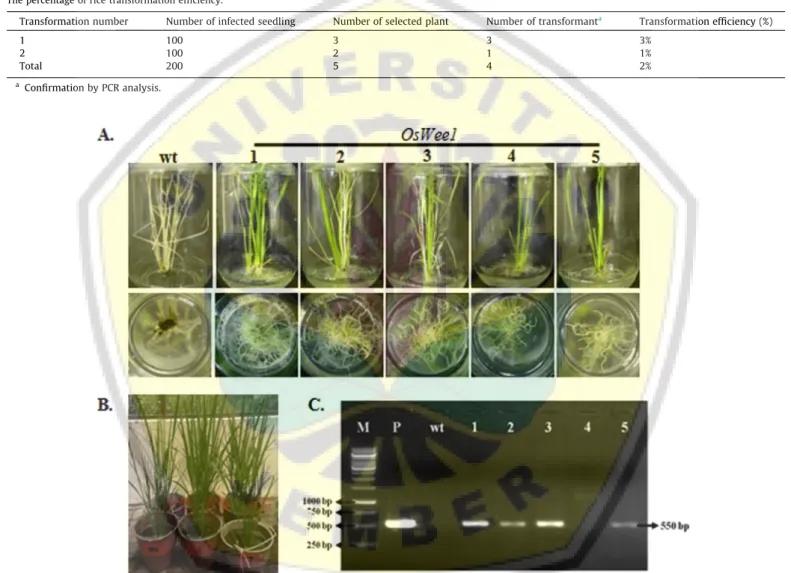
The co-cultivated explants were transferred in the selection medium, to inhibit the formation of non-transformant explants and eliminate the residual ofAgrobacterium. The first shoots pro- duced from the explants were subjected to three successive prop- agation cycles with the same level concentration of antibiotic. This method is applied to select putative transformants and reduce false positive transformants or eliminate the chimeric of transgenic explants [31]. After three sub-cultures, the non-transformant plantlet were turned into white (chlorosis), while the putative transformants were able to survive and grow normally (Fig. 4A).
The lacking ofnptIIgene in the non-transgenic plants caused inhib- ing of chlorophyll development and induce chlorosis at the shoot of rice plantlets. In contrast to the transgenic overexpressingOsWee1 showed normal green at the shoots. The absence ofnptIIgene will suppress the growth of non-transformant roots caused by unability of root to inactivated the kanamycin in the media (Fig. 4A). Similar results were also obtained in previous study[32]that increased concentration of kanamycin may lead to inhibition of root growth.
Kanamycin inhibits the synthesis of protein in plastid and mito- chondrial. Kanamycin acts as an inhibitor, active destroy the func- tion of ribosome following by inhibition of translational initiation.
Another way, the response was automatically inhibit protein syn- thesis and effects on reducing the growth and development of plants.
3.3. Expression of OsWee1 in rice
The putative transgenic plants which survived in selection in vitromedium were then transferred to soil and placed in the greenhouse under agronomic conditions (Fig. 4B). These plants were then analyzed for their transgenic status by PCR analysis.
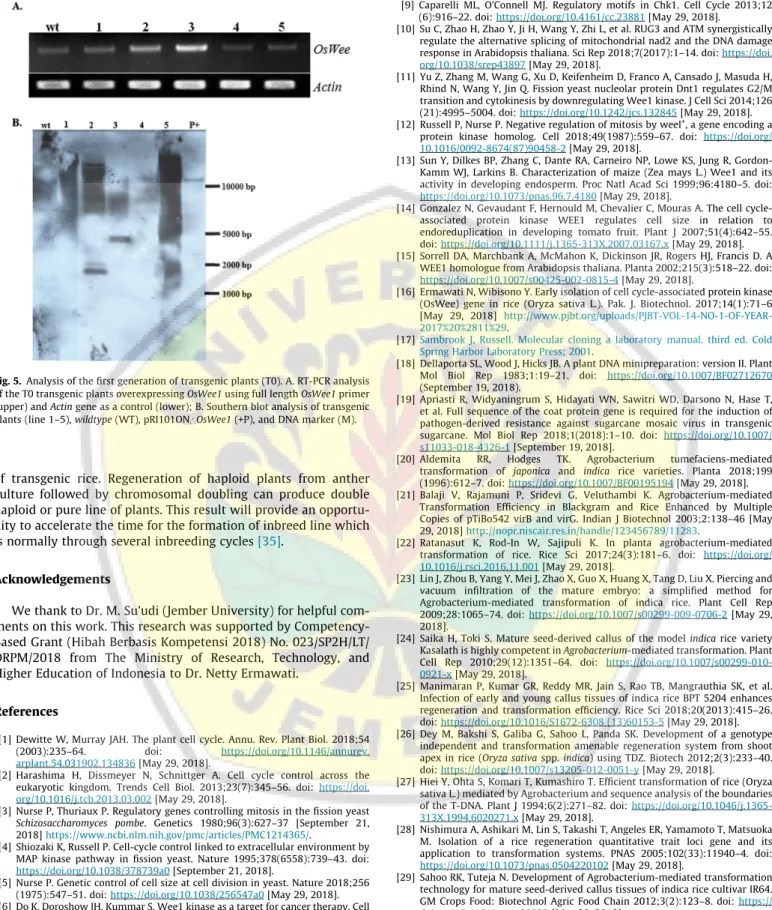
PCR analysis showed that thenptIIgene 550 bp in size was found in 4 of putative transgenic lines (Fig. 4C). To determine the expres- sion ofOsWee1at the RNA levels, we performed a RT-PCR analysis.
The quantity of RNA level is a reflection of the level of transcrip- tion. As shown inFig. 5A, the transcript levels of rice overexpress-
Fig. 2.Analyze of recombinantpRI101ON)OsWee1. A. PCR analysis of positive clones using several primers (M: 1 kb Tiangen Ladder, line 1–4: CaMV-F/RV-R primer, FndeI/
RBamHI primer, nptII primer, and CaMV-F/OsWee-R, respectively); B. Restriction digestion withHindIII(line 1),EcoRI/BamHI(line 2) andHindIII/BamHI(line 3).
ingOsWee1were higher compared to thewildtype. The data indi- cates thatOsWee1driven by CaMV35S was expressed in rice.
Southern blot analysis of transgenic rice was performed to prove integration of the transgene into the plant genome and to deter- mine copy number of the T-DNA. Southern blot analysis was con- ducted using a gDNA isolated from leaves of four transgenic rice lines. The Southern blot analysis showed that the transgenic rice displayed one to three hybridized DNA copy with a difference in molecular size suggesting the independent transformation events.
The hybridized DNA was not found in the genome of the WT plant
(Fig. 5B). These results confirmed that the copy of theOsWee1gene was integrated into the genome of the transgenic rice.
The transgenic plants required stability of expression to be used in seed production[33], as well asOsWee1overexpression plants.
In the present study, four among five independent transformation events have been shown to carry multiple copies of the T-DNA.
Multiple copies of the transgene are prone for transgene inactiva- tion, silencing, and likely to cause a high frequency of insertional mutagenesis[34]. To obtained stability of expression, the selection will be carried out through anther culture in the second generation Fig. 3.TransformationpRI101ON)OsWee1intoAgrobacterium. A.Agrobacteriumcolonies strain GV 3101 harboring recombinant DNA ofOsWee1; B. PCR analysis ofOsWee1 using a set of FNdeI and RBamHI primers and the estimation size ofOsWee1fragment.
Table 3
The percentage of rice transformation efficiency.
Transformation number Number of infected seedling Number of selected plant Number of transformanta Transformation efficiency (%)
1 100 3 3 3%
2 100 2 1 1%
Total 200 5 4 2%
a Confirmation by PCR analysis.
Fig. 4.Transgenic rice overexpressing ofOsWee1gene. A. Phenotypic selection of transgenic rice overexpressingOsWee1, rice planlet (upper) and root (lower) of wildtype (wt) and transgenic (lane 1–5); B. Transgenic plants after acclimatization in green house; C. PCR analysis of the T0 transgenic plants (line 1–5), wildtype (WT), pRI101ON)OsWee1(P) as positive control, and DNA marker (M).
of transgenic rice. Regeneration of haploid plants from anther culture followed by chromosomal doubling can produce double haploid or pure line of plants. This result will provide an opportu- nity to accelerate the time for the formation of inbreed line which is normally through several inbreeding cycles[35].
Acknowledgements
We thank to Dr. M. Su’udi (Jember University) for helpful com- ments on this work. This research was supported by Competency- Based Grant (Hibah Berbasis Kompetensi 2018) No. 023/SP2H/LT/
DRPM/2018 from The Ministry of Research, Technology, and Higher Education of Indonesia to Dr. Netty Ermawati.
References
[1] Dewitte W, Murray JAH. The plant cell cycle. Annu. Rev. Plant Biol. 2018;54 (2003):235–64. doi: https://doi.org/10.1146/annurev.
arplant.54.031902.134836[May 29, 2018].
[2] Harashima H, Dissmeyer N, Schnittger A. Cell cycle control across the eukaryotic kingdom. Trends Cell Biol. 2013;23(7):345–56. doi:https://doi.
org/10.1016/j.tcb.2013.03.002[May 29, 2018].
[3] Nurse P, Thuriaux P. Regulatory genes controlling mitosis in the fission yeast Schizosaccharomyces pombe. Genetics 1980;96(3):627–37 [September 21, 2018]https://www.ncbi.nlm.nih.gov/pmc/articles/PMC1214365/.
[4] Shiozaki K, Russell P. Cell-cycle control linked to extracellular environment by MAP kinase pathway in fission yeast. Nature 1995;378(6558):739–43. doi:
https://doi.org/10.1038/378739a0[September 21, 2018].
[5] Nurse P. Genetic control of cell size at cell division in yeast. Nature 2018;256 (1975):547–51. doi:https://doi.org/10.1038/256547a0[May 29, 2018].
[6] Do K, Doroshow JH, Kummar S. Wee1 kinase as a target for cancer therapy. Cell Cycle 2013;12(19):3159–64. doi:https://doi.org/10.4161/cc.26062[May 29, 2018].
[7] Kalhorzadeh P, Hu Z, Cools T, Amiard S, Willing E, De Winne N, et al.
Arabidopsis thaliana RNase H2 deficiency counteracts the needs for the WEE1 checkpoint kinase but triggers genome instability. Plant Cell 2018;26 (2014):3680–92. doi:https://doi.org/10.1105/tpc.114.128108[May 29, 2018].
[8] Sørensen CS, Syljua RG. Safeguarding genome integrity: the checkpoint kinases ATR, CHK1 and WEE1 restrain CDK activity during normal DNA replication.
Nucleic Acids Res 2012;40(2):477–86. doi:https://doi.org/10.1093/nar/gkr697 [May 29, 2018].
(6):916–22. doi:https://doi.org/10.4161/cc.23881[May 29, 2018].
[10] Su C, Zhao H, Zhao Y, Ji H, Wang Y, Zhi L, et al. RUG3 and ATM synergistically regulate the alternative splicing of mitochondrial nad2 and the DNA damage response in Arabidopsis thaliana. Sci Rep 2018;7(2017):1–14. doi:https://doi.
org/10.1038/srep43897[May 29, 2018].
[11] Yu Z, Zhang M, Wang G, Xu D, Keifenheim D, Franco A, Cansado J, Masuda H, Rhind N, Wang Y, Jin Q. Fission yeast nucleolar protein Dnt1 regulates G2/M transition and cytokinesis by downregulating Wee1 kinase. J Cell Sci 2014;126 (21):4995–5004. doi:https://doi.org/10.1242/jcs.132845[May 29, 2018].
[12] Russell P, Nurse P. Negative regulation of mitosis by weel+, a gene encoding a protein kinase homolog. Cell 2018;49(1987):559–67. doi: https://doi.org/
10.1016/0092-8674(87)90458-2[May 29, 2018].
[13] Sun Y, Dilkes BP, Zhang C, Dante RA, Carneiro NP, Lowe KS, Jung R, Gordon- Kamm WJ, Larkins B. Characterization of maize (Zea mays L.) Wee1 and its activity in developing endosperm. Proc Natl Acad Sci 1999;96:4180–5. doi:
https://doi.org/10.1073/pnas.96.7.4180[May 29, 2018].
[14] Gonzalez N, Gevaudant F, Hernould M, Chevalier C, Mouras A. The cell cycle- associated protein kinase WEE1 regulates cell size in relation to endoreduplication in developing tomato fruit. Plant J 2007;51(4):642–55.
doi:https://doi.org/10.1111/j.1365-313X.2007.03167.x[May 29, 2018].
[15] Sorrell DA, Marchbank A, McMahon K, Dickinson JR, Rogers HJ, Francis D. A WEE1 homologue from Arabidopsis thaliana. Planta 2002;215(3):518–22. doi:
https://doi.org/10.1007/s00425-002-0815-4[May 29, 2018].
[16] Ermawati N, Wibisono Y. Early isolation of cell cycle-associated protein kinase (OsWee) gene in rice (Oryza sativa L.). Pak. J. Biotechnol. 2017;14(1):71–6 [May 29, 2018] http://www.pjbt.org/uploads/PJBT-VOL-14-NO-1-OF-YEAR- 2017%20%2811%29.
[17]Sambrook J, Russell. Molecular cloning a laboratory manual. third ed. Cold Spring Harbor Laboratory Press; 2001.
[18] Dellaporta SL, Wood J, Hicks JB. A plant DNA minipreparation: version II. Plant Mol Biol Rep 1983;1:19–21. doi: https://doi.org/10.1007/BF02712670 (September 19, 2018).
[19] Apriasti R, Widyaningrum S, Hidayati WN, Sawitri WD, Darsono N, Hase T, et al. Full sequence of the coat protein gene is required for the induction of pathogen-derived resistance against sugarcane mosaic virus in transgenic sugarcane. Mol Biol Rep 2018;1(2018):1–10. doi: https://doi.org/10.1007/
s11033-018-4326-1[September 19, 2018].
[20] Aldemita RR, Hodges TK. Agrobacterium tumefaciens-mediated transformation of japonica and indica rice varieties. Planta 2018;199 (1996):612–7. doi:https://doi.org/10.1007/BF00195194[May 29, 2018].
[21] Balaji V, Rajamuni P, Sridevi G, Veluthambi K. Agrobacterium-mediated Transformation Efficiency in Blackgram and Rice Enhanced by Multiple Copies of pTiBo542 virB and virG. Indian J Biotechnol 2003;2:138–46 [May 29, 2018]http://nopr.niscair.res.in/handle/123456789/11283.
[22] Ratanasut K, Rod-In W, Sajipuli K. In planta agrobacterium-mediated transformation of rice. Rice Sci 2017;24(3):181–6. doi: https://doi.org/
10.1016/j.rsci.2016.11.001[May 29, 2018].
[23] Lin J, Zhou B, Yang Y, Mei J, Zhao X, Guo X, Huang X, Tang D, Liu X. Piercing and vacuum infiltration of the mature embryo: a simplified method for Agrobacterium-mediated transformation of indica rice. Plant Cell Rep 2009;28:1065–74. doi:https://doi.org/10.1007/s00299-009-0706-2[May 29, 2018].
[24] Saika H, Toki S. Mature seed-derived callus of the modelindicarice variety Kasalath is highly competent inAgrobacterium-mediated transformation. Plant Cell Rep 2010;29(12):1351–64. doi: https://doi.org/10.1007/s00299-010- 0921-x[May 29, 2018].
[25] Manimaran P, Kumar GR, Reddy MR, Jain S, Rao TB, Mangrauthia SK, et al.
Infection of early and young callus tissues of indica rice BPT 5204 enhances regeneration and transformation efficiency. Rice Sci 2018;20(2013):415–26.
doi:https://doi.org/10.1016/S1672-6308 (13)60153-5[May 29, 2018].
[26] Dey M, Bakshi S, Galiba G, Sahoo L, Panda SK. Development of a genotype independent and transformation amenable regeneration system from shoot apex in rice (Oryza sativaspp.indica) using TDZ. Biotech 2012;2(3):233–40.
doi:https://doi.org/10.1007/s13205-012-0051-y[May 29, 2018].
[27] Hiei Y, Ohta S, Komari T, Kumashiro T. Efficient transformation of rice (Oryza sativa L.) mediated by Agrobacterium and sequence analysis of the boundaries of the T-DNA. Plant J 1994;6(2):271–82. doi:https://doi.org/10.1046/j.1365- 313X.1994.6020271.x[May 29, 2018].
[28] Nishimura A, Ashikari M, Lin S, Takashi T, Angeles ER, Yamamoto T, Matsuoka M. Isolation of a rice regeneration quantitative trait loci gene and its application to transformation systems. PNAS 2005;102(33):11940–4. doi:
https://doi.org/10.1073/pnas.0504220102[May 29, 2018].
[29] Sahoo RK, Tuteja N. Development of Agrobacterium-mediated transformation technology for mature seed-derived callus tissues of indica rice cultivar IR64.
GM Crops Food: Biotechnol Agric Food Chain 2012;3(2):123–8. doi:https://
doi.org/10.4161/gmcr.20032[May 29, 2018].
[30] Rashid H, Afzal A, Khan MH, Chaudhry Z, Malik SA. Effect of bacterial culture density and acetosyringone concentration on Agrobacterium mediated transformation in wheat. Pak J Bot 2010;42(6):4183–9 [May 29, 2018]
https://www.researchgate.net/publication/260156533_Effect_of_
bacterial_culture_density_and_acetosyringone_concentration_on_
Agrobacterium_mediated_transformation_in_wheat.
[31] Nap JP, Bijvoet J, Stiekema WJ. Biosafety of kanamycin-resistant transgenic plants. Transgenic Res 1992;1(6):239–49 [May 29, 2018] https://link.
springer.com/article/10.1007/BF02525165.
Fig. 5.Analysis of the first generation of transgenic plants (T0). A. RT-PCR analysis of the T0 transgenic plants overexpressingOsWee1using full lengthOsWee1primer (upper) andActingene as a control (lower); B. Southern blot analysis of transgenic plants (line 1–5),wildtype(WT), pRI101ON)OsWee1(+P), and DNA marker (M).
highly reproducible approach for the selection of upland transgenic cotton produced by pollen tube pathway method. Aust J Crop Sci 2013;7 (11):1714–22 [May 29, 2018] https://search.informit.com.
au/documentSummary;dn=644871058289920;res=IELHSS.
[33] Takaiwa F, Wakasa Y, Takagi H, Hiroi T. Rice seed for delivery of vaccines to gut mucosal immune tissues. Plant Biotechnol J 2015;13(8):1041–55. doi:https://
doi.org/10.1111/pbi.12423[May 29, 2018].
M. Transgene expression and transgene-induced silencing in diploid and autotetraploid arabidopsis. Genetic 2011;187(2):409–23. doi:https://doi.org/
10.1534/genetics.110.124370[September 22, 2018].
[35] Silva TD. Indica rice anther culture: can the impasse be surpassed? Plant Cell Tissue Organ Culture 2010;100(1):1–11. doi:https://doi.org/10.1007/s11240- 009-9616-9[May 29, 2018].
Research article Open access
Agrobacterium tumefaciens-mediated transformation of Dendrobium lasianthera J.J.Sm: An important medicinal orchid
Edy Setiti Wida Utami, Sucipto Hariyanto, Yosephine Sri Wulan Manuhara Pages 703-709
In Silico Biotechnology
Short communication Open access
Screening of anti-inflammatory phytocompounds from Crateva adansonii leaf extracts and its validation by in silico modeling
Rathinavel Thirumalaisamy, Subramanian Ammashi, Govarthanan Muthusamy Pages 711-719
Research articleOpen access
In silico structural and functional modelling of Antifreeze protein (AFP) sequences of Ocean pout (Zoarces americanus, Bloch & Schneider 1801)
Manojit Bhattacharya, Arpita Hota, Avijit Kar, Deep Sankar Chini, ... Basanta Kumar Das Pages 721-730
Research article Open access
In silico structural homology modeling of nif A protein of rhizobial strains in selective legume plants
Sadam D.V. Satyanarayana, M.S.R. Krishna, Pindi Pavan Kumar, Sirisha Jeereddy Pages 731-737
Research article Open access
In silico analysis of squalene synthase in Fabaceae family using bioinformatics tools Zahra Aminfar, Masoud Tohidfar
Pages 739-747
Research article Open access
In silico studies on bacterial xylanase enzyme: Structural and functional insight Bhramar Dutta, Aparna Banerjee, Priyanka Chakraborty, Rajib Bandopadhyay Pages 749-756
Research article Open access
In silico thermodynamic stability of mammalian adaptation and virulence determinants in polymerase complex proteins of H9N2 virus
Zienab Mosaad, Abdelsatar Arafa, Hussein A. Hussein, Mohamed A. Shalaby Pages 757-767
Research article Open access
Interaction of rs316019 variants of SLC22A2 with metformin and other drugs- an in silico analysis