http://jurnal.ar-raniry.ac.id/index.php/samarah
║ Submitted: May 14, 2022 ║ Accepted: June 10, 2023 ║Published: 30 July, 2023
1397
Dimensions Maqāṣid Al-Sharī‘ah and Human Rights in The Constitutional Court’s Decision on Marriage Age Difference in Indonesia
Agus Purnomo
Institut Agama Islam Negeri Ponorogo, Indonesia Nor Salam
Al-Yasini Islamic College Pasuruan, Indonesia Mukhammad Zamzami
Sunan Ampel State Islamic University Surabaya, Indonesia Abu Bakar
Sunan Ampel State Islamic University Surabaya, Indonesia Email: [email protected]
Abstract: This article analyzes the Constitutional Court's ruling on the difference in marriage age between men and women as contained in Decision Number 22/PUU-XV/2017 and examines whether the decision guarantees the protection of human rights. Methodologically, the study is normative research using the maqāṣid al-sharī'ah approach and human rights as analytical tools. The data analyzed are Constitutional Court decisions, journal articles, books, and various literature related to the discussion. The study concluded that the Constitutional Court's ruling on the age limit for marriage contains aspects of maqāṣid al- sharī'ah in the form of considerations to prevent harm. This is in line with the general rule in Islamic law of avoiding damage (mafsadah) which must take precedence over efforts to achieve benefit. Another aspect of maqāṣid in the Constitutional Court's ruling is that it affirms the protection of life (ḥifẓ al-nafs), either through the enforcement of qiṣāṣ (retributive justice) or the protection of children or minors. This legal principle can also mean protection from all forms of discrimination and violence, all of which are assessed in the ruling. Viewed from a human rights perspective, the ruling is closely related to the affirmation of discriminatory treatment of women, as the main objective of basic human rights and must be protected. However, this decision also cannot be interpreted as an equality of women with men. Gender differentiation does exist but should not result in harm.
Keywords: Maqāṣid al-sharī’ah, constitutional court decision, age of marriage, human rights
http://jurnal.ar-raniry.ac.id/index.php/samarah
Abstrak: Artikel ini menganalisis putusan Mahkamah Konstitusi tentang perbedaan usia pernikahan antara laki-laki dan perempuan sebagaimana tertuang dalam Putusan Nomor 22/PUU-XV/2017 dan mengkaji apakah putusan dimaksud menjamin perlindungan hak asasi manusia. Secara metodologis, kajian tersebut merupakan penelitian normatif dengan menggunakan pendekatan maqāṣid al-sharī‘ah dan hak asasi manusia sebagai alat analisis. Data yang dianalisis yaitu putusan Mahkamah Konsitutusi, artikel jurnal, buku dan berbagai literatur yang terkait dengan pembahasan. Penelitian tersebut menyimpulkan bahwa putusan Mahkamah Konstitusi tentang batasan usia pernikahan mengandung aspek maqāṣid al-sharī‘ah berupa pertimbangan untuk mencegah kemudharatan. Hal ini sejalan dengan kaidah umum dalam hukum Islam menghindari kerusakan (mafsadah) yang harus didahulukan dari pada usaha untuk mencapai kemaslahatan. Aspek maqāṣid lainnya dalam putusan Mahkamah Konsitusi adalah menegaskan adanya perlindungan jiwa (ḥifẓ al- nafs), baik melalui penegakan qiṣāṣ (keadilan retributif) maupun melindungi anak atau anak di bawah umur. Asas hukum ini juga dapat berarti perlindungan dari segala bentuk diskriminasi dan kekerasan, yang kesemuanya dinilai dalam putusan tersebut. Ditinjau dari perspektif hak asasi manusia, putusan tersebut erat kaitannya dengan penegasian terhadap perlakuan diskriminatif terhadap perempuan, sebagai tujuan utama hak asasi manusia yang mendasar dan harus dilindungi. Namun, keputusan ini juga tidak dapat diartikan sebagai penyetaraan perempuan dengan laki-laki. Diferensiasi gender memang ada tetapi tidak boleh mengakibatkan kerugian.
Kata Kunci: Maqāṣid al-sharī‘ah, putusan mahkamah konstitusi, usia menikah, maqāṣid al-sharī‘ah, hak asasi manusia
Introduction
The establishment of the Constitutional Court (Mahkamah Konstitusi/MK) is one of the changes mandated by the 1945 constitution after the amandements during the reformation period in Indonesia.1 It is given the authority to examine
1 Fanisya Berliananda Putri Prameswari, et.al., “Expansion of the Nature of Constitutional Court Decisions from Negative Legislature to Positive Legislature in Constitutional Law in Indonesia,”International Journal of Social Science and Human Research 6, No. 7 (2023).
Iwan Satriawan and Khairil Azmin Mokhtar, “The Role of Indonesian Constitutional Court in Resolving Disputes among the State Organs,” Hasanuddin Law Review 5 No. 2 (2019). Luthfi Widagdo Eddyono, “The Constitutional Court and Consolidation of Democracy in Indonesia,”
Jurnal Konstitusi 15, No. 1 (2018).
http://jurnal.ar-raniry.ac.id/index.php/samarah
laws against the Constitution, and its decisions are final and binding.2 Between 1999 and 2020, four amendments were made to the Indonesian Constitution.3
The presence of MK as one of the actors of judicial power outside the Supreme Court (Mahkamah Agung/MA) brought major administrative changes in the rule of law in post-New Order Indonesia. This change is reflected in the embodiment of the system of checks and balances in the modern government system, especially the control and balance of the executive, legislative, and judicial power relations. MK has the power to cancel or declare a certain law or article has no legal force because it violates the 1945 Constitution.4
Since its creation, MK has exercised its authority to check laws against the Constitution in the form of judicial reviews.5 This is evident from several legal decisions on judicial review of Law no. 1 of 1974 concerning Marriage (hereinafter written Law 1/1974), which includes the Decision No. 12/PUU- V/2007 concerning the rule of law for polygamy, Decision No. 46/PUU- VIII/2010 on the lineage of children out of wedlock, and Decision No. 38/PUU- IX/2011 on reasons for divorce. In 2014 MK issued Decision No. 68/PUU- XII/2014 related to interfaith marriage and Decision No. 30-74/PUU-XII/2014 regarding the age limit for marriage. This was followed by Decision No. 69/PUU- XIII/2015 on joint assets in 2015, and Decision No. 22/PUU-XV/2017 on marriage age difference in 2017.
Some of the decisions above can be interpreted from the perspective of the objectives of Islamic law (maqāṣid al-sharīʿah) and human rights. If it is agreed that the ultimate goal of the existence of law, to borrow Rahardjo’s (1930–2010) term, is dedicated to the benefit of mankind, it then follows that the law is for the people, and not that the people are for the law.6 Rahardjo alluded to the maqāṣid al-sharīʿah as a reflection of the fundamental function and purpose of Islamic law, namely to protect and maintain religion, life, reason, lineage, and property (al-dharūriyat al-khams). In the same spirit he called the Universal Declaration
2 See, the explanation of Article 10 Paragraph (1) of Law no. 24 of 2003 concerning the Constitutional Court which has been amended by Law no. 8 of 2011. Article 24 C of the 1945 Constitution.
3 Amrizal J. Prang, “Implikasi Hukum Putusan Mahkamah Konstitusi,” Kanun Jurnal Ilmu Hukum 53, no. XIII (2011), p. 77–94.
4 Suparman Marzuki, “Perspektif Mahkamah Konstitusi tentang Hak Asasi Manusia,”
Jurnal Yudisial 6, no. 3 (2013), p. 18-9–206.
5 Moh Mahfud MD, Membangun Politik Hukum Menegakkan Konstitusi (Jakarta:
Rajawali Pers, 2010), p. 112.
6 Abu Rokhmad and Ahmad Hakim, Hukum Progresif: Pemikiran Satjipto Rahardjo dalam Perspektif Teori Maslahah, (Semarang: Pascasarjana IAIN Wali Songo, 2012), p. 136.
http://jurnal.ar-raniry.ac.id/index.php/samarah
of Human Rights a ‘sacred document’ of fundamental human values (al-ḥuqūq al-insānīyyah).7
In the context of reading the law as a mutual agreement8 whose ultimate goal is to protect basic human rights, a presented legal formulation must not contradict these values. A study on MK’s decisions issued as a legal answer to the petition for judicial review of Law 1/1974 raises the question whether they accommodate the aspects of maqāṣid al-sharīah and human rights values. For instance, MK seems to ignore human freedom in choosing a life partner. This can be seen in the decision rejecting the petition for judicial review of chapter 2 paragraph (1) of Law 1/1974. In this case MK argued that the state must issue regulations in accordance with religious, moral, security, and public order values so that restrictions on interfaith marriages may lead a person to the goal of marriage, namely happiness.9
This includes MK’s decision to reject the judicial review of the provisions in chapter 7 paragraph (1) of Law 1/1974 concerning the age limit for marriage, which is stated in Decision No. 30-74/PUU-XII/2014. At the first glance, this decision does not reflect the accommodation of maqāṣid al-sharīʿah aspects such as protecting life (ḥifẓ al-nafs) and protecting offspring (ḥifẓ al-nasl). Considering that the marriage age limit for women is 16 years, this raises many serious concerns, as early marriage can threaten the life as well as the offspring, as producing children is one of the purposes of marriage (maqāṣid al-nikāḥ).
However, MK argued otherwise; the provisions on the age limit for marriage as regulated in chapter 7 paragraph (1) of Law 1/1974 were uniformly agreed upon by the country’s legislators and were reflective of the values predominant at the time the law was formulated.10
However, the scope of this study is MK’s Decision No. 22/PUU-XV/2017 on the marriage age difference between men and women, which is examined in light of the maqāṣid al-sharīʿah and human rights. This decision merits further investigation because it reflects a different approach to marriage law. Decisions related to differences in marriage age were followed up with the issuance of Law no. 16 of 2019 concerning changes to Law 1/1974, while other MK decisions, such as the decision on the lineage of children out of wedlock, are floating decisions.11
7 Masnun Tahir, “Perempuan dalam Bingkai Hak Asasi Manusia dalam Hukum Keluarga Islam,” Musawa 15, no. 1 (2016), p. 55.
8 A. Gunawan Setiardja, Hak-Hak Asasi Manusia Berdasarkan Ideologi Pancasila (Yogyakarta: Kanisius, 1993), p. 154.
9 Constitutional Court’s Decision No. 68/PUU-XII/2014, 150-3.
10 Constitutional Court’s Decision No. 30-74/PUU-XII/2014.
11 M. Agus Maulidi, “Menyoal Kekuatan Eksekutorial Putusan Final dan Mengikat Mahkamah Konstitusi,” Jurnal Konstitusi 16, no. 2 (2019), p. 342.
http://jurnal.ar-raniry.ac.id/index.php/samarah
Several previous studies have highlighted certain aspects of human rights and maqāṣid al-sharīʿah in the Constitutional Court's decision; for example a study conducted by Kurnia which examined the Interpretation of Human Rights by the Constitutional Court of the Republic of Indonesia but the judicial review decision on the Marriage Law was not included.12
Eddyono discussed the Constitutional Court which is able to have a positive influence on the consolidation of Indonesian democracy. The Constitutional Court is also useful for enforcing constitutional norms, especially regarding state institutions and human rights. examples are his rulings in judicial review and election dispute resolution.13 Satriawan and Mokhtar concluded that the Constitutional Court has not had a significant impact on advancing democracy.
The failure of the Court in consolidating democracy through its decisions regarding jurisdictional disputes between state organizations is believed to be caused by two main reasons. The first is due to the unclear concept of the subjectum litis of the Petitioners to have legal standing at the Constitutional Court, and the second is the lack of understanding of the main issues that fall under the jurisdiction of the Constitutional Court.14 Nevertheless, these two articles do not in the least mention maqāṣid al-syarī'ah as an approach or Islamic law.
Puspitadewi also examines Decisions in Judicial Review Cases of Laws by the Constitutional Court. However, it does not use maqāṣid al-sharīʿah and human rights as a research approach and or answers questions of material review of marriage law.15 As for Yusuf, he wrote about the law on child protection in the perspective of maqāṣid al-sharīah” discussing the Constitutional Court's decision regarding the lineage of children out of wedlock. However, it fails to compare the maqāṣid al-sharīah aspects with human rights aspects.16
Najichah examines the role of the Constitutional Court as interpreter, reinforcement, change and make Islamic family law using the lens of the constitution. In addition, the Constitutional Court also provides legal interpretation and reinforcement. Based on the four decisions of the Constitutional Court, the Constitutional Court has an important and effective role in the renewal
12 Titon Slamet Kurnia, Interpretasi Hak-hak Asasi Manusia oleh Mahkamah Konstitusi, Republik Indonesia: the Jimly Court, 2003-2008, (Bandung: CV Mandar Maju and Fakultas Hukum, Universitas Kristen Satya Wacana, 2015).
13 Widagdo Eddyono, “The Constitutional Court and Consolidation of Democracy in Indonesia,” Jurnal Konstitusi 15, No. 1 (2018).
14 Iwan Satriawan and Khairil Azmin Mokhtar, “The Role of Indonesian Constitutional Court in Resolving Disputes among the State Organs,” Hasanuddin Law Review 5 No. 2 (2019).
15 Rachmani Puspitadewi, Penerapan Hermeneutika di Ranah Hukum: Studi Putusan Perkara Pengujian Undang-Undang Oleh Mahkamah Konstitusi (Bandung: Universitas Parahyangan, 2017).
16 Buang Yusuf, “Hukum Perlindungan Anak Perspektif Maqāsid al-Syarīah” (Bandung:
UIN Sunan Gunung Djati, 2020).
http://jurnal.ar-raniry.ac.id/index.php/samarah
of Islamic family law in Indonesia. Nevertheless, this does not relate to human rights.17
These and similar studies do not focus on MK’s decision on the marriage age difference and apply various methodologies, for instance a monodisciplinary legal approach. Therefore, methodologically, this study is a normative study using the maqāṣid al-sharī'ah and human rights approaches as an analytical tool. The data analyzed are the rule of law, namely the decisions of the Constitutional Court, journal articles, books and various literature related to the discussion.1819
This article specifically examines MK’s decisions related to the marriage age difference between men and woman in the attempt to ascertain whether the intended decision reflects the protection of basic human rights contained in the maqāṣid al-sharī‘ah concept and human rights. It is argued that the existence of such protection of basic human rights must be considered by MK, at least theoretically, as it is considered a human rights court. To describe the focus of the study in question, this article first describes the academic justification that forms the basis of the study, followed by a brief description of the Constitutional Court's decision regarding differences in the age of marriage from the perspective of maqāṣid al-sharī'ah and humans right.
MK Decisions and Protection of Basic Human Rights
The protection of basic human rights in all MK decisions is motivated by its role as a human rights court. This means that it is obliged to make the aspect of protecting human rights the basis of its legal reasoning when examining the constitutionality of laws. It is assumed that the 1945 Constitution is an interpreted text (interpretandum) and MK is its interpreter, using a framework constructed under the auspices of the theory of natural law and natural rights.
Therefore, the role of MK in conducting judicial review of laws is to ensure that normative human rights are protected as stipulated in the 1945 Constitution as the state constitution to protect and respect human rights. The 1945 Constitution gives MK the authority to conduct judicial reviews to ensure that this protection is guaranteed, and that human rights violations through policies issued by the state can be monitored and resolved.20
Theoretically, the basic human rights that must be protected are discussed in the study of maqāṣid al-sharīʿah and human rights. The term maqāṣid al-
17Najichah, “Reconstruction of Islamic Family Law in Indonesia Through Constitutional Court Decisions,” Wali Songo law Review 4, No. 2 (2022).
18 Soetandyo Wignjosoebroto, Hukum: Konsep dan Metode, (Malang: Setara Press, 2013), p. 18. Juhaya S Praja, Teori Hukum dan Aplikasinya, (Bandung: Pustaka Setia, 2000).
19 Nor Salam, Metodologi Penelitian Hukum Islam Interdisipliner: Elaborasi Filsafat Ilmu dan Ilmu-Ilmu Keislaman (Malang: Literasi Nusantara, 2021), p. 58.
20 Wignjosoebroto, Hukum: Konsep…, p. 338.
http://jurnal.ar-raniry.ac.id/index.php/samarah
sharīʿah is defined as the intent or purpose of Islamic law. From this definition it follows that the main theme of the study is the wisdom and ratio legis (ʿillat al- ḥukm) behind the stipulation of one law.21 Considering that purpose is also part of Islamic legal philosophy, there is a close relationship between the study of maqāṣid al-sharīʿah and the philosophy of Islamic law.22
Hierarchically, maqāṣid al-sharīʿah theory includes three levels. First, essential needs (al-ḍarūrīyyāt) are things necessary for human survival. Included in this category are the protection of religion, soul, mind, property, lineage, and honor. Second, complementary needs (al-ḥājīyyāt) are necessary for human survival but not essential. In other words, if these needs are not fulfilled, human life will not be destroyed but become difficult. Third, embellishments (al- taḥsīnīyyat) are things used for the refinement and perfection of people’s customs and conduct. Their absence will not affect the main goal of establishing a well- functioning society, but their presence will beautify it.23
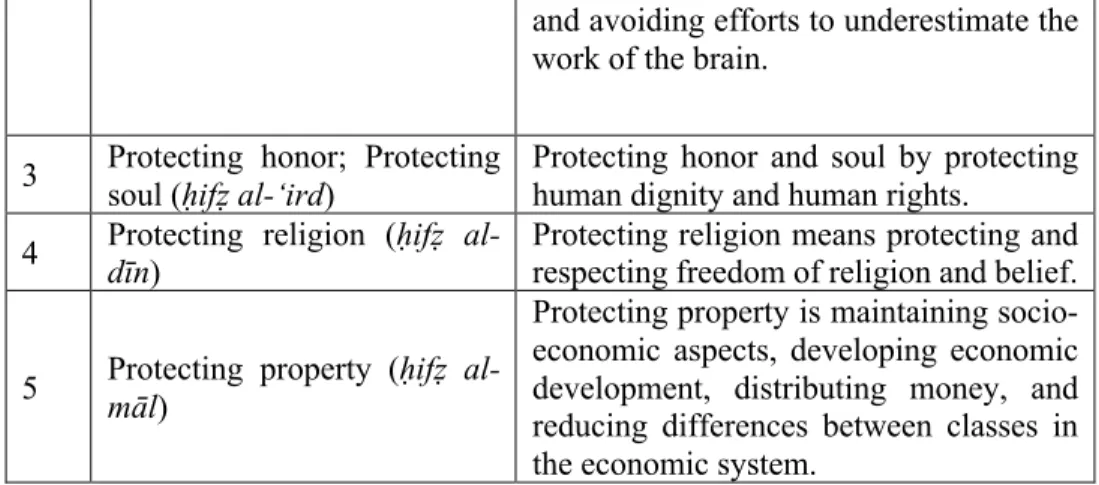
Given this classification, it appears that the classical approach to maqāṣid al-sharī’ah is limited to protection and preservation, unlike in the contemporary discourse which is more intent on development. This shift in scope and emphasis is further clarified by Jasser Auda, as shown in the following table:24
Table 1: Paradigm Shift on Maqāṣid al-Sharī’ah No
Paradigm Shift on Maqāṣid al-Sharī’ah Theory of Classical
Maqāṣid Theory of Contemporary Maqāṣid 1 Protecting Descendants (ḥifẓ
al-nasl)
Theories oriented toward family protection; more concerned with the family institution
2 Protecting mind (ḥifẓ al-‘aql)
Protecting the mind by multiplying the mindset and scientific research, prioritizing the journey to seek knowledge, suppressing the mindset that prioritizes the criminality of the crowd,
21 Agus Purnomo, “Characteristics of Hate Speech and Freedom of Expression in the Perspective of Maqāṣid Al-Sharī’ah,” Juris (Jurnal Ilmiah Syariah 22, No. 1 (2023). Zaprulkhan, Rekonstruksi Paradigma Maqashid al-Syar’iah: Kajian Kritis dan Komprehensif (Yogyakarta:
IRCiSoD, 2020).
22 A. Halil Thahir, Ijtihad Maqâsidi: Rekonstruksi Hukum Islam Berbasis Interkoneksitas Maslahah, (Yogyakarta: LKiS, 2015), 17.
23 Ahmed Mansoor Alkhan, “The Maqāṣid al-Sharīʿah and Islamic Finance Debate: The Underlying Philosophy and Perspectives of Sharīʿah Scholars,” Arab Law Quarterly, (2021), p.
1–31.
24 Jasser Auda, Maqasid Al-Shariah as Philosophy of Islamic Law: A Systems Approach (Washington [D.C.]: International Institute of Islamic Thought, 2008).
http://jurnal.ar-raniry.ac.id/index.php/samarah
and avoiding efforts to underestimate the work of the brain.
3 Protecting honor; Protecting soul (ḥifẓ al-‘ird)
Protecting honor and soul by protecting human dignity and human rights.
4 Protecting religion (ḥifẓ al- dῑn)
Protecting religion means protecting and respecting freedom of religion and belief.
5 Protecting property (ḥifẓ al- māl)
Protecting property is maintaining socio- economic aspects, developing economic development, distributing money, and reducing differences between classes in the economic system.
Human rights, also termed ‘basic rights’ or ‘fundamental rights’, are defined as natural rights that humans have from birth. In other words, human rights are guaranteed and life-long rights to freedom and equality which cannot be revoked by anyone.25
According to the definition contained in Human Rights Law, human rights are the set of unalienable rights given to all humans as creatures of God Almighty.
They are His gifts that must be respected, upheld, and protected by human rights, state, law, government, and everyone for the sake of honor and protection of human dignity.26
Even though interpretations of the concept of human rights may differ, there is the same emphasis on protecting basic human rights. The table below explains the development of basic human rights concepts.
Table 2: Development of Thought on Human Rights No Development of Thought on Human Rights
Early Thought Contemporary Thought
1
The term used is ‘man’s right’.
Only men are recognized as subjects of rights; women are not or considered secondary. For example, in the US Constitution version 1776, the rights in question are men’s rights.
Human rights include both men and women.
25 C. McCrudden, “Human Dignity and Judicial Interpretation of Human Rights,”
European Journal of International Law 19, no. 4 (2008), p. 655–724.
26 Alberto Quintavalla and Klaus Heine, “Priorities and Human Rights,” The International Journal of Human Rights 23, no. 4 (2019), p. 679–97.
http://jurnal.ar-raniry.ac.id/index.php/samarah 2 Human rights are only stated in
the national law of each country.
Human rights are not only regulated in national law but also in
international treaties or conventions.
3
Citizens’ individual rights or the rights of fellow human beings, with emphasis on individual rights.
Human rights emphasize individual rights but are also viewed as moral propriety considering the public interest.
4 Human rights are individual freedoms.
Human rights are individual freedoms.
5 Human rights are the right to political freedom (civil rights).
Human rights are the right to political freedom (economic, social, and cultural rights).
6 The state does not interfere. The state intervenes in facilitating the lives of its citizens.
7 Human rights apply universally (universalism)
Human rights apply in particular contexts (pluralism and
particularism).
Regarding the natural rights inherent in every human being, the theory of derogation and the theory of limitation are applied. Derogation or reduction theory refers to the ability of the state to ignore international human rights obligations in times of emergency. Under these circumstances individual citizens’ rights are curtailed to combat threats that might affect the population, political sovereignty, or territorial integrity of the country. Such a temporary suspension of rights is instituted to preserve the basic functions of those institutions that are indispensable for human rights.27
In addition to this theory, human rights studies also apply limitation theory which refers to a mechanism that allows the state to limit human rights without violating citizens’ rights.28 There is a difference between both theories. In the theory of limitation, the state is given the authority to limit the citizens’ basic rights not only in an emergency. However, the restrictions imposed must be based on statutory provisions so that they do not imply discriminatory attitudes and arbitrary actions from the government.29
27 Anna-Lena Svensson-McCarthy, International Law of Human Rights and States of Exception-With Special Reference to the Travaux Préparatoires and Case-Law of the International Monitoring Organs (London: Martinus Nijhoff Publishers, 1998).
28 United Nations Centre for Human Rights dan United Nations, ed., National Human Rights Institutions: a Handbook on the Establishment and Strengthening of National Institutions for the Promotion and Protection of Human Rights, Professional training series, no. 4 (New York:
United Nations, 1995), p. 35.
29 United Nations Centre for Human Rights dan United Nations, p. 3.
http://jurnal.ar-raniry.ac.id/index.php/samarah
Referring to Human Rights Law, restrictions on basic human rights must be done for legally justified reasons and consider public safety, public order, public health, public morals, and the fundamental rights and freedom of others.30 It states that: In exercising his rights and freedoms, everyone is obliged to comply with the restrictions established by law to guarantee the recognition and respect for the rights and freedoms of others and to fulfill fair demands in accordance with moral considerations, security, and public order in a democratic society.31
Description of MK’s Decision No. 22/PUU-XV/2017
This decision is a judicial review of chapter 7 paragraph (1) of Law 1/1974 concerning marriage proposed by citizens Endang Wasrinah, Maryanti, and Rasminah. Their request was authorized by several lawyers, namely Supriyadi Widodo Eddyono, S.H., Dian Kartikasari, S.H., Robert Sidauruk, S.H., Erasmus A.T. Napitupulu, S.H., Ajeng Gandini Kamilah, S.H., Lia Anggiasih, S.H., Rio Hendra, S.H., Anggara, S.H., Dewi Yani, S.H., Yohana Wardhani, S.H., Ade Novita, S.H., Wahyudi Djafar, and Wahyu Wagiman.32
The judicial review submitted by the applicants was motivated by the existence of chapter 7 paragraph (1) of Law 1/1974 concerning marriage which justified the marriage of a 16-year-old minor. The petitioners judged this to be in violation of the constitutional right of the age limit for marriage, which should be the same for men and women. Another reason that the petitioners put forward is the negative impact of child marriage which hinders the fulfillment of constitutional rights such as the right to education, health, and the right to grow and develop as guaranteed in the 1945 Constitution.33
Therefore, the petitioners considered the intended chapter to be contrary to chapter 27 paragraph (1) of the 1945 Constitution, which states that all citizens have the same position in law and government and are equally obliged to uphold the law and government. Limiting the marriage age for girls to 16 years thus constitutes a case of legal discrimination because the same age limit is not applied to boys who are only allowed to marry at the age of 19 years.34
In addition to assessing the provisions in chapter 7 paragraph (1) of Law 1/1974 as discriminatory legal provisions, the petitioners also considered that the state does not provide sufficient protection for the applicants who are married as
30 Article 70 of Law Number 39 of 1999 concerning Human Rights.
31 Cekli Setya Pratiwi, “Penghormatan dan Perlindungan Hak Asasi Manusia: Hak Kebebasan Beragama dan Berkeyakinan di Indonesia,” in Syamsul Arifin et.al., Hak Asasi Manusia Untuk Kebebasan Beragama dan Berkeyakinan di Indonesia, (Malang: PUSAM, 2014), p. 234.
32 Constitutional Court Decision No. 22/PUU-XV/2017, p. 1.
33 Constitutional Court Decision No. 22/PUU-XV/2017, p. 10.
34 Constitutional Court Decision No. 22/PUU-XV/2017, p. 11.
http://jurnal.ar-raniry.ac.id/index.php/samarah
children. The absence of such protection is clearly illustrated in the a quo chapter that still permits child marriage and thus enforces gender discrimination.
In turn, the implications of the marriage age difference between men and women have further implications for the creation of inequality in law enforcement. The age limit of 16 years for girls is two years below the legal age limit of 18 years based on the Convention on the Rights of the Child and results in different legal positions including the State’s obligations to protect, fulfill, and respect children’s rights in accordance with the 1945 Constitution.
Further, this difference in legal position results in girls being automatically considered as adults following marriage. Even though they are still children according to their age, they are deprived of their rights as children. At the same time, preferential measures are given to boys whose rights are guaranteed because of the provisions on the minimum marriage age of of 19 years in chapter 7 paragraph (1) of the Marriage Law.35
Another risk that the applicants highlighted when requesting the judicial review is related to the girls’ reproductive health. Every child has the right to survive, grow, and develop as mandated by Chapter 28B paragraph (2) of the 1945 Constitution. In addition, children are also entitled to access health facilities and health services and be protected from harmful practices that endanger their health as regulated in chapter 24 of the Convention on the Rights of the Child.
The health risks intended by the applicants are based on expert testimony presented in the trial. According to the medial expert Dr. Fransisca Handy, there are at least five health consequences of pregnancy under the age of 18 related to the mental health of the mother, infectious diseases, pregnancy disorders, complications during delivery, and the health of the infant (Exhibit P-4).
Further, although teenage girls may be already biologically capable of bearing children, this does not mean that they should. The reproductive development is not completed at the time of the first menstruation or menarche when the girl is, on average, 12 years old, especially in terms of optimal pelvic growth. Only after three to four years of menstruation does bone growth stop at which time a girl will have reached her optimal height due to the closure of the growth plates. However, this is not the case with the growth of the pelvic bone which will continue to grow until it reaches the optimal size for pregnancy and gestation at the age of 18 to 19 years. This clarifies that first menstruation is not a sign of optimal readiness for marriage and reproduction because growth continues for the next seven years.36
Another reason stated by the petitioners is related to the opportunity for girls to access education. Their right to education is constitutionally guaranteed. In the
35 Constitutional Court Decision No. 22/PUU-XV/2017, p. 17.
36 Constitutional Court Decision No. 22/PUU-XV/2017.
http://jurnal.ar-raniry.ac.id/index.php/samarah
provisions of chapter 28C paragraph (1) of the 1945 Constitution it is stated that everyone has the right to education and to benefit from science and technology as mandated. Thus, the younger the girls’ marriage age the lower the level of education that can be achieved. Girls trapped in child marriage can no longer go to school and are expected to carry new responsibilities at home, either as wives, daughters-in-law, or mothers-to-be.
Meanwhile, the national education system in Indonesia stipulates mandatory schooling for the duration of 12 years. Therefore, if girls enter into marriage at the age of 16 years, and the a quo provisions are maintained, they can no longer enjoy their constitutional rights to education. Of course, the situation is different for boys who have to be at least 19 years old to enter into marriage; by then they would have already completed their basic education.37
The final consideration for submitting the judicial review is the issue of child exploitation. A fundamental problem occurs when children enter marriages arranged by their parents for economic reasons. Children cannot give full consent to any legal actions taken, including marriage. Child marriage means that the girls do not have the right to their own body, must obey their parents, and have to accept being handed over to strangers and leaving the safety of their family home.
The petitioners argued further that the exploitation of children does not stop when being forced into an arranged marriage; the minors are often exposed to domestic violence (Kekerasan dalam Rumah Tangga or KDRT). Domestic violence is prone to occur because the men exercise undue control over their underaged wife and are prone to take advantage of this imbalance of power.38
Regarding the abovementioned arguments of the petitioners, MK considered that the legal provisions submitted for judicial review did indeed contain discriminatory elements. Although the provisions on the marriage age limit were considered as legal policy, it did not prevent the Court from conducting a judicial review arguing that it was contrary to the 1945 Constitution. However, it did not consider re-evaluating the girls’ minimum age for marriage, which was the domain of the lawmaking body. In this case, MK confirmed that the different marriage age policy for men and women is a discriminatory policy.
Another consideration in deciding in favor of a judicial review was related to the detrimental effect of child marriage. MK agreed that child marriage is very likely to threaten the psychological, emotional, and physical welfare of children.
Early pregnancy is detrimental to their health, in addition to the risk of exploitation and threat of violence and abuse. Furthermore, early marriage has a negative impact on the children’s education and future prospects.
37 Constitutional Court Decision No. 22/PUU-XV/2017, p. 24.
38 Constitutional Court Decision No. 22/PUU-XV/2017, p. 26.
http://jurnal.ar-raniry.ac.id/index.php/samarah
MK explicitly stated that child marriage is a form of violation of children’s rights that is prone to cause harm. The 1945 Constitution guarantees children’s rights, as stated in chapter 28B paragraph (2) that every child has the right to survive, grow, and develop and has the right to protection from violence and discrimination. Furthermore, the Child Protection Law stipulates that children’s rights fall into the category of human rights and must be guaranteed, protected, and fulfilled by parents, family, community, local government, and state government. A child is considered everyone under the legal age limit of 18 years whose rights must be guaranteed, protected, and fulfilled.39
Based on all the legal considerations described above, MK stated in its ruling Chapter 7 paragraph (1) along with the phrase “age sixteen years” of Law 1/1974 (State Gazette of the Republic of Indonesia of 1974 Number 1, Supplement to the State Gazette of the Republic of Indonesia Number 3019) which is contrary to the 1945 Constitution and has no binding legal force.
However, these provisions are still considered valid until changes are made within the stipulated grace period of three years.40
Concerning the amendment period to incorporate the provisions of the intended article to the legislators, changes to the marriage age limit have yet to be made. This would provide legal certainty and eliminate the discrimination caused by these provisions. The minimum age limit for marriage as regulated in chapter 7 paragraph (1) of Law 1/1974 should be harmonized with the Child Protection Law and applied equally to men and women.41
The decision above, if read in the context of a study on judicial review, is classified as a judicial review from the material perspective, considering that the tested object is related to the material of the Marriage Law Act. If classified from the formal perspective, as in the case of this decision, it will result in the cancellation of part of the legal material that is subject to judicial review. Given the rules of the procedural law in the context of reviewing the Marriage Law, as per chapter 7 paragraph (1), this chapter is invalidated by the issuance of MK’s decision that “chapter 7 paragraph (1) as long as the ‘sixteen years of age’ Law 1/1974 (State Gazette of the Republic of Indonesia of 1974 Number 1, Supplement to the State Gazette of the Republic of Indonesia Number 3019) is contrary to the 1945 Constitution and has no binding legal force”.42
39 Constitutional Court Decision No. 22/PUU-XV/2017, p. 55.
40 Constitutional Court Decision No. 22/PUU-XV/2017, p. 60.
41 Constitutional Court Decision No. 22/PUU-XV/2017.
42 Jimly Asshiddiqie, Hukum Acara Pengujian Undang-Undang (Jakarta: Sinar Grafika, 2010), 39.
http://jurnal.ar-raniry.ac.id/index.php/samarah
Maqāṣid al-Sharīʿah Reasoning Applied to the Decision
Observing the legal arguments taken into consideration by MK in deciding the judicial review of chapter 7 paragraph (1) of Law 1/1974, various aspects of maqāṣid al-sharīah can be applied; one of them is the consideration of protecting from harm. This case can be interpreted from a maqāṣid al-sharīah perspective based on the fiqh rule that “rejecting damage must take precedence over efforts to achieve benefit,”43 or based on the principle that God’s sharīʿah was created solely for the benefit of mankind.44
Considering the harm that will result from child marriage, MK’s decision is closely related to other aspects of maqāṣid al-sharīah, such as the child’s right to life (ḥifẓ al-nafs), to access education (ḥifẓ al-ʿaql), and improve the standard of living (ḥifẓ al-māl).
These maqāṣid categories were reflected in MK’s consideration that the marriage age difference between men and women resulted in child marriages. In addition to the threat to the children’s life due to early pregnancy, these marriages also caused them to lose their opportunity for a proper education and financial independence.
If the Court’s decision is read from the perspective of “rejecting harm must take precedence over efforts to achieve benefit,” two opinions emerge. First, child marriage carries some benefit because the religious texts (the Qur’an and Hadith) advocate marriage. However, if the resulting impact can lead to harm, its prevention must take precedence, which is the second opinion.
It can be further reasoned that the institution of marriage has moral benefit because it is part of ḥifẓ al-dīn (protecting religion). Meanwhile, preventing negative consequences that might threaten a person’s life belong to the ḥifẓ al- nafs (protecting life) category. Referring to the study of maqāṣid al-sharīah, it is debated whether the protection of religion or the protection of life should take precedence. This is reflected in the differences of opinion concerning the order of the five basic needs. Abū Ḥāmid al-Ghazālī (1058–1111) placed protecting religion before protecting life, while Shihāb al-Dīn al-Qarāfī (1223–1285) argued for the opposite.45
Following al-Qarāfī’s line of thought, saving human life constitutes the basis for fulfilling the other rights, which would otherwise be pointless. He argues that the very purpose of Islamic law is to benefit mankind. Islam provides relief
43 Jalāl al-Dīn al-Suyūtī, al-Ashbāh wa al-Nazāir fī al-Furū’ (Beirut: Dār al-Kutub al-
’Ilmīyah, 2006), 62.
44 Anver M. Emon, “Natural Law and Natural Rights in Islamic Law,” Journal of Law and Religion 20, no. 2 (2004), p. 351.
45 Holilur Rohman, Maqasid al-Syariah: Dinamika, Epistemologi, dan Aspek Pemikiran Ushuli Empat Madzhab (Malang: Setara Press, 2019), p. 77.
http://jurnal.ar-raniry.ac.id/index.php/samarah
and convenience for those adhering to its rules and prevents them from anything that would diminish its core values.46
Apart from the reasons already mentioned, putting the protection of life above the protection of religion can also be justified by saying that human life is the basis of obligation (manāṭ al-taklīf). In other words, without the soul or life (nafs), the burden or obligation (taklīf) of religion cannot be carried out.
Therefore, the aspect of sustaining life is very important in the context of carrying out religious duties. It follows logically that maintaining life must take precedence over maintaining religion.47
On the other hand, the scholars who argue that the protection of religion is more important than the protection of life have their own logical justification.
They argue that the primary purpose of human life is to worship God; therefore, religion must take precedence over life which is only an instrument for realizing the intended objective.48
MK’s legal considerations include that child marriage is very likely to threaten and have a negative impact on the girls’ health; therefore, it is legitimate to choose protecting life rather than protecting religion. As highlighted in the previous paragraph, marriage is an effort to uphold morality and follow religious teachings. However, the prevention of child marriage, which is likely to have a negative impact on the girls’ health, is included in the category of protecting life.
The above approach interprets MK’s decision as an effort to prevent harm caused through child marriage. In this sense it is an effort to achieve the benefit through preventing harm, which is—after all—the goal of Islamic law. In other words, Allah as Shāriʿ (Rule Maker) in lowering the law must have a purpose, and this purpose is to derive benefit (maṣlaḥah).49
In the context of MK’s decision, the intended benefit is protecting life.
However, to emphasize the benefit of the intended decision, two issues need to be clarified; the status of benefits included in the decision and the validity of the benefits contained therein.
In the study of Islamic jurisprudence (uṣūl al-fiqh) scholars divide benefit into three types, namely acknowledged benefit (maṣlaḥah muʿtabarah), rejected benefit (maṣlaḥah mulghah), and undefined benefit (maṣlaḥah mursalah). The first type refers to the benefits that are clearly stated by the Rule Maker (shāriʿ),
46 Zaprulkhan, Rekonstruksi Paradigma Maqashid al-Syar’iah, p. 89.
47 Fauzi and Zulihafnani, Hak Asasi Manusia dalam Fikih Kontemporer, (Depok:
Prenadamedia Group, 2018), p. 148.
48 Fauzi dan Zulihafnani, Hak Asasi Manusia dalam Fikih Kontemporer, p. 148.
49 Abdul Mun’im Saleh, Otoritas Maslahah dalam Madzhab Syafi’i (Yogyakarta:
Magnum, 2012), p. 69.
http://jurnal.ar-raniry.ac.id/index.php/samarah
as reflected in the five basic needs (ḍarūrīyat al-khamsah),50 while the second type is merely an imaginative benefit, such as equating the inheritance share between men and women.51
Meanwhile, the benefits that are classified as acknowledged benefit (maṣlaḥah mursalah) are benefits that are not directly designated by Islamic law.
In other words, there is no explicit argument that refers to the status of the benefit so that its status is undefined (mursalah). Such is the case in the efforts of the Companions to collect the Qurʾan and produce a final, authoritative copy in written form.52
The scholars stipulated that the intended benefit must be reasonable and relevant to the established legal case. Other requirements are that it must be in accordance with the law’s intent and not be in conflict with clear injunctions.
Also, the proposed benefit must be of essential importance to the community.
According to Imam al-Ghazali, it must be in line with the law and not contradict definite arguments, acceptable to common sense, and included in the category of basic interests. If these three requirements are met, the benefit can be accepted as a source of law and can be used as an argument, even if certain arguments do not support it.53
From the description above, MK’s decision can be qualified as a decision that relies on the valid concept of acknowledged benefit (maṣlaḥah mursalah). It is not supported by a definite proposition concerning the minimum age of marriage, but it is based on considerations of the general benefit beyond the provisions of a definite proof (qaṭʿī al-dalālah).
Suppose only one of the requirements for the recognition of acknowledged benefit (maṣlaḥah mursalah) must be included in the category of the five fundamental needs that have to be fulfilled. In that case, efforts to prevent child marriage supports the legal principle of protecting life. Therefore, it fulfils the condition of acknowledged benefit (maṣlaḥah mursalah) as a source of law.
Another requirement for the validity of maṣlaḥah mursalah is that the intended benefit can be ascertained. These legal considerations submitted by the applicants and MK, based on the results of research on the risks of child marriage support the validity of maṣlaḥah mursalah as the basis for the decision as follows:
According to UNICEF data, women who give birth at the age of 15–19 years are at risk of dying twice as much as women who give birth at the age of 20 years. In 2014 WHO
50 M. Noor Harisudin and Muhammad Choriri, “On The Legal Sanction Against Marriage Registration Violation in Southeast Asia Countries: A Jasser Auda’s Maqasid Al-Shariah Perspective,” Samarah: Jurnal Hukum Keluarga dan Hukum Islam 5, no. 1 (2021), p. 477.
51 Saleh, Otoritas Maslahah dalam Madzhab Syafi’i, p. 72.
52 Saleh, Otoritas Maslahah dalam Madzhab Syafi’i, p. 72.
53 Akmal Bashori, Filsafat Hukum Islam: Paradigma Filosofis Mengais Kebeningan Hukum Tuhan (Jakarta: Kencana, n.d.), p. 186.
http://jurnal.ar-raniry.ac.id/index.php/samarah
data, it was stated that the death of adolescents aged 15 to 19 years due to pregnancy and childbirth was the main cause of their death. Pregnancy in adolescence will increase the risk of death for the mother and fetus, especially in developing countries. Babies born to mothers under the age of 20 have a 50% higher risk of stillbirth; they are also more likely to be born with low birth weight and other long-term health risks.”54
According to the testimony of the medical expert witness in the judicial review of the articles proposed by the applicants, child marriage with early pregnancy constitutes a very high risk for the mother who is herself still in the process of reaching maturity. With a growing fetus attached to her womb, there is competition for nutrition between the mother and fetus. This condition might result in the emergence of other risks, such as premature birth, birth defects, and low birth weight. As for the mothers, they are at risk of anemia (lack of blood), seizures, excessive bleeding during parturition, and depression. There is also evidence of an increased Maternal Mortality Rate (MMR), increased risk of cervical cancer due to sexual activity before the age of 15, and risk of contracting sexually transmitted diseases (STDs) because the reproductive organs are not yet fully developed.55
In light of these statistical data, MK’s decision to prohibit child marriage protects children’s rights, including their right to live. It can be argued that protecting these rights goes beyond the fulfillment of the five fundamental needs (al-dharūriyat al-khamsah) which centres on obligations and prohibitions (min jānib al-wujūd aw jānib al-ʿadam). As an example of protecting the soul, the unjustified killing of a soul (murder) requires exact retribution (qiṣāṣ).56
However, MK’s decision to protect the life of minors is not part of enforcing qiṣāṣ; it involves broader considerations such as the prevention of a harmful social practice (child marriage) which is considered a threat to the safety of life. This general protection includes protecting individuals from being exposed to discrimination and violence. In this case, MK does not only apply the principle of ḥifẓ al-nafs in terms of physical protection but also psychologically.
Based on the description above, it can be argued that following the maqāṣid al-sharī’ah approach does not mean limiting it to classical interpretations of the past. It is possible to develop the classical tenets of Islamic law in response to contemporary issues, as done by modern scholars who extended the scope of ḥifẓ al-nafs which was originally limited to the prohibition of murder. Similarly, MK decided to widen the scope of the protection of life beyond the physical aspect to include the psychological aspect.
As seen in the legal considerations of MK above, reading of the law can be exercised in the form of diachronic reasoning by using classical fiqh texts—
54 Constitutional Court Decision No. 22/PUU-XV/2017, p. 21.
55 Constitutional Court Decision No. 22/PUU-XV/2017, p. 21.
56 Saleh, Otoritas Maslahah dalam Madzhab Syafi’i, p. 71.
http://jurnal.ar-raniry.ac.id/index.php/samarah
including texts on the maqāṣid al-sharī’ah— to know the history of meaning.57 In this case, MK is not tied to the maqāṣid readings formulated by classical scholars. In other words, the original aims of Islamic law can be re-evaluated and re-applied in light of contemporary knowledge and expertise.
Protection of Human Rights in MK Decisions
The principle of equality before the law was evident in the decision to adjudicate a judicial review of the provisions of chapter 7 paragraph (1) of Law 1/1974. The decision itself was motivated by the applicants’ understanding of the provisions in the intended chapter, which clearly distinguished between the marriage age of men and the marriage age of women, namely 19 years and 16 years respectively. The applicants considered this provision as a discriminatory provision.
In this case, MK decided to annul the discriminatory provisions and agreed with the petitioners that they do not reflect the principle of equality before the law. Referring to the document on human rights, equal treatment before the law is the right of both men and women and must be protected. This is expressly covered by the International Covenant on Civil and Political Rights. In the document, chapter 3 states that the state parties undertake to guarantee equal rights between men and women in the enjoyment of civil and political rights.58
The gender equality established in the provisions of the Covenant is considered a fundamental principle in protecting human rights based on the doctrine “all human beings are born free and equal in rights and dignity.”59 In the context of Islamic law, this principle is also recognized, and everyone has the right to be treated equally before the law. Equality before the law goes back to Prophet Muhammad himself. When a noblewoman from the Makhzum clan had committed theft, her clan members did their best to thwart justice and prevent her hand from being cut off in consequence of her proven guilt. The Prophet Muhammad PBUH, however, insisted on the punishment regardless of her position in society or her gender.60
Another case is that of Jabalah ibn al-Ayham, who was a king who embraced Islam at the time of the Muslim conquest of Sham (Greater Syria).
While performing tawwāf (circumambulation) on his pilgrimage, a man from the Fuzarah tribe accidentally stepped on his clothes. The king struck the man in his
57 Syafiq Hasyim, Hal-hal yang Tak Terpikirkan: Tentang Isu-isu Keperempuanan dalam Islam (Bandung: Mizan, 2001), p. 266.
58 Mashood A Baderin, Hukum Internasional Hak Asasi Manusia & Hukum Islam (Jakarta: Komisi Nasional Hak Asasi Manusia, 2010), p. 57.
59 C. McCrudden, “Human Dignity and Judicial Interpretation of Human Rights,”
European Journal of International Law 19, no. 4 (2008), p. 655–724.
60 Fauzi and Zulihafnani, Hak Asasi Manusia dalam Fikih Kontemporer, p. 64.
http://jurnal.ar-raniry.ac.id/index.php/samarah
face who sustained injuries from the blow. When Umar al-Khattab heard of this incident he ruled that the man from the Fuzarah tribe could either forgive the king, or had the king punished.61
In the context of Indonesian law, the guarantee of equality before the law is found in chapter 27 paragraph (1) of the 1945 Constitution which states, “All citizens are equal before the law and government and are obliged to uphold the law and government without exception.” It stipulates that there should be no discrimination in law or governance. In addition, these provisions also concern not only equality in enjoying rights but also equality in carrying out obligations.62
Related to discrimination limits which are considered contrary to the above provisions it is as stipulated in chapter 1 paragraph (3) of Law Number 39 of 1999 concerning Human Rights that: Discrimination is any restriction, harassment, or exclusion that is directly or indirectly based on human differences based on religion, ethnicity, race, ethnicity, group, class, social status, economic status, gender, language, political belief, which results in a reduction in, deviation, or elimination, recognition, implementation or use of human rights and basic freedoms in both individual and a collective life in the political, economic, legal, social, cultural and other aspects of life.
Based on the above definition of discrimination, the difference in the minimum age for men and women is clearly based on gender and thus constitutes a form of discrimination. This issue of discrimination was the main reason for MK’s decision to grant a judicial review of the provisions in chapter 7 paragraph (1) of Law 1/1974. Following the author’s review of the decision it transpired that the other aspects should also classified as human rights and be protected, such as free access to education.
In the consideration of MK, the difference in the marriage age limit deprives women of the same right to education as men. This rule has further increased the gender gap in society where women are being persistently disadvantaged and marginalized.63
Through the legal considerations above, in this case MK has acknowledged the demands of womens’ rights activists who challenge the fairness of the current law which is patriarchal and favors men’s interests. This claim is certainly justified if it refers to the various legal formulations, especially in family fiqh, which are often outdated and place men in positions of authority as the leaders of the household, while women are given secondary roles.
Male leadership in the household implies that men are superior to women.
For example, a man can have up to four wives, but a woman can only have one
61 Fauzi and Zulihafnani, Hak Asasi Manusia dalam Fikih Kontemporer, p. 64.
62 Mukthie Fadjar, Tipe Negara Hukum (Malang: Bayu Media Publishing, 2005), p. 98.
63 Constitutional Court Decision No. 22/PUU-XV/2017, p. 41.
http://jurnal.ar-raniry.ac.id/index.php/samarah
husband. A man is also free to divorce his wife without a reason, but a wife requires the permission of a judge. Further, a man inherits a larger share than a woman. Apart from the family, the activists’ claim that this is a man’s world is also closely related to the dichotomy between the private and public spheres.
Here, the protection of human rights is more concerned with the public sphere which is the men’s sphere. However, in the private sphere which is the women’s sphere violations of women’s rights are often ignored, and the women’s voices silenced for the sake of protecting the privacy of all concerned.
This dilemma is also evident in human rights violations perpetrated by the state. The torture of women constitutes a violation of women’s human rights when it is carried out by state officials and occurs in the public domain, yet the female victims of torture have an even slighter chance of justice than the male victims.
These cases illustrating the apparent inequality of men and women before the law can certainly be distinguished from the discrimination referred to in MK’s decision. In the context of Islamic law, a distinction is made between the rights and obligations of men and women, but they are not discriminatory in nature.
These differences are due to the different roles assigned to men and women and are not intended to classify one gender as superior and the other as inferior.
Men and women are different by nature, and Islamic law acknowledges these gender differences. However, this does not mean that their rights and obligations are not equally valid before the law. Thus, treating men like women or treating women like men, in other words treating two different things as if they were the same, would be unjust.
MK’s assessment of discriminatory attitudes in the marriage age differences between men and women cannot be interpreted as a decision to equate women with men in all matters and circumstances. As mentioned above, some differences occur naturally and should be acknowledged and respected. Men and women have physiological and psychological differences that also have social implications.
Even at the individual level, there are some clearly discernible differences between men and women.
However, acknowledging these individual differences does not justify any form of discriminatory treatment. In the study of human rights, one of the principles is non-discrimination which stipulates that there shall be no differences in treatment.
Therefore, discrimination against women is considered a violation of the principles of equal rights and respect for human dignity. In contrast, on humanitarian grounds it is universally agreed that all humans are entitled to certain basic rights, regardless of their differences in gender, skin color, economic
http://jurnal.ar-raniry.ac.id/index.php/samarah
status, citizenship, and religion. This consensus would later develop the concept of universal human rights.64
Regarding the principle of non-discrimination, some critics think that in practice this principle is not very useful for women because it is built on the assumption that everyone is the same and thus should be treated the same. In consequence, protection is only granted to women concerning their reproductive functions, such as breastfeeding and giving birth, with the assumption that certain biological differences must be recognized.65
The criticism above suggests that enforcing the principle of non- discrimination is not a way out of the inequality between men and women. On the contrary, what is needed is indeed not an equal but a different treatment of women.
In other words, focusing on the principle of non-discrimination does not solve the problem of inequality; therefore, strategic steps are needed to remove the disadvantages and risks to which women are exposed on the grounds of their gender.66
In light of this, MK’s decision can be interpreted as an effort to eliminate these barriers. Following the logic of MK’s legal considerations, the marriage age differences between men and women prevent women from accessing education, and without education they cannot close the gender gap and achieve economic parity with men. Thus, the annulling of this discriminatory provision provides more opportunities for women to enjoy access to education and other important benefits.
This strategy has been proposed in Law no. 7 of 1984 concerning the Convention on the Elimination of All Forms of Discrimination against Women.
It states that discrimination against women is considered an obstacle to women’s participation in the political, social, economic, and cultural spheres, which in turn hinders the prosperity of their family and in extension society. Therefore, women should be given equal access, especially in the education.67
Returning to MK’s legal considerations to annul chapter 7 paragraph (1) of Law 1/1974, the argument revolves around the negative impact of child marriage in terms of the children’s physical wellbeing, risk of exploitation, and threat of violence, in addition to its negative impact on their education. If these matters are
64 United Nations Centre for Human Rights dan United Nations, National human rights institutions.
65 Rhona K.M. Smith et.al., Hukum Hak Asasi Manusia (Yogyakarta: PUSHAM UII, 2008), p. 25.
66 Rhona K.M. Smith et.al., Hukum Hak Asasi, p. 26.
67 T.O. Ihromi, et.al., Hak Azasi Perempuan: Instrumen Hukum untuk Mewujudkan Keadilan Gender (Jakarta: Yayasan Pustaka Obor Indonesia, 2012), p. 16.
http://jurnal.ar-raniry.ac.id/index.php/samarah
analysed in the context of human rights, they would be classified as human rights, not as legal rights.68
The distinction between human rights and legal rights also has implications for the possibility of revocing certain rights. Human rights are defined as inherent rights in every human being, are closely related to the existence of human life itself, and thus cannot be revoked. On the other hand, legal rights are not given at birth and are determined by the governing laws at a given time and in a given place. Whosoever does not fulfill these manmade regulations can be subject to sanctions.69
If we acknowledge this distinction, the legal considerations of MK that formed the basis for annuling the chapter submitted by the petitioners can be placed in the category of unalienable human rights that must be protected. In other words, children have an inherent right to maintain life; therefore, they must not be exposed to harmful practices that can threaten their life, including child marriage. Until they have reached the age of 19 years children of both genders have the right to safety, growth, and self-development through education.
Conclusion
In summary, MK Decision No. 22/PUU-XV/2017 on the marriage age difference between men and women contains aspects of maqāṣid al-sharīʿah which are the basis for legal considerations. The prevention of harm must be a legal consideration that leads to the prohibition of child marriage. In accordance with the maqāṣid rule that avoiding damage must take precedence over efforts to achieve benefit. Further, the sharīʿah was created solely for the benefit of humans, both in this world and in the hereafter. Another conclusion that can be drawn is related to the principle of protecting life (ḥifẓ al-nafs) which in the view of MK does not only entail the enforcement of retributive justice (qiṣāṣ) but also broader considerations including psychological aspects. Thus, child marriage is ruled as a threat to the safety of life. Likewise, protection from all forms of discrimination and various forms of violence, all of which have been duly assessed, can violate the rule of protecting life (ḥifẓ al-nafs). In other words, protecting human rights means rejecting the discriminatory treatment of women. However, this decision cannot be interpreted as equating within with men in all matters. To achieve justice and fairness, it is not necessary to treat men and women equally; however, women must not be exposed to harm, their interests overlooked, and their right to equal opportunities dismissed for the benefit of men.
68 Muladi (ed.), Hak Asasi Manusia: Hakikat, Konsep dan Implikasinya dalam Perspektif Hukum dan Masyarakat (Bandung: Refika Aditama, 2009), p. 229.
69 Muladi (ed.), Hak Asasi Manusia, p. 229.
http://jurnal.ar-raniry.ac.id/index.php/samarah
References
Journals and Books
Alkhan, Ahmed Mansoor. “The Maqāṣid al-Sharīʿah and Islamic Finance Debate:
The Underlying Philosophy and Perspectives of Sharīʿah Scholars.” Arab Law Quarterly, (2021). https://doi.org/10.1163/15730255-BJA10075.
Asshiddiqie, Jimly. Hukum Acara Pengujian Undang-Undang, Jakarta: Sinar Grafika, 2010.
Auda, Jasser, Maqasid Al-Shariah as Philosophy of Islamic Law: A Systems Approach, Washingto