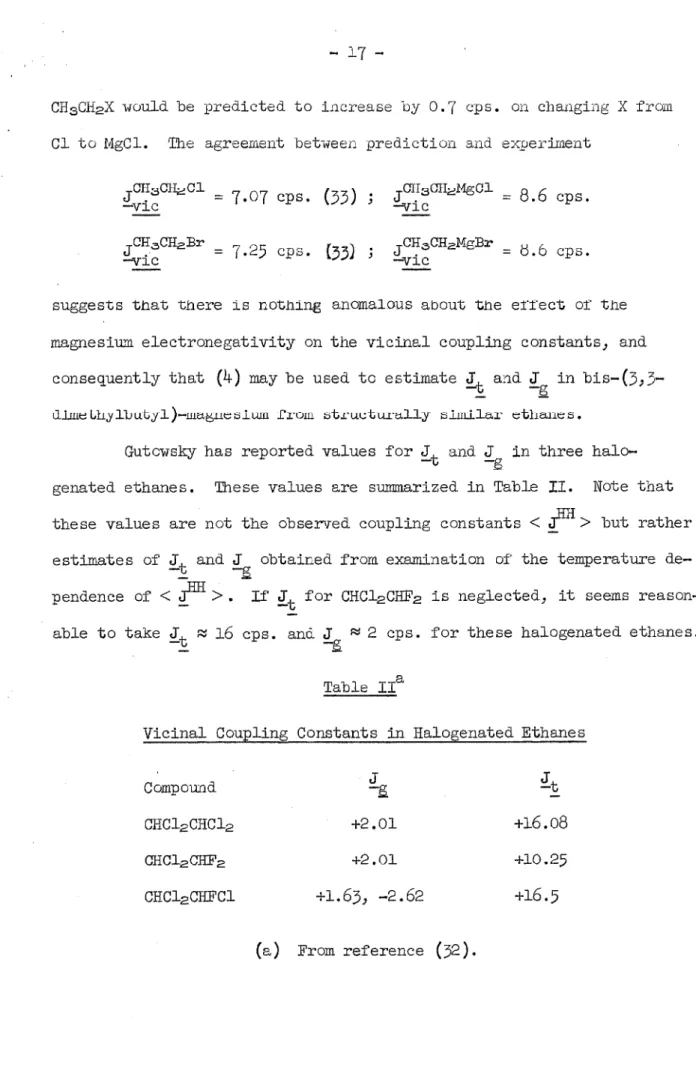
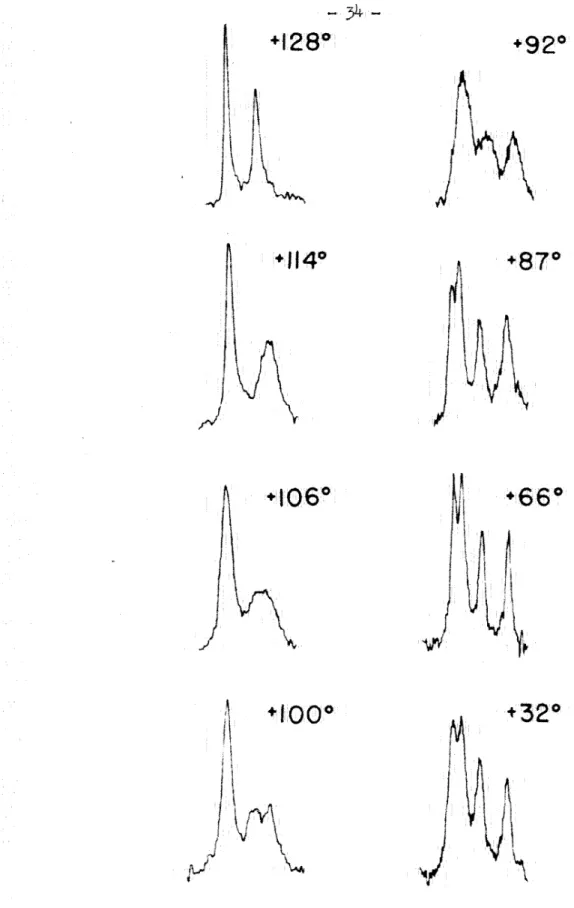
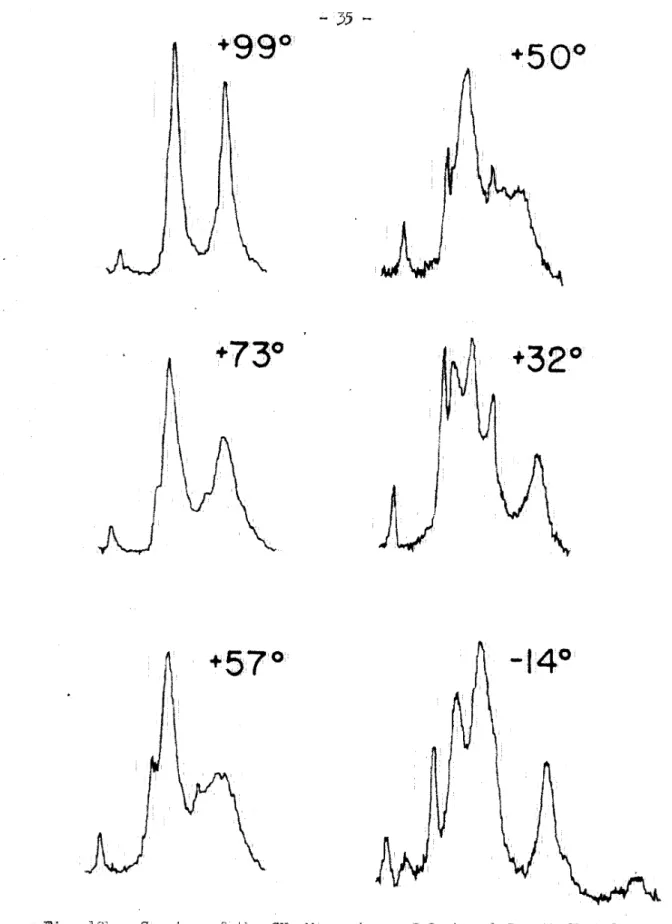
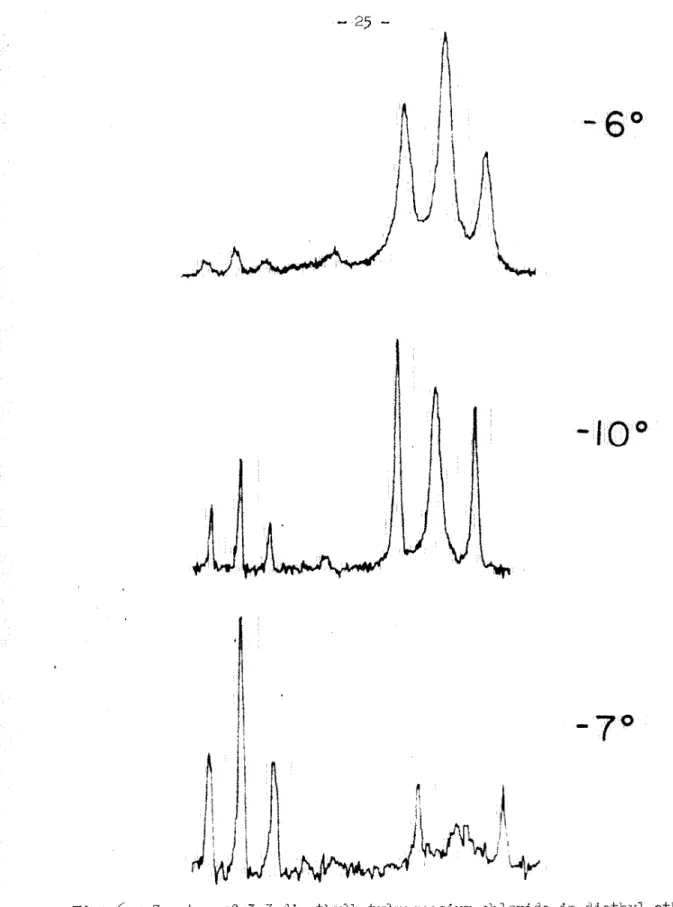
Experimentally, no significant temperature variation in the separation of the 1,2 and 3,4 transitions is observed. If changes in the populations of the trans and gauche conformations were important in determining the. Lowering the temperature of the Grignard reagent causes a broadening of the central line of its spectrum.
In fact; little change in the spectrum of the latter compound is observed with lowering of temperature.
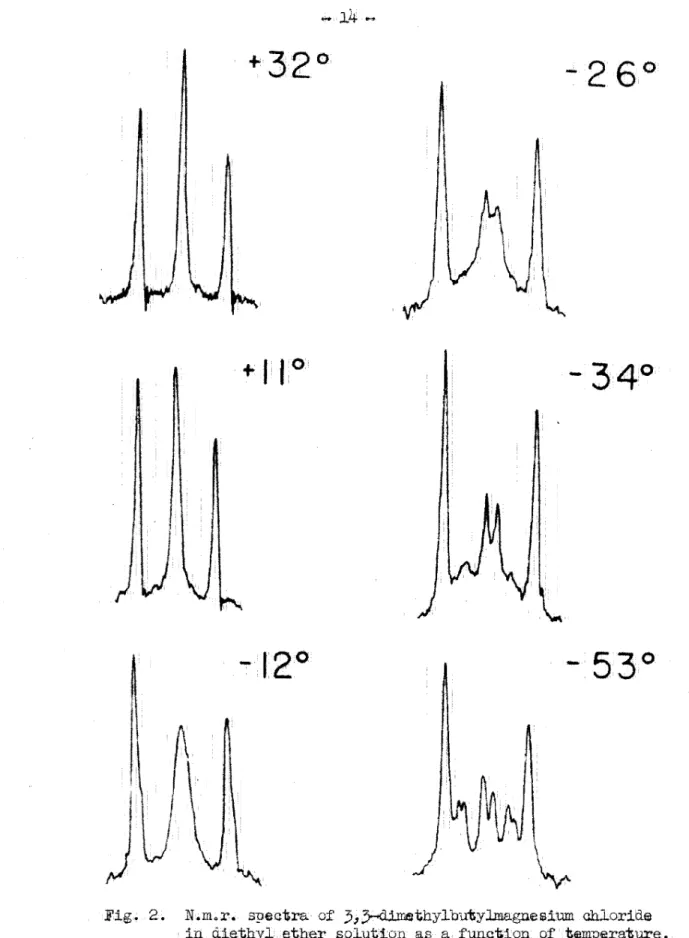
The effect of solvent on the spectrum of the Grignard reagent is equally dramatic (Fig. 7). In diethyl ether soluti•::in at room temperature the spectrum of the -C§2-Mg protons is a triplet; If inversion of configuration occurs in this Grignard reagent, an equilibrium will be established between the .. concentrations of the two isomers.
We schematically represent the exchange of the protons of the methylene group a with the magnesium atom by the reaction I. Previous discussion has suggested that the diagonal terms of p are related to the Boltzmann factors of the corresponding energy levels. In the laboratory frame, the core moves around the axis:'s of the field H(1-cr(i)) at an angular frequency called the I.armour.
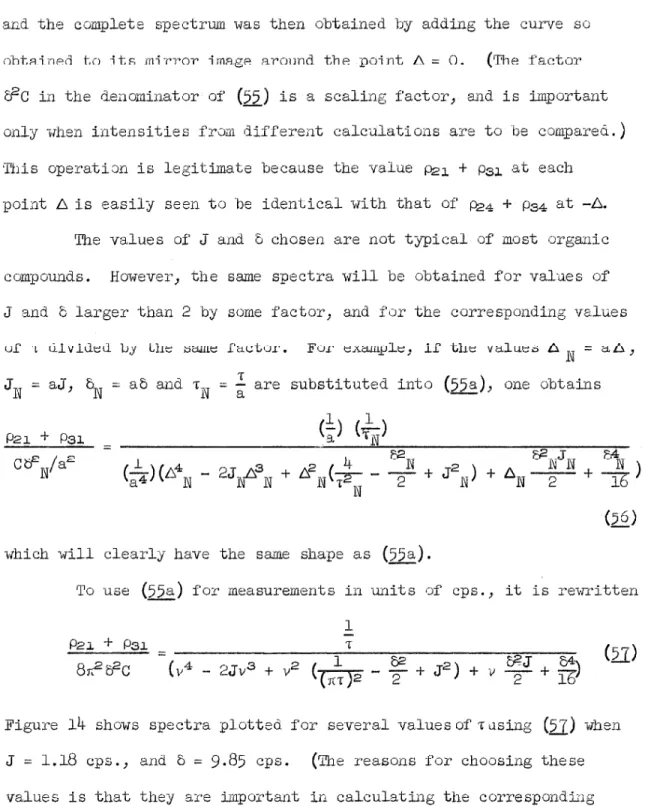
The amount. of these two equations is the lineshape function for the asymmetric quartet of an AA'YJC' spectrum.) under the assumption that the natural linewidth of the lines in the absence of exchange is. Prcviouoly J the insensitivity of the separation between the .. strong l:2 and ))4 transitions in these spectra was cited as evidence that large changes in the conformational populations were not responsible for the changes observed in the spectrum. This argument is not inconsistent with the suggestion that relatively small changes in conformational populations are responsible for measurable changes in the splitting of the 9 and ll transitions.
i . conformational populations; the corresponding change in separatio:i of 1.2 and. ); 4 transitions will be approx. 0.2 cps. The details of the calculations are formally identical to those for the AB spectrum. It has been observed experimentally that the rate of inversion depends very strongly on the concentration of Grignard.
We would then expect the degree of inversion to increase with increasing cletrophilicity of the o.to.cking species. Therefore, using a bimolecular model for the reaction and assuming that the rate depends mainly on the electrophilicity of the fragment -MgX), we predict that the rate of inversion should increase in the order R-.MgCl > R-MgBr > R-MgI > R- Mgr. The response of the inversion rate to changes in several variables appears to support the assumption that the inversion mechanism involves two magnesium atoms in the transition state.
If the mechanism of the inversion reaction bears any resemblance to electrophilic organomercury subsorption reactions. If the inversion depends primarily on the electrophilicity of the magnesium compounds in solution, the relatively small difference in the inversion rates of 3,3-dimethylbutylmagnesium chloride and bis-(3,3-dimethylbutyl)-magnesium is surprising.
PART II
The complexity of the spectrum of a compound containing one or more centers of asymmetry is often such that it can be very difficult to interpret the spin-spin coupling patterns of groups in the immediate vicinity of the asymmetric center in terms of the structural features of the molecule. The magnetic nonequivalence of the methylene group near the asymmetric center is capable of providing a sensitive and convenient probe with which to probe the conformations of the molecule in the region of the asymmetric center; studying the temperature dependence of this nonequivalence can provide information about fast reactions that take place near the asymmetric center. Furthermore, since the effect under consideration is independent of the optical activity of the sample, the n.m.r. spectroscopy can be used in the appropriate compounds to provide the same type of information that optical rotation measurements would provide without the need to resolve.
Two explanations have been advanced to account for the difference in chemical shift of methylene protons in the vicinity of a center. in rotamer I is identical to that of B;a in rotamer II, with the restriction that all the bond angles and bond lengths are the same in the two conformers and that HA in I and B.El in II occupy the same position relative to Ru R2 and R3 • Alternatively, a second explanation can be suggested for tJ:: i.e. magnetic nonequivalence of methylene protons in the vicinity of a molecular center.
Gutowaky (~ vigorously attacked this interpretation on the grounds that the characteristics of the 0-D bond are so similar to those of the 0-B bond that one would expect the -CH2D group in IV to be similar to the -CH3 gro~ :response to the asymmetric cer:rter and not on the CH2CH3 group, so he felt that no conclusions could be drawn from the IV spectrum about the origin of the asymmetry in V. Gutowsk:y suggested a better approach to the problem of distinguishing between the "intrinsic asymmetry" of a molecule and asymmetry due to the study of distortion factors or variation '
If, on the other hand, there is no significant contribution to the magnetic nonequivalence of the methylene group due to molecular "internal asymmetry", 11 the nonequivalence should drop to zero at high temperatures. Consequently, Gutowslcy's experimental test of this proposal, which includes an examination of the chemical shifts and coupling constants of CF aFbBrCY.Brel over the :cange temperature of 225 ° · to 465 °K, cannot be considered meaningful.
RESULTS A'ND DISCUSSION
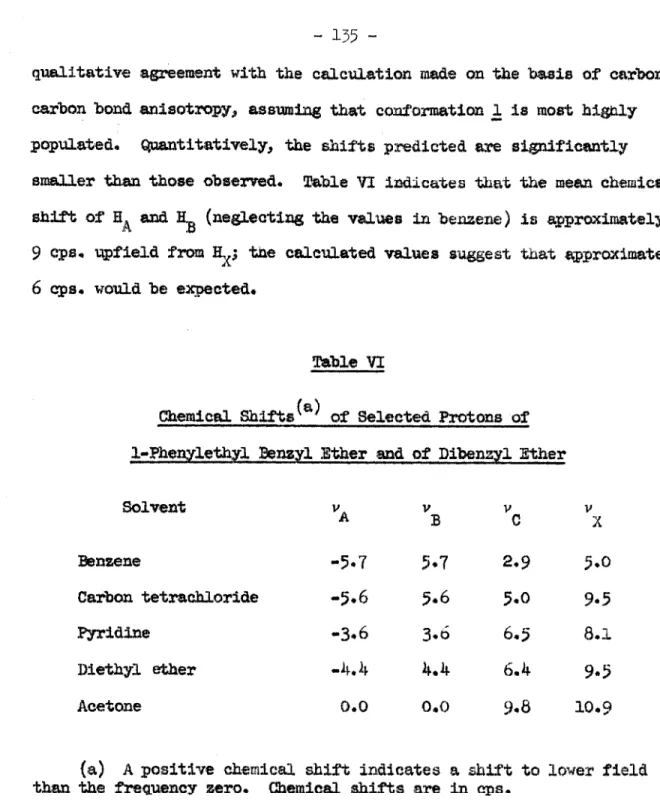
Q is the acute angle' between the axis of the bond and the radius vector of R. We investigate here the magnetic non-equivalence of the methylene protons in conformation 1: of Figure. Here we have compared the chemical shifts of the methylene and methinyl protons of 1-phenylethyl benzyl ether with the methylene protons of dibenzyl ether.
However, when the phenyl group attached to the methylene group is replaced by an isopropyl group, the magnetic nonequivalence of the methylene protons is drastically reduced (Table II). This observation suggests that most of the nonequivalence of the methylene hydrogens or these ethers should be attributed to the phenyl group. Models of bem:yl ethers suggest that the phenyl group in the conf.
With this rationale in mind, 1,1e now proposes a tentative e;:q,lanation for the solvent dependence of the magnetic nonequivalence of methylene o:f'l-;phenylethyl benzyl ether protons. The value for all conformations of the unsubstituted ether (X = Y = H in Table VIII) will be the same, in this approximate treatment. The field Dlis ia is related to the dielectric constant o1' the solvent by an equation of the form (90).
The magnetic anisotropy of the benzene stream, closer to the methylene protons, accounts for about 6-8 cps. The temperature control in the probe of the latter instrument was achieved by blowing the nitrogen gas at a.
The purity of the product was about 9.5" as estimated by v.p.c. and the il:>.fra:red spectra were consistent with the desired structure. 2-Carboethoxyczcl.opentanone from 2-Carboethoxyc;xclo;pente.none. The precipitated sodium iodide was then filtered from the sol\tt.ion, the benzene was removed on a rotary evaporator and the residue distilled to give 69 g Sul\lric acid-d2 in deuterium oxide was prepared by flask-to-flask distillation of 4 ml.
The intra-red spectrum had an expected absorbance at 174o cm-1 and a weak absorbance around 214o cm-1. The infrared spectrum of the crude product obtained after hydrolysis, drying and removal of the ether indicated that no ketone remained. The residue was quickly distilled to separate the product from the tar, then distilled again.
Cale.) and intensities (Int.) are given below: for 3,3-dimethylbutyl chloride in carbon tetrachloride solution at +33° (Table I) and for bis-.
10.69 Int
Separations and Te!!!2eratures used in Obta::tn:tng the. These data are given in Table VI: Note that T in this table has the same meaning as in table r1: ie. this T is twice the value used by Gutowsky. The product was identified by n.m.r. spectrum.. aluminum hydride in ref1U.:.!ing ether. l:i:ydrol;ysia .reaction mixtures .. l!product had the expected n.m.r. and infrared spectra and was not further characterized. Hydrolysis of the reaction mixture with saturated aqueous ammonium chloride or solution followed by removal of water with calcium sulfate and distillation gave a large amount of a colorless boiling liquid.
The major product of this reaction is 2,3-diphenylbutane, which apparently results from a metal-halogen exchange reaction between isopropyl Grignard reagent and 1-phen:ylethyl bromide. 1-Phenylethyl benzyl sulfide was synthesized by a modification of the .. procedure used by Backer and Jong (9 3) for the preparation of allyl benzyl sulfide. The product did not distil at 150° and 0.5 mm, nor could it be induced into crystals. l-Phenyleth;rl benzyl sulfone was prepared by careful addn. 1:l acetic acid: acetic anhydride solvent, followed by 24-hour digestion on a steam bath. 1 feature of the sulfone moiety. 1-phenylethyl »-chlorobenzyl ether and 1-u-chlorophenylethyl benzyl. ether was prepared in these laboratories by John Grock1. a) Chemical shifts are measured relative to internal ones.
Fortunately, clutch sizes . coustants observed for o.rgai10metC1.lll1.,;t> suggests that they exist predominantly in conformation I) and consequently only one kine. Abragam, 11 The Principle.s of Nuclear Magnetism, II rrhe Clarendon Press, Oxford, 1961, Chapter 2; and U. Roberts, "Introduction to Analysis. For a discussion of the effect of magnesium halides on the stereochemistry of addition of organomagnesium compounds to epoxide and references to procedures, see p.
For a general discussion of the difficult problem of determining conformational energies in simple substituted hydro-. Mizushirn.a; "Structure of Molecules and Internal Rotation." Academic: Press, N. 78) Most of the work described in this section was carried out by Dr. acknowledge their generous permission to include these data in this discussion. 8~).