A thesis that partially fulfills the requirements for the degree Doctor of Environmental Science and Engineering. Gregory Ruiz of the Smithsonian Environmental Research Center provided valuable guidance and critical intellectual input to my research and generously created an environment in which I could pursue it. The basis for the present analyzes was the compilation of a species pool of potential mollusc invaders.
A complicating factor for the study of invasions in marine systems is that much of the global transport of marine species by shipping and commercial fishing predates the earliest biological studies of marine and estuarine habitats. History, biogeography, and ecology of the introduced marine and estuarine invertebrates of the Pacific coast of North America. The role of humans in changing the face of the sea: biological invasions and implications for the conservation of coastal environments.
Introducing the marine and estuarine molluscs of North America: a late 20th century perspective. Non-indigenous aquatic species in a United States estuary: a case study of the biological invasion of the San Francisco Bay and Delta.
Historical Review of the Eastern Oyster
Crassostrea virginica) Fishery in the United States as a Vector for Accidental Transport of Associated Mollusks
The contribution of the commercial oyster industry to the introduction of non-native marine species worldwide is widely recognized (Carlton 1979, Rosenthal 1980, Andrews 1980, Mooney and Drake 1986, Carlton 1989, Chew 1990, Carlton and Man). During the latter half of the 19th century, the oyster industry in the United States was unparalleled anywhere in the world. The seed oyster trade was an important element of the commercial oyster industry linking these two regions together.
The demand for raw oysters was so high that at the height of the oyster season (fall) Baltimore shipped between 30 and 40 railcar loads of raw oysters per day to the interior of the country on the Baltimore and Ohio Railroad (Ingersoll 1881, Stevenson 1894, Churchill 1920) . The scale of the Chesapeake Bay oyster industry in the early 20th century and before is hard to imagine. By the end of the 19th century, 100,000 barrels of live oysters were reported annually to England (Kochiss 1974).
The US commercial oyster industry was the largest in the world during the 19th and much of the 20th century (Smith 1913). Notes: a Oyster quantities refer to eastern oysters (Crassostrea virginica) imported from the Atlantic coast of the United States.

Discriminating among Successful and Failed Molluscan Invaders
A Retrospective Analysis of Oyster-mediated Introductions to San Francisco Bay
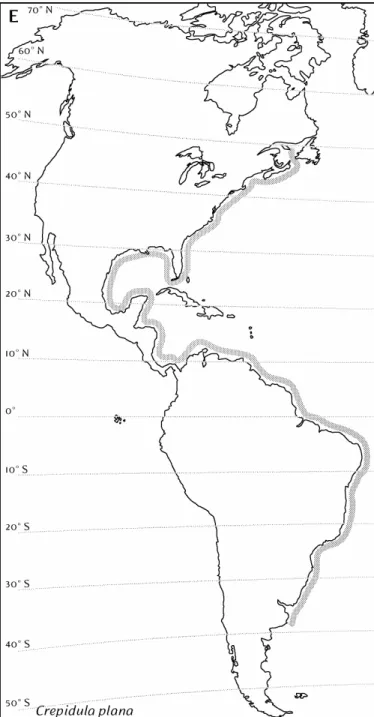
Consequently, the characteristics analyzed in this study are primarily limited to the adult stages of the organisms. Lower salinity limit and source amount accounted for 97.2% of the total spread in the model. In addition, one of the two non-San Francisco Bay invaders, Crepidula fornicata, also clustered closely with the San Francisco Bay invaders.
When all mollusks are graphed according to their historical abundance and tolerance of low salinity, all but one (Myosotella myosotis) of the twelve San Francisco Bay invaders clustered together. In this retrospective analysis of the historic commercial oyster trade (Crassostrea virginica) between the Mid-Atlantic coast and San Francisco Bay, California, successful invaders and failed invaders were effectively distinguished based on two biological traits: 1) tolerance to low salinity and 2) historical abundance in the donor region. Despite the prolific expansion of Littorina littorea's range in the western Atlantic Ocean over the past 150 years, it has failed to invade San Francisco Bay or other parts of the Pacific coast with the introduction of oysters.
Littorina is recognized as one of the most successful and dramatic molluscan invaders of the western Atlantic. For example, in San Francisco Bay the numerical abundance of the mud snail Ilyanassa obsoleta has led to the competitive displacement of the native snail Cerithidea californica (Gara 1982). Geographic range, native biogeographic faunal assemblage, salinity range, and historical abundance of oyster-associated bivalves of the Western Atlantic.
Results of univariate resampling and contingency tests of independence comparing successful San Francisco Bay invaders to remaining oyster candidates. Nonindigenous aquatic species in a United States estuary: a case study of biological invasions of the San Francisco Bay and Delta. Atlas of distribution and abundance of common benthic species in San Francisco Bay, California.
Studies on a Delaware oyster community: effects of estuarine environment on associated fauna. Environmental change and evolutionary history of periwinkle (Littorina littorea) in North America. Comparison of oyster-mediated mollusc inputs to eastern Pacific and eastern Atlantic coasts.

Comparing Oyster-mediated Molluscan Introductions to the Coasts of the Eastern Pacific and Eastern Atlantic Oceans
MATHEMATICAL COMBINATIONS
The formula calculates the number of unique ways that sets of k elements can be obtained from a set containing n elements (Cohen 1990). The following example demonstrates their use when using a set consisting of 5 letters from the alphabet (n = 5). Below is a comprehensive list of the 4 letter combinations that can be derived from the 5 letter set: ABCD, ABCE, ABDE, ACDE, and BCDE.
Since the combinations of interest must include the 2-letter combination AB, these letters can be subtracted from the 5-letter set (A,B,C,D,E becomes C,D,E (n=3)). Likewise, the size of the array selected by the new array will also be decreased by 2 letters (k=4 becomes k=2). The goal is to count the number of 2-letter combinations that can be obtained from a set of 3 letters (C,D,E) so that when the 2-letter combination AB is added to each, the resulting list represents the total number of 4 .Letter combinations that include AB.
Guide to identification of marine and estuarine invertebrates - Cape Hatteras to the Bay of Fundy. Hobart (eds.), The history, present condition and future of the mollusc fisheries of North and Central America and Europe, Vol. The history, present condition and future of the mollusc fisheries of North and Central America and Europe, Vols.
Factors affecting the distribution of the introduced bivalve, Mercenaria mercenaria, in a California lagoon - The importance of bioturbation. Non-indigenous animals in the Baltic Sea: change of benthic habitats in coastal inlets and lagoons. Report on Workshop on non-indigenous species in the Baltic and Black Sea, ZIN RAS, St.
Biological Invasions: The Challenges Ahead
What has emerged over millions of years of evolutionary history can be easily and quickly destroyed. The arrival of the western Atlantic scallop, Mnemiopsis leidyi, in the Black Sea illustrates this point. Mnemiopsis leidyi was accidentally introduced there in the early 1980s, probably in the ballast water of a commercial vessel.
Between 1984 and 1990, the anchovy fishery experienced an almost complete collapse, largely due to bee jelly predation on the anchovy's planktonic food sources (Vinogradov et al. 1993, Travis 1993). Although the Black Sea was far from a pristine environment before the arrival of Mnemiopsis leidyi, the addition of this one non-indigenous species. Had the invasion of Mnemiopsis leidyi not wiped out the most important fishery in the Black Sea, at an estimated cost of $250 million in fisheries damage (Travis 1993), the news may never have appeared.
The homogenization of Earth's ecosystems and the loss of co-evolved communities can never be reversed, despite the rate of this loss. In fact, the recent launch of a new journal by Kluwer Academic Publishers, Biological Invasions, is dedicated to advancing the ecological and evolutionary understanding of the invasion process.