All rights reserved. The Southern Baptist Theological Seminary has permission to reproduce and disseminate this document in any form by any means for purposes chosen by the Seminary, including, without limitation, preservation, or instruction.
AT FIRST BAPTIST CHURCH IN WEST BEND, WISCONSIN
__________________
A Project Presented to the Faculty of
The Southern Baptist Theological Seminary
__________________
In Partial Fulfillment
of the Requirements for the Degree Doctor of Ministry
__________________
by
Steven Luke Love May 2022
APPROVAL SHEET
PROMOTING CHURCH UNITIY THROUGH THE PULPIT AT FIRST BAPTIST CHURCH
WEST BEND, WI
Steven Luke Love
Read and Approved by:
__________________________________________
Michael E. Pohlman (Faculty Supervisor)
__________________________________________
Joseph C. Harrod
Date______________________________
I dedicate this project to my wife who has supported me and listened to more of my preaching than anyone else, and to my father who through years of watching I learned
what it meant to be a pastor.
TABLE OF CONTENTS
Page
LIST OF TABLES ... vii
PREFACE ... viii
Chapter 1. INTRODUCTION ...1
Context ...1
Rationale ...4
Purpose ...6
Goals ...6
Research Methodology ...7
Definitions and Limitations/Delimitations ...9
Conclusion ...10
2. A BIBLICAL FOUNDATION FOR A PHILOSOPHY OF MINISTRY FOR THE LOCAL CHURCH ...12
The Purpose of the Church: Matthew 28:16-20 ...13
The Practices of the Church: Acts 2:42-47 ...20
The Principles of the Church ...27
The Plan for the Church ...33
Conclusion ...39
3. ANAYLSIS OF CONTEMPORARY MINISTRY MODELS ...41
Page
Nine Marks of a Healthy Church ...42
Simple Church ...48
Sticky Church ...52
The Trellis and the Vine ...57
What is the Mission of the Church? ...62
Summary of Findings ...65
Conclusion ...67
4. DETAILS AND DESCRIPTION OF THE PROJECT ...68
Preparation and Evaluation ...69
Implementation ...71
Reassessment ...78
Conclusion ...79
5. PROJECT EVALUATIONS AND CONTINUATIONS ...81
Evaluation of the Project’s Purpose ...81
Evaluation of the Project’s Goals ...84
Strengths of the Project ...92
Weaknesses of the Project ...93
What I would do Differently ...96
Theological Reflections ...98
Personal Reflections ...101
Conclusion ...102
Appendix 1. PHILOSOPHY OF MINISTRY SURVEY ...103
2. PHILOSOPHY OF MINISTRY SURVEY RESULTS ...109
3. PREACHING PHILOSOPHY OF MINISTRY RUBRIC ...112
4. PHIILOSOPHY OF MINISTRY EVALUATION RUBRIC ...115
Appendix Page 5. PHIILOSOPHY OF MINISTRY FOR FBCWB ...117 6. PRE AND POST PHILOSOPHY OF MNISTRY SURVEY COMPARISON ..119 BIBLIOGRAPHY ... 120
LIST OF TABLES Table
1. Sermon Assessment Scores………87
2. Philosophy of Ministry Evaluation………89
PREFACE
At the core of this project is the desire to see the local church faithfully bring glory to God, so it is fitting that I begin by expressing my thankfulness to God for his gracious work in my life through the gospel to bring me to this point. I am grateful to my Lord for the gift of many churches that have impacted my spiritual life, and the
opportunity to serve him by serving the local church.
Second, I thank the Lord for the many individuals he used as conduits of grace and instruction in my life. My eyes and heart began to be opened to the importance of a philosophy of ministry when, as an assistant pastor, I took a course from Dr. Mark Farnham on the subject. This class whetted my appetite for pursuing my MDiv, and I’ve continued to see the impact of the philosophy of ministry on display through the churches I have been gifted to attend and pastor. Dr. Mark Farnham and Dr. Brian Trainor have mentored me while Nathan Gearhart and Tim Miller have guided my walk with God through an invaluable gift to a pastor of friendship. My family has given me the gift of time and support in a busy season of life. My supervisor, Dr. Michael Pohlman, has given me time, instruction, encouragement and not neglected to aid in helping me personally in this process. I’m thankful for SBTS for offering a doctorate in Expository Preaching and further shaping and instructing me in two areas I am passionate about—expository preaching and the philosophy of ministry within the church.
Luke Love West Bend, Wisconsin
May 2022
CHAPTER 1 INTRODUCTION
The purpose of First Baptist Church in West Bend, Wisconsin (FBCWI) has been exalt God, equip saints, and evangelize the world. This purpose, along with the doctrine of the church, provides the foundation for the unity of the church. Unity of the church is a prevalent theme in the New Testament. Paul’s desire for the church at Corinth is perfect unity of mind and thought (1 Cor 1:10). Also, the church of Ephesus was called to maintain the unity of the Spirit and to grow into unity (Eph 4:1-16). The unity of the church has internal benefits as it strengthens the church body, and it has external benefits as it validates the gospel to the community. This project serves to encourage the unity of FBCWB through developing and teaching a philosophy of ministry that flows from the church’s doctrine.
Context
The broad context of this ministry project is FBCWB. FBCWB is an
Independent Fundamental Baptist church that has been ministering the gospel in the West Bend community for over six decades. Like other churches, the ministry of FBCWB is multifaceted and needs to grow in many areas, but the aim of this project is to develop and preach a philosophy of ministry in order to promote a unified direction for FBCWB.
Every church has a philosophy of ministry. Some are formed and faithfully guide ministry; others are formed and forgotten as they are added to the pile of unused church documents. Other philosophies of ministry simply exist in the unwritten rules of the church’s culture and show up only when they have been offended by unsuspecting new pastors.
For FBCWB, its philosophy of ministry has not been officially developed, so the void has been filled with tradition from years gone by, ideas from new members, and passions from different leadership within the church. This conglomeration of ideas produces confusion about how ministries should take place in the church and conflict, at times, as different ministries of the church function with various guiding principles. The confusion and conflict have come to the surface recently because of several changes that FBCWB has undergone over the past five to ten years, including a continuing movement away from the church’s historical roots as hyper-fundamental, shifts within the leadership of the church, and a recent influx in the membership of the church from diverse church backgrounds. These changes are the direct context of this ministry project as they
illustrate the need and opportunity for developing and preaching a philosophy of ministry in order to promote a unified direction for FBCWB.
FBCWB was planted as an Independent Fundamental Baptist church, and the foundation of the fundamentals of the faith provide a biblically solid theological
foundation to build a philosophy of ministry from. The church has consistently embraced fundamental doctrines of the faith such as (1) the inspiration and inerrancy of Scripture, (2) the deity of Jesus Christ, (3) the substitutionary death of Christ, (4) and the virgin birth of Jesus. These fundamentals provide a unity for the church.
Where the roots of fundamentalism (or what could be classified as hyper- fundamentalism) cause struggle for a consistent philosophy of ministry is in the remnant of thinking that elevates personal standards, tertiary issues, or certain ministries to the level of the fundamentals of the faith. FBCWB has moved past its early days of signs in the church’s lobby telling women who were not wearing skirts that they were not welcome in the church building, but the elevation of personal standards to a degree of separation is still ingrained in many within the church, dictating what they view as a priority of the church. The battles over the King James Version of the Bible are far enough in the past that they are not an issue anymore that threatens the unity of the
church, but the issue still impacts ministry partnerships. For a significant portion of the church, it is teaching from past years that impacts their thinking about ministry and the church, teaching that a certain ministry or a certain way ministry happens is the only way the church should do ministry. Therefore, we are still functioning with values and
practices that no longer reflect the current state of FBCWB.
The polity of FBCWB has always been and is currently congregational with spiritual leadership from the pastors. For the vast majority of the history of FBCWB the pastoral leadership of the church has been held by one pastor. It is far easier to have a consistent philosophy of ministry being communicated to the church when there is only one pastor doing all the communication and direction of ministry. The result of this single pastor leadership was a philosophy of ministry that was never stated but consistently modeled and taught by the lone pastor. In the last five years FBCWB has transitioned from a single pastor to having a team of pastors. The pastors enjoy doctrinal unity, but without a clear philosophy of ministry to unify them, each pastor has proceeded with ministry in his specific ministry context guided by differing sets of values and principles.
Finally, in the past few years, God has brought an influx of new members and attenders into FBCWB. Currently fifty percent of the congregation is new to the church within the last seven years. This has created a large group of about 100-125 people arriving with new ideas and carrying with them an expectation of how a church should function and how ministry should take place. Digging in further to the group of new attenders reveals that even within those new individuals, there is no set agreement about how the church should function. The influx of new individuals into the church have come from the range of Independent Fundamental Baptist, Southern Baptist,
nondenominational, Methodist, Presbyterian, and Lutheran churches. This diversity of church backgrounds and experiences means that there is little overlap in the church body regarding the nature of the church and philosophy of how ministry should take place. The church may all use the same vocabulary such as discipleship, worship, glory of God,
community, etc., but struggle because individuals in the church are picturing various definitions for each of those words. Even with the diversity, there is unity in the church through a shared belief in the fundamentals of the faith and a passion for sound
expositional preaching, but the church has a lack of understanding and unity concerning the principles that will guide the ministries of FBCWB in the years ahead.
Rationale
The church’s doctrinal statement expresses the foundational beliefs that the church adheres to. Does the church embrace the inspiration and sufficiency of Scripture?
Does the church believe in substitutionary atonement? Does the church hold to a continuation of miraculous gifts? The answers to these questions and any other beliefs that are necessary for fellowship with the church will have a place in the church’s doctrinal statement.
On the other hand, the methodology of a church is how ministry in the church takes place. The methodology of the church would be the programs that fill in the time slots of the church calendar and the organic relationships that are encouraged in the church. The methodology of the church would include the small groups, evangelistic events, services, and whatever new ministry that is formed.
The final piece is the philosophy of ministry, which Tim Keller calls a
theological vision that occupies, “the middle space between doctrine and methodology.”1 A philosophy of ministry comes from the principles that direct the church in how
ministry will take place. If methodology in the church is the answer to the question what we do, philosophy of ministry is the answer to the question why and how we do it.
Methodologies may change over time as a church grows or the culture around the church changes, but the philosophy of ministry should remain the same and provides direction
1 Tim Keller, Center Church: Doing Balanced, Gospel-Centered Ministry in Your City (Grand Rapids: Zondervan, 2012), 17.
for how ministry will take place even if it takes on different shapes as the church enters new stages of life.
The word “occupies” is important within Keller’s definition because a
philosophy of ministry may simply occupy the gap between doctrine. For a philosophy of ministry to occupy only the middle space means that when the ministry of the church is considered, what is turned to is not the church’s doctrine; but to questions such as will this new ministry grow the church, will the influential individual in the church disprove of it, or the guiding statement of many churches—have we ever done it that way before.
The result of this type of thinking is that the philosophy of ministry is connected to pragmatism, traditionalism, and the pull of prominent individuals in the church. The methodologies that flow out of these philosophies of ministry may not be inherently unbiblical, but they are potentially dangerous because the doctrine does not shape the church.
Doctrines are not truths that are only necessary to complete a doctrinal
statement, pass a test, or get an “amen” when mentioned in a sermon. Doctrines are truths that shape life and church life. Charles Ryrie points to the essential connection between doctrine and actions by saying, “All doctrine is practical, and all practice must be based on sound doctrine. Doctrine that is not practical is not healthy doctrine, and practice that is not doctrinal is not rightly based.”2 So a philosophy of ministry should not simply occupy the middle ground between doctrine and methodology; it should also flow from or be built off the doctrines of the church. For FBCWB to be faithful to what it holds as core beliefs, a philosophy of ministry needs to be developed that flows from the doctrine of the church.
Saying that a philosophy of ministry needs to flow from the doctrine of the church is enough to satisfy the need for faithfulness to Scripture, but there is still a need
2 Charles Ryrie, Balancing the Christian Life (Chicago: Moody Press, 1969), 66.
for unity. The error that has hurt the unity of FBCWB is assuming that because individuals embrace the same doctrinal positions and know the stated purpose of the church, that those beliefs will lead to each individual filling in the how the church goes about ministry. The philosophy of ministry blank though can be filled in different ways by individuals who share the same purpose and doctrine. These differences are the root of so many conflicts and misunderstandings within churches. Therefore, in order to promote unity within FBCWB a clear philosophy of ministry needs to be formed and taught to the congregation, or the church runs the risk of being fractured and disenfranchising
individuals within the church. The hope is that by creating and teaching the church a philosophy of ministry that is built from the doctrine of the church, the church will be able to have the guidance to be unified in how they view the church and ministry, purposeful in how they minister, and consistent in how they evaluate ministries.
Purpose
The purpose of this project was to promote unity in the church through preaching a clear philosophy of ministry which is grounded in the doctrine of First Baptist Church, West Bend, Wisconsin.
Goals
The following goals guided the process of unifying the ministries and focus of FBCWB through a clear philosophy of ministry. These four goals progressed through the process of developing, communicating, and implementing a philosophy of ministry.
1. The first goal was to assess the current understanding and opinions of FBCWB concerning the purpose and practice of the church.
2. The second goal was to develop and preach a series of sermons that presented the purpose of the church and how to reach that purpose.
3. The third goal was to develop a philosophy of ministry that incorporates a purpose for the church, principles and priorities that will direct how ministry will take place, and the practices the church will utilize to strive to be faithful to its purpose.
4. The fourth goal was to reassess the current understanding and opinions of FBCWB concerning the purpose and practice of the church.
When these goals were successfully met, FBCWB has implemented a philosophy of ministry into the culture of FBCWB that provides a direction that will create more and more unity in the church in the years to come.
Research Methodology
There are four goals that directed the implementation of a unifying philosophy of ministry for FBCWB. The first goal was to assess the current understanding and opinions of FBCWB concerning the purpose and practices of the church. This goal was measured by conducting a survey of the congregation.3 This survey gathered information concerning the church body’s view of the purpose and ministries of the local church and the role of pastors and church membership to reach that purpose.4 In order for the survey to be helpful in providing an accurate assessment of the congregation’s views, a
substantial number of surveys were needed to be completed. Therefore, this first goal was considered successfully met when fifty percent of the attending adults of FBCWB had completed the survey, and the results were compiled and analyzed to gain a greater understanding of the current opinions of FBCWB regarding their philosophy of ministry.
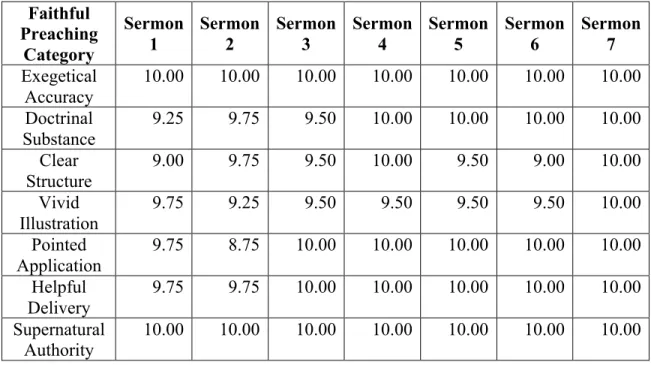
The second goal was to develop and preach a seven-week series of sermons that presented the purpose of the church and how to reach that purpose. This step was crucial to the unity of the church as it is the preaching ministry that is the primary means to teach the entire church body. This goal was measured by a panel consisting of eight ministry leaders in FBCWB who used a rubric to evaluate the exegesis, application, and delivery of the sermon series.5 This goal was considered successfully met when a
3 See appendix 1.
4 The instruments used in this project were approved by the Ethics Committee.
5 See appendix 3.
minimum of ninety percent of all the rubric evaluation indicators met or exceeded a ranking of eight or above.
The third goal was to develop a philosophy of ministry that incorporates a purpose for the church, principles and priorities that will direct how ministry will take place, and the practices the church will utilize to strive to be faithful to its purpose. This philosophy of ministry focused on the theology of church and church ministry as a whole but also provided a framework that can shape individual ministries so as to lead to a consistency within the ministry of FBCWB. A group of ministry leaders of FBCWB evaluated this goal by using the Philosophy of Ministry Evaluation Rubric to assess the philosophy of ministry’s clarity, its contextuality to the ministries of FBCWB, and its consistency with Scripture and the church’s doctrinal statement.6 The third goal was considered successfully met when the feedback from the panel of ministry leaders resulted in a minimum of eighty percent of all the rubrics’ evaluation criterion met or exceeded the “agree” level on the rubric.
The final goal was to reassess the current understanding and opinions of FBCWB concerning the purpose and practices of the church. In order to gain an understanding of the church’s understanding and acceptance of the philosophy of
ministry, the original survey was distributed to the congregation a second time. This goal was considered successfully met when fifty percent of the attending adults of FBCWB had completed the survey, and the results were compiled and analyzed to gain a greater understanding of the adjusted opinions of FBCWB regarding their philosophy of ministry.
6 See appendix 4.
Definitions and Limitations/Delimitations
The following definitions are the key terms that are used in the ministry project:
Expository preaching. Expository preaching can simply be defined as preaching in which the main point of the text is the main point of the sermon. Haddon Robinson provides the following definition that guides this project’s understanding of expository preaching, “Expository preaching is the communication of a biblical concept, derived from and transmitted through a historical, grammatical, and literary study of a passage in its context, which the Holy Spirit first applies to the personality and
experience of the preacher, then through the preacher applies to the hearers.”7
Philosophy of ministry. The term “philosophy of ministry” often gets used interchangeably with terms such as “purpose,” “vision,” and “value statement.” Simply, a philosophy of ministry is the principles that direct the church in how ministry will take place. This project will utilize David Doran’s fuller definition of a philosophy of ministry which is, “A statement of a ministry’s purpose for existence, the principles by which it operates, and the priorities of ministry which it pursues through careful planning and disciplined practices.”8
This project was limited in two ways. First, the accuracy of the survey of the congregation was dependent upon the willingness of the congregation to respond to the survey and upon the willingness of the respondents to be honest about their
understanding and opinions about the church and ministry within the church. To mitigate this limitation, the surveys were available over a three-week period to make completing the survey easier. Also, respondents were assured that their answers would remain
7 Haddon W. Robinson, Biblical Preaching: The Development and Delivery of Expository Messages (Grand Rapids: Baker Academic, 2001), 21.
8 David Doran, “Developing and Implementing a Course on Philosophy of Church Ministry for a Baptist Seminary” (DMin project, Trinity Evangelical Divinity School, 1992), 33.
anonymous. Second, the effectiveness of communicating and instructing of the
philosophy of ministry was limited by the consistency of the attendance of the church to the seven week preaching series. This sermon series occurred during the Sunday morning service, which is the time that the majority of the church comes together to worship. Even though the majority of the church gathers for the morning service, there will always be individuals who choose not to attend or are unable to be a part of the service due to other ministries happening during that time. To mitigate this limitation, each sermon was streamed live and made available for viewing on the church’s website.
Two delimitations were placed on the project. First, the project developed a broad philosophy of ministry for the entire church, not philosophies of ministry for each ministry within the church. Each ministry was evaluated to determine how it aligns with the broad philosophy of ministry, and this process may lead to specific ministries developing their own philosophy of ministry in the future. The extent of this project, however, did not require that development. Second, this project was scheduled to be completed in a six-month time frame. This six-month period gave adequate time to conduct the surveying of the congregation, develop the philosophy of ministry, preach the philosophy, and conclude the individual ministry evaluations.
Conclusion
A philosophy of ministry will not address every aspect of the church’s activity, but it will provide the church’s foundational beliefs, purpose, practices, and priorities that will guide the church. This philosophy of ministry then can unite the church by giving the church a clear and united direction and definition of success. The weight of what the church is as the Bride of Christ and what the church has been called to do in equipping believers and sowing the gospel, warrant that the church be faithful to Scripture not just in its beliefs but also in its philosophy of ministry. The following chapters focus on the
Scriptural foundation for a philosophy of ministry and an evaluation of the contemporary resources that can assist the local church in implementing a philosophy of ministry.
CHAPTER 2
A BIBLICAL FOUNDATION FOR A PHILOSOPHY OF MINISTRY FOR THE LOCAL CHURCH
If a philosophy of ministry provides the principles that direct how ministry will take place in the church, the question arises—where should those principles be derived from? Market research, tradition, ministry trends, and numeric growth focused ministry plans are all popular places to turn for forming principles that set the direction of
ministry. Fundamentally though, each of these starting points for a philosophy of ministry is flawed because each begins with man and builds the ministry of the church from man’s perspective or desires. The church is Christ’s possession (Acts 20:28), so his Word should be the authoritative foundation for a philosophy of ministry. This is why professor and pastor David Doran states, “The Word of God is the only authoritative source for developing a philosophy of ministry. All other data which is brought to bear upon the mission of the church are hypothesis which must be tested against the certain truth of God’s Word.”1
Even though God’s Word is the only authoritative source for developing a philosophy of ministry, God’s Word provides a substantial amount of latitude when it comes to how ministry is done in the church. There is not a how-to section in the Bible spelling out instruction on running a prayer meeting, organizing children’s ministries, determining suitable evangelism practices, or any number of ministry questions.2 The
1 David Doran, “Developing and Implementing a Course on Philosophy of Church Ministry for a Baptist Seminary” (DMin project, Trinity Evangelical Divinity School, 1992), 10-11.
2 George J. Zemek, Doing God’s Business God’s Way: A Biblical Theology of Ministry (Eugune, OR: Wipf & Stock, 2004), xi.
lack of clear step by step instruction in God’s Word for ministry though does not mean that God’s Word is silent in its authoritative position over the church. God’s Word provides the foundation for a philosophy of ministry by delivering the biblical purpose of the church, practices to accomplish the purpose, doctrines that guide the implementation of the practices, and the plan for accomplishing the purpose.
The Purpose of the Church: Matthew 28:16-20
Purpose is the starting point for a philosophy of ministry because it is purpose that establishes the direction. If a church’s purpose is numerical growth that is what it is aiming for, and that specific purpose will shape how decisions are made and how the church fills its calendar. A very different purpose some churches have is the nostalgic purpose of maintaining its beloved practices. That purpose will lead to very different decisions and schedules from the church whose purpose is numerical growth. The foundational nature of the purpose makes it essential that churches allow God’s Word to establish the purpose of the church, so that the church functions as Christ, the head of the church, intends.
To push the church to God’s Word for its God given purpose though is still a broad starting point. Jonathan Leeman delineates two main groups of thinking regarding the purpose of the church. One group of thinking sees a broad purpose for the church that focuses on making disciples and being disciples, and another group of thinking sees a narrow purpose of simply making disciples.3 Christopher Wright is a proponent of a broader view of the mission of the church as he sees the mission as, “our committed
3 According to Jonathan Leeman, “On the whole, the voices carrying on conversation about the church’s mission tend to characterize that mission in either broad or narrow terms. Broad definitions will pack into the church’s mission everything that Scripture enjoins of Christians—like stewarding the earth, pay taxes, or loving one’s spouse. Narrow definitions insist on some kind of distinction between the individual Christian and the church, and then argue that not everything enjoined of individual Christians is enjoined of the church. The church’s mission depends upon a subset of the biblical commands. Its
corporate mandate is narrower.” Jonathan Leeman, “Soteriology Mission: Focusing in on the Mission of Redemption,” in Four Views on the Church’s Mission, ed. Jason Sexton (Grand Rapids: Zondervan, 2017), 17-18.
participation as God’s people, at God’s invitation and command, in God’s own mission within the history of God’s world for the redemption of God’s creation.”4 Defining the mission of the church as broadly as Wright does though assumes that everything that God does toward his purpose of redemption of his creation, the Christian is tasked with as well; and it assumes that everything Christians are called to be, the church should be as well.5
These assumptions though do not take into consideration the unique creation that is the church. Jesus has given authority and called the church as an organization to certain actions that the individual Christian is not called to. For instance, in Matthew 18 the church is called to the practice of church discipline as a part of its ultimate purpose.6 The individual Christian has no command, authority, or ability to discipline an individual as Matthew 18 prescribes. Therefore, the church has been given a unique purpose, and to see that purpose one simply needs to ask, what has Christ specifically sent his church to accomplish? The answer to that question is found at the end of Jesus’s earthly ministry in the passage that is now called the Great Commission when Jesus sends his followers to make disciples. Admittingly there are other passages in Scripture that provide purpose for the Christian, but the unique nature of the post-resurrection commission passages carry a unique weight in determining the purpose of the church because their placement right
4 Christopher J. H. Wright, The Mission of God: Unlocking the Bible’s Grand Narrative (Downers Grove, IL: IVP Academic, 2006), 23.
5 Kevin DeYoung and Greg Gilbert, What Is the Mission of the Church? Making Sense of Social Justice, Shalom, and the Great Commission (Wheaton, IL: Crossway, 2011), 41.
6 Jonathan Leeman states, “If you therefore want to know what the mission of the church is, ask whom has God authorized to do what. What we will discover is that God has authorized the church as an organized collective with a priestly authority to do a priestly job, while he has authorized every member of the church with a kingly authority to do a kingly job. . . . Broadly, God sends every member of a church to do what Adam failed to do: represent him in kingly fashion as his dominion-establishing, God-imaging
‘sins.’ . . . Narrowly, God sends the church-as-organized-collective to make disciples or citizens, not just with words but with a particular kind of priestly words—adjudicatory declarations of binding and loosing.”
Jonathan Leeman, “Soteriology Mission” 20.
before Christ’s accession and this commission set the direction for the actions of the early church.
Although aspects of Jesus’s sending are found in five passages (Matt 28:18-20;
Mark 16:15-18; Luke 24:45-49; John 20:21-23; and Acts 1:8), only the Matthew 28 passage will be looked at in detail to see specifically what Jesus sent his followers to accomplish. The Great Commission passage in Matthew occurs as the final event
recorded in Matthew’s Gospel. In comparing the other four accounts of Jesus sending out his followers after the resurrection and before the ascension, it is clear that what Matthew records is a repeated message by Jesus during this time.
In just considering the setting of the passage an important question arises—to whom is Jesus addressing the Great Commission? This question is vital because if Jesus directed the command only to a select group of his followers, then the argument can be made that the application of this passage does not have direct connection to the purpose of the church and can extend only to the specific individuals Jesus sent at that specific time. Verse sixteen provides a seemingly clear answer to the question of audience as it says that the eleven disciples proceeded to the mountain in Galilee that Jesus had instructed them to go to and then received Jesus’s instructions.
A closer look at the passages though appears to point to other individuals being present and receiving Jesus’s instructions. Verse seventeen references two groups of people by saying, “And when they saw him they worshiped him, but some doubted.”7 D.
A. Carson points out that the “but some” is referring to individuals other than the disciples because “hoi de, here as in 26:67, means ‘but some,’ in contrast with those already mentioned, rather than ‘but they.’”8 Seeing two groups present in this passage
7 Unless otherwise noted, all Scripture quotations comes from the English Standard Version.
8 D. A. Carson, Matthew in, The Expositor’s Bible Commentary, vol. 8, Matthew, Mark, and Luke, ed. Frank Gaebelein (Grand Rapids: Zondervan, 1984), 593.
makes sense with the second group not joining in the worship but doubting. It is difficult to picture some of the eleven disciples hesitating to worship or doubting the risen Christ after they had already witnessed the risen Christ and, at that time, believed (Luke 24:10- 11 and John 20:24-29). Logically the group doubting at this moment fits better with the group of more than five hundred that witnessed the risen Christ which Paul references (1 Cor 15:6).9
The strongest indicator that the application extends beyond the eleven disciples and to the entire church is the duration of Jesus’s promise at the end of verse twenty.
Jesus promised that he would always be with them, but then places a far-reaching expiration date on the promise by saying that the promise lasts to the “end of the age.”
Kevin DeYoung and Greg Gilbert point out the significance of this promise by saying,
“Such a far-reaching guarantee would not have been necessary if Jesus envisioned the apostles fulfilling the Great Commission. But a promise to the end of the age makes perfect sense if the work of mission also continues to the end of this age. Jesus’s promise extends to the end of the age just as his commission does.”10 Therefore, what Jesus sends his followers to do in Matthew 28 reaches beyond the eleven disciples, or even the five hundred witnesses, and to the church as a whole; and, therefore, the purpose of the church can be found in the Great Commission.11
Before Jesus gives the imperative of the passage, the grounds to give the imperative is established. It is Jesus’s authority to command that gives absolute weight to the command and the confidence that obedience to the command will be fruitful. Jesus
9 Leon Morris, The Gospel According to Matthew, The Pillar New Testament Commentary (Grand Rapids: Eerdmans, 1992), 745.
10 DeYoung and Gilbert, What is the Mission of the Church? 46-47.
11 Another aspect to consider when seeing the reach of the Great Commission is the outworking of Christ’s call throughout the book of Acts. More than just the eleven disciples followed Christ’s command from Matthew 28. For instance, it was Philip who began the gospel work to the Samaritans in Acts 8.
declares that all authority in heaven and on earth had been given to him. Jesus having divine authority is not a new concept within the gospels. Jesus has already demonstrated on several occasions divine authority over creation (Luke 8:22-25), sin (Mark 2:1-12), and demonic forces (Luke 8:26-39). What is different in Jesus’s declaration of authority is the sphere of his authority. His absolute authority includes the entire universe—all earth and heaven.12 This exalted position of Jesus Christ fits with other Christologically focused passages such as Philippians 2:6-11 where Christ’s authority reached to everyone in heaven, earth, and under the earth.13 This absolute authority of Jesus Christ leads to his ability to send out his disciples, but it also provides the glory of God as the
overarching purpose of the church. The glory of Christ and the task of making disciples cannot be separated as it is the authority of Christ that leads to the power to make disciples, and making disciples produces more worship of Christ as these new disciples are obedient to Christ’s teaching. Therefore, whatever the purpose of the church entails, it must be encompassed by the glory of God.
Directly building off of Jesus’s proclamation of universal authority, Jesus gives the command to go and make disciples of all nations by baptizing them and teaching them to obey Christ’s teaching. The first element of this command that causes struggle is understanding the participle πορευθέντες. One option is to translate the word as “having gone” or “as you go” because it is an aorist participle.14 Colin Marshal and Tony Payne explain how this translation of the particple πορευθέντες impacts the thrust of Christ’s words:
Traditionally . . . this has been read as a missionary mandate, a charter for sending out gospel workers to the world. . . . But the emphasis to the sentence is not on
12 Carson, Matthew, 594.
13 David L Turner, Matthew, Baker Exegetical Commentary of the New Testament (Grand Rapids: Baker, 2008), 689.
14 Robert D. Culver, “What is the Church’s Commission? Some Exegetical Issues in Matthew 28:16-20,” Bibliotheca Sacra 125 (1968): 244.
“going.” In fact, the participle is probably better translated “when you go” or “as you go.” The commission is not fundamentally about mission out there somewhere else in another country. It’s a commission that makes disciple-making the normal agenda and priority of every church and every Christian disciple.15
Marshal and Payne are correct in noting that the emphasis in the sentence is not the participle πορευθέντες. The main thrust of the sentence is the sole imperative in the passage, μαθητεύσατε. The participle πορευθέντες, though, is better understood as a participle of attendant circumstance which gives the word the imperatival force of, go.16
Benjamin Merkle shows the grammar of the passage supports translating this participle with imperatival force but also points out that, “In Matthew’s Gospel, every instance of the aorist participle of πορεύομαι preceding an aorist main verb is clearly attendant circumstance.”17 So the first part of Jesus’s command involves the purposeful action of going, and the prepositional phrase, “of all nations” provides the direction for the going.18 It is fitting that a Savior who has all authority gives instruction that
encompasses all nations. That instruction to go to all nations stands in contrast to the instruction of Jesus to remain in Jerusalem until they received the Holy Spirit (Luke 24:49), but after the initial pause of waiting in Jerusalem, the New Testament shows faithful obedience to the call to go purposefully to the nations for the sake of the gospel.19
15 Colin Marshall and Tony Payne, The Trellis and The Vine (Kingsford, Australia: Mattias Media, 2013), 11.
16 Benjamin L. Merkle, “Why the Great Commission should be Translated ‘Go!’ and Not ‘As You Go” Southeastern Theological Journal 9, no. 2 (Fall 2018): 22.
17 Merkel, “Why the Great Commission,” 28.
18 R. T. France states, “The phrase panta ta ethne, ‘all the nations,’ has occurred already in 24:9, 14; 25:32 to denote the area of the disciples’ future activity, the scope of the proclamation of the
‘good news of the kingdom,’ and the extent of the jurisdiction of the enthroned Son of Man. In each case we have seen that the emphasis falls positively on the universal scope of Jesus’ mission rather than
negatively on ‘Gentiles’ as opposed to Jews.” R. T. France, The Gospel of Matthew, The New International Commentary of the New Testament (Grand Rapids: Eerdmans, 2007), 1114.
19 The call to “go” does not mean that every individual Christian is called to go. Romans 15 shows how this command was obeyed in the early church. The apostle Paul shared his burden to take the gospel to Spain, but the church at Rome is not called to go with him. Their role in obeying the command to
“go” was to support him in his going to Spain.
The main focus of Matthew 28:16-20 is the command to “make disciples.”
This command of Jesus infers that the foundational task of evangelizing takes place, but the command to make disciples means that following the Great Commission does not end with evangelizing. To be a disciple of Jesus has already been defined by Jesus in
Matthew’s Gospel. In Matthew 12:46-50, Jesus defined disciples as those who receive and obey his teachings.20 This definition of disciple fits Jesus’s instruction in Matthew 28 as he elaborates what is included in making disciples by instructing that it includes baptizing and teaching for obedience. To make disciples then includes ministry of Jesus’s gospel for the sake of salvation and sanctification. This full definition of making disciples corrects a sad reality of many ministry and missionary efforts that are content with
sowing the gospel message and hoping for professions of faith but not straining for fruitful, obedient, and mature disciples of Jesus Christ who are equipped to continue on with the task of the Great Commission.21
The Great Commission presents the church’s purpose as making disciples by going to all nations and under the umbrella of Christ's authority and for his glory.
DeYoung and Gilbert provide a fuller purpose of the church based on the Great
Commission: “The mission of the church is to go into the world and make disciples by declaring the gospel of Jesus Christ in the power of the Spirit and gathering these disciples into churches, that they might worship the Lord and obey his commands now and in eternity to the glory of God the Father.”22 At FBCWB the previous purpose statement is to exalt God, equip saints, and evangelize the world. This purpose statement
20 Carson, Matthew, 596.
21 Grant Osborne, Matthew, Zondervan Exegetical Commentary of the New Testament (Grand Rapids: Zondervan, 2010), 1084.
22 DeYoung and Gilbert, What is the Mission of the Church? Making Sense of Social Justice, Shalom, and the Great Commission, 62.
is consistent with the purpose Jesus gave in Matthew 28 and provides the first building piece needed for a biblical philosophy of ministry.
The God given purpose of the church, making disciples for God’s glory, must remain the uncompromised focus of the church. In order to be faithful to Jesus Christ, it is that purpose that has to drive the church to a singularly motivated action and to resist the passive purpose drift or self-serving purposes that can creep into the church. The sobering alternative for the church is to profess to be the Bride of Christ but be negligent in Christ’s ordained purpose and waste the opportunity to bring God glory through the eternally significant task of making disciples of our exalted Christ.
The Practices of the Church: Acts 2:42-47
Scripture has provided the purpose for the church’s philosophy of ministry.
Like the preparation for a road trip, the church knows its destination, but like any road trip the church needs to determine what route it is going to take to reach its destination.
Churches are often tempted to discover new and seemingly quicker short-cuts to reach the destination, and so they turn to brainstorming and innovating or simply copying what another successful church has done.23 But the Scriptures that provided the purpose of the church, also provide the practices or directions to accomplish the purpose.
Those who received Christ’s instruction to make disciples obeyed that
instruction, and the book of Acts is filled with examples of how the early church obeyed the command to make disciples as they proclaimed the gospel, formed churches, and ministered the gospel in those churches. The Epistles continue this theme of making disciples by providing instruction and admonishment about making disciples and becoming a mature disciple.24 In the totality of all these passages, Scripture provides a
23 Mark Dever and Paul Alexander, The Deliberate Church: Building Your Ministry on the Gospel (Wheaton, IL: Crossway, 2005), 20.
24 Doran, “Developing and Implementing,” 72.
blueprint for how the church is to go about making disciples. There is not one passage that lays out the entirety of the practices or ministries for accomplishing the purpose of the church, but Acts 2:42-47 does have, as Professor John Hammett states, “a
paradigmatic importance in that it describes how the church at this early stage was faithful to its purpose of making disciples.”25
Acts 2:42-47 is situated on the opposite side of Christ’s ascension from the Great Commission. With the miraculous events of Pentecost still reverberating through Jerusalem and thousands of newly baptized converts being added to the church, this infant church devoted themselves to what John MacArthur calls, “the basic ingredients of church life.”26 These ingredients or practices are more than describing unique practices of the Jerusalem church, because these practices can be seen practiced by churches and instructed by apostles throughout the New Testament as the foundational way to carry out the purpose of the church to make disciples.
There are different ways to break up these basic ingredients of church life.
Steve Lawson sees six major components in the early church. He sees Acts 2:42-47 showing the apostles’ teaching, fellowship, worship, prayer, service, and evangelism as major parts of the early church.27 John Hammett recognizes five ministries of the church in this passage: teaching, fellowship, worship, service, and evangelism.28 This study, although recognizing that there are other vital practices for the church, will focus on the
25 John S. Hammett, Biblical Foundations for Baptist Churches: A Contemporary Ecclesiology (Grand Rapids: Kregel, 2005), 220.
26 John MacArthur, The Master’s Plan for the Church (Chicago: Moody, 2008), 87.
27 Steve Lawson, “The Priority of Biblical Preaching: An Expository Study of Acts 2:42-47,”
Bibliotheca Sacra 158 (April-June 2001), 200.
28 Hammett, Biblical Foundations for Baptist Churches, 221.
four practices of church life in verse forty-two that the church devoted themselves to—
the ministry of the Word, fellowship, worship, and prayer.29 The Practice of the Word
The first practice that the early church devoted themselves to was the ministry of the Word through the teaching of the apostles. What all was included in the teaching of the apostles can be gleaned in part by looking at the sermons the apostles preached in Acts. The apostles’ preaching and teaching in Acts focused on the life, ministry, and substitutionary death of Jesus Christ. The apostles taught what they had witnessed and been taught by Jesus Christ.30 The word, “teaching,” used in verse forty-two, occurs about thirty times in the New Testament, and it often refers to, “the fixed body of doctrine as taught by the apostles to the church. . . . In the book of Acts διδαχῇ included the apostles’ exposition of Jesus’s words.”31
It is fitting that the church’s devotion to the apostles’ teaching is mentioned first among the practices of the church, because teaching the Word follows the example of Jesus in his ministry (Mark 1:14; Matt 7:29) as well as obeys the command of the Great Commission to teach disciples and to observe all that Jesus commanded them (Matt 28:19-20).32 Taking a step back from the church and the Great Commission, seeing the teaching of God’s Word being central to the life of the church is to be expected because it has always been God’s Word that God has used to transform his people (Gen 3:15; Exod
29 These four practices of the church are what the passage says the church specifically devoted themselves to. The other elements of the passage flow out of these four practices. The practice of serving each other in verse forty-five is an outworking of the κοινωνίᾳ in verse forty-two. The fruit of evangelism seen in verse forty-seven is the work of the Holy Spirt that he brings through the faithful ministry of the church.
30 Eckhard Schnabel, Acts, Zondervan Exegetical Commentary of the New Testament (Grand Rapids: Zondervan, 2012), 178.
31 Lawson, “The Priority of Biblical Preaching,” 207.
32 Lawson, “The Priority of Biblical Preaching,” 201-202.
20; Ezek 37:1-14; Rom 10:17; Jas 1:18).33 Steve Lawson points out the foundational aspect of the teaching ministry in the Acts 2 passage by saying, “Biblical preaching must always occupy the leading place of influence in the life of the church. At the core of any healthy congregation is a vibrant exposition of God’s Word.”34 So as the church
considers how it is going to be faithful to the purpose of making disciples, it must begin with the practice of the teaching of the Word of God.
As the church spread and grew beyond the ministry of the apostles, its teaching of the life and work of Jesus Christ continues to be foundational to making disciples. The apostle Paul shows the importance of teaching by mentioning the ability to teach as the requirement that differentiates an elder in the church (1 Tim 3:2). Paul’s instruction to Timothy is to preach the Word (2 Tim 4:2) and to pass on what he had learned to faithful men who are able to teach others (2 Tim 2:2). The importance of teaching the truth of God’s Word is also seen in the negative example of Paul’s warning the Ephesian elders that there will be some who distort the truth in order to draw away disciples from the church (Acts 20:30).
The ministry of the Word not only has a role of causing individuals to become disciples and mature in their discipleship of Christ, but it also plays a role in the church removing its recognition of the gospel in a professing disciple through church discipline.
The church at Corinth was faced with the situation of an individual in its body who was not obeying the Word of God. The one who was openly unrepentant in his disobedience to God’s Word was supposed to be removed from the church body (1 Cor 5:2). This removal from the church body shows that the mark of a true disciple of Christ is continued obedience to the teaching of the Word of God.
33 Dever and and Alexander, The Deliberate Church, 33-34.
34 Lawson, “The Priority of Biblical Preaching,” 204.
The Practice of Fellowship
The second practice that the church devoted themselves to in Acts 2:42 was fellowship. In the modern church the word “fellowship” is the dreaded word of introverts in the church because it has become connected to small talk after a service or a potluck with the church body. So to see the early church devote themselves to something as seemingly inconsequential as talking about the weather for a few minutes after a service is somewhat unexpected. What is included in this devotion to “fellowship” in the early church though is very different than how the word is often used in today’s churches. The word translated “fellowship” comes from the word κοινωνίᾳand has the meaning of
“participating or sharing something in common with another.”35 Ben Witherington draws the conclusion form the meaning of κοινωνίᾳ that, “Fellowship is not a very helpful translation, for fellowship is the result of koinia, of sharing in common. Koinia is an activity which can result in fellowship of some sort, and it can entail things like sharing not just spiritual activities such as prayer but also physical food or other goods in common.”36 Therefore, the church in Jerusalem wasn’t devoting themselves to a filled social calendar and meals, they were devoting themselves to a relationship based on what they had in common—new life in Jesus Christ empowered by the Holy Spirit.37
Fellowship, κοινωνίᾳ, holds a vital role in the church, as it is κοινωνίᾳ that draws believers away from their individualism and into a church body that Christ has built for the spiritual strengthening of the believer. It is fellowship that is the “means of sustaining and sanctifying grace” in the church, by leading those in the church to minister in such a way as to produce mature disciples through their interaction based on their
35 Hammett, Biblical Foundations for Baptist Churches, 233.
36 Ben Witherington, The Acts of the Apostles: A Socio-Rhetorical Commentary (Grand Rapids: Eerdmans, 1998), 160.
37 Jerry Bridges, True Community (Colorado Springs: NavPress, 2012), 2-3.
shared union in Christ.38 The shared relationship with Jesus Christ and empowerment of the Spirit led the early church in Acts 2 to share on a physical level as the church sold personal belongs and shared them with those in need in the body (Acts 2:44-45).
Throughout the New Testament, fellowship is seen in the one another commands to the church, such as to love one another (Rom 12:16), accept one another (Rom 14:13), serve one another (Phil 4:2), encourage one another (Col 3:16), and others. The one another outworking of κοινωνίᾳ works throughout the church in numerous relationships and ministries to help the church toward being faithful to make disciples.
Fellowship does not just work toward maturing disciples within the body;
Howard Snyder connects fellowship also to the making of disciples by saying, “Where Christian fellowship demonstrates the gospel, believers come alive and sinners get curious and want to know what the secret is. So true Christian community (koinonia) becomes both the basis and goal of evangelism.”39
The Practice of Worship
Worship is the third ministry that the church devoted themselves to in Acts 2:42. Verse forty-two says that the church devoted themselves to “breaking of bread.”At first read it is not clear what that phrase included for the early church. At the very least the church could simply be devoting themselves to shared meals together.40 The only other time that this exact phrase is used in the New Testament is in Luke 24:35, which is the two disciples’ account of Jesus breaking the bread with them after Jesus had
38 Hammett, Biblical Foundations for Baptist Churches, 234.
39 Howard Snyder, Community of the King (Downers Grove, IL: InterVarsity, 1978), 124-125.
40 There are variant readings that do not have καὶ between κοινωνίᾳ and τῇ κλάσει τοῦ ἄρτου.
The reading leads to viewing the breaking of bread as part of the κοινωνίᾳ. The study of Theron Stancil though shows that the reading with καὶ has support from the Byzantine texts as well as portions of the Alexandrain and Western text types. Stancil also supports the καὶ reading, “because it is compatible with the vocabulary that Luke uses in Acts.” Theron Stancil, “A Text-Critical Evaluation of Acts 2:42,” in Faith
& Mission 23, no. 3 (Summer 2006) 31.
completed his anonymous walk to Emmaus with them. Gathering to break bread though is connected to worship on the first day of the week in Paul’s ministry (Acts 20:7), which leads Ben Witherington to seeing that the breaking of bread was a part of their gathering of worship, “that involved eating, praying, teaching, and singing in homes, to mention but a few elements of the service.”41 It seems like the breaking of bread involved more than what is practiced for communion in many churches today, but it was also more than an ordinary meal for the church. This is consistent with F. F. Bruce’s conclusion of, “The
‘breaking of bread’ probably denotes more than the regular taking of food together: the regular observance of what came to be called the Lord’s Supper seems to be in view.”42
Seeing a fuller meaning to the phrase “breaking of bread” shows that the church in Jerusalem devoted themselves to the worship of Christ, though at the very least, the intentional remembering of Christ’s death and resurrection as Christ had instructed them to do. Their devotion to breaking of bread may also have included more aspects of worship. The practice of communion, among other acts of worship in the church, are not merely rituals to practice. All true worship beings with the truth of God and flows from hearts that have been transformed by that truth (John 4:24). The early church’s devotion to the breaking of bread was a part of their devotion to worship of God that flowed from their discipleship and was a part of their growth as mature disciples.
The Practice of Prayer
Prayer is the final practice that the church devoted themselves to in Acts 2:42.
The mention of prayer in Acts 2:42 though does not seem to be referencing a general practice of prayer as the church today would think of prayer, but to giving themselves to a specific prayer. David Peterson observes regarding prayer in verse forty-two, “The
41 Witherington, The Acts of the Apostles, 161.
42 F. F. Bruce, The Book of Acts, New International Commentary of the New Testament (Grand Rapids: Baker, 1984), 73.
plural form with the article in Greek suggests that the reference is to specific ‘prayers’
rather than to prayer in general. In the context, this most obviously points to their continuing participation in the set times of prayer at the temple.”43 The context that Peterson is referring to is that after mentioning prayer in verse forty-two, verse forty-six, mentions that the church met day by day in the temple, and the beginning of chapter three mentions Peter and John going up to the temple at the hour of prayer. So it would seem that the early church’s devotion to pray began with a carrying on of the Jewish prayers in the temple, yet throughout the book of Acts their devotion to prayer was practiced in many forms.
The early chapters of Acts show what devotion to prayer looked like as the church turned to prayer repeatedly. When decisions regarding leadership was needed, the church prayed (Acts 1:24). When their leaders were in prison, they prayed (Acts 12:5).
When they faced persecution, they prayed as a church for boldness (Acts 4:23-31). They even structured the church in a way that the apostles could devote themselves especially to prayer (Acts 5:3-6). It should not be surprising that such a devotion to prayer is present in the church, as the disciples learned the importance of prayer by observing Jesus Christ, the ultimate prayer warrior. Jesus got up early in the day for prayer time, went off into quiet places to pray, and through prayer submitted to the agony of the cross. Jesus taught the disciples to pray through lesson and practice.
The devotion of the church to prayer is connected to the purpose of the church to make disciples. Although God calls the church to make disciples, the church is merely the means by which God accomplishes the task. Prayer is connected to making disciples then because it is seeking God’s working in the advancement of the gospel which is the
43 David G. Peterson, The Acts of the Apostles, The Pillar New Testament Commentary (Grand Rapids: Eerdmans, 2009), 162.
only way true disciples will ever be made for his glory.44 Prayer is also connected to making disciples as it is prayer that reminds Christians of their complete dependance on God.
The church has a God given purpose to make disciples for God’s glory. The church though is not left in the dark about how to go about its purpose. Scripture provides the practices the church needs to accomplish its purpose. The early church models some of these practices in Acts 2:42 as they devoted themselves to the practice of the teaching of God’s Word, fellowship, worship, and prayer. These practices of ministry are not innovative church growth programs that are backed by some model church. They are, however, practices that God has provided and instructed the church to, and the church has relied on for centuries as the practices to carry out the church’s purpose faithfully.
The Principles of the Church
Scripture has provided the purpose and practices for the church’s philosophy of ministry. At this point though, in the building of a philosophy of ministry, there remains much ambiguity regarding how ministry happens in the church. The Bible that provided the purpose and the practices for the church does not spell out exactly how every practice is to take place. For instance, from Acts 2 the church knows that the practice of the Word is central to its ability to accomplish the purpose of making disciples, but what is not provided is exactly how that ministry of the Word is to be shaped. In that ambiguity there is some freedom for the church, but there is not a complete void of instruction for the church because God’s Word provides doctrine that guides the implementation of
ministry. “What you believe about God and salvation,” Jonathan Leeman claims, “should impact how you view the church and do ministry. Soteriology impacts ecclesiology.”45
44 Dever and Alexander, The Deliberate Church, 35.
45 Leeman, “Editor’s Notes,” 9Mark Journal (February 2019) 5.
Going back to the picture of a road trip, the purpose of the church is the destination of the trip, and the practices provide the directions for reaching the destination. In this
illustration, doctrine serves as the rules of the road that govern how the driving happens.
Although doctrine as a whole impacts how the church does ministry, there are certain doctrines that will have a greater impact on the formation of ministry in the church. Albert Mohler’s popular phrase, “theological triage,” helps one to understand the impact of different doctrines.46 The concept of theological triage is that there are levels of importance within theology. There are first level doctrines that hold up the Christian faith. If one of these doctrines is denied, orthodox Christian faith will have been denied.
There are also second level doctrines. These doctrines impact denominational differences.
And lastly, there are third level doctrines. According to Mohler differences on this level should not impact Christian fellowship even within a local church.47 In thinking through the impact of doctrine on the formation of ministry, it is the first and second level doctrines that the church should look to, to shape the ministry of the church. Although any number of doctrines can impact the philosophy of the ministry of the church, only two, the sovereignty of God and the sufficiency of Scripture, will be considered to illustrate that God’s Word establishes the doctrines that guide the church in the implementation of its practices for ministry. These two doctrines are going to be discussed because no matter the context that a local church is ministering in, these doctrines should have a comprehensive impact on how the church goes about the making of disciples. Specifically, the sovereignty of God will be considered because the
sovereignty of God is foundational to the church’s ability to make disciples, and the sufficiency of Scripture will be considered because it is the sufficiency of Scripture that
46 Albert Mohler, “A Call for Theological Triage and Christian Maturity,” Albert Mohler Blog, July 12, 2005, https://albertmohler.com/2005/07/12/a-call-for-theological-triage-and-christian-maturity.
47 Mohler, “A Call for Theological Triage and Christian Maturity.”
Kevin DeYoung correctly asserts is the doctrine of Scripture most forgotten by
evangelicals today.48 Forgetting the sufficiency of Scripture undermines the means God has provided for making disciples.
The Sovereignty of God: Ephesians 1:3-14
In Ephesians, Paul breaks from his normal formula of greeting and praise for beginning a letter, by opening Ephesians with a greeting and then launching into a massive doxology. Ephesians 1:3-14 is a single sentence with the main thrust being as Clint Arnold states, “There is one God who is sovereignly unfolding his plan for all of creation that includes the redemption of humanity.”49 This theme in the passage is clear as phrase after phrase presents God as the impetus behind salvation, the means of salvation, and the one deserving of praise for salvation. It is God who is responsible for salvation as the passages presents God choosing us (v. 4) and predestining us (vv. 5, 11).
God is the means of salvation as it was according to “his will” (vv. 5, 9), “the purpose of his will” (v. 9), and through “his blood” (v. 7). The motivation for God’s choosing and predestining is also found in God as it flows out of his love (v. 5) and “the counsel of his will” (v. 11). Since God is sovereign over all of salvation, then it is right that his work of salvation result in him receiving praise (vv. 6, 12, and 14).50
Although the passage as a whole shows God sovereignly working his plan for salvation, the two words, “chosen” (ἐκλέγομαι) and “predestined” (προορίζω), warrant a closer analysis because all of God’s blessing in the passage flow from these two words.
The common Greek usage of ἐκλέγομαι means to choose or to pick out, and most times
48 Kevin DeYoung, Taking God at His Word: Why the Bible is Knowable, Necessary, and Enough, and what that Means for you and Me (Wheaton, IL: Crossway, 2014), 43.
49 Clinton Arnold, Ephesians, Zondervan Exegetical Commentary of the New Testament (Grand Rapids: Zondervan, 2010), 94.
50 Arnold, Ephesians, 95.