[ Journal of Law and Economics, vol. 62 (August 2019)]
© 2019 by The University of Chicago. All rights reserved. 0022-2186/2019/6203-0016$10.00
Do Payday Loans Cause Bankruptcy?
Paige Marta Skiba Vanderbilt University
Jeremy Tobacman University of Delaware
Abstract
Payday loans are used by millions of Americans every year despite their annu- alized interest rates of several hundred percent. We provide new evidence on the consequences of payday borrowing and the determinants of personal bank- ruptcy. Using an administrative panel data set of loan records in a regression- discontinuity design, we estimate that payday loans increase personal bank- ruptcy rates by a factor of two. We assess possible mechanisms and find the most support for a novel one: payday loan access appears to induce bankruptcy filings by worsening the cash flow position of the household.
1. Introduction
Usury laws are often adopted to restrict high-interest lending such as payday loans. With annual percentage rates (APRs) of 400–600 percent, payday loans carry some of the highest interest rates available on formal credit products. De- spite this, about 10 million American households borrow using payday loans each year, and payday lenders have more storefronts in the United States than McDonald’s and Starbucks combined (Pew Charitable Trusts 2012; Lusardi and de Bassa Scheresberg 2013).
This paper contributes new evidence on both the impact of payday loan access
We would like to thank David Abrams, Ken Ayotte, Dan Benjamin, Neil Bhutta, David Card, Kitt Carpenter, Raj Chetty, Michael Clemens, Stefano DellaVigna, Ed Glaeser, Michael Greenstone, Zack Grossman, Joseph Hennawi, Joni Hersch, Mark Hoekstra, Pamela Jakiela, Kory Kroft, David Laib- son, David S. Lee, Ulrike Malmendier, Paco Martorell, Justin McCrary, Markus Mobius, Ed Morri- son, Sendhil Mullainathan, Kate Nicholson, Devin Pope, Matthew Rabin, Steve Raphael, Emman- uel Saez, Anna Skiba-Crafts, Mel Stephens, Justin Sydnor, Kip Viscusi, Maisy Wong, and Jonathan Zinman for many helpful conversations and seminar audiences at the Bank of Canada, the Federal Reserve Bank of Chicago, Harvard University, the Institute for Fiscal Studies, the London School of Economics, Oxford University, the RAND Corporation, the Wharton School of the University of Pennsylvania, Yale University, and the University of California, Berkeley, for valuable feedback.
Susan Payne Carter, Katie Fritzdixon, Jonathan Leung, Caroline Malone, John Roberts, Chandini Singh, and Molin Zhong provided excellent research assistance. We are also grateful to Elizabeth Warren for facilitating access to the bankruptcy data and to the Horowitz Foundation and a War- burg grant from the Harvard Economics Department for financial support.
and the causes of personal bankruptcy. We use an administrative panel data set from a lender and a discontinuity in the lender’s underwriting rule to study the impact of payday loans on bankruptcy filings. The administrative panel includes information about the timing, size, and locations of applications as well as demo- graphics for 145,000 applicants. Individual identifiers in the administrative data permit matching to bankruptcy petitions that are available from the Public Ac- cess to Court Electronic Records (PACER) database.
An institutional feature of the lender’s underwriting process then allows sta- tistical identification of the impact of payday loans on bankruptcy using a regression- discontinuity analysis. Payday loan applications are approved if the applicant’s credit score exceeds a fixed threshold. Regression- discontinuity anal- yses rely on unobservable characteristics not changing discontinuously at the threshold.1 With this standard identifying assumption, differences in bankruptcy rates between barely approved and barely rejected applicants can be attributed to the causal impact of payday loan access.2
Our estimates answer the paper’s title question affirmatively: yes, access to pay- day loans causes a significant increase in personal bankruptcy rates. The bench- mark point estimate corresponds to a near doubling of the annual bankruptcy rate, with other specifications ranging between increases of 21 and 185 percent.
Regression-discontinuity results can sometimes be fragile, so we show exactly how our findings depend on implementation choices, demonstrating robustness and allowing readers to focus on their preferred specifications for quantitative takeaways.
Even at the low end of the estimate range, the magnitudes we find are striking:
payday loan principals average about $300, but access has an economically sig- nificant effect on bankruptcy, a cumulative financial outcome. We therefore view the remainder of the paper, which complements the main bankruptcy impact analysis by extensively evaluating a series of possible mechanisms, as a second essential contribution. This investigation of mechanisms also contextualizes the paper within the literature on the determinants of bankruptcy.
A variety of forces have been implicated as drivers of bankruptcy-filing rates, including the pecuniary benefits of debt discharge (Fay, Hurst, and White 2002), stigma (Gross and Souleles 2002), the expansion of credit card indebtedness (Domowitz and Sartain 1999; White 2007), adverse health and medical expense shocks (Himmelstein et al. 2009; Morrison et al. 2013), and the ability to pay fil- ing costs (Mann and Porter 2010; Gross, Notowidigdo, and Wang 2014). We find evidence for a complementary force, which to our knowledge is novel in this lit- erature: payday loans increase bankruptcy rates by worsening borrowers’ cash flow positions.
1 For econometric foundations of the regression-discontinuity approach, see Thistlethwaite and Campbell (1960), Hahn, Todd, and Van der Klaauw (2001), Porter (2003), and McCrary (2008).
Many modern applications stem from Angrist and Lavy (1999). Imbens and Lemieux (2008) pro- vide a practical guide.
2 For convenience, we refer to approval of one’s first payday loan application, conditional on ap- plying, as the effect of payday loan access.
Payday Loans 487 Using individual-level variation3 (rather than the typical changes in state reg- ulatory environments or zip-code-level and county-level shocks), we are able to contribute new evidence on the effects of high-interest credit.4 Other analyses of the effects of payday loan access include Lefgren and McIntyre (2009), Zinman (2010), Melzer (2011), Morse (2011), Morgan, Strain, and Seblani (2012), Car- rell and Zinman (2014), Bhutta (2014), Bhutta, Skiba, and Tobacman (2015), and Carter and Skimmyhorn (2017). Caskey (2012) reviews the mixed collection of findings in this literature, and we contextualize our contribution in Section 6.1.
This unique, large-scale, matched database and our individual-level identification strategy allow us to explore the microeconomic channels through which credit affects consumers, which complements the rich literature that identifies market- level impacts of credit.
It is sometimes suggested that the central policy question is whether payday loans suck borrowers into a downward spiral of financial distress. The answer we come to in this paper is nuanced and involves a reframing of the question.
We find the empirical evidence compelling that payday loan access causes per- sonal bankruptcy rates to increase. The mechanism supported most strongly is that the bankruptcies could arise because of the cash flow burden of pressing pay- day finance charges. Additional theoretical work, beyond the scope of this paper, should investigate whether this household cash flow mechanism is or is not con- sistent with a downward-spiral view. Beyond these considerations, it could be the case that the bankruptcy filings benefit the filers, providing a fresh start following their longstanding financial distress. Bankruptcy filings also cause other debt to become delinquent, which distorts equilibrium interest rates for those who are not payday borrowers. Instead of further discussing a possible downward spi- ral, we therefore attempt in Section 6.2 to seriously analyze the private and social costs and benefits of bankruptcy filings.
The remainder of the paper is organized as follows. In Section 2 we provide additional background on payday loans and introduce the administrative data.
Section 3 describes our estimation strategy, focusing on the credit-score discon- tinuity. We present our main empirical results and robustness checks in Section 4 and discuss mechanisms driving those results in Section 5. Section 6 examines the implications and relates our work to previous literature, and Section 7 con- cludes.
3 Among the vast literature in economics on borrowing and credit, there is relatively little em- pirical research on the causal impact of individual-level random variation in the ability to borrow money, as in this paper. Excellent exceptions are Ausubel (1999) and Gross and Souleles (2002) on credit cards and Karlan and Zinman (2008, 2009, 2010) on South African consumer credit.
4 Payday loans are often described as a form of “fringe banking” (Caskey 1994). Like check- cashing services and pawnshops, payday lenders provide alternatives to traditional banks. Caskey (1991, 1994, 2001, 2005, 2012) examines fringe banking in great detail, Flannery and Samolyk (2005) analyze the profitability of the payday-lending industry, Elliehausen and Lawrence (2001) conduct surveys of payday borrowers, and Stegman and Faris (2003) review the payday loan industry’s busi- ness practices.
2. Context and Data
Administrative data were supplied for this project by a provider of financial services that offers payday loans. To apply for a payday loan at this company, individuals fill out paper applications and present their most recent pay stubs, checking account statements, utility or phone bills, and state-issued photo identi- fication cards. The lender uses applicants’ pay stubs to infer the dates of their next paydays and assign loan due dates. Loans are collateralized only with personal checks dated on borrowers’ upcoming paydays.5 Finance charges equal 18 per- cent of the loan’s principal. The 2-week loan term that is most common implies an APR of 18 percent × 26 = 468 percent, since people who are paid biweekly receive 26 paychecks per year.6
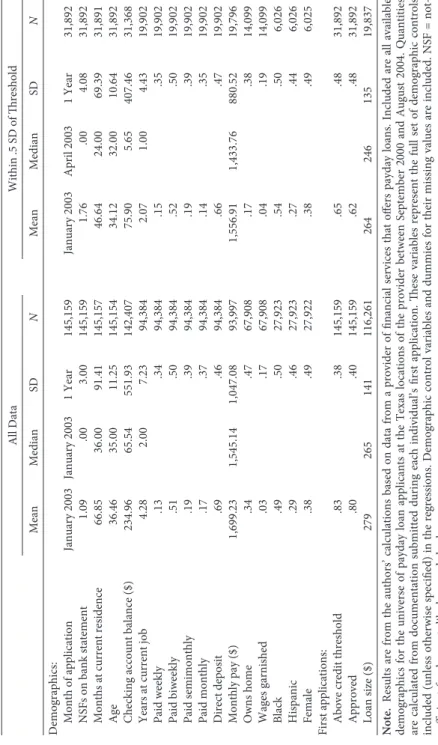
We study the universe of individuals whose first loan application at the com- pany occurred at an outlet in Texas between September 2000 (when the firm en- tered that market) and August 2004. This includes about 1 million loan applica- tions from 145,159 individuals. Table 1 presents demographic and background characteristics of this population and summary information about their appli- cations and loans.7 There is variation in the availability of the background char- acteristics, mostly because of changes over time in the data collection and data retention practices by the lender.8
Overall, the available observables align with the broader population of payday borrowers (see, for example, Elliehausen and Lawrence 2001). Table 1 also re- ports summary statistics for a subgroup of 31,892 applicants on which we focus in some of the empirical analysis whose credit score is within .5 standard devia- tions of the passing payday loan credit-score threshold. We describe this thresh- old in detail in Section 3.1.
Summary statistics for the bankruptcy data are presented in Tables 2 and 3.
Personal bankruptcy petitions are in the public record and were downloaded from PACER. We obtained the universe of 556,767 personal bankruptcy filings
5 The longstanding practice of some employers providing advances against upcoming paychecks is distinct from the topic studied here: payday lenders do not directly garnish future paychecks to obtain loan repayment.
6 Payday lenders typically do not allow interest to compound, but an alternative measure of the annualized cost of liquidity from biweekly payday loans is 100 × (1.1826 − 1) = 7,295 percent.
7 All dollar values are deflated with the Consumer Price Index for All Urban Consumers to Janu- ary 2002 dollars. We replace the top and bottom .1 percent of the distributions of checking account balance and take-home pay with signifiers for missing data. We also replace age with a signifier for missing data if it is less than 18.
8 For the data extract we use, the company stopped collecting some work-related variables in Au- gust 2003, namely, job tenure, pay frequency, and income. It had, in December 2002, stopped col- lecting information on wage garnishment and homeownership. This means that only a few observa- tions (less than 2 percent) are missing those control variables for reasons that are uncorrelated with the time effects that we control for in all the paper’s specifications. The firm that provided the data also offers pawn loans. Data on race and sex are collected incidentally since all of the information on drivers’ licenses is recorded in accordance with pawnbroking underwriting rules. Those variables are therefore available in our data only for people who had pawned an item at the company prior to their first payday loan application. Thus, missing values for race and sex are perfectly correlated with a dummy for not having previously taken a pawn loan at this company. We include that dummy variable in all specifications below.
Table 1 Payday Loan Summary Statistics All DataWithin .5 SD of Threshold MeanMedianSDNMeanMedianSDN
Demographics: Month of applicationJanuary 2003January 20031 Year145,159January 2003April 20031 Year31,892 NSFs on bank statement1.09 .003.00145,1591.76 .004.0831,892 Months at current residence66.8536.0091.41145,15746.6424.0069.3931,891 Age36.4635.0011.25145,15434.1232.0010.6431,892 Checking account balance ($)234.9665.54551.93142,40775.905.65407.4631,368 Years at current job4.282.007.2394,3842.071.004.4319,902 Paid weekly .13 .3494,384 .15 .3519,902 Paid biweekly .51 .5094,384 .52 .5019,902 Paid semimonthly .19 .3994,384 .19 .3919,902 Paid monthly .17 .3794,384 .14 .3519,902 Direct deposit .69 .4694,384 .66 .4719,902 Monthly pay ($)1,699.231,545.141,047.0893,9971,556.911,433.76880.5219,796 Owns home .34 .4767,908 .17 .3814,099 Wages garnished .03 .1767,908 .04 .1914,099 Black .49 .5027,923 .54 .506,026 Hispanic .29 .4627,923 .27 .446,026 Female .38 .4927,922 .38 .496,025
First applications: Above credit threshold .83 .38145,159 .65 .4831,892 Approved .80 .40145,159 .62 .4831,892 Loan size ($)279265141116,26126424613519,837 Note. Results are from the authors’ calculations based on data from a provider of financial services that offers payday loans. Included are all available demo graphics for the universe of payday loan applicants at the Texas locations of the provider between September 2000 and August 2004. Quantities are calculated from documentation submitted during each individual’s first application. These variables represent the full set of demographic controls included (unless otherwise specified) in the regressions. Demographic control variables and dummies for their missing values are included. NSF = not- sufficient-funds events like bounced checks.
in the four US bankruptcy courts in Texas from 2000 through 2006.9 These bank- ruptcy data include the date of filing, the chapter (7 or 13),10 the disposition of
9 The Bankruptcy Abuse Prevention and Consumer Protection Act of 2005 (BAPCPA) modified US bankruptcy law substantially. It was enacted on April 20, 2005, and became effective 6 months later. We lack statistical power to draw clear conclusions about the interaction of BAPCPA and pay- day loan access. Most applicants for payday loans we study have incomes low enough that they meet the (more stringent) post-BAPCPA means-test criterion for a Chapter 7 filing.
10 Filing under Chapter 7 generally results in a full discharge of debt obligations. Filing under Chapter 13 entails a reorganization of debts. Below we discuss in more detail the important differ- ences.
Table 2
Texas Bankruptcy Totals, 2000–2006
Bankruptcies Annual Personal
Bankruptcy Rate Filers Who Ever Applied
Petitions per Applicant
per Year
Chapter 7 311,864 .205 3,903 .384
Chapter 13 244,903 .161 9,637 .948
All 556,767 .366 13,540 1.333
Note. The data are from the Public Access to Court Electronic Records (PACER) database. The Texas-wide personal bankruptcy rate is calculated using PACER bank- ruptcy data and population data from the Census Bureau. Bankruptcy rates among payday loan applicants are calculated by matching administrative data from a pay- day lender to individual bankruptcy filings in PACER, using first names, last names, zip codes, and the final four digits of social security numbers.
Table 3
Payday Loan Applicants’ Bankruptcy Rates All Credit Scores Within .5 SD of
Approval Threshold Within .05 SD of Approval Threshold
Below Above Below Above Below Above
Within 1 year after first application:
Chapter 7 .41 .69 .37 .51 .36 .41
Chapter 13 1.62 1.94 1.49 1.55 1.46 2.91
Chapter 13 and dismissed 1.03 1.07 .91 .98 .95 1.74
All 2.03 2.63 1.86 2.06 1.82 3.32
Within 2 years after first application:
Chapter 7 .60 1.17 .55 .83 .44 .82
Chapter 13 2.53 3.31 2.30 2.55 2.63 4.14
Chapter 13 and dismissed 1.51 1.71 1.31 1.56 1.46 2.20
All 3.13 4.48 2.84 3.38 3.07 4.95
Applicants 25,305 119,854 11,320 20,572 1,370 1,958
N 145,159 31,892 3,328
Note. Bankruptcy rates are calculated by matching administrative data from a payday lender to indi- vidual bankruptcy filings in PACER, using first names, last names, zip codes, and the final four digits of social security numbers. Two-year rates are not annualized.
Payday Loans 491 the bankruptcy case (generally, dismissal or discharge of debts),11 and individual identifiers that permit linkage to the payday loan data.
Table 2 shows an individual bankruptcy rate (as a fraction of population) for Texas of .366 percent per year.12 We identify debtors in the PACER bankruptcy data as payday loan applicants if the following variables in the two data sets match exactly: first name, last name, zip code of home residence, and last four digits of the social security number. By these criteria, 13,540 of the 145,519 applicants filed for personal bankruptcy during the bankruptcy sample period. Thus, the annual bankruptcy rate among payday applicants is 13,540/(145,519 × 7) = 1.33 percent per year, more than 3.5 times the overall annual rate in Texas from 2000 to 2006.
This average difference is also displayed over time in Online Appendix Figure OA1.Table 3 provides summary information about the fraction of applicants above and below the credit threshold who subsequently filed for bankruptcy. These av- erages imply that people above the credit-score threshold are more likely to file.
This is true for the full sample and for samples of .5 and .05 standard deviations around the threshold. These differences are suggestive of a relationship between payday lending and bankruptcy. For more thorough analysis, next we turn to re- gressions that exploit the discontinuous access to payday loans near the credit- score threshold.
3. Identification and Empirical Strategy 3.1. The Credit-Score Regression Discontinuity
Access to payday loans depends on a credit score calculated at the time of the loan application by the third-party credit bureau Teletrack.13 During our observa- tion period, the lender maintained a fairly strict threshold rule for loan approvals.
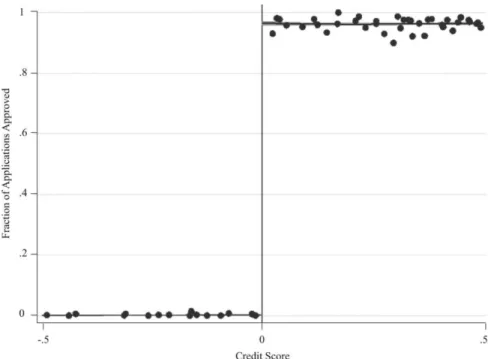
Among first-time applicants with scores below the threshold, 99.6 percent were rejected, while 96.9 percent of first-time applicants scoring above the threshold were approved. The threshold rule did change during our sample period. We dis- cuss the effects of this change in Section 4.3. In most of the empirical analysis, we pool the data and use the variable Credit Score, which equals the raw Teletrack score minus the approval threshold that was in force at the time of the applica-
11 We focus primarily on bankruptcy petitions and secondarily on whether debt was eventually discharged; filing is an indicator of financial distress (Fay, Hurst, and White 2002). Bankruptcy law precludes creditors from contacting debtors once a petition is filed, so debtors may file to protect themselves from creditors even if their debts are unlikely to be discharged. Hereafter, we use the terms “petition” and “filing” interchangeably.
12 Population data are from Census Bureau, Table 1: Annual Estimates of the Population for the United States and States, and for Puerto Rico: April 1, 2000 to July 1, 2005 (https://www2.census .gov/programs-surveys/popest/tables/2000-2005/state/totals/nst-est2005-01.xls).
13 The credit-scoring formula is proprietary, but in personal communications with Teletrack personnel we were told these scores differ from Fair Isaac Corporation (FICO) scores in that they depend on a shorter history of behavior and focus on borrowing in the subprime market. Though Teletrack serves major payday lenders, the lenders establish their own criteria for approving loan applications. In other work (Skiba and Tobacman 2008; Agarwal, Skiba, and Tobacman 2009), we discuss more details of the credit-scoring process in the context of the profitability of payday lenders.
tion, normalized by the standard deviation of raw scores during the correspond- ing period. Figure 1 displays a histogram of Credit Score, which indicates that there is discreteness in the distribution but no unusual bunching in proximity to the threshold.
Consistent with the company’s stated policy, the credit score has a discontin- uous effect on the probability that a payday loan application is approved. Figure 2 shows the probability of approval among first-time applicants (Approved) as a function of Credit Score. Two quartic polynomials, fit independently to the data on either side of the credit-score threshold, are superimposed on the graphs. We quantify this visually striking discontinuity by regressing Approved on an indi- cator for being above the threshold (AboveThr), controlling for a polynomial in Credit Score and background characteristics:
Approved =b0+b1AboveThr + ( +gX¢ +d ¢+e,
(1) i i f Credit Scorei) i Mti i (1)
where Xi is a vector for borrower i of all the demographic and background char- acteristics provided by the company and reported in Table 1 and Mti¢ is a full set of dummies for the month-year of the first payday loan application, so Mti¢ equals one if individual i’s first application was in month t and zero otherwise. A variety of choices can be made for the functional form of f(Credit Scorei), and we adopt
Figure 1. Distribution of Teletrack scores
Payday Loans 493
an agnostic approach. Our benchmark specifications allow f(∙) to be a quartic in Credit Scorei interacted with AboveThri.14
Informal default is common on payday loans: at this firm, over 30 percent of borrowers had a loan written off by the lender within a year of taking their first loans. In choosing the threshold for loan approval, the company therefore had in- centives disconnected from bankruptcy-filing probabilities. To the extent that the company adjusted its threshold to decrease loan losses due to borrowers’ bank- ruptcy filings, the bankruptcy rate should fall when crossing the threshold, which would bias our findings downward.
3.2. Identification
The identifying assumption for the regression-discontinuity design is that un- observables must not change discontinuously at the threshold. This assumption is not directly testable, but two main avenues are available for gaining insight about
14 Table OA1 in the Online Appendix reports linear probability and probit estimates of equation (1) based on this specification. In every regression, the coefficient on AboveThr is highly significant and close to 1. The R2-value equals .90 when only AboveThr is included on the right-hand side. As the subsequent columns add a quartic in Credit Score fully interacted with AboveThr, the demo- graphics listed above, and the dummies for month of first payday loan application, the coefficient on AboveThr hardly changes, and the R2-value increases by only 1 percent. Results from probit equa- tions (showing marginal effects) reveal the same pattern.
Figure 2. Probability of approval by credit score
it. The first avenue relates to observable characteristics. If observables do not change discontinuously at the threshold, that is neither necessary nor sufficient to guarantee that unobservables also do not, but it increases our confidence. Figure OA2 plots the 16 control variables from Table 1 versus Credit Score and indicates reasonable but imperfect balance. Table OA2 in the Online Appendix provides further information about balance across the threshold. It shows that the balance of the raw variables improves as the range around the threshold shrinks; it also shows estimates of the discontinuities using the same approach we use to esti- mate the bankruptcy effects of interest below.
Imbalances are most pronounced for age, checking account balance, and months at current residence, all of which are modestly higher above the credit score threshold. Manipulation of these types of covariates to get over the thresh- old would be problematic: applicants successful at this kind of manipulation could also be successful at navigating the bankruptcy-filing process, for example.
We view this type of manipulation as unlikely for the checking account bal- ances, which are measured with bank statements, but possible with the (unveri- fied) variable measuring months at current residence. Were borrowers to know the impact that this has on loan access, they might wait until a sufficient amount of time has elapsed to apply for a loan.
Encouragingly, there is no difference in the discontinuity on the basis of whether people have multiple applications on the same day as their first applica- tion (some people reapply immediately after being rejected). It does not appear that applicants and the lender are trying to adjust underwriting variables in real time to gain approval.
Reassuringly for our strategy, the particular directions of imbalances we ob- serve across the threshold in Table OA2 and Figure OA2 usually would induce omitted-variables bias that would go against our bankruptcy findings below. For example, above-threshold applicants have slightly higher checking account bal- ances and residential stability.
Moreover, institutional features of the underwriting process increase our con- fidence in the exogeneity of AboveThri conditional on f(Credit Scorei) for first- time applicants. First, during the application process, the payday loan compa- ny’s employee submits information about the applicant electronically to the company’s central servers, which in turn send a query to Teletrack. Within min- utes, a notification of whether the application was approved or declined is re- turned to the employee. Neither applicants nor the employees in the store are informed of the applicants’ scores or the passing credit-score threshold. Second, Teletrack uses additional information from other lenders, which is not available to this lender’s employees, to compute the score: an ordinary least squares (OLS) regression of the Teletrack scores of first-time payday loan applicants on the de- mographic and background variables in Table 1, including a full set of month- year dummies, yields an R2-value of just .304. This process limits the capacity of applicants and clerks to decisively manipulate applications, which increases our confidence that AboveThr affects an individual’s future choices only insofar as it
Payday Loans 495 affects application approval. In light of these considerations, and following best practices for regression-discontinuity implementations, we control for all of the available covariates and proceed.
3.3. Regression-Discontinuity Specifications
Using the credit-score discontinuity described in Section 3.2, we estimate the effect of payday loan approval on bankruptcy at various horizons (from 1 day to 27 months) after the first payday loan application.15 Our main outcome of in- terest, Bankruptcyi, is an indicator for whether payday loan applicant i filed for bankruptcy within 1 or 2 years of his or her first payday loan application. We consider several specifications, the first of which is an OLS specification:
=b0+b1 + +gX¢+d ¢+e
(2) Bankruptcyi Approvedi f(Credit Score )i i Mti i. (2) Our main specification is a reduced-form equation:
=b0+b1 + +gX¢+d ¢+e
(3) Bankruptcyi AboveThri f(Credit Score )i i Mti i. (3) Finally, we report instrumental-variables regressions, instrumenting for Ap- proved in equation (2) with AboveThr.16
Analyses identified from discontinuities generally involve a trade-off as more and more data are included around the discontinuity (that is, as the bandwidth increases). The additional data reduce sampling noise but potentially introduce bias as weight is placed on observations where unobservables may be correlated with the outcome.17
We take an agnostic perspective about how to proceed in light of this trade-off, demonstrating robustness to a variety of choices. First, we restrict to subsets of the data, narrowing to ±.5 and ±.05 standard deviations around the credit- score threshold. These bandwidth restrictions result in samples with 31,892 and 3,328 applicants, respectively. Second, we implement optimal bandwidth estimates fol-
15 The last payday loan applications in the administrative data set occur in August 2004, and we study bankruptcies through the end of 2006, so at least 27 months of outcome data are available for all applicants.
16 Throughout the paper, we focus on identification from first applications. In principle, more power would be available if our first stage included all applications. However, there is more slippage between AboveThr and application approval after the first loan application: the lender is more likely to have a history for a repeat applicant that informs its approval choice. In addition, the regression results reported above indicate that we already have considerable power in the first stage, and using all applications would require correcting for intra-applicant correlation structure in the effect of AboveThr on application approval and the effect of approval on the outcome variables of interest.
In principle, it would be possible to replicate the instrumental-variables regressions using a new endogenous variable, an indicator for whether an individual has ever had an application approved.
17 The starkness of the trade-off is highlighted in Table OA3. Suppose that instead of studying the effect of payday loans on bankruptcy using the discontinuity available in this field environment, we could run an experiment that randomly assigned payday-loan access. Table OA3 reports the num- bers of observations necessary to have the specified probability of detecting various effect sizes at a 95 percent confidence level. For example, if the expected effect is an increase in the bankruptcy rate from 1.5 percent to 2 percent, then for 90 percent power almost exactly the number of observations that we have with a .5-standard-deviation bandwidth would be required.
lowing Calonico, Cattaneo, and Titiunik (2014a, 2014b) and Imbens and Kaly- anaraman (2012). Third, we show how the direction and statistical significance of our findings vary for any bandwidth.
4. Results 4.1. Descriptive Findings
Figures 3, 4, and 5 show how the 2-year bankruptcy rate varies with Credit Score in six ways that all suggest that payday loan access increases personal bank- ruptcy rates. Figure 3A reports the raw bankruptcy rates, where each dot corre- sponds to one of 40 bins. The averages to the left and right of the threshold are 2.84 percent and 3.38 percent, respectively, as in Table 3. Smoothed polynomial fits are also plotted with 95 percent confidence intervals. Figure 3B replicates Fig- ure 3A, except that we use the residuals from a regression of the Bankruptcy indi- cator on the control variables and the month dummies.
Since filing a bankruptcy petition is such a rare outcome, averaging only 31,892
× 3 percent/40 = 24 events per bin, some volatility is evident in Figure 3A and 3B. Figure 4, before plotting, takes the cumulative sum of bankruptcy events (4A) and residuals (4B) from left to right and plots that cumulative sum against Credit Score. For a binary outcome variable like a bankruptcy indicator, a regression discontinuity in levels corresponds to a regression kink in the cumulative sum, so an effect of payday loan access on bankruptcy is present if the slope differs across the threshold in Figure 4.
Figure 5 again shows the cumulative sums of bankruptcy events and residu- als, but with the horizontal axis as the applicant’s Credit Score rank. Figure 5A and 5B show all of the observations below the threshold and an equal number of observations above the threshold, respectively. Again, an effect of payday loan access on bankruptcy rates would appear as a change in slope at the threshold.
4.2. Conventional Regression-Discontinuity Results
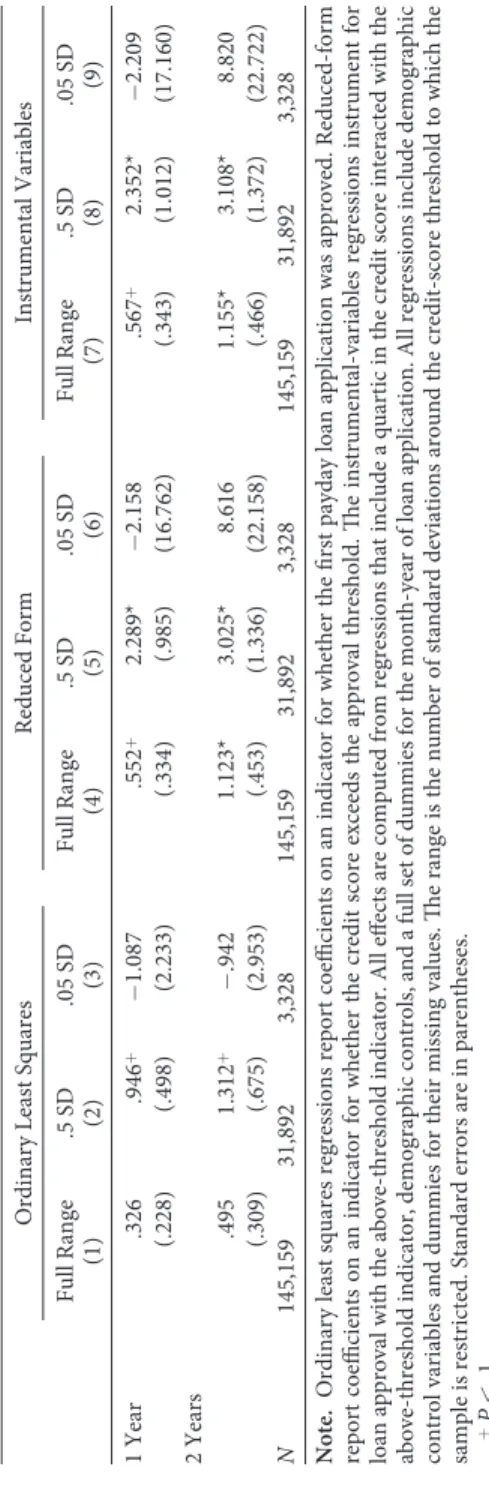
Tables 2 and 3, along with Figures 3–5, suggest that payday loan access in- creases bankruptcy rates. We formalize and quantify first by estimating equations (2) and (3) in Table 4. Regressions report point estimates and standard errors of β1 for bankruptcies at 1- and 2-year time horizons since the first loan application.
Each point estimate in Table 4 is from a different regression. The outcome vari- ables are multiplied by 100, so the coefficients can be interpreted as the increase in bankruptcies in percentage points associated with unit increases in the inde- pendent variables.
Section 3 demonstrates that a large share of the variation in Approved can be explained by AboveThr, the indicator for whether the credit score is above the lender-defined threshold. To the extent that individual characteristics cause slip- page between AboveThr and loan approval, correlation between those character- istics and propensity or ability to declare bankruptcy (for example, if loan ap-
Figure 3. Probability of bankruptcy within 2 years. A, Raw bankruptcy rates; B, residualized bankruptcy rates.
Figure 5. Cumulative bankruptcies within 2 years: ranked scores. A, Raw cumulative bank- ruptcies; B, residualized cumulative bankruptcies.
Table 4 Conventional Regression Estimates Ordinary Least SquaresReduced FormInstrumental Variables Full Range (1)
.5 SD (2)
.05 SD (3)Full Range (4)
.5 SD (5)
.05 SD (6)Full Range (7)
.5 SD (8)
1 Year.326.946+−1.087.552+2.289*−2.158.567+2.352* (.228)(.498)(2.233)(.334)(.985)(16.762)(.343)(1.012) 2 Years .4951.312+−.9421.123*3.025*8.6161.155*3.108* (.309)(.675)(2.953)(.453)(1.336)(22.158)(.466)(1.372) N145,15931,8923,328145,15931,8923,328145,15931,892 Note. Ordinary least squares regressions report coefficients on an indicator for whether the first payday loan application was approved. Reduced-form report coefficients on an indicator for whether the credit score exceeds the approval threshold. The instrumental-variables regressions instrument for loan approval with the above-threshold indicator. All effects are computed from regressions that include a quartic in the credit score interacted with the above-threshold indicator, demographic controls, and a full set of dummies for the month-year of loan application. All regressions include demographic control variables and dummies for their missing values. The range is the number of standard deviations around the credit-score threshold to which the sample is restricted. Standard errors are in parentheses. +P< .1. * P< .05.
Payday Loans 501 proval is correlated with resourcefulness in filling out paperwork, which is also necessary for completing a bankruptcy filing) could bias even the restricted-range OLS estimates. We can more cleanly estimate the causal impact of payday loan access on bankruptcy by putting AboveThr on the right-hand side, as in equation (3). Controlling for f(Credit Score), Xi, and the month of application as well, we obtain the results in columns 4–6 of Table 4.18
Table 4 also shows that the reduced-form effect of AboveThr on bankruptcies is significant at the 5 percent level for the .5-standard-deviation sample. Having a credit score above the passing threshold increases bankruptcies by 2.289 percent- age points over 1 year, more than a doubling of the baseline rate of 1.864 percent.
Standard errors grow large when we restrict to .05 standard deviations on either side of the threshold.
In columns 7–9 we instrument for Approved with AboveThr. As we would expect given the tight relationship between Approved and AboveThr reported above, these regressions are nearly identical to the reduced-form values in mag- nitude and significance. Effects for bankruptcies 2 years after the first payday loan are generally larger than the 1-year effects, statistically and economically.
4.3. Alternative Specifications
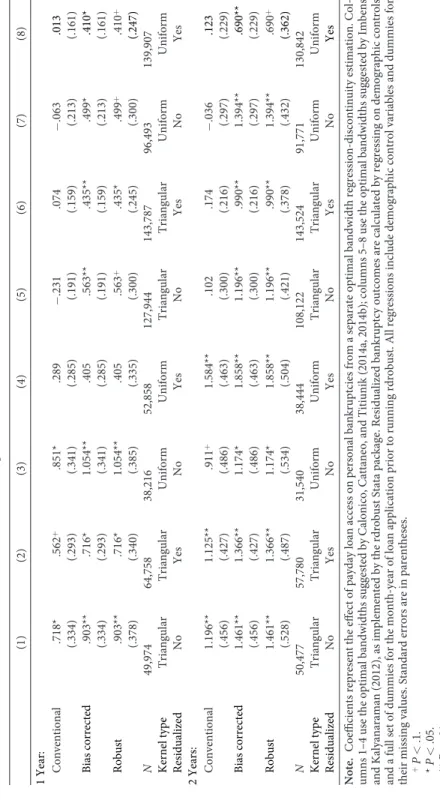
In six important ways, this section evaluates the directional and quantitative robustness of our conclusions. First, in Table 5 we employ the optimal band- width approaches of Calonico, Cattaneo, and Titiunik (2014a, 2014b) and Im- bens and Kalyanaraman (2012), which formally balance the increased precision from additional data with the possible introduction of correlation in unobserv- ables. Optimal bandwidths implied by these procedures tend to be larger than the ±.5- standard- deviation windows adopted above, which imply numbers of observations greater than 31,892. Coefficients from the optimal bandwidth spec- ifications tend to be smaller in magnitude but more highly statistically significant than the conventional regressions in Section 4.2. Robust estimated effects on the 2-year bankruptcy rate range from .690 to 1.858 percentage points and are gener- ally significant at the 1 percent level.
Second, we consider alternative functional forms for f(∙) and the error struc- ture. Instead of a quartic in Credit Scorei interacted with AboveThri, we try cu- bics, quadratics, and linear functions interacted with AboveThri and quartics, cu- bics, quadratics, and linear functions not interacted with AboveThri. Relatedly, instead of linear probability models, we implement probit models. Most of the coefficients in these specifications, reported in the Tables OA5–OA8, go in the same direction and are similarly significant.
Third, we examine robustness with respect to the bandwidth and the functional form of f(Credit Scorei) by plotting point estimates and confidence intervals as
18 The full regression results for these three specifications may be found in Table OA4. Beyond our coefficient of interest, a few other covariates are of note. There are statistically significant and posi- tive coefficients on homeownership, checking account balance, job tenure, and monthly pay.
Table 5 Optimal Bandwidth Estimates (1)(2)(3)(4)(5)(6)(7)(8) 1 Year: Conventional.718*.562+.851*.289−.231.074−.063.013 (.334)(.293)(.341)(.285)(.191)(.159)(.213)(.161) Bias corrected.903**.716*1.054**.405.563**.435**.499*.410* (.334)(.293)(.341)(.285)(.191)(.159)(.213)(.161) Robust.903**.716*1.054**.405.563+.435*.499+.410 (.378)(.340)(.385)(.335)(.300)(.245)(.300)(.247) N49,97464,75838,21652,858127,944143,78796,493139,907 Kernel typeTriangularTriangularUniformUniformTriangularTriangularUniformUniform ResidualizedNoYesNoYesNoYesNoYes 2 Years: Conventional1.196**1.125**.911+1.584**.102.174−.036.123 (.456)(.427)(.486)(.463)(.300)(.216)(.297)(.229) Bias corrected1.461**1.366**1.174*1.858**1.196**.990**1.394**.690** (.456)(.427)(.486)(.463)(.300)(.216)(.297)(.229) Robust1.461**1.366**1.174*1.858**1.196**.990**1.394**.690 (.528)(.487)(.534)(.504)(.421)(.378)(.432)(.362) N50,47757,78031,54038,444108,122143,52491,771130,842 Kernel typeTriangularTriangularUniformUniformTriangularTriangularUniformUniform ResidualizedNoYesNoYesNoYesNoYes Note. Coefficients represent the effect of payday loan access on personal bankruptcies from a separate optimal bandwidth regression-discontinuity estimation. umns 1–4 use the optimal bandwidths suggested by Calonico, Cattaneo, and Titiunik (2014a, 2014b); columns 5–8 use the optimal bandwidths suggested by Imbens and Kalyanaraman (2012), as implemented by the rdrobust Stata package. Residualized bankruptcy outcomes are calculated by regressing on demographic controls and a full set of dummies for the month-year of loan application prior to running rdrobust. All regressions include demographic control variables and dummies for their missing values. Standard errors are in parentheses. +P< .1. * P< .05. **P< .01.
Payday Loans 503 a function of the bandwidth in Figure 6A (independent quartic functions) and 6B (independent linear functions). The horizontal axis is the bandwidth in stan- dard deviations around the credit-score approval threshold: smaller bandwidths restrict attention to smaller intervals around the threshold, so data points to the left are noisier than those to the right, which include more data. Figure 6A and 6B shows statistically significant effects for almost any interval around the thresh- old from ±.4 standard deviations to ±1 standard deviation. To our knowledge, it is an innovation in the literature to demonstrate robustness of regression- discontinuity estimates in this fashion.
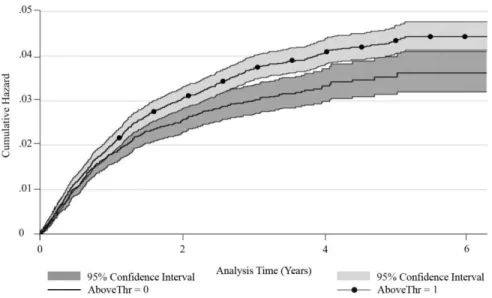
Fourth, in Figure 7 and associated Table OA9, we show the results of Cox pro- portional hazard regressions. These specifications incorporate information not only about whether a payday loan applicant files for bankruptcy but also about how quickly he or she does so after the payday loan application. Again, we find statistically and economically significant evidence that payday loan access in- creases bankruptcy- filing rates as shown by the difference in cumulative hazard rates for those above and below the passing credit-score threshold.
Fifth, to the extent possible, we examine heterogeneity across the credit-score distribution. The credit-scoring formula and the threshold for approval were ad- justed at the lender’s storefronts only once each during our period of observation.
On November 12, 2002, the lender began receiving credit scores from Teletrack based on a new formula with a lower mean and variance. Exactly 3 months ear- lier, the company had reduced the approval threshold by two-thirds of a standard deviation. The resulting approval rates for applications prior to August 12, 2002, between August 12 and November 11, 2002, and from November 12, 2002, on- ward were 85.2 percent, 94.6 percent, and 79.1 percent, respectively. For appli- cants within .5 standard deviations of the threshold, the approval rates during the three periods were 82.7 percent, 79.0 percent, and 52.1 percent, respectively.
About three-fifths of the available observations are from the period after Novem- ber 12, 2002, because the lender’s business was growing rapidly, so power is lim- ited when estimating treatment effects without that period. Table OA10 shows that the results are less precise but statistically indistinguishable in each period when identified separately off these several points in the Credit Score distribu- tion.19
Sixth, the results reported above rely on data from a single payday lender, though applicants rejected by that firm might be able to obtain payday loans else- where. This means that the estimates represent a lower bound on the true effect of payday loan access on bankruptcy. Qualitatively, we expect the size of the un- derestimate to be moderate for two reasons. First, during our sample period most major payday lenders used Teletrack to provide information about loan appli- cants. Each lender, however, chooses its own rule for approving loan applications (and may use a smoother decision rule), and we lack information about those
19 Regardless of this demonstration of robustness, we agree with Karlan and Zinman (2010) that it is particularly valuable to study the effects of credit access on marginally approved borrowers since they are likely to be the first borrowers affected by changes in policy or lenders’ choices.
Payday Loans 505
Figure 7. Effect of payday loan access on bankruptcy hazards
practices.20 If all lenders choose exactly the same threshold, our estimated coef- ficients will not reflect bias due to substitution opportunities. To the extent that the firms have comparable costs (Flannery and Samolyk 2005) and the industry is competitive (Skiba and Tobacman 2008), they would adopt identical thresholds in equilibrium. We also suspect that the underestimation of the effect of payday loan approval on bankruptcy is small because the company’s loans remain attrac- tive to rejected applicants. Of the 20 percent of applicants who were first rejected, 48 percent reapplied. Only 9 percent of reapplicants were approved, but those who were approved borrowed on average $2,485 and paid $415 in interest, sim- ilar to initially approved applicants who cumulatively borrowed $2,793 and paid
$477 in interest.
Moving beyond those essentially speculative considerations, we attempt to quantify the possible bias due to outside borrowing opportunities. Table 6 re- veals how the estimated treatment effects vary with proxies for the lender’s zip- code-level market share. Local market share is proxied as follows. For each new applicant, we count the number of the company’s stores visited by applicants re- siding in the new applicant’s zip code. We divide this number by the Census Bu- reau’s ZIP Codes Business Patterns’ year-specific count of establishments with North American Industry Classification System codes 522291 and 522390 (Bhu- tta 2014). Columns 1 and 2 of Table 6 show that, as expected, the results atten- uate when the lender has a low (below-median) market share, though the stan- dard error on the point estimate in column 1 is large. The estimates in column 3
20 Endogeneity of the approval decision rules does not matter for our estimates. The distribution of credit scores is smooth near the credit-score approval threshold, as shown in Figure 1.
are from regressions interacting AboveThr with the market-share proxy.21 In the high-market-share zip codes, we estimate effects of payday loan access that are large and significant at both 1- and 2-year horizons.22
Considering this collection of six tests together, we find that the positive ef- fect of payday loan access on bankruptcy appears robust to optimal bandwidth algorithms, the functional form of the relationship with the credit score, many reasonable bandwidth choices, analysis using hazard models, the location of the threshold in the credit-score distribution, and the degree of competition in the local payday-lending market. Next we investigate the mechanisms that could give rise to this economically and statistically large effect.
21 The coefficient on the interaction term in column 3 is statistically insignificant, but the main effect is close to the N-weighted average of the point estimates in columns 1 and 2.
22 Applicants further below the threshold are less likely to be able to successfully reapply at a com- peting payday lender. Regressions with larger bandwidths, which include individuals with very low scores, will suffer less from this source of attenuation bias.
Table 6
Effects of Payday Loan Approval on Bankruptcy Filings by Market Structure
Low Ratio (1)
High Ratio
(2)
Interacted Ratios
(3) 1 Year:
AboveThr .302 2.592* 2.102*
(1.941) (1.129) (1.000)
AboveThr × Company Store Ratio .029
(.038) 2 Years:
AboveThr .896 3.287* 2.635+
(2.546) (1.536) (1.355)
AboveThr × Company Store Ratio .065
(.052)
N 5,785 25,972 31,757
Company Store Ratio <1 ≥1
Note. Results are estimated reduced-form effects on bankruptcy filings, in per- centage points, with standard errors in parentheses. The sample is restricted to a ±.5-standard-deviation range around the credit-score threshold. Ratios of company stores in the borrower’s home zip code to the number of estab- lishments in that zip code are from the Census Bureau’s ZIP Codes Business Patterns, with North American Industry Classification System codes of 522291 and 522390. All regressions include a quartic in the credit score interacted with the above-threshold dummy, demographic controls, and a full set of dummies for month of loan application. Demographic control variables and dummies for their missing values are included.
+ P < .1.
* P < .05.
Payday Loans 507 5. Mechanisms
The typical payday loan is quite small: in our data set the mean and median principal amounts are approximately $300. This section investigates the interest- ing question of how access to these loans can impact a cumulative financial out- come like bankruptcy.
5.1. Assets and Liabilities of Bankruptcy Filers
Debtors filing for bankruptcy protection must provide the court with sched- ules of detailed information documenting their assets and liabilities.23 This infor- mation is publicly available in PACER. We hand coded the data for a threshold sample of the 100 post-payday-application bankruptcy filers closest to the credit- score threshold on each side, plus those with equal scores at the endpoints.24 Table 7 reports summary information about their balance sheets.
Substantial empirical support has been found for strategic default to escape outstanding obligations, at least in the sense that debtors’ pecuniary incentives to file correlate strongly with bankruptcy propensities. Fay, Hurst, and White (2002) find that each $1,000 increase in the financial benefit of a bankruptcy fil- ing increased the predicted probability of such a filing by .021 of a percentage point. Domowitz and Sartain (1999) and Gross and Souleles (2002) provide ev- idence that higher credit card debt predicts higher probabilities of bankruptcy, and White (2007) elaborates on this with supportive evidence.
The balance sheet data in Table 7 show substantial unsecured liabilities, with a mean of $27,880, which indicates considerable possible financial benefit from a bankruptcy filing. However, by the time of the observed filings, the median ap- proved borrower had no payday loan debt outstanding from the company that supplied our data. Thus, strategic default to escape outstanding payday loan bal- ances does not appear to be directly implicated as the mechanism driving our results.
5.2. Short-Run Responses
The empirical analysis above focuses on the cumulative effect of payday loan access until 1 or 2 years after the first loan application. Some evidence on the de- terminants of bankruptcy points to motives that would induce shorter-run effects of credit access. First, applicants might (erroneously) believe that imminent debt erasure means it would be to their advantage to borrow as much as possible prior to a filing. Bankruptcy courts generally do not tolerate such short-run abuse of bankruptcy protection; regardless, the evidence from filers’ balance sheets sug- gests that many payday loans are repaid or written off by the time of filing, which raises the question of how payday loans cause bankruptcy. Figure 8 reports point
23 Debts not listed on the petition will not be discharged, and misrepresentation on the petition is grounds for dismissal, so debtors have strong incentives to be comprehensive.
24 This resulted in review of 211 filings, 104 below the threshold and 107 above.
Liabilities in Bankruptcy Below
Threshold Above Threshold Total assets:
Mean 105,905 131,149
Median 105,784 125,788
SD 83,156 80,009
Personal property:
Mean 67,249 85,408
Median 60,300 82,620
SD 67,463 59,081
Real property:
Mean 20,802 20,772
Median 17,432 15,046
SD 17,252 18,243
Liabilities:
Mean 110,581 116,513
Median 87,560 99,094
SD 85,524 75,514
Secured debt:
Mean 82,543 88,786
Median 72,994 77,310
SD 78,995 63,228
Unsecured debt:
Mean 28,037 27,726
Median 16,868 17,480
SD 29,988 30,208
Company payday debt:
Mean 11 159
Median 0 0
SD 66 335
Other payday debt:
Mean 41 88
Median 0 0
SD 179 285
Note. Results, in dollars, are from bankruptcy petition fil- ings for 211 payday loan applicants (104 below and 107 above the passing credit score threshold) who filed for bankruptcy after their first payday loan application. The samples are not exactly balanced because of ties in scores.
Data are from the Public Access to Court Electronic Re- cords data base matched to records from a payday loan company.
Payday Loans 509
Figure 8. Long-run effects of payday loans on bankruptcies
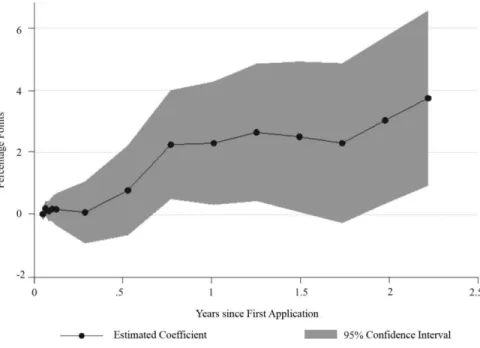
estimates of the effect of payday loan access on bankruptcy filing on time hori- zons from several days to several years. It confirms that the directional effects are robust to the time horizon we examine, and it displays no disproportionate short-run response. Estimated coefficients are from the reduced-form specifica- tion, equation (3), with ±.5-standard-deviation windows around the threshold.
A second possible reason that payday loan access could have a short-run effect on bankruptcy concerns filing fees. Mann and Porter (2010) argue that filing fees affect the chapter of a bankruptcy filing. Gross, Notowidigdo, and Wang (2014) use a natural experiment to estimate the impact of positive liquidity shocks on filing rates. They find large very short-run effects, which supports the view that sometimes liquidity infusions can be used to pay filing fees. Together, the balance sheet information shown in Table 7 and the estimates at various time horizons reported in Table 6 and Figure 8 suggest that a different mechanism is more likely to give rise to the effect of payday loan access on bankruptcy.
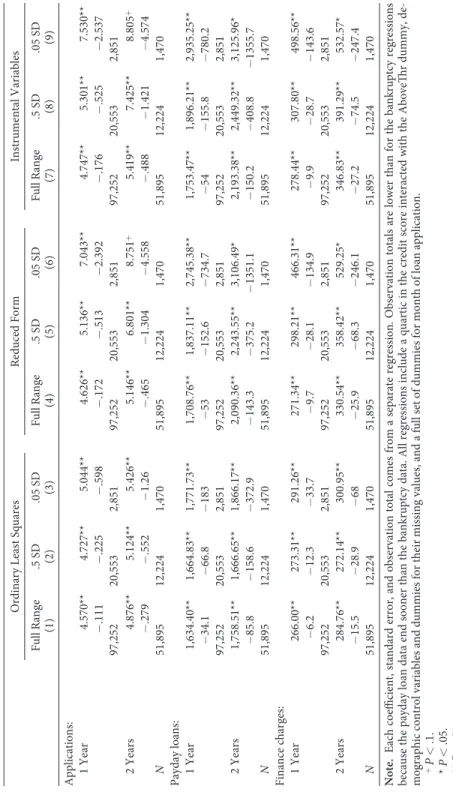
5.3. Subsequent Payday Loan Borrowing and the Cash Flow Hypothesis This section investigates the possibility that payday loan access increases the personal bankruptcy rate via household cash flow. Table 8 reports the effect of payday loan access on number of applications, total dollar amount borrowed, and total finance charges at the lender. Here we use the same regression speci- fications as our main results in Table 4. Approval for one payday loan evidently