http://doi.org/10.22342/jme.v13i4.pp565-586
How does a missing part become important for primary school students in understanding fractions?
Puri Pramudiani1 , Tatang Herman1* , Turmudi1 , Maarten Dolk2 , Michiel Doorman2
1Elementary Education Department, School of Postgraduate Studies, Universitas Pendidikan Indonesia, Bandung, Indonesia
2Freudenthal Institute, Utrecht University, Utrecht, The Netherlands
*Correspondence: [email protected]
Received: 5 November 2022 | Revised: 4 December 2022 | Accepted: 8 December 2022 | Published Online: 11 December 2022
© The Author(s) 2022
Abstract
Understanding of fractions is difficult for Indonesian students. This often leads to misinterpretation in solving fractional problems. In this study, a task aiming at identifying students’ struggles in understanding the basic concept of part-whole relationships in fractions was developed and tested with six 4th-grade students. The task uses Indonesian sweet food, martabak, that has a rounded pizza-like shape as a context in which one slice was missing. Realistic Mathematics Education underlies the context designed, that was also inspired by the Dutch textbook Alles telt Q Basiswerkschrift. The study used a qualitative methodology through an interview, observation, and written test. The result of this study indicated that the students’ struggles can be identified as follows: making references to the whole, making references to the complete partition, and making sense of the incomplete partition. The study showed that the designed tasks have potentials to provoke students' reasoning in learning fractions. The findings indicate that when students learn fractions, their understanding of the meaning of fractions should be well addressed with problems that challenge this part-whole relationship. Challenging this relationship can be supported with problems that have some ambiguity about what is the ‘whole’ using the missing part context.
Keywords: Fraction, Primary School, Realistic Mathematics Education, Student
How to Cite: Pramudiani, P., Herman, T., Turmudi, Dolk, M., & Doorman, M. (2022). How does a missing part become important for primary school students in understanding fractions?. Journal on Mathematics Education, 13(4), 565-586. http://doi.org/10.22342/jme.v13i4.pp565-586
In our daily lives, there are many things related to fractions. Jordan et al. (2017) and Cwikla (2014) revealed that students know fraction well long before they learn in class. They informally construct their own perceptions of fractions. For instance when a child shares a cake or a candy with a friend and divides it into two halves, they know that it was cut "in half" (Bennett et al., 2018; Bright & Litwiller, 2002; Keijzer, 2015). It indicated that young children already have their sense into fractions in simple form like a half, a third, a quarter, etc.
In a broader form, fraction is related to some concepts such as a part of a whole, ratio, quotient, measurement, and operator (Baker et al., 2012; Behr et al., 1992; Pantziara & Philippou, 2012). In learning mathematics, fraction is not as easy as students imagine. Although it often occurs in everyday life, the topic of fractions is a difficult subject to understand because of its complexity (Keijzer, 2015;
Ratnasari, 2018; Tekin-Sitrava et al., 2022). Since it contains several concepts, the foundation of fractions basics often was overlooked. Many studies showed the existence of difficulties and misconceptions in
solving fraction problems (Blair, 2008; Hoon et al., 2020; Nattrass, 2017; Ratnasari, 2018; Shahbari &
Peled, 2017; Streefland, 1993; Zhang et al., 2015). From several concepts of fractions, understanding part-whole concept of fractions is the most important thing that underlies students' thinking about the meaning of fraction itself. It is in line with the research of Kerie et al. (2019) showed that mostly students misunderstand about the concept of part-whole relationship in fractions. This can be positioned as the main foundation in understanding fractions. Since part-whole relationship is the central focus of fraction’s curriculum, so it becomes essential to be comprehended by students (Wilkins & Norton, 2018).
The students’ difficulties in understanding and solving a fractional problem often due to the students only focus on formal or abstract ways (Vale et al., 2016). According to the preliminary study conducted by the researchers, some students in grade 4 in some primary schools in West Java and Banten Indonesia only knew the meaning of fractions as a rational number consists of numerator and denominator. Therefore, there is a need to give more attention to students’ development understanding toward the meaning of fraction especially as part-whole relationship. This research more focuses on the concept of fractions as part-whole relationship in which the researchers try to develop a task design that is different from teaching fractions in general.
Usually, students learn fractions as part of the whole using complete partitions. However, in this study the task design used incomplete partitions to challenge the students whether they can still use the part-whole relationship concept or more to see number of existing partitions. When students learn about
"fractions" in primary school, they conceive parts of a given whole where the whole could be a set of objects or a single object that can be divided equally (Čadež & Kolar, 2018). Therefore, we formulate the research question as follows: “How do students’ struggle in understanding the meaning of fractions as a part of a whole?” The aim of this research is to identify students’ struggle in understanding the meaning of fractions as part-whole relationship using the task design of missing part context.
METHODS
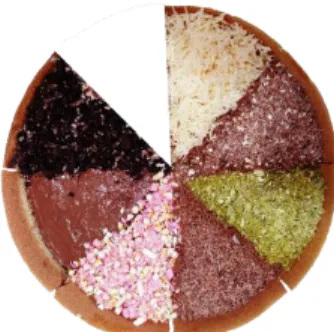
In this research, the mathematical problem was designed using Indonesian sweet food, martabak, that has a rounded pizza-like shape as a context in which one slice was missing (Figure 1). The use of context according to Zulkardi & Putri (2006) should be meaningful and real for students' mind. This research is a part of a larger design research developed by the researchers about teaching and learning fractions using Realistic Mathematics Education (RME). The context design was also inspired by the Dutch textbook Alles telt Q Basiswerkschrift(Wetering et al., 2020), the classroom material used in some primary schools in The Netherlands. In RME, the word ‘realistic’ means realizing the sense that it is meaningful for students and is used as a starting point to develop mathematical concept ideas (Gravemeijer, 1994).
Using context in fractions also provides students with opportunities to build their understanding in the meaning of fraction (Keijzer, 2015) instead of starting to explain the abstract and procedural knowledge about a fraction as a rational number that consists of numerator and denominator.
The aim of this study is to identify students’ understanding of fractions as a part of a whole when one part is missing. To assess students’ understanding, we refer to Čadež & Kolar (2018) that when students can figure out the parts of a given whole which is divided equally, even though one part is missing, it means they understand the concept of fractions as a part of a whole. The researchers gave the students the basic problem of fractions using the missing part context to assess whether the students understood the meaning of fractions as a part of a whole such in Figure 1.
Figure 1. The missing part of martabak
The study used a qualitative methodology through an interview, observation, and written test that aiming is to identify students' understanding of the meaning of fractions as a part of a whole. The interview was conducted to target research students. Besides recording the answers, the researchers also observed their behavior in investigating the problem. All the interview result, observation, and students’
written works were analyzed. After the students did a written test, it was analyzed according to the classification of the student’s answers.
The researchers identified the strategies that students applied when they perform in a mathematical discussion. This activity was aimed to determine the important big ideas that students struggled with when trying to understand fractions. It focused on how they investigated the partition in the context and interpreted their perspective mathematically. The misconception of students’ answer about fractions also was elaborated in the result and discussion.
Participants
The participants of this study were 4th-grade primary school students, aged 9-10 years old, in Banten and West Java, Indonesia. The participants involved were the students who got permission from their parents to solve the problem designed by the researchers
There were six students who became the target research. The researchers named the students as Ari, Lili, Putra, Nana, Fahmi, and Sari. All students had previously learned about the meaning of fractions in their class. According to their teachers, in grade 3, the students had learned about the form of fractions consist of numerator and denominator.
Task Design
To examine the 4th-grade primary school students, the researchers gave a series of problem to each Indonesian student. The problem was also inspired by the Dutch textbook Alles telt Q Basiswerkschrift (Wetering et al., 2020).
In Alles telt Q Basiswerkschrift, when students were introduced to the meaning of fractions, they used the context of food in which one part was taken, but it was still visible so that students could figure out which part was taken from the whole (Figure 2).
Figure 2. The fraction context in Alles telt Q Basiswerkschrift (Wetering et al., 2020)
What is new in this research that makes different with Alles telt Q Basiswerkschrift, the problem developed by the researchers is that the part of food that is taken does not appear, and it is the missing part of a whole (Figure 1). Consequently, the problem includes ambiguity about what is the whole (the remaining pieces or the original piece of food). This type of problem is a novelty that has never been developed before, so the researchers aimed to assess when a part is missing, can the students determine how much the other part from the whole?
Recognizing part-whole relationships of fractions is the first goal to be embedded into the students’
knowledge before other concept and procedures. The researchers developed the idea of fractions using food as a context to introduce part-whole relationships. This was done because in Indonesia, students only knew fractions as a formal notation consists of numerator and denominator. If there is a textbook which introduced contextual situation using food or other things, it will only start from the complete picture of the object and then divided into several pieces equally. There is no challenging problem started from the missing part and then asked for the other part from the whole.
Procedures
The purpose of missing part context in this research is to assess whether students understand about the concept of fractions as a part of a whole. This challenging context is expected to provoke students' mathematical reasoning. When the students are asked about other part of the whole, while there was one missing part (incomplete partition), the students' answers might more varied. In this task, the students were asked how much cheese martabak in picture A (from the whole).
According to our conjectures some of them might answer Cheese Martabak in Picture A (CA) as 1, 1
8, or 1
7. However, when students answered 1
7, we presumed that there will be disequilibrium in student’s thinking when they were asked the price of 1 slice of cheese martabak in which the price of 1 whole martabak is Rp. 16000, -. In fact, the price of 1 slice of cheese martabak is Rp. 2000, both for incomplete partition martabak and complete partition martabak. In this case, the students' thinking processes and how they understand the concept of fractions as part of a whole were analyzed. The task design series consist of several stages as follows:
1. The students were asked how much the martabak is covered with cheese in picture A (CA).
Picture A. The missing part of martabak (incomplete partition)
2. The students were asked how much the martabak is covered with cheese in picture B (CB).
Picture B. The full martabak (complete partition)
3. The students were asked how much the price of cheese martabak (CA and CB), when the price of a whole martabak is Rp.16000
Picture A Picture B
4. The students were asked about their conclusion whether the cheese martabak in Picture A (CA) and Picture B (CB) were the same or not.
5. The students were asked to write their answers including their reasoning in the answer sheets.
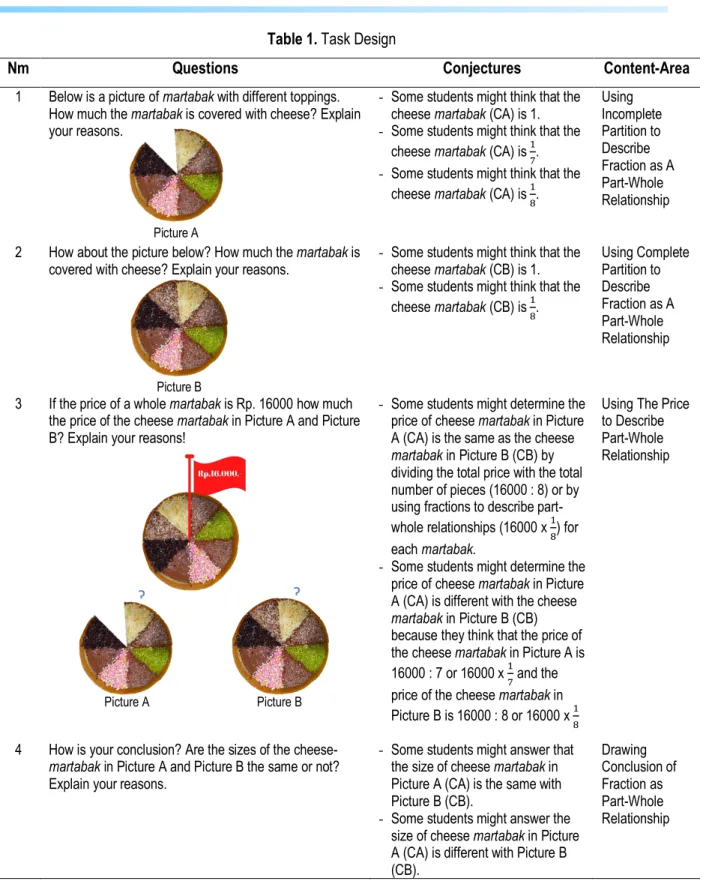
All student participants were interviewed by the researchers one-by-one. During the interview, the researchers also observed their behavior in investigating the problem. The researchers analyzed all of the participants’ answers and identified the students’ misconceptions. After the interview was taken, the students were asked to write their answers to explore their reasons for their final decision. The task design is shown in Table 1.
Table 1. Task Design
Nm Questions Conjectures Content-Area
1 Below is a picture of martabak with different toppings.
How much the martabak is covered with cheese? Explain your reasons.
Picture A
- Some students might think that the cheese martabak (CA) is 1.
- Some students might think that the cheese martabak (CA) is 1
7. - Some students might think that the
cheese martabak (CA) is 1
8.
Using Incomplete Partition to Describe Fraction as A Part-Whole Relationship
2 How about the picture below? How much the martabak is covered with cheese? Explain your reasons.
Picture B
- Some students might think that the cheese martabak (CB) is 1.
- Some students might think that the cheese martabak (CB) is 1
8.
Using Complete Partition to Describe Fraction as A Part-Whole Relationship
3 If the price of a whole martabak is Rp. 16000 how much the price of the cheese martabak in Picture A and Picture B? Explain your reasons!
Picture A Picture B
- Some students might determine the price of cheese martabak in Picture A (CA) is the same as the cheese martabak in Picture B (CB) by dividing the total price with the total number of pieces (16000 : 8) or by using fractions to describe part- whole relationships (16000 x 1
8) for each martabak.
- Some students might determine the price of cheese martabak in Picture A (CA) is different with the cheese martabak in Picture B (CB) because they think that the price of the cheese martabak in Picture A is 16000 : 7 or 16000 x 1
7 and the price of the cheese martabak in Picture B is 16000 : 8 or 16000 x 1
8
Using The Price to Describe Part-Whole Relationship
4 How is your conclusion? Are the sizes of the cheese- martabak in Picture A and Picture B the same or not?
Explain your reasons.
- Some students might answer that the size of cheese martabak in Picture A (CA) is the same with Picture B (CB).
- Some students might answer the size of cheese martabak in Picture A (CA) is different with Picture B (CB).
Drawing Conclusion of Fraction as Part-Whole Relationship
RESULTS AND DISCUSSION
There were four stages in this task design tested to the students. On the first stage, they were asked how much martabak covered by cheese (picture A) in which one slice was missing (incomplete partition). On the second stage they were asked how much martabak covered by cheese (picture B) in which no one was missing (complete partition). After that, on the third stage they were given information that the price of full martabak was Rp. 16000, and they were asked how much the price of cheese martabak in picture
? ?
A and picture B. Finally, on the last stage they were asked to conclude whether the cheese martabak on both pictures (picture A and B) was the same or not. According to the result, there were different students’
answers with various reasonings that are elaborated as follows.
Using Incomplete Partition to Describe Fraction as A Part-Whole Relationship On the first stage, when they were asked about how much the cheese martabak with one missing part (Picture A), most students answered it was one part. However, when the students answered there was one part, the researchers asked further how if it was compared to the whole. After this further question, they could come up with the fraction language, except for Ari who still answered that the cheese martabak was only one part. It means, Ari thought that a part is a unit. Dialogue 1 is the interview script between the researcher and Ari.
Dialogue 1
R : Yesterday, I bought this Martabak (showing Picture A)...What flavors are there?
A : There are chocolate, crunchy chocolate, marshmallow, meses chocolate, green tea, ceres chocolate, and cheese.
R : What do you think, What part of the martabak is covered with cheese?
A : ...Hmmmm.... It seems... it is one or two?
R : Mmmmm....Which one is the cheese?
A : That's on the top
R : So...What part of the martabak is covered with cheese? If it is compared with the whole (martabak)
A : ... There is....one (uncertain voice)
R : Hmmmm…..
A : It seems....one cheese martabak
R : My neighbor bought this martabak (showing Picture B). What part of her martabak is covered with cheese? If it is compared to the whole?
A : One....It is one....
From the dialogue 1, it can be seen that when Ari was asked what part of cheese martabak, he also confused between 1 or 2. According to his answer, he didn't know whether the missing part was also cheese martabak or not. When he was shown the full martabak without the missing part, he realized that the missing part was not cheese, but his answer of cheese martabak was the same as one part. He did not come up with the idea of fractions even though the researcher asked further using the reference to the whole.
According to the research conjectures, there were 3 students (Lili, Fahmi, and Sari) who answered the cheese martabak was 1
8. At the beginning it seemed that they had no encountered problem in understanding the fraction as a part of a whole. When they were asked why the answer was 1
8 , they said that because the total of martabak slices was eight parts, but one part was dissepear. Dialogue 2 is the interview script with Lili.
Dialogue 2
R : (showing picture A) What do you think? What part of the martabak is covered with cheese?
L : Mmmmm... One
R : One? Oke... But if it is compared to the whole martabak, what part of cheese martabak compared to the whole?
L : Mmmmm... one-eighth
R : One-eighth? How do you know?
L : Because...if the whole is divided...or is cut, it becomes 8 parts
R : If it is cut, it becomes eight parts? How many pieces of martabak here?
L : Mmmmm....There are...eight parts, but one part can't be...
R : There are eight parts? How do you know?
L : Because there is one part which is almost the same, but it's disappear…
R : How many parts are there?
L : (silent counting) ....There are eight R : Are you sure?
L : (She nodded her head)
For Fahmi and Sari, the answer and reason were almost the same. They answered 1
8 because they counted the parts. However, Putra and Nana answered differently. They argued that the cheese martabak was 1
7 because the total of slices martabak were 7. For Putra he also doubted with 1
6 because when he was asked how if cheese martabak was compared to the whole, he thought that the whole means the rest of slice martabak other than cheese, and those were 6 slices. But finally, he concluded that the total slices were 7, so his answer was 1
7 for the cheese martabak. The interview script between the researcher and Putra can be seen in Dialogue 3.
Dialogue 3
R : In your opinion, what part of the martabak is covered with cheese if it is compared to the whole (martabak)?
P : ... One....?
R : Yes, one part...How if it is compared to the whole? What part of the martabak is covered (with cheese)?
P : ... Seven....
R : Seven?
P : Yes…
R : So, I asked once again, if the cheese martabak is compared to the whole martabak, then is it one over what?
P : ... One-seventh...?
R : One-seventh? Why is it one-seventh?
P : ... Because the cheese is only one.
R : The cheese is only one, so how did you get seven?
P : ... Seven come from the other parts.
R : The other parts....So, how many parts are there?
P : ...(silent counting)... Six...
R : There are six other parts?
P : ...Yes
R : So, why you said it was one-seventh?
P : ...
R : There is one cheese, and if it is compared to the others, so how much is it?
P : ... One-sixth...?
R : One-sixth...? Why is it one-sixth?
P : ...
R : One-seventh or one-sixth?
At the beginning you said it was one-seventh, and then you said it was one-sixth, So, which one was correct?
P : Mmmm...one-seventh...Oh yeah I was wrong...
R : Why it is one-seventh?
P : ... Because.... Because one is divided by seven
For Nana the answer was almost the same, she thought that the cheese martabak is 1
7 because she said there were 7 slices of martabak.
Using Complete Partition to Describe Fraction as A Part-Whole Relationship On the second stage, when they were asked about what part of cheese martabak from the full martabak in which there was no missing part (picture B), almost all students answered 1
8, except for Ari who still answered that was only 1 part. It means that when there was no missing part (complete partition), the students did not find it too difficult to determine the part of cheese martabak from the whole.
In accordance with the conjecture made, at this stage most students answered CA was 1
8 (except for student who did not understand the concept of fractions, the answer would be 1). The context in picture B is commonly used in textbooks or classroom learning, both in Indonesia and in the Netherlands.
However, the purpose of giving picture B (complete partition) is to serve as a comparison for the part of the cheese martabak asked in picture A.
Using the Price to Describe Part-Whole Relationship
On the third stage, it was stated that the price of each martabak was Rp. 16000, and they were asked how much the price for cheese martabak in Picture A and Picture B? There were also many interesting findings from their strategies. Some students who answered the cheese martabak in Picture A and B differed between 1
8 and 1
7 were confused when they determined the price of the cheese martabak, because both prices were the same as Rp. 2000. Dialogue 4 is the transcript interview between the researcher with Putra who answered the cheese martabak in picture A was 1
7 and the cheese martabak in picture A was 1
8. Dialogue 4
R : When I asked the martabak seller, he said that the price of one full martabak (picture B) is Rp. 16000. In your opinion, how much the price for the cheese martabak?
P : ………... 2000?
R : How do you get 2000?
P : From the cut part…
R : The cut part? What do you mean? How do you get 2000?
P : From the division…
R : Division?
P : 16 : 8 = 2 R : 16: 8 = 2?
P : Yes…
R : So, how much the price for one piece of cheese martabak?
P : 2000
R : So, if I back to the picture A, how much the price for cheese martabak (in picture A)?
P : ………
R : How much?
P : …………....
R : We focus on the cheese martabak, so, how much?
P : 2000?
R : Why 2000?
P : From the division…
R : From the division…. How much divided by how much?
P : ……. 16:8? it is equal to 2…
R : Oh, so you divided it by 8…At the beginning you said that this cheese martabak (in picture A) was 7, not 8?
P : …………. 14:7 = fourteen is divided by seven R : Oh, why 14:7?
P : because the result is 2 (he answered whisperly)
R : (showing picture A and picture B) ….So, in your opinion the cheese martabak in picture A and picture B are the same or not?
P : Those are different…
R : Why those are different?
P : Because from the cut part…
R : How they are different?
P : The one is 1
7 cut part, and the other one is 1
8 cut part.
R : Oke…if the cheese martabak in picture A is 1
7 and the cheese martabak in picture B is 1
8, I want to ask again about the price. How much the price for cheese martabak in picture A?
P : 16000
R : Yes, it was for the whole martabak, I asked for the cheese martabak in picture B, how much is it?
P : 2000
R : How about the price of cheese martabak in picture A?
P : 2000
R : So, if it is like that, what do you think? Are the sizes of cheese martabak in picture A and picture B the same or not?
P : …………sa………….
R : Are they the same or not?
P : The same…
R : Are they the same? You said the price was the same, and the size of cheese martabak in the picture was 1
8, and 1
7 for picture A, so which one was correct?
P : ………
R : Are the sizes of cheese martabak in picture A and picture B the same or not?
P : Those are different…
R : Why?
P : ………
According to Dialogue 4, Putra could determine that the price of each cheese martabak for both pictures were Rp 2000, but he doubted when he was asked whether the sizes of cheese martabak in picture A and B were the same or not because in the former interview (see dialogue 3), he answered CA was 1
7 and CB was 1
8. Until the end of the conversation, Putra was still confused because he said that both prices were the same, but the sizes were different. However, eventually he wrote in his written answer that cheese martabak were 1
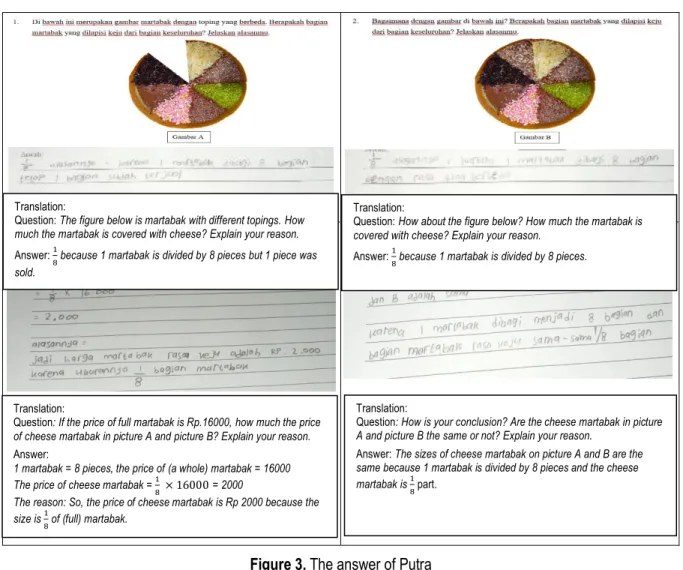
8. The following are the Putra’s answers (Figure 3).
Figure 3. The answer of Putra
Lili’s answer was almost the same with Putra. She answered the price of cheese martabak is 2000 by dividing 14000:7. When she was asked why she divided by 14000, not by 16000, she answered because 1 piece was missing. However, it was different from Putra, after the price was asked, Lili’s answer changed from 1
8 to 1
7. Dialogue 5 is the transcript interview between the researcher and Lili.
Dialogue 5
R : Previously, I have shown these two martabaks (showing picture A and B). What do you think?
Are the price of cheese martabak in picture A and picture B the same or not?
L : Mmmm...for the price... those are different…
R : Why?
L : Because one was missing, and the other one was full.
R : Oke...that is for the whole martabak. Now I asked the price of cheese martabak, Previously, you said that one slice (for picture B) is 2000. Now, I want to buy the cheese martabak (in picture A). In your opinion, are the price of cheese martabak in picture A and picture B the same or not?
L : Those are different…
R : Why?
L : Because the price (in picture A) is 14000, and the price (in picture B) is 16000.
R : Why the price (in picture A) is 14000?
L : Because there was one missing part…
R : Oke...which one was missing? Which taste?
L : The peanut taste
Translation:
Question: The figure below is martabak with different topings. How much the martabak is covered with cheese? Explain your reason.
Answer: 1
8 because 1 martabak is divided by 8 pieces but 1 piece was sold.
Translation:
Question: How about the figure below? How much the martabak is covered with cheese? Explain your reason.
Answer: 1
8 because 1 martabak is divided by 8 pieces.
Translation:
Question: If the price of full martabak is Rp.16000, how much the price of cheese martabak in picture A and picture B? Explain your reason.
Answer:
1 martabak = 8 pieces, the price of (a whole) martabak = 16000 The price of cheese martabak = 18 × 16000 = 2000
The reason: So, the price of cheese martabak is Rp 2000 because the size is 18 of (full) martabak.
Translation:
Question: How is your conclusion? Are the cheese martabak in picture A and picture B the same or not? Explain your reason.
Answer: The sizes of cheese martabak on picture A and B are the same because 1 martabak is divided by 8 pieces and the cheese martabak is 1
8 part.
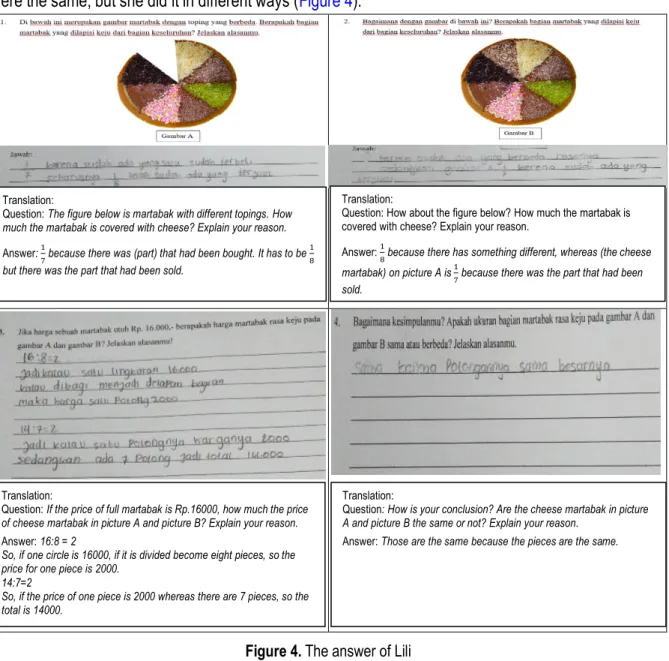
Based on dialogue 5, Lili thought that the prices for martabak in picture A and picture B were different because she looked at the whole that martabak in picture B that was 16000. In picture A one part was missing compared to picture B, so the price of whole martabak in picture A was 14000. When we looked at her answer, we could see that she determined the prices of cheese martabak in both pictures were the same, but she did it in different ways (Figure 4).
Figure 4. The answer of Lili
When Lili was interviewed, at the beginning she said that the cheese martabak in picture A was 1
8, but after she compared the price of each martabak from the whole, she changed her answer to 1
7. On the fourth question, she mentioned that the sizes of both martabak were the same because the cut part were the same. However according to her answer, the form of fractions was different, she determined 1
7 for cheese martabak in picture A, and 1
8 for cheese martabak in picture B.
A similar case was found in Fahmi. At the beginning he answered the cheese martabak in picture A was 1
8. After he compared the price, he changed his answer to 1
7. However, when he wanted to determine the price of the cheese martabak in picture A, he had no idea how to solve it. The following figures were the answers of Fahmi (Figure 5).
Translation:
Question: If the price of full martabak is Rp.16000, how much the price of cheese martabak in picture A and picture B? Explain your reason.
Answer: 16:8 = 2
So, if one circle is 16000, if it is divided become eight pieces, so the price for one piece is 2000.
14:7=2
So, if the price of one piece is 2000 whereas there are 7 pieces, so the total is 14000.
Translation:
Question: How is your conclusion? Are the cheese martabak in picture A and picture B the same or not? Explain your reason.
Answer: Those are the same because the pieces are the same.
Translation:
Question: How about the figure below? How much the martabak is covered with cheese? Explain your reason.
Answer: 1
8 because there has something different, whereas (the cheese martabak) on picture A is 1
7 because there was the part that had been sold.
Translation:
Question: The figure below is martabak with different topings. How much the martabak is covered with cheese? Explain your reason.
Answer: 1
7 because there was (part) that had been bought. It has to be 1
8 but there was the part that had been sold.
Figure 5. The answer of Fahmi
Nana, the student who answered the size of cheese martabak in picture A was 1
7, determined the price of the cheese martabak was 16000:7 pieces = 2285, and finally she rounded the price become 2200. For the cheese martabak in picture B, she answered the price was 2000. After she compared the price of cheese martabak in picture A and picture B, Nana did not change her answer from the beginning and still determined the size of cheese martabak in picture A was 1
7 (Figure 6).
Translation:
Question: The figure below is martabak with different topings. How much the martabak is covered with cheese? Explain your reason.
Answer: 17 because all total pieces of martabak are seven.
Translation:
Question: How about the figure below? How much the martabak is covered with cheese? Explain your reason.
Answer: 18 because the total pieces of martabak are eight.
Translation:
Question: If the price of full martabak is Rp.16000, how much the price of cheese martabak in picture A and picture B? Explain your reason.
Answer:
Picture A = 1
7× 𝑅𝑝 16000 = Picture B = 1
8× 𝑅𝑝 16000 = 𝑅𝑝 2000
Translation:
Question: How is your conclusion? Are the cheese martabak in picture A and picture B the same or not? Explain your reason.
Answer: Those are the same because in picture A there's a piece that was thrown away, if it was not thrown away then the pieces (cheese martabak) would be the same with (cheese martabak) in picture B.
Figure 6. The answer of Nana
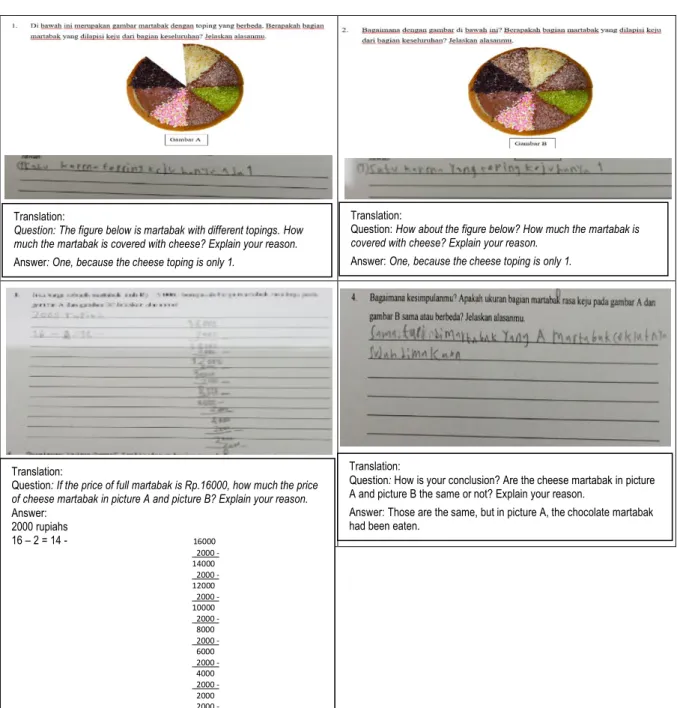
When Ari, the student who answered the part of cheese martabak as a unit, was asked about the price of the cheese martabak, he repeated the subtraction and finally determined the price of cheese martabak was Rp. 2000. The following answers were written by Ari (Figure 7).
Translation: Question: The figure below is martabak with different topings. How much the martabak is covered with cheese? Explain your reason.
Answer: The part of cheese martabak is 1
7. Reason: There is one piece of cheese martabak from seven pieces of martabak in the picture. Because from the beginning it was not explained whether the (missing part) martabak had been eaten or not.
Translation:
Question: How about the figure below? How much the martabak is covered with cheese? Explain your reason.
Answer: The cheese martabak is 1
8 .
Reason: There is one piece of cheese martabak from eight pieces of martabak in the picture.
Translation:
Question: If the price of full martabak is Rp.16000, how much the price of cheese martabak in picture A and picture B? Explain your reason.
Answer:
Picture A = 16000 : 7 pieces = 2285 / 2200 So, the price of one cheese martabak is 2200 Picture B:
16000 : 8 pieces = 2000
So, the price of cheese martabak is 2000
Translation:
Question: How is your conclusion? Are the cheese martabak in picture A and picture B the same or not? Explain your reason.
Answer: The sizes of cheese martabak in picture A and B are the same but the sizes of full martabak in picture A and B are different.
For Sari, the student who answered 1
8 for the two pictures of martabak, she answered the price was 2000 for each martabak. From the beginning Sari answered CA was 1
8 . She did not care whether there was incomplete or complete partition because in Sari’s opinion she looked to the facet, and there were eight facets in picture A which was the same with picture B. The following figures were the written answers of Sari (Figure 8).
Translation:
Question: The figure below is martabak with different topings. How much the martabak is covered with cheese? Explain your reason.
Answer: One, because the cheese toping is only 1.
Translation:
Question: How about the figure below? How much the martabak is covered with cheese? Explain your reason.
Answer: One, because the cheese toping is only 1.
Translation:
Question: How is your conclusion? Are the cheese martabak in picture A and picture B the same or not? Explain your reason.
Answer: Those are the same, but in picture A, the chocolate martabak had been eaten.
Figure 7. The answer of Ari
Translation:
Question: If the price of full martabak is Rp.16000, how much the price of cheese martabak in picture A and picture B? Explain your reason.
Answer:
2000 rupiahs
16 – 2 = 14 - 16000 2000 - 14000 2000 - 12000 2000 - 10000 2000 - 8000 2000 - 6000 2000 - 4000 2000 - 2000 2000 - 0
Figure 8. The answer of Sari
Drawing Conclusion of Fraction as Part-Whole Relationship
On the fourth stage, the students were asked again about the cheese martabak in picture A. Some students had the same answers as their previous ones (Ari answered the cheese martabak in picture A still 1, Nana still answered 1
7, Sari still answered 1
8). Some students changed their answers (Lili changed her answer from 1
8 to 1
7, Putra changed his answer from 1
7 to 1
8, and Fahmi changed his answer from 1
8 to 1
7).
From the series of the problems given, the students were asked their conclusion, are the cheese martabak in Picture A and Picture B the same or not? Lili, Putra, Nana, and Fahmi thought those were different. Only Sari answered that the size and the price of the cheese martabak in picture A and B are the same. She still answered the cheese martabak in picture A as 1
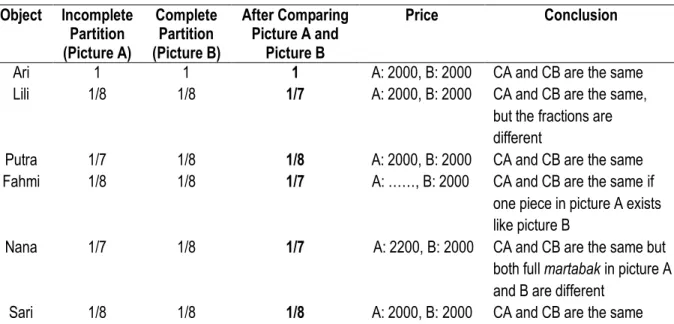
8, even though there was one missing part, and she said it because she looked to the sides, not at the number of martabak slices. Table 2 shows the result of task design applied to student participants.
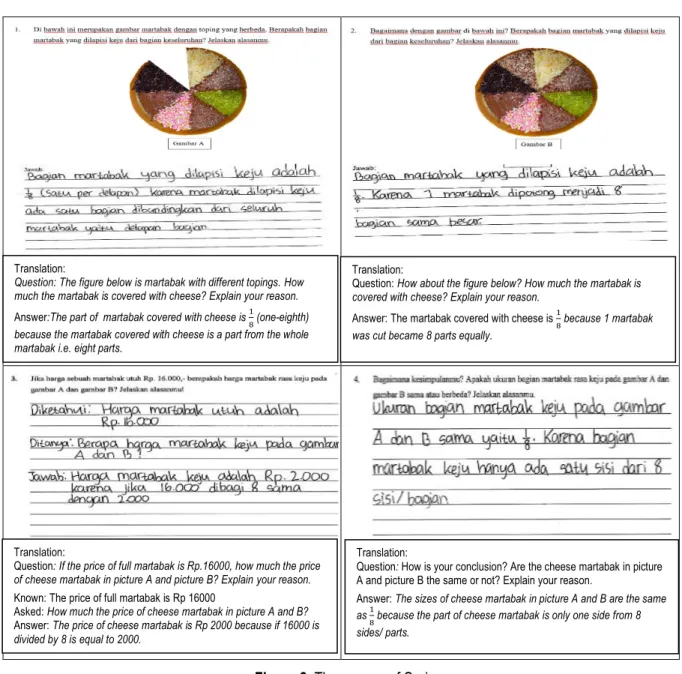
Translation:
Question: The figure below is martabak with different topings. How much the martabak is covered with cheese? Explain your reason.
Answer:The part of martabak covered with cheese is 18 (one-eighth) because the martabak covered with cheese is a part from the whole martabak i.e. eight parts.
Translation:
Question: How about the figure below? How much the martabak is covered with cheese? Explain your reason.
Answer: The martabak covered with cheese is 18 because 1 martabak was cut became 8 parts equally.
Translation:
Question: If the price of full martabak is Rp.16000, how much the price of cheese martabak in picture A and picture B? Explain your reason.
Known: The price of full martabak is Rp 16000
Asked: How much the price of cheese martabak in picture A and B?
Answer: The price of cheese martabak is Rp 2000 because if 16000 is divided by 8 is equal to 2000.
Translation:
Question: How is your conclusion? Are the cheese martabak in picture A and picture B the same or not? Explain your reason.
Answer: The sizes of cheese martabak in picture A and B are the same as 18 because the part of cheese martabak is only one side from 8 sides/ parts.
Table 2. The Result of Task Design Object Incomplete
Partition (Picture A)
Complete Partition (Picture B)
After Comparing Picture A and
Picture B
Price Conclusion
Ari Lili
Putra Fahmi
Nana
Sari
1 1/8
1/7 1/8
1/7
1/8
1 1/8
1/8 1/8
1/8
1/8
1 1/7
1/8 1/7
1/7
1/8
A: 2000, B: 2000 A: 2000, B: 2000
A: 2000, B: 2000 A: ……, B: 2000
A: 2200, B: 2000
A: 2000, B: 2000
CA and CB are the same CA and CB are the same, but the fractions are different
CA and CB are the same CA and CB are the same if one piece in picture A exists like picture B
CA and CB are the same but both full martabak in picture A and B are different
CA and CB are the same
Note: CA: Cheese Martabak in Picture A; CB: Cheese Martabak in Picture B
According to Table 2, there were 2 students who answered both cheese martabak in picture A and B were 1
8, Putra and Sari. However, the process to come up to that answer between Putra and Sari were different. Sari made the relationship between fraction and measurement concept by looking at the number of facets in which those were the same in picture A and picture B. Even though the focus of this task is about part-whole relationship, Sari used the idea of measurement to reveal fractions. It is in line with Baker et al. (2012), Behr et al. (1992), Pantziara & Philippou (2012) that beside as a part whole relationship, fractions concept can be related to measurement. Meanwhile, when the interview was conducted Putra doubted between 1
7 and 1
6. He confused with the word “compare”. He thought that comparing here was similar to ratio. But after that he concluded that it was 1
7. Interestingly, when he determined the price, he realized that CA and CB were the same because the price was also the same.
At the end of the task, Putra answered CA as 1
8. It means for the case of Putra; the task design series gave impact to his’ thinking.
From this study, it can be seen that there were students’ struggles related to determine fraction as a part of a whole. For instance, Lili and Fahmi at the beginning answered CA as 1
8, but after they compared to CB, they changed their answers become 1
7. Those students struggled to making sense of the incomplete partition. They doubted to determine what is a whole. When there is incomplete partition, they thought that the whole is the number of partitions existed.
From the case of Nana, it indicated that her struggle is making references to the complete partition.
Based on Nana’s answer, she looked to the number of partitions existed were 7 parts. From her answer, it can be indicated that she did not come up to the idea of all partitions in fraction should be divided equally. She just compared one part to the number of the visible partitions.
From all participants, almost all of them came up to the idea of fractions except Ari. Until the end of the task, he still answered that CA was 1. According to Ratnasari (2018), in Indonesian national curriculum, all of students should have learned about fractions since 3rd grade. However, in fact the student in grade 4 in this research still did not understand the concept of fractions as well.
Based on the finding of this study, students who already understand the concept of part-whole relationship would give the answer like Sari. From the beginning she did not change that both CA and CB were the same as 1
8, but for the other students according to the researcher's conjecture, when they were given the problem in picture B, some students changed their answer. Those who previously answered CA was 1
8 changed their answer became 1
7 or vice versa. Therefore, giving picture B is a stimulus to assess students' persistence in perceiving the fraction itself, especially in the missing part context.
Even though this study is focused to the idea of fraction as a part of a whole, but based on the findings, the researchers found that there were many answers with various reasoning when the students were asked about part-whole concept from incomplete partition. Almost all students in this research came up to the idea of part-to whole concept but some of them were still struggling to make references to the complete partition (Putra and Nana). Some students were still struggling to make sense to the incomplete partition (Lili and Fahmi). Putra also experienced coming up the idea of ratio even though he did misunderstand about the word of “compare”. When the students were given the problem about the price of the whole martabak, almost all of them could make relation between fraction-quotient concept, except Ari who did repeated subtraction for determining the price of CA and CB. These are in line with Bennett et al. (2018) stated there are three concepts of fractions that usually emerge when children began to know fractions: the part-to-whole concept, the fraction-quotient concept, and the ratio concept.
Based on the findings, the researchers classified the students’ struggles in understanding the meaning of fractions as a part of a whole become three categories, namely: 1) making references to the whole, making references to the complete partition, and making sense of the incomplete partition.
Some students’ misconceptions emerged due to their unusual way of solving fraction problems using a missing part to represent other parts as a whole. When there was no missing part, the students did not find it too difficult to determine a fraction as a part of a whole. However, when one part is missing, there were different answers with various reasoning. It can be concluded that the designed problem can provoke the disequilibrium of students’ thinking, which has potential to encourage their mathematical reasoning to understand the meaning of fractions. It means challenging this relationship can be supported with problems that have some ambiguity about what is the ‘whole’. This is in line with Wilkins & Norton (2018) stated that the challenge with fractions might emerge from the boundaries of part-whole concepts of fractions, which is the central focus of the fraction’s curriculum. When children struggle to understand fractions if there is one missing part, some important big ideas frequently confuse them and sometimes change their interpretation. For example, some students struggle with fractions representing a part-whole relationship, but when one part disappears, could it be assumed as a whole? It is in line with Fosnot &
Dolk (2002), who stated that when children were asked to determine part of what it means, they explored relationships and found ways to make their own procedures, proofs, and proper strategies.
CONCLUSION
The result of this study indicated that the students’ struggles can be identified as follows: making references to the whole, making references to the complete partition, and making sense of the incomplete partition. The problem showed that even though the students had learned about fractions, it did not guarantee they understood the basic concept of fractions. According to this finding, it is recommended that when students learn fractions, their understanding of the meaning of fractions should be well
addressed with problems that challenge this part-whole relationship. Although the finding of this research can show various answers from diverse students, but there was limitation regarding the number of participants involved. Since the result of this research showed that the problems that have some ambiguity about what is the ‘whole’ can support the challenging of part-whole relationship, it is recommended that further research will provide supplementary details about how this problem is applied in the larger group of participants to develop the knowledge for educators in teaching fractions especially in provoking students’ mathematical reasoning.
Acknowledgments
We would like to thank all participants for their time and willingness to participate in this research, and for their parents who allowed their children to become the research subjects. Besides, thank you to Directorate of International Affairs Universitas Pendidikan Indonesia (UPI) Bandung and all colleagues in Indonesia and some educators in The Netherlands who have given suggestions on this research.
Declarations
Author Contribution : PP: Conceptualization, Writing - Original Draft, Editing and Visualization;
TH: Review and Editing, Formal analysis, Validation and Supervision; T:
Review and Editing, Formal analysis, Validation and Supervision; MD:
Conceptualization, Review and Editing, Formal analysis, Methodology, Validation and Supervision; MD: Conceptualization, Review and Editing, Formal analysis, Methodology, and Validation.
Funding Statement : This research was supported by Directorate of International Affairs Universitas Pendidikan Indonesia Bandung Indonesia towards World Class University Program for international publication collaboration with Freudenthal Institute Utrecht University, The Netherlands.
Conflict of Interest : The authors declare no conflict of interest.
Additional Information : Additional information is available for this paper.
REFERENCES
Baker, W., Czarnocha, B., Dias, O., Doyle, K., & Kennis, J. R. (2012). Procedural and Conceptual Knowledge: Adults Reviewing Fractions. Adults Learning Mathematics – An International Journal, 7(2), 39–65.
Behr, M. J., Harel, G., Post, T., & Lesh, R. (1992). Rational Number, Ratio, and Proportion. In D. A.
Grouws (Ed.), Handbook of research on mathematics teaching and learning: A project of the National Council of Teachers of Mathematics (pp. 296–333).
Bennett, A. B., Laurie J. Burton, & Nelson, L. T. (2018). Mathematics for Elementary Teachers: A Conceptual Approach. In Mcgraw-Hill (9th ed.). The McGraw-Hill Companies, Inc.
Blair, A. (2008). Hot Ideas for Fractions. 13(2), 16–18. https://archive.org/details/ERIC_EJ802701 Bright, G. W., & Litwiller, B. H. (2002). Classroom Activities for Making Sense of Fractions, Ratios, and
Proportions. 2002 Yearbook. National Council of Teachers of Mathematics.
Čadež, T. H., & Kolar, V. M. (2018). How fifth-grade pupils reason about fractions: a reliance on part- whole subconstructs. Educational Studies in Mathematics, 99(3), 335–357.
https://doi.org/10.1007/s10649-018-9838-z
Cwikla, J. (2014). Can Kindergartners Do Fractions? National Council of Teachers of Mathematics, 20(6), 354–364. https://www.jstor.org/stable/10.5951/teacchilmath.20.6.0354
Fosnot, C. T., & Dolk, M. (2002). Young Mathematicians at Work: Constructing Fractions, Decimals, and Percents (V. Merecki & L. Peake (eds.)). HEINEMANN • Portsmouth, NH.
Gravemeijer, K. P. E. (1994). Developing Realistic Mathematics Education: Ontwikkelen Van Realistisch Reken/wiskundeonderwijs. , 1994. CD-[Beta] Press, 13(3).
Hoon, T. S., Mohamed, S. S. E., Singh, P., & Kee, K. L. (2020). In Search of Strategies Used by Primary School Pupils for Developing Fraction Sense. Malaysian Journal of Learning and Instruction, 17(2), 25–61. https://doi.org/10.32890/mjli2020.17.2.2
Jordan, N. C., Rodrigues, J., Hansen, N., & Resnick, I. (2017). Fraction Development in Children:
Importance of Building Numerical Magnitude Understanding. In D. C. Geary, D. B. Berch, R. J.
Ochsendorf, & K. M. Koepke (Eds.), Acquisition of Complex Arithmetic Skills and Higher-Order Mathematics Concepts. Elsevier Academic Press. https://doi.org/10.1016/B978-0-12-805086- 6.00006-0
Keijzer, R. (2015). Teaching Formal Mathematics in Primary Education. Fraction Learning as Mathematising Process. Wilco, Amersfoort.
Kerie, B., Banda, B., Tyomane, N., & MOE-JICA, E. (2019). Students’ Understanding of the Concept of Fraction and Computational Skills: A Case of Grade Seven and Eight in Selected Regions of Ethiopia. Researchgate.Net, January 2022.
Nattrass, G. (2017). Review Reviewed Work ( s ): Fractions in Realistic Mathematics Education : A Paradigm of Developmental Research by Leen Streefland. The Arithmetic Teacher, 39(7), 41.
Pantziara, M., & Philippou, G. (2012). Levels of Students’ “Conception” of Fractions. Educational Studies in Mathematics, 79(1), 61–83. https://doi.org/10.1007/s10649-011-9338-x
Ratnasari, R. (2018). Students’ Errors and Misconceptions about Operations of Fractions in an Indonesian Primary School. Southeast Asian Mathematics Education Journal, 8(1), 83–98.
https://doi.org/10.46517/seamej.v8i1.66
Shahbari, J. A., & Peled, I. (2017). Modelling in Primary School: Constructing Conceptual Models and Making Sense of Fractions. International Journal of Science and Mathematics Education, 15(2), 371–391. https://doi.org/10.1007/s10763-015-9702-x
Streefland, L. (1993). The design of a mathematics course. A theoretical reflection. Educational Studies in Mathematics, 25(1–2), 109–135. https://doi.org/10.1007/BF01274105
Tekin-Sitrava, R., Kaiser, G., & Işıksal-Bostan, M. (2022). Development of Prospective Teachers’ Noticing Skills Within Initial Teacher Education. International Journal of Science and Mathematics Education, 20(7), 1611–1634. https://doi.org/10.1007/s10763-021-10211-z
Vale, C., Widjaja, W., Herbert, S., Bragg, L. A., & Loong, E. Y.-K. (2016). Mapping Variation in Children’s Mathematical Reasoning: The Case of ‘What Else Belongs?’ International Journal of Science and
Mathematics Education, 15(5), 873–894. https://doi.org/10.1007/s10763-016-9725-y
Wetering, van de M., Bekkema, C., Coenen, F., Eijnden, van den M., Harten, C., Ootermeijer, J., Nillesen, C., Santen, van Y., Westheest, Y., & Woltjer, M. (2020). Alles telt Q Basiswerkschrift.
ThiemeMeulenhoff.
Wilkins, J. L. M., & Norton, A. (2018). Learning progression toward a measurement concept of fractions.
International Journal of STEM Education, 5(1), 27. https://doi.org/10.1186/s40594-018-0119-2 Zhang, X., Clements, M. A., & Ellerton, N. F. (2015). Conceptual mis (understandings) of fractions: From
area models to multiple embodiments. Mathematics Education Research Journal, 27(2), 233–261.
https://doi.org/10.1007/s13394-014-0133-8
Zulkardi, & Putri, R. I. I. (2006). Mendesain sendiri soal kontekstual matematika [Designing your own contextual math problems]. Konferensi Nasional Matematika XIII Semarang, 1–7.