DOES ORGANIZATIONAL PARTICIPATION AFFECT RELIGIOUS TOLERANCE?
Arnel Willim1*, Mohamad Fahmi2
,2Padjadjaran University, Indonesia
*e-mail: [email protected]
Abstract: Amidst the rising religious intolerance in Indonesia, initiatives to foster religious tolerance is highly needed. However new initiative is limited and older initiative like Youth Organization (Karang Taruna) is never evaluated. Thus, this study focuses on evaluating the impact of the existing national Youth Organization (Karang Taruna) on the religious tolerance of its participants. Utilizing panel data from the 2007 and 2014 IFLS data, this study employed panel data regression and the result shows that there is no statistically significant impact of participation in Youth Organization on the individual’s level of religious tolerance.
Keywords: religious tolerance, voluntary associations, youth organization, Karang Taruna
APAKAH PARTISIPASI PADA ORGANISASI MEMENGARUHI TOLERANSI BERGAMA?
Arnel Willim1*, Mohamad Fahmi2
,2Padjadjaran University, Indonesia
*e-mail: [email protected]
Abstrak: Ditengah meningkatnya intoleransi beragama di Indonesia, inisiatif/program untuk memelihara toleransi beragama menjadi sangat dibutuhkan. Namun begitu, terdapat keterbatasan pada penciptaan program baru sedangkan program lama seperti organisasi pemuda (Karang Taruna) tidak pernah dievaluasi. Oleh karena itu, fokus dari studi ini adalah mengevaluasi dampak dari organisasi pemuda (Karang Taruna) pada tingkat toleransi beragama individu. Studi ini menggunakan data panel dari data IFLS 2007 dan 2014, dan model regresi data panel. Hasil regresi menunjukkan bahwa secara statistik, partisipasi pada organisasi pemuda tidak berpengaruh signifikan pada tingkat toleransi beragama individu.
Kata kunci: toleransi beragama, partisipasi pada organisasi, organisasi pemuda, Karang Taruna
INTRODUCTION
Religious tolerance and freedom are sharply deteriorating around the globe. A severe violation of religious freedom happens in one out of every three countries, and nearly 67 percent of the world’s population live in those countries (ACN International, 2021). Among the world’s 25 most populated countries, Iran, Russia, Egypt, China, and Indonesia have the greatest degree of governmental restrictions on religion (Pew Research Center, 2019). In Indonesia, religious restrictions occur simultaneously with a rise on populist conservatism (Hadiz, 2018; Rakhmani, 2017) and Islamist extremism (ACN International, 2021) which is a threat to democracy and social harmony. In 2021, USCIRF placed Indonesia, along with 11 other countries, like Malaysia, Egypt, and Iraq under the recommendation for Special Watch List Countries for its engagement in or tolerance of severe violations of religious freedom.
Those data make religion a highly critical issue in Indonesia, not to mention that it’s also one of the most religious countries out of 32 other countries for more than 10 years (Pew Research Center, 2020). As of 2022, the government of Indonesia recognizes six official religions – Hinduism, Islam, Catholicism, Protestantism, Confucianism, and Buddhism. Islam accounted for nearly 87% of the population which makes Indonesia the largest Muslim country in the world. Its long history of religious pluralism (USCIRF, 2021) made Indonesia known as an example of moderate and tolerant Muslims, at least before the early 2000s (Dibb, 2001;
Wanandi, 2002). However, after Suharto's rule came to an end, democratic reforms took place, allowing everyone—including political organizations with an Islamic foundation—to express themselves more freely. This is suspected to be the beginning of rising religions tensions (Qurtuby, 2020; Yusuf et al., 2019).
In 2000, several terrorist attacks were done on churches and in 2002, a popular tourist site in Bali was bombed, which was repeated annually until around three years. In 2001 and 2002, a few political parties demanded that the Jakarta Charter, which required Muslims to follow Islamic law, be reinstated in the Constitution. While the previously mentioned incidents were linked to vocal but minority Islamic hardliners, attitudes on Islam and interactions between different religious groups also changed negatively. Discrimination against Shia and Ahmadiya as well as objection to the construction of non-Muslims’ houses of worship are examples of this shifting attitude in the country. Nearly ten mosques belong to the Indonesian Ahmadiyya Congregation (JAI) were sealed from use since the declaration that Ahmadiyya Muslims are
apostates by Indonesian Ulema Council (Majelis Ulama Indonesia/MUI). From 2007 to 2019, more than 200 churches have been forced to stop its operation or construction due to protests and violence acts by the surrounding communities (Wijaya, 2019) . Similar, although less common, objection also happens the other way around in some areas where Muslims are minorities. In 2018, the renovation of Al-Aqa Great Mosque in Sentani, Papua was rejected due to the mosque’s minaret being taller than the churches around (Rahmiaji et al., 2022).
In addition to visible acts of intolerance, surveys and studies conducted by several institutions also found concerning results. A national survey of a total of 1.520 respondents shows that 60 percent has a hated group that include either non-Muslims, Chinese, communists, or others. Of that 60 percent, 92 percent objects if members of their hated groups become government officials, and 82 percent even refuses those members to be neighbors (LSI & Wahid Foundation, 2016). Similar results found by the Centre of Study for Islam and Society (PPIM) of UIN (State Islamic University) that of the 500 Islamic teachers, more than 80% opposed the presence of non-Muslim leaders or the construction of a non-Islamic house of worship nearby.
The evidence of these studies is reflected by the case of Basuki "Ahok" Purnama, a Chinese Christian former governor of Jakarta who received a two-year prison term for blasphemy against Islam in 2017, following a political black campaign targeted on him (Kato, 2017).
A survey by the Ministry of Religious Affairs and Wahid Foundation on 1600 high schoolers that participated in Islam-related extracurricular (ROHIS) resulted in a more appalling finding. 75 percent of the students supported the caliphate system, 60 percent were ready to offer combat missions to conflicted areas, such as Palestine and Syria, and 68 percent agreed to join missions in the future (Wahid Foundation, 2016). The National Counter Terrorism Agency (BNPT) mentioned that more than 52 percent of terrorist convicts are in the age of 17 to 34 years old. Young people are more vulnerable to commit terrorism, as they have lower understanding of religious dogma, highly exposed to religious information that contains suspicion and hatred and tend to have higher feeling of alienation from their environment, therefore, are easily infiltrated by radical and intolerant ideas (Wahid Foundation, 2017). Even worse, some of radicalization doctrine aim to target youth in particular, through activities in school and universities (Fathonah, 2021).
Since 2005, Karang Taruna, a national scale youth organization was established and one of its objectives is to preserve tolerance and diversity in communities (Ministry of Social Affairs
Regulation Number 83/HUK/2005). Nowadays, even though members participation is weakening (Evi Surya, 2022; Rohalia, 2022; Yuwanto, 2019), it’s still remained with more than 65,000 counterparts located in various villages throughout the country. A few programs, like discussion and seminar to prevent radicalization and increase religious tolerance are reported to have been conducted (Fathonah et al., 2021; Lestari, 2017). Besides, the nature of the organization that is open to youth from all ethnicities, religions, and races is also thought to increase interaction between individuals from different backgrounds, thereby reducing negative prejudice (Hodson, 2011). Although holding a strategic position to cultivate acceptance in diversity, Karang Taruna’s impact on religious tolerance is never evaluated until today. This study intends to prove whether participation in Karang Taruna influences the level of religious tolerance among individual members.
METHOD
This study uses data from Indonesia Family Life Survey (IFLS) Wave 4 and 5. IFLS is an ongoing longitudinal survey that collect data from individual respondents, households, communities, and public facilities. It contains data from over 30,000 individuals living in 13 of the 27 provinces in the country. IFLS has been conducted 5 times, in 1993-1994 (IFLS Wave 1), 1997-1998 (IFLS Wave 2), 2000 (IFLS Wave 3), 2007-2008 (IFLS Wave 4), and 2014-2015 (IFLS Wave 5).
The authors utilizes data from IFLS Wave 4 and IFLS Wave 5 to capture a time span of 7 years between the two surveys so the long-term effects of individual participations in the Youth Organization can be analyzed. This is considering that the impact of organizational participation needs some time to develop. Moreover, the utilization of IFLS as a data source is due to the completeness of the aspects surveyed, especially the aspect of religious tolerance which is rarely found in other surveys.
Based on the official regulation, the individuals eligible to participate in the Youth Organization are those with a minimum age of 13 years old and a maximum of 45 years old.
However, the IFLS survey on organizational participations was only given to individuals aged 15 years or older, and therefore the data of individuals aged 13 and 14 years old isn’t available.
The unit of analysis are those who live in areas (village or equivalent customary community) that has a Youth Organization, in which population will be divided into two groups:
(1) those who have continuous participation in the Youth Organization, known by their answers in IFLS 4 (2007) and IFLS 5 (2014) and; (2) those who didn’t participate in the Youth Organization, both at the time when IFLS 4 and IFLS 5 were conducted.
Variables that are used in this study includes independent variable, dependent variables, and control variables. The independent and dependent variable is Youth Organization participation and religious tolerance respectively. While control variables are aspects related to demography (sex, age, marital status), individual background (educational attainment, income, level of religiosity), and community characteristics (residing in urban/rural areas).
This study uses panel data regression model and forms an index of religious tolerance from 5 types of religious tolerance in IFLS 2007 and 2014. The equation of the index measurement is as follows:
∑
i=0 1❑
And it’s regressed as a dependent variable with the following specification:
Description:
Wit = has a minimum value of 0 (lowest level of tolerance) and a maximum value of 1 (highest level of tolerance). An individual who objected to every question on tolerance scored the minimum value of 0. If they objected to none, they scored 1. Individuals who objected to at least one of the questions scored between 0 and 1.
Xit = Youth Organization Participation τ it = control variables
ε it = error term
� = individuals
� = dummy (0 = intolerance; 1 = tolerance)
� = time (�1 = 2007; �2 = 2014)
As an addition, this study also regressed the same model with cross sectional linear regression to analyse relationships between the variables on each year as a comparison to panel data regression that analyse relationships throughout the year or in a longer term.
Yijt
Wit =
Wit = Xit + τ it + ε it
Below is the hypothesis for this study.
H1 = Youth organization participation has an impact on religious tolerance.
H0 = Youth organization participation has no impact on religious tolerance.
FINDINGS AND DISCUSSION Findings
First, the author will describe the distribution of the panel data. The author utilizes 12 variables in which 9 of them are dummy variables, 2 are continuous, and 1 is in the form of index ranging between 0 to 1. From the sample, 88.6% are non-participants of the Youth Organization, and 11.4% are participants. For the characteristics of the participants of the Youth Organization, the majority resides in urban area (67%) and are married individuals (55%). Youth Organization is a male dominated organization as male consists 92% of its participants. For age, 32% of its participants are between 15 to 25 years old, 52% are between 26 to 36 years old, and only 16% are between 37 to 45 years old. Furthermore, a great majority of its participants are religious individuals (72%). For educational attainment, 21% reported elementary school/equivalent & below as their highest level of education. Meanwhile 22% reported junior high school/equivalent, a majority of 37% reported senior high school/equivalent, and 20%
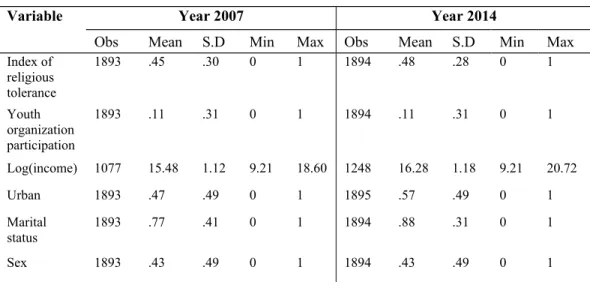
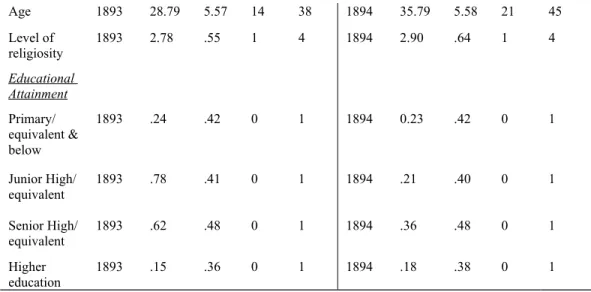
reported a higher education. Moreover, the general statistic of each variable is described in Table 4.1 for the cross-section data and Table 4.2 for the panel data.
Table 4.1 Summary Statistics: Cross Section from IFLS4 & IFLS5
Variable Year 2007 Year 2014
Obs Mean S.D Min Max Obs Mean S.D Min Max
Index of religious tolerance
1893 .45 .30 0 1 1894 .48 .28 0 1
Youth organization participation
1893 .11 .31 0 1 1894 .11 .31 0 1
Log(income) 1077 15.48 1.12 9.21 18.60 1248 16.28 1.18 9.21 20.72
Urban 1893 .47 .49 0 1 1895 .57 .49 0 1
Marital status
1893 .77 .41 0 1 1894 .88 .31 0 1
Sex 1893 .43 .49 0 1 1894 .43 .49 0 1
Age 1893 28.79 5.57 14 38 1894 35.79 5.58 21 45 Level of
religiosity 1893 2.78 .55 1 4 1894 2.90 .64 1 4
Educational Attainment Primary/
equivalent &
below
1893 .24 .42 0 1 1894 0.23 .42 0 1
Junior High/
equivalent
1893 .78 .41 0 1 1894 .21 .40 0 1
Senior High/
equivalent 1893 .62 .48 0 1 1894 .36 .48 0 1
Higher
education 1893 .15 .36 0 1 1894 .18 .38 0 1
Source: IFLS Wave 4 and 5, Processed
Table 4.2 Summary Statistics: Panel from IFLS4 & IFLS5
Variable Obs Mean Std. Dev. Min Max
Index of religious
tolerance 3787 .466 .296 0 1
Youth organization participation
3787 .114 .318 0 1
Log(income) 2325 15.913 1.224 9.21 20.723
Urban 3787 .446 .497 0 1
Marital status 3787 .832 .374 0 1
Sex 3787 .435 .496 0 1
Age 3787 32.294 6.587 14 45
Level of religiosity 3787 .778 .416 0 1
Educational Attainment Primary/equivalent &
below 3787 .241 .427 0 1
Junior High/equivalent 3787 .215 .411 0 1
Senior High/ equivalent 3787 .374 .484 0 1
Higher education 3787 .17 .375 0 1
Source: IFLS Wave 4 and 5, Processed
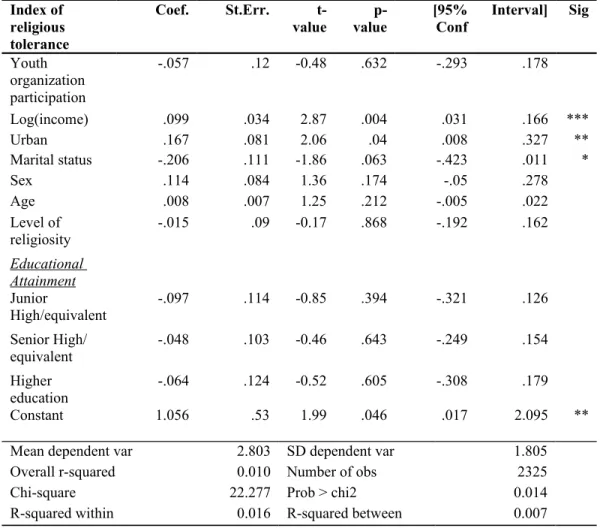
This study regresses Youth Organization participation on Index of religious tolerance together with control variables related with demography and educational aspects. The result shows that the p-value of the variable Youth Organization Participation is not less than alpha
(5%), which means that the participation on Youth Organization is not statistically significant on affecting the levels of religious tolerance of its participants. Meanwhile having a higher income and residing in urban areas have a positive impact on religious tolerance, and being married has a negative impact on religious tolerance although it is less significant.
Table 4.3 Regression Result: Youth Organization Participation & Control
Index of religious tolerance
Coef. St.Err. t-
value p-
value [95%
Conf Interval] Sig Youth
organization participation
-.057 .12 -0.48 .632 -.293 .178
Log(income) .099 .034 2.87 .004 .031 .166 ***
Urban .167 .081 2.06 .04 .008 .327 **
Marital status -.206 .111 -1.86 .063 -.423 .011 *
Sex .114 .084 1.36 .174 -.05 .278
Age .008 .007 1.25 .212 -.005 .022
Level of
religiosity -.015 .09 -0.17 .868 -.192 .162
Educational Attainment Junior
High/equivalent -.097 .114 -0.85 .394 -.321 .126
Senior High/
equivalent -.048 .103 -0.46 .643 -.249 .154
Higher
education -.064 .124 -0.52 .605 -.308 .179
Constant 1.056 .53 1.99 .046 .017 2.095 **
Mean dependent var 2.803 SD dependent var 1.805
Overall r-squared 0.010 Number of obs 2325
Chi-square 22.277 Prob > chi2 0.014
R-squared within 0.016 R-squared between 0.007
*** p<.01, ** p<.05, * p<.1 Source: IFLS Wave 4 and 5, Processed
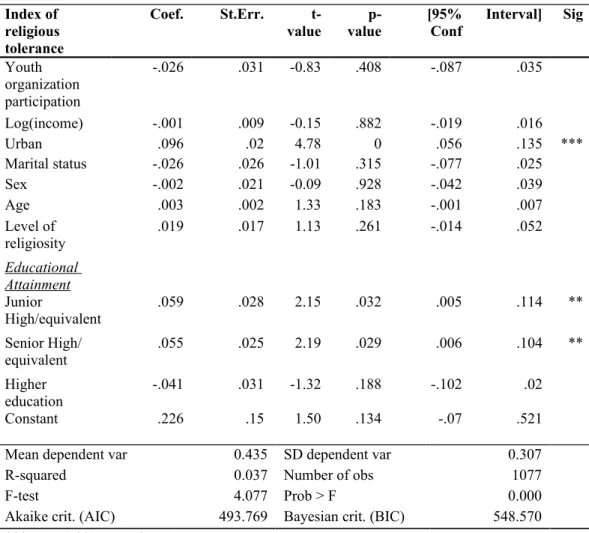
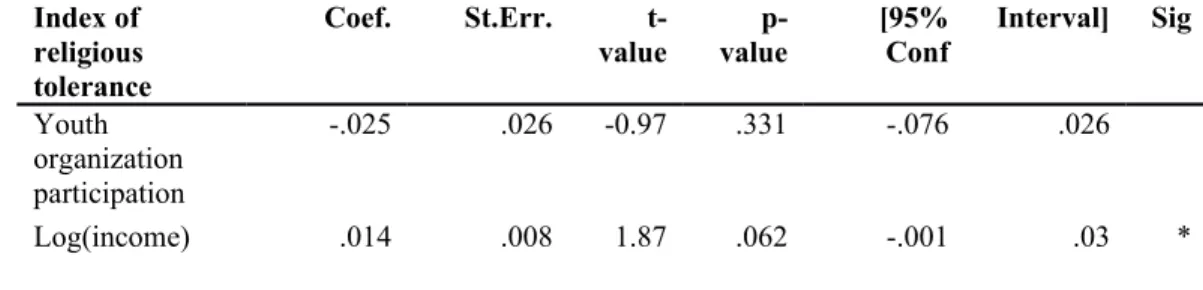
For comparison, this study also regresses cross section data from ILFS4 (2007) and IFLS5 (2014) individually with all control variables. The regressions imply different results in terms of variables that are statistically significant. From the data in 2007, factors that have positive relationships with religious tolerance are residing in urban area, having junior high/equivalent and senior high/equivalent as the highest educational attainment. Meanwhile in
2014, having a higher income, residing in urban areas, and being a male have positive relationships with religious tolerance. While being married, is older in age, and having a higher level of religiosity have negative relationships with religious tolerance.
Table 4.4 Regression Result: 2007 Cross Section
Index of religious tolerance
Coef. St.Err. t-
value p-
value [95%
Conf Interval] Sig Youth
organization participation
-.026 .031 -0.83 .408 -.087 .035
Log(income) -.001 .009 -0.15 .882 -.019 .016
Urban .096 .02 4.78 0 .056 .135 ***
Marital status -.026 .026 -1.01 .315 -.077 .025
Sex -.002 .021 -0.09 .928 -.042 .039
Age .003 .002 1.33 .183 -.001 .007
Level of
religiosity .019 .017 1.13 .261 -.014 .052
Educational Attainment Junior
High/equivalent .059 .028 2.15 .032 .005 .114 **
Senior High/
equivalent .055 .025 2.19 .029 .006 .104 **
Higher
education -.041 .031 -1.32 .188 -.102 .02
Constant .226 .15 1.50 .134 -.07 .521
Mean dependent var 0.435 SD dependent var 0.307
R-squared 0.037 Number of obs 1077
F-test 4.077 Prob > F 0.000
Akaike crit. (AIC) 493.769 Bayesian crit. (BIC) 548.570
*** p<.01, ** p<.05, * p<.1 Source: IFLS Wave 4, Processed
Table 4.5 Regression Result: 2014 Cross Section
Index of religious tolerance
Coef. St.Err. t-
value p-
value [95%
Conf Interval] Sig Youth
organization participation
-.025 .026 -0.97 .331 -.076 .026
Log(income) .014 .008 1.87 .062 -.001 .03 *
Urban .033 .018 1.84 .065 -.002 .068 *
Marital status -.055 .026 -2.07 .039 -.107 -.003 **
Sex .049 .019 2.64 .008 .013 .086 ***
Age -.004 .002 -2.23 .026 -.007 0 **
Level of
religiosity -.022 .013 -1.76 .078 -.047 .003 *
Educational Attainment Junior
High/equivalent .012 .026 0.47 .641 -.038 .062
Senior High/
equivalent .027 .023 1.17 .244 -.018 .072
Higher
education .011 .027 0.41 .683 -.042 .064
Constant .441 .136 3.23 .001 .174 .709 ***
Mean dependent var 0.495 SD dependent var 0.293
R-squared 0.033 Number of obs 1248
F-test 4.280 Prob > F 0.000
Akaike crit. (AIC) 452.580 Bayesian crit. (BIC) 509.003
*** p<.01, ** p<.05, * p<.1 Source: IFLS Wave 5, Processed
Discussion
The three regressions consistently show insignificant impact of Youth Organization Participation and religious tolerance. It suggests that the participation in Youth Organization, in this case Karang Taruna, has no impact on the levels of religious tolerance of individuals. This result is contrary with a prominent theory in civic studies, namely intergroup contact theory which argues that social contact that happened as a result of participation in voluntary associations (organizations) will develop tolerance, trust, and acceptance towards outgroup or people who are seen as different.
However, being introduced in 1954, this theory slowly loses its prominence as recent studies show more ambiguous relationships between organizational participations and tolerance.
It has been shown through various research that not all organizations have positive impact on tolerance. To be a setting for the development of tolerance, organizations need to consist of people from diverse background (Putnam, 2000), therefore creates an all-embracing identity, which, in turn lessens intergroup bias and promotes generalized trust. Organizations that have diversity also requires its participants to compromise and reconciliate views to consider the
perspectives of others, all of which will develop generalized tolerance (Paxton, 2007).
Meanwhile, organizations that only consists of homogeneous group of people have the tendency to result in an ingroup-bias, where trust is only developed for members of the ingroup and intolerance is developed for members of the outgroup (Stolle et al., 2008).
Furthermore, several studies also suggests that there is no causal relationship between organizational participation and tolerance (Kramer, 2011; Achbari et al., 2018). The positive correlation that was captured between the two variables might only be a result of self-selection effect, meaning that it shows the difference on individuals’ propensity in participating in voluntary organizations (Sønderskov, 2011). Consequently, a diverse organization tend to attract people who are more accepting and tolerant towards people from different background.
Similarly, a homogeneous organization tend to attract people who are less accepting and tolerance. A mix of self-selection effect and social contact theory is also possible. As a result of the self-selection process, some subcultures might develop within voluntary organizations, and this group culture can be developed even more through socialization. Thus, there is no reason to assume that all voluntary participations have the same impact because not all organizations have the same group cultures.
Considering those discussions, the insignificant impact of Youth Organization participation can be better understood, especially when examining the possible reasons behind this result. Another important point, Youth Organization, namely Karang Taruna that is used as a sample in this study has several critical problems within its body. Its numbers of participants who are active members are declining. There have been a few articles that reported a decline on Karang Taruna membership participation in some areas of Indonesia (Evi Surya, 2022; Rohalia, 2022). For instance, in Grendeng Village, the active members have significantly decreased from 74 people in 2012 to only 36 people in 2018 (Yuwanto, 2019). One reason for this is a lack of consistent programs and a lack of enthusiasm from the younger generation (Ramadhan, 2016;
Setiawan, et al., 2019). When in fact, active membership has been consistently proven as one of the strong predictors of organizational participation that lead to tolerance development (Chong et al., (2011). This is because active participation provides more opportunity for socialization between members, which include compromising and trying to understand different perspectives of others.
Furthermore, although being open for youth from all background, the nature of Karang Taruna that organizes its activities only within a counterpart, meaning that it is limited to one area/village might not provide the opportunity for its members to have intergroup contact.
Karang Taruna from different counterparts/areas rarely have any programs or activities that can bring them together. Besides, several studies also show that some Karang Taruna counterparts held religious activities as its scheduled program, thus making it more likely to self-select individuals from the same religion only.
CONCLUSION
Motivated by the rising religious intolerance globally and especially in Indonesia, this study aims to examine the impact of participation in Youth Organization (Karang Taruna) on the individuals’ level of religious tolerance. Using large-scale longitudinal data, this study finds that Youth Organization participation doesn’t have any impact on religious tolerance of individuals, which is shown by a statistically insignificant result on the regression of the variable.
Several reasons that might explained this phenomena were discussed. First is regarding the nature of the Youth Organization that has a high tendency to self-select homogeneous participants, in this case people with the same religion and residence. Organizational homogeneity indicates that an organization doesn’t have the required setting for the development of tolerance as there is no intergroup interaction within the organization. Second is regarding its active membership and programs that declines over the year. Active participation is a strong predictor of the development of tolerance and trust because it creates more social interaction between members, which involves compromising and perspective taking between people with different view.
In general, this study supports the notion that not all organizations have positive impact on tolerance (Putnam, 2000), and there might be no causal relationship between participation in voluntary associations and a higher level of social tolerance (Achbari et al., 2018).
REFERENCES
Aberson, C. L. (2015). Positive intergroup contact, negative intergroup contact, and threat as predictors of cognitive and affective dimensions of prejudice. Group Processes &
Intergroup Relations, 18(6), 743–760. https://doi.org/10.1177/1368430214556699
Achbari, W., Gesthuizen, M., & Holm, J. (2018). Ethnic Diversity and Generalized Trust:
Testing the Contact Hypothesis in Dutch Voluntary Organizations. Nonprofit and Voluntary Sector Quarterly, 47(4), 813–835. https://doi.org/10.1177/0899764018764328
ACN International. (2021). Religious Freedom in The World.
https://acninternational.org/religiousfreedomreport
al Majali, S., & al Khaaldi, K. (2020). Values of tolerance in relation to academic achievements, cultures, and gender among UAE universities students. International Journal of Instruction, 13(3), 571–586. https://doi.org/10.29333/iji.2020.13339a
Al Qurtuby, S. (2020). The rise of Islamism and the future of Indonesian Islam. Journal of Allport, G. W. (1954). The Nature of Prejudice.
Allport, G. W. (1966). The Religious Context of Prejudice. Journal for the Scientific Study of Religion, 5(3), 447–457. https://doi.org/https://doi.org/10.2307/1384172
Allport, G. W., & Kramer, B. M. (1946). Some Roots of Prejudice. The Journal of Psychology, 22(1), 9–39. https://doi.org/10.1080/00223980.1946.9917293
Almond, G. A., & Verba, S. (1963). The civic culture: Political attitudes and democracy in five nations. Princeton, NJ: Princeton University Press.
Árnadóttir, K., Lolliot, S., Brown, R., & Hewstone, M. (2018). Positive and negative intergroup contact: Interaction not asymmetry. European Journal of Social Psychology, 48(6), 784–
800. https://doi.org/10.1002/ejsp.2365
Aydin, N., Krueger, J. I., Frey, D., Kastenmüller, A., & Fischer, P. (2014). Social exclusion and xenophobia: Intolerant attitudes toward ethnic and religious minorities. Group Processes &
Intergroup Relations, 17(3), 371–387. https://doi.org/10.1177/1368430213510569
Bagci, S. C., Baysu, G., Tercan, M., & Turnuklu, A. (2022). Dealing With Increasing Negativity Toward Refugees: A Latent Growth Curve Study of Positive and Negative Intergroup Contact and Approach-Avoidance Tendencies. Personality and Social Psychology Bulletin.
https://doi.org/10.1177/01461672221110325
Bahry, D., Boaz, C., & Gordon, S. B. (1997). Tolerance, transition, and support for civil liberties in Russia. Comparative Political Studies, 30, 484-510.
Barlow, F. K., Paolini, S., Pedersen, A., Hornsey, M. J., Radke, H. R., Harwood, J., Sibley, C. G.
(2012). The contact caveat: Negative contact predicts increased prejudice more than positive
contact predicts reduced prejudice. Personality and Social Psychology Bulletin, 38, 1629- 1643.
Bayram Özdemir, S., Özdemir, M., & Boersma, K. (2021). How Does Adolescents’ Openness to Diversity Change Over Time? The Role of Majority-Minority Friendship, Friends’ Views, and Classroom Social Context. Journal of Youth and Adolescence, 50(1), 75–88.
https://doi.org/10.1007/s10964-020-01329-4
Ben-Nun Bloom, P., & Bagno-Moldavsky, O. (2015). The Conditional Effect of Network Diversity and Values on Tolerance. Political Behavior, 37(3), 623–651.
https://doi.org/10.1007/s11109-014-9284-2
Bentsen, B. M. A. (2022). Intergroup Contact and Negative Attitudes Towards Immigrants Among Youth in Sweden: Individual and Contextual Factors. Journal of International Migration and Integration, 23(1), 243–266. https://doi.org/10.1007/s12134-021-00837-x Bergin, A.E. (1991). Values and religious issues in psychotherapy and mental health. American
Psychologist, 46, 394-403.
Bizumic, B. (2015). Ethnocentrism. In R. A. Segal & K. von Stuckrad (Eds.), Vocabulary for the study of religion (Vol. 1, pp. 533–539). Leiden, the Netherlands: Brill Academic Publishers.
Bjarnason, T., Stevenson, C., Shuttleworth, I., & Meckl, M. (2020). Spatial mobility and tolerance towards immigrants: the case of Northern Iceland. Ethnic and Racial Studies, 43(10), 1813–1832. https://doi.org/10.1080/01419870.2019.1667003
Brophy, I. N. (1945). The luxury of anti-Negro prejudice. Public opinion quarterly, 9(4), 456- 466.
Brown, K. M., Hoye, R., & Nicholson, M. (2014). Generating trust? Sport and community
participation. Journal of Sociology, 50(4), 437–457.
https://doi.org/10.1177/1440783312467091
Burrmann, U., Braun, S., & Mutz, M. (2018). In whom do we trust? The level and radius of social trust among sport club members. International Review for the Sociology of Sport, 55(4), 416–436. https://doi.org/10.1177/1012690218811451
Cakal, H., & Petrović, N. (2017). Intergroup contact and ingroup identification as predictors of intergroup attitudes and forgiveness in the Serbian context: The moderating role of exposure to positive information. Primenjena Psihologija, 10(4), 477–497.
https://doi.org/10.19090/pp.2017.4.477-497
Calhoun, C. (1993). Civil society and the public sphere. Public Culture, 52, 67-80.
Chong, S. T., Mohamad, M. S., Hoesni, S. M., Lukman, Z. M., Fauziah, I., Sarnon, N., Nen, S., Subhi, N., Jusoff, K., Alavi, K., & Kadir, A. A. (2011). Generalized trust and organized group membership among Young Australians. World Applied Sciences Journal, 12, 58–62.
https://www.researchgate.net/publication/287006996
Christ, O., Schmid, K., Lolliot, S., Swart, H., Stolle, D., Tausch, N., al Ramiah, A., Wagner, U., Vertovec, S., & Hewstone, M. (2014). Contextual effect of positive intergroup contact on outgroup prejudice. Proceedings of the National Academy of Sciences, 111(11), 3996–4000.
https://doi.org/10.1073/pnas.1320901111
Coenders, M., & Scheepers, P. (1998). Support for Ethnic Discrimination in the Netherlands 1979-1993: Effects of Period, Cohort, and Individual Characteristics. European Sociological Review, 14(4), 405–422. https://doi.org/10.1093/oxfordjournals.esr.a018247 Côté, R. R., & Erickson, B. H. (2009). Untangling the Roots of Tolerance. American Behavioral
Scientist, 52(12), 1664–1689. https://doi.org/10.1177/0002764209331532
de Coninck, D., Rodríguez-de-Dios, I., & d’Haenens, L. (2021). The contact hypothesis during the European refugee crisis: Relating quality and quantity of (in)direct intergroup contact to attitudes towards refugees. Group Processes and Intergroup Relations, 24(6), 881–901.
https://doi.org/10.1177/1368430220929394
Deutsch, M., & Collins, M. E. (1951). Interracial housing: A psychological evaluation of a social experiment: U of Minnesota Press.
Dibb, P. (2001). Indonesia: the key to South-East Asia’s security. International Affairs, 77(4), 829–842. https://doi.org/10.1111/1468-2346.00221
Djupe, P. A., & Calfano, B. R. (2012). American Muslim investment in civil society: Political discussion, disagreement, and tolerance. Political Research Quarterly, 65(3), 516–528.
Evi Surya. (2022, July 8). Melemahnya Konsistensi Pemuda Dalam Menjalankan Karang Taruna.
https://www.kompasiana.com/evisurya5126/62c713654f3b544599689032/melemahnya- konsistensi-pemuda-dalam-menjalankan-karang-taruna
Evi Surya. Melemahnya Konsistensi Pemuda Dalam Menjalankan Karang Taruna.
https://www.kompasiana.com/evisurya5126/62c713654f3b544599689032/melemahnya- konsistensi-pemuda-dalam-menjalankan-karang-taruna
Fathonah, R., Anwar, M., Maroni, M., & Ariani, N. D. (2021). Formation of an anti-radicalism and terrorism law-aware society. Abdimas: Jurnal Pengabdian Masyarakat Universitas Merdeka Malang, 6(4), 656–664. https://doi.org/10.26905/abdimas.v6i4.5714
Finke, Roger, and Rodney Stark. (2003). The dynamics of religious economies. In Handbook of the Sociology of Religion. Cambridge: Cambridge University Press, 96–109.
Franssen, V., Dhont, K., & Hiel, A. van. (2013). Age-Related Differences in Ethnic Prejudice:
Evidence of the Mediating Effect of Right-Wing Attitudes. Journal of Community &
Applied Social Psychology, 23(3), 252–257. https://doi.org/10.1002/casp.2109
Gordon, S. (2015). The Relationship Between National Well-Being And Xenophobia in A Divided Society: The Case of South Africa. African Review of Economics and Finance, 7(1), 80–103.
Graf, S., Paolini, S., & Rubin, M. (2014). Negative intergroup contact is more influential, but positive intergroup contact is more common: Assessing contact prominence and contact prevalence in five Central European countries. European Journal of Social Psychology, 44(6), 536–547. https://doi.org/10.1002/ejsp.2052
Habermas, J. (1989). Structural transformations of the public sphere. Cambridge, MA: MIT Press.
Hadiz, V. R. (2018). Imagine All the People? Mobilising Islamic Populism for Right-Wing Politics in Indonesia. Journal of Contemporary Asia, 48(4), 566–583.
https://doi.org/10.1080/00472336.2018.1433225
Hanif, S., Ali, M. H., & Carlson, J. (2020). What Predicts Religious Tolerance? Education or Religiosity in Pakistan’s Multi-religious Society. International Journal on Minority and Group Rights, 27(3), 530–554. https://doi.org/10.1163/15718115-02702005
Harell, A., Soroka, S., & Iyengar, S. (2016). Locus of Control and Anti-Immigrant Sentiment in Canada, the United States, and the United Kingdom. Political Psychology, 38(2), 245–260.
https://doi.org/10.1111/pops.12338
Haubert, J., & Fussell, E. (2006). Explaining Pro-Immigrant Sentiment in the U.S.: Social Class, Cosmopolitanism, and Perceptions of Immigrants. International Migration Review, 40(3), 489–507. https://doi.org/10.1111/j.1747-7379.2006.00033.x
Hertanto, Mulyaningsih, H., Suripto, & Sudarman. (2022). Journal of Social Studies Education Research The relationship between different social factors and the intensity of student radicalism. Journal of Social Studies Education Research, 13(2), 288–319. www.jsser.org Hilbe, J. M. (2015). Practical Guide to Logistic Regression.
Hodson, G. (2011). Do Ideologically Intolerant People Benefit From Intergroup Contact?
Current Directions in Psychological Science, 20(3), 154–159.
https://doi.org/10.1177/0963721411409025
Hodson, G. (2011). Do Ideologically Intolerant People Benefit From Intergroup Contact?
Current Directions in Psychological Science, 20(3), 154–159.
https://doi.org/10.1177/0963721411409025
Hoffman, M. (2020). Religion and Tolerance of Minority Sects in the Arab World. Journal of Conflict Resolution, 64(2–3), 432–458. https://doi.org/10.1177/0022002719864404
Hooghe, M. (2003). Value congruence and convergence within voluntary associations.
Ethnocentrism in Belgian organizations. Political Behavior, 25(2), 151–175.
Hooghe, M., & Quintelier, E. (2013). Do All Associations Lead to Lower Levels of Ethnocentrism? A Two-Year Longitudinal Test of the Selection and Adaptation Model.
Political Behavior, 35(2), 289–309. https://doi.org/10.1007/s11109-012-9201-5
Iglič, H. (2010). Voluntary associations and tolerance: An ambiguous relationship. American Behavioral Scientist, 53(5), 717–736. https://doi.org/10.1177/0002764209350834
Indonesian Ministry of Religious Affairs. (2010). Toleransi Beragama Mahasiswa: Studi tentang Pengaruh Kepribadian, Keterlibatan Organisasi, Hasil Belajar Pendidikan Agama, dan Lingkungan Pendidikan Terhadap Toleransi Mahasiswa Berbeda Agama pada 7 Perguruan Tinggi Umum Negeri (Bahari, Ed.; Vol. 1). Badan Litbang dan Diklat Kementrian Agama.
International Studies, 16, 105-128. https://doi.org/10.32890/jis2020.16.7
Jackman, M. R. (1978). General and Applied Tolerance: Does Education Increase Commitment to Racial Integration? American Journal of Political Science, 22(2), 302.
https://doi.org/10.2307/2110618
Kanas, A., Scheepers, P., & Sterkens, C. (2015). Interreligious Contact, Perceived Group Threat, and Perceived Discrimination: Predicting Negative Attitudes among Religious Minorities
and Majorities in Indonesia. Social Psychology Quarterly, 78(2), 102-126.
doi:10.1177/0190272514564790
Kato, Hisanori. 2017. The Challenge to Religious Tolerance: Fundamentalist Resistance to a Non-Muslim Leader in Indonesia. Comparative Civilizations Review.
Kephart, W. M. (1957). Racial factors and urban law enforcement: University of Pennsylvania Press.
Kossowska, M., & Sekerdej, M. (2015). Searching for certainty: Religious beliefs and intolerance toward value-violating groups. Personality and Individual Differences, 83, 72–
76. https://doi.org/10.1016/j.paid.2015.03.053
Kotzur, P. F., Schäfer, S. J., & Wagner, U. (2019). Meeting a nice asylum seeker: Intergroup contact changes stereotype content perceptions and associated emotional prejudices, and encourages solidarity based collective action intentions. ‐ British Journal of Social Psychology, 58(3), 668–690. https://doi.org/10.1111/bjso.12304
Kramer, M. (2011). Toward a communication model for the socialization of voluntary members.
Communication Monographs, 78(2), 233–255.
Kuklinski, J. H., Rigle, E., Ottati, V., Schwarz, N., & Wyer, R. S., Jr. (1991). The cognitive and affective bases of political tolerance judgments. American Journal of Political Science, 35, 1-27.
Lancee, Bram, & Oriane Sarrasin. (2015). Educated Preferences or Selection Effects? A Longitudinal Analysis of the Impact of Educational Attainment on Attitudes Towards Immigrants. European Sociological Review, 31, 490–501.
Lee, F. L. F. & Tang, G. K. Y. (2012). Economic development, political change, and young people’s turn to post-materialism in Hong Kong. Paper presented at the Conference on Hong Kong Society and Culture, Chinese University of Hong Kong.
Lestari, Y. (2017). Peranan Karang Taruna Putu Djenggot dalam Peningkatan Toleransi Antarumat Beragama di Desa Jrahi Kecamatan Gunungwungkal Kabupaten Pati Jawa Tengah.
Linssen, R., Meeske, M., van Moorten, R., & van Veen, S. (2021). How Empowerment And An Enabling Environment Matters For Youth Employment Programme Effectiveness.
LSI & Wahid Foundation. (2016). Survei Nasional: Potensi Intoleransi dan Radikalisme Sosial Keagamaan di Kalangan Muslim Indonesia.
Lubis, S. I., & Sianipar, A. (2022). How religious tolerance can emerge among religious people:
An investigation on the roles of intellectual humility, cognitive flexibility, and trait aggressiveness. Asian Journal of Social Psychology, 25(2), 276–287.
https://doi.org/10.1111/ajsp.12493
Lundberg, E., & Abdelzadeh, A. (2022). Time matters: civic engagement and the development of anti-immigrant attitudes among adolescents. Acta Politica, 57(3), 597–620.
https://doi.org/10.1057/s41269-021-00211-w
Ma, N. (2011). Value changes and legitimacy crisis in post-industrial Hong Kong. Asian Survey, 51(4), 683–712.
Mepham, K. D., & Martinovic, B. (2018). Multilingualism and Out-Group Acceptance: The Mediating Roles of Cognitive Flexibility and Deprovincialization. Journal of Language and Social Psychology, 37(1), 51–73. https://doi.org/10.1177/0261927X17706944
Miklikowska, M. (2017). Development of anti-immigrant attitudes in adolescence: The role of parents, peers, intergroup friendships, and empathy. British Journal of Psychology, 108(3), 626–648. https://doi.org/10.1111/bjop.12236
Milligan, S. (2012). Economic Inequality, Poverty, and Tolerance: Evidence from 22 Countries.
Comparative Sociology, 11(4), 594–619. https://doi.org/10.1163/15691330-12341235 Milligan, S., Andersen, R., & Brym, R. (2014). Assessing Variation in Tolerance in 23 Muslim-
Majority and Western Countries. Canadian Review of Sociology/Revue Canadienne de Sociologie, 51(3), 239–261. https://doi.org/10.1111/cars.12046
Millington, G. (2016). The cosmopolitan contradictions of planetary urbanization. The British Journal of Sociology, 67(3), 476–496. https://doi.org/10.1111/1468-4446.12200
Moors, G. (2004). Facts and Artefacts in the Comparison of Attitudes Among Ethnic Minorities:
A Multigroup Latent Class Structure Model with Adjustment for Response Style Behavior.
European Sociological Review, 20(4), 303–320. https://doi.org/10.1093/esr/jch026
Muhid, A. (2020). Religious tolerance among college students: How it’s influenced by religious orientation and personality traits? HUMANITAS: Indonesian Psychological Journal, 17(1), 55. https://doi.org/10.26555/humanitas.v17i1.12222
Mutz, D., & Mondak, J. (2006). The workplace as a context for cross-cutting political discourse.
Journal of Politics, 68(1), 140–155.
Nannestad, P. (2008). What have we learned about generalized trust, if anything? Annual Review of Political Science, 11, 413-436.
Nshom, E., Tovivich, S., & Sadaf, S. (2020). Prejudice Towards Muslims: A Study among Young People in the North-West Region of Cameroon. Islam and Christian–Muslim Relations, 31(1), 67–84. https://doi.org/10.1080/09596410.2020.1732170
Persell, C. H., Green, A., & Gurevich, L. (2001). Civil society, economic distress, and social tolerance. Sociological Forum, 16(2), 203–230
Pettigrew, T. F., & Tropp, L. R. (2006). A meta-analytic test of intergroup contact theory.
Journal of Personality and Social Psychology, 90, 751-783.
Pew Research Center. (2019). Key findings about restrictions on religion around the world in 2019. https://www.pewresearch.org/fact-tank/2021/09/30/key-findings-about-restrictions- on-religion-around-the-world-in-2019/
Pew Research Center. (2020). The Global God Divide (Vol. 20). www.pewresearch.org.
Portes, A. (1998). Social capital: Its origins and applications in modern sociology. Annual Review of Sociology, 24, 1–24.
PPIM. (2018). Api dalam sekam: Keberagamaan generasi Z. Covey Report.
Putnam, R. D. (1993). The prosperous community: Social capital and the public life. American Prospect, 13, 35-42.
Putnam, R. D. (2000). Bowling alone: The collapse and revival of American community. New York, NY: Simon & Schuster.
Quinton, W. J. (2019). Unwelcome on campus? Predictors of prejudice against international students. Journal of Diversity in Higher Education, 12(2), 156–169.
https://doi.org/10.1037/dhe0000091
Rahmiaji, L. R., Rahardjo, T., & Sulistyani, H. D. (2022). Is Women Becoming More Tolerant Through Age? https://doi.org/10.4108/eai.14-9-2021.2321428
Rahmiaji, L. R., Rahardjo, T., & Sulistyani, H. D. (2022). Is Women Becoming More Tolerant Through Age? https://doi.org/10.4108/eai.14-9-2021.2321428
Rakhmani, I. (2017). Mainstreaming Islam in Indonesia: Television, identity, and the middle class. https://doi.org/10.1057/978-1-137-54880-1
Ramadhan, A. (2016). Disfungsional Peran Karang Taruna Dalam Pelestarian Kearifan Lokal Di Kampung Cireundeu. 6(2).
Rapp, C., & Freitag, M. (2015). Teaching Tolerance? Associational Diversity and Tolerance Formation. Political Studies, 63(5), 1031–1051. https://doi.org/10.1111/1467-9248.12142 Reutter, L. I., Veenstra, G., Stewart, M. J., Raphael, D., Love, R., Makwarimba, E., &
McMurray, S. (2008). Public Attributions for Poverty in Canada. Canadian Review of Sociology/Revue Canadienne de Sociologie, 43(1), 1–22. https://doi.org/10.1111/j.1755- 618X.2006.tb00852.x
Rohalia, A. N. (2022, July 7). Partisipasi Pemuda dalam Organisasi Karang Taruna.
https://kumparan.com/ari-nur-aliyah-rohalia/partisipasi-pemuda-dalam-organisasi-karang- taruna-1yPwc1AFwA2
Rohalia, A. N. Partisipasi Pemuda dalam Organisasi Karang Taruna. https://kumparan.com/ari- nur-aliyah-rohalia/partisipasi-pemuda-dalam-organisasi-karang-taruna-1yPwc1AFwA2 Scheepers, P., Gijsberts, M., Hello, E., & Gijsberts, M. (2002). Religiosity and Prejudice against
Ethnic Minorities in Europe: Cross-National Tests on a Controversial Relationship. Review of Religious Research, 43(3), 242. https://doi.org/10.2307/3512331
Schirmer, W., Weidenstedt, L., & Reich, W. (2012). From tolerance to respect in inter-ethnic contexts. Journal of Ethnic and Migration Studies, 38(7), 1049–1065.
Schutte, S. (2019). Politics or prejudice? Explaining individual-level hostilities in India’s Hindu–
Muslim conflict. International Interactions, 45(4), 666–692.
https://doi.org/10.1080/03050629.2019.1620743
Setiawan, R. (2019). Peran Karang Taruna Dalam Meningkatkan Aktivitas Kepemudaan Di Kelurahan Gunung Lingai Kecamatan Sungai Pinang Kota Samarinda. 7, 661–674.
Skocpol, T. (1999). Advocates without members: The recent transformation of American civic life. In T. Skocpol & M. P. Fiorina (Eds.), Civic engagement in American democracy (pp.
461-509). New York: Russell Sage.
Sønderskov, K. M. (2011). Does generalized social trust lead to associational membership?
Unravelling a bowl of well-tossed spaghetti. European Sociological Review, 27(4), 419–
434.
Spierings, N. (2019). The Multidimensional Impact of Islamic Religiosity on Ethno-religious Social Tolerance in the Middle East and North Africa. Social Forces, 97(4), 1693–1730.
https://doi.org/10.1093/sf/soy092
Stammann, A., Heiß, F., & McFadden, D. (2016). Estimating Fixed Effects Logit Models with Large Panel Data.
Stolle, D., Soroka, S., & Johnston, R. (2008). When does diversity erode trust? Neighborhood diversity, interpersonal trust and the mediating effect of social interactions. Political Studies, 56, 57-75.
Stouffer, S. A., Suchman, E. A., DeVinney, L. C., Star, S. A., & Williams Jr, R. M. (1949). The American soldier: Adjustment during army life. (Studies in social psychology in World War II), Vol. 1.
Strabac, Z., & Listhaug, O. (2008). Anti-Muslim prejudice in Europe: A multilevel analysis of survey data from 30 countries. Social Science Research, 37(1), 268–286.
https://doi.org/10.1016/j.ssresearch.2007.02.004
Subchi, I., Zulkifli, Z., Latifa, R., & Sa’diyah, S. (2022). Religious Moderation in Indonesian Muslims. Religions, 13(5), 451. https://doi.org/10.3390/rel13050451
Theiss-Morse, E., & Hibbing, J. (2005). Citizenship and civic engagement. Annual Review of Political Science, 8, 227–249.
Titzmann, P. F., Brenick, A., & Silbereisen, R. K. (2015). Friendships Fighting Prejudice: A Longitudinal Perspective on Adolescents’ Cross-Group Friendships with Immigrants.
Journal of Youth and Adolescence, 44(6), 1318–1331. https://doi.org/10.1007/s10964-015- 0256-6
USCIRF. (2020). Violating Rights: Enforcing The World’s Blasphemy Laws.
USCIRF. (2021). United States Commission on International Religious Freedom Annual Report 2021. www.uscirf.gov
van der Meer, T. (2016). Neither bridging nor bonding. Social Science Research, 55, 63–74.
https://doi.org/10.1016/j.ssresearch.2015.09.005
van Ingen, E., & Bekkers, R. (2015). Generalized Trust Through Civic Engagement? Evidence from Five National Panel Studies. Political Psychology, 36(3), 277–294.
https://doi.org/10.1111/pops.12105
Vezzali, L., Lolliot, S., Trifiletti, E., Cocco, V. M., Rae, J. R., Capozza, D., & Hewstone, M.
(2022). Effects of intergroup contact on explicit and implicit outgroup attitudes: A longitudinal field study with majority and minority group members. British Journal of Social Psychology. https://doi.org/10.1111/bjso.12558
Wagner, U., Christ, O., Pettigrew, T. F., Stellmacher, J., & Wolf, C. (2006). Prejudice and minority proportion: Contact instead of threat effects. Social Psychology Quarterly, 69, 380- 390.
Wahid Foundation & Kementerian Agama RI. (2016). Survei Potensi Intoleransi dan Radikalisme di Kalangan Aktivis Kerohanian Islam (Rohis).
Wahid Foundation. (2017). Intoleransi Kaum Muda di Tengah Kebangkitan Kelas Menengah Muslim di Perkotaan.
Wahyu, A. M., & Sa’id, M. (2020). Semakin Religius, Semakin Intoleran? Peran Kepercayaan Politik Sebagai Variabel Moderator. Jurnal Ilmu Sosial Dan Humaniora, 9(1).
Wanandi, J. (2002). Islam in Indonesia: Its History, Development and Future Challenges. Asia- Pacific Review, 9(2), 104–112. https://doi.org/10.1080/1343900022000036115
Warren, M. E. (2001). Democracy and association. Princeton, NJ: Princeton University Press.
Wijaya, C. (2019, August 29). Setidaknya 200 gereja disegel atau ditolak dalam 10 tahun
terakhir, apa yang seharusnya dilakukan pemerintah?
https://www.bbc.com/indonesia/indonesia-49494326
Wilson, Ian. (2017). The Political Economy of Rising Religious Intolerance in Indonesia. A submission to the Department of Foreign Affairs and Trade Foreign Policy White Paper 2017 Taskforce.
Winter, K., & Sassenberg, K. (2021). Mitigating the Default? The Influence of Ingroup Diversity on Outgroup Trust. International Review of Social Psychology, 34(1), 19.
https://doi.org/10.5334/irsp.520
Wise, J., & Driskell, R. (2016). Tolerance Within Community: Does Social Capital Affect Tolerance? Social Indicators Research, 134(2), 607–629. https://doi.org/10.1007/s11205- 016-1449-4
Wölfer, R., Schmid, K., Hewstone, M., & van Zalk, M. (2016). Developmental Dynamics of Intergroup Contact and Intergroup Attitudes: Long-Term Effects in Adolescence and Early Adulthood. Child Development, 87(5), 1466–1478. https://doi.org/10.1111/cdev.12598 Wong, K. Y., & Wan, P. S. (2009). New evidence of the post-materialist shift: The experience of
Hong Kong. Social Indicators Research, 92(3), 497–515.
Works, E. (1961). The prejudice-interaction hypothesis from the point of view of the Negro minority group. American Journal of Sociology, 67(1), 47-52.
Yusuf, A. A., Shidiq, A. R., & Hariyadi, H. (2019). On Socio-Economic Predictors of Religious Intolerance: Evidence from a Large-Scale Longitudinal Survey in the Largest Muslim Democracy. Religions, 11(1), 21. https://doi.org/10.3390/rel11010021
Yusuf, A. A., Sumner, A., & Rum, I. A. (2014). Twenty Years of Expenditure Inequality in Indonesia, 1993–2013. Bulletin of Indonesian Economic Studies, 50(2), 243–254.
https://doi.org/10.1080/00074918.2014.939937
Yuwanto, R. O. (2019). Penurunan Partisipasi Pemuda Desa Grendeng Dalam Karang Taruna.
Pengembangan Sumber Daya Perdesaan dan Kearifan Lokal Berkelanjutan IX.
Zhou, M., & Hu, T. (2020). Social Tolerance of Homosexuality: A Quantitative Comparison of Mainland China, Singapore, and Taiwan. Chinese Sociological Review, 52(1), 27–55.
https://doi.org/10.1080/21620555.2019.1654368