
Children are the epicenter of the information revolution, the zero point of the digital world. In the next chapter, Helen Nixon provides a systematic critique of the ways in which the family is targeted by the promotion of new technologies. The chapter questions many of the assumptions underlying household investment in computing and challenges recurring claims that the technology is.
1993) Childhood Identities: Self and Social Relationships in the Experience of the Child, Edinburgh: Edinburgh University Press.
Fun and Games are Serious Business
Since 1994, there has been increasing mention of the use of the Internet by businesses, schools and home users in Australian. For some young people, an affective link will be established between global internet rock concerts, the title of the book, Mosh, and the online launch of the book to 'meet' the author. The majority of representations of the 'family' in these texts agree with the publishers'.
In the Shadow of the Continuum Military Entertainment Complex: The Australian Journal of Media and Culture.
Blue Group Boys Play Incredible Machine, Girls Play Hopscotch: Social Discourse and
Gendered Play at the Computer
Moving away from textual analysis of game content and the technological determinism that has heavily influenced theorizing about gender and computer use, close observation of classroom behavior suggests that certain aspects of interactive group play—the social discourse about computer play—influence girls' participation in play. Incredible machine. Another girl, 9-year-old Maria, eloquently described the games she plays at home, but said of school games that "The boys kind of screw up the computer". After they started, the mouse clicker, with the help of the teacher, turned to the other girl and asked quite calmly, 'Do you have any ideas?' The other girl had no fixed ideas and the teacher intervened and asked the girls what they already had. knew or believed was the goal of the game, and ultimately bring them to an understanding of the goal through questions and answers.
This play session, although quite different from those characteristic of boys' play (strongly influenced by the tutorial provided by the teacher), still shows the social dimension of interactivity in group play.
Digital Visions: Children’s ‘Creative’ Uses of Multimedia Technologies
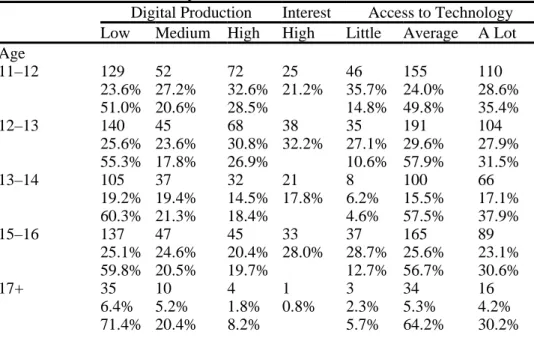
Therefore, we began by conducting a survey of the ways in which students in both schools used digital technology at home. An overview of the sample taken from the survey can be found in the tables below. Some of the student houses seemed (at least to us) extremely well equipped: a number spoke of having two or three PCs at home, in addition to game consoles.
More importantly, there is a sense that the context of the research may have determined what we were able to discover in this regard. On the other hand, the use of technology is largely limited and determined by the demands of the formal curriculum. Many also rejected the slower and less powerful equipment at school compared to home.
In this final section, we will explore some of the ways in which technology has been mediated and regulated in the home, and the ways in which it may have hindered or helped. One of the first questions we asked in the small group discussion was about who taught the students how to use the equipment. Encouraging Ben's use of technology seemed to provide a way to connect with his son.
It may be that the creative flowering of the digital revolution has not yet arrived. 1990) Common Culture: Symbolic Work at Play in the Everyday Cultures of the Young, Milton Keynes: Open University Press.
Making Connections: Young People and the Internet
With the advent of the World Wide Web in 1993, many of these devices and their authors migrated to this new medium. Indeed, it seems to be part of the growing orthodoxy of Web design that credit to software is. Many of the first users to see the potential of web publishing seem to have been young.
I'm Peter Dawkins, I'm 14 years old and I live in one of the quietest towns in the United States: Belmont, Massachusetts. It is important to maintain up-to-date knowledge of appropriate vocabulary in accordance with applicable group norms. To date, there has been no comprehensive, reliable analysis of how young people use the web.
At the time, most young people approached for this study had never had such a study before. In some cases, the owner of the page lived in one country, but the page was stored in another - a common phenomenon on the Internet. Sixty-five percent of the total also agreed that the desire to learn how to write HTML code was important.
The semi-anonymous nature of the web has led some young people to reveal their homosexuality to the world in this way, even where they have not told their own families. On other parts of the screen, video windows are opened so participants can see each other.
An American Otaku (or, a Boy’s Virtual Life on the Net)
As in the case of otaku and the Nihonjinron discourse that surrounds them, and MUDder and Turkle's (1995) book about them, the story of Isaac's life is on the Internet. He joined the games user list and quickly emerged as one of the most prolific contributors. I have a feeling the problem with this puppy is the order of the units in autoexec.bat.
Just as important as the availability of equipment is our ability and willingness to support Isaac's computer-based learning. A typical evening in the Tobin household: Beth, Isaac, and I finish dinner in front of the TV and then move to the couch to watch the next show that's coming on. What is this thread about, Isaac?’ ‘It's some kind of metaphysical discussion about the motivations of the Eldar.
His letter to the friends he made on the web represents a revival of the epistolary form. Although an invention and convention of the late twentieth century, Isaac's e-mail correspondence harkens back to the heyday of letter writing in the pre-electronic age. One of the ironies of e-mail is that it fuses male technology with female correspondence.
Sometimes the list maintainer will even warn people to stay on topic with the list. We can teach them to master cyberculture by withdrawing from the classroom and inviting them to teach us and each other.
Digital Culture—the View from the Dance Floor
In addition to the specific questions and problems that I discussed with the producers within the club culture, I also wanted to talk to the participants - the clubbers. The combination of the club scene and technology is not at all surprising when you consider how the dance music scene has evolved. Most new DJs and musicians in the dance music scene taught themselves how to mix.
But before I discuss recent developments in club culture, I need to contextualize them in the history of the club scene. As Tony Langois argues in his study of DJing in British house music: “The key role in the house scene is that of the DJ. At one of the club nights I attended, they projected a slide on a record player that was covered with mirrors.
As part of the logic of capitalism ... the music industry's own continuity is preserved in an ever-changing array of fetishistic goods traded for profit. Many within the club scene want to incorporate these new technologies into the club culture, but are frustrated by the slow pace of technology development. Dance music and club culture should take advantage of new technologies and push them to the limits - that's what culture is all about.
Underground Creativity - Youth Training and Enterprise My research has documented how technology is being used within London's underground club culture. For example, club venues such as The Ministry of Sound and The Complex in London have received sponsorship from Sony and have in-club game rooms featuring Sony Playstations.
Hackers: Masters of Modernity and Modern Technology
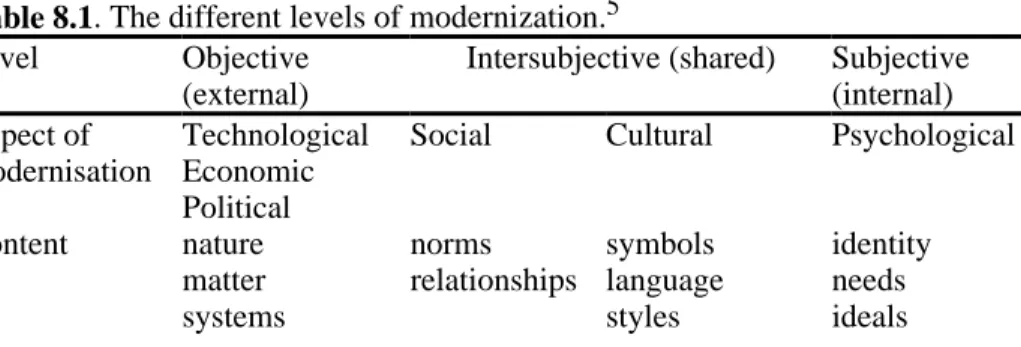
In order to combine the analysis of computer-enthusiastic youth with the discussion of the development of modernity, this chapter is divided into four parts. In order to get some answers to these questions, in the next section we will focus on some aspects of hacker culture - or the microcosm of computer-enchanted youth. In the early 1990s, Swedish BBSs were targeted at young people who already had an interest in computers.
Of course, many youth cultures can be seen as free zones protected from the colonizing effects of the system. This alternative view of society can be summarized under three heads: politics of information, social technology and the demystification of the computer. This is a very clear example of how those within the cyberculture work with different forms to counter the system's colonization of the living world.
Computer technology is identified as a tool in the hands of the social apparatus (the system). It is also clear that this interest falls within the bounds of the reinforcing and ontologizing reactions to this expanded horizon of possibility. The counterculture theories developed by the Center for Contemporary Cultural Studies (CCCS) can be used as a model to analyze the effects of the computer-incarcerated youth on the system.
The mere existence of hackers, for example, alerts the owner of a computer file to the knowledge that the files are available. It is mainly countercultures of the latter type that have been the subject of research.
Notes on Contributors
Karen Orr Vered is a PhD student in critical studies, University of Southern California, School of Cinema—Television. She is also an education specialist for multimedia software at the Annenberg Center for Communication at the University of Southern California.
Index