i1
Ecological Sorting of Vascular
Plant Classes During the Paleozoic Evolutionary Radiation
William A. DiMichele, William E. Stein, and Richard M. Bateman
DiMichele, W.A., Stein, W.E., and Bateman, R.M. 2001. Ecological sorting of vascular plant classes during the Paleozoic evolutionary radiation. In: W.D. Allmon and D.J. Bottjer, eds. Evolutionary Paleoecology: The Ecological Context of Macroevolutionary Change.
Columbia University Press, New York. pp. 285-335
THE DISTINCTIVE BODY PLANS of vascular plants (lycopsids, ferns, sphenopsids, seed plants), corresponding roughly to traditional Linnean classes, originated in a radiation that began in the late Middle Devonian and ended in the Early Carboniferous. This relatively brief radiation followed a long period in the Silurian and Early Devonian during wrhich morphological complexity accrued slowly and preceded evolutionary diversifications con- fined within major body-plan themes during the Carboniferous. During the Middle Devonian-Early Carboniferous morphological radiation, the major class-level clades also became differentiated ecologically: Lycopsids were cen- tered in wetlands, seed plants in terra firma environments, sphenopsids in aggradational habitats, and ferns in disturbed environments. The strong con- gruence of phylogenetic pattern, morphological differentiation, and clade- level ecological distributions characterizes plant ecological and evolutionary dynamics throughout much of the late Paleozoic. In this study, we explore the phylogenetic relationships and realized ecomorphospace of reconstructed whole plants (or composite whole plants), representing each of the major body-plan clades, and examine the degree of overlap of these patterns with each other and with patterns of environmental distribution. We conclude that 285
286 EVOLUTIONARY PALEOECOLOGY
ecological incumbency was a major factor circumscribing and channeling the course of early diversification events: events that profoundly affected the structure and composition of modern plant communities.
Paleoecological studies of Carboniferous terrestrial environments consis- tently have revealed distinct ecological centroids for those major architectural groups traditionally described as taxonomic classes. Although the ecological spectra encompassed by the constituent species of these clades overlapped, each predominated in a distinct, broadly construed environmental type, irre- spective of whether dominance is assessed by species richness or percentage biomass. In modern landscapes, one of these primordial architectural groups, the seed plants, dominate most habitats, and among seed plants, the angio- sperms are now most prominent over most of the Earth's surface. The roots of the modern pattern first appeared at the end of the Paleozoic, when the breadth of ecologically dominant taxa narrowed at the class level, and one class, seed plants, began their rise to prominence in all types of environments.
The rise of angiosperms from within the seed plants further narrowed the phylogenetic breadth of ecologically dominant clades. Viewed over geological time, the patterns of clade replacement within major environmental types suggest a self-similar pattern, each new radiation bringing to dominance an even more narrow portion of phylogenetic diversity.
The primordial Carboniferous pattern appears to have become progres- sively established during the Middle to Late Devonian, when major architec- tural groups of vascular plants originated from the structurally simple ances- tral forms predominant from the Late Silurian to the late Early Devonian (Scott 1980; Gensel and Andrews 1984). This radiation has come under increasing phylogenetic scrutiny (Crane 1990; Kenrick and Crane 1991,1997;
Gensel 1992; Bateman in press). Much still remains to be learned, however, regarding the early evolution of major bauplans (represented by modern classes), which were largely in place by the Early Carboniferous, and of the paleoecological preferences of these groups. The paleoenvironmental distribu- tion of the major clades is well enough known to lead us to conclude that the radiation of architectural types (bauplans) coincided with partitioning of eco- logical resources, the latter playing an important role in both channeling and constraining the radiation.
The interplay between evolution and ecology, the understanding of which is a primary objective of evolutionary paleoecology, is well illustrated by these mid-Paleozoic events. The evolution of large-scale architectural (and hence taxonomic) discontinuities was made possible in large part by the (evolving) patterns of resource occupation in what was initially an ecologically undersat- urated terrestrial world. We believe the basic dynamics of ecological control of
Ecological Sorting of Vascular Plant Classes 287
plant diversification and morphology are probably general rather than unique to this major radiation (for a parallel pattern in modern seed plants see Lord, Westoby, and Leishman 1996). The architectural results and taxonomic conse- quences of the mid-Paleozoic radiation, however, are unique, due to both unique environmental opportunities available at the time and the relatively simple morphologies (and by inference low developmental complexity) of the ancestral forms (Stein 1993; DiMichele and Bateman 1996).
The Scenario
Prior to the Middle Devonian, vascular plants were, in structural and develop- mental terms, relatively simple compared with later forms (e.g.. Knoll et al.
1984). Organ, tissue, and cell types were few and such innovations were added piecemeal, gradually building structural complexity in the various lineages (Chaloner and Sheerin 1979). Furthermore, the ecological spectrum encom- passed by these plants was limited largely to the wetter parts of lowland envi- ronments (Andrews et al. 1977; Edwards 1980; Gensel and Andrews 1984;
Beerbower 1985; Edwards and Fanning 1985). The variety of environments colonized through time clearly increased, although relatively slowly, and likely was limited more by constraints produced by primitive vegetative and repro- ductive morphology (e.g., inadequate root systems, few types of dispersal modes, limited photosynthetic arrays, reproductive phenotypes linked to the need for free water) than by basic physiology, the core aspects of which were probably in place (e.g., photosynthetic pathways, water transport, nutrient use; for discussion of major phases in plant evolution see Bateman 1991). The possible phenotypic disparity (sensu Foote 1994) between ancestor and descendant species was small, although the aggregate spectrum of variation was gradually expanding through time. Clearly, morphological and physiolog- ical behavior (capacity) are linked, and as structural complexity increased so did the capacity for energy acquisition and utilization.
During the late Middle and Late Devonian, the vascular plants attained an aggregate "critical mass" of morphological complexity regulated by in creasingly complex developmental systems (Niklas, Tiffney, and Knoll 1980;
Rothwell 1987; Wight 1987; Stein 1993; DiMichele and Bateman 1996). This permitted an increase in the maximum ancestor-descendant disparity; phe- notypic "experimentation" became greater simply because of greater com- plexity of the starting forms. The unfilled nature of ecological resource space at this time created a permissive, abiotic selective regime that allowed many of these "hopeful monsters" to locate adequate resources where there was mini- mal competition from well entrenched incumbent species (Scheckler 1986a;
288 EVOLUTIONARY PALEOECOLOGY
Bateman 1991; Bateman and DiMichele 1994a). Thus, even though the earH- est derivatives would not have been optimally functional, distinctive new plant architectures appeared and, more critically, some established historically per- sistent ecologically delimited clades.
The radiation was relatively brief for two reasons (DiMichele and Bateman 1996): (1) Nonaquatic plants have a limited range of resource acquisition and exploitation strategies (Niklas 1997), and the number of major resource pools available to vascular plants is rather limited, so the effects of incumbent advantage (Gilinsky and Bambach 1987; Rosenzweig and McCord 1991) in different parts of the ecological landscape developed very rapidly as resources were expropriated; (2) as morphological complexity accrued, the effects of the
"epigenetic ratchet" (Levinton 1988) began to limit the size of ancestor- descendant evolutionary disparity-developmental interdependencies progres- sively limited functional morphological combinations. Moreover, with greater structural and developmental complexity, the evolution of new architectures requires "escape" from the structural organization of complex ancestral forms (Bateman 1996a). This does not mean that speciation rate declined. Rather, the average morphological difference between ancestor and descendant decUned, and new species fitted into the existing architectural types (bau- plans).
Relative species diversities of class-level clades that evolved during the Mid- dle Devonian radiation, particularly tree forms, appear to have been limited strongly by the resource breadth of the environment into which the clade radi- ated. Terra firma habitats, the favored territory of seed plants, were the most physically diverse and were thus capable of supporting the most species and the most variation on the basic architectural aspects of the clade. Wetlands, the ecological centroid of the rhizomorphic lycopsids, were much less diverse edaphically and consequently supported fewer architectural types and fewer species. Aggradational and disturbed habitats, the narrowest of all adaptive zones, were occupied by the rhizomatous sphenopsids, which evolved propor- tionally the fewest variations on their basic tree architecture and also were the group with the lowest species diversity. Early ferns were opportunists that exploited interstitial disturbance in many kinds of environments, permitting them to radiate in significant numbers in ecotonal settings. Tree-fern domi- nance did not appear until much later, after environmentally induced extinc- tions created opportunities to exploit previously occupied resources (Pfeffer- korn and Thomson 1982; Phillips and Peppers 1984).
We examine this scenario from three perspectives, each of which is usually examined independently as a central attribute of an evolutionary radiation.
Only through examination of all three is it possible to evaluate interrelated
Ecological Sorting of Vascular Plant Classes 289
causal factors for this important period in vascular plant history (Bateman, in press). First is the pattern of phylogenetic diversification that began in the Middle Devonian and substantially terminated by the Early Carboniferous.
Second is the nature of the ecophenotypic morphospace that evolved during this radiation and the degree to which it was congruent with the phylogenetic pattern. Third is the ecological preferences of the major lineages and the degree to which such preferences constrained the species diversities of class- level clades.
The Vascular Plant Radiation: Phylogeny
Extant vascular plants can be organized into two major complexes based on their ancestry. The basal groups of the vascular plant phylogenetic tree are rep- resented by the zosterophylls and the trimerophytes, apparently descended from common ancestors among the earliest vascular plants, the rhyniophytes (Banks 1968; Gensel 1992). This fundamental basal dichotomy took place no later than Early Devonian (Banks 1975).
Derivatives of the zosterophylls include at least one and possibly two dis- tinct clades (Kenrick and Crane 1997). The older and more diverse clade is the lycopsids. Within this group are three subclades, likely successively derived from one another in the sequence Lycopodiales, Selaginellales, Isoetales. The other clade is the barinophytes, which may be zosterophylls or derived from a zosterophyll ancestor (Brauer 1981).
Most extant plants are derivatives of the trimerophytes, encompassing sev- eral complexes of structurally similar groups. Perhaps least derived are the ferns, first appearing in the Late Devonian (Phillips and Andrews 1968; Roth- well 1996), consisting of several architecturally distinct subgroups, the zygopterids, marattialeans, and filicaleans. The sphenopsids include the equi- setophytes and sphenophylls, and may be derived from morphologically inter- mediate groups in the Middle Devonian that include the iridopterids (Stein, Wight, and Beck 1984) or one or more groups of cladoxylopsids (Skog and Banks 1973; Stein and Hueber 1989). The seed plants and their ancestors, the progymnosperms, form another distinct group. There are two major sublin- eages of progymnosperms, the archaeopterids and aneurophytes, and there has been considerable debate over which of these groups included the seed- plant ancestor (Rothwell 1982; Meyen 1984; Beck and Wight 1988).
Clearly, classical Linnean taxonomy has not successfiiUy encapsulated this early radiation. Groups with distinctive body plans form a nested hierarchy of relationships, rendering some paraphyletic (e.g., progymnosperms in their possible relationship to seed plants). Crane (1990) and Kenrick and Crane
290 EVOLUTIONARY PALEOECOLOGY
(1991,1997) examined this radiation cladistically and compared it with tradi- tional Linnean grouping. Although the nested hierarchy means that some architectural groups are more closely related to one another than to other groups, the basic architectures clearly are distinct, especially when viewed ret- rospectively in the light of subsequent radiations. Since the Early Carbonifer- ous, speciation largely has taken place within the confines of these existing body plans. Surviving to the present are all three of the lycopsid groups, the fil- icalean and marattialean ferns, the equisetophyte sphenopsids, and numerous groups of seed plants (although none that were present in the Carboniferous).
Here, we view the angiosperms as a subset of the seed plants.
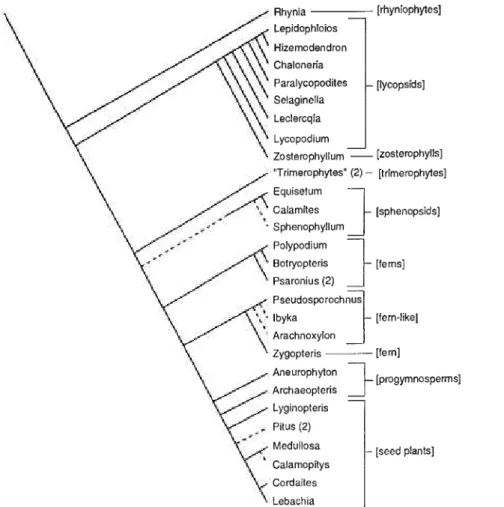
We present a cladistic representation of this early radiation (figure 11.1), noting the points of origin of modern plant body plans. This cladistic phy- logeny is an authoritarian composite based on several separate analyses (see figure caption). Placed in the context of geologic time, phylogenetic analysis demonstrates the relative temporal compression of the radiation. It makes no claim for nor does it require unique rates of speciation or evolutionary mech- anisms operating only during this time interval. It does emphasize, however, that the outcomes of the evolutionary process appear to have changed in breadth, with ancestor-descendant disparity apparently decreasing in a non- linear fashion through time (Gould 1991; Erwin 1992).
The Angiosperm Problem
The flowering plants are the only group traditionally given high taxonomic rank (i.e., class rank or above) that did not originate during the Middle Devonian-Early Carboniferous radiation. Some mention of them is necessary because the question will arise: Is not the origin and diversification of the angiosperms, the most species-rich groups of vascular plants ever to inhabit the Earth, indeed a radiation as profound structurally as that of the Late Devonian?
Angiosperms have been ranked most often between phylum (equivalent to division) and class. This high rank was deemed necessary to accommodate the great species diversity within the group. It reflects a historical accident in plant systematics, where classification systems were initially developed and based upon extant plants, overwhelmingly angiosperms, with the less derived groups subsequently incorporated into the classification in only a quasi-phylogenetic manner. During the past 25 years, it has become traditional to distort this prob- lem even further by treating the angiosperms as a phylum. In attempts to jus- tify this taxonomic strategy, nearly all nonangiospermous seed plant and lower vascular plant orders were inflated to the rank of phylum, simply in order to accommodate the large number of Linnean ranks needed to encapsulate the diversity of the angiosperms (leaving most of these "phyla" encompassing only
Ecological Sorting of Vascular Plant Classes 291
[rhyniophytes]
- [lycopsids]
- [zosterophylls]
- [trimerophytes]
[sphenopsids]
[ferns]
[fern-like]
• [fern]
• [progymnosperms]
Rhynia — Lepidophloios Hizemodendron Chalonsria Paralycopodiles Selaginella Leclercqia Lycopodium Zosteroptiyllum —
"Trimerophytes" (2) Equisetum Calamites
• Sphenophyllum Polypodium Botryopteris Psaronius (2) Pseudosporochnus lbyl<a
Aracfinoxylon Zygopteris Aneuropfiyton Arcfiaeopteris Lyginopteris Pitus (2) IVIedullosa Calamopitys Cordaites Lebacfiia
FIGURE 11.1. Tentative phylogeny of representative composite and wrhole-plant taxa, compiled by synthesizing an amalgam of recent phylogenetic studies. Main framework of the phylogeny is extrapolated from Rothwell (1996, figure 1), also with reference to Crane (1990), Kenrick and Crane (1991,1997), Pryer, Smith, and Skog (1995), and Stevenson and Loconte (1996). Lycophyte clade (A) follows Bateman (1996a,b, figure 1), also with refer- ence to Kenrick and Crane (1991, 1997) and Bateman, DiMichele, and Willard (1992).
Lignophyte clade (B) follows Rothwell and Serbet (1994, figure 1), also with reference to Doyle and Donoghue (1992) and Nbcon et al. (1994).
- [seed plants]
one class and one order). This approach obscures evolutionary relationships among the supposed phyla, the evolutionary significance of morphologies observed within each group, and the morphological disparity among them.
Numerous phylogenetic analyses of seed plants have appeared in recent years (Crane 1985; Doyle and Donoghue 1992; Nixon et al. 1994; Rothwell and
292 EVOLUTIONARY PALEOECOLOGY
Serbet 1994). All of these demonstrate clearly that the angiosperms are a derived group within the seed-plant body plan that, like all other basic body plans, was a product of the great Devonian radiation. Furthermore, from a morphological perspective, the basics of angiosperm design are no more distinct from any of the traditional seed plant "orders" than any of these "orders" are from one another (cf., Lyginopteridales, Medullosales, Cycadales, Coniferales, Ginkgo- ales, Peltaspermales, Pentoxylales, Caytoniales, Bennettitales, Gnetales). It can- not be denied that many more variations on the seed-plant architectural theme have evolved among the more derived angiosperms than within any other seed-plant group. Even the most divergent forms, however, are largely confined within the seed plant-progymnosperm bauplan. Consequently, allowing for the implicit phylogenetic outlook of the Linnean perspective, the angiosperms should be ranked as an order (Bateman 1991; DiMichele and Bateman 1996); a very species-rich order, but an order nonetheless. Rather than indicating a later escape from the constraints of development and body plan that were emplaced in the Middle Devonian-Early Carboniferous radiation, they are, in fact, one of the best indications of the inescapability of such con- straints. Body plans evolved early and entrained subsequent evolution of form.
The Vascular Plant Radiation: Ecomorphospace
The major clades that originated in the Late Devonian appear by inspection to represent different body plans, or at least different styles of structural organization. In order to test this hypothesis we undertook an analysis of the structure-function morphospace relationships realized by the major lineages.
Philosophically, our objective was not to identify an idealized (or Raupian) morphospace, one circumscribed by theoretical limits on plant architectures (e.g., Niklas 1977,1982), but rather to examine the morphospace as delimited by the plants that actually existed at different times (Foote 1993,1994). Coded taxa were chosen so that each major lineage (class-level clade) would be repre- sented by several placeholders or (if no single species was fully reconstructed) by composite taxa from different sublineages within each class. In this way, we hope to examine the degree to which each class formed a distinct functional morphological entity that might be termed an ecomorphic group. Ecomorphic characters are units of structure-function that will be compared analytically to the results of the ecological analysis; consequently, they were chosen to emphasize shared aspects of functional morphology largely separate from phylogeny, in several instances they are not necessarily homologous (i.e., synapomorphous) between or even within groups. Although characters were
Ecological Sorting of Vascular Plant Classes 293
chosen to minimize repetition, we recognize that they are not fully indepen- dent. The numerical analyses used do not require that character axes be orthogonal. Indeed, we were seeking characters that are nonorthogonal due to covariance, reflecting developmental or ecological associations but not neces- sarily phylogenetic relatedness. Wherever clear duplication (as opposed to convergent patterns of expression) of structural or functional attributes was identified, one of the overlapping characters was excluded from the analysis.
Our intention in constructing the ecomorphospace was to determine the degree of congruence between the phylogenetic relationships of groups based on cladistic analysis (figure 11.1) and their similarity as measured by distance in the multivariate space of structure-function (ecomorphic) characters.
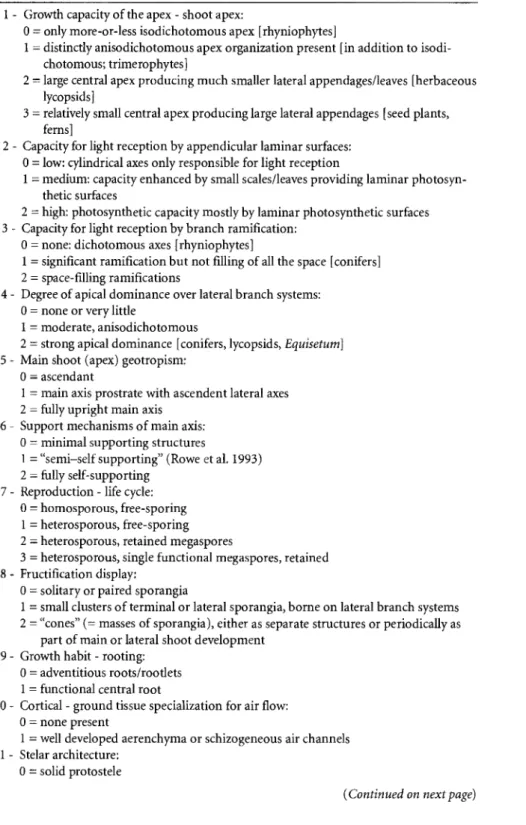
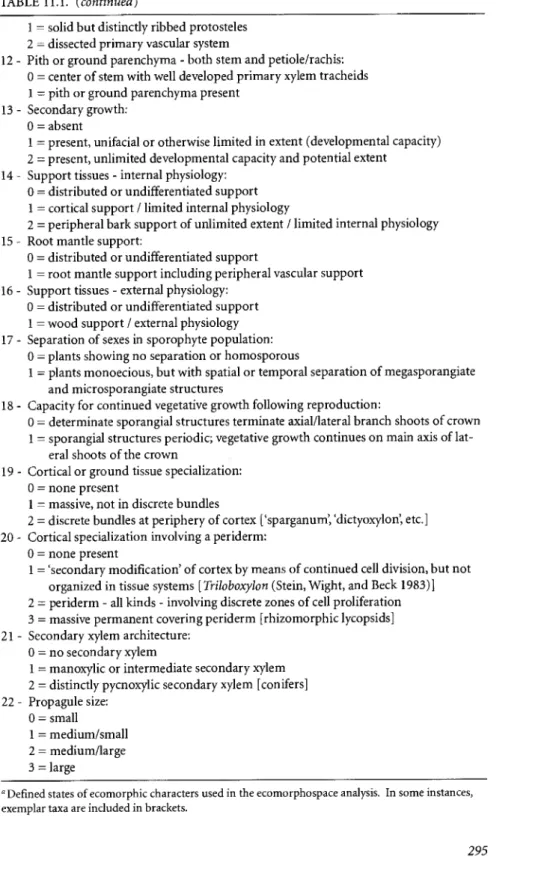
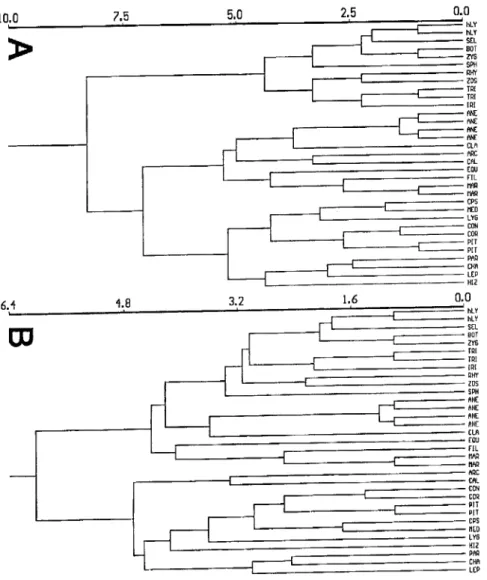
Plants were scored for each of 22 ecomorphic characters listed in table 11.1 and discussed in the following section; a best guess, based on nearest known relatives or functionally related morphological features, was made for matrix cells lacking direct observations. The plants and scores of states for particular ecomorphic characters are listed in table 11.2. Analyses were carried out with NTSYS, version 1.8 (Applied Biostatistics, Inc.), written by James Rolf Analy- ses were exploratory and visual in nature, as no explicit hypotheses of similar- ity or difference were tested statistically. Techniques utilized included principal components analysis (PCA) on the correlation matrix of ecomorphic charac- ters, unweighted pair group cluster analysis (UPGMA), and complete linkage cluster analysis (CLCA), the latter two utiUzing the Euclidean distance metric.
Results are shown in figures 11.2 and 11.3.
Ecomorphic Characters
The following aspects of structure-function were used in the analysis. For convenience of analysis, each ecomorphic character was divided into alterna- tive discrete structure-function "states" by analogy with phenetic or cladistic characters. In most instances, more than two states have been identified for each ecomorphic character; if a linear sequence was hypothesized, the end- point states were considered to be more distinct from each other than either was from any of the intermediate states. In other instances, where linear chains of states were not inferred (ecomorphic characters 2-3,11-12,14-16,19-20), multistate ecomorphic characters were converted to two-state or multistate, allowing for several possible proximity relationships among states.
Ecomorphic character 1 expresses the growth capacity of the axis/shoot apex. The growth dynamics of both the root and shoot system in vascular plants are regulated by the meristems, which are places where cell division takes place and firom which much of the internal and external architecture is
TABLE 11.1. Features of Morphology used in the Analysis of Ecomorphospacc"
1 - Growth capacity of the apex - shoot apex:
0 = only more-or-less isodichotomous apex [rhyniophytes]
1 = distinctly anisodichotomous apex organization present [in addition to isodi- chotomous; trimerophytes]
2 = large central apex producing much smaller lateral appendages/leaves [herbaceous lycopsids]
3 = relatively small central apex producing large lateral appendages [seed plants, ferns]
2 - Capacity for light reception by appendicular laminar surfaces:
0 = low: cylindrical axes only responsible for light reception
1 = medium: capacity enhanced by small scales/leaves providing laminar photosyn- thetic surfaces
2 = high: photosynthetic capacity mostly by laminar photosynthetic surfaces 3 - Capacity for light reception by branch ramification:
0 = none: dichotomous axes [rhyniophytes]
1 = significant ramification but not filling of all the space [conifers]
2 = space-filling ramifications
4 - Degree of apical dominance over lateral branch systems:
0 = none or very little
1 = moderate, anisodichotomous
2 = strong apical dominance [conifers, lycopsids, Equisetum]
5 - Main shoot (apex) geotropism:
0 = ascendant
1 = main axis prostrate with ascendent lateral axes 2 = fully upright main axis
6 - Support mechanisms of main axis:
0 = minimal supporting structures
1 = "semi-self supporting" (Rowe ct al. 1993) 2 = fully self-supporting
7 - Reproduction - life cycle:
0 = homosporous, free-sporing 1 = heterosporous, free-sporing 2 = heterosporous, retained megaspores
3 = heterosporous, single functional megaspores, retained 8 - Fructification display:
0 = solitary or paired sporangia
1 = small clusters of terminal or lateral sporangia, borne on lateral branch systems 2 = "cones" (= masses of sporangia), either as separate structures or periodically as
part of main or lateral shoot development 9 - Growth habit - rooting:
0 = adventitious roots/rootlets 1 = functional central root
10 - Cortical - ground tissue specialization for air flow:
0 = none present
1 = well developed aerenchyma or schizogeneous air channels 11 - Stelar architecture:
0 = solid protostele
{Continued on next page)
294
TABLE 11.1. {continued)
1 = solid but distinctly ribbed protosteles 2 = dissected primary vascular system
12 - Pith or ground parenchyma - both stem and petiole/rachis:
0 = center of stem with well developed primary xylem tracheids 1 = pith or ground parenchyma present
13- Secondary growth:
0 = absent
1 = present, unifacial or otherwise limited in extent (developmental capacity) 2 = present, unlimited developmental capacity and potential extent
14 - Support tissues - internal physiology:
0 = distributed or undifferentiated support 1 = cortical support / limited internal physiology
2 = peripheral bark support of unlimited extent / limited internal physiology 15 - Root mantle support:
0 = distributed or undifferentiated support
1 = root mantle support including peripheral vascular support 16 - Support tissues - external physiology:
0 = distributed or undifferentiated support 1 = wood support / external physiology 17 - Separation of sexes in sporophyte population:
0 = plants showing no separation or homosporous
1 = plants monoecious, but with spatial or temporal separation of megasporangiate and microsporangiate structures
18 - Capacity for continued vegetative growth following reproduction:
0 = determinate sporangial structures terminate axial/lateral branch shoots of crown 1 = sporangial structures periodic; vegetative growth continues on main axis of lat-
eral shoots of the crown
19 - Cortical or ground tissue specialization:
0 = none present
1 = massive, not in discrete bundles
2 = discrete bundles at periphery of cortex ['sparganum', 'dictyoxylon', etc.]
20 - Cortical specialization involving a periderm:
0 = none present
1 - 'secondary modification' of cortex by means of continued cell division, but not organized in tissue systems [Triloboxylon (Stein, Wight, and Beck 1983)]
2 = periderm - all kinds - involving discrete zones of cell proliferation 3 = massive permanent covering periderm [rhizomorphic lycopsids]
21- Secondary xylem architecture:
0 = no secondary xylem
1 = manoxylic or intermediate secondary xylem 2 = distinctly pycnoxylic secondary xylem [conifers]
22 - Propagule size:
0 = small 1 = medium/small 2 = medium/large 3 =large
"Defined states of ecomorphic characters used in the ecomorphospace analysis. In some instances, exemplar taxa are included in brackets.
295
<N
<N
•^
<N O
<N CTv "^
00 "^
K
—1
'^ «
LO ^
M"
i»
Q<
"^
<—i
<
ct; tN
<
s: u '—1
tj S
a- O OS '-i
P
En
§
o^O U
M lil
t^ 00
0
6 o tx
w u
--t-H
o ^
w
'M3 _>.
"rt <.r,
< C
.s
•^*« 4J
tn <^
u w
£:i <N 3 ra •-^
t4«
0
S Q
4-> O
c/l U
•T3 C «
P3 ?5
H
<N
r-^
--H
w 2;
1
0000>—•OOr-l'-'Of-jmCDOOC'^Or^f-jqpOr^'—t(N ^
&-
'-''-(--'•-'(NO —'OfNfNj—iOOO-^O-—i-^OO'—'-H<N
,_,,-Hi—I.—irjorJ-^motNO^OOOOOO^^fNO O fN rO rN
OOOOOOOO^^OOOOOOOOO-—'OOOOOO^
COOOOOOfS-—'O-—'-—lOOOOrjO—'(NOOfSO--
^^-H^^O^OO^ OOOOOr-OOOOOO-—'
oooooooooooooooooooo — o o o ooooooor-H^ooors-—'oooorj-—'oo-—'(NO
(NfN<N<N<NO(N'-H^-..-((NfNOOOO'—'O-—'•—'OO-—'•—'tN
OOOO^O^^^O—^ — OOO — o
f—^ -H-H^^H(NOfN(NOr-J(Nrj(NrslOOO — 0(N(N(N(NO(N
OOOOOO'—'O'-'OOO'—'OOO-—'O-—'O ^ o — o
O O O O —' o o OOOO — O—'--OO^^^
^__,_,(-si^(N(N(N(N(NrM(N(N(N(N(N—'(N-^rM<Nr^rOfS
oooo-—'OOfo-—'OfnfooocDornO'T^moiSr^r^f^^
^,_i,—(^(NO(N^H(-JfN<N(N'—''—'•—''—'(N>-.rg""<N(N--<NrS
-—'•—'rJfNfNO-—ifNfNr^fNtN-—'>—'OOtN>—'(NO-—'(N(N(N(N
1—'CN^tNCNi—'(N(Nrv|(N(N<N<N'—lO'-'tN'—ifN-—'rJ(N(N(NrJ
^„,_,,-H^—i(NO<^tN'—'—HrvJOOO-—'•—lO-—'OOO-—'O
OOOOfN-—"(NfMrjf^-—'(NOfN-—'•—'i—'OfN — (NfNfN-—'(N
^^^^o-irn<nrnr^'~trnrnrNifn(NCNtN'—'rsirnrnrnf^fNiTi
»; e^ Q
QJ dj QJ (U • -^ pC -G JS
&,&.&,&.
o o o o
3 3 3 3 w w OJ OJ
c c c c
Is
ii &. fe T, !« i3 S a .t! -3a. Ci, o o c
u u O
_>^ _>> ^ <^ '^ 13 •S
'5
3 3 3 ^
-ij J J
o o •^ C -r: "« "rt
1
1> 031 1
'So IS! rt^ II! S u ^ ^ ^
1 1
rt S^ -^ 3 A- „
296
a;
s I
a;o
I
i
(NOOOOOOO
fMOOcNOOOO
oooooooo
rSOOOOOOO
•—>00—-'OOOO
oooooooo oooooooo
(NOO—'OOOO
.—lOOOOOOO
tNOOOOOOO
OO-—'OOOOO
-^OOOOOOO
(NOr^fN-—'•—itNf-J
rOO-^OOOOO
(NOO"—iracNOO
fNCJOOO—'OO
OOO—'•—'-^O^
fvio-—i^OO--'-'
rTiorNrs-—'—'Oc^
r >-• 1 a^ ^ ^ ^ O
§
<u a> c/3
^ =: -= o. fr 'D. c
g-l §- S 2 2 S
•£ 2 3 ^ 'fS is ,3 t^
297
A 0.4-T
0.2-
SEL HLYHLY
ZYG
C^ 0.04iHY
a. o
-0.2
-0.4-
MAR
MAR LEP
FIL CHA
PAR HIZ EQU
MED CPS
IRI ' SPH
CAL LYQ
CLA
COR CON PIT PIT ARC
ANEANE
^*^^A*1^ I I I I I I I I I I I I I I I I I I I I I I I I I I I I
0.0 0.4 0.8 1.2 1.6
PC 1
B 0.8
o.e-i
CO 0,
O
0.2-
0.0-
-0.2-
CAL
MAR MAR
CLA
EQU ARC
FIL 4-ANE
ANE JANE
ANE
IRI CON SPH' "'
COR THI PIT
PIT
BOTHLY ZYG
PAR HIZ
Z08 HLY 6EL
CHA CPS
RHY MED
LYQ LEP
I I I I I I M I I I I I I I I n I I I M I I I I I I M I I I 111 I I I 11 I 1111 111 I { 11 I 11
-0.4 -0.2 0.0 0.2 0.4
PC 2
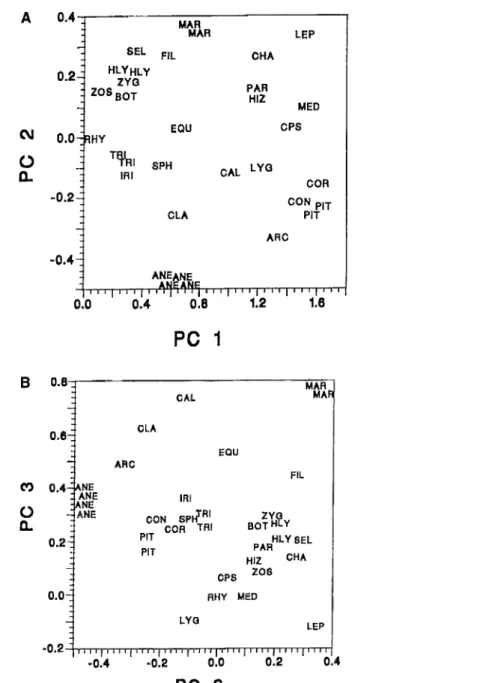
FIGURE 11.2. Principal components analysis of representative composite and whole-plant taxa. Analysis based on data matrix presented in table 11.2. See table 11.2 for key to acronyms: (A) Axis 1 vs. Axis 2; (B) Axis 2 vs. Axis 3. See text for details.
298
10.0 7.5 5.0 2.5 G.0
-^ • SEL •BOT •ZVS
•SPH
•OHY -ZOS - TBl - TM - IB!
•m.
- HH - (K - N€
- an
- rt!C
•CHL
- E:QU
• riL - nnp
• tiw - CPS -MED - LY6
- PIT
•Pit - PM - CHfl - LEP - HIZ
6 A 1.8 3.2 1.6 0.0
OD {1
• SEL • Bor • zre• roi - rpi - im
^
SPH «NE Ate dNE dNE ELfl
• FIL - IM
-cm
-CON - COS -PIT -PIT - CPS
- K.a
• IVS - HIZ - PdP
- cm
-LCP
FIGURE 11.3. Cluster analyses of representative composite and whole-plant taxa. Analysis based on data matrix presented in table 11.2. See table 11.2 for key to codes.
(A) Unweighted Pair Group Method of Analysis (UPGAC); (B) Complete Linkage Cluster Analysis (CLCA). See text for details.
299
300 EVOLUTIONARY PALEOECOLOGY
controlled (e.g., Bateman, in press). This ecomorphic character attempts to capture the developmental interaction between the apex of the central axis and the lateral appendages. Simple, bifurcating apices (states 0 and 1) contrast with apices that produce appendicular organs, notably leaves (states 2 and 3).
Appendicular organs may have minimal developmental impact on axis orga- nization (state 2) or may have a strong feedback effect on further development of the axis (state 3).
Ecomorphic characters 2 and 3 express the potential of the aerial shoot sys- tem to capture light, either through appendicular organs or through the organization of the branch system. Light is a primary resource, needed for growth, development, and reproduction in all plants. Architecture of the pho- tosynthetic array does not capture all dimensions of the means by which plants sequester light, most obviously missing physiological trade-offs for dealing with temperature, water stress, and variations in light intensity. Even at the basic level examined here, however, construction of the array clearly differs among major clades.
Ecomorphic character 2 expresses the capacity for light reception by appen- dicular laminar surfaces.
Ecomorphic character 3 expresses the enhancement of the capacity for light reception by branch arrangement through the support of appendicular organs, or by density of branching, increasing axis surface area.
Ecomorphic characters 4, 5, and 6 describe, in various combinations, the aerial growth form of a plant. They include the mechanisms by which a plant branches and the degree to which the lateral branching morphology is regu- lated by the apex, the vertical or horizontal position of the shoot axis, and the ability of the plant to support itself. Ecomorphic characters 13-16, the nature of support tissues, also contribute to growth form, particularly the ability to grow upright and the potential to achieve considerable height. Height further enhances light interception and propagule dispersal, emphasizing the func- tional interrelatedness of many architectural features.
Ecomorphic character 4 expresses the degree of apical dominance over the lateral branching system. This character identifies the extent to which the plant developed a main axis and either wholly suppressed lateral branches or relegated them to a subordinate, lateral growth position.
Ecomorphic character 5 expresses main-shoot (apex) geotropism. This character seeks to identify the developmental basis of growth habit. In ascen- dant growth forms (state 0) the apex is elevated dynamically as the axis
"unrolls" along a substrate. Other shoot systems of clonal organisms differen- tiate into strictly prostrate and strictly vertical stems (state 1). A fully upright
Ecological Sorting of Vascular Plant Classes 301
plant (state 2) may be centrally rooted or may be supported by adventitious roots, but is fundamentally unitary in construction and vertical in orientation.
Ecomorphic character 6 describes the support mechanism of main axis. It describes the degree to which the main axis was capable of supporting itself in an upright (vertical) position. Some plants with upright structure are not capable of standing vertically without leaning against or climbing on other plants (i.e., "semi-self supporting" sensu Rowe, Speck, and Galtier 1993; Speck
1994).
Ecomorphic character 7 describes reproduction and life cycle. This charac- ter focuses on the ability of a plant to disseminate its reproductive organs and gain control over the vagaries of environmental conditions. Each of the basic life histories in plants places different constraints on the likelihood of repro- ductive success and dispersal to suitable habitats. Homosporous plants, for example, often have great dispersal abilities and can produce a new population from a single propagule. They must, however, accommodate two independent life history phases (gametophyte and sporophyte) during evolution of habitat tolerance (Bateman and DiMichele 1994b). Seed plants, in contrast, greatly compress the life cycle, almost into one life history phase, the sporophyte, but must contend with the necessity for pollination and special mechanisms to disperse seeds. Using the major life cycles as short-hand, this character differ- entiates homosporous, heterosporous, and seed-bearing plants, considering degree of heterospory to represent a structure-function morphocline. "Seeds"
are considered to be any integumented megasporangium; consequently, the
"aquacarps" of the rhizomorphic lycopsids (Phillips and DiMichele 1992) are coded as functional seeds, even though, in phylogenetic terms, they were not borne by seed plants.
Ecomorphic character 8 expresses fructification display. Reproductive effort, both in any single reproductive event and over the entire lifetime of the individual, is an important ecological characteristic related to energy alloca- tion patterns. Reproductive effort can be measured in various ways for fossil plants, although, unfortunately, not by the precise dry weight measurements preferentially made for extant plants. Here we used the degree of aggregation of sporangia as a measure of reproductive effort put into any one, short-term event. Note that fern fronds bearing abundant sporangial clusters (sori) are coded as "cones," reflecting shared high reproductive output per reproductive event (state 3).
Ecomorphic character 9 expresses growth habit and rooting. This ecomor- phic character is intended to separate centrally rooted plants from those in which adventitious roots are the main fluid absorbing and/or support organs.
Plants with central rooting have limited potential to spread from the point of
302 EVOLUTIONARY PALEOECOLOGY
rooting. The root system and shoot system in such plants must remain con- tinually connected by live tissue. Adventitious roots provide flexibility in point of growth through time if combined with a prostrate growth habit, but also limit the ability of the plant to undergo extended vertical growth.
Ecomorphic character 10 describes ground tissue specialization for gaseous flow within the plant body. The presence of aerenchyma tissues is most fre- quently associated with growth under conditions of periodic flooding or stand- ing water. In some plants (e.g., some species of Psaronius tree ferns), aerenchy- matous tissues provide structural strength with limited carbon input and may have permitted attainment of tree habit with minimal energetic outlay.
Ecomorphic characters 11 and 12 differentiate the primary vascular archi- tecture of the plant. Vascular architecture influences both support of the pri- mary body and water conducting capacity. This is especially important in herbaceous plants with little or no secondary vascular tissues, but is also important in many groups that achieve tree habit using support mechanisms other than wood. The combination of ecomorphic characters 11 and 12 per- mits specialized types of nonlobed steles to be identified (e.g., siphonosteles are coded as protosteles in ecomorphic character 11 and as having a pith in ecomorphic character 12).
Ecomorphic character 11 describes the stelar architecture of main axis.
States are differentiated by the degree of stelar surface area created by xylary lobing: smooth, ribbed, or dissected.
Ecomorphic character 12 describes the pith or ground parenchyma in main axis or leaves. Pith parenchyma has been shown to be a mechanism of water storage and a means to reduce the energetic cost of vascular support of an axis (a cylinder is a more effective means of support than a solid rod).
Ecomorphic character 13 expresses presence and mode of secondary vas- cular growth. It reflects the potential of the vascular cambium (if present) to produce a cylinder of secondary xylem and phloem. Plants with unifacial cambia have limited growth potential (Cichan and Taylor 1984), as do some plants with bifacial cambia.
Ecomorphic characters 14, 15, and 16 differentiate contrasting means of support of the shoot system and the effects these means of support have on location of the major physiological processes of the plant. Plants with states 1 or 2 of ecomorphic character 14 have cortical or peripheral bark support. Such plants retain much of their physiology within the support tissues, most notably water and nutrient transport. Plants with state 1 of ecomorphic char- acter 15 have peripheral support from mantles of adventitious roots. Such root mantles are functionally analogous to wood, transporting water and nutrients
Ecological Sorting of Vascular Plant Classes 303
to active leaves and meristems. In such systems, water transport, although external, is compartmentalized within the individual roots. Most other stem- based physiology resides within the support tissue. Ecomorphic character 16 identifies those plants supported by secondary xylem. In such cases, vascular tissue development confines all the active physiology outside of or marginal to the main locus of support of the plant: the periphery of the vascular cylinder.
Ecomorphic character 17 describes separation of the sexes in the sporo- phyte population. The distribution of male and female sex organs in plant populations is a complex phenomenon that would benefit from greater detail than can be obtained from most fossil taxa. For example, many homosporous plants (state 0) with potentially bisexual gametophytes regulate sex organ pro- duction through complex chemical regulation, creating distinct male and female plants; in other cases, male and female sex organs function on the same gametophyte. Many heterosporous plants produce both microspores ("male") and megaspores ("female") in the same cone, but when dispersed, the mature sex organs from the same plant, borne on different gametophytes, may not be in close proximity. Unfortunately, this character can be identified for few taxa;
in fossils its level of refinement is far below that possible for extant plants. In our matrix, where the state in the fossil could not be determined, scoring was based on comparison with the nearest living relative.
Ecomorphic character 18 describes the capacity of the plant to continue vegetative growth following sexual reproduction. This character separates those plants that are monocarpic (semelparous) from those that are poly- carpic (iteroparous). In the case of rhizomatous and other clonal plants (e.g., Equisetum), reproductive capacity was considered for the whole clone rather than just the "individual" upright shoots.
Ecomorphic character 19 describes cortical ground tissue specialization.
Some plants have specialized sclerenchyma bundles or regions of the cortex that can serve as support tissues. Such tissues offer flexible support in young stems of plants with limited secondary support tissues in all or part of the plant, or in vine-like stems.
Ecomorphic character 20 describes cortical specialization involving a peri- derm. Periderms are secondary nonvascular tissues developing at the periph- ery of the stem. In certain lycopsids, the periderm was a permanent, largely supportive tissue (state 2). In most woody plants periderm is strictly protec- tive, given the peripheral position of the active physiological attributes of the plant. In such plants new layers of periderm form during each increment of growth, reorganized within the secondary phloem of the previous increment (state 3).
304 EVOLUTIONARY PALEOECOLOGY
Ecomorphic character 21 describes secondary xylem architecture. It is intended to separate plants that produce dense, pycnoxylic wood from those that have more parenchymatous wood or produce larger diameter, thinner walled tracheids.
Ecomorphic character 22 expresses propagule size. It distinguishes plants by the size of their female disseminules (see Bateman and DiMichele 1994b).
Homosporous plants are routinely small, generally less than 160-180 |xm (state 0). Heterosporous plants are apportioned between the two medium states (1 and 2), generally between 160-180 |jLm and 1 mm, or 1 mm to 5 mm.
State 3 is for propagules greater than 5 mm in diameter. Seeds may fall in states 1, 2, or 3, although all the seeds scored for Paleozoic plants were of medium- large or large size.
Numerous potential ecomorphic characters could not be evaluated satis- factorily in the suite of fossils under consideration. Examples include epi- phytic habit, parasitism or saprophytism, the nature of the relationships of root systems with mycorrhizal fungi, and of course numerous physiological features. In many cases there are grounds to speculate on certain of these char- acters for a few, exceptionally well-known species, but provide no basis for assessing the vast majority of species. At this juncture, therefore, we present this list of ecomorphic characters as a preliminary examination of the eco- morphospace created by the Middle Devonian-Early Carboniferous evolu- tionary radiation.
Coded Taxa
The following vascular land plants were selected for the analysis. Our objective was to include as many growth forms as possible in the analysis, including dif- ferent variants within the major groups. Where unavoidable, composite taxa were constructed to permit combination of anatomical, morphological, and reproductive features, generally not all known from a single "species" (it is possible that different fossil species actually may represent the same plant pre- served differently).
Rhyniophytes
Rhyniophytes are the basal plexus from which the two major Early Devo- nian clades are thought to have evolved (Banks 1968). The rhyniophytes are represented by a generalized composite plant similar in character to Rhynia gwynne-vaughnii (Kidston and Lang 1917; D. S. Edwards 1980). This is the most phylogenetically primitive plant in the analysis.
Ecological Sorting of Vascular Plant Classes 305
Trimerophyte Lineage
TRiMEROPHYTES. Two types of generalized trimerophytes are represented, based on Psilophyton dawsonii (Banks, Leclercq, and Hueber 1975) and Pertica spp. (Kaspar and Andrews 1972; Granoff, Gensel, and Andrews 1976). They dif- fer according to the form of growth of the axis (ecomorphic character 5), either ascendant or with inferred upright axes borne on a prostrate axis system.
iRiDOPTERiDS. These are represented by the genera Ihyka (Skog and Banks 1973: gross morphology) and Arachnoxylon (Stein 1981; Stein, Wight, and Beck 1983: anatomy).
CLADOXYLOPSiDS. These are represented by the genus Pseudosporochnus (Leclercq and Banks 1962; Stein and Hueber 1989; Berry and Fairon-Demaret 1997).
SPHENOPSIDS. Herbaceous equisetophytes are represented by the modern genus, Equisetum. Woody tree-equisetophytes are represented by a general- ized, homosporous calamitean; all members of this group shared common basic architectural features (Andrews and Agashe 1965; Barthel 1980).
Sphenophylls are represented by the prostrate, but woody, Sphenophyllum plu- rifoliatum (Williamson and Scott 1894).
FERNS. Three major variants of fern architecture are included in the analy- sis. The Filicales include two taxa, a generalized filicalean based on the mod- ern polypodiaceous ferns and Botryopteris antiqua from the Late Carbonifer- ous (Phillips 1974). The Zygopteridales are represented by Zygopteris illinoensis (Dennis 1974), a form very similar to the filicalean types but dif- fering phylogenetically rather than in gross architecture; both botryopterids and zygopterids are known from the Early Carboniferous. The Marattiales are represented by two generalized forms of Late Carboniferous Psaronius. The more primitive is of scrambling habit and lacks a well developed root mantle;
the more derived is arborescent with a large supportive root mantle (Lesnikowskal989).
PROGYMNOSPERMS. There are two widely recognized types of progym- nosperms, the aneurophytes and archaeopterids. Four alternative interpreta- tions of aneurophyte morphology are presented, based on different interpre- tations and combinations of ecomorphic characters 4 and 5 (degree of apical dominance and main shoot geotropism), both contributing to general growth habit. The concept of aneurophytes is based on Rellimia (Bonamo 1977), Triloboxylon (Matten and Banks 1966; Scheckler 1976), and Tetraxylopteris (Bonamo and Banks 1967). Archaeopterids are represented as a composite, combining information from petrified stem remains and compressions of foliage and reproductive organs (Beck and Wight 1988; Trivett 1993).
306 EVOLUTIONARY PALEOECOLOGY
SEED PLANTS. Included in the analysis are several kinds of seed plants, which can be grouped broadly into two lineages. "Cycadophytic" seed plants share radially symmetrical seeds, manoxylic wood, and limited secondary vascular development, and include Calamopitys (Rowe and Galtier 1988; Galtier and Meyer-Berthaud 1989), Medullosa primaeva (Delevoryas 1955; Stidd 1980), and Lyginopteris oldhamia (Oliver and Scott 1904). "Coniferophytic" seed plants share more dense, pycnoxylic wood with unlimited potential for secondary growth, bilaterally symmetrical seeds, and generally small leaves; included are two variations of Pitus that differ on uncertainty in ecomorphic character 17 (dioecy or monoecy), a generalized cordaitalean (Costanza 1985; Trivett and Rothwell 1985), a generalized primitive conifer (Clement-Westerhoff 1988).
Zosterophyll Lineage
zosTEROPHyLL. Generalized zosterophyll are based on Rebuchia, Serrula- caulis, and Gosslingia (Niklas and Banks 1990; Lyon and Edwards 1991; Hue- ber 1992).
LYCOPODiopsiDS. Thcse are represented by an herbaceous lycopod similar in form to extant Huperzia and by the Middle Devonian Ledercqia (Banks, Bonamo, and Grierson 1972). The two types of lycopodioid morphology included here differ in degree of inferred apical dominance (ecomorphic char- acter 4).
SELAGiNELLiDS. Most evidence for the presence of selaginellids in the Devonian and Early Carboniferous is equivocal (Thomas 1992; although see Rowe 1988). However, the phylogeny of the lycopsids (Bateman 1996b) sug- gests that selaginellids evolved prior to the isoetoids, which have an excellent Late Devonian and Carboniferous record. Consequently, we scored a modern Selaginella of the S. kmussiana type.
isoETALEANS. The isoctalcan lycopsids were a far more diverse group in the Paleozoic than they are today. Many fossil forms are known in exceptional detail, and whole plants have been reconstructed. We used as exemplars the best known extinct tree forms, Lepidophloios hallii (the most derived species) and Paralycopodites brevifolius (the most primitive species), the pseudoherb Hizemodendron serratum, and the more typically isoetalean Chaloneria (Bate- man, DiMichele, and Willard 1992).
Analysis Results
Principal Components Analysis
The principal components analysis (figure 11.2) reveals a pattern that is strongly, but not perfectly, congruent with the phylogeny. In other words, the
Ecological Sorting of Vascular Plant Classes 307
clusters of taxa based on ecomorphic characters, and the relative proximity of these clusters, are similar to the grouping of taxa in the phylogenetic analysis.
Ninety percent of the variance is accounted for by the first eight axes and 66%
by the first three, indicating (perhaps expected) high dimensionality of the morphospace. The basic pattern shows clearly when the coded taxa are plotted on the first two axes (figure 11.2A). The seed plants and their pteridophytic ancestors, the progymnosperms, are largely distinct from the rest of the lower vascular plants. There is some overlap among the cycadophytic seed plants and the woody equisetophyte and cladoxylopsid lower vascular plants. Differ- entiated along the first axis are forms with centralized root systems and upright growth habits (wood or bark supported) versus those with trailing habit. This latter gradient in habit is anchored at one end by the phylogeneti- cally basal rhyniophytes and at the other by plants with tree habit, divided into two major groups: the lycopsids plus ferns and the progymnosperms plus seed plants. Various other groups, mostly pteridophytes, occupy the middle ground. Most differentiated by a third axis (figure 11.2B) are the marattialean tree ferns, the calamites (tree sphenopsids), and, to a lesser extent, the clado- xylopsids, indicating that these groups represent different ways to build a tree and may share some similarities in detail, despite significant, including phylo- genetic, differences.
The following aspects of this analysis are noteworthy:
1. Using rhyniophytes as a basis for comparison, isoetoid lycopsids are the most ecologically-structurally divergent members of the zosterophyll lineage. They form a fairly tight cluster in the PCA. Members of this group have a distinctive basic body plan. They are bark-supported, have strong apical dominance, specialized root systems, and heterosporous reproduc- tion. Branches play litde or no role in the construction of their photosyn- thetic array, and leaves and branches are based on different developmental programs, resulting in few architectural similarities such as those found in leaves and shoots of groups descended from trimerophytes. Bark support permits them to separate support and water transport functions in different specialized tissues; Cichan (1986), in model studies, found lycopsid wood to have high efficiency in water transport. The structural and developmental similarity of the rhizomorphic rootlets to the microphyllous leaves, and the lack of identifiable secondary phloem to permit transport of photosynthate from the shoot to the root systems, suggest that root systems may have been photosynthetically self-supporting (Phillips and DiMichele 1992). Thus, these plants may come closer than any other vascular plant trees to a colo- nial growth habit, similar to that seen in metazoans such as bryozoans.
308 EVOLUTIONARY PALEOECOLOGY
2. The seed plants represent the evolutionary pinnacle of the trimero- phyte lineage. Although diverse, they form four distinct clusters on the PCA plot, clearly separated from all pteridophytes except the archaeopterid pro- gymnosperms, which are virtually identical to seed plants in vegetative architecture. Of course, except for the archaeopterids, the seed plants are united by the presence of their specialized reproductive apparatus, which permits them to escape free-water constraints during critical phases of the life cycle. All woody members of this group have distinctly bifacial vascular cambia, although many have limited wood development. Leaves are primi- tively large and share many developmental and structural characteristics with branches. The stems tend to be centrally rooted. Most of the plants included here are trees, except for the scrambling or semi-self supporting Calamopitys and Lyginopteris, which plot away from the other seed plants.
The medullosans and lyginopterids converge with the lycopsids in some design aspects, particularly in their nonwoody peripheral support and con- sequent high flow capacity in the specialized secondary xylem (Cichan 1986).
3. The aneurophyte progymnosperms do not cluster with the archae- opterid progymnosperm-seed plant group. Aneurophytes are similar to other Middle Devonian plants on PCA axis 1. They occupy an intermediate position, possibly indicating the general progression of many lineages toward larger size and greater phenotypic complexity than Early Devonian ancestors, while being less divergent than Late Devonian forms. PCA axis 2 indicates that aneurophytes, although the most divergent, are nevertheless most like their cousins, the archaeopterids and (to a lesser extent) the early seed plants. The overall isolation of the aneurophytes probably signifies a divergent ecological role for these plants in the Middle Devonian, perhaps reflecting movement into the better drained habitats more fully exploited later by archaeopterids and seed plants.
4. The sphenopsids and their potential ancestors, iridopterids, spheno- phylls, and herbaceous and woody equisetophytes (Stein, Wight, and Beck 1984), form a loose cluster that is closer than any other lineage to the ances- tral trimerophytes. The relationship is closest between the trimerophytes and iridopterids, with the sphenophylls somewhat more distant. All share trailing or rhizomatous growth habits. Equisetum and the calamites are considerably less similar in the ecomorphospace than would be expected, given their clear phylogenetic and structural similarities, including shared nodal whorls of leaves, branches, and reproductive organs, and unique attributes of the reproductive organs (notably sporangia borne on "sporan- giophores" of uncertain homology to reproductive organs in other plants).
Ecological Sorting of Vascular Plant Classes 309
Perhaps the relatively small, nonwoody Equisetum is not a particularly close ecological analogue of the ancient woody, arborescent calamites.
5. Filicalean and zygopterid ferns plus lycopsids, all of generalized trail- ing morphology, form a distinct group that is more phylogenetically het- erogeneous than the other clusters. In contrast, ground cover plants with sprawling, thicket-forming, or climbing habits (e.g., Hizemodendron among the rhizomorphic lycopsids, Sphenophyllum among the sphenopsids, and Lyginopteris among the primitive seed plants) appear closer to the tree forms of the respective taxonomic groups. The cluster of ferns and primi- tive lycopsids may reflect phylogenetically retained (i.e., plesiomorphic) structural simplicity, whereas the other groups with sprawling habit have converged by secondary morphological simplification from relatively derived architectures (Bateman 1994,1996a). Thus, specialization followed by simplification actually may have created more ways to exploit the resources available to ground cover than were available to the more primi- tive ancestral forms.
Cluster Analyses
Several ecomorphic groups appear in both the CLCA and UPGMA cluster analyses (Figure 11.3). Because CLCA uses the most distant relationship of taxa in constructing clusters, this method tends to suggest clusters of greater compactness, but lower similarity, than UPGMA. The latter assesses relation- ships of unlinked taxa with the arithmetic means of clusters that have already been formed. Both methods use the full dimensionality of the data in calculat- ing distances between taxa. Thus, the methods serve as a useful comparison with the more incomplete, but highly suggestive, patterns observed in PCA.
1. As with the PCA, there remains a distinction between ground cover and the more structurally complex trees. The first dichotomy in the com- plete linkage dendrogram, and the second in the UPGMA dendrogram, separate ground cover from tree forms. Forming one group are primitive rhyniophytes, trimerophytes, zosterophylls, lycopodiopsids, sellaginellop- sids, filicalean and zygopterid ferns, iridopterids, and Sphenophyllum.
Missing from this group are the ground cover rhizomorphic lycopsids, the ground cover pteridosperms, and, interestingly, both the trailing filicalean and the marattialean ferns.
2. Another feature also seen in the PCA is evident in the dendrograms.
The tree-sized groups show strong concordance with phylogeny. The follow- ing architectural groups are distinct in both CLCA and UPGMA analyses:
310 EVOLUTIONARY PALEOECOLOCY
the woody seed-plants, the bark-supported isoetalean lycopsids, and the rela- tively primitive aneurophytes plus cladoxylopsids. More difficult to interpret are two consistent associations: (1) the marattialeans (both tree and trailing habits) plus Equisetum plus the advanced filicaleans, and (2) the archae- opterids plus calamites.
3. In UPGMA, which, compared to CLCA, de-emphasizes highly divergent taxa, the first dichotomy separates woody taxa from those that generate little if any woody tissue. Unsurprisingly, most of the nonwoody forms are also nontrees. Of the woody forms, the rhizomorphic lycopsids are the only group not supported primarily by wood. In contrast, the CLCA separates most ground cover, including clonal mats, from tree and shrub habits.
Patterns of Ecological Distribution of Major Vascular Plant Clades Clade Distributions
The major vascular plant classes appear to occupy distinct ecological centroids soon after their appearance, their divergence continuing through the Late Devonian and Early Carboniferous. This assertion is borne out not only by the previous ecomorphospace analysis but by numerous paleoecological studies that relate fossil plant species to sedimentary environments and thereby reconstruct ancient plant communities. In the most generalized terms the clades differentiate as follows.
Isoetalean lycopsid trees became dominant elements in the wettest parts of the lowlands. Beginning as important elements in minerotrophic (clastic sub- strate) swamps (Scheckler 1986a,b), they quickly became the dominant ele- ments in peat-forming habitats as well (Daber 1959; PhiUips and Peppers 1984; Scott, Galtier, and Clayton 1985). Scott (1979) documented their occur- rence in a broad spectrum of wetland habitats well into the Late Carbonifer- ous, including swamps, mires, point bars, and the wetter parts of flood plains.
Calamitean tree sphenopsids appeared in stream and lakeside settings as early as the Late Devonian (Scheckler 1986a) and continued in these types of aggradational environments throughout the Carboniferous and into the Permian (Teichmuller 1962; Scott 1978,1979; Bateman 1991; Gastaldo 1992).
Their success in habitats with high clastic influx reflects their clonal, rhizoma- tous growth habit and the ability it confers to recover from burial (Potonie 1909; Gastaldo 1992). The literature suggests that calamites became relatively widespread in wetlands but were only truly abundant in environments mar- ginal to water bodies, a narrow "adaptive zone."
Ecological Sorting of Vascular Plant Classes 311
The progenitors of the seed plants, the progymnosperms, appear to have become tolerant of soil moisture deficits early in their evolutionary history.
Beck (1964) and Retallack (1985) suggested that archaeopterid progym- nosperms exploited a wide range of habitats in the Late Devonian, including better drained interfluves. Although such environments may not have been
"dry" by later standards, they appear to have been among the drier settings col- onized by Middle and Late Devonian vascular plants. Substrate-penetrating centralized root systems may have been a key morphological feature permit- ting this ecology (Bateman and DiMichele 1994b; Algeo et al. 1995; Retallack 1997; Ehck, Driese,