
The US Small Business Administration's Office of Advocacy funded the conference itself. The SBC Foundation provided a large portion of the financial support to the Center for Regional Economic Affairs at Case Western Reserve University that helped host the conference.
Scott Shane
THE PURPOSE
The result of a workshop at Case Western Reserve University in which scholars were invited to share their views on the linkages between government, university, and business efforts to promote economic development through entrepreneurship, the book aims to provide a systematic review of what we know about effective policy in this area. The authors present both best practices and problematic strategies for joint efforts by governments, industries, and universities to promote economic development through entrepreneurship.
THE CHAPTERS
An historical perspective on
Irwin Feller
INTRODUCTION
OVERVIEW AND LIMITATIONS
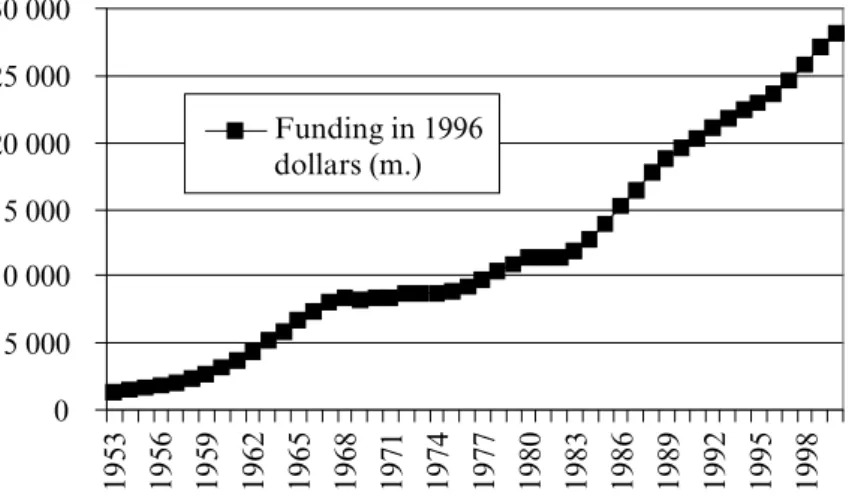
Of the total $33 billion, the federal government provided $19 billion, or 59 percent, academic institutions $6.7 billion, state and local governments $2.2 billion. Also, although it draws attention to the increasing number and diversity of goals and curriculum content of academic entrepreneurship programs (Cooper, 2003; Newton and Hendricks, 2003) and indeed concludes by asking questions about the connection of these programs to public/private R&D ventures, it does not include in an ongoing discussion of their effects (Newton and Hendricks, 2003; Hopkins, 2004).
EXEGESIS ON THE MEANINGS OF ENTREPRENEURSHIP
For example, Eisinger (1988) used the term 'entrepreneurial state' to describe the changing character of state economic development policies in the 1980s from 'supply-side', smoke-chasing to 'demand-side' creation of the basis of knowledge and capital base. for the production of new technologies, firms and industries. The difference is clearly seen in Pollard's comparison of the Schumpeterian entrepreneur and his rivals:
HISTORICAL OVERVIEW
Similarly, without too much stretch in analysis and reformulation of language, one can portray the history of federal land policies, at least through the Homestead Act of 1862, not only as manifestations of the Jeffersonian ideal of encouraging independent economics, but also as effort. Thus, in various ways, from the colonial period onwards, government attention has been focused on the adequacy of labor supply, the stimulation of 'critical' industries, the provision of capital, the development of a flexible but stable monetary and banking system, the isolation from foreign competition. , and physical infrastructure (or general social capital).
THE (RE)EMERGENCE OF GOVERNMENT–
Many of the same observed events regarding America's loss of international economic competitiveness, particularly in technology-intensive sectors, also support the resurgence of attention to entrepreneurship. Much of the analytical and political opposition to the R&D, innovation and technology transfer proposals of the 1980s ran exactly along these lines: almost every new initiative was called "statist".
PAST IMPACTS AND FUTURE PROSPECTS
Finally, ATP can also be considered a mixed case because, although most of the awards involve only firms, either alone or in consortia, there are a number that formally involve universities as subcontractors.9. Not only do organizational arrangements differ between the different types of partnerships, but so do the expected benefits that each of the different parties to the partnerships – firms, universities, state sponsors – expect when they enter into these partnerships.
CONCLUSIONS
From these perspectives, more detailed questions about the spatial location of new businesses and jobs within a country are second-order considerations. Even at this rate of growth, industry funds accounted for one of the smallest shares of academic R&D.
NOTES
To what extent those individuals who first participate in academic entrepreneurship programs and then start R&D firms differ from comparable firms that do not participate in any of the above. For example, an impact assessment of the Department of Defense's SBIR program by Audretsch et al indicates that the program's contributions in
COMMENTARY
Government policies to encourage economic development through
Scott Shane
UNIVERSITY SPIN-OFFS ENHANCE ECONOMIC DEVELOPMENT
The indirect economic impact of university adjuncts can be even greater than its direct effects. The magnitude of the effect of university adjuncts on the transformation of a regional economy can be quite large.
THE EFFECT OF GOVERNMENT POLICIES
Exclusive licensing is important to promote the creation of spin-off companies for two reasons. Even within the US, the data suggests a link between leave policies and the creation of spin-off companies.
POLICY IMPLICATIONS
Creating innovation networks among manufacturing firms: how
Susan Helper and Marcus Stanley
The third section discusses arguments for various economic development approaches, and examines how the MEP program has worked in practice.
SECTOR DESCRIPTION AND DATA
Each year, companies in the panel are also mailed a more detailed survey that asks additional questions about their business practices. We use this information to create measures of the urban density of a company's location and whether the company is located in a cluster of companies in similar industries.

SOME RESEARCH FINDINGS
However, the city's location still has a significant productivity impact for other companies as well. But sales fell 15 percent for companies below the median on our repeat mass production measure.
WHAT CAN (AND SHOULD) ECONOMIC DEVELOPMENT POLICY DO?
Since centers are more likely to be in urban areas, this favors urban businesses. On the other hand, the Pennsylvania MPs disproportionately serve small firms (Deloitte and Touche, 2004).
CONCLUSION
Our measure of urban location is the number of nonmanufacturing firms located within 10 miles of a factory. Firms can benefit from 'knowledge trading' with other returning firms (von Hippel, 1988) or by gaining a reputation as cooperators (Rege, 2003).
POLICIES FOR PRODUCTIVITY
In this interesting, ambitious paper, Helper and Stanley identify and report on the performance of 250 component sector firms surveyed in 2003. Helper and Stanley hypothesize that the inability of these firms to capture the gains from higher productivity for owners and managers. lead to underestimating the 'urban productivity externality'.
WHERE CAN POLICY DO THE MOST?
From a policy perspective, it is also consistent with the thrust of many northern states' approach to economic attraction: rather than just 'chasing smokestacks', they are trying to create 'cool cities' where well-educated, presumably skilled workers would want to migrate to . . What is less clear is that the political logic of each state's center, which makes MEP service a right for small manufacturers, is equally sensible.
WHICH POLICY CONTENT?
Investing in the MEMS regional innovation networks and the
Michael Fogarty
CAPTURING ECONOMIC BENEFITS FROM STATE S&T INVESTMENTS
OHIO’S MEMS INITIATIVES
The Microfabrication Laboratory is a state-of-the-art facility with $8 million worth of equipment, including a recent $3.75 million facility update that was funded by the Ohio Board of Regents and Case Western Reserve University.5 The purpose of the laboratory is to provide faculty and students at each of the participating institutions with access to infrastructure for MEMS device research. In 2000, the University was building a second cleanroom, which would be a state-of-the-art facility capable of supporting bioMEMS research.
THE METHODOLOGY FOR IDENTIFYING MEMS REGIONAL TECHNOLOGY CAPABILITIES
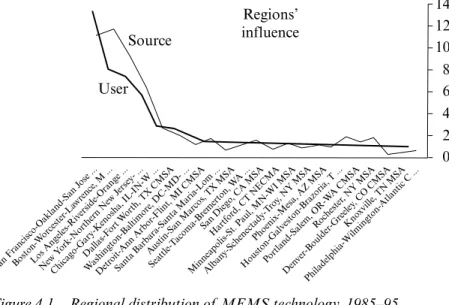
The San Francisco Bay Area, Boston, Los Angeles, New York, Chicago and Dallas are responsible for the bulk of the technology; Without state intervention, a region with a share of technology equal to A will tend to lose share (from A to B, C, D); a region with a share equal to E will tend to gain market share (from E to F, G, H).
SELECTING TECHNOLOGIES WITH ‘BROAD- BASED’ ECONOMIC BENEFITS
Because of the technology's defense and aerospace origins, MEMS has disproportionately generated spillovers for the aerospace industry (about 60 percent of all estimated spillovers). As a result, MEMS spillover effects have affected many key technologies in four of the five industries.
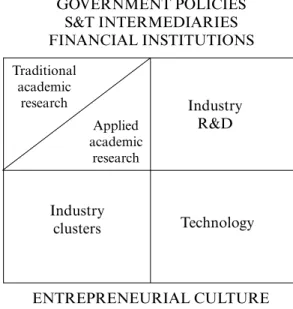
CAPTURING MEMS: THE REGIONAL INNOVATION SYSTEM MUST ‘FIRE ON ALL CYLINDERS’
Top-notch basic research is linked to highly effective commercialization mechanisms, but disconnected from local industry R&D. Superior basic research and highly efficient commercialization mechanisms match well with local industry R&D, but all production is located elsewhere.
OHIO’S MEMS INNOVATION SYSTEM
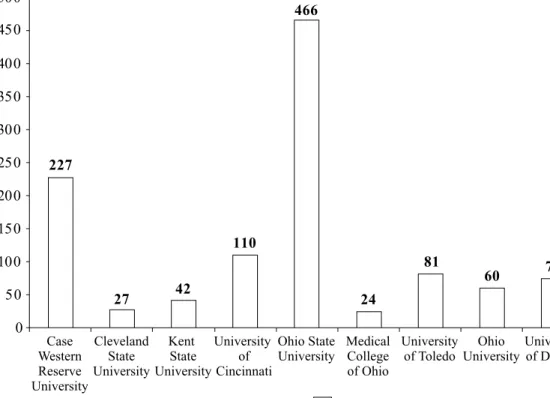
A good start to examining Ohio's MEMS innovation system is to look at the companies involved in the state's MEMS initiatives. We identified companies that have become partners or affiliates of Ohio's MEMS research programs, including those of the Glennan Microsystems Initiative (GMI).
CONCLUSIONS AND IMPLICATIONS
Buying Ohioans’ loyalty? How state financial aid affects brain drain
Eric Bettinger and Erin Riley
This chapter argues that, if government financial assistance programs affect long-term mobility, they do so by 'buying time' for 'life events' to occur. The academic literature on brain drain often focuses squarely on students' decisions before and immediately after their education.
DEFINING BRAIN DRAIN
The first section of the chapter reviews previous academic work on brain drain and defines brain drain more precisely. Despite the fact that Ohio imports more students than it exports, concerns about brain drain remain.
ECONOMIC MODEL OF MIGRATION
Moreover, the longer an individual has been a resident of a particular metropolitan area or state, the more likely he is to stay in the region (Sumell et al., 2003). The Georgia Hope Scholarships, for example, increased the likelihood that students would attend college in the state of Georgia (Dynarski, 2000).
BRAIN DRAIN AND LIFE EVENTS
These life events have a significant impact on the likelihood that students will remain in the same state. Students who have completed advanced degrees, especially doctorates, are much less likely to remain in the same state after five years.

STATE POLICIES TO COMBAT BRAIN DRAIN
On SBA-guaranteed lending and economic growth
Ben Craig, William Jackson and James Thomson 1
In the next section, we provide a brief history of the SBA and an overview of its major lending programs. In the third section, we provide a brief overview of the academic literature on credit rationing and relationship lending.
A BRIEF HISTORY OF THE SBA AND ITS MAJOR CREDIT-EXTENDING PROGRAMS
The SBA's main business loan programs are the 7(a) Guaranteed Loan Program and the 504 Loan Program. The 7(a) loan program is the most basic and significant of the SBA's business loan programs.
SBA LENDING AND THE ECONOMICS OF CREDIT MARKETS
For these reasons, the expected return to the bank may increase less rapidly than the interest rate and, beyond a point, may actually decrease. Of course, the interest rate is not the only term of the contract that is important.
THE QUESTIONS, EMPIRICAL STRATEGY AND DATA
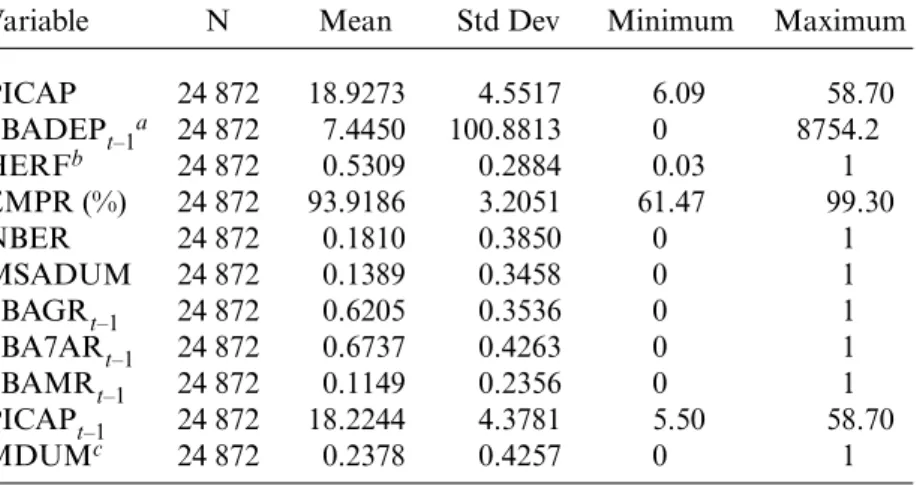
LNDEP Natural logarithm of FDIC total deposits SUMD LNEMPR Natural logarithm of BEA employment rate. LNSBAt–1 Natural log of SBA guaranteed loans at t–1 minus natural log of SBA guarantees.
THE EMPIRICAL RESULTS
For the full sample and the urban sample (MSA), the coefficients on SBAGRt–1 and SBA7ARt–1 are significantly negative, while the coefficients on SBAMRt–1 are positive and significant. The coefficient on the log level for deposits lagged by two periods is negative and significant for the full sample and the MSA sample.
CONCLUSIONS AND EXTENSIONS TO THE ANALYSIS
Smart places for smart people
Michael Luger
The central point is that cluster-based planning today must be different from that of the past because of the realities of the new economy. In the section immediately following, I provide a critique of the 'standard' approach to cluster-based planning and show how it best fits the 'old' economy.
THE STANDARD APPROACH TO CLUSTER-BASED PLANNING
Definitions are likely to shift as information is collected, seriously compromising the objectivity of the findings. In summary, cluster-based planning typically consists of a quantitative analysis of the way individual industries interact through trade, and a qualitative assessment of which industries appear to be emerging.
IMPLICATIONS OF THE ‘NEW ECONOMY’
The table does not show that the differences have increased since the last census. This is consistent with the volatile nature of the labor market in the new economy mentioned by Atkinson above.

CREATING SMART PLACES FOR SMART PEOPLE
The procedure we used created the grouping shown in the table, which we then had to interpret. This is consistent with the role attributed to science and technology (S&T) in the rapid transformation of new economy enterprises, also in the Atkinson quote above.
CLUSTER-BASED PLANNING FOR THE 21 ST
But there is no guarantee that the particular business they have, even if it belongs to one of the industries in Table 7.3, will have any synergy with other businesses in the region. Conversely, businesses that would be highly connected in the region are likely to be left out of the table.
CENTURY
Regional wealth creation and the 21st century: women and
John Butler
THEORETICAL CONSIDERATIONS
Studies of regions that thrive, thanks to the presence of 'foreigners', have a strong tradition that is being revived in the context of American science. As noted earlier, the study of women and minority groups can also be seen in the tradition of 'foreigners'.
REGIONAL PROSPERITY AND IMMIGRANT ENTREPRENEURSHIP
This chapter applies the theoretical tradition of the stranger to recent immigrant groups in affluent regions, to Black Americans in regions with a tradition of economic security, and to women entrepreneurs.