Effects of Victimization on Depression:
How Children Respond to Being Bullied Stephanie L. Cordel
Vanderbilt University
Advisor:
David A. Cole Vanderbilt University
Abstract
Many victimized children suffer negative psychological outcomes as a result of being bullied.
One prominent consequence is that of depression. In a cross-sectional study about childhood victimization and depression among elementary school students (N=421), children completed a free response survey regarding how he or she would respond to relational, physical and verbal victimization respectively as well as a depression inventory and self report of victimization history. Two categorization systems (RSQ and CRTB) classified the responses to see whether certain responses moderated the effect of depression for a particular set of children. Results suggest that certain responses to victimization scenarios moderate the relation between victimization history and depression.
Keywords: depression, children, victimization, coping responses
Effects of Victimization on Depression:
How Children Respond to Being Victimized
Although peer victimization is a widely studied topic, it continues to be an issue within school systems (Hawker & Boulton, 2000). Despite numerous studies, peer victimization still induces negative consequences that are harmful to some children’s psychological development (Craig, 1996; Juvonen et al., 2000; Crick & Grotpeter, 1995). An area that recently has been given particular attention involves the strategies children use in reaction to being victimized and how various coping styles affect the victimization and its consequences (Kochenderfer-Ladd &
Skinner, 2002; Kochenderfer-Ladd, 2004; Lodge & Feldman, 2007). Not all children who have been victimized actually experience a form of maladjustment. Therefore, moderating factors are important to consider. What prevents some children from becoming depressed as a result of being victimized while others maintain their psychological well-being? We speculate that part of the difference is due to the fact that different children apply different coping strategies to
different types of victimization.
Research in this field dates back to the 1970’s by the Swedish researcher Olweus (Card &
Hodges, 2008). Since then, numerous studies have been conducted and many suggest that peer victimization is an area that needs to be addressed within schools. Peer victimization affects between thirty and sixty percent of school children (Card & Hodges, 2008). In a 2000 meta- analysis Hawker and Boulton concluded that peer victimization is considered to be aggressive behavior targeted to certain children which involves those outside of the family and who are not necessarily the same age.
Under this broad conceptualization, various distinctions can be made. Three general types of victimization have been described in the literature: relational, physical, and verbal. Relational
victimization occurs when a child’s social relationships are threatened or damaged by another (Crick et al., 1999). Physical victimization refers to any kind of attack on the physical body such as a child being punched, kicked or hit by another. Verbal victimization references the act of being harmed by means of words (Hawker & Boulton, 2000).
In addition to identifying different forms of victimization, researchers have also learned that various correlates exist in relation to the victims involved in peer victimization. Correlates linked to being bullied include low self-esteem, academic maladjustment, anxiety, and isolation (Crick & Grotpeter, 1996; Bond et al., 2001). Depression is another common feature among children who experience victimization. A general consensus establishes that victims experience higher rates of depression than those of non-victims (Craig, 1998).
Children cope with victimization in a variety of ways. Many researchers have studied how coping affects the perpetuation of victimization. Some have used previously devised scales for coping (Lodge, 2006) whereas others have developed their own (Kochenderfer-Ladd, 2004).
As peer victimization is a stressful event, still other researchers have applied the coping categorizations of stress scales to the responses children have in regards to being victimized.
Popular classifications of stress coping styles are Tobin et al.’s (Tobin et al., 1989) arrangement which discusses problem solving, cognitive restructuring, expressing emotions, social support, problem avoidance, self-criticism and social withdrawal. Ayers et al. (Ayers et al., 1998) explains active strategies, distraction strategies, support seeking strategies and avoidance
strategies. Walker et al. (Walker e al., 1997) produces active coping, accommodative coping and passive coping in the analysis of responses (Skinner & Edge et al., 2003).
Conner-Smith et al. (2000) constructed a well supported and empirically tested taxonomy that incorporates both automatic and purposeful responses to a stressful situation. This
organization involves both automatic and controlled responses. The specific components are voluntary primary control engagement coping, voluntary secondary control engagement coping, voluntary disengagement coping, involuntary engagement and involuntary disengagement (Conner-Smith et al., 2000).
After establishing a particular categorization of coping styles, researchers have explored the differential outcomes associated with various coping styles. Kochenderfer-Ladd (2004) investigated the role of emotional responses and how they affect the consequences of being victimized. She reports that the emotion of fear elicited a conflict resolution response and thus reduced peer victimization as well as internalizing symptoms such as loneliness and depressive tendencies. In another study, Kochenderfer-Ladd and Skinner (2002) explain that victimized boys who are high in distancing and externalizing are more anxious and depressed than those who do not elicit the same behaviors in response to being bullied. Lodge and Feldman (2007) discussed that there is a negative relationship between avoidant coping and psychological well- being. Davidson and Demaray (2007) found that social support as a means of coping alleviated the distress that was internalized after a child was a victim. Craig et al. (2007) explained that aggressive and confrontational coping strategies prolonged victimization.
Although research has addressed the effects of coping on the perpetuation of peer
victimization and the psychological outcomes, little has related coping to its effect on depression specifically. The fact that every victimized child does not necessarily experience depression associated with the victimization, implies that there may be moderating factors. Thus a worthwhile question is whether coping strategies moderate the relation between peer victimization and depression. Therefore we will look at the effects of relational, verbal and
physical victimization on depression and the degree to which the effect of depression is moderated by the different coping measures children claim to use.
Method Participants
We collected information from two rural/suburban elementary schools and one middle school in central Tennessee. Consent forms were given to 826 students in third, fourth, fifth and sixth grades. Over half of the parents allowed their child’s participation (N=421). On the day of data collection, 403 (96%) of the students who had parental consent were present. Children were in third (n = 100), fourth (n = 96), fifth (n = 101), and sixth (n = 104) grades. Ages ranged from 8 to 14. Males and females were close to evenly represented. In terms of ethnicity, Caucasian (92.2%), Hispanic (2.8%), African American (1.5%), Asian (.5%) and other (3.0%) were
included in the sample. The What Would You Do (WWYD) questionnaire was last in a packet of several questionnaires. As a result, not every child was able to answer each question. Question 1(N=345), Question 2(N=344), Question 3(N=343) and Question 4(N=341) varied in how many children provided a free response.
Measures
Victimization by peers. We measured direct and indirect verbal victimization as well as physical and relational victimization through self-reports. The self-report questionnaire consisted of 12-items and was designed to assess both relational and physical victimization modeled after the items used by Ladd and Kochenderfer-Ladd (2002). We modified it for the somewhat older children so a broader range of victimization areas could be addressed such as verbal
victimization. Each item was then scaled on one of four points (1=never, 2=rarely, 3=sometimes, 4=a lot).The score that combines all victimization areas of relational, physical and verbal, is considered the peer victimization score (PV).
Depressive Symptoms. Depressive symptoms were measured using a 26-item version of the Children’s Depression Inventory (CDI; Kovacs, 1985) which included the assessment of cognitive, affective and behavioral symptoms of depression in children. The item regarding suicidal ideation was eliminated. Each item had three statements in order of increasing severity, scored from 0 to 2. Each child selected a statement that best describes themselves for the past two weeks (e.g., “I am sad once in a while,” “I am sad many times,” or “I am sad all the time).
Coping responses. We gathered responses to peer victimization by using What Would You Do (WWYD), a four item questionnaire that asked the participants what they would do if they were to find themselves experiencing various peer victimization situations. Each question addressed a different type of peer victimization: physical, verbal, and relational. Each participant was then asked to write a written response of what they would do.
Question 1 presented a direct, verbal victimization scenario: What would you do if someone was teasing you about your appearance?
Question 2 presented an indirect, relational victimization situation: You and your friend got mad at each other. The next day you find out that your friend is trying to turn all of your friends against you. What would you do?
Question 3 presented an indirect, verbal victimization situation: Someone you know has been saying mean things about you behind your back. What would you do?
Question 4 presented a direct, physical victimization scenario: A bully starts picking a fight with you after school. What would you do?
Categorizing responses. Based on the fact that being victimized is considered a stressful situation, we used a modified version of Connor et al.’s (2002) Responses to Stress
Questionnaire (RSQ). We selected 8 of the 17 items that best applied to being victimized (see table 1). Due to the variety of problem solving strategies reported by children, we developed an alternate coding scheme to better capture these variations and was more relevant to the act of peer victimization specifically. This second coding system, the Children’s Responses to Bullying (CRTB), contained 13 response categories (see Table 2).
Once data were collected, some responses were separated based on the fact that they had more than one type of response. An example of a response that would be spliced is “I would punch him; go tell the teacher and then cry.” This particular response would be separated into three different responses: “I would punch him”; “Go tell the teacher”; “cry.” The separation was based on the fact that the child responded with three different actions.
After the separation among responses across each WWYD question, each response was categorized using both the CRTB and RSQ. All questions from the WWYD were categorized using the CRTB and RSQ by a total of five raters each. One rater remained consistent across all questions and both categorization systems, while 4 raters rated one question each for the CRTB and RSQ respectively. Table 3 shows the percent agreement for all raters.
Procedures
Before data collection, students in each classroom was given a parental consent form to take home and teachers were offered $100 for their classroom if 90% of the students returned their consent forms, regardless of whether parents did or did not permit the child to participate.
Psychology graduate students and advanced research assistants administered the questionnaires
during school hours. For third- and fourth-graders, one research assistant read the questionnaires aloud to a group of students. For students in the fifth and sixth grades, a research assistant introduced the battery questionnaires and allowed students to complete them at their own pace.
For all students, the assistants walked around to monitor, answer questions throughout the
administration of the test. At the end, students were rewarded with snacks and a decorated pencil.
Results Descriptive Statistics
Frequencies. Tables 4 and 5 display frequencies of responses from both the RSQ and the CRTB based on each type of victimization evaluated by the WWYD.
When examining the different types of victimization using the RSQ categories, there were certain responses that are used more frequently given a particular type of victimization.
When faced with direct, verbal victimization (question 1 of WWYD), the three most common responses were avoidance (33%), problem solving (23.2%), and emotional expression(22%). For indirect, relational victimization (question 2), children most often reported using Problem
Solving (55.8%) and avoidance(20.1%). In response to indirect, verbal victimization (question 3) sixty-one percent of children report using problem solving. Children used escape (46.4%), problem solving (38.1%) and involuntary action (23.5%) the most when facing a direct, physical confrontation (question 4).
Similarly, there were more commonly used categories of responses from the CRTB.
When faced with direct, verbal victimization (question 1 of WWYD), the two most used responses were ignore (31.3%) and tell an adult (29%). For indirect, relational victimization (question 2), children most often reported using problem solving via aggressor (27.6%) and
problem solving via peers (25.9%). Indirect, verbal victimization (question 3) has problem solving via aggressor (29.15%) and tell an adult (26.53%) as the most frequently used responses.
Children reported avoidance (46%), tell an adult (27.9%), and physical confrontation (23.5%) the most when facing a direct, physical confrontation (question 4).
Cronbach’s alphas. We also examined each category to see if children responded consistently across questions. Cronbach’s alphas ranged from .059 to .543 when looking at the categories from the CRTB and then .112 to .615 when considering the items from the RSQ.
Based on the relatively small alphas for each category system, we note that responses were not highly consistent across the different types of victimization suggesting that children respond to victimization scenarios based on the type of victimization presented in the scenario. Thus, all subsequent results will be reported for each individual question of the WWYD.
Coping Response and Self-reported Peer Victimization History. Tables 6 and 7 show the t-values reflecting whether use (versus non-use) of codes in each category system (RSQ and CRTB) were associated with self-reported peer victimization scores. Only significant results will be discussed.
On the RSQ, when presented with a direct, verbal victimization situation (question 1), emotional arousal response (t=2.471, p<.05) was associated with higher victimization scores while avoidance response (t=-2.914, p<.01) was associated with lower scores. Children who reported using avoidance (t=1.967, p<.05) had lower victimization scores when faced with an indirect, relational victimization scenario (question 2) Children who reported using an emotional arousal response (t=-2.189, p<.05) had higher victimization scores when presented with the indirect, relational victimization scenario (question 2) and also when reporting emotional arousal (t=-2.147, p<.05) for an indirect, verbal victimization situation (question 3).
Similarly, certain responses from the CRTB were associated with higher and lower peer victimization scores. Children who reported using an emotional response (t=-2.284, p<.05).
When being faced with a direct, verbal victimization situation (question 1) had higher peer victimization scores than those who did not. Those children who reported using ignore (t=2.1, p<.05) had lower victimization scores than those who did not. When presented with an indirect, verbal victimization situation (question 3), children who reported using nonspecific
confrontation (t= -2.005, p<.05) and an emotional response (t=-2.147, p<.05) had higher peer victimization scores than those who did not.
Childhood Depression Inventory Scores. Tables 8 and 9 show the t-values of each category system (RSQ and CRTB) when compared with CDI scores. Only significant values will be discussed.
As with peer victimization score, t-scores relating type of response and CDI score varied based on the response of the category system as well as the victimization being presented. When considering the RSQ, children who reported being emotionally aroused had higher depression scores than those who did not; while children who reported using avoidance had lower
depression scores when faced with a direct, verbal victimization situation (question 1). When given an indirect, relational victimization scenario (question 2), children who reported using emotional arousal and involuntary action had higher depression scores than those who did not, while children who reported using avoidance or problem solving had lower depression scores than the children who did not. Children who reported using involuntary action when being
presented with indirect, verbal victimization (question 3) had higher depression scores than those who did not. When facing direct, physical victimization (question4), children who reported using escape had lower depression scores than those who did not.
According to the CRTB, children who use an emotional response when being faced with a direct, verbal victimization situation (question 1) had higher depression scores than those who did not. Children who reported using ignore in response to this situation, had lower depression scores. In response to being indirectly, relationally victimized (question 2), children who
reported using physical confrontation and emotional response had higher depression scores while children who responded with problem solving via aggressor had lower depression scores. In response to an indirect, verbal victimization situation (question 3), children who reported using nonspecific confrontation had higher depression scores while children who reported using problem solving via aggressor had lower depression scores. When presented with a direct, physical victimization scenario (question 4), children who reported using avoidance as a response had lower depression scores than those who did not.
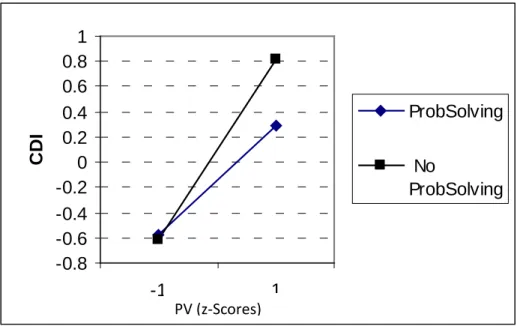
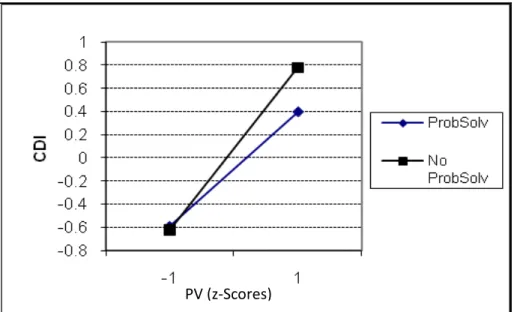
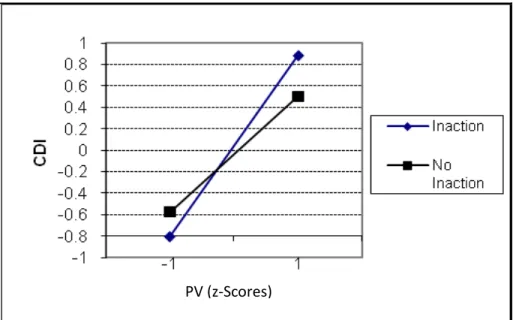
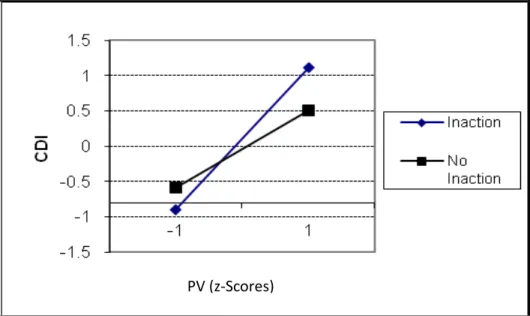
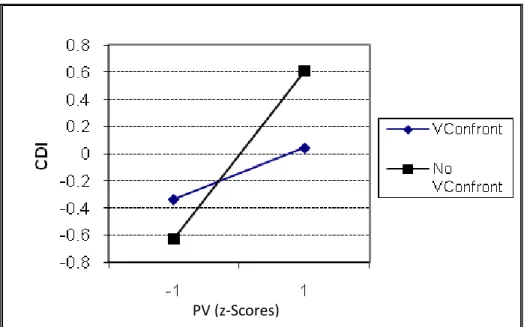
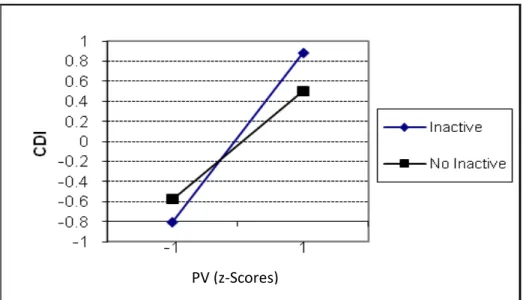
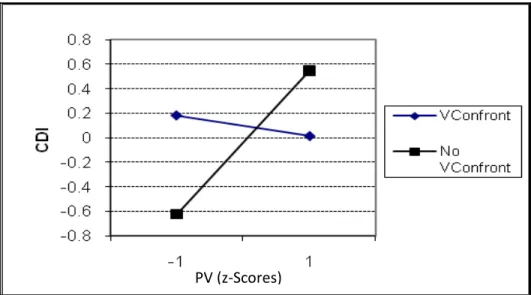
Moderation: Tables 10-17 display the results of regression analyses of each WWYD question looking at the relation between victimization and depression and how children’s responses of both RSQ and CRTB affect it. Figures 1-9 show the significant results that will be discussed.
For the RSQ, the relation between victimization and depression weakened when children report using avoidance compared with those who did report this when given a direct, verbal victimization situation (question 1). There were two responses that moderated the relation
between victimization and depression differently for an indirect, relational victimization scenario
(question 2). Problem solving weakened the relation while emotional arousal strengthened it.
There were also two responses that moderated the relation differently when it comes to an indirect, verbal victimization situation (question 3). Problem solving again strengthened the relation while inaction weakened it. For a direct, physical victimization scenario (question 4) the relation between victimization and depression was strengthened when children provided the inaction response in comparison with those who did not.
When looking at the categories for the CRTB, the relation between victimization and depression weakened for children who reported using ignore versus those who did not in
response to a direct, verbal victimization situation (question 1). The relation also weakened when a child reported using verbal confrontation in response to an indirect, relational victimization scenario (question 2) when compared with those children who did not report using the response.
In response to an indirect, verbal victimization scenario (question 3), the relation was
strengthened for those children who provided an inactive response compared to those who did not. Two responses for a direct, physical victimization situation (question 4) moderated the
relation between victimization and depression differently. In comparison to not using the strategy, the use of verbal confrontation weakened the relation between peer victimization and depression while an inactive response strengthened it.
Discussion
Overall, there were many significant results that emerged in four major aspects regarding child victimization and depression. The first aspect relates to how children respond differently to victimization based on the type of scenario. The second area of interest would be the responses
that children who are depressed report to use when faced with different types of victimizing situations. The third area that holds significant results is the responses that children who are victimized discuss using when dealing with various victimizations. The fourth area that supports our hypothesis is looking at how children’s responses to peer victimization scenarios moderate the relation between victimization and depression. Each of these results is discussed below.
First of all, this study examined the free responses that children use in reaction to different types of victimization scenarios. Overall, there were certain responses that were reported more frequently than others based on the type of victimization presented. Consistent with popular suggestions by teachers and parents, tell an adult and ignore were the most frequent responses from children when being given a direct, verbal victimization situation (question 1) when using the CRTB. Problem solving, emotional expression and avoidance were most common for the RSQ. In regards to an indirect, relational victimization scenario (question 2), problem solving via aggressor and via peers were the most commonly reported responses from the CRTB, while problem solving and avoidance were most common from the RSQ. Problem solving via aggressor and tell an adult from the CRTB as well as problem solving and avoidance from the RSQ were the most common responses from children for the indirect, verbal
victimization situation (question 3). For a direct, physical victimization situation (question 4), the most common responses from the CRTB were physical confrontation, tell an adult and avoidance.
The most common responses from the RSQ were problem solving, involuntary action and escape.
Based on the fact that little research has focused addressed gathering free responses from children in reaction to being victimized, it is unclear whether our data fully support any prior findings.
Second, depressed children reported using an emotional type of response for both the CRTB and RSQ when faced with a direct, verbal victimization situation as well as an indirect, relational situation. They were less likely to report an ignore response, problem solving with the aggressor, using an avoidance response and an escape response across all questions looking at both the CRTB and the RSQ. This is inconsistent with previous findings by Kochenderfer-Ladd and Skinner (2002) who discussed that boys who use more distancing are considered more depressed. Based on the findings in this study, it appears that depressed children are less likely to report any sort of distancing behavior. In addition, these findings are also inconsistent with Lodge and Feldman’s (2007) when they reported that avoidant coping is associated with psychological well-being. This suggests that perhaps a potential behavior that influences a child’s depression in face of victimization is whether or not the child can distance themselves from the situation by avoiding or ignoring it.
Third, victimized children reported using an emotional type of response for both the CRTB and RSQ when dealing with a direct and indirect verbal victimization scenarios as well as an indirect, relational situation. In terms of the CRTB, they were less likely to report ignoring it when it was a direct, verbal victimization situation. For the RSQ, they were less likely to report using an avoidance response when faced with indirect and direct, verbal victimization as well as indirect, relational victimization. These findings are inconsistent with Kochenderfer-Ladd’s (2004) study when she explained how children who are victimized often have intense fear which moves them to use conflict resolution. None of our results indicate that victimized children are more likely to report using any type of problem solving when considering the categories from both the CRTB and the RSQ.
Fourth, there were certain responses that children used which moderated the effect of victimization on depression. When considering both the CRTB and the RSQ, the responses that moderated and weakened the relation between victimization and depression were ignore, verbal confrontation, avoidance and problem solving. The responses that moderated and strengthened the relation of victimization and depression were an inactive response, emotional arousal and inaction. Because there is little research that focuses specifically on how a response effects depression in particular when a child is victimized, it is difficult to confirm whether these findings are consistent with previous studies. Davidson and Demaray (2007) say that social support is a form of coping which alleviates the internalizing distress of victimization, however our findings suggest that telling an adult or emotional expression is not a moderating factor.
Lodge and Feldman (2007) explain that avoidant styles of coping increase the risk for negative outcomes for those children who are victimized, but according to our results, reporting using ignore or avoidance for direct, victimization situation not only moderated, but also weakened the relation between victimization and depression. This suggests that avoidance actually helps psychological well-being in terms of depression. Craig et al. (2007) report that aggressive or confrontational coping prolonged victimization. Although we did not conduct a longitudinal study to gather information about victimization over time, given our results, a verbal
confrontation response is considered beneficial when a child is faced with an indirect, relational or direct, physical victimization situation because it strengthened the relation between
victimization and depression.
Several shortcomings of the current research suggest avenues for future research. First, there is little racial diversity in our sample population which limits the generalizability of our results. Future studies should aim at gathering diverse samples of both ethnic and age differences.
Second, the responses we collected from the WWYD are only hypothetical answers. They do not necessarily indicate what a child would actually when presented with the various victimization scenarios. Thus, our results cannot be considered a completely accurate representation of how children would respond to victimization. In the future, a questionnaire could be developed using the CRTB to ask children what they have actually done in the past when confronted with various types of victimization. Third, this study developed a categorization system that had not been used prior and thus has not been validated and cannot be considered to have strong reliability. Future studies need to be conducted to test this categorization system to ensure it can be a well-
supported and reliable source for classifying children’s responses to being victimized. Lastly, our study was cross-sectional and the regression analyses we conducted did not determine the causal relation between victimization and depression and how a response would affect it in that manner.
Future studies can be done to determine the causal relation and establish whether victimization experiences are impacted by the response a child uses.
References
Ayers, T. S., Sandler, I. N., West, S. G., & Roosa, M. W. (1996). A dispositional and situational assessment of children’s coping: Testing alternative models of coping. Journal of Personality, 64, 923-958.
Bond, L., Carlin, J., Thomas, L., Rubin, K. & Patton, G. (2001). Does bullying cause emotional problems? A prospective study of young teenagers. BMJ, 323, 480-484.
Card, N. A. & Hodges, E.V.E. (2008). Peer victimization among schoolchildren:
Correlations, causes, consequences, and considerations in assessment and intervention. School Psychology Quarterly, 23, 451-461.
Connor-Smith, J.K., Compas, B.E., Wadsworth, M.E., Thomsen, A.H. & Saltzman, H.
(2000) Responses to stress in adolescence: Measurements of coping and involuntary stress responses. Journal of Consulting and Clinical Psychology, 68, 976-992.
Craig, W.M. (1998). The relationship among bullying, victimization, depression, anxiety, and aggression in elementary school children. Personal and Individual Differences, 24, 123-130.
Crick, N. & Grotpeter, J. (1995) Relational aggression, gender, and social-psychological adjustment. Child Development, 66, 710-722.
Davidson, D.M. & Demaray, M.K. (2007). Social support as a moderator between victimization and internalizing-externalizing distress from bullying. School Psychology Review, 36, 383-405.
Hawker, D.S.J. & Boulton, M.J. (2000). Twenty years’ research on peer victimization and psychosocial maladjustment: A meta-analytic review of cross-sectional studies. Journal of Child Psychology and Psychiatry, 41, 441-455.
Juvonen, J. Nishina, A. & Graham, S. (2000). Peer harassment, psychological adjustment, and school functioning in early adolescence. Journal of Educational Psychology, 92, 349-359.
Kochenderfer-Ladd, B. (2004) Peer Victimization: The Role of Emotions in Adaptive and Maladaptive Coping. Social Development, 13, 329-349.
Kochenderfer-Ladd, B. & Skinner, K. (2002). Children’s Coping Strategies: Moderators of the Effects of Peer Victimization? Developmental Psychology, 38, 267-278.
Lodge, J. & Feldman, S.S. (2007). Avoidant Coping as a Mediator Between Appearance- related victimization and Self-esteem in Young Australian Adolescents. British Journal of Developmental Psychology, 25, 633-642.
Skinner, E., Edge, K., Altman, J. & Sherwood, H. (2003). Searching for the structure of coping: A review and critique of category systems for classifying ways of coping. Psychological Bulletin, 129, 216-269.
Tobin, D. L., Holroyd, K. A., Reynolds, R. V., & Wigal, J. K. (1989). The hierarchical factor structure of the Coping Strategies Inventory. Cognitive Therapy and Research, 13, 343–
361.
Walker, L. S., Smith, C. A., Garber, J., & Van Slyke, D. A. (1997). Development and validation of the pain response inventory for children. Psychological Assessment, 9, 392–405.
Table 1
Modified Responses to Stress Questionnaire with Examples from WWYD
Factor Definition Examples from WWYD Responses
Primary Control Engagement
Problem Solving Making an effort to fix the situation
talk to my friends about it, confront them, talk it out
Emotional Expression Talk to someone about feeling tell the teacher, tell the principal Secondary Control
Engagement
Positive Thinking Thoughts that incorporate optimism and the idea that things will be okay
I like the way I am
Primary Control Disengagement
Avoidance Staying away from problem/people
ignore him, I would not be their friend, just make new friends
Involuntary Engagement
Emotional Arousal Sensitive to stress and everyday situations
I would cry, I would be sad, get mad Involuntary Action Inability to control verbal or
physical responses
punch him back, tease him back, kick her
Involuntary Disengagement
Inaction Inability to take action in response to stress
I don’t know, nothing Escape The urge to get away from the
situation
run away, go home
Other Un-categorizable response sing a song and laugh, the sun is too bright
Table 2
Children's Responses to Bullying Categorization with Factor, Definition and Examples
Factor Definition Examples
Verbal
Confrontation
Response that addresses the aggressor verbally that is off-putting and could involve hurting the aggressor.
Curse them out, he’s just a baby, tell him he’s a jerk, you are jealous, make fun of them, yell at my friend, threaten him, tell him to stop
Physical Confrontation
Response that addresses the aggressor in a physical manner such as punching, hitting or kicking.
Punch them, hit them, beat them up, throw food
Non-specific Confrontation
Response that is negative in nature and could be acted out verbally or
physically, but there is no specification
Defend myself, hurt him, confront them, revenge Problem
Solving via aggressor
Response that describes a problem solving effort directly with the
aggressor, but the solution is vague and there is no specification as to how the child will carry out the action.
Be friends with them,
Apologizing, talk to him, ask him why, say stop it, try to
compromise, not play with him, tell that person how I feel, ask them to stop
Problem Solving via peers
Response that describes a problem solving effort not involving aggressor, but involving other peers who may or may not be related to the aggression.
Try and make new friends, get a buddy and stick with her
Problem solving-non- Specific
Response that describes a problem solving effort where it is not clear whether the aggressor or other peers are involved.
Try and fix it, I’d tell someone
Tell an adult Response that seeks to address the situation by going to an adult of some kind such as a teacher or parent.
Talk to my mom, tell my dad, tell the teacher
Avoidance Response
Response that describes the victim as attempting to remove self physically from the situation
Run away, walk away, leave, go home
Emotional Response
Response that explains how the child would feel. It can be a positive or negative emotion.
Feeling embarrassed, get mad, get sad, cry, I would be upset Self-
Affirmation
Response that references self verbally or physically.
I like the way I am, I wouldn’t care because I know who I am, Count to ten
Ignore Response that does not recognize the behavior of the aggressor and does not address him or her in any way.
Don’t pay attention, ignore them, pretend they are not there, not listen to them, not talk to them, not worry about it, forget about it
Inactive Response
A response that does not designate any action at all.
I don’t know, nothing, don’t care Other A response that does not fit within the
other categories. Often they are random statements
Get over it, nice things, I would make an excuse,
Table 3
Percent of Inter-rater Agreement for CRTB and RSQ Across WWYD Questions Categorization Question 1 Question 2 Question 3 Question 4
CRTB 84% 75% 85% 85%
RSQ 74% 74% 94% 87%
Table 4
Frequency Distribution of RSQ Categories across WWYD Questions
Category Question 1 Question 2 Question 3 Question 4
Problem Solving 23.20% 55.80% 61.80% 38.10%
Emotional Expression 22.00% 8.10% 1.20% 1.20%
Positive thinking 3.80% 1.20% 0.60% 0.00%
Avoidance 33.00% 20.10% 16.90% 2.90%
Emotional Arousal 6.10% 5.20% 5.50% 0.30%
Involuntary Action 11.00% 10.20% 9.00% 23.50%
Inaction 1.70% 2.90% 7.30% 3.20%
Escape 12.20% 2.90% 0.90% 46.30%
Other 6.40% 4.40% 4.40% 6.70%
Table 5
Frequency Distribution of CRTB Categories Across WWYD Questions
Category Question 1 Question 2 Question 3 Question 4
Verbal Confrontation 14.50% 11.30% 5.25% 3.20%
Physical Confrontation 6.40% 3.50% 4.66% 23.50%
Nonspecific Confrontation 1.70% 5.80% 7.58% 7.00%
PS-Aggressor 11.60% 27.60% 29.15% 2.90%
PS-Peers 0.90% 25.90% 2.62% 0.90%
PS-Nonspecific 1.70% 4.90% 4.08% 7.00%
Tell Adult 29.00% 10.50% 26.53% 27.90%
Avoidance 10.40% 3.20% 0.87% 46.00%
Emotional Response 5.80% 5.20% 5.54% 3.00%
Self Affirmation 3.50% 0.30% 0.29% 0.00%
Ignore 31.30% 7.60% 14.58% 2.60%
Inactive 3.20% 3.20% 7.29% 2.30%
Other 4.30% 5.80% 3.79% 1.80%
Table 6
T-Scores of RSQ Categories and PV
Category Question 1 Question 2 Question 3 Question 4
Problem Solving -1.379 0.371 0.036 -0.913
Emotional Expression -0.217 -1.37 -0.684 -0.115
Positive Thinking -0.506 0.316 0.44 ---
Avoidance 2.471* 1.967* 0.111 0.224
Emotional Arousal -2.914** -2.189* -2.147* -1.3
Involuntary Action -0.302 -0.912 0.194 -0.395
Inaction -1.041 0.078 0.037 -0.289
Escape 0.152 -0.672 -0.368 0.937
Other 0.599 -0.308 -0.004 -2.001*
Note. *p<.05, **p<.01, ***p<.001
Table 7
T-Scores of CRTB Categories and PV
Category Question 1 Question 2 Question 3 Question 4
Verbal confrontation -1.352 -0.55 0.906 0.119
Physical confrontation -0.308 -0.82 -0.856 -0.506 Nonspecific confrontation 0.582 -0.799 -2.005* -0.915
PS via Aggressor 0.335 1.282 1.353 0.812
PS via Peers 1.098 1.41 -0.077 1.176
PS Non-specific -1.81 -1.092 -1.65 1.113
Tell an Adult -1.134 -1.279 -0.096 -1.481
Avoidance 0.459 -0.252 -0.368 1.109
Emotional Response -2.284* -1.774 -2.147* -1.3
Self Affirmation -0.234 -0.584 1.237 ---
Ignore 2.1* 0.917 0.288 0.056
Inactive 0.22 -0.836 0.037 -1.266
Other 0.862 -0.356 0.215 -2.053*
Note. *p<.05, **p<.01, ***p<.001
Table 8
T-tests of RSQ Categories and CDI by Question
RSQ Category Question 1 Question 2 Question 3 Question 4
Problem Solving 0.004 2.426* 1.573 0.347
Emotional Expression 0.642 -1.459 0.736 0.351
Positive Thinking 0.238 0.185 -0.463 ----
Avoidance 3.139** 1.883 0.711 0.165
Emotional Arousal -4.013*** -2.875** -0.876 -1.307
Involuntary Action -1.841 -2.313* -1.961 -1.553
Inaction 0.882 0.148 -0.263 -0.694
Escape -0.011 -0.398 -0.543 2.405*
Other -0.614 -1.325 -0.963 -1.368
Note. *p<.05, **p<.01, ***p<.001
Table 9
T-tests of CRTB Categories and CDI for each Question
CRTB Category Question 1 Question 2 Question 3 Question 4
verbal confrontation -1.42 0.564 -1.103 -0.656
physical confrontation -1.658 -2.267* -1.192 -1.252 Nonspecific confrontation 0.993 -1.888 -2.395* -0.676
PS via Aggressor 0.883 3.656*** 2.453* 1.244
PS via Peers 1.315 1.248 0.509 -0.839
PS Non-specific -0.421 -0.979 -0.609 1.281
Tell an Adult -0.412 -1.107 0.137 0.083
Avoidance 0.35 -0.513 -0.543 2.195*
Emotional Response -2.99** -2.047* -0.876 -1.307 Self Affirmation 1.255 0.555 0.152 ---
Ignore 3.039** 1.638 0.646 0.489
Inactive -0.415 -0.218 -0.263 -1.397
Other -0.079 -1.716 -0.61 -2.013*
Note. *p<.05, **p<.01, ***p<.001
Table 10
Interaction Values for RSQ Categories from Question 1 of WWYD
Predictor B SE (B) β
Intercept PV Response
PV x
Response Intercept PV Response
PV x
Response Intercept PV Response
PV x Response Problem S -0.009 0.578 -0.098 -0.005 0.047 0.048 0.097 0.102 --- 0.6 -0.044 -0.003 Emotional
Ex -0.012 0.562 -0.091 0.054 0.046 0.047 0.098 0.101 --- 0.584 -0.041 0.026
Positive T -0.027 0.579 -0.137 -0.086 0.042 0.043 0.214 0.202 --- 0.601 -0.028 -0.019 Avoidance 0.024 0.636 -0.219 -0.248 0.049 0.05 0.087 0.091 --- 0.66 -0.11 0.142**
Emotional A -0.065 0.535 0.315 0.33 0.041 0.043 0.189 0.174 --- 0.556 0.081 0.095 Involuntary -0.061 0.576 0.265 -0.036 0.043 0.044 0.129 0.135 --- 0.598 0.089 -0.012
Inaction -0.034 0.57 0.067 0.104 0.041 0.043 0.321 0.239 --- 0.591 0.009 0.2
Escape -0.034 0.58 0.012 -0.05 0.043 0.045 0.125 0.131 --- 0.602 0.004 -0.018
Other -0.045 0.569 0.219 0.107 0.042 0.043 0.169 0.179 --- 0.591 0.057 0.027
Note. *p<.05, **p<.01, ***p<.001
Table 11
Interaction Values for RSQ Categories from Question 2 of WWYD
Predictor B SE (B) β
Intercept PV Response
PV x
Response Intercept PV Response
PV x
Response Intercept PV Response
PV x Response
Problem S 0.1 0.715 -0.239 -0.282 0.06 0.06 0.08 0.083 --- 0.74 -0.128 0.213**
Emotional
Ex -0.042 0.538 0.077 0.287 0.042 0.044 0.15 0.146 --- 0.557 0.023 0.091
Positive T -0.03 0.567 -0.002 -0.013 0.041 0.043 0.412 0.734 --- 0.587 0 -0.001
Avoidance -0.012 0.573 -0.107 -0.066 0.046 0.046 0.106 0.118 --- 0.594 -0.046 -0.028 Emotional A -0.053 0.52 0.162 0.515 0.041 0.044 0.191 0.161 --- 0.538 0.039 0.152**
Involuntary -0.059 0.582 0.304 -0.179 0.043 0.045 0.134 0.136 --- 0.602 0.099 0.061 Inaction -0.029 0.572 -0.043 -0.146 0.041 0.043 0.243 0.228 --- 0.593 -0.008 -0.029
Escape -0.03 0.563 -0.021 0.168 0.042 0.043 0.245 0.264 --- 0.583 -0.004 0.029
Other -0.042 0.564 0.28 0.057 0.042 0.043 0.199 0.217 --- 0.584 0.062 0.012
Note. *p<.05, **p<.01, ***p<.001
Table 12
Interaction Values for RSQ Categories from Question 3 of WWYD
Predictor B SE (B) β
Intercept PV Response
PV x
Response Intercept PV Response
PV x
Response Intercept TPV Response
PV x Response Problem S 0.078 0.701 -0.175 -0.21 0.066 0.069 0.083 0.087 --- 0.728 -0.091 -0.174*
Emotional
Ex -0.024 0.573 -0.437 -0.376 0.041 0.042 0.397 0.452 --- 0.595 -0.051 -0.038
Positive T -0.033 0.569 0.452 -0.07 0.041 0.042 0.579 0.599 --- 0.59 0.037 -0.006 Avoidance -0.017 0.559 -0.084 0.047 0.045 0.046 0.11 0.113 --- 0.581 -0.034 0.02 Emotional A -0.026 0.563 -0.138 0.141 0.042 0.044 0.195 0.205 --- 0.585 -0.034 0.034 Involuntary -0.064 0.562 0.371 0.082 0.043 0.044 0.142 0.161 --- 0.584 0.114 0.023
Inaction -0.037 0.539 0.078 0.306 0.042 0.044 0.156 0.146 --- 0.56 0.022 0.096*
Escape -0.032 0.566 0.159 0.121 0.041 0.042 0.444 0.528 --- 0.588 0.016 0.011
Other -0.041 0.574 0.221 -0.23 0.042 0.043 0.2 0.251 --- 0.596 0.049 -0.041
Note. *p<.05, **p<.01, ***p<.001
Table 13
Interaction Values for RSQ Categories from Question 4 of WWYD
Predictor B SE (B) β
Intercept PV Response
PV x
Response Intercept PV Response
PV x
Response Intercept TPV Response
PV x Response Problem S 0.007 0.633 -0.099 -0.137 0.052 0.056 0.084 0.086 --- 0.652 -0.052 0.052 Emotional
Ex -0.032 0.571 -0.195 0.121 0.041 0.043 0.38 0.507 --- 0.589 0.023 0.011
Positive T -0.034 0.572 --- --- 0.041 0.043 --- --- --- 0.59 --- ---
Avoidance -0.017 0.559 -0.084 0.047 0.045 0.046 0.11 0.113 --- 0.592 0.005 -0.017
Emotional A -0.026 0.563 -0.138 -0.141 0.042 0.044 0.195 0.205 --- 0.587 0.029
Involuntary -0.064 0.562 0.371 0.082 0.043 0.044 0.142 0.161 --- 0.577 0.073 0.024
Inaction -0.037 0.539 0.078 0.306 0.042 0.044 0.156 0.146 --- 0.56 0.028 0.117*
Escape -0.032 0.566 0.159 0.121 0.041 0.042 0.444 0.528 --- 0.652 -0.106 -0.102
Other -0.041 0.574 0.221 -0.23 0.042 0.043 0.2 0.251 --- 0.603 0.023 -0.052
Note. *p<.05, **p<.01, ***p<.001
Table 14
Interaction Values for CRTB Categories from Question 1 of WWYD
Predictor B SE (B) β
Intercept PV Response
PV x
Response Intercept PV Response V x
Response Intercept V Response
PV x Response Verbal Con -0.045 0.577 0.091 -0.04 0.044 0.046 0.116 0.119 --- 0.599 0.035 -0.016 Physical Con -0.051 0.577 0.303 -0.092 0.042 0.043 0.165 0.205 --- 0.599 0.079 -0.2 Nspecific
Con -0.028 0.577 -0.458 -0.723 0.041 0.042 0.345 0.529 --- 0.599 -0.064 -0.066
PS via Agg -0.019 0.589 -0.129 -0.207 0.043 0.044 0.127 0.156 --- 0.612 -0.044 -0.061 PS via Peers -0.029 0.575 -0.76 -0.597 0.041 0.042 0.591 0.592 --- 0.597 -0.076 -0.06
PS NS -0.029 0.57 -0.756 0.677 0.041 0.042 0.44 0.405 --- 0.592 -0.097 0.096
Tell an Adult -0.027 0.54 -0.028 0.115 0.048 0.05 0.09 0.091 --- 0.561 -0.014 0.065 Avoidance -0.03 0.582 -0.024 -0.09 0.043 0.044 0.134 0.145 --- 0.604 -0.008 -0.028 Emotional R -0.053 0.562 0.337 0.036 0.042 0.043 0.192 0.205 --- 0.583 0.084 0.009 Self Aff -0.018 0.59 -0.383 -0.356 0.041 0.042 0.22 0.209 --- 0.612 -0.075 -0.075 Ignore 0.027 0.627 -0.228 -0.218 0.048 0.049 0.088 0.091 --- 0.651 -0.113 -0.124*
Inactive -0.037 0.573 0.159 0.021 0.041 0.043 0.232 0.208 --- 0.595 0.03 0.004
Other -0.04 0.546 0.259 0.455 0.041 0.043 0.202 0.166 --- 0.567 0.057 0.12
Note. *p<.05, **p<.01, ***p<.001
Table 15
Interaction Values for CRTB Categories from Question 2 of WWYD
Predictor B SE (B) β
Intercept PV Response
PV x
Response Intercept PV Response
PV x
Response Intercept PV Response
PV x Response Verbal Con -0.01 0.619 -0.138 -0.428 0.043 0.044 0.126 0.129 --- 0.641 -0.047 0.152**
Physical Con -0.048 0.557 0.465 0.132 0.041 0.043 0.223 0.211 --- 0.577 0.092 0.028 Nspecific
Con -0.048 0.567 0.306 -0.038 0.042 0.044 0.174 0.163 --- 0.587 0.17 -0.011
PS via Agg 0.058 0.599 -0.342 -0.16 0.047 0.047 0.095 0.109 --- 0.62 -0.165 -0.086 PS via Peers -0.034 0.558 0.036 0.241 0.042 0.043 0.192 0.23 --- 0.61 -0.032 -0.058
PS NS -0.034 0.558 -0.068 -0.127 0.047 0.047 0.095 0.109 --- 0.577 0.008 0.048
Tell an Adult -0.038 0.545 0.041 0.17 0.043 0.045 0.134 0.129 --- 0.564 0.014 0.062
Avoidance -0.033 0.565 0.104 0.062 0.042 0.043 0.232 0.25 --- 0.585 0.02 0.011
Emotional R -0.043 0.549 0.146 0.265 0.042 0.044 0.192 0.194 --- 0.568 0.035 0.065
Self Aff -0.027 0.589 --- -1.681 0.041 0.042 1.574 --- 0.589 -0.049
Ignore -0.013 0.583 -0.273 -0.295 0.042 0.044 0.158 0.172 --- 0.604 -0.078 -0.08 Inactive -0.027 0.574 -0.056 -0.131 0.042 0.043 0.234 0.203 --- 0.594 -0.011 -0.03
Other -0.05 0.545 0.321 0.267 0.042 0.044 0.173 0.156 --- 0.564 0.081 0.078
Note. *p<.05, **p<.01, ***p<.001
Table 16
Interaction Values for CRTB Categories from Question 3 of WWYD
Predictor B SE (B) β
Intercept PV Response
PV x
Response Intercept PV Response
PV x
Response Intercept PV Response
PV x Response
Verbal Con -0.05 0.567 0.411 0.158 0.042 0.043 0.193 0.25 --- 0.589 0.099 0.03
Physical Con -0.039 0.565 0.161 0.023 0.042 0.043 0.195 0.209 --- 0.586 0.037 0.005 Nspecific
Con -0.047 0.579 0.281 -0.193 0.042 0.045 0.159 0.143 --- 0.601 0.08 -0.064
PS via Agg 0.023 0.602 -0.198 -0.126 0.048 0.051 0.09 0.09 --- 0.625 -0.097 -0.075 PS via Peers -0.026 0.574 -0.182 -0.167 0.041 0.043 0.255 0.222 --- 0.596 -0.031 -0.036
PS NS -0.025 0.585 0.052 -0.434 0.042 0.043 0.219 0.223 --- 0.608 0.011 -0.093
Tell an Adult -0.025 0.563 -0.021 0.022 0.048 0.048 0.093 0.102 --- 0.584 -0.01 0.01 Avoidance -0.032 0.566 0.159 0.127 0.041 0.042 0.444 0.528 --- 0.588 0.016 0.011 Emotional R -0.026 0.563 -0.138 0.141 0.042 0.044 0.195 0.205 --- 0.585 -0.034 0.034
Self Aff -0.032 0.569 --- -0.428 0.041 0.042 --- 0.6 --- 0.591 -0.031
Ignore -0.021 0.044 0.562 0.046 -0.065 0.117 0.034 0.121 --- 0.584 -0.025 0.014
Inactive -0.037 0.539 0.078 0.306 0.042 0.044 0.156 0.146 --- 0.56 0.022 0.096*
Other -0.038 0.574 0.154 -0.327 0.042 0.043 0.217 0.314 --- 0.596 0.032 -0.047
Note. *p<.05, **p<.01, ***p<.001
Table 17
Interaction Values for CRTB Categories from Question 4 of WWYD
Predictor B SE (B) β
Intercept PV Response
PV x
Response Intercept PV Response
PV x
Response Intercept PV Response
PV x Response Verbal Con -0.04 0.585 0.139 -0.669 0.041 0.043 0.232 0.316 --- 0.602 0.026 0.094*
Physical Con -0.059 0.6 0.109 -0.128 0.047 0.048 0.096 0.101 --- 0.618 0.05 -0.063 Nspecific
Con -0.036 0.575 0.03 -0.031 0.043 0.045 0.161 0.137 --- 0.593 0.008 -0.011
PS via Agg -0.027 0.577 -0.337 -0.32 0.042 0.043 0.259 0.301 --- 0.594 -0.061 -0.051 PS via Peers -0.042 0.576 1.614 1.089 0.041 0.043 0.896 1.089 --- 0.593 0.162 0.09
PS NS -0.025 0.58 -0.18 -0.208 0.043 0.044 0.169 0.198 --- 0.598 -0.049 -0.05
Tell an Adult -0.004 0.578 -0.108 -0.005 0.049 0.052 0.092 0.091 --- 0.595 -0.052 -0.003 Avoidance 0.038 0.619 -0.165 -0.117 0.055 0.057 0.082 0.086 --- 0.637 -0.088 -0.08
Emotional R -0.036 0.57 --- 0.431 0.041 0.043 --- 0.645 --- 0.587 0.029
Self Aff -0.034 --- 0.043 --- 0.572 --- --- --- --- ---
Ignore -0.03 0.581 -0.199 -0.628 0.041 0.043 0.256 0.356 --- 0.599 -0.034 -0.078
Inactive -0.042 0.544 0.038 0.538 0.041 0.043 0.276 0.2 --- 0.561 0.006 0.124*
Other -0.04 0.573 0.479 -0.238 0.041 0.043 0.371 0.284 --- 0.59 0.068 -0.045
Note. *p<.05, **p<.01, ***p<.001
-0.8 -0.6 -0.4 -0.2 0 0.2 0.4 0.6 0.8 1
-1 1
CDI
ProbSolving
No
ProbSolving
Figure 1. Relation of Problem Solving of RSQ from Question 1 of WWYD to CDI Scores PV (z-Scores)
Figure 2. Relation of Avoidance of RSQ from Question 1 from WWYD to CDI Scores PV (z-Scores)
Figure 3. Relation of Emotional Arousal of RSQ from Question 2 to CDI Scores PV (z-Scores)
Figure 4.Relation of Problem Solving of RSQ from Question 3 of WWYD to CDI Scores PV (z-Scores)
Figure 5. Relation of Inaction of RSQ from Question 3 of WWYD to CDI Scores PV (z-Scores)
Figure 6. Relation of Inaction of RSQ from Question 4 of WWYD to CDI Scores PV (z-Scores)
Figure 7. Relation of Ignore of CRTB for Question 1 of WWYD to CDI Scores PV (z-Scores)
Figure 8. Relation of Verbal Confrontation of CRTB for Question 2 of WWYD to CDI Scores PV (z-Scores)
Figure 9. Relation of Inactive Response of CRTB for Question 3 of WWYD to CDI Scores PV (z-Scores)
Figure 10. Relation of Verbal Confrontation of CRTB for Question 4 of WWYD to CDI Scores PV (z-Scores)