THE EFFECTS OF PRENATAL EDUCATION AND HOSPITAL INTERVENTION ON BREASTFEEDING INITIATION
by Lauren Camp
A thesis submitted to the faculty of The University of Mississippi in partial fulfillment of the requirements of the Sally McDonnell Barksdale Honors College.
May 2014
Approved by
___________________________________
Advisor: Dr. John Green
__________________________________
Reader: Dr. Teresa Carithers
___________________________________
Reader: Dr. Douglass Sullivan-González
© 2014 Lauren Blaire Camp ALL RIGHTS RESERVED
ACKNOWLEDGEMENTS
This research has been conducted in partnership with the University of
Mississippi’s Center for Population Studies. The Center for Population Studies works with the Mississippi Department of Health and Women and Children Health Initiatives, Inc., a nonprofit organization, to better understand maternal and child health in the state.
Funding support for the overarching “Right! from the Start” initiative is being provided by the W.K. Kellogg Foundation and the Community Foundation of Northeast
Mississippi. The ideas expressed in this thesis do not necessarily reflect the partner organization.
ABSTRACT
! Breastfeeding is considered an important health practice for mothers and babies.
However, Mississippi has the lowest breastfeeding rate of any state in the nation. Because of the numerous potential benefits of breastfeeding, the overall health of Mississippians could benefit from improved breastfeeding outcomes. Using 2010 data retrieved by the Pregnancy Risk Assessment Monitoring System (PRAMS) survey, which is administered through the Mississippi State Department of Health (MDH) in partnership with the Centers for Disease Control and Prevention (CDC), this study explores the factors that influence the breastfeeding decisions of mothers in Mississippi. In the PRAMS survey, women were asked whether a healthcare professional had talked to them about
breastfeeding both during prenatal care visits and before discharge from the hospital.
Their responses were analyzed using a logistic regression model to determine whether their decisions regarding breastfeeding initiation were influenced by the breastfeeding advice they received. Existing literature shows that women who are offered support from health professionals are more likely to breastfeed their children than those without support. This study supports this claim, showing that mothers who spoke with a
healthcare worker both during prenatal visits and before discharge from the hospital were more likely to initiate breastfeeding than women who spoke with a healthcare worker just once or not at all. This knowledge can be useful in efforts to improve breastfeeding outcomes and in inspiring further research.
TABLE OF CONTENTS
INTRODUCTION...1
INTRODUCTION...1
RESEARCH FOCUS...3
RESEARCH FOCUS...3
LITERATURE REVIEW ON BREASTFEEDING INTERVENTIONS...5
LITERATURE REVIEW ON BREASTFEEDING INTERVENTIONS...5
HYPOTHESIS...12
HYPOTHESIS...12
METHODS...13
METHODS...13
FINDINGS...14
FINDINGS...14
DISCUSSION...21
DISCUSSION...21
CONCLUSION...22
CONCLUSION...22
REFERENCES...26
REFERENCES...26
INTRODUCTION
The World Health Organization (WHO) recommends that infants be fed exclusively on breast milk for the first six months following birth (2002). This is due to the fact that the practice of breastfeeding provides benefits for the future health and development of both babies and their mothers.
For infants, exclusive and prolonged breastfeeding practices have been associated with lower rates of asthma, sudden infant death syndrome (SIDS), ear infections, gastrointestinal infections, respiratory tract infections, and other illnesses (American Academy of Pediatrics, 2012). Breast milk provides proteins, lipids, hormones, cells, and other factors that supplement an infant’s developing immune system (Hanson, 2007, as cited in Eglash, Montgomery, & Wood, 2008, p. 345). Furthermore, young babies who are fed artificial food are more likely to be obese later in life than those who are fed human breast milk (Eglash, Montgomery, & Wood, 2008).
Breastfeeding offers a number of benefits to the mother as well. After the baby is born, a mother’s uterus, which has expanded during pregnancy to accommodate the baby, must contract in order to return to the size it was before pregnancy. Otherwise, the mother is at risk of hemorrhaging. A baby’s suckling triggers the release of oxytocin, which lets down the milk from the mother’s breast. Oxytocin also induces uterine contractions, which help the uterus return to a smaller size, preventing blood loss due to hemorrhaging
(Dermer, 2001). Mothers who breastfeed their children also benefit from a decreased risk of breast and ovarian cancers (León-Cava, Lutter, Ross, & Martin, 2002). The practice of breastfeeding, has also been connected to a reduced risk of diabetes and heart disease for the mother (Dermer, 2001). Furthermore, it has been suggested by a number of
breastfeeding supporters that the prolonged skin-to-skin contact and the mother’s direct attention to the needs of the baby that result from the practice of breastfeeding can improve bonding between mother and child (Dermer, 2001; Else-Quest, Hyde, & Clark, 2003).
For these and many other reasons, breastfeeding is considered an important health practice for mothers and babies. However, Mississippi’s breastfeeding rates are some of the lowest in the nation. In 2012, although 76.9 percent of babies born in the United States were ever breastfed, only 47.2 percent of babies in Mississippi were breastfed at least once, representing the lowest rate of any state in the nation (The Centers for Disease Control and Prevention [CDC], 2012a). Only 7.6 percent of babies born in Mississippi in 2012 were given breast milk exclusively for the first six months, as is recommended by WHO (CDC, 2012a). This was once again the lowest rate of any state in the nation and much lower than the national rate of 16.3 percent (CDC, 2012a).
Because of the numerous potential benefits of breastfeeding, the state of public health in Mississippi could benefit from improved breastfeeding outcomes, a term which is here used to described increased rates of breastfeeding over increased durations in the general population. The importance of breastfeeding outcomes to overall public health is particularly relevant to Mississippians, who face high rates of obesity (CDC, 2012c),
diabetes (CDC: National Diabetes Surveillance System, 2010), and other illnesses that have lower prevalence among mothers and babies that breastfeed. In response to the numerous health issues in Mississippi and the possible benefits of breastfeeding, this study explores the factors associated with the breastfeeding decisions of mothers in Mississippi, according to 2010 data retrieved by the Mississippi State Department of Health (MDH) and Centers for Disease Control and Prevention (CDC).
RESEARCH FOCUS
Research has shown that individual breastfeeding education can be an important part of a woman’s decision to initiate and continue the practice of breastfeeding, but there has been very little research on this in Mississippi, where the rates of breastfeeding are the lowest in the country (CDC, 2012a).
Furthermore, Mississippi is known for its poor health outcomes. Mississippi had the highest rate of obesity of any state in the United States in 2011 (CDC, 2012c). In 2010, the state also exhibited a higher percentage of adults with diabetes than any other state (CDC: National Diabetes Surveillance System, 2010). As previously stated, an infant’s and mother’s outcomes in healthy body weight and other health issues are shown to be positively affected by breastfeeding (León-Cava, Lutter, Ross, & Martin, 2002), and the impact of these health issues in the general population could be lessened with improved breastfeeding outcomes. For this reason, public health interventions that focus on the improvement of breastfeeding outcomes are important for the health of all
Mississippians.
Furthermore, very little has been published on the effectiveness of breastfeeding interventions in Mississippi. This regional focus is critical, because the importance of breastfeeding and the success of breastfeeding interventions are likely to vary by region, culture, and the sociodemographic characteristics of the mother. Maher discusses the way that the social or cultural environment surrounding the mother can affect her decision to choose breastfeeding or bottle-feeding (1995). She points out that the practice of feeding infants is heavily influenced by social dynamics and cultural ideas that are enforced differently across cultures.
For example, the Western emphasis on a woman’s sexuality, male sexual privilege within a marriage, and the historically uneven economic power of men and women can influence the way a woman feeds her infant (Maher, 1995). In many parts of sub-Saharan Africa, however, where economic power between men and women is relatively equal and kin relationships are more valued than marital ties, “it is rare to find men curtailing breast-feeding [sic] by their wives” (Maher, 1995, p. 11). Instead, women are influenced by other culturally-transmitted knowledge about breastfeeding. Although this is an example of two starkly-contrasting cultures, cultural and social influences on a mother can vary even between regions of the same country or neighborhoods in a single city. As a result, the conditions surrounding the mother must be understood, and the effectiveness of particular interventions must be examined in specific social and cultural situations. A program that may work in one country or region might have less of an effect when used in another setting. The American South in general, and Mississippi in particular, have largely been left out of published studies of breastfeeding intervention, and improved
breastfeeding outcomes have the potential to improve health outcomes in Mississippi, where rates of poor health are high. For these reasons, it is important that Mississippi become the focus of investigations into breastfeeding interventions.
Certain methods of intervention have been more effective than others throughout multiple cultural settings. However, there has been very little written about the
connection between breastfeeding outcomes and breastfeeding advice given during regular visits to the doctor’s office or hospital, and there has been little written about interventions in Mississippi. This study examines the relationship between the
interventions Mississippi women receive in the form of breastfeeding advice, provided both during prenatal care and before discharge from the hospital, and the decisions they make about whether to initiate breastfeeding.
LITERATURE REVIEW ON BREASTFEEDING INTERVENTIONS
Researchers have identified numerous developmental and health benefits that are associated with breastfeeding (León-Cava, Lutter, Ross, & Martin, 2002). Despite these known benefits of breastfeeding, many women choose not to breastfeed their infants as recommended and rely heavily on formula instead. As a result of low breastfeeding rates, some researchers have begun to investigate the reasons that mothers decide to breastfeed and determine methods for improving breastfeeding outcomes.
The literature repeatedly recognizes a variety of socioeconomic and psychological characteristics that are common among women who never begin breastfeeding or who cease exclusive breastfeeding before the recommended duration of six months
(McDowell, Wang, & Kennedy-Stephenson, 2008; Tawia, 2012; O’Brien, Buikstra, &
Hegney, 2008; Ogbanu et al., 2009).
A number of socioeconomic characteristics are understood to be relevant to breastfeeding rates in the United States. McDowell, Wang, and Kennedy-Stephenson (2008) reported in a data brief for the National Center of Health Statistics that white children were significantly more likely to be breastfed than black children in every year studied over a ten year period from 1996-2006. They also found that a greater proportion of children from higher income homes were breastfed than children from lower income homes during this time period. Additionally, they reported that “breastfeeding rates increased significantly with increasing maternal age” during the studied time period (McDowell, Wang, & Kennedy-Stephenson, 2008, p. 3). Another study showed that a higher proportion of highly educated women breastfed their children than did women with low levels of education (van Rossem et al., 2009).
Psychological influences are also important factors of a mother’s decision to breastfeed. Self-efficacy and intention to breastfeed are two psychological factors commonly associated with increased rates of breastfeeding (Tawia, 2012; O’Brien et al., 2008). Other studies have found that worries about the adequacy of their milk supply were strong factors in women’s decisions to quit breastfeeding before their babies reached six months of age (Kirkland & Fein, 2003; Li, Fein, Chen, & Grummer-Strawn, 2008).
Tawia writes that “education is pivotal to improving all modifiable breastfeeding interventions” (2012, p.49). Poor breastfeeding outcomes have been connected to
mothers who lack confidence in themselves or in the practice of breastfeeding as well as mothers who lack self-efficacy, or the determination to continue exclusively
breastfeeding for six months (Kirkland & Fein, 2003; Li et al., 2008; O’Brien et al., 2008;
Tawia, 2012). It is important that a mother be dedicated to breastfeeding her child and that she see the practice as a measure of proper health for her infant. Education focused on providing knowledge about the benefits of breastfeeding, helping to alleviate fears about breastfeeding, and helping the mother find solutions to problems that may arise during breastfeeding may strengthen the mother’s resolve to continue breastfeeding her child. Many researchers and healthcare leaders support education efforts, because they believe that a woman who is educated about the benefits of breastfeeding may have a stronger drive to continue breastfeeding her child even when she faces obstacles to the practice of breastfeeding. Certain educational methods could potentially improve self- efficacy in recent mothers and alleviate some of the insecurities that may cause the mothers to avoid or discontinue breastfeeding (Tawia, 2012).
Education may improve breastfeeding outcomes, particularly among mothers who are educated in a group setting. However, long-term, consistent, individual care is also important (de Oliveria, Camacho, & Tedstone, 2001). A number of studies indicate that individual interventions may be even more effective if follow-up support is provided in the form of instructional materials intended to be taken home for future reference or consultations provided throughout the time that the baby is being fed breast milk
(Lumbiganon et al., 2012). It appears that, when combined, individual intervention from a health professional before the child’s birth and further intervention immediately after
delivery can have an impact on the breastfeeding outcomes of mothers. One study conducted by Pannu, Giglia, Binns, Scott, and Oddy (2011) in Australia indicates that individual breastfeeding interventions that occur at the hospital are related to a mother’s breastfeeding behavior. In this particular study, intervention before discharge from the hospital was associated with a significant increase in the length of time a mother spent breastfeeding her child exclusively without supplementation.
However, self-efficacy and education during pregnancy may not make much impact if they are not supplemented by an environment that encourages breastfeeding after the baby is born. A Japanese study by Otsuka et al. (2014) provided information targeted at increasing self-efficacy in mothers who planned to have their babies at one of two hospitals certified as Baby-Friendly Hospitals (BFH) or one of two non-Baby-Friendly Hospitals (nBFH). A BFH follows a set of criteria put forth by WHO and the United Nations Children’s Fund (UNICEF). The criteria include a requirement that the hospital not take free or reduced-price artificial foods. They also include a set of “steps to successful breastfeeding,” which require that the BFH have a policy on breastfeeding, inform all mothers about breastfeeding benefits and practice of breastfeeding, offer instruction on breastfeeding practices and lactation, instate a number of other specific practices (such as rooming-in) that encourage breastfeeding, and restrict a number of practices (such as the practice of feeding babies with something other than breast milk unless medically necessary) that discourage breastfeeding (WHO, UNICEF, & Wellstart International, 2009; UNICEF, 2005).
Otsuka et al. (2014) compared breastfeeding outcomes at 12 weeks after the child’s birth in mothers who used a BFH to the outcomes of mothers who used a nBFH and in mothers who were given supplemental materials that focused on improving self-efficacy to mothers who were not given supplemental materials. The researchers found that the supplemental materials, which they provided during the last trimester of pregnancy, significantly increased self-efficacy and the practice of breastfeeding in women planning to have their babies in BFH. In non-Baby-Friendly Hospitals, however, no impact was noted. This indicates that more than self-efficacy and understanding of the benefits and practice of breastfeeding before the baby’s birth is important to the improvement of breastfeeding outcomes. The authors strongly believe that the hospital’s efforts to encourage breastfeeding and make it simpler for the mother were important in
determining whether a mother initiated breastfeeding and continued to breastfeed for up to four weeks after delivery (Otsuka et al., 2014).
Some studies have focused on the cause for low breastfeeding rates in order to determine an appropriate solution for poor outcomes. One study, using data from the Arkansas Pregnancy Risk Assessment Monitoring System (PRAMS) survey, analyzed the self-reported reasons women gave for not initiating breastfeeding (Ogbanu et al., 2009).
The researchers found that women who reported that they did not receive information about breastfeeding at the hospital had more than double the odds of reporting that personal issues with breastfeeding or responsibilities at home prevented them from breastfeeding when compared with women who reported that they did receive
breastfeeding intervention at the hospital (Ogbanu et al., 2009). The results of this study
indicated that breastfeeding education received in a professional, medical setting has an impact on the determination of a mother to continue breastfeeding through certain social and economic hardships.
Many of the studies that were used for the review conducted by Lumbiganon et al.
(2012) showed increased rates of breastfeeding initiation among women who were involved in group counseling with their peers, although it is noted in the article that sample sizes were small in many of the studies, and the differences were rarely noted as being statistically significant. Group education was the most effective strategy examined in the literature reviewed by de Oliveira, Camacho, and Tedstone (2001). A Chicago study used in the review, conducted by Kistin, Benton, Rao, and Sullivan (1990),
compared the breastfeeding outcomes among low-income black mothers who participated in group interventions and individual interventions to outcomes among low-income black women who did not receive any intervention. They found that, although women who received individual interventions had higher breastfeeding rates, group sessions were the only intervention effective at increasing the duration of breastfeeding in mothers (Kistin, Benton, Rao, and Sullivan, 1990). From this, de Oliveira, Camacho, and Tedstone concluded that,
The most effective strategies identified were group sessions during the prenatal phase; home visits during the postnatal phase or in both periods;
and the combination of group sessions, home visits, and individual sessions in interventions spanning both periods. Individual sessions
carried out in the postnatal phase or in both periods were also effective (2001, p. 340).
While de Oliveira, Camacho, and Tedstone noted that group interventions, which allow for peer support, were more effective at improving breastfeeding outcomes, they made the point that individual sessions were still effective, particularly in the period after birth or when implemented both before and after the birth of the child.
This conclusion was supported by the results of an Australian study conducted by Pannu, Giglia, Binns, Scott, and Oddy (2011) at two public hospitals. They found that women who had an individual consultation or discussion with a health professional soon after having their babies were 55 percent less likely to stop exclusively breastfeeding before the end of six months, and the same women were 50 percent less likely to stop breastfeeding at any frequency before the end of 12 months. Furthermore, women who were given instruction on how to position and feed their children while still in the
hospital were 30 percent less likely to stop breastfeeding exclusively before the end of six months (2011).
Individual interventions, like the one provided in the Australian study, may also be more simple to implement than group interventions, because they do not require an arranged meeting among recent mothers. New mothers may find it difficult to honor an appointment, particularly if these mothers are poor, single, or working full time. These women are also likely to have difficulties in breastfeeding, so individual consultations, which allow mothers to work around their schedules, may actually be more effective in improving breastfeeding outcomes, simply because they are more effective at reaching a
broader group of women. Furthermore, even when group sessions can be implemented, one-on-one consultation between a mother and a healthcare provider is an important source of knowledge about breastfeeding and healthy choices for oneself and one’s baby, and the improvement of individual relationships with a healthcare provider are important to improving overall health.
HYPOTHESIS
This study investigated the combined effects of individual consultations during both prenatal care and hospital care. According to the conclusions drawn by de Oliveira, Camacho, and Tedstone (2001), as well as the result of the study by Pannu, Giglia, Binns, Scott, and Oddy (2011), women who receive such interventions both before and after the child’s birth should be more likely to initiate and maintain healthy breastfeeding
practices. This argument is further supported by research showing that a mother’s high self-efficacy and intention to breastfeed are associated with increased breastfeeding rates (Tawia, 2012; O’Brien et al., 2008). Educational interventions, perhaps offered by a healthcare worker during routine prenatal checkup visits and/or pre-discharge from the hospital after the chid’s birth, as examined in this study, may improve self-efficacy and intention to breastfeed in recent mothers by addressing issues that often turn women away from breastfeeding (Tawia, 2012).
Knowing this, one can hypothesize that, despite the influence of other variables, women who talked with healthcare workers about breastfeeding both during prenatal care and before discharge from the hospital would be more likely to initiate breastfeeding than
women who had not spoken with a healthcare professional about breastfeeding at both of these times. The null hypothesis states that a woman’s experience talking with a
healthcare worker about breastfeeding would not affect how she fed her child when other variables (such as race, education, and income) were taken into account.
METHODS
This study used data from the 2010 Mississippi PRAMS survey, which is developed by the CDC nationally and distributed by the MDH in Mississippi. Every year, the
PRAMS questionnaire is sent to between 1,300 and 3,400 recent mothers from each participating state. Survey participants are chosen from state birth records for recent live births. The CDC provides a set of core questions that are standardized across all
participating states. Individual states may add questions, which are either taken from a list provided by the CDC or created by the state at their discretion. The sample of mothers surveyed is meant to display a representative cross-section of the recent live births in the states, although some states oversample particular groups of interest. These over-sampled groups have some characteristic that are of particular interest to researchers or policy- makers and may include mothers who have experienced premature births or had an infant with a low birth weight (CDC, 2012b).
Every few months, a group of women is selected by the MDH to receive the PRAMS questionnaire. These women are initially contacted by mail with a letter introducing the PRAMS survey and informing them that they have been selected to participate in the survey. Later, a copy of the questionnaire is sent to each woman’s home.
Every state continues to send new questionnaires to women who fail to respond within 1-2 weeks. Three questionnaires are sent to the mother before a follow-up survey is attempted via a phone call from the MDH (CDC, 2012b). In 2010, the year the data for this study were collected, the Mississippi PRAMS survey had a response rate of 64 percent and a final overall sample size of 1,244 women.
The questions from the Mississippi PRAMS questionnaire used in this analysis, paraphrased here for clarity, are presented below in Table 1. The survey instrument asks women two questions about the breastfeeding advice they have received from healthcare workers. One question asks about whether the mother was given information about breastfeeding during prenatal care, and the other asks about instruction and advice given before discharge from the hospital. For this analysis, data from the two questions were combined for each mother to determine whether she received breastfeeding consultation both before and after the delivery of her most recent child. The survey instrument also addresses a woman’s experience breastfeeding her child to determine whether the mother initiated breastfeeding at all, how long she has continued to breastfeed, and whether she has exclusively fed her child breast milk. For the purposes of this study, only the question determining whether a mother fed her child breast milk at any time was used.
FINDINGS
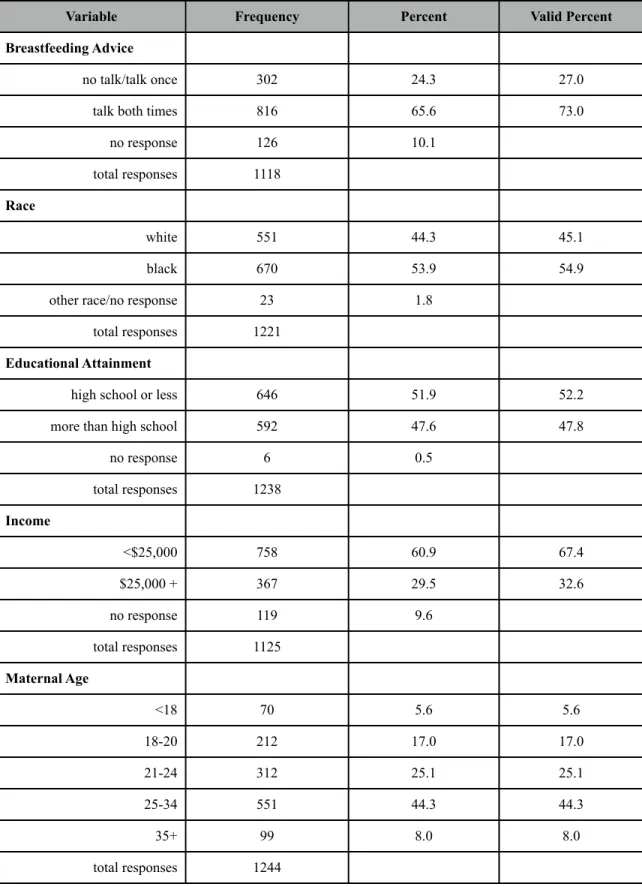
The 2010 survey data in this analysis included the responses provided by 1,244 women. The frequencies of different responses, shown in Table 2, show that 816 of the women reported having spoken to a healthcare provider about breastfeeding both during
Table 1: Variables Paraphrased from the Mississippi PRAMS Survey, 2010
Advice Received Answer Choices
During any of your prenatal care visits did a doctor, nurse, or other health care worker talk with you about breastfeeding your baby?
yes or no
Before you were discharged from the hospital after having your new baby, did a doctor, nurse, social worker, or other health care worker talk with you about
1. How to position the baby for feeding yes or no 2. How often and how much to feed the baby yes or no 3. How to get help when you need it when
breastfeeding the baby yes or no
Feeding Practices Answer Choices
Did you ever breastfeed or pump breast milk to feed your new baby after delivery, even for a short period of time?
yes or no
Table 2: Dependent and Independent Variable Frequencies (Mississippi PRAMS, 2010)
Variable Frequency Percent Valid Percent
Breastfeeding Advice
no talk/talk once 302 24.3 27.0
talk both times 816 65.6 73.0
no response 126 10.1
total responses 1118 Race
white 551 44.3 45.1
black 670 53.9 54.9
other race/no response 23 1.8
total responses 1221
Educational Attainment
high school or less 646 51.9 52.2
more than high school 592 47.6 47.8
no response 6 0.5
total responses 1238
Income
<$25,000 758 60.9 67.4
$25,000 + 367 29.5 32.6
no response 119 9.6
total responses 1125 Maternal Age
<18 70 5.6 5.6
18-20 212 17.0 17.0
21-24 312 25.1 25.1
25-34 551 44.3 44.3
35+ 99 8.0 8.0
total responses 1244
prenatal care and before discharge from the hospital. Those 816 women compose 73.0 percent of women who responded to both the question inquiring about their having spoken with a healthcare provider during prenatal care and the question pertaining to their experience with a healthcare provider before discharge.
Because very few respondents identified themselves as a race other than black or white, this study only used the data for black and white mothers, who made up 54.9 percent and 45.1 percent of the sample, respectively. The sample was divided in such a way that about half (52.2%) of the women had not received an education beyond high school and the other half (47.8%) had gone on to receive further education. A majority of women in this study (67.4%) reported a household income of less than $25,000 over the previous 12 months. The 25-34 age group was the largest age group in the sample, making up 44.3 percent of the entire sample, followed by the 21-24 age group with 25.1 percent of the entire sample. In other words, a majority of the women in this survey were in their twenties and early thirties, with only 22.6 percent of the women representing the youngest age groups (<18 and 18-20) and only 8.0 percent of them representing the oldest age group (35+).
Initial comparisons of the number of women who breastfed at least once to the number of women who never breastfed were performed using the complex sampling analysis plan provided with the PRAMS data, which takes into account the sampling bias of the survey’s distribution. This comparison, shown in Table 3, showed that a majority (63.9%) of women who talked about breastfeeding with a healthcare professional both during prenatal visits and before discharge reported breastfeeding their infants at least
once. On the other hand, a majority (60.9%) of women who did not talk with a healthcare professional about breastfeeding at both of these times never breastfed their new babies.
This indicates that women who talked with a healthcare professional both before and after having their babies were more likely to initiate breastfeeding. However this does not take into account other factors that are shown to influence a mother’s decision to initiate breastfeeding.
Table 3: Crosstabulation of Breastfeeding Initiation by Advice Received from Healthcare Provider (Mississippi PRAMS, 2010)
No Talk/Talk Once
Talk Both
Times Total
Never Breastfed
Estimate Never
Breastfed 95%
Confidence Interval
Breastfed at Least Once
Estimate Breastfed at
Least Once 95%
Confidence Interval
Total Estimate
60.9% 36.1% 43.4%
[54.2%-67.3%] [32.1%-40.3%] [39.8%-47.0%]
39.1% 63.9% 56.6%
[32.7%-45.8%] [59.7%-67.9%] [53.0%-60.2%]
100% 100% 100%
These variables, including maternal race, maternal educational attainment, household income, and maternal age, were included in a model with the variables taken from the questions in Table 1 and were used to complete a binary logistic regression using the Statistical Package for the Social Sciences (SPSS). This regression model used
breastfeeding intervention (mothers who received no more than a single intervention, compared with intervention both during prenatal care and intervention before discharge as the reference group) as the main independent variable and breastfeeding initiation status (never initiated breastfeeding = 0, did initiate breastfeeding = 1) as the dependent variable. Maternal age, race, education, and income, all of which have been associated with rates of breastfeeding (Jones, Kogan, Singh, Dee, & Grummer-Strawn, 2011), were used as controls. All data were statistically weighted according to PRAMS/CDC
guidelines with the complex sampling design analysis function in SPSS.
Table 4 displays the results of a logistic regression model that measure how likely a mother was to breastfeed her child at least once after speaking to a healthcare
professional both during prenatal care and before discharge from the hospital after delivery. Additionally, the results are shown for control variables that take into account maternal race, maternal education level, household income, and maternal age.
The logistic regression model results show that women who only talked about breastfeeding with a healthcare professional one time or not at all were significantly less likely to breastfeed at least once (Exp(B) = 0.245, [0.165-0.365]) than women who spoke with a healthcare professional about breastfeeding both during prenatal care and while in the hospital, even when other factors that are known to be connected to a mother’s decision to initiate breastfeeding, such as maternal race, maternal educational attainment, household income, and maternal age, were taken into account. Conversations that a mother has with a healthcare professional both before and after having the baby, appear to have a relationship to a mother’s decision to initiate breastfeeding, and a mother
Table 4: Logistic Regression Model Predicting Whether a Woman Initiated Breastfeeding Based on Receiving Advice from a Healthcare Worker (Mississippi PRAMS, 2010)
Variable B Exp(B) 95% Confidence
Interval
Intercept 0.034
(p = 0.950) 1.034 [0.362 - 2.954]
Breastfeeding Advice No talk/Talk only once
(Ref. = talk twice)
-1.406
(p < 0.001) 0.245 [0.165 - 0.365]
Race
White (Ref. = black)
1.090
(p < 0.001) 2.975 [2.072 - 4.272]
Educational Attainment HS or less (Ref. = more than HS)
-0.477
(p = 0.012) 0.621 [0.428 - 0.899]
Income
Less than $25,000 (Ref. = $25,000 or more)
-.616
(p = 0.002) 0.540 [0.368 - 0.791]
Age
Years 0.026
(p = 0.142) 1.026 [0.991 - 1.062]
Model Statistics
Pseudo R2 0.2400.2400.240
Model Adjusted Chi Square 95.28395.28395.283
Sample Size 979979979
appears to be less likely to initiate breastfeeding if she has only spoken to a healthcare professional about breastfeeding at one of these times or not at all.
The logistic regression model also supported the expected outcomes of a mother’s decision to breastfeed in the presence of other factors that have been shown in the literature to have a relationship to a mother’s decision to initiate breastfeeding. As hypothesized by the information from existing literature, results show that white women were significantly more likely to breastfeed at least once than black women (Exp(B) = 2.975, [2.072-4.272]). Women with a high school degree or lower were significantly less likely to initiate breastfeeding than women with education beyond the high school level (Exp(B) = 0.621, [0.428-0.899]), and women with an income of less than $25,000 in the past year were significantly less likely to breastfeed at least once than women who had a higher income (Exp(B) = 0.540, [0.368-0.791]). The regression model also indicated that the odds that a woman would initiate breastfeeding her child increased with age (Exp(B)
= 1.026, [0.991-1.062]), though the p-value of 0.142 indicates that the result was not significant, and the null hypothesis, which states that age has no influence on a woman’s decision to initiate breastfeeding, cannot be rejected.
DISCUSSION
The logistic regression model supported the hypothesis that women who received information about breastfeeding both before and after having their babies would be more likely to breastfeed their new babies at least once. This supports the results mentioned in the literature, particularly the Australian study by Pannu, Giglia, Binns, Scott, and Oddy,
which discovered that women who received individual interventions from a healthcare worker at the hospital were more likely to initiate and continue breastfeeding (2011).
The results for other variables reflected the report put forward by McDowell, Wang, and Kennedy-Stephenson (2008), which stated that white women were more likely to breastfeed their new babies than black women. The magnitude of the odds ratio for this finding in the present study, when controlling for breastfeeding educational interventions, educational attainment, household income, and maternal age, indicates that there is much additional research to be done regarding racial disparities in breastfeeding in Mississippi.
Furthermore, women who had a high school education or lower were less likely to
breastfeed than their counterparts, which supports the results of van Rossem et al. (2009), and women who lived with a household income of less than $25,000 over the past year were less likely to breastfeed than their counterparts (McDowell, Wang, & Kennedy- Stephenson, 2008). Additionally, women were more likely to breastfeed with age. This result agrees with the report by McDowell, Wang, and Kennedy-Stephenson that
“breastfeeding rates increased significantly with increasing maternal age” (2008, p. 3).
CONCLUSION
From the existing state of health knowledge, it is clear that breastfeeding is a healthy and cost-effective option for feeding infants. It is also clear that, despite the numerous benefits of breastfeeding, many women in Mississippi choose other options for their babies. They may do this for a number of reasons, including personal preference or as a reaction to social, economic, and cultural barriers. Whatever their reasons for not
breastfeeding, this study indicates that reinforcement on the importance of breastfeeding and support from healthcare workers appears to influence women to attempt
breastfeeding at least once. The effectiveness of a number of interventions have been studied throughout the world, but each place has a different culture, and each intervention operates under a different context in each new culture. One American study in the review, conducted by Kistin, Benton, Rao, and Sullivan, showed that individual discussions about breastfeeding did not significantly affect a woman’s decision to breastfeed, but that group interventions did (as cited in de Oliveira, Camacho, and Tedstone, 2001). On the other hand, an Australian study showed that multiple individual interventions can improve breastfeeding outcomes (Pannu, Giglia, Binns, Scott, and Oddy, 2011). The present study demonstrates that, at the most basic level (i.e. a mother’s decision regarding whether to initiate breastfeeding), women in Mississippi have reacted positively when provided with multiple educational reinforcements from a healthcare professional, offered both during prenatal checkups and after delivery.
This information can be valuable to health professionals and community leaders.
Merely encouraging trusted healthcare workers to discuss breastfeeding and its benefits with expectant mothers could change perspectives on breastfeeding and could increase the number of women who initiate breastfeeding.
Furthermore, cultural and group support appear to be important factors in a woman’s decisions concerning breastfeeding (Maher, 1995; de Oliveira, Camacho, and Tedstone, 2001; Lumbiganon et al., 2012), so an increase in the number of women in a community who breastfeed confidently, could spread to other new mothers in a social
group or community. Group support (de Oliveira, Camacho, and Tedstone, 2001 &
Lumbiganon et al., 2012) and self-confidence in one’s ability to breastfeed (Kirkland &
Fein, 2003; Li et al., 2008; O’Brien et al., 2008; Tawia, 2012) can be a valuable source of encouragement for a woman to begin breastfeeding her infant. This study shows that repeated breastfeeding-related interactions between a mother and a healthcare
professional improve the odds that a mother will try to breastfeed her infant, and very likely indicate her increased confidence in her ability to breastfeed. Healthcare workers have the opportunity to improve the breastfeeding confidence and self-efficacy of many women in the same community, improving community health and breastfeeding
outcomes as a whole as well as encouraging the spread of breastfeeding practice throughout the community.
The results of this study do not indicate the mother’s continued confidence in her ability to breastfeed beyond a single attempt to breastfeed, as it does not address the connection of these interactions to the duration of breastfeeding practice. However, it does indicate a step in the right direction. Further studies may address the effectiveness of such discussions between a mother and healthcare worker on a mother’s decision to breastfeed more regularly, perhaps over the recommended six month period of exclusive breastfeeding. They may also examine the effectiveness of repeated interventions, occurring in the time after a child is taken home from the hospital, which were described as effective interventions by Lumbiganon et al. (2012).
While this study may not provide many powerful conclusions on its own, it provides a strong base for future studies, which may focus on more effective
interventions or the particular topics of discussion between healthcare workers and mothers that may most improve breastfeeding outcomes. It can also inform healthcare professionals or other parties interested in improving community health outcomes on the importance of a healthcare worker’s interactions with a patient in improving
breastfeeding outcomes.
REFERENCES
American Academy of Pediatrics Section on Breastfeeding. (2012). Policy statement:
Breastfeeding and the use of human milk. Pediatrics,129, e827-e841.
Centers for Disease Control and Prevention. (2012a). Breastfeeding report card, 2012, United States: outcome indicators [Data report]. Retrieved from http://
www.cdc.gov/breastfeeding/data/reportcard2.htm.
Centers for Disease Control and Prevention(2012b). PRAMS methodology. Retrieved from http://www.cdc.gov/prams/Methodology.htm
Centers for Disease Control and Prevention (2012c). Adult obesity facts. Retrieved from http://www.cdc.gov/obesity/data/adult.html.
Centers for Disease Control and Prevention: National Diabetes Surveillance System (2010). Age-adjusted percentage of adults (aged 18 years or older) with diagnosed diabetes by state, 2010 [Data report]. Retrieved from:
http://apps.nccd.cdc.gov/DDTSTRS/Index.aspx?stateId=28&state=Mississippi
&cat=prevalence&Data=map&view=TO&trend=prevalence&id=1.
de Oliveria, M.I.C., Camacho, L.A.B., & Tedstone, A.E. (2001). Extending breastfeeding duration through primary care: A systematic review of prenatal and postnatal interventions. Journal of Human Lactation, 17, 326-343.
Dermer, A. (2001). A well-kept secret: Breastfeeding’s benefits to mothers. New Beginnings, 18(4), 124-127.
Eglash, A., Montgomery, A., & Wood, J. (2008). Breastfeeding. Disease-a-Month, 54, 343-411.
Else-Quest, N.M., Hyde, J.S., & Clark, R. (2003). Breastfeeding, bonding, and the mother-infant relationship. Merrill-Palmer Quarterly, 49(4), 495-421.
Hanson, L. (2007). The role of breastfeeding of the infant. In T. Hale & P.E. Hartmann (Eds.), Textbook of human lactation (1st Edition) (pp. 159-192). Amarillo, TX:
Hale Publishing
Jones, J.R., Kogan, M.D., Singh, G.K., Dee, D.L., & Grummer-Strawn, L.M. (2011).
Factors associated with exclusive breastfeeding in the United States. Pediatrics, 128 (6), 1117-1125.
Kirkland, V.L. & Fein, S.B. (2003). Characterizing reasons for breastfeeding cessation throughout the first year postpartum using the construct of thriving. Journal of Human Lactation, 19, 278-285.
Kistin, N., Benton, D., Rao, S., Sullivan, M. (1990). Breastfeeding rates among black urban low-income women: Effect of prenatal education. Pediatrics, 86, 741-746.
León-Cava, N., Lutter, C., Ross, J., & Martin, L. (2002). Introduction. Quantifying the benefits of breastfeeding: A summary of the evidence. Washington, D.C.: Pan American Health Organization (PAHO).
Li, R., Fein, S.B., Chen, J., Grummer-Strawn, L.M. (2008). Why mothers stop breastfeeding: Mothers’ self-reported reasons for stopping during the first year.
Pediatrics, 122, 569-576.
Lumbiganon, P., Martis, R., Laopaiboon, M., Festin, M.R., Ho, J.J., & Hakimi, M.
(2012). Antenatal breastfeeding education for increasing breastfeeding duration.
Cochrane Database of Systematic Reviews, (9). Art. CD006425. doi:
10.1002/14651858.CD006425.pub3
McDowell, M.M., Wang, C., & Kennedy-Stephenson, J. (April, 2008). Breastfeeding in the United States: Findings from the National Health and Nutrition Examination Survey, 1999-2006. National Center for Health Statistics Data Brief No. 5.
Retrieved from http://www.cdc.gov/nchs/data/databriefs/db05.htm.
Maher, V. (1995). Breast-feeding in cross-cultural perspective: Paradoxes and proposals.
In V. Maher (Ed.), The Anthropology of Breast-Feeding (pp. 1-36). Herndon, VA:
Berg Publishers.
O’Brien, M., Buikstra, E., & Hegney, D. (2008). The influence of psychological factors on breastfeeding duration. Journal of Advanced Nursing, 63(4), 397-408.
Ogbanu, C.A., Probst, J., Laditka, S., Liu, J., Baek, J.D., & Glover, S. (2009). Reasons why women do not initiate breastfeeding: A southeastern state study. Women’s Health Issues, 19, 268-278.
Otsuka, K., Taguri, M., Dennis, C., Wakutani, K., Awano, M., Yamaguchi, T., & Jimba, M. (2014). Effectiveness of a breastfeeding self-efficacy intervention: Do hospital practices make a difference? Maternal and Child Health Journal, 18, 296-306.
Pannu, P.K., Giglia, R.C., Binns, C.W., Scott, J.A., & Oddy, W.H. (2011). The effectiveness of health promotion materials and activities on breastfeeding outcomes. Acta Paediatrica, 100, 534-537.
Tawia, S. (2012). Breastfeeding interventions that improve breastfeeding outcomes and Australian Breastfeeding Association services that support these interventions.
Breastfeeding Review, 20(2), 48-51.
United Nations Children’s Fund (January 12, 2005). The Baby-Friendly Hospital Initiative. Retrieved from: http://www.unicef.org/nutrition/index_24806.html.
van Rossem, L., Oenema, A., Steegers, E.A.P., Moll, H.A., Jaddoe, V.W.V., Hoffman, A.,... Raat, H. (2009). Are starting and continuing breastfeeding related to
educational background? The Generation R study. Pediatrics, 123(6), e1017-e1027.
World Health Organization. (2002). Infant and young child nutrition: Global Strategy on infant and young child feeding, report by the Secretariat (A55/15, paragraph 10), World Health Assembly. Geneva, Switzerland, Retrieved from:
http://apps.who.int/gb/archive/pdf_files/WHA55/ea5515.pdf
World Health Organization, UNICEF, & Wellstart International (2009). Background and Implementation. In Baby-Friendly Hospital Initiative: Revised, updated and expanded for integrated care (Section 1). Geneva Switzerland: WHO Press.
Retrieved from: http://whqlibdoc.who.int/publications/
2009/9789241594967_eng.pdf