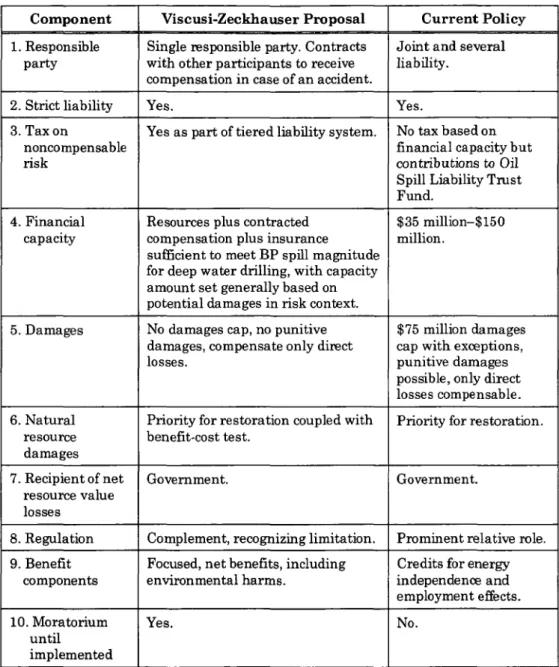
All three major companies involved in the spill had safety deficiencies, which together almost certainly created the conditions for the large-scale spill that occurred.7 The spill also highlighted the shortcomings of current regulatory and accountability structures for dealing with catastrophic risks. In May 2010, President Obama, through Executive Order 13,543, established the BP Deepwater Horizon National Oil Spill and Offshore Drilling Commission (the “Commission”) to address the spill.8 The Commission issued several reports in 2010 criticizing Obama.
EFFICIENT SAFETY LEVELS
Because the probabilities are very small, there are few opportunities to learn about the magnitude of the risk. When the states of the world (as decision theorists call them) are unknown, we are in a world of.
BEHAVIORAL DECISIONS, FAT TAILS, AND THE SEPARATION OF PROBABILITY AND SIZE OF LOSS
Similarly, the magnitude of losses—the other component of the loss calculation—can be highly unpredictable even after an oil spill occurs. The Japanese earthquake ranks as one of the largest earthquakes ever recorded.34 Indeed, the mere similarity of the events may be enough to dramatically influence policy decisions. Proper estimation of the magnitude of disaster losses reveals the disturbing reality that disaster losses tend to have large distributions (ie, distributions where there is a non-trivial chance of extremely large losses).
The following examples illustrate the wide variability that can occur in the upper tail of the loss distribution. Second, a single extreme outcome can easily account for the majority of losses from a given type of disaster. For an understanding of the difference in monetary losses, see Deadliest Fires/Large Losses: 10 Largest Wildland Fres Losses in the US, NAT'L FIRE PROT.
INSURANCE PRINCIPLES, COMPENSATION, AND NONTRANSFERABLE LOSSES
Compensation levels in wrongful death cases do not include payment levels sufficient to restore the person's well-being to the same level as when he or she was alive. Because serious injuries reduce the extent to which money increases well-being, people typically choose insurance coverage that is much lower than the amount needed to return them to their pre-injury level of well-being.56 More technically speaking, if there is actuarially fair insurance is available, a rational individual will purchase enough insurance so that his marginal income utility is constant across states.
Indeed, if back pain prevented one from participating in an expensive recreation, for example skiing, then suffering pain would reduce the marginal utility of income. Consequently, in the case of environmental damage from oil spills, the emphasis should be on ameliorating the environmental damage to an efficient level rather than compensating the public for the diminished value of the environmental amenity they experience. The emphasis of current policies on repairing environmental losses rather than direct payments to the citizenry is well founded.57 To the extent that there is a deterrence rationale for additional sanctions, such funds should be directed to the US.
THE CURRENT LIABILITY STRUCTURE: RETROSPECTIVE LIABILITY
The OPA is the most important federal statute regarding the damages caused by oil spills and is the focus of the discussion here. Other federal statutes may also be pertinent depending on the nature and consequences of the spill.64 The OPA imposes strict, joint and several liability for the damage caused by oil spills.65 The damage components relate to financial consequences as well as natural resource damage. . Moreover, the responsible party will also have an incentive to monitor the behavior of the other companies involved.
Calculating the appropriate compensation for any given individual is complicated by the confounding effects of the protracted recession that began in 2008. It would be difficult to separate the effects of the spill from the effects of macroeconomic conditions on e.g. hotel income. Should these suppliers receive compensation if they are located in different parts of the country.
WHO SHOULD PAY FOR THE DAMAGES?
In assessing whether the liability regime is appropriate, the first question is whether the drilling companies should be subject to strict liability rather than another legal requirement, such as a negligence standard. First, a negligence standard requires both a determination of the standard of care used to judge negligence and a determination of whether the oil company met that standard. Removing the compensation cap, or indeed any measure that leads to an increase in the expected damages paid after an accident, may induce small businesses with limited financial resources to engage in the activity.
A consistent theme of the President's Commission report is that assessment of the safety practices and. Even in the case of the BP oil spill, BP operated the well and was best placed to monitor safety-related actions as well as the activities of its two main contractors, Halliburton and Transocean.111 Our policy proposal number one. It will be the responsibility of the oil company to determine whether its associates have sufficient financial resources and/or insurance, as the failure of these companies to indemnify the oil company for damages will not reduce the oil company's liability.
PUNITIVE DAMAGES
Because there are no loopholes in the damages payment structure, there is no need for punitive damages. Missing from this discussion is the potential role of punitive damages from a punitive point of view, above and beyond its deterrent or compensatory role. Given the much stricter liability system we have proposed, firms will now be penalized much more than they currently are under the current liability system, as they will enjoy no cap on damages and will be required to have the resources financial to pay very large. claims for compensation.
Our proposal eliminates the serious risk of misuse of punitive damages as a form of punishment for catastrophic environmental damage. To the extent that jurors judge conduct based on the level of harm caused rather than whether the companies have struck an effective balance between risk and cost, there will be a tendency to award punitive damages for major oil spills, regardless of whether the company was hit. balance appropriately.1 1 5 Our proposal eliminates the risk of erroneous jury verdicts, establishes a liability structure that provides strong incentives for prudence while ensuring compensation payments for most accidents, and raises a tax fund that can be used for payments in the event of catastrophic loss.
PROSPECTIVE LIABILITY AND GOVERNMENT REGULATION Recognizing that not all companies have sufficiently deep
PROSPECTIVE LIABILITY AND GOVERNMENT REGULATION Recognition that not all companies are sufficiently deep. regime, and the potential for error, exceed the information requirements associated with retroactive liability, which is why we use retroactive liability of the responsible party as our core incentive mechanism. Many such schemes, such as the Pension Benefit Guarantee Corporation, tend to collect well below the actuarial value of the costs imposed. Note that in order to separate the regulatory oversight, management and revenue functions, the Department of the Interior had to change its organizational structure after the spill.
The Minerals Management Service was reorganized into three separate entities with distinct missions: Bureau of Ocean Energy Management, Regulation and Enforcement; Bureau of Safety and Environmental Enforcement; and the Office of Natural Resources Revenue.1 18 In line with the Commission's conclusions, these activities could be strengthened based on what has been learned about institutional deficiencies from the BP oil spill. Department of the Interior, Salazar Divides Three Conflicting MMS Missions (available at http://www.doi.gov/news/pressreleases/Salazar-Divides-MMSs-Three-Conflicting- MIssions.cfm; Secretary of the Interior, Establishing Bureau of Ocean Energy Management, Bureau of Safety and Environmental Enforcement, and Office of Natural Resources Revenue, No. For these reasons, our proposals shift the preponderance of responsibility for safety to the oil drilling company.
PROCEDURES FOR COMPENSATORY DAMAGES PAYMENTS An administrative compensation scheme has and will conduct
NATURAL RESOURCE DAMAGES
Economists' research on natural resource damage assessment has focused on the second component of natural resource damage, which refers to losses that occur from the time of the oil spill until natural resources are fully restored. The analysis therefore begins by calculating the trajectory over time of the value that the natural resource would have had without the spill. It then calculates the decline in value of the natural resource from the time of the spill to the time the loss is fully recovered, which may never happen.
The loss at any point is the decrease in the value of the natural resources. Conceptualizing the damages in the form of trajectories highlights the dynamic nature of the damage assessment. WTA thus measures how much money is required to compensate a person for the value of a loss if the purpose is to restore that person's welfare to what it would have been without the injury.
CONCLUSION
In particular, WTA values often dwarf WTP values much more than economic theory could reasonably have predicted.154 Based on a literature review, including both survey and experimental studies, the average discrepancy between studies between the average WTA value and the average The WTP value is a ratio of 7.17.155 However, the gap is much larger for public or non-market goods, such as goods that cause environmental damage, since the average ratio of WTA to WTP for such goods is 10 .41.156 Unknown goods that do not belong to ordinary private goods. goods that the person could purchase tend to generate high ratios.15 7 Thus, although WTA and WTP should be comparable, they often differ by an order of magnitude for the types of goods involved in natural resource damage cases. However, given the serious nature of the losses, they may actually represent a significant portion. The BP disaster, for example, is an outlier in the distribution of drilling losses in the United States over the country's history.
Second, the incentives for safety will be insufficient because operators will recognize that they are not responsible for a significant portion of the expected costs they incur. Our package of policy reforms will address the major shortcomings of the current arrangements by ensuring that companies carrying out activities with catastrophic risks can pay for the damage in the event of an accident and will in fact be liable for the full economic value of the costs their activities generate. The incurred environmental risks can result in losses far beyond the ability of the person responsible to pay.