+ (,1 1/,1( 2
Citation: 98 Cal. L. Rev. 59 2010 Content downloaded/printed from HeinOnline (http://heinonline.org) Mon Jul 2 12:22:30 2012
-- Your use of this HeinOnline PDF indicates your acceptance of HeinOnline's Terms and Conditions of the license
agreement available at http://heinonline.org/HOL/License -- The search text of this PDF is generated from
uncorrected OCR text.
-- To obtain permission to use this article beyond the scope of your HeinOnline license, please use:
https://www.copyright.com/ccc/basicSearch.do?
&operation=go&searchType=0
&lastSearch=simple&all=on&titleOrStdNo=0008-1221
Retrieved from DiscoverArchive, Vanderbilt University’s Institutional Repository
This work was originally published in 98 Cal. L. Rev. 59 2010
Climate Change, Dead Zones, and Massive Problems in the
Administrative State:
A Guide for Whittling Away
J.B. Ruhlt
James Salzmantt
INTRODUCTION
The modem administrative state does not have the luxury of many "easy cases." Consider a few well-known agency headaches:
* The U.S. Fish and Wildlife Service, which administers one of the most potent environmental laws, the Endangered Species Act (ESA), recently extended the law's protections to the polar bear,'
Copyright C 2010 California Law Review, Inc. California Law Review, Inc. (CLR) is a California nonprofit corporation. CLR and the authors are solely responsible for the content of their publications.
f Matthews & Hawkins Professor of Property, Florida State University College of Law.
tt Samuel F. Mordecai Professor of Law, Nicholas Institute Professor of Environmental Policy, Duke University. We are thankful to Erwin Chemerinsky, Jamison Colburn, Robin Kundis Craig, Joe DiMento, Rob Fischman, Catherine Fisk, Jody Freeman, Brian Galle, Paul Haagan, Sam Jordan, Alex Klass, Wayne Logan, David Markell, Hari Osofsky, Michael Tigar, Manuel Utset, Leslie Wexler, and Jonathan Wiener for input on earlier versions of this work; to participants in law faculty workshops at Connecticut, UC Irvine, Indiana-Bloomington, Wake Forest, Duke, and Florida State University for their helpful comments; to our research assistants Nino Chiarello, Jake Cremer, and Vicki Shiah; and to the Duke, Florida State University, and Harvard law schools for research and other support during the preparation of this Article. All positions taken and mistakes made in this Article are, of course, our own. Please direct any
questions or comments to [email protected] or [email protected].
1. See Determination of Threatened Status for the Polar Bear, 73 Fed. Reg. 28,212 (May 15, 2008) (to be codified at 50 C.F.R. pt. 17). The agency's decision to list the polar bear was, to say the least, controversial. It followed contentious litigation designed to force the agency to reach a decision, and while the agency did list the species as threatened, it promulgated a special rule, as authorized under section 4(d) of the ESA, that had the effect of limiting the full extent of regulatory protections available under the statute. See Special Rule for the Polar Bear (interim rule), 73 Fed. Reg. 28,306 (May 15, 2008) (to be codified at 50 C.F.R. pt. 17); Special Rule for the Polar Bear (final rule), 73 Fed. Reg. 76,249 (Dec. 16, 2008) (to be codified at 50 C.F.R. pt.
17). Both the listing decision and the special rule have been challenged in litigation that remains pending at the time of this writing. For background on these and related events, see J.B. Ruhl, Climate Change and the Endangered Species Act: Building Bridges to a No-Analog Future, 39
59
CALIFORNIA LAW REVIEW
yet the agency is powerless to stop the leading cause of the bear's imperilment-climate change.2
* Every morning in cities across the nation, grumbling commuters inch along, locked in traffic gridlock, yet no local or regional planning agency can solve its cause-suburban sprawl.
o Each spring, a massive slug of nutrients flows down the Mississippi River and empties into the Gulf of Mexico where it creates an enormous hypoxic "dead zone," an area so low in oxygen that aquatic life must either flee or suffocate. Yet federal agencies from the Environmental Protection Agency (EPA) to the Department of Agriculture cannot meaningfully address its primary cause-runoff of fertilizers and manure from Midwestern farms.4
ENVTL. L. REP. 10,735, 10,744-45 (2009).
2. At a press conference announcing the polar bear listing, Secretary of the Interior Dirk Kempthome warned that "[w]hile the legal standards under the ESA compel me to list the polar bear as threatened, I want to make clear that this listing will not stop global climate change or prevent any sea ice from melting." News Release, U.S. Department of the Interior, Secretary Kempthome Announces Decision to Protect Polar Bears under Endangered Species Act (May 14, 2008), available at http://www.doi.gov/news/08_NewsReleases/080514a.html. Subsequently, in announcing his decision not to alter the previous administration's decision regarding the status of the polar bear and level of protection it will receive under the ESA, Interior Secretary Salazar proclaimed that "the Endangered Species Act is not the proper mechanism for controlling our nation's carbon emissions." News Release, U.S. Fish & Wildlife Service, Salazar Retains Conservation Rule for Polar Bears, Underlines Need for Comprehensive Energy and Climate Legislation (May 8, 2009), available at http://www.fws.gov/news/NewsReleases/showNews.cfm?
newsld=20FB90B6-Al88-DBO1-04788EO892D91701. Climate change has been described as "a major threat to the survival of species and integrity of ecosystems world-wide." Philip E. Hulme, Adapting to climate change: is there scope for ecological management in the face of a global threat?, 42 J. APPLIED ECOLOGY 784, 784 (2005). In its 2007 Synthesis Report, the Intergovernmental Panel on Climate Change predicted that "[t]here is medium confidence that approximately 20 to 30% of species assessed so far are likely to be at increased risk of extinction if increases in global average warming exceed 1.5 to 2.50C," and that if warming "exceeds about 3.5oC, model projections suggest significant extinctions (40 to 70% species assessed) around the
globe." INTERGOVERNMENTAL PANEL ON CLIMATE CHANGE, CLIMATE CHANGE 2007: SUMMARY FOR POLICYMAKERS 13-14 (2007), available at http://www.ipcc.ch/pdf/assessment-report/ar4/syr/
ar4_syrspm.pdf For additional discussion of the climate change problem, see infra Parts 11-111.
3. Florida, no stranger to sprawl, defines "urban sprawl" by regulation as
urban development or uses which are located in predominantly rural areas, or rural areas interspersed with generally low-intensity or low-density urban uses. . ..Urban sprawl is typically manifested in one or more of the following land use or development patterns: Leapfrog or scattered development; ribbon or strip commercial or other development; or large expanses of predominantly low-intensity, low-density, or single- use development.
FLA. ADMIN. CODE ANN. r. 9J-5.003(134). There is ongoing debate about the pros and cons of this particular form of suburban development and its antidote, "smart growth." See ROBERT BRUEGMANN, SPRAWL: A COMPACT HISTORY (Univ. Chi. Press 2005); JULIAN CONRAD JUERGENSMEYER & THOMAS E. ROBERTS, LAND USE PLANNING AND DEVELOPMENT REGULATION
LAW § 9.1B at 475-79 (Thomson-West Practitioner Treatise Series 2d ed. 2007); Nicole Stelle Garnett, Save the Cities, Stop the Suburbs?, 116 YALE L.J. 598 (2007). For additional discussion
of sprawl, see infra Parts II-III.
4. According to the U.S. Geological Survey,
[e]xcessive nutrients, in particular nitrogen and phosphorus, have resulted in the growth
60 [Vol. 98:59
If you were the administrator of the Fish and Wildlife Service, or the head of a city's planning agency, or the Secretary of Agriculture, what would you do to fulfill your agency's mandate to solve these problems, knowing that your regulatory toolkit is woefully inadequate and that any action your agency takes will likely have little effect? That question vexes agencies dealing not only with environmental and land use issues but also with concerns about widening income gaps, provision of social services, rising health care costs, rising unemployment, and a litany of other social and economic woes. Mandates that agencies solve problems like these roll easily out of the halls of legislatures but, as a practical matter, what should an agency do when legislatures and courts give only sparse guidance on how to implement the delegated authority, when the agency's solitary actions will most assuredly not solve the problem, and when any policy measure the agency might advance has the potential to engender new concerns?
The dilemma agencies face in these settings is most acute in the area of climate change. In Massachusetts v. Environmental Protection Agency,5 the Court found that the EPA had erred in denying the state's rulemaking petition to regulate greenhouse gas emissions from motor vehicles6 as an air pollutant
of large amounts of algae that decay and consume oxygen, thereby causing a zone of low dissolved oxygen or 'hypoxic zone' in the Northern Gulf of Mexico. This can stress and cause death in bottom-dwelling organisms, threatening the economic and ecological health of one of the nation's largest and most productive fisheries.
U.S. Geological Survey, Mississippi River Basin and Gulf of Mexico Hypoxia, http://water.usgs.gov/nawqalsparrow/gulf findings/hypoxia.html (last visited Feb. 12, 2008). The most definitive study of the causes concludes that runoff from agricultural sources contributes 70 percent of the excess nutrients. See Richard B. Alexander et al., Differences in Phosphorous and Nitrogen Delivery to the Gulf of Mexico from the Mississippi River Basin, 42 ENVTL. Sc. &
TECH. 822, 822 (2007), available at http://pubs.acs.org/doi/pdf/l0.1021/es0716103?cookieSet-l.
Hypoxia from agricultural runoff and urban sewage is expanding exponentially throughout the world as well, affecting 400 estuarine systems covering over 245,000 square kilometers. See Robert J. Diaz & Rutger Rosenberg, Spreading Dead Zones and Consequences for Marine Ecosystems, 321 Sci. 926, 926 (2008); see generally MINDY SELMAN ET AL., EUTROPHICATION AND HYPOXIA IN COASTAL AREAS: A GLOBAL ASSESSMENT OF THE STATE OF KNOWLEDGE
(2008), available at http://pdf.wri.org/eutrophication-andhypoxia in coastal-areas.pdf (reviewing instances and the science of estuarine eutrophication from around the world). For additional discussion of agricultural runoff pollution and Gulf hypoxia, see infra Parts 11-111 and V.
5. 549 U.S. 497 (2007).
6. See Control of Emissions from New Highway Vehicles and Engines, 68 Fed. Reg.
52,922-02, 52,922 (Sept. 8, 2003). The EPA dismissed the petition on the broad basis that global climate change is so complicated that either Congress did not provide for greenhouse gas emissions to be subject matter for the Clean Air Act or, if Congress did so provide, the agency properly identified conflicting policy concerns as a basis for deciding not to regulate emissions.
See id. at 52,929-31. For concise yet thorough summaries of the rulemaking petition, the EPA's decision, lower court proceedings, the Supreme Court's majority and dissenting opinions, and the likely impact of the case, see Arnold W. Reitze Jr., Controlling Greenhouse Gas Emissions From Mobile Sources-Massachusetts v. EPA, 37 ENVTL. L. REP. 10535 (2007); Michael Sugar, Comment, Massachusetts v. Environmental Protection Agency, 31 HARv. ENVTL. L. REV. 531 (2007).
CALIFORNIA LAW REVIEW
under the Clean Air Act.7 Among the many reasons the agency offered to justify its decision was that no "realistic possibility exists that the relief petitioners seek would mitigate global climate change and remedy their injuries."8 In other words, the EPA's actions, no matter how draconian, could not solve the global climate change problem. The problem was just too big for one agency to handle.
The Court retorted that while the EPA could not hope to use its limited capacity to solve the climate change problem completely, this did not justify the agency's inaction and disregard of a statutory mandate to regulate one of the problem's many causes. The Court observed that agencies do not "resolve massive problems in one fell regulatory swoop. They instead whittle away at them over time, refining their preferred approach as circumstances change and as they develop a more-nuanced understanding of how best to proceed."9 The Court was clear in ordering the EPA to "whittle away" as best it could, yet unhelpfully silent on how, exactly, the EPA should do so. 0 The Court's only guidance was its observation that the "EPA no doubt has significant latitude as to the manner, timing, content, and coordination of its regulations with those of
7. The Clean Air Act defines "air pollutant" in sweeping terms to include "any air pollution agent ... including any physical, chemical, [or] biological ... substance or matter which is emitted into or otherwise enters the ambient air." 42 U.S.C. § 7602(g) (2000). The Court found that "greenhouse gases fit well within [this] capacious definition." Massachusetts v. EPA, 549 U.S. 497, 532 (2007).
8. Mass. v. EPA, 549 U.S. at 523.
9. Id. at 524.
10. Given that the Court found that greenhouse gas emissions are pollutants under the statute, the Clean Air Act charges the EPA with regulating greenhouse gas emissions from motor vehicles if in the EPA's "judgment [the emissions] cause, or contribute to, air pollution which may reasonably be anticipated to endanger public health or welfare." 42 U.S.C. § 7521(a)(1). Noting that the Clean Air Act defines "welfare" to include "effects on ... weather ...and climate," the Court rejected all of the EPA's proffered bases for its judgment not to regulate greenhouse gas emissions. See Mass v. EPA, 549 U.S. at 506 (quoting 42 U.S.C. § 7602(h)). Rather, the Court concluded, under the clear terms of the Clean Air Act, the EPA can avoid taking further action to regulate carbon emissions from motor vehicles "only if it determines that greenhouse gases do not contribute to climate change or if it provides some reasonable explanation as to why it cannot or will not exercise its discretion to determine whether they do." Id. at 533. As its only example of a
"reasonable explanation," the Court suggested that the EPA might find "the scientific uncertainty is so profound that it precludes EPA from making a reasoned judgment as to whether greenhouse gases contribute to global warming." Id. at 534. Yet having previously observed that "[r]espected scientists" believe greenhouse gas emissions do contribute to climate change, id. at 504, the Court seems to have left the EPA little wiggle room. See Jonathan Z. Cannon, The Significance of Massachusetts v. EPA, 93 VA. L. REV. IN BRIEF 53, 59 (2007), http://www.virginialawreview.org/
inbrief/2007/05/2l/cannon.pdf ("The Court's opinion seems to leave EPA little room in dealing with climate change."); Reitze, supra note 6, at 10538 ("[T]he Court's opinion pushes EPA to find that GHGs need to be regulated."). Nevertheless, as a matter of judicial restraint the Court was silent on how the EPA might go about fulfilling the decision, observing simply that "[w]e need not and do not reach the question whether on remand EPA must make an endangerment finding, or whether policy concerns can inform EPA's actions in the event that it makes such a finding."
Mass. v. EPA, 549 U.S. at 534-35.
62 [Vol. 98:59
other agencies."'1 Simply put, the agency must figure out for itself how best to whittle.12
This is no small task. Of course, the EPA is not alone in whittling away at climate change. The Fish and Wildlife Service must protect a growing list of species under the ESA.13 The Securities and Exchange Commission must determine how public companies disclose potential effects of climate change on their financial profiles.14 The Department of Transportation must take climate change into account in setting fuel efficiency standards.'5 State and local energy, environmental, and land use agencies must consider how to account for climate change when planning infrastructure and regulating facilities.16 How
11. Mass. v. EPA, 549 U.S. at 533.
12. The agency has yet to do this. In July 2008, the EPA announced it would delay its decision on endangerment in order to solicit comments on an advance notice of proposed rulemaking from the public and other federal agencies and state and local governments on options for how to proceed. See Regulating Greenhouse Gas Emissions Under the Clean Air Act, 73 Fed.
Reg. 44,354 (July 30, 2008) [hereinafter Regulating Greenhouse Gas]. EPA later found that carbon emissions do pose an endangerment. See Endangerment and Cause or Contribute Findings for Greenhouse Gases Under Section 202(a) of the Clear Air Act, 74 Fed. Reg. 66,496 (Dec. 15, 2009). The agency also proposed rules to regulate greenhouse gas emissions from large industrial sources in October 2009. See Prevention of Significant Deterioration and Title V Greenhouse Gas Tailoring Rule, 74 Fed. Reg. 55,291 (Oct. 27, 2009). No further regulatory actions have taken place as of this writing.
13. See J.B. Ruhl, Climate Change and the Endangered Species Act: Building Bridges to the No-Analog Future, 88 B.U. L. REV. 1 (2008) (describing ecological effects that climate change will cause and their implications for administration of the ESA).
14. See Trisha L. Smith et al., Climate Change in SEC Disclosures: Charting a Course Through Murky Waters Without a Compass, in CLIMATE CHANGE: LITIGATION, REGULATION, AND RISK 21 (2008). Several institutional investors recently petitioned the Securities and Exchange Commission to require companies to disclose more information and analysis of the financial risks they face from climate change effects and the regulation of greenhouse gas emissions. See California Public Employees Retirement System et al., Petition for Interpretive Guidance on Climate Change Disclosure (2007), available at http://www.sec.gov/rules/petitions/
2007/petn4-547.pdf. Similarly, in 2008 the Attorney General of New York entered into agreements with several energy companies requiring them to disclose increased financial, regulatory, and litigation risks likely to be triggered by the impact of climate change on their plans to construct coal-fired power plants. See John Herzfeld, Xcel Energy Agrees to Disclosure Plan On Climate-Related Risk for Shareholders, DAILY ENV'T (BNA), Aug. 28, 2008, at A-8; see, e.g., In re Dynegy Inc., AOD 08-132 (N.Y. Att'y Gen'l 2008), available at http://www.oag.state.ny.us/mediacenter/2008/oct/ dynegy..aod.pdf.
15. See Ctr. for Biological Diversity v. Nat'l Highway Traffic Safety Admin., 508 F.3d 508, 548-58 (9th Cir. 2007) (faulting the National Highway Traffic Safety Administration for failing to take climate change effects into account when promulgating fuel economy standards for light trucks and SUVs).
16. For summaries of proposed and adopted state and local climate change measures, see John C. Dernbach & Seema M. Kakade, Climate Change Law: An Introduction, 29 ENERGY L.J.
1, 15-20 (2008); David Hodas, State Initiatives, in GLOBAL CLIMATE CHANGE & U.S. LAW, 343- 369 (Michael B. Gerrard ed., ABA Press 2007); J.R. DeShazo and Jody Freeman, Timing and Form of Federal Regulation: The Case of Climate Change, 155 U. PA. L. REv. 1499, 1521-30 (2007); Stephen C. Jones & Paul R. McIntyre, Filling the Vacuum: State and Regional Climate Change Initiatives, 38 ENV'T REP. (BNA) 1640 passim (2007); PEW CENTER ON GLOBAL CLIMATE CHANGE, A LOOK AT EMIsSIoNs TARGETS, http://www.pewclimate.org/
what s being-done/targets (last visited Feb. 12, 2008). Many observers believe the measures are
CALIFORNIA LAW REVIEW
aggressively should each of these agencies whittle away? What types of knives should they use? With all of this whittling, how do they avoid cutting each other, much less come up with an agreed upon final carving?
Climate change is as big and unwieldy a problem as they come, so it is an easy choice for poster child of the "massive problems" dilemma described by the Court. But many problems, even those smaller in scope, present no less of a challenge to public policy administration. As mentioned above, agriculture is the nation's leading source of water quality impairment, but its diffuse form of nonpoint source pollution remains almost invulnerable to regulation.'7 Urban sprawl stretches public infrastructure to its limits, yet has defied all variety of policy prescriptions. Global immigration and low-cost production have altered the operation of our domestic labor market and have raised complex human rights issues.19 The bursting of the subprime mortgage bubble has led to fingers pointing in all directions.20 These are all massive problems with
unrealistic. See, e.g., Robert N. Stavins, Free GHG Cuts: Too Good to be True?, ENVTL. F., May- June 2007, at 16 (asserting that the cost estimates California is providing for its greenhouse gas reduction benchmark goals are wildly low).
17. In his comprehensive study of the problem, Halting Hypoxia, Jay Landers concludes that "[t]o address hypoxia in the Gulf of Mexico, the enormous amounts of nutrient entering the water body via the Mississippi River must be reduced. Achieving this goal will require an array of actions and strategies across a broad swath of America's heartland." Jay Landers, Halting Hypoxia, Civ. ENGINEERING, June 2008, at 54. For a legal analysis of agricultural nonpoint source pollution, see J.B. Ruhl, Farms, Their Environmental Harms, and Environmental Law, 27 ECOLOGY L.Q. 263, 287-91 (2000) (examining the failure of legal measures to address agricultural runoff).
18. As Robert Bruegmann concludes in his survey of sprawl's history and the efforts to arrest it, "a great many people have concluded ... that sprawl is inevitable and that efforts to stop it are doomed." BRUEGMANN, supra note 3, at 220. For legal discussions of sprawl's intractability, see William W. Buzbee, Urban Sprawl, Federalism, and the Problem of Institutional Complexity, 68 FORDHAM L. REv. 57, 64 (1999); Henry R. Richmond, Sprawl and Its Enemies: Why the Enemies Are Losing, 34 CONN. L. REv. 539 (2001). For the argument against the so-called
"inevitability theory" of sprawl, see Michael Lewyn, Sprawl in Europe and America (Aug. 1, 2008), available at http://ssrn.com/abstract-1 194862. 17.1, p 147 and 17.2, 150.
19. See Lesley Wexler, The Non-Legal Role of International Human Rights Law in Addressing Immigration, 2007 U. CHI. LEGAL F. 359 (2007) (examining the causes and human
rights implications of the "recent migration explosion").
20. One analysis concluded that "it is hard to overstate the extent of this reversal in fortunes," Securitisation-When it Goes Wrong, EcONOMIsT, Sept 20, 2007, at 1, and another suggested that "the regulators are trying to figure out how to work around it, but the Hill is going to be in for one big surprise." Gretchen Morgenson, Crisis Looms in Market for Mortgages, N.Y.
TIMES, Mar. 11, 2007, at 1 (quoting Josh Rosner). In a candid evaluation of how the problem reached dimensions that outstripped the capacity of regulatory agencies, a former chairman of the Securities and Exchange Commission observed that "as the markets grew larger and more complex-in scope and in products offered-the commission failed to keep pace." Julie Hirschfield Davis, Former SEC ChiefSays Agency Dropped Ball, USA TODAY, Oct. 17, 2008, at 5B (quoting Arthur Levitt). Among the gathering swirl of theories from pundits, the popular press, and academics, a careful account of the anatomy of the rise and fall of the American subprime mortgage market and its fallout around the globe comes from a Korean financial analyst, Man Cho, who meticulously surveys the complex set of "key economic and institutional factors that boosted the rise of the market, and those that contributed to the abrupt fall in 2007." Man Cho, Subprime Mortgage Market: Rise, Fall, and Lessons for Korea 3 (KDI Sch. of Pub. Policy &
64 [Vol. 98:59
dimensions far beyond the capacity of any single agency to manage effectively.
In this Article we examine from both theoretical and practical perspectives what it means for agencies to whittle away at massive problems such as these.
Conventional policy approaches, proposed both in administrative law scholarship and in practice, to guide the design of regulatory institutions and instruments have proven deeply inadequate when confronted by the complexities of massive problems such as climate change, sprawl, and Gulf hypoxia. A fundamentally different approach is needed, but it must be based on a far clearer understanding of the nature and challenges of massive problems.
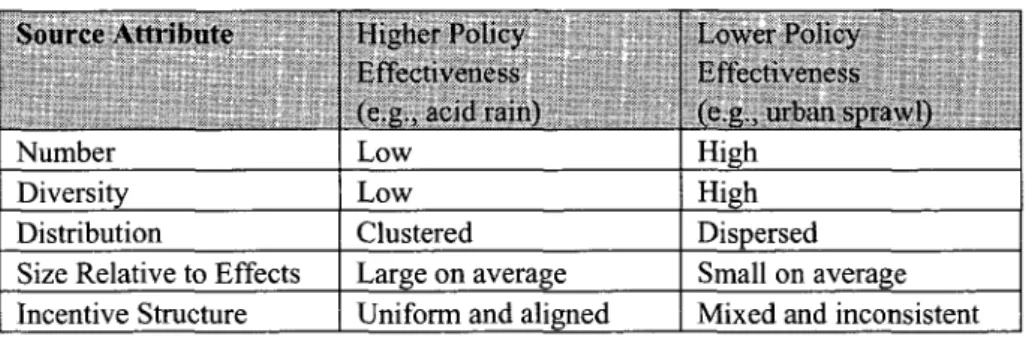
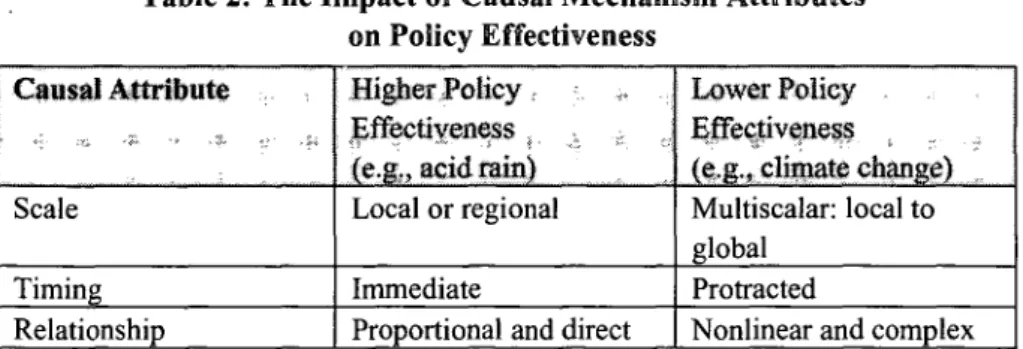
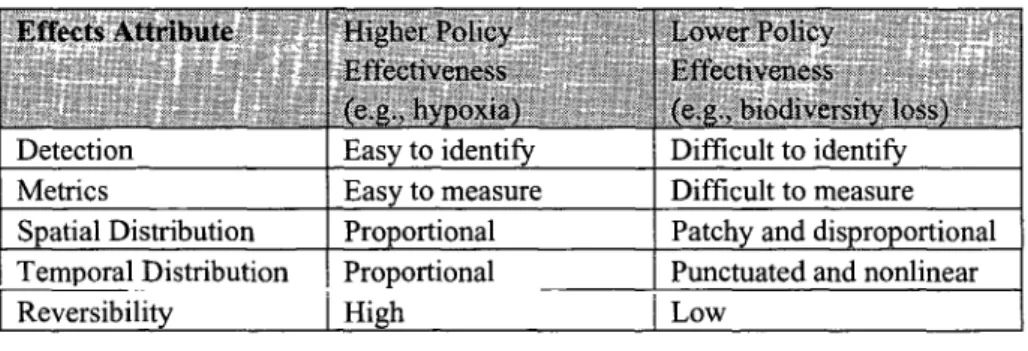
Part I of the Article explores what makes problems massive. The Court's observation that agencies have to whittle away at some problems is no doubt accurate, but it raises three fundamental questions: which agencies should be whittling, how should they proceed, and what exactly are they whittling. A great deal of scholarship has focused on the first two questions,21 yet little touches on the last. By contrast, we focus on the what question as the threshold inquiry. In particular, we show that while all massive policy problems exhibit large-number and large-scale attributes, what makes some particularly difficult to address is the presence of cumulative effects-the complex accumulation of economic, environmental, and social impacts from multiple sources. Policy problems defined by large-scale cumulative effects may all appear massive from a distance. Upon closer inspection, however, it becomes clear that differ- ent combinations of causal sources, causal mechanisms, and cumulative effects lead to quite different types of massive problems, exhibiting different behavior- al properties. As policy problems become even more massive due to cumulative effects, the effectiveness of policy responses can change dramatically.
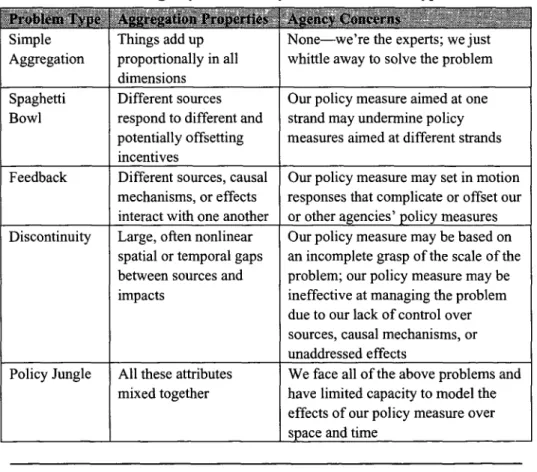
In Part II, therefore, we develop a framework to identify different types of massive problems and their corresponding policy implications. Some massive problems, such as wetlands loss, are relatively simple in structure; the clear identification of sources and the proportionality of causal mechanisms lead to readily manageable effects. Whittling away at these problems is easy. Some massive problems, however, exhibit complicating factors such as highly diverse and divergent sources, feedback loops between sources and effects, nonlinear causal mechanisms, and temporal and spatial discontinuities between sources and effects. As these factors become more dominant, simple solutions become elusive. Whittling away gets harder.
When we probe the mechanisms of problems such as sprawl, we find components operating at different spatial and temporal scales, with causal feedback loops across and between scales. It is unlikely that any single level of
Mgmt. Paper No. 08-08, 2008), available at http://ssm.com/abstract-l132976. For a probing examination of the complexity of the causes and the proposed solutions, see John A. Tatom, The U.S. Foreclosure Crisis: A Two-Pronged Assault on the U.S. Economy (Networks Fin. Inst., Working Paper No. 2008-WP-10, 2008), available at http://ssm.com/abstract-1194975.
21. For discussion of the scholarship on these questions, see infra Part I.A.
CALIFORNIA LAW REVIEW
government is better positioned than any other to address that kind of problem.
Using sprawl and other examples from environmental and land use policy, we create in Part II a typology of massive problems based on the different properties that cumulative effects can exhibit. This framework makes clear why problems that appear equally massive can differ dramatically in their core attributes, which explains why some prove relatively easy to manage and others mind-bogglingly intractable. The nature of the problem, in other words, has much to say about an agency's choice of whittling strategies.
Part III surveys how the law has addressed massive problems and their cumulative effects mechanisms. With few exceptions, regulation has been unimaginative, regarding all effects as homogeneous, linear, proportionally aggregated, and thus easily whittled away at. Heavy reliance on cost-benefit analysis, risk assessment, and predecision assessment-the mainstays of agency analysis-has not proven useful in the face of certain types of massive problems. By ignoring the particular cumulative causes of problems, therefore, agencies may be whittling away, but with a blindfold on.
If conventional approaches to massive problems have been inadequate, what should agencies do instead? In Part IV we consider strategies for whittling away at massive problems. We demonstrate that conventional prescriptions to match agency scale with problem scale and to choose instruments through cost- benefit analysis offer little hope in the face of complex massive problems. An agency acting solo with these tools will be no match for problems of massive dimension. Instead, building on recent political science scholarship in the areas
22 23
of Dynamic Federalism, New Governance, and Transgovernmental Networks, 24 we argue that agencies whittling away at massive problems must be empowered to pool resources with other similarly charged agencies in loosely linked "weak ties" networks that connect both institutions and people within the institutions.
22. Scholars of Dynamic Federalism theory reject the "minimal overlap" model in which there is a "particular allocation of at least primary regulatory authority between the states and the federal government," replacing it with one "in which multiple levels of government interact in the regulatory process." Kirsten H. Engel, Harnessing the Benefits of Dynamic Federalism in Environmental Law, 56 EMORY L.J. 159, 161 (2006). More detail on Dynamic Federalism theory is presented infra Part IV.B.
23. New Governance theory turns "away from the familiar model of command-style, fixed- rule regulation by administrative fiat, and toward a new model of collaborative, multi-party, multi- level, adaptive, problem-solving" governance. Bradley C. Karkkainen, "New Governance " in Legal Thought and in the World: Some Splitting as Antidote to Overzealous Lumping, 89 MINN.
L. REV. 471, 473 (2004). More detail on New Governance theory is presented infra Part IV.B.
24. Transgovernmental Networks theory emphasizes the role of "networks of similarly- situated technocrats" who work in many different governance units, and "conceive[s] of lawmaking as an organic enterprise, harnessing the technical expertise of bureaucrats who do not possess heady titles but nonetheless intimately understand the practical exigencies of their particular issue areas." Janet Koven Levit, A Bottom-Up Approach to International Lawmaking:
The Tale of Three Trade Finance Instruments, 30 YALE J. INT'L L. 125, 182 (2005). More detail on Transgovernmental Network theory is presented infra Part IV.B.
66 [Vol. 98:59
This can all sound rather abstract, so in Part V we get practical, presenting a case study of the multiagency response to Gulf hypoxia. Legislatures granted considerable policy discretion to the agencies participating in the effort, creating space in which to design coordinated multiscale, multiagency policy responses. In the absence of a legislatively issued master plan, each agency adapted its particular response to facilitate the coordinated effort while retaining full autonomy and accountability. The agencies working on solutions to Gulf hypoxia demonstrate the type of networked strategy that our model suggests is needed for agencies to best whittle away at massive problems. By contrast, case studies from water management efforts in California and the Chesapeake Bay reveal the pitfalls of coordinating through formally institutionalized conglomerates of agency resources. Between solo agency efforts and highly institutionalized multiagency coordination efforts lies the sweet spot of personalized "weak ties" interagency networks that we believe is best equipped to whittle away at massive problems. We conclude by setting out the measures needed in administrative law to develop and endorse this new form of multiagency coordination.
I
FRAMING THE MASSIVE PROBLEMS DILEMMA
It is not hard to find massive policy problems, nor is it hard to find public calls to solve them. In this respect, massive problems are as much a political challenge for legislatures as an administrative challenge for agencies.
Legislatures, however, have the luxury of issuing broad mandates to agencies with equally broad delegations of discretion in implementing them.2 5 Appearing to do something, anything, but then passing on the tough choices to the agency is an all-too-common practice in the face of policy problems of massive dimensions. 26In this style of delegation, legislatures specify sets of institutions and perhaps instruments, but largely leave to agencies the responsibilities of developing the methodologies, such as model-building, and
25. Broad legislative delegation of authority to administrative agencies is a long-practiced component of governance in the modern regulatory state which we take as a given, leaving the normative question of whether the practice is consistent with constitutional separation of powers and theories of legislative responsibility outside the scope of this Article. For examples of the vast body of commentary on the ubiquity and inevitability of legislative delegations, see Steven P.
Croley, Theories of Regulation: Incorporating the Administrative Process, 98 COLUM. L. REV. 1 (1998); David B. Spence & Frank Cross, A Public Choice Case for the Administrative State, 89 GEO. L.J. 97 (2000). For examples of contrasting views of the propriety of legislative delegations, compare David Schoenbrod, Delegation and Democracy: A Reply to My Critics, 20 CARDozo L.
REv. 731 (1999) (arguing against delegation), with Jerry Mashaw, Prodelegation: Why Administrators Should Make Political Decisions, 1 J.L. EcON. & ORG. 81 (1985) (arguing in favor of delegation).
26. See, e.g., Robert L. Glicksman, Balancing Mandate and Discretion in the Institutional Design of Federal Climate Change Policy, 102 Nw. U. L. REV. COLLOQUY 196, 197 (2008) ("Congress should vest more discretion in agencies to decide how to address climate change than it does on the question of whether to do so.").
CALIFORNIA LAW REVIEW
determining the final details of implementation and adaptation.27 Surely legislatures can do better than simply giving agencies the authority to whittle away and then hope for the best. Responding effectively to massive problems requires an understanding of which agencies to enlist, the policies they should adopt, and what specific aspects of the problems they should address-the threshold questions of who should whittle away, how they should whittle away, and what they should whittle away at.
A. The Threshold Questions of Whittling Away: Who, How, and What?
The question of who should whittle away falls under the broad umbrella of federalism, and has motivated heated debate over the proper allocation of federal and state authority, whether through centralization of authority in the federal government, devolution of authority to state and local governments, dualism's separation of federal and state authority, or the middle ground of so- called "cooperative federalism."28 A central premise of these and similar analyses is that there is an appropriate level of government to take charge of the problem, the key question being which level is best for a particular set of circumstances. As Professors William Brock and Stephen Carpenter observe, however, such thinking can lead to misguided policy "panaceas" that form
"when people think they have arrived at the truth regarding how the world would work under different institutional designs and the design they propose is optimal."29
27. As Don Elliott describes the fate of agencies "tasked with solving emerging problems without legislative guidance," they must "adapt[] their statutes creatively to emerging problems by seizing on bits and pieces of language or legislative history." E. Donald Elliott, Portage Strategies for Adapting Environmental Law and Policy During a Logjam Era, 17 N.Y.U. ENVTL. L.J. 24, 25
(2008).
28. "Centralized federalism suggests that the federal government should address environmental problems on its own. Devolved federalism argues that environmental decisions are best made at the state and local level. Dual federalism posits that each level of government should have distinct and separate approaches to environmental regulation." Benjamin K. Sovacool, The Best of Both Worlds: Environmental Federalism and the Need for Federal Action on Renewable Energy and Climate Change, 27 STAN. ENVTL. L.J. 397, 405 (2008). "[C]ooperative federalism is a system of shared authority between federal and state governments" in which "state programs adopt environmental standards at least as stringent as the federal program. . ..[and] the federal government retains oversight authority." David E. Adelman & Kirsten H. Engel, Adaptive Federalism: The Case Against Reallocating Environmental Regulatory Authority, 92 MINN. L.
REV. 1796, 1811-12 (2008). Scholarly and judicial discussion of these different strands of federalism theory is legion. For a thoughtful survey of "the ongoing tension between the oft- voiced judicial and scholarly preference for distinctly delineated federal and state roles and the reality of overlapping federal and state roles that one finds [in] federalism's central debates," see William W. Buzbee, Asymmetrical Regulation: Risk, Preemption, and the Floor/Ceiling Distinction, 82 N.Y.U. L. REV. 1547, 1551 (2007).
29. William A. Brock & Stephen R. Carpenter, Panaceas and Diversification of Environmental Policy, 104 PRoc. NAT'L ACAD. OF SCI. 15206, 15206 (2007). For more on policy panaceas, see Elinor Ostrom, A Diagnostic Approach for Going Beyond Panaceas, 104 PROC.
NAT'L ACAD. OF SCI. 15181 (2007).
68 [Vol. 98:59
For example, the well-known "matching principle" claims that "regulatory authority should go to the political jurisdiction that comes closest to matching the geographic area affected by a particular externality,"30 a maxim that has gained considerable attention in administrative law scholarship. 3 This precise
"problem-shed" approach would presumably subject climate change, for example, to national and global governance, yet imposing such a level of governance remains a hotly contested topic with vigorous arguments made for matching climate change to regional, state, and local government scales as well. Moreover, even if a particular level of government could be identified as32
the optimal locus of regulatory authority, horizontal allocation of responsibili- ties would have to be made between federal agencies (if at the federal level), between states (if at the state level), and between state and local agencies (also if at the state level). Horizontal coordination between governments and
30. Henry N. Butler & Jonathan R. Macey, Externalities and the Matching Principle: The Case for Reallocating Environmental Regulatory Authority, 14 YALE L. & POL'Y REv. 23, 53 (1996).
31. See, e.g., Buzbee, supra note 18, at 106-07 nn.202, 205; Daniel C. Esty, Good Governance at the Supranational Scale: Globalizing Administrative Law, 115 YALE L.J. 1490,
1493 (2006); Matthew D. Fortney, Devolving Control Over Mildly Contaminated Property: The Local Cleanup Program, 100 Nw. U. L. REV. 1863, 1897-98 (2006).
32. Compare Jonathan B. Wiener, Think Globally, Act Globally: The Limits of Local Climate Policies, 155 U. PA. L. REv. 1961, 1962 (2007) ("subnational state-level action is not the best way to combat global climate change"), with Kirsten H. Engel, Mitigating Global Climate Change in the United States: A Regional Approach, 14 N.Y.U. ENVTL. L.J. 54 (2005) (outlining means of implementing a "regional interstate cooperative approach"), with Hari M. Osofsky &
Janet Koven Levit, The Scale of Networks?: Local Climate Change Coalitions, 8 CHI. J. INT'L L.
409 (2008) (arguing the advantages of a local jurisdiction "bottom-up networking" approach).
Some are of two minds, hoping for more federal regulation but recognizing the importance of local, state, and regional regulation as, at the very least, catalysts for eventual federal regulation, if not effective in their own right. See Randall S. Abate, Kyoto or Not, Here We Come: The Promise and Perils of the Piecemeal Approach to Climate Change Regulation in the United States, 15 CORNELL J.L. & Pus. PoL'Y, 369, 401 (2006) (concluding that "[s]tate, regional, and local climate change initiatives may be subject to criticism, but in light of the current federal regime, such criticism may be unduly harsh."); Stephen C. Jones & Paul R. McIntyre, Filling the Vacuum: State and Regional Climate Change Initiatives, 30 ENv'T REP. (BNA) 1640 (2007) (comparing the paucity of federal initiatives to date with the proliferation of state and regional measures). Others reject the state catalyst theory, arguing it will lead ultimately to a less effective federal response.
See Cary Coglianese & Jocelyn D'Ambrosio, Policymaking under Pressure: The Perils of Incremental Responses to Climate Change, 40 CONN. L. REv. 1411 (2008); Benjamin K.
Sovacool & Christopher Cooper, The Hidden Cost of State Renewable Portfolio Standards (RPS), 15 BUFF. ENVTL. L.J. 1 (2008). And yet others argue against federal preemption of state and local initiatives and in favor of a "cooperative federalism" approach under which federal legislation sets a preemptive "floor" of greenhouse gas emission standards above which states are free to regulate.
See WILLIAM ANDREEN ET AL., CENTER FOR PROGRESSIVE REFORM, COOPERATIVE FEDERALISM AND CLIMATE CHANGE: WHY FEDERAL, STATE, AND LOCAL GOVERNMENTS MUST CONTINUE TO PARTNER (2008), available at www.progressivereform.org; Robert L. Glicksman & Richard E.
Levy, A Collective Action Perspective on Ceiling Preemption by Federal Environmental Regulation: The Case of Global Climate Change, 102 Nw. U. L. REV. 579 (2008); Thomas D.
Peterson et al., Developing a Comprehensive Approach to Climate Change Policy in the United States that Fully Integrates Levels of Government and Economic Sectors, 26 VA. ENVTL. L.J. 227 (2008).
CALIFORNIA LAW REVIEW
agencies at any scale presents difficult questions of institutional choice and cross-jurisdiction coordination.33 As problems become larger in scope and complexity, crossing scales of governance and exceeding the capacity of any particular agency at any particular scale, no obvious solution to the "which agency" question presents itself. Indeed, massive problems may require an altogether different and far more flexible way of thinking about federalism in both its vertical and horizontal directions. In the terminology of Professor Hari Osofsky, problems operating on massive scales may even require a "diagonal"
form of federalism.34
The second question-how agencies should whittle away at massive problems-skirted by the Massachusetts v. EPA Court, presents a dilemma. At one extreme, an agency could choose to act solely on its own, whittling away hard and fast through maximum exercise of its regulatory power and without any regard for other agencies. While such an agency would retain full autonomy, it would also retain full accountability. The EPA, for example, might use its Clean Air Act authority to clamp down hard on vehicles' greenhouse gas emissions. The EPA's actions undoubtedly would affect other agencies' policy measures and cause significant economic costs, yet not make a noticeable dent in global greenhouse gas emissions. Whittling away hard and fast in this way will likely not get an agency much credit for solving the problem, but instead the agency would likely receive plenty of heat for the policy and economic consequences. Why would any agency want to make so many enemies for so little practical gain?
Alternatively, an agency could seek partners-other agencies with regulatory jurisdiction over some aspect of the problem-in the hope that collaboration would lead to greater results while spreading accountability for the political and economic consequences.35 Finely tuned, efficiently administered, strongly coordinated agency action is a worthy aspiration, but unfortunately this idealized collaborative model is not easily attained in
33. For background on horizontal federalism, or "federalism without Washington," and the cross-jurisdiction coordination challenges it presents, see Ann O'M. Bowman, Horizontal Federalism: Exploring Interstate Interactions, 14 J. PUB. ADMIN. RES. & THEORY 535 (2004);
Allan Erbsen, Horizontal Federalism, 93 MINN. L. REv. 493 (2008); Noah D. Hall, Toward a New Horizontal Federalism: Interstate Water Management in the Great Lakes Region, 77 U.
COLo. L. REV. 405 (2006).
34. See Hari M. Osofsky, Is Climate Change "International": Litigation's "Diagonal"
Regulatory Role, 49 VA. J. INT'L L. 585 (2009) (suggesting greater emphasis on connections between governance institutions at different scales).
35. We use case studies of multiagency water management efforts in California (known as CalFed) and the Chesapeake Bay to demonstrate this effect in Part V, infra. Our focus is on collaboration primarily between numerous public agencies rather than between public agencies and private stakeholders. For one of the seminal discussions of public-private collaboration as a regulatory strategy, see Jody Freeman, Collaborative Governance in the Administrative State, 45 UCLA L. REV. 1 (1997). See also Eric W. Orts & Cary Coglianese, Debate: Collaborative Environmental Law: Pro and Con, 156 U. PA. L. REV. PENNUMBRA 289 (2007) (a point- counterpoint debate over public-private collaborative regulation).
70 [Vol. 98:59
practice.36 The transaction costs of strong coordination, the differing internal incentives of each agency, the loss of autonomy, and other collective action challenges often overwhelm ambitions toward coordination. The collaboration may devolve into the tragedy of the regulatory commons-each agency, counting on others to do their part, free rides, thus leading to an ineffective combined effort.3 7
Much administrative law and political science scholarship has focused on techniques of solo and collaborative policy administration.3 8 Some scholars address the solo method through economic models of optimal regulation using cost-benefit analysis;39 some attempt to refine the collaborative method through policy models of multiagency management;40 and some propose entirely new models.41 While we believe there is much value in proposals that seek to increase agencies' effectiveness through efficiency and cooperation, scholars have given little attention to the challenges an agency faces when dealing with a problem with dimensions that far outstrip the agency's regulatory capacity.42 As we demonstrate in Part IV, the crisp theories of cost-benefit analysis and collaborative regulation that abound in administrative law scholarship have no straightforward applications here.
Who should whittle away and how best to whittle away at massive problems are, of course, critically important questions. However, the third fundamental question suggested by Massachusetts v. EPA remains both
36. A recent example is the collapse of the CalFed multiagency collaborative process for water resources planning in the Bay-Delta area of California. See Dave Owen, Law, Environmental Dynamism, Reliability: The Rise and Fall of CALFED, 37 ENVTL. L. 1145 (2007).
37. See William W. Buzbee, Recognizing the Regulatory Commons, 89 IOWA L. REV. 1 (2003).
38. See Jody Freeman & Daniel A. Farber, Modular Environmental Regulation, 54 DUKE L.J. 795 (2005) (reviewing different proposed approaches).
39. See, e.g., CAss R. SUNSTEIN, THE COST-BENEFIT STATE: THE FUTURE OF REGULATORY PROTECTION (2002). For a comprehensive critique of cost-benefit analysis, see Sidney A. Shapiro & Christopher H. Schroeder, Beyond Cost-Benefit Analysis: A Pragmatic Reorientation, 32 HARv. ENVTL. L. REv. 433 (2008).
40. See, e.g., Freeman & Farber, supra note 38.
41. See, e.g., Robert Baldwin & Julia Black, Really Responsive Regulation, 71 MOD. L.
REV. 59 (2008) (suggesting regulatory strategies that incorporate factors such as cognitive frameworks of regulated firms).
42. Professor Bill Buzbee's theory of the regulatory commons, with its attention to scale of sources and effects for complex regulatory problems, is a notable exception. See Buzbee, supra note 28, at 604-06. Climate change has, in particular, motivated increased attention to scalar properties of problems as a driver of regulatory design. See Robin Kundis Craig, Climate Change, Regulatory Fragmentation, and Water Triage, 79 U. COLo. L. REV. 825, 898-903 (2008) (using Buzbee's model to examine climate change, among other factors, as a driver of multiscalar regulatory fragmentation in coastal and marine ecosystem contexts); Hari M. Osofsky, The Geography of Climate Change Litigation: Implications for Transnational Regulatory Governance, 83 WASH. U. L.Q. 1789, 1791-95 (2005) (using Buzbee's model to identify an array of scalar mismatches confounding efforts to regulate climate change causes). Our purpose is to advance this line of thinking to a more formal model of how the spatial and temporal scales of cumulative effects problems operate to confound regulatory strategy, and how best to respond.
CALIFORNIA LAW REVIEW
unanswered and largely overlooked by administrative law scholars-what exactly should the agencies be whittling? These scholars are not alone in avoiding a deeper analysis of the nature of massive policy problems. Neither did the Supreme Court articulate the characteristics that comprise massive problems, presumably assuming that one is much like another. Likewise, political scientists have long grappled with so-called "wicked" problems, their defining characteristic being that the solution of one aspect of the problem reveals another, but have seldom deeply explored what makes a problem
"wicked."43 Administrative law scholarship has only described massive legal problems as "wicked" in passing.44 Even Professor Charles Lindblom's
"incrementalism" theory from the late 1950s-the most influential critique of
"one-fell-swoop" approaches in which an agency attempts to wrestle a
"complex problem" under control with comprehensive policy measures-did not explore what makes a policy problem complex.4 5 That massive problems exist and that the law must deal with them is taken as a given;46 nevertheless, administrative law has given little attention, in either scholarship or application, to what exactly makes a problem "massive" (or "wicked" or "complex") and, as a consequence, so difficult to manage that agencies are resigned to whittling away.
Perhaps a deeper understanding of the nature of massive problems is unnecessary for purposes of effective policy design. Climate change and many other policy problems appear massive from a distance, but so what? That they cover large geographic areas and have large impacts may simply make them bigger versions of smaller problems. If massive problems are no more complex
43. There is no fixed model of a "wicked" problem and no final outcome to solving the problem short of running out of time or resources. See Donald Ludwig, The Era of Management Is Over, 4 ECOSYSTEMs 758 (2001). The classic discussion is found in Horst W.J. Rittel & Melvin M.
Webber, Dilemmas in a General Theory ofPlanning, 4 POL'Y SCI. 155, 160-67 (1973).
44. See, e.g., Richard J. Lazarus, Super Wicked Problems and Climate Change: Restraining the Present to Liberate the Future, 94 CORNELL L. REV. 1153 (2009) (discussing climate change as a wicked problem for environmental lawmaking).
45. See Charles E. Lindblom, The Science of "Muddling Through," 19 PUB. ADMIN. REV.
79 (1959) [hereinafter Muddling Through]; Charles E. Lindblom, Still Muddling, Not Yet Through, 39 PUB. ADMIN. L. REV. 517 (1979). Lindblom critiqued what he called the "rational comprehensive method" of public administration, offering in its place a model of incremental policy making focused on "continually building out from the current situation, step-by-step and by small degrees." Lindblom, Muddling Through, supra, at 81. During its first twenty years, Muddling Through had "been cited, re-cited, ex-cited, mal-cited, and well-cited," to the point that public administration academics and professionals considered the article's impact on public policy and administration to be "enormous." Editorial, Here Comes Tomorrow, 39 PUB. ADMIN. REV.
509, 509 (1979) (journal editorial introducing a symposium issue on the paper). Yet Lindblom referred to "complex problems" repeatedly-over thirty times in his two primary articles- without ever defining what makes a problem complex.
46. See, e.g., A. Dan Tarlock, Is There A There There in Environmental Law?, 19 J. LAND USE & ENvTL. L. 213, 253-54 (2004) ("environmental law will for the foreseeable future be a messy process of adapting the contingencies and limitations of science to 'wicked' problems informed by rebuttable principles.").
72 [Vol. 98:59