Wages in Employment Relations in the Tourism Sector in Yogyakarta in Justice Perspective
Fithriatus Shalihah,
1ΩSiti Alviah,
2Imtikhan Anas Shob’ron
11
Faculty of Law, Ahmad Dahlan University, Yogyakarta, Indonesia.
2
Hong Kong Under the Bridge Community, Tsuen Wan Hong Kong New Territorial, China.
Ωemail correspondence: [email protected]
ABSTRACT
The tourism sector in Indonesia plays a significant role in the country's foreign exchange income.
Optimizing this sector is seen as a way to stimulate various economic segments after the Covid- 19 pandemic. However, the workers in this industry face multiple challenges in their employment relationships. Issues such as sub-minimum wages and excessive working hours are prevalent among workers in the hotel, restaurant, and travel agency domains. These problems indicate systemic obstacles within the industry. This study focuses on the Special Region of Yogyakarta and examines the legal intricacies within the employment relationships of its tourism sector.
Specifically, it explores the Culinary and Cultural Services Sector associated with the Remains of the Tombs of Kings. The primary goal is to clarify the nuances of justice within employment relationships and scrutinize the alignment of rights for culinary service workers and royal grave attendants with Indonesian law or the presence of justifiable legal reasons for deviations. The research methodology involves comprehensive data collection through stakeholder interviews, summarizing diverse challenges in the field. Findings underscore persistent discrepancies, notably within certain restaurants that violate the stipulated minimum wage as per the Indonesian Job Creation Law through fixed-term or indefinite-term work agreements. On the other hand, the employment relationship of Abdi Dalem workers, safeguarding Kings' tombs, aligns with labor laws due to their casual daily worker status, justified by an intermittent work schedule that exceeds legal provisions. In conclusion, this research provides a nuanced understanding of the existing issues within the employment relationships of the tourism sector. It sheds light on both legal infringements and instances where deviations are substantiated by explicit legal rationales.
Keywords: Work relationship; Tourism Sector; Culinary Services; Abdi Dalem;
Date of Submission: October 27, 2023 Date of Publication: October 23, 2023 DOI: http://dx.doi.org/10.56087/substantivejustice.v6i2.261
INTRODUCTION
Tourism is one of the many sectors that positively impact national income (Barančoková &
Barančok, 2020) Since 2016, Indonesia's tourism sector has contributed to the Indonesian economy (BPS Provinsi D.I. Yogyakarta, 2023.). In 2019, the Government of Indonesia wanted
to double this figure to 8% of Indonesia's Gross Domestic Product (GDP) (Jaramillo-Moreno et al., 2020; Winardi, 2023). Tourism is one of the sectors that can absorb the tourism workforce of 13 million people in the tourism sector. To increase the competitiveness of tourism for cities/regencies in Indonesia, the government, or in this context, the Ministry of Tourism and Creative Economy (Kemenparekraf), created a Tourism Index in Indonesia in 2016 (Siregar et al., 2023).
The United Nations World Tourism Organization (UNWTO) defines tourism carrying capacity as the maximum number of people who can visit a tourist destination area at the same time without causing damage to the physical, economic, and socio-cultural environment and unacceptable deterioration of quality. This definition signifies tourism activities as crucial and exciting for an unlimited time without changing the local environment and satisfying stakeholders (Candia et al., 2020).
The problem is, that one of the elements that assimilates the workforce in Indonesia is the tourism industrial area. This area is one of the significant monetary areas in Indonesia. The tourism industry can sustain jobs directly or indirectly. The travel industry can minimize unemployment and increase local wages through tourism. The jobs of public and private authorities are of great interest in the assimilation of jobs in the tourism industry. According to a report from the Ministry of Manpower (Kemnaker), the number of workers in the Indonesian tourism sector will reach 1,073,485 people in 2022. It can be said that the tourism sector has a relatively high level of labor (Kurniawati & Hennigusnia, 2019).
However, the fact is that workers in the tourism sector still experience various problems that have an impact on the workers themselves. Some of the problems faced by workers in the hotel, restaurant, and travel agency sectors include paying wages lower than the minimum wage.
This can cause financial difficulties and a lower standard of living for workers and trigger dissatisfaction in work relationships (Adiati, 2013). Then tourism sector workers often have to work long hours, including weekends and holidays. This can lead to physical and mental exhaustion, which can affect their health and well-being, many tourism sector workers do not receive benefits such as health insurance, paid sick leave, or paid time off, this can make it difficult for them to take time off when they are sick or need a break (SBM, 2022). Workers in the tourism sector also experience job dissatisfaction, such as unclear work contracts or precarious work.
This can affect the welfare of workers in work relationships (Sutrisna, 2011). Apart from that, there is a lack of security, especially for female workers, who are very vulnerable to harassment, which can have physical and mental impacts. It can be concluded that unequal work relations between workers will certainly trigger injustice in industrial relations (Lahilote, 2010). Because of the problems faced by workers, this is due to the lack of maximum legal protection for workers, as regulated in Indonesian Law concerning Employment, articles 67 to Article 101, including
protection for workers with disabilities, children, women, working time, occupational safety and health, wages. and welfare.
The tourism sector in Indonesia is one of the leading sources of foreign exchange earnings.
It is hoped that optimizing the tourism sector can spur other sectors in various efforts to accelerate economic recovery after the Covid-19 pandemic, such as reducing unemployment due to layoffs that occurred during the pandemic. The recovery of the tourism industry also provides opportunities to increase the income of people who work in the tourism sector. However, workers in the tourism sector still have various problems in carrying out work relationships. Including legal problems. Some of the problems faced by workers in the hotel, restaurant, and travel agency sectors include paying wages lower than the minimum wage, working hours that exceed the maximum working time limit determined by labor law, not guaranteeing the fulfillment of maternity rights, and so on. Several legal problems experienced by workers in the tourism sector have also become a phenomenon of employment relations in the tourism sector in the Special Region of Yogyakarta.
The province of Yogyakarta Special Region is among those granted special autonomous status, and Aceh, Papua, and the Special Region of the Capital Jakarta because of its special privileges. Article 18 of the Constitution of the Republic of Indonesia of 1945 guarantees the regulation of the four regions above, recognizing areas with still traditional governments as unique (Hidayah, 2017). Yogyakarta's particular status was recognized long before Indonesia gained independence as a cultural heritage (Wijayanti & Damanik, 2019). One of the specialties of Yogyakarta is that it maintains its cultural legitimacy during the development of an increasingly modern era (Ikhwan & Aidulsyah, 2020). In addition, the system of government led by a King made him look different from other regional heads. In running the wheels of government, a courtier assisted the Sultan (Susila & Abidin, 2016). Abdi Dalem is an aide to the Sultan as both a mover in the field of government and a guard in charge of preserving Javanese culture in the palace environment (Paramita, 2020).
The principle of justice in the formation of law and legal practice has gained a position in official documents on human rights. To understand the law that reflects society's sense of justice, one must first understand the true meaning of law. According to the view adopted in legal literature, the meaning of law is to bring about justice in human life. This meaning will be achieved by including the principles of justice in the rules of living together. The law referred to here is positive law which is the realization of the principles of justice. According to Immanuel Kant's teachings, justice is based on human dignity. Thus, the formation of laws must reflect a sense of fairness and reflect a sense of justice and aim to protect human dignity. Justice is a fundamental normative principle for the State. Therefore, the State is very interested and obliged to strive to achieve justice for its citizens. On this basis, the criteria for principles of justice in regulating rights in working relationships are very fundamental, because all countries in the world always try to
apply the principles of justice in the formation of their laws. The principle of justice has a special place in the entire history of legal philosophy. In the concept of modern states, the emphasis on the principle of justice is given by stating that the true aim of law is to create justice in society (Shalihah, 2017b).
In Law Number 13 of 2003 concerning Employment, wages are regulated. The state has guaranteed wages in such a way that in private relations between workers and employers, there is no arbitrariness by employers in paying wages to workers. In Article 1 number 30 of the Employment Law, it has been explained that the definition of wages is: (Shalihah, 2017a) "The rights of workers or laborers which are received and expressed in the form of money as compensation from the entrepreneur or employer to the workers. laborers which are determined and paid according to a work agreement, agreement or statutory regulations including allowances for workers/laborers and their families for work and/or services that have been or are performed."
Abdi Dalem position is the same as that of a worker. As a worker, Abdi Dalem is entitled to wages to meet the needs of his daily life. The Indonesian Job Creation Law, which has been amended into Law Number 6 of 2023 concerning Stipulation of Government Regulations in replacement of Law Number 2 of 2022 concerning Job Creation to become Law, as well as Government Regulation of the Republic of Indonesia Number 36 of 2021 on Wages, guarantee this provision. Article 88 describes Abdi Dalem right to earn income to fulfill a decent livelihood.
With fulfilling the needs of a decent life, the welfare of life is not a dream. The Labor Act guarantees the implementation of activities in the field of employment well in addressing gaps related to the rights of unprotected workers through bargaining for political and economic purposes (McMurry, 1946).
On the other hand, the government seeks to improve the welfare of life through improvements related to the minimum wage (Ni & Kurita, 2020). Minimum wage policies are in place for a better life (Che Ahmat et al., 2019). With wage increases reaching the minimum wage standard, additional funds seen as gifts can be reconsidered concerning total wages (Brink et al., 2021). The existence of minimum wage policies narrows the gap (Katzkowicz et al., 2021). Setting a minimum wage can also reduce the growth rate of job needs within a few years (Meer & West, 2016).
Abdi Dalem was positioned as a volunteer worker. The meaning of volunteering gives the sense that a small amount of money does not judge every job they do. No free volunteer work is included as freelancers campaigning in New York (Merkel, 2018). Although still paid in the form of money, the wages given to Abdi Dalem are not comparable to the work done. Low wages can lead to social problems (Pantea, 2020). Low wages can also destroy low-skilled jobs (Neumark
& Munguía Corella, 2021). Even low wages tend to affect the work done (Galvin, 2016). Abdi Dalem is a skilled worker. Many come from the highly educated class and even have rank.
As someone with skills, Abdi Dalem wage determination cannot be aligned with workers without skills. According to Indonesian Job Creation Law, the Governor shall determine the minimum wage for the province and the wages in each district and city, subject to certain limitations, such as inflation or growth in the local economy. Based on the geographical conditions of the king's tomb in the Bantul Regency area, the minimum salary used is the Bantul Regency Minimum salary. Thus, this determination can improve the quality of life (Che Ahmat et al., 2019).
Low wages have the potential to harm mental health (Kronenberg et al., 2017). This phenomenon was then challenged through previous research (Wijayanti & Nafiah, 2019), where the minimum wage did not affect the lives of Abdi Dalem to the point of damaging their mentality.
Abdi Dalem showed different circumstances and accepted such low wages happily. This phenomenon is an encouraging thing, and from previous research, it can be said that Abdi Dalem is not concerned about wages for the work they do, but this is related to Abdi Dalem work which is seen as an application of culture. The values carried out by Abdi Dalem are something related to Abdi Dalem loyalty to the Palace. Apart from discussing the minimum wage for workers in a cultural heritage site, researchers also examined the minimum wage that workers in the culinary tourism sector get. This phenomenon is interesting to study so that a problem formulation emerges: does paying wages to servants at royal tombs violate the laws and regulations in force in the Unitary State of the Republic of Indonesia or can it be justified by certain legal reasons and are there still restaurants that give minimum wages to their waiters? his workers. This research aims to find out whether giving wages to servants in royal tombs violates the laws and regulations in force in the Unitary State of the Republic of Indonesia or can be justified for certain legal reasons. This research aims to see whether there are still restaurants that provide minimum wages to workers under the law that has been issued.
METHOD
This research employs empirical legal research to collect primary and secondary data. The primary data was obtained through interviews with 11 Abdi Dalem stationed at the Imogiri King's Tomb and the restaurant serving as kepang wedono, penewu, bekel, and jajar. The information saturation point was prioritized during data collection. If the data collected from respondents no longer contains new information, it is considered sufficient and data collection is stopped.
Continuing to add data would result in redundancy. This research will employ various steps to collect data. In the initial stage, this research will focus on collecting data and information from each interested party. This will be achieved through various methods such as field observations, participation in observations, surveys, literature reviews, document reviews, interviews, or any other necessary steps. The collected data will be used to summarize the various problems in the field.
This research focuses on collecting and collecting primary data from respondents in the field using a list of questions that contain matters relevant to the title of the research, while data collection from sources is carried out using an open-ended interview guide that can be developed according to the direction of the conversation. The data that has been collected is then filtered and compiled for analysis which produces an understanding of the various conditions of workers in the tourism sector today. This understanding will also be complemented by recommendations for policy forms to the Yogyakarta Government as a legal basis for solving legal problems regarding employment relations in the tourism sector.
ANALYSIS AND DISCUSSION
The rule of law is a state that stands on law which guarantees justice to its citizens. Justice is a condition for achieving a happy life for its citizens, and as a basis for justice, it is necessary to teach a sense of morality to every human being so that he or she becomes a good citizen.
Likewise, real legal regulations only exist if the legal regulations reflect justice for social interactions between citizens. "The law in a constitutional state has a high position so that state power holders do not deviate, and so that the law always provides legal certainty in all aspects of people's lives, especially in terms of work relations.
The rule of law has a passive nature as it is expressed. So that legal rules do not function passively, it is necessary stimulus from certain events (das sein), so that legal rules can be active, which can then be applied to the concrete event. Therefore, as long as certain concrete events do not occur then these legal rules are only passive guidelines. So it's a rule law that requires the occurrence of concrete events: Das Sollen requires Das Sein. If a concrete event becomes a legal event, then concrete events that are relevant to the law, are events that are by law associated with legal consequences. Hence, an event concreteness does not itself become a legal event. A legal incident could not have happened without a legal incident. Legal events are created by legal rules. On the other hand, legal rules are in process occurrence is influenced by concrete events (Shalihah, 2019).
The 2024 DIY Provincial Minimum Wage reached IDR 2,125,897.61 or an increase of 7.24% compared to the 2023 UMP. Meanwhile, the average UMK for DIY 2024 increased by around 7% compared to this year. Yogyakarta City is the region with the highest 2024 UMK in DIY, while Gunungkidul Regency is the lowest. The following is a complete list of 2024 MSEs in DIY, sorted from highest to lowest:
-
Yogyakarta City: Rp. 2,492,997-
Sleman Regency: Rp. 2,315,976.39-
Bantul Regency: Rp. 2,216,463-
Kulon Progo Regency: Rp. 2,207,737-
Gunungkidul Regency: Rp. 2,188,041This UMK adjustment only applies to workers with work experience of less than one year.
For workers whose work period is one year or more, wages are guided by the structure and wage scale created by the company.
The tourism sector in Indonesia is one of the leading sources of foreign exchange earnings.
It is hoped that optimizing the tourism sector can spur other sectors in various efforts to accelerate economic recovery after the Covid-19 pandemic, such as reducing the unemployment rate due to many layoffs that occurred during the pandemic. "The recovery of the tourism industry also provides an opportunity to increase the income of people who work in the tourism sector. The life of the Yogyakarta palace cannot be separated from the role of Abdi Dalem. Abdi Dalem position is as the state civil apparatus that handles government issues and as a servant of culture. Being a courtier is the soul's call to devote itself to a glorified palace. This devotion is considered a hereditary habit in the family. Not infrequently, the sentence following in parents' footsteps becomes one of the main reasons to become a servant of culture or devote themselves to the palace.
A courtier is not limited by age and class. Everyone can become a courtier, even if the person is not a local native. However, Abdi Dalem must know everything about the culture and behave like a cultured person. Abdi Dalem is a role model of society in general. Therefore, every prospective Abdi Dalem must understand the traditions, norms, ethics, and values that apply etiquette to Abdi Dalem Punakawan and Abdi Dalem Kaprajan. The difference between Abdi Dalem punakawan and kaprajan lies in the origin of prospective Abdi Dalem. Abdi Dalem punakawan comes from ordinary people, while Abdi Dalem kaprajan is a retired Indonesian National Army (TNI), Police of the Republic of Indonesia (POLRI), and Civil Servant (ASN).
Concerning Abdi Dalem, serat kekancingan Is a kind of legality that signifies that Abdi Dalem is part of the citizens of Kraton Yogyakarta. Through serat kekancingan, Kraton Yogyakarta has the right to regulate monitoring and controlling courtiers. Serat kekancingan This became the basis of the sting for Abdi Dalem. This means that the court must carry the rights and obligations depending on the rank/kalenggahan of each of the courtiers. Moreover, through serat kekancingan, is also Abdi Dalem entitled to bear the title, the name of the gift, kekucah/wages, and kalenggahan, which reflects the rank and position of Abdi Dalem in the existing structure in the Kraton Yogyakarta. At the same time, a responsibility that must be carried by Abdi Dalem is to act as a cultural servant. This means they devote their lives to being the guardians of the Yogyakarta Kraton's culture who can preserve the culture of the Yogyakarta Kraton (Angel Barrasa, 2016).
Table 1. Pranatan Kalenggahan Number 01/Pran/KHPP/XII/2004 Chapter of Abdi Dalem Rank 15 Dulkaidah Wawu 1937 Suryo Kaping December 27, 2004
Order Rank Civil Servants (ASN) POLRI TNI
Punakawan Kaprajan Rank Factions
1 1 KPH Jendral Jendral
2 2
Regent of Nayaka (Bupati Nayaka)
Komjen Letjen
3 3
Regent of Kliwon
(Bupati Kliwon)
Junior Administrator (Pem. Utm. Mud)
IV/d Irjen Mayjen
4 4
Regent of Sepuh
(Bupati Sepuh)
Junior Administrator (Pem. Utm. Mud)
IV/c Bridjen Bridjen
5 5
Regent of Anom
(Bupati Anom)
First Class Administrator (Pembina I)
Administrator (Pembina)
IV/b Kombes
AKBP
Kolonel Letkol
6 6 Riyo Bupati
Anom
First Class
Superintendent (Penata I) Superintendent (Penata)
III/d III/c
AKP Iptu Ipda
Kapten Lettu Letda
7 7 Wedono
First Class Junior Superintendent
(Penata Muda I) Junior Superintendent (Penata Muda)
III/b
III/a
Aiptu
Aipda
Pem. Lettu
Pem Letda
8 8 Penewu
First Class Supervisor (Pengatur I)
Supervisor (Pengatur)
II/d II/c
Bripka Bridpol
Serma Serka
9 9 Lurah
First Class Junior Supervisor
(Pengatur Muda 1) Junior Supervisor (Pengatur Muda)
II/b
II/a
Briptu
Bripda
Sertu
Serda
10 10 Bekel
First Class Clerk (Juru I)
Clerk (Juru)
I/d I/c
Aj. Briptu Aj. Briptu Aj. Bripda
Kopka Koptu Kopda
11 11 Jajar
First Class Junior Clerk (Juru Muda I)
Junior Clerk (Juru Muda)
I/b
I/a
Bharaka Bharatu Bharada
Praka Pratu Prada
The table above shows the various rankings that Abdi Dalem can hold, ranging from Jajar to KPH. The rank of KPH is the highest, and therefore, KPH is rarely held by Abdi Dalem; this is because it depends on the sultan's policy (kawicaksanaan-mirunggan) (Sudaryanto, 2008).
2.1. Abdi Dalem Tomb of the King in Imogiri
Someone with the potential to serve culture is Abdi Dalem. One can be said to be a servant dalem after obtaining a decree or serat kekancingan (Decree or Confirmation Letter) issued by the Yogyakarta Kraton. Based on Pranatan Kalenggahan Number 01/Pran/KHPP/XII/2004, the status of Abdi Dalem is divided into two, namely Abdi Dalem punakawan and Abdi Dalem kaprajan.
Abdi Dalem punakawan, the courtier, gets the wages (kekucah) from the Kraton side through Tepas Danartopuro (served in receipt, expenditure, and storage of money). At the same time, Abdi Dalem Kaprajan, in principle, they are not entitled to get wages from Kraton but gets it from the government of the Republic of Indonesia. Thus, Abdi Dalem Kaprajan, in principle, is just as Abdi Dalem caos (who came to the Kraton as recognition as a courtier) and did not have the burden of duty on the part of the Kraton. It is different with Abdi Dalem Punakawan, for this group is institutionally recognized by the Kraton as one of the devices of the Kraton government.
Therefore, they get specific tasks or jobs (Sullivan, 2000).
Abdi Dalem, placed in the tomb of the king of Imogiri Yogyakarta, currently numbers 99 (Ninety-Nine) people. The amount is the calculation of Abdi Dalem, who has served for a long time, and Abdi Dalem, who is still an apprentice. When viewed from the rank level, eleven ranks are entitled to be held by courtiers, both Abdi Dalem punakawan And Abdi Dalem kaprajan. The type of rank is jajar, bekel, lurah, penewu, wedono, riyo bupati anom, bupati anom, bupati sepuh, bupati kliwon, bupati nayoko and Kanjeng Pangeran Haryo (KPH). The determination of this rank and title is the prerogative of the Sultan. However, for Abdi Dalem punakawan, it can be ascertained that the power must be through an internship from jajar, bekel, etc. In general, the internship period for prospective courtiers ranges from 2-5 years. The sultanate set this pre- employment provision to consider its discipline and loyalty to devote itself to the Yogyakarta Kraton. The procession of being Abdi Dalem is marked by graduation. As for Abdi Dalem kaprajan, in general, not through internships. Once entered Abdi Dalem, the rank has been adjusted to the rank or class in the government office or rank while serving as a member of POLRI and TNI. A courtier, either during the trial period or having passed, is simultaneously charged with rights and obligations due to tying himself to the palace. These rights and obligations are born because of working relationships.
Like two coins with two opposite sides, a relationship has two inversely proportional things.
Duty must accompany every right. Like workers in general, Abdi Dalem also has obligations that must be fulfilled. Abdi Dalem, placed in the tomb of the king of Imogiri, should maintain security and preserve the tomb. A tomb is where previous kings lived and became a religious tour that
many people often visit. In addition to being a confidant to guard the tomb, Abdi Dalem was also ordered to be a guide when visitors visited the king's tomb.
Before opening the tomb area to the public, Abdi Dalem usually cleans the tomb area first.
Each courtier is responsible for his or her territory. In carrying out duties, Abdi Dalem must wear clothes mataraman complete, for men must wear striated clothes and Javanese blangkon. In contrast, women wear long cloth kebaya, and some wear kemben (jarik). In addition, neither men nor women are allowed to wear footwear when wearing clothing. mataraman. Waluyo, as Mas Penewu Jogo, who has been a courtier for 15 years, said that this provision applies not only to the king's tomb in Imogiri but to all Abdi Dalem, whether in the palace environment or not. In addition to cleaning, Abdi Dalem has a ritual nyekar to the tomb of Sultan Agung. Based on the presentation of Mr. Diarjo, who ranked as Mas Penewu Jogo, this routine is a form of respect for the Great Sultan. This agenda is one of the obligations that cannot be missed.
The following obligation is regarding the presence of the courtiers at the tomb of the king of Imogiri. A courtier was asked to be present at the Kraton. Although they do not serve in the Kraton, they must show their face for ten days. His presence assesses the performance that has been done and has fulfilled each Abdi Dalem. Sapingi, one of the tomb guards who ranked Mas Penewu Jogo juga, added that the presence is evidence that can be used so that a courtier dalem rises through the ranks. Thus, the presence used to rise through the ranks was a collection of attendance for five years. This is because Abdi Dalem can be promoted for five years unless specified by the Sultan. In general, the presentation contains a list of activities that have been carried out. Furthermore, he also describes Abdi Dalem obedience, discipline, and karmic system in carrying out his duties. In two years, the tomb of King Abdi Dalem must be present as many as 8 (eight) times to the Kraton.
The last obligation of a servant dalem tomb of the king of imogiri is to follow the traditional ceremony. As a still thick with culture, Kraton Yogyakarta often holds cultural events, one of which is a traditional ceremony. All Abdi Dalem, including the tomb of king Abdi Dalem in Imogiri, must attend this ceremony. Abdi Dalem in each series of ceremonies becomes an independent assessment for Dalem Abdi. If they do not attend traditional ceremonies for no reason, sanctions will be given. The sanctions were brutal in applying for their promotion. The Kraton considers it very important to involve courtiers in this traditional ceremony because it is expected to understand and carry out the teachings. P. Samber Nyawa Known as Tri Darma, that is. mulat sarira, hangrasa wani (introspection), rumangsa melu handarbeni (Feeling you have), and wajib melu hanggondeli (follow defense) (Sudaryanto, 2008).
2.2. Wages (Kekucah) Abdi Dalem Tomb of the King in Imogiri
In addition to the right to hold a certain rank, as mentioned above, the courtier, Abdi Dalem, is also entitled to bear the title of name aligned with the field of work or expertise. Usually, this title is granted to Abdi Dalem in the name of the Sultan, who is known and signed by the head of
his work section (kawedanan/tepas). In addition, the courtiers are also entitled to get a salary/wage. However, Abdi Dalem kaprajan does not have the right to get a salary/wage from the Yogyakarta Kraton. This provision can be seen in the assignment letter (kekancingan) as a Kraton courtier because Abdi Dalem, with this type, usually gets wages/salaries from the government of the Republic of Indonesia. Abdi Dalem punakawan is Entitled to get a salary/wage from the Kraton Yogyakarta with a certain amount of money. Salary/wages (kekucah) given Kraton to Abdi Dalem punakawan vary, depending on the type.
Abdi Dalem punakawan Divided into two types, namely punakawan caos and punakawan tepas. Punakawan caos is a courtier who generally works in a designated place following the rules and is obliged to sowan or come to the Kraton every ten days and come on Tuesday Wage when wiyosipun dalem. At the same time, Abdi Dalem punakawan tepas is Abdi Dalem who works in the office of the Kraton government, so that it can be sowan or come to the Kraton every day.
These courtiers must come to the Kraton at least 1-3 times a week from 09.00 to 12.00 WIB.
Before performing his responsibilities, Abdi Dalam and Kraton agreed on a working partnership. According to Law No. 13 of 2003's Article 1 number 14, the working relationship began with an employment agreement between employers in Kraton and workers (Abdi Dalem), which included the following components:
1. Existence of work
2. Under command/command 3. Certain wages/loans, and 4. Some periods limit work.
The number of wages, or kekucah, is determined by the degree and rank of Abdi Dalem.
The wages given vary with the lowest nominal of USD 0,65 month, and the highest USD 2,67 month, the amount is only allocated to Abdi Dalem punakawan caos.
Figure 1. Wages (Kekucah) Abdi Dalem Tomb of the King in Imogiri (Caos & Tepas)
Rp10.000 Rp15.000 Rp20.000 Rp25.000 Rp30.000 Rp35.000
Rp20.000
Rp30.000
Rp40.000
Rp50.000
Rp60.000
Rp70.000
Rp0 Rp10.000 Rp20.000 Rp30.000 Rp40.000 Rp50.000 Rp60.000 Rp70.000 Rp80.000
Jajar Bekel Nom Bekel Sepuh Lurah Penewu Wedono
WAGES/KEKUCAH
CaosRankTepas
The table above shows the nominal amount of Abdi Dalem power shows a different number. Not only against Abdi Dalem with a separate rank but the payment of the kekucah is also distinguished by the type of Abdi Dalem. Although the ratio was twice as large as Abdi Dalem Punakawan Caos, the wage payment was still not worth it. However, regardless of the amount of kekucah given, they still accepted happily. Abdi Dalem, assigned to the Tomb of King Imogiri, also asserted that being a courtier is not a job but a devotion. Therefore, no matter how strong it is, it will not hinder Abdi Dalem motivation to continue serving in the Kraton. The motivation to become a servant lies not in the material obtained but, in the blessings, and peace. According to them, being a courtier is a fortune. With a relatively small strength, Abdi Dalem can still meet the needs of his life, both primary and secondary.
Related to the wage (kekucah) of the king's tomb in Imogiri, of course, it is still far from the minimum wage standard of Yogyakarta regency and province. The Special Region of Yogyakarta (Daerah Istimewa Yogyakarta, DIY) provincial minimum wage limit indicates a sizable amount. In 2020, the minimum wage of DIY province amounted to USD 113,87; the amount became the standard so that employers do not provide wages based on existing provisions. Because referring to the purpose of wages is to give the welfare of life. The achievement of a prosperous life is seen in fulfilling daily living needs such as eating, clothing, and others.
The minimum pay in a district is set in addition to the minimum wage for the province. The minimum wage of the Bantul district is relatively higher than the minimum wage of DIY provinces.
In 2020, the amount of the minimum wage of the Bantul regency amounted to USD 119,61;
because the tomb of the king of Imogiri is in the Bantul regency, the wage given must refer to the amount of the minimum wage of the Bantul regency. Law No. 11 of 2020's Article 88E, paragraph (2) forbids firms from paying employees less than the minimum wage. Let's say the employer transgresses the clause. In that scenario, the employer might face penalties outlined in Article 185 paragraph (1), which upholds the validity of jail sentences and fines imposed on companies.
Realizing the small amount given, Kraton then increases the fees for Abdi Dalem caos, whose funds are sourced from special allocation funds/Special Funds. The Special Allocation Fund (Dana Alokasi Keistimewaan, DAK) is a budget derived from the State Revenue and Expenditure Budget (Anggaran Pendapatan dan Belanja Negara, APBN) and the Yogyakarta Regional Revenue and Spending Budget (Anggaran Pendapatan dan Belanja Daerah, APBD).
This provision is stipulated in article 44 of Law No. 13 of 2012 on Special Region Privileges of Yogyakarta, which reads, "the costs intended to carry out duties as in article 43 are charged to the State Budget and APBD DIY". As mentioned in Article 43 Law, the task charged is about the activities of the Yogyakarta palace government.
However, special allocation funds are only given to Abdi Dalem every four months, meaning that Abdi Dalem only receives an additional fee three times a year. Awarding this bonus
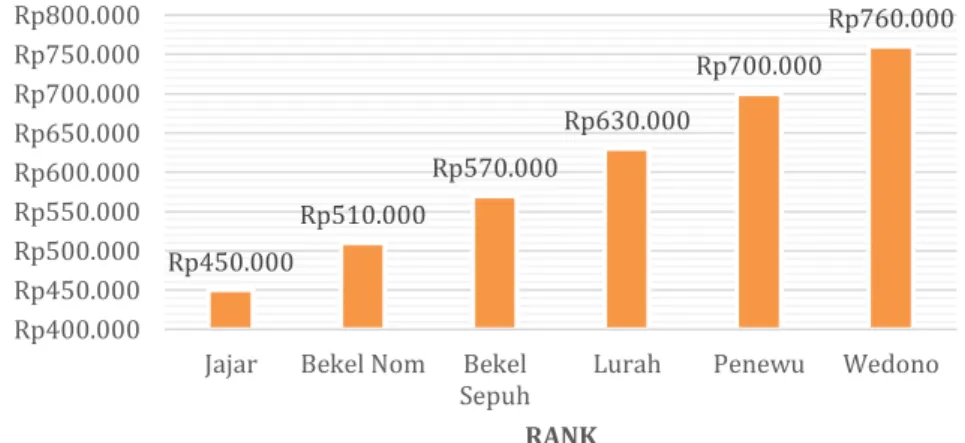
is nominally based on the title and rank of Abdi Dalem. The higher the rank, the greater the additional wages received. The number of funds given is as follows:
Figure 2. Abdi Dalem Caos Special Allocation Fund
The figure 2, contains a list of special funds for Caos Abdi Dalem starting from Jajar, Bekel Nom, Bekel Sepuh, Lurah, Penewu, to Wedono.The Special Allocation Fund above is one of the additional blessings that does not affect Abdi Dalem sincerity to the Sultan (Sa’adah, 2017).
Although welcomed with joy, Abdi Dalem still did not expect the number of bonuses obtained. All that is given to them is gratitude, regardless of the amount. The nominal difference in each rank of Abdi Dalem is only around USD 4,01. Explanations related to wages (kekucah) and additional funds received by Abdi Dalem still show minimal numbers to meet a decent life. Article 88 of Law No. 11 of 2020 states that wage policies are applied to protect workers, including the minimum wage, to complete a decent livelihood for humanity. So, the sultan of Yogyakarta Kraton, as an employer, must provide wages based on the minimum wage of districts and provinces.
For a courtier, devoting himself to Kraton is a high honor. The reason for becoming a courtier is to gain inner peace and happiness. Abdi Dalem was also grateful to have been allowed to live on the Sultan's estate. One of the factors obtained from being a courtier is getting Dalem blessing. In addition, they believe that only the chosen ones can be servants of dalem, and there is luck that comes and can meet his family's needs after becoming a courtier dalem. Therefore, it is okay if they are paid very low. However, by signing an employment contract, Kraton and Abdi Dalem have an agreed working relationship. That means there are laws in place because of such actions. Regarding working time, the Indonesian Job Creation Law mentions that every employer must implement the working time provisions. The provisions of the active time are stipulated in Article 77 paragraph (2), namely:
1. 7 hours a day and 40 hours a week for six working days a week, or
2. Eight hours a day and 40 hours a week for a working period of 5 days a week.
Rp450.000
Rp510.000
Rp570.000
Rp630.000
Rp700.000
Rp760.000
Rp400.000 Rp450.000 Rp500.000 Rp550.000 Rp600.000 Rp650.000 Rp700.000 Rp750.000 Rp800.000
Jajar Bekel Nom Bekel
Sepuh Lurah Penewu Wedono RANK
caos
Interestingly, the system arranged in such a way is not applied in the working environment of Abdi Dalem tomb of the king of Imogiri. Based on the study results, the authors found that the courtier of the tomb of the king of Imogiri only worked for 3 (three) days a week. Designated workdays are Sundays, Mondays, and Fridays. Working time also needs to meet the standards in the law provisions above. They only work from 10 am to 12 pm, meaning the working time of Abdi Dalem Tomb of King Imogiri is only 3 (three) hours a day. This situation violates the provisions of Article 77, paragraph (2). However, based on the exposure, Mr. Pancolo, one of the courtiers of the tomb of the king of Imogiri, said that Kraton's work system did not provide working time provisions. Abdi Dalem can work at any time. If there is a situation where the Sultan and his family need the help of a servant, then they should have time.
The reason for this policy is that the Kraton has no compulsion for someone to become a courtier. They agreed with the provisions provided by the Kraton because they believed that if they devoted themselves wholeheartedly to the Sultan and his family, the work done would feel light, and courtiers' lives would be guaranteed. Thus, the working time stated in Article 77 paragraph (2) never occurred or did not apply to Abdi Dalem. Abdi Dalem is not a conceptual volunteer worker. Although only working briefly in labor law, Abdi Dalem was categorized as a freelance day laborer. As in Article 10 of the Decree of the Minister of Manpower and Transmigration of the Republic of Indonesia Number Kep.100/Men/VI/2004, freelance day labor is only reserved for specific jobs that change in time and volume of work and wages based on attendance. Freelance day laborers are included in Specific Time Work Agreements, so agreements tied through oral agreements contradict the Act. The verbal agreement also regulates the fulfillment of rights and obligations. Although freelance day laborers are not guaranteed permanent, the life satisfaction given to freelance day laborers should be equivalent to that of a permanent worker, such as the wages employers give to workers.
The author understands that as a freelance day laborer, wages and work implementation provisions are based on mutual agreement. All binding provisions are permitted not to refer to the applicable rules. In the implementation of Abdi Dalem, it is clearly stated that the wages based on the Sultan's decree do not list the nominal given. Even the reward for Abdi Dalem is based on something other than the provincial and county minimum wage. This means that the provision of wages is based on the decision of the Sultan as the leader of the Yogyakarta palace by first conveying it to Abdi Dalem. Thus, an employment agreement from an employment relationship signifies the parties' agreement to the clauses, including wages or salaries provided. When referring to Government Regulation No. 36 of 2021 on Wages, the freelance daily worker will get a monthly wage based on daily calculations as long as he works under the following conditions:
1. Working time lasts for 6 (six) days a week, monthly wage divided by 25 (twenty-five) 2. Working time for 5 (five days) a week, wages divided by 21 (twenty-one)
Whereas if the determination of wages is based on the calculation of hourly wages, then the calculation of hourly wages is as follows:
Monthly Wages
Hourly Wage =
126
Although Abdi Dalem thought that his life had prospered with the availability of facilities as described earlier, it did not mean that a small amount of the problem of wages became neglected.
As a human being, the fulfillment of life needs must continue. Fulfillment can only be done if one has enough money. How will survival continue if a worker does not have adequate wages?
Therefore, there needs to be a minimum wage for Abdi Dalem, especially those in the king's tomb in Imogiri. This arrangement aims to protect workers from arbitrary ratings in earning a living wage to eradicate poverty and reduce economic inequality.
Standardization of the minimum wage is critical in determining the need for a decent living because improving welfare can also increase workers' productivity if the minimum wage is high (Holtemöller & Pohle, 2020). This statement contradicts previous research that stated that changes in wages for workers would result in 3 (three) things, one of which is a decrease in quality, including benefits and flexibility of schedules (Regmi, 2020). The above statement affirms the selfishness that shackles workers. The existence of adequate wages will encourage the spirit of workers to do the best thing. In addition, the nature of the work is to provide opportunities for workers to improve their quality of life.
In our country, there are several regions whose lifestyles may still follow the past where they had two sides of government. One state government is based on the presidency, and one side is the keratan or sultanate. This system functions to maintain the nation's culture and also the nobles who contributed to building that culture into a strong history. People's high belief in myths about civilization and also about life-based on caste is still very strong, but they also enjoy it. For us in a generation like mine, maybe it is something strange and strange, but for some, it is something unique and special that must be maintained and even mandatory but also does not ignore human values. For the sake of authenticity and maintaining culture, they sacrificed all their blood to obtain an honor that according to people outside was an extraordinary stupidity.
But it cannot be denied that the palace still has to raise and try to open up the implementation of humanizing all palace workers or servants in all their ranks like other human beings. Among them are work systems that may be combined with the modern era of government and the old era to create good harmonization. A salary that has clear standards to provide satisfaction to employees and facilitate their needs is indeed balanced. If the nominal amount is a symbol of maximum humanity, none of them will want to take part in recruitment which is voluntary and with all the conditions that have been determined.
That they are not complied with doesn't mean they don't know, but because they know more and love their predecessors and their homeland and their authentic identity more than they do themselves. Like a contract without written words and rules, like a vertical relationship between humans and their God, which makes them perhaps blind and even blind themselves to maintain the authentic existence of the Palace's identity. We cannot blame any party. What we can do apart from respecting the decisions of job owners and office holders, but ensuring that the other side of humanity can still be implemented is above all else.
If civil servants work based on PKWT or PKWTT then it is truly a serious violation of labor law. However, because their working relationship with the Yogyakarta Palace was no more than a casual daily work relationship, there was no violation as intended. Because the servants in the Tomb of the King of Yogyakarta only work 3 or 4 days a week and their working hours do not exceed those regulated by the laws in force in Indonesia. So that their legal relationship is more subject to the agreement agreed by the parties as regulated in legal agreements in general in the Civil Code. Remember the rights and obligations of the parties as follows as mentioned in Article 1 paragraph (14) of Law Number 13 2003 Concerning Employment. It is further confirmed in Article 51 paragraph (1) Law Number 13 of 2003 concerning Employment that employment agreements can be made verbally. The conditions for the validity of a work agreement refer to the legal conditions Civil agreements in general are as follows: a. There is an agreement between the parties (no coercion, dwaling-misdirection/mistake or bedrog-deception); b. The parties concerned have the ability or the ability to (act) carry out legal actions (capable of age and not under guardianship); c. There is an (object of) work agreed upon; And d. (Causa) The work agreed upon is not contradictory with public order, morality, and applicable laws and regulations (article 52 paragraph (1) of the Law Employment) (Shalihah & Nur, 2019).
Everyone has the right to decide what kind of life they live and what kind of job they want to have just to be secure and granted peace of mind. In the writer's point of view, a writer could not blame anyone for the government, keraton system, or the people. Abdi Dalem and being a Guard at The Thomb of King may cruelest job for everyone, They have to work without employment or clear management openly. But what I've seen is Those people take a step in, and They are aware of the consequences without complaining if we took from the part of normal workers it is like slavery, but They are willing to do so because of Their beliefs. And still, a lot of them wanna join in and be a part of the Keratons to guard and maintain our Identity.
Yogyakarta is a special place and special city in Indonesia, to protect all The natural culture they probably will keep that way to maintain the old system. The offer of being ab Abdi Dalem whatever the rank doesn't matter to them, it proves a pure love from the society and their people for their ancestor and their culture more than their blood. The bonding within them has already been connected since the day they were born in Their city. Writers may agree with a human right
and have the right of protection as a worker for them to bring justice, but we also should aware of their point of view on why they chose the path.
The Keraton also may need to upgrade some systems but doesn't have to change too much just to expose their incorporation with our country's system. We just need to respect their decision and give some advice if needed. If we are talking about working hours, agreements and so on. it's not going to work on them because They are already set and determined to understand what the term and condition value. Unless They are being forced to be so I am just speechless and hats off to Them who could accept and sacrifice Their youth to be servants in The Keraton.
The standardization of the welfare of life is not money, but without money, a prosperous life is just wishful thinking. Based on the above facts, creating welfare as another right that Abdi Dalem has is challenging to explain. In theory, the welfare obtained by Abdi Dalem can be said to have not been fulfilled because the wages given to Abdi Dalem are still below the minimum wage. This is undoubtedly a criminal act that receives the threat of punishment. However, different circumstances are shown in practice. Abdi Dalem, tomb king in Imogiri, claimed to have earned welfare even with the provision of wages below the minimum wage. It was considered fair by them when it was an act that violated the law. This is a form of ius contra legem, whichever ius contra legem. It is a legal principle that is the Act of overriding the law when the laws and regulations cause injustice so that the judge must side with justice by the rule of law or laws that have been established.
In this case, the regulation of the law regarding employment, primarily related to wages, was ruled out based on an agreement made by the Yogyakarta Kraton with the king's tomb in Imogiri, which has been poured in the form of a seat kekancingan/determination letter that the Yogyakarta Kraton has issued.
2.3. Problems of employment relations in the culinary sector
In every tourism destination apart from natural resources and cultural heritage, there are also other tourism objects, which are no less famous than other tourist objects. So tourism objects apart from natural resources and cultural heritage are culinary objects. In this case, culinary services are also one of the tourism objects that have become tourism icons, especially those that we will examine in the Special Region of Yogyakarta.
In a relatively short period, the development of culinary tourism after Covid-19 has returned to normal, as evidenced by culinary tourism visits which are increasing day by day. Visits are becoming more significant every day as evidenced by the density of culinary tourism which is considered an icon of Yogyakarta. In the culinary business, attention must be paid to the working relationships between workers and restaurant owners themselves. This research was conducted in the Special Region of Yogyakarta, where DIY has one city and four districts, including Yogyakarta City, Sleman Regency, Bantul Regency, Gunungkidul Regency, and Kulon Progo Regency. Therefore, we took samples from 2 districts, namely Sleman Regency and Bantul
Regency. Data collection for this research was carried out through direct interviews with workers.
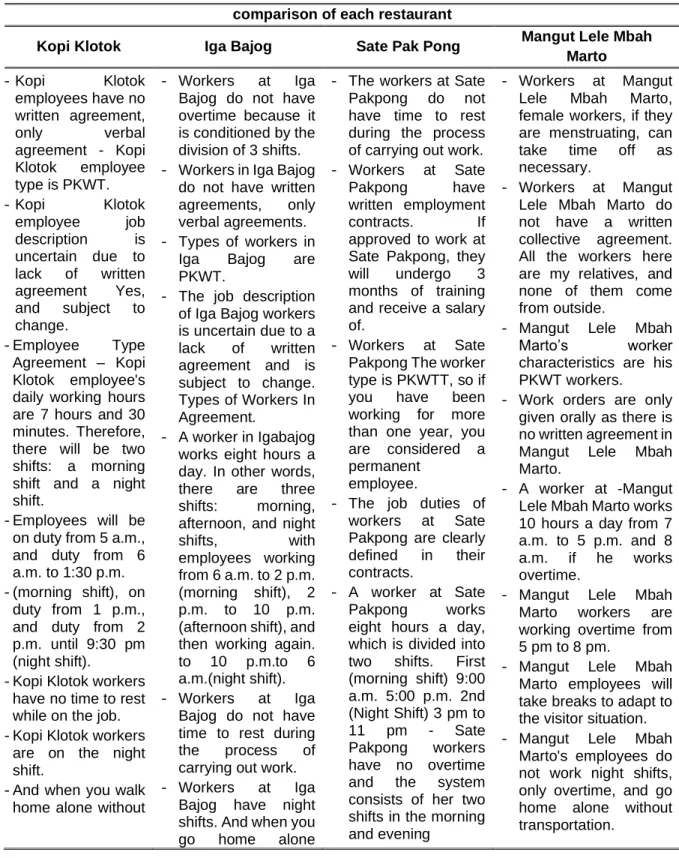
The following is data that researchers obtained from interviews with 4 workers at restaurants that are considered icons of the city of Yogyakarta. Data obtained from workers includes:
Table 1. Research Interview Results comparison of each restaurant
Kopi Klotok Iga Bajog Sate Pak Pong Mangut Lele Mbah Marto
-
Kopi Klotok employees have no written agreement, only verbal agreement - Kopi Klotok employee type is PKWT.-
Kopi Klotok employee job description is uncertain due to lack of written agreement Yes, and subject to change.-
Employee Type Agreement – Kopi Klotok employee's daily working hours are 7 hours and 30 minutes. Therefore, there will be two shifts: a morning shift and a night shift.-
Employees will be on duty from 5 a.m., and duty from 6 a.m. to 1:30 p.m.-
(morning shift), on duty from 1 p.m., and duty from 2 p.m. until 9:30 pm (night shift).-
Kopi Klotok workers have no time to rest while on the job.-
Kopi Klotok workers are on the night shift.-
And when you walk home alone without-
Workers at Iga Bajog do not have overtime because it is conditioned by the division of 3 shifts.-
Workers in Iga Bajog do not have written agreements, only verbal agreements.-
Types of workers in Iga Bajog are PKWT.-
The job description of Iga Bajog workers is uncertain due to a lack of written agreement and is subject to change.Types of Workers In Agreement.
-
A worker in Igabajog works eight hours a day. In other words, there are three shifts: morning, afternoon, and night shifts, with employees working from 6 a.m. to 2 p.m.(morning shift), 2 p.m. to 10 p.m.
(afternoon shift), and then working again.
to 10 p.m.to 6 a.m.(night shift).
-
Workers at Iga Bajog do not have time to rest during the process of carrying out work.-
Workers at Iga Bajog have night shifts. And when you go home alone-
The workers at Sate Pakpong do not have time to rest during the process of carrying out work.-
Workers at Sate Pakpong have written employment contracts. If approved to work at Sate Pakpong, they will undergo 3 months of training and receive a salary of.-
Workers at Sate Pakpong The worker type is PKWTT, so if you have been working for more than one year, you are considered a permanentemployee.
-
The job duties of workers at Sate Pakpong are clearly defined in their contracts.-
A worker at Sate Pakpong works eight hours a day, which is divided into two shifts. First (morning shift) 9:00 a.m. 5:00 p.m. 2nd (Night Shift) 3 pm to 11 pm - Sate Pakpong workers have no overtime and the system consists of her two shifts in the morning and evening-
Workers at Mangut Lele Mbah Marto, female workers, if they are menstruating, can take time off as necessary.-
Workers at Mangut Lele Mbah Marto do not have a written collective agreement.All the workers here are my relatives, and none of them come from outside.
-
Mangut Lele Mbah Marto’s worker characteristics are his PKWT workers.-
Work orders are only given orally as there is no written agreement in Mangut Lele Mbah Marto.-
A worker at -Mangut Lele Mbah Marto works 10 hours a day from 7 a.m. to 5 p.m. and 8 a.m. if he works overtime.-
Mangut Lele Mbah Marto workers are working overtime from 5 pm to 8 pm.-
Mangut Lele Mbah Marto employees will take breaks to adapt to the visitor situation.-
Mangut Lele Mbah Marto's employees do not work night shifts, only overtime, and go home alone without transportation.anyone coming to pick you up.
-
Kopi Klotok workers must continue towork during
menstruation.
-
Kopi Klotok worker gets 2 days holiday for 1 month.-
Money may be paid if you do not start your vacation within one month.-
Kopi Klotok employees,especially female employees, are entitled to leave and receive their full salary even if they are pregnant.
-
Kopi Klotok workers earn 1.2 million yen per month.-
Kopi Klotok workers have no annual leave, only two days off per month.-
Kopi Klotok workers do not receive social insurance like BPJS, but if a worker falls ill, they are immediately taken to the nearest PKU.-
Not a single worker was fired at Kopi Klotok.-
Kopi Klotok workers have the right to retire for reasons such as marriage, circumcision of a child, baptism, death of a family member, etc.-
Kopi Klotok has approximately 60 employees.-
Workers at KopiKlotok are
dissatisfied with the
without anyone to pick you up.
-
Workers at Iga Bajog are still required to work even though femaleworkers are
menstruating.
-
Workers at Iga Bajog, especially female workers, if they are pregnant,can take
approximately 1 week off.
-
Workers at Iga Bajog receive wages according to the Sleman Yogyakarta UMK-
Workers at Iga Bajog do not have annual leave.-
Workers in Iga Bajog do not receive social security like BPJS.However, the owner is fully responsible if his employees have an accident while working.
-
No workers at Iga Bajog were laid off-
Workers at Iga Bajog have the right to leave regarding marriage, child circumcision, child baptism, family death, etc. The longest is about 1 week-
The number of workers at Iga Bajog is approximately 50 people.-
The workers at Iga Bajog have a complaint that while working at Iga Bajog, they find that many visitors are impatient when waiting for orders.-
The workers at Sate Pakpong have night shifts, but when they come home from work they use their private vehicles without anyone picking them up.-
Workers at Sate Pakpong, especially female workers, ifthey are
menstruating, they still work
-
Workers at Sate Pakpong, especially women, if they are pregnant, can take leave for 3 months.-
Workers at Sate Pakpong have wages according to Yogyakarta UMR.-
Workers at Sate Pakpong have annual leave-
Workers at Sate Pakpong receive social security, namely BPJS-
No workers at Sate Pakpong are laid off, however, if a worker resigns, they will receivecompensation (and the amount of compensation depends on how long the worker has been there)
-
Workers at Sate Pakpong get their leave rights such as marriage, child circumcision, child baptism, family death, etc.-
Workers at Sate Pakpong have 10 days off in 1 month-
Pakpong Sate Restaurant has 3 branches. and the-
Workers at Mangut Lele Mbah Marto, female workers who are pregnant can take leave as they wishbecause the
employees are
relatives.
-
The workers at Mangut Lele Mbah Marto's wages are kept secret.-
None of the workers at Mangut Lele Mbah Marto are permanent employees, and there is no annual leave.However, if you want to take time off, just say so.
-
The workers at Mangut Lele Mbah Marto do not have social security, but the owner is fully responsible for his workers because all the workers are his relatives.-
None of the workers at Mangut Lele Mbah Marto were laid off.-
For workers at Mangut Lele Mbah Martoregarding the
fulfillment of leave rights (such as marriage, child circumcision, child baptism, death in the family, etc.), so for leave, just contact the owner directly and for how long.
-
The number of workers at Mangut Lele Mbah Marto is 15 people-
The workers at Mangut Lele Mbah Marto don't have monthly holidays for 1 month of work, buttake holidays
according to the agreement between the owner and the workers, such as
number of enthusiastic and noisy visitors they encounter while working at Kopi Klotok.
-
Workers at Iga Bajog have 4 working holidays, during 1 month of worktotal number of
workers is
approximately 150 people
holidays, celebrations, etc. so the restaurant doesn't have holidays every working day and there are no shifts.
Obstacles experienced during research include, several restaurants are considered tourism icons in Yogyakarta, such as Sate Ratu Restaurant, Gudeg Yu Jum Restaurant, Jejamuran Restaurant, Mie Ayam Tumini which are reluctant to be interviewed, the workers are not willing to be interviewed, at When interviewing workers, they are reluctant to be interviewed because they are afraid of saying something wrong and are afraid of being reprimanded by the owner which will result in layoffs, etc. Therefore, we took the initiative to ask workers to contact the owner directly from one of these restaurants. We found that the owner of one of the restaurants was reluctant to be interviewed and asked us to interview other restaurants.
From the results of the interview above, it is evident that there are still restaurants that pay wages lower than the minimum wage to workers. This is strictly regulated in Article 81 number 25 of the Job Creation Law. Furthermore, wages can be determined based on an agreement between employers and workers in the company. However, wage arrangements determined by agreement between employers and workers/laborers or trade/labor unions may not be lower than the wage provisions stipulated in statutory regulations. This means that the wage agreement between workers/laborers and the company must be above the provincial minimum wage or district/city minimum wage set by the governor (Moonti, 2019). If in the agreement, the wages paid turn out to be lower or contrary to statutory regulations, the agreement can be null and void and wage arrangements are carried out under the provisions of statutory regulations. But in practice, there are still many restaurants that violate these rules for their benefit by reducing wages.
Talking about legal protection for workers in the tourism sector, especially restaurants, in the 1945 Constitution, article 27 paragraph (2) states that every citizen has the right to work and a living that is worthy of humanity. The state is obliged to be present in protecting work norms to ensure that workers/laborers rights relating to rest, working hours, and the like are guaranteed.
The author believes that it is important for the government to make every effort to implement policies to run the country based on the principle of public interest which prioritizes the welfare of many people (Budisetyowati, 2017). The goal of a state itself is to protect the general public, as a result of a Welfare State ideology where the government is the party that has responsibility for realizing the welfare of the community. Government organizations can prepare and implement various expected procedures (Manossoh, 2015; Meiyani, 2018).
Apart from being regulated in the PP on Wages, the Job Creation Law also regulates that in principle employers are prohibited from paying workers wages lower than the minimum wage.
On the other hand, employers are obliged to pay wages to workers in accordance with the agreement which must not be lower than the wage provisions stipulated in statutory regulations.
It should be noted that the minimum wage also applies to workers with less than 1 year of service at the company concerned. Meanwhile, wages above the minimum wage are determined based on an agreement between employers and workers. However, the application of UMP and UMK provisions is excluded for micro and small businesses. Entrepreneurs who pay workers wages lower than the minimum wage could potentially be sentenced to prison for a minimum of 1 year and a maximum of 4 years and/or a fine of at least IDR 100 million and a maximum of IDR 400 million.
CONCLUSION
The tourism sector has been able to create jobs through various types of tourism-related businesses that can be utilized by workers. Even though many workers are involved in various activities in the tourism sector, various problems always accompany wage or salary gaps, and worker concentration. The results of research from two tourism objects, namely culinary tourism research and cultural heritage tourism, prove that there are two different conclusions, namely:
First, workers at culinary tourism attractions, there are still restaurants that provide wages lower than the minimum wage to their workers in employment relationships based on fixed working time agreements or indefinite working time agreements. This is a clear violation of workers' rights as stated in Law Number 6 of 2023 Article 88 paragraph (2). In this article, the central government establishes a wage policy as an effort to realize the rights of workers/laborers to a decent living for humanity. This policy includes setting a minimum wage every year. Furthermore, wages can be determined based on an agreement between employers and workers in the company.
However, wage arrangements determined based on an agreement between employers and workers/laborers or workers/labor unions cannot be lower than the wage provisions regulated in statutory regulations. This means that the wage agreement between the worker/laborer and the company must be above the provincial minimum wage or district/city minimum wage set by the governor. If in the agreement it turns out that the wages paid are lower or contrary to statutory regulations, then the agreement can be null and void, and wage arrangements are carried out in accordance with the provisions of statutory regulations. Second, the workers at the Kings Tombs tourist attraction, that workers at the Kings Tombs, wage arrangements by the employer do not conflict with labor law because the employment relationship is based on Abdi Dalem status as a casual daily worker, because the worker is only work three or four days a week. Moreover, the number of hours worked in a day does not exceed the legal provisions in force in Indonesia. The offer to become an Abdi Dalem, whatever their rank, is not a problem for them. This reflects the genuine love of the community and its people for their ancestors and culture, beyond the importance of their blood. If indeed the courtiers or restaurant workers are just casual daily workers who do not work full time during the six-day work week. A maximum of twenty-one days
in one month, according to Law Number 13 of 2003 article 1 number 14 and the Job Creation Law article 81 number 25, from these articles it can be concluded that the amount of wages does not violate labor law. Because it refers to the Civil Code where the amount of wages permitted depends on the agreement between the parties. However, if it turns out that there is a work agreement for a certain period of time that does not comply with what is determined by the law that has been regulated, especially if it exceeds the working time per day and does not include overtime, then the agreement can be null and void and wage arrangements are carried out in accordance with the provisions of the laws and regulations. invitation.
REFERENCE
Adiati, M. P. (2013). Analisis Mengenai Problematika yang Dihadapi Karyawan Wanita di Bidang Perhotelan. Binus Business Review, 4(1), 102–110.
Angel Barrasa, C. L.-G. (2016). Social Psychology. International Journal of Psychology, 51(S1), 1036–1106. https://doi.org/10.1002/ijop.12351
Barančoková, M., & Barančok, P. (2020). The Evaluation of the Potential of Developing Tourism in Kysuce Region. Ekológia (Bratislava), 39(4), 380–400. https://doi.org/10.2478/eko-2020- 0030
BPS D.I. Yogyakarta. (2023). Kunjungan Wisatawan Mancanegara per Bulan Menurut Kebangsaan (2) 2023. https://yogyakarta.bps.go.id/indicator/16/342/1/kunjungan- wisatawan-mancanegara-per-bulan-menurut-kebangsaan-2-.html
BPS D.I. Yogyakarta. (2023). Kunjungan Wisatawan Mancanegara per Bulan Menurut Kebangsaan (2) 2023. https://yogyakarta.bps.go.id/indicator/16/342/1/kunjungan- wisatawan-mancanegara-per-bulan-menurut-kebangsaan-2-.html
Brink, W., Kuang, X. (Jason), & Majerczyk, M. (2021). The effects of minimum-wage increases on wage offers, wage premiums and employee effort under incomplete contracts.
Accounting, Organizations and Society, 89, 101195.
https://doi.org/10.1016/j.aos.2020.101195
Budisetyowati, D. A. (2017). Prinsip-Prinsip Good Governance dalam Pelayanan Publik. Al-Qisth Law Review, 1(1), 11.
Candia, S., Pirlone, F., & Spadaro, I. (2020). Integrating the carrying capacity methodology into tourism strategic plans: A sustainable approach to tourism. International Journal of Sustainable Development and Planning, 15(3), 393–401.
https://doi.org/10.18280/ijsdp.150317
Che Ahmat, N. H., Arendt, S. W., & Russell, D. W. (2019). Effects of minimum wage policy implementation: Compensation, work behaviors, and quality of life. International Journal of Hospitality Management, 81, 229–238. https://doi.org/10.1016/j.ijhm.2019.04.019
Galvin, D. J. (2016). Deterring Wage Theft: Alt-Labor, State Politics, and the Policy Determinants of Minimum Wage Compliance. Perspectives on Politics, 14(2), 324–350.
https://doi.org/10.1017/S1537592716000050
Hidayah, O. A. N. (2017). Sistem Pemerintahan Kraton Yogyakarta Pada Masa Perang Kemerdekaan Tahun 1945-1951. Risalah, 4(1).
Holtemöller, O., & Pohle, F. (2020). Employment effects of introducing a minimum wage: The
case of Germany. Economic Modelling, 89, 108–121.
https://doi.org/10.1016