Organized and supported by
International Conference
Language Technologies for All (LT4All):
Enabling Linguistic Diversity and Multilingualism Worldwide
in the framework of
the 2019 International Year of Indigenous Languages 4 - 6 December 2019
UNESCO Headquarters, Paris, France Conference programme at a glance In partnership with
Page 2 of 22 Programme
5 December 2019 (Room II)
Day 2. ACHIEVEMENT
Applying language technologies for linguistic diversity and multilingualism
(Room II and Poster Area: Hall Segur)08:00-09:00 Registration 09:00-10:15 Opening Session
Moderator: Mr Moez Chakchouk, Assistant Director-General for Communication and Information, UNESCO
Mr Moez Chakchouk Assistant Director- General for
Communication and Information
UNESCO
Ms Anne Karin Olli
Ms Dorothy Gordon
Vice Minister
Chair
National Government,
Ministry of Local Government and Modernisation
UNESCO Intergovernmental Information for All Programme (IFAP)
Norway
Ghana
Ms Aiolupotea Sina Aiono
Deputy Chief Executive, Regional Partnerships
New Zealand Ministry for Pacific Peoples
New Zealand
Mr Khalid Choukri Secretary General European Language Resources Association (ELRA) and Special Interest Group: Under-resourced languages (SIGUL)
France
Ms Lixin Tian Director-General Department of Language Information Management, Ministry of Education
The People’s Republic of China
Introduction of the LT4ALL: Language Technologies for All by the co-chairs of LT4All Day 2-3 10:15-10:30 Ms Sakriani Sakti Associate Professor, Nara Institute of Science and
Technology, Japan
Secretary of SIGUL, ELRA-ISCA Special Interest Group of Under-Resourced Languages
Mr Joseph Mariani Senior Researcher, LIMSI-CNRS, France Honorary President of ELRA, France Mr Khalid Choukri Secretary-General, European Language
Resources Association / ELRA CEO
Page 3 of 22
10:30-11:00 Session Keynote 1
Moderators:
Mr Marko Grobelnik Researcher, Jozef Stefan Institute, Slovenia
Mr Heather Souther Program Coordinator, Prairies to Woodlands, Indigenous Language Revitalization Circle, Canada
Rapporteur:
Ms Eugenia Urrere Director, Latinoamerica Habla, Argentina
Mr Daan van Esch Senior Technical Program Manager, Google, Inc., USA Building Language Technologies for Everyone
11:00-11:30 Poster Session P1: Pacific Languages Coffee Break - Poster Area Hall Segur
Moderators/Rapporteurs:Mr Steven Bird Professor, Charles Darwin University, Australia
Ms Apolonia Tamata Senior Culture & Heritage Specialist, iTaukei Trust Fund, Fiji Ms Isabella Shields Research Assistant, University of Auckland, New Zealand
P.1.1 Ms Ana Krajinovic Humboldt-Universität zu Berlin/The University of Melbourne Germany/Australia
Ms Ana Krajinovic, Ms Rosey Billington, Mr Lionel Emil, Mr Gray Kaltap̃au and Mr Nick Thieberger
Building capacity for community-led documentation in Erakor, Vanuatu
P.1.2 Ms Amanda Harris University of Sydney, Australia Ms Amanda Harris and Mr Nick Thieberger
PARADISEC (Pacific and Regional Archive for Digital Sources in Endangered Cultures)
P.1.3 Mr Paul Nelson SIL International, USA Mr Paul Nelson
Bloom Books
P.1.4 Ms Isabella Shields University of Auckland, New Zealand
Ms Isabella Shields, Ms Catherine Watson, Mr Peter Keegan, Ms Rebekah Berriman and Ms Jesin James
Creating a Synthetic Te Reo Māori Voice
Page 4 of 22
11:30-13:00 Session 5: Innovative aspects related to applications of Language Technologies in various areas, products and services
Moderators:
Ms Febe de Wet Research Associate, Stellenbosch University, South Africa Mr Hermann Ney Professor, RWTH Aachen University, Germany
Rapporteur:
Ms Ethel Ong Associate Professor, De La Salle University, Philippines
11:30 – 11:40 Mr Shehzad Mevawalla Director Alexa Speech Recognition, Amazon, USA Alexa, how do language technologies work?
11:40 – 11:50 Mr Kelly Davis Machine Learning Group Manager, Mozilla, Germany Common Voice and Deep Speech: Democratizing Speech Corpora and Tools
11:50 – 12:00 Mr Dmitriy Genzel Research scientist manager, Facebook, Inc., USA Large-scale content understanding on Facebook
12:00 – 12:10 Mr Radu Florian Senior Manager and Distinguished Research Staff Member, IBM Research AI, (USA)
The Journey to Multilingual Watson: Best Practices for Building NLP Models for New Languages
12:10 – 12:20 Mr Shijin Wang Dean of iFLYTEK AI Research, IFLYTek, China How do Speech Translation Technologies work in iFLYTEK Translator
12:20 – 12:30 Mr Amit Kumar Pandey
President, Chief Science Officer (CSO), Chief Technology Officer (CTO), Hanson Robotics, China
Language Technologies, Social Robots and the Society- The needs, challenges and the impact
Page 5 of 22
12:30-13:00 Panel discussion
13:00-14:30 Poster Session 2: European and Arctic Languages
During Lunch Break - Poster Area Hall Segur
Moderators/Rapporteurs:Ms Teresa Lynn Research Fellow, ADAPT Centre, Dublin City University, Ireland Mr Daniil Kocharov Associate Professor, Saint Petersburg State University, Russian
Federation
Mr Vicent Fenollar Policy and Outreach Manager, Network to Promote Linguistic Diversity (NPLD), Belgium
P.2.1 Mr Peter Bouda Poio
Mr Peter Bouda
Poio - Open Source Technology for Language Diversity
P.2.2 Mr Thierry Declerck DFKI GmbH
Mr Simon Krek, Mr Thierry Declerck, Mr John Philip McCrae and Ms Tanja Wissik Towards a Global Lexicographic Infrastructure
P.2.3 Mr Laurent Kevers Università di Corsica Pasquale Paoli Mr Laurent Kevers, Ms Stella Retali-Medori, Mr Florian Guéniot and Ms A. Ghjacumina Tognotti
Tooling up a less-resourced language with NLP : the example of Corsican and the
"Banque de Données Langue Corse" (BDLC, Corsican Language Database)
P.2.4 Ms Anna Nikulásdóttir Grammatek ehf Ms Anna Nikulásdóttir
Language Technology Program for Icelandic
P.2.5 Mr Philippe Boula de Mareüil LIMSI-CNRS
Mr Philippe Boula de Mareüil, Mr Gilles Adda, Mr Albert Rilliard and Mr Frédéric Vernier A speaking atlas of indigenous languages of France and its Overseas
P.2.6 Mr Aidar Khusainov Institute of Applied Semiotics of the Tatarstan Academy of Sciences Mr Dzhavdet Suleymanov, Mr Aidar Khusainov and Mr Rinat Gilmullin
Software and Linguistic Resources for the Tatar language preservation and development: Regional Experience
P.2.7 Ms Victoria Bobicev Technical University of Moldova Ms Victoria Bobicev, Ms Catalina Mărănduc, Mr Tudor Bumbu, Ms Ludmila Malahov, Mr Alexandru Colesnicov and Ms Svetlana Cojocaru
Contribution to the Universal Dependencies Treebank of Non-Standard Romanian Texts
Page 6 of 22 P.2.8 Ms Claudia Soria Consiglio Nazionale delle Ricerche -
Istituto di Linguistica Computazionale "A.
Zampolli"
Ms Claudia Soria and Mr Cor van der Meer
Inquiring about digital use and usability of minority languages: the approach of the Digital Language Diversity Project
P.2.9 Ms Patricia Serbac University of Tîrgu-Mureș Ms Patricia Serbac
Language Technologies for Istro-Romanian
P.2.10 Ms Birna Arnbjörnsdóttir Vigdis Institute, University of Iceland Ms Birna Arnbjörnsdóttir and Ms Auður Hauksdóttir
Innovative CALL Solutions and the Sustainability of Nano Languages in the North West Arctic Region
P.2.11 Mr Brendan Molloy The Techno Creatives Mr Brendan Molloy
Indigenous/Minority Language Keyboard and Spell Checking Support, for Desktop and Mobile Operating Systems
P.2.12 Mr Damien Nouvel Inalco ERTIM Mr Damien Nouvel, Mr Driss Sadoun and Mr Mathieu Valette
MultiTAL : an online platform to list NLP tools for under-resourced languages P.2.13 Mr Valeriy Pylypenko Speech Science and Technology
Department International
Research/Training Center for Information Technologies and Systems, Kyiv
Mr Valeriy Pylypenko and Ms Tetyana Lyudovyk
Automatic Recognition of mixed Ukrainian-Russian Speech
P.2.14 Mr Mikel L. Forcada Universitat d'Alacant Mr Mikel L. Forcada and Mr Francis Tyers
Apertium: a free/open-source platform for machine translation and basic language technology
P.2.15 Ms Oana Niculescu The Romanian Academy Institute of Linguistics “Iorgu Iordan – Al. Rosetti”
Ms Oana Niculescu, Ms Maria Marin and Ms Daniela Răuțu
Rediscovering past narrations: the oral history of the Romanian language preserved within the national phonogramic archive
P.2.16 Mr Trond Trosterud U Tromso Mr Sjur Moshagen, Ms Lene Antonsen and Mr Trond Trosterud
Language technology for indigenous languages: Achievements and challenges
P.2.17 Ms Tracey Herbert First Peoples Cultural Council Ms Lorna Williams, Ms Tracey Herbert and Mr Daniel Yona
Using technology to empower Indigenous knowledge sharing
P.2.18 Ms Sabine Kirchmeier Dansk Sprognævn/Danish Language Council & Kirchmeier.dk
Ms Sabine Kirchmeier
European Language Monitor by EFNIL
Page 7 of 22 P.2.19 Ms Amel Fraisse Université de Lille
Ms Amel Fraisse, Mr Ronald Jenn, Ms Shelley Fisher Fishkin and Mr Zheng Zhang Preserving Endangered European Cultural Heritage and Languages Through Translated Literary Texts
P.2.20 Ms Benedicte Haraldstad Frostad The Language Council of Norway Ms Benedicte Haraldstad Frostad
Towards ASR that recognises everyone in a country with no spoken standard P.2.21 Mr Jack Rueter University of Helsinki, Digital Humanities Mr Jack Rueter
Komi Latin-Alphabet Letters Not Found in Unicode
P.2.22 Mr Niko Partanen University of Helsinki Mr Niko Partanen, Mr Michael Rießler and Mr Thierry Poibeau
Developing technologies for low-resource Uralic languages: Case studies on Saami and Komi varieties
P.2.23 Ms Maria Eskevich CLARIN ERIC Ms Maria Eskevich and Ms Franciska de Jong
Understanding culture and society with the language resources and tools offered through the CLARIN Research Infrastructure
P.2.24 Mr Alexey Karpov St. Petersburg Institute for Informatics and Automation of the Russian Academy of Sciences
Mr Alexey Karpov, Mr Ildar Kagirov, Mr Dmitry Ryumin and Mr Alexander Axyonov A Multimodal Database of Russian Sign Language
P.2.25 Mr Mikkel Rasmus Logje The Sámi Parliament Mr Mikkel Rasmus Logje
Sámi languages
P.2.26 Mr Tamás Váradi MTA Research institute for Linguistics Mr Marko Tadić and Mr Tamás Váradi
LT Data Free for All
P.2.27 Ms Jacqueline Brixey USC Institute for Creative Technologies Ms Jacqueline Brixey, Mr Seyed Hossein Alavi and Mr David Traum
Can we use a spoken Dialogue System to document Endangered Languages?
P.2.28 Ms Adrià Martín-Mor Universitat Autònoma de Barcelona Ms Adrià Martín-Mor
Technologies for Endangered Languages: The Case of the Languages of Sardinia
Page 8 of 22
14:30-16:15 Session 6: Scientific aspects related to the state of the art in Language Technologies, for spoken, written and sign languages
Moderators:
Mr Volker Steinbiss General Manager AppTek, Germany
Ms Ximena Guttierez-Vasques Postdoctoral Researcher, Universität Zürich, Switzerland Rapporteur:
Ms Dessi Puji Lestari Head of Research and Development of Artificial Intelligence Research Centre, Bandung Institute of Technology /
Prosa.ai, Indonesia
14:30-14:40 Ms Judith Klavans Senior Research Scientist, University of Maryland, USA
Achievements and Contributions from Natural Language Processing (NLP) 14:40-14:50 Mr Jean Senellart CEO, Systran, France
NMT4All (Neural Machine Translation for All) 14:50-15:00 Mr Alex Waibel
Mr Sebastian Stüker
Professor, Director, Karlsruhe Institute of Technology, Institute for Anthropomatics and Robotics, Germany
Associate Fellow, Karlsruhe Institute of Technology (KIT), and CEO, Karlsruhe Information Technology Solutions – kites GmbH
Communicating with Everybody: Going the Extra Mile toward Automatic Simultaneous Interpretation for All
15:00-15:10 Ms Aijun Li Professor, Institute of Linguistics,
Chinese Academy of Social Sciences, China Handling Prosody and Tone Languages
15:10-15:20 Mr Ahmed Ali Principal Engineer, Qatar Computing Research Institute, Hamad Ben Khalifa University, Qatar Dialectal Speech Processing: Past, Present, Future
15:20-15:30 Mr Roger Moore Professor of Spoken Language Processing, University of Sheffield, UK
Talking with Robots: Opportunities and Challenges
15:30-15:40 Mr Thomas Hanke Researcher, Universität Hamburg, Germany Recent Advances on Sign Language Technologies
Page 9 of 22
15:40-16:15 Panel Discussions
16:15-16:45 Poster Session 3: Latin America and the Caribbean Languages Coffee Break - Poster Area Hall Segur
Moderators/Rapporteurs:
Mr Francisco Cláudio Samapaio de Menezes
Adjunct Professor, University of Brasilia, Brazil
Mr Marco Antonio Martínez Pérez Activist, Kumoontun, Mexico
Ms Anuschka van ‘t Hooft Professor, Autonomous University of San Luis Potosí, Mexico
P.3.1 Mr Jhonnatan Rangel INALCO-SeDyL Jhonnatan Rangel
Challenges for language technologies in Ayapaneco P.3.2 Mr Michael Gasser Indiana University Mr Michael Gasser
Mainumby: computer-assisted Spanish-to-Guarani translation
P.3.3 Mr Maximiliano Duran Université Franche-Comté Mr Maximiliano Duran
Baby Quechua robot
P.3.4 Ms Cynthia Montaño Universidad Nacional Autónoma de México Ms Cynthia Montaño, Mr Gerardo Sierra Martínez and Ms Gemma Bel-Enguix
On the development of the Mexican Languages Parallel Corpus
P.3.5 Ms Tajëëw Díaz Colmix
Ms Tajëëw Díaz
Project: Endless Oaxaca Multilingual
P.3.6 Ms Alejandrina Cristia Laboratoire de Sciences Cognitives et
Psycholinguistique (ENS, EHESS, CNRS), Département d'Etudes Cognitives, Ecole Normale Supérieure, PSL Research University
Ms Camila Scaff, Mr Marvin Lavechin and Ms Alejandrina Cristia
Large-scale audio-recordings to study infant language acquisition
P.3.7 Ms Vania Ramírez UNAM
Ms Vania Ramírez
Nierika Red Social para aprender y enseñar una lengua indígena
P.3.8 Ms Purvi Shah Pratham Books
Ms Purvi Shah
Preserving indigenous languages in south and central America by leveraging open licensing and technology
P.3.9 Ms Ximena Gutierrez-Vasques UNAM Ms Ximena Gutierrez-Vasques and Mr Victor Mijangos
Page 10 of 22 Comunidad Elotl. Language Technologies for Mexico's Indigenous Languages
P.3.10 Ms Emiliana Cruz CIESAS-CDMX Ms Emiliana Cruz
Language and Landscape: Hiking and Documenting the Chatino Language of San Juan Quiahije
P.3.11 Mr Luis Flores Martínez National Institute of indigenous languages of Mexico (INALI)
Mr Luis Flores Martínez
Resources and digital materials in Mexico’s indigenous languages P.3.12 Mr Marco Martinez Kumoontun
Mr Marco Martinez Ayöök, México
16:45-18:15 Session 7: Infrastructural aspects
Moderators:
Mr Mark Liberman Professor, University of Pennsylvania, USA
Ms Amanda Harris Research Fellow, Director of PARADISEC Sydney unit PARADISEC, University of Sydney, Australia
Rapporteur:
Mr Alexey Karpov Head of the Speech & Multimodal Interfaces Lab. St. Petersburg Institute for Informatics and Automation of the Russian Academy of Sciences, Russian Federation
16:45-16:55 Ms Denise di Persio Associate Director, Linguistic Data Consortium University of Pennsylvania, USA
The Linguistic Data Consortium: Developing and Distributing Language Resources4All
16:55-17:05 Mr Yohei Murakami Associate Professor, Risumeikan University, Japan Language Sphere: A Socio-Technical Approach to Bilingual Dictionary Creation for Indigenous Languages
17:05-17:15 Mr Craig Cornelius Senior Software Engineer, International Engineering Google, Inc. USA
Every Language on the Web - How Unicode makes it happen!
17:15-17:25 Mr Carl Rubino Research Program Manager, IARPA, USA IARPA’s Contribution to Low Resource HLT Development and Evaluation
17:25-17:35 Mr Sanjeev Khudanpur
Associate Professor, The Johns Hopkins University, USA
Open source toolkits and Tutorial/Summer school
17:35-17:45 Mr Georg Rehm Principal Researcher and Research Fellow, DFKI GmbH, Germany
European Language Grid: Language Technologies for Europe
Page 11 of 22
17:45-18:15 Panel discussion
18:30-20:30 Social event (Welcome Reception Hall Segur)
Moderators/Rapporteurs:
Ms Sakriani Sakti Associate Professor, Nara Institute of Science and Technology, Japan
Secretary of SIGUL, ELRA-ISCA Special Interest Group of Under-Resourced Languages, France
Mr Joseph Mariani Senior Researcher, LIMSI-CNRS, France;
Honorary President of ELRA, France
Mr Khalid Choukri Secretary General, European Language Resources Association / ELDA CEO, France
Special event (1) Mr Tunde Adegbola
Executive Director, African Languages Technology Initiative (Alt-i), Nigeria
Yoruba Drum Language: Implications for Language Technology
Special event (2) Mr Rory O'Connor
Chief Executive Officer, Yugambeh Museum, Australia How Yugambeh's Aboriginal language revitalisation has helped shape Woolaroo, an App for all Indigenous languages
Page 12 of 22 Programme 6 December 2019
Day 3. CHALLENGES:
Addressing the digital divide and multilingualism
(Room II and Poster area: Hall Segur)
09:00-09:30 Session Keynote 2:
Moderators:
Ms Tanja Shultz Professor, University of Bremen, Cognitive Systems Lab, Germany
Mr Justus Roux Researcher, South African Centre for Digital Language Resources (SADiLaR), South Africa
Rapporteur:
Mr Priyankoo Sarmah Associate Professor, Indian Institute of Technology Guwahati, India
09:00-09:30 Ms Lorna Williams Board Member; Prof Emerita, First Nations Cultural Foundation; University of Victoria, Canada
Wa7 szum’in’stum’ ti nqwelutenlhkalha - Technology and Indigenous Language Revitalization, Recovery and Normalization
09:30-11:00 Session 8: Minority and Indigenous Languages
Moderators:
Mr Yoshinori Sagisaka Professor, Waseda University, Japan
Ms Sonja Bosch Professor, University of South Africa, South Africa Rapporteur:
Ms Claudia Soria Researcher, Consiglio Nazionale delle Ricerche, Italy
09:30-09:40 Mr Borja L.C. Patrocino Antonino
Universidade Nacional de Timor Leste, Timor Leste Speech Technology for Indigenous Language in Timor Leste
09:40-09:50 Ms Evelyn Fogwe Chibaka
Professor of Linguistics, University of Buea, Cameroon Language Technology Applications in Africa within an “Inclusive, innovative and reflective”
crisis Interface
09:50-10:00 Ms Fadoua Ataa Allah Director, Centre des Etudes Informatiques, IRCAM, Morocco
The IRCAM Realizations for the Amazigh Preservation and Revitalization in Morocco
Page 13 of 22 10:00-10:10 Ms Aili Keskitalo President of the Sami Parliament and Co-chairs of the
Steering Committee of International Year of Indigenous Languages, Norway
The voices of Indigenous Languages in the infinite cyberspace
10:10-10:20 Ms Cecilia Piaggio Founder / Program Director, Latinoamérica Habla / RWS Moravia, Argentina
Our learnings when rolling out tech initiatives in Qom
10:20-10:30 Ms Apolonia Tamata Senior Culture & Heritage Specialist, iTaukei Trust Fund, Fiji
Challenges with indigenous minority languages and language technologies
10:30-11:00 Panel discussion
11:00-11:30 Poster Session 4: African Languages
Coffee Break - Poster Area Hall Segur
Moderators/Rapporteurs:Ms Dorothy Beermann Professor, Norwegian University of Science and Technology, Norway
Ms Evelyn Fogwe Chibaka Professor of Linguistics, University of Buea, Cameroon Mr Audace Niyonkuru Chief Executive Officer, DIGITAL UMUGANDA, Rwanda
P.4.1 Ms Marissa Griesel University of South Africa Ms Sonja Bosch and Ms Marissa Griesel
African Wordnet – digital documentation and preservation of indigenous knowledge
P.4.2 Ms Brigitte BIGI LPL, CNRS, Aix-en-Provence,
(France) Ms Brigitte BIGI
Automated Speech Segmentation: Example of an African Language
P.4.3 Z Steyn SADiLaR
Z Steyn
Establishing Sustainable Infrastructures for African Languages
P.4.4 Ms Febe De Wet Stellenbosch University
Ms Febe De Wet, Mr Ewald Van der Westhuizen and Mr Thomas Niesler
A South African Corpus of Multilingual Code-switched Soap Opera Speech
P.4.5 Mr Valentin Vydrin INALCO
Mr Valentin Vydrin
Corpora Mandeica: text corpora for Mande languages (West Africa)
P.4.6 Ms Kerry Jones African Tongue and Stellenbosch
University Ms Kerry Jones
Page 14 of 22 Missing link: A centralised digital archive for endangered languages of southern
Africa
P.4.7 Mr Christopher Cieri Linguistic Data Consortium, University of Pennsylvania Mr Christopher Cieri and Mr Mark Liberman
Using Citizen Linguistics to Empower Indigenous Communities
P.4.8 Mr Lulamile Mzamo North-West University
Mr Lulamile Mzamo, Mr Albert Helberg and Ms Sonja Bosch
Heuristic guided probabilistic graphic language modelling for morphological segmentation of isiXhosa
P.4.9 Ms Febe De Wet Stellenbosch University
Mr Astik Biswas, Ms Febe De Wet, Mr Herman Kamper, Raghav Menon, Mr Thomas Niesler, Mr Armin Saeb, Mr John Quinn, Mr Ewald Van der Westhuizen and Emre Yilmaz
Radio-browsing in support of relief and development work in rural Africa
P.4.10 Ms Martha Yifiru Tachbelie Addis Ababa University Ms Martha Yifiru Tachbelie, Mr Solomon Teferra Abate and Ms Tanja Schultz
Analysis of Language Relatedness for the Development of Multilingual Automatic Speech Recognition for Ethiopian Languages
P.4.11 Mr Lucas Ondel Brno University of Technology Mr Lucas Ondel and Mr Lukas Burget
Automatic Learning of a Phonological System: a Case Study on the Mboshi Language
P.4.12 Mr Seid Yimam Universität Hamburg
Mr Seid Yimam and Mr Chris Biemann
Current Status, Issues, and Future Directions for Ethiopian Natural Language Processing (NLP) Research
P.4.13 Mr Martin Benjamin Kamusi Project International Mr Martin Benjamin
ACALAN: Platform for African Language Empowerment (PALE)
P.4.14 Mr Moses Ekpenyong University of Uyo Mr Moses Ekpenyong, Ms Eno-Abasi Urua and Mr Aniefon Akpan
SCAnnAL – An Automatic Speech Corpus Annotator for African Speech Corpora
P.4.15 Mr Damien Nouvel Inalco ERTIM
Mr Elvis Mboning and Mr Damien Nouvel
NTeALan - Artificial Intelligence, Development and Promotion of African National Languages
P.4.16 Mr Sunday Ojo Tshwane University of Technology Mr Sunday Ojo
Grappling with Opportunities and Challenges in developing Language Technologies for Under-resourced African Languages
P.4.17 Ms Fatiha Sadat UQAM
Mr Houssein Ahmed Assowe and Ms Fatiha Sadat
Towards the First Low-Resource French-Somali Machine Translation System
Page 15 of 22
P.4.18 Ms Fatiha Sadat UQAM
Bilal Belainine and Ms Fatiha Sadat
Automatic Dialect Detection in Arabic Broadcast Media
P.4.19 Mr Abdoulaye Barry Winden Jangen
Mr Abdoulaye Barry and Mr Ibrahima Barry The ADLaM Story
11:30-13:00 Session 9: Activities for language preservation, reclamation, and enhancement
Moderators:
Ms Cyntia Montaño Project Manager, Grupo de Ingeniería Lingüística, Mexico
Mr Mikel Lorenzo Forcada Zubizarreta Professor, Universitat d'Alacant, Spain Rapporteur:
Mr Satoshi Tamura Associate Professor, Gifu University, Japan
11:30-11:40 Mr Steven Bird Professor, Charles Darwin University, Australia Designing for Language Revitalisation
11:40-11:50 Ms Mandana Seyfeddinipur
Endangered Languages Documentation Programme, Director, SOAS University of London, UK
We just scratched the surface: 16 years of supporting endangered languages documentation
11:50-12:00 Mr Alan Black Professor, Carnegie Mellon University, USA Using found data to build speech recognition and speech synthesis for all languages 12:00-12:10 Mr Antti Arppe Associate Professor, University of Alberta, Canada 21st century language technology and tools meet 21st century challenges and
opportunities
12:10-12:20 Ms Jeannette Stewart Founder, Translation Commons, USA Translation Commons: No Language and No Linguist Left Behind
12:20-12:30 Mr David Traum Research Professor, University of Southern California, USA
Conversations with History: Spoken dialogue technology to preserve culture and language
Page 16 of 22
12:30-13:00 Panel discussion
13:00-14:30 Poster Session 5: Asian Languages
Lunch Break - Poster Area Hall Segur
Moderators/Rapporteurs:Ms Budi Irmawati Lecturer, University Mataram, Indonesia
Mr Lorang Yun Secretariat Coordinator, Cambodia Indigenous Peoples Alliance, Cambodia
Mr Netra Mani Rai Language Development Project Adviser, International Nepal, Nepal
P.5.1 Mr Thierry Declerck DFKI GmbH
Mr John McCrae and Mr Thierry Declerck Linguistic Linked Open Data for All
P.5.2 Mr Mohammad Nurul Huda United International University and eGeneration Ltd.
Mr Mohammad Nurul Huda
Bangla Text and Spoken Language Technology
P.5.3 Mr Bal Krishna Bal Department of Computer Science and Engineering, Kathmandu University, Nepal
Mr Bal Krishna Bal, Mr Amrit Yonjan Tamang and Mr Lasang Jimba Tamang Envisioning a Trilingual Machine Translation System for the Language Pairs –
<Tamang –English –Nepali>
P.5.4 Mr Marc Durdin SIL International
Mr Marc Durdin, Mr Sok Makara, Mr Joshua Horton and Ty Rasmey Keyman: High Fidelity Text Input for All Languages
P.5.5 Ms Natsuko Nakagawa National Institute for Japanese Language and Linguistics
Ms Natsuko Nakagawa, Mr Masahiro Yamada, Mr Kenan Celik, Ms Nobuko Kibe and Mr Yukinori Takubo
Digital archiving and museum for language documentation and revitalization in Japan
P.5.6 Ms Sunayana Sitaram Microsoft Research India Ms Sunayana Sitaram, Mr Monojit Choudhury and Ms Kalika Bali
Project Mélange: Speech and Language Technologies for Code-switching
P.5.7 Mr Martin Raymond SIL International
Mr Martin Raymond and Mr Peter Martin
Providing smart, open fonts for the world’s language communities
P.5.8 Ms Dessi Puji Lestari Institut Teknologi Bandung Ms Ayu Purwarianti, Ms Dessi Puji Lestari and Mr Teguh Eko Budiarto
Page 17 of 22 InaNLP: Indonesian Natural Language Processing Tools API
P.5.9 Mr Alexis MICHAUD CNRS - LACITO
Ms Séverine Guillaume, Mr Balthazar Do Nascimento and Mr Alexis MICHAUD
The Pangloss Collection: an open archive of under-documented languages designed with Natural Language Processing in view
P.5.10 Mr Virach Sornlertlamvanich Faculty of Data Science, Musashino University
Mr Virach Sornlertlamvanich, Mr Teguh Eko Budiarto and Ms Thatsanee Charoenporn Multi-lingual Support in Connective Learning Scheme for Refining and Connecting the Open Educational Videos
P.5.11 Ms Ethel Ong De La Salle University
Ms Ethel Ong, Ms Nathalie Rose Lim-Cheng, Ms Charibeth Cheng and Mr Edward Tighe Promoting and Preserving Philippine Culture and Languages through Language Technologies
P.5.12 Mr Virach Sornlertlamvanich Faculty of Data Science, Musashino University
Ms Thatsanee Charoenporn and Mr Virach Sornlertlamvanich Improvement of Thai NER and the Corpus
P.5.13 Ms Kalika Bali Microsoft Research Labs
Ms Kalika Bali, Mr Monojit Choudhury, Ms Sunayana Sitaram and Mr Sebastin Santy Deploying Language Technologies for Underserved Communities
P.5.14 Ms Angelina Aquino University of the Philippines Diliman Ms Angelina Aquino and Mr Rhandley Cajote
Language Technologies at the University of the Philippines DIliman
P.5.15 Mr Tenzin Namgyel Dzongkha Development Commission Mr Tenzin Namgyel
Languages and Technology in Bhutan
P.5.16 Mr Ramakrishnan Angarai Ganesan Indian Institute of Science Mr Ramakrishnan AngaraiGanesan
Language technology at MILE Lab, Indian Institute of Science
P.5.17 Mr Udaya Narayana Singh Amity University Haryana Udaya Narayana Singh
Multilingual profile of India
P.5.18 Mr Udaya Narayana Singh Amity University Haryana Mr Udaya Narayana Singh, Ms Esha Jainiti, Ms Rusha Mudgal and Ms Anwita Maiti Mediating Multilingualism
P.5.19 Mr Vijay Kumar Ministry of Electronics and Information Technology Vijay Kumar and Dr S K Srivastava
Technology Development for Indian Languages
P.5.20 Ms Purvi Shah Pratham Books
Ms Purvi Shah
Page 18 of 22 Creating access to openly licensed early reading resources in Asia’s indigenous
languages
P.5.21 Mr Virach Sornlertlamvanich Faculty of Data Science, Musashino University
Ms Ari Yanase, Ms Thatsanee Charoenporn and Mr Virach Sornlertlamvanich Conversational Bot for Eyesight Testing Automation
P.5.22 Mr Arbi Haza Nasution Universitas Islam Riau Mr Arbi Haza Nasution and Mr Totok Suhardijanto
Dictionary 4.0: Alternative Presentations for Indonesian Multilingual Dictionaries
P.5.23 Ms Viyazonuo Terhiija Indian Institute of Technology Guwahati
Ms Viyazonuo Terhiija, Mr Samudra Vijaya and Mr Priyankoo Sarmah Speech Technology in three tonal languages of North-East India
P.5.24 Ms Win Pa Pa University of Computer Studies, Yangon
Ms Win Pa Pa
Bringing Zero-resourced Languages of Myanmar to the Digital World
P.5.25 Mr Totok Suhardijanto University of Indonesia Mr Totok Suhardijanto and Ms Arawinda Dinakaramani
Building Corpora for Under-Resourced Languages in Indonesia
P.5.26 Mr Ritesh Kumar Department of Linguistics, Dr.
Bhimrao Ambedkar University, Agra Mr Ritesh Kumar, Ms Bornini Lahiri, Mr Atul Kr. Ojha, Mr Mayank Jain and Mr Deepak Alok Language Resources and Technology Development Efforts for some Lesser-known Indian Languages
P.5.27 Mr David Yarowsky Johns Hopkins University
Mr David Yarowsky, Mr Arya D. McCarthy, Mr Garrett Nicolai, Mr Winston Wu, Mr Aaron Mueller, Mr Dylan Lewis, Ms Yingqi Ding, Mr Abhinav Nigam, Mr Emre Ozgu, Mr Debanik Purkayastha, Mr James Scharf and Mr Kenneth Zheng
A 1000-language Collaborative Universal Dictionary and Universal Translator P.5.28 Mr Nathaniel Oco De La Salle University Mr Nathaniel Oco
Tagalog-English Code-Switching: Challenges for Automatic Detection
P.5.29 Ms Fatiha Sadat UQAM
Mr Tan Ngoc Le and Ms Fatiha Sadat
How a low-resource named entities recognition and transliteration framework for Vietnamese can improve the automatic machine translation ?
P.5.30 Mr Shyam Sundar Agrawal KIIT College of Engineering, Gurgaon
Ms Shweta Sinha and Mr Shyam Sundar Agrawal
Situation and challenges of technologies for indigenous languages of India
P.5.31 Mr Craig Cornelius Google, Inc.
Mr Craig Cornelius
Unicode for Indigenous Languages - Standards and technology for getting online
Page 19 of 22
P.5.32 Wei Wang Institute of Linguistics, Chinese
Academy of Social Sciences Wei Wang, Ms Aijun Li and Ms Danqing LIU
CASS-LING’s Linguistic Infrastructure: Resources, Platforms and Services
14:30-16:00 Session 10: Scientific aspects related to handling language diversity
Moderators:
Mr Laurent Besacier Professor, LIG - University Grenoble Alpes (France) Mr Ossama Emam IBM Senior Technical Staff Member, IBM Egypt, (Egypt) Rapporteur:
Mr Nathaniel Oco De La Salle University (Philippines)
14:30-14:40 Ms Odette Scharenborg
Associate Professor, Delft University of Technology, Netherland
Towards speech technology for unwritten languages 14:40-14:50 Mr Satoshi
Nakamura
Professor, Nara Institute of Science and Technology, Japan
Semi-supervised learning: Machine Speech Chain, Code-switch & Automatic Interpretation
14:50-15:00 Mr TrondTrosterud, Mr Sjur Nørstebø Moshagen
Professor of Saami Language Technology
Chief Engineer, UiT The Arctic University of Norway, Norway
Rich morphology, no corpus - and we still made it. The Sámi experience 15:00-15:10 Mr Holger Schwenk Professor, Facebook, France
Mining for Multilingual Resources on the WEB
15:10-15:20 Mr Brian Roark Research Scientist, Google, Inc. USA Text entry for All
15:20-15:30 Ms Kalika Bali Principal Researcher, Microsoft Research Labs India, India
Evaluating Speech Data and Technology for Indian Languages
Page 20 of 22
15:30-16:00 Panel discussion
16:00-16:30 Poster Session 6: North America Languages
Coffee Break - Poster Area Hall Segur
Moderators/Rapporteurs:Mr Chris Cieri Adjunct Associate Professor, Linguistics; Executive Director, Linguistic Data Consortium, University of Pennsylvania, USA Mr Francis Tyers Assistant Professor, Indiana University, USA
Mr Jan Trmal Associate Research Scientist, Johns Hopkins University, USA
P.6.1 Ms Lynne Bowker University of Ottawa
Ms Lynne Bowker
Machine Translation 4 All: Developing informed and critical users through a program of machine translation literacy
P.6.2 Ms Marie-Odile Junker Carleton University Ms Marie-Odile Junker and Delasie Torkornoo
Building a common Digital Infrastructure to sustain Algonquian Languages P.6.3 Ms Emily Prud'hommeaux Boston College
Ms Emily Prud'hommeaux, Mr Robert Jimerson, Mr Richard Hatcher, Mr Raymond Ptucha and Ms Karin Michelson
On the promise and pitfalls of repurposing existing language technologies for endangered language documentation
P.6.4 Ms Alexa Little 7000 Languages
Ms Alexa Little, Ms Kayleigh Jeannette and Ms Kelsey Riggs
7000 Languages: Free Language-Learning Software for Language Reclamation
P.6.5 Mr Aidan Pine National Research Council Canada
Mr Aidan Pine, Mr Nathan Brinklow, Ms Heather Souter and Ms Delaney Lothian National Research Council Canada Indigenous Language Technology Project P.6.6 Ms Lane Schwartz University of Illinois at Urbana-
Champaign
Ms Lane Schwartz, Ms Emily Chen, Ms Hayley Park, Ms Sylvia Schreiner and Mr Benjamin Hunt
St. Lawrence Island Language Technology for Documentation & Revitalization
P.6.7 Delaney Lothian University of Alberta
Ms Delaney Lothian, Ms Daniela Teodorescu, Mr Denilson Barbosa and Ms Carrie Demmans Epp
Building a Language Model of Nehiyawewin (Cree, Y-dialect)
P.6.8 Mr Roy Boney Cherokee Nation
Page 21 of 22 Mr Roy Boney
From Talking Leaves to Pixels: The Evolution of the Cherokee Syllabary P.6.9 Ms Jacqueline Brixey USC Institute for Creative
Technologies Ms Jacqueline Brixey
ChoCo: A multimodal corpus for the Choctaw language
P.6.10 Ms Fatiha Sadat UQAM
Ms Fatiha Sadat, Mr Tan Ngoc Le and Mr David Huggins Daines
Issues and challenges of NLP in relation to Canada's Aboriginal languages
16:30-17:30 Session 11: Developing Language Technologies for All:
Best Practices
Moderators:Ms Delyth Prys Head of Language Technologies, Bangor University, UK Ms Astrid Berengere Mengue Project Coordinator, Center for Human Rights and
Democracy in Africa, Cameroon Rapporteur:
Ms Emiliana Cruz Researcher, CIESAS-CDMX, Mexico
16:30-16:40 S.K. Srivastava Senior Director/Scientist G, Government of India, Ministry of Electronics and IT, India
Technology Development for Indian Languages: Government Initiatives 16:40-16:50 Mr Juan Steyn Project Manager
South African Centre for Digital Language Resources South Africa
The South African Research Infrastructure Roadmap and national mandate of the South African Centre for Digital Language Resources
16:50-17:00 Mr Vaine Tutai Richard
Language Programme Lead, Ministry for Pacific Peoples, New Zealand
Lalanga Fou: weaving a new collaborative and regional approach to ensure the survival of Pacific languages, cultures and identities in Aotearoa New Zealand and the Pacific Oceania region through technology
17:00-17:10 Mr Aodhán Mac Cormaic
Director, Ministry for Culture, Heritage and the Gaeltacht, Ireland
Language technologies in the language planning framework for Irish 17:10-17:20 Mr Norberto
Zamora
Chief of Department, Instituto Nacional de los Pueblos Indígenas - Departamento de Medios Digitales, Mexico Códice México
17:20-17:30 Ms Tracey Herbert
Chief Executive Officer, First Peoples' Cultural Council, Canada Indigenous perspective on developing and maintaining an Indigenous curated Technology to support language revitalization
Page 22 of 22
17:30-18:30 Session 12: The Future of Language Technologies for All:
Outcome Document, Recommendations, and Closing remarks
Moderators and Rapporteurs :
Mr Moez Chakchouk Assistant Director-General for Communication and Information, UNESCO
Mr Khalid Choukri Secretary General, European Language Resources Association / ELDA CEO
Mr Gilles Adda
Rapporteurs from Day One
Researcher, LIMSI-CNRS, France Member of the ELRA Board
Proceedings of the Language Technologies for All (LT4All), pages 147–150 Paris, UNESCO Headquarters, 5-6 December, 2019.
c 2019 European Language Resources Association (ELRA), licenced under CC-BY-NC
147
Dictionary 4.0: Alternative Presentations for Indonesian Multilingual Dictionaries
Arbi Haza Nasution, Totok Suhardijanto
Informatics Engineering Department Universitas Islam Riau, Linguistics Department Universitas Indonesia Pekanbaru Riau Indonesia, Jakarta Indonesia
[email protected], [email protected]
Abstract
Building a multilingual dictionary for 719 languages in Indonesia is a challenging task. We have developed application to create the Leipzig-Jakarta list database for all indigenous languages in Indonesia. The database can be used to generate lexical similarity or lexical distance matrix between languages by comparing the word list. For starter, we covered 11 languages: Indonesian, Javanese, Sundanese, Madurese, Bima, Ternate, Tidore, Palembang Malay, Mandailing Batak, Malay, and Minangkabau. The application has two main features: exploring the existing translations and adding translations to a new language or editing existing translations through crowdsourcing. User acceptance test showed 3.48/4 score.
Keywords:multilingualism, multilingual dictionary, lexical network, lexical computation, computational linguistics Abstrak
Membangun kamus multibahasa untuk 719 bahasa di Indonesia adalah tugas yang berat. Kami telah mengembangkan aplikasi untuk membuat pangkalan data daftar Leipzig-Jakarta untuk semua bahasa daerah di Indonesia. Pangkalan data tersebut dapat digunakan untuk menghasilkan kesamaan leksikal atau matriks jarak leksikal antar bahasa dengan membandingkan daftar kata tersebut. Sebagai permulaan, aplikasi ini mencakup 11 bahasa: Indonesia, Jawa, Sunda, Madura, Bima, Ternate, Tidore, Melayu Palembang, Batak Mandailing, Melayu, dan Minangkabau. Aplikasi ini memiliki dua fitur utama: menjelajahi terjemahan yang ada dan menambahkan terjemahan ke bahasa baru atau mengedit terjemahan yang ada melalui mekanisme urun daya. Uji keberterimaan pengguna menunjukkan skor 3,48 / 4.
1. Introduction
According to (Eberhard et al., 2019), there are 719 lan- guages in Indonesia, where 707 languages are still alive and 12 languages have become extinct. Extinct in this sense is that there are no longer any of the speakers. Among the sur- viving languages, 701 languages are local languages and 6 languages are not local languages. Furthermore, there are 18 languages that are used as administrative and / or edu- cational languages, 73 languages are still growing, 188 lan- guages are classified as strong, 347 languages are in diffi- culty, and 81 languages are in a danger of extinction.
Furthermore, based on his observations, (Anderbeck, 2015) groups Indonesian languages into three groups. First, about two of the four languages in Indonesia today still have a vi- tal life force and have a safe number of speakers (EGIDS (Expanded Graded Intergenerational Disruption Scale) 1- 6a). In this group, intergenerational transmission of speak- ers still occurs and persists. Even though some of them are bilingual, they know when to use local and Indone- sian languages. Second, one of the four languages in In- donesia is in fragile condition (EGIDS 6b Threatened) with speakers who continue to decline in number. Usually most young people still learn their mother tongue, but certain reasons make them change their orientation towards lan- guages that are more economically advantageous. Third, the rest, one of the four languages in Indonesia seems to be dying (EGIDS 7-8b) or may have become completely ex- tinct (EGIDS 9 and 10). Some, like the Marori language, may be lost in a generation. The other may be in two or three generations. With conditions like that, of course, we are like racing with time to document language.
Although some experts distinguish the terms of language documentation and language description (Austin and Sal- labank, 2011), in some ways, the two are interconnected.
According to Austin, the documentation and description of languages differ in their purpose, points of interest, re- search methods, workflow, and outcomes. Descriptions or language descriptions basically aim at producing grammar, dictionaries, and collections of texts, the target users are generally linguists, and the material produced is sometimes written in a framework that is accessible to trained lin- guists. In contrast, language documentation is discourse- centered, the main objective being the direct representa- tion of as many types of discourse as possible (Austin, 2007; Woodbury, 2003; Himmelmann, 1998). However, according to (Austin and Grenoble, 2007) the documenta- tion project must rely on the application of theoretical and descriptive linguistic techniques so that the resulting output is sure to be utilized and understood by many communities.
So, in other words, documentation and description are ac- tivities with objectives and outcomes that complement each other, and one of their important outcomes is the result of lexicographic work, the dictionary.
In the context of endangered languages, dictionaries have a very crucial role, namely storing what is left of endan- gered languages and cultures by recording valuable infor- mation that might be lost (Cristinoi and Nemo, 2013). The bilingual dictionaries are also useful for natural language processing researchers, especially for those related with enrichment of language resources like bilingual dictionary (Nasution et al., 2016; Nasution et al., 2017b; Nasution et al., 2017a; Nasution et al., 2018) or machine translation
148 (Nasution et al., 2017c; Nasution, 2018). Furthermore, in many cases, the existence of a dictionary can help revive a language and change the attitudes of speakers of that lan- guage which ultimately encourage them to use it as often as possible. Even so, (Cristinoi and Nemo, 2013) mentioned that there are some problems related to lexicography in the realm of language documentation. First, the compilers of endangered language dictionaries are generally people or linguists who care. Certainly, the result is different from the general dictionary compiled by a professional team. Sec- ondly, dictionaries made for endangered languages are cer- tainly far from direct economic profit. Third, the endan- gered language dictionaries have limited distribution, that is only to linguists or the public who have an interest in the language concerned. Fourth, in the work of lexicography in endangered languages there are several problems that must be resolved, for example what characters are used, which variations are considered standard, and so on. Fifth, data collection of endangered languages is more difficult be- cause it only relies on the ethnographic work of researchers or notes from concerned community members. Sixth, the dictionary of threatened languages ??is usually used for re- search purposes, documenting specific languages and cul- tures, protecting language and cultural heritage that will be lost without written traditions on the language or culture, helping indigenous people communicate in dominant for- eign languages, helping non-native speakers to understand the native speakers and their cultural background, and pro- vide orthography or standard written form for the entire vo- cabulary.
Because of the problems mentioned above, the data collec- tion of endangered language dictionaries is generally done with a limited number of vocabularies, generally focus on general vocabulary or even basic vocabulary lists. The list is a lexical artifact which is a vocabulary whose references are universally available in many languages in the same re- gion. In the condition of Indonesia which is multilingual, of course the problem becomes more complex. Over time, how do lexicographic studies contribute to language docu- mentation efforts, especially in terms of recording impor- tant and varied information about language and culture in Indonesia? Making multilingual dictionaries is not an easy task, especially from the point of computational lexicogra- phy (Walker, 1995). Thus, in this paper, we try to build a model that can accommodate the diversity of languages in Indonesia. This can be further elaborated with the ques- tion: how to compile dictionaries for languages in Indone- sia? What is the correct format of multilingual dictionaries that can help document languages in Indonesia? These two questions will be answered in this paper.
2. Methodology
In the 1950s, linguist Morris Swadesh published a list of 200 words called the Swadesh list, which were thought to be 200 lexical concepts found in all languages ??that were most unlikely to be borrowed from other languages (Swadesh, 1955). Swadesh then reduced the list to 100 items based on intuition where a drastic removal from a 200-word list was the best solution, with the considera- tion that quality is at least as important as quantity. Al-
though the new list has weaknesses, but the list is rela- tively light to process because of the small amount. Au- tomated Similarity Judgment Program (ASJP) (Brown et al., 2008) is an open source software with the main objec- tive to develop a Swadesh list database for all languages in the world where lexical similarity or lexical distance ma- trix between languages can be obtained by comparing the word list. However, the list of 100 Swadesh words was cut down to 40 words that are considered the most stable of forms of change, maintained over time and not replaced by other lexical items from the language itself or elements borrowed from other languages (Holman et al., 2008). The lexical distance between regional languages in Indonesia has been visualized using the ASJP database (Nasution and Murakami, 2019; Nasution et al., 2019). However, there are doubts about the validity of the lexical distance between some regional languages such as between Sundanese and Javanese which should be closer to the lexical distance but only 21.8% of lexical similarities are produced. Therefore, alternative word lists are needed that can produce more ac- curate lexical distances.
In addition to the Swadesh list, linguists also use the Leipzig-Jakarta list (100 words) (Tadmor et al., 2010) to test the level of chronological separation of languages by comparing words that are resistant to loans. The Leipzig- Jakarta list is available in 2009 (Sakel and Everett, 2012).
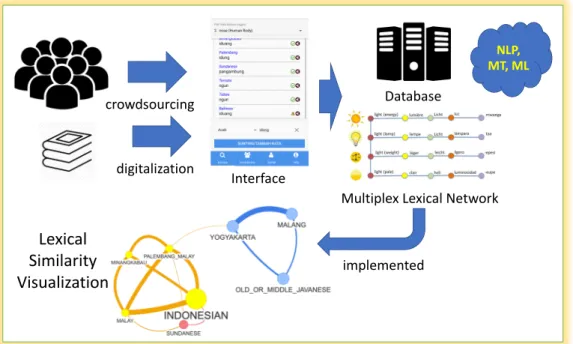
The mobile application developed in this paper aims to de- velop the Leipzig-Jakarta list database for all regional lan- guages in Indonesia where lexical similarity or lexical dis- tance matrix between languages can also be further ob- tained by comparing the word list. The application built will be tested for user satisfaction with quantitative analysis using a questionnaire. The proposed framework is depicted in Figure 1. The data will be used to generate visualiza- tion of Indonesian Indigenous Languages Lexical Similar- ity with Knowledge Graph.
3. Results
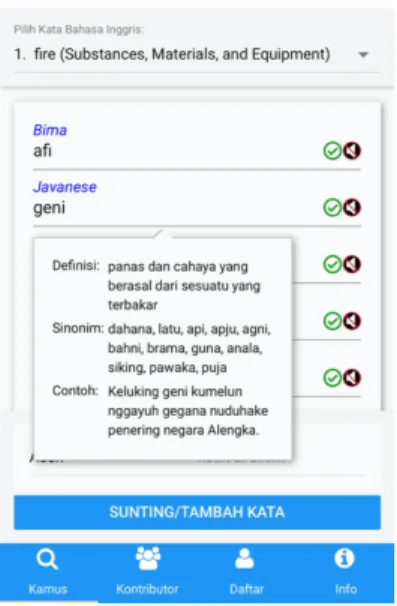
For the initial research, 100 Leipzig-Jakarta word lists were translated into 11 languages: Indonesian, Javanese, Sundanese, Madurese, Bima, Ternate, Tidore, Palembang Malay, Mandailing Batak, Malay, and Minangkabau. The application has two main features: exploring the transla- tions of the 100 Leipzig-Jakarta word list and adding trans- lations to new languages or changing translations that are already available. The exploration interface for translating 100 Leipzig word lists into 11 languages with the details of the translated words including the definition, synonyms and example use of the word in a sentence are shown in Figure 2.
To add a translation to a new language or change an al- ready available translation, the user should register to the system first using the registration form. After entering the user’s email address for verification, the user can click on the language selection dropdown, then the user can choose the destination language according to the language selec- tion feature, the last step, the user can type the translation according to the language of choice, and click the ”SUNT- ING / TAMBAH KATA” (which translated to EDIT / ADD WORDS) button, then the translation added / edited will be
149 digitalization
crowdsourcing Database
Multiplex Lexical Network Interface
Lexical Similarity Visualization
NLP, MT, ML
implemented
Figure 1: Proposed framework.
Figure 2: The definition, synonyms and example in sen- tence.
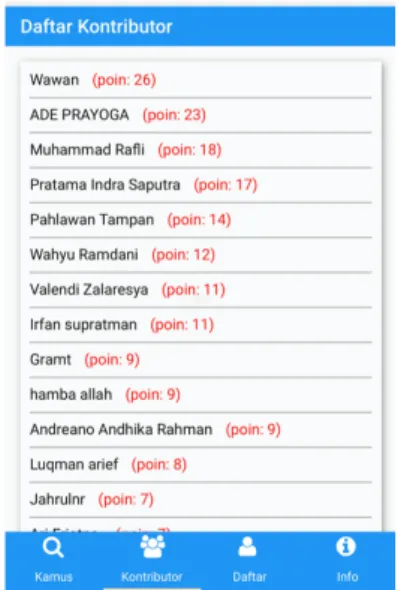
verified by the linguist. Finally, the user will get a poin for each translation added or edited, and another poin when the new translation or edition has been verified. The leader- board is shown in Figure 3.
The application that was built was tested by 36 random users with quantitative analysis using a questionnaire with 7 questions as shown in Table 1. Based on the results of the user satisfaction questionnaire with dictionary 4.0, the av- erage value for the whole questionnaire item was 3.48. This shows that the design and appearance of the Dictionary 4.0 Application is quite interesting, easy to use and accepted by users.
Figure 3: Leader board of contributor.
4. Conclusion
Until now, in this study, a multilingual dictionary prototype model with the functionality to collect data of various lan- guages was quickly compiled. Therefore, the focus in this paper is on the issue of setting up a language data collection system through a crowd sourcing mechanism. Meanwhile, in terms of usage, acceptance testing has been carried out to see how well the application design according to the user.
Based on these tests, we obtained quite interesting results, which is 3.48 from a scale of 4. The next stage of this re- search is to upgrade the dictionary 4.0 application that is capable of managing multilingual dictionary services with dedicated functions for general users and registered users.
In addition, the language similarity comparison function
150
Item Mean Median Standard Deviation
Appealing design and appearance 3.47 3 1.078
The design and appearance of the application is easy to understand 3.41 3 1.043
The navigation menu is easy to understand 3.37 3.5 1.157
The colors used in the application are suitable and not excessive 3.72 4 0.958
The application is easy to use 3.47 4 1.078
Easy to explore each word translation 3.47 4 1.047
It is easy to propose revision to existing translations or add new translations 3.47 3.5 1.047 Table 1: Results of user satisfaction questionnaire of dictionary 4.0
will be included using the lexical distance approach as in the ASJP database program.
5. Acknowledgements
This research was partially supported by Universitas Islam Riau.
6. Bibliographical References
Anderbeck, K. (2015). Portraits of language vitality in the languages of indonesia. Language documentation and cultural practices in the Austronesian world: Papers from, pages 19–47.
Austin, P. K. and Grenoble, L. (2007). Current trends in language documentation. Language documentation and description, 4:12–25.
Austin, P. K. and Sallabank, J. (2011). The Cambridge handbook of endangered languages. Cambridge Univer- sity Press.
Austin, P. K. (2007). Training for language documenta- tion: Experiences at the school of oriental and african studies. Documenting and revitalizing Austronesian lan- guages, pages 25–41.
Brown, C. H., Holman, E. W., Wichmann, S., and Velupil- lai, V. (2008). Automated classification of the world?
s languages: a description of the method and prelimi- nary results. STUF-Language Typology and Universals Sprachtypologie und Universalienforschung, 61(4):285–
308.
Cristinoi, A. and Nemo, F. (2013). Challenges in endan- gered language lexicography.
Eberhard, D. M., Simons, G. F., and Fennig, C. D. (2019).
Ethnologue: Languages of the world.
Himmelmann, N. P. (1998). Documentary and descriptive linguistics.
Holman, E. W., Wichmann, S., Brown, C. H., Velupillai, V., M¨uller, A., and Bakker, D. (2008). Explorations in au- tomated language classification.Folia Linguistica, 42(3- 4):331–354.
Nasution, A. H. and Murakami, Y. (2019). Visualizing lan- guage lexical similarity clusters: A case study of indone- sian ethnic languages. Journal of Data Science and Its Applications, 2(2):45–59.
Nasution, A. H., Murakami, Y., and Ishida, T. (2016).
Constraint-based bilingual lexicon induction for closely related languages. InProceedings of the Tenth Interna- tional Conference on Language Resources and Evalua- tion (LREC 2016), pages 3291–3298, Paris, France, May.
Nasution, A. H., Murakami, Y., and Ishida, T. (2017a).
A generalized constraint approach to bilingual dictio- nary induction for low-resource language families.ACM Trans. Asian Low-Resour. Lang. Inf. Process., 17(2):9:1–
9:29, November.
Nasution, A. H., Murakami, Y., and Ishida, T. (2017b).
Plan optimization for creating bilingual dictionaries of low-resource languages. In2017 International Confer- ence on Culture and Computing (Culture and Comput- ing), pages 35–41, Sept.
Nasution, A. H., Syafitri, N., Setiawan, P. R., and Suryani, D. (2017c). Pivot-based hybrid machine translation to support multilingual communication. In 2017 Interna- tional Conference on Culture and Computing (Culture and Computing), pages 147–148, Sept.
Nasution, A. H., Murakami, Y., and Ishida, T. (2018). De- signing a collaborative process to create bilingual dictio- naries of indonesian ethnic languages. InProceedings of the Eleventh International Conference on Language Re- sources and Evaluation (LREC 2018), pages 3397–3404, Paris, France, may. European Language Resources Asso- ciation (ELRA).
Nasution, A. H., Murakami, Y., and Ishida, T. (2019). Gen- erating similarity cluster of indonesian languages with semi-supervised clustering. International Journal of Electrical and Computer Engineering (IJECE), 9(1):1–
8.
Nasution, A. H. (2018). Pivot-based hybrid machine trans- lation to support multilingual communication for closely related languages. World Transactions on Engineering and Technology Education, 16(2):12–17.
Sakel, J. and Everett, D. L. (2012). Linguistic fieldwork: A student guide. Cambridge University Press.
Swadesh, M. (1955). Towards greater accuracy in lexico- statistic dating. International journal of American lin- guistics, 21(2):121–137.
Tadmor, U., Haspelmath, M., and Taylor, B. (2010). Bor- rowability and the notion of basic vocabulary.Diachron- ica, 27(2):226–246.
Walker, Z. C. (1995). Automating the lexicon: research and practice in a multilingual environment. Oxford Uni- versity Press.
Woodbury, A. C. (2003). Defining documentary linguis- tics. Language documentation and description, 1(1):35–
51.