
Mathematical modeling shows that the Page model is the most suitable model to describe the drying behavior of coffee beans using a hybrid solar dryer. Mathematical modeling shows that the Page model is the most suitable model to describe the drying behavior of coffee beans using a hybrid solar dryer.
Editor: Informasi artikel telah diterima (5 November 2019)
IJRED] Submission Acknowledgement
Reviewer: Komentar Reviewers 1 (7 Desember 2019)
IJRED] Editor Decision
Author: Jawaban Reviewers 1 (13 Desember 2019)
Int. Journal of Renewable Energy Development (IJRED)
Introduction
The hybrid solar drying system was constructed of natural convection solar dryer, natural convection thermal backup unit and recovery dryer. The drying efficiency of the hybrid solar drying for drying red chili was obtained as 9.9%. Mathematical models also allow for design and evaluation of dryer performance, control and optimization of the process, which is important for maintaining food safety and quality (Castro et al., 2018).
Among many drying models, thin-layer models are able to describe the drying phenomena in a unified way, regardless of the control mechanism. For agricultural products, the moisture content of the material has generally been exposed to a constant relative humidity, and temperature conditions are measured and correlated with the drying parameters. This type of drying does not require large areas and can be used in cloudy weather, an external intervention can also be minimized.
Therefore, the objectives of the research are to study the performance of hybrid solar dryer for coffee bean drying and solar drying without LPG burner. The drying curve and drying rate of coffee beans, drying temperature profile, energy analysis and mathematical modeling of hybrid solar dryers were also investigated.
Materials and Methods
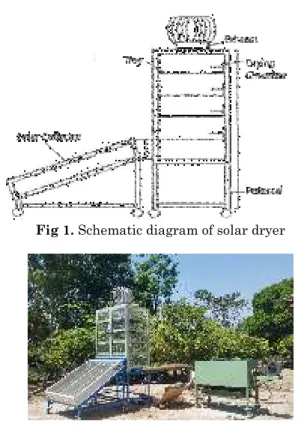
Since the measurements of some variables during the drying process can be quite complicated, mathematical models can be used to simulate the distribution of temperature, moisture and wind speed during the drying process. Thin layer modeling is simple to perform and the model equations do not require evaluation of many model parameters, unlike more complex models (Kadam et al., 2011). The dryer has three compartments: one for a solar collector to capture solar radiation, drying chamber and the last is a liquefied petroleum gas (LPG) burner to assist thermal energy.
As for the hybrid solar dryer (HSD), the independent variable is the drying temperature, with the LPG burner temperature set to 40, 50 and 60 oC respectively. The dryer is prepared by connecting the drying chamber, solar collector and the LPG burner. The fan in the LPG burner is then switched on to blow warm air to the lower part of the drying chamber.
The temperature, RH, solar intensity and mass of the coffee beans were measured once every 60 minutes with appropriate measuring equipment. The air temperatures of the inlet dryer (solar collector inlet), drying chamber and outlet dryer were measured.
Analysis
Page MR = exp(-ktn) Tzempelikos. MRNi=1 exp,i-MRCCCCCCCC)pre2∑ (MRNi=1 pre,i-MRCCCCCCCC)pre2 (10) According to Ertekin and Firat (2015), drying properties in the decreasing velocity period can be described using fick's diffusion equation. Assuming long drying time, uniform moisture distributions and plate geometry for coffee beans, equation 11 can be used (Tzempelikos et al. 2015). By changing equation 11 to logarithmic form, a new linear equation is obtained, as shown in equation 12.
Results and Discussion
The heat will decrease after passing the first tray, this is because the distance of the heat source (LPG burner outlet and solar collector outlet) is getting further, this result is similar to that during the combustion process of high-temperature gas, bottom samples. the tray dried faster (Yassen, et al., 2016). Based on Tashtosh et al (2014), the rate of drying decreases with time because the moisture content inside the coffee beans also decreases with time. The rate of drying of coffee beans that are dried by different temperatures and methods is shown in Fig.
The fluctuation in the graph is due to the variation in solar intensity from day to day and this is the same as that studied by Sengar et al. However, other studies on thin film drying of coffee report that Midilli et al. 2019) found that Modified Midilli et al. model is the best model, although the Page model can also be considered to describe the drying behavior of coffee beans. Desiccation of biological products during the falling rate period is controlled by the mechanism of liquid and/or vapor diffusion, assuming that the resistance to moisture flows is uniformly distributed within the material.
Effective diffusivity values in this experiment were found to be in the range of 10-11 to 10-9 m2/s, which is generally considered an acceptable range for most agricultural and food products (Aviara et al. 2016). It can be seen that higher temperature will increase the effective diffusion value (Alara et al. 2017).

Conclusion
1994) Thermodynamic behavior of green whole coffee beans and decaffeinated coffee beans during adsorption. 2017) Thin-layer model study of cassava pulp drying. Experimental new hybrid solar dryer and hot water storage system for thin film dehumidification of coffee beans. 2017). Mathematical modeling of cashew nut drying behavior in a hybrid solar biomass dryer. 2017) Effect of different drying techniques on bioactive components, fatty acid composition and volatile profile of robusta coffee. 2019) Comparative evaluation of volatile profiles and flavor characteristics of roasted coffee beans as affected by drying method and detected by electronic nose, electronic tongue and HS-SPME-GC-MS. 2007) Characteristics of solar drying of strawberries.
Investigation of the effect of shapes on drying kinetics and study of the sensory evaluation of dried breadcrumbs. 2014) Drying kinetics and quality characteristics of beetroot slices under hot air followed by final microwave drying. African Journal of Environmental Science and Technology, 3. 2003) Effects of different drying times and temperatures on moisture percentage and seed quality (viability and vigor) of pea (Pisum sativum L.) seeds.
Case studies on the effect of air drying conditions on convective drying of quinces. Journal of Renewable Energy Development, xx(xx), xx-xx. 2015) Experimental investigation of convective drying of quince slices and evaluation of thin-layer drying models.
Reviewer: Komentar Reviewers 2 (28 Desember 2019)
Your manuscript submitted to the International Journal of Renewable Energy Development entitled "Energy analysis of a hybrid solar dryer for drying coffee beans" was reviewed by IJRED reviewers who are experts in related fields. Based on the reviewers' recommendations, I am pleased to inform you that your manuscript has been ACCEPTED for the International Journal of Renewable Energy Development. We will forward your manuscript to the layout editor and send you a proof for final revision.
Thank you very much for submitting your article to the International Journal of Renewable Energy Development.
Author: Jawaban Reviewers 2 (30 Desember 2019)
Among the many drying models, thin-layer models can describe the drying phenomena in a uniform way, regardless of the control mechanism. The aim of the research is therefore to study the performance of the HSD for drying coffee beans and solar drying without an LPG burner. Full view of the hybrid solar dryer. Warm air flowed from the bottom of the aluminum rack, coming from the LPG burner, to speed up drying.
Among many drying models, thin ...downlayer models are able to describe ...the drying phenomena in a unified way, regardless of the control mechanism. Therefore, the aim of the research is to study the performance of … SDhybrid solar dryer … for drying coffee beans drying … and solar drying without an LPG burner. The transparent cover of the dryer and solar collector is made of glass due to its good absorbability for solar radiation, light weight.
As for HSD, the independent variables are drying temperature, ie. setting the temperature of the LPG burner to 40, 50 or 60 oC, respectively. Figure 3a shows that the relative humidity of the surroundings was from 31 to 38%, the maximum solar intensity is 1186 W/m2 at 9 hours of drying. It can be seen from Figure 7 that the efficiency for the HSD mode of operation is greater than the SD mode of operation, it is about 79.78 percent for a temperature of 40oC. The fluctuation in the graph is due to the difference in solar intensity for the day and this is the same as what was studied by Sengar et al.
Mathematical modeling shows that the Page model is most suitable to describe the drying behavior of coffee beans with an HSD.
Editor: Article proof (12 Januari 2020)
In this study, hybrid solar drying of coffee beans was carried out and energy analysis was carried out to determine the performance of the system in terms of energy efficiency, compared to solar drying and open sun drying method. Result indicated that the drying time of coffee beans varied from 10 to 14 hours drying time. Fudholli, et al (2016) and Ayensu, et al (1997) calculated the efficiency of the hybrid solar drying system was estimated according to the following equation.
In this experiment, seven thin-layer drying models were used to determine the most suitable model that can describe the drying behavior of coffee beans using hybrid solar dryer. Two parameters were used to evaluate the accuracy of the drought models, namely correlation coefficient (R2) and Root Mean Square Error (RMSE). The model with the highest value of R2 and the lowest value of RMSE will be selected as the most suitable model (Charmongkolpradit and Luampon Energy Analysis of Hybrid Solar Dryer for Coffee Beans Drying.
The changes of solar intensity, ambient temperature, relative humidity of the environment are shown in Fig.3a-b, during the drying of coffee beans using a hybrid solar dryer at 60oC and 50oC. The moisture ratio data obtained from the experiment were plotted on seven thin-layer drying models to determine the best model to describe the drying behavior of coffee beans using hybrid solar dryers.