129
CHINA'S ENERGY DIPLOMACY TOWARDS RUSSIA IN THE EASTERN SIBERIA PIPELINE DEVELOPMENT DURING
PRESIDENT XI JINPING PERIOD
Muhamad Firmansyah1, Silvia Dian Anggraeni2 Department of International Relations,
Faculty Communication and Diplomacy of Universitas Pertamina Email:1 [email protected]
Email:2 [email protected] Abstract
China is a very active country in building energy diplomacy relations towards Russia. Since the end of the Cold War, the intensity of energy relations between the two countries has been increasing, one of which is related to the Eastern Siberian pipeline project. The Eastern Siberian pipeline project is a strategic project for China to maintain the stability of their energy security in the future. This is what makes China under the leadership of Xi Jinping, increasingly seeking to improve their energy diplomacy relations towards Russia in an effort to develop the Eastern Siberian pipeline project which includes two major projects, specifically oil pipeline through the Eastern Siberian Pasific Ocean (ESPO) and the natural gas pipeline through the Power of Siberia. Using qualitative research methods and literature reviews, the authors sought to provide an in-depth analysis of China's implementation of energy diplomacy against Russia in the development of the Eastern Siberian pipeline. China's energy diplomacy towards Russia is part of efforts to diversify China's energy imports many involving actors of China's national energy companies. This research also proves that energy cooperation relationships are not only built within bilateral frameworks but also in multilateral frameworks as part of China-Russia efforts to accelerate the development of the Eastern Siberian pipeline.
Keywords: China; Russia; Energy Diplomacy; Eastern Siberia Pipeline; Xi Jinping.
INTRODUCTION
China is growing into a major country in the 21st century with rapidly growing industries and economies. The situation makes China increasingly need more energy supplies to support its national economic and industrial growth.
The energy security dilemma has become a challenge for China when its national energy production cannot meet its national energy consumption needs. The
130 International Energy Agency (IEA) data shows that China's crude oil energy consumption in 2015 reached 560 million tons of oil equivalent (Mtoe). The consumption increased rapidly compared to China's crude oil energy consumption in 1978, which only reached 91 Mtoe. This situation shows that China has experienced a rapid growth in crude oil energy consumption in recent decades. In 2015, about 61% of China's crude oil energy needs came from their share of energy imports (Dong et al., 2016).
In other energy sectors, the China’s natural gas sector consumption growth has also been increasing. This can be seen with China's natural gas consumption reaching 233.5 billion cubic meters (bcm) in 2017 (Jianhong, 2018). When compared to China's natural gas consumption in 2000 which only reached 25.3 bcm and in 2014 which increased to 185.5 bcm, this situation shows that China has experienced a very drastic increase in natural gas consumption (Xin Li, 2015: 5-7). This situation further encourages China in its foreign policy to secure the stability of their national energy security in the future, especially in the natural gas and crude oil sectors. Therefore, hydrocarbon fuels have been considered an important energy source for China in supporting the pace of growth and the progress of its industry and national economy.
Under Xi Jinping, China becomes an increasingly active country orienting in energy diplomacy relations with various major energy-producing countries, including Russia. In the context of China and Russia energy cooperation, both countries have quite similar foreign policy views and orientations as making energy a strategic commodity and an important instrument in foreign policy (Xu
& Reisinger, 2018). Since the 1990s, the energy cooperations between the two countries have been increasingly showing rapid development. The two countries signed the draft cooperation on the construction of the Eastern Siberian pipeline in 1996, which extended until 2003 through the agreement on the construction of the Eastern Pacific-Ocean Pipeline (ESPO). ESPO has become an important pillar of the two countries’ strategic partnership in the energy sector (Kononczuk, 2008).
131 Since the beginning, the construction of the East Siberian pipeline has been an important part of the two countries' energy diplomacy relations. The Eastern Siberian region is considered to be a stable energy route for China's energy security. The region also relates to the potential of considerable energy resources.
Considering the capacity of potential crude oil energy resources in the region, Russia is able to supply China with an annual capacity of 100-150 million tonnes of oil by 2029, which will be increased with an annual capacity of 200-210 million tonnes by 2035 (Leung, 2011). In the natural gas sector, the East Siberia and the Far East regions (Russia Far East) have the potential of natural gas reserves reaching 59 ton m3 with the prospect of natural gas resources reaching 9.6 ton m3 (Kontorovich et al., 2018). The abundance of potential energy resources of the Eastern Siberian region is an integral part of the strategic energy partnership between China and Russia.
The situation above has made China under the leadership of President Xi Jinping increasingly seek to increase the intensity of energy diplomacy relations between China and Russia. The two countries have had a common view and interest in creating mutually beneficial cooperation relationships through energy diplomacy. Russia, which has great energy resource potential, especially in the natural gas and crude oil sectors, is an attraction for China to increase efforts to diversify China's energy imports that have been dependent on the Middle East region. As for Russia, energy cooperation with China is an important part for Russia to increase its energy export capacity in the Chinese energy market (Yi Lee, 2019). Since the end of the Cold War, the two countries have increasingly made energy a strategic instrument to improve bilateral cooperation and economic relations between the two countries (Downs, 2006).
The implementation of the energy diplomacy relations between the two countries in the development of the Eastern Siberian pipeline was further enhanced during the time of President Xi Jinping. The energy cooperations cover two major projects in it, namely the ESPO pipeline and the Power of Siberia. The great deal struck in 2014 between President Xi Jinping and Vladimir Putin in
132 constructing the Power of Siberia pipeline became a major project for both countries to develop the East Siberian pipeline project (Bolt, 2016). The agreement on the development of the Eastern Siberian pipeline project by building the Power of Siberia became a significant momentum for the energy cooperation of the two countries.
In his article entitled "The energy factor in China's Foreign Policy", Ziegler (2006) explains that China as an energy consumer country has a crucial strategy pattern reflected in the implementation of their energy diplomacy, including efforts to diversify Chinese energy imports through bilateral frameworks, the involvement of actors of Chinese national energy companies, and its diplomacy efforts through multilateral frameworks. The series of energy diplomacy efforts built by China against Russia in developing the Eastern Siberian pipeline prove the strategy. In an article entitled "Finacial and Energy Security Analysis of China's loan for oil deals", Gholz, et al. (2017) explains that China, through its
"Going out” policy, actively supports its national energy companies to participate in a series of energy cooperation and in the implementation of energy pipeline projects. It is almost similar to Ziegler’s statements. China's diplomatic efforts in developing the Eastern Siberian pipeline involve its national energy companies, such as China National Petroleum Corporation (CNPC) and SINOPEC.
They participate in constructing energy pipeline projects in the Eastern Siberian region through the ESPO and Power of Siberia projects. In the article entitled "The energy nexus in China-Russia Strategic Partnership", Yilmaz &
Daksueva (2017) explain that CNPC and Rosneft have agreed on joint exploration cooperation in oil and natural gas fields in eastern Siberia. Another agreement was also struck between SINOPEC and Rosneft to build exploration fields in the Yurubchenco-Tokhomskoye, Russkoye regions. The deals show that the Eastern Siberian region has become a strategic area for energy business relations of energy companies built within the framework of China-Russia cooperation. Rab
& Zhilong (2019), through their article entitled "China and Shanghai Cooperation Organization (SCO): Belt and Road Initiative (BRI) Perspective", explain that
133 China is also an active country in building energy cooperation through multilateral forums. The establishment of the SCO Energy Club forum in 2013 has been developed into an important platform for China and Russia in implementing their energy projects that will involve many Central Asian countries and the SCO.
China’s geopolitical motivation in the BRI has provided a new perspective on China’s energy diplomacy maneuvers towards Russia in the development of the Eastern Siberia Pipeline. China under the leadership of Xi Jinping, considers that the Eastern Siberia regions will become an important route in their energy geopolical in Eurasian region. This situation shows that the implementation of China's energy diplomacy towards Russia in the development of the East Siberian pipeline has an interesting pattern of energy diplomacy strategy to discuss intensely. Based on the literature review described in the study, the authors attempt to analyze the extent of China's energy diplomacy efforts towards Russia in developing the Eastern Siberian pipeline under the leadership of President Xi Jinping. It refers to China's main interests in maintaining its national energy security stability in the future. Through this research it can be shown that China’s energy diplomacy maneuver against Russia has become a strategic energy diplomacy model for other countries. China’s intelligence in designing their energy diplomacy strategy will have broad implications in the realm of international politics.
ANALYSIS FRAMEWORK
Conceptual Definition of Energy Diplomacy
Conceptually, energy diplomacy has an expansive view. Energy diplomacy is part of a country's foreign policy that aims to build a cooperation relationship in the international realm to maintain the stability of their energy supply. In the context of the foreign policy conducted by consumer countries, energy diplomacy is a form of foreign policy activities and instruments of a country to secure access
134 to energy markets to maintain the stability of their energy security. In contrast to the producing countries in their foreign policy, they consider that energy diplomacy is a strategic instrument for producing countries to improve their energy trading relations (Goldthau, 2010: 17-19).
Energy diplomacy conception, in another view, is also explained by Giuli (2015). He states that state actors generally carry out energy diplomacy in its implementation to maximize their potential strength in improving access to resources and energy markets. However, in practice, energy diplomacy also involves many important non-state actors, such as the national energy companies who play as business actors. Energy diplomacy also closely relates to aspects of a country's national interest to maintain energy security stability and national economic development (Bovan et al., 2019). This can be reflected in the implementation of energy diplomacy built by China. In Yi Lee's view (2019), energy security stability has been an important factor in China's foreign policy implementation. It drives China to become an active country in building its energy diplomacy efforts and actively involved in the investment of a series of energy infrastructure development in various countries, such as Russia, Indonesia, Kazakhstan, and Saudi Arabia.
In the practice of Chinese energy diplomacy described by Ziegler (2006), China has a series of strategies used to implement its energy diplomacy. In its foreign policy, China is not only focused on efforts to build energy cooperation through the bilateral framework, but China is also very open in building cooperations within the multilateral framework. Furthermore, to support its energy security, China strongly supports the involvement of its national energy companies to engage in the investment activities of their energy projects. In their article entitled "China's energy diplomacy: SOE relations in the Context of Global Distribution and Investment Pattern", Chi Yeh & Wei Yu (2012) describe that China strongly supports their national energy companies, such as CNPC, SINOPEC, and CNOOC to enhance energy cooperation activities in the global realm with various strategic countries. This is paralleled with China's goals and
135 interests to maintain the stability of their energy supply which is an essential part of China's national economic development.
Based on the explanation of the conception of energy diplomacy above, the authors draw three plausible sets of China’s strategies: bilateral frameworks, multilateral networks, and the involvement of actors of its national energy companies. All of the strategies aim to achieve China’s goal of creating diversification of energy imports to maintain its energy security in the future.
These three strategies will be the authors’ focus in analyzing the extent of the implementation of China's energy diplomacy relations with Russia in the development of the Eastern Siberian pipeline under the leadership of President Xi Jinping. This can be described through the conceptual framework as follows:
Figure 1. The Chart of Implementation China’s Energy Diplomacy Source : Managed by Authors from Various Sources
RESULTS AND DISCUSSION
136 In this study, discussions then focused on the implementation of China's energy diplomacy with Russia in the development of the Eastern Siberian pipeline during the leadership of President Xi Jinping.
China-Russia Energy Cooperation in the Eastern Siberia Pipeline Project China-Russia cooperation has been established for a long time. The relations have been established since the agreement of Nerchinsk Treaty in 1689 and the Aigun Treaty in 1858 (Shioya, 2019). This became part of an important milestone in the history of the two countries' relations in the international political scene. At the end of the Cold War, the two countries began normalizing diplomatic relations. Until 1992, the two countries increasingly showed the intensity of bilateral relations. In 1996, both countries signed for the Strategic Partnership Agreement. The two countries committed to create a pattern of mutually beneficial cooperation (Megits, 2016). After the end of the Cold War, China became an important partner for the Russian economy. The intensity of bilateral relations is increasingly promising, especially in the energy cooperation sector (Hsu & Soong, 2014).
Energy has become an important instrument within the cooperation framework relationship between the two. This can be seen from the intensity of the relationship in improving energy trade through a number of oil and natural gas pipeline infrastructure projects that further strengthen their energy cooperation in the future (Hsu & Soong, 2014). On 1996, the two countries began discussions on the construction of energy pipeline infrastructure projects in the Eastern Siberian Pipeline. Until 2003, the two countries began to agree on realizing the construction of the East Siberian pipeline through the Eastern Siberia Pacific Ocean (ESPO) project in 2003 (Henderson& Mitrova, 2016: 11- 12).
Geographically, the construction of energy pipeline projects in the Eastern Siberian region is considered to provide access to relatively cheaper and safer energy lines (Sagena etal., 2019). This what makes China very ambitious in the
137 construction of the Eastern Siberian pipeline project. In 2003, through the Chiba First diplomacy strategy, China had to compete with Japan to convince Russia to build the ESPO oil pipeline on the Daqing route (Masuda, 2007).
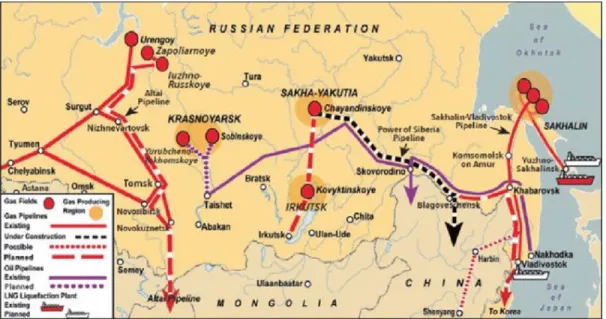
The bankruptcy of Yukos Corporation in 2003 had brought the construction of the ESPO pipeline to a halt. Until 2005, China provided loan assistance to Russia to acquire Yukos shares. After a lengthy negotiation process, in 2006 China through CNPC and Russia through Rosneft, the two companies became major players in the construction of the ESPO pipeline. Both companies are also actively involved in oil exploration in Eastern Siberia (Eder, 2014: 44-45). In 2009, it became a major momentum for the cooperation of the two countries in the construction of the ESPO pipeline. Through a "loan for oil" agreement, China provided US$ 25 billion in loans to Russian energy companies Rosneft and Transneft to resume construction of the ESPO pipeline, which targeted to complete in 2012 with crude oil supply capacity reaching 300 thousand barrels/day (Leung et al., 2011).
Figure 2. East Siberia Oil and Gas Energy Pipeline Route (ESPO and Power of Siberia) Source: Shi. 2016. Energy Studies Institute. Vol. 8, No.5.
Since 2013, under the leadership of President Xi Jinping, China has been increasing the intensity of energy cooperation relations in the development of the
138 East Siberian pipeline. The leadership of President Xi Jinping, with his geopolitical ambitions in the idea of the Belt Road Initiative (BRI), has made energy one of the major agendas in the Chinese foreign policy. BRI has been part of China's strategy to build a series of energy cooperation with major energy- producing countries, such as Russia (Wang, 2019). The intensity of the two's relations is increasingly seen through a number of development projects of the Eastern Siberian pipeline. The increase can be seen in the crude oil supply capacity of ESPO 1 pipeline to 58 million tonnes/year in 2014. Meanwhile, in 2017, oil supply capacity through the Skovordino pipeline was increased to 30 million/ year and the Skovordino-Mohe pipeline to 28 million tonnes/year in 2018 (Transneft, Nov. 27, 2019).
Another agreement took place in the development of the Eastern Siberian pipeline under the leadership of President Xi Jinping, namely with the successful construction of the Power of Siberia natural gas pipeline. Meeting President Xi Jinping with Russian President (Vladimir Putin) in 2014 in Shanghai, the two countries agreed to construct the Power of Siberia pipeline, which has been a discussion between the two countries since 2004. In the agreement, the two countries agreed to begin construction of the Power of Siberia pipeline in 2015, which will connect Russia's natural gas pipelines in the Eastern and Western Siberian regions (Overland & Kubayeva, 2018: 104).
The Power of Siberia project as a form of commitment of the two countries in developing the East Siberian energy pipeline has become a great momentum for the two countries to increase further energy cooperations between the two countries in the Eastern Siberian region. The construction of the 4,000 km Power of Siberia pipeline will be a mega project in the two countries' energy cooperation history. The project will cost Russia investment funds through Gazprom, reaching US$ 55 billion in addition to the deal, China is willing to provide an injection of funds reaching US$ 25 billion (Roberts, 2016).
The increasing intensity of the two countries' energy cooperation in developing the East Siberian pipeline further makes the two countries' energy
139 cooperation optimistic in the future. This is inseparable from China's growing economy, which increasingly requires a large supply of oil and natural gas energy and China's ambition to increase the diversification of its energy imports, which have been dependent on the Middle East and the Malacca Straits. The Russians also possess the same motivation to build their Eastern Siberian and Russian Far East strategy. On the other hand, Russia is also working to increase its export diversification by making China its strategic partner (Kumar & Chatnani, 2018). This is the driving factor for the energy diplomacy relationship between the two countries in the future.
The Implementation of China's Energy Diplomacy Towards Russia in the Eastern Siberia Pipeline Development
The long historical relationship between China and Russia in the energy cooperation is increasingly leading to a very complex strategic partnership. The strategic partnership of the two countries in the energy sector has had a broad implication on the two countries' political relation and has had a broad implication on the two countries' political relation. Since the beginning, the dynamics of the East Siberian pipeline construction have been influenced by the two countries' political and economic motivations amidst the existing international political dynamics.
China, which was under President Xi Jinping's leadership, has its strategic pattern of building and formulating its energy diplomacy relationship with Russia. It includes strategic efforts made by China against Russia to develop the Eastern Siberian pipeline.
China-Russia Bilateral Energy Cooperation Framework
Diversification of energy imports has been an essential agenda in China's foreign policy under the leadership of President Xi Jinping. In Kusuma's view (2014), China's enormous dependence on their traditional energy routes in the
140 Straits of Malacca made it a dilemma for China's energy security (Malacca dilemma). This is inseparable from China's problems in the South China Sea region which is considered to be able to impact their energy and trade routes through the Strait of Malacca. The sensitivity of political and security relations between China with the India and United States in the Malacca Strait region is a source of threat to the stability of China’s energy route in the Malacca strait.
Since the leadership of President Hu Jintao, this situation has increasingly pushed China’s orientation to reduce their dependence on the Malacca Strait (Putra, 2020).
This situation further encourages China's policy to improve its relations with Russia to diversify China's energy imports. The Eastern Siberian pipeline project is considered an important instrument in the bilateral energy cooperation relationship of the two countries. This can be seen with the energy trade contracts of the two countries that have been increasing since 2013. In 2013, the two countries agreed on a crude oil trade value of US$ 270 billion. Through this agreement, China will get a relativity cheaper supply of crude oil from Russia. Under the deal, Russia through its largest oil company Rosneft, will provide China with crude oil supplies reaching 365 million tonnes over the next 25 years or with an average annual oil supply of 14-15 million tonnes/year (Paik, 2015: 4-6). The crude oil trade agreement between the two countries from the year 2013 to 2014 reached US$ 355 billion. Another considerable momentum also occurred when President Xi Jinping held a meeting with Vladimir Putin in Moscow in 2013. The two countries agreed on an expansion of energy cooperation in the Eastern Siberian and Western Siberian regions. It would mark another milestone in the energy trade relations of the two countries in the future (Zhang & Serdar, 2017).
The Eastern Siberian oil pipeline or ESPO is an important key to increasing oil trade between the two countries. One of the evidences happened in June 2015, when Russia shifted Saudi Arabia as the largest crude oil supplier to China. Furthermore, Russia's deteriorating relations with the West in the
141 aftermath of the Crimean conflict have become a momentum for China and Russia to enhance its energy cooperation further. Both countries agreed on natural gas trade whose value reaches US$ 400 billion with an annual volume capacity of up to 38 bcm over the next 30 years. Through this agreement, the two countries also approved the construction of a Power of Siberia gas pipeline that will be a strategic route for both countries in the Eastern Siberian region (Skalamera, 2016).
The Eastern Siberia Pipeline will be a strategic energy route’s for China to obtain a safe and cheap energy route. So that this will reduce China’s dependence on their traditional energy route’s, such as the Malaca Strait.
Eastern Siberia will be an important arena for energy cooperation relations between the two countries. However, China implements its bilateral energy diplomacy relations with Russia by involving a large network of its national energy companies to develop energy pipelines in the Eastern Siberian region.
The Involvement Of China’s National Energy Companies
In its energy diplomacy activities, China is a country that is very active in facilitating its national energy companies to develop their investment networks in various strategic areas. The presence of national energy companies in China’s energy diplomacy, has a vital role in China's efforts to maintain its energy security. This can be seen from the last few decades in the implementation of energy diplomacy. In addition, the national energy companies have contributed significantly to Chinese energy projects abroad (Chirstoffersen, 2016).
Through its “Going out Policy", China further encourages increased investment of their national energy companies, especially for the Belt and Road Initiative (BRI) partners. The policy is an integral part for China to get a lot of energy supply that is mainly owned by their BRI partners (Shi & Cai, 2020). This can be seen in China's energy diplomacy relations with Russia in developing the Eastern Siberian pipeline. In 2013, China through CNPC and Russia through
142 Rosneft agreed to increase oil supply capacity for China through the ESPO 1 pipeline. Under the deal, Rosneft will increase crude oil supplies to China through CNPC by 58 million tonnes in 2015 and 80 million tonnes by 2020. Not only CNPC, another Chinese energy company, SINOPEC also participated in increasing ESPO pipeline oil supply capacity through a "ten year's deal" with Rosneft. In the agreement, SINOPEC-Rosneft agreed an oil trading contract with a value of US$ 85 billion (Roseth, 2017).
Another deal also took place between Rosneft and CNPC in October 2013.
Under the deal, CNPC and Rosneft will build oil exploration fields in the Far East and Siberia region with a 49% stake owned by CNPC and 51% held by Rosneft.
Until 2016, CNPC again made new breakthroughs by building an ESPO pipeline branch that will connect the Mohe-Daqing region targeted to be completed in 2018. This branch of the ESPO pipeline is expected to increase Russia's oil export capacity to China by 19.7% in 2018 (Liao, 2019). Russia through Transneft has committed to increase the ESPO I pipeline with a supply capacity of 58 million tonnes/year in 2014. In addition, Transneft will increase the oil production capacity of the Skovordino pipeline to 30 million tons/year in 2017. While in the ESPO II pipeline, in 2015 Transneft has built an oil refinery with a capacity of 6 million tonnes/year in the Khabarovsk region and built an oil refinery in the Komsomolsk region that began operations in 2019 with a capacity of 8 million tonnes/year (Transneft, Nov. 27, 2019).
The realization of ESPO pipeline development has had a positive impact on China. Where in 2019, Russia's crude oil exports to China rose to 9.8% with the value of crude oil exports reaching 30.54 million tonnes (Liao, 2019). In 2014 at the Shanghai Summit, CNPC and Gazprom participated in a natural gas trade agreement between the two countries. Under the deal, CNPC will get natural gas supplies from Gazprom with an annual average of 38 bcm over the next 30 years.
In addition CNPC and Gazprom will work together on the construction of the Power of Siberia project which will be an important part of the cooperation relationship between the two countries in the natural gas sector (Charap et al.,
143 2017). Thus, China builds the framework of energy diplomacy through the bilateral framework and a multilateral framework.
China’s Energy Diplomacy Towards Russia Through Multilateral Framework The complexity of the development of the East Siberian pipeline project, which closely relates to the geopolitical, economic, and security motivations of the two countries, makes this situation further encourage the two countries to increase the intensity of their cooperation relations in the multilateral forum.
The Power of Siberia project, which is undergoing expansion through the Power of Siberia 2 project, includes the Western Siberian region and Eastern Siberia which integrated with the Mongolian region. Gazprom as the main actor in the construction of the Power of Siberia 2 project will attempt to complete the construction of the natural gas pipeline with a capacity of up to 50 bcm/year (Smith, Sept. 18, 2020).
144 Figure 3. POWER OF SIBERIA PIPELINE
Source: Pipeline & Gas Journal. (2020)
The presence of the Proyek Power of Siberia, which is part of the East Siberian region's infrastructure development efforts that will accelerate the integration of the Eurasian region, further encourages China-Russia to organize their cooperation in a multilateral framework seriously. In Bennett's view (2016), what motivates Russia to strongly support multilateral diplomacy efforts through the Shanghai Cooperation Organization (SCO) forum in infrastructure development efforts in the Eastern Siberian region and Russia's Far East is a political consideration. Until 2013, China and Russia successfully encouraged the establishment of the SCO Energy Club, which will be a multilateral instrument for the relationship between the two.
The presence of the SCO Energy Club will make it easier for the two countries to collaborate with SCO countries to participate in developing integrated energy infrastructure and energy markets (Golobokov, 2016). This makes the SCO Energy Club's cooperation framework considered an essential instrument in supporting the development of the Power of Siberia developed by China and Russia. The involvement of SCO and Central Asian countries, such as Mongolia, in the development of the Power of Siberia, is considered to require a more complex framework of cooperation, and this is what can be facilitated through the establishment of the SCO Energy Club (Golobokov, 2016). The presence of SCO and SCO Energy Club is considered an important part of maneuvering the two countries' energy diplomacy.
This is inseparable from the involvement of Central Asian countries that will be heavily involved in espo pipeline projects and the Power of Siberia. It is seen by Gubaidullina et al., (2020) that the presence of SCO and SCO Energy Club will be a strategic platform for both countries to gain political support, security and efforts to create joint economic integration in the Eurasian region which has been the main objective and interest pursued by China and Russia. The presence
145 of SCO is considered to be a framework of cooperation that has great potential for China's energy security in the future.
CONCLUSION
The series of development of the Eastern Siberian pipeline project has been an important part of the energy cooperation relationship built by China with Russia. The huge potential of the Eastern Siberian energy pipeline is considered to provide China with safe and cheap access to energy. This makes China increasingly prioritize their energy diplomacy over Russia in the development of the Eastern Siberian pipeline through the ESPO and Power of Siberia projects.
The development of the East Siberian pipeline through the ESPO and the Power of Siberia, is considered to be an important part of China's energy import diversification efforts to realize its energy security stability amidst its national economic and industrial growth. China in its energy diplomacy implementation efforts with Russia has a special strategy built with Russia, including bilateral frameworks, multilateral networks, and the involvement of corporate actors.
Within the framework of bilateral cooperation, President Xi Jinping's closeness to Vladimir Putin is an important key to the relationship of energy cooperation between the two. In addition, China's implementation of its energy diplomacy, through its "Going out Policy" policy, further encourages actors of its national energy companies, CNPC and SINOPEC, to be actively involved in a series of East Siberian pipeline development through the ESPO and Power of Siberia projects.
Under President Xi Jinping, China further increased its energy diplomacy with Russia concerning Eastern Siberian pipeline projects. This can be seen by the efforts of China-Russia energy diplomacy which is not only built through the bilateral framework. The two countries also actively build their energy diplomacy relations through a multilateral framework platform in the SCO forum, which then developed into the SCO Energy Club. This is a strategic step for both countries to accelerate the East Siberian transnational pipeline development by involving SCO countries and Central Asia.
146 This situation further demonstrates that the East Siberian pipeline has become a strategic arena for the implementation of China's energy diplomacy towards Russia in the future. Vorius major agreements have accourred in the China-Russia energy cooperation relationship in the development of the East Siberia Pipeline, such as the expansion of the ESPO pipeline, the construction of the Power of Siberia pipeline, and the increase in the supply of Russian oil and natural gas to China. China’s geopolitical motivation in the BRI has become an important instrument in China’s energy diplomacy towards Russia. This shows the strength of China’s energy diplomacy under the leadership of Xi Jinping. The strategic partnership of the two countries in the development of the Eastern Siberian pipeline, is considered an important part for China to get a lot of oil and natural gas energy supply from Russia. The large supply of crude oil and natural gas that Russia will provide to China will be an important part for China to further boost its national economic and industrial growth.
REFERENCES
Bakry. (2016). Metode Penelitian Hubungan Internasional. Yogyakarta: Pustaka Pelajar.
Bennett. (2016). The Silk Road Goes North: Russia's role within China's Belt and Road Initiative. Area Development and Policy, 1 (3). 341-351.
Doi: 10.1080/23792949.2016.1239508.
Bolt, P. (2016). Energy and the Sino-Russian Relationship. INSS Strategic Paper of US AIR Force Academy.
Bovan, A., Vucenovic, T., & Peric, N. (2019). Negotiating Energy Diplomacy and its Relationship with Foreign Policy and National Security. International Journal of Energy Economics and Policy, 10(2). 1-16. Doi:
10.32479/ijeep.8754.
147 Charap, S., Drennan, J., & Noel, P. (2017). Russia and China: A New Model of Great-Power Relations. Survival Journal, 59 (1).2542.
Doi:10.1080/00396338.2017.1282670.
Chi Yeh & Wei Yu. (2012). China’s Energy Diplomacy: SOE Relations in the Context of Global Distribution and Investment Pattern. Advances in Applied Sociology Journal, 2 (4). 325-343. Doi: 10.4236/aasoci.2012.24043.
Christoffersen, G. (2016). The Role of China in Global Energy Governance. China Perspectives (2). 15-24. Doi: 10.4000/chinaperspectives.6968.
Creswell. (2014). Research Design: Qualitative, Quantitative, and Mixed Methods Approaches. (4th eds). London: SAGE Publication.
Dong, K., Sun, R., & Jiang, H. (2016). A Review of China’s Energy Consumption Structure and Outlook Based on a Long Range Energy Alternatives Modeling Tools. Petroleum Science, 14(2017). 214-227.Doi:10.1007/s12182- 016-0136-z.
Downs. (2006). The Brookings Foreign Policy Studies Energy Security Series:
China. The Brookings Institution.
Eder. (2014). China-Russia Relations in Central Asia: Energy Policy, Beijing’s New Assertiveness and 21st Century Geopolitics. Austria: Springer VS.
Gholz, E., Awan, U., & Ronn, E. (2017). Financial and Energy Security Analysis of China’s Loan for-Oil Deals. Energy Research & Social Science (24). 42-50.
Doi: 10.1016/j.erss.2016.12.021.
Giuli, M. (2015, Oct 23). Getting Energy Diplomacy Right: A Challenge Starting at Home: Retrieved from European Policy Centre:
https://www.epc.eu/en/Publications/Getting-energy-diplomacy- right~1d05b0.
148 Goldthau. (2010). Energy Diplomacy in Trade and Investment of Oil and Gas.
Dalam Goldthau & Witte (eds.). Global Energy Governance. USA: Brookings Institution Press.
Golobokov. (2016). Various Forms and Mechanisms of Chinese-Russian Cooperation in the Energy Sphere and the Role of Non-Governmental Structures. Pacific Science Review B: Humanities and Social Sciences 1 (45- 48). Doi: 10.1016/j.psrb.2016.01.002.
Gubaidullina, M., Yelibayeva, A., & Liu, Qi. (2020). The SCO Space in Geopolitical Configuration of Eurasia: Rapprochement and Contradictions of Energy Interest (The Case of China). Scientific Journals, 89 (1). Doi:
10.26577/IRILJ.2020.v89.i1.01.
Henderson & Mitrova. (2016). Energy Relations Between Russia and China:
Playing Chess with the Dragon. England: The Oxford Institute for Energy Studies.
Hsu, J & Soong, J. (2014). Development of China-Russia Relations (1949-2011).
Chinese Economy Journal, 47(3). 70-87. doi:10.2753/CES10971475470305.
Jianhong. (2018). Analysis of Sustainable Development of Natural Gas Market in China. Natural Gas B 5 (2018). 644-651. Doi:10.1016/j.ngib.2018.11.013.
Kononczuk. (2008). The East Siberia/Pacific Ocean (ESPO) Oil Pipeline: A strategic Project- An Organisational Failure?. Centre for Eastern Studies (CES), 12.
Kontorovich, A., Eder, L., & Nikitenko, S. (2018). Key Problem in the Development of the Power of Siberia Project. Regional Research of Russia, 8. 92-100. Doi:10.1134%2FS2079970518010057.
Kumar & Chatnani. (2018). Achieving Energy Security Through Cross Border Investments: China’s Energy Across Russia & Central Asia and Lessons for India. Academy of Strategic Management Journal, 17 (4).
149 Kusuma, A.S. (2014). Rivalitas Strategi Maritim China dan India di Selat
Malaka. Jurnal Insignia, 1 (1). Doi:10.20884/1.ins.2014.1.01.430
Leung, G. (2011). China’s Energy Security: Perception and Reality.
Energy Policy Journal, 39 (3). 1330-1337. Doi: 10.1016/j.enpol.2010.12.005.
Leung, G., Li, R., & Low, M. (2011). Transitions in China’s Oil Economy, 1990- 2010. Eurasian Geography and Economics, 52 (4). Doi: 10.2747/1539- 7216.52.4.483.
Liao, J. (2019). China’s Energy Diplomacy towards Central Asia and the Implications on its “Belt and Road Initiative. The Pacific Review.Doi:10.1080/09512748.2019.1705882
Masuda. (2007). Security of Energy Supply and the Geopolitics of Oil and Gas Pipelines. European Review of Energy Markets, 2 (2).
Megits, N. (2016). The Impact of Russia-China Trade Relationship on the U.S.
Economy. Journal of Eastern European and Central Asian Research (JEECAR), 3(2). Doi: 0.15549/jeecar.v3i2.135.
Overland & Kubayeva. (2018). Did China Bankroll Russia’s Annexation of Crimea? The Role of Sino-Russian Energy Relation. In Blakkisrud & Rowe (eds.). Russia’s Turn to the East: Domestic Policymaking and Regional Cooperation. Selected Reading, (pp. 104-105). Swisterland: Palgrave Macmillan.
Paik. (2015). Sino-Russian Gas and Oil Cooperation: Entering into a New Era of Strategic Partnership? England: Oxford Institute for Energy Studies.
Pipeline & Gas Journal. (2020, Mei 18). Gazprom Begins Preparation for Power of Siberia-2. Retrieved from: https://pgjonline.com/news/2020/05- may/gazprombegins-preparation-for-power-of-siberia-2.
150 Putra, R.J. (2020). Hambatan-Hambatan Yang Dihadapi Cina Dalam Melindungi Aliran Minyak Bumi Dari Ancaman India. Jurnal Dinamika Global, 4 (02), 269-282. Doi: https://doi.org/10.36859/jdg.v4i02.134.
Rab, A., & Zhilong. (2019). China and Shanghai Cooperation Organization (SCO): Belt and Road Initiative (BRI) Perspectives.
International Journal of Humanities and Social Science, 9 (2). Doi:
10.30845/ijhss.v9n2p21
Roberts, J. (2016). Russia’s Gas Challenge: The Consequences for China, Central Asia, Europe and the USA. Journal of World Energy Law and Business. (1- 22). Doi: 10.1093/jwelb/jwv040.
Roseth. (2017). Russia’s Energy Relations with China: Passing the Strategic Threshold? Eurasian Geography and Economics, 58 (1). 23-55.
Doi: 10.1080/15387216.2017.1304229.
Sagena, U., Pratiwi, T., & Mujiono. (2019). Tren Dalam Kerja sama Keamanan Energi Russia-Tiongkok: Perspektif Negara Produsen. Jurnal Hubungan Internasional, 8 (1). Doi: 10.18196/hi.81142.
Shi, B & Cai. (2020). Has China’s Oil Investment in Belt and Road Initiative Countries Helped Its Oil Impor? Journal Energies (13). Doi:
10.3390/en13123176.
Shi. (2016). Gas Hub Initiatives in East Asia: Motivation, Competition and Cooperation. Energy Studies Institute, 8 (5).
Shioya. (2019). The Treaty of Ghulja Reconsidered: Imperial Russian Diplomacy toward Qing China in 1851. Journal of Eurasian Studies, 10 (2). 147-158.
Doi: 10.1177/1879366519842882.
Skalamera, M. (2016). Sino-Russian Energy Relations Reversed: A New Little Brother. Energy Strategy Reviews (13-14). 97- 108.
Doi:10.1016/j.esr.2016.08.005.
151 Smith, C. (2020, Sept 18). Gazprom advancing Power of Siberia 2 Gas Pipeline.
Oil & Gas Journal. Retrieved from OGJ: https://www.ogj.com/pipelines transportation/pipelines/article/14183699/gazprom-advancing-power-of- siberia-2-g.
Transneft. (2019, November 27). Transneft Brings Eastern Siberia-Pacific Ocean Oil Pipeline to Maximum Capacity. Retrieved from Transneft Press:
https://en.transneft.ru/newsPress/view/id/25213.
Wang, X. (2019). Leadership-building Dilemmas in Emerging Powers’ Economic Diplomacy: Russia’s Energy Diplomacy and China’s OBOR. Asia Europe Journal, 18. Doi: 10.1007/s10308-019-005364.
Xin Li. (2015). Natural gas in China: a Regional Analysis. England: Oxford Institute for Energy Studies.
Xu, B & Reisinger, W. (2018). Russia's Energy Diplomacy with China:
Personalism and Institutionalism in its Policy-Making Process. The Pacific Review, 32 (1). 1-19. Doi: 10.1080/09512748.2018.1428675.
Yi Lee. (2019). China’s Energy Diplomacy: Does Chinese Foreign Policy Favor Oil-Producing Countries. Foreign Policy Analysis, 15 (1). Doi:
10.1093/fpa/orz011.
Yilmaz & Daksueva. (2017). The Energy Nexus in China–Russia Strategic Partnership. International Relations of the Asia-Pacific, 19 (1). 63-88. Doi:
10.1093/irap/lcx003.
Zhang & Serdar. (2017). Analysis of Oil and Gas Cooperation between China and Russia in the Belt and Road. SHS Web of Conferences, 39 (3).
Doi:10.1051/shsconf/20173901034.
Ziegler, C. (2006). The Energy Factor in China’s Foreign Policy. Journal of Chinese Political Science, 11 (1). 1-23. Doi: 10.1007/BF02877031.