© 2017 Chase V. Moore ALL RIGHTS RESERVED
To great BIG God: because I owe it all to you. Thank you!
My eternal cheerleader, the late Nigela Patreece Robinson Moore: Thank you for your dedication and service to the world, always showing the way of excellence and beauty.
Because of you, I can. I will forever hold you in my heart, upholding your legacy and brilliance.
I am grateful to my father, Milton and step-mother Phyllis Moore, who have provided and supported me throughout my life. I am also grateful to my other family members and friends who have supported me along the way, with special honor to my grandmother, Mary Robinson and dear friend, Kaypounyers Maye.
A very special gratitude goes to Dr. Tony Ammeter for your unwavering guidance and support. Thank you for the hours, days, weeks and months you gave me. My experience at the University of Mississippi would not have been the same without you. Thank you pouring into me on this scholarly journey.
With a special mention to Debra Whitley, Shawnboda Mead, Dr. Debra Young, and Dr.
Brandi Hephner LaBanc for your motivation and encouragement to go on! Without you, I would not have completed this work. I am forever grateful for you.
Thanks for all your encouragement!
ABSTRACT
Drawing on the Job Demands-Resources (JD-R) model, this study explores the effect of the resources student employees receive from management and from the nature of their work on their engagement at work and their engagement in academic pursuits. Student workers make up a significant pool of workers in our institutions of higher education and supporting academic achievement of student workers is consistent with our institutions’
missions. Accordingly, the purpose of this study is to examine the antecedents
(supervisory support, supervisory feedback, person-organization fit, and person-job fit) that affect levels of work engagement of students employed in educationally-situated work environments, and the impact this work engagement has on academic engagement.
Further, the model examines the moderating role of perceived autonomy on the impact of supervisory support and feedback. Ninety-seven student workers within eleven
departments of the Division of Student Affairs at a large public university participated in the study. Analyses found support for the relationship between both person-organization fit and person-job fit and work engagement. The analyses further found support for the relationship between person-organization fit and academic engagement, with work engagement being a moderator of this relationship. Implications for research and practice are discussed.
INTRODUCTION...1
Conceptual Background & Hypotheses...3
METHOD...10
Participants...10
Materials...10
Procedure...11
Measures...11
RESULTS...13
DISCUSSION, IMPLICATIONS, AND LIMITATIONS…………...15
CONCLUSION & RECOMMENDATIONS FOR FUTURE STUDIES...19
LIST OF REFERENCES...21
TABLES AND FIGURES……...25
APPENDICES………….……...33
Appendix A...33
Appendix B...34
Appendix C...36
INTRODUCTION
Organizations experience intense competitive pressures to thrive in an ever- changing world of work. More than ever, organizations need their employees to be energetic, dedicated, and fully engaged in their work because the quality of human resources is vital to the success of organizations, especially in dynamic work contexts.
Work engagement has been shown to be positively associated with individual and organizational performance (Christian, Garza, & Slaughter, 2011). Employee work engagement has recently received considerable attention from organizational behavior and human resources scholars and practitioners. Human resources (HR) professionals are increasingly being called upon to support the development of strategies that facilitate employee engagement in the workplace (Macey & Schneider 2008). Prior research linking employee engagement to positive work outcomes drives organizations to prioritize a culture of engagement at work. One definition for employee engagement is
“an individual employee’s cognitive, emotional, and behavioral state directed toward desired organizational outcomes" (Shuck, Rocco, & Albornoz, 2011).
Despite the growth of research on the subject of employee engagement and the widespread use of student workers in academic environments, little is known about student employee engagement within these environments. At one large public university, student employees were found to constitute 41.81% of the staff workforce, and this percentage is higher in the area of Student Affairs (Office of Institutional Research, Effectiveness, and Planning, 2017). For departments within the Division of Student Affairs, it is paramount that student employees are engaged, as they have significant influence on the quality and efficiency of operation, performance and success of each
department and ultimately the division. Because of this unique relationship between student employment and the performance and operation of the organization, it is crucial to examine the variables that affect the student employees and associated outcomes, work and academic engagement.
Thus, student workers represent a large, yet understudied population, and this gap in contemporary research motivates the present study. I examine the antecedents that impact student employees' work engagement in educationally-situated work
environments and their corresponding levels of academic engagement. A student employee is defined as a person who is enrolled as a student and employed part time (maximum hours=20 hours/week) by a university or college. Likewise, an educationally- situated work environment is defined as a state or setting of work that concurrently operates within a university or college.
This study hopes to contribute to the existing literature in the following ways:
First, through examination of the variables: supervisory support, supervisory feedback, perceived autonomy, person-job (P-J) fit and person-organization (P-O) fit, I add to the knowledge of individual-level antecedents on student employee work engagement.
Second, I hope to inform the field of student affairs of more effective practiceswhen employing student employees.Third, I investigate the relationship between work engagement and academic engagement. It is our desire that our findings help us
understand if engaged student employees have increased academic achievement within educationally-work environments. Findings could potentially uncover a positive linkage between work activities and academic opportunities.
CONCEPTUAL BACKGROUND AND HYPOTHESES
Drawing on the Job Demands-Resources (JD-R) model, this study explores student employees’ engagement and effects by the resources they receive from
management and the nature of work. The JD-R model is a conceptual framework used to explain employee engagement in the workplace (Bakker & Demerouti, 2007; Demerouti, Bakker, Nachreiner, & Schaufeli, 2001). The model asserts that resources are what the organization provides to its employees; those resources can include autonomy,
supervisory support, or supervisory feedback. Such resources are expected to (a) be functional in achieving work goals; (b) reduce job demands at the associated physiological and psychological costs; and (c) stimulate personal growth and
development (Demerouti et al., 2001). This study seeks to explain how resources can be used to enhance work engagement and how work engagement and academic engagement are related. The antecedents examined in this study are supervisory support, supervisory feedback, perceived autonomy, person-job fit and person-organization fit. The dependent variables are work engagement and academic engagement.
Engagement. Employee engagement is “a positive, fulfilling, work-related state of mind that is characterized by vigor, dedication, and absorption” (Schaufeli, Salanova, Gonzalez-Roma, & Bakker, 2002, p. 74). Vigor refers to a willingness and determination to exert energy and effort in one's work and to be resilient and persistent when confronted with obstacles. Dedication is analogous to an emotional component of engagement in that dedication refers to finding meaning and purpose in one's work and being enthusiastic, inspired, and proud of one's work. Absorption parallels the cognitive component of engagement. Absorption refers to being totally immersed and content with one's work
such that time passes quickly and to finding it difficult to detach oneself from work (Salanova, Agut, & Peiro, 2005). Consequently, employee engagement is ‘an individual employee’s positive, work related state of mind directed toward desired organizational outcomes’ (Shuck et al., 2010; Schaufeli et al., 2002, p. 74). Bakker and Demerouti (2007) suggested that employees with high work engagement will find their work interesting, meaningful, and energizing and will experience positive effects, including happiness, joy, and enthusiasm.
Supervisory support. Supervisory support is “the degree to which employees perceive that supervisors offer employees support, encouragement and concern" (Babin
& Boles, 1996). As employees sense more supervisory support, they feel more secure and believe that the organization takes care of their well-being (DeConinck, 2010). According to the JD-R model, supervisory support is critical because it motivates employees to be engaged in the workplace. During adverse situations, having a supervisor to depend on and who is willing to listen can be a motivational boost for employees (DeConinck, 2010). Further, supervisory support can ease some of the stress and strain caused by the high demands associated with the job (Babin & Boles, 1996). Therefore, when employees feel that they are equipped with adequate resources such as supervisory support, high job demands feel less daunting and employees remain engaged in their work (Sand &
Miyazaki, 2000). Contrarily, when supervisory support is lacking, employees question their value and contribution to the organization and feel detached, frustrated, and even helpless.
H1. Supervisory support is positively related to work engagement.
Supervisory feedback. Jaworski & Kohli (1991) define supervisory feedback as employees' perception that they are receiving clear information about their performance outcome and suggestions for improvement. When employees perceive sufficient
feedback, they have specific direction on how to become more effective (Jaworski &
Kohli, 1991). Essentially, this fosters an increase in communication between the two entities and helps the supervisor guide employees to better performance (Ashford &
Cummings, 1983). When employees perceive that they are receiving more candid and accurate developmental feedback, they sense that supervisors are interested in their growth, development, and learning (Ashford & Cummings, 1983). Providing corrective measures to get employees back on track or reinforcing their effectiveness motivates employees to be more engaged. In contrast, a lack of feedback can create ambiguity, conflict, and confusion about what is expected (Jaworski & Kohli, 1991). The absence of developmental feedback can create a lack of stimulation that can lead to less enthusiasm, energy, passion, and inspiration regarding the job – less engagement.
H2. Supervisory feedback is positively related to work engagement.
Perceived autonomy. While it is important to understand variables that positively affect engagement, in reality, multiple variables are employed simultaneously. Perceived autonomy is defined as the degree to which employees feel they have independence, flexibility, discretion, and control in performing their jobs (Hackman & Oldham, 1976).
In their study of the service employees, Menguc, Auh, Fisher, and Haddad (2013) found that there is an important relationship between perceived autonomy and supervisory support. That is, as employees perceive greater autonomy, their engagement benefits
greater sense of motivation, empowerment, and competence (Marinova, Ye, & Singh, 2008). Consequently, when employees receive supervisory support under conditions of high perceived autonomy, they will be able to embrace and integrate the task and social support received from their supervisors. This suggests that at high levels of perceived autonomy, supervisory support will have a positive effect on engagement. Conversely, when supervisory support is sufficient but employees perceive little autonomy,
employees feel less motivation and empowerment to actually put the support into action.
H3. Perceived autonomy positively moderates the relationship between
supervisory support and work engagement such that (a) when perceived autonomy is high, supervisory support will have a positive effect on work engagement while (b) when perceived autonomy is low, supervisory support will have no effect on work engagement.
This relationship and that for the next hypothesis are summarized in TABLE 1.
INSERT TABLE 1 HERE
Similarly, Menguc et al. (2013) found that supervisory feedback has a positive effect on engagement under conditions of low perceived autonomy. When employees perceive low autonomy, they have little latitude, discretion, and empowerment to make decisions on their own. Similarly, Marinova et al. (2008) suggest that, as employees perceive less autonomy, they feel that there is more control and pressure from
management to perform tasks in certain ways. Consequently, when employees receive feedback, it is specific and concrete performance feedback information on what and how to perform to become more effective (Jaworski & Kohli, 1991). With low perceived
autonomy, feedback gains importance as a guideline and roadmap for how to perform based on supervisor input; therefore, feedback will be a more valuable resource under low perceived autonomy than high (Ashford & Cummings, 1983).
In contrast, under conditions of high perceived autonomy, supervisory feedback may not contribute as much and may be perceived as less effective in influencing
engagement because more autonomy suggests that employees have more internal control over how to perform tasks. That is, they are less dependent and influenced by supervisory feedback than they would be under conditions of low perceived autonomy. Therefore, at high levels of perceived autonomy, the benefits of supervisory feedback on engagement are expected to be limited.
H4. Perceived autonomy negatively moderates the relationship between supervisory feedback and work engagement such that (a) at low levels of perceived autonomy, supervisory feedback has a positive effect on work
engagement while (b) at high levels of perceived autonomy, supervisory feedback will have no effect on work engagement.
Person-Organization fit. Person-organization (P-O) fit is defined as the compatibility between people and organizations, which occurs when at least one entity provides what the other needs, they share similar fundamental characteristics, or both (Chan, 1996; Kristof-Brown, 2007). This definition includes examples of mutual need fulfillment, value congruence between individuals and organizations, personality similarity between individuals and other members of the organization, and shared individual and organizational goals. P-O fit is the level of compatibility that exists
between the worker and organization when at the minimum level one entity is able to provide what the other one wants and prefers (Kristof, 1996). This compatibility is of two types, one is supplementary fit and the other is complementary fit (Kristof, 1996).
Supplementary fit means that personal characteristics of the individual employee are harmonized with that of the organizational characteristics. If the worker’s psychological needs are satisfied by the conditions of the workplace, then complementary fit is
achieved. Shared characteristics may include individual’s ideas, principles, interests and dispositional characteristics with organizational doctrine, norms, traditions and overall organizational climate (Chan, 1996). P-O fit is evaluated by matching the personality of the individual worker with his or her organization (Cable & Judge, 1996). I posit that when the listed positive consequences of P-O fit are maximized, they will promote positive work engagement.
H5. P-O fit is positively related to work engagement.
Kristof-Brown (2007) defines person-job (P-J) fit as the compatibility between individuals and the job or tasks that they perform at work. There are two types: One is Demand-Abilities (D-A) fit while the other is Need-Supply (N-S) fit (Cable & DeRue, 2002). D-A fit is a match between employees’ knowledge, skills and abilities (KSA) with the requirements of their jobs, whereas N-S fit is the degree to which employees’ needs, aspirations and preferences are fulfilled by the jobs they perform and by the rewards associated with the jobs (Cable & DeRue, 2002). These two parts of P-J fit are now combined into an overall concept of P-J fit (Cable & DeRue, 2002; Vogel & Feldman, 2009). A good fit exists when an individual has the right skills and abilities to perform his
or her job or the job can fulfill the individual’s needs (Edwards, 1991). Research shows P-J fit has a strong positive correlation with job satisfaction, a moderate to strong positive correlation with organizational attraction, organizational commitment, satisfaction with supervisors, and overall performance and tenure (Kristof-Brown, 2007).
H6. P-J fit is positively related to work engagement.
Academic engagement. A fundamental underpinning of this research is a desire to know "how does working as a student worker in an academic environment impact one's level of academic engagement?" In their framework for understanding employee engagement, Macey and Schneider (2008), illustrate how work attributes and leader characteristics influence state engagement and, subsequently, levels of behavioral
engagement. They describe employees in a state of engagement demonstrating feelings of energy, passion, absorption, and organizational commitment. Researchers describe this state of engagement in employees as relatively stable and constant over time (Schaufeli et al., 2002). Mowday, Porter, and Steers (1982) measure organizational commitment with items relating to belonging, effort and pride. In addition to this organizational attachment, employees often tie their own self-worth to commitment to the job and attaining the supervisor’s goals (Bass, 1999). When employees experience this state of work engagement, and also have a sense of personal identity in the role, I suggest that this positively impacts engagement in other, similar roles. For example, a student worker in academic affairs working for a person who believes strongly in higher education is more likely to view this work as consistent with personal values of academic success.
Accordingly, I propose that work engagement provides the mechanism through which the
environment—in the form of supervisor support and supervisor feedback, and the relationship between the student's self-image and what he or she perceives to be the image of the work environment, in the form of P-O and P-J fit—impacts the level of engagement that the student has with his or her academic studies.
H7. Work engagement in an educationally-situated work environment mediates the impact of supervisory support, supervisory feedback, P-O fit, and P-J fit on academic engagement.
METHOD
The process involved conducting a survey during the spring semester of 2017.
The purpose of the study was to examine the factors that impact student employees' work engagement and academic engagement in educationally-situated work environments.
Participants. Student workers within a Division of Student Affairs at a large public university in the United States participated in the study. There were 15 departments within the Division. 13 of those departments employed student workers who work 5-25 hours per week. 11 departments were represented in this study. Of the 355 student survey distributions, 101 responded for a usable rate of 27% (four respondents indicated that they were under the age of 18 years and were removed from the analyses). In the final sample, 63% were female and 34% male.
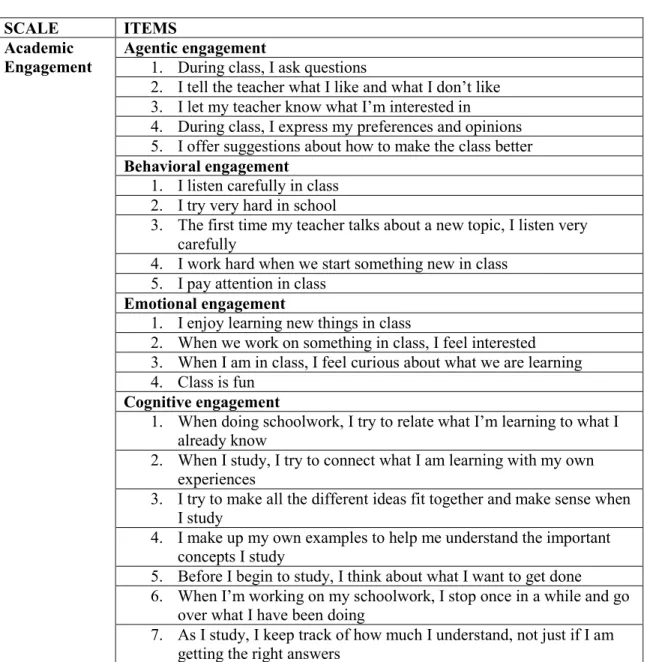
Materials. The survey included a total of 69 questions, shown in TABLE 2. There were 58 Likert scale questions, 9 single response questions and 2 short answer questions. All 58 Likert scale questions were measured on 5-point scales. Portions of the survey included scales that were pulled from previous studies related to supervisory support, feedback, and perceived autonomy (Menguc, et al., 2013); academic engagement (Reeve
& Tseng, 2011); work engagement (Rich, Lepine, & Crawford, 2010); and person- organization and person-job fit (Cable et al., 2002). Respondents self-reported the extent of their engagement in the classroom and at work.
INSERT TABLE 2 HERE
Procedure. The survey was designed using Qualtrics Survey Software and submitted to the University Institutional Review Board for approval. Once approved, department directors were solicited to distribute the anonymous survey link to student employees on behalf of the researcher. The invitation to the survey was emailed explaining that they were chosen to participate in the survey because they were a student worker within the Division of Student Affairs (See Appendix B). They were also informed that their participation would be completely anonymous. The survey start and end dates were mentioned and a link to the survey was also included. Once respondents opened the survey, they were again informed of why they were selected to participate, of the
deadline to complete the survey, and also a brief description of the purpose of the survey.
After completing the survey, respondents were redirected to a survey collecting contact information. This information was used to randomly select four participants to receive a
$25 gift card for their participation. After collecting the data, it was then exported from Qualtrics into IBM SPSS Statistics 24 for analysis.
Measures
All items for each antecedent appears in TABLE 2. For each antecedent measure, we used the same 1-5 bipolar response scale that ranged from “extremely” to “not at all”
with “moderately” serving as the midpoint.
Academic Engagement. I assessed four aspects of academic engagement—
agentic engagement, behavioral engagement, emotional engagement, and cognitive engagement developed by Reeve, et al. (2011) from a previous work in the educational psychology field. These items have emerged to characterize student engagement during learning activities. Cronbach’s alpha ( reliability for the academic engagement scale was .90.
Work Engagement. I assessed three aspects of work engagement—physical engagement, emotional engagement, and cognitive engagement developed by Rich, et al.
(2010) from a previous work in the management field. These items were constructed in a study focusing on the antecedents and effects on job engagement and performance.
Cronbach’s alpha ( reliability for the work engagement scale was .95.
Supervisory Support, Supervisory Feedback and Perceived Autonomy. I measured supervisory support, supervisory feedback and perceived autonomy with respective three-items scales borrowed from Menguc, et al. (2013). Cronbach’s alpha ( reliability for the supervisory support scale was .93; supervisory feedback scale was .92; and perceived autonomy scale was .78.
Person-Organization Fit and Person-Job Fit. I measured P-O fit and P-J fit with respective three-items scales borrowed from Cable et al. (2002). Cronbach’s alpha ( reliability for the P-O fit scale was .89 and P-J fit scale was .89
Control variables. To control for past student performance in relation to
academic engagement, grade point average (GPA) was self-reported. Four categories of GPA were listed in the survey: “Below 2.6”, “2.6-3.0”, “3.1-3.5”, “3.5-4.0,” and these were converted to a 1-4 Likert-type scale. Gender was also coded "1" or "0" for male or
female. Tenure, or time in job, was constructed by combining two of the survey questions. The first question asked how many months the student has been in the position, with response categories of "0-3 months," "4-6 months," "7-9 months," “10-12 months," and "13+ months." The second question asked how many hours per week the student spent at that job, with response categories of "0-5 hours," “6-10 hours," "11-15 hours," "16-20 hours," "21-25 hours," and "26+ hours." These two items were converted to 1-5 and 1-6 Likert-type scales, respectively, and then the converted scales were
multiplied to create a composite measure of cumulative exposure of the student to the work environment (that I am calling tenure).
RESULTS Descriptive Statistics
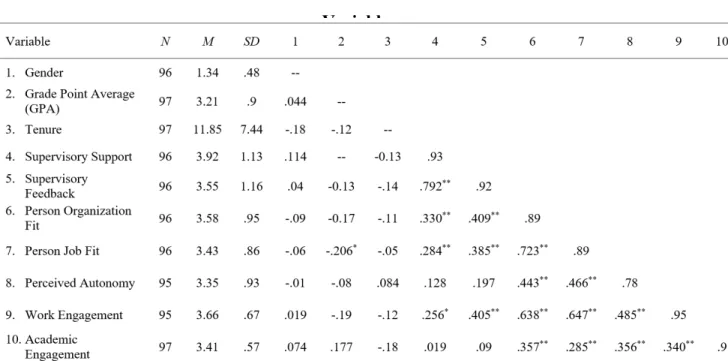
Means, coefficient alpha reliabilities, and correlations of study variables are presented in TABLE 3.
INSERT TABLE 3 HERE Data Analyses and Results
The hypotheses were tested using hierarchical regression analyses to predict work engagement. In Step 1 of the regression analyses, the controls of Gender, GPA and Tenure were entered. In Step 2, supervisory support, supervisory feedback, P-O fit, and P-J fit were entered in order to test Hypotheses 1, 2, 5, and 6.
The results of the hierarchical regression analyses are shown in TABLE 4. The analyses did not show support for H1; that is, supervisory support was not positively related to work engagement. Similarly, no support was found for H2—supervisory
feedback was not positively related to work engagement. However, support was shown for H5 and H6. PO- fit and P-J fit were positively related to work engagement.
INSERT TABLE 4 HERE
To test H3, supervisory support, perceived autonomy, and the interaction term for supervisory support and perceived autonomy were entered. To test H4, Supervisory Feedback, Perceived Autonomy, and the interaction term for supervisory feedback and perceived autonomy were entered. The results of the hierarchical regression analyses including the interaction terms are shown in TABLE 5 and TABLE 6.
No support for H3 or H4, the moderation hypotheses, were found. The interaction between perceived autonomy and supervisory support did not have a significant
relationship with work engagement, nor did the interaction between perceived autonomy and supervisory feedback with work engagement.
INSERT TABLES 5 AND 6 HERE Mediation Analysis
To test H7, supervisory support, supervisory feedback, P-O fit, P-J fit and perceived autonomy were entered in Step 2. In Step 3, Work Engagement was entered.
Bivariate correlations (see TABLE 3) were checked to ensure that supervisory support, supervisory feedback, P-O fit, P-J fit and perceived autonomy were significantly correlated with work engagement—and they each were.
The results of the mediation analysis are shown in TABLE 7. It was found that before the entry of work engagement in the model, P-O fit was significant, and after entry (in Step 3), P-O fit was no longer significant. Therefore, P-O fit was related to academic engagement by way of work engagement, partially supporting H7. Finally, perceived
autonomy has a significant relationship with academic engagement, and its relationship is not mediated by work engagement (note that this relationship had not been
hypothesized).
INSERT TABLE 7 HERE
DISCUSSION, IMPLICATIONS, AND LIMITATIONS
The results of this study provide support for continued research on the antecedents that impact student employees' work engagement and academic engagement in
educationally-situated work environments. First, through examination of the supervisory feedback, supervisory support, person-job (P-J) fit and person-organization (P-O) fit, I hoped to add knowledge of individual-level antecedents to student employee work engagement in educationally-situated work environments. Secondly, I sought to inform the field of college students of more effective practices of employing student workers.
Thirdly, I investigated the relationship between work engagement and academic engagement. I found that both P-O fit and P-J fit were positively related to work
engagement, indicating that there may be as important a link between perceptions about fit and engagement for student workers as there is for permanent employees.
Because of the positive relationship between P-O fit and work engagement, I suggest it is important that employers take fit into consideration during the selection of students to fill their jobs. In practice, managers and supervisors rarely systematically measure P-O fit during the selection process. Instead, this type of fit is usually discussed only in conversation. For example, it’s often heard “I think [potential employee] would fit right in with our office; they’ll be perfect. Let’s hire [potential employee]!” Despite
their idea of good fit “I know it when I see it” method, it is often far more difficult to interpret the idea of a “good fit” into the factors required for using it as a systematic part of the hiring process.
As a result, I suggest that managers should invest in a systematic way of
measuring P-O fit for organizations. I recommend the use of P-O fit measures based on Kristof-Brown’s (2007) definition of P-O: the “compatibility between people and
organizations… individual characteristics include individual’s ideas, principles, interests and dispositional characteristics while organizational characteristics are made of
organizational doctrine, norms, traditions and the overall organizational climate…,”
essentially the correlation of the individual’s beliefs and values with the culture, norms, and values of an organization.
Among the advantages of investing time and effort into a systemic measure of P- O fit during selection, organizations have the opportunity to create an attachment with the mission of the organization. The value in understanding the organization climate in terms of P-O Fit, then expressing or sharing these values in the recruitment process provides a screening test for potential employees or deterrence to those whose values are not aligned with the organization. Organizations investing in P-O fit in their selection process may benefit similarly from lower turnover and other, less tangible, outcomes such as increased commitment to the organization and its mission.
Similarly to P-O fit, because of the positive relationship between P-J fit and work engagement, it is important for employers to explore how this type of fit can be increased in selection practices. P-J fit exists when an individual has the right skills and abilities to perform his or her job or the job can fulfill the individual’s need(s) (Edwards, 1991). As
studied by Kristof-Brown (2007), P-J fit has been found to have the strongest positive correlation with job satisfaction, followed by moderate to strong positive correlations with organizational attraction, organizational commitment, satisfaction with supervisors, and overall performance and tenure and that a satisfied and committed workforce is imperative, as a detached workforce will not be able to perform at an optimum level.
Accordingly, when examining the work of student affairs, it is important that student employees are engaged, as they have significant influence on quality and efficiency of operation, performance and success.
This study also sought to help understand if engaged student employees would have increased academic achievement within educationally-work environments—
essentially linking work activities and academic achievement. Our study did show P-O fit was related to academic engagement by way of work engagement. Thus, the congruence of an individual’s beliefs and values with the culture, norms, and values of an
organization appear to affect a student’s academic engagement and ultimate academic success. How well an employee fits in its organization, in this study, an educationally- situated environment, impacts how engaged the student is in their academic pursuits.
Students working in an environment that is highly engaging appear to also be highly engaged students. Working in a functional area or department of Student Affairs that fits with who a student is (his, her, or their beliefs and values) makes for an optimal
employee —or, a better student.
I did not find support for the interaction between perceived autonomy and supervisory support and supervisory feedback in relation to work engagement. A possible explanation for this is that the environments in which students are usually
employed are typically characterized as having set procedures and rules, often for reasons of risk management (e.g., dorm rules are set and enforced by university administrators).
This possible restriction of range in autonomy, and consequent prescribed support and feedback, may have tempered our ability to find results for the expected effect of the interaction of perceived autonomy and, respectively, supervisor support and feedback.
Limitations. There were several limitations to this study. The first limitation was the method of survey distribution. To keep the panel completely anonymous, the researcher had to trust the directors of each department to distribute the survey and in a timely manner. Of the anticipated 13 departments that employ student workers, 11 responded and/or distributed, and the second largest of the departments yielded an extremely low response rate for reasons unknown. Second, the timing of the survey deployment was not ideal. The survey was launched the first week students arrived back to school and work from spring break. As classes resumed, students may have been too busy to complete the survey. Given the number of usable responses received, I was not able to meaningfully investigate the impact that being from a particular department had on any of the study variables.
Another limitation in this study is that the survey is cross-sectional, that is, it is not possible to determine the order of causality. For example, I hypothesized that perceptions of person-job fit caused the level of work engagement that I found, when it may have been that this relationship was reversed. In this case, relying on past research to create the model of causality was necessary. Future research may include temporal
analyses that illustrate how engagement may be built over time. Similarly, I would need
to conduct a more sophisticated set of studies to investigate the effect of students high in academic engagement that are likely to want to work in educationally-situated
environments, thus possibly restricting the range of academic engagement seen in our sample population.
CONCLUSION & RECOMMENDATIONS FOR FUTURE STUDIES For this study, student employees within a division of student affairs were specifically targeted to examine the factors that impact student employees' work engagement and their academic engagement in educationally-situated work
environments. To gain deeper knowledge of the impact of student work on engagement, I suggest studying a broader sample of student employees within other divisions on college campuses (e.g., academic departments, Academic Affairs Divisions, Offices of Research, etc.), as well as work at off-campus organizations. It would be useful to know the
mechanisms by which the type of non-academic work a student undertakes can lead to increased attention to one’s studies. Similarly, as discussed in the section on Limitations, a longitudinal research design would be key to examining the process by which student worker participation leads to work engagement and, ultimately, academic engagement.
Our study also found that perceived autonomy had a significant relationship with academic engagement, and the relationship was not mediated by work engagement.
While this finding was not hypothesized, I recommend further study to investigate this relationship.
To conclude, I believe that our research provides a useful framework to study the relationship between student workers’ employment and academic engagement in
educationally situated environments. I hope that our present findings help organizations such as Student Affairs divisions to prioritize a culture of meaningful engagement at work and employ better selection and placement practices of student employees with the ultimate objective of increasing students’ achievement of their academic and personal goals.
REFERENCES
Ashford, S. J., & Cummings, L. L. (1983). Feedback as an individual resource: Personal strategies of creating information. Organizational Behavior and Human
Performance, 32(3), 370–399.
Babin, B. J., & Boles, J. S. (1996). The effects of perceived coworker involvement and supervisor support on service provider role stress, performance and job
satisfaction. Journal of Retailing, 72, 57–75.
Bakker, A. B., & Demerouti, A. (2007). The job demands-resources model: State of the art. Journal of Managerial Psychology, 22(3), 309–328.
Bass, B.M. (1999). Two decades of research and development in transformational leadership. European Journal of Work and Organizational Psychology, 8, 9-32.
Cable, D. M., & DeRue, D. S. (2002). The Convergent and Discriminant Validity of Subjective Fit Perceptions. Journal of Applied Psychology, 87(5), 875-884.
Cable, D.M., & Judge, T.A. (1996). Person–Organization Fit, Job Choice Decisions, and Organizational Entry. Organizational Behavior and Human Decision Processes, 67(3), 294-311.
Chan, D. (1996). Cognitive misfit of problem-solving style at work: a facet of person–
organization fit. Organizational Behavior and Human Decision Processes, 68, 194–207.
Christian, M. S., Garza, A. S., & Slaughter, J. E. (2011). Work engagement: A
quantitative review and test of its relations with task and contextual performance.
Personnel Psychology, 64, 89–136.
DeConinck, J. B. (2010). The effect of organizational justice, perceived organizational support, and perceived supervisor support on marketing employees' level of trust.
Journal of Business Research, 63(12), 1349–1355.
Demerouti, E., Bakker, A. B., Nachreiner, F., & Schaufeli, W. B. (2001). The job
demands-resources model of burnout. Journal of Applied Psychology, 86(3), 499–
512.
Edwards, J.R. (1991). Person-job fit: A conceptual integration, literature review, and methodological critique. International Review of Industrial and Organizational Psychology, 6, 283–357.
Hackman, R. J., & Oldham, G. R. (1976). Motivation through the design of work: The test of a theory. Organizational Behavior and Human Performance, 16(August), 250–259.
Jaworski, B. J., & Kohli, A. K. (1991). Supervisory feedback: Alternative types and their impact on salespeople's performance and satisfaction. Journal of Marketing Research, 28(2), 190–201.
Kristof, A.L. (1996). Person-organization fit: An integrative review of its
conceptualizations, measurement, and implications. Personnel Psychology, 49(1), 1-49.
Kristof-Brown, A. L. (2007). Person-job fit. In S. G. Rogelberg (Ed.), Encyclopedia of industrial and organizational psychology (Vol. 2, pp. 618-619). Thousand Oaks, CA: Sage Publications.
Marinova, D., Ye, J., & Singh, J. (2008). Do frontline mechanisms matter? Impact of quality and productivity orientations on unite revenue, efficiency, and customer satisfaction. Journal of Marketing, 72, 28-45.
Macey, W.H., and B. Schneider. 2008. The meaning of employee engagement. Industrial and
Organizational Psychology 1: 3–30.
Menguc, B., Auh, S., Fisher, M., & Haddad, A. (2013). To be engaged or not to be engaged: The antecedents and consequences of service employee
engagement. Journal of Business Research, 66(11), 2163-2170.
Mowday, R.T., Porter, L.W., & Steers, R.M. (1982). Employee-organization linkages:
The psychology of commitment, absenteeism, and turnover. New York: Academic Press.
Office of Institutional Research, Effectiveness, and Planning (2017). Office of
Institutional Research, Effectiveness, and Planning | Fall-2016-2017-enrollment.
The University of ___________________, 2017. Web. 23 Jan. 2017.
Reeve, J., and Tseng, C.-M. "Agency as a Fourth Aspect of Students’ Engagement during Learning Activities." Contemporary Educational Psychology, 36.4 (2011): 257- 67. Web. 6 Nov. 2016.
Rich, B. L., Lepine, J. A., & Crawford, E. R. (2010). Job engagement: antecedents and effects on job performance. Academy Of Management Journal, 53(3), 617-635.
Salanova, M., Agut, S., & Peirό, J. M. (2005). Linking organizational resources and work engagement to employee performance and customer loyalty: The mediation of service climate. Journal of Applied Psychology, 90(6), 1217–1227.
Sand, G., & Miyazaki, A. D. (2000). The impact of social support on salesperson burnout components. Psychology and Marketing, 17(1), 13–26.
Schaufeli, W., Salanova, M., Gonzalez-Roma, V., & Bakker, A. B. (2002). The measurement of engagement and burnout: A two sample confirmatory factor analytic
approach. Journal of Happiness Studies, 3, 71–92.
Shuck, M.B., T.S. Rocco, and C. Albornoz. 2011. Exploring Employee Engagement from the Employee Perspective: Implications for HRD. Journal of European and Industrial Training 35, no. 4: 300–25.
Vogel, R.M., & Feldman, D.C. (2009). Integrating the levels of person-environment fit:
The roles of vocational fit and group fit. Journal of Vocational Behavior, 75(1), 68-81.
TABLES AND FIGURES
TABLE 1: Effect of Perceived Autonomy as Moderator Supervisory Support (+) Moderation
High Perceived Autonomy Positive Effect on Work Engagement Low Perceived Autonomy No Effect on Work Engagement
Supervisory Feedback (-) Moderation
High Perceived Autonomy No Effect on Work Engagement Low Perceived Autonomy Positive Effect on Work Engagement
TABLE 2: Scales and Items Used in this Study
SCALE ITEMS
Academic Engagement
Agentic engagement
1. During class, I ask questions
2. I tell the teacher what I like and what I don’t like 3. I let my teacher know what I’m interested in
4. During class, I express my preferences and opinions 5. I offer suggestions about how to make the class better Behavioral engagement
1. I listen carefully in class 2. I try very hard in school
3. The first time my teacher talks about a new topic, I listen very carefully
4. I work hard when we start something new in class 5. I pay attention in class
Emotional engagement
1. I enjoy learning new things in class
2. When we work on something in class, I feel interested 3. When I am in class, I feel curious about what we are learning 4. Class is fun
Cognitive engagement
1. When doing schoolwork, I try to relate what I’m learning to what I already know
2. When I study, I try to connect what I am learning with my own experiences
3. I try to make all the different ideas fit together and make sense when I study
4. I make up my own examples to help me understand the important concepts I study
5. Before I begin to study, I think about what I want to get done 6. When I’m working on my schoolwork, I stop once in a while and go
over what I have been doing
7. As I study, I keep track of how much I understand, not just if I am getting the right answers
8. If what I am working on is difficult to understand, I change the way I learn the material
Work
Engagement Physical engagement
1. I work with intensity on my job 2. I exert my full effort to my job 3. I devote a lot of energy to my job
4. I try my hardest to perform well on my job 5. I strive as hard as I can to complete my job 6. I exert a lot of energy on my job
Emotional engagement
1. I am enthusiastic in my job 2. I feel energetic at my job 3. I am interested in my job 4. I am proud of my job 5. I feel positive about my job 6. I am excited about my job Cognitive engagement
1. At work, my mind is focused on my job 2. At work, I pay a lot of attention to my job
3. At work, I focus a great deal of attention on my job 4. At work, I am absorbed by my job
5. At work, I concentrate on my job
6. At work, I devote a lot of attention to my job Supervisory
Support
7. My manager is very concerned about the welfare of those under him/her
8. My manager is willing to listen to work-related problems
9. My manager can be relied upon when things get difficult at work Supervisory
Feedback
1. My manager gives me sufficient information about work goals 2. My manager gives me feedback on my performance
3. My managers gives me feedback on how I can improve my performance
Perceived Autonomy
1. I can use my own personal judgment on carrying out my job 2. I have the freedom to decide what I do on my job
3. I can make my own decisions in carrying out my job Person
Organization Fit
1. The things that I value in life are very similar to the things that my organization values
2. My personal values match my organization's values and culture 3. My organization's values and culture provide a good fit with the
things that I value in life Person Job Fit Needs-supplies fit
1. There is a good fit between what my job offers me and what I am looking for in a job
2. The attributes that I look for in a job are fulfilled very well by my present job
3. The job that I currently hold gives me just about everything that I want from a job
Demands-abilities fit
1. The match is very good between the demands of my job and my personal skills
2. My abilities and training are a good fit with the requirements of my job
3. My personal abilities and education provide a good match with the demands that my job places on me
TABLE 3: Means, Coefficient Alpha Reliabilities, and Correlations of Study Variables
TABLE 4: Regression Analyses
Dependent Variable = Work Engagement Standardized Coefficients
Step 1 Step 2
Step 1
Gender -- .06
GPA -.21 -.05
Tenure -.14 -.05
Step 2
Supervisory Support -.16
Supervisory Feedback .25
Person Organization Fit .33**
Person Job Fit .35**
Notes: N=95. *p>.05, **p<.01 (two-tailed tests).
TABLE 5: Regression Analyses
Dependent Variable = Work Engagement Standardized Coefficients
Step 1 Step 2
Step 1
Gender -- -.03
GPA -.21 -.17
Tenure -.14 -.16
Step 2
Supervisory Support -.19
Perceived Autonomy .08
Supervisory Support x Perceived
Autonomy .57
Notes: N=95. *p>.05, **p<.01 (two-tailed tests).
TABLE 6: Regression Analyses
Dependent Variable = Work Engagement Standardized Coefficients
Step 1 Step 2
Step 1
Gender .00 -.01
GPA -.21 -.14
Tenure -.14 -.13
Step 2
Supervisory Feedback .31
Perceived Autonomy .45
Supervisory Feedback x Perceived
Autonomy -.03
Notes: N=95. *p>.05, **p<.01 (two-tailed tests).
TABLE 7: Mediation Analysis
Dependent Variable = Academic Engagement Standardized Coefficients Step 1 Step 2 Step 3 Step 1
Gender .04 .08 .08
GPA .13 .21* .22*
Tenure -.16 -.14 -.14
Step 2
Supervisory Support -.21 -.19
Supervisory Feedback .08 .05
Person-Organization Fit .29* .26
Person-Job Fit .04 .00
Perceived Autonomy .25* .23*
Step 3
Work Engagement .12*
Notes: N=95. *p>.05, **p<.01 (two-tailed tests).
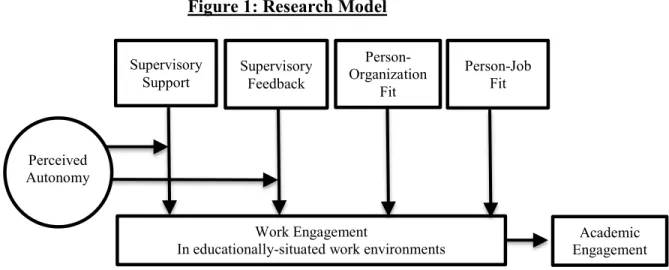
Figure 1: Research Model
Supervisory Support
Person- Organization
Fit Supervisory
Feedback
Work Engagement
In educationally-situated work environments
Person-Job Fit
Academic Engagement Perceived
Autonomy
APPENDIX A
Fall 2016 Student Affairs Poll
Department Student Employees Professional Staff Full Time (FT) Center for Inclusion & Cross
Cultural Engagement
4 2
University Police Department 12 49
Ole Miss Union 6 4
Campus Recreation 180 10
Health Center 0 19
Center for Student Success & First Year Success
5 17
Office of Conflict Resolution &
Student Conduct
3 2
Luckyday 18 4
Financial Aid 3 23
Career Center 8 6
Admissions 18 43
Student Housing 304 14
Office of the Dean of Students 3 3
564 196
FTE 352.5
FTE+FT 548.5
FTE/FT 64%
APPENDIX B Recruitment Emails Hello,
My name is Chase Moore and I am a senior business major. I am in the Sally McDonnell Honors College and I am currently conducting research for my senior thesis project as part of my graduation requirements. My study is currently titled, "Work & academic engagement: The antecedents & consequences of student employee engagement within Student Affairs." I desire to survey student employees within the division of Student Affairs at the University of Mississippi, and I need your help. The purpose of the study is to examine the factors that impact student employees' work engagement and academic engagement in educationally-situated work environments.
Would you be able to distribute the survey to your undergraduate student
employees via email and send me the count of students that you email? If possible, please send by 5pm, March 20, 2017. I have attached the email to the student employee. This choice of distribution will create a completely anonymous project.
The survey will run Sunday, March 19 and close Saturday, March 25, 2017. The students will also have the opportunity to win $25 gift cards for their participation.
This study has been reviewed by The University of Mississippi's Institutional Review Board (IRB). If you have any questions, concerns, or reports regarding your rights as a participant of research, please contact the IRB at (662) 915-7482 or [email protected]. If you have any questions, comments, or concerns, can contact me via cell at (901) 634- 8477 or email at [email protected].
Thank you so much for helping me and all that you do!
Best,
Chase V. Moore
University of Mississippi, '17
School of Business Administration, Management Major
Dear Student,
You're invited to participate in a survey!
You were selected to receive this invitation because you are a student employee within the Division of Student Affairs at the University of Mississippi whose opinion is valued.
In this survey you will be asked questions about your job and schoolwork. Please answer as honestly as possible.
Your responses will remain anonymous. Your supervisor will not receive the answers you select. For your participation, you will be entered to win a $25 Gift Card. There will be 4 chances to win. The survey will open Sunday, March 19 and close Saturday, March 25, 2017.
This study has been reviewed by The University of Mississippi's Institutional Review Board (IRB). If you have any questions, concerns, or reports regarding your rights as a participant of research, please contact the IRB at (662) 915-7482 or [email protected].
Click here for the survey!
http://uofmississippi.qualtrics.com/SE/?SID=SV_d0c3w0bhi3V7kdn
APPENDIX C Survey
STUDENT EMPLOYEE WORK ENGAGEMENT AND ITS RELATIONSHIP TO ACADEMIC ENGAGEMENT
Q1 Thank you for participating in this survey! You were selected to receive this invitation because you are a student employee within the Division of Student Affairs at the University of Mississippi. Your opinion is valued! In this survey, you will be asked questions about your job and schoolwork. Please answer as honestly as possible. The survey should take less than 10 minutes. Your responses will remain anonymous. Data from this research will be reported in the aggregate and will not contain any identifying information. For your participation, you will have the opportunity to be entered to win a $25 Gift Card. There will be 4 chances to win. This study has been reviewed by The University of Mississippi's Institutional Review Board (IRB). If you have any questions, concerns, or reports regarding your rights as a participant of research, please contact the IRB at (662) 915-7482 or [email protected]. I have read and understand the above information. By completing the survey, I consent to participate in the study.
Q2 Are you 18 years of age?
Yes (1) No (3)
Q3 What is the highest level of course hours you have completed at the University?
0-15 hours (Freshman) (1) 16-29 hours (Freshman) (2) 30-59 hours (Sophomore) (3) 60-89 hours (Junior) (4) 90 or more hours (Senior) (5)
Q4 Which office are you currently employed this semester?
Admissions (1)
Center for Inclusion and Cross Cultural Engagement (2) University Police Department (3)
Ole Miss Union (4) Campus Recreation (5) Health Center (6)
Center for Student Success & First Year Success (7) Office of Conflict Resolution & Student Conduct (8) Luckyday (9)
Financial Aid (10) Career Center (11) Student Housing (12) Counseling Center (13)
Office of the Dean of Students (14) Student Disability Services (15) Fraternity & Sorority Life (17) Other (16)
Q5 Which category best describes the length of time you've worked in your current office of employment?
0-3 months (1) 4-6 months (2) 7-9 months (3) 10-12 months (4) 13 or more months (5)
Q6 Which category best describes your hourly pay at your current office of employment? (The federal minimum wage is currently $7.25 per hour.)
$7.25 - $7.49 (1)
$7.50 - $7.99 (2)
$8.00 - $8.49 (3)
$8.50 - $8.99 (4)
$9.00 or more (5)
Q7 Which category best describes the amount of hours you work per week at your current office of employment?
0-5 hours (1) 6-10 hours (2) 11-15 hours (3) 16-20 hours (4) 21-25 hours (5)
26+ hours (Your work time exceeds the 25 hour per week limit) (6)
Q8 To what extent is the following true about you and
your schoolwork?
(1=not at all, 5=completely
true)
Not at all (1) Slightly (2) Moderately (3) Very (4) Extremely (5)
During class, I ask questions
(1) I tell the teacher
what I like and what I don’t
like (2) I let my instructor or professor know
what I’m interested in (3)
During class, I express my preferences and
opinions (4) I offer suggestions about how to make the class
better (5) I listen carefully in
class (6) I try very hard
in school (7) The first time my instructor or
professor talks about a new topic, I listen very carefully
(8) I work hard when we start something new
in class (9) I pay attention
in class (10) I enjoy learning
new things in class (11)
When we work on something in
class, I feel interested (12)
When I am in class, I feel curious about
what we are learning (13)
Class is fun (14) When doing schoolwork, I
try to relate what I’m learning to what
I already know (15) When I study, I
try to connect what I am learning with
my own experiences
(16) I try to make all
the different ideas fit together and
make sense when I study
(17) I make up my own examples to help me understand the
important concepts I study
(18) Before I begin to study, I think
about what I want to get
done (19) When I’m working on my
schoolwork, I stop once in a while and go
over what I have been
As I study, I keep track of how much I understand, not
just if I am getting the right
answers (21) If what I am working on is
difficult to understand, I change the way
I learn the material (22)
Q9 Which category best describes your current cumulative grade point average (GPA)?
Below 2.5 (1) 2.6-3.0 (2) 3.1-3.5 (3) 3.5-4.0 (4)
Q19 To what extent is the following true about you and your job? (1=not at all, 5=extremely)
Not at all (1) Slightly (2) Moderately (3) Very (4) Extremely (5) I work with
intensity on my job (6) I exert my full effort to my job
(7) I devote a lot of
energy to my job (8) I try my hardest to perform well on my job (9) I strive as hard as I can to complete my
job (10) I exert a lot of
energy on my job (11)
I am enthusiastic in
my job (12) I feel energetic
at my job (13) I am interested in my job (14) I am proud of
my job (15) I feel positive about my job
(16) I am excited about my job
(17) At work, my mind is focused
on my job (18) At work, I pay
a lot of attention to my
job (19) At work, I focus a great
deal of attention on my
job (20)
At work, I am absorbed by my job (21) At work, I concentrate on
my job (22) At work, I devote a lot of attention to my
job (23) I can use my own personal judgment on carrying out my job (24) I have the freedom to decide what I do on my job
(25) I can make my
own decisions in carrying out my job (26)
Q11 To what extent is the following true about your manager or supervisor? (1=not at all, 5=
extremely)
Not at all (1) Slightly (2) Moderately (3) Very (4) Extremely (5) My manager or
supervisor is very concerned
about the welfare of those under him/her (1) My manager or
supervisor is willing to listen to work-related problems (2) My manager or
supervisor can be relied upon when things get
difficult at work (3) My manager or
supervisor gives me sufficient information about work goals (4) My manager or
supervisor gives me feedback on my
performance (5) My manager or
supervisor gives me feedback on
how I can improve my performance
(6)
Q12 To what extent is the following true about you and your job? (1=not at all, 5= extremely)
Not at all (1) Slightly (2) Moderately (3) Very (4) Extremely (5) The things that
I value in life are very similar
to the things that my organization
values (1) My personal values match
my organization's
values and culture (2)
My organization's
values and culture provide
a good fit with the things that I value in life (3) There is a good
fit between what my job offers me and
what I am looking for in a
job (4) The attributes that I look for in a job are fulfilled very
well by my present job (5)
The job that I currently hold gives me just
about everything that
I want from a job (6) The match is
very good between the demands of my
job and my personal skills
(7)