clearing methods for single-cell phenotyping in whole organs
Thesis by
Ken Yee Chan
In Partial Fulfillment of the Requirements for the degree of
Doctor of Philosophy
CALIFORNIA INSTITUTE OF TECHNOLOGY Pasadena, California
2017
Defended May 18th, 2017
2017 Ken Yee Chan
ORCID: 0000-0002-8853-5186
ACKNOWLEDGMENTS
I begin by thanking my Ph.D. advisor, Dr. Viviana Gradinaru, for her guidance, hard work, dedication, persistence, and patience over the course of my Ph.D. training. Throughout my training, Viviana has advised me a great deal both professionally and personally. Viviana sets the bar high for each of her mentees, but because of her hard work, calm and caring nature, and dedication, she has provided me with the necessary means to achieve my goals during my Ph.D. training. She has done this by providing invaluable guidance and advice, an uncanny amount of resources, and a positive lab environment for learning, individual growth, and collaboration. Her patience and guidance has allowed me to learn many of the most up- to-date techniques in neuroscience, as well as valuable off-the-bench skills, such as writing papers, grants, and abstracts for conferences. She has also nurtured my future career by providing me with opportunities in presenting my work at numerous conferences and also allowing me to participate in many collaborations with other top scientists around the country. I am convinced my journey as a graduate student would not have been as productive and eventful had Viviana not taken the chance on accepting me into her lab. I hope her journey in mentoring me has been as positive and enjoyable as much as it has been for me in being her graduate student.
Furthermore, I would like to thank Dr. Benjamin E. Deverman. Ben has played a key role in my Ph.D. training and life in graduate school. His thoroughness, integrity, and efficiency on and off the bench have always been traits I have greatly admired. Ben has become one of the very few role models I find myself falling back to in times of self- reflection and growth. In addition, I have appreciated Ben’s style of mentorship in my graduate studies. His mentorship has always come in the form of bringing others to the same level as his by training or advising a person as if he or she will eventually become his peer.
Ben’s cool headedness and unbelievable strive to become exceptional at whatever he sets out to do, in and outside of science, has inspired many facets of my life. I am extremely grateful to know Ben and to have worked with him but, more importantly, for not leaving me to my death during our bike rides up Glendora Mountain Road.
There are a few people without whom much of the work presented in this thesis would not have been possible, including my colleague and dear friend Dr. Alon Greenbaum.
I have worked closely with Alon on many projects and have enjoyed and appreciated his candor and determination in getting things done. Alon’s need for perfection, consistency, and efficiency has been a major backbone in our work together. I feel very fortunate to have worked alongside Alon on our projects. One of the most important things I have learned from Alon was how to carry out a project and finish it. I have always felt fortunate to have been paired with Alon and would never want to miss an opportunity to work alongside him, if possible.
I would also like to thank a few other postdoctoral scholars in Viviana’s lab:
Dr. Cheng Xiao, Dr. Jennifer Treweek, and Dr. Min Jee Jang. Cheng and Jennifer were both present when I first joined Viviana’s lab. Much of my initial training in neuroscience techniques was largely from Cheng and Jennifer. Their investment in training me has played a large role in my success as a graduate student. I would also like to thank Min Jee Jang for her friendship, support, and help in my projects. She has been an amazingly helpful colleague and friend.
I would also like to thank Bin Yang. Bin was a research technician in Viviana’s lab when I started graduate school. Bin had also taught me many things on the bench. Most importantly though, I am grateful that Bin had set up Viviana’s lab so promptly. Surely, without a functional lab during my rotation, Viviana might not have taken me into her lab.
Graduate school has its ups and downs, and I believe I could not have dealt with this roller coaster experience without the many friends that I have met along the way. Two in particular come to mind. I would like to thank Nicholas Flytzanis and Ryan Cho for their friendship, humor, and support. Since both Nick and Ryan are also graduate students, they also understand the ups and downs of graduate school. Their role in being good friends has been invaluable. Their humor has been cheerful. Their support has been immensely helpful.
I feel fortunate to have met them. I would also like to thank my friends and colleagues
Sripriya Ravindra Kumar, Bryan Yoo, Pradeep Rajendran, and Claire Bedbrook, who have always been there when I needed them. In addition, I would also like to thank the entire Gradinaru lab for being an amazing and well-rounded group of individuals that has supported me throughout my training.
In addition, I would like to thank all of the collaborators with whom I have worked with during my graduate training. In particular, the outstanding scientists Dr. Rogely Boyce and Dr. Helen McBride from Amgen for their, kindness, enthusiasm, valuable time, and generosity in sharing knowledge. I would also like to thank Dr. Carlos Lois, Dr. Victoria Orphan, Dr. Sarkis Mazmanian, and Dr. Luis Oscar Sanchez Guardado for collaborations in projects.
Furthermore, I would like to thank Dr. Henry Lester, Dr. Long Cai and Dr. John Allman for being on my oral candidacy and thesis committee. Henry, Long, and John have been guiding me, supporting my learning, and encouraging me over the last few years. I am extremely grateful to have such support during my Ph.D. training. In particular, I would like to thank Henry for his candor and enthusiasm over my work throughout the years and for always encouraging me to reach for my goals.
I would like to thank my land lord and lady, Martin Zitter and Carol Nakamoto-Zitter, whom I practically consider family now. I would also really like to thank them for not raising my rent in the past several years since I have been living with them.
In addition, I would like to thank my mom and dad for their continued support, and my friends Michael Knapp, Kristin Cummings, Tai Ting-Chi, Chris Tucker, Irina Meininger, Daniel Zitter, Dubravka Pezic, and Evelyn Stuwe. I would also like to thank my past mentors Dr. Casey Quinlan, Dr. Alexei Aravin, Dr. Bruce Hay, Dr. Katalin Fejes Tóth, Dr. Nikolai Kandul, and Dr. Ivan Olovnikov for their support, friendship, and guidance.
ABSTRACT
A central question in biology is how different cell types interact with each other and their native environment to form complex functional systems and networks. Although our ability to investigate this question has considerably expanded from the development of genetically encoded tools, some limitations still persist. For instance, we are limited in our ability to visualize the native three dimensional environments of whole organs. Additionally, it is challenging to efficiently deliver transgenes into difficult-to-target areas through direct- injections, such as the cardiac ganglia, or broadly distributed networks, such as the myenteric nervous system, which limits our ability to extensively study these areas. Therefore, tools and methods that overcome these limitations are needed. Towards this end, my thesis work has been focused on developing tools for single-cell resolution phenotyping in whole organs.
I have been developing tissue clearing technologies to render whole organs transparent for optical interrogation and characterizing viral capsids and engineering viral vectors for noninvasive widespread gene delivery to the central and peripheral nervous system.
Tissue clearing techniques for three dimensional optical interrogation were invented over a century ago. However, these earlier methods used harsh organic chemicals and failed to retain the tissue’s native fluorescence or epitopes. These earlier methods eventually became incompatible to the hundreds of newly generated transgenic mouse lines that allowed for cell type-specific expression of fluorescent transgenes or to fluorescent labeling techniques, such as immunohistochemistry (IHC). The first part of my dissertation is aimed at addressing these limitations by further developing and standardizing a tissue clearing method that utilizes the vasculature to perfuse clearing reagents. This technique, called perfusion assisted agent release in situ (PARS) enables (i) whole organ clearing of soft tissue, (ii) preservation of native fluorescence, and (iii) preservation of epitopes compatible with IHC.
Although PARS allows us to optically investigate whole soft tissue organs, it is unsuitable for clearing bone tissue. The clearing of bone is important as it may provide
optical access to delicate environments, such as the lymphatic vessels lining the dural sinuses beneath the skull that would otherwise be damaged through traditional methods. However, clearing bone tissue is challenging since it is composed of both soft (bone marrow) and hard (mineral) tissue. To overcome this challenge, I developed a clearing method that rendered intact bone tissue transparent by using EDTA to decalcify bones and by constructing a convective flow chamber to efficiently clear bones. This method, called Bone CLARITY, is able to preserve native fluorescence and epitopes. In order to demonstrate the utility of Bone CLARITY, I collaborated with colleagues to quantitatively access a rare and non-uniformly distributed population of osteoprogenitor cells in their native three dimensional environment.
Bone CLARITY in conjunction with light-sheet microscope enabled the early detection of an increase to this osteoprogenitor population after administration of a novel anabolic drug, which may have been undetected with traditional techniques.
Towards my second goal, I have been working on characterizing adeno-associated viruses (AAVs) for non-invasive widespread gene delivery across the central or peripheral nervous system. Through systemic delivery, these novel AAVs are able to efficiently deliver transgenes to (i) difficult-to-target areas, such as the dorsal root ganglia; (ii) cellular populations that are widely distributed across the mouse body, such as neurons in the myenteric nervous system, and (iii) through highly selective barriers, such as the blood-brain barrier. These viruses enable rapid expression of transgenes for perturbing and monitoring cellular circuits, or for potentially treating neurological diseases. In addition, I worked on engineering or validating several different gene regulatory elements to achieve cell type restricted expression in transgenic and non-transgenic animals with AAVs. These viral vectors may prove useful in rapidly testing newly developed genetic tools. Finally, I developed and characterized two different two-component viral vector systems to control the density of labeling when systemically delivering genes with our novel engineered viruses. I utilized this two-component system to perform single-cell morphology studies in the CNS and PNS. Collectively, these capsids and vectors expand the AAV toolbox and enable efficient and versatile gene delivery into the CNS and PNS of transgenic and non-transgenic animals.
PUBLISHED CONTENT AND CONTRIBUTIONS
[1] Chan, K.Y.C et al. “Engineered adeno-associated viruses for efficient and noninvasive gene delivery throughout the central and peripheral nervous systems”. In press.
K.Y.C helped design and perform experiments, collect and analyze data, prepare figures and write the manuscript with input from all authors
[2] Greenbaum, A. et al. “Bone CLARITY: Clearing, imaging, and computational analysis of osteoprogenitors within intact bone marrow”. In: Science Translational Medicine 387.9 (2017).
URL: http://doi.org/10.1126/scitranslmed.aah6518.
K.Y.C. performed experiments, data acquisition, data analysis, generated figures, and wrote the manuscript with input from all authors.
[3] Allen, W. et al. “Global Representations of Goal-Directed Behavior in Distinct Cell Types of Mouse Neocortex”. In: Neuron 94.4 (2017), pp. 891-907.
URL:http://dx.doi.org/10.1016/j.neuron.2017.04.017.
K.Y.C. prepared AAV-PHP.B viruses.
[4] Xiao, C. et al. “Cholinergic Mesopontine Signals Govern Locomotion and Reward through Dissociable Midbrain Pathways”. In: Neuron 90.2 (2016), pp. 333-347. URL:
http://doi.org/10.1016/j.neuron.2016.03.028
K.Y.C. contributed to animal behavior tests and data illustration.
[5] Deverman, B.E. et al. “Cre-dependent selection yields AAV variants for widespread gene transfer to the adult brain”. In: Nature Biotechnology 34.2 (2016), pp. 204-209. doi:
10.1038/nbt.3440.
K.Y.C. performed experiments, virus production and characterization.
[6] Treweek, J.B. et al. “Whole-body tissue stabilization and selective extractions via tissue- hydrogel hybrids for high-resolution intact circuit mapping and phenotyping”. In: Nature Protocols 10.11 (2015), pp. 1860-1896. doi:10.1038/nprot.2015.122.
K.Y.C designed and performed experiments, analyzed the data and prepared figures.
[7] Skennerton, C.T. et al. “Genomic reconstruction of an uncultured hydrothermal vent gammaproteobacterial methanotroph (family Methylothermaceae) indicates multiple adaptations to oxygen limitation”. In: Frontiers in Microbiology 23.6: 1425 (2015). doi:
10.3389/fmicb.2015.01425. URL: https://doi.org/10.3389/fmicb.2015.01425 K. Y.C performed laboratory work to prepare samples for sequencing
[8] Flytzanis, N.C. et al. “Archaerhodopsin variants with enhanced voltage-sensitive fluorescence in mammalian and Caenorhabditis elegans neurons”. In: Nature Communications 15.5: 4894 (2014). doi:10.1038/ncomms5894.
K.Y.C. performed experiments.
Table of contents
Acknowledgments………... iii
Abstract ………vi
Published Content and Contributions………...viii
Table of Contents………. ix
Chapter I: Introduction ... 1
1.1 Technology development for the study of biological systems ... 1
1.2 Tissue clearing for whole organs using the vasculature ... 2
1.3 Developing tissue clearing to render whole bone transparent ... 3
1.4 1.4 Characterizing adeno-associated viral capsids and engineering viral vectors ... 5
Chapter II: Whole-body tissue stabilization and selective extractions via tissue- hydrogel hybrids for high-resolution intact circuit mapping and phenotyping . 8 2.1 Summary ... 8
2.2 Building a PARS chamber ... 8
2.3 Standardized Procedure for PARS ... 10
2.4 Main Figures ... 12
Chapter III: Bone CLARITY: clearing, imaging, and computational analysis of osteoprogenitors within intact bone marrow ... 15
3.1 Summary ... 15
3.2 Introduction ... 16
3.3 Results ... 18
3.4 Discussion ... 24
3.5 Main figures ... 27
3.6 Supplementary Figures ... 34
3.7 Supplementary movie captions ... 45
3.8 Materials and methods ... 46
3.9 Supplementary methods ... 49
3.10 Additional information ... 54
Chapter IV: Engineered adeno-associated viruses for efficient and noninvasive gene delivery throughout the central and peripheral nervous systems... 55
4.1 Summary ... 55
4.2 Introduction ... 56
4.3 Results ... 58
4.4 Discussion ... 64
4.5 Main Figures ... 68
4.6 Supplementary figures ... 78
4.7 Supplementary tables ... 91
4.8 Supplementary movie caption ... 93
4.9 Methods ... 94
4.10 Additional information ... 100
Bibliography ... 102
C h a p t e r 1 INTRODUCTION
1.1 Technology development for the study of biological systems
Scientific discoveries are not only dependent on new and novel ideas or conceptual leaps that result in paradigm shifts, but also in advances to the technologies that make these steps possible. Tools that enable viewing or manipulation of biological systems have accelerated efforts in our understanding of complex biological processes by allowing researchers to visualize or perturb these events. Some of the most important and widely adopted biological tools are simple, elegant, and have revolutionized the way we perform research. One classic example of this is the discovery and usage of green fluorescent protein in E. coli and C. elegans. Since its publication, it has allowed researchers to peer into the inner workings of biological environments. Another example of this are the tools in optogenetics, where the use of light-activated bacterial proteins have allowed researchers to perturb biological circuits and dissect out their function with high spatial and temporal resolution in genetically defined populations of cells1. These examples highlight the importance of tool development in the study of biological systems. As the complexity of biology unravels, the demand for more advanced tools and techniques rises, and consequently, tool developers will need to adapt to this demand in order to further push discoveries with novel approaches. Limited to our current repertoire of tools, are those that allow for visualization of native three dimensional environments. Additionally, it is challenging to deliver transgenes into difficult-to-access areas, such as the cardiac ganglia, or broadly distributed networks, such as the myenteric nervous system, which limits our ability to extensively study these areas. Therefore, technological tools that overcome these limitations are in need.
The body of work summarized in this dissertation has been focused on developing tools in addressing a central question in biology: how different cell types interact with each
other and their native environment to form complex functional systems and networks. These tools include (i) developing tissue clearing methods to render tissue transparent for three- dimensional optical interrogations, (ii) expanding the adeno-associated viruses (AAV) toolbox by characterizing capsids for non-invasive widespread gene delivery throughout the CNS and PNS, (iii) generating or validating gene regulatory elements for cell type-specific expression of transgenes in non-transgenic animals, and (iv) developing viral vectors for sparse multi-color gene expression for single-cell morphology studies. Collectively, the developed tissue clearing methods, characterized novel viruses, and engineered viral vectors allow for single-cell resolution phenotyping in whole organs and will help further our understanding of complex biological systems and networks.
1.2 Tissue clearing for whole organs using the vasculature
The ability to visualize biological tissue has long been appreciated by scientists. That is why tools like microscopes and microtomes have been indispensable in research. They allow us to view physical evidence of cellular components and processes in two-dimensional sections. But recently, with the growing ability to handle and process bigger data sets, more advanced microscopes being built (i.e., objectives with longer working distances and light- sheet microscopy allowing for faster acquisition times), and multidisciplinary approaches to tackle on scientific questions on a larger scale, it is no surprise that there is a trend to investigate biological tissue in three dimensions to better understand how cells interact with each other and their native environment. The brain is a prime example that represents the complexity of an organ and the need to study it in three dimensions. Neurons can project long distances and branch in many different directions to form intricate neural networks.
However, the idea of rendering tissue transparent for three-dimensional optical access has been around for over a century. For example, solvent-based clearing methods, such as benzyl alcohol, was first described by Spalteholz over one hundred years ago2. Since then, many solvent-based variations have been published to render tissue transparent. These methods were able to produce samples that were novel at the time and allowed unprecedented optical access to study anatomy. However, major limitations to solvent-based clearing were the
inability to perform immunostaining, preserve native fluorescence, and risks damage to the tissue from the use of harsh chemicals3. With the ever growing number of transgenic reporter mouse lines and tools that genetically targeted cells with fluorescent proteins it was only a matter of time until researchers would come up with ways to render tissue transparent while preserving the ability to perform immunostaining and native fluorescence. The hurdle was crossed in 2013 when Chung K. et al. published the CLARITY technique4 allowing the ability to immunostain and preserve native fluorescence. CLARITY utilized a hydrogel mesh that locked the proteins in their original positions while removing lipids from the tissue.
Lipids are the main organic material that prevents imaging deep into tissue because of their light-scattering properties. However, a caveat to CLARITY was the use of an electric current to speed up the lipid removal process and penetration of antibodies. The use of this electric current caused the tissue to heat up and turn brown mainly due to the Maillard reaction.
CLARITY also required expensive equipment, such as platinum wires and a commercial refractive index matching solution, which limited its wide adoption. Ultimately, researchers aimed to expand upon the CLARITY approach by avoiding the use of the electric current and also making the procedure more adoptable. In Chapter 2, I present tissue clearing work where I aimed to develop and optimize ways to perform rapid whole organ clearing of soft tissue using the vasculature, an idea published in the lab5 but its procedure was not yet optimized. I standardized this procedure by detailing a step-by-step protocol and also outlined how to easily build an affordable clearing chamber with common and readily available parts found in a molecular laboratory. By using the vasculature, the use of an electric current could be avoided while still maintaining a rapid clearing time. In addition, small molecular dyes and antibodies could be perfused through to allow for immunostaining.
This work is summarized in Chapter 2.
1.3 Developing tissue clearing to render whole bone transparent for single-cell phenotyping
Since the publication of CLARITY and the proceeding clearing methods (uDISCO6, CUBIC7, PACT5, PARS5, ScaleSQ8), there was growing interest in adopting clearing
technology for the study of bone. There were two main reasons why this was important in relation to neuroscience. The first came from a paper in 2015 that detailed the discover of lymphatic vessels beneath the skull lining the dural sinuses9. Access to these areas beneath the skull through traditional means is difficult. They are readily damaged with even low amounts of force. Therefore, the study of such lymphatic vessels were difficult and for a long time overlooked. Methods that can study these areas of interest without disruption to the native environment could prove useful in fields like neuroimmunology and may help shed insight into how immune system dysfunction is associated with neurodegenerative diseases.
The second reason came from the fact that bone contributes to whole-organism physiology.
They regulate calcium levels, energy metabolism, and provide structural support10. Interestingly, there also exists a bone-brain axis that regulates appetite11. Therefore, the importance of bone to whole-organism physiology and accessing the delicate interfaces housing unique environments was a large motivation in developing tissue clearing technology to study bone. However, the challenge with bone is that it is a complex tissue; it contains both soft tissue (marrow) and hard tissue (minerals). At the time, tissue-clearing protocols were designed for soft tissue only, such as the brain. Consequently, a clearing protocol would need to be designed specifically for clearing bones. The goal was to develop a way to clear bone tissue while maintaining the native fluorescence of reporter mouse lines.
This involved removing hard minerals from bones by decalcifying them with a chelating agent before lipid removal. In addition, since bone harbors a large amount of heme that autofluorescence, an amino alcohol was used to remove the heme. After I had developed a bone-clearing protocol, I collaborated with colleagues to use tissue clearing for bones to answer a biologically relevant question. I worked alongside Dr. Greenbaum in imaging intact bones with a custom-built light-sheet fluorescence microscope that minimized acquisition times compared to conventional point scanners microscopes. Together, we were able to image native fluorescence in whole bones at single-cell resolution to study a rare and non- uniform population of osteoprogenitor cells. I also worked with two young collaborators to build computation tools for semi-automated cell quantification of these rare and non- uniformly distributed osteoprogenitor cells. We found after administration of a novel
anabolic drug, we were able quantitatively detect a minute increase in the osteoprogenitor population of cells. We demonstrated that this minor increase may have been undetected using traditional methods until later time points due to sub-sampling errors from statistical estimation. This highlighted the sensitivity of our methods. The summary of this work is found in Chapter 3.
1.4 Characterizing adeno-associated viral capsids and engineering viral vectors The process of introducing foreign DNA into a cell is one of the most fundamental techniques in biology. It allows researchers to manipulate a cell’s phenotype for study or treatment. There are many ways to achieve gene transfer in vivo: electrically (electroporation), mechanically (microinjection), synthetically (nanoparticles), or biologically (viruses), to name a few. There is no gold-standard way, and each of the listed methods has its pros and cons. Nevertheless, the methods listed are well-established techniques and widely adopted in research. However, if there were a gold standard for in vivo gene transfer, it would probably be something that was: non-invasive, had a high transduction efficiency, with either broad or specific tropisms, have low immunogenicity, with the ability to deliver large-sized genomes, be cost efficient to produce, and allowed for long-term expression without host genome integration. With no surprise, various viruses have evolved from nature that are able to satisfy a moderate amount of these requirements, but not all. For example, herpes simplex virus HSV allows for large packaging of genomes and allows for fast expression in neuronal cells; however, HSVs can cause an acute inflammatory response12. Lenti viruses, on the other hand, have a modest packaging capacity and can transduce dividing and non-dividing cells, but generally contain impurities in their envelope, making them difficult to purify which causes an acute inflammatory responses13. Recombinant adeno-associated viruses (rAAVs) have a small packaging capacity compared to other viruses; however, their ability to provide safe and moderate levels of long-term expression in a wide array of cell types has made them an attractive gene delivery tool in basic research and clinical trials14. For example, in 2012, the first AAV gene therapy was approved by the European Commission for the treatment of lipoprotein lipase deficiency15.
This was a major milestone for viral gene therapy. Although AAVs are widely adopted in research and preclinical trials nowadays, their full potential is only beginning to unravel.
Within the AAV platform, there is a lack of AAVs that can provide broad and non-invasive gene transfer to difficult-to-access environments (i.e., dorsal root ganglion, cardiac ganglia) or widely distributed organs (brain, enteric nervous system). In addition, the main delivery method of AAVs is through site-directed injections, which for most applications is suitable and desirable to restrict expression of a transgene. However, for applications, such as gene therapy in neurological diseases within the central nervous system (CNS), where likely multiple brain regions are affected, the current repertoire of AAVs would require numerous site-directed injection due to their poor transduction efficiency during systemic delivery.
Furthermore, for basic research, the ability for widespread gene delivery could allow researchers to more rapidly test new molecular tools, such as voltage indicators, and refine those tools before dedicating the time and cost in generating a transgenic mouse line. In addition, AAVs that could delivery genetic tools into difficult-to-target areas could help in our studies in understanding these areas. From the already desirable properties of AAVs, it wasn’t surprising that researchers focused on improving the versatility of the AAV platform.
For example, researchers have engineered AAVs with more specific tropism to endothelial cells16 in the CNS or to have enhanced transduction efficiency into the CNS 17 through systemic delivery. In 2016, Deverman et al. published AAV-PHP.B using a capsid selection method, called Cre recombination–based AAV targeted evolution (CREATE)18. AAV- PHP.B allowed for the ability to deliver genes across the central nervous system (CNS) non- invasively with a 40-fold higher transduction efficiency than the current standard, AAV9, at the time. Such AAVs may prove to be important for the treatment of neurological diseases where the replacement of a defective gene in the entire central nervous system would require widespread non-invasive gene delivery. However, much work is still required to improve these new novel AAVs. For example, AAVs with efficient non-invasive delivery into the peripheral nervous system (PNS) are lacking. These AAVs could be useful for the delivery of genes into areas that are difficult-to-target surgically, such as the dorsal root ganglia, for the study of pain. In addition, high viral payloads for efficient widespread transduction
through systemic delivery are still required. The ability to maintain a high transduction efficiency with a lower viral payload could be useful in several ways. The first is lowering viral payloads could help bypass neutralizing antibodies in the organism when high viral payloads are used. The second is more practical: lower viral payloads with high transduction efficiency will help in reducing the cost and time burden in viral production when scaling up for larger model organisms or preclinical trials. The viral work presented in this thesis is focused on the characterization of novel AAVs for efficient and noninvasive gene delivery throughout the CNS and PNS. The work is based off the CREATE method and uses it to further evolve the AAV-PHP.B capsid towards more efficient transduction in neurons at lower viral payloads. It also involves the characterization of a new capsid that showed high transduction efficiency towards peripheral sensory neurons. Viruses that can transduce sensory neurons widely distributed, such as those found in the enteric nervous system, are lacking, so this variant may prove useful in accelerating research in newly developing multi- system fields, such as the gut-brain axis19. In addition, I present my work in developing viral vectors for single-cell phenotyping in whole-organ systems. This was done by using our novel AAVs with engineered viral vectors I constructed to allow for sparse multicolor labeling of cells in a ubiquitous or cell type-specific manner. The idea of using multicolor for cell tracing and morphology studies is not novel. It was first published in 2007 by Livet J et. al, and afterwards, several iterations20 were made to improve its approach. However, a major limitation to the approach was the lack of ability to modulate its density in labeling, something difficult to achieve with transgenic animals or site-directed injections of viruses.
To overcome this, I worked on building and testing two different two-component systems using Flp recombinase or the tetracycline inducible system for modulating the density of labeling with our systemically deliverable viruses. I utilized this system to study cell morphology in the CNS and PNS. Finally, in order to further maximize the utility of AAVs, I also constructed or validated several different gene regulatory elements for cell type specific expression in non-transgenic animals. Collectively, this expansion of the AAV toolbox enables efficient and versatile gene manipulation in the CNS and PNS of transgenic and non- transgenic animals. This work is summarized in Chapter 4 of my thesis.
C h a p t e r 2
Whole-body tissue stabilization and selective extractions via tissue-hydrogel hybrids for high-resolution intact circuit mapping and phenotyping
[6] Treweek, J.B. et al. “Whole-body tissue stabilization and selective extractions via tissue- hydrogel hybrids for high-resolution intact circuit mapping and phenotyping”. In: Nature Protocols 10.11 (2015), pp. 1860-1896. doi:10.1038/nprot.2015.122.
2.1 Summary
To facilitate fine-scale phenotyping of whole specimens, we describe here a tissue fixation-embedding, detergent-clearing and staining protocol that can be used to transform whole organisms into optically transparent samples within 1–2 weeks without compromising their cellular architecture or endogenous fluorescence. The method perfusion-assisted agent release in situ (PARS) is optimized and standardized in this chapter for whole-body tissue clearing of soft tissue. It uses a hydrogel to stabilize tissue biomolecules during selective lipid extraction, resulting in enhanced clearing efficiency and sample integrity. Furthermore, the macromolecule permeability of PARS-processed tissue hybrids supports the diffusion of immunolabels throughout intact tissue, whereas RIMS (refractive index matching solution) grants high-resolution imaging at depth by further reducing light scattering in cleared and uncleared samples alike. The protocol and solutions outlined enable phenotyping of subcellular components and tracing cellular connectivity in intact biological networks.
2.2 Building a PARS chamber
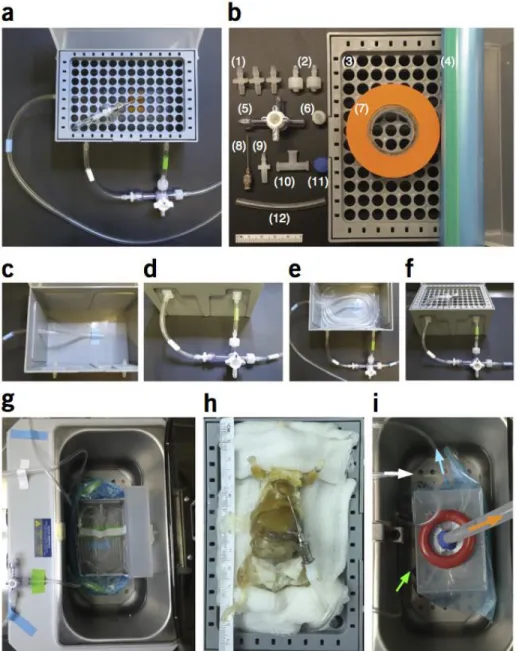
To perfuse PARS reagents through vasculature in a contained environment, we construct a PARS chamber using components that are readily found in most of the biological research laboratories (Figure 2.1). The necessary components of a PARS setup are as follows: a feeding needle catheter to deliver PARS reagents to vasculature; a perfusate catch-basin (pipette box) in which recirculating PARS reagents may pool once they exit the vasculature;-Tygon tubing threaded through a peristaltic pump so that pooling
reagents may be collected from the catch-basin and recirculated back into a subject's vasculature; Luer-to-tubing couplers; and a Ziploc bag to contain the entire PARS chamber setup.
To construct the PARS chamber, drill two 1/8-inch holes into the front and one 1/8- inch hole into the left side wall of an empty 1,000-μl pipette tip box. The holes are drilled just below the tip wafer (in Figure 2.1, the holes are ~2 cm below the top rim). Next, snap 1/8 × 1/8-inch barbed connectors into each of the drilled holes. The outflow line will circulate solvents from the pipette box chamber to the 3-way stopcock. To join the outflow line to a 3-way stopcock, use a 10-cm piece of Tygon tubing and connect one end to the inner left side 1/8 × 1/8-inch barbed connector and tape the other end to the inside bottom of the pipette tip box. Continue this line through a peristaltic pump by using a new piece of Tygon tubing, and connect one end to the outer left side 1/8 × 1/8-inch barbed connector and then thread the tubing through a peristaltic pump. Next, join the free end to a three- way stopcock with a 3/32-inch barbed male Luer with locking nut. The inflow line circulates solvents from the three-way stopcock to the vasculature. To link the inflow line to the pipette tip box, use a piece of 15-cm Tygon tubing and connect one end to the outer right front 1/8 × 1/8-inch barbed connector and the other end to the three-way stopcock with a 3/32-inch barbed male Luer with locking nut. To finish the inflow line, connect a piece of 75-cm Tygon tubing to the inner right front 1/8 × 1/8-inch barbed connector. Next, coil the inflow line to the bottom of the pipette tip box. This will equilibrate inflowing solvent to the desired temperature before it enters the subject's vasculature. Tape the coiled tubing to the pipette tip box. To quickly circulate bubbles formed during the changing of solutions without disconnecting the inflow line and for use of bubbling nitrogen gas into the solution during the polymerization step, a line linking the outflow line back to the pipette tip box is connected by joining a piece of 15-cm Tygon tubing to the three-way stopcock with a full-thread 3/32-inch barbed female Luer to the outer left front 1/8 × 1/8- inch barbed connector. This line is continued inside the pipette tip box and taped to the bottom. To finish the chamber, thread the inflow line through the top-left corner of the tip wafer and connect it to a feeding tube with a 1/8-inch barbed male slip Luer. As a
forewarning, SDS and salt precipitate will begin to accumulate within these narrow lines over time. It is important to flush the lines (e.g., with ddH2O) between subjects, and to replace occluded lines with new Tygon tubing (e.g., after every few subjects).
During hydrogel polymerization, the chamber must be enclosed inside a Ziploc freezer bag. To do this, disconnect the outer Tygon tubing that connects to the barbed connectors of the pipette tip box, and puncture three holes into the Ziploc bag to accommodate the 1/8 × 1/8-inch barbed connectors. Reconnect the Tygon tubing to their original 1/8 × 1/8-inch barbed connector. To connect a vacuum line to this bagged PARS box for withdrawing oxygen, tape a female Luer tee onto the lid of the pipette box and puncture one hole through the Ziploc. Finally, make the Ziploc airtight by placing clay around the punctured regions in the Ziploc.
As a final note, a 1,000-μl tip box has a volume of ~750 ml. Thus, during hydrogel polymerization and during clearing, 200–300 ml of solution may be placed in the pipette box for recirculation without risk of the pipette box overflowing or the solution splashing out during its transport. Similarly, to conserve reagents during PARS clearing and immunostaining of smaller samples, a 200-μl tip box may be used to construct the PARS chamber; only 100 ml of reagent is necessary to fill such a chamber about one-third full (Figure 2.1).
2.3 Standardized Procedure for PARS
After polymerization, wash the perfusion lines with 1× PBS, and then replace the wash buffer with 8% SDS-PBS (pH 7.5) clearing buffer. This procedure can be accomplished easily by removing the PARS chamber from the shaking water bath (optional), by turning off the pump, by removing excess initiator buffer from the PARS chamber and by replacing it with 100 ml of 1× PBS to perform the wash. Circulate the wash buffer through the sample for 10 min. Afterward, replace the buffer with 8% SDS-PBS (pH 7.5). Place the chamber back into the Ziploc bag and into the 37–42 °C water bath. Allow the SDS clearing buffer to recirculate through the system for 24 h. Perform a buffer exchange with fresh 8% SDS-PBS
(pH 7.5), by clearing the buffer daily until the recirculated fluid is no longer yellowish, after which the SDS solution can be refreshed less frequently (every 48–72 h).
Check on the clearing progress daily. Add additional SDS buffer to the PARS chamber if necessary, as depending on how well the Ziploc bag is sealed around the perfusion tubing, some buffer may evaporate over time.
The sample can be continuously perfused for up to 2 weeks until all desired organs have cleared, even if some organs appear clear within the first 24–48 h. Alternatively, if all but one or two organs appear sufficiently transparent after a few days, one may proceed directly to Step 7C(iv) to flush SDS from tissue, and then excise all organs. The one or two semiopaque excised organs are transferred into 8% (wt/vol) SDS to finish clearing via PACT, whereas the organs that cleared more rapidly are immediately promoted to passive immunostaining (optional) and mounting without further delay.
For samples that will be immunolabeled after clearing, the hydrogel matrix will be required to support the cleared tissue for several rounds of washing and multiday incubations with gentle shaking. If the already delicate tissue-hydrogel matrix seems precariously fragile after clearing (this usually only occurs with thin-sectioned tissue), it is advisable to repeat the hydrogel embedding and polymerization steps. This will stabilize tissue architecture during immunolabeling, prevent tissue loss or disintegration and counteract expansion in mounting medium. For cleared samples that will not undergo any immunohistochemical labeling steps before imaging. The ending results are in (Figure 2.2)
2.4 Main Figures
Figure 2.1. Assembling and working with the PARS chamber. (a) A completed PARS chamber used for whole-body tissue clearing. (b) Individual parts to build a PARS chamber: (1) three 1/8 × 1/8-inch barbed connectors, (2) two 3/32-inch barbed male Luers with locking nut, (3) a 1,000 µl pipette tip box, (4) a 1-gallon Ziploc freezer bag, (5) a three-way stopcock with Luer lock, (6) a 3/32-inch barbed female Luer with full tread, (7)
a roll of lab tape, (8) a 22-G × 1-inch gavage needle, (9) a 1/8-inch barbed male slip Luer, (10) a female Luer tee with locks, (11) clay and (12) Tygon E-lab tubing. Ruler shown is 5 cm in length. (c) Three 1/8-inch holes are drilled into the pipette tip box: two into the box front and one into its side, all ~2 cm below the top rim of the box. The three 1/8 × 1/8-inch barbed connectors are placed into the drilled holes. To connect the outflow line (blue tape bands on outflow line tubing), a piece of Tygon tubing is connected from the bottom inside of the pipette box to the single 1/8-inch barbed connector that was inserted through the box side. (d) To continue the outflow line, a second, longer piece of blue-taped tubing is attached to the outer fitting of this same barbed connector (on the outside of the pipette tip box side), and then the other end of this tubing is threaded through the peristaltic pump, pulled back over toward the pipette box and finally connected to a three-way stopcock with a 3/32-inch barbed male Luer with locking nut (rightmost blue-banded tubing in d). To form the inflow line, a short length of tubing (green tape band) is used to connect the three- way stopcock to the front right 1/8-inch barbed connector of the pipette box. The solute flushing line and nitrogen bubbling line, which are subserved by the same tubing (white tape band), are formed by another short length of tubing that joins the third port of the stopcock to the front left 1/8-inch barbed connector. (e) The inflow line is continued inside the pipette box, with the tubing coiled several times around the base of the box so that the solute will be reheated before it passes through the feeding gavage into the subject. The solute flushing line and nitrogen bubbling line is continued inside the pipette tip box and taped to the bottom of the chamber (not shown). (f) The tip of the coiled inflow line tubing is threaded up through the tip wafer (see bird’s-eye view of threaded wafer in a) and connected to a 22-G ×1-inch gavage needle with a 1/8-inch barbed male slip Luer. The gavage needle is secured with a short loop of Tygon tubing (~90 mm) threaded through two holes of the wafer. (g) During the polymerization step, the chamber is placed into a 37
°C water bath and sealed in a Ziploc bag. The tubing is attached to the chamber with three 1/8 × 1/8-inch barbed connectors punctured through the Ziploc bag. The Tygon tubing is reconnected from the outside of the bag and surrounded with clay to make an airtight seal.
(h) The animal is placed onto the pipette tip box, and the 22-G × 1-inch gavage needle is
used to catheterize the heart. (i) The chamber is placed into a 37 °C water bath. A female Luer tee, which is taped onto the lid of the pipette tip box, is punctured through the Ziploc bag, and this joint is sealed with clay to ensure an airtight seal. Finally, to accelerate polymerization, a vacuum line is connected to the female Luer tee to remove oxygen (orange arrow), and a nitrogen gas line (white arrow) is connected to the 1/8-inch barbed connector to deliver a steady flow of nitrogen into the bagged system. The solute is continually circulated through the animal from the outflow line (blue arrow, which also indicates the direction of flow through blue-taped tubing) and inflow line (green arrow, which also indicates the direction of flow through green-taped tubing).
Figure 2.2. Whole-body clearing of mice with PARS. (a) A4P0-hybridized organs shown before the start of clearing (left) and after 5 d of clearing with 8% SDS-PBS (pH 8.5) and overnight washing with 1× PBS at pH 7.5 (right). Numbers correspond to the extracted organs in b. (b) Extracted organs from the cleared mouse in a, pictured before (top) and after (bottom) RIMS incubation for 3 d. Black pointers correspond to the adrenal gland on the kidney and to the ovaries on the fallopian tubes. Each square represents 0.5 cm2. Rodent husbandry and euthanasia conformed to all relevant governmental and institutional regulations; animal protocols were approved by the Institutional Animal Care and Use Committee (IACUC) and by the Office of Laboratory Animal Resources at the California Institute of Technology.
C h a p t e r 3
Bone CLARITY: clearing, imaging, and computational analysis of osteoprogenitors within intact bone marrow
[2] Greembaum, A. et al. “Bone CLARITY: Clearing, imaging, and computational analysis of osteoprogenitors within intact bone marrow”. In: Science Translational Medicine 387.9 (2017). URL: http://doi.org/10.1126/scitranslmed.aah6518.
3.1 Summary
Bone tissue harbors unique and essential physiological processes such as hematopoiesis, bone growth, and bone remodeling. To enable visualization of such processes at the cellular level in an intact environment, we developed “Bone CLARITY”, a bone tissue clearing method. We used Bone CLARITY and a custom-built light-sheet fluorescence microscope (LSFM) to detect the endogenous fluorescence of Sox9- tdTomato+ osteoprogenitor cells in the tibia, femur, and vertebral column of adult transgenic mice. To obtain a complete distribution map of these osteoprogenitor cells, we developed a computational pipeline that semi-automatically detects individual Sox9- tdTomato+ cells in their native 3D environment. Our computational method counted all bone cells without relying on sampling techniques and displayed increased precision when compared with traditional stereology techniques for estimating the total number of rare cells. We demonstrate the value of the clearing–imaging pipeline by quantifying changes in the population of Sox9-tdTomato labeled osteoprogenitor cells following sclerostin antibody treatment. Bone tissue clearing is able to provide fast and comprehensive visualization of biological processes in intact bone tissue.
3.2 Introduction
The mammalian skeletal system consists of numerous bones of varying shapes and sizes that provide support to the body and protect internal organs from external physical stress21,22. Different bone types harbor specialized physiological processes that are key for proper development and survival of the organism, such as replenishment of hematopoietic cells, growth, and remodeling of the bone during healthy and diseased states23,24 25,26. Traditionally, these processes have been investigated through methods that provide zero- or two-dimensional information, such as fluorescence activated cell sorting (FACS) or analysis of histological sections. Quantitative 3D data of geometric features such as volume and number of cells, can be obtained from histological sections with unbiased stereological methods. Although statistically robust, such methods are labor-intensive and provide no visualization of the 3D structures. The need for methods that provide 3D information to study the bone has long been recognized. While methods such as serial sectioning and milling are valuable tools for understanding the structure of bone at the tissue level, these are destructive techniques that do not provide information at the cellular level and cannot be easily combined with other methods such as immunohistochemistry to characterize cellular processes27,28.
CLARITY (Clear Lipid-exchanged Acrylamide-hybridized Rigid Imaging / Immunostaining / in situ-hybridization-compatible Tissue hYdrogel) was originally developed for soft tissues such as the brain4recently there has been a surge in optical clearing methods for a variety of applications, for example profiling of tumor biopsies and brain tissue 4,5,29-33. Bone is a more complex histological sample owing to its hard (mineral) and soft (bone marrow) tissue, and accordingly osseous tissue has remained a challenge, despite some promising developments reviewed in32,34. One method for investigating intact bones and their 3D microenvironments at sub-micron resolution is to render the tissue optically transparent. Bone transparency can be accomplished by coupling refractive index (RI) matching reagents with removal of minerals and lipids that scatter light. Most bone clearing literature is based on solvent clearing methods35-38 . These methods focus on RI matching and solvation of some lipids, but do not remove minerals32,34. In general, these
solvent-based clearing methods have achieved an imaging depth of approximately 200 µm using two-photon microscopy36. Murray’s clearing method was recently modified to clear bisected long bones and achieved an imaging depth of approximately 600 µm with confocal microscopy39. Despite these advances, manipulation and subsampling of the bone is required for deep imaging, thus disrupting the intact bone architecture. A key limitation of Murray’s clearing method and its variants is that they quench endogenous fluorescence, minimizing their application with transgenic fluorescent reporter lines, which are used to highlight key cell populations within the bone and marrow. Consequently, there is a need for a clearing method that maintains the intact bone structure, preserves endogenous fluorescence, and allows deeper imaging within intact bone without manipulation for sub- sampling.
In our prior work33 we noticed that decalcification (deCAL) of bones by EDTA could in principle expand CLARITY applications to osseous tissues but we only achieved modest optical access (200–300 µm). In this work we introduce deCAL CLARITY for bones, a specialized protocol that incorporates continuous convective flow during the clearing process, amino alcohol to minimize tissue autofluorescence40,41, and an imaging procedure that minimizes refractive index variations in light-sheet microscopy. These improvements allowed us to achieve whole-bone clearing with an imaging depth of up to approximately 1.5 mm, while maintaining native tdTomato fluorescence and a signal-to-noise ratio (SNR) that permitted detection and 3D placement of single cells. We present a comprehensive platform based on whole bone clearing, light sheet imaging with a custom-built microscope, and dedicated computational methods for counting fluorescently labeled cells. We use this trio of methods to visualize and quantify the total number of osteoprogenitors contained within a volume of mouse bone and map their 3D spatial distribution in response to a sclerostin antibody (Scl-Ab), a bone-forming agent.
3.3 Results
Bone CLARITY renders intact bones transparent while preserving endogenous fluorescence
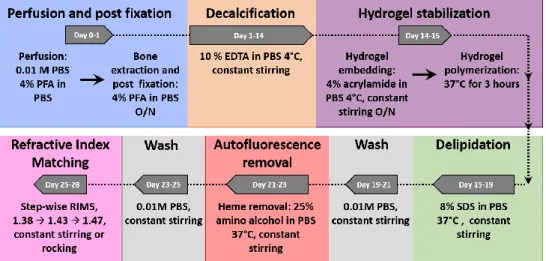
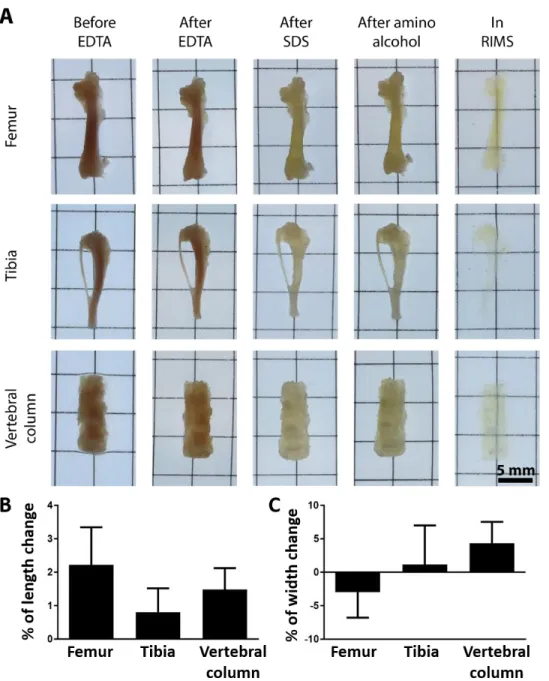
We developed and applied a bone clearing method to render the tibia, femur, and vertebral column of mice transparent for light-microscopy investigation (Fig. 1A). The key steps of the sample preparation including tissue clearing and autofluorescence removal are outlined in Fig. 1B and fig. S1. The bone is decalcified to increase light and molecular penetration through the tissue while leaving a framework of bone matrix with similar structural characteristics to dense fibrous connective tissue. DeCAL CLARITY employs an acrylamide hydrogel to support the tissue structure and minimize protein loss prior to the delipidation step. The detergent sodium dodecyl sulfate (SDS) is used to remove lipids in order to minimize their light scattering effects. We observed high autofluorescence in the bone marrow, one of the primary sites of heme synthesis. As heme is strongly autofluorescent, in the final step of the process we used the amino alcohol N,N,N',N'- tetrakis(2-hydroxypropyl)ethylenediamine40,41 to remove heme, which minimized marrow autofluorescence by approximately 3-fold (fig. S2). All of the above clearing stages were conducted on a temperature controlled stir plate that provides continuous convective flow (fig. S3, auxiliary design file). This accelerates and improves the clearing process for entire organs compared with passive clearing33. The samples did not change size during the clearing process (fig S4).
The imaging of intact bone tissue using a point scanning method, for example using a confocal microscope, poses an operational challenge because acquisition times are prolonged, with concomitant photobleaching42,43 44. To address this, we built a custom light-sheet fluorescence microscope (LSFM) with confocal slit-detection (fig. S5)3345. To modify the LSFM to image bones, an additional light-sheet path was added to illuminate the bones from two opposite directions. This additional light path improved optical access to areas containing a high percentage of cancellous bone, which typically scatter light more extensively and consequently lower the SNR. Given a particular depth scan, the sample is
illuminated by only one of the two light-sheet paths, whichever provides the better contrast.
We use only one illumination path per depth scan because there is always one illumination direction that scatters less light and thus provides superior image quality. To minimize RI mismatch between the objective lens and the bones, the samples are directly immersed in the immersion chamber without the use of a quartz cuvette to hold the sample. If RI variations still persist, the position of the detection objective is changed for each tile and specific depth along the Z-scan to mitigate any resulting out-of-focus aberrations. The LSFM captures images at a frame rate of 22 frames per second (16-bit depth) and produces 0.176 GB of imaging data per second. Large datasets are thus acquired for each imaged bone (50–500 GB). In order to manage these large datasets, we designed a computational pipeline that includes image stitching, automatic detection of individual cells, and volume of interest (VOI) rendering for analysis (Fig. 1C).
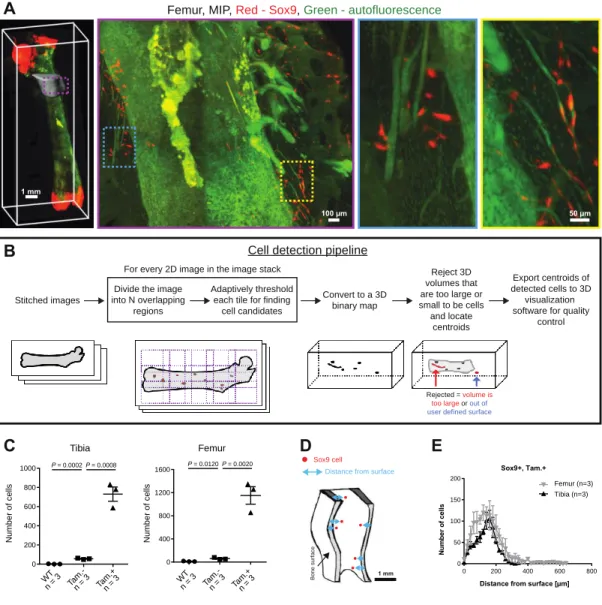
To validate the protocol, we applied our clearing and imaging method to locate progenitor cells in the long bones and vertebrae of transgenic reporter mice. A Sox9CreER transgenic mouse line was used in which, upon tamoxifen injection, multipotent osteoblast and chondrocyte progenitor cells express tdTomato21,46. We visualized the endogenous fluorescence of Sox9+ cells using Bone CLARITY (Fig. 1D and E). Quantification of the imaging depth in different regions of the tibia, femur, and vertebral body showed that we were able to image through the diaphysis of the femur (movie S1) and tibia (movie S2) and the entire vertebral body (movie S3). Furthermore, we were able to reliably detect Sox9+ cells up to approximately 1.5 mm deep into the bones (fig. S6). Collectively, deCAL CLARITY coupled with LSFM and the data-processing pipeline is an effective clearing, imaging, and data processing protocol to investigate intact mouse bones.
Semi-automated computational pipeline quantifies Sox9+ cells in mouse tibia and femur
To demonstrate that biological environments can be observed and quantified with Bone CLARITY, we first counted Sox9+ cells in the tibia and femur. We found that Bone
CLARITY allows for detection and quantification of individual Sox9+ cells in 3D (Fig.
2A), some of which appear associated with small vessels. Owing to the large VOI (Fig 2A, gray surface), we created a semi-automated cell-detection algorithm (Fig. 2B and fig. S7).
The algorithm divides the 2D images that make up the Z-stack (or depth scan) into N small overlapping regions, and then adaptively thresholds the 2D images into binary images on the basis of the local mean and standard deviation of fluorescence. The resulting binary 2D images are further subject to morphological operations to eliminate noise and discontinuity within a cell. All of the 2D binary images are then combined into a 3D matrix. From the 3D matrix, only volumes that fit the properties of a Sox9+ cell are maintained, thus avoiding erroneous counting of large blood vessels or small autofluorescence artifacts. All cells outside the user-defined VOI (Fig. 2A) are discarded. The cell candidate centroid locations are then imported to 3D visualization software for quality control. During the quality control stage, the annotator reviews the entire 3D volume and corrects the automatic results by marking false negative cells and omitting false positive cells. Therefore, at the end of the quality control stage, the cell counts are equivalent to cell counts that are performed manually. According to our experiments, a fully automatic pipeline only achieves on average 52% sensitivity and 36% precision. It should be noted that removing false positives is a faster operation in the 3D visualization software than adding false negatives, therefore the value of sensitivity outweighs the need for precision.
We quantified the number of fluorescently labeled Sox9 cells in the femur and tibia of Sox9CreER mice versus two control groups: Sox9CreER mice without tamoxifen administration and wild-type mice without the transgenes (Fig. 2C). The analyzed volume for each group was comparable (fig. S8). The cell counts in the Sox9CreER group without tamoxifen administration can be attributed to leakage of the reporter line because there was no visible expression of tdTomato in the wild-type control samples47. Qualitatively, this leakage can be observed in fig. S9, where the expression of the tdTomato signal is compared between the experimental group and the two control groups. We next quantified the cell distribution as a function of distance from the periosteal surface along the longitudinal plane (schematic in Fig. 2D). Based on our analysis, most of the cells in the
diaphysis reside adjacent to the endocortical surface, with mean distances from the periosteal surface of approximately 136.9 µm and 143.6 µm for the tibia and femur, respectively (Fig. 2E). This result supports similar findings in48 and validates deCAL CLARITY as a reliable method to resolve and quantify individual cells in intact bone and marrow spaces. It should be noted that Bone CLARITY is not limited to visualize cell populations in transgenic animals only and that antibody staining is also feasible (fig. S10).
However, for maximum penetration of the antibody into the bone, it is recommended to bisect the bone prior to the clearing process.
Bone clearing can complement section-based stereology
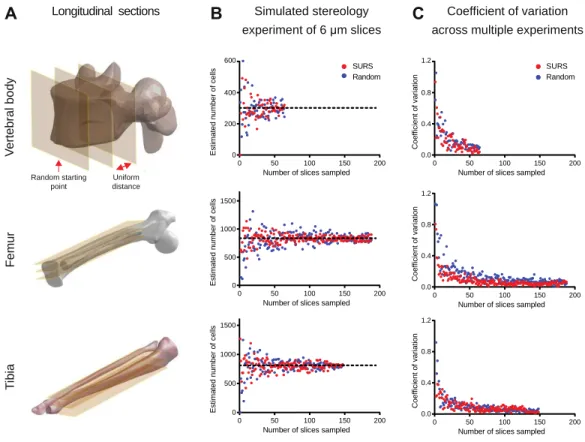
Design-based stereology is the gold standard method to quantify total cell numbers and densities in organs while preserving spatial information49. Stereology relies on statistical sampling methods. Systematic uniform random sampling (SURS) is a frequently used sampling method that efficiently reduces the variance of the estimate compared with random sampling. SURS obtains histological sections from an organ to reduce the amount of tissue for analysis. SURS samples at regular uniform intervals with the first sample collected at a position random within the first interval50,51. The number of cells in a tissue volume is a zero-dimensional geometric feature, and to avoid bias based on the cell size or shape, a probe based on two thin physical sections or optical planes separated by a known distance (disector), is used to accomplish quantification5253. Cells are typically counted in a known fraction of the organ, which allows for an estimation of the total number of cells in the entire organ54. The spatial distribution of cells can also be obtained using second- order stereological methods55.
Applying stereological methods to cleared organs offers notable time-saving because clearing precludes the need for labor-intensive sectioning. Using the Bone CLARITY method and our 3D counting scheme, we investigated the variability in stereology estimates as a function of the number of slices for both SURS and simple random sampling in stereology experiment simulations. Figure 3A shows one
representative selection of N random uniformly spaced sections for a simulated SURS experiment in the femur, tibia, and vertebral body. Fig. 3B shows the estimates for the cell count of an entire VOI based on N sampled slices, and Fig. 3C illustrates the coefficient of variation of simulated stereology experiments that were conducted with N slices. To estimate the coefficient of variation for each N representative slices, 5 simulated stereology experiments were conducted. In these simulations, as expected, variance decreased rapidly with increasing number of slices for femur, tibia, and vertebrae. Precision of the stereological estimate would likely be improved with proportionator sampling, a form of non-uniform sampling better suited to rare structures56. Therefore, the 3D counting method offers several advantages for quantifying rare cellular populations: the ability to detect subtle changes that might be overlooked because of sampling variance, elimination of the need for sectioning, and 3D visualization.
Sclerostin antibody increases the number of Sox9+ cells in the vertebral column We next applied deCAL CLARITY to the vertebral column, a bone that is highly susceptible to fractures due to osteoporosis57 and whose complex geometry is particularly difficult to probe with traditional sectioning-based methods. We cleared and imaged the vertebrae from mice, and focused on the 4th lumbar vertebral body (L4), which is dense, opaque, and predominately composed of cancellous bone. Fig. 4, A and B show schematics of lateral and transverse cuts from a representative vertebra. Fig. 4B also shows the approximate locations (dashed lines) of the digital sections (30 µm thickness) that are shown in Fig. 4C. The lateral processes that extrude from the vertebral body can be seen in the horizontal edges of the 650 µm section. These processes were excluded from the cell counts, as illustrated by the representative VOI (Fig. 4D). Additionally, careful attention was given to ensure the exclusion of the intervertebral discs and cartilage endplates from the VOI, as they are both primarily populated by chondrocytes. These chondrocytes express Sox9and are tdTomato+ after tamoxifen administration, and thus require careful exclusion for accurate cell counts of fluorescently marked osteoprogenitors. The
quantification of vertebral Sox9-tdTomato cells after tamoxifen administration versus the two control groups, Sox9CreER mice without tamoxifen administration and wild-type mice, can be seen in Fig. 4E. Again, we observed that the Sox9CreER transgenic animals without tamoxifen administration display mild leakage of tdTomato expression (Fig. 4E and fig. S9). Overall, similar to the cell distribution results presented for the tibia and femur, the Sox9+ cells were primarily located adjacent to the endocortical surface (Fig. 4, F and G), with a mean distance of 138.8 µm and 137.6 µm for the tamoxifen-negative (Tam.-) and tamoxifen-positive (Tam.+) groups, respectively.
We next tested the effects of sclerostin antibody (Scl-Ab) on the total number of Sox9+ cells in the vertebral column. Sclerostin is an extracellular inhibitor of the canonical Wnt signaling pathway and is highly expressed in osteocytes. Inhibition of sclerostin leads to activation of canonical Wnt signaling in the osteoblast lineage resulting in a rapid but transient marked increase in osteoblast number and bone formation58. Although the early dramatic increase in osteoblast number is considered to be at least in part due to activation of bone lining cells59, the contribution of osteoprogenitors to this early increase in osteoblast number is unclear. While a decrease in osteoprogenitors has been demonstrated to be associated with the attenuation of bone formation that occurs with long-term Scl-Ab treatment in rats, stereological methods have not detected effects on progenitor number coincident with the maximal increase in osteoblast number. In order to gain insight into the acute effects of Scl-Ab on osteoprogenitors, we conducted an experiment as outlined in Fig. 4H. On day one, Sox9CreER mice were injected with Scl-Ab (100 mg/kg subcutaneously). Four days afterwards, we provided a second dose of Scl-Ab along with tamoxifen to label Sox9+ cells with tdTomato. We euthanized the animals five days later and cleared the bones using Bone CLARITY. Indeed, after performing blinded quantification of Sox9+ cells, we observed an increase in the total number of Sox9+ cells in the vertebral body nine days after initial Scl-Ab treatment versus the vehicle control group (Fig. 4I). We did not observe any significant changes to the vertebra body volume (Fig. 4J) between the experimental and control groups at this early time point. These results demonstrate that there is an increase in osteoprogenitors that are likely recruited to the bone
surface to contribute to the increase in osteoblast number. The distribution of cells as a function of distance from the surface can be seen in Fig. 4K, with mean distances of approximately 99.9 µm and 137.8 µm for the vehicle and treated groups, respectively.
3.4 Discussion
In the bone remodeling process, bone health is maintained through continuous cycles of bone resorption by osteoclasts and bone formation by osteoblasts. Imbalances in these physiological processes can lead to various bone diseases such as osteoporosis, which affect millions of people in the United States alone57,60. In order to gain better insight into potentially effective treatments for osteoporosis, it is imperative to study the physiological processes that occur in healthy and diseased bone and understand the molecular and cellular mechanisms within the 3D microenvironment. We demonstrate that the Bone CLARITY technique renders the tibias, femurs, and vertebral bodies of mice optically transparent while preserving bone morphology and an endogenous fluorescent reporter signal. In addition to matching the RI of the tissue, Bone CLARITY also removes minerals and lipids, thus enabling us to reconstruct a whole vertebral body as well as the entire diaphysis from the tibia and femur.
For maximum impact, clearing and imaging platforms need to be easy to use and scalable. The trio of methods presented here has a few limitations in its current rendering that could be improved in the future, such as the addition of antibody staining to the clearing workflow, reducing processing time and overcoming the technical barriers of acquiring and analyzing big datasets. Antibody staining of an intact bone is challenging owing to poor penetration by relatively large intact antibodies. In order to improve antibody penetration, we bisected and cleared half of a tibia and femur. In the bisected and cleared bones, the antibody penetrated up to 400 µm from the bone surface and showed high specificity and SNR (fig. S10). The use of small-molecule staining methods (e.g. single- molecule hybridization chain reaction61 could allow the labeling of intact bones while achieving reliable staining depths. Meanwhile the ability to retain and detect endogenous fluorescence has proven highly enabling although the gentle clearing reagents used in