
CL Method and Strategy through English Camp 113 Figure 4.2 Percentage of the Students' Results on Communicative Language. Implementation of CL method and strategy through English camp 118 Figure 4.6 Frequency distribution of students' self-interest after.
INTRODUCTION
Background of the Study
The practical reason is that cooperative learning is one of the effective methods for students to share information among students. Therefore, it is necessary to investigate the effectiveness of other learning strategies for teaching speaking skills, one of them is the cooperative learning strategy.
Statement of the Problems
Do the students taught with the English Camp (EC) strategy have a greater self-interest in speaking English on the post-test than on the pre-test. Do the students taught with an English Camp (EC) strategy have greater confidence in speaking English on the post-test than on the pre-test.
Objective of The Study
Do students taught the cooperative learning (CL) strategy through an English camp have higher achievement of English communicative language function in the posttest than in the pretest? To identify whether students taught the cooperative learning (CL) strategy through an English camp have higher achievement of English communicative language function in the posttest than in the pretest.
Significance of the Study
In other words, the general objectives of this study can be stated as that it is to investigate the implementation of cooperative language learning strategy through English camp to improve the students' speaking skills. The students' speaking skills they express after learning with CL strategy are reflections of their experience and understanding of what they did at English Camp.
Scope of the Study
- English Camp as EFL
- English Camp Purpose
The positive response from the students in learning English through English camp (Ismail and Tahir 2011). The purpose of the activities in the English camp is to enforce the organization of activities for learning to meet educational goals.
Professional Meeting Program of English Camp
The next step is to invite some participants to speak. Before the discussion, it is necessary that the subject of the discussion activity be determined by the instructor.
Communicative Language Teaching Strategies 1. Linguistic Theory and Classroom Practice
- What about grammar
Berns (1990) points out that defining communicative competence that is appropriate for students requires an understanding of the sociocultural context. Language use is recognized to serve ideational, interpersonal, and textual functions and is associated with the growth of students' competencies in each.
The Use Cooperative Learning Strategy 1. Class Activities of Cooperative Learning
- Why use Cooperative Learning Strategy?
- Elements of Cooperative Learning
- The Theoretical Base of Cooperative Learning a. Motivational Theories
Finally, the examiner asks the other members of the group to explain the reasons and justification for the group's answer. Each member of the group has unique information that they must share with their teammates in order to achieve their common goals.
Implementation of Cooperative Learning Activities
Slavin (1986) emphasized the applicability of cooperative learning to the planning of instruction in school subjects and the formation of heterogeneous groups. Slavin (1995) identified cooperative learning as “Students work together in teams of four members to master material initially presented by the teacher.
The Essence of Cooperative Learning
- Heterogeneous Grouping
- Individual Accountability
- Prior Training of Group Skills
- Group Processing
- Equal Opportunities for Success
- Summary on the Essence of Cooperative Learning
- Cooperative Learning Advantages
- Enhancing Student's Social Skills
- Appreciating Differences
- Individualization of Instruction
- Increasing Motivation and Positive Attitude toward Learning
- Increasing Self-Esteem
- Increasing Academic Achievement
This type of grouping is often adopted by guidance-oriented cooperative learning methods (also called student team learning methods), including STAD (Student Teams Achievement Divisions), TGT (team game tournaments), TAI (Team Assisted Individualization), and CIRC (cooperative integrated reading and composing). The simultaneous use of individual responsibility and group goals significantly enhanced the effect of cooperative learning.
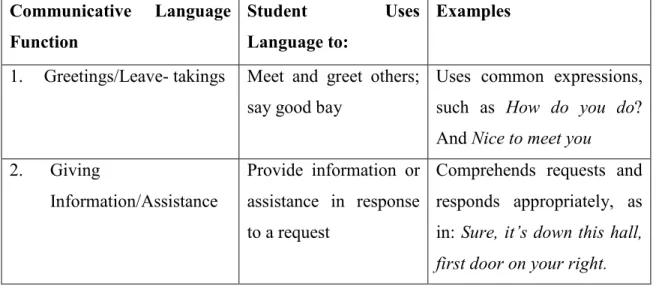
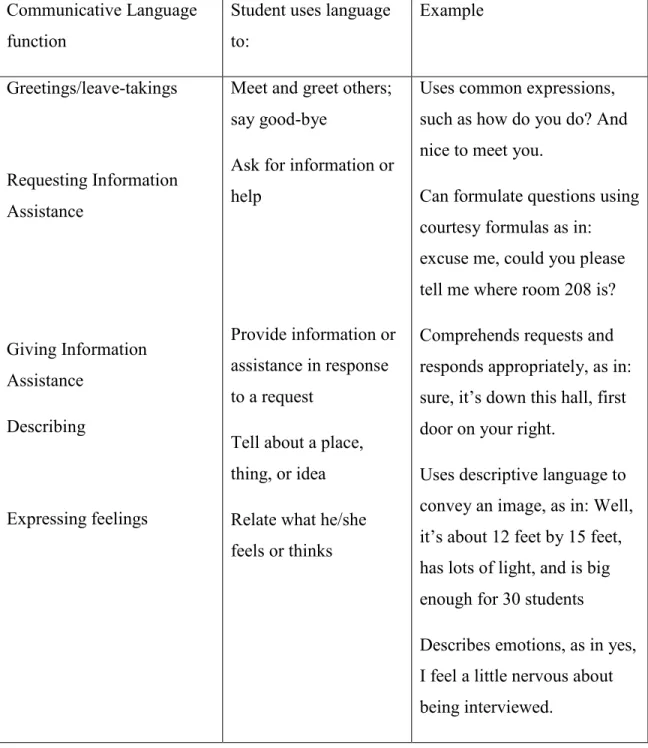
Language Functions
The rationale for teaching academic language is simple: students will struggle to learn from what they read if they do not understand the language of the text. Function of academic language The student uses language to: Examples Search for information/inform Observation and research.
The Nature of Oral Language and Speaking Process
- Organization of the work
- The speaking sub-skills
- The relationship between speaking and the other skills
The teacher's roles in the process of teaching and assessing speaking are also considered. The roles of teachers and students and also some of the benefits and pitfalls of CLL are also considered. This sometimes reflects the apparent needs of the students, the objectives of the course and the method followed by the teacher.
Principles for Teaching Speaking Skill
- Be aware of the differences between second language and foreign language learning contexts
- Give students practice with both fluency and accuracy
- Provide opportunities for students to talk by using group work or pair work, and limiting teacher talk
- Design classroom activities that involve guidance and practice in both transactional and interactional speaking
An accuracy is the degree to which students' speech matches what people actually say when they use the target language. They cannot develop fluency if the teacher constantly interrupts them to correct their oral mistakes. Another interesting point is that when the teacher is removed from the conversation, the learners.
Language Learning Strategies
Strategies for Developing Speaking Skills
- Using Minimal Responses
Instructors can help students develop their speaking skills by making them aware of the scripts for different situations so that they can predict what they will hear and what to say in response. Through interactive activities, instructors can give students practice managing and varying the language different scripts contain. Instructors can also provide students with strategies and phrases to use to clarify and check understanding.
Strategis for Developing Speaking Activities
- Structured Output Activities
- Communicative Output Activities
- Set Lesson Goals
Lesson objectives are most usefully expressed in terms of what students will do or achieve at the end of the lesson. If they are not, choose points that are related in some significant way to the topic of the lesson. This means that some students may be able to complete the task without using the grammar point or strategy presented in the first part of the lesson.
Strategies for Improving Speaking Skills in English Learning
To be authentic, tasks should allow, but not require, students to use the vocabulary, grammar, and strategies presented in the lesson. Give your students opportunities to engage in role plays to improve their speaking skills. Remind students to think in English of phrases they know would be polite in a situation.
Oral Language Assessment
- Nature of oral language
- Oral Language in University
- Language Functions
For these reasons it is more valuable in terms of feedback received for higher level students. One of the primary responsibilities of any teacher working with English Language Learners (ELL) is to enable students to communicate effectively through oral language. California's policy is more specific regarding AE and is discussed in some detail in this section of the report.
The Importance of Self Confidence in Learning
- The Role of Self-confidence
- Trusting Yourself to Build your Confidence
- Practice, Practice, and Practice
Low self-esteem can have a negative effect on foreign language learning, a long page with many other possible themes. Therefore, a student's sense of self-confidence may be promoted by other students' sense of self-competence and self-confidence in a foreign language education classroom with high self-confidence students. Confidence can help foreign language teachers communicate with their students and promote their students' confidence.
The important Functions of Self-Interest in learning
- Interest as A Motivational Resource
- Situational Interest in Physical Education
He can be considered a pioneer for inclusion in this field of physical education research. In short, what teachers do in the learning environment can greatly influence the development of interest as shown by the level of involvement in physical education activities. Exploratory and confirmatory factor analysis revealed five dimensions of situational interest in physical education: novelty, challenge, exploratory intent, immediate gratification, and demand for attention.
Defining Self-Regulating
- Self-Regulated Learning Strategies for Students
- Encouraging Student Self-Regulated Learning
According to Zimmerman in Quince (2013), self-regulated learning is a self-directed process that assists learners and encourages awareness of their own strengths and weaknesses. Learners are guided by personally set goals and task-related strategies. Learners can develop self-regulated learning skills that optimize the motivational, behavioral and metacognitive processes by using a variety of strategies. Self-regulated learning strategies are the actions and processes used to acquire information and skills.
Conceptual Framework and Hypotheses
- Conceptual Framework
Teaching and learning activities using cooperative learning strategy through English Camp are the input variables. Students instructed in the cooperative learning strategy through English Camp have better performance in the academic language function of speaking ability on the post than on the pretest. Students taught with cooperative learning strategy through English Camp have better performance in communicative language function of speaking skill on the posttest than on the pretest.
Research Design 1. Research Type
- Time Allocation
- Instructors and Committees
- Developing and constructing Speaking Test
In the third phase of the test, it was found that the three items of the questions about the value of r count < r table. In the second phase of the test, 4 question items were still found that have r number < r table. In the second phase of the test, 4 elements were still found that have a value of r count <.
Procedure of Data Collection
- Treatment Process
- Post Testing
The time for each topic was 3 minutes with interview test and 5 minutes with role-play form. In interview form was handled by Ratna and role play form was handled by Hengki (researcher himself). In this final stage, four types of the test were used, namely interview test, role play or drama competition, problem solving by discussion and Interview test was conducted to measure students' ability to communicate and academic speaking.
Scoring Rubric
Can participate with a high degree of fluency in any conversation within the scope of this experience. Can understand and participate in any conversation within the scope of his experience with a high degree of precision of vocabulary. 5 Has complete fluency in the language so that his speech is fully accepted by educated native speakers.
Procedure of Data Analysis
Definition of the Key Terms
- What is an English Camp?
The function of communicative language is the language used by students to develop their communicative competence. Self-regulation refers to knowledge of a skill, self-awareness, self-motivation, and behavioral ability. This chapter presents the results of the analysis of the data collected in this study, in order to find answers to the research questions presented in chapter 1, the dependent T-test is applied, at the end, after the analysis has been carried out, the hypothesis testing is also done and discussed .
Findings
- The Qualification and Percentage of Students’ Communicative and academic Language Function of Speaking
- Result of t-test for Students’ Performance of Communicative and Academic Language Function of Speaking
- The Test Result of Students’ Self Confidence
- The Test Result of Students’ self-regulation
- Testing Hypothesis for Communicative Function of Speaking
- Testing Hypothesis for Academic Function of Speaking
- Result of Wilcoxon Test for The Students’ Internal Factors
Table 4.4 shows that students' self-interest before joining the English Camp program using the CL strategy. The table shows the students' self-regulation of their pretest, without applying the CL method and strategy through the English camp program. This shows that CL method and strategy through English speaking teaching camp is found to be more effective to improve students' English speaking confidence.

Discussion
- The Implementation of CL method and Strategy through English Camp of Teaching Communicative Speaking
- The Implementation of CL Strategy through English Camp of Teaching Speaking in Academic Language Function
- The Implementation of CL Strategy through English Camp to Increase the Students’ Self Interest in Speaking English
- The Implementation of CL method and strategy through English Camp to Increase the Students’ Self Confidence in Speaking English
- The Implementation of CL method and strategy through English Camp to Increase the Students’ Self-Regulation in Speaking English
It means that 45 students increased their self-regulation after learning speaking skill using CL method and strategy through English camp. It means that students' self-regulation in speaking English increases after learning speaking skill through English Camp. Applying CL method and strategy through English camp to increase students' confidence in speaking English students' confidence in speaking English.
Summary
Language camp like EV is purposely designed to create teaching and learning conditions where students speak English from early morning to midnight. Students constantly discuss, debate, and clarify their understanding of the concepts and materials covered in class. In relation to the previous theories, it really strengthens the finding of this study that the use of CL strategy through the English camp successfully improves the students.
CHAPTER VI
Conclusion
Teaching speaking skills using the CL strategy through English Camp can increase learners' intrinsic factors. The implementation of the CL strategy through English Camp in teaching speaking can also increase students' intrinsic factors. Students' confidence in speaking English increased significantly after being taught the CL strategy at English Camp.
Recommendation for the Future Study
Hismanoglu, M, 2000, Language learning strategies in foreign language learning and teaching, Ankara: Hacettepe University, retrieved February 8, 2014, from htt P://iteslj,org/Articles/Hismanoglu - Strategies, html. Kang S, 2002, In jack Richards C, and Willy A, Renandya, Methodology, In Language Teaching, USA: Cambridge University Press,. Snow, C, & Uccelli, P, (2009), The challenge of academic language, In D, Olson & N, Torrance (Eds,), The Cambridge handbook of literacy, New York: Cambridge University Press,.
Topics of Speech
Topics/Name of Game
PRETEST (Communicative language function and academic language function of speaking ability, - EC opening program of UNISKA - Rest/Pray. Professional meeting (M C, Delivering the welcome speech, self-introduction, making a. praise discussion /rumors: , giving the closing speech) - Break/prayer Professional Meeting (M C, Delivering welcome speech, introduction of self, discussion: marriage vs. study, game, closing speech).