The researcher realizes that this thesis could never have been completed without their support and help. Her siblings Astan, Astin and Mastan, who always provide fantastic motivation, support and guidance to the researcher. All the fifth grade students of SD Negeri 82 Parepare who help the process of the research.
The researcher's best friends, Andi Syafitri Syam, Fatima Risa and Meriana, who always supported and motivated the researcher. The researcher's other best friends, Nurul Wahyuni, Titiaan Ekasari, Sri Julianti and Nurul Aulia Awal, who always provided advice, support and motivation for the research. Based on the above explanation, the researcher decides to investigate one of the primary schools in Parepare, it is SD Negeri 82 Parepare.
Based on the researcher's discussion above, the researcher decides to research on "An Analysis of Teaching English Pronunciation to Younger Students in SD Negeri 82 Parepare".

Problem Statement
Objectives of the Research
Significance of the Research
The first relevant study was a study entitled 'The Teaching of English Pronunciation to Young Learners (A Case study of The Sixth Grade Students of SDN 6 Ciputat'), authored by Nicky Dwiningrum, a study from Syarif Hidayatullah State Islamic University, which was conducted in 2016 was published. The purpose of the study was to obtain the techniques used by teachers in teaching pronunciation to young students. The second relevant research was the thesis entitled “Developing Pronunciation with Young Learners” written by Nad'a Tomčíková, a thesis of the Faculty of the University of Pardubice. Art and Philosophy (Department of English and American Studies).
The objective of the research was the group of young learners that was used as the basis for the research. 4Nicky Dwiningrum, “Teaching English Pronunciation to Young Learners (A Case Study in Sixth Grade Students of SDN 06 Ciputat)” (Unpublished thesis; Faculty of Education Sciences, Syarif Hidayatullah University, 2016), p. The last relevant study was the thesis entitled “Teaching and Learning English to Young Learners in SD Islam Al-Azhar 29 Mijen-Semarang” written by Devita Ratna Sari, a thesis of Islamic University of Walio State.
The similarity with the first study and the second study is that we investigated teaching pronunciation for young students.
Some Pertinent Ideas
The teaching of English at the elementary level is an urgent need and the teacher must be trained before teaching young learners because young learners have different competencies and abilities in English language than adults. 43Arif Sari Çoban, and Albina Kuç, Teaching Problematic Consonants in English to Young Learners (An Unpublished, Turkey: Elsavier Ltd, Procedia Social and Behavioral Science 2, 2010). Teachers of young learners can flourish and focus on learning if they provide the necessary care to meet their needs. 44.
Young learners under the age of seven need to learn something about the world that they have recently acquired. 44Caroline T, Linse and David Nunan, Practical English Language Teaching for Young Learners (New York: McGraw-Hill Companies, Inc., 2005), p. In addition, primary school teachers need to know that even though young learners have very short attention spans and attention spans, they are enthusiastic and positive about learning when they enjoy it and are encouraged by teacher praise and support.
Young students still want to have an activity, even if they do not know what and how this activity. 47 Mary Lou McCloskey, Seven Teaching Principles for Teaching Young English Learners (Unpublished: Georgia State University), p. 50 Sukarno, Teaching English to Young Learners and Factors to Consider in Designing the Materials (Yogyakarta: Jurnal Ekonomi dan Pendidikan, Vol: 5, no: 1, 2008), p.
According to Brown, there are several categories that are proposed in providing some practical approaches to teaching young learners. It is closely related to what Piaget calls "concrete opinion," that is, young learners understand something concrete. Therefore, English teachers of young learners should make sure that they are interested in that curiosity whenever possible and the teacher will help to keep the attention and focus of the children.
The previous part deals with young students and aspects of their cognitive development. Young learners enjoy repetition, and songs and rhymes are generally repetitive and easy to remember. From the above explanation, we can learn a technique that can be used for young students.
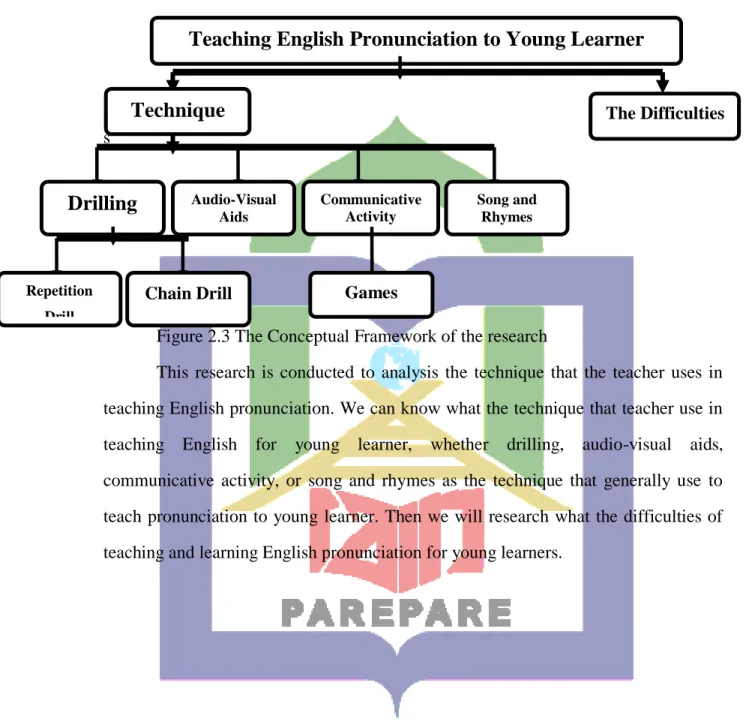
Drilling is suitable for young learners because drilling makes it easy to learn pronunciation for young learners as a beginner, while the use of audiovisual aids, communication activities and singing can be a technique we can use to ensure that learners are not boring and they are interested in learning English pronunciation.
Conceptual Framework
Teaching English Pronunciation to Young Learner
Location of the Research
Kinds and Source of Data
The data study used secondary data sources such as written sources such as book source, documents about staff and the teacher in SD Negeri 82 Parepare such as syllabus, RPP and curriculum.
Instrument of the Research
Procedure of Collecting Data
Technique of Data Analysis
The researcher used teacher's lesson plan and syllabus as data source to analyze whether it is appropriate with classroom activities or not. After that, she interpreted what the informants informed, compared the result of the interview and the fact in class. Third, lesson plan and syllabus of sixth grade students were the type of documents analyzed by the researcher.
She checked the compatibility of the pronunciation teaching techniques with the indicator, whether the activity is already appropriate in indicator or not. After explaining the data, the researcher described the conclusion based on the result of data. The result of analysis and interpretation of teaching English pronunciation to grade 5 students of SDN 82 Parepare will be reported in this chapter.
Findings
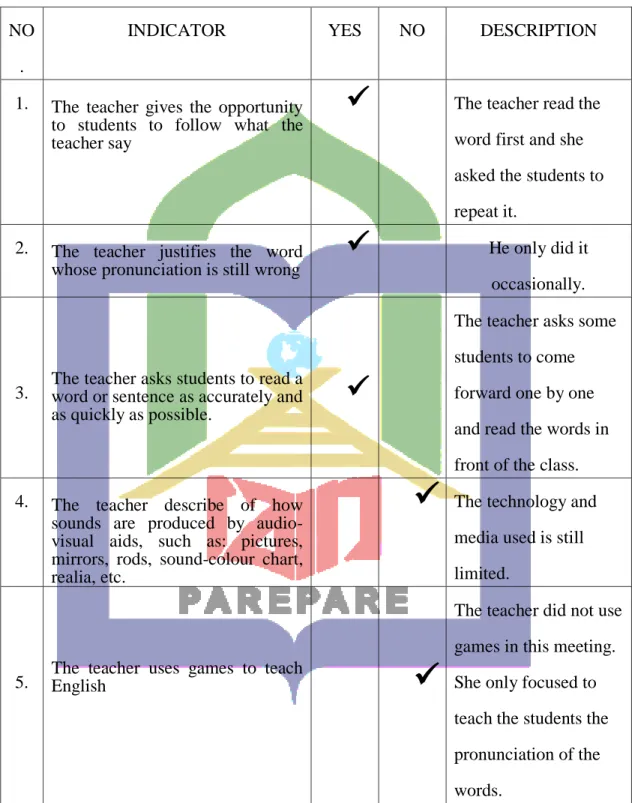
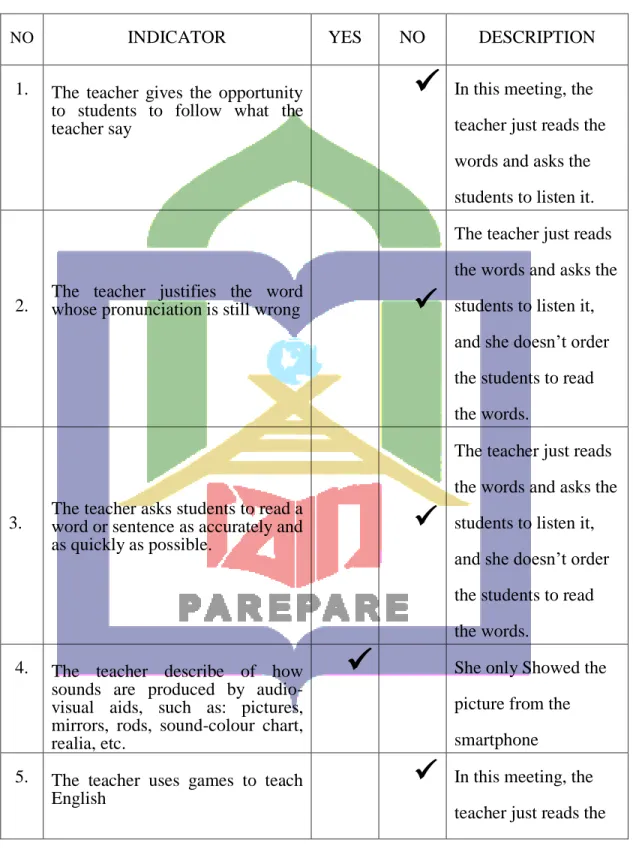
During this meeting, the teacher only reads the words and asks the students to listen to them. The teacher only reads the words and asks the students to listen to them, and she does not order the students to read the words. The teacher gave a warm-up for the students with singing and dancing so as not to make the student boring.
The teacher first read the word and asked the students to repeat it. Then the teacher gave a warm-up for the students with singing and dancing so as not to make the student boring. The teacher used repetition exercises, which made it easier for the students to remember the words.
The teacher asks a few students to stand one by one and read the words in front of the class. The teacher asked the students one by one to read the words in front of the class. In this meeting, the teacher asked if the students remembered the words given in the previous meeting.
Then the teacher asks some students to come forward one by one and remember it in front of the class. She said that the teacher always gives new words and the teacher orders them to read the words. She said the teacher reads the words and the students follow what the teacher said.
Afterwards, the teacher gives each group the opportunity to present their performance in front of the class. She also said that the teacher uses singing to teach English pronunciation, but it is not related to English pronunciation.
Discussions
So in the fourth point, where the teacher described how sounds are produced by audiovisual aids, the teacher used image to support his teaching process. In the fifth point, the researcher found that the teacher did not use games, she only focused on teaching the students the pronunciation of the words. So in the seventh point, the researcher found that the teacher used song in his teaching process, but the teacher did not use song that relates to English pronunciation.
And then, in the last point, the teacher gives assignments to students, but this was not related to the pronunciation of words in English. Then, in the second observation to explain the first point on the observation sheet, the researcher noticed that the teacher read the word first and she asked the students to repeat it. Based on the statement in the fourth point, in which the teacher described how sounds are produced by audiovisual aids, the teacher used a picture related to the material.
And then for the fifth, sixth and seventh points, the teacher did not do so appropriately with the statement in the observation sheet. Last in the third observation, in the second observation the teacher carried out activities that correspond to the first, second and third points in the observation sheet. However, the teacher did not carry out the activities corresponding to the fifth, sixth, seventh and eighth points in the observation sheet.
In addition, the researcher found from the observation that the teacher uses the method of audiovisual aids to teach pronunciation. In the interview, the teacher said that she teaches to pronounce words and correct them when the students make a mistake. And then in the interview, the teacher and the students said that the teacher sometimes used visual aids in learning.
With this technique, the teacher read a word or a sentence and the teacher asks the students to repeat it after her. From the observation and interview with the teacher and some students, the researcher found that there are some difficulties in teaching and learning pronunciation.
Suggestion
Department of English Education, Faculty of Tarbiyah and Teacher Training, Ar-Raniry Darussalam State Islamic University: Banda Aceh. Teaching Problematic Consonants in English to Young Learners” Unpublished; Elsavier Ltd, Procedia Social and Behavioral Science 2: Turkey. Teaching English Pronunciation to Young Learners (A Case Study of Sixth Form Students of SDN 06 Ciputat)”.
APPENDICES
Interview Sheet of Teacher
Interview Sheet of Students
Pertemuan 1
- Metode Pembelajaran
Bacalah cerita tentang jenis-jenis seragam pramuka dan segala macam barang yang berhubungan dengan pramuka. Identifikasikan jenis-jenis pakaian yang digunakan untuk kegiatan tertentu, misalnya bermain (kaos), sekolah (seragam), tidur (piyama), pesta (kemeja), dan lain-lain. Buatlah tanya jawab tentang jenis-jenis pakaian bersama teman sekelasmu dengan menggunakan kalimat tersebut apa yang kamu pakai.
The teacher asks the students to read a word or sentence as accurately and as quickly as possible. The teacher describes how sounds are produced by audio-visual aids, such as: pictures, mirrors, bars, sound color chart, realia, etc. The teacher asks the students to read a word or sentence as accurately and as quickly as possible.
The teacher describes how sounds are produced by audio-visual aids, such as: pictures,.
CURRICULUM VITAE