Agents as intelligent engines of business process reduction, 99 Conclusion: agents, EIPs and the virtual enterprise, 100. A knowledge life cycle (KLC) framework, 114 Tacit knowledge and explicit knowledge, 119 Polanyi, implicit knowledge and Popper, 121 Individual world-level knowledge 2 and.
K NOWLEDGE L IFE C YCLE S UBPROCESSES 137
K NOWLEDGE M ANAGEMENT AND THE
A F ORWARD L OOKING EIP
D ECISION P ROCESSING P ORTAL P RODUCTS 269
C ONTENT M ANAGEMENT P ORTAL P RODUCTS 275
D ECISION P ROCESSING /C ONTENT M ANAGEMENT
P ORTAL T ECHNOLOGY , E-B USINESS , K NOWLEDGE
P ROCESSING , AND K NOWLEDGE M ANAGEMENT 381
EIP D EVELOPMENT : P ATHWAYS TO THE F UTURE 391
McElroy, now President of KMCI and my co-instructor in the KMCI Certified Knowledge and Innovation Manager (CKIM) program (but also including the assistance of Edward Swanstrom, Douglas Weidner, and Steven Cavaleri), led to the initial formulation of the life cycle framework of knowledge (KLC). The KLC later became the basis for Mark's definition of the concept of Second Generation Knowledge Management (SGKM) and its subsequent adoption as the KMCI orientation in KM.
Purposes and objectives: what this book is about
One benefit that is clearly an EKP benefit, and not an EIP, is that of supporting organizational intelligence, by which I mean, not business intelligence as commonly used in IT circles, but organizational intelligence in the sense of ability. of an organization to learn and adapt to its changing environment. And it is also about better knowledge process innovation through its support for improvements in knowledge management processes.
Overview
It then goes on to discuss the 13 types of EASI as a basis for analyzing the two island problems and the architecture of enterprise information portals. I show that AKMS (theoretically) partially supports NKMS by partially supporting processes and tasks in NKMS through use cases that define the functional requirements of a distributed knowledge management system (DKMS), the realization of AKMS using current technology.
Who this book is for
Each Chapter presents conclusions that emerge from the analysis and Chapter 17 presents conclusions that apply to all four chapters. The eCP and eSCM; The eCP and eERP; The eCP and e-commerce; and the DKMS, eCP applications and the future of e-business.
How to use this book
Some benefit can be gained from the chapters individually, particularly from Chapter 13 on EKP and the case studies in Chapters 14−17, but to fully benefit from these chapters the earlier chapters are recommended. Finally, Part Seven may prove interesting in its own right to some, but it is likely that the topics discussed there will seem less significant to those who have not read the rest of the book.
Introducing Enterprise Information Portals
Definition and Evolution
Introduction
Defining the Enterprise Information Portal
EIP definition is a political process
This exam will introduce some concepts and vocabulary that I will need to support my discussion of history, benefits, and architecture in later chapters, but will not create the forward-looking segmentation that I will ultimately need for EIP characterization, EIP analysis. products and solutions and predicting the future of the EIP space. This segmentation will be presented in Chapter 12 after discussing the previous topics, knowledge processing and management, and finally the role of XML in EIP.
EIP definitions
While Shilakes and Tylman's definition emphasizes decision processing more than collaborative processing, it is clearly intended to include collaborative, expertise, and knowledge management (KM) applications as part of EIP. This definition is clearly aimed at distinguishing corporate portals from public portals based on the type of access available on corporate portals.
Types of definition and synthesis
Merrill Lynch's original definition of EIP and Colin White and Plumtree Software's definition of a corporate portal fall into this category. However, it is still a subtype of collaborative processing portal rather than a type in its own right.
EIP technology and e-business
The term "extraprise" seems to have gradually evolved over the past decade, reflecting the reality of increased corporate involvement and corporate image. The company at the heart of the extraprise system typically hosts the extraprise "extended intranet" (a/k/a, "extranet").
Conclusion
An "extra-price" is "an extended enterprise, usually consisting of a community of trading partners revolving around a common host enterprise of mutual interest, who do business with each other on a fairly predictable and repetitive basis." Stephen Haeckel in Adaptive Enterprise (1999, p. 46) provides a good example of the creation of a premium in Dee Hock's Visa. The Emergence of Enterprise." Keynote Lecture to the IFIP WG 5.7 Working Conference, Organizing the Extended Enterprise, Ascona, Switzerland, September.
The Origin and Evolution of Enterprise Information
Portals
Enterprise information portals (EIPs)
Structured data/information/knowledge management
In turn, this origin depends on evolutionary changes over recent years in IT applications in the structured, unstructured, "relationship" and integration categories. They sometimes include data management and business intelligence tools, but only in an effort to extend their reach into the DSS realm.
Data warehousing (business intelligence and data management)
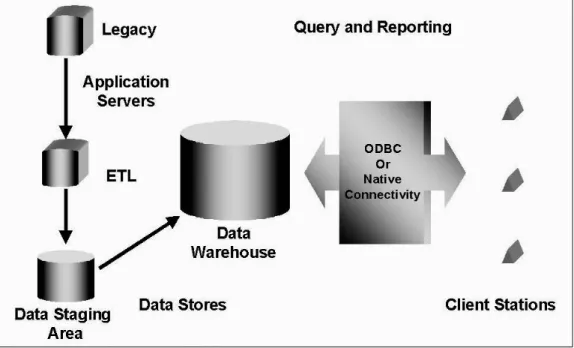
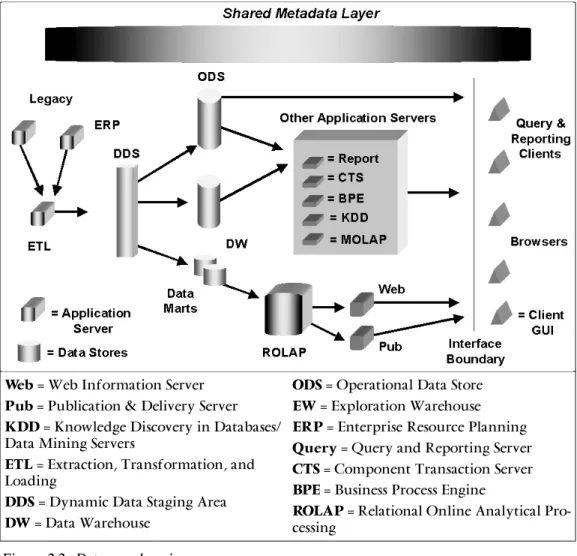
The end result of the data warehouse approach to analyzing ERP data is to loosely couple ERP systems into a distributed data warehouse architecture that contains both non-volatile DSS data stores and ERP application servers. Data warehouse now. . by Brio), previously active in the BI, DW and data management segments.
Enterprise resource planning (ERP)
Also, the relatively tight integration of ERP applications must give way to the loose integration of the components in data warehousing applications. The result is a distributed information management system that is neither an OLTP ERP system nor a DSS data warehousing system, but both.
Requirement: integration of data warehousing and ERP applications in EIPs
Or rather, architecturally, the ERP and the data warehousing system merge, and the complexity of the web-based data warehousing system also includes the ERP system. The evolution of data warehousing and ERP systems brings IT to the brink of such integration.
Content management
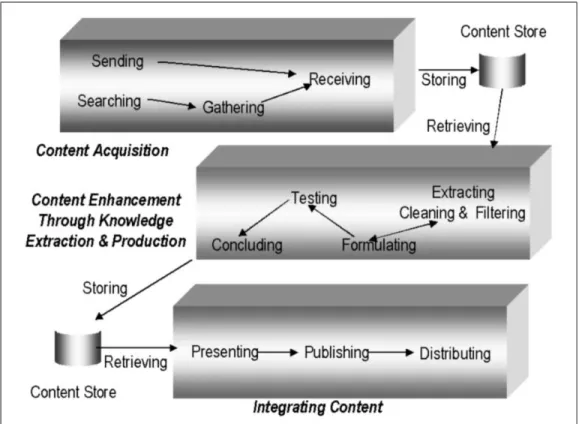
Content management is the process of organizing, directing, and integrating content analysis and dissemination efforts aimed at producing or disseminating data, information, or knowledge. That is, content management systems become data, information and knowledge production and extraction systems in the broader context of a content value chain that includes content acquisition (searching for, collecting and receiving content), storage, content retrieval and content distribution. sion activities.
EIPs: managing the structured/unstructured content relationship
EIP content management servers can interpret queries coming from the user and direct them to the appropriate enterprise stores, whether it is structured data or content type. Third, an emerging content management capability in portals is the ability to produce structured data from unstructured content.
Integrating EIP-based systems
Fourth, if the choice is made to use an object-oriented database management system (OODBMS) as one of the data repositories for an EIP system, structured data and content can be stored in the same distributed database. What is striking about the representation of the EIP in the image is the absolute lack of interaction between structured decision processing and content management at any point in the process workflows.
Further EIP evolution
In addition, the integrating layer in the EKP is different from that in the EIP. In the EKP, on the other hand, the integrating layer, called The Artificial Knowledge Manager (AKM) (Firestone b, 1999b), places great emphasis on criteria used to test and validate the knowledge produced or acquired by the EKP.
Benefits of Enterprise Information Portals and
Corporate Goals
Benefits of Enterprise Information Portals
Enterprise innovation and justification
EIP benefits
Competitive advantage
Increased ROI
Increased employee productivity
If we multiply this times the number of employees in an organization, we have the gross amount of time saved by the portal, which, of course, can easily be converted into a dollar benefit (Plumtree, 1998; Plumtree, 2001). The portal may speed up cycle time and therefore produce greater efficiency, but whether this actually yields a dollar benefit depends on whether the time freed up is used for a productive purpose in the broadest sense of the term.
Accelerated innovation
If the portal saves fifteen minutes of surfing time per employee per person per day, this will not translate into actual savings unless the fifteen minutes gained contribute to quality, effectiveness and net profit.
Increased effectiveness
First, we do not yet know whether portals provide sufficient increased focus to increase efficiency. Second, we do not know whether the increased actual exposure to information provided by portals may have the negative effect of further diverting employees' attention away from job roles.
Decreased cost of information
Increased collaboration
Universal access to enterprise resources
The second is that universal access to information is also believed to be an advantage itself. If this is not the case, the universal access to information of an EIP can entail both costs (side effects) and benefits.
A unified, dynamically integrated and maintained view of enterprise data and information
Intuitively, we believe that a common enterprise view produced by an EIP will bring these expected benefits. It is argued that all such claims presuppose the truth or validity of the information managed by the EIP in question.
Estimating Benefits of Enterprise Information
Portals: Concepts, Methodology, and Tools
Enterprise information portal benefits and corporate goals
A framework for EIP benefit estimates
Corporate goals, business processes, and IT applications
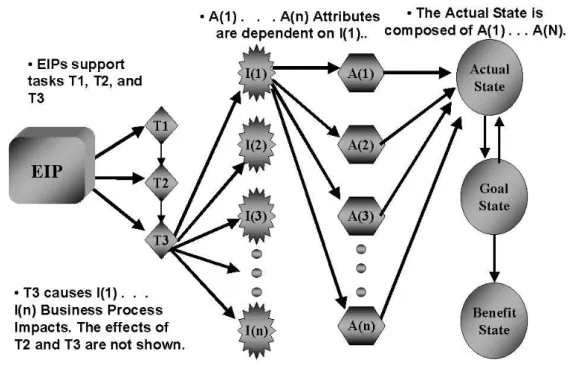
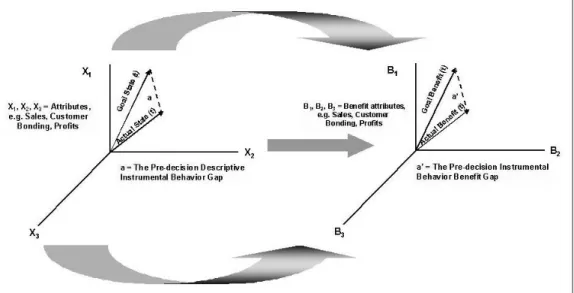
The row now defines a multi-attribute goal-state of the corporation at the specific time. The geometric space defined by the component properties of the goal states and actual states I will call corporate reality space.
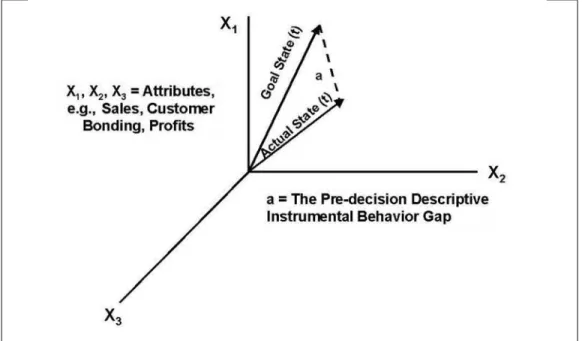
EIP benefits and corporate goals
If we look at assessments of EIP benefits from the above conceptual framework, it is clear that a thorough assessment of EIP benefits would. The following is a list of the steps involved in each of these phases of comprehensive EIP benefit assessment, along with some comments describing some of the work involved and tools that can be used to do it.
Measuring actual and goal-states Step one: Perform measurement modeling
Once the measured attributes are given values, the measurement model is used to calculate the values of the target measurable attributes to arrive at a description of the actual situation. We can then start using the actual values of the actual state attribute components as a basis for estimating the target state values of the same attributes.
Modeling the impact of EIPs
However, you can also add hypotheses that specify the relative size of the impact of EIP software versus alternative software options on each mutually endogenous or endogenous characteristics in the model. Ratio scaling techniques can also be used here to measure these relative sizes and check the consistency of the estimates.
Mapping from reality to benefit space
Step Three: Extend the impact model by adding hypotheses that compare the effects of EIP and other software alternatives on mutually endogenous and endogenous variables. The same method as when calculating the descriptive instrumental behavior gap can be used, but note two differences.
Implementing estimation
If the focus concept (or concepts in the case of more than one goal attribute) is a benefit attribute, the priority weights defined at the goal level of the hierarchy (relative to the benefit level) will provide a simple mapping (a linear composition) of reality space to benefit space, as well as a relative assessment of the impact of the software alternatives on goals and benefits. In addition, data will be collected on many of the properties in the system.
Summary
Mathematica (2001) at www.wolfram.com. 2001), “A Framework for Assessing Return on Investment for Enterprise Portal Implementation,” Plumtree Software, Inc., San Francisco, CA. 1972), "An Eigenvalue Assignment Model for Prioritization and Planning", Energy Management Policy Center, Philadelphia, PA: University of Pennsylvania. Ward Systems Group (2001) at www.wardsystems.com. 1986), “The Analytic Hierarchy Process: A Survey of the Method and its Applications,” Interfaces, 16, no.
Architecture of Enterprise Information Portals and
Enterprise Artificial Systems Integration
EIP Architectural Questions and Approaches: EASI and
Definition of enterprise artificial systems integration (EASI)
David Linthicum - "Enterprise Application Integration, or EAI, is one of those buzzwords that describes something that has been happening for years: the integration of applications so that they can freely exchange information and processes." Linthicum's definition states that application integration is the ability to freely exchange information and processes between applications, while Mann emphasizes the continued independence of applications in their management.
Types of EASI
John Mann - "Enterprise Application Integration (EAI) is the process of integrating multiple independently developed applications that may use incompatible technology and must remain independently managed. The idea of sharing across applications does not make it easier to think about all the aspects of the company's artificial systems, which must be integrated by the company.
Islands of information and Stonebraker’s enterprise integration solutions
On the other hand, the logical integration of legacy or real-time data leads to data aggregation systems. One such trend is marked by business conditions that "require real-time information that warehouses cannot provide." Another trend is the increasing need for companies to respond to changing business conditions and external events (especially in e-business).
Natural and artificial systems integration
If one does choose the data integration route, the crucial choices are between physical and logical integration, and between legacy data and real-time data. Physical integration of legacy data leads to data warehouses and data marts, while physical integration of real-time data leads to operational data storage and messaging systems.
Enterprise application integration (EAI)
Stonebraker's view of artificial enterprise system integration is also too narrow in its development of the application integration category. But you can't arrive at a fair assessment of its effectiveness for integrating artificial systems into enterprises through an analysis that either excludes key competitors or gives them a less than full overweight.
The data federation approach
But he seems clearly incorrect in asserting that practitioners of the approach generally do not provide a unified picture of the enterprise, and much more evidence than he presents would be needed to support his other two criticisms. It only integrates data islands and leaves most of the "information islands" and knowledge of the enterprise still intact.
Content integration
An artificial system that provides a truly dynamic integration must handle changes in all knowledge and information components, not just data-based ones. It is for this reason that the data federation approach is inherently inadequate.
Artificial information integration
Finally, like data and content federations, information federations use wide connectivity to move from and write to the distributed data and content stores and applications of the enterprise. It is scalable because its connection to application servers allows it to transparently access applications; in addition, new information managers can be added as needed to spread the processing and query load across widely distributed resources.
Artificial knowledge integration
It uses multiple distributed application servers along with multiple distributed data stores to maintain a unified view through a common object model. They provide process control and distribution services for the information federation to synchronize and adapt it to locally defined changes.
The DIMS solution to the “islands of information”
The AIM
Many of the objects in the AIM are shared across distributed physical platforms—either data stores or application servers. In this way, the data entering the AIM from data stores can be in the DIMS.
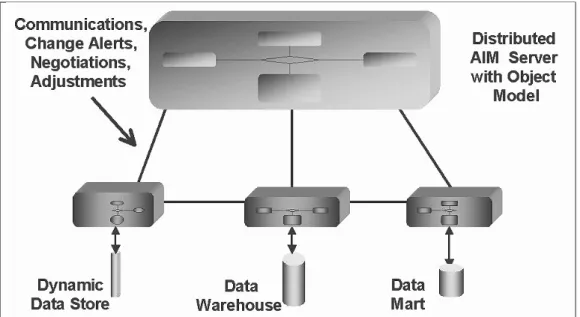
Connectivity services
Objects are reflexive if they are aware of their current state and any change of state. In this way, they are like human agents in natural knowledge management and other business processes.
Application servers
The role of intelligent software agents in the AIM is discussed in the context of their broader role in EIPs in Chapter 6. Business process engines: application servers that maintain state. Business process engines manage the most important business state in a fast memory environment and in close coordination with back-end databases.
Object/data stores
Object request brokers (ORBs) and other components,
Client-side application components
The DIMS, federations, and the enterprise information portal
Solving the “islands of automation” problem
Subject matter integration
In fact, some commentators (Koenig, 2002, p. 21) believe that awareness of the importance of content and its accessibility is the "third level of knowledge management" (a view that I find somewhat narrow and focused on information technology. The next step in the integration of portal objects is the development of such network relationships based on the tracking of non-hierarchical patterns of behavior in the search for information and knowledge.
Enterprise application integration through workflow
These subject relationships are as important as hierarchical relationships to a user's view of the world and therefore to (1) providing effective access to information relevant to that view and (2) to the user's decision making. The concept of use case looks at a sequence of tasks from the perspective of the estimated result that the user will get from it (ibid. p. 432).
Information integration through ad hoc navigation
Of course, it cannot provide the integrated behavior of mid-level and high-end processing. But if the integration of islands of information is managed successfully, EAI through the workflow produces a comprehensive form of integration of both islands of information and islands of automation.
EIP integration and architecture
The portal interface, both subject and workflow of enterprise applications, and content management content stores and applications are integrated. The portal interface, both subject and workflow of enterprise applications, and all stores and application servers within and across both structured and content management areas are integrated.
The PAC approach
The DFI approach
The SAI approach
All but a few EIP solutions currently implemented in the current portal implementation period are PAC portals. Within certain limits, this "active metadata hub" in the SAI architecture manages the integration of structured data applications into the EIP without administrative intervention.
The DCM approach
In the SAI architecture, by contrast, the object model has methods to perform these functions, but it is also programmed with methods to automatically adjust and synchronize the various metadata stores in the system. DCM architecture provides a unified view of content objects in the enterprise and handles semantic conversions "on the fly" through the DCM's object model.
The PAI approach
It is also scalable at the enterprise level due to (1) its distributed, federated structure, (2) its partial instantiation capability (ability to load parts of objects into memory) (3) storage objects in virtual memory in memory, and (4) its extensive connection to content stores and applications. It is also scalable at the enterprise level due to (1) its distributed and federated structure; (2) its partial instantiation capability (the ability to load parts of objects into memory); (3) storing its virtual cached memory objects; and (4) its extensive connection to content stores and applications.
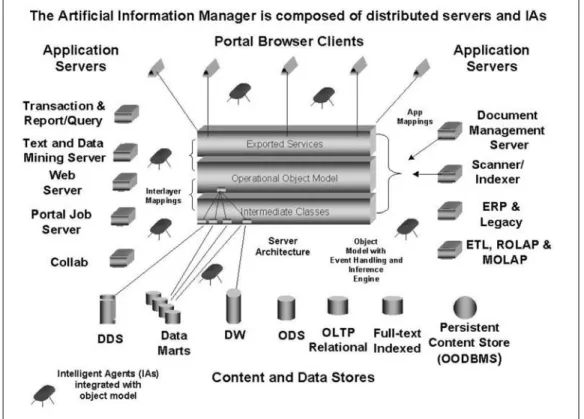
The incremental PAI approach
Four: Engines Business Process in Distributed Knowledge Management Systems,” Executive Information Systems, DKMS Brief, Wilmngton, DE, na http://www.dkms.com/White_Papers.htm. Managing Distributed Warehouse Metadata,” DM Review, februarska spletna različica), na http://www.dmreview.com.
The Role of Intelligent Agents in EIPs
Some definitions
In the client/server model, a single request is sent over a network and activates a computer procedure on the destination computer. They recruit other agents to create task forces and delegate work to the agents they recruit.
Agents in PAI architecture
In contrast, a mobile SA travels to a server and can then perform a series of transactions with it. Eventually, when its business with the destination computer is complete, it either returns to the source computer with the results of its transactions or moves to another destination computer to perform yet more transactions.
Object/component management and agents
If the changed objects are acceptable, the old versions of the objects can be deleted from all object models and the new objects can be incorporated into all distributed object models. Without negotiator agents, all transactions in negotiations between central and local AIM components would go over the enterprise network and could greatly slow down EIP or EKP performance.
Use case/workflow management and agents
- Facilitating specification of routing and distribution information and knowledge retrieval agents resident at each information or knowledge
- Supporting rapid and easy change in the routing structure, the distribution process, and the business rules governing the workflow
- Providing the capability to either store the product of a workflow task or “push” it to the next step in the workflow
- Providing the capability to distribute the workflow process across multiple computers
- Providing the capability to gather knowledge resources to support the workflow
- Supporting collaborative transactions among workflow participants
- Supporting subject matter integration of the UI
- Providing the capability to model and present individual, personalized workflows at subject matter nodes of the UI
- Providing the capability to simulate collaborative workflow
- Providing the capability to customize workflows by integrating custom, legacy, or external data and/or applications
Providing the ability to model and present individual, personalized workflows at topic nodes of the UI. The same agents can also capture the non-hierarchical network relationships between concepts in the topic hierarchy.
Transactional multithreading
Agents can be assigned tasks they perform according to rules programmed into the agents and triggered by events and their parameters. When the simulation is run, various characteristics of the workflow design can be evaluated.
Agents as intelligent scaled-down business process engines
Agents provide only one way to integrate custom, legacy, or external data and applications into a workflow system. But agent technology can be used to produce a simple information agent by “wrapping” any information source to allow it to adhere to the communication conventions of an agent infrastructure (Bradshaw, 1998, p. 31).
Conclusion: agents, EIPs, and the virtual enterprise
Rymer says: (1998, p. 1) “Business status is information that describes the current state of an organization. Software Agents: A Review,” Trinity College, Dublin, and Broadcom Eirann Research Ltd., 27 May 1997, Available at: http://www.cs.tcd.ie/.
On Knowledge and Knowledge Management
3 have taken us as far as we can go in analyzing the relationship of enter- prise information portals to knowledge management without engaging in an explicit
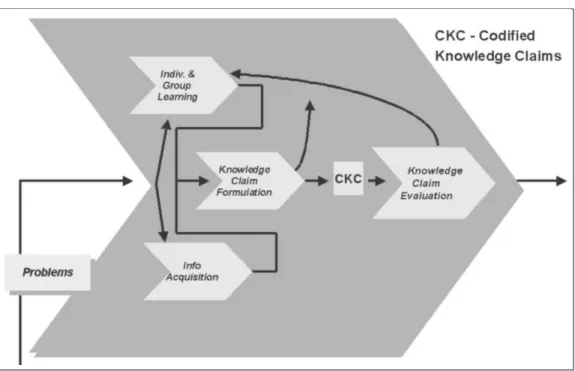
It specifies information acquisition, individual and group learning knowledge claim formulation and knowledge claim validation, the sub-processes of knowledge production and knowledge dissemination, search/retrieval, knowledge sharing and teaching, and the sub-processes of knowledge integration. All sub-processes are analyzed in sufficient detail to provide an understanding of what type of process activities an OIP will need to support to improve knowledge processing.
On Knowledge
On definition
The cognitive map idea is therefore not limited to mathematical or precise logical connections, but can also accommodate less demanding formulations of relationships between concepts. With the complex and comprehensive pattern of the entire cognitive map in mind, as well as the small area that the definition represents, I will characterize the definition as the "elevator speech" (the 30-second expression of the idea, Moore, 1991, p. . that is, when one communicates with others about any expression.
Definitions of knowledge
The World 2 definition of knowledge I gave above means that knowledge is not the same as "understanding", whether qualified by experience, greater understanding or insight. Thus, such knowledge about the world 2 is difficult and in many cases impossible to share even through non-verbal communication.
If we do not acknowledge their existence, we limit knowledge of world 2 to the level of the individual. The distinction between world 2 and world 3 knowledge raises the question of what type of knowledge should be the object of KM.
To what extent is world 2 knowledge about an organization determined by organizational interaction, rather than individual dispositions and interactions, which cannot be handled by the organization. Where does the distinction between world 2 and world 3 knowledge leave the much better known distinction between tacit and explicit knowledge.
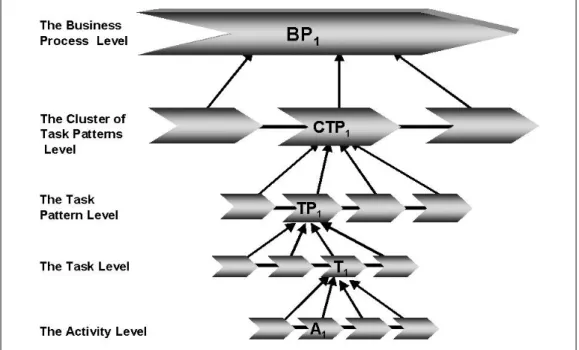
Business process hierarchies, decision cycles, and knowledge processing
Monitoring means to retroactively trace and describe the business process (cluster, pattern or task) and its outcome. Thus, each decision cycle in each business process can include both knowledge processing (production and.
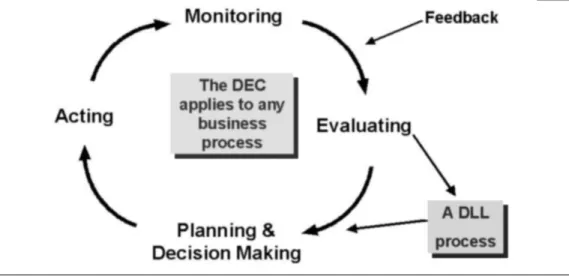
A knowledge life cycle (KLC) framework
The process of knowledge production, in combination with agents' prior predispositions, also produces beliefs related to world knowledge claims. It is the testing and evaluation of knowledge claims. world 3), or testing and evaluating beliefs (world 2).
Tacit knowledge and explicit knowledge
Information about falsified knowledge claims—Information that testifies to the existence of falsified knowledge claims and the circumstances under which such knowledge was falsified. Information about surviving knowledge claims—Information that testifies to the existence of surviving knowledge claims and the circumstances under which such knowledge was tested and evaluated.
Polanyi, implicit knowledge, and Popper
On the other hand, some of Popper's world 2 mental phenomena are obviously personal and "tacit" in the sense that they can (by definition) represent mental objects that cannot be focused into expressible psychological orientations. Also note that all explicit statements are not about world 3 objects and all personal, tacit knowledge is not about world 2.
Individual level world 2 knowledge and motivational hierarchies
Interactions between these factors are knowledge or belief dispositions of agents, and they are an essential part of the world 2 knowledge system of an agent. And they provide much of the continuity in individual behavior and knowledge seeking that we observe in the knowledge life cycle and other business process behaviors.
Knowledge and culture
The motivating factor is the strength of the aptitude for goal pursuit resulting from the interaction of the other three factors. The availability and expectation factors in this framework are cognitive in nature and the stimulatory factor is emotional or affective.
Alternative definitions of culture
Culture is how people solve problems of adapting to the environment or living together. The upshot of this brief study of "culture" is that when one says that knowledge cannot be shared or transferred because of cultural barriers, one really needs to seek clarification as to what sense of culture is intended.
Culture, or something else?
What is culture and how does it fit with other factors influencing behavior?
It affects the behavior of the group itself by predisposing it to the behavior (see Figure 7.9). Then, transactions, social ecology, and prior decisions (the feedback loop to achieve the goal) are considered as "influences" on a goal-directed typical agent whose internal process then produces decisions that result in the agent's transaction outputs (i.e. ) directed toward other agents j, k ,.
Modes of conversion and the KLC view
These are the most abstract value orientations and attitudinal assumptions in the hierarchy in Figure 7.10. Fourth, although high-level value orientations and attitudes are both the most pervasive and the weakest influences on immediate behavior, they are also the most difficult preconditions to change in the short term.
Specific commentary on the four modes of conversion Tacit to tacit
Instead, it is from the obvious to the implicit (perhaps with the help of some tacit knowledge) and then from the implicit to the obvious. In other words, I propose that internalization is an explicit to implicit rather than an explicit to tacit conversion.
Does “conversion” produce organizational knowledge or only knowledge claims?
In that case, the combination is explicit to explicit, but is of a purely deductive nature. Finally, explicit-to-tati (internalization) is a dubious state, probably better characterized as explicit-to-implicit, but even if this is done, what is actually achieved.
An oversimplified classification scheme?
It is about the creation of beliefs and knowledge predispositions at the individual level, which are the result of the interaction of world 3 organizational knowledge with the individual agent and his social context.
The four modes of conversion and the KLC
Finally, internalization is one of the expected effects of knowledge integration on DOKB. In summary, the KLC model incorporates all the knowledge conversion modes of Nonaka and Takeuchi while emphasizing Popper's distinction between world 2 and world 3 objects.
The knowledge conversion model: missing the point
Organizational inquiry: The search for effective knowledge,” Knowledge and Innovation: Journal of the KMCI, 1, no. The Age of The Metaprise,” Knowledge Management Consortium International, Gaithersburg, MD, available at http://www.km.org/metaprise/.
Knowledge Life Cycle Subprocesses
Information acquisition
The information must be relevant to the problems that the KLC agents are trying to solve in their decision cycles. Externally available information must be broad enough in scope to meet the variety of problems presented to decision makers.
Process descriptors
However information is obtained and from whatever external source, the efficiency and effectiveness of the KLC is related to the information acquisition cycle time, the relevance of the information obtained and the scope of that information. The cycle time must be fast enough to provide information to other task clusters in the KLC that need the information.
Information acquisition infrastructure
Information descriptors
Types of models used in the acquired information base (conceptual analysis, data models, measurement models, effect models, predictive models, assessment models, object models, structural models). Types of formal languages used in the acquired information base (set theory, mathematics, fuzzy logic, etc.).
Descriptors of change in processes
Types of semi-formal languages used in the acquired information base (object modeling language, information modeling language, etc.).
Individual and group (I&G) learning
Knowledge claim formulation
Use and frequency of use of methods for interpersonal search, intelligence gathering, and knowledge claim formulation. Use and frequency of use of electronic search, intelligence gathering and knowledge claim methods.
KCF infrastructure
KCF outcome descriptors
Types of models used to base knowledge claims (conceptual analytical models, data models, measurement models, impact models, predictive models, evaluation models, object models, structural models). Types of semiformal languages used in knowledge claims base - Unified Modeling Language (UML), Knowledge Claim Modeling Language (KQML).
Other outcome descriptors
Descriptors of growth and change in KCF outcomes
Change in the extent of withdrawal from interaction with other agents as a result of cooperative activity. Change in degree of relevance of knowledge claims produced to problems motivating KLC.
Knowledge claim validation or evaluation
Knowledge claim validation descriptors are divided into process descriptors and knowledge claim descriptors. Many of the descriptors of the knowledge claim validation process are the same as those already presented for knowledge claim formulation.
KCV (or KCE) infrastructure
Portal-enabled, server-based automatic arbitration of agent-mapped knowledge claims (Firestone, 2000a), This method is not included among KCF methods. In it, servers use predefined rules to arbitrate between knowledge claims and provide machine-mediated evaluation of them as an input for human validation judgments.
KCV (or KCE) outcome descriptors
This refers to the extent to which alternative theories, models or other knowledge claims can be expressed using a common conceptual framework (Popper, 1970; Kuhn, 1970). There is no way to know that a comparison set is actually complete, just as there is no way to guarantee that a knowledge claim is true.
Descriptors of growth and change in validated knowledge claim outcomes
This is the extent to which each alternative theory or model is comparatively faithful to previous terms. Change in types of methodologies (cost reduction, volume increase, capacity increase/decrease).
Knowledge broadcasting
Change in the relationship between messages received by an agent and messages sent by that agent related to KCV. The extent of withdrawal from interaction with other agents as a result of collaborative broadcast activity.
Broadcasting infrastructure
Broadcasting outcome descriptors
Descriptors of growth and change in broadcasting outcomes
Knowledge-related searching and retrieving
Searching/retrieving infrastructure
Searching/retrieving outcome descriptors
Descriptors of growth and change in searching/retrieving
Change in degree of withdrawal from interaction with other agents as an outcome of cooperative activity in search/retrieval. Change in ratio of messages received by an agent to messages sent by that agent related to search/retrieval.
Teaching
Teaching infrastructure
Teaching outcome descriptors
Descriptors of growth and change in teaching
Knowledge sharing
Sharing infrastructure
Sharing outcome descriptors
Descriptors of growth and change in sharing
This new focus of KM, also called the new knowledge management (or TNKM) (McElroy, 2002), is on innovation. We do know that acceleration means changing the knowledge-sharing processes in the KLC and their interrelationships, and that this requires knowledge management.
On Knowledge Management
Introduction: Approach to KM
Complex adaptive systems
The ability of instances to adapt, along with their emergent behavior, is what distinguishes them from simple adaptive systems and Newtonian systems that lack adaptive ability. It is a constant, conceptually separate, persistent, adaptive interaction between intelligent agents (1), whose interactional properties are not determined by design, but arise from the dynamics of the company's interaction process itself; and (2) that produces, maintains, and reinforces the diffuse knowledge base produced by the interaction.
Hierarchical vs. organic KM
Emergent behavior is behavior that cannot be modeled based on knowledge of the components of the system. If the situation is the latter, then the implication is that KM should not take a hands-off stance, but instead try to intervene to restore the natural, productive tendencies of the NKMS.
Some definitions of knowledge management
But we lack clear criteria to evaluate when we have an NKMS that requires laissez-faire KM and when we have one that requires a more active KM policy. Without such criteria for making evaluations, the political stance that follows from a belief in organic KM is difficult to apply and should be treated with caution.
Malhotra (1998)
Sveiby (1998)
Ellen Knapp (PWC) (1998)
University of Kentucky (1998)
Karl Wiig (1998)