284
Enterprise Information Systems
10
Learning Objectives
쐃Understand how enterprise systems support cross- functional and multinational operations.
Understand why companies need enterprise resource planning (ERP) systems.
Describe supply chain management (SCM) networks and solutions.
Understand collaborative planning, forecasting, and replenishment (CPFR).
Describe customer relationship management (CRM) systems.
Discuss benefits of knowledge management systems.
Chapter 10 Link Library Quick Look at Chapter 10
ERP Gives Under Armour an Edge on Nike
10.1
Enterprise Systems10.2
Enterprise Resource Planning (ERP) Systems10.3
Supply Chain Management (SCM) Systems10.4
Collaborative Planning, Forecasting, and Replenishment (CPFR) Systems10.5
Customer Relationship Management (CRM) Systems10.6
Knowledge Management (KM) SystemsBusiness Case:
ERP Helps Productivity at Northern Digital Inc.Nonprofit Case:
Arbor Day Foundation Implements Constituent Relationship Management SystemAnalysis Using Spreadsheets:
Assessing the Value of E-CRMCases on Companion Site
10.1 West Marine: A CPFR Success Story 10.2 Northrop Grumman Uses KM to Prevent Brain Drain
References
ACC FIN MKT OM HRM IS
Integrating IT
285
QUICK LOOK at Chapter 10, Enterprise Information Systems
This section introduces you to the business issues, challenges, and IT solutions in Chapter 10. Topics and issues mentioned in the Quick Look are explained in the chapter.
Companies have many of the database and software applications that they had invested in over the past sev- eral decades. These older information systems (IS), called legacy systems,have been built with various out- dated technologies. As business strategies and technolo- gies changed over the years, the legacy systems were modified repeatedly and patched to the point where they just cannot be modified anymore. Typically, legacy systems are inflexible and expensive to maintain for two reasons:
1. They cannot be updated or cannot be updated without significant effort.
2. They cannot interface (connect to) and exchange data with newer information technologies (IT) or cannot be interfaced without significant effort.
Regardless of their limitations and age, a company’s legacy systems may be mission-critical.That means that if one of these systems crashes or stops working, one or more business operations may grind to a halt. Think about the chaos you’d be caught in if you were at an air- port when your airline’s reservation system crashed.
Passengers could not make connections and their luggage could not be checked in.You can imagine—or might have experienced—other aggravating consequences.
New IT may also be mission-critical. Our dependency on newer IT infrastructures was made obvious on August 6, 2009, when a hack attack took down the microblogging site Twitter. In some companies and in some countries,Twitter has turned into a critical infrastructure. Over 45 million Twitter users worldwide were left speechless—so to speak—
by the attack, including companies that relied on Twitter for marketing and consumer outreach.
Given the situation that organizations of all types find themselves in with their legacy systems, when they need to upgrade mission-critical ISs or implement global systems, they turn to enterprise information system soft- ware.Enterprise information systems,or simply enter- prise systems, are integrated ISs that support core business processes and functions. Business processes and functions include marketing, accounting, finance, infor- mation security, human resources (HR), compliance, pro- duction, purchasing, and logistics. Integration is achieved by linking databases and data warehouses so they can share data from:
• Internal functions: Functions that take place within the company, which are referred to collectively as the internal supply chain
• External partners: Business or supply chain partners, such as customers or suppliers, which are referred to as the external supply chain
As you read in greater detail in this chapter, key enterprise systems are:
• ERP: Enterprise resource planning
• SCM: Supply chain management
• CPFR: Collaborative planning, forecasting, and replen- ishment
• CRM: Customer relationship management
• KM: Knowledge management
The key benefit of enterprise systems is data integra- tion. Integration enables the sharing or exchange of data.
For example, ERP is integrated with SCM to improve supply chain performance, and KM is integrated with CRM to identify profitable and unprofitable customers.
Improvements in business processes are highly depend- ent on data accuracy, completeness, context, and access to it—which all of the ISs discussed in this chapter help achieve.
CHAPTER 10 LINK LIBRARY
Comparison of top 10 ERP vendors top10erp.org/
ERP Vendor Shootout erpshootout.com/
Oracle oracle.com SAP sap.com
SSA Global ssaglobal.com/solutions/erp/ln.aspx
Microsoft Dynamics microsoft.com/dynamics/en/us/default.aspx Teradata Teradata.com
and corporate strategy because of their potential to increase both thetop line(growth in net revenues) and the bottom line(growth in net income).Corporate strategy is the collection of activities and actions a company chooses to invest in and perform as well as those it chooses not to invest in or perform.
systems are not the technical ones. Rather, the biggest chal- lenges are process and change management. Companies that have inconsistent or outdated business processes along their supply chains tend to have poor-quality data. To improve data quality, companies reengineer those processes and consolidate them into an integrated enterprise system.
Entering a market dominated by Nike, adidas, and Reebok is tough. Competing successfully with them on a global playing field is even tougher. That’s what former University of Maryland football player and entrepreneur Kevin Plank did with Under Armour Inc. (underarmour.com/ ) in 1996. Under Armour is the originator of performance apparel that’s made of fabric to keep athletes cool, dry, and light throughout their games and work- outs. The company develops, markets, and distributes branded apparel, footwear, and accessories. The brand’s synthetic fab- rics are engineered in many different designs and styles for wear in any climate. Their products are sold worldwide and worn by athletes at all levels and ages, from youth to professional. The Under Armour global headquarters is in Baltimore, Maryland, with European headquarters in Amsterdam and remote offices in Denver, Toronto, Hong Kong, and Guangzhou, China.
• ISs with multicurrency and multicompany processing capa- bilities were needed to support international expansion.
• Software applications could not support growth of the prod- uct lines or the company’s expansion into several other countries.
The company had sharp spikes in orders during seasonal product shifts and promotional pushes. To improve its brand and channel management, the company needed to replace its time-consuming manual allocation processes with depend- able available-to-promise (ATP) capabilities. ATP is a busi- ness function that provides data about resource availability and delivery dates to keep customers informed of their orders’
status. ATP also supports order fulfillment in order to manage demand and match it to production plans. The software takes a lot of work out of the order fulfillment process—and less effort means lower cost and fewer errors.
ERP Solution
After identifying its challenges, management reviewed various software vendors’ products to identify the one that best met the company’s needs. The company selected an ERP solution from SAP (sap.com) that would give it the ability to accelerate time-to-market of new products, to improve customer service, and to take advantage of growth opportunities. Under Armour implemented the SAP Apparel and Footwear Solution for Consumer Products module to the ERP. Together with the SAP NetWeaver Exchange Infrastructure component, Under Armour had the capabilities to achieve its ambitious expansion plans.
The ERP solution had broad executive support and guid- ance. Within eight months, a 20-person project team from oper- ations and IT together with ERP consulting company Metamor managed the implementation. To improve management and operational visibility, the company also deployed Web-based SAP NetWeaver Business Intelligence software through which reports can be accessed on demand or be delivered on schedule.
Growth in the Top and Bottom Lines of the Business
With the SAP ERP, products module, and exchange infra- structure, Under Armour increased both its top line—growth
ERP Gives Under Armour an Edge on Nike
Figure 10.1 Under Armour is the originator of performance apparel and succeeds in a fiercely competitive industry.
(©Under Armour, Inc. 2010.)
Business and IT Challenges
Under Armour was facing several business challenges due to its extensive product line, global distribution, and ambitious growth strategy, as well as the fierce competition in the athletic apparel and gear industry. The company’s key technology and business challenges and needs were:
• ISs did not provide sufficient agility to outpace competitors and enable the company to reinvent itself every six months—a goal important to top management.
ACC
MKT OM GLOBAL
286
IS
10.1 Enterprise Systems
Enterprise information systems,or enterprise systemsfor short, are systems that help managers and companies improve their performance by enabling them to seamlessly share data among departments and with external business partners. Enterprise sys- tems allow workers to access and analyze real-time information and transaction processes across the entire organization. These systems integrate the functional sys- tems that you read about in Chapter 9, such as accounting, finance, marketing, and operations. Another advantage of enterprise systems is that processes become more automated or totally automated, which increases efficiency. For example, by automat- ing finance processes, a company can do things such as accept online orders and do business-to-business (B2B) transactions electronically instead of via e-mail or offline methods such as telephone or fax.
Prior to selecting and implementing an ERP or other enterprise system, it’s essential that a company identify the problems to be solved, the goals to be achieved, and the type of support the IS is to provide. For example. Under Armour’s manage- ment wanted real-time or near-real-time data and sufficient agility to respond quickly to operational and market conditions.Agilityis the ability to thrive and prosper in an environment of constant and unpredictable change. Agility is a result of stream- lining processes on the shop floor to speed up order fulfillment, which in turn max- imizes capacity for increased productivity.
in sales—and bottom line—growth in net income. With automated ATP processes, the data is reliable and inventory management is efficient and lower cost. Multiple currencies and companies are supported. Managers have a clear view of timely data to drive better decisions and business performance.
On July 28, 2009, Under Armour announced positive financial results for the second quarter (Q2) of 2009—a time when most companies’ sales were being hurt by the recession.
Consolidated net revenues for Q2 increased 5.1 percent to
$164.6 million, and net income increased 4.7 percent. The apparel division’s net revenues increased 16.5 percent while direct-to-consumer net revenues grew an impressive 36.6 per- cent during Q2. CEO Kevin Plank stated about Q2, “Our results this quarter demonstrate our continued ability to suc- cessfully manage our business.”
Given the capabilities provided by the ERP, the company is able to close its books faster than ever, to bring new oper- ations onboard quickly, and to make more knowledgeable decisions with greatly improved operational visibility. With bottom-line growth every year since 1996 and net revenues over $810 million in 2009, Under Armour is one of the best- performing and fastest-growing public companies.
With clear objectives for the ERP, SAP software, and the assistance of an experienced consulting firm, Under Armour improved sales revenues and profits in a highly competitive industry during a recession. The Under Armour case illustrates the operational and strategic benefit of enterprise systems to ensure quick response to market changes and customer needs.
Doing so is not a simple task, as you read in this chapter.
Sources: Compiled from Business Wire (2009), SAP (sap.com), and Under Armour (underarmour.com, 2010).
For Class Discussion and Debate
1. Scenario for Brainstorming and Discussion:Many factors contributed to Under Armour’s success in the fiercely compet- itive sports apparel industry.
a. Identify all of the factors, reasons, and conditions that con- tributed to Under Armour’s success.
b. Discuss the importance of each factor, reason, and condi- tion. Decide which are the top three success factors and explain why.
2. Debate: Based on your answers to 1(a) and (b), debate how and to what extent a company wanting to enter that market today—given today’s economic and market conditions—could succeed for the same reasons and due to the same factors.
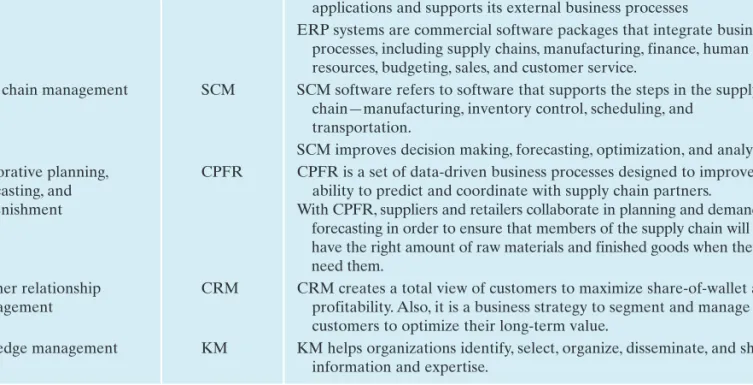
Several examples of enterprise systems are listed and described in Table 10.1.
Companies implement most or all of these systems, not just one.
TYPES OF ENTERPRISE SYSTEMS AND THEIR FUNCTIONS
287
TABLE 10.1 Descriptions of Enterprise Systems
Name Abbreviation Description
Enterprise resource planning ERP ERP is the software infrastructure that links an enterprise’s internal applications and supports its external business processes
ERP systems are commercial software packages that integrate business processes, including supply chains, manufacturing, finance, human resources, budgeting, sales, and customer service.
Supply chain management SCM SCM software refers to software that supports the steps in the supply chain—manufacturing, inventory control, scheduling, and
transportation.
SCM improves decision making, forecasting, optimization, and analysis.
Collaborative planning, CPFR CPFR is a set of data-driven business processes designed to improve the forecasting, and ability to predict and coordinate with supply chain partners.
replenishment With CPFR, suppliers and retailers collaborate in planning and demand forecasting in order to ensure that members of the supply chain will have the right amount of raw materials and finished goods when they need them.
Customer relationship CRM CRM creates a total view of customers to maximize share-of-wallet and management profitability. Also, it is a business strategy to segment and manage
customers to optimize their long-term value.
Knowledge management KM KM helps organizations identify, select, organize, disseminate, and share information and expertise.
The reasons companies migrate to enterprise systems stem from limitations with their existing legacy systems. Here are several reasons for the migration from legacy sys- tems to enterprise systems:
• High maintenance costs. Maintaining and upgrading legacy systems are some of the most difficult challenges facing CIOs (chief information officers) and IT depart- ments.
• Business value deterioration. Technological change weakens the business value of legacy systems that have been implemented over many years and at huge cost.
• Inflexibility. Monolithic legacy architectures are inflexible. That is, these huge sys- tems cannot be easily redesigned to share data with newer systems, unlike modern architectures.
• Integration obstacles. Legacy systems execute business processes that are hard- wired by rigid, predefined process flows. Their hardwiring makes integration with other systems such as CRM and Internet-based applications difficult and sometimes impossible.
• Lack of staff. IT departments find it increasingly difficult to hire staff who are qualified to work on applications written in languages no longer used in modern technologies.
REASONS COMPANIES MIGRATE TO ENTERPRISE SYSTEMS
Implementing an enterprise system is challenging because it requires extensive changes in processes, people, and existing systems. Three required changes are:
1. Redesign of business processes. Processes need to be simplified and redesigned so that they can be automated, either totally or partially. Tasks that are no longer necessary are removed from the processes.
2. Changes in how people perform their jobs. Jobs and how they are performed will change to accommodate the new processes. Enterprise systems require retraining of end users, whose productivity will slow initially as they adjust to a new way of doing their jobs.
IMPLEMENTATION CHALLENGES AND BEST PRACTICES
3. Integration of many types of information systems. Integrating information sys- tems is necessary so that data can flow seamlessly among departments and business partners. Automated data flows are essential to productivity improvements.
A best practice is to examine the inefficiencies in existing processes to find ways to improve on or significantly simplify the process. For example, manual document- intensive processes (such as order entry and billing) create major headaches for work- ers. These processes require users to manually review documents for approval, enter data from those documents into a back-office system, and then make decisions.
Automated order entry systems track customer orders from the time of initial order placement through the completion of those orders; they also perform backorder pro- cessing, analysis, invoicing, and billing.
Because of their complexity, enterprise systems are leased or licensed from vendors and customized with support from IT personnel who are familiar with their company’s business processes.The trend towardERP as a servicecontinues to increase. In fact, the term ERP commonly refers to commercially available software systems. For examples of monthly costs and a comparison of 10 ERP vendors’ products, visittop10erp.org/.
To simplify and reduce the cost of the ERP software selection process (the selection process itself is complex and critical), an annual event called the ERP Vendor Shootout (erpshootout.com/) is held and geared toward ERP selection teams and decision mak- ers for companies with manufacturing, distribution, or project-oriented requirements.
10.1
Enterprise Systems 289Here are three other insights related to enterprise systems to better understand the current state of enterprise systems and their potential:
1. One of the IT department’s most important roles is to provide and support appli- cations that enable workers to access, use, and understand the data. These applica- tions need to be tightly aligned with well-defined and well-designed business processes—a standard that few enterprises are able to achieve.
2. Customer loyaltyhelps drive profits, but only for customers who are profitable to the company. Many companies don’t know how to recognize or encourage the kind of cus- tomer loyalty that’s worth having.Using data about buying behaviors (e.g.,amount spent per month, purchase of high-margin products, return activity, and demands for customer service) helps a company identify its loyal customers and which ones are profitable.
3. Companies all over the world are spending billions of dollars on the design and implementation of enterprise systems. Huge investments are made in ERP systems from vendors such as Oracle, Peoplesoft (acquired by Oracle), JD Edwards (also acquired by Oracle), SAP, Microsoft, and BAAN to create an integrated global sup- ply chain. Interorganizational ISs play a major role in improving communication and integration among firms in a global supply chain.
Next you read about ERP systems, which despite the name are not limited to planning functions. Although most types of companies now have an ERP system, ERP evolved from the manufacturing industry.
ENTERPRISE SYSTEMS INSIGHTS
Review Questions
1. Explain the purpose of an enterprise system.
2. Describe five types of enterprise systems.
3. What are two challenges of legacy systems?
4. Explain the three types of changes needed when an enterprise system is implemented.
10.2 Enterprise Resource Planning (ERP) Systems
What is an ERP (enterprise resource planning) system?From a technology perspec- tive, ERP is the software infrastructure that links an enterprise’s internal applica- tions and supports its external business processes, as you read in the opening case on Under Armour. ERP applications are modular, and the modules are integrated with each other to expand capabilities.
An ERP helps managers run the business from front to back. Departments can easily stay informed of what’s going on in other departments that impact their oper- ations or performance. Being informed of potential problems and having the abil- ity to work around them improves the company’s business performance and customer relations. For example, an ERP enables a manufacturer to share a com- mon database of parts, products, production capacities, schedules, backorders, and trouble spots. Responding quickly and correctly to materials shortages, a spike in customer demand, or other contingency is crucial because small initial problems are usually amplified down the line or over time. Table 10.2 lists the characteristics of ERP suites and applications.
TABLE 10.2 Characteristics of ERP Applications
• Bring silos of information together to enable managers to really understand what is going on
• Provide the information access, integrated business processes, and modern technology platform necessary to become and remain competitive
• Support all, or a great majority, of a company’s business functions and processes
• Expand a company’s reach beyond its internal networks to its suppliers, customers, and partners
Food manufacturing is a highly competitive and regulated environment. Major chal- lenges facing food manufacturers are margin pressures, food safety and regulations, and constantly changing consumer tastes. An integrated business software system is essential for controlling costs, managing inventory, and meeting government regula- tions. Another challenge is knowing how to evaluate a new enterprise-wide software system.
Figure 10.2 shows the subsystems that need to share data and support the oper- ations of most manufacturers.
Food Safety and Agri-Food Regulations. In a survey conducted by Food Engineering magazine, the top concern of the agri-food industry was food safety, in large part because worldwide distribution systems have increased the risk and range of contaminated food entering the food supply. In 2009, the New York Timesreported that a single hamburger could contain beef products from several slaughterhouses on several continents (Moss, 2009). An estimated 76 million people in the United States get sick every year with foodborne illness and 5,000 die, according to the U.S.
Centers for Disease Control and Prevention (CDC).
The threats and potential costs associated with food safety are high and rising.
Contaminated spinach, peanut butter, beef, imported seafood, pet food, and many other food products, in addition to life-threatening and ethical issues, result in liti- gation, bad publicity, and recall costs that damage or destroy companies’ reputations.
The European Food Safety Authority (efsa.europa.eu/)applies a “from the farm to the fork” integrated approach based on transparency, risk analysis and prevention, ERP: A STRATEGIC
WEAPON FOR FOOD MANUFACTURERS
Laboratory
& R&D
Regulatory
Reporting Order Entry
POS & Sales
Accounting Purchasing
Production Inventory
Figure 10.2 An ERP system integrates all function ISs of a food manufacturer around a single set of data.
and consumer protection. The U.S. Congress responded to terrorism by passing the Public Health Security and Bioterrorism Preparedness and Response Act (Bioterrorism Act) in 2002. In 2009, Congress passed a food safety law creating new traceability requirements for the food supply chain and giving greater facility inspec- tion power to the Food and Drug Administration (FDA).
Using IT to Deal with Complexity. All of these challenges have one thing in common: They add complexity, and that adds costs. The challenge for today’s food manufacturer is how to meet the regulatory requirements, ensure a safe food sup- ply, constantly improve business processes, and make a profit. The answer has been investments in IT.
The first software purchased is an accounting package to handle the financial aspects of running a business. As the company grows, companies invest in IT to man- age inventory, process sales and purchase orders, and control production. This pro- gression of IT investments addresses the needs of individual departments or functions.As a result, companies have separate ISs for accounting, sales and purchas- ing, and inventory management—with the same data being held in multiple systems.
This leads to duplicate data entry and differing versions of the truth.
Integrated ERP System. A well-designed ERP system can help integrate all aspects of an organization around a single set of data. Key benefits of an integrated ERP system to a food manufacturer are improved operational performance, a framework to meet regulatory mandates and reporting requirements, and cost control. Many food manufacturers are replacing multiple software applications with a single inte- grated ERP system to manage their complex businesses to maximize productivity and profitability. Specifically, the ERP gives manufacturers a single point of control for data, thereby:
• Eliminating the need to enter data in multiple systems
• Reducing common data entry errors and costs
• Allowing for the posting of transactional data in real time for instant access to up-to-date information
• Being able to respond quickly to food recalls
• Meeting requirements of the Bioterrorism Act or other regulations for accurate recordkeeping in order to support the discovery of and quick response to food chain supply threats
Like many other companies, food manufacturers are being squeezed at both ends. Increased pressure for food safety and regulation add costs to the food pro- cessing supply chain. Higher energy bills and distribution further reduce profit mar- gins. These pressures are leading to investments in enterprise systems to integrate data silos.
10.2
Enterprise Resource Planning (ERP) Systems 291When companies need to replace their disparate (stand-alone) or labor-intensive legacy systems, they often invest in enterprise systems. Doing so requires migrating databases and applications from legacy to enterprise systems. Not surprisingly, data- base vendors such as Oracle and IBM are also enterprise system vendors. These ven- dors provide tools that help automate both the database migration and the application migration, which occur separately.
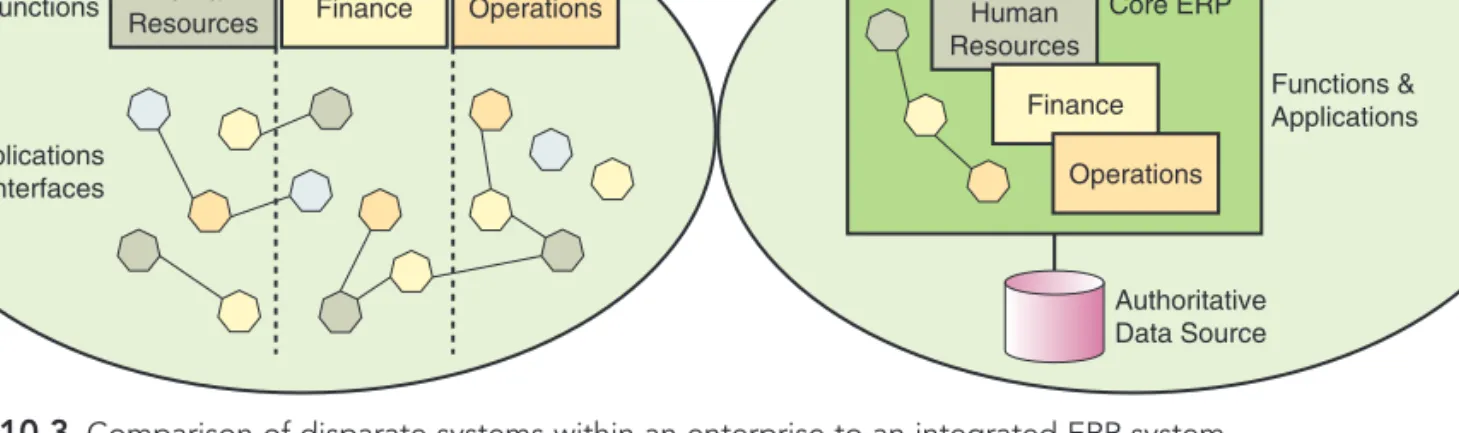
Implementing an enterprise system may be a competitive necessity for compa- nies with data management problems. The greater the number of applications and databases, the greater the complexity of data management because of the numerous interfaces needed to exchange data.As you see in the left-side diagram of Figure 10.3, disparate functional systems—HR, finance, operations—involve numerous interfaces.
These interfaces increase maintenance efforts and costs as well as the risk of dirty FROM STAND-ALONE
DATA SILOS TO AN INTEGRATED ENTERPRISE SYSTEM
data. An ERP integrates functions, including a suite of IT modules that can be pur- chased as needed by the company.
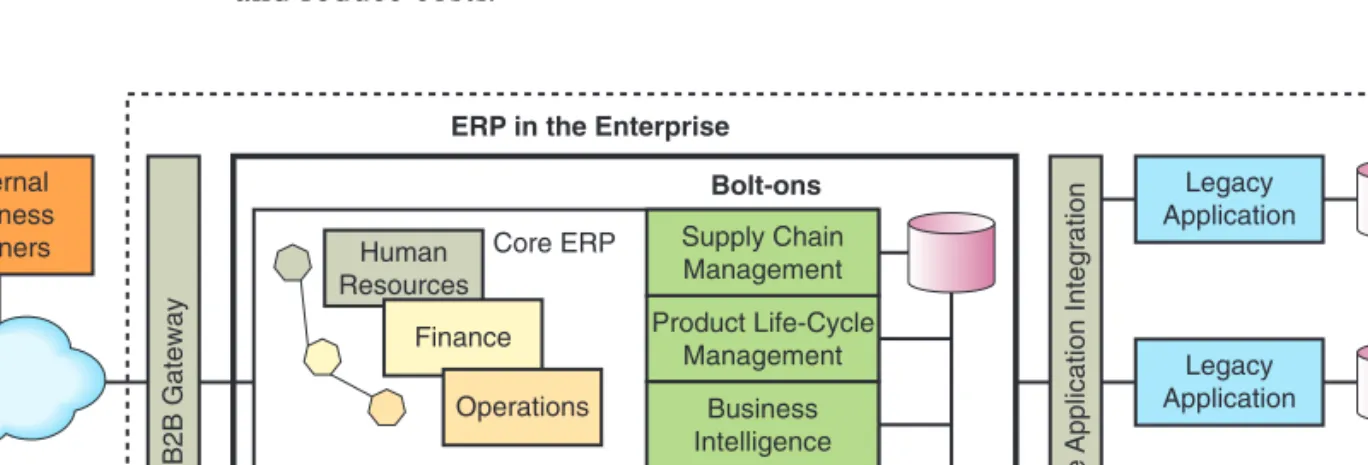
Enterprise Application Integration Layer. In Figure 10.4, you see how an ERP fits into an enterprise’s IT infrastructure.The core ERP functions are integrated with other systems or modules that are bolted-on, including SCM, PLM, CRM, and BI.
In the example shown in Figure 10.4, the ERP interfaces with legacy applications through an enterprise application integration (EAI) layer and with external business partners through a B2B gateway (explained in next section). EAI is middleware that connects and acts as a go-between for applications and their business processes.
Benefits of EAI are listed in Table 10.3.
B2B Gateway Layer. Business-to-business integration (B2Bi) is vital to ensure the efficient, accurate, and timely flow of data across internal ISs and external business partners. (See left side of Figure 10.4.) Companies that implement B2Bi are realizing enormous competitive advantage through faster time to market, reduced cycle times, and increased customer service. Through integration of busi- ness and technical processes, companies are able to strengthen relationships with partners and customers, achieve seamless integration inside and outside the enter- prise, gain real-time views of customer accounts, increase operational efficiencies, and reduce costs.
Human Resources Functions
Before ERP—Disparate After ERP—Integrated
Applications
& Interfaces
Finance Operations
Functions &
Applications
Authoritative Data Source Core ERP Human
Resources Finance
Operations
Figure 10.3 Comparison of disparate systems within an enterprise to an integrated ERP system.
(Courtesy of U.S. Army Business Transformation Knowledge Center (2009), army.mil/armyBTKC/.)
Authoritative Data Source
Core ERP
Bolt-ons ERP in the Enterprise
Human Resources
Supply Chain Management Product Life-Cycle
Management
Legacy Application External
Business Partners
Legacy Application
Legacy Application Business
Intelligence
Enterprise Application Integration
B2B Gateway
Finance Operations
Figure 10.4 How ERP interfaces with other enterprise systems.
(Courtesy of U.S. Army Business Transformation Knowledge Center (2009), army.mil/armyBTKC/.)
Companies need to be able to safely and securely participate in B2Bi and to securely exchange data over the Internet.B2B gatewaysprovide these services. They consist of a suite of software products that support internal and external integration and business processes. B2B gateways provide a backbone for the secure exchange of data, files, and documents—intracompany and with external parties. As such, they increase real-time visibility into business activity and performance.
10.2
Enterprise Resource Planning (ERP) Systems 293TABLE 10.3 Benefits of the Enterprise Application Integration (EAI) Middleware Layer
• Reduced IS development and maintenance costs
• Enhanced IS performance and reliability
• Extended life cycle of legacy systems
• Reduced time-to-market of new IS features or applications
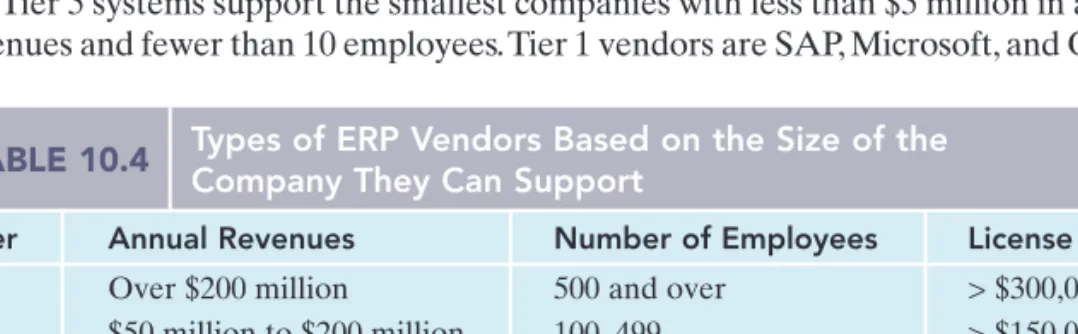
TABLE 10.4 Types of ERP Vendors Based on the Size of the Company They Can Support
Tier Annual Revenues Number of Employees License Fees
1 Over $200 million 500 and over > $300,000
2 $50 million to $200 million 100–499 > $150,000
3 $10 million to $50 million 50–99 > $50,000
4 $5 million to $10 million 10–49 > $5,000
5 Less than $5 million 1–9 > $100
Why are ERP systems worth their cost? Because decisions are only as good as the timeliness and completeness of the data on which they’re based. The more complete the data, the less the uncertainty and risk involved in the decision process. An ERP provides the integration and automation that makes timely and complete data pos- sible. So it’s not surprising that establishing a reliable pipeline of data from internal functions and external business partners is a priority for businesses in every indus- try and of all sizes.
JUSTIFYING AN ERP
Typically, ERP systems are acquired by purchasing or leasing packaged software.The purchased or leased ERP software is customized to meet the company’s need by adding modules. ERP systems include modules for manufacturing, order entry, accounts receivable and payable, general ledger, purchasing, warehousing, transporta- tion, and HR. ERPs are not built in-house or built using proprietary software because the costs and time to do so would be staggering. You read more about IS acquisition in Chapter 11.
The current major ERP vendors are the following. Note that acquisitions con- tinue to consolidate the industry.
• Oracle,oracle.com,which acquired PeopleSoft and JD Edwards
• SAP,sap.com
• SSA Global,ssaglobal.com/,which acquired BAAN
• Microsoft Dynamics,microsoft.com/dynamics/en/us/default.aspx
Vendors charge license fees based on the number of users and annual revenues, as shown in Table 10.4.Table 10.4 lists the types of ERP vendors, whose systems range from Tier 1 to Tier 5. Tier 1 ERP systems are able to support the largest global corporations—those with annual revenues over $200 million with 500 or more employ- ees. Tier 5 systems support the smallest companies with less than $5 million in annual revenues and fewer than 10 employees.Tier 1 vendors are SAP, Microsoft, and Oracle.
ACQUIRING AN ERP
These revenues and license fees for the five tiers are only general figures, and ven- dors may use their own cut-off points. In addition to the license fees, there are imple- mentation, training, and maintenance costs. The conventional wisdom is that you buy a software license, and then you buy maintenance and support separately, which usu- ally costs 20 percent of the original license cost annually. For a $1,000 software license, maintenance and support cost an additional $200 per year.
Lesser known ERP vendors tend to be less expensive and to provide more spe- cialized (customized) features than traditional ERP options. For example, complex design-to-order low-volume manufacturers are not going to want a package that sup- ports high-volume, make-to-stock manufacturing. Rather, they need a solution that handles their customized type of business very well rather than one that tries to be everything to everyone.
As the Under Armour opening case and the Humanetics case inIT at Work 10.1 illustrate, improved agility can create a competitive advantage. ERP provides the infrastructure needed for the agility for quick correction and response, which can be exploited to improve profitability, market share, or customer service.
IT at Work 10.1 w
The first step toward becoming an agile manufacturer is developing the means to monitor the marketplace— for example, changes in customer demand or competitors’ actions—and to respond to it quickly. ERP software brings all areas of the manufacturing operation into a single, real-time database where the actions of one department do not happen in isolation, but rather are known throughout other departments. As a result, all departments are aware of what’s going on within the company and capable of responding quickly to cus- tomer demands. Manufacturers that have invested in ERP to become agile are able to leverage their insights into new products and services for their current customers and prospective ones—and to counteract competitors’ attempts to steal away their customers.
While agile manufacturing is not widespread, early adopters are reaping the benefits. An example is Humanetics (humanetics.com), a Texas-based precision metal works company with four geograph- ically dispersed plants. Humanetics’ ERP system serves the following functions:
• Supports estimating and quoting processes
• Supports parts’ manufacturing, shipping, invoicing, and pay- ment collection
• Prepares financial statements
• Manages the day-to-day international movement of parts, qual- ity control, and on-time delivery
In a global economy, windows of opportunity open quickly and can close just as fast. The more agile and aware the manu- facturer, the greater the rewards from being the first responder to customer needs.
Sources: Compiled from Alexander (2009) and humanetics.com.
Discussion Questions: What competitive advantages does agility provide to a manufacturing company? Are those competitive advantages sustainable? Why or why not?
ERP Enables Agility, a Competitive Asset for Manufacturers
Managers and other decision makers tend to think that if an enterprise system works for the best companies, it will work for them, too. But that’s not true. In fact, as you read in Table 10.5, several of the best companies have suffered devastating conse- quences that led to multimillion-dollar losses, bankruptcy, or lawsuits. Most often, the ERP eventually is fixed and remains in use, which gives the false impression that the ERP was successful from the start.
The success of ERP depends on organizational and technological factors that occur prior to, during, and after the implementation. Knowing what to do and what not to do are important. Both the successes and failures teach valuable lessons, too, as you read in this section.
Be aware that reading vendor white papers and viewing Webcasts or demos may give you a biased view of the benefits of their software. You need to conduct your own research to learn the full story of an enterprise system implementation. Problems may be skipped over or ignored.While blogs and YouTube posts may be good sources of objective data, many vendors have blogs and YouTube videos that are designed to appear to be neutral, when in fact they’re not.
UNDERSTANDING ERP SUCCESS AND FAILURE FACTORS
MKT OM GLOBAL
Cases of ERP Failure. ERP implementations are complex, so it’s not surprising to learn that there have been horror stories of ERP projects gone wrong. Dell canceled an ERP system after spending two years and $200 million on its implementation.
Hershey Food Corp. brought widely publicized lawsuits against ERP software ven- dors because of their failed implementations.Table 10.5 presents Hershey’s and other cases of ERP failures. In cases of extreme failure, companies have sued their ven- dors or consulting firms because their ERP software failure made it impossible to ship product or, at the extreme, led to a shutdown of the entire business.
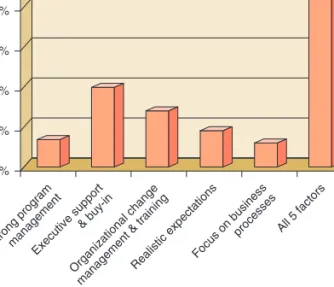
ERP Success Factors. What factors increase the likelihood of ERP success and min- imize the risk of problems? Many managers assume that success or failure depends on the software and, furthermore, that a failure is the fault of the software that’s pur- chased or licensed. In reality, 95 percent of a project’s success or failure is in the hands of the company implementing the software, not the software vendor.
The results of a 2008 survey to identify what ERP experts had found to be most important to successful ERP projects are shown in Figure 10.5.These ERP experts were given a list of five factors and asked to select only one of them as most important. The sixth alternative was all five factors.The results (which sum to 100 percent) are:
1. Strong program management: 6 percent 2. Executive support and buy-in: 19 percent
3. Organizational change management and training :13 percent 4. Realistic expectations: 8 percent
5. Focus on business processes: 5 percent 6. Interaction of all five factors: 49 percent
10.2
Enterprise Resource Planning (ERP) Systems 295TABLE 10.5 ERP Failures
Company and Industry Description of ERP Failure
Hershey Food, manufacturer Hershey’s spent three years implementing a $115 million ERP system with SAP, Siebel, of chocolates, confectionaries, inventory, and Manugistics. The ERP was to replace all legacy systems and to and beverages integrate inventory, production, order processing, payroll, accounting, and finance.
Hershey’s devastating mistake was trying to implement all systems in all departments at the same time and at its busiest time of the year.
Hershey suffered heavy losses in profits and sales, which led to an 8 percent drop in its stock price, and filed a lawsuit against the vendors.
Nike, athletic shoe and apparel Nike implemented i2’s (i2.com) demand and supply planner software, which it wanted manufacturer up and running before introducing an SAP ERP to handle all supply chain and sales
order processes.
The i2 system created duplicate orders, deleted customer orders, and deleted
manufacturing requests to Asian factories. Adding to the problems, the ERP was not designed to handle Nike’s large number of products. Many legacy systems had been left in use that lacked the ability to communicate with the supply chain software, causing huge delays and system crashes. The $400 million upgrade to Nike’s supply chain and ERP systems caused $100 million in lost sales, a drop of 20 percent in stock price, and class-action lawsuits. Nike blamed the failure on underestimating the needed resources for the i2 system and rolling out the SAP prematurely.
FoxMeyer, bankrupted; FoxMeyer’s ERP could not process the transactions needed to supply its customers formerly the fourth largest with their orders. FoxMeyer had been processing 425,000 invoice lines per day on its pharmaceuticals distributor legacy software. Its ERP was limited to 10,000 invoice lines per day. This decreased
order processing capability, quickly put the company into bankruptcy protection, and ultimately shut down the business.
Waste Management, garbage- As of mid-2009, Waste Management was embroiled in a $100 million legal battle with disposal giant SAP over an 18-month installation of its ERP software. In the lawsuit filed in March
2008, Waste Management claimed that SAP executives participated in a fraudulent sales scheme and demo that resulted in the massive failure. SAP countersued, alleging that Waste Management violated its contract agreement.
That is, 49 percent of the ERP experts have found that success depended on all five factors. Stated another way, nearly half of the experts indicated that the failure of any one of these five factors would or could cause the ERP to fail.
The following recommendations explain why ERP success depends on several key factors being done right.
1. Focus on business processes and requirements. Too often, companies get caught up in technical capabilities or platforms on which the ERP runs. But compared to business processes, none of this really matters. What matters is how managers want business operations to run and what the key business requirements are. Once man- agement and IT have defined them, they can more effectively choose the software that fits their unique business needs.
2. Focus on achieving a measurable ROI. Developing a business case to get approval from upper management or the board of directors is essential, but not suf- ficient. Establish key performance measures, set baselines and targets for those meas- ures, and then track performance after going live. The performance results are proof of how well the ERP meets the expectations that had been listed in the business case.
3. Use a strong project management approach and secure commitment of resources.
An ERP project depends on how it is managed. Responsibility for the management of the ERP implementation project cannot be transferred to vendors or consulting firms. Because of the business disruption and cost involved, ERP projects require the full-time attention and support of high-profile champions from the key functions for a long period of time, from six to twelve months on average. It’s also known that ERP projects cannot be managed by people whocan be spared. They must be managed by people who are indispensablepersonnel. Without powerful champions and the necessary budget (discussed next), expect the ERP to fail.
4. Ensure strong and continuing commitment from senior executives. Any project without support from top management will fail. No matter how well run a project is, there will be problems, such as conflicting business needs or business disruptions, that can only be resolved by someone with the power and authority to cut through the politics and personal agendas.
5. Take sufficient time to plan and prepare up front. An ERP vendor’s goal is to close the deal as fast as possible.The company needs to make sure it correctly defines its needs and what it can afford to achieve in order to intelligently evaluate and select the best vendor. Do not be rushed into a decision. Too often, companies jump right
Survey responses to the question:
What is most important to successful ERP projects?
50%
40%
30%
20%
10%
0%
Strong programmanagement Executive support
& buy-in
Organizational change management & training
Realistic expectationsFocus on business
processes All 5 factors
Figure 10.5 Experts identify what’s most important to the success of an ERP.
into a project without validating the vendor’s understanding of business requirements or its project plan.The principle of “measure twice, cut once” applies to vendor selec- tion. The more time the company spends ensuring that these things are done right at the start, the lower the risk of failure and the less time spent fixing problems later.
Filing a lawsuit against a vendor (see Table 10.5) is not a fix. Lawsuits are both expen- sive and risky, and they add nothing to the company’s performance.
6. Provide thorough training and change management. Another key principle to understand is that when you design an ERP, you redesign the organization. ERP sys- tems involve dramatic change for workers. An ERP loses value if people do not understand how to use it effectively. Investing in training, change management, and job design are crucial to the outcome of any large-scale IT project.
Why Companies Don’t Invest in ERP. One of the IT department’s most impor- tant roles is to provide and support applications that ensure that workers can access, use, and understand the data they need to perform their jobs effectively. An ERP would seem to be the perfect solution. Despite their potential benefits, not all com- panies invest in ERP, typically because they are unable to meet or overcome the fol- lowing requirements:
• Applications must be tightly aligned with well-defined and well-designed business processes, which is a standard that few enterprises are able to achieve.
• Selecting the appropriate ERP is time-consuming, complex, and expensive.
• Business processes must be modified to fit the software.
• Initial costs to purchase or lease and set up the ERP may be extremely high.
• The complexity of the applications might make it too difficult for employees to use the ERP correctly for maximum efficiency and ROI.
In addition, justifying an ERP becomes more difficult during an economic downturn.
10.3
Supply Chain Management (SCM) Systems 297Review Questions
1. Define ERP and describe its objectives.
2. Briefly describe the challenges of legacy systems that motivate the migration to ERP.
3. Describe how ERP enables agility.
4. List and briefly describe three ERP implementation success factors.
5. Describe two barriers to ERP implementation.
10.3 Supply Chain Management (SCM) Systems
The journey that a product travels, as shown in Figure 10.6, starting with raw mate- rial suppliers, then to manufacturers or assemblers, then forward to distributors and retail sales shelves, and ultimately to customers, is its supply chain.The supply chain is like a pipeline composed of multiple companies that perform any of the follow- ing functions:
• Procurement of materials
• Transformation of materials into intermediate or finished products
• Distribution of finished products to retailers or customers
• Recycling or disposal in a landfill
Supply chains vary significantly depending on the type, complexity, and perisha- bility of the product. For example, in a simplified sense, the food supply chain begins with the livestock or farm, moves to the manufacturer (processor), then through the distribution centers and wholesalers to the retailer and final customer. In IT at Work 10.2, you read how track and trace technologies are being used to improve food safety and reduce costs.
Sub-sub supplier
Sub supplier
Sub supplier
=
=
= Inventory
Money Material, products
Internal chain Upstream
Manufacturer or Assembler
Information Flow
Downstream Legend
Supplier
Customer Distributor
Customer
Supplier
Figure 10.6 Structure of a typical supply chain.
IT at Work 10.2 w
Beef patties, pet food, peanut butter, lettuce, and spinach are a few of the recent high-profile food recalls due to contamination.
Consumers worldwide are worried about the safety and source of their food. One solution is to implement track and trace technolo- gies that follow food products throughout their supply chain, prima- rily through the use of barcodes and radio frequency identification (RFID). Barcoding and RFID enable the tracking of food through the food supply chain from “farm to fork.” Without the capability to identify the scope of the contamination and contain it, the food recall is much more extensive than necessary as a safety precaution. For example, when E.coli-tainted spinach was discovered in 2007, using the barcode on a bag of bad spinach, investigators traced its origin to California’s Salinas Valley. But then they had to do an intense and expensive search for the specific grower in that valley. And during that search time, all spinach was being pulled from grocery stores, distribution plants, and processing plants and destroyed. A grow- ers’ organization estimates the recall cost the spinach industry
$74 million. It would have been much faster to track the contaminated leaves to the grower if spinach bags and containers had carried RFID tags with complete histories of the contents’ origins.
With detailed information, companies can streamline the dis- tribution chain and lower spoilage and contamination rates.
Reducing the rates of spoilage and contamination is important for reasons related to safety and costs.
Consumer product and retail industries lose about $40 billion annually, or 3.5 percent of their sales, due to supply chain inefficiencies.
In the Canadian Province of Manitoba, a full traceability network was developed connecting more than 16 supply chain partners, including beef and pork producers, animal feed ingre- dient producers, feed manufacturers, farmers, processing plants, truckers, and a retail grocery chain. Using Global Traceability Network (GTNet) software from TraceTracker, an IBM partner, the Manitoba project shows it is possible to securely and accurately collect and process data about a piece of meat from a variety of sources and share that information at any step in the process.
Track and trace technologies are also being used at Germany’s METRO Future Store (future-store.org/), where butch- ers not only cut meat but also apply RFID smart labels. Each package is identified with an RFID tag and recorded when it is placed into the refrigerated display case. All cases are equipped with RFID readers and antennas to scan the label of each prod- uct as it goes in, as it sits on the shelf, and as it goes back out with a consumer. Real-time data helps the store maintain fresh products, control the storage environment, and manage inven- tory levels.
Sources: Compiled from METRO Future Store (future-store.org, 2009), CDC.gov, IBM (ibm.com), and Weier (2007).
Discussion Questions: Where does the food supply chain start and end? What costs are reduced during a food recall if the food has RFID tags? How has barcoding and RFID improved the food supply chain? How has the Bioterrorism Act affected food SCM?
Track and Trace Technologies Lead to Safer Food and Lower Costs
IS OM GLOBAL GOV10.3
Supply Chain Management (SCM) Systems 299 Supply chains involve the flow of materials, data, and money. Descriptions of these three main flows are:1. Material or product flow: This is the movement of materials and goods from a supplier to its consumer. For example, chipmaker Intel supplies computer chips to its customer Dell. Dell supplies its computers to end users. Products that are returned make up what is called the reverse supply chain because goods are moving in the reverse direction. For any location on the supply chain, the immediate previous source is one-backand the immediate subsequent recipient is one-up.For example, in the food chain, each immediate previous supplier of food is a one-back and the immediate subsequent recipient (customer) of the food product is the one-up. For a manufacturer, raw material suppliers are one-back in the supply chain while retail- ers are one-up in that chain.
2. Information flow: This is the movement of detailed data among members of the supply chain, for example, order information, customer information, order fulfillment, delivery status, and proof-of-delivery confirmation. Most information flows are done electronically, although paper invoices or receipts are still common for noncommer- cial customers.
3. Financial flow: This is the transfer of payments and financial arrangements; for example, billing payment schedules, credit terms, and payment via electronic funds transfer (EFT). EFT provides for electronic payments and collections. It is safe, secure, efficient, and less expensive than paper check payments and collections.
Supply chain links are managed.Think of the chain in terms of its links because the entire chain is not managed as a single unit. A company can only manage the links it actually touches. That is, a company will manage only partners who are one- back and one-up because that’s the extent of what a company can manage.
MANAGING THE FLOW OF MATERIALS, DATA, AND MONEY
Order fulfillmentis the set of complex processes involved in providing customers with what they have ordered on time and all related customer services. Order fulfillment depends on the type of product/service and purchase method (online, in-store, cat- alog, etc). For example, a customer who has ordered a new appliance via the Sears.comWeb site needs to receive it as scheduled, with assembly and operating instructions as well as warranty and return information. The customer can receive a paper manual with the product or download the instructions from the Sears Web site.
In addition, if the customer is not happy with a product, an exchange or return can be arranged via the Web site.
Order fulfillment is a part of back-end (orback-office) operations,which are activ- ities that support the fulfillment of orders, such as accounting, inventory management, and shipping. It also is closely related to front-office operations, or customer- facing activities,which are activities, such as sales and advertising, that are visible to cus- tomers.The key aspects of order fulfillment are the delivery of materials or products at the right time, to the right place, and at the right cost.
Logisticsis defined by the Council of Logistics Management as “the process of planning, implementing, and controlling the efficient and effective flow and storage of goods, services, and related information from point of origin to point of consump- tion for the purpose of conforming to customer requirements” (Logisticsworld.
com). Note that this definition includes inbound, outbound, internal, and external movements and the return of materials and goods. It also includes order fulfillment.
The distinction between logistics and order fulfillment is not always clear, and the terms are sometimes used interchangeably because logistics is a large part of order fulfillment.
ORDER FULFILLMENT AND LOGISTICS
The order fulfillment process consists of the flows of orders, payments, information, materials, and parts, all of which need to be coordinated with various departments and external partners. The order fulfillment process starts when an order is received STEPS IN THE ORDER
FULFILLMENT PROCESS
and includes the following nine activities that are supported by software or may be automated:
Step 1.Make sure the customer will pay.Depending on the payment method and prior arrangements with the customer, verify that the customer can and will pay and the payment terms. This activity is done by the finance department for B2B sales or an external company, such as PayPal or a credit card issuer such as Visa for B2C sales.
Any holdup in payment may cause a shipment to be delayed, resulting in a loss of goodwill or a customer. In B2C, the customers usually prepay by credit card, but the buyer may be using a stolen card, so verification is crucial.
Step 2.Check in-stock availability and reorder as necessary.As soon as an order is received, the stock (inventory) is checked to determine the availability of the prod- uct or materials. If there’s not enough stock, the ordering system places an order, typ- ically automatically using EDI (electronic data interchange). To perform these operations, the ordering system needs to be connected to the inventory system to verify availability and to suppliers’ ordering systems. Several scenarios are possible that may involve the material management department and production department as well as outside suppliers and warehouse facilities. Most often buyers can check availability by themselves using the Web.
Step 3.Arrange shipments.When the product is available, shipment to the customer is arranged (otherwise, go to Step 5). Products can be digital or physical. If the item is physical and it’s readily available, packaging and shipment arrangements are made.
Both the packaging/shipping department and internal shippers or outside trans- porters may be involved. Digital items are usually available because their “inventory”
is not depleted. However, a digital product, such as software, may be under revision and thus unavailable for delivery at certain times. In either case, information needs to flow among several partners.
Step 4.Insurance.Sometimes the contents of a shipment need to be insured. Both the finance department and an insurance company could be involved, and, again, information needs to flow not only inside the company but also to and from the cus- tomer and insurance agent.
Step 5.Replenishment.Customized (build-to-order) orders will always trigger a need for some manufacturing or assembly operation. Similarly, if standard items are out of stock, they need to be produced or procured. Production can be done in-house or by contractors.
Step 6.In-house production.In-house production needs to be planned, and actual production needs to be scheduled. Production planning involves people, materials, components, machines, financial resources, and possibly suppliers and subcontractors.
In the case of assembly and/or manufacturing, several plant services may be needed, including collaboration with business partners. Production facilities may be in a dif- ferent country than the company’s headquarters or retailers. This may further com- plicate the flow of information.
Step 7.Use suppliers.A manufacturer may opt to buy products or subassemblies from suppliers. Similarly, if the seller is a retailer, such as in the case of Amazon.com or Walmart.com,the retailer must purchase products from its manufacturers. In this case, appropriate receiving and quality assurance of incoming materials and prod- ucts must take place.
Once production (Step 6) or purchasing from suppliers (Step 7) is completed, shipments to the customers (Step 3) are arranged.
Step 8.Contacts with customers.Sales representatives need to keep in close con- tact with customers, especially in B2B, starting with notification of orders received and ending with notification of a shipment or a change in delivery date. These con- tacts are usually done via e-mail and are frequently generated automatically.
Step 9.Returns.In some cases, customers want to exchange or return items. The movement of returns from customers back to vendors is reverse logistics.Overall,
10.3
Supply Chain Management (SCM) Systems 301Supply chain management (SCM)is the efficient management of the flows of mate- rial, data, and money in the supply chain, as shown in Figure 10.7.SCM software refers to software that supports the steps in the supply chain—manufacturing, inven- tory control, scheduling, and transportation. SCM software concentrates on improv- ing decision making, forecasting, optimization, and analysis. SCM software is configured to achieve the following business goals:
• To reduce uncertainty and variability in order to improve the accuracy of forecasting
• To increase control over the processes in order to achieve optimal inventory lev- els, cycle time, and customer service
The benefits of SCM have long been recognized in business, government, and the military. In today’s competitive business environment, efficient, effective supply chains are critical to survival and fully dependent on SCM software, which depends on up-to-date and accurate data. If the network goes down or data is outdated, those managing the supply chain are mostly working blind.
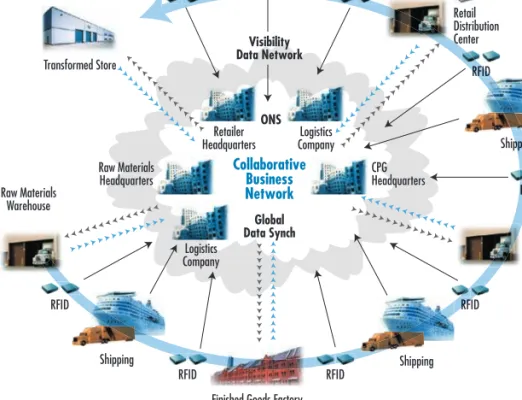
The use of RFID in the supply chain provides a major opportunity to reduce costs and increase operating efficiencies. Figure 10.8 illustrates how RFID can improve the efficiency of a supply chain by improving data quality.
SUPPLY CHAIN MANAGEMENT CONCEPTS
The current business environment contains the elements of an on-demand enterprise with real-timeoperations. To review those concepts:
• On-demand enterprise. The concept of an on-demand enterprise is based on the premise that manufacturing or service fulfillment operations will start only after an order is received. We also refer to this approach as build-to-order. Enterprises have added this approach to their traditional produce-to-stock manufacturing. As the term indicates,produce-to-stockis the manufacture of products to stockpile inventory so the company is ready to respond to future demand. An obvious example of produce-to- stock is automobile dealerships, which have huge inventories of vehicles on their lot.
MANAGING ON-DEMAND ACTIVITIES
between $50 and $100 billion in U. S. goods are returned each year. Such returns can be a major problem, especially when they occur in large volumes.
We now take a more in-depth look at supply chain management concepts.
Transformed Store
Shipping
Shipping Shipping
Finished Goods Factory
Shipping RFID
RFID
RFID
RFID RFID
RFID Raw Materials
Warehouse
Retailer
Headquarters Logistics Company
Logistics Company
CPGHeadquarters
CPGWarehouse Collaborative
Business Network Digital Supply Chain Map
Goods Movement Visibility
Visibility Data Network
ONS
Global Data Synch
Retail Distribution Center
Raw Materials Headquarters
RFID RFID
ppin
RF C
RF RFID
Figure 10.7 Managing a supply chains with RFID.
• On-demand and real-time processes. An on-demand process in the fulfillment cycle is one that is primed to respond to real-time conditions. There will be no back- orders, safety stock, lag time, or excess inventory. This principle is not fully achiev- able, but it is the direction that high-tech companies are headed in. Laptop and netbook manufacturers build-to-order as much as possible to reduce inventory, hold- ing, and obsolescence costs. Inventory holding costs can greatly add to the cost of a product and narrow the profit margin.
These on-demand concepts have revolutionized the design and management of supply chains.To achieve on-demand and real-time processes, companies must reengi- neer their supply chain and add SCM to their ERP capabilities.
The market for SCM software applications and services reached $6.68 billion in 2008, a 4 percent increase over 2007, according to AMR Research (amrresearch.com).
Leading SCM software vendors SAP and Oracle both posted significant percentage gains in 2008, with SAP up nearly 12 percent and Oracle growing by nearly 9 percent.
In 2009, growth declined because of the bad economy. In a recession, companies do not make major investments in supply chain software unless it is mission-critical.
Figure 10.8 How RFID tags provide the data needed to manage the supply chain.
Retailer using RFID
Supply chain management system recognizes need for inventory
Manufacturer's logistics software locates supplier's trucks, reads RFID tags of contents, routes trucks to production Inventory
management system sends request for more inventory
Supply chain management software also places orders for raw materials to begin production of additional products
Shipments to manufacturers Grocery
INVENTORY NEEDED
Retailer's warehouse
Warehouse sends what inventory it can
Finished goods trucks RFID at warehouse<