http://dx.doi.org/10.31506/jog.v8i4.20831
Entrepreneurial Finance Governance on SMEs: A Bibliometric Co- Authorship Analysis
Erna Maulina1*, Margo Purnomo1, Agus Taryana1, Yogi Sugiarto Maulana2, Ahmad Hadi Fauzi1, Francisco Carballo1
1Department of Business Administration, Universitas Padjadjaran
2Department of Government Science, Universitas Padjadjaran
*Correspondence Email: [email protected]
Received: 27 June 2023; Revised: 13 November 2023; Accepted: 30 November 2023
Abstract: This article aims to find out the development of the government's role in providing SME financial governance policies. The development of knowledge is seen from the relationship and direction of collaboration of affiliation, country, and relationship between authors so that the dynamics of novelty can be known. The method used is bibliometric science mapping. Data was taken from the Scopus database in several stages, namely identification, filtering (inclusion and exclusion criteria), and data finalization. We use the Analyse Results and Source menus on Scopus, Scimago Journal, and Country Rank. Cluster co-authorship calculations and their visualisations use VOSviewer software version 1.6.12. The results showed that publications on the topic of entrepreneurial finance began to appear in 1992. The United States was the country with the most publications, with an output of 92 documents out of a total of 327 documents.
The most prolific writer is Douglas Cumming, with a total of 18 articles. Based on the visualisation analysis of VOSviewer, Douglas Cumming has a strong relationship in terms of collaborative writing with Silvio Vismara, Massimo G. Colombo, and Joern Block. The results of his research found that venture capital was approached significantly by technology-based companies compared to other external sources of capital. The results of our mapping can be used to determine reference information and future research bases, both by author and by country, for the application and development of the topic of entrepreneurial finance research, especially for SMEs.
Keywords: Entrepreneurial Governance; SMEs; Co-Authorship; Scopus; VOSviewer.
How to Cite:
Maulina, E., Purnomo, M., Taryana, A., Maulana, Y. S., Fauzi, A. H., & Carballo, F. (2023).
Entrepreneurial Finance Governance on SMEs: A Bibliometric Co- Authorship Analysis.
Journal of Governance, 8(4), 517–540.
https://doi.org/http://dx.doi.org/10.31506/jog.v8i4.20831
This work is licensed under a Creative Commons Attribution-ShareAlike 4.0 International License.
Introduction
National economic development will not be separated from the existence of small and medium enterprises (SMEs), because they are the main source of employment, attract investment, and empower people (Krikunov et al. 2020).
One of the obstacles for SMEs is financial growth and managing the company's cash flow (Donati, Cinquegrana, and Sarno 2012). However, most SMEs face many obstacles in accessing external finance (Godke Veiga and McCahery 2019).
Entrepreneurs need to be able to manage their finances effectively to avoid financial distress and bankruptcy. They also need to attract and retain investors, lenders, and other stakeholders who are willing to support their ventures. Good financial management and planning can lead to greater success and profitability, while poor financial decisions can lead to failure and loss of investment. Entrepreneurial finance is critical for the success of startups and small businesses.
Various market and regulatory failures, as well as the macroeconomic environment of cheap credit that occurred in the United States, became the beginning of the global economic crisis of 2008 (Helleiner 2008). Banks and private investors in developed countries have withdrawn from entrepreneurial finance activities (Bhaird, Owen, and Freel 2019;
Wilson and Silva 2013). That's when there are many alternative sources of funding in entrepreneurial finance (World Bank Group 2019). Although the concentration of funds coming from traditional sources is still in demand, Banks provide loans of as much as 85% to MSMEs from total loan financing in developed countries (Bhaird, Owen, and Freel 2019).
After the global economic crisis in 2008, it resulted in entrepreneurial finance collusion occurring. Research
conducted by O'Dair and Owen (2019) revealed that the use of blockchain technology can increase the number of resources significantly in the music industry in Indonesia because it reduces the number of intermediaries in accessing royalty payments (O’Dair and Owen 2019). In addition, blockchain has many specific advantages, such as reducing transaction fees and facilitating micropayments (O’Dair and Owen 2019).
Other researchers surveyed financial market anomalies seen in financial behaviour (Schiliro 2013).
Innovations in financial technology increase and allow users to be more directly involved between funders and borrowers. With innovations in the field of finance, a simpler and faster process will be created for accessing finance, increased information support, data integration, and greater services to create connections between parties in the financial system (Roundy and Bayer 2019; Bhaird, Owen, and Freel 2019). This is where a new term appears in the financial sector, namely the term Fintech (Financial Technology), which is a technology company that offers financial services (Arner, Barberis, and Buckley 2015; Zalan and Toufaily 2017).
Fintech includes financing services such as crowdfunding, peer-to-peer (P2P) lending, venture capital, private equity, or other forms of financing (Arner, Barberis, and Buckley 2015; Zalan and Toufaily 2017).
With fintech, financial services are more accessible, efficient, and affordable (Ma and Liu 2017).
Based on the results of several studies mentioned above, this article provides an overview of the direction of entrepreneurial finance studies after the global crisis. This can also paint a picture of the direction of study in the future.
Previous researchers mapped future entrepreneurial finance research,
covering issues such as 1) funding gaps, 2) interactions between different types of investors, 3) accelerators, 4) creating returns on investment and the board of directors (Douglas Cumming et al. 2019).
First, research on the issue of funding gaps is needed to help understand the increasing complexity of funding and capital gaps (Douglas Cumming et al.
2019). Based on studies conducted by Cosh, Cumming, and Hughes (2009) and Lockett, Murray, and Wright (2002), it is evident that entrepreneurs face funding constraints. But empirical evidence of the extent and nature of such funding gaps is still very rare, even though the government desperately needs it to formulate policies (Cressy 2012).
Second, the issue of the interaction between various types of investors needs to be studied more deeply, for example, the combination of crowdfunding and business angels or business angels and venture capital investors. But in reality, the combination of different types of investors is very complex, given the emergence of a wide variety of investors (D. Cumming et al. 2019). For startup entrepreneurs, financing from banks and other types of debt is important (Cassar 2004; Cosh, Cumming, and Hughes 2009;
Robb and Robinson 2014; Hirsch and Walz 2019). With a larger portfolio, it will certainly provide alternative financing options but also create a space for conflict and agency costs among actors. For this reason, insight into the way and under what conditions different types of investors interact to create value and minimise problems (D Cumming et al.
2019).
Third, the accelerator programme provides financial guidance and support, starting with accessing further funding sources (Mejia and Gopal 2015; Hallen, Cohen, and Bingham 2018). Accelerator
programmes provide a more successful way out through acquisitions than business angels (Winston Smith and Hannigan 2014). However, further studies are needed to compare the performance and survivability of the company selected by the accelerator (D. Cumming et al.
2019). In addition, further analysis also requires variations in the selection process of various types of accelerators and their differences from the processes adopted by venture capital and business angels (D. Cumming et al. 2019).
Fourth, the investor will withdraw their investment if they have preliminary information or evidence about the bankruptcy of the company. More research is needed to find out how investors, such as venture capitalists, private equity firms, business angels, crowdfunding, and accelerator programmes, exit their investments (D.
Cumming et al. 2019). Having more board of directors can help attract more funds from investors, including crowdfunding investors (Ahlers et al. 2015), and also the presence of experienced private equity (PE) investors are also important (Degeorge, Martin, and Phalippou 2016), especially if it is considered to be involved in the board of the company (Jelic and Wright 2011). So future research should consider the role of the board (D.
Cumming et al. 2019).
The aforementioned presentation gives us an overview of the research topics in entrepreneurial finance. However, no one has researched collaboration between authors or between countries. Such as research on the topic of crowdfunding (Blasco-Carreras, Albort-Morant, and Ribeiro-Navarrete 2015); however, a co- authorship analysis of entrepreneurial finance does not yet exist. This is the reason why the researcher chose the topic this time. Entrepreneurial finance includes
a wide range of financial types and providers, including venture capital, private equity, private debt, trade credit, IPOs, business angel finance, crowdfunding, and other forms of finance, such as grants, funding from incubators or accelerators, and support from family and friends (Cosh, Cumming, and Hughes 2009).
The purpose of this study is to study the relationship between various entrepreneurial finance types of research that have been carried out and to provide information about the direction of collaboration, affiliates or institutions, which countries are involved, and the relationship or collaboration between authorships. The information is presented through visualizations from the VOSviewer 1.6.12 program. To achieve the objectives of this study, the following research questions (RQ) are considered:
RQ1. What are the research trends in entrepreneurial finance and distribution in each country?
RQ2. Which journals, affiliations, and authors contribute to publications on entrepreneurial finance?
RQ3. What is the pattern of the relationship between the authors (co-authorship of authors) on the topic of entrepreneurial finance, and what are the implications?
RQ4. What is the pattern of the relationship between the countries (co-authorship of countries) on the topic of entrepreneurial finance, and what are the implications?
RQ5. How is the development of entrepreneurial finance for SMEs?
We will discuss it in the findings and discussions section.
Method
The method used is bibliometric science mapping. Bibliometric analysis is a
spatial representation of how disciplines, fields, specialties, and individual documents or authors are interrelated with each other and focuses on monitoring the scientific field and limiting the research area to determine its cognitive structure and evolution (Smyrnova- Trybulska et al. 2017). Bibliometrics provides powerful information to support the development of science and research effectiveness (Smyrnova-Trybulska et al.
2018).
Science mapping is focused on finding the conceptual structure of scientific production by assessing the science map of scientific field research to determine the conceptual structure and evolution (Martínez et al. 2015). The results of this study present a visualisation of the domain of knowledge collaboration between the authors and the countries involved.
The data was taken from scopus.com (Elsevier BV, Amsterdam, Netherlands). We chose to take data from Scopus because it has the largest database of abstracts and peer-reviewed citations of scientific publications. Scopus also has more than 24,600 names of scientific publications published by more than 5,000 publishers. The search strategy is carried out in the search area: title, abstract, and keywords. The validity of the search strategy is manually tested based on the detected data. There were 298 search result documents we obtained on February 3, 2020. The data is downloaded in comma-separated value (CSV) format.
The data is from a database of publicly published scientific publications;
therefore, it is public information that does not require special permission to be processed and analyzed. The following search string is used:
TITLE-ABS-KEY (“entrepreneurial finan*”) AND (LIMIT-TO (PUBSTAGE,
“final”)) AND (LIMIT-TO (DOCTYPE, “ar”)) AND (LIMIT-TO (LANGUAGE, “English”)) AND (LIMIT-TO (SRCTYPE, “j”)) AND (EXCLUDE (PUBYEAR, 2020))
We use the Analyse Results and Source menus on Scopus, Scimago Journal, and Country Rank. Cluster co-authorship calculations and their visualisations use VOSviewer software version 1.6.12.
Network illustration using co-authorship analysis. The interpretation of map visualisation is based on three characteristics, namely the size of the circle, distance, and color. The closer the distance between the two authors, the closer the relationship between the two
authors. Furthermore, the larger the author's circle, the higher the frequency of authorship. As for colour, the same author’s colour means that it has a close link. The use of VOSviewer software for bibliometric analysis has been widely used by other researchers with the same goal, including Maulana et al. (2022), using the help of VOSviewer software to analyse the relationship between e-business and tourism. Including other research using this software to calculate and visualise authors, keywords, and co-occurrence in finding the relationship between digital technology and circular tourism (Nassanbekova and Yeshenkulova 2022).
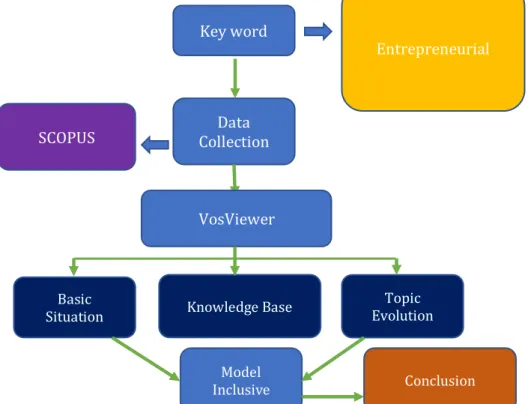
Figure 1. Research Framework
Results and Discussion
Research Trends of Entrepreneurial Finance
The earliest publications were
recorded in 1992, and since then, its annual growth has not been so great. From 2008 onwards, publications have become widespread. 2019 was the most Data
Collection Key word
Entrepreneurial
SCOPUS
VosViewer
Basic
Situation Knowledge Base Topic
Evolution Model
Inclusive Conclusion
productive year with 68 publications, followed by 2018 with 59 publications.
The total publication was 298 documents.
The annual publication can be seen in
Figure 2. Trends in the development of e- business research on tourism that we present in Figure 2.
Figure 2. Research Trends
Source: scopus.com The article that was first published
and indexed by the Scopus database is an article that discusses how Indonesia's success in credit schemes and other financial problems in business can be adopted by sub-Saharan countries in Africa (Due, Darmawan, and Syukur 1992). Interestingly, the article was written by an author from the State of Indonesia. The surge in the number of articles starting in 2016 doubled from 14 to 30 documents. The 2016 publication article that was widely cited was an article from Terjesen S., Hessels J., and Li D. that addresses systematically the comparative research of international entrepreneurship and suggests the agenda of subsequent research topics (Terjesen,
Hessels, and Li 2016). as well as an article from Vismara (2016) that discusses comparisons of worldwide regulations that have an impact on market development and investigates equity and social capital retention. The second spike occurred in 2018 twice, namely at 59 articles. The most cited articles are from the authors' Block J., Colombo M.G., Cumming D., and Vismara S., which discuss how new players are entering the entrepreneurial finance arena (Block et al.
2018).
We also found that all the published documents come from 50 countries. Based on this data, the United States is the country that publishes the most articles, with a dominant output of 92 documents
Year 2 4 2 2 3 1
1 2 0 0 0 0 0 1 1 1
0
11 10 12 11 11 8
10 14 14
20
30 30 50
40 30 60 59
68 80
70
Documents
out of a total of 327 documents, or 22%, followed by the UK with 49 documents and Germany with 39 documents. Here we present the data of the top 10 productive
countries with a total number of 327 articles that account for 78% of the total publications:
Table 1. Top Ten Countries Produced Entrepreneurial Finance Articles
No Country Country Ranks NPEF Percentage
1. United States 1 92 22
2. United Kingdom 3 49 12
3. Germany 4 39 9
4. Canada 7 32 8
5. Italy 8 27 6
6. France 6 24 6
7. China 2 20 5
8. Belgium 21 19 5
9. Netherlands 14 16 4
10. Sweden 18 9 2
Source: scopus.com In the table mentioned above, the
publication number of entrepreneurial finance (NPEF) is still dominated by European and American countries.
Although there are countries in Asia, namely China, they only contribute as much as 5 percent. This is a challenge as well as an opportunity for researchers in Indonesia to contribute their research on the topic of entrepreneurial finance.
Contributions of Journals, Affiliates, and Authors in Entrepreneurial Finance Research
We use the facilities of the Analyse search results menu on Scopus. Of the 298 documents, the most contributed were venture capital journals from the publisher Taylor & Francis, which had 33 documents. In more detail, we present the top ten contributions of journals on the topic of entrepreneurial finance, as follows:
Table 2. Top Ten Journals Produced Entrepreneurial Finance Articles
No Journal Country Document Publisher Quartile H-Index
1. Venture Capital Inggris 33 Taylor & Francis Q2 44
2. Small Business Economins Belanda 13 Kluwer
Academic Publishers
Q1 108
3. Journal of Business Venturing Belanda 12 Elsevier BV Q1 154 4. Journal of Banking and
Finance Belanda 8 Elsevier BV Q1 135
5. Entrepreneurship: Theory and
Practice 7 Wiley-Blackwell Q1 121
6. Journal of Corporate Finance Belanda 7 Elsevier BV Q1 83 7. Technological Forecasting and
Social Change Belanda 7 Elsevier BV Q1 93
8. International Journal of Entrepreneurship and Innovation
Inggris 6 Inderscience
Publishers Q3 20
9. International Journal of Entrepreneurship and Small Business
Inggris 6 Inderscience
Publishers Q2 26
10. Strategic Change Inggris 6 John Wiley and
Sons Ltd Q2 8
Source: scopus.com & scimagojr, 2020 Based on table 2, there are 6
journals out of the top 10 Q1 journals, which are based on publishers based in the Netherlands and the United States.
Publishers are dominated by Elsevier BV.
Some of the articles published in the journal Venture Capital include an article entitled "Equity crowdfunding: anything to celebrate?" written by Schwienbacher A. The article discusses equity crowdfunding in Continental Europe (Schwienbacher 2019). As well as the article on the topic of entrepreneurial finance that is most widely cited in the journal, namely an article entitled "The early-stage equity market in the USA"
written by Sohl J.E., the article provides an
overview of equity markets, business angels, and equity financing trends in the early stages of entrepreneurial activity in America (Sohl 1999). Furthermore, based on the author's affiliation, There are 160 affiliates identified by Scopus-Analyze- Affiliation. Of the 160 affiliates, we present the top 10 affiliates that are most productive in producing articles or documents on entrepreneurial finance in Table 3. We detail the table based on the affiliation, the origin of the affiliate country, the ranking of the affiliate country, and the number of publications about the entrepreneurial finance of each affiliate (NPEF).
Table 3. Top Ten Affiliates Produced Entrepreneurial Finance Articles
No Affiliate Country Country Rank NPEF
1. Università degli Studi di Bergamo Italy 3 15
2. York University United Kingdom 11 15
3. Universiteit Gent Belgium 11 14
4. Erasmus Universiteit Rotterdam Netherlands 36 9
5. SKEMA Business School France 31 8
6. University of Glasgow United Kingdom 11 7
7. University of Edinburgh United Kingdom 40 7
8. Université Côte d'Azur France 3 6
9. Adam Smith Business School United Kingdom 35 6
10. University of East Anglia United Kingdom 34 5
Source: scopus.com Based on the table, the Università
degli Studi at Bergamo and York University are affiliates of the authors who
have published the most articles.
However, when viewed from the origin of the affiliate country, the United Kingdom is
Doc
0 1 2 3 4 5 6 7 8 9 10 11 12 13 14 15 16 17 18 19 Article
the dominant country in publishing articles about entrepreneurial finance.
Although in Table 1, the United States of America is the dominant country in terms of the number of documents and articles, the United Kingdom is dominant in terms of affiliation. One of the authors who hails from the Università degli Studi di Bergamo is Silvio Vismara, whose article discusses comparisons of regulations around the world that have an impact on market development and investigates the retention of equity and social capital (S Vismara 2016). The article is also more
cited compared to other articles published in the same year.
Next, we analyse the authors who produced entrepreneurial finance articles.
There are 537 authors identified by the VOSviewer application. The data is based on the calculation of the number of authors of each document, regardless of the name contained in one or more documents. Thus, the actual number of names involved in the preparation of the document is only 156. Here are the top 10 names who wrote articles about entrepreneurial finance.
Figure 3. Top Ten Authors
Source: scopus.com Based on Figure 2, Douglas
Cumming takes first place in articles produced on the topic of entrepreneurial finance. One of Douglas Cumming's most
widely cited articles is one that talks about Australian government programmes in venture capital, private equity funds, and investments. (Douglas Cumming, 2007).
Author
Cumming, D.
Vismara, S.
Johan, S.
Schwienbacher, A.
Wright, M.
Mason, C.
Wonglimpiyarat, J.
Vanacker, T.
Block, J.
Botelho, T.
The most popular article from Douglas Cumming was in 2019 that discussed crowdfunding equity as a digital ownership model. (D. Cumming, Meoli, and Vismara, 2019). Interestingly, the article collaborated with Silvio Vismara.
We also analysed the productivity of authors based on the number of publications (number of publications in entrepreneurial finance/NPEF), total
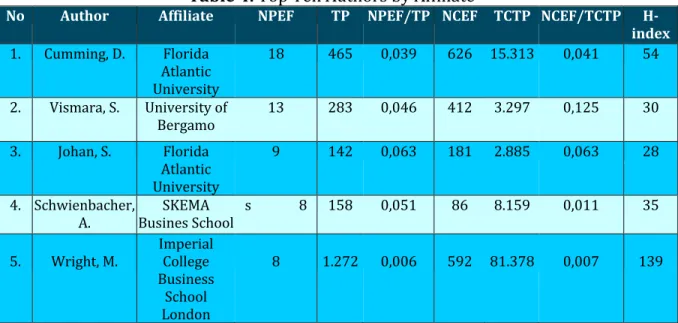
publications (total publications/TP), number of citations on entrepreneurial finance articles (number of citations in entrepreneurial finance/NCEF), total citations from total publications (total citations in total publications/TCTP), and h-index. The author with the most articles is from Florida Atlantic University, with 18 articles. For more details, you can see the following table:
Table 4. Top Ten Authors by Affiliate
No Author Affiliate NPEF TP NPEF/TP NCEF TCTP NCEF/TCTP H- index 1. Cumming, D. Florida
Atlantic University
18 465 0,039 626 15.313 0,041 54
2. Vismara, S. University of
Bergamo 13 283 0,046 412 3.297 0,125 30
3. Johan, S. Florida Atlantic University
9 142 0,063 181 2.885 0,063 28
4. Schwienbacher,
A. SKEMA
Busines School s 8 158 0,051 86 8.159 0,011 35 5. Wright, M. Imperial
College Business
School London
8 1.272 0,006 592 81.378 0,007 139
Source: scopus.com Based on the table above, Douglas
Cumming is the most productive author;
he is from Florida Atlantic University. This is interesting because, based on the data in Table 3 (Top Ten Affiliates Produced Entrepreneurial Finance Articles), they are not from Florida Atlantic University but from the University of Bergamo. This indicates that there is a collaboration among several authors that affects the relationship between the author and his affiliate. For this reason, at the next stage, we present the results of the analysis of the co-authorship of the author and the country.
Co-authorship Analysis of Cited Authors
Cooperation among researchers or authors will increase the number and quality of publications. We use the VOSviewer application to perform co- authorship analysis with the full counting method, and the unit of analysis is the authors. On the "Choose thresholds" menu, the total number of authors identified by VOSviewer is 537. We decided that the minimum number of author documents is two, the minimum number of author citations is 1, and the minimum cluster size is 1. The results of the application output inform us that the largest set connected consists of 20 items/node
(authors) of 58 items; the number of clusters is 6 clusters; links are 30 links;
and the total link strength is 54. Complete
data regarding the cluster of authors is presented in the following table:
Table 5. Cluster of Authors
Cluster Number of
Authors Name of Authors Links Total Link Strength 1
Red 4 1. Fraser S.,
2. Han L., 3. Khavul S., 4. Wright M.
2 1 1 5
2 1 1 5 2
Green 4 1. Block J.,
2. Hervé F., 3. Hornuf L.,
4. Schwienbacher A.
4 1 2 3
6 2 3 5 3
Blue 4 1. Meoli M.,
2. Rossi A., 3. Signori A., 4. Vismara S
3 2 1 6
4 3 15 2
Yellow 4 4 1. Cumming D.,
2. Johan S., 3. Li D., 4. Zhang Y.
10 2 1 2
23 8 1 5
Purple 5 3 1. Deloof M.,
2. Manigarts S., 3. Vanacker T.
4 4 3
5 6 6 6
Light blue 1 Colombo M.G. 3 5
Source: VOSviewer Based on the table, there are six
clusters in which each cluster is presented in a different colour, and each cluster consists of several authors. Cluster 1 consists of four authors, coloured red.
Cluster 2 consists of four authors, coloured reen. Cluster 3 consists of four authors, in blue. Cluster 4 consists of four authors, in yellow. Cluster 5 consists of three authors,
in yellow. Cluster 6 consists of a single author, in light blue. Each writer has a relationship with other authors, either within the same cluster or with other clusters. This linkage can be seen from the lines that connect the "nodes." The distance between the "nodes" shows the closeness of each writer. Here we present the 20 items (authors) in Figure 4.
Figure 4. Co-authorship of Cited Authors
Source: VOSviewer The output of the mapping in
Figure 4 can be interpreted to mean that there are six interrelated groups or clusters. Each cluster has the largest visualisation of the node, which means that the larger the node, the more documents the author creates. In Cluster 1 (red), the majority of documents from the authors of Wright M. Wright et al.
discussed private equity (PE) in the context of entrepreneurship and business survival (Wright et al. 2019). In addition, Wright writes about recent developments in forms of entrepreneurial finance and provides an overview for future research related to the focus on funding gaps and crowdfunding (Douglas Cumming et al.
2019). The article is a co-authorship with Cumming D, Deloof M, and Manigart S, of which Cumming D is in cluster 4 (yellow), Deloof M, and Manigart S are in cluster 5 (purple). However, when viewed from the visualisation in Figure 3, the closeness of the relationship is closer to Deloof M and
Manigart S compared to Cumming D.
Cluster 2 (green) is dominated by Schwienbacher A, which is the largest
"node" in the cluster. Schwienbacher, in one of his articles, discusses equity crowd- functioning over the last 10 years in Europe (Schwienbacher 2019).
Schwienbacher collaborated in writing articles with several other authors, including Hervé, who discussed crowdfunding and innovation in entrepreneurial companies (Hervé and Schwienbacher 2018). Schwienbacher also collaborated twice with Hornuf, one of which discussed what influences the behaviour of individual investors to enter the equity crowdfunding market in Germany (Lars Hornuf and Schwienbacher 2018), as well as articles discussing internet-based crowd-investing in Europe, especially in Germany (L Hornuf and Schwienbacher 2018). Both Hervé and Hornuf are still in cluster 2 (green).
Another collaboration with authors in
Cluster 5 (purple), namely with Vanacker, discusses the factors that encourage companies to seek equity crowdfunding (Walthoff-Borm, Schwienbacher, and Vanacker 2018). Overall, Cluster 2 discusses a lot about equity crowdfunding.
Cluster 3 (blue) is dominated by Vismara S, the cluster's largest "node."
Vismara wrote an article about the relationship between sustainability and crowdfunding in the United Kingdom (Silvio Vismara, 2019). Vismara collaborated with Cumming and Meoli, who discussed dual-class equity crowdfunding as a digital ownership model in the United Kingdom (D.
Cumming, Meoli, and Vismara 2019).
Cumming D is in cluster 4 (yellow), while Meoli M is still in cluster 3 (blue). Vismara also collaborated with the author on two other different clusters, namely Block J on Cluster 2 (green), Colombo G on Cluster 6 (light blue), and Cumming D on Cluster 4 (yellow). This article discusses the factors that explain the emergence of new players in entrepreneurial finance and categorises them into supply and demand sides (Block et al. 2018). Overall, Vismara is collaborating with three other clusters, with crowdfunding being the most dominant discussion.
Cluster 4 (yellow) is dominated by Cumming D, which is the largest "node" in the cluster and also the largest of all existing clusters. Additionally, Cumming D collaborated with authors across all clusters. The latest article co-authored with the author in the same cluster is about due diligence in crowdfunding platforms (D. J. Cumming, Johan, and Zhang 2019). In 2018, they also collaborated to produce articles discussing the design of government policy portfolios for entrepreneurial finance (D. Cumming, Johan, and Zhang 2018). Collaborating with Meoli and
Vismara on cluster 3 (blue), which discussed dual-class equity crowdfunding as a digital ownership model in the United Kingdom (D Cumming, Meoli, and Vismara 2019), co-authored with Deloof M., Manigart S., and Wright M., who are in cluster 1 (red) and cluster 5 (purple). The article discusses the latest developments in forms of entrepreneurial finance, in addition to providing an overview for future research related to the focus on funding gaps and crowdfunding (Douglas Cumming et al. 2019). We also found that Cumming D collaborated with authors in other clusters, namely Block J in Cluster 2 (green), Colombo G in Cluster 6 (light blue), and Vismara S in Cluster 3 (blue).
The article discusses the factors that explain the emergence of new players in entrepreneurial finance and classifies them into the supply side and demand side (Block et al. 2018). Overall, Cumming D is a centred writer and mostly discusses the topic of entrepreneurial finance.
Cluster 5 (purple) is dominated by Vanacker T, the cluster's largest "node."
The latest article from Vanacker T resulted from a collaboration with Deloof M. and La Rocca M. in 2019. The article discusses the development of local banking for new corporate debt financing in Italy. The results of his research show that more and more foreign banks exist in a province, causing reduced access to debt for the bank (Deloof, La Rocca, and Vanacker 2019). Another article, in collaboration with De Prijcker S., Manigart S., and Collewaert V., discusses venture capital in the states of the United States (De Prijcker et al. 2019). In addition, while still collaborating with authors in the same cluster, namely Deloof M., to produce articles that discuss the impact of the financial crisis on initial financing and survival in Belgium, the results of his research reveal that start-up companies
that depend on banks are more likely to experience financial constraints (Deloof and Vanacker 2018). Finally, in collaboration with Walthoff-Borm X. and Schwienbacher A. Schwienbacher A. is in cluster 2 (green). The collaborative article discusses the factors that drive companies to seek equity crowdfunding (Walthoff- Borm, Schwienbacher, and Vanacker 2018).
In cluster 6 (light blue), there is only 1 author, namely Colombo M.G.
Nevertheless, Colombo G collaborated with two authors from different clusters, namely Cumming D. in cluster 4 (yellow) and Vismara S. in cluster 3 (blue). The article discusses governmental venture capital (GVC), which is a form of government support for the development of the venture capital industry (Colombo, Cumming, and Vismara 2016). The second article is the result of collaboration with Block J. in Cluster 2 (green), Cumming D. in Cluster 4 (yellow), and Vismara S. in Cluster 3 (blue). This article discusses the factors that explain the emergence of new players in entrepreneurial finance and categorises them into supply and demand sides (Block et al. 2018).
In the end, based on the visualisation, we can see the amount of the pacifier and the line connecting the node.
Two nodes are the largest compared to other nodes, namely Cumming, D, and Vismara, R. Both also have lines connecting them. This means that both often collaborate and produce many articles from the collaboration. One of the articles resulting from the collaboration
between the two is an article that discusses crowdfunding equity as a digital ownership model (D. Cumming, Meoli, and Vismara 2019). However, there are still many authors who are not connected to each other, either within the cluster or between clusters. This indicates that collaboration between authors is limited to certain cluster groups.
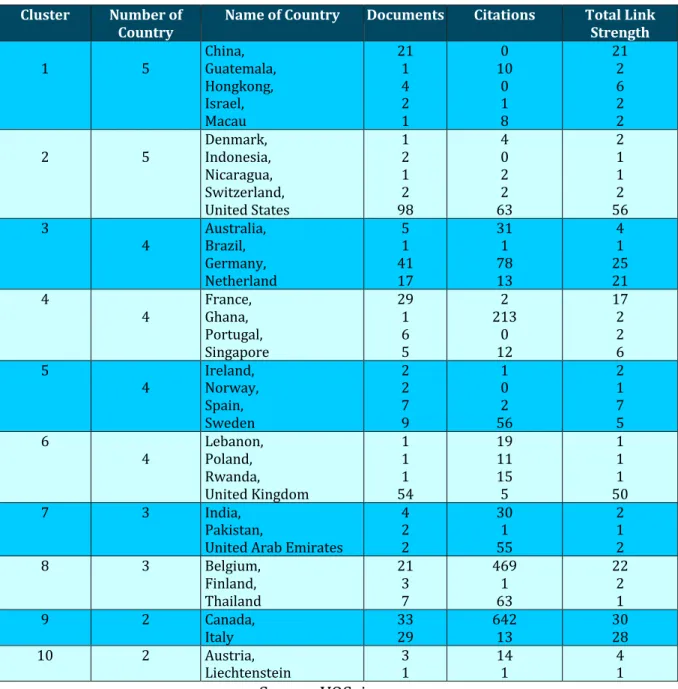
Co-authorship Analysis of Countries Co-authorship analysis of countries is important to know because it provides an overview of the collaboration of authors based on the country of origin. will provide trends in which countries contribute to entrepreneurial finance research topics. We use the VOSviewer application to perform co-authorship analysis with the full counting method, and the unit of analysis is country. The minimum number of documents for a country is 1, and the minimum number of citations for a country is 0, so 54 countries meet the threshold. Of the 54 countries detected by VOSviewer, we removed 4 lists that were not country names, namely
"CEBR," “Department of Entrepreneurship," "Management," and
"S." So, the remaining 50 countries are rightly named. With the minimum cluster size being 1, the VOSviewer output indicates that the largest set of connected items (countries) consists of 36 items (countries). The number of clusters is 10, the links are 78, and the total link strength is 149. Complete data regarding the cluster of countries is presented in the following table:
Table 6. Cluster of Countries
Cluster Number of
Country Name of Country Documents Citations Total Link Strength
1 5 China,
Guatemala, Hongkong, Israel, Macau
21 1 4 2 1
0 10 0
1 8
21 2 6 2 2
2 5 Denmark,
Indonesia, Nicaragua, Switzerland, United States
1 2 1 2 98
4 0 2 2 63
2 1 1 2 56 3
4 Australia, Brazil, Germany, Netherland
5 41 1 17
31 78 1 13
4 25 1 21 4
4 France,
Ghana, Portugal, Singapore
29 1 6 5
2 213
12 0
17 2 2 6
5 4 Ireland,
Norway, Spain, Sweden
2 2 7 9
1 0 2 56
2 1 7 5 6
4 Lebanon,
Poland, Rwanda, United Kingdom
1 1 54 1
19 11 15 5
1 1 50 1
7 3 India,
Pakistan,
United Arab Emirates
4 2 2
30 1 55
2 1 2
8 3 Belgium,
Finland, Thailand
21 3 7
469 63 1
22 2 1
9 2 Canada,
Italy 33
29 642
13 30
28
10 2 Austria,
Liechtenstein 3
1 14
1 4
1
Source: VOSviewer Based on the table, there are ten
clusters, and each cluster consists of several countries. Each country has links to other countries, either within the same cluster or with other clusters. This linkage
can be seen from the lines that connect the
"nodes." The distance between the "nodes"
shows the closeness of each country. Here we present the 36 items (countries) in Figure 5:
Figure 5. Co-authorship of Country
Source: VOSviewer In figure 5, it can be seen that the
largest node is the United States, which means that the country of origin of the author produces the most documents. The fact follows from Table 1 above. However, in Figure 6, we also analyse the linkages between countries. Although the United States and the United Kingdom are the countries of origin of the authors who produce the most articles, the two do not have a direct link or relationship, which means that there has been no collaboration between the two.
Interestingly, the Indonesian state has collaborated with the country that has produced the most articles, namely the United States. One of the results of the collaboration between these countries is an article that discusses how Indonesia's success in credit schemes and other
financial problems in business can be adopted by sub-Saharan African countries (Due, Darmawan, and Syukur, 1992). The United States has also collaborated with countries in Asia, namely China, Thailand, and Singapore. This means that the increase in the number of scientific publications to date has increased the collaboration of authors in different countries.
Entrepreneurial Finance on SMEs In this section, we examine the 298 documents we have downloaded. As a result of the inspection, we found 28 documents whose focus was on small and medium enterprises (SMEs). In addition, we found that the study on SMEs mostly discussed venture capital. We present more complete data in the following table:
Table 7. Entrepreneurial Finance on SMEs
No Authors Title Year Focus
1. Cicchiello A.F., Battaglia
F., Monferrà S. Crowdfunding tax incentives in Europe: a
comparative analysis 2019 Crowdfunding 2. Godke Veiga M.,
McCahery J.A. The Financing of Small and Medium-Sized Enterprises: An Analysis of the Financing Gap in
Brazil
2019 Privat Equity, Ventur Capital 3. Gy?ri Á., Czakó Á.,
Horzsa G. Innovation, Financial Culture, and the Social-
Economic Environment of SMEs in Hungary 2019 External financial source 4. Liu B., Cao J., Johan S.,
Leng T. The real effect of liquidity provision on entrepreneurial
financing: evidence from a natural experiment in China
2019 Venture Capital
5. Knyazeva A. Financial innovation in microcap public offerings 2019 Microcap Public Offerings 6. Junoha M.Z.B.H.J.M., bin
Hidthiirb M.H., Basheer M.F.
Entrepreneurial financial practices in Pakistan:
The role of access to finance and financial literacy 2019 Financial literacy 7. Rahman A., Zbrankova
H. Female borrowers and credit constraints in sme loan market: An analyses from the visegrad countries [Kobiety przedsi?biorcy i ograniczenia
kredytowe na
rynku kredytowym m?p: Analizy z krajów wyszehradzkich]
2019 Financing
8. van Klyton A.,
Rutabayiro-Ngoga S. SME finance and the construction of value in
Rwanda 2018 Lending
9. Yan Z., Wang K., Wang
Z.-Y., Yu J., Tsai S.-B., Li G. Agricultural internet entrepreneurs' social network behaviors and entrepreneurship
financing performance
2018 Crowdfunding
10. Wang T., Jiao H., Xu Z.,
Yang X. Entrepreneurial finance meets government investment at initial public offering: The role of
minority state ownership
2018 IPO
11. Signori A., Vismara S. M&A synergies and trends in IPOs 2018 IPO 12. Kim G. Entrepreneurial financing relationships: how does
gender matter? 2018 Financing
13. Rupeika-Apoga R.,
Saksonova S. SMEs' alternative financing: The case of Latvia 2018 Friends and Family (FF), Venture Capital
(VC) and Business Angels
(BA) 14. Panda D.K. Microfinance Spurs Microenterprise Development:
Exploration of the Latent Processes An
2016 Financing
15. Mac an Bhaird C., Vidal
J.S., Lucey B. Discouraged borrowers: Evidence for Eurozone
SMEs 2016 Bank Loan
16. Cole R., Cumming D., Li
D. Do banks or VCs spur small firm growth? 2016 Venture Capital 17. Rostamkalaei A., Freel
M. The cost of growth: small firms and the pricing of bank
loans
2016 Bank Loan
18. Takahashi H. Dynamics of bank relationships in entrepreneurial
finance 2015 Venture Capital
19. Johan S., Wu Z. Does the quality of lender-borrower relationships affect
small business access to debt? Evidence from Canada and implications in China
2014 Financing
20. Güçbilmez U. Why do some Chinese technology firms avoid
ChiNext and go public in the US? 2014 IPO 21. Mantovani G.M. Competence value emersion: A key to sound
practices in entrepreneurial finance. from 'Q' to 'T' ratios in the North-Eastern Italian experience
2014 Entrepreneurial Finance 22. Yazdanfar D. The patterns of financial bootstrapping behaviour
empirical evidence from Swedish SMEs 2011 Financial bootstrapping 23. Minola T., Giorgino M. External capital for NTBFs: The role of bank and
venture capital 2011 Venture Capital 24. Serrasqueiro Z., Nunes
P.M., Leitão J. Sources of finance for R&D investment: Empirical evidence from Portuguese SMEs using dynamic
estimators
2011 Financing
25. McPhee C., St-Onge A. Case study: Al Amana of Morocco 2009 Microfinance 26. Bozkaya A., van
Pottelsberghe de la Potterie B.
Who funds technology-based small firms?
Evidence from Belgium 2008 Business angel, Venture Capital 27. Han L. Bricks vs clicks: Entrepreneurial online banking
behaviour and relationship banking 2008 Financing 28. Harrison R.T., Mason C.,
Girling P. Financial bootstrapping and venture development
the software industry 2004 Financial bootstrapping
Source: Scopus.com Based on this data, we have
highlighted some interesting articles to discuss. One of them is an article that discusses the topic of venture capital for SMEs. Most articles discussing venture capital in SMEs are commonplace because venture capital is a financing business to enable the formation and development of new businesses in technology and/or non- technology sectors. In other words, venture capital targets the small and medium enterprises (SMEs) level. The most recent articles we found in the database are articles from the collaboration of Godke Veiga M. and McCahery J.A. The article is based on the fact that many SME actors face external financial access constraints, so they examine the potential for SMEs to seek new sources of financing from private
equity and venture capital in Brazil (Godke Veiga and McCahery 2019). However, based on mapping using the VOSviewer application, these authors are not included in the mapping because they do not meet the required minimum criteria, namely at least 2 documents (see Figure 3).
The next article is the result of the collaboration of Liu B., Cao J., Johan S., and Leng T. The article discusses the formation of the Small and Medium Enterprises Board (SME Board) in China. The formation of the SME Board is an effort to increase venture capital investment activity while also highlighting the importance of institutional factors and government policies (Liu et al. 2019). One of the authors of the article, Johan S, is the author of cluster 4 (yellow), in which Johan S is related to Cumming D in the
same cluster (see Figure 3). Cummings also contributed to the study of venture capital in SMEs. He collaborated with Cole and Li. The results of this collaboration resulted in an article that compared the effects of primary sources of entrepreneurial finance on new companies. The results of his research found that venture capital has a significant effect both economically and statistically on stimulating new companies (Cole, Cumming, and Li 2016).
Other researchers who discussed the topic of venture capital in SMEs, namely the collaboration between Minola T. and Giorgino M. The results of his research found that venture capital was approached significantly by technology- based companies compared to other external sources of capital (Minola and Giorgino 2011). Some of the results of these studies indicate that at the SME level, entrepreneurial finance is more dominant than venture capital. Although there is also discussion on crowdfunding, private equity, business angels, friends, and families (FF), which are part of the entrepreneurial study on SMEs,.
Conclusion
A comprehensive review of the bibliometric co-authorship analysis of entrepreneurial finance for SMEs has been completed. Based on the data we collected from Scopus sources using existing methods, as many as 289 articles were selected during the period between 1997 and 2023. The number of publications related to entrepreneurial finance has increased from year to year, especially in 2019. The most productive journal is Venture Capital, with 33 publications. The five journals and publishers that entered Q1 were from Dutch publishing houses, and only one Q1 journal was from United States publishers. The United States is the
most active country in publications, followed by the United Kingdom and Germany. The author with the highest number of articles is Douglas Cumming from the College of Business, Florida Atlantic University, Florida, United States.
The United States is the dominant country in terms of the number of documents, but the United Kingdom is dominant in terms of affiliation. Visualisations of the co- authorship analysis inform us that the joint authorship is still spread across several clusters; each cluster has a dominant author, among others: Wright M., Schweinbacher A., Vismara S., Cumming D., Vanacker T., and the latter is Colombo M. G.
In contrast to other external sources of financing, technology-based enterprises made a substantial effort to approach venture capital, according to the findings of his research. Further search results showed that out of 298 documents, we only found 28 that focused on SMEs and focused on the topic of venture capital.
This means that the increase in the number of scientific publications to date has not improved the quality of co- authorship entrepreneurial finance for SMEs. In general, based on a visualised analysis of co-authorship, our research can be used to determine reference information and future research bases, both by author and by country, for the application and development of the topic of entrepreneurial finance research, especially for SMEs.
Acknowledgment
The author is grateful to Universitas Padjadjaran for providing support in this research so that it can produce an article that can be a current problem.
References
Ahlers, G K C, D Cumming, C Günther, and D Schweizer. 2015. “Signaling in Equity Crowdfunding.”
Entrepreneurship: Theory and Practice 39 (4): 955–80.
https://doi.org/10.1111/etap.121 57.
Arner, D W, J Barberis, and R P Buckley.
2015. “The Evolution of Fintech: A New Post-Crisis Paradigm?” Geo. J.
Int’l L. 47 (4): 1271–1319.
Bhaird, Ciarán Mac An, Robyn Owen, and Mark Freel. 2019. “The Evolution of Entrepreneurial Finance – 10 Years after the Global Financial Crisis.”
International Journal of Entrepreneurship and Innovation
20 (4): 235–338.
https://doi.org/10.1177/1465750 319877017.
Blasco-Carreras, C, G Albort-Morant, and B Ribeiro-Navarrete. 2015.
“International Impact of Crowdsourcing as a New Topic of Interest in the Scientific Field of Entrepreneurship: Bibliometric Analysis of 2008-2015.”
Universitas: Gestão e TI 5 (2): 57–
65.
Block, J H, M G Colombo, D J Cumming, and S Vismara. 2018. “New Players in Entrepreneurial Finance and Why They Are There.” Small Business Economics 50 (2): 239–50.
https://doi.org/10.1007/s11187- 016-9826- 6.
Cassar, G. 2004. “The Financing of Business Start-Ups.” Journal of Business Venturing 19 (2): 261–83.
https://doi.org/10.1016/S0883- 9026(03)00029-6.
Cole, R, D Cumming, and D Li. 2016. “Do
Banks or VCs Spur Small Firm Growth?” Journal of International Financial Markets, Institutions and
Money 41: 60–72.
https://doi.org/10.1016/j.intfin.2 015.12.005.
Colombo, Massimo G, Douglas J Cumming, and Silvio Vismara. 2016.
“Governmental Venture Capital for Innovative Young Firms.” The Journal of Technology Transfer 41:
10–24.
Cosh, A, D Cumming, and A Hughes. 2009.
“Outside Enterpreneurial Capital.”
Economic Journal 119 (540): 1494–
1533.
https://doi.org/10.1111/j.1468- 0297.2009.02270.x.
Cressy, R. 2012. “Funding Gaps.” Oxford Handbook of Entrepreneurial Finance.
Cumming, D, M Deloof, S Manigart, and M Wright. 2019. “New Directions in Entrepreneurial Finance.” Journal of Banking and Finance 100: 252–
60.
https://doi.org/10.1016/j.jbankfin .2019.02.008.
Cumming, D J, S A Johan, and Y Zhang.
2019. “The Role of Due Diligence in Crowdfunding Platforms.” Journal of Banking and Finance 108.
https://doi.org/10.1016/j.jbankfin .2019.105661.
Cumming, D, S Johan, and Y Zhang. 2018.
“Public Policy towards Entrepreneurial Finance:
Spillovers and the Scale-up Gap.”
Oxford Review of Economic Policy
34 (4): 652–75.
https://doi.org/10.1093/oxrep/gr y012.
Cumming, D, M Meoli, and S Vismara. 2019.
“Investors’ Choices between Cash and Voting Rights: Evidence from Dual-Class Equity Crowdfunding.”
Research Policy 48 (8).
https://doi.org/10.1016/j.respol.2 019.01.014.
Cumming, Douglas. 2007. “Government Policy towards Entrepreneurial Finance: Innovation Investment Funds.” Journal of Business Venturing 22 (2): 193–235.
Cumming, Douglas, Marc Deloof, Sophie Manigart, and Mike Wright. 2019.
“New Directions in Entrepreneurial Finance.” Journal of Banking and Finance 100: 252–60.
https://doi.org/10.1016/j.jbankfin .2019.02.008.
Degeorge, F, J Martin, and L Phalippou.
2016. “On Secondary Buyouts.”
Journal of Financial Economics 120
(1): 124–45.
https://doi.org/10.1016/j.jfineco.
2015.08.007.
Deloof, M, M La Rocca, and T Vanacker.
2019. “Local Banking Development and the Use of Debt Financing by New Firms.” Entrepreneurship:
Theory and Practice 43 (6): 1250–
76.
https://doi.org/10.1177/1042258 718783486.
Deloof, M, and T Vanacker. 2018. “The Recent Financial Crisis, Start-up Financing and Survival.” Journal of Business Finance and Accounting
45 (7–8): 928–51.
https://doi.org/10.1111/jbfa.1231 9.
Donati, Cristiana, Giuseppe Cinquegrana, and Domenico Sarno. 2012. “Inside Finance Constraints on the Growth of Italian Small Medium Sized
Enterprises.” Theoretical and Practical Research in the Economic Fields, Vol. 3 (2): 59–70.
Due, Jean M, Delima Darmawan, and M Syukur. 1992. “Lessons for Africa from Indonesia’s Experience in Smallscale Entrepreneurial Finance.” African Development Review 4 (1): 47–63.
Godke Veiga, M, and J A McCahery. 2019.
“The Financing of Small and Medium-Sized Enterprises: An Analysis of the Financing Gap in Brazil.” European Business Organization Law Review 20 (4):
633–64.
https://doi.org/10.1007/s40804- 019-00167-7.
Hallen, B, S Cohen, and C Bingham. 2018.
“Do Accelerators Accelerate? If so, How? The Impact of Intensive Learning from Others on New Venture Development.” Do Accelerators Accelerate? If So How?
The Impact of Intensive Learning from Others on New Venture Development.
Helleiner, Eric. 2008. “Understanding the 2007 – 2008 Global Financial Crisis : Lessons for Scholars of International Political Economy.”
https://doi.org/10.1146/annurev- polisci-050409-112539.
Hervé, F, and A Schwienbacher. 2018.
“CROWDFUNDING AND
INNOVATION.” Journal of Economic Surveys Vol. 32 (5): 1514–30.
https://doi.org/10.1111/joes.122 74.
Hirsch, J, and U Walz. 2019. “The Financing Dynamics of Newly Founded Firms.” Journal of Banking and Finance 100: 261–72.
https://doi.org/10.1016/j.jbankfin .2018.11.009.
Hornuf, L, and A Schwienbacher. 2018.
“Internet-Based Entrepreneurial Finance: Lessons from Germany.”
California Management Review 60
(2): 150–75.
https://doi.org/10.1177/0008125 617741126.
Hornuf, Lars, and Armin Schwienbacher.
2018. “Market Mechanisms and Funding Dynamics in Equity Crowdfunding.” Journal of Corporate Finance 50: 556–74.
Jelic, R, and M Wright. 2011. “Exits, Performance, and Late Stage Private Equity: The Case of UK Management Buy-Outs.” European Financial Management 17 (3): 560–
93.
https://doi.org/10.1111/j.1468- 036X.2010.00588.x.
Krikunov, Arseniy, Ainur Uteubayeva, Berik Nazhmidenov, Ansar Kabiev, Kulyash Syzdykova, and Gulnara Baibasheva. 2020. “Investment, Organizational and Environmental Aspects of Regulation of Small and Medium Business.” Journal of Environmental Management &
Tourism 11 (7): 1841–56.
Liu, B, J Cao, S Johan, and T Leng. 2019.
“The Real Effect of Liquidity Provision on Entrepreneurial Financing: Evidence from a Natural Experiment in China.” European Journal of Finance 25 (6): 568–93.
https://doi.org/10.1080/1351847 X.2017.1307771.
Lockett, A, G Murray, and M Wright. 2002.
“Do UK Venture Capitalists Still Have a Bias against Investment in New Technology Firms.” Research
Policy 31 (6): 1009–30.
https://doi.org/10.1016/S0048- 7333(01)00174-3.
Ma, Y, and D Liu. 2017. “Introduction to the Special Issue on Crowdfunding and FinTech.” Financial Innovation, Vol.
3 (1).
https://doi.org/10.1186/s40854- 017-0058-9.
Martínez, Ma Angeles, Manuel Jesús Cobo, Manuel Herrera, and Enrique Herrera-Viedma. 2015. “Analyzing the Scientific Evolution of Social Work Using Science Mapping.”
Research on Social Work Practice 25 (2): 257–77.
Maulana, Yogi Sugiarto, Erna Maulina, Nenden Kostini, and Tetty Herawati. 2022. “Integration of Electronic Business on Tourism: A Bibliometric Network Analysis.”
Journal of Environmental Management & Tourism Vol. 13 (6):
1779–97.
Mejia, J, and A Gopal. 2015. “Now and Later? Mentorship, Investor Ties and New Venture Performance in
Entrepreneurial Seed-
Accelerators.” Paper Presented at DRUID Conference, Rome, Italy.
Minola, T, and M Giorgino. 2011. “External Capital for NTBFs: The Role of Bank and Venture Capital.” International Journal of Entrepreneurship and Innovation Management 14 (2–3):
222–47.
https://doi.org/10.1504/IJEIM.20 11.041733.
Nassanbekova, Samalgul, and Gaukhar Yeshenkulova. 2022. “Mapping Analysis of the Research Trends on Digital Technologies and Circular Economy in Tourism.” Journal of
Environmental Management &
Tourism 13 (7): 2048–57.
O’Dair, M, and R Owen. 2019. “Monetizing New Music Ventures through Blockchain: Four Possible Futures?” International Journal of Entrepreneurship and Innovation
20 (4): 263–76.
https://doi.org/10.1177/1465750 319829731.
Prijcker, S De, S Manigart, V Collewaert, and T Vanacker. 2019. “Relocation to Get Venture Capital: A Resource Dependence Perspective.”
Entrepreneurship: Theory and Practice 43 (4): 697–724.
https://doi.org/10.1177/1042258 717739003.
Robb, A