
Ana Maria Peredo, University of Victoria, [email protected] Chris Steyaert, University of St Gallen, [email protected] Yohanan Stryjan, Södertörns högskola, [email protected]. Siljan är en påminnelse om det tredje största meteoritnedslaget i vår planets historia.
Chris Steyaert and Daniel Hjorth
First, we will place the thematics of this book on entrepreneurship as social change in the light of the recent emergence of the phenomenon of social entrepreneurship and the. Third, we will comment on the first section of this book which contains the series of conceptual explorations related to the emergence of interest in social entrepreneurship.
SURPRISING THE ACADEMIC FIELD OF ENTREPRENEURSHIP?
Social entrepreneurship has had offspring in areas as diverse as healthcare (De Leeuw, 1999), the informal sector in the Third World (Morris, Pitt and Berton, 1996), ecology (Pastakia, 1998; Albrecht, 2002), non-governmental development organizations (Fowler, 2000), and various other cultural and social domains (Borzaga and Defourny, 2000; Dees, 1998). In such a scenario, it is not unlikely that scholarly reporting on social entrepreneurship could repeat the history of academic entrepreneurship literature.
THE EARTH AND (UN)GROUNDING ENTREPRENEURSHIP
Once again we could describe this liberation of entrepreneurship from its real origins as a 'deterritorialization' of entrepreneurship. However, we have also presented – especially in Part II – examples of how entrepreneurship development is being reterritorialized.
CONCEPTUALIZING SOCIAL ENTREPRENEURSHIP
In order to conceptualize social entrepreneurship, Yohanan Stryjan proposes in Chapter 2 to reframe social entrepreneurship by shifting the focus from the social goals of social enterprises to their modes of operation. In Chapter 6, Pascal Dey questions why the academic literature creates an unambiguously positive image of social entrepreneurship.
CONTEXTUALIZING SOCIAL CHANGE
A series of such stories that attempt this follow in the second part bringing different contexts of social change. Approaching this industrial circuit as one that always celebrates the 'good old days' (in the authors' words, an imprisoning curse) rather than self-reflexively developing alternative futures, the authors worry about the need for a remaking of the identity of community.
Richard Swedberg
IN THEORIE DER WIRTSCHAFTLICHEN ENTWICKLUNG: DIFFERENT TYPES OF CHANGE AND
Schumpeter writes: 'The Man of Action acts in the same decisive manner both within and outside the usual tracks of economics. Schumpeter explains: 'The entrepreneur is our Man of Action in the field of economics.
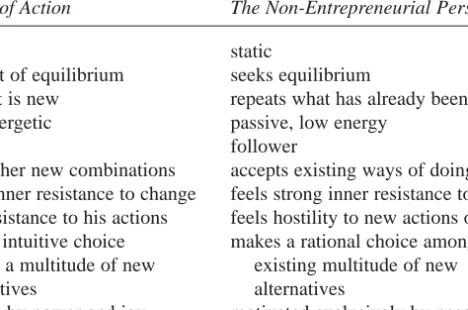
IN THEORIE DER WIRTSCHAFTLICHEN ENTWICKLUNG: CHANGE AND ENTREPRENEURSHIP IN
The average worker, says Schumpeter, “considers the entrepreneur's profits to have been robbed from him” (Schumpeter, 2003, p. 105). It constitutes, he says, “the dawn of the scientific understanding of human affairs” (Schumpeter, 2003, p. 106; emphasis added).
CONCLUDING REMARKS ON ENTREPRENEURSHIP AND SOCIAL CHANGE
It really helps us to know that the term social entrepreneurship can be translated into Schumpeterian language in this way. Finally, it is an unfortunate sign of the lack of interest in Schumpeter's work that the first and most radical version of his theory of entrepreneurship is still so little known.

REFRAMING SOCIAL ENTREPRENEURSHIP
The article is organized as follows: some initial considerations on social capital and its relation to social entrepreneurship are presented in the next section. The themes highlighted in this section are then integrated into a tentative model that reconsiders the relationship between social structure, entrepreneurship and resources, which is presented in the concluding section.
A FIRST LOOK AT SOCIAL ENTREPRENEURSHIP AND SOCIAL CAPITAL
The level of social capital in a given community is generally seen as improving economic welfare and civic governance. Entrepreneurship apparently spans the conceptual gap between the domain of social capital and the domains of economic performance and 'conventional'.
SOCIAL ENTERPRISING IN SWEDEN: SOME EXAMPLES
In accordance with the Swedish normative setup, teachers are considered part of the production infrastructure and generally receive wages. Public internship placements are a central part of the company's mission and are a source of up to 25 percent of company revenues.
OVERVIEW OF THE PRESENTED ENTERPRISES
The company is very aware of the importance of networking for all its commercial operations, and is active in the regional chamber of commerce and local business events. These property rights and collective action aspects of social enterprise will be discussed in the next section.
DISCUSSION
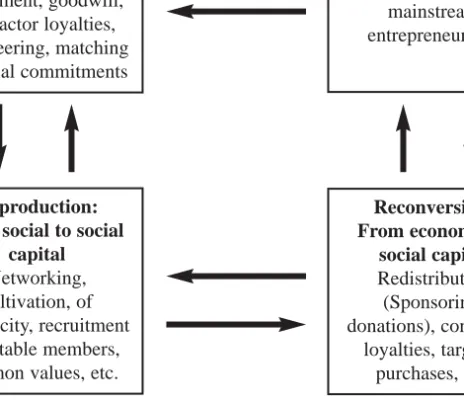
The boundaries between these company outreaches and the actual organization are often deliberately kept vague. Some of the typical modes of conversion and reproduction are shown schematically in Figure 2.1 below.
Robert B. Anderson, Benson Honig and Ana Maria Peredo
Creating and operating businesses that can compete profitably in the global economy over the long term. i) Exercise control over activities on traditional lands (ii) End dependence through economic self-sufficiency. Forming alliances and joint ventures among themselves and with non-Aboriginal partners to create businesses that can compete profitably in the global economy.
WHO ARE THE INDIGENOUS
Beyond the matter of definition is a richer characterization of the real living conditions of indigenous people. Some of these elements are echoed in the above definitions, while others extend to a fuller account of indigenous circumstances.
SOCIAL ENTREPRENEURSHIP
What makes social entrepreneurship social is that these are the intended outcomes of the activity and not just the accidental by-products. Should social goals be the only purpose of the operation, or can an intention to generate profit also be admitted.
DEVELOPMENT AND INDIGENOUS PEOPLE
Despite changes in recent years (So, 1990), some argue that the modernization and dependency perspectives offer incompatible views of the relationship between a 'developing' people/region and the 'developed' world. Recognizing the increasing flexibility of modern economic systems, regulation theory analyzes the global economy “in terms of a range of modes of development, based on combinations of the currently emerging regime of accumulation and a variety of forms of social regulation” (Hirst & Zeitlin). , 1992, pp. 84–85).
INDIGENOUS PEOPLE AND MODERN INSTITUTIONAL FORCES
The organizations of the civil sector also play an important role directly and through their influence on the state and on corporations. Indigenous groups choosing to engage with the global economy are not at the end of the process – they are at the beginning.

INDIGENOUS ENTREPRENEURSHIP VERSUS ETHNIC ENTREPRENEURSHIP
Second, indigenous entrepreneurship is often associated with the notions of community-based economic development, whereas ethnic entrepreneurship typically involves business development at the individual or family level. These differences certainly do not imply that the study of indigenous entrepreneurship stands in isolation from the study of ethnic enterprise, or even from the general field of entrepreneurship.
INDIGENOUS ENTREPRENEURSHIP AND SOCIAL ENTREPRENEURSHIP
In the Canadian and Andean contexts, this is certainly social entrepreneurship from the indigenous community, as opposed to exogenous. Rather, it provides a source of theoretical and empirical analyzes of social entrepreneurship relevant to the development of generalizable theory applicable to many settings, including, but by no means exclusive to, indigenous communities.
HIGH-PROFILE SOCIAL ENTREPRENEURSHIP (HPSE)
Gregory Dees (Duke University) has published extensively on this topic, as has Jed Emerson (who helped establish the Roberts Enterprise Development Fund [REDF] – George R. Roberts is of Kohlberg, Kravis and Roberts, one of the best-known private equity firms in the US). It appeals to large-scale ambition and heroism (Collins, 1998, pp. 36-38 describes the figure of the 'hero manager').
TOWARDS A MORE COMPREHENSIVE VIEW
INTRODUCING THREE CASES
The Homelessness Industry
One part of the document represents an attempt to identify the key players and events in the field of homelessness dating back to the late 1970s and early 1980s - which virtually every source I consulted, with the exception of one that took a historical approach (Hopper, 1990) ), identified as the beginning of what some sources have explicitly called and very implicitly related to it as 'the homeless industry'. A notable point in the campaign was that "federal agencies have taken the position that no significant number of homeless people are being denied access to these benefits, so the Congressional Budget Office has estimated the cost of these measures to be zero."
Jane Addams and Hull House
Following the model of Toynbee Hall, she wanted Hull House to be 'flexible and able to respond to the needs of neighbors as they arose' (Polikoff, 1999, p. 69). Addams identified herself with this movement and was considered by others to be a leader of this movement (Polikoff, 1999, p. 92).
Academic Entrepreneurship
Donham's responses to this challenge included hiring a historian, purchasing documents from the Medici family, inviting Alfred North Whitehead to lecture at HBS, and recruiting Whitehead's son to join to join Mayo's research agenda at HBS. Unable to secure funding from Harvard's president, Donham formed alliances with CEOs, mainly to hire Mayo and fund Mayo's research at Western Electric.
SYNTHESIZING THE CASES: OPPORTUNITIES FOR SE
She felt shame that her education had 'immunized' her against 'the automatic response to the human appeal'. As Ackroyd notes, this is a matter of linkage within the academic community as well as to 'the community more generally conceived' (Ackroyd, 1993, p. 113).
Daniel Hjorth and Björn Bjerke
INTRODUCTION
To contextualize our use of “public,” we need to relate it to “the social,” to. The social is now becoming an epiphenomenon of the market, and is therefore presented as populated by consumers.

THE PROBLEMS OF UNDERSTANDING PUBLIC ENTREPRENEURSHIP
The genealogy of the social also includes the kind of positivity it has acquired through the role statistics plays in the service of the state. In the welfare version of the social, the state tried to operate through the economy and the 'social' to secure society.
CASES OF PUBLIC ENTREPRENEURSHIP
This process is driven by Monika, who lives nearby and loves the place. The project aims to systematically identify and exploit gardening knowledge already developed in the area.
ANALYSIS: OPENINGS FOR AN OTHER DISCOURSE
Social entrepreneurship' is successfully used today in an increasingly influential discourse on how to 'fix' the problems of dwindling 'prosperity'. This allowed us to problematize the "social" as a historically situated construct of political potential used to demonstrate the problems of unequal distribution of power and poverty.
PUBLIC ENTREPRENEURSHIP: IN CONCLUSION
By making room for 'public entrepreneurship' we have created an opening to a new discourse on entrepreneurship as a society-creating force. In this way we have identified the missing people on the agenda of policy makers: the public entrepreneurs.
Pascal Dey
For present purposes, I identify rhetoric strongly with Derrida's (1976) deconstructive effort, in that rhetorical analysis inevitably entails a sensitivity to the indeterminacy of the sign “social entrepreneurship.” The final part of this chapter is therefore devoted to making suggestions for the future research agenda of social entrepreneurship.
RE-READING SOCIAL ENTREPRENEURSHIP TEXTS
Importantly, the ideological implications of this imagery stem from the conflation of social entrepreneurship and the mainstream economy. By invoking 'temperament' it is implied that social entrepreneurship is only considered possible through the possession of certain innate abilities.
LOOMING STALEMATE?
However, this cannot be a question of making exhaustive and definitive suggestions to advance the field of social entrepreneurship. Third, I will applaud a paralogical basis of social entrepreneurship through the use of writing styles hitherto unknown in scholarly representation.
Denise Fletcher and Tony Watson
Thus, we take an interpretive sociological standpoint in which we emphasize the subjectivity that plays its part in the emergent entrepreneurial and life-changing processes with which we engage (Fletcher and Watson, 2006). In this chapter, we are concerned with the entrepreneurial processes and changing life orientations that emerged as part of the social changes that took place in English rural communities between 1984 and 2004.
COUNTERURBANISATION AND THE TRANSFER OF AGRICULTURAL PROPERTIES TO URBAN–RURAL
As reported in other studies of rural change in the UK (Fuller, 1990; Evans and Ilbery, 1992), these processes of social change in the Kerston district took place in three phases. The third phase, in the late 1980s and in the 1990s, sees the appearance of the entrepreneur-developer.
FROM ‘MOTIVES AND DRIVERS’ TO ‘EMERGENT LIFE ORIENTATIONS AND MEANINGS’ IN SOCIAL CHANGE
Later work using the work orientation approach refined it considerably, especially by moving away from Goldthorpe and Lockwood's (1968) emphasis on 'prior orientations' and taking full account of the way people's orientations change with their circumstances change (Beynon and Blackburn, 1972; Watson, 1977; Watson, 2003). The link between people's work and their wider lives needs further exploration (Watson, 2003).
ENTREPRENEURSHIP, LIFE ORIENTATIONS AND
BECOMING OTHERWISE’
We now turn to the 'social becoming' of the key property developing entrepreneur in the Kerston district: looking at how his own shifting life orientation or 'other becoming' brought him both into the rural location and into entrepreneurial property development . . The key concepts we use to address this question are those of life orientations and entrepreneurship as a process that represents the interconnected 'othering' of the entrepreneur and the.

EDDIE NEWHALL: RURAL SHIFTER AND PROPERTY ENTREPRENEUR
In our terms, this is where Eddie 'becomes different' as he now undertakes the building work 'at my own expense, as you might say - doing the job at the weekend with some of the guys I brought into it'. Although it was a matter of what we would call 'becoming different' in a domestic and non-work identity sense (having a 'dream house' for the family and space to keep and train horses), this was by no means the whole story : 'It wasn't just a move to live.
SYLVIE NEWHALL: URBAN–RURAL SHIFTER AND PR-ENTREPRENEUR
In forming the business idea, she then refers to Eddie who suggested the niche of 'specialised PR for the construction industry' where there was something of an unmet need. What this implies is that social mobility as well as geographical mobility is an important factor in the 'differentiation' of Eddie's customers.
JANE AND TOM FORD: RURAL–URBAN SHIFTERS AND ENTREPRENEUR-DEVELOPER CLIENTS
Yeah, but we wouldn't even be here if it wasn't for my job. And didn't he connect us with those people in the church who helped us with.
CONCLUSIONS: THE ENTREPRENEURIAL
Newark makes sense for my business because it's only 1 hour 30 minutes by train to London. It's just that for my business to really take off, I need to be in a city now.
FACILITATION OF RURAL SOCIAL CHANGE AND THE RURAL SOCIAL CHANGE FACILITATION OF
It really is an up and coming city, quite cosmopolitan with lots of bistros and leisure activities. But there is simply no leeway within the construction industry to make a lot of money.
ENTREPRENEURSHIP
In focusing our analysis on the Kerston district in the East Midlands, we have described three families who. They also influenced the development of the physical infrastructure of rural villages (new asphalt roads and the introduction of broadband technology).
Kathryn Campbell
REGAINING AN ENTREPRENEURIAL RELATIONSHIP WITH MOTHER EARTH
ARCHETYPAL ENTREPRENEURIAL ACTIVITIES FOR SPECIES SURVIVAL
However, land is also power and while millions of women around the world toil to feed themselves and their children, they are prevented from owning the means of production. Other women have written about 'an ethic of care' (Gilligan, 1982) and 'ecological humility' (Primavesi, 1994, p. 190) and the entrepreneurial experiences of women living in harmony with the land have much to teach us. learn about who we can become.
ABOUT TELLING A DIFFERENT ENTREPRENEURIAL STORY DIFFERENTLY
I read somewhere that 'with a garden there is always hope' and I think that says it all for me. Of course, the women in this study did not speak to each other, but I believe that each of them speaks as if they were part of a 'jam session' and that their words are best understood as part of a 'shared text'.
NURTURING THE BODY THROUGH ‘PRUDENT SUBSISTENCE’ IN THE INFORMAL ECONOMY OF
It's better to be patient and slowly reach your goals." She strategizes about improvements to her garden - "I want my business to be bigger and also offer more products" - and her semausu - "I would like to make homemade jams from those fruits." I would rather renovate my hut.' She continues in the traditional nomadic lifestyle, traveling from her garden to the fields to plow in January and February and back again in June for harvest.
NURTURING AN ECOLOGICAL MIND IN THE BACKWOODS OF ONTARIO – THE STORY OF
Consistently cheerful in the face of severe hardship, she seemed to draw strength and an indefatigable joie de vivre from the land. In 1852 she protested to the editor of the Genesee Farmer that in the rush to clear land, maintain greenhouses and grow annuals for gardens, native forest plants were disappearing' (Gray, 1999, p. 290) thus qualifying her as Canada's foremost ecofeminist. .
WOMEN GARDENERS AND BUSINESS OF BUILDING COMMUNITY – ‘ANNE’S PERENNIALS’
Never gloomy, she is quick to joke that, instead of her ideal death, she would "probably drop dead in the lathe house and one of my customers will come in and find me and come to the house [screaming], 'Anne is dead in there .' Then she laughed as only Anne can. Although she did not engage in philosophical reflection, she thoughtfully reversed the causality of my question: “Are people who garden happy people?” She looked at me rather warily and after a long pause said, “That's a really loaded question, because I think you are happy when you are in the garden, I think a garden is a place where you can get away from it all.'
READING THESE STORIES AS ‘SHARED TEXT’
Later, in a moment that reflects her Scottish background, she speaks of dying 'by fire'. Affectionately spoken of within the gardening community, Anne does not have a presence in the local business community.
WE NEED MORE STORIES ABOUT ENTREPRENEURIAL, SELF-CREATING WOMEN
They document projects from around the world and compile a dossier of principles to guide a self-sustaining economy that respects and supports the individual and puts the health of the human community above profit. With a substantial portion of the world's population engaged in subsistence work, researchers have a responsibility to shape the theory and practice of entrepreneurship.