
The essence of the new competitive landscape remains the dominant influence on business success in the twenty-first century. In addition, top executives play a key role in the development and implementation of corporate strategy (Finkelstein and Hambrick, 1996).
Strategic Leadership and Growth
Similarly, Barkema and Chvyrkov argue in their chapter that the top management team is critical in internationally diversified companies. As we have explained and as Barkema and Chvyrkov show, top managers are important in internationally diversified companies.
Conclusions
These authors suggest that if one considers entrepreneurship as the creation of new economic activity. For example, growth in existing economic activity (eg, through the acquisition of other firms or increased sales of current product lines) is not entrepreneurship.
2001.Entrepreneurship in the large corporation: A longitudinal study of how established firms create breakthrough inventions.Strategic Management Journal, (22) (special issue): in press. 2001. Internal capabilities, external networks and performance: A study of technology-based firms. Strategic Management Journal, (22) (special issue): 615 40.
Entrepreneurship and Strategic Management
CHAPTER TWO. The Entrepreneurship-Strategic Management Interface
The creative aspect of entrepreneurship is a necessary precursor to the performance-oriented process of strategic management. If we take intersectional conversations to the extreme, integration means the need to bring the fields of entrepreneurship and strategic management closer together.
Entrepreneurship as a Field of Academic Inquiry
We'll start with a history of the entrepreneurship field and discuss the problems the field faces in developing one. Morris (1998) proposed an interesting input-output process model for entrepreneurship that incorporates much of the literature to date in this area.
The Intersection of Entrepreneurship and Strategic Management
In this sense, entrepreneurship is seen simply as a subordinate component of strategic management – it does not necessarily intersect. Sandberg (1992) argued that the "point of contact" between the fields of entrepreneurship and strategic management is corporate entrepreneurship.
Driving Forces of Integration
Addressing his review of entrepreneurship journals and the "excessive preoccupation" with performance, Venkataraman argues "the discriminating issues in these studies, or what makes them purportedly qualify as entrepreneurship research, is that the questions are raised at the level of startups, small businesses, or corporate enterprise initiatives" (1994: 3). We call this space, which will be discussed in the next section, the Entrepreneurship-Strategic Management Interface.
The Entrepreneurship-Strategic Management Interface (ESMI)
However, more than 95 percent of all empirical research on strategic management represents less than 1 percent of the total population (Dennis, 1997; Aldrich, 1999). Clearly, each field can benefit the other, and given the maturity of the field of strategic management, strategy researchers who connect with entrepreneurship could greatly contribute to the advancement and legitimacy of the field of entrepreneurship.
Conclusion: the New Mindset
Because this chapter focuses on the interface between entrepreneurship and strategic management research, hoping to convince those in each field that integration is unnecessary, we selected the top discipline-specific journal in each field to build our interface argument. 1990. New Venture Strategies: An Empirical Study of Eight 'Archetypes' of New Entry Competitive Strategy.Strategic Management Journal.
CHAPTER THREE. Discovery and Coordination in Strategic Management and Entrepreneurship
1996. Governance, ownership, and corporate entrepreneurship: the moderating impact of technological opportunities in industry. Academy of Management Journal.
Strategic Management at the Mature Phase of the Research Life Cycle
These two tasks, called "administrative management" and "enterprise management" respectively, for good historical and economic reasons, were merged for the duration of the twentieth century. A close review of strategic management research suggests that many of the most important achievements for both theory and practice have been in administrative management.
Entrepreneurial and Administrative Management
In order to develop the field of business management, this chapter examines and critiques some (but not all) of the existing research in light of potential limitations created by the history of the field of strategic management. The purpose was to monitor the performance of operational departments; verification of the use of allocated funds; and redefine departmental product lines as needed to continue to effectively use the company's organizational capabilities.
Separating entrepreneurial from administrative management
It is important to note that much of the IT investment is not transaction specific (Clemons, 1993). It should also be noted that much of the progress in strategic management has primarily been progress in administrative management in terms of efficiency and value creation.
Administrative management as a solved problem
This logic was further reinforced by explicit prescriptions about how to "fit" the parts of the organization to the strategy (Porter, 1985). And such strategies, based on economics, were "guaranteed" to be profitable - the low-cost producer or differentiator always is.
Entrepreneurial Management as Discovering Tomorrow's Businesses
The alternative strategy for moving the boat quickly down the river is for the boat captain to identify a fast moving current. In that case it was appropriate for them to be educated in Administrative Management since the main issue was "control". The main strategic issue was to ensure that the decisions made were implemented within the company.
Topics of Entrepreneurial Management
Knowledge management assumes the knowledge is there - the entrepreneurial management approach assumes it is not. The resource-based view of the enterprise (RBV) argued that the enterprise is best viewed as a bundle of resources or factors of production that management must systematically employ to add value (Barney, 1991; Wernerfelt, 1984).
Future Directions
More generally, all the older insights from planning also extend to new venture formation and enterprise management. It was a work of business history (Chandler's Strategy and Structure) that largely began the strategic management discipline; perhaps some other work could promote entrepreneurship.
Conclusion
4 Current research in economics goes beyond this limitation, but the topics and skills likely to be available to most strategic management researchers and doctoral students are largely static. 1995. Knowledge acquisition, transfer, and depreciation in service organizations: Productivity in franchises. The science of management.
CHAPTER FOUR. A Framework for Entrepreneurial Strategy
For each model, we will identify potential strategies of entrepreneurial firms that are consistent with the model. Next, we will examine some empirical research that fits the model and points to potential areas of fruitful research.
Four Cornerstones of Competitive Advantage
Our use of the term resource is related to the way resources are conceptualized in the resource-based view of the firm, but there is an important difference. The resource-based view of rents, in contrast, is a concept that applies only in equilibrium.
Models from Organizational Theory
In the entrepreneurship literature, the industry is not a static model of the environment; it is an emergent construct. Finally, ex post restrictions on competition can be secured, in some cases through actions at the institutional level.
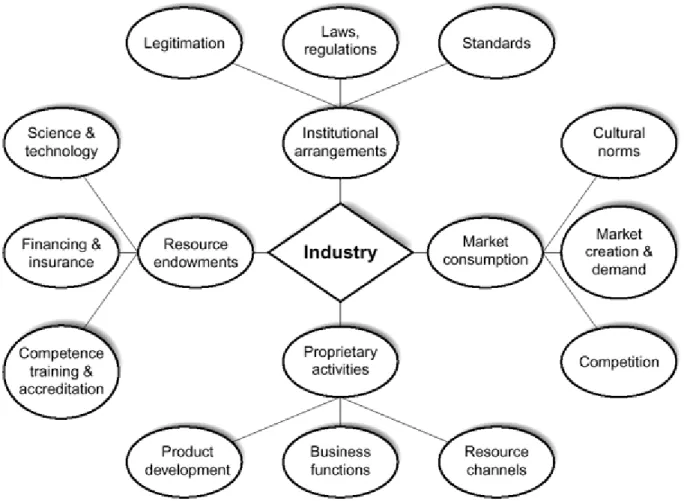
Discussion
At the same time, the emergence of industry is an unusual context in the study of strategy. 1982. Uncertain imitability: An analysis of interfirm differences in efficiency under competition. The Bell Journal of Economics.
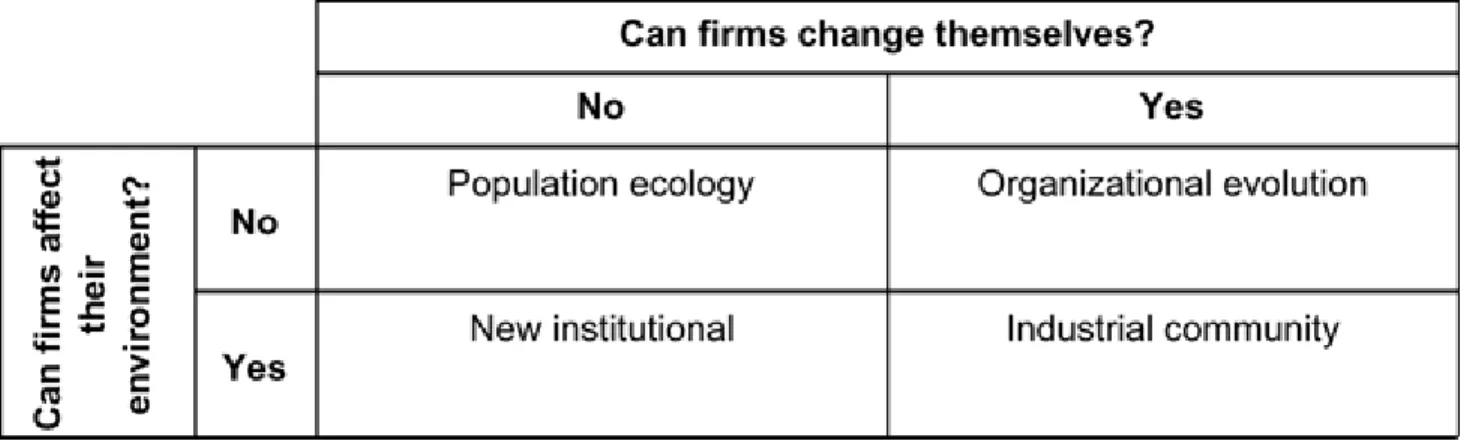
Entrepreneurial Resources
1989. A Framework for Understanding the Emergence of New Industries. Research on Technological Innovation, Management and Policy. 1993. Innovation and industry development: The case of cochlear implants. Research on Technical Innovation, Management and Policy.
CHAPTER FIVE. Resource-Based Theory and the Entrepreneurial Firm
Currently, resource-based theory lacks the insights provided by creativity and the entrepreneurial act (Barney, 2001). Indeed, resource-based theory may be the unifying theory that the field of entrepreneurship has lacked.
Resource Heterogeneity
Kirzner (1973) distinguishes between entrepreneurial knowledge and the knowledge expert, suggesting that it is the entrepreneur who hires the latter. The knowledge expert therefore has specialized knowledge and the entrepreneur has a breadth of knowledge. It is through the business that the two types of knowledge are combined to create wealth.
Ex Post Limits to Competition
The entrepreneur may not have the specialized knowledge of the expert (such as technology expertise), but it is the entrepreneur who recognizes the value and opportunity of specialized knowledge. Therefore, entrepreneurial firms create wealth because their competitors are ignorant of the cause of the entrepreneurial firm's.
Imperfect Factor Mobility
These insights may suggest that there is a point where path-dependent resources impede the entrepreneurial process. If resources are exploited through the entrepreneurial activity of recombining those resources, then entrepreneurship is path dependent.
Ex Ante Limits to Competition
Previous understanding of the RBV suggests that entrepreneurship can occur in large firms as they transform inputs into heterogeneous outputs. The resource-based theory contributes to entrepreneurship theory, an understanding of the importance of the firm in the entrepreneurial action of transforming inputs into.
CHAPTER SIX. Overcoming Resource Disadvantages in Entrepreneurial Firms: When Less Is More
Introduction
Traditional research on the resource-based view of strategy has generally ignored the wide range of human choices and behaviors involved in identifying, utilizing and creating resources. Accordingly, I focus on the entrepreneurial process and examine this process from the perspective of the resource-based view of strategy.
The Resource-Based View of Strategy
The discussion in this section builds on the previous discussion of the entrepreneurial process to consider how resource allocations can impair this process. However, a comparison of the first and second best use of the resource does not identify a path to value destruction: the best use of the resource is by definition better than the second best use and quasi-interest emphasizes the value created by the presence of a second scarce resource.
The Entrepreneurial Process
Qualifies the business model and strategy that the entrepreneur develops to exploit the business opportunity as fixed resources. Therefore, I suggest that the business model and strategy should not be seen as inputs, and therefore cannot be considered as fixed resources.
Marginal Effects of Firm Resources on the Entrepreneurial Process
In the case of a resource-rich company, compound options can create value for the company's resource portfolio. Can the collection of entrepreneurial firms shown in Figure 6.1b do. experience the benefits of joint control of an options portfolio, without joint ownership of options.
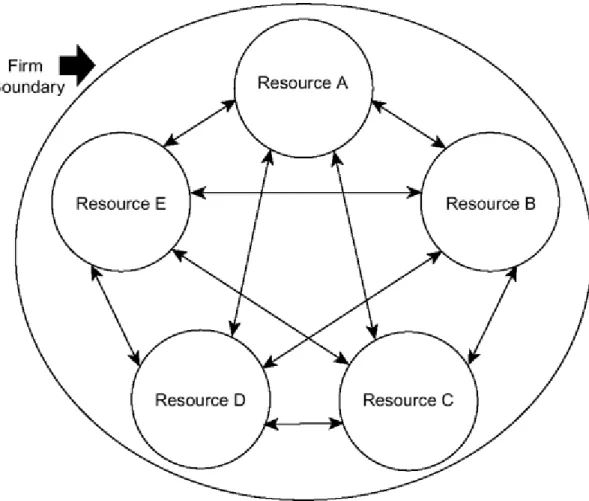
Concluding Discussion
It is this approach that I advocate for future research in the resource-based strategy view. 3Conner (1991) notes that the concept of the firm as a combiner of inputs is central to the resource-based view of strategy.
Innovation
The creative act is not an act of creation in the Old Testament sense. Regarding the market process, we claim that entrepreneurial actions constitute the key element of the competitive market process, where equilibrating actions generate and disseminate new knowledge in the market, while disequilibrating actions disrupt the tendency toward equilibrium by calling into question the means-ends relationship that previously existed. was previously taken for granted.
Variations in Market and Resource Knowledge as a Source of Opportunity
Market participants are unaware of the real opportunities for beneficial exchanges available to them in the market. The bold claim that non-equilibrium actions create additional knowledge problems in the market deserves further explanation.
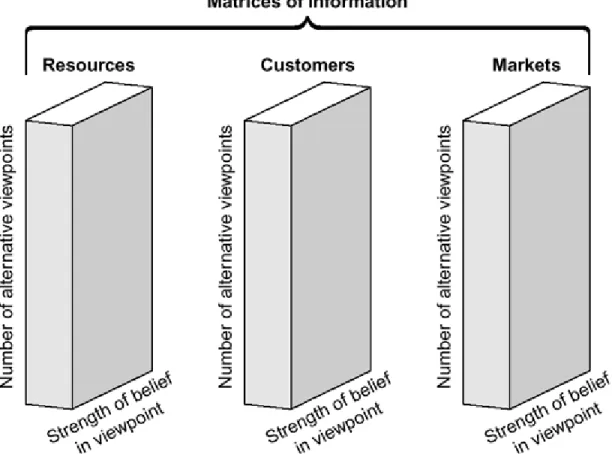
Predicting Variation in Entrepreneurial Action
Stimulus
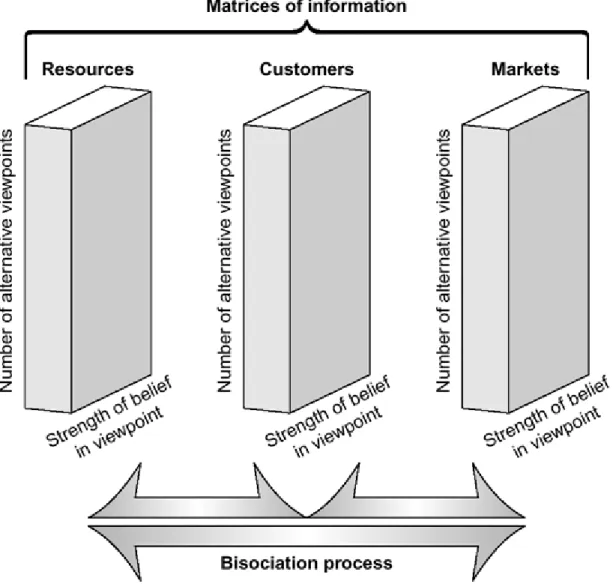
We have argued that entrepreneurial action flows directly from the entrepreneur's bisociative thought process, which in turn depends on the existence of a venture. We argue that the novelty of an entrepreneurial action arises from the nature of the information that is analyzed and integrated into the entrepreneur's bisociative thought process.
Discussion and Conclusion
In the case of balancing actions, the resolution of the knowledge problem will be signaled by a momentary consensus judgment among market participants about the appropriateness of the action, and such action will reduce confusion about the potential set of opportunities available. In this chapter we have attempted to provide a more complete understanding of the role of entrepreneurial action.
CHAPTER EIGHT. Market Uncertainty and Learning Distance in Corporate Entrepreneurship Entry Mode
These sources of entrepreneurial entry can be viewed as internal or external to the established firm. Externally, firms can pursue entrepreneurial activities through cooperative strategy (e.g., strategic alliances) and acquisitions (Gulati, 1999; Hitt et al., 2000; Hitt, Hoskisson, and Johnson, 1996).
The Challenges of Corporate Entrepreneurship
The receptivity of a new invention or innovation once it is released to the market is extremely difficult to predict. The market environment can be very turbulent regarding the acceptance and implementation of entrepreneurial efforts.
Strategic Approaches to Entrepreneurial Entry
Organizationally, we argue here that an internal business should generally be set apart from the rest of the business. Again, this is especially relevant when there is a large learning gap between the capabilities sought in the acquisition and the acquiring firm's current capabilities.
Implications and Conclusion
Future research on corporate entrepreneurship should pay attention to the implications presented by our framework. 1999. Towards a reconciliation of definitional issues in the field of corporate entrepreneurship. Entrepreneurship: theory and practice.
A Knowledge-Based View of Corporate Entrepreneurship
It is driven either by perceived gaps in the knowledge base of the firm or by an emerging strategic intent (Hamel and Prahalad, 1989) of senior management to a. The difference is in the emphasis or priority of the knowledge management tasks to the CE strategy.

Knowledge Management Designs that Implement CE Strategies
One detailed example of the creation of a new firm that is completely unrelated to the firm's existing knowledge is provided by Sykes (1986) in his analysis. As an example of the number of new firms in such an incubator, Hansen et al.
Discussion and Conclusions
1996.Predicted change in operating synergy and performance after acquisition of acquired companies.Strategic Management Journal. 1999. Linking Corporate Entrepreneurship to Strategy, Structure, and Process: Suggested Research Directions. Entrepreneurship theory and practice.