At the Intersection of Science and Faith:
Epistemic Cognition about “Religiously-Loaded”
Scientifijic Issues
Anindito Aditomo
Abstract
Science and religion represent important facets of human experience. Yet, they are re- lated in complex and sometimes conflicting ways. The present study examines how re- ligious people think about the science-religion relations by focusing on their epistemic cognition, i.e. thoughts about the nature and justifijication of knowledge when making sense of competing claims to truth. The study’s main question was whether people express diffferent beliefs with regards to “religiously-neutral” vs. “religiously-loaded” is- sues in the social-psychological and biological domains. The religiously-neutral issues explored were (a) motivation and work performance, and (b) sugar as the cause of obesity; while the religiously-loaded issues were (c) homosexuality as a disorder, and (d) human evolution. On each of the four issues, undergraduate students from Islamic and Christian backgrounds (N = 317; mean age = 21.4 years; 74.1% female) were asked to express their epistemic beliefs along the three dimensions: (1) ontology, i.e. whether there is a single, objective truth (ontology); (2) fallibility, i.e. whether knowledge of the issue could be wrong; and (3) decidability, i.e. whether there are rational ways to decide on truth. The fijindings show when thinking about religiously-loaded scientifijic issues such as homosexuality and evolution, people tend to believe that there is a single ob- jective truth, that their own beliefs are infallible, and that there is no rational method to evaluate knowledge claims. This thinking pattern may be one reason underpinning the difffijiculty of learning about science concepts which are seen to contradict religious doctrine. Some implications for science education are also entered into the discussion.
Keywords
epistemological belief – religious belief – science education – evolution – homosexuality
Conflicts between science and religion present unique challenges for indi- viduals who wish to maintain a religious identity in the modern world (Roth, 2010).1 Can faith in religion be reconciled with a belief in science? Can a person embrace the scientifijic worldview, while preserving his/her religious faith?
Such questions can be answered in the afffijirmative, and with relative ease, if only science and religion occupy distinct domains with clear demarcations.
In this view, science reigns over explanation and manipulation of the natu- ral world, while religion has authority over moral values and transcendental truths. By occupying separate domains, the two can further be imagined as being complementary: science is tasked with developing new knowledge and technologies, while religion is consulted upon the ethical applications of those products of science. Thus, in education systems teaching both science and reli- gion, the two can unproblematically be taught as separate subjects by diffferent teachers. There is little need for science teachers to discuss religious beliefs, and vice versa for teachers of religion.
This idyllic picture of the science-religion relationship is, unfortunately, incomplete and perhaps even misleading. Science and religion do intersect problematically because the sacred texts (at least those from the Abrahamic traditions) contain claims about the natural world which can be difffijicult to reconcile with scientifijic explanations. Two examples of such problematic in- tersections were examined in this study: claims about the psychiatric status of homosexuality, and claims about the origin of the human species (Clark, 2014). With regards to the fijirst, the Abrahamic religions regard homosexuality as an abnormality, which is at odds with the scientifijic consensus (Halstead
& Lewicka, 1998; Stm & Gramick, 1989). On the second issue, convention- al religious teachings maintain that modern humans were created by God more-or-less in the present form, and thus reject the theory of evolution. In the Indonesian context, the general concept of evolution is included in the science curriculum, while the Biblical/Quranic versions are taught in the reli- gious studies (compulsory for all students, in all schools).
This study seeks to understand the ways people make sense of these
“religiously-loaded” scientifijic issues, and whether and how they difffer from their thinking about more “religiously-neutral” ones. In the following section,
1 Author Note: Anindito Aditomo, Universitas Surabaya. Correspondence concerning this article should be addressed to Anindito Aditomo, Department of Psychology Universitas Surabaya, Jl. Ngagel Jaya Selatan No. 169 Surabaya 60294 Indonesia. Email: a.aditomo@gmail .com.
a brief review of educational research, touching upon the science-religion schism, is presented. The review is admittedly selective, but will hopefully suf- fijice to show why understanding people’s thinking about the science-religion relationship is essential for education. The next sections then explicate the no- tion of epistemic cognition, its relevance to understanding how people think about the science-religion relationship, as well as the theoretical model used in the design of this study.
11.1 Religious Beliefs and Science Education
Educational research on the science-religion relationship has mostly exam- ined the teaching and learning about human evolution. Data from the recent survey in the US show that only a minority of biology teachers in the US con- sider themselves as advocates of evolutionary theory (Berkman & Plutzer, 2011). Sixty percent of the teachers endorse neither creationism nor evolution- ary theory, while a signifijicant minority explicitly advocate for creationism (Berkman & Plutzer, 2011). These personal beliefs seem to influence classroom pedagogy, with 17% of biology teachers in the US omitting the topic of human evolution from their teaching (Berkman, Pacheco, & Plutzer, 2008).
Qualitative studies confijirm and further illuminate the influence of teach- ers’ religious views on their teaching. An interview-based study conducted in a Protestant context (Brazil) found that pre-service teachers difffered in how they negotiate tensions between their religious and scientifijic knowledge (El-Hani & Sepulveda, 2010). Some pre-service teachers recognize that reli- gious knowledge is as epistemologically distinct from scientifijic knowledge, and thus can see them as serving diffferent facets of the human needs. Those in- dividuals developed versions of creationism which enabled them to reconcile divine creation with the central tenets of evolutionary theory. Another group of pre-service teachers, however, deliberately reject and hence exhibit a poor understanding of evolutionary theory (El-Hani & Sepulveda, 2010).
A similar study conducted with Muslim pre-service teachers in Egypt re- sulted in a less diverse picture (Mansour, 2010). That study identifijied four ways in which Muslim pre-service teachers described the relationship between sci- ence and religion: integration, dialogue, independence, and conflict. All four stances, however, subsume scientifijic knowledge under the domain of religion.
Thus, science can confijirm and enrich religious beliefs, but can never falsify them. For all pre-service teachers interviewed, conflicts between science and religion will result in a rejection of science. Consequently, they teach evolution
in conjunction with creationism, presenting relevant verses from the holy book to undermine the veracity of evolutionary theory (Mansour, 2010).
Similarly, religious headmasters of secondary schools in Muslim-majority Senegal feel uneasy about having to teach evolutionary theory and the Big Bang theory (Croché, 2015). The headmasters respond by teaching about religion (in the religious sense) and undermining science through one of the three strate- gies. The three strategies include presenting science and religious discourses as competing “theses”; teaching the offfijicial curriculum during formal lessons, but expressing their disbelief after class; and merely failing to teach the scientifijic theories, and replacing them with religious explanations about the origin of humans and the universe (Croché, 2015).
For the student, the challenge of learning about evolution and other scien- tifijic theories which conflict with faith is partly rooted in the biases inherent in human cognition. From this cognitive perspective, religion offfers explana- tions, which are more believable than science. In other words, belief in reli- gion comes more naturally, while scientifijic theories are more counter-intuitive (Blancke, de Smedt, de Cruz, Boudry, & Braeckman, 2012). Unsurprisingly, studies show that the strength of students’ religious belief negatively predicts their understanding of science (Lawson & Worsnop, 1992; Moore, Brooks, &
Cotner, 2011). Qualitative studies also show that religious Muslim and Christian students do perceive conflicts between evolution and religion, and that explic- itly discussing epistemological tensions could facilitate deeper understanding about evolution (Dagher & BouJaoude, 1997; Yasri & Mancy, 2014).
The tension between science and religion has also played out at the societal level. In the US there is a long history of attempts to include versions of cre- ationism in the science curriculum (Berkman et al., 2008). A similar tug-of-war over the content of biology curriculum has occurred in Muslim-majority but secular Turkey. While in the US the court has sided with proponents of sci- ence, the outcome in Turkey has favored the religious faction with the inclu- sion of an Islamic version of intelligent design theory in the country’s science curriculum (Edis, 2009).
Overall, the studies discussed thus far show that religious beliefs influence science teaching and learning in signifijicant ways, particularly with regards to scientifijic knowledge which conflict with those beliefs. Addressing this chal- lenge requires, among other things, a more profound understanding of how people think about the relations between science and religion. The current study seeks to contribute to developing such an understanding by focusing on epistemic cognition, the facet of thought which is fundamental to reasoning about conflicting claims to truth.
11.2 Epistemic Cognition: Development and Key Dimensions
Epistemic cognition can be defijined as thought processes which are pertinent to the consideration of what counts as valid or believable knowledge (Aditomo, 2014; William A. Sandoval, Greene, & Bråten, 2016). Epistemic cognition draws upon assumptions regarding the nature of knowledge and the processes of coming to know. In a seminal article, Kitchener (1983) provided a framework to understand the role of epistemic cognition within the more general process of problem-solving. In Kitchener’s view, epistemic cognition means a specifijic form of metacognition, one which applies standards about what counts as valid knowledge to the task at hand. This view is echoed more recently by other researchers (Barbara K. Hofer, 2004; Moshman, 2011).
This specifijic form of metacognition becomes crucial when dealing with ill-structured problems which have multiple, possibly conflicting and po- tentially equally valid solution paths. For example, in reading a book on the science of sexual orientation, an individual may engage in metacognitive processes such as monitoring whether she has enough understanding of one chapter before deciding to move on to the next. This kind of monitoring is suf- fijicient if the goal is merely to understand the text. However, if the individual is reading to decide which side to believe in the debate on homosexuality, then she would also need to consider the trustworthiness of the information sourc- es, the strength of the evidence, the logical connections between diffferent ar- guments, and so on. In short, she would need to engage in epistemic cognition.
Researchers have documented a general trajectory involving two signifiji- cant shifts in the development of epistemic cognition. Initially, individuals subscribe to an objectivist epistemology which sees knowledge as certain and absolute truth based upon solid and objective foundation. The fijirst major epis- temic shift occurs when individuals discard their objectivist epistemology in favor of a subjectivist one, which views knowledge as personal and having no objective foundation. The second shift occurs when individuals become able to reconcile the subjective and objective nature of knowledge, to see it from an
“evaluativist” stance whereby all claims can and need to be assessed based on reason and evidence (Barbara K. Hofer & Pintrich, 1997; Kuhn & Park, 2005).
While prior studies converge on the trajectory of individuals’ epistemologi- cal development, there is a wide discrepancy in the timing of key shifts in that development. Some studies indicate that the shift from objectivism to subjec- tivism occur in late adolescence or early adulthood, prompted by the college experience (Perry, 1968). Others locate the shift during the early adolescent years (Hallett, Chandler, & Krettenauer, 2002), or even during pre-adolescence
(Kuhn, Cheney, & Weinstock, 2000). These conflicting fijindings have led re- searchers to postulate that epistemological development occurs in a contex- tualized, domain-specifijic manner. Epistemological development typically occurs fijirst in the domain of moral values and personal taste, then the domain of the social, and fijinally the domain of the natural world (Hallett et al., 2002;
Kuhn et al., 2000). Hence, it should be common to fijind an adolescent who ex- presses subjectivist views about moral and social issues, but a more objectivist view on scientifijic issues.
Other researchers have proposed that epistemic cognition is dependent upon subtle contextual cues, such that it can vary even within a single domain, topic, and activity (Hammer & Elby, 2002). For example, groups of students may adopt one epistemic stance when listening to lectures but quickly shift to a diffferent stance when given the opportunity to engage in independent inqui- ry (Rosenberg, Hammer, & Phelan, 2006). Based on such examples, Hammer, Elby and colleagues have proposed that epistemic cognition draws upon fijine-grained ideas which do not necessarily form coherent beliefs or stages of development (Hammer, Elby, Scherr, & Redish, 2005).
Another line of research has focused on identifying the main dimensions of belief which comprise epistemic cognition. Some models in this tradition por- tray epistemic cognition as composed of beliefs about the certainty, structure, source, and justifijication of knowledge (Aditomo, 2018; Barbara K. Hofer, 2001;
W. A. Sandoval, 2009). Other models also incorporate beliefs about the nature of learning or knowledge acquisition (Schommer-Aikins, 2004). These multi- dimensional models attempt to account for the discrepant fijindings about the timing of key epistemic transitions by postulating that epistemological devel- opment occurs asynchronously across the dimensions. For example, maturity in the belief about the certainty of knowledge does not necessarily correlate with maturity in the beliefs about sources of or how to justify knowledge (Schommer-Aikins, 2004).
11.3 Epistemic Cognition in Cultural and Religious Contexts
Some studies indicate that cultural contexts influence and interact with epis- temic cognition. For example, a cross-cultural study found that compared to their American, European, and African peers, Taiwanese students emphasize societal well-being to justify decisions in the face of moral dilemmas (Zeidler, Herman, Ruzek, Linder, & Lin, 2013). The authors speculate that the diffferent reasoning pattern stems from the more interdependent sense of self which
characterize individuals in more collectivist societies (Ziedler et al., 2013).
Another study (Karabenick & Moosa, 2005) found that compared to their Western (US) peers, Middle-eastern students are more likely to trust scien- tifijic authorities and to view scientifijic knowledge as simple and certain (un- changing). The authors attributed their fijindings to the traditional religious (Islamic) values regarding deference to authorities over independent thinking (Karabenick & Moosa, 2005).
The role of religious values and beliefs in epistemic cognition has been ex- plicated further in a study comparing the views of 5th, 9th, and 12th grade stu- dents from secular and religious schools with regard to two controversies: fijirst, on the existence of God, and second, on whether children need to be punished when they misbehave (Gottlieb & Mandel Leadership Institute, 2007). The study found that older students tend to be more aware that other people may hold opposing beliefs on the two issues, and that there are no objective/ratio- nal ways to resolve diffferences in opinion regarding both issues. Comparing across the two issues, students were more likely to believe that the God issue had a true/correct answer, that there are no rational ways to arrive at that truth, and that their views about the issue might be wrong (fallible). Comparing be- tween religious and secular students, the study also found diffferent epistemic orientations with regards to the God controversy, but not for the punishment controversy. For the God controversy, religious students were more likely to believe that there is only one correct answer (i.e., more realist), that their own views are correct (i.e., more infallible) and that there should be rational ways to resolve diffferences in opinion (i.e., more rationalist). This last diffference in the epistemological orientations of religious and secular students was inter- preted as evidence that individuals draw from their social-cultural communi- ties’ ways of knowing (Gottlieb & Mandel Leadership Institute, 2007).
11.4 The Current Study
The current study extends prior research on epistemic cognition by examin- ing “religiously-loaded” and “religiously-neutral” scientifijic issues from the social-psychological and the biological domains. Religiously-loaded issues deal with questions that have been investigated empirically using scientifijic meth- ods, but leading to conclusions which contradict religious doctrines. Two such issues were examined in this study: whether homosexuality is a psychological disorder, and whether evolution can explain the origin of the human species.
As far as the author is aware of, this is the fijirst study which compares epistemic
cognition on such issues with religiously-neutral ones. Thus, the second ques- tion addressed by this study is whether and how epistemic cognition varies across religiously-neutral and religiously-loaded issues.
To address these questions, this study adopted Gottlieb’s model of epistemic cognition which focuses on three dimensions of beliefs. The beliefs include ontology, i.e. whether there is a single correct answer (realist vs. perspectiv- ist); fallibility, i.e. whether one’s belief could be wrong (fallibilist vs. infalli- bilist); and decidability, i.e. whether there are rational ways to decide which view is correct (rationalist vs. non-rationalist) (Gottlieb & Mandel Leadership Institute, 2007). Based on fijindings from Kuhn et al. (2000) and Hallett et al.
(2002), young adults, like the participants of this study, should express more objectivist epistemic beliefs with regards to questions about the physical/natu- ral world (“brute facts”) than the social world (“institutional facts”), compared to questions about the social world. Translated into this study’s framework, participants should express less perspectivist, less fallibilist, and more ratio- nalist beliefs when thinking about the biological issues (evolution and obesity) compared to the social-psychological issues (homosexuality and motivation).
With regards to diffferences in epistemic beliefs across religious content, the most relevant prior study would be one reported by Gottliet and the Mandel Leadership Institute (2007). Indirectly, their fijindings suggest that individuals would be less perspectivist, more fallibilist, and less rationalist concerning re- ligious issues than non-religious ones. However, Gottlieb’s study focused on comparing students from diffferent communities (religious vs. secular schools), rather than comparing the same individual with regards to diffferent issues.
Moreover, the religious claim used in their study (that God exists) can be considered as outside the domain of science. In contrast, the current study is interested in religious issues which can legitimately be addressed through sci- entifijic methods. Hence, it remains to be seen whether the pattern of epistemic cognition found in this study replicates those found by (Gottlieb & Mandel Leadership Institute, 2007).
11.4.1 Method 11.4.1.1 Design
An online survey was conducted over a period of three months (approximate- ly September to October 2016) to collect background information as well as epistemic orientations with regards to four issues from diffferent judgment do- mains and with diffferent religious content (motivation, homosexuality, obe- sity, and evolution; see section on Measures). Prior to the survey, a pilot study was conducted by interviewing six students about their epistemic orientations
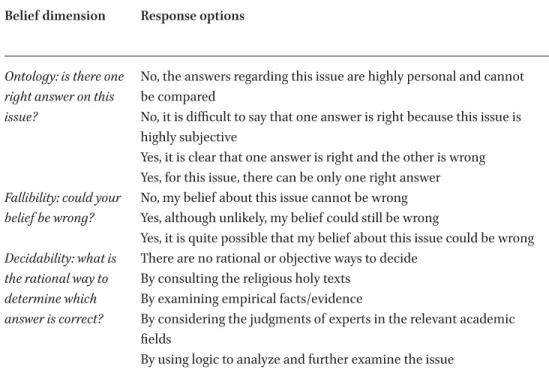
along the three dimensions of ontology, fallibility, and decidability regarding the four issues. The purpose was to test whether the issue vignettes could be understood and to explore possible answers to questions about the three epis- temic dimensions of ontology, fallibility, and decidability. These possible an- swers were incorporated as options in the multiple choice questions designed to measure epistemic orientation (see the second column of Table 11.2).
11.4.1.2 Participants
Participants were fourth-year university students from various academic de- partments in a private university in a metropolitan city in Indonesia. They were invited through personal contacts and social media to complete an on- line survey administered through a Google form. Participation was rewarded with a chance to win one of twenty cash prizes (approx. equivalent to 5 to 7 US dollars) in a lucky draw. Initially, 369 participants completed the online survey. Of those, 6 participants who considered themselves to be non-religious in response to a screening question were excluded. Also, the analysis only fo- cused on participants from the Islamic and Christian religions, because these religions contain teachings which contradict scientifijic conclusions about ho- mosexuality and the evolutionary origins of the human species. This process further excluded 46 participants from the Buddhist and Hindu religions. The fijinal sample was composed of 317 participants who were on average 21.4 years, mostly female (74.1%), and who mostly come from Chinese (48.4%) and Javanese (38.8%) ethnic backgrounds. In terms of their academic backgrounds, the participants were studying pharmacy (n = 96), psychology (n = 117), engi- neering (n = 63), business and economics (n = 35), and law (n = 6).
11.4.1.3 Measures
Background questionnaire. A background questionnaire asked participants to report their gender, age, ethnic background, and religious afffijiliation. It also in- cluded a screening question asking participants to report their level of religios- ity, going from “not religious”, “religious but somewhat less so than the average person”, “just as religious as the average person”, and “more religious than the average person”.
Scientifijic issue vignettes. The main data came from responses to vignettes around four issues displayed in Table 11.1. The issues were systematically varied along two dimensions: judgment domain (social vs. biological) and religious content (“loaded” vs. “neutral”).
Epistemic cognition prompts. Participants were asked whether they agree or disagree with the fijictitious person’s claim in each issue vignette. They were
then presented with close-ended questions assessing orientations regarding the three epistemic dimensions examined in this study: “Do you think there is one right answer on this issue?” (ontology); “Do you think it is possible that your belief about this issue could be wrong?” (fallibility); and “How can you rationally determine which answer is correct regarding this issue?” (decidabil- ity). The response options for each question and their coding are displayed in Table 11.2.
11.4.1.4 Analysis
The data was fijirst screened based on participants’ religious afffijiliation and level of religiosity. Only participants from Islamic and Christian (both Catholics and Protestants) who consider themselves as religious were included in further analysis. For those participants, the analysis was fijirst proceeded by aggregat- ing responses to the epistemic questions to become dichotomous orientations, i.e., perspectivist vs. realist for the ontology dimension, fallibilist vs. infallibilist for the fallibility dimension, and rationalist vs. non-rationalist for the decid- ability dimension. Then, McNemar Chi-Square tests were performed to test whether observed diffferences in the proportion of epistemic orientations for each belief dimension were statistically signifijicant. Comparisons were fijirst made across domains (social vs. biological issues), but within the type of re- ligious content, and then across type of religious content (neutral vs. loaded), but within each domain. Hence, McNemar tests were performed for 12 com- parisons (2 domains × 2 religious content × 3 belief dimensions).
Table 11.1 Scientifijic issue vignettes used as context to assess epistemic cognition
Religious content Domain
Social-psychological Biological Religiously-neutral Motivation issue: “… claimed
that motivation is more important than skill in
determining work performance.
Obesity issue: “… claimed that sugar instead of fat is the main cause of obesity”
Religiously-loaded Homosexuality issue:
“… claimed that homosexuality is not a psychological disorder.”
Evolution issue: “… claimed that humans evolved from a common ancestor with the apes”
11.4.2 Findings
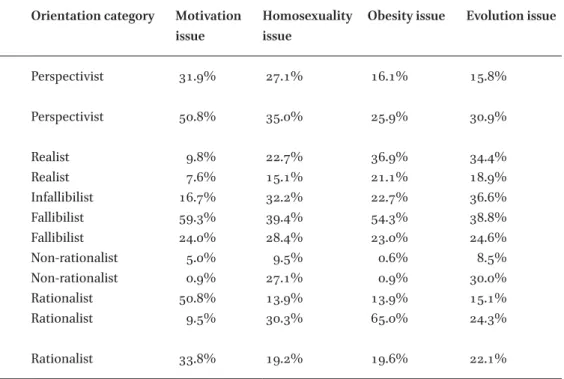
Descriptive results. Table 11.2 shows the proportion of responses for each ques- tion assessing epistemic cognition. On the ontology dimension, more partici- pants adopted a perspectivist rather than a realist orientation for social issues, but not for biological issues. On the fallibility dimension, the majority adopted a fallibilist orientation for all four issues. There was a clear overall trend in the decidability dimension as well: most participants adopted a rationalist ori- entation. Note that the “consulting religious holy text” option was chosen by very few participants with regards to religiously-neutral issues (motivation and obesity), but was much more popular with regards to religiously-loaded ones (homosexuality and evolution).
Epistemic belief across judgment domains. Comparing across domains for the ontological belief dimension, McNemar tests indicate that participants were less perspectivist (i.e., more realist) with regards to biological issues com- pared to social issues. The diffferences were relatively large, especially for the non-religious issues. Diffferences in the fallibility belief dimension across social and biological issues were smaller and only signifijicant for non-religious issues (in the hypothesized direction: less fallible for obesity than for motivation).
In other words, when thinking about the cause of obesity, participants were less likely to believe that their views could be wrong, while no such diffference was observed when comparing fallibility beliefs across the homosexuality vs. evolution issues. Diffferences in decidability beliefs were also modest and were statistically signifijicant only for the non-religious issues (again, in the hy- pothesized direction: participants were more rationalist for obesity than for motivation).
Overall, it seems that domains of knowledge serve as a prompt for partici- pants to adjust their epistemic orientation, especially with regards to the onto- logical dimension. As hypothesized, participants were less perspectivist (more realist), less fallibilist, and more rationalist when considering a biological issue than a social one. Furthermore, there was an interaction between domain and religious content in prompting epistemic adjustment. For religiously-loaded issues, the diffference in epistemic orientation about social vs. biological issues became less prominent (on the ontological dimension) or disappears (on the fallibility and decidability dimensions).
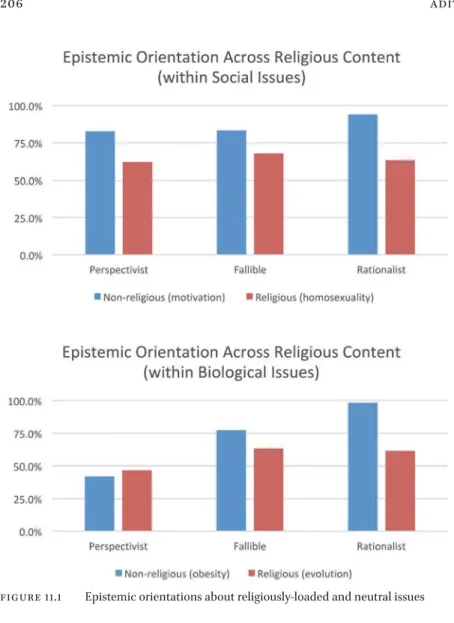
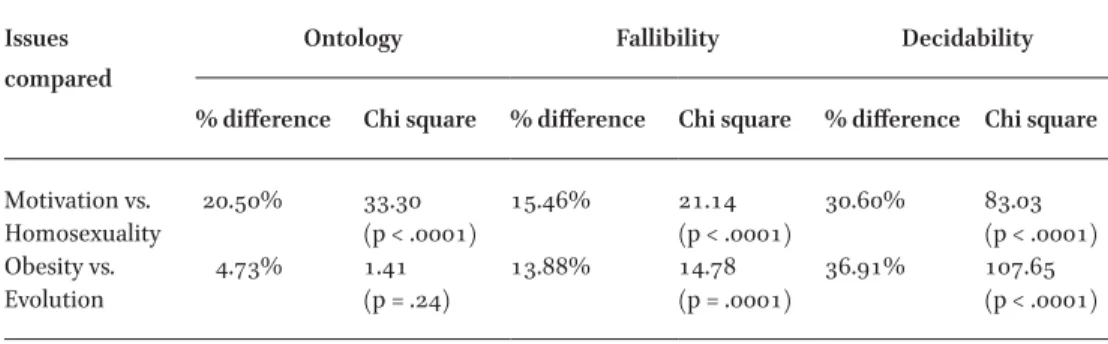
Epistemic belief across religious content. Comparing across religious content for the ontological dimension, the analysis indicated that participants were less perspectivist (i.e., more realist) with regards to the religiously-loaded social issue (homosexuality) than the religiously neutral one (motivation).
For the biological domain, however, there was no diffference in participants’
ontological belief. For the fallibility dimension, participants were less fallibilist (i.e., more infallibilist) in their orientation towards religiously-loaded issues than for religiously-neutral ones in both the social and biological domains.
For the decidability dimension, diffferences in orientations with regards to religiously-loaded and neutral issues were even larger, and participants were less rationalist (i.e., more non-rationalist) when considering religiously-loaded issues.
Overall, the fijindings indicate that the religious content of an issue also prompts shifts in people’s epistemological orientations in all three dimen- sions. For the ontological dimension, the influence of religious content in- teracted with the domain, with religiously-loaded content prompting less perspectivist (more realist) orientations only within the social domain. For the fallibility dimension, religiously-loaded content prompted fewer fallibilist ori- entations for both domains. For the decidability dimension, religiously-loaded content prompted a shift away from rationalist orientations (i.e., towards non-rationalist orientations).
Table 11.2 Responses for each option within the three epistemic dimensions Belief dimension Response options
Ontology: is there one right answer on this issue?
No, the answers regarding this issue are highly personal and cannot be compared
No, it is difffijicult to say that one answer is right because this issue is highly subjective
Yes, it is clear that one answer is right and the other is wrong Yes, for this issue, there can be only one right answer Fallibility: could your
belief be wrong?
No, my belief about this issue cannot be wrong Yes, although unlikely, my belief could still be wrong
Yes, it is quite possible that my belief about this issue could be wrong Decidability: what is
the rational way to determine which answer is correct?
There are no rational or objective ways to decide By consulting the religious holy texts
By examining empirical facts/evidence
By considering the judgments of experts in the relevant academic fijields
By using logic to analyze and further examine the issue
Table 11.3 McNemar Chi-square tests comparing social and biological issues Issues
compared
Ontology Fallibility Decidability
% diffference Chi square % diffference Chi square % diffference Chi square Motivation vs.
Obesity
40.69% 103.36 (p < .0001)
5.99% 4.06
(p = .0440)
4.42% 8.17
(p = .004) Homosexuality
vs. Evolution
15.46% 19.21 (p < .0001)
4.42% 1.92
(p = .1980)
1.89% 0.35
(p = .556) Orientation category Motivation
issue
Homosexuality issue
Obesity issue Evolution issue
Perspectivist 31.9% 27.1% 16.1% 15.8%
Perspectivist 50.8% 35.0% 25.9% 30.9%
Realist 9.8% 22.7% 36.9% 34.4%
Realist 7.6% 15.1% 21.1% 18.9%
Infallibilist 16.7% 32.2% 22.7% 36.6%
Fallibilist 59.3% 39.4% 54.3% 38.8%
Fallibilist 24.0% 28.4% 23.0% 24.6%
Non-rationalist 5.0% 9.5% 0.6% 8.5%
Non-rationalist 0.9% 27.1% 0.9% 30.0%
Rationalist 50.8% 13.9% 13.9% 15.1%
Rationalist 9.5% 30.3% 65.0% 24.3%
Rationalist 33.8% 19.2% 19.6% 22.1%
11.4.3 Discussion and Conclusion
The purpose of this study was to understand how epistemic cognition about scientifijic issues vary across judgment domains and religious content. This was done by asking religious, highly educated young adults to report their epis- temic orientations about four issues: whether motivation is more important than skill in determining work performance; whether homosexuality is a psy- chological disorder; whether sugar is the primary cause of obesity; and wheth- er humans are the product of evolution.
Figure 11.1 Epistemic orientations about religiously-loaded and neutral issues
Table 11.4 McNemar chi-square tests comparing religiously-loaded and neutral issues
Issues compared
Ontology Fallibility Decidability
% diffference Chi square % diffference Chi square % diffference Chi square
Motivation vs.
Homosexuality
20.50% 33.30
(p < .0001)
15.46% 21.14
(p < .0001)
30.60% 83.03
(p < .0001) Obesity vs.
Evolution
4.73% 1.41
(p = .24)
13.88% 14.78
(p = .0001)
36.91% 107.65
(p < .0001)
With regards to variations across domains, the fijindings show that people are more realist, infallibilist, and rationalist with regards to biological issues than social ones. In other words, people are more likely to believe that there are objective truths which can be rationally justifijied when thinking about issues such as the cause of obesity and human evolution, than issues such as work motivation and sexual orientation. They are also more certain about the cor- rectness of their personal views regarding biological than social issues. This pattern is consistent with prior studies which show that shifts from an objec- tivist to a subjectivist epistemology occur earlier with regards to “institutional facts” about the social world, than for “brute facts” about the natural world (Hallett et al., 2002; Kuhn et al., 2000; Kuhn & Weinstock, 2002). The current study lends further empirical support for this developmental pattern using topics which have not yet been utilized for this purpose.
In addition to reinforcing previous theories, the current study also pro- duced new insights about how epistemic cognition on scientifijic issues varies across religious content. The fijindings indicate that religious content influ- enced epistemic cognition in systematic ways. For scientifijic issues which are
“religiously-loaded” (homosexuality and evolution), people are less likely to acknowledge the possibility of multiple truths, more likely to be convinced that their views are correct, and less likely to believe that there are rational ways of evaluating competing claims. This pattern is partly consistent with a prior study of Israeli students, which found that students were less likely to be perspectivists and more likely to be non-rationalists about whether God exists, than about whether children should be punished for misbehavior (Gottlieb &
Mandel Leadership Institute, 2007).
Interestingly, however, the fijindings of the current study difffer from Gottlieb’s concerning the fallibility dimension. Unlike the students in Gottlieb’s study,
participants of this study were less fallibilist (i.e., less likely to see the possibil- ity of being mistaken) about religiously-loaded scientifijic issues than neutral ones. This contrast may be due to some yet to be identifijied socio-cultural dif- ferences. For instance, compared to Indonesian students, Israeli students may be more exposed to radically diffferent ideas about religious topics (including the existence of God), such that they are more at ease in acknowledging the fallibility of their beliefs. For the Indonesian context, secular views about ho- mosexuality and the origin of humans have yet to become part of mainstream discourse. As such, Indonesians have fewer discursive resources to draw on when thinking about those issues. Further research needs to be done to exam- ine whether these conjectures have any merit.
These fijindings are relevant to theoretical issues about the nature and de- velopment of epistemic cognition. According to one view, highly educated young adults (such as those who participated in this study) should already have moved away from an objectivist epistemology towards a subjectivist one.
Some should even have shifted from a subjectivist epistemology to an evalu- ativist one, which is considered to be the most advanced stage of development in many models (Greene, Azevedo, & Torney-Purta, 2008; Barbara K. Hofer &
Pintrich, 1997; Kuhn & Weinstock, 2002). In the framework of this study, an evaluativist epistemology would be characterized by the view that there can be multiple truths (perspectivism), that one’s knowledge could be wrong (fallibil- ism), and that there are rational ways of determining the validity of knowledge claims (rationalism). This was indeed the general trend found in this study (see Table 11.2). However, this study also concurs with the suggestions that epis- temic development does not occur “wholesale”. Instead, epistemic develop- ment seems to occur in a more contextual and fragmented fashion (Hammer
& Elby, 2002). As previous studies have shown, an aspect of context which is important for epistemic development is the judgment domain (Hallett et al., 2002; Barbara K. Hofer, 2000; Kuhn & Park, 2005). This study further shows that even within the same domain, religious content acts as a contextual cue which influences epistemic cognition.
One question which arises from these fijindings is why people become less perspectivist, fallibilist, and rationalist when thinking about religiously-loaded issues. One possibility is that scientifijic knowledge on such issues poses a threat to religious individuals’ worldview and identity. For religious individuals in a religious society, adopting the epistemic orientations observed in this study may serve to afffijirm and protect valued parts of their worldview and identity.
That is, believing that homosexuality is a disorder, or that God created humans in our modern form, afffijirms their worldview. This worldview is further pro- tected by believing that there are no rational ways to decide between religious
faith and scientifijic knowledge (hence, pre-empting the possibility of fijinding evidence which undermines those worldviews). If true, this means that when thinking of religiously-loaded scientifijic issues, epistemic cognition functions to serve motivated reasoning whose goal is primarily non-epistemic (pursuing not truth, but self-related goals, see (Sinatra, Kienhues, & Hofer, 2014)). Future research could explore this possibility qualitatively using in-depth interviews or quantitatively using models which explicitly include religiosity and goals of reasoning.
Another question this study raises is about what should count as sophis- ticated epistemic cognition (i.e., the end points of epistemic development).
Normatively speaking, should epistemic development always move away from objectivism towards subjectivism, and ultimately to evaluativism? Alterna- tively, considering that epistemic cognition seems to be embedded within socio-cultural communities, should the end points of epistemic development be expected to vary across communities (Gottlieb & Mandel Leadership Insti- tute, 2007)? The answer to this question may also be contextual. If one’s family or community upholds the view that there are absolute truths about theo- logical matters, perhaps it would be more socially adaptive for an individual also to adopt an objectivist epistemology about those matters. However, the same epistemology may be less adaptive in academic contexts, which expect individual to develop conceptual understanding about scientifijic concepts that may go against religious doctrine.
Implications. If students believed only on a single truth which is justifijied non-rationally and cannot be wrong, then it would not be surprising that they fijind it difffijicult to develop a deep understanding about scientifijic concepts which go against their personal beliefs. This challenge has been well docu- mented in the case of learning about evolution (Blancke et al., 2012; Lawson
& Worsnop, 1992; Moore et al., 2011). By way of analogy, similar challenges may impede learning about sexual orientation for students of psychology and psychiatry. Hence, direct competition between science and religion may not be the most productive way forward. That is, presenting scientifijic knowl- edge as the ultimate truth to replace religious beliefs about matters such as human evolution and homosexuality may lead to the rejection of science altogether. As prior studies have shown, many teachers in religious societ- ies tend to undermine or de-legitimize scientifijic knowledge which are per- ceived to conflict with religious faith (Croché, 2015; El-Hani & Sepulveda, 2010;
Mansour, 2010).
How, then, should educators address this challenge? If part of the difffijiculty is indeed underpinned by epistemic cognition, then addressing it would need to involve stimulating epistemic growth. For example, it may be important
for teachers to help students to see multiple truths (become less realist and more fallibilist) on various matters. It may also be important to develop stu- dents’ intellectual humility and acknowledge that one’s belief could be wrong, even when it is founded upon religious texts. Students may perhaps need to develop the belief that there are legitimate methods to evaluate competing claims, even if those methods cannot provide access to an objective reality or absolute truths. To overcome the challenges associated with negotiating ten- sions between science and religion, this kind of epistemic development likely needs to occur with regards to religion as well as science. In other words, in the context of religious societies, reform is needed simultaneously in the teaching of religion and science.
Conclusions. Overall, it can be concluded that not only is epistemic cogni- tion about scientifijic issues sensitive to variations in judgment domains, but also to variations in religious content. On matters where religious claims con- flict with scientifijic knowledge, people tend to adopt a more objectivist episte- mology typifijied by realist, infallibilist, and non-rationalist orientations. While this pattern of epistemic cognition may be socially or culturally adaptive in the context of religious communities, it may represent a signifijicant barrier to the learning and teaching in some areas of science.
Limitations and future research. In considering the fijindings and conclusions of this study, readers should be aware of several limitations. Methodologically, this study measured epistemic cognition using a nominal scale, thus limiting the analysis which could be performed. The model used in this study (which included three dimensions of epistemic orientations: ontology, fallibility, and decidability) proved to be fruitful to capture meaningful variations in people’s responses. Hence, future studies should attempt to assess the three epistemic dimensions using either more in-depth qualitative methods or using quantita- tive instruments which could yield data at the interval level of measurement.
Another methodological limitation was the order of presentation of the four issues. In this study, all participants received the issues in the same order (mo- tivation, homosexuality, evolution, and then obesity). Although remote, the order of presentation may have biased responses in systematic ways. Future studies should examine whether the fijindings replicate when the order of pre- sentation is controlled/counter-balanced. Last, this study was designed to serve exploratory purposes. The study succeeded in fijinding meaningful patterns of epistemic cognition, but could not provide insights as to why such patterns exist. Qualitative studies using interviews and/or observations of cognition-in- action would be useful for further understanding of why certain epistemic be- liefs are adopted with regards to religiously-loaded scientifijic issues.
Acknowledgement
The author would like to thank LPPM Universitas Surabaya for its fijinancial support, and also Cynthia Vivian for helping manage the data collection of this study.
References
Aditomo, A. (2014). Evaluating the validity of an epistemic belief questionnaire:
Evidence based on internal structure, content, and response process. ANIMA Indonesian Psychological Journal, 29(3), 155–168.
Aditomo, A. (2018). Epistemic beliefs and academic performance across soft and hard disciplines in the fijirst year of college. Journal of Further and Higher Education, 42(4), 482–496. https://doi.org/10.1080/0309877X.2017.1281892.
Berkman, M. B., Pacheco, J. S., & Plutzer, E. (2008). Evolution and creationism in America’s classrooms: A national portrait. PLoS Biology, 6(5), 0920–0924. https://
doi.org/10.1371/journal.pbio.0060124.
Berkman, M. B., & Plutzer, E. (2011). Defeating Creationism in the Courtroom, But Not in the Classroom. Science, 331(6016), 404–405. https://doi.org/10.1126/science.1198902.
Blancke, S., de Smedt, J., de Cruz, H., Boudry, M., & Braeckman, J. (2012). The Implications of the Cognitive Sciences for the Relation Between Religion and Science Education:
The Case of Evolutionary Theory. Science and Education, 21(8), 1167–1184. https://
doi.org/10.1007/s11191-011-9402-z.
Clark, K. J. (2014). Religion and The Sciences of Origins: Historical and Contemporary Discussions. New York: Palgrave Macmillan.
Croché, S. (2015). Science and religion on the blackboard: exploring schoolmasters’
beliefs and practices in Senegal. British Journal of Religious Education, 37(1), 37–52.
https://doi.org/10.1080/01416200.2013.830956.
Dagher, Z. R., & BouJaoude, S. (1997). Scientifijic views and religious beliefs of college students: the case of biological evolution. Journal of Research in Science Teaching, 34(5), 429–445.
Edis, T. (2009). Modern science and conservative Islam: An uneasy relationship. Science
& Education, 18, 885–903. https://doi.org/10.1007/s11191-008-9165-3.
El-Hani, C. N., & Sepulveda, C. (2010). The relationship between science and religion in the education of protestant biology preservice teachers in a Brazilian univer- sity. Cultural Studies of Science Education, 5(1), 103–125. https://doi.org/10.1007/
s11422-009-9212-7.
Gottlieb, E., & Mandel Leadership Institute. (2007). Learning How to Believe: Epistemic Development in Cultural Context. Journal of the Learning Sciences, 16(1), 5–35.
https://doi.org/10.1080/10508400709336941.
Greene, J. A., Azevedo, R., & Torney-Purta, J. (2008). Modeling epistemic and ontologic cognition: Philosophical perspectives and methodological directions. Educational Psychologist, 43(3), 142–160.
Hallett, D., Chandler, M. J., & Krettenauer, T. (2002). Disentangling the course of epistemic development: parsing knowledge by epistemic content. New Ideas in Psychology, 20, 285–307.
Halstead, J. M., & Lewicka, K. (1998). Should Homosexuality be Taught as an Acceptable Alternative Lifestyle? A Muslim perspective. Cambridge Journal of Education, 28(1), 49–64. https://doi.org/10.1080/0305764980280105.
Hammer, D., & Elby, A. (2002). On the form of a personal epistemology. In B. K. Hofer
& P. R. Pintrich (Eds.), Personal Epistemology: The Psychology of Beliefs about Knowledge and Knowing (pp. 169–190). Mahwah, NJ: Erlbaum.
Hammer, D., Elby, A., Scherr, R. E., & Redish, E. F. (2005). Resources, framing, and trans- fer. In J. Mestre (Ed.), Transfer of learning from a modern multidisciplinary perspec- tive (pp. 89–120). Greenwich, CT: Information Age Publishing.
Hofer, B. K. (2000). Dimensionality and disciplinary diffferences in personal epistemol- ogy. Contemporary Educational Psychology, 25(4), 378–405. Retrieved from http://
www.sciencedirect.com/science/article/B6WD1-45FCGBP-4/2/1b8a41b9128d9f6d6 25852a03fd14df4.
Hofer, B. K. (2001). Personal epistemology research: Implications for learning and teaching. Educational Psychology Review, 13(4), 353–383.
Hofer, B. K. (2004). Epistemological understanding as a metacognitive process:
Thinking aloud during online searching. Educational Psychologist, 39(1), 43–55.
https://doi.org/10.1207/s15326985ep3901.
Hofer, B. K., & Pintrich, P. R. (1997). The development of epistemological theories:
Beliefs about knowledge and knowing and their relation to learning. Review of Educational Research, 67(1), 88.
Karabenick, S. A., & Moosa, S. (2005). Culture and personal epistemology: U.S. and middle eastern students’ beliefs about scientifijic knowledge and knowing. Social Psychology of Education, 8(4), 375–393. https://doi.org/10.1007/s11218-005-1826-3.
Kitchener, K. S. (1983). Cognition, metacognition, and epistemic cognition. Human Development, 26(4), 222–232. https://doi.org/10.1159/000272885.
Kuhn, D., Cheney, R., & Weinstock, M. (2000). The development of epistemological understanding. Cognitive Development, 15(3), 309–328.
Kuhn, D., & Park, S.-H. (2005). Epistemological understanding and the development of intellectual values. International Journal of Educational Research, 43, 111–124.
Kuhn, D., & Weinstock, M. (2002). What is epistemological thinking and why does it
of Beliefs about Knowledge and Knowing (pp. 121–144). Mahwah, New Jersey:
Lawrence Erlbaum Associates Inc.
Lawson, A. E., & Worsnop, W. A. (1992). Learning about evolution and rejecting a belief in special creation: Efffects of reflective reasoning skill, prior knowledge, prior belief and religious commitment. Journal of Research in Science Teaching, 29(2), 143–166.
https://doi.org/10.1002/tea.3660290205.
Mansour, N. (2010). Science teachers’ interpretations of Islamic culture related to sci- ence education versus the Islamic epistemology and ontology of science. Cultural Studies of Science Education, 5(1), 127–140. https://doi.org/10.1007/s11422-009-9214-5.
Moore, R., Brooks, D. C., & Cotner, S. (2011). The relation of high school biology cours- es and students’ religious beliefs to college students’ knowledge of evolution. The American Biology Teacher, 73(4), 222–226. https://doi.org/10.1525/abt.2011.73.4.7.
Moshman, D. (2011). Evolution and development of reasoning and argumentation:
Commentary on Mercier (2011). Cognitive Development, 26(3), 192–195. https://doi .org/10.1016/j.cogdev.2011.03.002.
Perry, W. (1968). Patterns of Development in Thought and Values of Students in a Liberal Arts College: A Validation of a Scheme. Cambridge. Retrieved from http://eric .ed.gov/?id=ED024315.
Rosenberg, S., Hammer, D., & Phelan, J. (2006). Multiple epistemological coherences in an eighth-grade discussion of the rock cycle. Journal of the Learning Sciences, 15(2), 261–292.
Roth, W.-M. (2010). Science and religion: what is at stake? Cultural Studies of Science Education, 5, 5–17. https://doi.org/10.1007/s11422-009-9234-1.
Sandoval, W. A. (2009). In defence of clarity in the study of personal epistemology.
Journal of the Learning Sciences, 18(1), 150–161.
Sandoval, W. A., Greene, J. A., & Bråten, I. (2016). Understanding and promoting think- ing about knowledge Origins, issues, and future directions of research on epistemic cognition. Review of Research in Education, 40(1), 457–496.
Schommer-Aikins, M. (2004). Explaining the epistemological belief system: Introducing the embedded systemic model and coordinated research approach. Educational Psychologist, 39(1), 19–29.
Sinatra, G. M., Kienhues, D., & Hofer, B. K. (2014). Addressing Challenges to Public Understanding of Science: Epistemic Cognition, Motivated Reasoning, and Conceptual Change. Educational Psychologist, 49(2), 123–138. https://doi.org/
10.1080/00461520.2014.916216.
Stm, R. N., & Gramick, J. (1989). Homosexuality: Protestant, Catholic, and Jewish issues;
a fijishbone tale. Journal of Homosexuality, 18(3–4), 7–46. https://doi.org/10.1300/
J082v18n03.
Yasri, P., & Mancy, R. (2014). Understanding Student Approaches to Learning Evolution in the Context of their Perceptions of the Relationship between Science and Religion. International Journal of Science Education, 36(1), 24–45. https://doi.org/
10.1080/09500693.2012.715315.
Zeidler, D. L., Herman, B. C., Ruzek, M., Linder, A., & Lin, S. (2013). Cross-cultural epis- temological orientations to socioscientifijic issues. Journal of Research in Science Teaching, 50(3), 251–283. https://doi.org/10.1002/tea.21077.