Evolution of the Rails
of the South Atlantic Islands (Aves: Rallidae)
STORRS L. OLSO
i
t
SMITHSONIAN CONTRIBUTIONS TO ZOOLOGY • NUMBER 152
S E R I A L P U B L I C A T I O N S O F T H E S M I T H S O N I A N I N S T I T U T I O N The emphasis upon publications as a means of diffusing knowledge was expressed by the first Secretary of the Smithsonian Institution. In his formal plan for the Insti- tution, Joseph Henry articulated a program that included the following statement:
"It is proposed to publish a series of reports, giving an account of the new discoveries in science, and of the changes made from year to year in all branches of knowledge."
This keynote of basic research has been adhered to over the years in the issuance of thousands of titles in serial publications under the Smithsonian imprint, com- mencing with Smithsonian Contributions to Knowledge in 1848 and continuing with the following active series:
Smithsonian Annals of Flight Smithsonian Contributions to Anthropology
Smithsonian Contributions to Astrophysics Smithsonian Contributions to Botany Smithsonian Contributions to the Earth Sciences
Smithsonian Contributions to Paleobiology Smithsonian Contributions to Zoology Smithsonian Studies in History and Technology
In these series, the Institution publishes original articles and monographs dealing with the research and collections of its several museums and offices and of professional colleagues at other institutions of learning. These papers report newly acquired facts, synoptic interpretations of data, or original theory in specialized fields. These pub- lications are distributed by mailing lists to libraries, laboratories, and other interested institutions and specialists throughout the world. Individual copies may be obtained from the Smithsonian Institution Press as long as stocks are available.
S. DILLON RIPLEY
Secretary
Smithsonian Institution
Evolution of the Rails of the South Atlantic Islands
(Aves: Rallidae)
Storrs L. Olson
SMITHSONIAN INSTITUTION PRESS City of Washington
1973
A B S T R A C T
Olson, Storrs L. Evolution of the Rails of the South Atlantic Islands (Aves:
Rallidae). Smithsonian Contributions to Zoology, number 152, 53 pages, 8 fig- ures, 11 plates, 1973.—Abundant remains of a medium-sized, flightless rail col- lected on Ascension Island are described as a new species, Atlantisia elpenor.
The very large, extinct, flightless rail, previously described as Aphanocrex po- darces, is also shown to be a member of the genus Atlantisia, the only other member of which is the diminutive, flightless, living species A. rogersi of Inac- cessible Island in the Tristan da Cunha group. These three species are believed to be descended from a common mainland ancestor of a pro-Rallus stock that arrived as wind-blown vagrants to all three islands where each population inde- pendently evolved Sightlessness and divergent body sizes in response to different environmental conditions. Bones of a flightless rail much smaller than A. po- darces were also discovered on St. Helena and represent a new species, Porzana astrictocarpus, which, along with the flightless species "Porzanula" palmeri of Laysan Island in the Pacific, is thought to be descended from the widespread Old World species Porzana pusilla. The two nearly identical flightless gallinules of Tristan da Cunha (nesintis) and Gough (comeri) Islands are considered as each having been independently derived from volant Gallinula chloropus and are, therefore, best treated as separate species or as subspecies of G. chloropus rather than one being a subspecies of the other. Two species of purple gal- linules (Porphyrula) are regular vagrants to the South Atlantic islands yet have never established breeding populations on any of them. This genus is thought to be too specialized morphologically to adapt to insular environments. Flight- lessness in rails is shown to be a neotenic condition that involves only the con- trol of relative growth of body parts, is evolved at a rapid rate, .arid therefore has limited taxonomic significance. The evolutionary advantage of Sightlessness is thought to be in the conservation of energy resulting from the decrease in mass of the flight muscles.
OFFICIAL PUBLICATION DATE is handstamped in a limited number of initial copies and is recorded in the Institution's annual report, Smithsonian Year. SI PRESS NUMBER 4818. SERIES COVER DESIGN: T h e coral Montastrea cavernosa (Linnaeus).
Library of Congress Cataloging in Publication Data Olson. Storrs L.. 1944-
Evolution of the rails of the South Atlantic islands (Aves: Rallidae).
(Smithsonian contributions to zoology, no. 1~>2) Bibliography: p.
1. Rails (Birds) 2. Birds—Evolution. 3. Birds—South Atlantic Ocean. 4. Birds—Islands of the Atlantic. I. Title. II. Series: Smithsonian Institution. Smithsonian contributions to zoology, no. 152.
QL1.S54 no. 152 [QL696.G8] 591'.u8s [598.3'1] 73-2859
For sale by the Superintendent of Documents, U.S. Govennent Printing Office, Washington, D.C. 20402 Price 95 cents domestic postpaid or 70 cents GPO Bookstore
Contents
Page
Introduction 1 Acknowledgments 2 Rails of Ascension Island 3 History of the Endemic Ascension Rail . 3 Atlantisia elpenor, new species 7 Environment and Extinction of the Ascension Rail 10 Vagrant Rallids . 12 Rails of St. Helena 13 Redescription and Relationships of "Aphanocrex" podarces 13 A Second Species of Extinct Rail 16 Porzana astrictocarpus, new species 17 Extant Rails 20 The Resident Gallinula 20 Errant Species of Porphyrula 21 Environment and Lives of the Rails 21 Rails of the Tristan da Cunha Group and Gough Island 23 Origin and Evolution of the South Atlantic Rails 25 Genus Porphyrula 25 Genus Gallinula 27 Genus Atlantisia 28 Genus Porzana . 29 Evolution of Flightlessness in Rails . 31 Concluding Remarks 36 Literature Cited 37 Appendix 1: Comparative Material Examined 41 Appendix 2: Characterization of the Genus Atlantisia 41 Plates 1-11 43
Evolution of the Rails of the South Atlantic Islands
(Aves: Rallidae)
Storrs L. Olson
INTRODUCTION
Among the families of terrestrial vertebrates, the rails (Rallidae) have one of the most compre- hensive geographical distributions. Not only are they widespread in continental areas, except in re- gions of extreme cold or aridity, but practically no island or group of islands is too remote or inhospi- table to have been discovered and inhabited by some species of rallid.
The islands of the mid-South Atlantic are among the smallest and most isolated in the world; yet as it has turned out, each harbored one or more spe- cies of rail. Ascension, St. Helena, and the Tristan da Cunha group, remote from each other as they are, have been occupied by one group of these rails which has radiated almost as if it were in an archipelago. In these solitary microcosms has un- folded an evolutionary story in its own way as fas- cinating as that of the Galapagos or Hawaii.
The islands with which we will be concerned are entirely volcanic and are part of the Mid- Atlantic Ridge. Ascension and Tristan lie di- rectly on the ridge and both are geologically very young. St. Helena lies to the east of the center of the ridge and is considerably older (Baker, 1970).
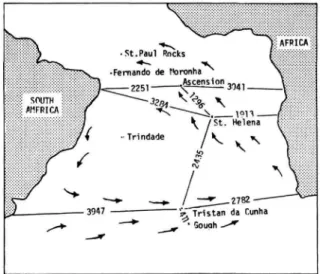
The map (Figure 1) demonstrates how far re-
Storrs L. Olson, Department of Vertebrate Zoology, National Museum of Natural History, Smithsonian Institution, Wash- ington, D.C. 20560.
moved these islands are from each other and from the continents.
Ascension was discovered in 1501, St. Helena in 1502, and Tristan da Cunha in 1506. St. Helena, being of good climate and rich in resources, was
AFRICA;
FIGURE 1.—Map of the South Atlantic Ocean showing the principal islands. Numbers represent distances in kilometers and were computed by F. C. W. Olson from coordinates obtained from the World Port Index (Publication 150, U.S.
Navy Oceanographic Office, 1963). Arrows indicate direction of prevailing surface winds.
settled not long after its discovery. Because of its barren nature, Ascension was not permanently in- habited until 1815. The Tristan group, composed of the main island of Tristan da Cunha, the two smaller adjacent islands of Inaccessible and Night- ingale, and Gough Island considerably to the south, was not settled permanently until 1810, and then only the main island of Tristan was occu- pied; the rest to this day remain uninhabited. As a consequence of man's interference, a number of species of birds from these islands have become ex- tinct and, of these, most are known only from bones. In search of fossil bird remains, I made collections on Ascension Island (12 June-15 July 1970, 1 June-4 June, and 19 July-31 July 1971) and on St. Helena (5 June-17 July 1971). These collections include, in addition to thousands of specimens of seabirds and a few other landbirds, three species of rails, two of which are described here as new. The bulk of this paper will concern itself with the origins, relationships, descriptions, ecology, and adaptations of the living and fossil rails of the South Atlantic Islands. The most strik- ing modification of most of these species is their flightlessness. This is a condition that appears often in insular rails, yet one that has received little analysis. The origins, advantages, and sig- nificance of flightlessness in the Rallidae are also treated here.
ACKNOWLEDGMENTS.—I need first single out the constant assistance and advice of George E. Wat- son, who has helped me from the inception of this project in ways too many to enumerate; my debt to him is great indeed.
Funding for travel was provided by the Smith- sonian Institution, Departments of Vertebrate Zoology (G. E. Watson), Invertebrate Zoology (R.
B. Manning), and Office of Systematics (R. S.
Cowan). Helena Weiss, Hazel Fermino, and Fran- cine Berkowitz took care of difficult travel arrange- ments. J. P. Angle, T. S. Bober, E. N. Gramblin, F. M. Greenwell, W. P. Haynes, and G. R. Shaver provided for the assembling and shipping of sup- plies and equipment.
Travel and accomodations to Ascension in both years, were effected through the fine cooperation of the United States Air Force, especially Philip F.
Hilbert, Deputy Under Secretary (International Affairs) and Major General David Jones, Com- mander, USAF Eastern Test Range, who responded
to inquiries by Sidney R. Galler of the Smith- sonian. Major Jesse M. Couch, Base Commander Ascension AAF, repeatedly gave more than gener- ously of his time and effort to contribute to the success of my undertakings.
To H. E. Sir Dermod Murphy, Governor of St.
Helena; H. E. Ian Rose, Government Secretary and Acting Governor of St. Helena; Brigadier H.
W. McDonald, Administrator of Ascension Island;
and Mr. Jeff Appleby, Chief of Police and Acting Administrator of Ascension Island, I am indebted for permission to conduct scientific studies on their islands and for many other courtesies as well. Doug- las S. Rogers, then Curator of the Ascension His- torical Society Museum, contributed his invaluable island lore and enthusiastically aided in the col- lection of specimens. Dave Gallop, Peter Critchley, John Taylor, Kay, John, and Michael Hutchfield, Danny Nickerson, Ray Futrell, George Taylor, Gil Hermans, and Carl Coggins were among those on Ascension who helped in so many ways. On St.
Helena, Mr. and Mrs. A. H. Mawson, William Stopforth, Joyce Wade, and Milly Thomas pro- vided superb accomodations and encouragement.
My first two years of research were undertaken while holding scholarships as a graduate student in the Department of Pathobiology, Johns Hopkins University, School of Hygiene and Public Health.
I am most grateful to Frederik B. Bang for provid- ing this opportunity and for his considerable per- sonal and administrative support. Barreda Howell continually and patiently helped me through ad- ministrative crises, large and small, during my tenure at Hopkins. My last year of graduate study was financed by a visiting research fellowship from the Office of Academic Studies of the Smithsonian Institution, during which period Gretchen Gayle and Hazel Fermino helped with a multitude of details.
Dean Amadon, American Museum of Natural History (AMNH); D. W. Snow, British Museum (Natural History) (BMNH); R. W. Storer, University of Michigan Museum of Zoology (UMMZ); R. A.
Paynter, Jr., Museum of Comparative Zoology (MCZ); A. R. McEvey, National Museum of Vic- toria (NMV); and Pierce Brodkorb, University of Florida, loaned comparative material in their care.
The collections of the National Museum of Natu- ral History, Smithsonian Institution (USNM) were a major source for my research, in which connec-
tion R. L. Zusi has often rendered his aid.
Genevieve Tvrdik and Ned K. Johnson supplied information on specimens of Tribonyx in the Mu- seum of Vertebrate Zoology.
Sheila Ford generously executed Plates lc, Id, and Si. The patience, care, and dispatch exercised by Victor E. Krantz in taking and printing the photographs is very much appreciated. N. Drahos and I. Ikehara kindly supplied me with specimens of the Guam rail. The late James A. Peters as- sisted in making calculations on time-share com-
puter. In the course of my work I have benefited from discussions with R. L. Zusi, A. Wetmore, G.
E. Watson, P. Slud, K. C. Parkes, R. B. Manning, P. Brodkorb, and N. P. Ashmole. This paper was submitted in partial fulfilment of the degree of Doctor of Science at the Johns Hopkins Univer- sity and the members of my committee, F. B. Bang, J. T. Fales, E. Gould, W. J. L. Sladen, and G. E.
Watson, read and commented on the manuscript.
Finally, Hazel Fermino spent many long, late hours typing the final draft.
R A I L S OF ASCENSION ISLAND
History of the Endemic Ascension Rail
The 7th June anno 1656. Att evening wee arrived att Ascention and anchored on the NW. side of the iland. On our rightt hand was a faire sandy bay and on our leftt were multi[tu]de of rarreg [ragged], craggy, sharpe pointed hard rocks for many miles along the shoare, and up toward the land, appearing white with the dung of sea foule, of which were innumerable of severall kinds. The most deso- late, barren [land] (and like a land thatt God had cursed) thatt ever my eies beeheld (worse then Kerne Ky, etts. in Cornewall). I co[n]ceave the whole world affoards nott such another peece of ground: most part of the collour of burnt bricke, reddish, the substance stones, somwhatt like pumice stones; the rest like cinders and burnt earth. The hills, of which there are many, were meere heapes of the same. It may bee supposed thatt the fire in former ages hath consumed the substance therof, hath made it incapable of producing any vegetalls. Only the topps of the high moun- taines in the middle appeared somwhatt greene, there beeing a kind of rushes and spicy [Pspiky] grasse. Some of our company went up and broughtt downe six or seven goates, doubtlesse att first left there by the Portugalls: allsoe halfe a dozen of a strange kind of fowle, much bigger then our sterlings ore stares: collour gray or dappled, white and blacke feathers intermixed, eies red like rubies, wings very imperfitt, such as wherewith they cannot raise themselves from the ground. They were taken running, in which they are exceeding swift, helping themselves a little with their wings (as it is said of the estridge), shortt billed, cloven footed, thatt can neither fly nor swymme. It was more then ordinary dainety meatt, relishing like a roasting pigge
(Peter Mundy, in Temple and Anstey, ed., 1936:82-83).
Peter Mundy was a traveler of exceptional per- ception who several times in the 17th century sailed from England to India and made stops at Ascension and St. Helena while keeping a detailed journal of his observations. With his entry (above)
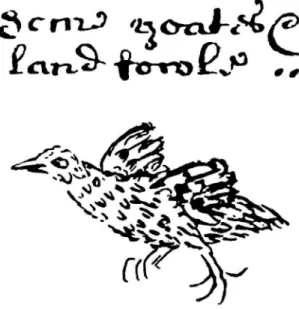
on Ascension Island he included a small sketch of his "strange kind of fowle" (Figure 2) which, al- though historically interesting, is hardly diagnostic.
It shows a bird with a medium-sized bill and re- duced wings, but whether the flecks on the body represent dappled plumage, as Ashmole (1963a) conjectured, or whether they are simply indica- tions of feathers, is speculative. Kinnear (1935), in commenting on the fauna mentioned in Mun- dy's journal, came to the conclusion that the Ascen- sion bird was an extinct flightless rail; a decision that was concurred in by other ornithologists
FIGURE 2.—Peter Mundy's sketch of the Ascension rail, with a sample of his script for scale. (From Temple and Anstey, ed., 1936:83.)
(Murphy, 1936:151; Hagen, 1952:230). However, as no such bird exists on Ascension today, Stone- house (1962) felt that Mundy's description might apply to juvenile Sooty Terns (Sterna fuscata) de- spite the fact that their eyes are brown, their feet webbed, and their locomotion hardly "exceeding swift." It is certain now that this was not the case.
No further information relating to this bird on Ascension Island was forthcoming until the British Ornithologists' Union (BOU) sent an expedition to Ascension in 1957-1959 to study its seabird colo- nies. In order to gain some knowledge of the past seabird fauna, the expedition searched for avian re- mains in several sites on the island. Included among the bones they discovered was the skull of a small rail taken from a deep fumarole north of Sisters Peak, and a ralline tarsometatarsus from phosphate de- posits south of South Gannet Hill. These were reported on by Ashmole (1963a), who thought them to be unlike any living rail, but he refrained from naming the bird in the hope of being able to obtain more material at a later date. He provision- ally considered the species a member of the genus Rallus while pointing out that the skull was pro- portionately very similar to Atlantisia rogersi of Inaccesible Island in the Tristan da Cunha group.
The late James Fisher (Fisher and Peterson, 1964:
241, 273) referred to the Ascension rail as "Cre- copsis sp.," and it is listed as such in the Red Data Book (Vincent, 1966). Fisher informed me (letter of 22 January 1970) that he had done this solely on the basis of Mundy's description, but on ex- amining the skull he had later decided to refer it to Rallus. Crecopsis egregia is an African rail which is dappled and has a red eye but which is probably not directly related to the Ascension rail.
Armed with these tantalizing scraps of informa- tion, it was my purpose in visiting Ascension to attempt to obtain additional remains of the rail.
On arriving at the island in 1970, I went directly
FIGURE 3.—The collecting locality for the Ascension rail:
a, The barren volcanic landscape around the fumaroles where the rail remains were found. Arrow indicates the large fumarole, the smaller one is almost hidden to the right.
The large cinder cone is Sisters Peak. Note the white patches of old guano on the leeward side of the rocks, b, The precipitous descent into chamber B of the large fuma- role. The floor of the chamber is about 7-8 meters below the opening visible here. It should be self-evident why flightless rails became entrapped within. (Photographs taken 14 July 1970 by Douglas S. Rogers.)
Fa.IRK 4.—Diagram of a cross-section through the interior of the fumaroles shown in Figure 3. The blackened areas show where most of the rail bones were found. Scale=approx.
•3 m. Arrow points north.
to the locality where Ashmole collected the rail skull, this site being the larger of two fumaroles situated on an elevated plain a few hundred meters north of the base of Sisters Peak. A more inhos- pitable place is hardly to be imagined (Figure 3a).
The plain, which lies at about the 550 foot con- tour, consists of volcanic ash and cinders inter- spersed with mounds of lava. Looming some 300 meters above is the summit of Sisters Peak, a large cone entirely composed of cinders. Aside from a few lichens and wisps of dry grass, the area is barren of life. In the midst of this "lunar"
landscape project two fumaroles, or driblet cones, made up of blobs of red lava, remnants of the most recent volcanic activity on the island. The largest is about 8 meters high and is penetrated by two chimney-like openings that descend for a depth of about 10-12 meters (Figure 36). These open into three large interconnecting chambers (Fig- ure 4). For historical geology and further descrip- tions of this area see Daly (1925) and Stonehouse
(1960).
From both fumaroles the BOU party collected bird remains, among which Ashmole (1963a) identified bones of Masked Booby (Sula dactylatra), Fairy Tern (Gygis alba), and Sooty Tern (Sterna fus- cata). In chamber B of the large fumarole, I found remains of Sterna fuscata, Sula dactylatra, and Red- footed Booby (Sula sula), and, in addition, a single femur of a rail lying by itself on top of a pile of recently dislodged debris. No other rallid remains were found in this chamber and it is possible that
this one bone was accidentally dropped there by one of the BOU party or other subsequent visitors to the fumarole. A narrow crevice near the ceiling of the south wall of chamber B led into a third chamber (c). Access into (and egress out of) this room was made difficult by a sheer drop of about 3 meters at the end of the crevice. In the east cor- ner of this totally dark chamber, in a depression about 1.5 X 2 meters, lay a myriad of small bones, all of rails. Amongst them were shell fragments of a single land crab (Gecarcinus lagostoma), a spe- cies which is now common on the southeastern vegetated part of the island and on Green Moun- tain, but is seldom met with elsewhere on Ascen- sion. In five descents into the large fumarole, accompanied by D. S. Rogers or J. M. Couch, I picked up with forceps all the large bones I could reach, and with the aid of a camel's hair brush and a spoon, removed a quantity of the smaller bones and associated debris. From chamber c ran several tunnels too narrow to permit passage but into which a rail might easily have slipped. From the largest of these, which Rogers with much diffi- culty was able to enter a short way, were extracted bones of two rails and a single Gygis alba, the lat- ter the only seabird found in chamber c. Rogers saw other skeletons in this tunnel which he could not reach but which he thought were rallid.
On analyzing the bones collected in this fuma- role, I can account for the presence of about 35 individual rails—doubtless more remain secreted in inaccessible crannies. Some of the bones are friable and chalky and variously eroded, but others are in an excellent state of preservation with very deli- cate processes still intact. None is mineralized. A few appear somewhat yellowish as if they might re- tain some grease, while the proximal end of one tibiotarsus still has a few shreds of tendon ad- herent. Most of the bones are of adult birds but a few show the spongy articulations characteristic of immaturity.
A few meters south of the large fumarole is the rather wide opening of a smaller fumarole that rises 2-3 meters above the plain. I did not explore it until 1971, but previously Ashmole (1963a) had reported no rail remains from this fumarole and Stonehouse (1960:181) had said that he had taken from it "all the skulls and fragments of long bones." In three trips, however, I removed from this site hundreds of additional bones of Sterna
fuscata from not less than 146 individuals, remains of several Gygis and Sula and more importantly, nearly 200 bones or fragments from at least 17 in- dividual rails, and surprisingly, a few 'bones of a single small heron (Olson, in prep. (a)).
Conditions in the small fumarole were somewhat different than in the large one. The main part of the floor lay about 6 meters below the rim and off to one side was a pocket about 1.5 meters deeper which contained nearly all the bones discovered at this site except for those of a few Sula. The bot- tom of this pocket, about 1 x 3 meters in area, was filled with a loose, dry deposit of dust, cinders, and the organic debris resulting from the decom- position of hundreds of bird carcasses, to a depth of 60 cm, or more, in places. Bones lay jumbled on the surface and throughout the powdery matrix, those from the deeper layers being stained dark brown while those on the surface were white. This was in contrast to the large fumarole where the bones were lying on bare rock.
The deposits of bones in both fumaroles bear evidence of having accumulated over some period of time but the latest specimens, to judge from their appearance, can hardly be older than a few hundred years. Unfortunately, in spite of the dry conditions, no mummification appears to have taken place and no feathers or other soft parts re- main. However, all the elements of the skeleton are represented, including such rarely preserved items as the lacrimals, pterygoids, and even the ossified portions of cricoid cartilages. None of the rail specimens from either fumarole shows any pathological condition although in my experience in such a large series (at least 52 individuals) it would not be unexpected to find a few bones that had been broken and subsequently mended.
The remarkably reduced wing elements and ca- rina of the sternum disclosed at first glance that these remains were from an absolutely flightless bird. As there were no other landbirds on the island, there can be little doubt that these bones are from the species described by Mundy. Being unable to fly, the birds that ventured up the sides of the fumaroles and tumbled into the steep vents would not have been able to effect their escape.
Thus trapped, they must have wandered about the interior until they dropped into the farthest re- cesses where they succumbed to lack of water and food.
On comparing the exceptionally fine series of bones of the Ascension rail with skeletons of other Rallidae (see Appendix 1 for species compared), one species emerged as being inescapably similar in proportions and most details of structure, this being the diminutive, flightless, Atlantisia rogersi Lowe from Inaccessible Island, until now consid- ered a monotypic genus. More surprisingly, the very large, extinct rail, Aphanocrex podarces Wet- more, of St. Helena, also agrees closely in morphol- ogy with the Ascension bird and with A. rogersi.
For these and other reasons discussed further on, I consider these three forms as congeners. The characters of the expanded genus Atlantisia are discussed in Appendix 2.
Atlantisia elpenor, new species
HOLOTYPE.—Complete left tarsometatarsus, fully ossified (Plate 5e,f,g). Vertebrate paleontological collections of the National Museum of Natural His- tory (USNM 170129). Collected in depression on the east side of the southernmost chamber of the largest fumarole located about 260 meters true north of the summit of Sisters Peak, Ascension Island, South Atlantic Ocean (approximately 7°55'25"S; 14°22'15"W), on 17 June 1970, by Storrs L. Olson and Jesse M. Couch. Directly associated with the type were right and left humeri, ulnae, radii, carpometacarpi, coracoids, scapulae, fibulae, left femur, sternum, furcula, mandible, left quad- rate, 13 ribs, 18 vertebrae, and 15 pedal phalanges which have been cataloged under the same number, as I am confident that they are all from the same individual. As this specimen was well exposed and in an excellent state of preservation and had the mandible present but the rest of the skull lacking, it is possible that the skull (Ashmole No. F21) picked up by Ashmole and now in the British Mu- seum (Natural History) may be from the same individual. However, lest there possibly be any confusion, and since there were so many other rail remains in the area, I designate only the tarso- metatarsus as the holotype. The associated elements may be considered as especially significant para- types in the large series of paratypical material from the two fumaroles.
The type tarsus is 38.0 mm in total length; trans- verse breadth across head 5.5 mm; transverse breadth across center of shaft 2.5 mm; transverse
breadth across trochleae 5.7 mm. It is near the maximum length and stoutness for the species and is yellowish white in color. There being so much more material of tarsi and other skeletal elements, I will not further belabor the description of the actual type.
PARATYPES.—All of the various elements of rallid material from the two fumaroles included in the series USNM 169773-170128, 170130-170272, and
175803-175853 may be considered paratypes.
RANGE.—Ascension Island, South Atlantic Ocean.
STATUS.—Extinct; exterminated sometime after 1656.
ETYMOLOGY.—Elpenor was one of Odysseus' crew members, who, while stranded on Circe's island, fell from the roof of her palace, was killed, and de- scended straight to Hades. Odysseus later encoun- tered Elpenor's shade during his journey through the Underworld. The Ascension rail was also stranded on an island and upon falling off the lip of the fumarole, descended straight to the bowels of the earth and was not known again until its shades were stirred up by inquiring mortals in- vading its underworld tomb. The specific name stands in apposition to that of the genus and is in the nominative case.
DIAGNOSIS.—A medium-sized flightless rail, rough- ly the size of a Virginia Rail (Rallus limicola) but with much reduced pectoral girdle and wings, and stouter hind limbs. It is very similar in most respects to Atlantisia rogersi but much larger, the major bones averaging 25 to 35 percent longer. On the other hand, A. elpenor is but half the size of A.
podarces (Table 2).
DESCRIPTION.—The skull of A. elpenor (Plate 16) is represented by several nearly complete crania and cranial fragments, fragments of bill, and one specimen that is nearly complete, with bill, palatal bones, and cranium intact. In this specimen (USNM 170131) the interorbital bridge had been corroded away and when first collected the bill and palate were connected to the cranium by only a thread of the parasphenoid rostrum which with subsequent handling parted. The specimen is su- perior to the skull collected by Ashmole (1963a, pi. 10), which I have not examined, in that the anterior portions including the palatines, vomer, maxillopalatines, portions of the jugal bar, etc., remain attached. By approximating the two por- tions of the specimen, I got an overall measure-
ment of 51.6 mm length, which is essentially identical to the 51 mm Ashmole estimated for the British Museum specimen. The interorbital bridge is quite narrow; 7 specimens range from 2.70 mm to 3.25 mm (average 2.97) in width at the nar- rowest point. The bill is like that of A. rogersi (Plate la). The nasal bar is narrow and twisted dorsally in A. elpenor and is broader and flat in A. rogersi. The palate is essentially like that of A. rogersi save that the posterior portions of the palatines are slightly more expanded and squared.
The scars for the attachment of M. pseudotempo- ralis superficialis and M. adductor mandibulae are larger and deeper in A. elpenor, indicating a greater development of the jaw muscles than in A. rogersi.
The lacrimal in rails is a small delicate bone and is not fused to the skull. Lowe (1928:123) drew attention to the very distinctive nature of the lacrimal of A. rogersi and I therefore felt my- self most fortunate to obtain three lacrimals of A. elpenor for comparison. These in no way re- semble A. rogersi but are more like the typical rallid form (Plate 2e). In A. rogersi the descend- ing process is long, slender, and twisted, the head of the bone is reduced to a pointed, anteriorly projecting spur, and the horizontal process is a short hook. In contrast, in A. elpenor there is a broad square head with a deep depression on the medial surface and a well-developed area for the attachment to the nasal; the descending process is fairly short and the horizontal process is long, strong, and tapering. Lowe (1928:124) considered the peculiar lacrimal of A. rogersi to represent a remarkable degree of "generalization"; however, I cannot agree with this determination. The condi- tion of the lacrimal of A. rogersi is much more likely some sort of specialization. It is not a re- tention of a generalized embryonic condition in the Rallidae, as none of the embryos or chicks of rails I have seen possess such a lacrimal. The lacrimal does not provide attachment for muscles, but nu- merous ligaments do attach to it and in rails it may provide a brace for the jugal bar and pro- tection for the anterior orbital region (Cracraft, 1968). This bone in rails is quite variable in shape as I have previously noted (Olson, 1970), but the adaptative significance of such variations is un- known.
The mandible of A. elpenor (Plate 2c,d) is very
like that of A. rogersi, although in the latter the symphysis seems slightly wider and more trough- like.
The furcula (Plate Sh) is slender and in the shape of a narrow U, with the epicleideum repre- sented by only a slight swelling.
The coracoid (Plate 3/,g) like all of the pectoral elements, is reduced in size. The shaft is propor- tionately wider than in A. rogersi, not thickened and bent as in A. podarces. As in A. rogersi, the brachial tuberosity is in line with the shaft. The sterno-coracoidal impression is considerably shal- lower than in A. rogersi and the scapular facet is also shallow.
In the scapula of A. elpenor (Plate 3i) the tu- bercle for the attachment of the dorsal branch of the tendon of M. expansor secondariorum is com- pletely lacking, whereas in A. rogersi a reduced but distinct tubercle is still present.
The sternum of A. elpenor differs greatly from that of A. rogersi (Plate 4). In A. elpenor it is broad and Hat, the carina being reduced to a thick- ened ridge about 1.5 mm at its greatest depth.
Thus, literally speaking, the species barely quali- fies as a "carinate" bird and was without question flightless. The carina of A. rogersi, in contrast, is elevated posteriorly. In A. rogersi there is a deep, rounded notch widely separating the coracoidal sulci and completely obliterating the spina externa.
This notch is much shallower in A. elpenor al- though there is still no trace of the spina externa.
The sterno-coracoidal processes of A. elpenor are fairly broad and short as in typical rails, not tenu- ous and elongate as seen in A. rogersi and also in the large, flightless Weka (Gallirallus) of New Zea- land. In A. elpenor, the posterior lateral processes are short, scarcely extending beyond the xiphium, and the sternal notches are correspondingly re- duced, being confined to the posterior fourth or less of the sternum. The xiphium of A. elpenor is notched, unlike A. rogersi but like Gallirallus.
From the anterior end of the carina of A. elpenor, two well-defined ridges extend forward to the in- ternal margin of the ventral lip of the coracoidal sulci, but in A. rogersi the anterior half of the sternum is much more conspicuously flattened.
Overall, the sternum of A. elpenor is quite similar to that of Gallirallus, except that the latter has slender, elongate sterno-coracoidal processes like A.
rogersi. This similarity is purely convergent as the
sterna of flightless rails assume a number of shapes that are not necessarily correlated with phylo- genetic affinity (see below).
The humerus (Plate 3a,b) is not as robust as that of A. podarces. The bicipital crest is better developed and shaft slightly more curved than in A. rogersi. The ectepicondylar prominence and external tuberosity are further reduced than in either A. rogersi or A. podarces.
In the ulna (Plate 3c) the external condyle is slightly better developed than in A. rogersi. A distinct depression just proximal to the internal face of the external condyle of A. elpenor is not apparent in the other two species of Atlantisia.
Compared to A. rogersi, the carpometacarpus of A. elpenor (Plate Sd,e) has the proximal meta- carpal symphysis somewhat longer and narrower, the distal portion of metacarpal m not as thin, and the external side of metacarpal n slightly narrower and flatter.
In dorsal view of the pelvis (Plate 2a,b) the portion of the posterior iliac crest above the anti- trochanter flares rather abruptly outward, giving the area between the crests a squared appearance in A. elpenor. These crests in A. rogersi are less prominent and spread apart gradually and farther behind the antitrochanters, which gives the area between the crests a triangular shape. The an- teriormost part of the ilium of A. elpenor forms a sharp, laterally directed point which is less devel- oped and rounder in A. rogersi.
Except for size, the hind limb elements of the three species of Atlantisia are quite similar (Plate 10). The shaft of the femur (Plate bc,d) of A.
elpenor, in lateral view, is more curved than in A. rogersi. Proportionately, the shaft of the tibia (Plate 5a,b) is narrower and the fibular crest is shorter in A. elpenor than in A. podarces. The fibula (Plate ba,b) of A. elpenor is a long slender splint with the head less stout than A. podarces.
None of the 50 appropriate specimens of tarso- metatarsus (Plate 5e,f,g) of A. elpenor has the ossi- fied tendinal loop for the tendon of M. extensor digitorum longus on the proximal anterior face.
In A. rogersi this loop is mostly cartilaginous and the same may be assumed for A. elpenor; however, this loop is fully ossified in A. podarces. The scar for the hallux is deep in A. elpenor and is longer than that of A. podarces. The internal trochlea of
A. elpenor is noticeably less flared medially than in A. podarces.
The toes of A. elpenor, as far as can be deter- mined from assembling the disarticulated pha- langes, are of about the same proportions as A.
rogersi. The claws are not nearly as long and well developed as those of A. podarces.
In plotting the lengths of the humerus, femur, tibia, and tarsus on a graph, no bimodality is ap- parent except possibly in the tarsal measurements, so it cannot be conclusively demonstrated that A.
elpenor was sexually dimorphic in size. The amount of variation in size (Table 1), may never- theless be attributable in part to sexual differences, as in most rails the males are larger than the fe- males.
Of the external characteristics of A. elpenor there is only Mundy's description to go on. From this we may assume the bird had a more variegated plumage than the drab-colored A. rogersi, although A. rogersi does retain some variegation. The red eye noted by Mundy corresponds well with the red eye of adult A. rogersi, although this is a character TABLE 1.—Selected skeletal measurements of At- lantisia elpenor (shaft widths taken at the nar- rowest point; pelvic width taken across the a n ti trochanters)
Characters Cranial width Length furcula Length coracoid Length scapula Length humerus Width head humerus ....
Width shaft humerus ....
Width distal humerus ....
Length ulna Length radius
Length carpometacarpus Length ilium
Width pelvis Length femur Width shaft femur Width distal femur Length tibia Width shaft tibia Width distal tibia Length fibula Length tarsus Width head tarsus Width shaft tarsus Width distal tarsus
mm. max. mean 3
2 34 6 36 35 35 29 13 10 13 9 8 35 34 33 28 28 24 7 32 25 29 27
16.0 17.8 15.2 21.4 24.0 5.3 1.3 3.6 17.8 18.5 12.8 27.5 135 31.1 2.1 5.3 51.2 2.0 4.7 285 33.0 5.0 2.2 4.9
16.4 18.4 16.3 26.2 28.0 6.2 1.7 4.9 22.0 20.6 14.8 31.9 14.7 36.5 2.5 6.2 58.5 2.3 5.2 32.0 38.0 5.7 2.5 5.8
16J23 18.1 15.58 24.53 26.34 5.84 151 3.95 20.13 19.5 13.84 30.0 14.16 3451 2.28 5.80 55.29 2.19 5.02 30.9 35.48
5.31 2.32 5.40
that appears at random throughout the Rallidae and is without taxonomic importance.
Environment and Extinction of the Ascension Rail Ascension is a relatively small island (97 km2; 38 mi2), entirely volcanic in origin. Geological re- ports emphasize its extreme youth (e.g., Daly, 1925) and the oldest rocks have now been dated at only 1.5 ± .2 million years of age (Chace and Manning, 1972:5). Since the discovery of the island in 1501, there has been no volcanic activity re- ported there, which is considered odd in view of the very fresh appearance of some of the lava for- mations. The highest point on the island is the peak of Green Mountain (860 m; 2817 ft). The coastline consists mainly of steep rocky cliffs with a few scattered patches of beach composed of shell sand or pebbles. The climate is mild, tempera- tures ranging from about 26° to 29°C in the low- lands and 6° to 6.5°C lower on Green Mountain.
Rainfall on Green Mountain, which is often en- shrouded in mist and clouds, averages about 708.6 mm (27.9 in) annually, but in the lowlands, where near-desert conditions prevail, there is only about 127 mm (5 in) per year. Strong trade winds blow with great consistency from the southeast. There is very little seasonal variation in weather but at rare intervals heavy rainstorms occur which may destroy the nests and eggs of Sooty Terns (Huckle, 1924) and may have affected rails. These storms are usually followed by a marked burst in growth of vegetation. Unusually heavy rainfall preceded my second visit to Ascension by several weeks.
When I arrived, most of the low areas of the island were covered with rippling waves of grass where before there had been only cinders. Within six weeks this grass had dessicated and turned yellow after having produced a prodigious amount of seeds to await the next rains.
Duffey (1964) summarized the history of the terrestrial fauna and flora of the island (although he failed to cite Mundy's journal (Temple and Anstey, ed., 1936), which contains several valuable points of information aside from the reference to the rail). Man has drastically altered the environ- ment, probably from his first encounter with the island. In Mundy's account, which is earlier than any cited by Duffey, the only vegetation described as present in 1656 was "rushes" and "grass" on the
higher mountains. Goats were already present and Mundy is probably correct in assuming that they were released years earlier by the Portuguese dis- coverers of the island. The impressions of the ear- liest botanists to visit the island largely confirm Mundy's report. Only two shrubs are known to be native to Ascension, both of which are endemic (Euphorbia origanoides and Hedyotis adscensionis, the latter apparently extinct). A few other flower- ing plants and grasses, as well as a number of cryptogams, including several endemic ferns, are native to the island, most of these being confined to the Green Mountain area. The disproportion of cryptogams to phanerogams indicates an early stage of floral colonization of Ascension somewhat simi- lar to that reported for the Pliocene of St. Helena (Muir and Baker, 1968). Osbeck (1771, 11:98) de- scribed "several petrifactions of branches of trees and pieces of wood" and was under the impression that the island had formerly been forested. Murphy (1936:154, 865) assumed that Ascension was for- ested at one time, mostly on the basis of Osbeck's testimony. There is no other evidence, however, that this was the case. Palynological studies by Duffey (1964) showed no evidence of pollen from indigenous trees and he discounts the idea that the island ever possessed forest cover. Very likely Os- beck mistook some of the deceptively woodlike lava formations about the island for actual remains of trees. There is very little area of suitable soil for forest growth on the island and much of what is now present resulted from the mulch of intro- duced plants and from direct importation of soil.
The impoverished flora of the island has been greatly augmented by man's introductions, most of which, after the establishment of a permanent Brit- ish garrison in 1815, were intentional. The in- vertebrate fauna is likewise depauperate and the presence of many species may well be the result of having been unintentionally introduced along with plants. There are now no native terrestrial verte- brates (the only one known was Atlantisia el- penor). Of the several species of birds that were released on the island, only four have persisted, and these are dependent on the man-made vegeta- tion landscape. They are a francolin (Pternistes afer), a myna (Acridotheres tristis), and two finches
(Estrilda astrild, Serinus flaviventris).
Pelagic seabirds that used the island for nesting and roosting were once present in tremendous
numbers on the main island of Ascension as all the early accounts testify (Temple and Anstey, ed., 1936; La Caille, 1763). Huge colonies of boobies (Sula spp.), Sooty Terns (Sterna fuscata) and frigatebirds (Fregata aquila) were reported, mostly from the northwestern and southern portions of the island (for an account of the history of the sea- bird colonies of Ascension, see Stonehouse, 1962).
Because of introduced predators, all but the Sooty Terns and a few Gygis abandoned the main island and retreated to Boatswainbird Islet, a 96-meter (315 ft) high trachytic monolith, roughly 4000 m- in area, lying about 250 meters off the eastern side of the main island. Most of the island's re- maining populations of tropicbirds (Phaethon aethereus, P. lepturus), noddy terns (Anous stoli- dus, A. tenuirostris), Fairy Terns (Gygis alba), and petrels (Oceanodroma castro) are also found on this crowded refuge and adjacent cliffs. Only large deposits of guano and dung-whitewashed rocks, especially in the area between Sisters Peak and Eng- lish Bay, remain as mute testimony of the former great abundance of the seafowl of Ascension. In the vicinity of the fumaroles may be found guano and numerous rocks whitened on their leeward side (Figure 3a), and in crevices in the rough lava, skeletons and even feather shafts of boobies (Sula dactylatra) are occasionally encountered.
How did Atlantisia elpenor survive in its seem- ingly hostile environment? What role did it play in the island's relatively simple ecosystem? Upon what did it feed? The island's poor flora could hardly have provided enough, if any, suitable seeds or fruit; nor, presumably, was there ever much of an invertebrate fauna associated with this flora to provide it with sustenance. It is possible that some birds may have been able to glean a little food from the few beaches available for foraging, but these very small areas could hardly sustain a viable population of any bird. Furthermore, the only in- dications of the bird have come from the interior of the island. Mundy's (Temple and Anstey, ed., 1936) account implies that their birds were taken up on the mountain. The fumaroles are about 3 km from the nearest beach, over rough country—a long trip for a flightless bird. The locality south of South Gannet Hill, where Ashmole (1963a) col- lected a tarsus of A. elpenor, is about 1 km from the very small beach at Mars Bay and well over 2 km from the nearest suitable beach at Southwest
Bay. The species must have been fairly numerous, as evidenced by the abundant remains in the fu- maroles and the fact that Mundy's men could catch a half-dozen individuals in one afternoon's foray.
It is obvious that there must have been a good many rails in the neighborhood of the fumarole and that they were finding food in the vicinity.
The most probable explanation is that A. elpenor was a scavenger in the large colonies of seabirds.
During the process of feeding, the young and adults of boobies and terns often drop food. Thus, the rails would have had an ample supply of pelagic fish, squid, and crustacea available to be picked up, or perhaps even stolen directly, not to mention an abundance of seabird eggs, which were no doubt taken as well. In the carcasses of birds on Boatswainbird Islet, I found numerous dermestid beetles which are probably an original element in the fauna and these could well have provided an additional food source for the rails. With the bird remains in both fumaroles were numbers of dip- terous pupae cases which would indicate that flies and maggots were abundant. The Laysan Island Rail (Porzanula palmeri), which lived in a situa- tion somewhat similar to that of A. elpenor, was observed to eat the eggs of seabirds and maggots from carcasses (Rothschild, 1893). The Spotless Crake (Porzana tabuensis) has been seen to eat petrel eggs in the Kermadec Islands (Soper, 1969), so there is ample precedent among rails for using seabird colonies as food sources. In a different order, adults and young of sheathbills (Chionis) during the breeding season subsist almost entirely on krill regurgitated by penguins (Jones, 1963) and seem particularly well adapted to this semi- parasitic existence. As there is seabird nesting activity the year around on Ascension (Stonehouse, 1960:213), the rail would have been able to reap an abundant harvest throughout the year in its commensal role.
Judging from the old reports and the guano that still remains, the seabird population of Ascen- sion was very large, and one might assume a cor- respondingly large population of rails. Predation would certainly not have been a limiting factor under natural circumstances. The only possible predator of A. elpenor would have been the frigate- bird Fregata aquila, a species that does prey to a certain extent on the chicks of Sooty Terns.
The agility and speed of rail chicks and adults,
plus their relative scarcity in comparison to more easily obtained food would certainly have pre- cluded their capture by frigatebirds on any but the most exceptional of conditions.
Unfortunately, we know nothing of the nesting of A. elpenor. The only typically suitable nesting cover would have been on Green Mountain and adjacent vegetated areas. The birds perhaps could also have nested in small sheltered crannies in the lava flows of the lowlands, using the sparse grass and possibly feathers to construct a nest. Again, Chionis provides a fine example, as it nests in rocky holes and lines its nest with feathers, egg- shells, and bones of penguins (Jones, 1963).
One factor that is more difficult of explanation is the seeming ability of the rails to cope with the almost complete lack of fresh water on the island.
The only more or less permanent sources of water are on Green Mountain. The nearest of these to the fumaroles is a small seepage area (Dampier's Drip), the result of an accumulation of water above an impermeable, compact layer of iron oxide (Dar- win, 1844), which is 3.2 km away. South Gannet Hill is even farther from a source of fresh water.
Rain does not collect in any appreciable amounts in the porous rocks and soil, and rainfall in the area of the fumaroles, for instance, is very slight anyway. Atlantisia elpenor probably ingested re- gurgitated invertebrates such as squid, which are isotonic to seawater, making some mechanism of salt excretion a necessity. In the salt-marsh dwell- ing rail Rallus longirostris, the interorbital bridge is narrowed to accommodate hypertrophied supra- orbital glands which function in the excretion of salt. The much narrowed interorbital bridge of A. elpenor is a good indication that its supraorbital glands were equally well developed. The birds, therefore, probably derived their water solely from their food.
With the coming of man, Atlantisia elpenor was a doomed species. As mentioned, goats were an early introduction to the island, although they probably had little effect on the avifauna. At some unknown time, rats and mice made their appear- ance. They were present by 1754 (La Caille, 1763) and Osbeck (1771, 11:84) felt that they came to the island with the wreck of William Dampier's ship Roebuck in 1701, although they may well have reached shore previously with vessels stopping for sea turtles or other supplies. The rats at least
must soon have made inroads on the population of ground-nesting rails and probably some of the seabirds as well. Kepler (1968) has documented the grisly effects of direct predation by Rattus exu- lans on seabirds in the Pacific.
Just how long after 1656 the Ascension rail sur- vived is not known. If present, its numbers must have been considerably reduced by the 1700s as the species was never reported again. If any persisted into the 19th century they could never have sur- vived the coup de grace administered by the British who introduced cats for rodent control soon after
1815. By 1823, feral cats were in abundance and by the 1860s this vicious scourge had eliminated all but the Sooty Terns from breeding in signifi- cant numbers on the main island (Stonehouse, 1962:111-113). Thus, the rail and its source of food were both destroyed.
Vagrant Rallids
In recent times, three species of rallids have found their way across hundreds of miles of open ocean to Ascension. The first of these to be re- ported was a gallinule "killed with a stick near the summit of the island" in July 1836 (Darwin, 1841:134) and which was made the type of a new species "Porphyrio simplex" (Gould, in Darwin, 1841). Sharpe (1894) synonymized this with Por- phyrula parva (=P. flavirostris), an uncommon South American species, which has not otherwise been recorded as an ocean-crossing vagrant. Gould's description is of an immature bird and does not tally with the appearance of P. flavirostris while the measurements given are too small for P. mar- tinica. Therefore, I think that it is highly likely that this specimen represents the African species P. alleni. An immature specimen of Porphyrula alieni was taken on Ascension on 27 May 1920 and reported by Lowe (1924). I have examined this specimen and confirmed its identity.
I have reported and discussed two unexpected instances of the occurrence of the American Purple Gallinule (Porphyrula martinica), both immatures, on Ascension in June in 1970 and 1971 (Olson,
1972).
Stonehouse (1960, 1962) records the capture of a juvenile Common Gallinule (Gallinula chloro- pus) at Mars Bay during the BOU expedition. Un- fortunately, the bird was not made into a specimen
and later escaped, eliminating the possibility of a subspecific determination. In view of the fact that both American and African species of Porphyrula have occurred on Ascension, it would seem that Gallinida chloropus, which is native to both con- tinents, could come from either direction. Stone-
house (1960:153) mentions a farmhand on Ascen- sion who had seen other gallinules in previous years, and my own discussions with islanders imply that gallinules (probably of all three species) are of fairly regular occurrence there. The significance of these records is discussed later.
RAILS OF ST. HELENA Beneath the upper and central green circle, the wild valleys
are quite desolate and untenanted.
Darwin, 1846
Darwin's impression of St. Helena is as true today as it was in 1836, but at one time the desolate valleys were well tenanted with multi- tudes of birds. The island of St. Helena has under- gone a drastic alteration of its fauna and flora since its discovery by man in 1502. At present there are only two species of landbirds (an endemic plover, Charadrius sanctaehelenae, and a gallinule) not in- troduced by man, and only a handful of seabird species remain. Such was not always the case.
The BOU Ascension expedition also visited St.
Helena and while there collected a small series of bird fossils from several sites on the island. These and other collections, which were reported on by Ashmole (1963b), indicated that there were many other species of birds on the island in the past.
The deposits from which these fossils came range in age from Pleistocene to recent. In 1971 I visited these same localities, discovered a few other sites, and collected thousands of fossil specimens, mostly of seabirds. All of these specimens are now in the National Museum of Natural History, Smithsonian Institution. These sites and most of the speci- mens will be described in detail in a later paper covering the entire former avifauna of the island.
Here I will concern myself only with the rails. An assortment of fossils from Prosperous Bay and Dry Gut collected by Arthur Loveridge and forwarded to the Museum of Comparative Zoology also con- tains a few bones of rails and these are included in the following discussions.
Redescription and Relationships of
"Aphanocrex" podarces
From the extensive sediment deposits at Pros- perous Bay, the BOU expedition collected several
elements of a very large rail. These were subse- quently examined by Wetmore (1963) and de- scribed as a new genus and species, Aphanocrex podarces. The material available to Wetmore con- sisted of a left tarsometatarsus (the type), one right and one left femur, a left tibiotarsus, a prox- imal right ulna, a distal left humerus, and a partial pelvis.
My own collections contain a number of speci- mens of this species from four localities in all parts of the island. From the same deposits on the east bank of the gorge at Prosperous Bay came a right and left tarsus, proximal and distal left tibiae, a right femur, a cervical vertebra, and a pedal pha- lanx. In addition, on the west bank I unearthed much of a skeleton of a single individual associated with the bones of a frigatebird (Fregata sp.). This specimen (USNM 175878) is represented by a right femur, right and left tibiae, the head of a fibula, right and left tarsi, seven pedal phalanges (includ- ing two claws), right and left humeri (both lacking distal ends), right ulna (lacking proximal end), right and left carpometacarpi, digit n phalanx 1 of the wing, right and left coracoids (both lacking the sternal ends), 3 cervical vertebrae, 2 fragments of pelvis, and a fragment that appears to be part of the posterolateral process of the sternum. In the MCZ collections are a right and a left femur, right ulna, proximal right tibia, and a fragmentary right tarsus. The Prosperous Bay specimens do not appear to be mineralized and are probably of no great age. Including the material examined by Wetmore, there are at least four, and very likely more, individuals represented from this site.
From the eroded washes of Dry Gut, near Ben- coolen, I collected the following material of the large rail: two left femora and a proximal right lemur, a proximal right tibia, three proximal right tarsi, a fragment of a distal left tarsus, a distal left humerus and a proximal left coracoid. There is a
14
distal right tibia in the MCZ collections. Some of these specimens are quite well mineralized and are ot obviously greater age than those from Prosperous Bay. Not less than three individuals are repre- sented from this site.
Near Sugarloaf Hill are aeolian deposits of cal- carious sand that are much dissected by erosion.
These are thought to be Pleistocene in age (Baker, 1970) and contain fairly abundant bird remains.
Here I collected a single, well-mineralized and nearly complete right tarsus of A. podarces.
Ashmole (1963b) has described all of the above localities but listed remains of A. podarces only from Prosperous Bay. However, a worn proximal end of a right tibia (BMNH S/1963.25.24) from the Sugarloaf site which Ashmole (1963b:405)
thought "may represent another species of colum- bid," on examination proves to be from A. po- darces, and in a lot of unidentified specimens collected from this site by the BOU, I found a distal left ulna of this species.
I found more bones of this species at one addi- tional site that was discovered quite by accident.
While walking along the well-used trail next to a small embankment immediately south of the old battery ruins in Sandy Bay Valley, I saw an avian tarsus which because of its size, location near houses, and new appearance, I assumed to be of a barnyard fowl or a pheasant. Picking it up out of force of habit, I was more than pleasantly surprised to find that it was a complete left tarsus of A.
podarces. Further searching on this low hillside
TABLE 2.—Size comparison of the three species of Atlantisia*
Characters A. podarces A. elpenor A. rogersi
Cranial width Length mandible Width interorbital bridge Length furcula
Length coracoid Length scapula Length humerus Width head humerus Width shaft humerus Width distal humerus Length ulna
Length car pome tacarpus . Length digit u phalanx 1 Length ilium
Width pelvis Length femur Width shaft femur Width distal femur Length tibia Width shaft tibia Width distal tibia Width head fibula Length tarsus Width head tarsus Width shaft tarsus Width distal tarsus
26.4(1.96. 1.63) 10.7 (3.96, 3.60) 27##(2.45, 1.73) 58* • (2.93, 2.21) 13.0(3.25, 2.24) 4.0» * (4.00, 2.66) 9.1 (3.25, 2.33) 48.4 (3.56, 2.41) 35.5 (3.86, 2.57) 10.4(2.81, 2.00)
66.3 (2.60), 1.92) 4.9 (3.06, 2.13) 12.6(3.07, 2.17) 108.5(2.63, 1.96) 5.3(3.31, 2.41)
10.6(2.94, 2.12) 6.9(3.14, 1.97) 72.2 (2.97, 2.03) 11.1(3.00, 2.09) 4.8 (3.00, 2.09) 11.6(2.90, 2.14)
16.2(1.20) 40.5(1.25) 2.97(1.10) 18.1 (1.20) 15.6(1.42) 24.5 (1.22) 26.3(1.33) 5.8 (1.45) 1.5(1.50) 3.9(1.39) 20.1 (1.48) 13.8(1.50) 5.2(1.40) 30.0(1.40) 14.2(1.22) 34.5(1.35) 2.3 (1.44) 5.8(1.41) 55.3(1.34) 2.2(1.38) 5.0(1.39) 3.5(1.59) 35.5 (1.46) 5.3(1.43) 2.3(1.44) 5.4(1.35)
13.5 32.3 2.7 15.0 11.0 20.0 19.8 4.0 1.0 2.8 13.6 9.2 3.7 21.5 11.6 25.5 1.6 4.1 41.3 1.6 3.6 2.2 24.3 3.7 1.6 4.0
•The numbers outside parentheses are the means for each measurement (except where there was only a single element available). The numbers in parentheses after A. podarces are the means of that species divided by the mean of A. rogersi and A. elpenor respectively; the num- ber in parentheses after A.elpenor is the mean of that species divided by the mean of A.rogersi.
Thus, for instance, we read that the cranial width of A. podarces is 26.4 mm, which is 1.96 times as large as A. rogersi and 1.63 times as large as A. elpenor, while the same measurement of A. elpenor is 16.2 mm, which is 1.20 times as large as A. rogersi. Shaft widths taken at the narrowest point. Pelvic widths measured across antitrochanters.
••Estimated.