WATER OVER THE BRIDGE: EXAMINING TRANSNATIONAL MUNICIPAL NETWORKS OF AMERICAN AND CANADIAN LOCAL GOVERNMENTS
IN THE CONTEXT OF CANADA-U.S. BILATERAL ENVIRONMENTAL RELATIONS WITHIN THE GREAT LAKES BASIN
By
Ireneusz W. Kusmierczyk
Dissertation
Submitted to the Faculty of the Graduate School of Vanderbilt University
in partial fulfillment of the requirements for the degree of
DOCTOR OF PHILOSOPHY in
Political Science May, 2010 Nashville, Tennessee
Approved:
Professor M. Donald Hancock Professor Marc J. Hetherington
Professor W. James Booth Professor Florence Faucher-King
To my parents, Marta and Richard, and my brother Andrew For your boundless love, encouragement, and faith
ACKNOWLEDGEMENTS
My greatest discovery at Vanderbilt University was to find myself surrounded by good people. The Department of Political Science was my home away from home and its faculty members, students, and staff were family. I am especially indebted to Dr. Donald Hancock, my supervisor, my mentor, and my friend, whose patience and trust allowed me to find the courage to pose my own questions and find my own answers. Dr. Neal Tate, Dr. George Graham, and Dr. James Ray taught me to knock on doors with purpose. My dissertation committee—Dr. Florence Faucher-King, Dr.
James Booth, and Dr. Marc Hetherington—provided invaluable guidance.
I count myself lucky to have been part of such a close-knit community of graduate students. Life would not have been as colorful without the Latin American contingent and the Polish Students Club or as much fun without quiz nights at the Flying Saucer or the triumphs of our intramural softball, volleyball, and soccer team the Heads of Tate. I won‘t forget watching the historic rise of the first black president with my colleagues. Special thanks to Rae and Sonalini for your counsel, conversation, and friendship at the Journal of Politics. We looked out for each other.
The rich and vibrant campus life at Vanderbilt University sustained my spirits and curiosity. Dr. Graham‘s Program on Social and Political Thought, Dr. Lamb‘s literary Mellon Seminar, and the Center for the Americas workshop, were interdisciplinary incubators of ideas where so many of my ideas blossomed. I was honored to co-chair the 30th Annual Holocaust Lecture Series. Where else could one listen to courageous survivors, break bread with Pulitzer Prize historians, authors, and
work alongside such brilliant, dedicated and generous committee members. My co- chair, Shaiya Baer, I will miss your imagination, optimism and our talks most of all.
I have always maintained that I have come across angels at just the right time in my life, and Nashville was no different. Through your eyes I came to see America.
My sincerest gratitude, Ginger, for not only giving me a roof over my head but for your companionship, encouragement and for introducing me to the city that you love.
Thank you, Holly, for the comfort of home and the idea for California. Jan, my insufferable landlord, you toiled night and day in your basement studio to show me the true meaning of dedication to one‘s craft. Julie, our east coast pilgrimage through the Shenandoah Valley was like a dip in the Jordan. Thank you for showing me Arlington Cemetery, where I began to understand the meaning of the words home of the brave. Thank you, Felicia, for introducing me to the lively Jewish community in Nashville and for inviting me to the unveiling of the Holocaust Memorial which touched my heart. To Peggy and David, thank God for your tendency to take in strays. Thank you for the home-cooked meals, the Polish beer, the chess pie and the books! Your generosity, spirit and love sustained me.
To my friends in Windsor, thank you Mike and Monica for the nights of ping- pong, poker and pasta just when I needed it most. Thanks Raz for always making the trip literally and figuratively since fifth grade. Jenny K, you always know where the sun is shining and how to dance through life. Shauna, my sweet nugget, because of you I got through the hardest chapters and look forward to the next.
Thank you to all the anonymous folks who handled my applications and ideas and passed them forward. This work would not have been possible without the
financial assistance of the Government of Canada including the Social Sciences and Humanities Research Council (SSHRC) of Canada and the Doctoral Student Research Award, the Doctoral Fellowship from the Council for European Studies (CES) at Columbia University, the Graduate Fellowship from the Center for the Americas at Vanderbilt University, the Dissertation Enhancement Grant from the Graduate School, and the Summer Research Award from the College of Arts and Science. I am grateful to David Ullrich at the Great Lakes and St. Lawrence Cities Initiative for opening so many doors. Thank you to the Gordon Sinclair Foundation of Canada, for your support and for introducing me to the broadcaster who penned The Americans and the ideas contained therein which my years in Nashville confirmed. My friends at Goodenough College opened my eyes to new worlds, new tastes, and new possibilities in our little commonwealth of imagination on Mecklenburgh Square.
Thank you to Rotary International, and in particular Jennifer Jones, a true angel, who epitomizes the ideal of service above self. I cannot express enough gratitude for all the opportunities you have given me to explore and to grow.
Of course, all my accomplishments come down to family. Thank you, Anna, Curling and Maggie for your love, your humor, weekend trips to Lake Erie, blueberry picking, and so much more. To my brother and best friend, Andrew, aka Big K, who blazed many a trail for me, I‘m glad to have you in my corner. To my parents, Marta and Richard, you are the reason anything is possible. You crossed oceans for us, and taught me that it‘s never too late and it‘s never too far to seek out the things beyond the horizon. I dedicate these last six years to you.
TABLE OF CONTENTS
Page
DEDICATION ... ii
ACKNOWLEDGEMENTS ... iii
LIST OF FIGURES AND TABLES... ix
LIST OF ABBREVIATIONS ...x
Chapter I. INTRODUCTION ...1
Organizational Framework ...19
II. LOCAL GOVERNMENT CROSS-BORDER RELATIONS IN A MULTILEVEL GOVERNANCE FRAMEWORK: A LITERATURE REVIEW ...25
Introduction ...25
The Internationalization of Local Government and Transnational Municipal Networks ...29
Canada-United States Bilateral Environmental Relations ...38
Bilateral Relations in a Multilevel Governance Perspective: a Paradox ...44
Democratization ...46
De-nesting and Decoupling ...48
Entrepreneurship ...57
Legitimacy and Social Capital ...57
Intergovernmental Relations ...60
De-formalization ...61
Type-I and Type-II Multilevel Governance ...63
Disorganization and Democratic Deficit ...68
Multilevel Governance and Polycentricity: Local Governments as Vital Components of Systems Addressing Common-Pool Resource Problems ...71
Multilevel Governance and Regional Cross-Border Cooperation in North America and Comparison Abroad ...73
III. METHODOLOGY ...77
Case Studies ...77
Case One: The Great Lakes and St. Lawrence Cities Initiative ...79
Case Two: The British Petroleum Refinery Dispute ...80
Case Three: Comparing the Refinery and the Bridge ...82
Limits of the Case Studies ...83
Data Collection ...85
IV. BREAKING THE FORMAL BOUNDS OF FEDERALISM: THE EXPANSION OF LOCAL ENVIRONMENTAL DECISION-MAKING CAPACITY IN A DYNAMIC MULTILEVEL GOVERNANCE STRUCTURE ...95
Introduction ...95
Differentiating Formal and Informal Policy Capacity ...97
Threadbare But For a Constitutional Straightjacket: The Weak Formal Powers and Severe Constitutional Constraints of Local Governments in Canada and the United States ...98
The Weak Formal Role of Local Government within the Great Lakes Basin ...101
An Unforeseen Expansion of Local Policy Capacity in Cross-Border Environmental Policymaking...103
A New Playground for Local Government Activity: Contrasting Type-I and Type-II Multilevel Governance ...111
Rebalancing Federal-Sub-national Relations and its Local Effects: Collaboration and Decentralization ...116
Domestic Interaction: Intergovernmental Relations in the Context of Canadian and American Federalism ...118
The Evolution Towards Collaborative Intergovernmental Relations ...118
Competitive-Cooperative Federalism in the United States ...119
Competitive-Cooperation in Canada...123
Collaboration in Canada ...128
Towards Collaboration in the United States ...130
The Impact of Decentralized-Collaboration on Local Government: the Case of Ontario ...133
Explaining the Turn Toward Collaboration and the Expansion of Local Government Policy Capacity ...139
V. THE GREAT LAKES AND ST. LAWRENCE CITIES INITIATIVE: EXAMINING TRANSNATIONAL MUNICIPAL NETWORKS IN NORTH AMERICA ...155
Internal Structures, Characteristics and Concerns ...158
Transnational Municipal Networks as Sui Generis and the Internal and External Governing Behaviors that Result ...170
Homogeneity ...171
The Double Helix: Homogeneity and the Defining Duality of Transnational Municipal Networks...171
Internal Governing as a Non-State Actor...181
External Relations as a Non-State Actor ...185
Beyond Resource Dependence as a Motivating Factor ...192
Beyond Lobbying...194
External Recognition, Political Opportunities and Support Structures: a Tale of Two Cities on Two Continents ...194
Rich Soil, Deep Roots, Ample Sun: the Effects of Institutionalization and Supranational Support on the Development of TMNs in Europe ...197
Poor Soil, Shallow Roots, Little Sun: The Effects of Weak Institutionalization and Anemic Supranational Support on the Development of Transnational Municipal Networks in North America ...205
Between Mobilization and Marginalization: the International Joint Commission as an Instrument of Multilevel Governance...207
Untapped Potential and Bottled Ambitions: NAFTA‘s Commission for Environmental Cooperation ...214
Cut Short: the North American Fund for Environmental Cooperation...223
Top-Down or Bottom-Up Dynamics? The Emergence and Development of Transnational Municipal Networks...227
From Embedded Networks to Emboldened Networks: a Change of Tactic at the Five Year Anniversary ...233
VI. TRANSNATIONAL MUNICIPAL NETWORKS AND THE EFFECTIVE DEPLOYMENT OF INFORMAL POWERS: OPPOSITION TO THE EXPANSION OF BRITISH PETROLEUM‘S (BP) WHITING REFINERY ...240
Introduction ...240
The Need for New Oil...249
The Development of Canadian Oil as an American Political Imperative ...251
Canada Responds: a Willing and Eager Partner ...255
Oil Sands, Big Business, and the Economic Imperative ...259
The Oil Sands and the Great Lakes: an Intimate Relationship ...261
Refinery Expansion Around the Great Lakes: Costs and Benefits ...267
The Case of British Petroleum and the Whiting, Indiana Refinery ...274
Traversing the Regulatory Road: the Water Permit ...277
Unsettled and Obscured Waters: the Lack of Transparency and Accountability at the Heart of the Permit Process Controversy ...280
The Opposition and Local Government Mobilization ...292
The Effects of the Opposition on the Policy Result and the Policy Process...296
Assessing the Case in Comparative Perspective: the British Petroleum Expansion In Whiting, Indiana and the Vasco da Gama Bridge in Lisbon, Portugal ...302
The Vasco da Gama Bridge ...302
Comparing the Bridge and the Refinery Cases ...307
Differences in Opportunity Leads to Differences in Strategy and Outcome ...313
VII. CONCLUSION ...325
BIBLIOGRAPHY ...333
LIST OF FIGURES AND TABLES
Figure Page
1. Trade and Traffic Flows in U.S.-Canada Border ...3
2. Four Cross-Border Regions ...4
3. Number of Federal and Sub-national Governance Instruments Created per Decade (1900-2007)...7
4. GLSLCI Member-City Map 2009 ...26
5. Select Cross-Border Networks and Organizations ...44
6. Transboundary Air Flows into Great Lakes...107
7. Structure of Transnational Municipal Networks...160
8. Three Tiers of Water Protection ...287
Table 1. GLSLCI Member-City List 2009...27
2. Interviews Conducted and Declined ...87
3. Major Refinery Expansions Around the Great Lakes ...268
ABBREVIATIONS AND ACRONYMS
AEP American Electric Power Corporation AMO Association of Municipalities of Ontario AOC Area of Concern
BCC bioaccumulative chemicals of concern b/d barrels-per-day
BELIEF Building in Europe Local Intelligent Energy Forums
BP British Petroleum
CAA Clean Air Act
CAO Commission for Oversight and Construction CAPP Canadian Association of Petroleum Producers CCME Canadian Council of Ministers of the Environment CEAA Canadian Environmental Assessment Act
CEMR Council of European Municipalities and Regions CEPA Canadian Environmental Protection Act
CERI Canadian Energy Research Institute
CGLRM Council of Great Lakes Resource Managers COA Canada-Ontario Agreement
COA MOC Canada-Ontario Agreement Memorandum of Cooperation COR Committee of the Regions
CRS Congressional Research Service CWA Clean Water Act
CWSRF Clean Water State Revolving Fund EIA environmental impact assessment ELPC Environmental Law and Policy Center EPA Environmental Protection Agency (US)
EU European Union
FCM Federation of Canadian Municipalities GAO General Accounting Office
GATTEL Office of the Tagus River Crossing in Lisbon (POR) GHG greenhouse gas
GLSLCI Great Lakes and St. Lawrence Cities Initiative GLWQA Great Lakes Water Quality Agreement
HQW High Quality Waters
IAQAB International Air Quality Advisory Board
ICLEI International Council for Local Environmental Initiatives IDEM Indiana Department of Environmental Management IJC International Joint Commission
IWI International Watersheds Initiative IWQC Indiana Water Quality Coalition
IWRM Integrated Water Resources Management JPAC Joint Public Advisory Council
MAFRA Ministry of Agriculture, Food and Rural Affairs (CAN)
MARN Ministry of Natural Resources (POR) MEP Member of European Parliament MF Ministry of Finance (POR)
MNR Ministry of Natural Resources (CAN) MOE Ministry of the Environment (CAN)
MOPTC Ministry of Public Works, Transport and Communication (POR) NAAEC North American Agreement on Environmental Cooperation NAALC North American Agreement on Labor Cooperation
NAEWG North American Environmental Working Group NAFEC North American Fund for Environmental Cooperation NAFTA North American Free Trade Agreement
NCG non-central government NEP National Energy Policy
NGO non-governmental organization
NPDES National Pollution Discharge Elimination System OMC Open Method of Coordination
ONRW Outstanding National Resource Waters OSRW Outstanding State Resource Waters
PADD Petroleum Administration for Defense District PCB polychlorinated biphenyls
PNWER Pacific Northwest Economic Region POGG Peace, Order and Good Government PRI Policy Research Initiative
RAP Remedial Action Plan
RECITE Regions and Cities for Europe SAB Science Advisory Board SEA Single European Act SNA sub-national actors
SODES St. Lawrence Economic Development Council SPA special protection area
SPP Security and Prosperity Partnership TMN transnational municipal network TSS total suspended solids
UBC Union of Baltic Cities
UCLG United Cities and Local Governments
UN United Nations
WQB Water Quality Board
The water crisis is essentially a crisis of governance.
-The United Nations World Water Development Report
The time is fast approaching when water can no longer be viewed in isolation by one institution or any one group of professionals without explicit and simultaneous consideration of other related sectors and issues and vice versa.
-Asit K. Biswas, Stockholm Water Prize recipient
The 21st century will be the century of the city, but this fact has not yet been fully appreciated.
-Michael Harcourt, Chair, Prime Minister‘s External Advisory Committee on Cities and Communities, Canada.
CHAPTER I
INTRODUCTION
Geography is destiny. In his masterpiece, Europe Between the Oceans, the distinguished archeologist Barry Cunliffe writes that in human history ―geography provides the stage with all its constraints and opportunities‖ (Cunliffe 2008, viii), and that it is the complex interaction of humans with their environment that provides the content of that history. In North America, geography brings Canada and the United States face-to-face across a shared 9,000 kilometer border, provides much of the content of the domestic and bilateral relations that bind them across the 49th parallel, and suffuses these relations with their central motif which is the indelible tension between economic and environmental aims. In terms of the economy, Cunliffe observes that ―geography determines that natural resources are not evenly distributed‖
(26), and it is this innate imbalance which drives the social, political and economic interactions between the two countries, finding its most forceful expression in the free trade era, and the establishment of the North American Free Trade Agreement (NAFTA), which has increased cross-border trade between Canada and the United States fifteen-fold within the last three decades (Brunet-Jailly 2008, 109). Much of that exchange is driven by what is the largest energy trade relationship in the world based on Canada‘s seemingly endless natural resources and the United States‘
seemingly endless demand. At the same time, the fact that half the border cuts across three-hundred shared water basins composed of lakes and rivers has also thrust the
two countries together into environmental cooperation to protect these watersheds from the air and water pollution emanating from increasing industry, transportation and other fossil-fuel based activities. That the first permanent joint institution established by Canada and the United States was the International Joint Commission (IJC), created a century ago by the Boundary Waters Treaty of 1909 to settle and prevent disputes emanating from the use of transboundary water bodies, illustrates the importance of the environmental dimension to these bilateral relations. Hence, no dynamic has solidified and simultaneously strained these relations more so than the increase in economic trade and the increased concern over management of shared ecosystems coming under growing pressure from transboundary pollution and other derivatives of a globalized North American economy. As a result, in short, no other dynamic has catalyzed closer cross-border linkages and integration than the environmental-economic nexus.
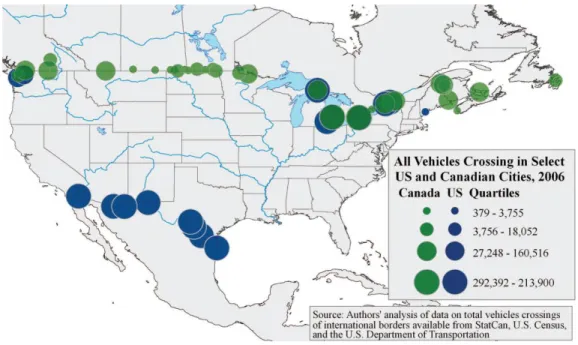
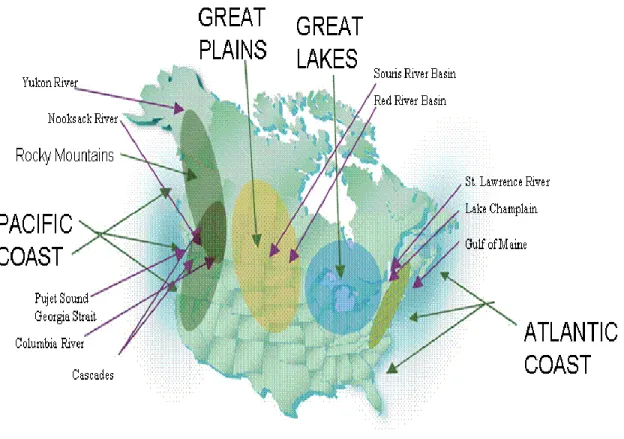
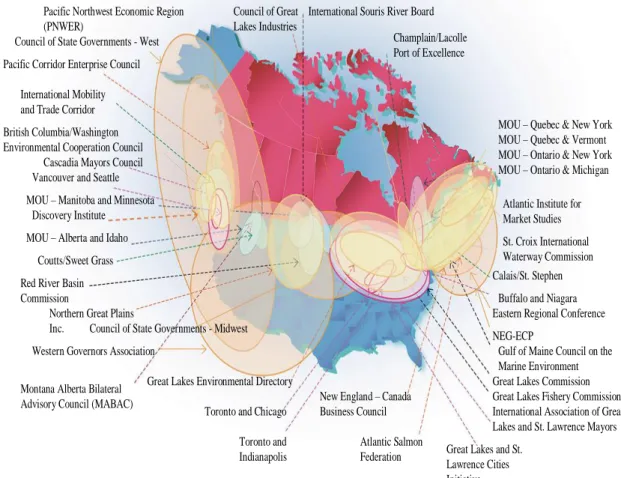
This observation is supported by the fact that cross-border linkages in North America are concentrated around flows of trade (see Figure 1) and shared ecosystems (see Figure 2) leading to the formation of four distinct clusters or cross-border regions where those linkages are thickest and most intense (Policy Research Institute, 2005).
In addition to serving as a catalyst for these bilateral relations, more than ever, geography is prompting the United States and Canada to re-consider, adapt, and re- scale the structures which govern their flow. This is particularly evident in the sphere of bilateral environmental policy due to a growing understanding of the fundamental mismatch that exists between geography and the political institutions erected thus far to manage the numerous shared ecosystems at the border. The two societies,
proceeding from a territorialized understanding of nature, have historically sought to impose governance systems that are territorially fixed upon natural resources like lakes and rivers that are fluid and governed by hydrological laws which transcend socially-constructed political boundaries (Norman 2009) and exceed the scope of state sovereignty and the capacity of any one level of government (Lopez-Gunn 2009).
Figure 1: Trade and Traffic Flows in U.S.-Canada border Source: Austin et al. 2008, 13
Our conceptualization of transboundary water governance has long been mired in what Agnew (1994) termed the territorial trap, which is a Westphalian conceptualization of the state and sovereignty as territorially bounded and hierarchical, based on the conceptual separation of domestic and international affairs, and on the conceptualization of the state as a container of social and political-
United States-Canada Shared Ecosystems and Cross-Border Regions
Figure 2: Four Cross-Border Regions Source: Policy Research Institute, Canada, 2008, 3
-processes (Agnew 1994, 1995, 1999). Consequently the dominant paradigm for transboundary water governance has been a state-centric, hierarchical, federal-to- federal model, reflected for example in regime theory, which espouses top-down management of transboundary water-issues through international agreements, protocols, compacts and global conferences that minimize or ignore non-central-state actors. It is often termed the ‗cascade model‘ because sub-national actors are portrayed as the passive recipients of policy direction from on high (Bulkeley and
Essentially we are now slowly realizing that the principle of ‗spatial exclusion‘ (Agnew 1995) underpinning our long-held conceptualization of the state is incongruent with transboundary water issues that are inherently too complex and interconnected—affecting agriculture, industry, energy, and health policy—and too fluid—affecting the local, regional, national and global scales—to be addressed by any single jurisdictionally bounded organization, institution, or regime (Biswas 2004). To illustrate, a single governmental agency such as the Environmental Protection Agency (EPA) is ill-equipped to protect the interests of American port communities on the St. Lawrence River whose drinking water is affected by effluent from Canadian paper mills, whose reliance on fisheries for subsistence is threatened by invasive species introduced by international ocean freighters from Asia and Latin America, and whose dependence on the shipping industry makes them sensitive to global processes such as global warming which alter the levels of the waterways.
Only within the last decade have we become alive to the fact that watersheds simultaneously interact with processes at all levels between the local and global and thus begun to comprehend the need to develop a comprehensive, holistic, multi-scalar approach to watershed management (Conca 2006). Hence, we are witnessing a paradigm shift from top-down, state-centric models of transboundary watershed management to an Integrated Water Resources Management (IWRM) approach with a clear emphasis on collaboration, de-centralization, and a new localism, based on the assumption that local community involvement improves the decision-making process (Corry and Stoker 2002; Biswas 2004).
As a result of these changes in our perception of natural resources and their management, we have witnessed over the last two decades the democratization of water governance and a proliferation in the quantity and variety of governance instruments being applied to transboundary water governance. Lopez-Gunn (2009) argues,
This realization or shift in the perception of groundwater as a common resource and as a flow rather than a stock also has subtle - yet crucial institutional implications. It shifts the focus towards a process-oriented outlook on managing a common flow through appropriate institutional frameworks, such as networks operating at multi-scalar levels, including international, regional, national and local partnering opportunities between international institutions, state, private and civil society, NGOs, communities, individuals and epistemic communities (42).
These changes have sparked a new period of institutional innovation and rescaling as the United States and Canada increasingly adapt their political structures in order to accommodate their geography, and not vice-versa.
One of the hallmarks of this period of democratization and innovation is the re-scaling of environmental governance downwards. A growing variety and number of sub-central governments and non-state actors are interacting across the border in order to manage the environment and balance the tension at the heart of the relationship between Canada and the United States. Analyzing the number of transboundary water governance instruments (i.e. treaties, memoranda of agreement, organizations) created per decade across the Canada-U.S. border between 1900 and 2007, Norman and Bakker (2009) concluded that ―the majority of instruments created since the 1980s were conceived and implemented at the sub-national level‖ (106) as part of a clear trend toward greater sub-national (provincial/state) and local (sub-
state/sub-provincial) participation in cross-border environmental policymaking (See Figure 3).
Figure 3: Number of federal and sub-national governance instruments created per decade (1900-2007)
Source: Norman and Bakker 2009, 105
Consequently, in his study, ―The Canada-U.S. Relationship at the Turn of the Century‖, Alan Schwartz (2000) observed that ―there is a complex web of interactions on many levels‖ (223). Although we have attained a more sophisticated appreciation of this complexity, our understanding of who participates in the bilateral environmental relations between Canada and the United States, remains incomplete.
Until the 1990s, bilateral relations between the United States and Canada were predominantly understood to be the exclusive domain of federal governments, due in large part to a strictly formal, constitutionally defined understanding of jurisdictional authority in international affairs (Carroll 1983). Gradually, scholars peeled back, and
cross-border interactions between provinces and states (Munton and Kirton, 1996;
Alper 1997; Rabe 1997; Smith 2002). Subsequent investigations uncovered intricate networks of cross-border exchanges, a kind of micro-diplomacy not confined to the public sector but including non-governmental organizations and industry. Munton and Kirton (1996) and VanNijnatten (2003), for instance, found that epistemic communities composed of scientific and technical experts from government, non- governmental organizations, and industry were prerequisites for the day-to-day operation of the bilateral relationship as well as critical components for successfully completing intermittent high-profile environmental negotiations.
Yet, despite the more nuanced appreciation of the multilevel character of bilateral environmental relations between the United States and Canada inclusive of a greater array of actors, our relative understanding of the role local government plays within this mesh of relations remains a blank space. To paraphrase an observation made by Daniel Latouche (1988), of all government actors, local governments have been the slowest to receive recognition as a bona fide international actor, in part because their potential contribution to theory building and policymaking has been considered negligible (29). The lack of formal-constitutional recognition of local government in the United States and Canada has meant that local governments have traditionally been depicted as inconsequential actors in bilateral environmental policymaking and predominantly ignored. In most minds, they remain ‗bit players‘
(Graham et al. 1998, 1). In 2005, for example, the Policy Research Institute sponsored by the Government of Canada conducted a survey of 110 Canadian and American leaders in the public and private sector to record perceptions of cross-
border linkages between the two countries and found that cities were perceived to be the least useful actors in promoting cross-border linkages, far behind provinces and states, think-tanks, the research community, non-governmental organizations and even chambers of commerce.
The purpose of this dissertation is to correct these unbalanced perceptions by presenting evidence of the ever-increasing policy repertoire of American and Canadian local governments, one that goes far beyond responsibility for local streets and sewers and which takes them beyond the boundary of their city limits, and even beyond the limits of the nation-state, focusing on their expanded participation—
empowerment—in cross-border environmental management within one particular region—the Great Lakes basin. This dissertation seeks to add to the thin body of literature that directly acknowledges the increasing capacity of local government in transboundary environmental management (Allee 1993; De Loe et al. 2002; Frame et al. 2004; Priscoli and Wolf 2009), defined as the degree to which actors can participate in and influence governance, or decision-making, processes (Norman 2009).
At the turn of the millennium, local governments around the Great Lakes lacked a seat at the decision-making table and were virtually invisible in the major bilateral environmental agreements and institutions that formed the structure of Great Lakes environmental governance. Today, local governments work alongside their federal, provincial and state counterparts within a wide range of forums such as the bi-national International Joint Commission and the sub-national Council of Great Lakes Governors, reviewing major international agreements such as the Great Lakes
Water Quality Agreement (GLWQA), and setting priorities and outlining strategies to meet their goals for the basin. In addition, for the first time local governments are being invited to take part in formal governance structures, such as the Canada-Ontario Agreement (COA) which implements major bilateral water agreements on the Canadian side of the border. Furthermore, the first meetings between federal, sub- national, and local governments via a newly established, and previously non-existent, trilateral forum for cooperation were held in the fall of 2009.
What is striking about this transformation is the degree of internationalization of these non-central-state actors. Local governments are bypassing their own national governments in conducting their own foreign policy. For example, Canadian local governments are using the American court system to pressure American industries to adhere to American environmental standards while referring specific complaints not to their own federal government, i.e. Environment Canada, but to the United States Environmental Protection Agency (EPA) and other American institutions. In one recent case the City of Toronto filed an amicus curiae brief in 2005 with a United States court, joining the U.S. federal government, eight states, and twelve non- governmental organizations in an environmental lawsuit against American Electric Power Corporation, one of the largest operators of coal-fired plants in the United States. Toronto‘s participation in the lawsuit was notable not only for the fact that it contributed to the largest pollution reduction settlement by a utilities operator by testifying on the health and environmental costs of transboundary air pollution from American coal fired plants, but it was the first time a Canadian local government utilized an American court system in this manner to conduct its own foreign policy.
In addition, American and Canadian local governments operate beyond the Great Lakes basin and are in constant communication with other local governments across the globe through, for example, their membership in the International Council for Local Environmental Initiatives (ICLEI), a network of close to 500 cities from over 40 countries headquartered in Toronto, Canada, or through collaboration with the Union of Baltic Cities (UBC) headquartered in Gdansk, Poland, a network of over 100 Northern European cities from ten countries, to plan and coordinate the voluntary implementation of tougher carbon emission standards and water conservation measures than their own national governments are adopting. This internationalization of local government stems from a broader trend referred to as glocalization (Swyngedouw 1997), which is a neologism describing the intensifying combination of local and global interactions brought about by advances in transportation and communication so that communities no longer define themselves spatially but socially (Wellman 2002) and thus operate on multiple scales.
While dedicating part of the dissertation to describing their expanded capacities as individual local governments, this dissertation will focus specifically on the development, behavior and role of one particular mechanism for cross-border interaction, the transnational municipal network, which is an institutionalized form of cross-border cooperation between local governments. This dissertation will focus on the only example of a regionally defined transnational municipal network in North America, and the only network whose membership is confined to North American cities. This network, the Great Lakes and St. Lawrence Cities Initiative, institutionalizes cooperation between American and Canadian mayors from over sixty
cities within the Great Lakes basin and operates from a secretariat located on the shore of Lake Michigan in the city of Chicago. This organization finds itself at the heart of the environmental economic nexus, with an explicit mission to secure the economic vitality of the basin by preserving the environmental integrity of the Great Lakes. Combined with a commitment to social equality, these three principles comprise the organization‘s ‗triple bottom line‘.
Thus, one can say, that the regular traffic of bilateral relations between Canada and the United States composed in large measure of issues of trade and water are now passing over a newly established bridge that is the Great Lakes and St.
Lawrence Cities Initiative, which connects the full range of stakeholders, the different levels of government, non-governmental organizations, industry and citizens, and integrates the trade and environmental communities that have traditionally operated on separate shores.
Evidence presented in this dissertation of the viability of the Cities Initiative challenges previous findings that local actors in North America are unable to institutionalize their cross-border relations. Brunet-Jailly (2004) concludes that a
‗competitive-city paradigm‘ permeates cross-border relations in North America predicated on intense market pressures that precludes local governments from establishing and sustaining institutionalized forms of cross-border cooperation.
Norman (2009), in her analysis of transboundary water governance along the United States-Canada border, concludes that ―although local actors are genuinely attempting to engage in transboundary governance, they encounter limited success due to inadequate resources and restricted capacity‖ (141) and that ―local actors are less able
to transcend the border than their nation-state counterparts‖ (141). The emergence of a viable transnational municipal network in the Great Lakes challenges these conclusions. The Cities Initiative is the clearest manifestation of the increased policy capacity of American and Canadian local governments.
The Cities Initiative also exposes the limitations of Norman‘s methodology.
Norman limits her investigation into ‗local actors‘ to non-governmental organizations and First Nations while ignoring local government. This practice is reflective of a wider trend in the study of transboundary water governance (Alper 1996; Schwartz 2000; Fall 2000) of lumping local governments and community organizations together while emphasizing the latter. This dissertation makes the case that local governments, and especially transnational municipal networks, must be studied on their own terms otherwise their distinct nature and behavior is obscured.
Transnational municipal networks have been studied almost exclusively in the context of the European Union (Heinelt and Niederhafner 2005; Kern 2007; Kern and Bulkeley 2009) or in the context of global networks such as the International Council for Local Environmental Initiatives (Bulkeley and Betsill 2003). The Cities Initiative is the first, purely North American example of this phenomenon, and this is the first study of the role of a regionally defined transnational municipal network both within the Great Lakes and within the context of broader bilateral relations between Canada and the United States. Hence, this dissertation is also the first to take the opportunity to study North American and European transnational municipal networks in comparative perspective.
Two important findings emerge from this comparative analysis. It is demonstrated that the mode of transition which transformed cities from inward- looking domestic actors into transnational ones, though showing similarities in Europe and North America, also has its differences which must be taken into account.
In addition to different modes of transition, North American local governments find themselves in a political environment defined by different political opportunities and constraints than cities belonging to the European Union. Foremost in this category, the lack of a robust, overarching supranational superstructure, like the one found within the European Union, conditions the behavior and structure of North American local government cross-border cooperation in important ways that distinguishes these networks from their European cousins.
In addition to outlining the differences between North American and European transnational municipal networks, this dissertation sets out to address common questions related to both. These include, what precipitated local governments to institutionalize their cross-border relations? How do transnational networks govern themselves internally? Do they behave like public or private actors or both and to what effect? What role do these networks play externally, for example, in policymaking? Are local governments simply participating in policymaking, or can they actually influence the process and the outcome?
There are several compelling reasons, besides updating the record, for bringing local government bilateral environmental cooperation into the spotlight.
First and foremost, contrary to previous expectations, a realization is slowly growing that environmental challenges will not be solved at the international level or through
the cooperation of federal governments alone. As Betsill and Bulkeley (2006) argue with regards to climate change, ―it is increasingly clear that nation-states will be unable to meet their international commitments for addressing climate change without more explicit engagement with sub-national action‖ adding that especially in the area of airborne pollutants, for example, ―the local is the most appropriate political jurisdiction for bringing about any necessary reductions in these emissions‖ (141).
Cities potentially have the greatest impact in addressing most environmental challenges, not just climate change, for the simple fact that three-quarters of the developed world now lives in urban regions, which makes them major consumers of energy and emitters of pollution but also sites with the greatest potential for positive change. In their study, ―The Carbon-Neutral Individual‖, Michael Vandenbergh and Anne Steinemann (2007) calculate that individual Americans, through everyday transportation and household energy use, contribute roughly one-third of all carbon emissions in the United States, a proportion that exceeds even total industrial emissions. They conclude that tremendous reductions in pollution can be achieved through small behavioral changes of individual citizens that have a monetary benefit and requires little effort, what they term ―low-hanging fruit‖. Since six-out-of-ten Americans live in the 100 largest metropolitan centers, local governments, as the government closest to individual citizens, are arguably the best placed governments to influence their behavior and make a dramatic positive environmental impact by enacting by-laws, implementing urban planning, organizing information and outreach programs with regards to ‗low-hanging fruit‘ such as recycling, engine idling, home insulation and heating etc.
Cities not only have influence over their inputs and outputs through their control over land-use planning, transportation supply, energy management, and wastewater treatment, but they have extensive expertise to offer federal governments and international regimes in environmental conservation, prevention, mitigation and remediation. With regards to other contributable resources, in terms of dollars-and- cents, American and Canadian local governments around the Great Lakes cumulatively spend $15 billion annually on basic water quality management in the basin (GLSLCI 2008). Simply put, it is time for a reappraisal of local government policy capacity in cross-border environmental cooperation around the Great Lakes so that our perceptions are commensurate with their contributions.
Another compelling reason for analyzing local government is that their increased participation in environmental governance around the Great Lakes has the potential to improve accountability within water governance structures, adding an extra layer of oversight to an otherwise deteriorating regulatory system in the United States and Canada. A recent article published in the New York Times on September 13, 2009, entitled ―Toxic Waters‖, found that violations of the Clean Water Act have risen at a steady pace across the country, and that between 2004-2009, factories and plants have violated the Clean Water Act 506,000 times by over 23,000 companies (Duhigg, 1). The report states that, ―tap water in parts of the Farm Belt, including cities in Illinois, Kansas, Missouri and Indiana, has contained pesticides at concentrations that some scientists have linked to birth defects and fertility problems‖
(Duhigg, 2). One in ten Americans, meaning thirty-one million people, have been exposed to drinking water ―that contains dangerous chemicals or fails to meet a
federal health benchmark‖ (Duhigg, 2). Sixty-percent of polluters were deemed to be in ‗significant noncompliance‘ which means that the discharges of cancer causing agents such as copper, lead, zinc, chlorine and selenium into water systems were not being measured or reported.
More troubling, and reflective of the moth-eaten regulatory system in the Great Lakes and the country, less than three percent of Clean Water Act violations resulted in fines. In an internal memo sent by the current EPA administrator Lisa Jackson to her enforcement deputy, she noted that ―in many parts of the country, the level of significant noncompliance with permitting requirements is unacceptably high and the level of enforcement activity is unacceptably low‖ (Duhigg, 4). The significance of local government mobilization effectively as oversight agents is a critical development in the light of recent comments by Minnesota Congressman James Oberstar that ―the EPA and states have completely dropped the ball. Without oversight and enforcement, companies will use our lakes and rivers as dumping grounds—and that‘s exactly what is apparently going on‖ (Duhigg, 4). The weakened regulatory structure illustrates the negative consequences of the decentralization of North American water policy and the retrenchment of both federal and state governments from water management. As former EPA administer William Reilly states, ―unless the EPA is pushing state regulators, a culture of transgression and apathy sets in‖ (Duhigg, 8), while Matthew Crum, an employee of West Virginia‘s Department of Environmental Protection, observes, ―if you don‘t have vigorous oversight by the feds, then everything just goes limp‖. In such a context, the mobilization of local government as additional oversight agents, as catalysts for the
improvement of accountability structures within the water governance system, takes on a new imperative.
The Great Lakes region is a natural laboratory for analyzing how local governments participate in the management of the economic-environmental nexus at the heart of bilateral relations between Canada and the United States, and presents somewhat of a difficult case, because nowhere in North America is the relationship between energy, economy and the environment so intertwined, the public and private interests of each sector so concentrated and the stakes so high. The region, which includes Indiana, Illinois, Michigan, Ohio, Wisconsin and parts of Minnesota and New York, as well as the province of Ontario and part of Quebec, has been for over a century the center of North American economic development. It is the birthplace of the oil, steel, auto and aviation industries and, according to the Brookings Institute, is the ―primogeniture of the world‘s carbon economy‖ (Austin et al. 2008, 2). As a country, it would be considered the second largest economy in the world, containing almost half of the total manufacturing jobs and one-third of the population of both countries (Austin et al. 2008, 7). The $500 billion worth of annual trade between the region‘s provinces and states represents 62.3 per cent of all trade between Canada and the United States, a third of that passing across the Windsor-Detroit border alone (Austin et al. 2008, 10). As the continent‘s economic engine, it is also one of the largest consumers and producers of energy, with large concentrations of coal-fired electric plants and the largest concentration of nuclear power plants in North America. At the same time, the heavy industrial production and energy consumption poses serious environmental challenges which threaten the integrity of the Great
Lakes, the largest fresh water resource in the world containing 95 per cent of the United States‘ fresh surface water. The environmental footprint also manifests itself in simmering cross-border conflicts in the form of transboundary air and water pollution which has led to the highest rates of respiratory, neurological and other pollution related diseases in both countries. In such a high-stakes game one would expect federal as well as provincial and state governments to keep the management of the economic-environmental nexus free of interference from local government and other external actors by minimizing their role.
Organizational Framework
The organizational framework employed to analyze expanding local government policy capacity has been developed by Hoberg (1997), Harrison (2000) VanNijnatten (2003), and Norman and Bakker (2009) which holds that environmental bilateral relations between Canada and the United States must account for cross- border relations occurring at all levels of government, and that this account must include an examination of both formal and informal relations. Consequently, this dissertation will employ a multilevel governance framework which sees authority being dispersed away from the central-state both vertically, to supranational and sub- national actors, as well as horizontally to non-governmental organizations and other societal actors as well as across borders through both formal and informal channels.
Accounting for informal governance structures is critical since the expansion of sub- national and local government policy capacity in North America stems almost
exclusively from an informal basis (Norman and Bakker 2009) and this has significant consequences for the behavior of transnational municipal networks.
Chapter Two provides a literature review which traces the evolution of our understanding of bilateral relations and the role of sub-central-state actors within them. The chapter will demonstrate how a multilevel governance framework allows us to understand the processes shaping bilateral environmental relations in North America, namely, the reorganization of the state, the re-scaling of policymaking and the internationalization of non-central state actors. Chapter Three will outline the methods that were used to collect and organize data.
Chapter Four will outline how formal authority relating to cross-border environmental cooperation is dispersed within the American and Canadian federal systems. The evolution of formal intergovernmental relations between the federal and sub-national governments is traced in order to demonstrate that the expansion of local government policy was precipitated by the gradual re-balancing and re-scaling of formal relations between federal, state and provincial governments and, in particular, the adoption of a more participatory, collaborative model of intergovernmental relations on both sides of the border that together have led to the opening of political opportunities, the appearance of functional imperatives for local government mobilization, and the stirring of local political entrepreneurialism.
Chapter Five will analyze how the Great Lakes and St. Lawrence Cities Initiative governs its internal and external relations and present what is novel about this particular actor. Fundamentally, what distinguishes transnational municipal actors from all others is the fact that they govern their internal and external relations
as non-state actors, yet as a constellation of individual local governments they remain anchored to the hierarchical federal structure and remain governed by the inherent hierarchical intergovernmental power relations in which they are supremely subordinate. The fact that the network‘s authority is derived almost entirely from informal structures, yet it must operate from a position of weakness within the shadow of hierarchy (Scharpf 1997) of a federal structure, endows the member cities of transnational municipal networks with a sense of their own tenuousness and vulnerability and this understanding dictates how the Cities Initiative conducts its relations with other actors in the basin and how it balances the economic- environmental nexus. This vulnerability pushes the network to act as a catalyst for closer integration, eschewing conflict in favor of cooperation, building new platforms of communication between all levels of government while strengthening existing accountability structures within the governance system. Furthermore, the lack of a supranational superstructure like the European Union with institutions outside the federal structure that could provide transnational municipal networks with political and financial support to test its authority further means that the Cities Initiative is especially concerned with maintaining positive relations with higher levels of government.
Nonetheless, despite the tenuousness of its formal standing, local governments, largely through the Great Lakes and St. Lawrence Cities Initiative, have successfully embedded themselves within the informal governance structures around the Great Lakes and within networks which include all levels of government, industry and non-governmental organizations. Through these informal networks, they have
acquired policy capacity and broken the bounds of their formal constitutional jurisdiction, while at the same time, that policy capacity is increasingly becoming institutionalized in an increasingly formal basis.
The Sixth Chapter will address a fundamental question raised by Peters and Pierre (2004) about the informal basis of multilevel governance in general, and the informal basis for the expansion of local government policy capacity, which is ―to what extent informality entails inequality?‖ (23). In other words, although it is well demonstrated throughout the dissertation that local governments, largely through the Cities Initiative, have acquired a seat at the decision-making table in environmental governance around the Great Lakes, the question remains whether local governments and transnational municipal networks can actually influence the outcome of the policymaking process? Can they affect environmental management around the Great Lakes? The general assumption is that local governments are bit players, passive, captives of industry, and that their attempts at cooperation are thwarted by centrifugal forces of intra-city competition. In short, although increasingly present, local governments are expected to remain ineffectual actors.
The case study presented in this chapter addressing this central concern centers on local government opposition to the expansion of refinery capacity at the British Petroleum refinery in Whiting, Indiana. The British Petroleum expansion represents a difficult case in the sense that local governments were not expected to oppose a project of this scale and import, one that was painted as a matter of national security, and one that was backed by immense political and financial investments by federal, state, and provincial governments, industry, and supported by pubic opinion
which supported the increase in refinery expansion in order to find relief from record gasoline prices by bringing more supply online. Furthermore, the refinery expansion represented significant local and regional investments in an otherwise economically depressed area, precious investments which local governments would not otherwise be expected to delay or endanger. Nonetheless, contrary to these expectations, local government and the Cities Initiative mobilized and successfully opposed the expansion, resulting in decreased discharges of pollutants into Lake Michigan and, most importantly, led to the instigation of a significant regulatory review by the State of Indiana of its permit process, thereby improving the accountability structure around the Great Lakes.
Chapter Seven will draw conclusions from the original research contained in the preceding three chapters, and outline the direction for future studies, as well as provide suggestions for improving environmental management around the Great Lakes.
Finally, a word about what this dissertation will not include. Norman (2009) cautions against the pitfall of what Brown and Purcell dub (2005) the local trap in which it is assumed that ―organization, policies and action at the local scale are inherently more likely to have desired social and ecological effects than activities organized at other scales‖ (Brown and Purcell, 607). Rather, this dissertation joins a major thread emerging within the political ecology literature which posits that ―there is nothing intrinsically desirable about the local scale‖ (Brown and Purcell, 608) and that ―the characteristics of a given scale or scalar arrangement cannot be assumed a priori; rather the social and ecological outcomes of any particular scalar arrangement
are the result of the political strategies of particular actors, not the inherent qualities of particular scales‖ (609). Hence, this dissertation will refrain from making any claim that there are inherent benefits in the inclusion of the local scale in transboundary water governance, but instead will operate from the premise that
―scales and scalar relationships are the object and outcome of political struggle‖
(Brown and Purcell, 620). A corollary of the rejection of these a priori assumptions is that, as will be demonstrated, it is not the rescaling of the governance architecture itself which empowers local governments, although it does provide favorable conditions in which enterprising local governments may empower themselves.
CHAPTER II
LOCAL GOVERNMENT CROSS-BORDER RELATIONS IN
A MULTILEVEL GOVERNANCE FRAMEWORK: A LITERATURE REVIEW
Introduction
On March 16, 2006, Richard M. Daley appeared before the United States Senate Environment and Public Works Committee in his capacity as Mayor of Chicago and the Chairman of the Great Lakes and St. Lawrence Cities Initiative to discuss the Great Lakes Regional Collaboration Strategy to Restore and Protect the Great Lakes, a significant document released in 2005 that sets priorities, objectives and strategies for environmental management in the basin, and lays the groundwork for the forthcoming bi-national review of the Great Lakes Water Quality Agreement.
The Strategy resulted from months of effort on the part of the Great Lakes Regional Collaboration, a network which brought together 1,500 members from the federal, state, provincial and local governments of Canada and the United States as well as representatives of First Nations, non-governmental organizations, and industry, in meetings held in cities across the basin in Rochester, Toledo, Traverse City, and Duluth. In discussing the contributions of local government to the Strategy, Mayor Daley submitted two documents to the Senate Committee. The first was a list of the 48 cities from the United States and 37 cities from Canada who, as members of the Cities Initiative, had deliberated on and formed common positions that were represented in the Strategy. The second document was a letter from David Miller, the Mayor of Toronto and the Canadian Chair of the Cities Initiative, supporting the
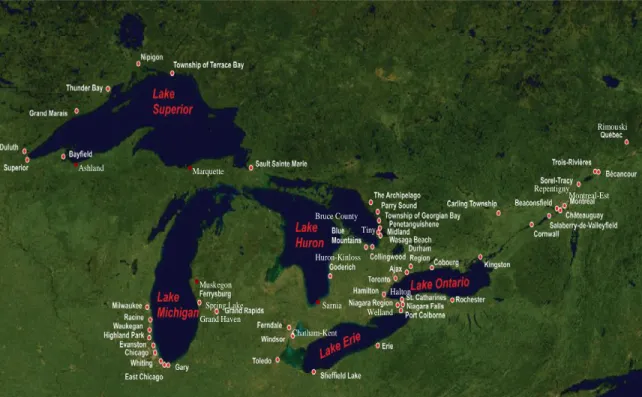
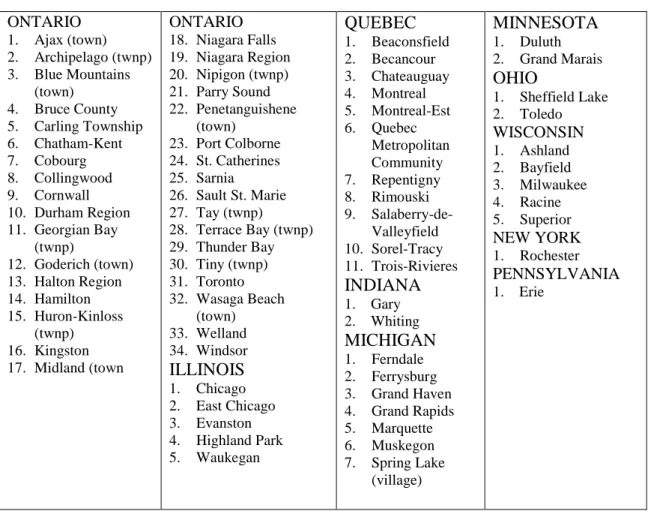
testimony of the mayor of Chicago and presenting to the Committee a very brief update on the work taking place on the Canadian side of the border (For GLSLCI Member-City Map see Figure 4 and Member-City List see Table 1).
Table 1: GLSLCI Member-City List 2009
Mayor Daley‘s testimony in front of the Senate as a delegate of a transnational municipal network institutionalizing cross-border cooperation between American and Canadian local governments that took part in an expansive multilevel, multi- stakeholder, and bi-national collaborative policymaking network illustrates the complexity of environmental policymaking around the Great Lakes. However, two interdependent and complimentary processes can be teased out of this tangled policy
•Sarnia
Grand Haven
•Muskegon
Spring Lake
•Ashland •Marquette
Rimouski
Montreal-Est Repentigny
Chatham-Kent Bruce County
Huron-Kinloss
Welland Tiny
Halton
Figure 4: GLSLCI Member-City Map 2009 Source: www.glslcities.org
Table 1: Member-City List 2009
Source: www.glslcities.org
First, the swarm of actors, both state and non-state, interacting across multiple levels and across national boundaries, in varying combinations, reflects the democratization of transboundary water management. It has been argued that this phenomenon is a hallmark of global processes that are partially ‗hollowing out‘ the state as traditional power bases are eroded (Pierre 2000) and political power is dispersed away from the central-government upward to the supranational level and downward to the sub-national and local level.
ONTARIO 1. Ajax (town) 2. Archipelago (twnp) 3. Blue Mountains
(town) 4. Bruce County 5. Carling Township 6. Chatham-Kent 7. Cobourg 8. Collingwood 9. Cornwall 10. Durham Region 11. Georgian Bay
(twnp)
12. Goderich (town) 13. Halton Region 14. Hamilton 15. Huron-Kinloss
(twnp) 16. Kingston 17. Midland (town
ONTARIO 18. Niagara Falls 19. Niagara Region 20. Nipigon (twnp) 21. Parry Sound 22. Penetanguishene
(town) 23. Port Colborne 24. St. Catherines 25. Sarnia
26. Sault St. Marie 27. Tay (twnp) 28. Terrace Bay (twnp) 29. Thunder Bay 30. Tiny (twnp) 31. Toronto 32. Wasaga Beach
(town) 33. Welland 34. Windsor
ILLINOIS
1. Chicago 2. East Chicago 3. Evanston 4. Highland Park 5. Waukegan
QUEBEC
1. Beaconsfield 2. Becancour 3. Chateauguay 4. Montreal 5. Montreal-Est 6. Quebec
Metropolitan Community 7. Repentigny 8. Rimouski 9. Salaberry-de-
Valleyfield 10. Sorel-Tracy 11. Trois-Rivieres
INDIANA
1. Gary 2. Whiting
MICHIGAN
1. Ferndale 2. Ferrysburg 3. Grand Haven 4. Grand Rapids 5. Marquette 6. Muskegon 7. Spring Lake
(village)
MINNESOTA
1. Duluth 2. Grand Marais
OHIO
1. Sheffield Lake 2. Toledo WISCONSIN 1. Ashland 2. Bayfield 3. Milwaukee 4. Racine 5. Superior NEW YORK 1. Rochester PENNSYLVANIA 1. Erie
Second, within this democratization of the policymaking process, we see evidence of the internationalization of non-central governments (NCG), in this case, involving the internationalization of local government in the form of a transnational municipal network, the Great Lakes and St. Lawrence Cities Initiative. External relations have traditionally resided outside the constitutionally defined jurisdiction of local government hence the institutionalization of cross-border municipal relations can be interpreted as the loosening of those constitutional fetters and an assertion of local power vis-à-vis the state. Local governments have seized the opportunity presented by the reorganization of the state in order to widen and exercise their political freedom, and the transnational municipal network has been an integral vehicle in that process.
Thus, the reorganization of the state and the internationalization of local government are two intertwined processes transforming the mode of bi-national environmental policymaking around the Great Lakes. This chapter will begin by describing how our understanding of the internationalization of local government has evolved, followed by how our understanding of bilateral relations has grown to include a role for sub-central actors such as local governments within the study of transboundary water governance. Finally, a multilevel governance framework will be applied to advance our understanding of the changing role of non-central state actors in policymaking within an evolving and re-organizing nation-state moving away from a centralized, closed model of decision-making.
The Internationalization of Local Government and Transnational Municipal Networks
The internationalization of local government has unfolded in three ways, either through engagement in issues with a foreign policy dimension as individual local governments, as part of temporary alliances, or as members of long-term, institutionalized cooperation. For example, starting with the first form, the City of Oakland waded into international nuclear non-proliferation debates by passing a resolution banning city investments in companies involved in the manufacture of nuclear warheads which was eventually struck down by United States v. City of Oakland (1990). Illustrative of temporary alliances, during the 1980s, hundreds of local governments joined a large-scale divestment movement protesting South African apartheid thereby pressuring the Reagan administration to adopt the Comprehensive Anti-Apartheid Act of 1986 (Shuman 1986; Love 1986). Over 700 local governments have adopted targets set by the Kyoto Protocol when the United States federal government refused to ratify the international agreement on climate change. Sister-city and Twin-city projects institutionalized cultural and economic cooperation. Emblematic of deeper institutionalization of local government internationalization, in the second half of the twentieth century, local governments began joining a burgeoning list of regional and global municipal associations that have transformed them into global actors, such as the United Cities and Local Governments (UCLG), the largest international association of local governments comprising over 1000 members across 120 countries, the World Federation of United Cities, the International Council for Local Environmental Initiatives (ICLEI) and the Great Lakes and St. Lawrence Cities Initiative. The institutionalization of the