
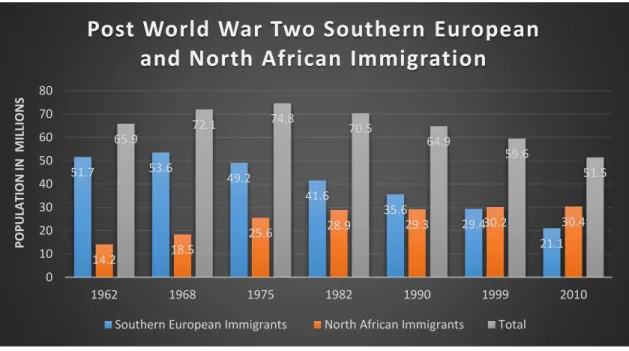
AMBER BREANN MALONE: Exogenous barriers to the integration of second generation North Africans in France. led by Alice Cooper). Three young boys became representatives of the tension between the French authorities and minority youth. Around the same time, the representation of North Africans in France increased (see Figure 1.2).
Following the rate of non-graded immigrant descendants, 41 percent of North African immigrant-descendant men (age 20-35) without a diploma above the brevet are below secondary education, while 33 percent of Southern European men not at least a secondary education diploma (Brinbaum 2012, 47). Scholars must first explain the difference between the socio-economic mobility of these two groups: South European and North African. The importance of the classification is that it indicates the socio-economic mobility of immigrants.
MIPEX
21 | P a g e The author explains the ways in which the level of generosity of benefits affects social mobility: unskilled and low-educated immigrants will tend to seek the most "generous" countries, the motivation of immigrants to improve their social mobility will be hindered from whether there are internal penalties for benefit dependency, and socioeconomic inequality between hosts and immigrants will be higher in generous welfare states (Koopmans 2010, 9). Economic and demographic differences have a significant impact on the participation of immigrants in the labor market (Guiradon. Emphasizing the control and empirical focus of the independent variables, this thesis will focus on explaining the lack of socio-economic mobility of the North African French it may be partly due to political economy: few tax incentives, inadequate access to childcare, segregated housing policies and markets, and discriminatory inclusion in education.
The second chapter will explore how political economy and differential demography handicap the second generation of North Africans in their pursuit of socio-economic success.
Chapter Two: The Political Economy
In this section of exogenous factors, statistics from various sources will be used to determine whether these policies combine to disadvantage immigrant descendants in France or whether North African French are adequately provided with tools to increase their human capital. The correlation between the tax system and the socio-economic status of North African French citizens is mainly reflected in the low labor market participation of the second generation of North Africans. Social demographics, such as family size, are strong signs of differences between North African French, Southern European French and Franco-French.
This section will explore how a tax policy that does not favor dual-earner households affects households larger than the average family size in North Africa. By explaining the French tax system, this section will show how the lack of tax incentives for North African immigrants can lead to low labor market participation and low investment in childcare, affecting the potential academic and professional success of their children. The system of taxes and benefits can have a significant impact on immigrant households in France.
Single-income households in France do not contribute as much tax to the state as dual-income households (see Figure 1). Given the nature of the tax benefit system, it is obvious that this would have a significant impact on the households of North African immigrant families, which are larger than the average native French and Southern European family. A demographic determinant among descendants of immigrants of Southern European and North African descent is household size.
For any North African family, the number of children per mother is significantly greater than in a Southern European family. To be more specific, in 2005 there were an average of 5.4 children per North African mother and.
2013 Distribution Net Transfers to the Government in France
In other words, a parent's occupational level affects access to certain types of childcare. The possibility of parents to be employed in unskilled work reduces the professional mobility of their children since they would not have much cultural and economic capital (Aebehardt 2015, 573). As expected, there is a gap in terms of the quality of education available, academic success and access to moderately paid employment.
Considering the residential location and socio-economic demographics of the second generation of Southern Europe and North Africa, there is evidence of “territorial. The limits of educational provisions most likely place these children in the vocational tract. It is clear that social background and residential location can only be applied as one aspect of the explanation regarding the lack of socio-economic mobility of second-generation North Africans compared to the descendants of Southern European immigrants.
It is the foundation of this institution conducive to facilitating the social and economic incorporation of the second generation of North Africans. The combination of parental strategy, transmission, selection methods for special courses all have a direct impact on the educational attainment and quality of education of immigrant offspring. Unfortunately, parental support is not enough to ensure the success of their children.
47 | In terms of ethnicity, the Portuguese and Moroccans will be representatives of the second generation of Southern Europe and North Africa, respectively. French education places great importance on the participation of parents in the academic growth of their children (OECD 2008, 5). The parents' lack of education and their type of work can affect the children's educational trajectory (Kurzbaum 2009, 38).
However, it is intriguing that this limited progress for North African men is no greater than that of second generation Southern European women.

Chapter Three: Incorporation by Validation
The French have a term for this: communaurtarisme (Garrett France places great importance on the integration of the individual immigrant. 29 Consequently, the way in which the French model of integration is interpreted creates a direct link between immigrants' access to institutions and the power of the State (Garrett 2009, 8) Ancien Régime France is mostly based on the "monarchical faith" and the universal power of the church.
The secularization of the French state required that the entire public service be neutral to religious opinion. The national discourse about the French state model generally arises in relation to Muslim immigrants of North African origin (Garrett 2009, 20). When applied to the issue of the socio-economic mobility of second-generation North African and Southern European French, it is clear that there are discursive constructions in French society that determine the discursive possibilities or rather the invisibility of the second-generation North African French . that the second European-southern generation does not experience.
Politics from the early 1970s to the present is one of the many ways in which North African immigrants are consistently placed in the position of the 'other'. Several scholars call this the politicization of “Muslim” in French society. There is a conflict over the political and ideological title of the North African community as Muslim. Presentation in politics is not the only area of influence regarding the visibility of the North African second generation.
Media such as films, music, magazines and news broadcasts contribute equally to the portrayal of North Africans in French society. Seventy-one percent of respondents believed that the media (particularly the news) play a strong role (Marsh 2003, 6).
Conclusion
67 | Page or characterizes as issues in French society that oppose the socio-economic mobility of the North African second generation. Moreover, these policies and methods of social exclusion would still have an effect regardless of an individual's willingness or unwillingness to integrate. By examining the impact of tax/benefit systems, residency policies and educational structure, the issue of the socio-economic success gap hinges on whether the French government interprets these policies in a way that discourages the integration of some immigrants.
That North African immigrants are the most subject to these policy failures is partly due to their attainment of higher education, family size, employment status of parents and peers, and other demographic characteristics. Information on policies and the status of second-generation French North Africans during the implementation of these policies all confirm that North African French are often overlooked in the creation of policies that lead to their eventual lack of success in education and the labor market. This information rightly calls for a reconfiguration or restructuring of the goals of these policies and how they should be implemented.
68 | A representation that is not "too visible". The debate over the headscarf and the occupational marginalization of women attempting to enter the workforce shows how the visibility of the second generation of North Africans serves to penalize them in the process of incorporation. Political economy as an exogenous factor focuses more on the passive marginalization of North African French while public discourse and secularism imply a more active marginalization of the second generation of North Africa and the natural acceptance of the second generation of Southern Europe. Based on the historical context behind North African immigration and the interaction of North African culture with French culture, the social aspect of the exogenous factor has more weight than the political economy.
However, these social barriers are conflicts that arguably every French North African would encounter, regardless of social and economic demographics. It is the active stigmatization and exclusion of North Africans that influence the creation of these policies and their goals.
Bibliography
Boubeker, Ahmed, Ch Didier Gondola og Peter J. 34;Outsiders in the French Melting Pot: The Public Construction of Invisibility for Visible Minorities." 34;The Integration of Muslim Immigrant Communities: Education Systems in France and Holland." Politica, Berkeley Undergraduate Political Science Journal, november. -Offs between Equality and Difference: Immigrant Integration, Multiculturalism and the Welfare State in Cross-National Perspective." Journal of Ethnic and Migration Studies 36, no.
34;Le Débat Autour De L'identité Nationale Dans La Campagne Présidentielle 2007 : Quelle Rupture ?" French Politics, Culture & Society 27, no. 34; France's secularism is driving young Muslims out of school, work and French culture." International Business Times. 34; Shifting Focus: Policies to Support the Labor Market Integration of New Immigrants in France." Migrationpolicy.org. 34; A Conservative Revolution within Secularism: Ideological Premises and Social Effects of the March Anti-Headscarf Law." In Frenchism and the African Diaspora: Identity and Insurgency in Contemporary France.


