RE-IMAGINING SCHOOL COMMUNITIES: AN EXPLORATION OF THE FACTORS INFLUENCING TEACHERS’ TRUST IN PARENTS
By
Joanna D. Geller
Dissertation
Submitted to the Faculty of the Graduate School of Vanderbilt University
in partial fulfillment of the requirements for the degree of
DOCTOR OF PHILOSOPHY in
Community Research and Action December, 2014
Nashville, Tennessee
Approved:
Maury Nation, Ph.D.
Kimberly Bess, Ph.D.
Claire Smrekar, Ph.D.
Paul Speer, Ph.D.
I dedicate this dissertation to my great-grandparents, for whom I try to do my part to dismantle hatred and fear.
ACKNOWLEDGEMENTS
First, I would like to thank my Dissertation Chair, Dr. Maury Nation. Dr. Nation has helped me formulate, refine, and communicate many ideas over the course of graduate school, always with great enthusiasm and encouragement. I owe many thanks to the rest of my
committee as well: Dr. Claire Smrekar for teaching me qualitative methods, deepening my perspectives and depth of knowledge on the social context of education, and asking critical questions that propelled my work forward; Dr. Paul Speer for opening my eyes to community organizing in such an engaging way and always raising poignant (and humorous) critiques; and Dr. Kimberly Bess for supporting my work in the community.
I would also like to thank other mentors I have had throughout my journey in the educational justice field, including Dr. David Schoem, who first inspired my interest in family engagement back in college; Adam Seidel, who as my boss in my first job out of college, gave me both the freedom and the support to take on new challenges and grow; Robin Veenstra- VanderWeele, who made this work possible through her impassioned leadership to make life better for children and families; and Rosann Tung, who as my current boss at the Annenberg Institute for School Reform has fully supported me as a researcher, social change activist, and human being and has taught me so much in just over a year.
There is no possible way to thank my parents for all they have done to support my education: the hours my Dad spent by my sometimes teary-eyed side as I struggled to grasp algebra; the countless essays my mother marked up in red pen while patiently helping me learn how to write; and the unwavering support of my decisions to pursue all of my higher education in states far away from Massachusetts. From all of the conversations our family shared – around the dinner table, while hiking on summer vacations, and during odd moments here and there – I
learned to love learning and to think critically. A big thanks to my big brother, Greg, who has always shown me the way in life by example and by asking good questions – and listening to the answers – and to my sister-in-law, Alyson, for taking on this same sort of big sibling charge so effortlessly. And, thank you to my little nephew, Alexander, whose smiles and special kisses during his first year on this planet were the perfect dissertation-writing distraction. All of my grandparents have also been an inspiration and a support to me. As a researcher, I strive to ask thoughtful questions half as effortlessly as Oma did and to tell stories half as eloquently as Opa did. Nanny and Poppy have kept me grounded through their unconditional love, their humor, and the pride and interest they take in my work. Finally, I know how proud Pop-Pop would have been to have another doctor in the family.
I would also like to thank my CRA student support network, in particular, Bernadette Doykos, Krista Craven, and Laurel Lunn. Each of these women is a critical and passionate scholar who has inspired me with her strong pursuit for justice. I’d also like to thank other members of my Nashville family, Sandy and Pat and Jody, for making me feel that I had a warm and welcoming home away from home.
Finally, I owe James for my ability to not only stay sane throughout graduate school but genuinely happy. I thank him for both the time and the mental energy he has freed for me to be able to finish my dissertation. He has taken my mind off of writing at all the right times and at other times has focused my mind deeply and critically on the task at hand and re-energized my spirits with his constant encouragement and enthusiasm about my work. He challenges me to always improve while never letting me forget that he will always love and respect me just the way I am. And, the final product would not be nearly as strong without his creative talents. I look forward to many years of many forms of partnership.
TABLE OF CONTENTS
Page
DEDICATION ... ii
ACKNOWLEDGEMENTS ... iii
LIST OF TABLES ... vi
LIST OF FIGURES ... vii
Chapter I. Introduction ...1
II. Theoretical Framework and Literature Review ...5
Theoretical Framework: Trust and Collective Trust ...5
The Relevance of Trust to Family Engagement ...5
Challenges of Trust-building ...7
Collective Trust ...10
Re-defining Teacher/Family Trust for Modern Times ...15
Ecological Influences on Faculty Trust in Families ...19
School Context and Collective Trust ...24
Summary and Study Purpose ...30
III. Methodology ...35
Study Background ...35
Study Schools ...37
Teachers Involving Parents (TIP) ...39
My Role ...41
Methods Overview ...42
Data Collection ...44
TIP Observations ...46
Document Analysis ...47
Interviews ...49
Surveys ...52
Data Analyses ...54
IV. Mirrors of Society: How External Factors Influence Individual Faculty
Trust in Families ...60
Faculty Trust in Families and Faculty/Family Interactions ...61
Explanations of Differences in Trust ...65
Hegemonic Norms and the “Good” Parent: “These Parents Don’t Do That” ...65
The Emotional Toll of Family Engagement: “I Want to Shake You” ...73
Educational Policy’s Toll on Family Engagement: “The Parents Should be Held Accountable, Too” ...78
Conclusion: The Overlooked Riskiness of Family Engagement V. Setting the Stage: Collective Faculty Trust and School Behavioral, Affective, and Cognitive Mechanisms ...84
A Portrait of Collective Faculty Trust in Families ...84
Behavioral Environment ...90
Affective Environment ...93
Cognitive Environment ...98
Conclusion ...103
VI. Interventions Playing Out Differently: The Varying Contributions of TIP and Community School Coordinators to Collective Faculty Trust ...105
Influence of TIP on Collective Faculty Trust in Families ...105
Differences in TIP Implementation ...108
Principal Buy-in ...109
Credible Challengers ...111
TIP Interactions with Behavioral, Affective, and Cognitive Climate ...114
Influence of Coordinators on Collective Faculty Trust in Families ...118
Conclusion ...126
VII. Discussion ...128
Strengths and Limitations ...129
Re-visiting an Ecological Approach to Collective Faculty Trust in Families132 Contextual Considerations for Faculty Social Exchange ...132
Vulnerabilities at the Individual Level ...136
School-community Partnerships and Collective Faculty Trust in Families ...138
Implications for Program and Practice ...140
Implications for Policy ...149
Directions for Future Research ...150
Conclusion ...152
REFERENCES ...153
Appendix
A. Trustworthiness and Authenticity ...165
B. Interview Protocol for TIP Participants ...172
C. Interview Protocol for Non-TIP Participants ...175
D. Codebook ...177
E. The Dual Capacity-Building Framework for School/Family Partnerships ...180
LIST OF TABLES
Table Page
1. Definition of Trust ...5
2. Types of Trust and Challenges Posed to Collective Faculty Trust in Families ...8
3. Demographics and Academic Achievement of Study Schools ...39
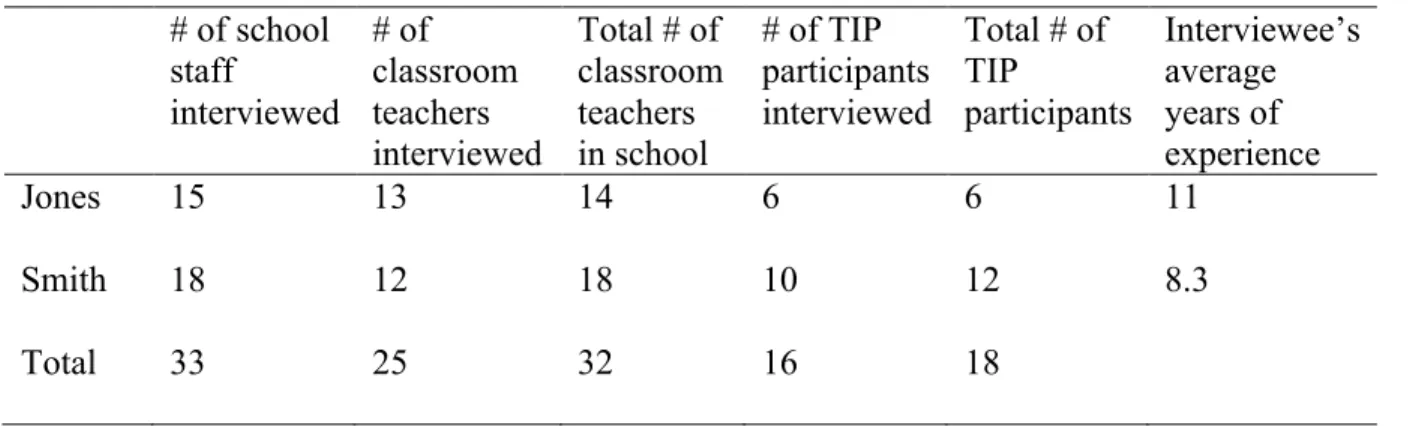
4. Sample Information for Faculty Interviews ...50
5. Analytic Steps Using the Constant Comparative Method ...56
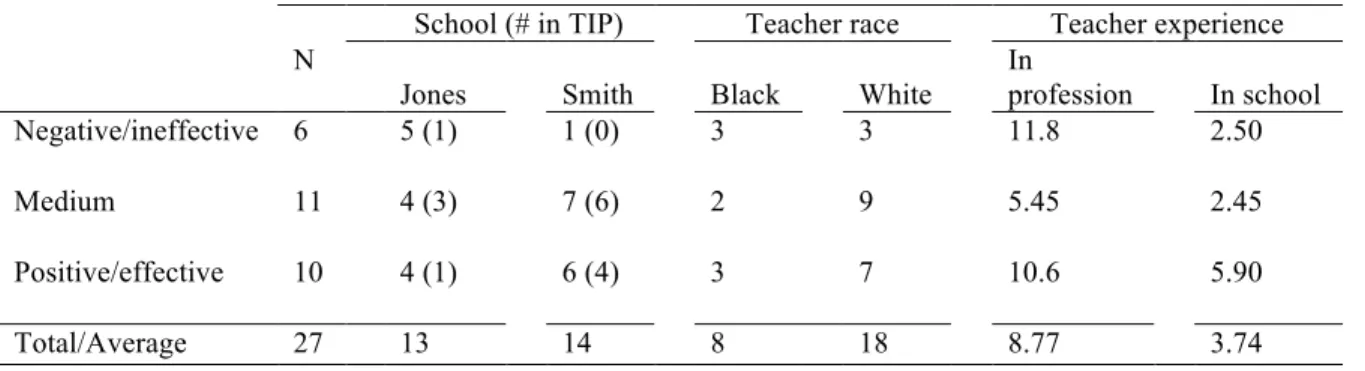
6. Descriptive Information for the Three Faculty Groups ...60
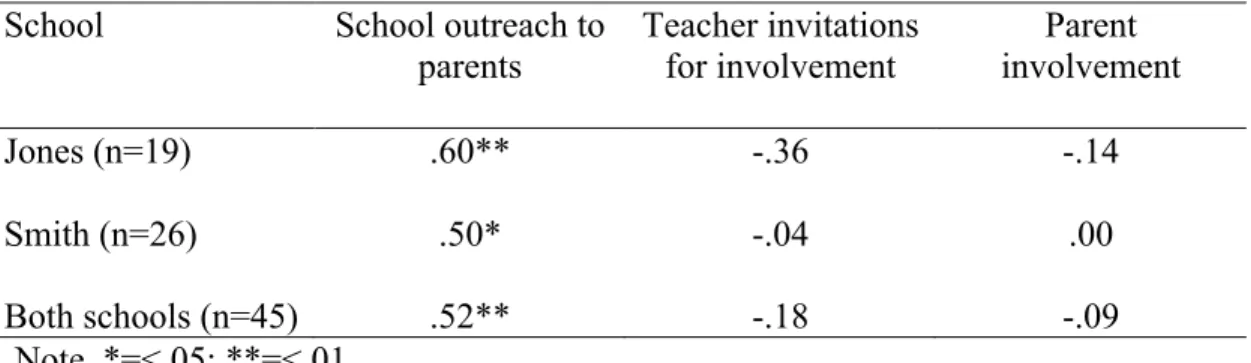
7. Spearman Correlation Coefficients Between Parent-Teacher Trust and School Outreach to Parents, Teacher Invitations for Involvement, and Parent Involvement ...90
8. Faculty Group Classification Before and After TIP Program ...106
9. Recommendations for Improving Collective Faculty Trust in Families ...146
LIST OF FIGURES
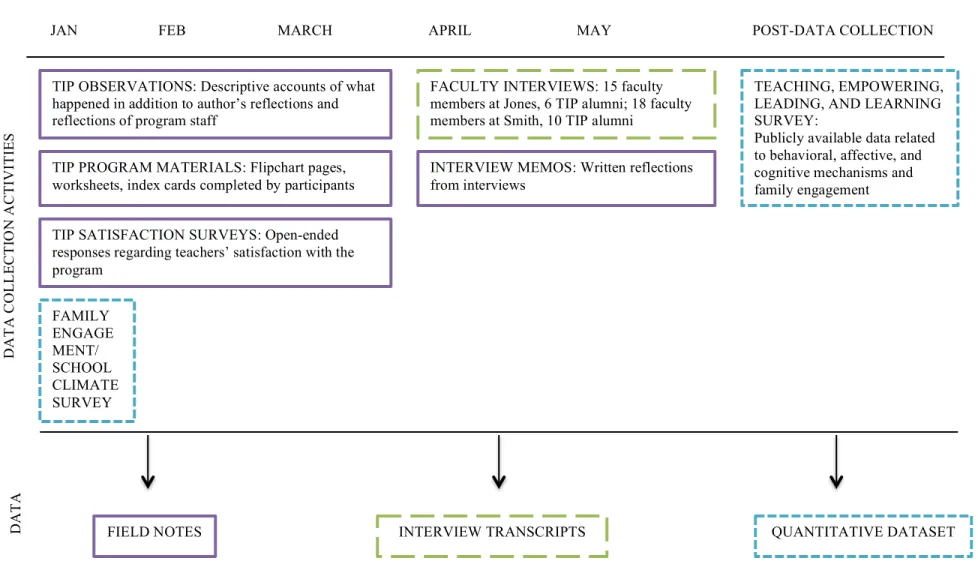
Figure Page 1. Conceptual model for collective faculty trust in families ...33 2. Data collection activities and corresponding data ...45 3. Percentage of faculty who report spending various amounts of time per
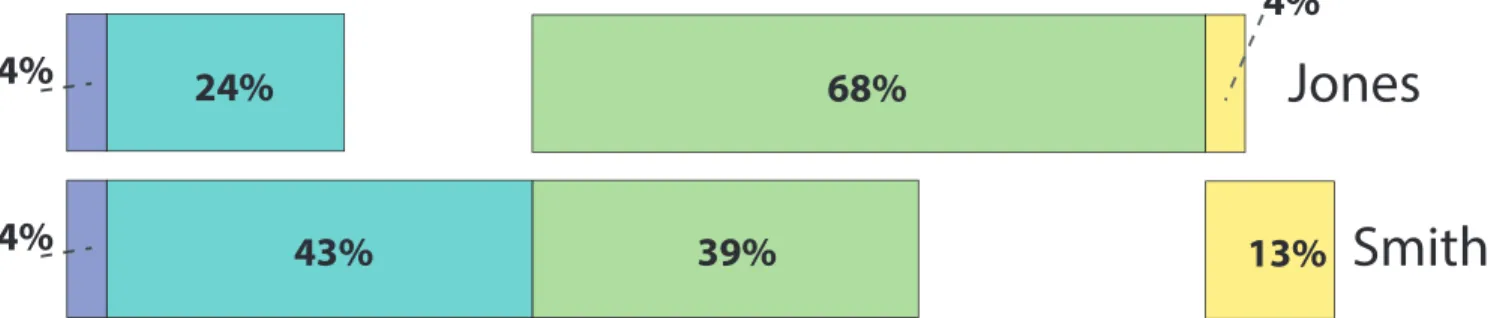
week in required committee/staff meetings ...91 4. Percentage of faculty who report spending various amounts of time per
week on collaborative planning ...91 5. Percentage of faculty who believe that their school is a good place to
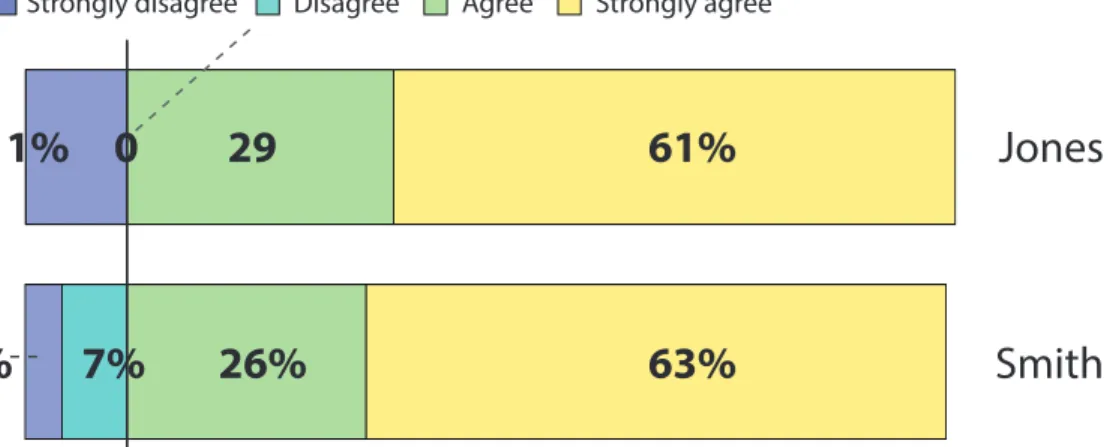
work and learn ...94 6. Percentage of faculty who believe that teachers have a role in school
improvement ...99 7. Differences between faculty social exchange during TIP at Jones and
Smith composition ...111 8. Interaction of factors influencing differences in TIP outcomes ...127
CHAPTER I
INTRODUCTION
Despite a massive body of research on family engagement in urban schools, widespread district, state, and federal family engagement policies, and a proliferation of school- and
community- based family engagement programs, urban schools continue to struggle with family engagement (Hornby & Lafaele, 2012; Mapp, 2012). While there is evidence that home-school collaboration (e.g. teacher/family communication, family involvement in school decision- making, family volunteering) benefits children (Grolnick & Slowiaczek, 1994; Houtenville &
Conway, 2008; Jeynes, 2005; Lee & Bowen, 2006), teachers (Lareau, 2003), families (Hong, 2011), and schools (Bryk, Sebring, Allensworth, Luppescu, & Easton, 2010), there is limited evidence that interventions to improve home/school collaboration improve student outcomes, and moreover, they may do little to improve home/school collaboration itself (Mattingly et al., 2002; White, Taylor, & Moss, 1992).
Many of these interventions have potentially floundered because they focus heavily on the achievement of specific goals or objectives, such as reaching out to parents using new forms of technology, additional math nights, or hiring family engagement coordinators. Yet, technical solutions alone are insufficient to disrupt enduring cycles of social reproduction in poor, urban schools (Rogers & Oakes, 2005). These interventions tend to overlook the importance of how altering institutional and individual norms, values, and attitudes facilitate changes in processes, structures, and systems (Chapman, 2002; Warren & Mapp, 2011). In the past decade, a wealth of compelling educational research in urban contexts has demonstrated how relational trust is a
critical precursor to the type of effective cooperation that makes schools thrive (Bryk &
Schneider, 2002; Bryk et al., 2010; Forsyth, Adams, & Hoy, 2011; Tschannen-Moran & Hoy, 2000). At urban schools with high levels of family engagement, faculty trust in families is a normative property of the school culture (Bryk & Schneider, 2002; Bryk et al., 2010; Tschannen- Moran & Hoy, 2000). Schools with high levels of collective trust socialize faculty to believe that putting effort into family engagement will be worth their while. Several studies indicate that collective faculty trust in families and students is an important predictor of academic
achievement, as it is associated with overall optimism about students’ potential (Adams, Forsyth,
& Mitchell, 2009; Goddard et al., 2001, 2004; Hoy, 2002; Tschannen-Moran, 2001).
Derived from their comprehensive review of extant literature relating to trust in schools, Tschannen-Moran and Hoy (2000) generated a definition of trust that pertains to relationships between and among actors in school communities. The authors define trust as one role group’s (e.g. teachers) willingness to be vulnerable to another role group (e.g. families) based on the confidence that the group is benevolent, reliable, competent, honest, and open. Trust is an interdisciplinary construct: psychologists examine trust in dyadic relationships, whereas
sociologists conceptualize trust as a collective property that develops by social exchange within and between role groups (Forsyth et al., 2011, p. 22). Compared to trust between individuals, collective trust is more stable over time. For example, when trusting families is a school-level norm, faculty are less likely to form negative opinions of all families due to sporadic negative interactions with some families (Hoy, Tarter, & Hoy, 2006). Thus, schools are more likely to effectively engage families when there is a collective willingness among faculty to risk vulnerability to cooperate with families based on the confidence that families care about their children’s education, possess strengths to help their children succeed, tell the truth, do not
withhold important information, and do what they say they will do.
An emerging literature of critical family engagement imagines schools that question exclusionary and privileged family engagement definitions and appreciate strengths of low- income and minority families (Auerbach, 2007; Baquedano-López, Alexander, & Hernandez, 2011; Moll, Amanti, Neff, & Gonzalez, 1992; Yosso, 2005). Despite these important
contributions, much of this work focuses on relationships between individual teachers and parents, rather than on how faculty trust in families becomes a normative property of schools.
Meanwhile, research on collective faculty trust in families and students (Forsyth et al., 2011;
Hoy, 2012) has not closely examined the contextual conditions that influence individual faculty members’ attitudes toward low-income families, including hegemonic racism, classism, and sexism; concentrated neighborhood poverty; and educational policies and discourses that threaten teachers’ willingness to be vulnerable to authentic family engagement and that hinder school improvement. This study attempts to integrate an understanding of how these contextual factors influence individual faculty – the contribution from critical family engagement studies – with an understanding of how schools can be organized to mitigate this influence – the
contribution of the collective trust and school organizational literature.
The purpose of this study is to examine how factors at multiple contextual levels
constrain and support the development of collective faculty trust in families. Although the study revolves around an in-service professional development program to help teachers improve family engagement, Teachers Involving Parents (TIP; Hoover-Dempsey, Walker, Jones & Reed, 2002), the study setting is particularly rich for investigating how context shapes collective trust, as the program operated in two elementary schools designated as community schools that are part of a larger place-based educational reform initiative (Geller, Doykos, Craven, Bess, & Nation, 2014).
I primarily use qualitative methods to understand how the effects of TIP interact with these broader initiatives, as well as school-level organizational characteristics and the broader
educational policy environment. Before discussing the study’s methods in detail, I first describe the theoretical frameworks guiding this study, introducing a conceptual model for predicting collective trust based in ecological theory. I then review extant literature supporting this model.
CHAPTER II
THEORETICAL FRAMEWORK AND LITERATURE REVIEW
Theoretical Framework: Trust and Collective Trust
This section details the relevance of trust to improving family engagement, challenges to establishing trust between faculty and families in poor urban areas, and limitations to current conceptualizations of collective faculty trust.
The Relevance of Trust to Family Engagement
Trust is defined as the willingness to be vulnerable to another role group based on the confidence that the group is benevolent, reliable, competent, honest, and open (Tschannen- Moran & Hoy, 2000). Trust is not a behavior or a choice, but an underlying psychological condition that can cause or result from behaviors and choices (Rousseau, Sitkin, Burt, &
Camerer, 1998). Table 1 details each definitional component.
Table 1. Definition of Trust
Component of trust Definition
Benevolence Faith in the altruism of the other
Honesty A correspondence between one’s statements and deeds Reliability A sense of confidence that one’s needs will be met in a
situation of interdependence
Competence When good intentions are not enough and a certain level of skill is expected to fulfill an expectation
Openness Where people make themselves vulnerable to others by
Although critical family engagement research emphasizes relationships (Greene, 2013;
Hong, 2011; Lawrence-Lightfoot, 1978), none of this work has deeply examined the role of trust in these relationships. One could argue that cooperation between teachers and parents could be guided through other relational mechanisms besides trust, such as caring (Noddings, 1988), empathy (Greene, 2013), or respect (Lawrence-Lightfoot, 2000). So, why focus on trust? Two conditions distinguish trust from caring, empathy, and respect: interdependence and risk (Rousseau et al., 1998). Trust can only exist when individuals or groups rely on one another (interdependence) and when there is something to lose (risk).
Interdependence and risk are critical components of faculty/family relationships.
Although there is debate about the extent to which academic achievement depends on interdependence between the teacher and the parent, research supports that some
interdependence is important (Coleman, 1988; Hoy, 2012; Jeynes, 2005; Robinson & Harris, 2014). However, trust is also important because of teachers’ perceptions of the need for interdependence with families. Local, state, and federal educational policies have increasingly focused on family engagement since No Child Left Behind (NCLB) (Evans, 2011; Nakagawa, 2006; Rogers, 2006). Such policies have been bolstered by the inflation of research that constructs a narrative that more family engagement is the solution to achievement gaps and teachers cannot succeed without it (Nakagawa, 2006).
Teachers might become frustrated with parents when they perceive a need for
interdependence, but cannot trust parents do their part in the division of labor. An absence of relational trust causes people to take fewer risks, feel uncomfortable around one another, and increasingly monitor and search for negative motives of one another (Tschannen-Moran & Hoy, 2000). Even if there were no evidence that faculty/family trust and cooperation improved student
outcomes, at the very least, improving faculty trust in families would improve negative emotions that teachers and families feel in the absence of trust (Hargreaves, 2001; Lewis & Forman, 2002). An absence of trust threatens faculty/family cooperation but also may fuel a hostile relationship that might be detrimental to the well-being of the parent, teacher, and child.
With interdependence comes risk. While empathizing, respecting, and caring are not inherently risky because they can be one-sided, trust assumes interdependence; henceforth, its betrayal can disappoint the trustor. To fully trust, one must be confident that she will not be harmed. The framework of trust recognizes the sense of vulnerability and negative emotions that teachers may experience when their efforts to engage families are unsuccessful (Evans, 2011;
Hargreaves, 2001; Lawson, 2003; Lewis & Forman, 2002). Understanding the limbo teachers face when they perceive that their professional and personal well-being depends on families – but that they cannot trust families – helps highlight the types of supports teachers need to be successful with family engagement.
Challenges of Trust-Building
Establishing trusting relationships between teachers and families in poor communities presents unique challenges (Hargreaves, 2001; Hong, 2011; Lareau, 1989, 2003; Lightfoot, 1978). Reviewing multiple types of trust, Tschannen-Moran and Hoy (2000) identified some of the challenges (see Table 2).
Table 2. Types of Trust and Challenges Posed to Collective Faculty Trust in Families Type of Trust Definition Challenge for Collective Trust
Characteristic-
based One party extends trust more readily to another party who they perceive as similar.
Socioeconomic and racial differences between teachers and families in urban areas render characteristic- based trust unlikely.
Institution-
based One party trusts another party because of that party’s
credentials or a contract.
Poor families tend to lack such institutional credentials that may automatically deem them trustworthy and school/family engagement contracts risk perpetuating uneven power.
Calculative One party accepts a certain level of vulnerability based on calculations of the costs of a relationship with another party.
Through family engagement, teachers risk that the benefits of family
engagement will not outweigh the costs of disappointment from failure.
Relational One party trusts another party through regular communication and social exchange.
Teachers and families have limited opportunities for interaction and these interactions are often
characterized by misunderstanding.
Although trust is often established through contracts and sanctions, Bryk and Schneider (2002) argue that cooperation between teachers and parents requires relational trust (or
knowledge-based trust). Relational trust is characterized by a trustor’s beliefs in the positive intentions of the trustee and an absence of beliefs in negative intentions. This type of trust derives from repeated actions over time between trustor and trustee, leading to emotions rooted in reciprocated care and concern (Baier, 1986; Rousseau et al., 1998; Tschannen-Moran & Hoy, 2000). Without relational trust, teachers are less likely to risk being vulnerable to families, and
schools are more likely to enact contractual trust, which all too often involves compacts between teachers and parents that are one-sided and exacerbate uneven power dynamics (Baier, 1986;
Nakagawa, 2001).
Although relational trust is the most promising for meaningful cooperation between parents and teachers, empirical research indicates that more social exchange does not necessarily improve trust between faculty and families. In one case study, for example, Crozier (1999) found that the longer teachers were at the school, the more cynical they became and the less effort they made to relate to parents. Another study found that the quality of faculty/family interaction is a stronger predictor of trust than the frequency of interaction (Adams & Christenson, 2000). Yet, interactions between teachers and low-income families tend to be riddled with conflict,
frustration, and misunderstanding (Hargreaves, 2002; Lareau, 1989, 2003; Lawrence-Lightfoot, 1978; Todd & Higgins, 1998).
Rousseau and colleagues (1998) note that trust can be both an independent and dependent variable. Thus, trust predicts how teachers will interact with families, and these interactions strengthen or diminish trust. Several ethnographic studies have illustrated “the teacher-parent relationship cycle,” whereby teachers view parents as being apathetic toward school and thus see no merit in reaching out to them; thus parents participate more passively, reinforcing teachers’
beliefs that they do not care (Doucet, 2011; Huss-Keeler, 1997). Once strong relational trust is in place, however, scholars argue that violations of trust are less likely to diminish it (Bryk &
Schneider, 2002; Tschannen-Moran & Hoy, 2000). Given the challenges noted above, this study seeks to augment previous research regarding what factors facilitate and impede relational trust between teachers and parents (Greene, 2013; Hong, 2011; Lareau, 1989; Lawrence-Lightfoot, 1978, 2003). How relational trust becomes a school-level property becomes even more
challenging, as will be discussed next.
Collective Trust
Institutions promote or constrain trust relations (Fukuyama, 1995), which is why Forsyth and colleagues (2011) conceptualized collective trust as an institutional rather than individual phenomenon. Collective faculty trust in families is a norm and a property of the school culture, rather than a sum of individual beliefs (Adams & Forsyth, 2013). According to factor analysis, faculty trust in parents and faculty trust in students forms a single dimension of trust, labeled,
“faculty trust in clients” (Hoy & Tschannen-Moran, 1999). Several studies indicate an
association between collective faculty trust in students and families and academic achievement.
Using multi-level modeling, a study of 47 elementary schools in one large urban district
indicated that collective trust significantly predicted reading and math achievement, controlling for student-level SES, gender, race, and prior achievement and school-level SES (Goddard, Tschannen-Moran, & Hoy, 2001). A much less rigorous study, from an analytical perspective, found that among 97 urban, rural, and suburban high schools, collective trust in clients and math achievement were significantly correlated, controlling for student SES (Hoy, 2001). Adams and Forsyth (2013) found that student self-regulated learning mediated the positive and significant relationship between collective faculty trust in clients and reading and math standardized test scores in 56 elementary schools in an urban district.
Researchers posit that collective faculty trust in clients not only fosters improved
collaboration between teachers and parents but also influences academic achievement through a school culture of “academic optimism” (Hoy, 2012). Academic optimism is a construct
comprised of three inter-related sub-constructs: collective faculty trust in students and parents;
collective efficacy (i.e. teachers’ ‘can do’ attitude); and academic emphasis (i.e. collaborative
work practices and high academic expectations and standards). Hoy and Tarter (2006) argue that academic optimism predicts academic achievement because it “views teachers as capable, students as willing, parents as supportive, and the task as achievable” (p. 40). For example, Adams and Forsyth (2013) found that student self-regulated learning mediated the positive and significant relationship between collective faculty trust in clients and reading and math
standardized test scores in 56 elementary schools in an urban district. The authors posit that when teachers trust their students and students’ families, they are less likely to control student behavior using threats and incentives that thwart intrinsic motivation.
To the best of my knowledge, Forsyth and colleagues (2013) have conceptualized the only model pertaining to the development of collective trust in schools. They posit that collective trust is established most proximally by “social construction,” referring to social exchanges within a group whereby group-members make comparisons between expected and observed behaviors of members of another group and evaluate that group based on its openness, honesty,
benevolence, reliability, and competence. Therefore, collective faculty trust in families would be established when faculty’s experiences with families meet their positive expectations and faculty communicate these positive expectations and experiences with one another through social
exchange. The authors argue that individuals begin to think increasingly alike the longer they are part of a group. Once collective trust is established, new faculty gain acceptance by adopting this norm, and failure to do so results in sanctioning from colleagues (Adams & Forsyth, 2013), particularly from the “elite” faculty members who are the main socializing agents (Forsyth et al., 2011).
However, the authors do not explain in detail exactly how social exchange might result in collective trust or detail what social exchange looks like in a school setting. Literature on
collective efficacy in schools might be useful to inform how collective trust develops. Collective efficacy refers to members’ perceptions of the performance of the system as a whole (Bandura, 1986). In schools with high levels of perceived collective efficacy, all teachers believe the school can excel, which encourages them to try their hardest and discourages them from giving up (Goddard, 2004). Although collective trust and collective efficacy are two different constructs, they are closely related because they both emphasize optimism as a force for change and social norms (Hoy, 2012). According to Bandura (1986), norms for collective efficacy form through mastery, vicarious experience, and social persuasion. Thus, norms for collective faculty trust might develop when faculty learn it by mastering it (e.g. “I trusted a parent and it paid off”), by vicarious experience (e.g. “My colleagues trusted parents and it paid off”), and social persuasion (e.g. “My colleagues encouraged me to trust parents”). One could also imagine that a teacher who trusts families may influence the social construction of trust in multiple ways: sharing with colleagues her own strategies to build trust with families and including colleagues in these strategies (i.e. helping colleagues gain mastery); sharing how the benefits of trusting families has outweighed the risks (i.e. offering colleagues vicarious experience with trusting families); and challenging her colleagues’ deficit views toward families (i.e. social persuasion to trust).
According to Forsyth et al.’s (2011) model, the social construction of trust is influenced by external context (i.e. environmental influences and experiences that shape the values,
attitudes, and expectations of individual group members), internal context (i.e. influences within an organization that affect the values, attitudes, and expectations of individuals and groups within the organization), and task context (i.e. the group’s activities). Reviewing the extant literature, the authors conclude that internal context involves: a) behavioral mechanisms, including behaviors and structures that support healthy communication in schools; b) cognitive
mechanisms, including an orientation to innovation within the school (Bryk & Schneider, 2002) and teacher collective efficacy (Goddard, 2001) and c) affective mechanisms, including inter- faculty trust (Bryk & Schneider, 2002) and sense of belonging. Regarding external context, the authors review several studies finding that higher school minority and socioeconomic
composition negatively influences faculty trust in students and parents (Adams, Forsyth, &
Mitchell, 2009; Bryk & Schneider, 2002; Goddard, Tschannen-Moran, & Hoy, 2001; Goddard, Salloum, & Berebitsky, 2006). However, the authors argue that poverty and school minority composition only affect collective trust to the degree that these variables influence school behavioral, cognitive, and affective mechanisms, an oversimplification of how macro-level factors influence collective trust (Rousseau et al., 1998). Notably, all of the research on collective trust in schools is quantitative.
Ecological systems theory (Bronfenbrenner, 1979) informs how this model may be revised to further account for broader contextual forces (Greene, 2013; Lawrence-Lightfoot, 1978), as well as the reciprocal influence of individuals and their social context. Much of the extant literature on relationships between school staff and families acknowledges that families are influenced by ecological factors (e.g. neighborhood poverty, single parenthood, the labor market, etc.), but with some exceptions (Hargreaves, 2005; Lawrence-Lightfoot, 1978; 2003;
Lawson, 2003; Lewis & Forman, 2002), largely overlooks how various contextual factors influence teachers’ attitudes toward families. Overlooking these contextual factors threatens to perpetuate the tendency of educational literature to attribute poor achievement solely to deficient teachers and failing schools (Lawrence-Lightfoot, 2003). Further, an understanding of how contextual factors influence teachers, their relations to one another, and the school environment will better inform implementation of policy and practice.
Additionally, while Forsyth and colleagues (2011) do account for the influence of the school environment on faculty social exchange, there is insufficient attention to how individuals influence these contexts through social exchange. Ecological systems theory is thus useful for its dual attention to individuals and contexts; it helps to recognize the broader social, political, and organizational forces that change actors must overcome when generating collective faculty trust in families, while also considering how faculty may have agency to respond to and improve their school environments.
In sum, trust differs from other relational mechanisms because it requires
interdependence and risk. Given that interdependence and risk comprise the faculty/family relationship, faculty trust in families deserves further examination. Relational trust, which is characterized by mutual respect and care and is less fragile than other types of trust, is most promising for faculty/family cooperation but difficult to attain. Collective trust, an organizational property of schools, is even more difficult to attain. Therefore, research is needed to understand how faculty trust in families and interactions with families mutually reinforce one another and what factors influence relational and collective trust between faculty and families. In the
literature review that follows, I first discuss how historical conceptions of faculty/family trust are no longer practical and why frameworks for studying trust in schools require a more critical lens.
Next, I turn to the critical family engagement literature to discuss ecological factors that
influence faculty trust in families at the individual level. Finally, I use the school organizational literature to illuminate how school and educational policy contexts influence the development of collective faculty trust in families.
Re-Defining Teacher/Family Trust for Modern Times
The literature on what type of family engagement matters most for academic outcomes is
still murky; however, there is growing consensus that the type of family engagement most strongly associated with academic achievement is what Robinson and Harris (2014) call “stage setting” (Fan & Chen, 2001; Hill & Tyson, 2009; Jeynes, 2005). This engagement occurs when parents convey the importance of education to children in a way that makes schooling central to their identity and when parents provide an environment – physical or cognitive – in which learning can be maximized (Robinson & Harris, 2014). Stage setting requires parents to take action and is thus distinct from high expectations for educational attainment, which are equally high across socioeconomic and racial groups, but predict academic achievement to a lesser degree among marginalized groups (Lee & Bowen, 2006; Yamamoto & Holloway, 2010).
Although parents can engage in stage setting without communicating and collaborating with their children’s teachers, social capital theory offers a theoretical rationale for the importance of positive home/school communication (Coleman, 1988).
Coleman (1988) argues that children perform better academically when the central adults in their lives instill common attitudes, beliefs, and norms toward education, and tight-knit school communities facilitate such consistent messaging.!Through a longitudinal secondary analysis of the High School and Beyond dataset, Coleman (1988) found that high school students who attended Catholic schools performed better academically and had lower rates of dropout than their demographically similar peers who attended public school and other types of private schools. He attributed these differences to the religious community that unified teachers with parents and parents with their peers and surrounded young people with common norms and values. Additionally, Coleman (1981) claimed that higher academic expectations and a stronger disciplinary climate bolstered Catholic school achievement. Such a climate was possible because Catholic school parents trusted teachers to assume authority in setting high expectations and
disciplining their children. !
All-Black schools prior to court-ordered integration represent another example of a type of school with strong social capital between teachers and parents. Morris (1999) described how many segregated all-Black schools were strong community institutions, “family-like,” and characterized by a strong set of relationships between and among teachers, parents, principals, and community members. For example, through ethnographic work conducted in a rural southern county, Siddle-Walker (1993) found that prior to court-mandated integration, parents fully
trusted the county’s all-black elementary school and believed that the principal and the teachers always harbored their children’s best interests. Due to this established trust, parents consistently responded to teachers’ invitations for involvement; auditoriums were full for PTO meetings; and the principal and teachers informally interacted with families in community settings.
Thus, if students do better when parents and teachers have social capital through which they instill similar messages about the importance of education, teacher/parent trust becomes a critical ingredient for facilitating their collaboration (Coleman, 1988; Hoy, 2012; Putnam, 1995).
When school norms support teacher trust in families, teachers devote more effort to cooperating with families (Hoy, 2012). Bryk and colleagues (2010) found that across the Chicago Public School system’s elementary schools, baseline levels of trust between teachers, teachers and principals, and teachers and parents significantly predicted whether schools stagnated or improved on parent involvement, where parent involvement was measured as a composite of teachers’ reports of parent involvement in the school and their outreach to parents.1 Schools that were in the 25th percentile on trust in the baseline year of the study declined in parent
involvement by over one third of one standard deviation, while schools at the 75th percentile
!!!!!!!!!!!!!!!!!!!!!!!!!!!!!!!!!!!!!!!!!!!!!!!!!!!!!!!!
1!This!analysis!controlled for school racial composition, social class of the local neighborhood,
school size, and enrollment stability.!
increased in parent involvement by over one fifth of one standard deviation. Additionally, in schools that declined in trust from 1994 to 1997, parent involvement also decreased by nearly one half of one standard deviation, and in schools that increased in trust, parent involvement increased by over one half of one standard deviation.
The Catholic schools described by Coleman (1988) and the pre-integration Black school described by Siddle-Walker (1993) both represent the idea of Gemeinschaft. Tönnies (1887), a German sociologist, distinguished between Gemeinschaft communities, which involve trusting, caring relational ties built on kinship, geography, and collective memory, versus Gesellschaft communities, which are instrumental, bureaucratic and focus on an exchange of goods. Writing during a period of rising urbanization and industrialism, Tönnies conceptualized society as drifting linearly from Gemeinschaftlich small-town communities rooted in organic trust to Gesellschaftlich depersonalized contractual relationships. Merz and Furman (1997) applied this
continuum to schooling, arguing that relationships within and beyond schools are becoming increasingly Gesellschaftlict, characterized by a growing economically driven purpose that emphasizes student test scores over more qualitative indicators of social and academic well- being; increased bureaucracy that creates formal processes for interaction between school actors rather than organic, spontaneous interaction; and greater role specialization that limits the extent to which teachers can assume relationally oriented roles (Mehta, 2013). This shift, the authors argue, threatens public education.
Gemeinschaftlich ideas about schooling evoke widespread nostalgia for a time in which
trust, belonging, and common purpose characterized relationships between schools and
communities (Tyack, 1992). However, Merz and Furman (1997) also warn against adopting an overly romanticized view of community. The authors cite feminist scholars (Gilligan, 1982;
Young, 1986) who acknowledge the uneven power dynamics inherent in idealized notions of community that neglect how cohesive communities tend to sustain themselves by excluding “the other,” or in the case of segregated schools under Jim Crow laws, are forcibly excluded. Young (1986), therefore, abandons the word community and replaces the term with “social relationships that embody openness to unassimilated otherness with justice and appreciation” (p. 23).
In contrast, Coleman (1987) does not provide an answer for how trust might flourish in pluralistic school settings, and furthermore, abandons hope that modern-day parents – whom he asserts are too consumed with the workforce and whose parenting styles are too laissez-faire – can work with teachers to instill positive norms in their children. Rather, he argues that other adults in the community should assume this role. This deficit perspective of parents discounts their right to have a meaningful voice in their children’s education and to have a positive and productive relationship with their children’s teachers.
Thus, it is critical to re-conceptualize teacher/parent trust for a modern-day society that is pluralistic and where parents want to be involved with their children’s education but often are unable to provide support in the form of PTO meetings and helping with homework. In other words, what does it mean for teachers to trust families today, given that in many urban schools, teachers and parents no longer can count on sharing a common definition of family engagement?
And, given that relational trust between faculty and families is challenging to establish, what ecological factors might account for differences in faculty trust in families?
Ecological Influences on Faculty Trust in Families
The myth that low-income parents do not care about their children’s education and that they are not capable of helping their children succeed is ubiquitous and pervasive in many urban schools (Huss-Keeler, 1997; Greene, 2013; Solorzano & Yosso, 2002). Ideologies surrounding
educational issues are tied closely with broader societal hegemonies that assume a cultural deficit model (Ball, 1987). The cultural deficit model attributes the low achievement of minority
students to deficient cultural values, such as large, disorganized, and female-headed households, less emphasis on the importance of education, and the use of non-standard English at home (Solorzano & Yosso, 2002).
Despite an increased focus in the past decade (Evans, 2011), teacher education programs tend to direct little attention to family engagement (Broussard, 2000; Graue & Brown, 2003).
Furthermore, teacher education programs and ongoing professional development for working with diverse populations tend to be superficial and ignore the centrality of race and racism (Milner, 2013). For example, Ruby Payne’s (2005) A Framework for Understanding Poverty is widely used by teacher preparation programs and school districts. Milner (2013) reviews multiple criticisms of Payne’s (2005) framework, books, lectures, and overall philosophy for perpetuating a cultural deficit model, neglecting systemic racism, and suggesting that students and families of color cannot operate in the normative White society. Solorzano and Yosso (2002) argue that a Critical Race Theory (CRT) lens is needed for teacher education, which probes how educational institutions function to maintain racism, sexism, and classism. Yet, White students, who have assumed a colorblind lens all their lives tend to resist such a lens (Ladson-Billings, 1994; Solomona, Portelli, Daniel, & Campbell, 2005), particularly if these programs do not address the emotions that this experience conjures. Similarly, García and Guerra (2004) observe that it is difficult for educators to view themselves as part of the problem for disparate
educational outcomes and therefore there is little willingness to look for solutions within the educational system.
Rather than accusing well-intentioned and hardworking teachers of racism, classism, or
sexism (Hargreaves, 2001; Noddings, 1988), it is critical to also understand the macro-level roots behind the cultural deficit model. Coupled with the hegemonic American belief that poverty is the fault of the poor – which is amplified when “the poor” is also female, single, and of color (Collins, 2008) – discourse and policies surrounding family engagement set families up to fail to meet teachers’ expectations, thus affirming the cultural deficit model and impeding the
development of relational trust. The broader educational policy environment, too, limits teachers’
abilities to have the types of interactions with families that are conducive to developing relational trust.
Policy discourse related to family engagement tends to position families as “empty vessels” to be filled by the middle-class norms of schooling (Lightfoot, 2004). Using critical discourse analysis to analyze legislation and policy statements related to parent involvement and family-school compacts and contracts, Nakagawa (2000) argues that discourse presents
contradictory notions about parents, as both problems (e.g. they lack the motivation to be involved) and protectors (e.g. they have the power to fix the public schools). Discourse constructs the ideal parent, one that “takes the lead of the school, who is involved but not too involved, and who supports but does not challenge” (p. 456). These confusing mixed messages, the author argues, prevent parents from taking action at all, by excluding families who believe their role is not to question the school as well as families who view schools as sites of political resistance. When parents do not fulfill expectations of the ideal parent, they are labeled as
apathetic. Rather than interrupting social reproduction, unrealistic and confusing expectations for parent involvement reinforces the status quo (De Carvalho, 2001; Lareau, 1989).
Demands of the current educational policy environment further engender unrealistic and confusing expectations for family engagement. Merz and Furman (1997) remark that families
fail to find meaning in the increasingly Gesellschaftlich mission of schools, confused by the paradoxical mission to simultaneously build community and efficiency. The authors note that this “identity crisis” (p. 42) affects educators as well, who struggle to find meaning in the Gesellschaftlich vision for schooling and are thus left without a shared vision for their work that
drives a sense of community within the school. Without recognizing this identity crisis,
educators do not call into question how the Gesellschaftlich mission of the school may alienate families, and they continue to enlist parent support for the school’s pre-defined, often
Gesellschaftlich objectives.
No Child Left Behind (NCLB) parent involvement policy further advances a Gesellschaftlich agenda. Rogers (2006) suggests that the NCLB narratives of test-based
accountability and choice “pit[s] poor parents against unmotivated educators and a recalcitrant education system” (p. 617). Conceptualizing parents as consumers in this way contributes to clientizing them in such a way that belies Gemeinschaftlich notions of community (Henry, 1996). Additionally, these policy narratives suggest that families will be empowered through individual action rather than collective action, ignoring the fact that many African American parents realize that individualized attempts to challenge schools will be ineffective and
potentially result in negative consequences for their children (Fine, 1991; Rogers, 2006). Again, in emphasizing individualism over collectivism and standardized test scores over relationships as primary indicators of school quality, NCLB imposes a Gesellschaftlich purpose of parent
involvement on schools and families. When families do not buy into this purpose, faculty members tend to label them as apathetic and unsupportive.
Further, Evans (2011) discusses how NCLB’s family engagement policies, including the requirement that any school receiving Title 1 funds develop a family-school compact, the
creation of parent information resource centers, efforts to enhance school transparency, and opportunities for families to exercise school choice, are built on the assumption that schools will be motivated to engage families only out of fear for losing students and funding. Scholars argue that framing family engagement in this way threatens to exacerbate adversarial teacher/parent relationships and indeed, researchers have found that exclusively focusing on raising test scores has dissolved trusting Gemeinschaftlich relationships (Shirley & Evans, 2007).
The broader educational policy environment, while increasingly emphasizing the importance of family and community engagement (Evans, 2011; Rogers, 2006), has
paradoxically introduced multiple barriers to promoting faculty trust and positive interactions with families. Teacher accountability policies result in an increased focus on classroom instruction and pressure to buffer students from instructional distractions (Evans, 2011;
Hargreaves, 2001). Such a focus sends a confusing message to educators, urging them to relinquish control to families and communities while remaining ultimately accountable. Thus, teachers become more vulnerable when they afford families genuine partnership opportunities, and this sense of vulnerability is magnified as teachers struggle to retain their professional stature in light of negative public discourse surrounding the profession (Forsyth et al., 2011). Mehta (2013) describes how teachers have been increasingly degraded in the public eye since the 1984 report, A Nation at Risk, positioned declining student test scores as an economic threat that could be attributed not to social forces but directly to schools and incompetent teachers.
Thus, affording families more power risks further dismantling the already shaky
professional stature of teachers (Crozier, 2001; Lawrence-Lightfoot, 1978, 2003; Lareau, 1989;
Lewis & Forman, 2002; Todd & Higgins, 1998). Lareau (1989) found that many teachers wanted parents to be deferential to their professional judgment and validating of their efforts, and the
author attributes this sentiment to broader social attitudes toward teachers. Hargreaves (2001), who highlighted the emotions teachers experience with family engagement, advised that policies that seek to empower family and community stakeholders must also commit to equipping
teachers with the means by which to ensure these relationships help them meet their goals and requirements. In other words, teachers need support to balance the Gesellschaftlich requirements of modern public education with the Gemeinschaftlich goal of family engagement.
Accountability connected to high-stakes testing, coupled with the degradation of teachers in the public eye (Goldstein, 2010), may also limit teacher-efficacy, which is an important predictor of family engagement (Hoover-Dempsey et al., 1987). Hoover-Dempsey and colleagues suggest that teachers who feel confident that they can teach and their students can learn will not perceive that asking for help from parents is a sign of inadequacy or that family engagement will be a threat to the teacher’s autonomy and specialized role. Current policies surrounding high-stakes testing and accountability may also simply limit the amount of time teachers can devote to building relationships (Evans, 2011). For example, Crocco and Costigan (2007) found that among new teachers in New York City public schools, opportunities for relationship building heavily influenced their decisions about staying in the teaching profession, yet they expressed that these opportunities were limited.
In spite of the challenges described above, due to their own experiences in school, in the profession, or in other facets of life (Ball, 1987), many teachers resist these macro-level norms and engage in authentic partnerships with families. Given that teachers are influenced by and also influence their contexts, the question then becomes how can school contexts influence teachers to overcome restraints placed on them by cultural deficit hegemonies and the educational policy environment?
School Context and Collective Trust
As discussed, the social construction of collective trust might occur in similar ways to the social construction of collective efficacy: through mastery, vicarious experience, social
persuasion, and affective state (Bandura, 1986). The extent to which faculty can influence one another through promoting one another’s mastery, learning and sharing through vicarious experience, and direct social persuasion depends on a set of school organizational properties.
According to Forsyth and colleagues (2011), these properties include: a) behavioral mechanisms, such as opportunities for teachers to engage in reflective dialogue; b) cognitive mechanisms, such as orientation to innovation (Bryk & Schneider, 2002; i.e. continually learning and seeking new ideas, having a “can-do” attitude, perceived teacher collective efficacy); c) affective
mechanisms, including sense of belonging and teacher-teacher trust (Bryk & Schneider, 2002;
Forsyth et al., 2011). Behavioral, cognitive, and affective mechanisms align closely with the concept of organizational social capital, which facilitates cooperation, efficiency, and knowledge transfer among individuals within an organization (Holme & Rangel, 2011).
Organizational social capital facilitates school improvement (Bryk et al., 2010; Holme & Rangel, 2011; Steinberg, Allensworth, & Johnson, 2011), and despite the critical importance of
understanding and addressing macro-structural factors, extant literature suggests that schools do have a certain level of agency in driving improvement (Bryk et al., 2010).
In organizations that are maximally oriented to change, multiple stakeholders are
involved in the task; there are learning-oriented norms; and members do not fear risk-taking, are minimally defensive, and are constantly checking their assumptions (Argyris & Schön, 2007).
Leaders enable rather than drive change, and employees feel a sense of orientation to innovation (Bryk et al., 2010; Tschannen-Moran & Hoy, 2000). Such active participation in the change
effort is necessary to enable the cognitive shifts that deep organizational change requires (Chapman, 2002).
In order for faculty to engage in a process of challenging their own and one another’s assumptions about family engagement, they must trust one another, an affective mechanism. A growing body of literature indicates that trust between and among school stakeholder groups
“lubricates” school changes and daily activities (Bryk & Schneider, 2002, p. 5; Goddard, 2001;
Hoy, 2002; Steinberg et al., 2011). Challenging colleagues’ attitudes, norms, and behaviors requires a certain degree of trust between faculty, the willingness to be vulnerable on the confidence that their colleagues will not think less of them or malign them to others (Bryk &
Schneider, 2002; Louis, 2007). In high trust schools, teachers are willing to share professional secrets, successful teaching strategies, and materials (Louis, 2007; Tschannen-Moran & Hoy, 2000). Major school changes tend to augment existing levels of trust in high-trust schools and further diminish trust in low-trust schools (Louis, 2007). Louis suggests that administrators need to assess, and if necessary address, the current level of inter-faculty trust before attempting to initiate a significant change.
Such affective mechanisms facilitate cognitive mechanisms, which enable enforcement and acceptance of collective norms (Bryk & Schneider, 2002; Goddard, Hoy & Hoy, 2004). Yet, trust should not be confused with an absence of conflict. Faculty need to feel safe and efficacious when they engage in the difficult conversations that drive meaningful change. Achinstein (2002) compared school change efforts between two high schools. The first school had a highly
cohesive teacher community but an avoidant stance toward conflict. Teachers bonded with one another partially through othering students and families and isolating those teachers who did not agree with them. Teachers adhered to the mainstream ideology of teachers as socializing agents.
“Uncomfortable” issues such as racism rarely surfaced. The other school frequently engaged in conflict, openly discussed issues pertaining to race and racism, and teachers perceived
themselves as social change agents. Importantly, the former school maintained existing social relations and norms while the latter school was open to learning and innovation. Achinstein notes that extreme consensus seeking is typically associated with stereotyping outsiders, impaired decision-making, and limited consideration of alternatives, and she contends that critical
reflection and dissent is essential to fostering a productive learning community. However, overt conflict comes at a cost, as conflict tends to exacerbate teacher stress and turnover (Achinstein, 2002; Ball, 1987; Troman, 2000).
Perceptions of collective efficacy enable faculty to engage in such difficult conversations because they believe that their efforts will be worthwhile. Strong beliefs in the capability of the whole group motivate individual members to try their hardest (Bandura, 1986). Thus, faculty members who have established relational trust in families might be more willing to challenge their colleagues’ deficit orientations because they believe in their overall collective capability, and for the same reason, their colleagues might be more willing to listen. Once such collective trust in families is in place, social exchanges communicate expectations, sanctions, and rewards to new members (Goddard et al., 2004). In a school characterized by a high level of perceived collective efficacy, faculty will sanction a new teacher whose actions are not consistent with group expectation.
In addition to behavioral, affective, and cognitive mechanisms, the extent to which teachers invest in school improvement efforts also depends on career stage. Ball (1987)
categorized teachers into three types of political efficacy: satisfaction, frustration, and fatalism.
Satisfieds tend to have influence; frustrated teachers continue to attempt change despite realizing
the limited potential of success; and fatalists believe that nothing can be done to change current conditions and that the risks of attempting to do so outweigh the benefits. Teachers’ experience tends to predict their orientation to innovation. Hargreaves (2005) found that young teachers try to establish their basic confidence and competence as professionals and tend to begin with the notion that they can conquer anything. Young teachers are also more likely to embrace change, having not witnessed years of policy churn. Older and more experienced teachers, in contrast, tend to concentrate their improvement efforts on their own classrooms where they believe they can make the most difference. They are more likely to resist change, as they have realized how quickly policies come and go and thus either critique the change, or more often than not, try to continue with business as usual.
Such generational differences tend to create misunderstandings between teachers, whereby younger teachers blame older teachers for their resistance and apparent complacency and older teachers accuse younger teachers of naïveté (Hargreaves, 2005). These dynamics may surface when a young teacher attempts to “shake up” how the school approaches family
engagement. According to Bandura (1986), the credibility, trustworthiness, and expertise of the persuader matters, which might further complicate new teachers’ efforts to influence their colleagues.
An ecological lens highlights how the dominant educational policy environment that emphasizes standardized testing, school choice, and accountability (Mehta, 2013; Ravitch, 2010) influences school-based behavioral, cognitive, and affective mechanisms. Forsyth and colleagues (2011) discuss how the broader educational policy environment influences collective trust in schools, stating the harmfulness of policies that demean teachers and leave them feeling threatened and unappreciated. Forsyth and colleagues argue that such “hard controls” damage
collective trust, and they review ample literature showing the failures of hard controls to improve schools (e.g. Fullan, 2005; Malen & Rice, 2009; Mintrop & Trujillo, 2005). In contrast, “trust- sensitive policies” (p. 140) frame school improvement as a collective responsibility, rather than that of teachers alone.
Teacher job satisfaction dropped 15 points between 2009 and 2011, from 59% who said they were very satisfied to 44% who are very satisfied (MetLife Survey of the American
Teacher, 2011). This is the lowest level in over 20 years. Additionally, the percentage of teachers who say they are very or fairly likely to leave the profession has increased by 12 points in that timespan. In schools where over two-thirds of the students are ethnic or racial minorities, the rate of teachers who report high levels of satisfaction was only 28%, compared to nearly 50% at schools with less than one third minority composition. Over one third of educators reported that there was decreased time to collaborate with colleagues in the past year. Schools possess higher levels of collective trust when teachers have more influence and control over instructional design, and teachers feel valued for their professional knowledge (Forsyth, Barnes, & Adams, 2006). Yet, teachers with lower job satisfaction are less likely to feel that they are treated as professionals (MetLife Survey of the American Teacher, 2011). Finnigan and Gross (2007) used data from Chicago Public School system to investigate whether teacher motivation levels
changed as a result of accountability policies under No Child Left Behind (NCLB), as hypothesized. Instead, many teachers experienced low morale and chronic feelings of voicelessness and disrespect.
Valli and Buese (2007) conducted a longitudinal study examining the changing roles of elementary school teachers in the context of increasing high-stakes accountability in one urban district from 2001-2005. Through observations and teacher focus groups with 150 teachers in 25
schools, the authors found that an increase in role expectations due to high-stakes accountability resulted in negative consequences for professional well-being. Group planning time focused increasingly on aligning curriculum to standards and test-taking strategies, rather than discussing substantive matters. Brooks, Hughes, and Brooks (2008) explored teacher alienation in the policy context of school reform through an in-depth ethnographic case study of a single high school.
They found that teachers felt alienated in many ways: although they were formally involved in school governance structures, they felt they had little real power to effect change, and many chose to isolate themselves from the politics of the school. These studies indicate that in spite of increased emphasis on professional learning communities and teacher leadership, other policy changes threaten the affective, behavioral, and cognitive mechanisms that influence collective faculty trust in families.
Additionally, a high rate of faculty turnover, which is approximately 50 percent higher in high-poverty schools compared to more affluent ones (Ingersoll, 2001), attenuate behavioral, cognitive, and affective mechanisms (Holme & Rangel, 2011). Holme and Rangel (2011) conducted a cross-case study in five geographically diverse high schools to understand the relationship between faculty stability and organizational social capital. Three of the schools were located in high-poverty areas, and frequent faculty and administrator turnover resulted in the absence of shared norms and vision (cognitive capital); weak relational ties between faculty (relational capital); and little collective professional knowledge (intellectual capital). The authors documented how weak organizational capital contributed to an inability to respond to external policy demands. One of the schools, also located in a high-poverty setting, had strong
organizational capital, but Holme and Rangel noted the tenuousness of this resource, as it was strongly tied to strong leadership and the principal’s ability to win grants to fund collaborative
processes, such as extra paid time for PLC activities. As alternative licensure programs, such as Teach for America, continue to expand in urban school districts, faculty turnover is likely to
increase further. After five years, under 15% of Teach for America teachers still work in their initial placement school (Donaldson & Johnson, 2011).
In sum, the current educational policy environment, characterized by an increasingly Gesellschaftlich focus on numerical outputs, accountability, and constant replacement of
teaching staff, has diminished teacher satisfaction (MetLife Survey of the American Teacher, 2011), augmented a sense of powerlessness to make school-level changes (Forsyth et al., 2011), and limited opportunities for reflective dialogue (Valli & & Buese, 2007). Research suggests that this policy context would hinder the behavioral, cognitive, and affective mechanisms that
facilitate the development of collective trust.
Summary and Study Purpose
Changes in attitudes and beliefs are critical foundations for structural and technical change (Argyris & Schön, 2007; Chapman, 2002; Rogers & Oakes, 2005). As such, family engagement should flourish in schools where faculty, as a collective unit, believes that efforts to engage families will be worth their while (Bryk & Schneider, 2002; Hong, 2011; Lawrence- Lightfoot, 2003). However, barriers at multiple ecological levels hinder the development of strong faculty/family relationships. Individual teachers’ level of trust in families and interactions with families are influenced by hegemonic norms concerning race, class, and gender that are represented in broader society and in scholarly and political family engagement discourse (Hong, 2011; Lawrence-Lightfoot, 1978, 2003; Nakagawa, 2000; Rogers, 2006). Additionally, the broader educational policy environment renders teachers less willing to be vulnerable to families and less able to invest time in building relationships (Evans, 2011; Hargreaves, 2001).
Although these barriers are well established in the educational literature, there is little understanding surrounding how faculty social exchange influences collective faculty trust in families. Faculty may influence the formation of collective trust through expanding opportunities for colleagues to interact with families (promoting mastery); modeling that trust pays off
(providing vicarious experience); and speaking directly with colleagues about trusting families (social persuasion). The extent to which these efforts occur and are successful, however likely depend on school-level affective, behavioral, and cognitive mechanisms, which are further influenced by broader educational policies. Extant literature has documented the importance of these mechanisms for school improvement (Bryk et al., 2010; Forsyth et al., 2011), but has not examined how they relate to the generation of collective faculty trust in families, specifically.
Furthermore, to my knowledge, no studies have investigated how the broader educational policy context influences the development of collective faculty trust in families. Research suggests that the current policy environment, characterized by an increasingly Gesellschaftlich focus on numerical outputs, accountability, and constant replacement of teaching staff, has diminished teacher satisfaction (MetLife Survey of the American Teacher, 2011), augmented a sense of powerlessness to make school-level changes (Forsyth et al., 2011), and limited opportunities for reflective dialogue (Valli & & Buese, 2007). This policy context theoretically will hinder the behavioral, cognitive, and affective mechanisms that facilitate the development of collective trust (Forsyth et al., 2011).
Initiatives that focus explicitly on connecting schools and communities, such as community schools, offer Gemeinschaftlich alternatives to this Gesellschaftlich policy drift.
Extant literature has documented how isolated efforts, including professional development (Garcia & Guerra, 2005; Moll et al., 1992) and school/community partnerships (Hong, 2011;
Lawson & Alameda-Lawson, 2012; López et al., 2005) may improve faculty trust in families.
Extant literature suggests that teacher professional development programs should not just equip teachers with ideas and resources for engaging families but should also strengthen collegial community (Hoover-Dempsey et al., 2002; Bryk et al, 2010), and community schools should focus on relationship building rather than expanding school bureaucracy through greater role specialization (Furman & Merz, 1996; Schutz, 2006; Smrekar & Mawhinney, 1999). No studies to my knowledge have investigated the strengths and challenges that arise through a combination of such efforts and how relevant change actors navigate clashes with the broader Gesellschaftlich policy environment.
Given the breadth of these ecological challenges, I have used ecological theory to enhance portions of Forsyth and colleagues’ (2011) conceptual model for predicting collective trust. Figure 1 depicts theorized interactions between the micro- and macro- level. The innermost box displays individual faculty members. Individual faculty trust and faculty/family interactions are mutually reinforcing, and each is influenced by macro-level factors, including hegemonic norms and family engagement discourse and policies. Such individual-level attitudes and behaviors then influence the nature of faculty interactions about family engagement (i.e. faculty social exchange), and faculty social exchange, in turn influences individual faculty members’
trust in and interactions with families. In accordance with Forsyth and colleagues (2011), school- level affective, behavioral, and cognitive mechanisms shape faculty social exchange. Finally, the broader educational policy environment influences these school-level mechanisms.