MIX: Jurnal Ilmiah Manajemen
Management Scientific Journal
ISSN (Online): 2460-5328, ISSN (Print): 2088-1231
https://publikasi.mercubuana.ac.id/index.php/jurnal_Mix
http://dx.doi.org/10.22441/jurnal_mix.2024.v14i1.011 190 Factors Influencing Intention and Decision to Visit Gadang
Clock Tower Tourist Object in Bukittinggi, West Sumatra
Winny Alna Marlina1); Eliza Ellen Surbakti2) ; Alfian Agus3) Padang, Indonesia
1*) [email protected], Universitas Andalas, Indonesia, Pa
2), Universitas Andalas, Indonesia,
3), Universitas Andalas, Indonesia, Pa
*) Corresponding Author
ABSTRACT
Objectives: The objective of this study is to contribute to the existing body of literature regarding the decision- making process of visiting the Gadang Clock Tower tourist attraction. This will be achieved by examining aspects like travel motivation, electronic word-of-mouth (EWOM), eco-destination image, and intention to visit. There exists a dearth of scholarly research on Gadang clocks, particularly about their significance within eco- destinations. Consequently, there is a pressing need for further investigation in this area.
Methodology: The data utilized in this study was obtained via a survey of tourists who were visiting the Clock Tower in Bukittinggi. The SEM is utilized in the assessment of validity, reliability, cross-loading, and t-statistics.
Finding: The study found that the influence of electronic word-of-mouth and eco-destination images on tourists' intentions and visiting decisions at the Gadang Clock Tower was positive and significant. Therefore, it can be inferred that these elements play a crucial role in enhancing visitors' intentions and decisions.
Conclusion: If the Clock Tower possesses a favorable eco-destination image, it is likely to attract a higher influx of tourists. Electronic word-of-mouth (e-WOM) has a substantial impact in influencing individuals' levels to encounter the clock tower. The number of visitors expressing an intention to revisit the Gadang Clock is expected to increase if they have a remarkable and memorable experience on their initial visit. Furthermore, the act of visiting the Clock Tower exerted a substantial impact on their subsequent inclination to revisit it.
Keywords: Eco Destination Image; Motivation; E-WOM; Intention to Visit; Visiting Decision
Submitted: Revised: Accepted:
2023-08-23 2024-02-27 2024-02-27
Article Doi:
http://dx.doi.org/10.22441/jurnal_mix.2024.v14i1.011
MIX: Jurnal Ilmiah Manajemen
Volume 14 Number 1 | February 2024
p-ISSN: 2088-1231 e-ISSN: 2460-5328 __________________________________________________________________________________
http://dx.doi.org/10.22441/jurnal_mix.2024.v14i1.011 191 INTRODUCTION
One service industry that makes a major contribution to the nation's economy is tourism (Tanihatu et al., 2021). Tourism is one industry that has the potential to become a larger source of government revenue. Restaurants, hotels, and other businesses provide regional benefits in addition to state-level advantages. Tourism and travel are virtually limitless industries. It unites and significantly influences sectors of a wide variety of diverse activities involving a diverse array of products and services that exhibit some homogeneity and diverse manufacturing processes. Possibly no other industry has such a wide variety of operations. This raises the topic of whether tourism and travel should be considered traditional manufacturing or commerce industries. In recent decades, tourism has evolved into a highly dynamic system. This industry has been significantly strained by the introduction of flexible structures, the ever-changing consumer behavior, and the significant influence of transport technology enhancements.
Information is the only thing this scenario has in common. The travel experience has multiple phases from the perspective of the demand side (tourists): the pre-travel decision phase, the time spent at the selected destination, and the post-travel evaluation (Sri Rahayu, Mardiah Kenamon, Nazipawati, Yulitiawati, 2022).
West Sumatra Province is developing its tourism potential following the existence of a national tourism policy. Recognizing this potential, the Provincial Government of West Sumatra has made tourism a key sector for future regional development.
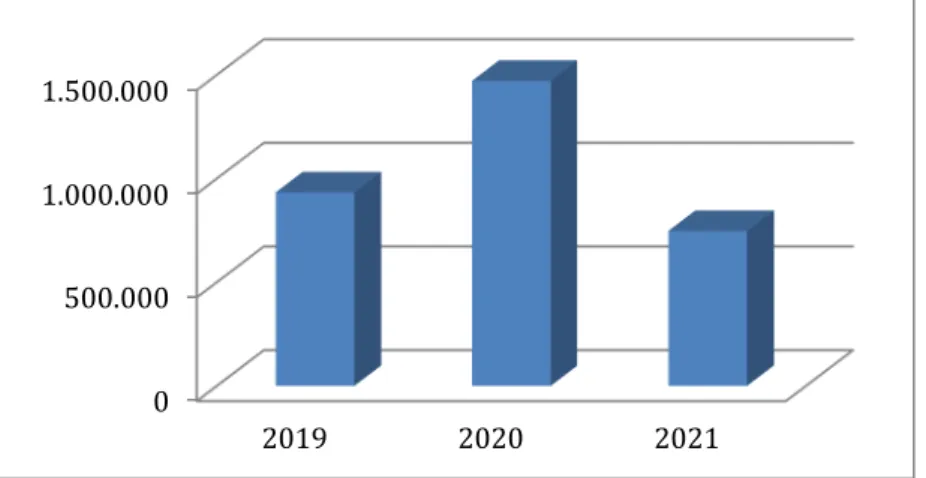
Numerous tourist attractions in the province of West Sumatra have enormous potential if developed and managed appropriately. The City of Bukittinggi has the potential to become a tourist destination in Indonesia. Numerous tourists visit Bukittingi, as demonstrated by Fig. 1.
Figure 1. West Sumatra Province Tourist Visit
Source: (Tourism and Creative Economy Office of West Sumatra Province, 2022)
Bukittingi is well-known as a tourist destination. This city has various tourist attractions, including the Gadang Clock Tower. This popular tourist destination is never devoid of visitors, both local and foreign. The Gadang clock was built during the Dutch colonial period and has since stayed steady, and the municipal administration has added a soothing garden, making this tourist site even more appealing to visit. The large number of visitors to the Gadang Clock has prompted the government to organize the city so that tourists return by increasing promotions and organizing the city with merchant arrangements so that visitors are motivated for intention visit and decide to visit Gadang Clock Tower. There are many studies on intention, such as
0 500.000 1.000.000 1.500.000
2019 2020 2021
MIX: Jurnal Ilmiah Manajemen
Volume 14 Number 1 | February 2024
p-ISSN: 2088-1231 e-ISSN: 2460-5328 __________________________________________________________________________________
192 https://publikasi.mercubuana.ac.id/index.php/jurnal_Mix
(Abbasi et al., 2021), (Arviriani, 2019), (Goker & Ayar, 2020), and (Happy Manurung & Astini, 2020), but there are few studies that mention visit intention as mediating for an eco-destination, travel motivation, and tower clock in Bukittinggi, particularly to visit decision. Therefore, the purpose of this study is to investigate visitor decision variables such as social media mediation, travel motivation, and ecotourism destinations. The problem faced by Gadang Tower tourist destinations is small space and crowded, making it difficult to find a toilet during the visit and none of the rest areas. Especially for Muslim travelers, it is hard to find prayer rooms. Pra Survey said that 60% of travelers feel uncomfortable visiting the Gadang Clock during peak season. It could be more friendly to tourists. Accessibility and convenience of information, and it is anticipated to boost tourism (Tanihatu et al., 2021)
Social media is now quite advanced. Every day, Indonesians share information on social media, whether it is personal or public. With numerous application containers such as Instagram, Facebook, and several websites that give similar facilities, social media also provides a location to provide information about tourist items or tourist attractions (Firdaus, 2020). People travel because they are motivated. There are numerous motivations to travel, including physical and mental rejuvenation, as well as an escape from routine (Satyarini et al., 2017). eWOM is a type of marketing communication in which consumers who have made purchases make positive or negative statements (Amir et al., 2022). Electronic word of mouth is thought to be more effective than traditional word of mouth since it reaches a larger audience than traditional word of mouth (Adrianty & Chairy, 2021). E-WOM is an abbreviation for Electronic Word Of Mouth. Consumers are currently very picky and engaged in providing feedback on new tourist attractions, sites, or destinations (Firdaus, 2020). In E-WOM, the public can freely argue and make comments, both favorable and negative, about the tourist object being discussed (Effendi et al., 2022). According to (Faricha Bascha et al., 2021)dimensions in electronic word of mouth.
E-WOM is now also utilized to share experiences with tourism items that have been visited, which are then reviewed and interacted with other consumers who have made tourist visits to these sites (Doosti et al., 2016), (Arif Kurniawan & Maftukhah, 2020). In eWOM, the public can also submit photographs or videos of visited tourist attractions to increase consumer confidence in coming to visit or not visiting these attractions (Jeong & Kim, 2020). E-Wom is proven to be high so far it has not maximized the use of social media to promote tourism in the area more broadly. To maximize the role of social media such as Facebook, Instagram, and Twitter, and also to update tourism information. In addition, this area has advantages in natural scenery, such as the Gadang Clock Tower tourist attraction. By using promotions on eWOM, the regional tourism advantage will be followed by improving supporting infrastructure such as parking and human resources who are involved in direct interaction with tourists, such as managers or employees of tourist attractions and traders.
The concept of eco-destination image refers to the behavioral responses of tourists when perceiving and experiencing tourist locations, which can be influenced by various factors such as ideas, beliefs, and impressions (Yerizal & Abror, 2019). These responses can be categorized into negative and positive images, each offering distinct viewpoints in terms of information acquisition. The concept of destination image refers to the subjective perception held by travelers regarding a certain tourist attraction, as discussed by (Satyarini et al., 2017). The perception that arises from foreign tourists after seeing several tourist objects they visit is a form of their views that are formed from what they see and feel while they are at these attractions. For the Gadang Clock, many tourists feel satisfied after they come and enjoy the scenery. Because the image that had been imagined about the Gadang Clock Tower turned out
MIX: Jurnal Ilmiah Manajemen
Volume 14 Number 1 | February 2024
p-ISSN: 2088-1231 e-ISSN: 2460-5328 __________________________________________________________________________________
http://dx.doi.org/10.22441/jurnal_mix.2024.v14i1.011 193 to be true when they came there. Bukit Tinggi is a tourist city that is very popular with tourists because there are so many objects that they can visit. It's just that until now the city of Bukittinggi is still not "eco friendly" because waste handling is still not optimal, and the use of plastic bags is still widely used, this is what makes the eco-destination image not realized properly.
According to (Jeong & Kim, 2020), intention refers to the inherent allure experienced by travelers towards a certain tourism destination that possesses distinctive features or qualities that make it appealing. According to a study conducted by (Pereira et al., 2019), the purpose experienced by visitors in selecting a tourist destination has a significant impact on their subsequent behavior leading up to the final decision. According to the research conducted by (Wang et al., 2022), intention refers to the level of interest that individuals have towards a particular tourist destination. (Fajrin & Mulia, 2020) claim that the purpose of visiting plays a significant role in shaping travelers' decision to visit a certain tourist destination.
Deciding to travel to a particular tourist site is a way to evaluate its acceptability in light of the demands of the individual traveler. This choice is influenced by the process of learning about the attractions and taking into account the actions of other travelers who have previously visited the place (Wang et al., 2021). The behavior of the tourist has an impact on the deciding factor for people when choosing a tourist site (Libre et al., 2022).
Research conducted by (Maghrifani et al., 2022) resulted in research showing a positive relationship between cognitive and affective attributes of destination image. The results of the study confirm that cognitive image has a significant influence on the affective image as well as cognitive and affective imagery which have a significant effect on intention to return, the results of which show a positive change in the level of travel satisfaction and intention to return from respondents who enjoy their travel experience with attractiveness. natural scenery, proximity to nature, beautiful natural wonders, and adequate tourism infrastructure.
Numerous studies investigate social media, visit intent, ewom, and image classification, among others. In his study, (Tsani et al., 2021) found that intentions to visit World Heritage sites (WHS) and social influence were significant predictors of future intentions to visit. (Stylidis et al., 2022) identified comprehensiveness, relevancy, timeliness, source expertise, and attitude as the most significant predictors of a traveler's intention to visit a destination after adopting an E- wom YouTube channel. In a study by (Reyes & Dael, 2023), it addresses four deficiencies in tourism studies. Despite the opportunities and costs that can arise from WHS-related tourism, few studies have attempted to verify the factors that predict visitation to World Heritage Sites;
few studies of visitors' perceptions of World Heritage. (Sarstedt et al., 2020) demonstrates in his study that Facebook profiles for destinations effectively increase followers' intentions to visit. In their study, (Pereira et al., 2019) attempt to determine the impact of personal values and purchasing intent on repurchase intent. (Song et al., 2021) analysis of the two respondents from Japan and Indonesia indicates that e-WOM positively impacts the destination's image and intention to visit, but not its confidence. It has also been shown that destination image moderates the effect of e-WOM on the intention to visit significantly. (Hanaysha, 2022) offers a novel perspective on the role of social media marketing in boosting the intention to visit a tourism destination whose image has a substantial influence on the intention to visit. Goyal (2023) discovered that the image of a wellness destination has a substantial effect on the level of satisfaction of wellness travelers and their eWOM intentions.
MIX: Jurnal Ilmiah Manajemen
Volume 14 Number 1 | February 2024
p-ISSN: 2088-1231 e-ISSN: 2460-5328 __________________________________________________________________________________
194 https://publikasi.mercubuana.ac.id/index.php/jurnal_Mix
As there are unlikely to be a large number of existing studies that explicitly relate to the topic of the visit to Bukittingi, this is to be expected. This study evaluates travelers visiting Bukittingi by integrating tourist intention and decision. Visit Intention tourists as mediating variables based on the eco-destination, EWom, travel motivation to travel decision, it is extremely important to pay close attention to the unique characteristics of local tourists and the major differences between them, as an illustration of social phenomena, particularly tourism. Unlike previous research, this study examines all of the above variables on tourist attractions. Many studies have examined Travel Motivation, eWom, and Eco Destination Image as independent variables, as well as visiting intention and visiting decision as dependent variables. Research on the Gadang Clock only found in research from (Libre et al., 2022) concluded that destination image, tourist experience, the value received by tourists, and tourist satisfaction can influence tourists' intention to return to tourist destinations.
The present study encompasses a comprehensive analysis of travel reviews, encompassing factors such as distance, duration of stay at the tourist site, temporal and financial limitations, anticipated level of uncertainty, and the degree of reliance on travel agents. The advantages of tourist locations encompass various factors such as the range of offerings available, the level of service quality, the characteristics of the physical and social environment, the prevailing political situation, the ease of accessibility, the behavior exhibited by local people towards tourists, and the overall image projected by the tourist destination.
There may be a theoretical gap in marketing because of a lack of knowledge of the relationship between green destinations and visit decisions. Few studies have looked into the relationship between eco-tourism and visit intent. This study investigated the concept and theoretical framework that explains a local tourist's decision to visit a local tourism object. The goal of this study is to add to the marketing literature review, particularly for academics interested in researching the Gadang Clock tourist attraction in Bukittinggi. Furthermore, this research is expected to be used by the government to limit the capacity of visitors and provide some facilities to accommodate tourists.
LITERATURE REVIEW Tourism
Tourism is the practice of going to and staying at various locations for fun, relaxation, or Travel for leisure or vacation is referred to as tourism, and it is a leisure-oriented activity. According to (Isa & Ramli, 2014) tourism includes a wide range of activities that visitors engage in that are made possible by the supply of amenities and services by the local population, other travelers, governmental bodies, regional authorities, and business owners. Tourism covers a wide range of travel activities that people, families, and groups engage in when they temporarily relocate from their principal abode to another location for vacationing. The accessibility of amenities and services provided by tourist destinations and the local community, with the expectation that visitors will eventually return to their original place of residence, encourage this unhurried pursuit. According to (Ariesta et al., 2020), tourism goods refer to the services that visitors acquire, experience, or perceive when they depart from their residences, travel to specific tourist locations, and return home. Tourism refers to the human activity of traveling and residing in destinations that are distinct from their regular everyday environment. Tourism
MIX: Jurnal Ilmiah Manajemen
Volume 14 Number 1 | February 2024
p-ISSN: 2088-1231 e-ISSN: 2460-5328 __________________________________________________________________________________
http://dx.doi.org/10.22441/jurnal_mix.2024.v14i1.011 195 plays a pivotal role in fostering growth and enhancing well-being within the realm of destination image development and tourism investment (Illah et al., 2019).
Travel Motivation
Motivation plays a crucial role in the decision-making process of tourists throughout their visit (Faricha Bascha et al., 2021). The motivation to travel serves as a catalyst for travelers to visit various tourist attractions and plays a significant role in their decision-making process about these destinations (Khan et al., 2019). A psychological need or desire that can justify an action's performance is known as motivation. The study of motivation can be approached from four main perspectives: expectancy theory, needs-based, values-based, and rewards sought or attained (Su et al., 2020; Marlapa, E. 2020). However, (Wijaya, 2019) stated that one of the primary factors luring foreign visitors to a destination is its cultural diversity.
The present body of literature extensively acknowledges travel motivation as a significant determinant of ecotourism aspirations. In a comprehensive framework by (Supryadi, Didy Ika, Taufan Handika, Daru Asih, Himawan Sutanto, Shine Pintor Siolemba Patiro, 2022), an examination of the factors influencing tourists' willingness to pay more for ecotourism indicates that their intentions are significantly influenced by their holiday goals, vacation preferences, attitudes towards ecotourism, environmental convictions, and subjective standards. The indicators of travel motivation are to get a new adventure, break away from the daily work routine, and relax.
Electronic word of mouth (e-WOM)
According to the research conducted by Goker and Ayar (2020), the dissemination of information can be achieved through two primary methods: word-of-mouth communication and the utilization of social media platforms for rapid information sharing. This study also examines the possible impact of electronic word-of-mouth (eWOM) on consumer behavior. In the study conducted by (Effendi et al., 2022) it was shown that electronic word of mouth serves as an informal means of communication targeted towards customers and visitors seeking information about a particular destination. Using this method of communication is more efficient than relying on the information services provided by travel agency companies. According to the research done by (Abubakar & Ilkan, 2016) note travelers' knowledge gained from social media platforms can be an added benefit, ultimately affecting their choice to travel to a specific location. E-WOM, an acronym for Electronic Word of Mouth, refers to the dissemination of information, opinions, and recommendations through electronic channels, such as social media platforms, online forums, and review websites. According to (Sudigdo & Khalifa, 2020), contemporary consumers exhibit a discerning and engaged approach while expressing their viewpoints regarding newly established tourist attractions, sites, or destinations. According to (Maghrifani et al., 2022), electronic word-of-mouth (eWOM) allows the general public to engage in unrestricted and unregulated discussions, expressing both good and negative opinions on the tourist attraction under consideration. The aspects of electronic word of mouth, as discussed by Henning et al. in the studies conducted by (Chi & Pham, 2022), are as follows.
According to (Chiu et al., 2016), E-Wom, which stands for electronic word of mouth, refers to the expression of both positive and negative feedback by customers regarding a product or tourist destination, namely through online platforms. According to (Rousta & Jamshidi, 2020), tourists tend to see online evaluations from social media as more favorable and accurate
MIX: Jurnal Ilmiah Manajemen
Volume 14 Number 1 | February 2024
p-ISSN: 2088-1231 e-ISSN: 2460-5328 __________________________________________________________________________________
196 https://publikasi.mercubuana.ac.id/index.php/jurnal_Mix
compared to the information offered by tourism service providers, which includes many indicators. The indicators of Electronic Word Of Mouth are social media, which helps get information, promotional tools, recommendation tours, and access and reviews of other people's positive experiences with the Gadang Clock Tower.
Eco-Destination Image
The concept of eco-destination image refers to the mental perception or impression that individuals hold toward a particular destination. It encompasses the overall image; the notion of destination image refers to the conceptualization and perception held by consumers regarding the desired product or service they intend to purchase (Anggraeni & Astini, 2020). (Happy Manurung & Astini, 2020) suggest that the concept of destination image encompasses a combination of knowledge, beliefs, impressions, and overall sentiments held by tourists toward a particular tourist location. The concept of destination image pertains to the cognitive and affective representations held by individuals or groups regarding their beliefs, impressions, prejudices, and emotions towards a specific area or travel destination. The concept of destination image refers to the mental representation, visual depiction, and perception of a specific place, which reflects the impressions travelers hold regarding its attractions. The concept of destination image refers to the comprehensive perception or impression that an individual holds regarding a particular area (Fajrin & Mulia, 2020). According to (Rohman, 2021) research, visitor experiences have a big impact on destination image. The indicators of Eco Destination Image are facilities such as prayer rooms, toilets, and rest areas to feel comfortable and like visiting London's Big Ben.
Visit Intentions
The concept of intention to visit refers to the act of motivating visitors to travel to a particular destination and its subsequent impact on an individual's decision-making process on the selection of tourist attractions to visit. In alternative terms, the inclination to engage in tourist activities may also be subject to the effect of the tourists' underlying motivations. According to (Fajrin & Mulia, 2020), The presence of interest serves as a powerful driving force that influences tourists in their decision-making process (Adrianty & Chairy, 2021). (Satyarini et al., 2017) posit that the intention to visit may be seen as an individual's inclination, volition, and enthusiasm towards visiting a particular destination and is intricately linked to one's attitude. The foundation of decision-making and the notion of tourist intentions to visit are rooted in intentions and attitudes. The study conducted by (Arviriani, 2019) posits that the intention to visit plays a pivotal role in influencing decision-making processes. (Arif Kurniawan
& Maftukhah, 2020) suggest that intention refers to the behavioral aspect of tourists engaging in tourism activities. Arvitriani and Wahyono (2019) propose that the concept of visiting intention pertains to the inclination of individuals to visit a specific tourist destination, hence exerting an influence on their decision-making process about engaging in such visits. According to the opinions of various experts, it has been concluded that variables like encouragement, action, and a close relationship to the attitude and conduct of people participating in tourism activities all have an impact on people's propensity to travel to tourist locations. These factors play a significant role in shaping the decision-making process regarding tourist visits. The indicators of Intention to Visit are access to easy-to-understand instructions, favorite tourist attractions, and used tourism services.
MIX: Jurnal Ilmiah Manajemen
Volume 14 Number 1 | February 2024
p-ISSN: 2088-1231 e-ISSN: 2460-5328 __________________________________________________________________________________
http://dx.doi.org/10.22441/jurnal_mix.2024.v14i1.011 197 Visit Decision
The act of visiting entails a systematic evaluation of a particular choice by visitors, which is contingent upon specific considerations (Afshardoost & Eshaghi, 2020). (Ariesta et al., 2020) suggest that the act of visiting a site can be understood as an individual's deliberate choice, influenced by a series of factors that are taken into account. The choice to engage in tourism shares a similar conceptual framework with consumer purchasing decisions, albeit modified to encompass the decision-making process related to selecting and participating in tours. The act of visiting is a cognitive process wherein individuals assess and select an option after taking into account specific factors (Anggraeni & Astini, 2020). The act of choosing to visit a particular destination involves a systematic evaluation of several options, which is contingent upon specific factors (Fajrin & Mulia, 2020). Satyarini et al. (2017) identified several aspects that exert an effect on the decision-making process regarding the purchase or visitation of a tourism destination. The characteristics of visitors can be analyzed based on socio-economic factors, including age, education, income, and experience. Additionally, behavioral traits such as motivation, attitudes, and values can also be taken into consideration. The recognition of the advantages associated with Travel and the acquisition of information about the intended locations, including familiarity with the destination's reputation.The indicators of the Visiting Decision are alternative options and choosing the Gadang Clock Tower tour as a vacation spot.
Research Hypothesis
The impact of travel motivation on decisions regarding visits.
According to (Fajrin & Mulia, 2020), the decision to visit the Kalibiru tourist attraction is significantly influenced by travel motivation. According to the findings of (Anggraeni & Astini, 2020), motivation positively influences the decision of Millennials to visit the National Museum. According to (Khan et al., 2019) motivation has a significant impact on a person's decision to participate in tourism.
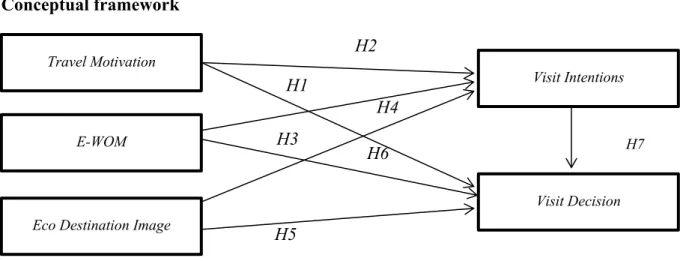
H1: Travel motive significantly influencing whether or not travelers visit the Clock Tower is their reason for travel.
The impact of travel motivation by mediating intended visits to decision visit
(Sri Rahayu, Mardiah Kenamon, Nazipawati, Yulitiawati, 2022) found that travel motivation has a substantial effect on the intention to visit Borobudur temple. According to the findings of (Reyes & Dael, 2023), there is a direct correlation between travel motivation and the intentions of visitors. According to the research of Khan et al (2019), travel motivation significantly influences travel intentions.
H2: Tourists' intent to visit the Gadang Clock Tower is significantly influenced by their travel motive mediating by visit intention
E-WOM's Impact on Decisions to Visit.
According to (Fajrin & Mulia, 2020) research, eWom significantly influences individuals' decisions to visit the Kalibiru tourist attraction. The findings of this study, which are supported by (Muflikhah, et al., 2018), indicate that e-Wom has a significant impact on visitors' enjoyment of their experience at Tourism Village. According to (Supriadi et al., 2021), e-wom has a substantial impact on whether or not individuals intention.
MIX: Jurnal Ilmiah Manajemen
Volume 14 Number 1 | February 2024
p-ISSN: 2088-1231 e-ISSN: 2460-5328 __________________________________________________________________________________
198 https://publikasi.mercubuana.ac.id/index.php/jurnal_Mix
H3: E-WOM significantly influences whether or not tourists choose to visit the Clock Tower.
E-WOM's Impact on Visit Intentions by Mediating Intended Visits
According to research by Göker and Ayar (2020), eWom significantly influences travel inclinations to Safranbolu, a city that was designated a UNESCO World Heritage Site.
According to research by (Yerizal & Abror, 2019), eWom has a favorable impact on travellers' intentions to travel to Tunisia. According to (Sri Rahayu, Mardiah Kenamon, Nazipawati, Yulitiawati, 2022), e-women significantly affect travelers' intentions to travel to Borobudur.
The findings of (Suwarduki & Yulianto, 2016) demonstrated a positive relationship between e- Wom and intention to visit a place. The fourth hypothesis in this study is based on earlier research.
H4: The Gadang Clock Tower Visitation Intention mediating tourists' visit decision is Significantly Affected by E-WOM
The impact of eco-destination image on travel visit decisions.
According to (Fajrin & Mulia, 2020), a destination's image has a significant impact on travelers' decisions. Satyarini et al. (2017) state that the perception of a destination has a significant impact on travelers' decisions. According to the findings of (Anggraeni & Astini, 2020) research, destination image positively influences travel decisions. According to research conducted by (Sudigdo & Khalifa, 2020), travelers' decisions to visit Jakarta are influenced by the destination's reputation. According to research conducted by (Muflikhah, et al., 2018), the perception of a destination has a significant impact on the decisions of travelers. According to research by (Afshardoost & Eshaghi, 2020) people's decisions to travel are heavily influenced by their perception of the destination. In this study, hypothesis 5 is formulated based on previous research
H5: the image of the eco-destination has a significant influence on the likelihood that travelers will visit the Gadang Clock Tower
The impact of eco-destination image on visit decision mediating by visit intention.
According to research by (Fajrin & Mulia, 2020), destination image substantially influences visitors' intentions to travel there. According to research by (Adrianty & Chairy, 2021), visitors' intentions to visit a destination are significantly influenced by its image. According to the findings of (Maghrifani et al., 2022), the perception of a destination influences travelers' intentions to visit it. According to the research of (Nguyen & Tong, 2022), there is a positive correlation between Jepara's destination image and travel intent. According to previous research by (Reyes & Dael, 2023), the image of a destination significantly influences visitors' travel intentions. According to (Suwarduki & Yulianto, 2016), travelers' intentions to visit a place are significantly influenced by the destination's image. Based on prior research, this investigation proposes hypothesis 6
H6: eco-destination image substantially influences the likelihood that tourists will visit the Gadang Clock Tower via visit intention.
The impact of visit intentions on travel decision
According to research by (Fajrin & Mulia, 2020), the intention to visit has a significant influence on the decision to visit the Kalibiru tourist site. In addition, (Satyarini et al., 2017) found that traveler intentions substantially impact travel decisions. According to earlier
MIX: Jurnal Ilmiah Manajemen
Volume 14 Number 1 | February 2024
p-ISSN: 2088-1231 e-ISSN: 2460-5328 __________________________________________________________________________________
http://dx.doi.org/10.22441/jurnal_mix.2024.v14i1.011 199
H3 H6
H4 H2
H5
H7
research findings, (Abubakar & Ilkan, 2016) found that the intention to travel to Jepara positively influenced the decision to do so. According to prior research, the study's seventh hypothesis is as follows:
H7: The intention of tourists to visit the Gadang Clock Tower significantly influences their choice to do so.
Conceptual framework
Figure 2. Conceptual Framework Source:(Fajrin & Mulia, 2020)
METHOD
Quantitative research, according to (Sekaran, 2017) can be interpreted as a research method to measure the behavior of tourists to visit. The study used non-probability purposive sampling, where the sample must meet certain criteria) This research is using the accidental sampling method (Sugiyono, 2018). The criteria sample is based on coincidence, in which visitors who coincidentally/accidentally meet researchers can be used as a sample Every visitor of Gadang Oclock who ever visited or wants to visit can become a respondent in this research. (Marlina &
Susiana, 2022) and (Marlina, Winny Alna, Fani Andriyani, 2023).
To determine the number of samples in this study by calculating the number of independent variables from this study (Hair et al., 2017). In this study, there were 3 independent variables, based on the significance level formula table made by (Cohen, 1992) with a significance level of 5%, the number of 3 independent variables, and R Square 0.10 with the maximum number of fractures indicating an endogenous construct in the model structural. Then the number of samples used in this study was 150 samples of tourist objects at the Bukittinggi Clock Tower.
There are many respondent profiles in the sample, including gender, age, education level, and monthly income. Methods for measuring and analyzing data using an adaptation of measurements from highly regarded international scientific journals pertinent to the research issue were carried out to make sure that the questionnaire provides good validity and reliability following the standards (Hair et al., 2017). The instrument of research is a questionnaire given to any visitors to the Gadang Clock. The questionnaire provides some questions regarding Travel Motivation, Electronic word of mouth (e-WOM), Eco-Destination Images, Visit
H1
Travel Motivation
E-WOM
Eco Destination Image
Visit Decision Visit Intentions
MIX: Jurnal Ilmiah Manajemen
Volume 14 Number 1 | February 2024
p-ISSN: 2088-1231 e-ISSN: 2460-5328 __________________________________________________________________________________
200 https://publikasi.mercubuana.ac.id/index.php/jurnal_Mix
Intentions, and Visit Decisions. Three questions were used to measure travel motivation, along with five for E-WOM, six for eco destination image, three for intention to visit, and two for visiting decisions. Because 5-point scales make it simpler for respondents' perceptions to match up, each thing that respondents thought was evaluated using a 5-point Likert scale (1=Strongly Disagree to 5=Strongly Agree. A data analysis technique called PLS-SEM serves as a predictor for creating useful models (Hair et al., 2017). The PLS-SEM method is also an excellent choice because this study model is predictive.Predictive Relevance validates the model's predictive capabilities. The structural model has relevant predictions if the value is greater than zero. The steps used in processing use PLS-SEM (Partial Least Squares Structural Equation Modeling) are the Outer Loading Test (Measurement Model), the Inner Model (Structural Model), and then the Hypothesis Testing.The SEM includes validity test, reliability, and bootstrapping
RESULTS AND DISCUSSION
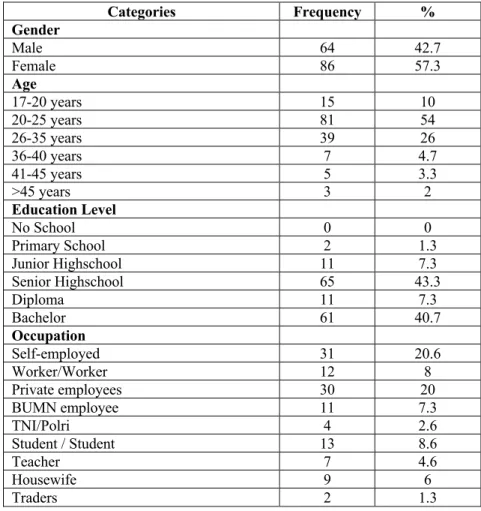
150 questionnaires were sent, and this is the main information. These 150 questionnaires are acceptable and practical to test because they satisfy the recommendations for sample size and number (Hair et al., 2017). Following the collection of the primary data, an analysis of the respondent characteristics and a PLS-SEM technique analysis were completed. As shown in the table below, respondent characteristics will be characterized in terms of gender, age, education, and income.
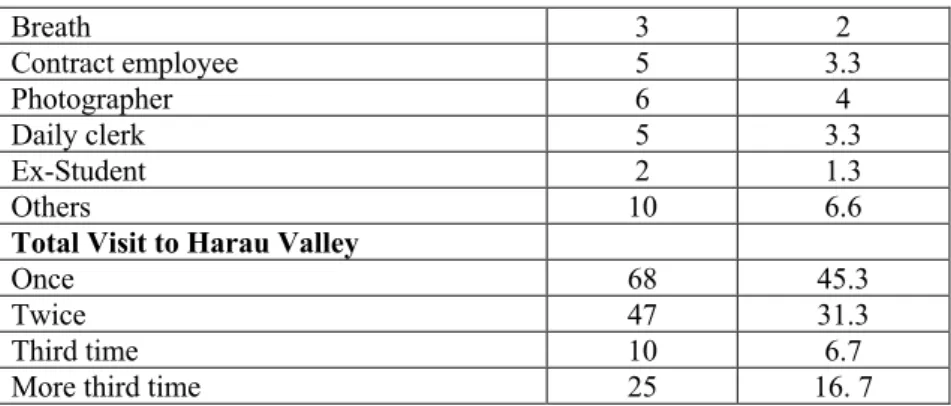
Table 1 Profile Respondent
Categories Frequency %
Gender
Male 64 42.7
Female 86 57.3
Age
17-20 years 15 10
20-25 years 81 54
26-35 years 39 26
36-40 years 7 4.7
41-45 years 5 3.3
>45 years 3 2
Education Level
No School 0 0
Primary School 2 1.3
Junior Highschool 11 7.3
Senior Highschool 65 43.3
Diploma 11 7.3
Bachelor 61 40.7
Occupation
Self-employed 31 20.6
Worker/Worker 12 8
Private employees 30 20
BUMN employee 11 7.3
TNI/Polri 4 2.6
Student / Student 13 8.6
Teacher 7 4.6
Housewife 9 6
Traders 2 1.3
MIX: Jurnal Ilmiah Manajemen
Volume 14 Number 1 | February 2024
p-ISSN: 2088-1231 e-ISSN: 2460-5328 __________________________________________________________________________________
http://dx.doi.org/10.22441/jurnal_mix.2024.v14i1.011 201
Breath 3 2
Contract employee 5 3.3
Photographer 6 4
Daily clerk 5 3.3
Ex-Student 2 1.3
Others 10 6.6
Total Visit to Harau Valley
Once 68 45.3
Twice 47 31.3
Third time 10 6.7
More third time 25 16. 7
According to consumer responses from the 150 questionnaires mentioned above, 64 (42.7%) more female responses were received than male responses, which numbered 86 (57.3%). This demonstrates that more women visit tourist destinations to simply relax after their daily tasks.
Compared to males, they prefer to unwind at tourist destinations that offer stretches of breathtaking natural scenery, as women are considered to lead more luxurious lifestyles and typically experience more emotional ups and downs. Regarding the respondents' varying ages, responses from respondents between the ages of 17 and 25 made up 91 (60.7%), those between the ages of 26 and 35 made up 39 (26%), those between the ages of 36 and 45 made up 17 (11.3%), and those from respondents older than 45 made up 3 (2%). This indicates that the majority of respondents were women of reproductive age, specifically those between the ages of 17 and 25, who made up 91 (60.7%) of the total. At that age, the decision to visit was more likely to involve irrational behavior because women's responses predominated in this study. 65 (43.3%) respondents had a high school diploma, 11 (7.3%) had one, and 61 (40.7%) had one.
Because it is well known that more women are continuing their education now than ever before and because this is also evident in the overall population, it demonstrates that the dominance of education tends to be more high school graduates. Another factor is that recent graduates from the millennial and Generation Z generations undoubtedly know more about tourism destinations than older generations do.
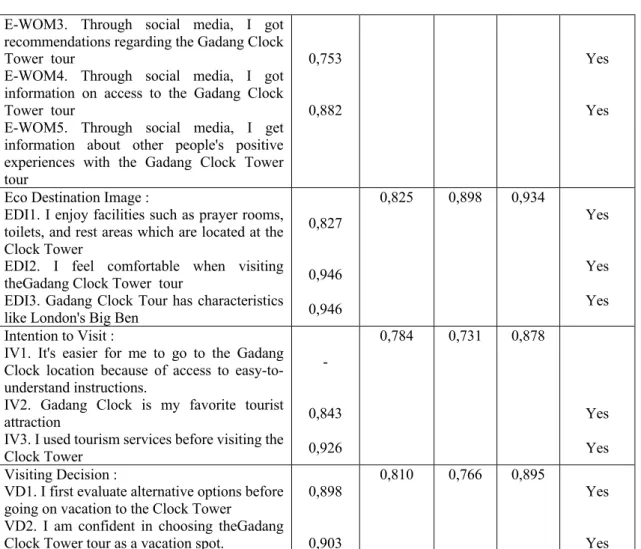
Table 2 Validity and Reliability Results
Indicator Validity Reliability
Accepted
LF AVE CA CR
Motivation :
M1. I want to go on an adventure at the Gadang Clock Tower tourist attraction
M2. I want to break away from my daily work routine while looking at the Gadang Clock M3. I want to feel relaxed in a new atmosphere at the Clock Tower
0,891 0,947 0,932
0,853 0,914 0,946
Yes Yes
Yes Electronic Word Of Mouth :
E-WOM1. Through social media, I got information about the Gadang Clock Tower tourist attraction
E-WOM2. Social media is an effective promotional tool for the Gadang Clock Tower object
0,822 - 0.776
0,656 0,830 0,884
Yes
Yes
MIX: Jurnal Ilmiah Manajemen
Volume 14 Number 1 | February 2024
p-ISSN: 2088-1231 e-ISSN: 2460-5328 __________________________________________________________________________________
202 https://publikasi.mercubuana.ac.id/index.php/jurnal_Mix E-WOM3. Through social media, I got
recommendations regarding the Gadang Clock Tower tour
E-WOM4. Through social media, I got information on access to the Gadang Clock Tower tour
E-WOM5. Through social media, I get information about other people's positive experiences with the Gadang Clock Tower tour
0,753 0,882
Yes Yes
Eco Destination Image :
EDI1. I enjoy facilities such as prayer rooms, toilets, and rest areas which are located at the Clock Tower
EDI2. I feel comfortable when visiting theGadang Clock Tower tour
EDI3. Gadang Clock Tour has characteristics like London's Big Ben
0,827
0,946 0,946
0,825 0,898 0,934
Yes
Yes Yes Intention to Visit :
IV1. It's easier for me to go to the Gadang Clock location because of access to easy-to- understand instructions.
IV2. Gadang Clock is my favorite tourist attraction
IV3. I used tourism services before visiting the Clock Tower
-
0,843 0,926
0,784 0,731 0,878
Yes
Yes Visiting Decision :
VD1. I first evaluate alternative options before going on vacation to the Clock Tower
VD2. I am confident in choosing theGadang Clock Tower tour as a vacation spot.
0,898 0,903
0,810 0,766 0,895
Yes
Yes
According to the principle that each indicator must be highly correlated while distinct constructs should not, discriminant validity seeks to ascertain whether a reflective indicator is an accurate measure of its construct (Ghozali & Latan, 2015). Cross Loadings, the Fornell-Larcker Criterion, and Heterotrait-Monotrait (HTMT) values are used to assess the discriminant validity (Henseler et al., 2015).
Table 3 Cross-Loading Results
Constructs Eco Destination
Image EWOM Intention to
Visit Motivation Visit Decision
EDI1 0.827 0.625 0.122 0.512 0.134
EDI2 0.946 0.729 0.259 0.677 0.294
EDI3 0.946 0.726 0.223 0.668 0.282
EWOM1 0.571 0.822 0.372 0.792 0.409
EWOM3 0.679 0.776 0.235 0.627 0.223
EWOM4 0.659 0.753 0.196 0.522 0.257
EWOM5 0.642 0.882 0.406 0.639 0.432
IV2 0.046 0.162 0.843 0.219 0.622
IV3 0.327 0.490 0.926 0.398 0.799
M1 0.525 0.685 0.301 0.891 0.358
MIX: Jurnal Ilmiah Manajemen
Volume 14 Number 1 | February 2024
p-ISSN: 2088-1231 e-ISSN: 2460-5328 __________________________________________________________________________________
http://dx.doi.org/10.22441/jurnal_mix.2024.v14i1.011 203
M2 0.704 0.786 0.342 0.947 0.390
M3 0.686 0.762 0.361 0.932 0.394
VD1 0.190 0.347 0.733 0.312 0.898
VD2 0.313 0.433 0.732 0.429 0.903
The purpose of cross-loadings is to make sure that the construct's correlation with the item is higher than that of the other constructs. According to Ghozali and Latan (2015), the predicted cross-loading value is >0.70. This model satisfies these requirements since it has a higher correlation between the construct and the item than it does with the other construct items (see Table 3). The following table also includes the Fornell-Larcker Criterion assessment.
Table 4 Fornell-larcker Criterion Results
Constructs EWOM Eco Destination
Image Intention to
Visit Motivation Visit Decision
EWOM 0.810
Eco Destination Image 0.767 0.908
Intention to Visit 0.398 0.237 0.885
Motivation 0.808 0.695 0.363 0.924
Visit Decision 0.433 0.280 0.814 0.413 0.900
According to (Henseler et al., 2015), the Fornell-Larcker Criterion value compares the value of the square root of the AVE of each correlated construct with other constructs. For the model to be discriminantly valid, the square root value of the AVE must be bigger than the correlation values of the other components (Fornell & Larcker, 1981). Based on this, the model passes the good test and receives a good grade (see Table 4).
Table 5 HTMT Results
Constructs EWOM Eco Destination
Image Intention to
Visit Motivation Visit Decision
EWOM
Eco Destination Image 0.898
Intention to Visit 0.438 0.250
Motivation 0.908 0.746 0.423
Visit Decision 0.508 0.312 1.069 0.492
The Heterotrait-Monotrait (HTMT) approach is the most sensitive evaluation because it is advised to employ a different technique to evaluate discriminant validity. HTMT 0.90 is the suggested value (Henseler et al., 2015). As a result, the model was at the level of satisfactory test criterion (HTMT 0.90), which means that all construct associations passed the assessment of discriminant validity (see Table 5).
MIX: Jurnal Ilmiah Manajemen
Volume 14 Number 1 | February 2024
p-ISSN: 2088-1231 e-ISSN: 2460-5328 __________________________________________________________________________________
204 https://publikasi.mercubuana.ac.id/index.php/jurnal_Mix Table 6 R2 and Q2 Results
Constructs R Square R Square Adjusted Q²
Intention to Visit 0.179 0.162 0.116
Visit Decision 0.680 0.671 0.536
By describing endogenous constructs, the R2 method evaluates the power of external constructions. If the value of R2 is 0.75 (strong), 0.50 (moderate), or 0.25 (weak), the value ranges from 0 to 1 (Sarstedt et al., 2020). Weak skills are produced by the variance of motivation, E-WOM, eco-destination image, and intention to visit, as indicated by the R2 value of 0.179 for this variable. While this was going on, an insufficient level of model capability was produced by the R2 Visiting decision (0.680) as described by the E-WOM, Eco Destination Image (see Table 7).
Table 7 Path Coefficient Results
Hipotesis β T Statistik P Values Decision
EWOM -> Intention to Visit 0.416 3.242 0.001 Supported
EWOM -> Visit Decision 0.071 0.733 0.464 Unsupported
Eco Destination Image -> Intention to Visit -0.196 2.042 0.042 Supported Eco Destination Image -> Visit Decision -0.018 0.234 0.815 Unsupported
Intention to Visit -> Visit Decision 0.756 17.275 0.000 Supported
Motivation -> Intention to Visit 0.163 1.513 0.131 Unsupported
Motivation -> Visit Decision 0.093 1.104 0.270 Unsupported
The table above shows an explanation of the tested hypothesis test analysis with a significance of 5%. Automatically, this produces a critical statistical t number of ± 1.655. The assumption is accepted if the t statistic is greater than the 1.655 t table. On the other hand, if the t statistic is less than 1.655 t table, the feasibility test is rejected. The results of this statistical test answer all research questions, and the descriptions can be found in the following descriptions.
DISCUSSION
Electronic Word Of Mouth Influences Visit Intentions
Judging from the results of the first hypothesis test, the statistical T value for the relationship between Electronic Word Of Mouth and Intention to Visit has a value of 3.242 > T Table, namely 1.655. So the first hypothesis, which is widely accepted, supports the idea that Electronic Word Of Mouth has a significant influence positive towards the intention to visit the Gadang Clock Tower tourist attraction. The better the eWom, the higher the Intention to visit.
That is, if eWom's reputation increases, the intention to visit also increases.
The results of this study are in line with the research of (Tsani et al., 2021) examining the facility among tourists has become an important matter for the spread of electronic word of mouth. The results of this study electronic word of mouth have a positive effect on visiting intentions. In addition, contrary to the research of (Wang et al., 2021), this study aims to identify theoretical arguments and hypotheses regarding the linkage of information seeking of an
MIX: Jurnal Ilmiah Manajemen
Volume 14 Number 1 | February 2024
p-ISSN: 2088-1231 e-ISSN: 2460-5328 __________________________________________________________________________________
http://dx.doi.org/10.22441/jurnal_mix.2024.v14i1.011 205 organization through electronic word of mouth to visiting intentions. The results of this study electronic word of mouth have a positive effect on visiting intentions. Research by (Goker &
Ayar, 2020; Arief, H, 2022) reveals the influence of communication from social media and the tendency to choose travel information. This research Electronic Word Of Mouth positively and significantly influences the intention to visit the UNESCO World Heritage city of Safranbolu.
Electronic Word Of Mouth Influences Visiting Decisions
Judging from the results of the second hypothesis test, the statistical T value for the relationship between Electronic Word Of Mouth and Visiting Decisions has a value of 0.733 > T Table, namely 1.655. So the second hypothesis, not widely accepted, supports the idea that Electronic Word Of Mouth has no influence significantly on the decision to visit theGadang Clock Tower tourist attraction. The better the eWom, the higher the decision to visit. That is, if eWom's reputation decreases, the decision to visit also decreases
This research has similarities with previous research conducted by (Fajrin & Mulia, 2020) which investigated an important factor in electronic word-of-mouth search that influences tourists' decisions to visit tourist areas, namely "Kalibiru Tourism Village". In this study, electronic word of mouth has a significant effect on visiting decisions. In line with the research of (Yerizal & Abror, 2019) in this study analyzing and testing the relationship of electronic word of mouth to visiting decisions, this research has a significant effect on visiting decisions on the island of Bali. Research by, this study electronic word of mouth is significant for the decision to visit a tourist village in Banjarejo Tourism
Destination Image Influences Visit Intentions
Judging from the results of the third hypothesis test, the statistical T value for the relationship between Destination Image and Visit Intention has a value of 2.042 > T Table, which is 1.655.
Then the third hypothesis can be accepted, it can be said that Destination Image has a significant positive influence on the Intention to Visit the Gadang Clock Tower tourist attraction, so tourists will plan to visit the Gadang Clock Tower tourist attraction. The better the Destination Image, the higher the intention to visit. That is if the reputation of the Destination Image increases, the intention to visit also increases.
This research has similarities with previous research conducted by (Fajrin & Mulia, 2020), this research is the destination image. In line with the research of (Faricha Bascha et al., 2021), destination image has a significant relationship with the intention to visit Islamic tourism objects in Taiwan. In line with the research of (Yerizal & Abror, 2019), showing a significant destination image of the intention of tourists to visit tourist villages.
Destination Image Influences Visiting Decisions
Judging from the results of the fourth hypothesis test, the statistical T value for the relationship between Destination Image and Visit Decision has a value of 0.234 > T Table, which is 1.655.
Then the fourth hypothesis cannot be accepted, it can be said that Destination Image does not have a significant positive influence on the decision to visit the Gadang Clock Tower tourist attraction.
The results of this study are in line with research conducted by (Satyarini et al., 2017) which showed that the results of destination image significantly influence the decision to visit tourism.
This is in line with (Anggraeni & Astini, 2020) which shows the image of a destination significantly influences the decision of millennials to visit the Museum. Museums in Indonesia.
Research by (Fajrin & Mulia, 2020) that destination image has a significant effect on the decision to visit a tour, namely "Kalibiru Tourism Village. To achieve environmental
MIX: Jurnal Ilmiah Manajemen
Volume 14 Number 1 | February 2024
p-ISSN: 2088-1231 e-ISSN: 2460-5328 __________________________________________________________________________________
206 https://publikasi.mercubuana.ac.id/index.php/jurnal_Mix
sustainability in Indonesia, all stakeholders should contribute to preserving the tourism sites' environments (Rohman, 2021).
Visiting Intentions Affect Visiting Decisions
Judging from the results of the fifth hypothesis test, the statistical T value for the relationship between visiting intentions and visiting decisions has a value of 17.275 > T table, namely 1.655.
So the fifth hypothesis, which is widely accepted, supports the idea that visiting intentions have a significant positive influence on visiting decisions. to the Gadang Clock tourist attraction. The better the intention to visit, the higher the decision to visit. That is, if the reputation of the intention to visit increases, the decision to visit also increases.
This research has similarities with previous research by (Fajrin & Mulia, 2020), this study aims to investigate the important factors that influence tourists' decisions to visit tourist areas, namely
"Kalibiru Tourism Village. The result of this research is the intention to visit also has a significant effect on the decision to visit. In addition to this research by (Afshardoost & Eshaghi, 2020), this research examines the influence of tourist intentions to visit tourist destinations with the results that visiting intentions have a significant effect on visiting decisions.
Travel Motivation Influences Visit Intentions
Judging from the results of the sixth hypothesis test, the statistical T value for the relationship between travel motivation and visiting intentions has a value of 1.513 > T table, namely 1.655.
So the sixth hypothesis, not widely accepted, supports the idea that travel motivation has no significant effect on visiting intentions. to the Gadang Clock tourist attraction. The better the travel motivation, the higher the intention to visit. That is if the reputation of travel motivation decreases, the intention to visit also decreases
This research has similarities with previous research by (Khan et al., 2019), research found that travel motivation has a positive effect on visiting intentions. In line with the research of (Nguyen & Tong, 2022)), this study aims to determine the effect of travel motivation on visiting intentions at the Beach. In this study, travel motivation has a positive influence on visiting intentions. Research by (Isa & Ramli, 2014), this research is to see the effect of the intention to visit tourist visitors for an aquarium, this research travel motivation has a significant effect on visiting intentions.
Travel Motivation Affects Visiting Decisions
Judging from the results of the seventh hypothesis test, the statistical T value for the relationship between travel motivation and visiting decisions has a value of 1.104 > T table, namely 1.655.
So the seventh hypothesis, not widely accepted, supports the idea that travel motivation does not have a significant effect on visiting decisions. to the Gadang Clock tourist attraction. The better the travel motivation, the higher the decision to visit. That is, if the reputation of travel motivation decreases, the decision to visit also decreases
The results of this study are in contrast to the research of (Fajrin & Mulia, 2020) which investigates an important factor of travel motivation that influences tourists' decisions to visit tourist areas, namely "Kalibiru Tourism Village". In this study, travel motivation has a significant effect on visiting decisions. Contrary to (Supryadi, Didy Ika, Taufan Handika, Daru Asih, Himawan Sutanto, Shine Pintor Siolemba Patiro, 2022), this study has significant travel motivation for visiting decisions on the Baduy. Research by Isa and Ramli (2014), discusses building tourist visits to new tourist areas in many cases depending on tourist behavior, one of
MIX: Jurnal Ilmiah Manajemen
Volume 14 Number 1 | February 2024
p-ISSN: 2088-1231 e-ISSN: 2460-5328 __________________________________________________________________________________
http://dx.doi.org/10.22441/jurnal_mix.2024.v14i1.011 207 which is significant travel motivation to the decision to visit FRI Aquarium Penang in Malaysia.
Research by (Wijaya, 2019) found that the following elements were discovered to be important in travelers' motivation to travel: local culture, natural landscape and climate, quiet rest areas, and hospitality services and tourist attractions.
CONCLUSION
Ecotourism destinations are similarly indicative of intention to visit is the decision to visit.
However, eco-tourism destination, motivation to visit as measured by visit intention has no bearing on visit decision. The results of hypothesis testing indicate that there is a substantial relationship between Motivation, E-WOM, Eco Destination Image, Visit Intentions, and Visit Decisions. In contrast, the findings of this study indicate that Visitor Intention and Visitor Decisions have a greater influence on E-WOM and Eco Destination Image, whereas Motivation has a lesser influence and is less significant. The Gadang Clock Tower must be able to maintain its reputation as an eco-tourism destination so that visitors can have a great time and take home beautiful memories. E-WOM also influences the intentions of visitors, resulting in more visits to the Clock Tower. The Gadang Clock Tower Tourism Object must elicit an emotional response that makes visitors want to visit this place. It is anticipated that the Gadang Clock Tower Tourism Object will be able to host training sessions or seminars for managers or the surrounding community. Training sessions or seminars are centered on fostering visitor confidence in the Gadang Clock Tower Tourism Object to improve the quality of the travel experience.
This study is limited by the fact that the questionnaire was only disseminated in the West Sumatera Gadang Clock Tower area and the variables of motivation, E-WOM, Eco Destination Image, visit intention, and visit decision. This research is only concerned with locals and not with other visitors. In addition, this study does not differentiate between first-time visitors and repeat visitors, which may be a moderating variable for the influence of visit intention on visit decisions. These findings differ from those of previous studies. This research presents important implications for the theory and practice of tourism marketing. According to studies, there is a relationship between Eco Destination Image and Intention to Visit, but not with customer decision to visit. Suggestions for future inquiry regarding the effect of eco destination on intention and visit choice to fill a theoretical gap connected to eco-destination and addition of a suitable variable for a visit to the Gadang clock tower.
REFERENCES
Abbasi, G. A., Kumaravelu, J., Goh, Y. N., & Dara Singh, K. S. (2021). Understanding the intention to revisit a destination by expanding the theory of planned behaviour (TPB).
Spanish Journal of Marketing - ESIC, 25(2), 282–311.
Abubakar, A. M., & Ilkan, M. (2016). Impact of online WOM on destination trust and intention to travel: A medical tourism perspective. Journal of Destination Marketing and Management, 5(3), 192–201.
Adrianty, O. N., & Chairy, C. (2021). Factors Affecting Tourist Revisit Intention in Bali. Jurnal Muara Ilmu Ekonomi Dan Bisnis, 5(1), 171.
Afshardoost, M., & Eshaghi, M. S. (2020). Destination image and tourist behavioural intentions: A meta-analysis. Tourism Management, 81(2019), 104154.
Amir, A. F., Mohd Hafizan, N. N., Mohd Anuar, N. A., Asyraff, M. A., & Shahril, Z. R. (2022).