CLYDE F. E. ROP RICHARD E. YOl and GILBERT L. VC
An Illustrated Key to the
Families of the Order Teuthoidea Cephalopoda)
SMITHSONIAN CONTRIBUTIONS TO ZOOLOGY • 1969 NUMBER 13
SMITHSONIAN CONTRIBUTIONS TO ZOOLOGY
NUMBER 13
Clyde F. E. Roper, A n Illustrated K e y
5K?Z" to the Families of the
Order Teuthoidea (Cephalopoda)
SMITHSONIAN INSTITUTION PRESS
CITY OF WASHINGTON
1969
SERIAL PUBLICATIONS OF THE SMITHSONIAN INSTITUTION The emphasis upon publications as a means of diffusing knowledge was expressed by the first Secretary of the Smithsonian Institution. In his formal plan for the Institution, Joseph Henry articulated a program that included the following statement: "It is proposed to publish a series of reports, giving an account of the new discoveries in science, and of the changes made from year to year in all branches of knowledge not strictly professional." This keynote of basic research has been adhered to over the years in the issuance of thousands of titles in serial publications under the Smithsonian imprint, commencing with Smithsonian Contributions to Knowledge in 1848 and continuing with the following active series:
Smithsonian Annals of Flight Smithsonian Contributions to Anthropology
Smithsonian Contributions to Astrophysics Smithsonian Contributions to Botany Smithsonian Contributions to the Earth Sciences
Smithsonian Contributions to Paleobiology Smithsonian Contributions to Zoology Smithsonian Studies in History and Technology
In these series, the Institution publishes original articles and monographs dealing with the research and collections of its several museums and offices and of professional colleagues at other institutions of learning. These papers report newly acquired facts, synoptic interpretations of data, or original theory in specialized fields. Each publica- tion is distributed by mailing lists to libraries, laboratories, institutes, and interested specialists throughout the world. Individual copies may be obtained from the Smith- sonian Institution Press as long as stocks are available.
S. DILLON RIPLEY
Secretary
Smithsonian Institution
Contribution No. 1024 from the Institute of Marine Sciences, University of Miami
Official publication date is handstamped in a limited number of initial copies and is recorded in the Institution's annual report, Smithsonian Year.
UNITED STATES GOVERNMENT PRINTING OFFICE WASHINGTON : 1969
For sale by the Superintendent of Documents, U.S. Government Printing Office Washington, D.C. 20402 - Price 45 cents
Contents
Page Plate
Introduction 1 Key to the Families 3 Table (Comparison of basic characters) 5 Suborder Myopsida 4
Loliginidae 4 1A, Pickfordiateuthidae 4 1c, D Suborder Oegopsida 6
Gonatidae 6 2A-D Enoploteuthidae 6 3A-C Octopoteuthidae 7 3D Onychoteuthidae 7 4A-C Lepidoteuthidae 8 4D Ctenopterygidae 8 5c Batoteuthidae 8 6A, B Brachioteuthidae 8 7A, B Lycoteuthidae 9 7c, D Histioteuthidae 9 8A, B Bathyteuthidae 9 9A-C Psychroteuthidae 9 8c, D Neoteuthidae 9 10A-D Architeuthidae 10 lie, D Ommastrephidae 10 11A, B Thysanoteuthidae 10 12A Chiroteuthidae 11 13A-E Mastigoteuthidae 11 12B, C Joubiniteuthidae 12 6c, D
Cycloteuthidae 12 14A-E Promachoteuthidae 12 5A, B Grimalditeuthidae 12 15A
Cranchiidae 12
15B-D, 16A-DUntenable Families 13
Selected Faunal Works 13
References 14
ABSTRACT
A dichotomous key to the twenty-five families of cephalopods of the order Teuthoidea is presented. A supplementary chart of basic, external teuthoid characters is in- cluded. Representatives of each family are illustrated. The current state of systematics within each family is briefly discussed.
Introduction
No comprehensive key to the families of the Teu- thoidea has been published since Hoyle's key to the dibranchiate Cephalopoda (1904). Hoyle's excellent work also includes a key to the genera. Three major keys on the suborder Oegopsida also were published around the turn of the century. The first of these keys was presented by Goodrich (1892) and dealt only with the genera of oegopsids. This was followed in 1900 by Pfeffer's synopsis of the oegopsid cephalopods which included a comprehensive key to the twelve known families. The remaining key to appear on oegopsids was published in Pfeffer's extensive mono- graph (1912) ; this was a modification of his earlier key, but utilized external characters only. Although not a key, Thiele's handbook (1935) includes brief diag- noses of the genera of Recent cephalopods known at that time. This work should be used with caution, how- ever, because some of the diagnoses are incomplete and misleading.
Advancements in the systematics of recent cephalo- pods have decisively altered earlier concepts and the former keys no longer reflect current knowledge. The need for a modern key is particularly pressing in the order Teuthoidea in which the number of families has nearly doubled since the last major revision (i.e., Pfeffer, 1912). Furthermore, the rapid expansion in the fields of fisheries science and biological oceanog- raphy has created a greater need by nonteuthologists for information about cephalopods. The cephalopods with which the programs in these fields are involved belong primarly to the order Teuthoidea.
The present work is designed for rapid identification of the families of the order Teuthoidea by utilization of a dichotomous key, a supplementary chart of basic Clyde F. E. Roper, Department of Invertebrate Zoology, Smithsonian Institution, Washington, D.C. 20560. Richard E.
Young, University of Hawaii, Honolulu, Hawaii 96822.
Gilbert L. Voss, Institute of Marine Sciences, University of Miami, Miami, Florida 33149.
characters, illustrations, and discussions of individual families. We believe this is the most effective method of presentation permitting the familial identification of both whole and damaged specimens. This paper is designed for use by the nonspecialist as well as the specialist.
The dichotomous key utilizes only external char- acters which have been kept to a minimal number. It is designed primarily for the identification of adult speci- mens; therefore, one should use caution when dealing with larval forms. The order in which the families are presented is not necessarily indicative of phylogenetic relationship; some closely related groups naturally will fall together, while others may be widely separated.
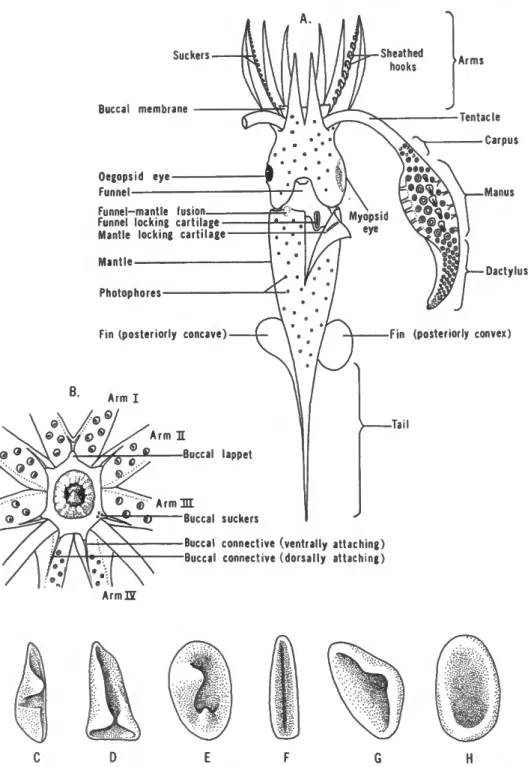
The diagrams in Figure 1 illustrate most of the morpho- logical terms presented in the key. The ventral arms are often modified in males (hectocotylization), and the tips of the other arms occasionally may be modi- fied; these modifications should not be confused with the typical characters of the arms used in the key. Some groups are characterized by the absence of tentacles, but lack of tentacles may also result from injury. In- jured specimens, however, invariably show stubs of the missing tentacles.
The chart presents a brief summary of the basic characters for each family. It should be particularly useful if damaged specimens lack certain characters that are utilized in the key. Representative species of each family are illustrated, and atypical forms are illustrated where necessary. A discussion is presented which more fully characterizes each family, briefly surveys the genera, and reflects the current status of their systematics. References to recent works dealing with the systematics of families and genera are given where possible.
ACKNOWLEDGMENTS.—Many of the illustrations are reproduced from recent works of the authors and were originally drawn by Miss Constance Stolen, as was the diagram of the basic teuthoid features; we gratefully acknowledge her contribution. The remaining illustra- 1
B.
Suckers-
Buccal membrane
Oegopsid eye- Funnel
Funnel-mantle fusion Funnel locking cartilage — Mantle locking cartilage- Mantle
Photophores-
Fin (posteriorly concave)
Arm I
Arm I I
Dactylus
Fin (posteriorly convex)
Buccal lappet
Tail
Arm H I
Buccal suckers
Buccal connective (ventrally attaching) Buccal connective (dorsally attaching)
A r m U
D F H
FIGURE 1.—A, A composite diagram illustrating basic teuthoid features, B, Diagram of oral surface of brachial crown and buccal membrane. Basic types of funnel locking-cartilage:
c, -H-shaped; D, J.-shaped; E, oval with inward projecting knobs; F, simple, straight; o, sub- triangular; H, oval.
NUMBER 13
tions come from published teuthological works of other from the Institute of Marine Sciences for testing and authors. The work was partially supported by grants commenting on the key: E. S. McSweeny, G. Y. Hen- GB 57294 and GA 1493 from the National Science drix, E. T. LaRoe, and students of the invertebrate Foundation. We wish to thank the following persons taxonomy class.
Key to the Families of the Order Teuthoidea
1. Eye covered by a transparent membrane (cornea) (Figure 1A) (Myopsida) 2 Eye without cornea and in open contact with seawater (Figure 1A) (Oegopsida) 3 2. Four rows of suckers on manus of tentacular clubs. Medial posterior border of fins concave (i.e., curves posteriorly toward midline) (Figure 1A) Loliginidae (Plate 1A, B ) Two rows of suckers on manus of tentacular clubs. Medial posterior border of fins convex (i.e.,
curves anteriorly toward midline) (Figure 1A) Pickfordiateuthidae (Plate l c , D ) 3. Funnel free from mantle; a funnel-mantle locking apparatus present 4 * Funnel fused to mantle on each side; no funnel-mantle locking apparatus present (Figure 1A) . 2 4 4. Funnel-mantle locking apparatus a simple, straight groove and ridge (Figure I F ) . . . . 5b
Funnel-mantle locking apparatus not a simple, straight groove and ridge (Figures lc, D, E,
G, H ) 18
5. Arms with hooks or with suckers in four rows on the proximal half of the ventral arms . . 6 Arms without hooks and with suckers in two rows on the proximal half of the ventral arms. 8 6. Armature of arms in two rows 7 Armature of arms in four rows Gonatidae (Plate 2A—D) 7. Tentacles present; fully developed clubs present Enoploteuthidae (Plate 3A—c) Tentacles and clubs absent in adults although present in larvae or occasionally juveniles (Taningia) but always with rudimentary clubs Octopoteuthidae (Plate 3 D ) 8. Buccal membrane connectives attach to the ventral sides of arms IV (Figure 1B) 9 Buccal membrane connectives attach to the dorsal sides of arms IV 13°
9. Hooks present on tentacular clubs (tentacles and clubs unknown in Chaunoteuthis)
Onychoteuthidae (Plate 4 A - C ) Hooks lacking on tentacular clubs 10 10. Cartilaginous scales present on mantle (may be minute) (Figure 2). Tentacular clubs with four longitudinal rows of suckers Lepidoteuthidae (Plate 4 D ) Cartilaginous scales lacking. Tentacular clubs with more than four longitudinal rows of suckers on some areas 11 11. Fins nearly as long as the mantle, supported by strong, transverse, muscular ribs. Minute suckers present on oral surface of buccal lappets (Figure 1B) . Ctenopterygidae (Plate 5c) Fins less than half the body length and without supporting ribs. No suckers on buccal lappets.
12 12. Tentacular clubs with six uniform rows of suckers. Long spike-like tail present (greater than the fin length) Batoteuthidae (Plate 6 A , B ) Tentacular clubs with four rows of suckers on distal portion, numerous rows on proximal portion. No tail present Brachioteuthidae (Plate 7A, B ) 13. Ventral surface of eye with a row of photophores. Buccal membrane with eight separate lappets.
Lycoteuthidae (Plate 7c, D ) No photophores on eyes. Buccal membrane with seven lappets or less 14 14. Surface of mantle, head, and arms covered with numerous photophores (usually large and distinct) Histioteuthidae (Plate 8A, B ) Surface of mantle and head without photophores (arms may have a few photophores). . 15 15. Minute suckers present on oral surface of buccal l a p p e t s . . . . Bathyteuthidae (Plate 9 A - C ) No suckers on oral surface of buccal lappets 16
a See footnote 1 in Table 1.
b See footnote 2 in Table 1.
e See footnote 3 in Table 1.
Key to the Families of the Order Teuthoidea—Continued
16. Many small to minute suckers (or suckers and knobs) at the proximal end of the manus . . 17 No cluster of small suckers at proximal end of the manus . . . Psychroteuthidae (Plate 8c, D) 17. Medial posterior borders of fins slightly convex. Carpal knobs in a single dorsal row or absent.
Small size Neoteuthidae (Plate 10A-D) Medial posterior borders of fins concave. Carpal knobs in a cluster alternating with carpal suckers. Attains gigantic size Architeuthidae (Plate l i e , D) 18. Funnel locking-cartilage with a longitudinal and a transverse groove, J_-shaped or —(-shaped (Figure ID or c) 19 Funnel locking-cartilage oval, triangular or oval with inward projecting knobs (Figures 1H,
O, E ) 20
19. Funnel locking-cartilage with a longitudinal groove crossed by a transverse groove at its posterior end, _L-shaped (Figure ID). Fins less than 60% of mantle length
Ommastrephidae (Plate 11A, B) Funnel locking-cartilage with a longitudinal groove from which a shorter groove branches
medially, -(-shaped (Figure lc). Fins more than 80% of mantle length
Thysanotcuthidae (Plate 12A) 20. Funnel locking-cartilage oval with one or two knobs directed toward the center of the concavity (Figure 1E) 21<*
Funnel locking-cartilage oval or subtriangular, without knobs (Figures lo, H) 22 21. Club with only four rows of suckers Chiroteuthidae (Plate 13A-E) Club with many (more than 15) rows of minute suckers . . Mastigoteuthidae (Plate 12B, C) 22. Suckers on arms in four to six rows. Tail extremely long (greater than the mantle length). . .
Joubiniteuthidae (Plate 6c, D) Suckers on arms in two rows. Tail short (less than half the mantle length) or a b s e n t . . . 23 23. Suckers on the tentacular clubs in four longitudinal rows. Mantle free dorsally
Cycloteuthidae (Plate 14A-E) Suckers on the tentacular clubs in eight or more longitudinal rows. Mantle fused dorsally to head Promachoteuthidae (Plate 5A, B) 24. Mantle free dorsally—articulates with head by ridge and groove
Grimalditeuthidae (Plate 15A) Mantle fused dorsally with head Cranchiidae (Plates 15B-D and 16A-D)
d See footnote 4 in Table 1.
Suborder MYOPSIDA
This suborder contains two families of near-shore, usually shallow water, squids, many of which form the basis of commercial fisheries (see Fields, 1965).
Members of the Myopsida can be recognized by the presence of corneal membranes covering the eyes.
LOLIGINIDAE sensu restricto Steenstrup, 1861
PLATE 1A, B
Presently eight genera are recognized in the family:
Loligo, Doryteuthis, Lolliguncula, Sepioteuthis, Loli- olopsis, Loliolus, Alloteuthis, and Uroteuthis. Loligo is the most common and speciose genus. Members of the family are primarily distributed throughout the warm waters of the world, although some species of Loligo occur in colder regions.
The characteristic features of this family include a straight, simple locking apparatus, seven buccal lap- pets each with a few small suckers, buccal connectives
that attach to the ventral borders of arms IV, four rows of suckers on the manus, two rows of suckers on the arms, and fins with concave posterior borders.
Photophores are present in some species.
PICKFORDIATEUTHIDAE Voss, 1953
PLATE 1C,D
This recently described family (Voss, 1953) con- tains a single species, Pickjordiateuthis pulchella, which is known only from the tropical western At- lantic. It is a small species that has a mantle length of about 13-17 mm at maturity. The family charac- teristics include the presence of only two rows of suckers on the manus of the tentacular clubs; biserial suckers on the arms; small, round fins with convex posterior borders; buccal membranes with reduced lappets and no suckers; buccal connectives that attach to the ventral sides of arms IV; and a straight, simple funnel locking apparatus. Photophores are absent.
T A B L E 1.—Comparison of basic characters for all families of the Teuthoidea
Families
Funnel locking apparatus
^ , 2 1
Co I
i 1,8
Buccal con- nectives to
arms IV
Arms I-III {excluding tips)
4 I
Clubs
Loliginidae Pickfordiateuthidae Gonatidae Enoploteuthidae Octopoteuthidae Onychoteuthidae Lepidoteuthidae Ctenopterygidae Batoteuthidae Brachioteuthidae Lycoteuthidae Histioteuthidae Bathyteuthidae Psychroteuthidae Neoteuthidae Architeuthidae Ommastrcphidae Thysanoteuthidae Chiroteuthidae Mastigoteuthidae Joubiniteuthidae Cycloteuthidae Promachoteuthidae Grimalditeuthidae Cranchiidae
X X X X X X X X X
X1
X
X X ' X X X X X X
X*
X X X
X X
X X X X X X X X
x»
X X
X7 X7
X8
X X "
X X X X X » X »
X
X »« X » X » X » X X
X X X
X
X " X "
X17
X X
Xi o
X1 8
1 See, however, Symplectoteuthis, under the discussion of the Om mas trephidae.
2 The classification "simple and straight" includes some locking apparatuses that show considerable variation. For example, in the Octopoteuthidae and the Histioteuthidae the central groove is fairly broad and may curve slightly and in Gonatopsis borealis (Gonatidae) the central groove flares broadly at its posterior end. The homogeneity of this classification becomes apparent when this type of lock- ing-cartilage is contrasted with the highly specialized types illustrated in Figure 1.
8 This character is difficult to detect in some histioteuthids because of the development of secondary connectives.
4 In some mastigoteuthids the knobs are difficult to distin- guish. See also Mastigoteuthis magna under discussion of the Mastigoteuthidae.
8 The arm characters used here refer only to the dorsal three pairs of arms; ventral arms fiequently arc modified.
The characters of the extreme tips of the arms are also excluded from this chart because the tips occasionally are modified by an increase in the number of sucker rows.
• Males of Berryteuthis anonychus lack hooks. Females of this species have hooks near the bases of arms I-III.
7 Ctenopteryx has sucker rows that increase distally to four or sometimes six rows.
332-752 O—«G 2
8 The rows of suckers on the arms of Bathyteuthis are irregularly arranged, beginning proximally with one or two rows but increasing to three or four rows.
* Only one species, Mtsonychoteuthis hamiltoni, has hooks on the arms.
10 Two genera, Pholidoteuthis and Tetronychoteuthis, have four rows of suckers on the clubs; Lepidoteuthis lacks tentacles.
11 Most, but not all, species of Histioteulhis have more than four rows of suckers on the club.
12 The species of Psychroteuthis have from four to seven irregular rows of suckers on the club.
IJ Young members of the Neoteuthidae have four rows of suckers on the clubs, however, with growth numerous rows of suckers appear at the proximal end of the manus and on the tentacular stalk.
14 Architeuthids have four rows of suckers on the manus and dactylus but more than four rows in the carpal locking region.
15 Illex has eight rows of suckers on the dactylus. Other members of the family have four rows of suckers on the manus and dactylus.
16 Berryteuthis has clubs with only suckers and no hooks;
Gonatus has some hooks; Gonatopsis lacks tentacles.
17 One genus, Pterygioteuthis, has only suckers on the clubs.
18 Several genera, e.g., Galiteuthis and Mesonychoteuthis, have some hooks on the clubs.
Suborder OEGOPSIDA
Species of this suborder generally inhabit the open sea from the surface to great depths. The group is very diverse in species and exhibits a wide variety of forms.
The Oegopsida is distinguished from the Myopsida primarily by the absence of a corneal membrane over the eye. The oegopsid eye is directly bathed in sea water. The muscular integument of the head encircles the eye, forming an oval eyelid capable of a sphincter- like contraction. A contracted eyelid in a preserved specimen may give the false impression that the eye is covered by a cornea. If one is careful, however, there should be no difficulty in distinguishing the two sub- orders of squids.
GONATIDAE Hoyle, 1886
PLATE 2A-D
This family is characterized by tetraserial armature on the arms. Arm tips, however, in one species, Gona- topsis octopedatus, are modified and have up to twelve rows of minute suckers. The two medial rows of arms I—III consist of hooks in all species, except Berryteu- this anonychus, which has only suckers, except at the bases of some arms in females. All members of the family have a simple, straight funnel locking-cartilage which may flare slightly at the posterior end; buccal connectives that attach to the ventral borders of arms IV; numerous irregular rows of suckers on the clubs with additional hooks in some forms (i.e., Gonatus species). Only one species in the family has photo- phores {Gonatus, new species) ; these are oval patches located on the ventral surfaces of the eyes.
Three described genera, Gonatus, Berryteuthis, and Gonatopsis, are known. Gonatus is characterized by at least a single large hook in the center of the tentacular club and only five longitudinal rows of radular teeth.
Berryteuthis is characterized by the absence of hooks on the tentacular club and by seven longitudinal rows of radular teeth. This genus has previously been con- sidered a synonym of Gonatus or at best a subgenus.
However, with the recent discovery of a number of new species of Gonatus, the generic differences are now more clearly defined and the evidence indicates that Berryteuthis should be considered a valid genus (Young, in manuscript). Gonatopsis is characterized by the complete loss of tentacles, except in the early larval forms (Young, in press).
Species in this family are cold water forms and are among the most abundant squids in higher latitudes.
ENOPLOTEUTHIDAE Pfeffer, 1900
PLATE 3A-C
All members of this large family possess a straight locking apparatus; biserial armature (except occasion- ally at the arm tips) with at least some hooks on the arms; tetraserial armature on the clubs (marginal suckers of the manus may be lost with growth in some species) ; photophores; eight buccal lappets and buccal connectives that attach dorsally to the ventral arms {Enoploteuthis dubia Adam, 1960, is unique in hav- ing connectives that attach dorsally to all arms). All species, except those of the genus Pterygioteuthis, possess hooks on the tentacular clubs.
The Enoploteuthidae is divided into three long- established subfamilies: Enoploteuthinae, Pyroteuthi- nae, and Ancistrochirinae. The Enoploteuthinae is characterized by the absence of nidamental glands, presence of numerous, small photophores over the suface of the mantle, head and arms, but not on the tentacles or viscera, and fins with concave posterior borders. This is the most speciose subfamily and con- tains the following genera: Enoploteuthis, Abralia, Ab- raliopsis, and Watasenia. The Pyroteuthinae has nid- amental glands, no photophores on the surface of the mantle, head or arms, but large photophores em- bedded in the tentacles and others present on the viscera, and fins with convex posterior borders. Two genera, Pyroteuthis and Pterygioteuthis, are included in this subfamily. The Ancistrochirinae has nidamental glands, a few large scattered photophores on the sur- face of the mantle, head, and tentacles, but not on the arms or viscera, and huge fins with convex posterior borders. Two genera, Thelidioteuthis and Ancistrochi- rus, are known, but there is a possibility that the first is a synonym of the latter. Occasionally Abralia, Abra- liopsis, and Watasenia have been split from the Eno- ploteuthinae as a separate subfamily, the Abraliinae.
This division, however, cannot be maintained on the basis of present knowledge.
Enoploteuthids are primarily inhabitants of the tropical and subtropical oceans of the world. Some species of Pterygioteuthis, Abraliopsis, and Watasenia, however, inhabit temperate waters as well. (Recent works include Roper, 1966, and Voss, in manuscript.)
NUMBER 13
OCTOPOTEUTHIDAE Berry, 1912
PLATE 3D
The family is characterized by biserial hooks on the arms (usually replaced by small biserial suckers near the arm tips); a lack of tentacles; buccal connectives that attach to the ventral borders of arms IV; a simple, straight, slightly broad funnel locking-carti- lage; very large fins; light organs at the tips of at least some of the arms.
The family presently consists of two genera, Octo- poteuthis and Taningia. Tenacles are present in lar- val forms of all species but are lost very early in Octopoteuthis, while they remain for some time in Taningia as small rudimentary filaments which bear a few distal suckers. Octopoteuthis bears small spin- dle-shaped photophores at the tips of all eight arms, but Taningia bears very large photophores only at the tips of the second arms. The genus Octopodo- teuthopsis PfefTer, 1912, was synonymized with Octo- poteuthis by Robson (1948). Recent workers have retained the genus Octopodoteuthopsis; however, this genus does not differ significantly from Octopoteuthis and the genus cannot be maintained (Young, in press).
Considerable confusion concerning the correct name of this family and its type genus has existed from the time of Riippell's original description of Octopoteuthis sicula to the present day. Therefore, it is necessary to review the nomenclatural history of the family in detail.
Riippell's description of Octopoteuthis sicula was published in March 1844. The new generic name was mentioned three times, always spelled Octopoteuthis.
Riippell stated that the new genus was called Octopo- teuthis because it united the characters of Octopus, Loligo, and Enoploteuthis. Regardless of the soundness of such a relationship, Riippell's intentions are clear—
he used the stem of Octopus in forming the name.
Krohn (1845) described the species in more detail and discussed the generic relationships. The generic name was used only twice, in the title and in the final sentence. Both times it was spelled Octopodoteuthis.
Krohn gave no reason for the emended spelling; he simply stated that, following Riippell's suggestion, he called the genus Octopodoteuthis. This is an "unjus- tified emendation" according to the International Code of Zoological Nomenclature (Article 33). The original spelling was correct, and Krohn's name is a junior objective synonym.
Krohn added to the confusion futher in 1847 when he changed the name of "Octopodoteuthis" to Verania
because he discovered that the young of O. sicula have tiny tentacles—thus have 10 appendages—so the origi- nal name no longer applied to the condition of the species. A change of this sort, of course, is untenable (Article 18); Verania is merely a junior synonym of Octopoteuthis.
Chun (1910) accepted the name Octopodoteuthis and created it for a new family. Chun, however, based the name of the family, the Veranyidae, on the genus Veranya which he admitted was a junior synonym.
Therefore, although Chun was the first to have a con- cept of the family, his name is inadmissible because it was originally based on a generic name that was not currently valid. Berry (1912) correctly pointed out that Chun's Veranyidae is untenable because Veranya is an "exact synonym of Octopoteuthis." He concluded that Octopoteuthidae (or Octopodoteuthidae if Krohn's emendation could be accepted) must replace Veranyidae.
Pfeffer's monograph came out in 1912 also; he called the group Octopodoteuthinae, based on the in- correctly emended generic name. This would require subsequent emendation to Octopoteuthinae and eleva- tion to Octopoteuthidae. We have been unable to de- termine the exact date of publication of Pfeffer's mono- graph and, therefore, must consider it as published on the last day of the year. The authorship of the family name must then be attributed to Berry.
Adam (1952) correctly used Octopoteuthis and gave a good synonymy.
ONYCHOTEUTHIDAE Gray, 1849
PLATE 4A-C
The family is characterized by tetraserial armature generally present on the tentacular clubs (the ten- tacles of Chaunoteuthis are unknown), of which the two median rows consist of hooks and the marginal rows of suckers (in some forms the marginal rows are absent; straight simple locking apparatus; two rows of suckers on the arms; buccal connectives that attach to the ventral sides of arms IV. Most members of the family are strong, active swimmers.
Five genera are currently recogized: Onychoteuthis, Onykia, Moroteuthis, Ancistroteuthis, and Chauno- teuthis. The generic boundaries, however, are not well defined and the family is in need of revision.
Onychoteuthis is the most widely distributed genus and the only genus of the onychoteuthids known to pos- sess photophores. Onykia contains the smallest forms
8
in the family and has a number of poorly defined spe- cies in tropical seas. Moroteuthis is the giant of the family; the largest recorded specimen had a total length greater than four meters (Verrill, 1876). Chaunoteu- this differs from the other genera by having a gelatin- ous consistency.
LEPIDOTEUTHIDAE Pfeffer, 1912
PLATE 4D
Formerly only a single species, Lepidoteuthis grimal- dii, was included in this family. We, however, include two additional genera, Pholidoteuthis and Tetronycho- teuthis, although a detailed analysis of the three genera is necessary to confirm their relationships. The lack of sufficient material has resulted in the uncertain posi- tion of these genera. Pholidoteuthis was previously placed in its own family, the Pholidoteuthidae; Tet- ronychoteuthis had been included in the Onychoteu- thidae, although its placement there is clearly unwarranted.
The family Lepidoteuthidae is characterized by the presence of distinct "scales" on the mantle (Figure 2), buccal connectives that attach to the ventral borders of arms IV, straight, simple funnel locking-cartilage, biser- ial suckers on the arms, and tetraserial suckers on the tentacular clubs, except in Lepidoteuthis, which lacks tentacles in the adults. Photophores are absent.
Species of Lepidoteuthis and Pholidoteuthis are known to attain large size: 97 cm mantle length in Lepidoteuthis (Clarke and Maul, 1962), and 78 cm mantle length in Pholidoteuthis (Voss, unpublished).
FIGURE 2.—Cartilaginous scales on the surface of the mantle in the Lepidoteuthidae: A, Tetronychoteuthis; B, Pholidoteuthis.
The most characteristic feature of this family is the existence of distinct cartilaginous "scales" that occur only on the surfaces of the mantle. The posterior end of the mantle, however, is devoid of "scales." The scale- less area on the dorsal side extends nearly to the an- terior margin of the fins, but on the ventral side it oc- curs only on the posterior two-thirds of the area cov- ered by the fins.
CTENOPTERYGIDAE Grimpe, 1922
PLATE 5C
The only genus in this family, Ctenopteryx, is readily distinguished by its long, ribbed fins; suckers on the lappets of the buccal membrane; eight to fourteen longitudinal rows of small suckers on the tentacular clubs; four to six rows of suckers on the distal half of arms I—III; buccal connectives that attach to the ven- tral borders of arms IV; straight, simple, locking-carti- lage; photophores in some species. A number of species exist; however, due to the confused state of the system- atics within the genus, all forms have long been lumped under the name C. sicula.
BATOTEUTHIDAE Young and Roper, 1968
PLATE 6A, B
This family has recently been discovered in Antarc- tic waters. The arms bear two rows of suckers, and the tentacles bear very elongate clubs with six longi- tudinal rows of suckers. The buccal connectives at- tach to the ventral borders of arms I V ; the funnel locking-cartilage has a simple, straight groove; the posterior end of the body is drawn out into a long, sharp tail. The single species, Batoteuthis scolops, is known only from Antarctic waters.
The title page of the journal (Antarctic Research Series) in which the description of the family first appeared inadvertently listed the publication date as 1967. The actual date of publication was May 1968.
BRACHIOTEUTHIDAE Pfeffer, 1908
PLATE 7A, B
This family is monotypic and characterized pri- marily by the presence of numerous rows of small suckers on the proximal portion of the tentacular clubs, straight, simple funnel locking-cartilage, ventral at- tachment of the buccal connectives to arms IV, two rows of suckers on the arms, and long slender bodies
NUMBER 1 3
with relatively short terminal fins. Some species of Braehioteuthis have peculiar larvae with character- istic, long, slender necks. The family is badly in need of a revision.
LYCOTEUTHIDAE Pfeffer, 1908
PLATE 7C, D
The family is distinguished by biserial suckers on the arms, tetraserial suckers on the tentacular clubs, straight, simple funnel locking-cartilage, buccal mem- brane with eight lappets and supports, buccal connec- tives that attach to the dorsal borders of arms IV, and photophores at least on the viscera and the ventral surfaces of eyes.
Two subfamilies are known. The Lampadioteu- thinae represented by a single species, Lampadioteuthis megaleia, is distinguished by the peculiarities of its pen and by the presence of only four light organs on the eye. The Lycoteuthinae has a characteristic pen and five photophores on the ventral surface of the eye.
This subfamily has four genera: Lycoteuthis, Seleno- teuthis, Nematolampas, and Oregoniateuthis. The fam- ily recently was monographed by Voss (1962).
HISTIOTEUTHIDAE Verrill, 1881
PLATE 8A, B
This monotypic family is easily distinguished by large, anteriorly directed photophores over the surface of the mantle, head and arms; large head with the left eye considerably larger than the right; six or seven buccal lappets; buccal connectives that attach to the dorsal border of arms I V ; a straight or slightly curved and slightly broad, simple, funnel locking- cartilage; suckers on the tentacular clubs arranged in four, or more commonly, greater than four irregular rows; suckers on the arms biserial.
The family is being monographed by N. Voss (in press).
BATHYTEUTHIDAE Pfeffer, 1900
PLATE 9A-C
The family is distinguished by the presence of a straight funnel locking-cartilage, buccal connectives that attach to the dorsal borders of arms IV, suckers on the buccal lappets, small clubs with many rows of minute suckers, round or paddle-like subterminal fins (i.e., posterior margins convex), suckers on the arms
arranged in irregular rows (two rows proximally in- creasing to four distally), and a deep maroon color.
A single photophore is embedded at the base of each arm I—III. This is easily apparent in young specimens but may be obscure in adults.
The family contains a single genus, Bathyteuthis, and three species. The most common species, B. abys- sicola, is a deep sea form that has been recorded from all major oceans and is most abundant between 1000 m and 2500 m; B. abyssicola is one of the most numer- ous cephalopods in the Antarctic waters. The syste- matics and distribution of the family have been re- cently studied (Roper, 1969).
PSYCHROTEUTHIDAE Thiele, 1921
PLATE 8C, D
The monotypic family is based on Psychroteuthis glacialis described from incomplete specimens from the stomachs of penguins and seals. Because of the inade- quate description, the status of this family has been considered doubtful. Recently additional material has become available that confirms the validity of the Psychroteuthidae (Young and Roper, in manuscript).
The family is characterized by buccal connectives that attach to the dorsal borders of arms IV, straight, simple funnel locking-cartilage, absence of photophores on the mantle and head, a tentacular club with four to seven rows of suckers on the manus and dactylus, and biserial suckers on the arms.
Two species, one undescribed, are presently known from Antarctic waters.
NEOTEUTHIDAE Naef, 1921a
PLATE 10A-D
The family is characterized by biserial suckers on the arms, four rows of suckers on the distal part of the manus and dactylus, and numerous small suckers on the proximal end of the manus, buccal connectives that attach to the dorsal borders of arms IV, straight, simple funnel locking-cartilage, anterior fin lobes lacking and posterior fin lobes free, the absence of photophores.
Two genera, Alluroteuthis Odhner, 1923, and Neo- teuthis Naef, 1921, are known. Odhner (1923) sug- gested that Parateuthis tunicata Thiele, 1921, might be the larva of the monotypic Alluroteuthis antarcticus.
Although these species appear superficially to be quite different, new material of both species presently under study indicates that they probably are synonymous and
10
that the older genus, Parateuthis, will, therefore, be the valid name. Before this change can be made, however, the problem will require further investigation.
The validity of Neoteuthis has previously been con- sidered doubtful because of the very inadequate early description. Recent findings, however, have confirmed the validity of the genus and have demonstrated its close affinity with Alluroteuthis. This information has necessitated the submergence of the family Alluroteu- thidae into the synonymy of Neoteuthidae (Young, in manuscript).
ARCHITEUTHIDAE Pfeffer, 1900
PLATE 1lc, D
This family includes the largest of all cephalopods.
Specimens occasionally are found moribund at the surface of the ocean, but most records are from strand- ings or whale stomachs.
The Architeuthidae is characterized by tetraserial armature on the tentacular clubs with large suckers in the medial rows of the manus and small suckers in the marginal rows; a distinct cluster of numerous small suckers and knobs at the proximal end of the manus;
two longitudinal rows of alternating suckers and pads on the tentacular stalks; a straight simple funnel lock- ing-cartilage; buccal connectives that attach to the dorsal border of arms IV; the absence of photophores.
Many species have been named in the sole genus of the family, Architeuthis, but they are so inadequately described and poorly understood that the systematics of the group is thoroughly confused. Total lengths of nearly 60 feet and mantle lengths of nearly 17 feet (not a complete specimen) have been recorded (summary in Clarke, 1966).
Juveniles of species from both the Atlantic and Pa- cific Oceans have recently been discovered (Roper and Young, in manuscript).
OMMASTREPHIDAE Steenstrup, 1857
PLATE 11A, B
The family is characterized by an inverted T-shaped funnel locking-cartilage, biserial suckers on the arms, tetraserial suckers on the tentacular clubs (except I Ilex which has eight rows of suckers on the dactylus), buc- cal connectives that attach to the dorsal borders of arms IV, photophores in some genera, and a muscular bridge anterior to the funnel locking-cartilage which passes from the funnel to the ventral surface of the head.
The inverted T-shaped funnel locking-cartilage easily distinguishes this family from all others, even in the youngest stages. One genus, Symplectoteuthis, has the funnel and mantle cartilages fused at a single point, but they are otherwise typical.
Three subfamilies are presently recognized: Om- mastrephinae, Todarodinae, and Illicinae. The Om- mastrephinae is distinguished by the presence of a central pocket (foveola) and several side pockets in the funnel groove, and by the presence of photophores which are often deeply buried in the tissue of the man- tle, head and arms. Five genera are present: Omma- strephes, Symplectoteuthis, Dosidicus, Hyaloteuthis, and Ornithoteuthis. Species of these genera are strong, powerful swimmers that are commonly found in sur- face waters at night. Dosidicus, the giant of the fam- ily which inhabits the Peru Current, is reported to at- tain a total length of about four meters (Duncan, 1941).
The Todarodinae has a foveola, but lacks side pock- ets in the funnel groove, and lacks photophores. Two genera are known: Todarodes and Nototodarus. Tod- arodes pacificus from Japan is the basis of one of the largest cephalopod fisheries in the world. Nototodarus is known only from the Pacific Ocean.
The Illicinae lacks both central and side pockets in the funnel groove and lacks photophores. The two genera, Illex and Todaropsis, are known only from the Atlantic Ocean. Illex illecebrosus from Newfound- land is the basis of one of the largest squid fisheries in the Atlantic.
All species of the family in which the developmental stages are known pass through the "rhynchoteuthis"
larval stage recognized by the fusion of the tentacles to form a trunklike proboscis. The systematics of the family is unstable and is presently being revised by Roper and by Clarke.
THYSANOTEUTHIDAE Keferstein, 1866
PLATE 12A
This family is characterized by a funnel locking- cartilage with a long, narrow longitudinal groove and a short, broad transverse groove ( —\-shaped, Figure l c ) ; long broad fins in the shape of a rhombus that extend nearly the full length of the mantle; nuchal-mantle lock with two distinct knobs that fit into opposing pits;
extremely long, cirrate trabeculae on the arms; buc- cal connectives that attach to the ventral borders of arms IV; two rows of suckers on the arms and four
NUMBER 13 11 rows of suckers on the manus; the absence of
photophores.
Two genera, Thysanoteuthis and Cirrobrachium, are currently included in the family. Cirrobrachium is known only from a few larval forms and a single, larger fragmentary specimen; it is distinguished by long, slender, free cirri (trabeculae) on the arms. So little is known about the characters of the two nominal species of Cirrobrachium that the genus is in question.
The monotypic species, Thysanoteuthis rhombus, at- tains a large size of at least 80 cm mantle length and 19 kg weight (Nishimura, 1966) and is a very powerful swimmer.
CHIROTEUTHIDAE Gray, 1849
PLATE 1 3A-E
This family is often divided into two subfamilies:
the Chiroteuthinae and the Mastigoteuthinae. We consider these groups to be closely related, but we believe that they are distinct enough to each merit familial ranking.
The family Chiroteuthidae, although distinctive, is rather difficult to characterize because of secondary modifications in certain genera (e.g., Valbyteuthis, Chiropsis). The funnel locking-cartilage distinguishes the Chiroteuthidae from all families except the Masti- goteuthidae. The locking apparatus is oval and bears one or two distinct knobs that project toward the center of the cavity. When two knobs are present, one occurs on the medial side and the other on the posterior side of the lock. The arms bear biserial suckers, except oc- casionally at the tips; the tentacles have tetraserial suckers; the buccal connectives attach to the ventral borders of arms IV; photophores are usually present.
Three genera are presently recognized: Chiroteu- this, Chiropsis, and Valbyteuthis. Several other genera have been described, but their status is uncertain.
Chirosoma regnardi Joubin, 1912, was named in a brief note on a collection of cephalopods from the east- ern North Atlantic. An inadequate preliminary diag- nosis was given, based on a single character (rows of suckers), but a description of the species never ap- peared. Joubin (1924) discussed the species of the family Chiroteuthidae (as Chiroteuthinae) but did not mention his own species Chirosoma regnardi. Ap- parently he no longer recognized the genus or species as distinct taxa. Clearly, this form must be considered a genus and species dubia. Berry (1920) described a new genus, Chiroteuthoides, based on a larval speci-
men from the western Atlantic. The affinity of this taxon with the Chiroteuthidae is doubtful. Bigelowia MacDonald and Clench (1934) possesses the typ- ical characteristics of Chiroteuthis and clearly is a syno- nym of this genus, although, until now, it has never formally been synonymized.
Most chiroteuthids belong in the genus Chiroteuthis and possess very elongate tentacles, distinctive clubs with suckers arranged in four rows on long, slender stalks, greatly enlarged ventral arms, and abundant photophores. Chiroteuthis larvae are noted for their large size and exotic appearance.
Chiropsis has a single species, C. mega, known only from the holotype. It is similar in appearance to Chiroteuthis except for the short, broad, blunt ventral arms.
Valbyteuthis differs considerably from Chiroteuthis and Chiropsis; a recent study, however, has revealed a striking similarity between the species of Valbyteu- this and certain larval forms ("doratopsis" type) of Chiroteuthis (Roper and Young, 1967). Members of the genus are easily recognized by the lack of a funnel valve and by the presence of an oval funnel locking- cartilage bearing only a posterior knob.
MASTIGOTEUTHIDAE Verrill, 1881
PLATE 12B, C
The family Mastigoteuthidae is characterized by an oval funnel locking-cartilage with inward pro- jecting knobs, as in chiroteuthids, but generally the posterior knob is weakly developed and occasionally the medial knob is also poorly developed giving the lock- ing-cartilage an almost oval appearance. The long, whiplike tentacles that bear many hundreds of minute, often microscopic, suckers in many rows (more than 15) are also very characteristic of the family. Suckers are arranged biserially on the arms; the buccal connec- tives attach to the ventral borders of arms IV; the fins generally are large; the ventral arms are com- monly greatly enlarged. Often numerous, small photo- phores are embedded in the integument of the mantle, fins, head, and arms. The funnel locking-cartilage of Mastigoteuthis magna is somewhat peculiar in having lobes that project toward the concavity from both the medial and the lateral sides, giving the groove of the lock a flask-shaped appearance. The Mastigoteuthidae is closely related to the Promachoteuthidae, but, among other characters, the Promachoteuthidae is easily dis- tinguished by the dorsal fusion of the mantle to the
12
head, while the Mastigoteuthidae has a free mantle margin.
Two genera, Mastigoteuthis and Echinoteuthis, are included in the family. Echinoteuthis, represented only E. danae Joubin, 1933, has not been reported since its original description. It is distinguished by numerous, small, cartilaginous tubercles over the sur- face of the mantle, head, funnel, and arms. Fifteen nominal species of Mastigoteuthis are known, several of which have been described from single multilated specimens. The species of Mastigoteuthis are common inhabitants of the deep sea.
JOUBINITEUTHIDAE Naef, 1922
PLATE 6C, D
This family is very distinctive and is easily recog- nized by the extremely elongate, slender arms which have six rows of suckers on each arm I—III and four rows of suckers on each arm IV. The tentacular clubs are elongate, compressed, and bear eight to ten longi- tudinal rows of small suckers; the funnel locking- cartilage is oval; the buccal connectives attach to the ventral borders of arms I V ; an elongate, thread-like tail that is longer than the length of the mantle is present; photophores are absent.
A single species, Joubiniteuthis portieri, is known.
A recent review of the family has shown that Valde- maria danae, a species previously included in the Mas- tigoteuthidae, is synonymous with Joubiniteuthis por- tieri (Young and Roper, 1969b).
CTOLOTEUTHIDAE Naef, 1923
PLATE 14A-E
The Cycloteuthidae is characterized by buccal con- nectives that attach to the ventral borders of arms IV;
arms with biserial suckers; a tentacular club with tetra- serial suckers; a compact, expanded club with a well- defined manus and dactylus, but an ill-defined carpus;
a subtriangular funnel locking-cartilage; fins (includ- ing tail when present) greater than 70% of the mantle length in adults; the presence of photophores.
Naef (1923) established the Cycloteuthinae as a subfamily of the Onychoteuthidae based on a pre- viously described genus, Cycloteuthis Joubin, 1919, that contains a single species, C. sirventi. Recently Young and Roper (1969a) elevated the Cycloteuthinae to familial status and included in it another genus, Discoteuthis.
C. sirventi has a prominent tail and four rows of equal-sized suckers on the manus of the tentacular club. Species of Discoteuthis lack a tail and have greatly enlarged medial suckers on the manus of the tentacular club.
PROMACHOTEUTHIDAE Naef, 1912
PLATE 5A, B
The Promachoteuthidae is known from only a few juvenile specimens; however, its very distinctive fea- tures make it easy to recognize. The mantle is fused dorsally to the head in the nuchal region; the eyes are greatly reduced; the funnel locking-cartilage is oval;
the tentacular club has numerous longitudinal rows (more than eight) of minute suckers; the buccal con- nectives attach to the ventral borders of arms IV;
the arms have biserial suckers; photophores are absent.
The eye openings are greatly reduced in size corre- sponding to the small eyes and are difficult to detect.
In the past, the misinterpretation of this condition re- sulted in the placement of the Promachoteuthidae in the Myopsida. Recently the family has been removed from the Myopsida and placed in the Oegopsida (Roper and Young, 1968—inadvertently listed as 1967 in journal). Promachoteuthis, the only genus in the family, contains two species, P. megaptera from the Pacific near Japan and an unnamed species from the waters off southern Chile.
GRIMALDITEUTHIDAE Pfeffer, 1900
PLATE 15A
The Grimalditeuthidae is easily recognized by the fusion of the funnel and mantle locking-cartilages while the dorsal mantle-nuchal locking apparatus is free. Tentacles are lacking; the arms have biserial suck- ers; buccal connectives attach to the ventral borders of arms IV. An extremely long tail bears an accessory fin; however, this structure is delicate and may be broken off during capture. Photophores may be pres- ent at the tips of the arms.
A single genus, Grimalditeuthis, is known. Two nom- inal species have been described but are probably synonymous.
CRANCHIIDAE Prosch, 1849
PLATES 15B-D; and 16A-D
The Cranchiidae contains a great diversity of species which exhibit a wide variety of basic characters. One
NUMBER 13
prominent character, however, easily distinguishes all members of the group: the mantle is fused to the head in the nuchal region and to the funnel at its two pos- terolateral corners. Buccal connectives attach to the ventral borders of arms I V ; the armature of the clubs generally is in four longitudinal rows; the arms gen- erally have biserial suckers; photophores are present.
The numerous cranchiid genera are divided into two subfamilies, the Cranchiinae and the Taoniinae.
The Granchiinae is characterized by cartilaginous strips bearing tubercles on the ventral surface of the mantle that originate at the funnel-mantle fusions and extend posteriorly, the lateral fusion of the funnel to the ven- tral surface of the head in the adult stage, and one or more rows of small, round photophores on the eye.
This subfamily contains the following genera: Cran- chia, Liocranchia, Leachia, and Drechselia. Pyrgopsis generally has been regarded as a separate genus; how- ever, a complete series of the developmental stages of a new species of Leachia has shown that young specimens possess the generic characters of Pyrgopsis and that this genus must fall into the synonymy of Leachia (Young, in press). The genus Egea was previously placed in this subfamily. One of us (G.L.V.) has recently exam- ined the type and found that there are no cartilaginous strips on the mantle contrary to what Joubin described and that the genus clearly belongs in the Taoniinae.
Liguriella has also been placed in the Cranchiinae but it is known only from larval specimens and its true af- finities are uncertain. Clarke (1966) erroneously placed Crystalloteuthis, a member of the Taoniinae, in this subfamily.
The Taoniinae is characterized by the absence of cartilaginous strips that extend posteriorly from the funnel-mantle fusions, by the presence of a funnel that is free laterally, and by the presence of one to three generally crescent-shaped photophores on the eyes.
This subfamily contains numerous and diverse species that are arranged in many ill-defined genera. In addi- tion, many of the genera are based on larval forms (e.g., Fusocranchia, Teuthowenia, and Taonidium);
therefore, a listing of the nominal genera would serve no useful purpose.
Mesonychoteuthis, represented only by M. hamil- toni, has large hooks on both the tentacles and arms;
it attains a total length of at least 3J4 meters (Clarke, 1966). A related genus, Galiteuthis, has large hooks only on the tentacular clubs. Taonius has a few greatly enlarged teeth, closely approximating hooks, that arise
333-752 O—69 3
13 from the sucker rings on the tentacular clubs. The sys- tematic position of Ascocranchia has been uncertain because of the atypical eye photophores in the only species. However, the close similarity of the peculiar attachment of the paddle-like fins and the large funnel with those of Helicocranchia indicates that Ascocran- chia belongs to the Taoniinae.
Untenable Families
PARATEUTHIDAE JOUBIN, 1919.—Clarke (1966) re- established the family Parateuthidae, and it is there- fore necessary to make some comments concerning it.
The family Parateuthidae was originally erected by Joubin (1919) to include the genera Lycoteuthis and Cycloteuthis. Not only is the familial name invalid since it is not based on a type genus, but also these genera do not form a natural group. The family Para- teuthidae has been rejected by teuthologists since it was first established. Thiele (1921) described the genus Parateuthis based on a larval oegopsid captured in the Antarctic Ocean; this genus has no connection what- soever with Joubin's Parateuthidae. Because of its un- certain position, Parateuthis has never been placed in any family, although Odhner (1923) thought it might be a larval Alluroteuthis. Larvel specimens of Allur- oteuthis in the collections of the I.M.S. indicate that this, indeed, probably is the case (see page 9 ) .
The family Parateuthidae is invalid and the four genera that Clarke includes in it (Cycloteuthis, Psy- chroteuthis, Parateuthis, and Alluroteuthis) do not form a natural group (except the last two as noted above).
ALLUROTEUTHIDAE ODHNER, 1923.—The Alluro- teuthidae has been synonymized with the Neoteuthi- dae. See page 9 for discussion.
PHOLIDOTEUTHIDAE ADAM, 1950.—The Pholidoteu- thidae has been synonymized with the Lepidoteuthidae.
See page 8 for discussion.
VALBYTEUTHIDAE JOUBIN, 1931.—The Valbyteuthi- dae has been synonymized with the Chiroteuthidae.
See page 11 for discussion.
VERANYIDAE C H U N , 1910.—The Veranyidae was incorrectly established and has been replaced by Oc- topoteuthidae. See page 7 for discussion.
Selected Faunal Works
Systematic works of broad general application in- clude Chun (1910), Pfeffer (1912), and Naef (1923).
14
T h e following brief list is presented as a preliminary guide to the literature dealing with the teuthoid fauna of local areas:
North Sea—Grimpe, 1925; Jaeckel, 1958 Northwestern Atlantic—Verrill, 1882 Mediterranean—Mangold-Wirz, 1963 Gulf of Mexico—Voss, 1956
West Africa—Adam, 1952 South Africa—Voss, 1967 Indian Ocean—Adam, 1939 Australia—Berry, 1918 New Zealand—Dell, 1952 Philippines—Voss, 1963 Japan—Sasaki, 1929 Hawaii—Berry, 1914 California—Young, in press
References
(Including the works in which the familial names were first introduced.)
Adam, W.
1939. The Cephalopoda in the Indian Museum, Calcutta.
Records of the Indian Museum, 4 1 ( 1 ) : 6 1 - 1 1 0 . 1950. Un Cephalopode Nouveau: Pholidoteuthis bosch-
mai gen. et sp. nov. Koninklijke Nederlandse Akademie van Wetenschappen, 53(10): 1-8.
1952. Cephalopodes. Resultats Scientifiques Expedition Oceanographique Beige Atlantique Sud, 3 ( 3 ) : 1—
142.
1960. Cephalopoda from the Gulf of Aqaba. Number 16 in "Contributions to the Knowledge of the Red Sea." Bulletin of the Sea Fisheries Research Station, Haifa, 26:1-27.
Berry, S. S.
1912. Some Necessary Changes in Cephalopod Nomen- clature. Science, 36(932): 643-646.
1914. The Cephalopoda of the Hawaiian Islands. Bulletin of the Bureau of Fisheries, Washington, 32:255- 362.
1918. Report on the Cephalopoda Obtained by F.I.S.
Endeavour in the Great Australian Bight and Other Southern Australian Localities. Biological Results of the Fishing Experiments by Endeavour,
1909-1914, 4(5):203-298.
1920. Preliminary Diagnoses of New Cephalopods from the Western Atlantic. Proceedings of the United States National Museum, 58(2335): 293-300.
Chun, C.
1910. Die Cephalopoden, I: Oegopsida. Wissenshaftliche Ergebnisse der Deutschen Tiefsee-Expedition, Val- divia, 18( 1): 1-410; atlas of 61 plates.
Clarke, M. R.
1966. A Review of the Systematics and Ecology of Oceanic Squids. Advances in Marine Biology, 4:91-300.
1967. A Deep-Sea Squid, Taningia danae Joubin, 1931.
Symposium of the Zoological Society of London, 19:127-143.
Clarke, M. R., and G. E. Maul
1962. A Description of the "Scaled" Squid Lepidoteu- this grimaldi Joubin, 1895. Proceedings of the Zoological Society of London, 139(1) :97—118.
Dell, R. K.
1952. The Recent Cephalopoda of New Zealand. Do- minion Museum Bulletin, 16:1-157.
Duncan, D. D.
1941. Fighting Giants of the Humboldt. National Geo- graphic Magazine, 79:373-400.
Fields, W. G.
1965. The Structure, Development, Food Relations, Re- production, and Life History of the Squid Loligo opalescens Berry. California Department of Fish and Game, Fish Bulletin, 131:1-108.
Goodrich, E. S.
1892. Note on a Large Squid (Ommastrephes pteropus Stp.). Journal of the Marine Biological Association of the United Kingdom, 2:314-321.
Gray, J. E.
1849. Catalogue of the Mollusc a in the Collection of the British Museum: I, Cephalopoda Antepedia. 164 pages. London.
Grimpe, G.
1922. Systematische Ubersicht der europaischen Cepha- lopoden. Sitzungsberichte der Naturforschenden Gesellshaft zu Leipzig, 45-48:36-52.
1925. Zur Kenntnis der Cephalopoden-fauna der Nordsee.
Wissenshaftliche Meeresuntersuchungen der Kom- mission, Kiel, 16(3): 1-124.
Hoyle, W. E.
1886. Report on the Cephalopoda Collected by H.M.S.
Challenger During the Years 1873-76. Report of the Voyage of the Challenger, Zoology, 16(44): 1- 246, 33 plates.
1904. A Diagnostic Key to the Genera of Recent Dibran- chiate Cephalopoda. Memoirs and Proceedings of the Manchester Literary and Philosophical Society, 48(21): 1-20.
Jaeckel, S. G. A., Jr.
1958. Cephalopoden. Die Tierwelt der Nord und Ostsee, 37(9 b,):479-723.
Joubin, L.
1900. Cephalopodes Provement des Campagnes de la Princesse-Alice (1891-1897). Risultats des Cam- pagnes Scientifiques du Prince de Monaco, 17:1—
135, 15 plates.
1912. Sur les Cephalopodes Captures en 1911 par S.A.S.
le Prince de Monaco. Compte Rendu Academie Sciences, Paris, 154:395-397.
1919. Etudes Preliminaires sur les Cephalopodes Re- cuilles au Cours des Croisieres de S.A.S. le Prince de Monaco. 7e Note: Cycloteuthis sirventi nov. gen.
et. sp. Bulletin Institut Oceanographique, Monaco, 351:1-7, 2 figures.