(field) researches. Linguistics and Culture Review, 5(S3), 1185-1216.
https://doi.org/10.21744/lingcure.v5nS3.1672
Linguistics and Culture Review © 2021.
Corresponding author: Vorontsov, S. A.; Email: [email protected]
Manuscript submitted: 18 July 2021, Manuscript revised: 09 Sept 2021, Accepted for publication: 27 Oct 2021 1185
Fight Corruption at the State and Municipal Levels in Russia: Following Sociological (Field) Researches
Sergey A. Vorontsov
Institute of Law and National Security of the Russian Academy of National Economy and Public Administration under the President of the Russian Federation, Moscow, 119571, Russia.
Alexey Y. Mamychev
Head of the Laboratory of Political and Legal Research, Lomonosov Moscow State University | Professor, Vladivostok State University of Economics and Service, Russia
Alexander V. Ponedelkov
Institute of Management South Russian being a branch of the RANEPA under the President of Russia
Veronika V. Kolesnik
PhD in Legal Sciences, Professor, Department of Civil Law in the Rostov Branch of the Russian State University of Justice, Russia
Natalia A. Boyko
Неad of the Department of Constitutional and Administrative Law in the Institute of Service, Tourism and Design (branch) of the Federal State Autonomous
Educational Institution of Higher Education, North Caucasus Federal University, Russia
Abstract---The need to improve the efficiency of combating corruption presupposes an increase in the influence of ethical and moral norms on the observance of prohibitions, restrictions, and requirements established in order to counter corruption, as well as the development of additional mechanisms and tools for preventing corruption manifestations. Moreover, it is clearly not enough to legalize the norms of anti-corruption behavior, through which law enforcement activities in this area could provide real results. Anti-corruption norms require not only legalization, but also legitimation, that is, recognition and support by citizens and society of this work as a whole. Only a combination of these two components can ensure an
increase in the effectiveness of the prevention of corruption offenses in the Russian Federation. Legislative and law enforcement activities in the field of combating corruption systematically demonstrate not resistance, but a compromise, which negatively affects the authority of state bodies responsible for solving problems in the field of combating corruption, provokes legal nihilism among some citizens, disbelief in the goals and objectives declared by the anti-corruption policy.
Keywords---anti-corruption policy, combating corruption, corruption, legislative and law, sociological.
Introduction
Systematic work to combat corruption continues in the Russian Federation. In recent years, the necessary legal framework has been created; anti-corruption standards have been developed; a system of bodies implementing anti-corruption technologies has been formed; anti-corruption education technologies and additional education of state and municipal employees have been introduced; the transparency of the measures taken has significantly increased, regardless of the official position of persons arrested for committing corruption crimes. The volume of work done on combating corruption was positively assessed by the OECD Working Group, which considered the possibility of transferring the Russian Federation to the third phase of the Monitoring the implementation of the OECD Convention on Combating Bribery of Foreign Public Officials in International Business Transactions. Such a transition will be possible if “promises and offers of bribes” would be enshrined in the Criminal Code of the Russian Federation until October 2020 as separate corpus delicti and the exclusion from legislation of provisions for the possibility of exemption from criminal liability in connection with active repentance in the event of bribery of a foreign official (Aarvik, 2019;
Bazhanov & Bazhanova, 2013).
In 2019, a resolution of the Plenum of the Supreme Court in the Russian Federation was adopted to amend resolutions on bribery cases . This resolution expanded the list of instruments for accumulating funds and carrying out payment transactions, which can be used for settlements with corrupted officials (the concept of "electronic wallet" was introduced), clarified the concept of
"mediation in bribery and corrupted business practices", as well as tightened requirements for the legality of any operational investigative means: so, now, regardless of whether the defendant admits his/her guilt, the court must check the legality and validity of each such operational-search activity in order to assess the evidence obtained in the course of those operational-search activity (Schultz &
Harutyunyan, 2015; Sabani et al., 2019).
Two draft laws have been submitted to the State Duma providing for the consolidation in the Criminal Code and the Code of Criminal Procedure of provisions on the criminalization of illegal enrichment of officials and the introduction of necessary amendments to other regulations. A draft law aimed at improving anti-corruption standards for employees of public corporations is under consideration. If this draft law is adopted, its norms will provide for:
employees of organizations controlled by state corporations, as well as organizations created to fulfil the tasks assigned to federal state bodies, and state bodies of a constituent entity of the Russian Federation and local governments.
The establishment of criteria for classifying legal entities as entities created to fulfil the tasks assigned to state bodies and local self-government bodies;
Unification of the provisions of laws related to the receipt of gifts and remuneration by various categories of officials, in particular, the establishment of a list of allowed gifts received in connection with the performance of official duties.
Expanding the list of disciplinary measures for persons holding state and municipal positions, and establishing mechanisms for applying such measures.
A significant amount of work was carried out by law enforcement agencies, which in 2019 sent to the court for consideration on the merits of 6468 criminal cases on 11,664 crimes. The following crimes prevail among those that were incriminated to the defendants in these criminal cases: giving and receiving bribes, various types of fraud, misappropriation and embezzlement. 6902 persons accused were brought before the court in these criminal cases. Thanks to the work of law enforcement agencies, damage from corruption crimes was compensated for 2.47 billion roubles. The property of the accused persons was also arrested for 12.9 billion roubles to ensure compensation for the harm caused. At the same time, in 2019, the number of corruption-related crimes in our country increased by 1.6%, the number of bribes increased by 10.7% and the volume of mediation in bribes increased by 32.5% (Petrovich et al., 2019; Baranov et al., 2021).
Method and Materials
In order to study the reasons and factors contributing to the preservation of corruption relations, the peculiarities of the perception by the population of corruption in the modern period, and also to establish the most effective ways to counter this phenomenon, on April 17, 2020 in the city of Rostov-on-Don the Laboratory for Problems of Increasing the Efficiency of State and Municipal Management of the South Russian Institute of Management being a branch of the RANEPA (Rostov-on-Don) has held a Scientific and Practical Conference with international participation "Combating Corruption at the State and Municipal Levels in Modern Russia" in the video conference mode (Brecht, 2015; Swamy, 2011; Okhotsky et al., 2019).
As part of the preparation of the above conference, in February-March 2020, the Laboratory for Problems of Increasing the Efficiency of the State and Municipal Management in the South Russian Institute of Management at the Russian Presidential Academy of National Economy and Public Administration (RANEPA) conducted a sociological study in the form of a survey of experts from 13 constituent entities of the Russian Federation: in the Rostov, Volgograd, Sverdlovsk, Chelyabinsk, Kurgan, Smolensk; Krasnodar regions; Altai and Primorsky territories; Tatarstan, Karachay-Cherkessia, Karelia, and Komi
republics. A total of 1080 people were interviewed (Kapyrina, 2019; Primakov, 2011). An analysis of the sociological survey results in the Rostov region, in which 270 experts took part, is presented in the context of this paper. Of them, there were 16.7% aged up to 29 years; 32.3% from 30 to 49 years old; 32.5% from 50 to 59 years old; and 18.5% aged 60 and older. By gender, there were 45.6% of men, and 54.4% of women. By occupation:
Representatives of public authorities and local self-government - 23.7%;
Labourers in the field of science and education - 12.8;
Legal professionals (advocates, lawyers) - 12.4%;
Representatives of the judicial system and law enforcement agencies - 8.2;
Members of public organizations - 16.9%;
Members of political parties - 12.4%;
Media representatives - 13.6%.
By the length of service in this position:
Up to 5 years - 20.3%;
From 5 to 10 years old - 22.4%;
From 10 to 20 years old - 26.2%;
From 20 to 30 years old - 23%;
Over 30 years - 8.1%.
The formulation of the questions and the answer options are set out in the wording proposed to the respondents. The data is given as a percentage of the actual number of responses.
Results of the sociological (field) research
An analysis of the results of a sociological survey of experts showed that:
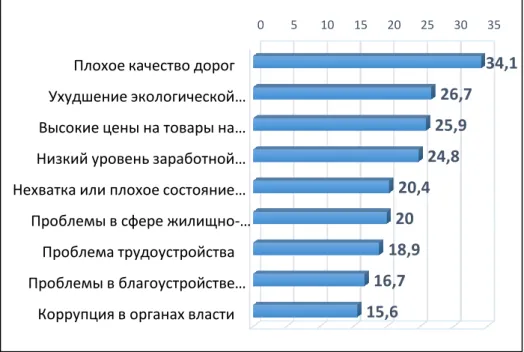
Corruption is currently not perceived as the most acute problem of concern to the population. The experts ranked the poor quality of the roads;
deterioration of the ecological situation; high prices for goods in markets and shops; low wages; shortage or poor condition of hospitals, clinics and health posts; problems in the field of housing and communal services, employment and problems in the improvement of the territories of municipalities, corruption in the authorities in the higher ranking positions (Figure 1).
Figure 1. Which of the following problems are most acutely perceived by the population in your area (city)
Image explanation:
плохое качество дорог poor quality of roads
ухудшение экологической обстановки environmental degradation высокие цены на товары на рынках и в
магазинах
high prices for goods in markets and shops низкий уровень заработной платы low wages
нехватка или плохое состояние больниц, поликлиник и медпунктов
shortage or poor condition of hospitals, clinics and health posts
проблемы в сфере жилищно-коммунального хозяйства,
problems in the field of housing and communal services,
проблемы трудоустройства employment problems
проблемы в благоустройстве территорий
муниципальных образований, problems in the improvement of the territories of municipalities, коррупция в органах власти government corruption
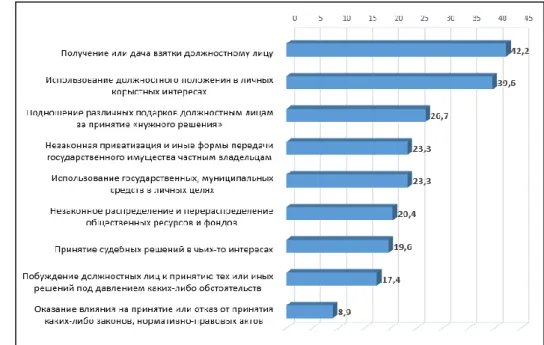
It is traditional for our country, that almost half of the experts perceive corruption as receiving or giving a bribe. The experts put the use of official position for personal gain in the second rank position. Attention should be drawn to the fact that gifts to officials were placed in the third rank position, which may indicate the effectiveness of anti-corruption education, because a few years ago many citizens did not consider the gifts as a manifestation of corruption (figure 2).
0 5 10 15 20 25 30 35
Плохое качество дорог Ухудшение экологической … Высокие цены на товары на … Низкий уровень заработной … Нехватка или плохое состояние … Проблемы в сфере жилищно-…
Проблема трудоустройства Проблемы в благоустройстве …
Коррупция в органах власти
34,1
26,7
25,9
24,8
20,4
20
18,9
16,7
15,6
Figure 2. What is the basic understanding of the content of corruption term in modern Russian society?
Image explanation:
Получение или дача взятки
должностному лицу Receiving or giving a bribe to an official Использование должностного
положения в личных корыстных интересах
Use of official position for selfish interests
Подношение различных подарков должностным лицам за принятие
«нужного решения»
Offering various gifts to officials for making the "right decision" by them Незаконная приватизация и иные
формы передачи государственного имущества частным владельцам
Illegal privatization and other forms of transfer of state property to private owners
Использование государственных, муниципальных средств в личных целях
Use of state or municipal funds for personal purposes
Незаконное распределение и перераспределение общественных ресурсов и фондов
Illegal distribution and redistribution of public resources and funds
Принятие судебных решений в чьих- то интересах
Making judgments in someone else's interests
Побуждение должностных лиц к принятию тех или иных решений под давлением каких-либо обстоятельств
Encouraging officials to make certain decisions under the pressure of any circumstances
Оказание влияния на принятие или отказ от принятия каких-либо законов, нормативно-правовых актов
Influencing the adoption or refusal to adopt any laws or regulations
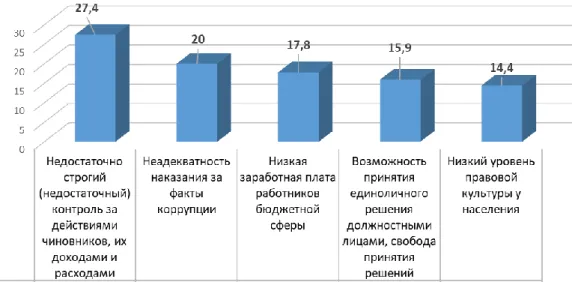
been introduced into anti-corruption practice allowing timely identification and prevention of corruption risks, the experts put in the first rank position the “insufficiently strict control over the actions of officials, and also their income and expenses" when characterizing the causes of corruption. The second rank position is occupied with “inadequacy of punishment for the facts of corruption”, which means the lack of “inevitability of punishment”
in combating corruption. The society has formed a request to ensure the adequacy of punishment, but, according to experts, it does not work in many cases concerning high-ranking corrupted officials. The experts brought “low wages of public sector workers” to the third position, which confirms the words of one of the heroes by Berthold Brecht: “bread is first, and morality is second” (Denisova-Schmidt et al., 2021; Mukhaev &
Prokopenko, 2020). Also noteworthy is the fact that experts pointed to a low level of legal culture among the population as a significant cause of corruption (5th rank position), which indicates the need to intensify anti- corruption and legal education, and to introduce progressive forms of this activity. The instability of the economic situation and the underdevelopment of civil society were named as the 6th and 7th positions (figure 3).
Figure 3. What are the causes of corruption in your opinion?
Image explanation:
Недостаточно строгий (недостаточный) контроль за действиями чиновников, их доходами и расходами
Insufficiently strict (insufficient) control over the actions of officials, their income and expenses
Неадекватность наказания за
факты коррупции Inadequacy of punishment for facts of corruption
Низкая заработная плата работников бюджетной сферы
Low wages of public sector employees Возможность принятия
единоличного решения
The ability to make a single decision by officials; freedom of decision making by
должностными лицами, свобода принятия решений
them Низкий уровень правовой
культуры у населения Low level of legal culture among the population
Experts see the main danger of corruption for an individual, society, and the state in the fact that corruption reduces to nothing the level of political loyalty of citizens to the state and its political leaders, since the latter do not comply with the law and their actions contradict the principles of justice (Al- Marhubi, 2000; Cohen & Cohen, 2012).
The experts put in the second rank position the statement that corruption destroys the concepts of morality, fairness and justice. Experts see the danger of corruption in the fact that it spreads an unlawful worldview in society (nihilism). According to them, since laws are not binding for corrupted elite, it means that the laws can be disregarded by the population. And here, it is appropriate to recall the words of E.M. Primakov as the representative of the Russian political elite, who, speaking about the foundations of Russia's economic struggle in the 21st century, pointed out a number of unresolved problems in our country, emphasized the level of
“corruption, which manifests itself everywhere, both in the practice of government orders and tenders, and in the framework of unfounded claims from inspection bodies, and the favouritism of civil servants who patronize those companies that may be competitors of potential investors, etc.”
Therefore, the desire to shift the brunt of the fight against corruption onto the officials themselves is counterproductive. To this end, it is necessary to actively use public institutions to prevent corruption manifestations destroying the atmosphere of invincible corruption (Figure 4).
Figure 4. Why corruption is dangerous for individuals, society and the state?
Снижает или вообще сводит на нет уровень политической лояльности граждан к государству и его политическим лидерам (поскольку они не соблюдают закон), и их действиям.
Reduces or completely negates the level of political loyalty of citizens to the state and its political leaders (since they do not comply with the law) and their actions.
Уничтожает понятия нравственности, честности справедливости.
Destroys the concept of morality, fairness, and justice.
Распространяет противоправное мировоззрение в обществе о том, что раз законы не обязательны для коррумпированной элиты, значит, их вообще можно не соблюдать.
Spreads an illegal worldview in society that since laws are not obligatory for corrupted elite, it means that they cannot be followed at all.
Угрожает безопасности государства, делая его уязвимым перед
возможным подкупом
государственных служащих со
стороны иных государств для работы в их интересах.
Threatens the security of the state, making it vulnerable to possible bribery of civil servants from other states to work in their interests.
Лишает людей стремления чего-либо добиваться в жизни и уничтожает социальную активность.
It deprives people of the desire to achieve anything in life and destroys social activity.
Лишает смысла институты государства, заменяя собой публичные управленческие и правовые процедуры.
It deprives the state institutions of meaning, replacing public
administrative and legal procedures.
Describing the real level of corruption in Russia, almost half of the experts ranked the first position with the statement that corruption is currently one of the main unsolved problems in our country; the level of its prevalence in state structures is very high. In contrast to them, a third of the experts noted that in recent years this level has dropped significantly (Côté &
Schwartz, 2002; Heyneman, 2004). The opinion of every fifth expert is surprising that the problem of corruption in Russia has been practically eradicated and only isolated special cases of bribery occur (Figure 5).
Figure 5. Which of the following judgments best reflects the real level of corruption in Russia as a whole?
Image explanation:
В настоящее время коррупция представляет собой одну из главных нерешенных проблем в нашей стране, уровень её распространенности в госструктурах очень высок
At present, corruption is one of the main unresolved problems in our country, the level of its prevalence in state structures is very high
Уровень коррупции в России заметный, однако, за последние годы он
существенно снизился
The level of corruption in Russia is noticeable, however, in recent years it has significantly
decreased
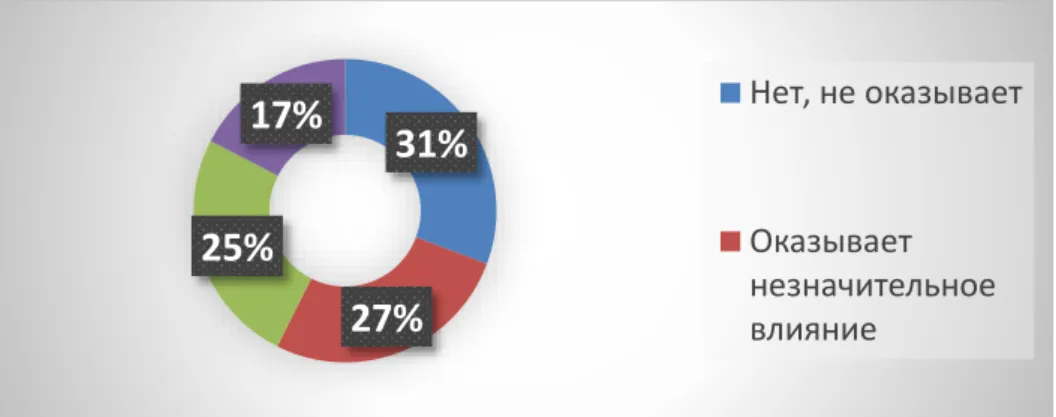
More than half of the experts believe that corruption either has no effect on their life, or has little impact. Only every fourth expert is convinced that corruption affects the entire spectrum of relations in the state and society;
therefore, it also affects the life of individuals (Figure 6).
Figure 6. Does corruption have an impact on your life?
45%
33%
22% В настоящее время
коррупция представляет собой одну из главных нерешенных проблем в нашей стране, уровень её распространенности в госструктурах очень высок
31%
27%
25%
17% Нет, не оказывает
Оказывает
незначительное
влияние
Нет, не оказывает No, it doesn't have Оказывает незначительное влияние It has a little impact
Да, оказывает Yes, it does have
Затрудняюсь ответить I am at a loss to answer
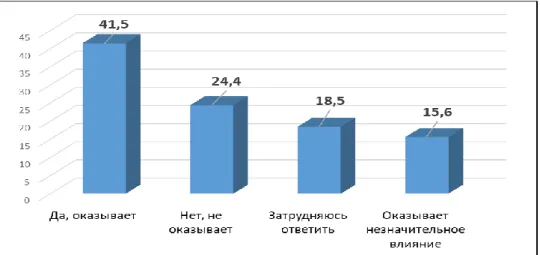
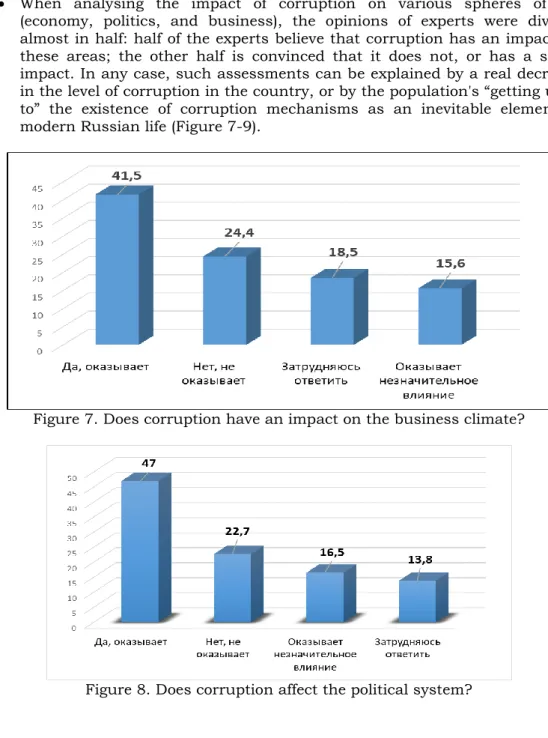
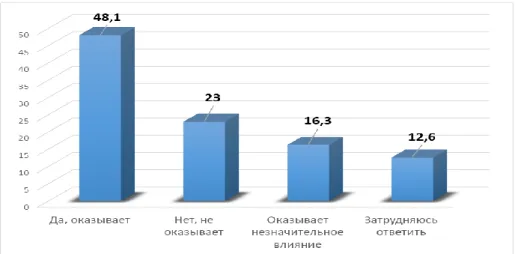
When analysing the impact of corruption on various spheres of life (economy, politics, and business), the opinions of experts were divided almost in half: half of the experts believe that corruption has an impact on these areas; the other half is convinced that it does not, or has a slight impact. In any case, such assessments can be explained by a real decrease in the level of corruption in the country, or by the population's “getting used to” the existence of corruption mechanisms as an inevitable element of modern Russian life (Figure 7-9).
Figure 7. Does corruption have an impact on the business climate?
Figure 8. Does corruption affect the political system?
Figure 9. Does corruption have an impact on the economy?
For example, the level of corruption in the Rostov region as a federal subject of the Russian Federation was assessed by 29% of experts as medium, as many as low. Moreover, in percentage terms, the level of corruption in the federal subject turned out to be lower than that indicated by them in Russia (38.9%). 27% of experts believe that the level of corruption in the region is high.
Figure 10. How do you assess the level of corruption in your federal subject?
Image explanation:
Высокий High
Средний Medium
Низкий Low
Затрудняюсь ответить I am at a loss to answer
Compared to 2019, 33.3% of experts noted that the level of corruption remained at the same level; 27.4% believe that the level of corruption has decreased; 17.4%
of experts believe that the level of corruption in the subject has increased significantly (Figure 10-11).
27%
29%
29%
15%
Высокий
Коррупции стало намного больше There is much more corruption Нет, всё осталось на том же уровне No, everything stayed the same Коррупции стало намного меньше Corruption has become much less Затрудняюсь ответить I am at a loss to answer
38.9% of experts rated the level of corruption in the Russian Federation as high; 27.4% believe that the level of corruption in the country is average, and 25.2% assessed it as low. 36% of experts believe that the level of corruption in the Russian Federation has not changed in 2019. 26.3% noted a decrease in the level of corruption. Every 5th respondent is convinced that corruption has become much more (Figure 12-13).
Figure 12. How do you assess the level of corruption in the Russian Federation?
Image explanation:
Высокий High
Средний Medium
Низкий Low
Затрудняюсь ответить I am at a loss to answer
Figure 13. How has the level of corruption in the Russian Federation changed over the past year?
Experts expectedly put traffic police officers in the first rank position among the representatives of the most corrupted professions, traditionally occupying the top lines in most sociological polls and followed by officials allocating plots for commercial activities and housing construction, employees of local administrations, employees of the prosecutor's office, military registration and enlistment offices, employees of the Federal Penitentiary Service , customs authorities, Rostpotrebnadzor, State Fire Supervision, judges of district and regional courts, doctors and other medical workers. Teachers and school principals mentioned in the reports of law enforcement agencies as the most corrupted category, are not so, in the opinion of experts, and occupy the last place in the list of corrupted professions (Table 1).
Table 1
Even if you have not personally encountered a problem, please tell me, in your opinion, which professions are the most corrupted?
Internal affairs officers (police), incl. traffic police
officers. 27,8 %
Officials providing land plots for commercial activities. 21,1 %
Local government officials. 18,5 %
Officials issuing individual building permits. 17,4 % Employees of the prosecutor's office. 17,0 % Officials issuing permits for the commercial construction
of residential buildings. 16,7 %
Military enlistment office employees. 16,3 % Officials of regional (territorial) ministries and
departments. 15,2 %
Employees of penitentiary institutions (pre-trial
detention centres, prison camps). 14,4 %
Customs officers. 13,7 %
District (city) court judges. 13,0 %
Employees of the State Fire Supervision. 12,6 % Rospotrebnadzor (Russian Agency for Health and
Consumer Rights) employees 11,9 %
Directors (heads) of enterprises. 11,1 %
Judges of the regional courts. 11,1 %
Doctors and other healthcare professionals. 11,1 % Employees of institutions providing funeral services. 10,7 %
University teachers. 8,9 %
Judges of the Arbitration Court. 8,5 %
Employees of Civil registry offices. 7,8 %
Tax officers. 7,8 %
Employees of the chambers for land and property
relations of regional executive committees. 7,4 %
Bailiff service officers 6,7 %
Justices of the peace. 6,7 %
Pension Fund employees. 5,9 %
Heads of preschool institutions. 4,8 %
Employees of passport and visa services. 4,8 %
Agricultural directorate workers. 4,4 %
School teachers, school directors. 2,2 %
I am at a loss to answer. 2,2 %
Others:
Gorgaz (city gas authority), Vodokanal (city
plumbing and water supply service), Elektronadzor (city electricity service) (resource supplying and utility organizations);
Those who are engaged in antimeritocratic behavior
0,7 %
Over the past year, one third of experts have personally come across manifestations of corruption. It seems that this is an unacceptably high figure. This indicates that potential bribe-takers are not afraid of the intensification of repressive measures for corruption offenses and that anti- corruption education measures have not yet had a proper deterrent effect on officials, and, therefore, have not led to a tangible decrease in the level of perception of corruption (Abbink, 2004; Zhang et al., 2019).
Two thirds of the experts believe that they are not protected, or protected to some extent from “administrative arbitrariness of corrupted officials” who give orders of a corrupted nature to their subordinates, threatening them with dismissal if they do not comply. No more than a quarter of experts are convinced of their “absolute security”. It should be noted that, in comparison with previous studies, the number of citizens who will not report the facts of corruption under no circumstances has significantly decreased (14.1%). Previously, this figure was at 30%. Every 5th expert chose the option: “I will contact the law enforcement agencies;” there is about the same number of those who are ready to use the helpline. In general, three-quarters of the experts are ready to cooperate with the authorities in combating corruption. 11.3% of experts are ready to inform the authorities by an anonymous letter.
Experts explain the position of citizens who refuse to inform about the facts of corruption by their fear for the safety of themselves and their loved ones, calling in their immediate environment with the name of a "denouncer or informant", as well as disbelief that real measures will be taken against corrupted officials (Fig.14).
Figure 14. If you would not report the facts of corruption, please, indicate your reason.
Image explanation:
Не считаю необходимым I do not consider it necessary Опасно для меня и моих близких It is dangerous for me and for my
loved ones
Затрудняюсь ответить I am at a loss to answer Считаю это бесполезным, меры не будут
приняты
I think it's useless: no action will be taken
Answering the question, when solving what problem, or in what situation people have to bribe, experts put in the first position "the desire to resolve problems with the traffic police." In the second position, there is a desire to achieve the desired result in court; the third is the settlement of problems with a military registration and enlistment office, then, employment and promotion. In general, the list of situations in which people have to resort to using corruption mechanisms shows a wide range of real corruption risks that require the attention of state bodies and public structures involved in combating corruption (Table 2).
Table 2
When solving what problem or in what situation do people have to bribe?
Traffic police: settle a situation, get a license, etc. 16,7 % Courts: To achieve justice or the desired result in court. 14,1 % Military enlistment offices: solving problems in connection with
conscription. 12,6 %
Medicine: receiving free medical care in a polyclinic, hospital,
disability registration. 8,1 %
School: go to the desired school and complete it successfully. 11,5 % Job: Get the job they want or secure a promotion. 11,5 % University: to enter, transfer to a more prestigious faculty, budget
education, pass exams, etc. 10,7 %
Police: get help and protection. 10,4 %
Living space: get (including social mortgage). 10,0 % Penitentiary institutions (pre-trial detention centres, prison camps):
when visiting relatives, handing over parcels, etc. 9,6 % Land plot: purchase (for summer cottages, housing construction,
personal subsidiary plots), registration, transfer of rights, etc. 8,1 % Bodies of local self-government of a city district (municipal district):
solving issues related to their activities. 8,1 %
Prosecutor's Office: obtaining legal assistance and protection. 8,1 % Regional ministries and departments: solving issues related to their
activities, with the activities of their structural units. 5,6 % Other:
- For all the indicated problems;
- Bailiffs - bribe for the purpose of non-payment of alimony
5,2 % Passport office: obtain registration at the place of residence, a
passport, a foreign travel passport. 4,4 %
Customs: passing customs control, cargo transportation, etc. 3,3 %
Pensions: early registration, etc. 3,3 %
documents allowing for real estate transactions, etc.
Real estate: formalize legal rights with the registration authorities. 3,3 %
Tax office: reduce taxes, get services. 3,3 %
Rospotrebnadzor: getting help on the quality of products and other
issues related to their activities. 3,0 %
Social payments: registration of benefits, payments, etc. 2,2 %
It should be noted that only every fourth expert considers giving gifts to officials as a manifestation of corruption. About the same number justify gifts by national tradition and a sincere desire to thank an official for the service rendered. 27.7% of experts believe that a gift is the only way to solve a problem and save time and nerves.
As they know, the Rostov region is a leader in the country concerning the implementation of “single window” technologies offered by MFCs (multifunctional centres for the provision of state and municipal services).
This ensures “transparency” of operations, which creates certain guarantees against corruption. Almost two-thirds of the experts noted that they use services provided electronically via the Internet (payment of utility bills, traffic fines, queuing at a preschool institution, preliminary registration for obtaining a foreign travel passport, etc.). At the same time, the same number of experts indicated that they do not consider services in electronic form a guarantee against corruption, since corrupted officials find ways to illegally resolve emerging issues (Butler, 1986; Witbooi, 2006).
The expert survey showed that more than 90% of experts have information on anti-corruption measures in full or in part. Only 8.1% admitted that they did not have such information. These figures dictate the need for more active implementation of measures to educate the population against corruption. It should be noted that in comparison with similar surveys conducted in previous years, the number of experts who are not familiar with the text of the Federal Law “On Combating Corruption” has significantly decreased. If in 2018 this indicator in the Rostov region was 26.1%, then this year it is 8.1% (Topchii et al., 2021; Holovkin et al., 2021).
An assessment of anti-corruption measures regulated by the Federal Law
"On Combating Corruption" showed that less than 10% of experts consider these measures to be effective in combating corruption. More than a third of experts agree with this assessment, but note that anti-corruption measures are not always respected. Another third of experts consider corruption prevention measures rather ineffective and practically impossible to implement in practice. 19.3% of experts believe that the measures under consideration are absolutely ineffective (Figure 15).
Figure 15. Are the corruption prevention measures outlined in the Anti- Corruption Law effective?
Image explanation:
Не знаком с текстом закона I’m not familiar with the text of the law Нет, меры по профилактике
коррупции, обозначенные в законе, абсолютно не эффективны
No, the measures to prevent corruption outlined in the law are absolutely ineffective
Скорее нет, меры по профилактике коррупции практически не
реализуются
Rather not, corruption prevention measures are practically not implemented
Скорее да, обозначенные в законе меры профилактики могут быть эффективны, но они не всегда соблюдаются
Rather, yes; the prevention measures outlined in the law can be effective, but they are not always respected Да, они реализуются в полной мере
и препятствуют распространению коррупции
Yes, they are fully implemented and prevent the spread of corruption
Experts identified the measures among those aimed at combating corruption: the removal of officials from office; the dismissal of an official convicted of corruption; bringing bribe-takers and corrupted officials to justice; improving anti-corruption legislation, and control over the income and expenses of officials. The activities of the Anti-Corruption Foundation by Alexei Navalny were noted by 3.7% of experts, which shows the lack of wide public interest in this actor (Figure 16).
Figure 16. What actions to combat corruption do you personally know about?
Image explanation:
Судебные дела против взяточников и коррупционеров
Lawsuits against bribe-takers and corrupted officials
Снятие с должности, увольнение должностного лица, уличенного в коррупции
Removal from office, or dismissal of an official convicted of corruption
Принятие законодательных актов, направленных на борьбу с
коррупцией
Adoption of legislation aimed at combating corruption
Публичные заседания Комиссии по координации работы по
противодействию коррупции в субъекте РФ
Public meetings of the Commission for the coordination of anti-corruption work in a constituent entity of the Russian Federation
Антикоррупционная пропаганда в
СМИ Anti-corruption propaganda in the
media Учреждение специального органа,
нацеленного на противодействие коррупции
Establishment of a special body aimed at combating corruption
Контроль за доходами и расходами
чиновников Control over the income and expenses
of officials Создание механизмов
общественного контроля над чиновниками, должностными лицами
Creation of mechanisms of public control over officials, civil servants
Другое: Деятельность Фонда борьбы с коррупцией Алексея Навального
Other: Activities of the Anti-Corruption Foundation by Alexei Navalny
Ничего не знаю I do not know anything about it
The experts indicated newspapers, television and radio broadcasting as the main source of information on anti-corruption. This is followed by the information and telecommunications network Internet and the websites of
state (municipal) authorities. As for the federal media, only every 5th expert is satisfied with the quality and volume of information received. Two-thirds of experts believe that the information is either insufficient, or it does not cover all aspects of anti-corruption issues. A similar picture exists in the local media, in which the experts' interest is lower than in the federal ones (Figure 17-19).
Figure 17. Please indicate from which sources you most often receive information on anti-corruption activities in your federal subject?
Image explanation:
СМИ (статьи в газетах, сюжеты на
телевидении, радиовещании) Mass media (articles in newspapers, stories on television, radio broadcasting) Сайт органа государственной/
муниципальной власти State / municipal authority website Информационно-
телекоммуникационные сети Интернета (новостная лента в Twitter и др.)
Information and telecommunication networks of the Internet (news feed on Twitter, etc.)
Другие источники (например, от родственников, друзей, в
образовательных учреждениях и др.)
Other sources (for example, from relatives, friends, educational institutions, etc.)
Затрудняюсь ответить I am at a loss to answer
Figure 18. Is there enough information about the anti-corruption policy in the federal media (articles in newspapers, stories on television, radio broadcasting)?
Image explanation:
Да, информация предоставляется в необходимом для меня объеме
Yes, the information is provided in the amount necessary for me Информации достаточно, но она не
освещает всех аспектов There is enough information, but it does not cover all aspects
Нет, информации недостаточно No, there is not enough information
Не смотрю (не читаю) I don't look at (I don't read) Затрудняюсь ответить I am at a loss to answer
Figure 19. Is there enough information about anti-corruption policy in the local media (newspaper articles, TV, radio broadcasts)?
1% of experts put the Federal Security Service of the Russian Federation in first position among the bodies that most effectively counteract corruption in Russia followed by the Prosecutor's Office of the Russian Federation and other law enforcement agencies. At the bottom of the rating there are public authorities and local self-government bodies, which are clearly
underestimated by experts as subjects of combating corruption, despite the significant amount of work carried out by them.
Figure 20. What bodies are most effective in combating corruption in modern Russia?
Image explanation:
Федеральная служба безопасности Federal Security Service Органы Прокуратуры Российской
Федерации.
Bodies of the Prosecutor's Office of the Russian Federation.
Правоохранительные органы Law enforcement Средства массовой информации Mass media
Затрудняюсь ответить I am at a loss to answer Институты гражданского общества Civil society institutions Органы государственной власти
субъектов РФ
State authorities of the constituent entities of the Russian Federation Федеральные органы государственной
власти РФ
Federal government bodies of the Russian Federation
Органы местного самоуправления РФ Local government bodies of the Russian Federation
As in the opinion polls of previous years, when answering the question about the arrests of officials who took bribes on an especially large scale, most experts consider these episodes not to be the result of a consistent anti-corruption policy of the state, but as “demonstrative performances” to create the appearance of fighting corruption. A little more than 20% of experts believe that those officials who did not deduct a percentage to their higher management have been detained. And only a quarter of experts think
(Figure 21).
Figure 21. Do the arrests of officials who took bribes on an especially large scale have a consequence in the form of the consistent anti-corruption policy of the
state?
Image explanation:
Да, все громкие дела являются
результатом борьбы с коррупцией Yes, all high-profile cases are the result of the fight against corruption
Большинство задержаний имело
«показательный» характер для создания видимости борьбы с коррупцией
Most of the arrests were “indicative” in order to create the appearance of fighting corruption
Были задержаны только
чиновники, которые не отчисляли
процент вышестоящему
руководству
Only those officials were detained, who did not deduct a percentage of money to the higher management
Другое Other
Затрудняюсь ответить I am at a loss to answer
Most experts believe that the punishment for corruption crimes should be made stricter than that specified in the RF Criminal Code. According to the experts, the second position was occupied by the answer that the punishment specified in the Criminal Code is fully consistent with the nature of the act. Every 5th expert believes that the punishment for accepting a bribe is excessively strict and unfair (Adinkrah & Adinkrah, 2021; Sumadi, 2016). It should be noted that compared to a similar question in the 2018 study, the number of experts voting in favour of tougher punishment is decreased, and the number of experts who found it difficult to answer quadrupled (Figure 22).
Figure 22. Is the punishment for accepting a bribe specified in the legislation of the Russian Federation sufficient and fair for such an act?
Image explanation:
Да, наказание, обозначенное в Уголовном кодексе, вполне соответствует характеру деяния
Yes, the punishment specified in the Criminal Code is quite consistent with the nature of the act
Нет, наказание за получение взятки является излишне строгим и
несправедливым
No, the punishment for accepting a bribe is unnecessarily severe and unfair
Нет, наказание за получение взятки необходимо сделать более строгим, чем указанное в Уголовном кодексе
No, the punishment for accepting a bribe needs to be made stricter than that specified in the Criminal Code Затрудняюсь ответить I am at a loss to answer
Assessing measures that can lead to a decrease in the level of corruption in Russian society, the experts ranked the first five positions in the following sequence:
Establish a lifelong ban on civil service for officials convicted of corruption crimes.
Increase the efficiency of law enforcement agencies in the fight against corrupted officials by expanding the possibilities for conducting operational-search activities and introduce the practice of "provoking a bribe".
Strictly control the distribution and expenditure of budget funds;
To increase the legal literacy of the population in terms of the anti- corruption component.
Introduce the rule of confiscation not only with regard to the property of persons convicted of a corruption offense, but also of their immediate family.
solving the problem, which seems to be a simpler and faster way than the educational aspect (Table 3).
Table 3
What measures can lead to a decrease in the level of corruption in Russian society?
Most experts said that the punishment for accepting a bribe should be the same for all officials, regardless of their rank. This position is only 3% ahead of the opinion that higher-ranking officials should be punished for bribery more severely than ordinary employees (Figure 23).
Establish a lifelong ban on civil service for officials convicted of corruption
offenses. 29,3 %
To increase the effectiveness of the activities of law enforcement agencies in the fight against corruption expanding the possibilities for conducting operational-search activities and introduce the practice of "provoking a bribe".
28,1 %
Strictly control the distribution and expenditure of budget funds. 27,4 % To increase the legal literacy of the population in terms of the anti-
corruption component. 23,3 %
Introduce the rule of confiscation not only with regard to the property of persons convicted of a corruption offense, but also of their immediate
family. 22,2 %
Track the property status of officials, and compliance of their expenses
with officially declared income. 21,1 %
Deprive persons convicted of corruption offenses from pension
supplements as civil servants. 21,1 %
Tighten anti-corruption legislation and dramatically increase prison
sentences. 17,8 %
Ensure openness of decision-making by the authorities for placing orders,
rendering services for state needs. 15,6 %
Introduce more widely a system of independent examination of draft laws
and laws for their corruption risks. 11,9 %
Increase the salaries of state and municipal employees. 11,5 % Provide an accessible and simple mechanism for judicial appeal against
decisions of an official. 10,7 %
Figure 23. Is it necessary in your opinion to determine the degree of punishment for bribery for officials depending on the level of their position?
Image explanation:
Да, чиновники более высокого ранга должны быть наказаны за
взяточничество строже, чем простые служащие
Yes, higher-ranking officials should be punished more severely for bribery than ordinary employees
Нет, наказание за получение взятки должно быть одинаковым для всех чиновников вне зависимости от их ранга
No, the punishment for accepting a bribe should be the same for all officials, regardless of their rank.
Другое: Наказание должно соответствовать ущербу от
нарушения; Конфискация скрытого имущества;
Other: The punishment must be consistent with the damage caused by the violation; Confiscation of hidden property;
Затрудняюсь ответить I am at a loss to answer
The most significant answer options regarding the measures to be taken to reduce the level of corruption were ranked by experts as follows:
Strengthening anti-corruption legislation
Strict control over the distribution and spending of budgetary funds
Ensuring openness of decision-making by the authorities on placing orders for the supply of goods and services for state (municipal) needs
Improving the efficiency of law enforcement agencies in the fight against corruption.
Formation of an anti-corruption worldview, increasing the legal literacy of the population (Table 4).
Table 4
What should be done in your opinion to reduce the number of corrupted officials (bribe-takers)?
Strengthen anti-corruption legislation. 28,9 %
Strictly control the distribution and expenditure of budget funds. 24,4 % Ensure openness of decision-making by authorities on placing orders for 22,2 %
To form an anti-corruption worldview, to increase the legal literacy of the
population. 21,1 %
To increase the effectiveness of the law enforcement agency activities in
the fight against corruption. 21,1 %
Regulate the actions of officials when interacting with the population. 20,0 % Start with ourselves and your loved ones: develop an unacceptable
attitude towards corruption. 20,0 %
Provide more coverage of anti-corruption activities in the media. 18,9 % To increase the wages of state (municipal) employees and public sector
employees. 16,3 %
Other:
- To increase the effectiveness of the activities of law enforcement officers and courts in the fight against corruption in their ranks;
- It is necessary to revive in full the measures of moral and material incentives for labour. At present, the awards concern a narrow circle of people;
- Introduce the death penalty for officials who take bribes;
- Inform the population about where the funds and property confiscated from bribe-takers are directed.
7,8 %
A positive result of the sociological survey in comparison with similar studies of previous years is the willingness of 93% of experts to take personal part in anti-corruption activities. Every 5th expert is already involved in such work and considers it their civic duty (Figure 24-25).
Figure 24. Are you ready to take part in anti-corruption activities?
Image explanation:
Да, готов принять участие в антикоррупционных акциях, направленных на повышение правовой грамотности.
Yes, I am ready to take part in anti- corruption actions aimed at
improving legal literacy.
Да, готов обращаться по фактам коррупции (ГИС «Народный контроль», СМИ, др. интернет-ресурсы,
предоставляющие возможность привлекать к широкому
общественному обсуждению подобных фактов)
Yes, I am ready to address corruption facts (GIS "People's Control", mass media, other Internet resources that provide an opportunity to involve such facts in a broad public discussion)
Да, готов обращаться в правоохранительные
органы/вышестоящие органы власти по решениям и действиям органов государственной и муниципальной власти и их должностных лиц по фактам коррупции
Yes, I am ready to apply to law enforcement agencies / higher authorities on decisions and actions of state and municipal authorities and their officials on the facts of corruption
Да, готов работать в организациях, целенаправленно занимающихся борьбой с коррупцией
(некоммерческие организации, правозащитные фонды,
исследовательские центры, интернет- проекты и др.)
Yes, I am ready to work in
organizations that are purposefully engaged in the fight against
corruption (non-profit organizations, human rights foundations, research centres, Internet projects, etc.) Я уже принимаю участие, считаю это
своим гражданским долгом I am already taking part, I consider it my civic duty
Нет, не готов No, not ready
Figure 25. If not, why?
Считаю, что результатов не будет / по выявленным фактам коррупции проверки будут формальными
I believe that there will be no results / Checks on the revealed facts of corruption will be formal
Это слишком рискованно для меня
и для членов моей семьи It's too risky for me and my family.
Работа в данном направлении уже проводится на государственном уровне
Work in this direction is already being carried out at the state level
У граждан нет достаточных полномочий / работу в данном направлении должны осуществлять только специализированные органы (организации)
Citizens do not have sufficient powers / Work in this direction should be carried out only by specialized bodies (organizations)
Не считаю это необходимым (мне
это не нужно) I don't consider it necessary (I don't need it)
Затрудняюсь ответить I am at a loss to answer Другое: Каждый должен заниматься
своим делом Other: Everyone should mind their own
business
Taking into account the above, it can be stated that the anti-corruption policy remains unbalanced and does not inspire confidence, and, consequently, support from part of the population. At the same time, the widespread opinion that corruption can be defeated through dictatorship and repression (the experience of China and other foreign countries) does not justify itself in practice. It is impossible to solve this problem only by means of legal suppression, since “susceptibility to corruption is part of human nature and if a cult of wealth has developed in society, then this only stimulates corruption” (Zulvany, 2020; Rinartha & Suryasa, 2017).
Conclusion
The need to improve the efficiency of combating corruption presupposes an increase in the influence of ethical and moral norms on the observance of prohibitions, restrictions, and requirements established in order to counter corruption, as well as the development of additional mechanisms and tools for preventing corruption manifestations. Moreover, it is clearly not enough to legalize the norms of anti-corruption behaviour, through which law enforcement activities in this area could provide real results. Anti-corruption norms require not only legalization, but also legitimation, that is, recognition and support by citizens and society of this work as a whole. Only a combination of these two components can ensure an increase in the effectiveness of the prevention of corruption offenses in the Russian Federation.
It seems that the time has come to study and assess the effectiveness of legal regulation concerning the participation of civil society institutions in the work on the prevention of corruption. At the same time, attention should be paid to the development of measures to ensure proper guarantees for the participation of civil society institutions in the national anti-corruption program. It should be noted
that the effectiveness of the regulatory impact of anti-corruption measures is constrained by the multiplicity and inconsistency of the normative legal acts regulating the scope of anti-corruption activities. In a number of cases, the relevant legislative regulation is either not supplemented by the regulatory framework of the subordinate level, or does not provide for an appropriate mechanism for the practical implementation of legislative norms aimed at combating corruption.
Anti-corruption legislative initiatives of political parties and social movements represented in the State Duma can be assessed as inappropriate to the level of threats. Many of them demonstrate a belated reaction to trends in the field of corruption, are abstract and declarative in nature, and are taken in isolation from the actual problems of the fight against corruption, and the real expectations and demands of society. Legislative and law enforcement activities in the field of combating corruption systematically demonstrate not resistance, but a compromise, which negatively affects the authority of state bodies responsible for solving problems in the field of combating corruption, provokes legal nihilism among some citizens, disbelief in the goals and objectives declared by the anti- corruption policy.
References
Aarvik, P. (2019). Artificial Intelligence–a promising anti-corruption tool in development settings. U4 Anti-Corruption Resource Centre.
Abbink, K. (2004). Staff rotation as an anti-corruption policy: an experimental study. European Journal of Political Economy, 20(4), 887-906.
https://doi.org/10.1016/j.ejpoleco.2003.10.008
Adinkrah, M., & Adinkrah, H. A. (2021). Focalizing Chinua Achebe’s no longer at ease: mitigating and aggravating factors in Obi Okonkwo’s corruption scandal. International Journal of Linguistics, Literature and Culture, 7(5), 371- 380. https://doi.org/10.21744/ijllc.v7n5.1011
Al-Marhubi, F. A. (2000). Corruption and inflation. Economics Letters, 66(2), 199- 202. https://doi.org/10.1016/S0165-1765(99)00230-X
Baranov, P. P., Mamychev, A. Y., Miroshnichenko, O. I., & Dremliuga, R. I. (2021).
Legal Consciousness And Legal Culture In The Era Of Total Digitalization. Revista Gênero e Interdisciplinaridade, 2(01).
Bazhanov, E. P., & Bazhanova, N. E. (2013). Dialogue and clash of civilizations. Moscow: Ves mir, 246.
Brecht, B. (2015). Brecht on art and politics. Bloomsbury Publishing.
Butler, H. N. (1986). General incorporation in nineteenth century England:
Interaction of common law and legislative processes. International Review of Law and Economics, 6(2), 169-188. https://doi.org/10.1016/0144- 8188(86)90002-5
Cohen, E., & Cohen, S. A. (2012). Current sociological theories and issues in tourism. Annals of Tourism research, 39(4), 2177-2202.
https://doi.org/10.1016/j.annals.2012.07.009
Côté, J. E., & Schwartz, S. J. (2002). Comparing psychological and sociological approaches to identity: Identity status, identity capital, and the individualization process. Journal of adolescence, 25(6), 571-586.
https://doi.org/10.1006/jado.2002.0511
Combining experimental evidence with machine learning to assess anti- corruption educational campaigns among Russian university students. Empirical Economics, 60(4), 1661-1684.
Heyneman, S. P. (2004). Education and corruption. International Journal of
Educational Development, 24(6), 637-648.
https://doi.org/10.1016/j.ijedudev.2004.02.005
Holovkin, B. M., Tavolzhanskyi, O. V., & Lysodyed, O. V. (2021). Corruption as a cybersecurity threat in conditions of the new world’s order. Linguistics and
Culture Review, 5(S3), 499-512.
https://doi.org/10.21744/lingcure.v5nS3.1538
Kapyrina, N. (2019). Resolution of the Plenary Session of the Supreme Court of the Russian Federation No. 10, 23 April 2019. GRUR International.
Mukhaev, R. T., & Prokopenko, E. E. (2020). Corruption as a global threat to sustainable development: a view from Russia. Amazonia investiga, 9(25), 160- 175.
Okhotsky, E., Vorontsov, S., Ponedelkov, A., Mamychev, A., & Frolov, S. (2019).
Statement and implementation of goals of the political strategy is the basis of effective public administration. Revista Inclusiones, 475-486.
Petrovich, B. P., Yurievich, M. A., Yurievich, M. A., Vyacheslavovich, S. O., &
Nikolaevna, G. E. (2019). Human Rights and Freedoms in the Digital Era:
Problems and Perspectives of Their Establishment in the Eurasian Space. J.
Pol. & L., 12, 93.
Primakov, E. M. (2011). Mysli vslukh [Thinking out loud]. Rossiyskaya Gazeta, 135 (5511).
Rinartha, K., & Suryasa, W. (2017). Comparative study for better result on query suggestion of article searching with MySQL pattern matching and Jaccard similarity. In 2017 5th International Conference on Cyber and IT Service Management (CITSM) (pp. 1-4). IEEE.
Sabani, A., Farah, M. H., & Dewi, D. R. S. (2019). Indonesia in the spotlight:
Combating corruption through ICT enabled governance. Procedia Computer Science, 161, 324-332. https://doi.org/10.1016/j.procs.2019.11.130
Schultz, D., & Harutyunyan, K. (2015). Combating corruption: The development of whistleblowing laws in the United States, Europe, and Armenia. International Comparative Jurisprudence, 1(2), 87-97.
https://doi.org/10.1016/j.icj.2015.12.005
Sumadi, K. (2016). Tourism development basis in traditional village of Kuta. International Journal of Linguistics, Literature and Culture, 2(3), 124-132.
Retrieved from https://sloap.org/journals/index.php/ijllc/article/view/124 Swamy, M. R. (2011). Financial Management Analysis Of Money Laundering,
Corruption And Unethical Business Practices: Case Studies Of India: Nigeria And Russia. Journal of Financial Management & Analysis, 24(1).
Topchii, V., Zadereiko, S., Didkivska, G., Bodunova, O., & Shevchenko, D. (2021).
International anti-corruption standards. Linguistics and Culture Review, 5(S4), 1552-1567. https://doi.org/10.21744/lingcure.v5nS4.1866
Witbooi, E. (2006). Law and fisheries reform: legislative and policy developments in South African fisheries over the decade 1994–2004. Marine Policy, 30(1), 30- 42. https://doi.org/10.1016/j.marpol.2005.06.005
Zhang, H., An, R., & Zhong, Q. (2019). Anti-corruption, government subsidies, and investment efficiency. China Journal of Accounting Research, 12(1), 113- 133. https://doi.org/10.1016/j.cjar.2018.12.001
Zulvany, V. (2020). Macrolinguistics: texts and discourses, conversation interactions and conversation components. Macrolinguistics and
Microlinguistics, 1(2), 104–116. Retrieved from
https://mami.nyc/index.php/journal/article/view/10