Exhibition Design and
The Evolution of Museum-goer Experience, 1924 - 2016.
William R. Shaffer
Submitted in partial fulfillment of the requirements for the degree
Master of Arts in the History of Design and Curatorial Studies MA Program in the History of Design and Curatorial Studies
Cooper Hewitt, Smithsonian Design Museum; and Parsons School of Design 2017
©2017 William R. Shaffer All Rights Reserved
Introduction………..1 Chapter 1………. 4 The Rise of the Universal Survey Museum
The Louvre; Public Museums in the U.S.;
The Growth of Museum Holdings; Museum Fatigue
Chapter 2………21 Modernism, the Advent of Exhibition Design and Frederick Kiesler
The New Stagecraft as Precursor to Modern Exhibition Design; The Bauhaus;
Constructivists and Liubov Popova; Frederick Kiesler and Del Stijl;
Frederick Kiesler and a New Paradigm in Exhibition Design
Chapter 3………48 The Changing Museum-goer Experience
Alexander Dorner and the Landesmuseum; New Forms of Communication between Museums and Museum-Goers; Museum Labels, Guide Books and Exhibition Catalogs; Alfred H. Barr, Jr. and The Museum of Modern Art;
Willem Sandberg and the Stedelijk Museum
Chapter 4………76 Emerging Technologies and the Museum Experience
The Beginning of Mediation Devices in Museums; Mediation Devices and Socialization in Art Museums; The Cooper Hewitt Pen; The Exhibition Designer and Digital Technology
Conclusion……….92
Figure 1 ………..8
“The Public Viewing David’s "Coronation" at the Louvre”
Louis Léopold Boilly. Oil on canvas, 1810.
©The Metropolitan Museum of Art, New York.
Figure …...………..19 Pages from "Museum Fatigue," detailing Benjamin Ives Gilman’s
observations of the physical nature of museum-goer experience.
The Scientific Monthly, January, 1916.
Figure 3 ………..26 Adolpe Appia stage design for Gluck’s Orfeo ed Euridice.
Institut Jaques-Dalcroze in Hellerau, 1913.
Figure 4 ………..26 Edward Gordon Craig stage for Hamlet. Moscow Art Theatre, 1912.
Figure 5 ……….30 Kasmir Malevich, sketches for Victory Over the Sun backdrops, 1913.
Figure 6 ……….32 Liubov Popova, stage design for The Magnaminous Cuckold, 1922.
Figure 7………..34 R.U.R. stage design, Fredeick Kiesler. Theater am Kurfürstendamm,
Berlin 1923.
Figure 8 ………...39 Frederick Kiesler, International Exhibition of New Theater Technique.
Vienna, 1924.
Figure 9 ……….40 Axiometric recreation of Kiesler layout. Agras, 2015.
Figure 10 ………...44 Frederick Kiesler, Raumstadt (The City in Space).
Figure 11 ………...49 Expressionist art exhibition,1920s. Landesmuseum, Hanover.
Figure 12 ………...51 Abstract Cabinet by El Lissitizky. Landesmuseum, Hanover, 1927.
Figure 13 ………53 Room of Our Time by László Moholy-Nagy. Landesmuseum, Hanover, 1927.
Figure 14 ………55 Alexander Dorner. Illustration by Sandra Karina Löschke;
text translated from German (Katenhusen & Reuning 1993:27).
Figure 15 ………57 El Lissitzky. The Constitution of the Soviets and The Newspaper Transmissions.
Soviet Pavilion, Pressa, Cologne, 1928.
Figure 16 ………59 Herbert Bayer. Société des Artistes décorateur Exhibit, Paris 1930.
Figure 17 ………....62 1930 Metropolitan Museum of Art catalog page.
Figure 18 ….………...66 Cubism and Abstract Art exhibition catalog cover.
Museum of Modern Art, 1936.
Figure 19 .………..74 Stedelijk Museum restaurant and library, 1960.
Figure 20 ….………..80 The first museum audio guides, 1952. Stedelijk Museum, Amsterdam.
Figure 21 …..………...85 Cooper Hewitt pen.
Figure 22 ………...88 Immersion Room, Cooper Hewitt Smithsonian Design Museum.
Figure 23 ...………...93
“Laboratory Relics.” Edison Institute, Dearborn, MI, 1929.
Figure 24 …..………...98 Virtual Tour, Sir John Soane Museum, London.
Introduction
Over the course of the last two hundred years the relationship between the museum and the museum-goer has changed markedly. Museum directors and, notably, exhibition designers, have, in a sense, given greater authority to viewers to ascribe their own meaning to objects by providing more information about artworks and objects on display. Contemporary museums strive to be more inclusive places than the early so- called universal survey museums.1 Today’s museums employ new technologies such as smartphone apps, social media and virtual tours to expand their audiences. This thesis explores how museums and exhibition design has evolved over time to make art and design objects ever more accessible to individual appreciation, interpretation and enjoyment.
Exhibition designers have played an especially pivotal role in this evolution. Ivan Karp, writing in 1991 in Exhibiting Cultures. The Poetics and Politics of Museum
Display, states that, “perhaps the most powerful agents in the construction of identity appear to be neither the producers of objects nor the audience but the exhibition makers themselves, who have the power to mediate among parties who will not come into face- to-face contact.”2 Exhibition designers have used the interior spaces of architectural structures, built display furniture and showcases, developed graphics and other
communication tools to identify and explain objects and artwork, and, in recent years, have embraced digital technology – all in an effort to forge a relationship between the viewer and object, or ascribe meaning to that which is on display.
In this thesis I examine the changing relationship between the museum and the museum-goer and the presentation of the object to the viewer via the institution, paying
particular attention to the evolution of exhibition design. I have constructed a lineage from the birth of the public art museum at the Louvre in 1793 up to present-day
museums’ use of digital tools and cyberspace to personalize or individualize the museum experience. This lineage integrates the impact of modern art movements in Europe in the early twentieth century – De Stijl, the Bauhaus, Constructivism and Futurism – as revolutionary movements that paralleled discussions among museum directors as to the purpose of their institutions and how best to present art and design to their
visitors. Museums originally founded and funded by the upper-classes were often used to enhance individual social standing and used art as a reflection of wealth and culture, the better to highlight the social distinction of the educated and worldly. The modern movements challenged such class distinctions; artists and designers aligned with these movements sought new ways to present a broader definition of the arts. New
developments in stagecraft emerged concurrently with these modern movements –in many cases by artists and designers engaged in both stage and exhibition design– to become a significant factor in redefining the museum-goer experience. I emphasize artists, designers and architects such as Frederick Kiesler, El Lissitzky, and László Moholy-Nagy, and their involvement with both stagecraft and exhibition design as integrated developments in these modern movements.
The changing ethos of museums can also be attributed to the contributions of significant museum directors. I address the contributions of Alexander Dorner, Willem Sandberg and Alfred H. Barr, Jr. as directors who not only contextualized art and design in new ways for their museum visitors, but also emphasized the socialization and
democratization of the museum experience by viewing the museum as a part of the
community in which it is placed. From the early practitioners’ activation of the three- dimensional space of a museum, to the use of digital technology today, exhibition designers, now working in conjunction with web designers, have shifted the means of viewer engagement away from the paradigm of the museum as authority by providing the data with which the individual museum-goer can create his or her own relationship with objects displayed.
I conclude by examining the digital platforms that continue to modify and alter the relationship between the museum-goer and institution, such as Cooper Hewitt, Smithsonian Design Museum and its pen technology. This relationship between the museum and the museum-goer is inevitably affected by capitalism and is postmodern in its reach—that is, it is necessarily affected by an institution’s desire to maintain both its financial viability as well as its societal importance not solely through its holdings but also by means of demonstrating significant attendance figures. But whether energized by economic goals or by a more meaningful desire to expand the audience for art, by
offering an enriched and individualized visitor experience, museums and exhibition designers continue to play a vital role in making art integral to contemporary life.
Chapter 1
The Rise of the Universal Survey Museum
The advent of what we know today as the public art museum began in Europe in the first half of the nineteenth century. Carol Duncan and Alan Wallach define this type of institution as the “universal survey museum” and describe them as “the most
prestigious and authoritative place(s) for seeing original works of art.”3 These institutions present a broad range of art and artifacts that are typically organized chronologically, geographically and by category (painting, metalwork, statuary, etc.), and are housed within grand architectural edifices, their interiors divided into individual galleries or spaces scaled to house a particular collection of artifacts.
Several collections of objects and artwork in Europe with public access pre-date the nineteenth century, notably The Musei Capotolini, founded in Rome in 1471 with a gift of bronze statues from Pope Sixtus IV to the people of the city; it opened to the public in 1734, and serves as a precursor to the universal survey museum. The Statuario Pubblico, a two-hundred-piece collection of antique statuary housed in Biblioteca Marciana in Venice opened in 1593,4 and the Ashmolean Museum, an art and archeologically-focused repository, at the University of Oxford opened in 1683. The British Museum opened to the public in 1759, but in its earliest incarnation, the museum was primarily a library and housed the collected scientific curiosities of Sir Hans Sloane, who bequeathed his holdings to King George II in return for a £20,000 payment to his heirs. The Uffizi Gallery, the collected holdings of the Medici family in Florence, opened to the public in 1765.
These early museums allowing public access were exceptions to eighteenth-
century norms. Collections of art and objects were typically held in private facilities – royal estates, the homes of wealthy bankers and merchants, and religious institutions – and could be viewed by those outside of a particular domain only as a guest or with a letter of introduction. Upper-class young men who were traveling across Europe on a Grand Tour to experience art and culture and refine their aristocratic tastes held many of these letters. Their journals and diaries were often published and became benchmarks for the sophisticated observation of art and architecture. The English novelist William Thomas Beckford made a Grand Tour in 1780, at the age of twenty, and in 1783 published his letters home as Dreams, Waking Thoughts, and Incidents; In a Series of Letters From Various Parts of Europe. An excerpt from his stay in Antwerp:
First, I went to Monsieur Van Lencren’s, who possesses a suite of apartments, lined, from the base to the cornice, with the rarest productions of the Flemish school. Heavens forbid I should enter into a detail of their niceties! I might as well count the dew-drops upon any of Van Huysem’s flower-pieces, or the pimples on their possessor’s countenance; a very good sort of man, indeed; but from whom I was not at all sorry to be delivered.
My joy was, however, of short duration, as a few minutes brought me into the courtyard of the Chanoin Knyfe’s habitation; a snug abode, well furnished with easy chairs and orthodox couches. After viewing the rooms on the first floor, we mounted a gentle staircase, and entered an ante-chamber, which those who delight in the imitations of art rather than of nature, in the likenesses of joint stools and the portraits of tankards, would esteem most capitally adorned: but it must be confessed, that, amongst these uninteresting performances, are dispersed a few striking Berghems and agreeable Polemburgs. In the gallery adjoining, two or three Rosa de Tivolis merit observation; and a large Teniers, representing a St.
Anthony surrounded by a malicious fry of imps and leering devilesses, is well calculated to display the whimsical buffoonery of a Dutch imagination.5
These published records of viewer experiences – the judgements, criticisms and praise – emanating from the cognoscenti, established “acceptable” levels of taste, as the display of art and objects moved out of private environments and into the public realm. While the
early universal survey museums were open to the public, their first audiences were the same educated, cultured patrons who had been collecting and viewing art in private surroundings for generations.
The Louvre
In 1747, as Louis XV maintained the royal court at the Chateau de Versailles, the art critic Étienne La Font de Saint-Yenne published a pamphlet advocating for a royal art gallery to be established at the Louvre palace, and to be opened to the public. Although the building had fallen into a state of neglect and disrepair, it continued to house the vast majority of the royal art collection and was still viewed with pride by the French people as a national symbol.6 La Font, and the critics and philosophers who joined his cause, were not necessarily advocating for public access for the masses, but rather for their aristocratic and educated peers. The wealthy class of Paris saw the royal art gallery at the Louvre, and their access to it, as confirmation of their own status in the upper echelon of French society. They desired a museum-goer experience that was as much about them being viewed in that environment as it was about the viewing of art.7 The idea of opening the Louvre as a public museum was much discussed at court, and by 1777, the King’s Director General of Buildings formalized a committee to begin the transformation of the Louvre into a royal museum. The Revolution of 1789 brought radical, societal
transformation to France, but the work to renovate the palace and convert the Louvre to a public museum remained on course. In 1792 and 1793, new decrees sanctioned the state confiscation of the royal art collection; the Louvre was declared to be a national museum
and was to be opened to the public.8 While this transfer of ownership of both the Louvre and its holdings was made in the same spirit of egalitarianism that helped drive the revolution, the physical appearance of the facility and the display of its contents, what Gordon J.Fyfe describes as “aristocratic cultural assets,”9 remained as it did when still in royal hands. Fyfe continues, “it was partly as museum objects and as design principles that the buildings, religious symbols, decorations, furniture, painting and sculpture, that is the material culture of the old order, passed into modernity.”10
When the museum opened on August 10, 1793 (the first anniversary of the fall of the monarchy), there was little work for the exhibition designer to do – the scale of the gallery, the expanse of the vaulted ceilings and sophisticated architectural ornamentation dominated the viewer experience. Paintings were hung in the style de salon, frames abutting, stacked one on top of the other from floor to ceiling. This method of displaying paintings is rooted in the exhibits of student artwork at the Académie Royale de Peinture et de Sculpture (Royal Academy of Painting and Sculpture) which began in Paris in 1667.
The volume of paintings and sculptures that were deemed worthy of exhibition at the academy necessitated that every available wall surface be used for hanging. This style de salon became an accepted form of exhibition or display well into the nineteenth century.
As these first museum-goers were educated and possessed a cultural sophistication, in all likelihood they would have been familiar, if not with a specific work, at least with the artist or school and genre. Though the quality of art maintained a threshold of accepted taste, it was the quantity of art and objects that overwhelmed, more so than the individual aesthetic merits of a given work. The museum-goer experience was as much about social inclusion as it was the viewing of artwork.
There is no record of signage or museum labels at the Louvre that identified what one was viewing, but that is not to say that every artwork was presented without
description. Louis Léopold Boilly’s 1810 painting The Public Viewing David’s
"Coronation" at the Louvre depicts a gathering of finely dressed Parisians standing in front of Jacque-Louis David’s enormous (33’-0” W x 20’-0” H) 1807 painting The Coronation of Napoleon.11 In the lower left side of the painting stands a man in military attire holding an open book, reading the names of the rich and powerful figures posing as spectators in David’s painting.12 He has been assigned this task by museum authorities to project the significance and power of the subject matter and, by extension, the museum’s possession of the painting. The authority of the Louvre is exerted in this museum-viewer relationship and is weighted solely with the institution. The ability to enhance one’s understanding and assign meaning to David’s master work is heavily influenced by the museum’s use of this narrator; without him, the viewer is left wanting.
Fig.1. “The Public Viewing David’s ‘Coronation’ at the Louvre,”
Louis Léopold Boilly. Oil on canvas, 1810.
©The Metropolitan Museum of Art, New York.
Other European nations looked at the opening of the Louvre as a national, public museum and saw the French exertion of national pride as a kind of cultural call-to-arms and began planning their own universal survey museums – institutions to showcase their native artists and collections of antiquities as symbols of national authority. The rush was on. The next three decades saw the opening of the Rijksmuseum in the Netherlands (Amsterdam, 1808), the Museo del Prado in Spain (Madrid,1819), the Königliches Museum in Prussia (Berlin, 1830), and the Nationalmuseet in Denmark (Copenhagen, 1819). The opening, and expansion of European museums continued for the duration of the nineteenth century. By 1860 the Louvre had expanded its facility to include the entire Louvre complex; the British Museum increased its holdings and built the Quadrangle Building in 1852, the core of the present-day museum. Elsewhere in London, the resounding success of the Great Exhibition of the Works of Industry of All Nations (Crystal Palace) in 1851 provided the impetus for the opening of the South Kensington Museum in 1852.13 The State Hermitage Museum in St. Petersburg, Russia was opened to the public in 1852. Forty-two years after the original opening of the Königliches Museum in Berlin, an entirely new facility was opened in Berlin in 1872, the Alte Nationalgalerie, to accommodate the institution’s increased holdings. The Kunsthistorisches Museum in Vienna also opened in 1872.
Public Museums in the U.S.
These initiatives in Europe were not lost on the educated and increasingly wealthy upper class in the United States. During the 1870s and 1880s, the U.S. economy rose at
the fastest rate in its history, with real wages, wealth, gross domestic product, and capital formation increasing rapidly.14 The industrialists, railroad magnates, manufacturers, and the financiers who backed them, all did exceedingly well. In Massachusetts for example, a predominantly manufacturing-based state, the wealthiest 2% of the population owned more than half of the state’s wealth (in held estates).15 This rise in wealth, particularly the steep rise within the upper class, created a stark disparity between rich and poor,
prompting examinations of wealth distribution and economic fairness across social classes. Mark Twain and Charles Dudley Warner lampooned the trappings and social aspirations of the newly rich in their 1873 satirical novel The Gilded Age: A Tale of Today and unbeknownst to them, launched an epithet for a generation. Andrew Carnegie began his 1889 essay for North American Review, entitled “Wealth,” by stating that, “The problem of our age is the proper administration of wealth, so that the ties of brotherhood may still bind together the rich and poor in harmonious relationship.”16
The accumulated wealth in this post-Civil war period generated a great deal of philanthropic activity, as hospitals, educational institutions and homes for the poor and indigent were established in large cities with endowments from the newly-minted rich and powerful. These services were required for an ever-increasing urban population: in 1850, 3.6 million people (15.4% of the population) lived in urban environments, and by 1900 that number had increased to 30.2 million (40% of the population).17 Workers in urban-based factories and waves of newly-arrived immigrants combined to tax any given city’s ability to provide shelter, education, or to stop the spread of deadly diseases. In addition to financing facilities to provide social and educational services, wealthy benefactors also sought to create public diversions for increasing numbers of urban
dwellers squeezed into small apartments and tenement buildings. Public parks and recreation centers were developed to provide outlets to escape the close quarters of city living. Writing about New York’s Central Park, opened in 1858, the art critic James Jackson Jarves described it as, “a great free school for the people… a magnetic charm of decent behavior, giving salutary lessons in order, discipline, comeliness, culminating in mutual good will.”18
As the Gilded Age reached its apogee, the public art museum emerged as an additional option for diversion in these large cities. The Metropolitan Museum of Art in New York City opened in 1872, and both The Boston Museum of Fine Arts and The Philadelphia Museum of Art opened in 1876. The Philadelphia Museum of Art was opened in conjunction with the Centennial Exposition, celebrating the hundred-year anniversary of the founding of the United States. Art museums spread rapidly westward from the east coast with the opening of the Art Institute of Chicago in 1879, the
Cincinnati Art Museum in 1881, and the Detroit Institute of the Arts in 1885. Unlike their European predecessors that were national institutions grown largely out of royal, church or state holdings, these U.S. counterparts emerged from civic concerns and were founded by industrialists and financiers who had reaped the benefits of capitalism in a particular locality. And while the missions of these museums were similar in Europe and the U.S.-- ostensibly to broaden the public’s exposure to taste and culture – they also stood on both continents as a reflection of the accumulated wealth and power of the social elite. Alan Trachtenberg notes that these new U.S. museums, “…subliminally associated art with wealth, and the power to donate and administer with social station and training.”19 Museum-goer experience was dependent on pre-existing knowledge and education –
while the uninitiated were welcome to cross a museum’s threshold, there was a social implication that little meaning or experience would be acquired by doing so. At meetings of museum directors during this time, they voiced their concerns to each other as to whether the common man could understand a museum collection in the same way as a man of the upper class.
The Growth of Museum Holdings
These museums, designed as Greek Revival and Neoclassical temples, were constructed to associate wealth and privilege with cultural institutions in much the same way that these same architectural forms were used by churches and governments of the time to convey religious or governmental authority. However, the grand entrances, massive columns and elaborate marble staircases of the architecture alone, only partially confirmed the stature attendant to a museum’s benefactors. The content of the museums – their inventory, acquisitions and gifts – was, after all, the raison d'être for an
institution’s existence. The wealthy became quick to acquire objects and artwork and donate them to their preferred museum, often in great numbers. The Metropolitan
Museum of Art opened with one Roman sarcophagus, and one hundred and seventy-four European paintings in 1872. Sixteen years later, the museum’s 1889 annual report describes the following gifts to the collection in 1888: nearly three hundred pieces of ancient iron work from Nuremberg, three hundred musical instruments, a collection of Egyptian antiquities, Battersea enamels, and “a very valuable collection of miniatures, snuff and other boxes in gold, silver, fine work of enamel, precious metals, shell and
jewels.” Henry G. Marquand, the president of the museum, noted his own loan of “noble examples of works of old masters in the art of painting.”20
Marquand, in an apparent act of humility, did not detail his own gift, but the thirty-seven paintings he bequeathed to the museum included Van Dyck’s, James Stuart, Duke of Richmond and Lennox, two Rembrandts, two Franz Hals portraits, a
Gainsborough and Vermeer’s Woman With a Water Jug, the first Vermeer to enter the country.21 Putting aside Marquand’s self-effacement in the Met’s annual report, surely egos, influence and civic pride were at play in this rush to fill museums with gifts of distinction. The Boston Herald reported that with Marquand’s loan, “in the manner of generous patronage New York is ahead of us.”22 This “generous patronage,” occurred not only in New York, but in cities across the nation where museums were opening. The affirmation of social status achieved by making loans and gifts to museums led to a massive infusion of objects and artworks to these institutions; paintings, tapestries, statuary, sculpture, ceramics, furniture, jewelry, armor, musical instruments and more were arriving on the doorstep of these new museums on a regular basis. Exhibition catalogues listing the donors of a particular collection became a social scorecard and motivated additional collecting and donating. By the end of the nineteenth century, the new American museums were planning moves to larger buildings or adding new wings to house their burgeoning collections, while additional cities such as Cleveland, Baltimore, and Atlanta planned their own museums.
As the nineteenth century drew to a close, public art museums in Europe and the United States were well-established manifestations of state or civic pride, providing a platform for the wealthy to demonstrate their largesse and becoming destinations for
public recreation. They were overflowing with objects and artwork to such a degree that museum directors began to question if visitors were being overwhelmed by the sheer quantity of items to be viewed in their facility. These questions prompted a critical analysis of what portion of a museum’s holdings was on display, how they were being displayed, what required explanation and what didn’t, and how did individual items fit within the context of a museum’s overall offering. While these questions raised prosaic concerns as to what was happening within a museum’s four walls, they pointed to the larger question of how an art museum acted as arbiter on behalf of the artists (makers) in providing a platform for the public (users) to attain meaning from the works being viewed.
The question of a museum’s mission were laid bare at The Mannheim Conference on Museums as Places of Popular Culture,23 a two-day gathering of more than two hundred people “interested in this social question,”24 including fifty museum directors, at the city’s Realgymnasium in 1903.25 The stated objective of the conference was, “to discuss in what ways museums could bring themselves into touch with the working people.”26 Day One focused on this fundamental issue, and elicited a sharp divergence of opinion regarding the degree to which a museum could educate or inspire its viewers. Dr.
Pauli, of the Kunsthalle in Bremen argued that while, “the upper classes felt themselves above instruction,” and that “no museum supposed it could turn a road-mender into a connoisseur on a Sunday morning,” it was possible to inspire working people who “were more susceptible, and it was from them that future creative artists were to be expected.”27 Dr. Lessing, director of the Kunstgewerbe-Museum in Berlin, countered that as “the public as a whole, from the man in the street up to ‘his Excellence’ - and higher still - had
not, and could not be given, a feeling for art,” it was best to prepare museum guides as factual textbooks to educate viewers. He cited Thomas Huxley’s Crayfish: An
Introduction to the Study of Zoology as model for the preparation of these guides.28
Huxley was a biologist who specialized in comparative anatomy, and wrote “Crayfish” as a dispassionate presentation of this creature, sparing any emotion or opinion that he may have harbored for the subject matter. Huxley’s approach, perhaps appropriate to a
“crayfish,” does not seem especially appropriate to art and its ability to move or inspire viewers.
In addition to speeches discussing a museum’s mission, several speakers
addressed the practical concerns increasingly faced by museums. Dr. Alfred Lichtwark, director of the Hamburger Kunsthalle, for example, questioned the architecture of large museums, with their “corridor-like arrangement of rooms en suite, to the waste of space and money on a huge stair-hall, and especially to the domination of a whole museum by the architect's conception of his façade.”29 Without mentioning the style de salon hanging method specifically, Professor Grosse of Freiburg im Breisgau, advocated, “setting apart for the public of certain rooms, in which carefully selected objects should be displayed according to aesthetic principles, abundance of space being allowed to each object (emphasis mine), especially to the smaller ones. Different classes of objects should be intermingled, and the exhibits should be changed at intervals.”30 Professor Grosse’s belief that “one should not confuse the scientific study of art with the faculty of appreciating beautiful works of art” 31 necessitated individual objects be given an
“abundance of space” within which to contemplate them. The increase in museum holdings also required rotation of displayed objects to allow for this adequate viewing
space. The nineteenth-century effort to fill museums with artwork and objects to educate and inspire the general public had created, in the opinion of some, an unintentional consequence: there was too much content for a “working man” to comprehend; the museum-goer experience was diminished by the sheer volume of items displayed. Dr.
Schmid of the Bavarian National Museum joined Dr. Lichtwark to question whether the big museums had gotten too big, and “urged the value of small local museums for the encouragement of an art connected with the life of the people.”32
Museum Fatigue33
The privileged class of the nineteenth century who endowed these early museums and filled them with artwork and objects had done so as much to confirm their own social standing as for the cultural enjoyment of those they deemed below them in rank. While museum-goer experience, and social scorekeeping, for these cultural elite remained unchanged in the first years of the twentieth century, the ability of museums to provide a meaningful experience for the “road-menders” who passed through an institution’s turnstiles was left wanting. This gap in the expectations of museum-goers was addressed by the British art historian, Robert Clermont Witt, in his 1902 practical guide, How to Look At Pictures. Witt begins his book with this introduction:
Among the most pathetic figures in the world must be counted the men and women who may be seen in any picture-gallery slowly circumambulating the four walls with eyes fixed upon catalogue or guide-book, only looking up at intervals to insure that they are standing before the right picture. All unknowing they falter on, achieving only fatigue of body and mind; with a certain mournful satisfaction in a toilsome task nearing accomplishment. Again and again they find themselves looking at famous pictures without seeing them.34
Witt walks his reader step-by-step through the various considerations one must take into account when viewing paintings – composition, color, light and shade,
distinctions between landscape and portrait, and the schools of painting by which artists are generally categorized. He also draws a distinction between the lens used by an artist to view a painting and that of the layman. While, “the artist, in the full consciousness of his greater experience in matters artistic, is convinced of the essential superiority of the spirit and letter of his criticism over the superficial reasoning of the amateur,”35 for both,
“the desire to understand should precede the wish to extol or condemn.”36
As museums began to evolve in the twentieth century, the distinction between maker (the artist) and user (the viewer) emerged as a fundamental determinant in aiding a visitor’s “desire to understand.” The visitors to early museums were primarily of the same educational background and social circumstances as those who founded them, but as the density of urban populations prompted both government agencies and wealthy individuals to create a broader range of educational and leisure-time activities, museums saw a more diverse audience come through their doors. Additionally, public
transportation in the form of underground or elevated trains began to operate in major cities – both in the U.S. and Europe37 – at the beginning of the twentieth century, making museums more accessible to a greater geographical populace. This new audience, with a greater range of educational and vocational background, experienced a different range of reaction and understanding to artwork and objects on display. In Witt’s example, a trained artist with knowledge of the properties of oil paint as a medium, glazes, brush types, etc., may look at a painting and ascribe meaning in fundamentally different ways
than an office clerk with no knowledge of painting technique. Similarly, an immigrant living in a cold-water flat on the lower east side of Manhattan could be expected to view a Thomas Cole painting in a different manner than a person born and raised in the Catskills, a common subject setting in a Cole painting. Untrained viewers in an
environment containing an overwhelming quantity of artwork and objects unrelated to their life experience could grow weary of a museum in a relatively short time period.
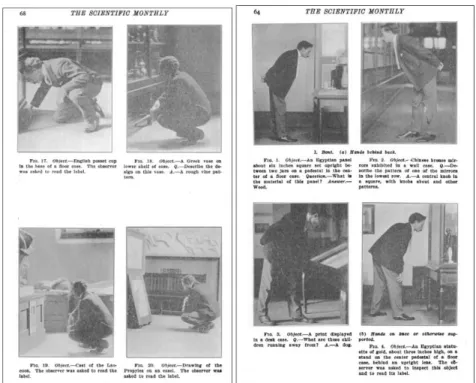
Benjamin Ives Gilman, the secretary of the Museum of Fine Arts in Boston, attributed the issue of museum fatigue not so much to previous life experience or educational point-of-view, but rather to the physicality of museum layouts and
positioning of artwork, lighting and placement of labels within galleries. Writing for The Scientific Monthly in 1916, in an article entitled “Museum Fatigue,” Gilman asks, “what kinds and amount of muscular effort are demanded of the visitor who endeavors to see exhibits as museum authorities plan to have them seen?”38 In an effort to address this issue of fatigue, he conducted a series of observational experiments to highlight the problem, and by extension, provide a remedy to improve museum-goer experience.
Gilman concluded that the physical exertion required of museum-goers limited their ability to gain meaning from exhibits, and that by only considering the curatorial concerns of a given collection, museums were forcing their visitors to “resign (themselves) to seeing practically everything imperfectly and by a passing glance.”39
Fig. 2. Pages from "Museum Fatigue," detailing Benjamin Ives Gilman’s observations of the physical nature of museum-goer experience.
The Scientific Monthly, January, 1916.
By 1920, it is clear that the original mission of these public museums – from their genesis as institutions founded by privilege to their use by a broader social spectrum as places of leisure-time activity and learning – was in a state of evolution. Witt, Gilman and the governors-at-large of these institutions acknowledged that wider audiences entered museums with differing levels of education, socio-economic status and cultural identity. While the questions of how to attract these audiences and impart a heightened level of museum-goer experience were the subject of ongoing debate, they were asked within the existing paradigm of the universal survey museum: whether to hang more or fewer paintings on a given wall, what is the preferred number of items to be placed within a given showcase, should benches be placed throughout galleries to “forestall, not recover from fatigue.”40 During this period of institutional examination, the museum’s
assumed position of influence within the greater cultural landscape remained essentially unchanged in the minds of museum authorities. Outside of the museum director’s realm, however, questions emerged regarding what these institutions represented, and their value in the collecting and exhibiting of art.
Chapter 2
Modernism, the Advent of Exhibition Design and Frederick Kiesler
Questions regarding the ‘mission’ of the museum were raised, at least in part, by artists at work during the same early years of the twentieth century. These living artists had taken their place within the larger social movements that emerged in Europe and spread to the United States during this period – movements that questioned the costs and benefits of living in a mechanized, industrial society, the socio-economic condition of the poor and underprivileged, the role of women, distribution of wealth, and the authority of such museum institutions. These modernists, aligned as members of De Stijl, the
Futurists, and the Constructivists, among others, wished to be unburdened by the weight of history, to explore new means and methods for living in the twentieth century that better reflected their belief in a new world order. While modernist philosophers and writers addressed a wide range of issues in their books and publications, artists took dead aim at art museums. The majority of a museum’s holdings were those created by artists who were long dead: the display of their work was left solely in the hands of museum officials and was contained within neoclassical behemoths built to recollect ancient Greek temples. Everything about public art museums was anathema to modernists as this excerpt from Marinetti’s Futurist Manifesto demonstrates:
Museums: cemeteries!… Identical, surely, in the sinister promiscuity of so many bodies unknown to one another. Museums: public dormitories where one lies forever beside hated or unknown beings. Museums: absurd abattoirs of painters and sculptors ferociously slaughtering each other with color-blows and line- blows, the length of the fought-over walls!
That one should make an annual pilgrimage, just as one goes to the graveyard on All Souls’ Day—that I grant. That once a year one should leave a floral tribute beneath the Gioconda, I grant you that… But I don’t admit that our sorrows, our
fragile courage, our morbid restlessness should be given a daily conducted tour through the museums. Why poison ourselves? Why rot?41
Alexandr Rodchenko, the Russian Constructivist, less incendiary than Marinetti, but no less forthright, wrote in Declaration of Museum Management, that the collection and exhibition of modernist art should in no way be the province of museum officials, but rather that authority should be solely conferred upon the artist:
It is the nature of their profession that cultural operators in the museums tend to preserve what has been done, in contrast to the artists who would like to replace the old by the new; since it is the artist who is the creative force in the field of art, it ought to be his task to guide the country’s artistic education…
The old anachronism, whereby the museums are filled with works of modern art chosen by the aforesaid cultural operators, should be done away with. The job of buying modern works is strictly the province of artists…42
Rodchenko’s call for museums to cede their authority for acquiring artwork to artists, and, by extension, how that work was presented to the public, represented a new school of thought regarding museum management – and a distinct break from the accepted norms of the museum’s role as “cultural operators.” In effect, Rodchenko and his compatriots believed that living makers of art could (and should) speak directly to viewers through the display of art, eliminating museum officials as arbiters of taste. They believed that the artist or maker was uniquely qualified to link past artistic endeavors to those of the present day, and that by arranging work chronologically in a seemingly never-ending series of galleries, museums functioned merely as storehouses of collected works. This inability of museums to provide the vital linkage between the artistic past and present deprived their visitors of gaining a meaningful experience. Museum
presentations as historical timelines were seen by Rodchenko as an outdated concept and of no interest. Writing in reference to European state museums, he desired “to create a museum of creative artistic culture which would serve to promote the artistic life of the country.”43
This questioning of authority and rejection of accepted assumptions of conformity cut across all disciplines of art to include design and architecture. New forms and objects emerged in a wide range of creative endeavors – painting, sculpture, furniture design, residential and commercial buildings, interior spaces, household objects, typography, illustration, and textiles, among others. This new generation of artist, designer and
architect sought to reinvent and bring a twentieth-century or modern sensibility to all they touched. The desire for reinvention extended to the theater as well, as both costume and stage designers sought to reflect the ambitions of the new, modern playwrights. It is from these stage designers as well as architects and industrial designers that we see modernist exhibition design emerge.
The New Stagecraft as Precursor to Modern Exhibition Design
It is not my intention to proffer a thorough discourse on the evolution of stage design from the late nineteenth century into the first two decades of the twentieth century.
This evolution – what came to be known as the New Stagecraft – had a profound effect on subsequent theater and opera productions over the next fifty years and in many ways informs the thinking of stage designers to this day. While the New Stagecraft is a subject worthy of its own detailed examination, the focus of this study is the link between
developments in stage design and the nascent field of modern exhibition design, given the fact that several influential early exhibition designers and architects, such as Joseph Urban, Frederick Kiesler and Norman Bel Geddes among others, began their careers as stage designers and incorporated this experience into their later display practices.
Stage design during the nineteenth century was typified by a two-dimensional canvas backdrop painted to suggest a three-dimensional environment and rolled down from rigging concealed behind a proscenium arch. The performer(s) stood in front of one or a series of backdrops and recited, or sang, their lines until the final curtain came down, signaling the conclusion of a performance. While there may have been props brought onstage at a particular point in a show, from a staging perspective, they were essentially two-dimensional affairs.
This two-dimensionality was reinforced by the flat, even light produced by gas lamps placed around the stage. In 1881, the Savoy Theatre in London installed the first incandescent lights in a theatrical setting. Richard D’Oyly Carte, founder of The Savoy noted, “the greatest drawbacks to the enjoyment of the theatrical performances are, undoubtedly, the foul air and heat which pervade all theatres. As everyone knows, each gas-burner consumes as much oxygen as many people, and causes great heat beside. The incandescent lamps consume no oxygen, and cause no perceptible heat.”44 In addition to these practical concerns, these new incandescent lamps could be focused to create areas of light and shadow, accentuate foreground and background, and bring a heightened sense of three-dimensionality to the stage.
The second technical advancement in stage design during this period was the introduction of the hydraulic stage elevator. More elaborate sets could be readied
offstage and raised and lowered into position as needed, and performers entering and exiting the stage were no longer confined to its left and right wings—they could also be raised or lowered from various points of the stage. As stages became more dynamic entities, stage designers were no longer bound by the conventions of past two-
dimensional productions and began to explore the activation of this three-dimensional space to the advantage of a particular theatrical or operatic work.
It is widely acknowledged among theater historians that the two designers who most clearly understood the possibilities to fundamentally alter the accepted practice of stagecraft were the Swiss-born Adolphe Appia (1862 -1928) and the Englishman Edward Gordon Craig (1872 – 1966). Appia and Craig differed in their approach to the execution of a particular stage set, but they agreed in principle that the nineteenth-century painted backdrop was a relic of the past, and that the concept of non-figurative scenery supported an ability to focus on a production for its dramatic content, and not to rely on the stage designer as a literal interpreter. Appia advocated a mise-en-scène approach to staging, and for every element of a production to be visibly included within the “framework” of a production. There was no need for a curtain, no need to hide the orchestra, but most importantly, there was a new opportunity to provide a stage that allowed the performers to move through three-dimensional space.
Appia wrote that form, as a component of mise-en-scène, “is not a reproduction of some aspect of life…it is the harmonious union of various technical devices for the sole purpose of communicating to many the conception of one artist.”45 Similarly, Craig advocated the use of non-pictorial scenery, and envisioned sets constructed of movable white screens, or ideally, shifting hydraulic columns, played upon by expressive light.46
He went a step further and approved the idea of actors wearing masks, so as to not let their personal identity cloud the audience’s pure reception of the dramatic content. This concept of stripping away elements that didn’t reinforce pure artistic intent surely resonated with the likes of Kiesler, Urban and others, and it is evident in both their work in the theater and later exhibition and architectural practice.
Fig. 3. Appia stage for Gluck’s Orfeo ed Euridice. Institut Jaques-Dalcroze in Hellerau, 1913.
Fig. 4. Craig stage for Hamlet. Moscow Art Theatre, 1912.
The Bauhaus
These new concepts in stagecraft paralleled early twentieth-century developments in other areas of design and the decorative arts, and were guided by similar precepts: a desire to cast off historical precedents, to embrace the new mechanical technologies possible in an industrial world, and an interest in the visual abstraction of physical form.
Creative coalitions formed in European nation-states to collectively probe visual
expression and give new meaning to both grand and everyday objects aligned with these precepts. The Futurists in Italy, De Stijl in the Netherlands, the Constructivists in Russia and the Werkbund, a precursor to the Bauhaus in Germany, became leading movements in this new avant-garde, pushing the boundaries of aesthetic taste. The members of these collectives included artists, industrial and graphic designers, architects, interior designers and craftsmen working both individually and in collaboration with their colleagues across disciplines. Stagecraft and the broader investigation of the movement of individuals through three-dimensional space became integrated into the other artistic pursuits of these groups.
In 1919, Walter Gropius, director of the Kunstschule and Kunstgewerbeschule in Saxony, merged that institution with a new department of architecture into the Staatliche Bauhaus in Weimar, Germany. His original Program of the Staatliche Bauhaus in Weimar stated that, “The Bauhaus strives to bring together all creative effort into one whole,”47 and in listing the “Principles of the Bauhaus,” Gropius called for, “new research into the nature of the exhibition to solve the problem of displaying visual work and sculpture within the framework of architecture.”48 Stagecraft was not included as part
of Gropius’s original “Range of Instruction,” in 1919, but a theater workshop was added to the Bauhaus curriculum in 1921, overseen by Lothar Schreyer. Exhibition design was developed as an area of experimentation within the printing workshop under the direction of Herbert Bayer from 1925-1928, and became a formalized area of study when Hans Meyer assumed the directorship of the Bauhaus in 1928.49
Schreyer directed the theater workshop at the Bauhaus for only two years; Oskar Schlemmer took over the program and ran it from 1923 to 1929.50 In a 1927 lecture, Schlemmer stated that the stage work at the Bauhaus had become, “an organic link in the total chain of Bauhaus activity,” and that, “it is the union of the most heterogeneous assortment of creative elements.”51 The significance of the theater workshop to the overall mission of the Bauhaus can be seen in Gropius’s plan for the new Bauhaus built in Dessau in 1925: the auditorium was located near the center of the building’s triadic pinwheel, between the entrance hall and canteen, as if to indicate the theater’s pivotal status within the school’s social and professional life.52
This link between two- and three-dimensional studies at the school promoted a multi-disciplinary approach to the performative arts – including lighting, graphics and form – and became the elements utilized in a prototypical mass-media approach to modern exhibition design. The study of movement through the transitory three- dimensional space inherent to theatrical productions was weighted with the same
intellectual rigor as movement through the fixed, permanent architectural space of homes, offices and factories. In contrast to permanent architectural space, the transitory space of the theater provided an immediate relationship between the artistic performers (makers) and audience (users), with the stage designer acting as a conduit between the two parties
to activate the space and impart meaning to the staged performance. In a sense, the role of the stage designer foreshadowed that of the exhibition designer—both worked to utilize space between makers (actor or artist) and users (audience or museum-goer).
Constructivists and Liubov Popova
Stage designers played a prominent role in the Russian Constructivist theater that emerged in these same early years of the twentieth century, a time that historian of twentieth-century Russian art, John Bowlt, describes as, “that point at which stage design in Russia moved from surface to space.”53 That point, specifically, was the debut of Mikhail Matyushin’s opera Victory Over the Sun in St. Petersburg in 1913. The avant- garde writers Alexei Kruchenykh and Velimir Khlebnikov wrote the libretto, and the set design (and costumes) were created by artist Kazimir Malevich. Victory Over the Sun marked the debut of the pre-revolutionary avant-garde into Russian theater and is regarded as an achievement of the Wagnerian concept of Gesamtkunstwerk: staged performance as a work of comprehensive art.54 Described as the first Cubo-Futurist opera,55 Victory Over the Sun intended to present the “emancipation of man from his dependence on Nature, which the urban-minded Futurists believed had been superseded in the twentieth century by the machine.”56 Malevich’s set design for Victory Over the Sun, a series of large canvases draped from the rear of the stage, was actually more physically aligned to the pre-Appia staging method of a two-dimensional painted backdrop hung from rigging, owing in part to Malevich’s primary work as an easel painter. Malevich used mobile lighting on the stage in conjunction with these canvases to
project light and dark areas on stage, metaphorically describing the passing of time. The content of these canvases, however – completely abstract compositions – introduced the Russian avant-garde to the concept of non-representational imagery as a means of creative expression in the theater. The Futurist poet Benedict Livshits attended the performance and wrote:
Painterly stereometry was created within the confines of the scenic box for the first time, and a strict system of volumes was established, one which reduced the element of chance (which the movements of the human figures might have introduced) to a minimum… Abstract form was the only reality, a form which completely absorbed the entire Luciferan futility of the world.57
Malevich’s work for Victory Over the Sun did not activate three-dimensional space per se, but the concept of using non-representational imagery and abstract form unlocked the potential for other Russian artists, including El Lissitzsky, Aleksandr Rodchenko, and Liubov Popova, to further experiment with form and movement in space as a vital component in the performative arts.
Fig. 5. Kazimir Malevich, sketches for Victory Over the Sun backdrops, 1913.
Left, Act 1. Right, Act 2.
While all of these Russian artists, and others, had some impact on the further exploration of three-dimensional space in the theater, it was Popova’s work for Vsevolod Meierkhold’s State Higher Producer Workshop in Moscow that embodies the evolution of stage design from the late nineteenth century into the modernist era. Popova, trained as an easel painter like Malevich, had reached a level of renown for her two-dimensional work while a part of the Cubist and Constructivists movements. Meierkhold invited her to compile a program in “material stage design” for the theater workshop in 1921;58 a year later, the workshop staged a production of the Belgian playwright Fernand
Crommelynck’s The Magnamimous Cuckold for which Popova designed both the set and costumes. Popova’s tour de force synthesized all of the concepts and physical elements that had been introduced into the world of stage design over the prior thirty years: there was no proscenium, wings or curtain, and no representational imagery, only abstract form. The actors moved through three-dimensional space, the stage elements included moving parts and two-dimensional graphics, and the audience was brought forward and into a relationship with both the actors and the stage. Popova, acting as arbiter between maker and user, brought the radicalization of stage design to a new level:
On the evening of the first presentation of The Magnanimous Cuckold
Muscovites...saw - on the stage completely denuded of curtain, backdrops, portals and footlights - a wooden installation of the strangest shape, a construction. It was assembled to look like a peculiar windmill and was a combination of platforms, ladders, gangways, revolving doors and revolving wheels. The box itself did not depict anything. It served merely as a support, a device for the actors'
performance and resembled something in the order of an intricate combination of trampolines, trapezes and gymnastic installations. The wings of the windmill and the two wheels revolved slowly or quickly depending on the intensity of the action and the tempo of the spectacle. The clever young actors and actresses, without make-up and in blue workers' overalls (the same for men and women), played out a firework-like symphony of movements with the ease of virtuosity for three hours....59
Fig. 6. Liubov Popova, stage design for The Magnaminous Cuckold, 1922.
Bowlt matter-of-factly notes that as a result of Popova’s work on The
Magnamimous Cuckold, her “influence was appreciable.”60 Harold Segel writes that the production, “has been credited with officially inaugurating ‘theatrical constructivism,’”
and that the work of Popova and others in the movement was ”impressive enough to attract considerable attention in the West.”61
By the mid-1920’s, it appears clear that the European art and design world recognized stage design as a new medium that encouraged experimentation with form and movement across multiple disciplines. This recognition, combined with questions of viewer experience within the institutional museum world, and a general casting-off of history by the avant-garde, created a fertile environment for the development of a new
approach to the exhibition of artwork and objects. The stage designer had taken an active role as arbiter between maker and user, creating a blueprint of sorts for the exhibition designer to act as arbiter between artist and museum-goer. And as Liubov Popova created a new paradigm for theatrical constructivism with her work for Meierkhold in 1922, so too did Frederick Kiesler in the field of exhibition design with his landmark
Internationalle Ausstellung neuer Theatertechnik (International Exhibition of New Theater Technique) in Vienna in 1924.
Frederick Kiesler and De Stijl
Frederick Kiesler was born on September 22, 1890 in Chernivtsi, Ukraine, and began university in Vienna in 1908. He studied architecture at the Technische
Hoschschule from 1908 to 1909, and enrolled in printmaking classes at the Akademie der bildenden from 1910 to 1912. Kiesler never received a formal degree from either
institution.62 Other than a three-month trip to Berlin in 1921, Kiesler remained based in Vienna from 1908 until departing for America in 1926. His first commission in
professional practice came in 1923, when he worked as a stage designer. This initial commission was to create a set for the Theater am Kurfürstendamm production of Karel Capek’s R.U.R. in Berlin. R.U.R. presented Capek’s futuristic vision of technology as a societal advancement to be feared, questioning man’s relationship to machines, and it featured the first known depiction of “robots.” Kiesler’s electromechanical set, ironically, embraced technology and featured an array of moving, multi-media parts: mechanical apparatuses, seismograph, iris diaphragm, flashing lights, film projector and mirrors to
create optical illusions.63 Kiesler, working as arbiter between actors and audience, created an implied, perhaps more optimistic, counterpoint to Capek’s darker vision of the future.
His ability to provide the audience with a means to interpret a work and impart meaning by using a variety of visual and audio stimuli, informed much of Kiesler’s later work, including his exhibition design.
Fig. 7. R.U.R.,Theater am Kurfürstendamm, Berlin 1923
Kiesler’s vison for R.U.R. and his execution of the physical staging elements was met with acclaim throughout the European avant-garde community. He later recalled:
After the second performance, as I walked out through the stage door at night, a man pushed his way in. He was tallish. I remember he had on a black shirt and a
white necktie, and a monocle was screwed in his eye; his hands were in elegant chamois gloves-and he had no hat. It was van Doesburg. He pushed me aside and asked, "Where is Kiesler?" I was rather astounded at this behavior of a stranger and I said, "He is right here," pointing at myself. He said (evidently surprised),
"You are Kiesler ?" and he made a sign, as you do when you call your gang, you know. The gang came in and the gang was Kurt Schwitters, Hans Richter, Moholy-Nagy, El Lissitzky, Werner Graeff and Theo van Doesburg. They came in, grabbed me without saying a word, lifted me up, and took me 6 or 7 blocks around the corner to a club ·where we met Mies van der Rohe and spent the whole night talking about architecture and the future theater (I described "The Endless" ) and it seemed to each of us as though we were individuals who had known one another for a long, long time. And this is how I joined the group known as "De Stijl," which so ardently continued the job of cleaning up the architecture of the Victorian age which Wagner and Berlage had started. 64
Photographs of the set were circulated and published by Theo von Doesburg in De Stijl, by Futurist set designer Enrico Prampolini in Rivista d’Arte Futurista and also in a German almanac of yearly avant-garde achievements, Das Querschnittbuch.65
In addition to being published in European art and design circles, the success of R.U.R prompted an invitation from von Doesburg for Kiesler to join De Stijl, which he accepted. His newfound notoriety led to an additional commission for another stage design – for the debut of Eugene O’Neill’s play, The Emperor Jones, directed by
Berthold Vietel in 1924, at the Lustspieltheater in Berlin. 66 The Emperor Jones tells the story of a despotic ruler of a Caribbean island nation faced with rebellion and overthrow by his subjects. The play is comprised of eight scenes, with scenes two through seven set as a monologue by the emperor as he evades his tormentors and hides in his lush, jungle kingdom. Kiesler created an abstraction of this jungle setting by using a series of slats that were moved or pivoted into various positions and manipulated for each scene change to represent the emperor’s rising and falling fortunes as his subjects close in on, and eventually kill, him. While The Emperor Jones set didn’t employ the same multi-media electromechanical background as R.U.R., Kiesler relied on the fundamental theme that
had taken root within the Constructivist school as exemplified by Poplova—the use of abstract form to create a three-dimensional environment and provide a platform for individual movement through space. Kiesler utilized these same principles as he transitioned from his work for the stage to exhibition design.
Frederick Kiesler and a New Paradigm in Exhibition Design
In 1924, the International Exhibition of New Theater Technique was held as part of the Music and Theater Festival of the City of Vienna in hopes of raising the city’s profile in European theatre arts of the time. The local authorities permitted the exhibition to be held at the Wein Konzerthaus, in one of the three performance halls67 with one proviso: that nothing could be fixed to the perimeter walls. It is no small irony that Frederick Kiesler, who would become one of the most avant-garde, rule-breaking designers, architects and visual theorists of the first half of the twentieth century, would alter the course of exhibition design and by extension, museum-goer experience, by following the rules.
While many designers might have railed against the Konzerthaus authorities, lectured them on the need for fixed structures, and demanded the right to mount the exhibition as they saw fit, Kiesler took a different position. He understood this edict not so much as a preventive measure to avoid nail holes and the need to patch and paint upon removal of the exhibition, but rather as liberation: an unshackling of objects and artwork from perimeter walls and the fixed paths that implicitly led viewers from a gallery entrance on one side of a room to an exit on another side. Kiesler saw that the two-
dimensional nature of flat walls could be replaced by three-dimensional forms placed within a given space, allowing viewers to choose their own paths through a room, circular and infinite. The unwritten rule regarding an exhibition-goer taking a linear, Point-A-to- Point-B, path around a room no longer applied – Kiesler obliterated it. Kiesler would later recall, “It was in 1924-25, in the Vienna of Strauss waltzes, and in the Paris of the Beaux-Arts, that I eliminated the separation between floor, walls, and ceiling, and created floors, walls, and ceiling, as a continuous whole [italics original].”68
The International Exhibition of New Theater Technique contained approximately six hundred drawings, posters, marionettes, photographs, designs and models of avant- garde theater productions, featuring the work of more than one hundred leading playwrights, stage designers, filmmakers and artists with El Lissitzky, Leon Bakst, Alexandra Exter, Natalia Gonchatova, Fernand Léger, Francis Picabia, Enrico Prampolini, Hans Richter and Oskar Schlemmer among them.69 Kiesler developed a system of exhibit structures for the Vienna exhibit that he named the “L&T System” in order to facilitate the creation of this “continuous whole.” While the floor plans and technical drawings for Kiesler’s exhibition concept no longer remain, we are fortunate to have several photos that show his inventive display system. Theo von Doesburg was so keenly interested in Kiesler’s work that he devoted a ten-page story to the L&T System in his widely read and respected De Stijl magazine.
The interest in Kiesler’s L&T System was not the result of the use of sumptuous materials. Simple wooden posts and slats were painted and bolted together in various combinations—some positions fixed and some adjustable by the viewer. All of the fixtures were freestanding and designed to be portable – they could be taken apart and
reassembled in another venue with little effort. There were two types of exhibition fixtures, the “L” (Leger-type), which were more horizontal in nature and provided platforms at varying heights to facilitate multiple viewing angles. The “T” (Trager-type) fixtures were vertical-oriented fixtures, and held the various cantilever devices to move the displayed objects to positions chosen by the viewer. Each of the fixture types were capable of holding an individual lighting fixture, in addition to the ambient light provided by the venue. Kiesler understood from his time in the theater that lighting was essential in the evocation of mood, and given the theatrical content of the Vienna exhibit, it was necessary to provide that option to enhance viewer experience.
Fig. 8. Frederick Kiesler, International Exhibition of New Theater Technique. Vienna, 1924.
In addition to Kiesler’s use of viewing angles, lighting, and circulation paths to enhance viewer experience, his L&T System simply and pragmatically created more exhibition space within the fixed dimensions of the room. While the exact measurements of the room and the L&T fixtures have been lost to time, Kiesler estimated that he had created three times the amount of display space70 than if he had taken a more traditional approach and followed the layout of the perimeter walls. Not only was Kiesler concerned with the details of viewing individual objects, he also provided more room for more things to be seen. He understood that allowing for sheer volume and depth, the amount of material to be presented could only become part of the viewer experience if the viewer could absorb the material on his or her own terms. This recent three-dimensional
simulation (Fig. 9) of the Vienna space shows the density of Kiesler’s L&T System in the Konzerthaus, but also the remarkable clarity of organization within the exhibition space.
One can also recognize a connection between Kiesler’s systematic organization of planes with that of the other members of De Stijl. Mondrian wrote in Neoplasticism in Painting, published by von Doesburg in multiple installments of De Stijl, that “…space is
expressed not by naturalistic plastic, but by the (abstract) plastic of the plane” and called for the replacement of “the capriciously curved line by the straight line.”71
The design principles espoused in Kiesler’s exhibit in Vienna also recall those of fellow member of De Stijl Gerritt Rietveld. Rietveld completed the Schröder House in Utrecht in 1924, the same year as Kiesler’s exhibit in Vienna. The Schröder House was designed without fixed walls, save for a second-floor bathroom, and instead utilized a series of partitions that allowed for the flexibility to subdivide the interior space into various arrangements. The use of these two-dimensional planes to create three-