Understanding the Doctorate of Medicine/Master of Education Joint Degree: An Examination of Students’ Development as Future Medical Educators
Monica Bhutiani
Peabody College of Education and Human Development March 8, 2017
Abstract
The increasing complexity of the healthcare system has spurned a profound reconceptualization of physician training, placing an increased value on physicians with educational expertise. Consequently, medical education has evolved into a more prominent professional focus within the field, pushing some physicians to seek additional training through masters programs in Health Professional Education. As the development of physician educators enters the medical school level by way of the Doctor of Medicine/Masters of Education
(MD/MEd) joint degree, we must assess the program’s ability to develop future medical educators capable of responding to the field’s needs.
In this capstone, I examine the collective experience of the MD and MEd programs using a competency-based framework, stakeholder interviews, and my own lived experience to gauge the program’s capacity to develop future medical educators. Stakeholders viewed the
framework’s competencies as both appropriate and congruent with their independent characterization of educators. Stakeholder interviews and tiered mapping of the curricular experience to the competency framework identified seven competency domains within which students could appropriately develop by understanding theoretical foundations and applying them within authentic activities supported by reflective practices. This analysis also highlighted the current divorce between the theoretical learning occurring within Peabody and the authentic activities present in the medical school.
Coupling theoretical development at Peabody with authentic practices in Vanderbilt University School of Medicine (VUSM) could tremendously enhance student development.
These natural alignments can occur by leveraging spaces for authentic practice as field sites within Peabody courses. Finally, as future medical educators, MD/MEd students require
knowledge of the field’s history and present landscape, which nether program presently provides.
These considerations would bolster the professional development of MD/MEd students while cultivating a rich environment for bi-directional learning between Peabody and VUSM and generating novel possibilities for future work.
Introduction
The rapidly changing and increasingly specialized healthcare environment necessitates physicians’ ability to function effectively in complex inter-professional systems. This imperative has forced a profound reconceptualization of physician training, and as a result, the value of educational expertise has emerged at both national and institutional levels (Cooke, Irby &
O’Brian 2010). Although the science continues to evolve, a robust body of literature already demonstrates increasing sophistication in the theory and practice of medical education. The acquisition of educational expertise now requires dedication, advanced training, and unique scholarly approaches, which the average clinician may find difficult to master (Hatem, Lown, &
Newman, 2006).
As demands for greater expertise and dedicated time escalate, educational responsibilities at academic health centers have fallen to a smaller cadre of faculty members increasingly
specialized in medical education. What was previously considered a supplemental activity for all faculty members has rapidly become a professional focus for a select group. To recognize the important contributions of such physicians, clinician-educator faculty tracks have grown progressively more prestigious, although ongoing struggles to define the expectations of this pathway continue at many institutions (Fleming, Schindler, Martin & DaRosa, 2005).
Medical education has therefore evolved into a more prominent professional focus within medicine, pushing key stakeholders to contemplate the professional responsibility of medical educators. Recently, Srinivasan and his colleagues enumerated these professional responsibilities as a set of educator specific competencies that encompass a wide array of skills (Srinivasan et. al, 2008; Waghmare, Waghmare & Sontakke, 2016; Sutkin, Wagner, Harris & Schiffer, 2008).
Such an immense educational expertise, however, lies outside the scope of medical training,
requiring physician educators to dedicate time towards advanced training and unique scholarly approaches (Hatem, Lown, & Newman, 2006). In response to this growing need for educational expertise, a rising number of individuals are seeking master’s degrees in Health Professional Education (MHPE) as a method for professional development (Tekian & Artino, 2013; Cable, Knab, Tham, Navedo & Armstrong, 2014; Tckian, Roberts, Batty & Cook, 2014). More recently, the demand for highly trained physician-educators has entered into the earliest developmental level – medical school. While some medical schools offer scattered opportunities to develop teaching skills, few have established, discrete pathways. To my knowledge, only Vanderbilt has formalized a joint MD/MEd degree for medical students considering careers as physician educators (Sullivan, DeVolder, Bhutiani & Miller, 2017).
Like the majority of joint degrees in medical school, students pursue the MD/MEd degree as two separate graduate tracks: a doctorate of medicine and a master of education. However, most students pursue such a path because of an inherent desire to cultivate understanding of the medicine-education interplay and the functionality of that interplay within the broader landscape of healthcare. Ultimately, most hope to apply this understanding towards a career as a physician educator. The siloing of these two degrees, however, begs an important question: how well does a joint degree, existing as two separate degrees, prepare students to understand and navigate the medicine-education intersection and ultimately fulfill the professional expectations as a future physician-educator?
Since the inception of the MD/MEd joint degree in 2011, programmatic changes have occurred both within Vanderbilt University School of Medicine (VUSM) and within the
Learning and Design Masters program. Through these evolutions, little attention has been paid to the holistic experience and its ability to form capable, future medical educators. As the
MD/MEd degree continues to grow and evolve and as an increasing number of students pursue this joint degree pathway, we have both a personal and a professional responsibility to ensure that we measure “success” of the joint degree not as the completion of both degree requirements, but rather, as the cultivation of a student’s professional understanding and development situated at the intersection of both degrees.
Through this capstone, I hope to examine the MD/MEd joint degree as a collective experience to assess its capacity for cultivating professional development at the intersection of medicine and education. I will first provide a comprehensive overview of the curricular
components of the MD/MEd joint degree. I will describe the current role of competencies within medical education as a backdrop to contextualize a physician-educator competency framework and to evaluate the framework’s affordances and constraints within the present work. I will then map the MD/MEd curriculum to the competency framework and use this in tandem with
stakeholder interviews to explore the competency domains applicable to the MD/MEd joint degree students and highlight considerations unaddressed by the framework. Finally, I will use this analysis to recommend changes within the MD/MEd joint degree curriculum.
The current curriculum of the MD/MEd joint degree
To expound upon the local context of the MD/MEd degree and provide a background for later discussions of curriculum, I will briefly describe the current landscape of the joint degree experience including MD and MEd requirements (Sullivan, DeVolder, Bhutiani & Miller, 2017).
Students begin medical school with a pre-clinical year aimed at providing foundational clinical knowledge and skills through multiple learning modalities. Clinical rotations in the second year expose students to multiple disciplines via clerkships in medicine, surgery, pediatrics, obstetrics and gynecology, psychiatry, and neurology. Here, students receive
graduated responsibility within an authentic work environment where both learning and practice occur. The immersion phase in the third and fourth year allows students to build an
individualized curriculum from a broad menu of courses spanning a wide range of clinical content and contexts. Students solidify clinical skills, deepen foundational science knowledge, address areas of personal learning needs and/or interest, ensure readiness for residency, and enhance workplace learning skills. During this immersion phase, students can pursue electives that develop teaching skills such as “Students as Teachers”, a one-year longitudinal course focusing on general teaching strategies, educational theory, and review of educational literature;
Med school 101, a course where medical students design and deliver a three-week summer course for high school students interested in medicine; and medical education research blocks.
Throughout medical school, students can also engage in extracurricular activities with
educational foci. These include the Student Curriculum Committee, where students serve as a liaison between peers and administration regarding curriculum content, organization, and execution and aid in course development and revision, and the Shade Tree clinic, where upper level students provide clinical care to underserved populations while teaching and mentoring younger students.
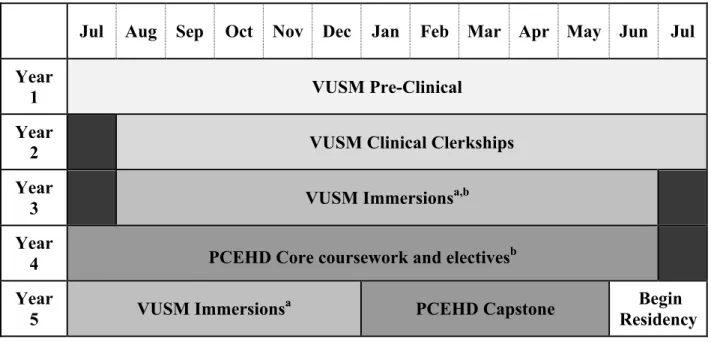
Between their third and fourth year of medical school, students begin their master’s studies by spending a full academic year at Peabody in the Learning and Design program. They spend the fall of their fifth year completing medical school requirements and applying to residency. Finally, they complete any outstanding MEd requirements in the spring semester.
Transfer of credit between Peabody and Vanderbilt University School of Medicine allows completion of both degrees in 5 years (Table 1).
Table 1. MD/MEd Timeline. A sample schedule for Vanderbilt University’s combined MD/MEd degree between Vanderbilt University School of Medicine (VUSM) and Vanderbilt Peabody College of Education and Human Development (PCEHD).
Jul Aug Sep Oct Nov Dec Jan Feb Mar Apr May Jun Jul Year
1 VUSM Pre-Clinical
Year
2 VUSM Clinical Clerkships
Year
3 VUSM Immersionsa,b
Year
4 PCEHD Core coursework and electivesb Year
5 VUSM Immersionsa PCEHD Capstone Begin
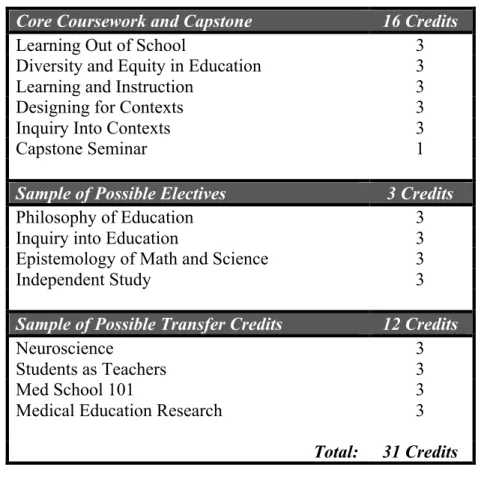
Residency Within the Learning and Design master’s program, students complete 16 hours of core coursework (Table 2). In addition to this core, students choose electives to supplement their studies. Of the 15 elective credits, 3 must be acquired through Peabody courses. Some students have developed independent studies to explore topics related to medical education that lie outside Peabody offerings. As an example, my independent study explored participatory
learning, identity formation, and communities of practice as theoretical lenses to understand the goals, objectives, and outcomes of the clerkship phase at VUSM. Faculty members at both Peabody and VUSM guided literature curation, which led to a unique synthesis of general education and medical education perspectives. The master’s coursework culminates in a capstone project that integrates knowledge and skills developed across the course of study and represents original scholarship.
Students obtain the remaining 12 elective credits through transfer from VUSM courses.
Such courses include, but are not limited to “Students as Teachers” and Med school 101. None of
these courses are currently required or recommended for joint degree students. Approval for credit transfer occurs through a process ill understood by former students or myself.
Table 2. Learning & Design Course Requirements
Core Coursework and Capstone 16 Credits
Learning Out of School 3
Diversity and Equity in Education 3
Learning and Instruction 3
Designing for Contexts 3
Inquiry Into Contexts 3
Capstone Seminar 1
Sample of Possible Electives 3 Credits
Philosophy of Education 3
Inquiry into Education 3
Epistemology of Math and Science 3
Independent Study 3
Sample of Possible Transfer Credits 12 Credits
Neuroscience 3
Students as Teachers 3
Med School 101 3
Medical Education Research 3
Total: 31 Credits
Competencies within Medical Education
To understand the work around medical education competencies, we must first appreciate how medical education defines and utilizes competencies. Medical competencies are defined as observable abilities of a health professional, incorporating multiple components such as
knowledge, skills, values, and attitudes. The observable nature of competencies ensures their ability to be measured and assessed to determine acquisition (Frank, Snell, Ten Cate et al, 2010).
Competencies entered the medical education scene in the early 21st century when the medical profession felt responsible to ensure the competency of practicing physicians. Prior to this,
exposing trainees to specific content for specific periods of time served as the basic structure for medical training programs. This paradigm often lacked identifiable, productive structures to assess educational outcomes and ensure the competence of physicians. Fueled by a desire to improve patient safety and the self-sustainability of the medical profession, the Accreditation Council for Graduate Medical Education (ACGME) championed an effort to ensure competency- based training for all physicians whereby the desired training outcome drove the creation and assessment of the educational process (Carraccio, Wolfstahl, Englander, Ferentz & Martin, 2002). With competency-based education came an important philosophical shift: “In a traditional educational system, the unit of progression is time and it is teacher-centered. In a competency based education system, the unit of progression is mastery of specific knowledge and skills and is learner-centered” (Sullivan & McIntosh, 1995). A competency based system requires four components: 1) identifying the outcomes 2) defining performance levels for each competency 3) developing a framework for assessing competencies and 4) continuous evaluation of the program to see if it indeed produces the desired outcomes. The desired outcomes within medical education centers around six domains of competence: patient care, knowledge for practice, practice based learning and improvement, interpersonal and communication skills, professionalism, systems-based practice, inter-professional collaboration, and personal and professional development.
The ground swell of competency based medical education occurring in tandem with the increasing prominence of medical education within the professional landscape caused
competencies for various medical educators to appear. However, these competencies aligned poorly with the ACGME’s domains of competence and lacked appropriate breadth to encompass all involved in medical education (from nonclinical faculty to educational policy makers).
Consequently, Srinivasan and his colleagues defined a set of competencies for medical educators organized around the ACGME domains to “foster common expectations for educator
performance and outcomes and introduce a uniform language to aid in dialogue and standard- setting across sites and institutions” (Srinivasan, 2011). They divided these requisite skills into two groups: core abilities for all medical teachers and specific abilities geared towards educators with additional programmatic roles (Appendix 1).
The advantages of using a competency-based framework for medical educators within the present discussion are three fold. First, using ACGME competency domains allows easier access for medical educators familiar with the competency lexicon and links the discussion to broader medical education conversations around competencies. Second, drawing on a competency based paradigm currently used for programmatic development and assessment within VUSM will provide Peabody faculty insight into the educational system influencing joint degree student thinking. Third, employing a competency-based framework in my analysis provides an opportunity to expand my own understanding of competency-based education through a first hand account of its affordances and constraints.
Competency based education can have different interpretations depending on one’s philosophical positionality. In their work, Paul and Gonczi explore different philosophical interpretations of competence and distinguish between three basic conceptions: the behaviorist, the generic, and the holistic (Hager & Gonczi, 1996). The behaviorist view conceives
competence as discrete, observable behaviors associated with task completion assessed by direct observation of performance. Paralleling broader behaviorism theories, it ignores the impact of underlying attributes, group process, environment, and evolution of cognitive structures (Driscoll, 2004). The genetic conception of competence includes general attributes such as
critical thinking ability and communication skills. They are often developed independent of context, sometimes limiting their utility within actual professional practice. Building on Hager and Beckett’s conceptualization of integrated competencies, the holistic view integrates
knowledge, abilities, skills, and attitudes displayed within realistic, professional tasks (Hager &
Beckett, 1995). Here, acknowledgement of knowledge and attitudes hints at the importance of cognitive processes within this conception, but ignores relational and social aspects likely present in authentic tasks.
Medical education competencies reflect holistic competency characteristics - they superficially consider cognitive processes and social factors but remain heavily behavioristic.
While this may be acceptable when competencies occur within a vacuum, medical competencies are fundamentally geared towards their viability within the complex social practice of patient care. The social genesis of clinical medicine necessitates consideration of a theoretical
perspective that appropriately captures learning born out of and negotiated within social practice.
Additionally, for the purposes of the MD/MEd joint degree, one also needs to consider that many learning experiences exist within a classroom setting. Taken together, one might consider the MD/MEd degree as a form of cognitive apprenticeship eclipsing both cognitive development of learners and social enculturation within a community of practice. As defined by Collins,
cognitive apprenticeships occur where “tasks and problems are chosen to illustrate the power of certain techniques and methods, to give students practice in applying these methods in diverse settings, and to increase the complexity of tasks slowly so that component skills and models can be integrated. In short, tasks are sequenced to reflect the changing demands of learning” (Collins, 2006, p. 48). He argues that much of these practices exist within authentic activities,
development of a community of practice, exploited cooperation, and reflection. Collins and
colleagues, therefore, theorize somewhere in the space between cognitive and situative theories by designing structures and forms to support the situated sociogenesis of students’ meaning- making. This highlights two important spheres for consideration in the subsequent analysis. In addition to whether or not students can develop medical educator competencies, we must consider the ability to provide appropriate cognitive maturation towards competency
development and to help students understand how social and environmental factors of clinical practice impact competency enactment.
MD/MEd Joint Degree viewed through a Competency Based Framework
Srinivasan’s medical educator competency framework paints a picture of the ideal medical educator. However, it does not provide a roadmap of how to achieve competence.
Additionally, this framework targets physician educators who are full participants within the medical system, possess greater insight into the nuanced interactions within the discipline, and have unrestricted access to authentic activity. Novices, on the other hand, enter the community of practice peripherally where full participants monitor legitimate access to learned community practices and relationships (Lave and Wenger, 1991). This competency framework does not address how a student’s inability to be a full participant within the profession may restrict their ability to access legitimate activities within competency domains nor how a novice might progress towards these competency goals. These restrictions beg the questions: what
competencies are applicable to MD/MEd students? And how might initial development of these competencies occur? To begin answering these questions, I utilize experiences within each curriculum (required and optional), stakeholder interviews, and the lived experiences of myself and another graduate of the program. I interviewed key stakeholders within the MD/MEd joint degree including Kris Neal, Rogers Hall, Bonnie Miller, Kim Lomis, Bill Cutrer, and Billy
Sullivan. Interviews sought to ascertain the stakeholders’ perceived goals and expectations of educators broadly, how these expectations align with or differ from the enumerated
competencies, the elements missing from the competency framework, and competencies of central consideration for the MD/MEd joint degree. With this data, I first discuss how this competency model aligns with stakeholders conceptualization of educators. Then, I map
curricular elements of both programs to the competencies and highlight trends. Finally, I address additional considerations regarding competency development for MD/MEd students. (Note: my interview with Rogers Hall did not include a direct conversation around the competency
framework due to time restrictions.)
Competency Alignment with Stakeholder Ideals
In evaluating alignment of stakeholder ideals with the competencies, I examined interviewees’ ideal characterizations of educators as well as their reactions to the enumerated competencies.
Stakeholders independently identified a majority of competencies within their characterization of educators. Specifically, all six named or described examples of learner centeredness, communication, role-modeling for learners and peers, reflection and improvement, understanding basic design principles, assessment cycles, scholarship, and leadership.
Interestingly, emphasis on specific characteristics varied depending on the stakeholder’s current roles within education. A current resident who predominantly engages in one-on-one and small group teaching focused on the importance of learner centeredness, communication, role
modeling, assessment, and reflection. He suggested that scholarship, evaluation, and design were more important for “keeping my finger on the pulse of the larger system” but less integral to his daily work (Interview Billy Sullivan, February 20, 2017). The assistant dean for undergraduate
medical education emphasized program design and implementation, evaluation, scholarship, and leadership while noting the importance of understanding learner centeredness, role modeling, and practice based reflection for design purposes (Interview Bill Cutrer, February 20, 2017).
Finally, a director of the teaching and learning program emphasized all characteristics but distinguished between those she employs when teaching a class - learner centeredness,
communication, role modeling, practice-based reflection, program design and implementation - and those she employs as program director - evaluation, scholarship, leadership, mentorship (Interview Kris Neal, February 22, 2017).
When directly presented with the competency list, interviewees felt the collective list appropriately characterized educator roles and professional expectations. Medical educators particularly noted the importance of alignment with current ACGME competency domains as discussed previously. One Peabody faculty commented on the synergy among this framework, her professional identity as an educator, and the learning and design program (Interview Kris Neal, February 22, 2017).
The independent identification of the majority of competencies by current educators insinuates their authenticity within the field of education as a whole. The pattern of competency separation by one’s role as a teacher versus an educator involved in higher order programmatic roles gives credence to Srinivasan’s decision to distinguish between these groups in his
framework. Finally, assertion of the framework’s appropriate delineation of educator’s professional expectations makes it a sound tool for the current work.
Curricular Map of the MD/MEd program to Srinivasan’s Competencies
To appreciate how the current curricular experiences of the MD/MEd program map to these competencies, I created a curriculum-competency map (Table 3, located at the end of this
paper). This map includes required and elective courses in the MD and MEd curricula as well as extracurricular experiences related to medical education. The map also includes descriptions of each course or experience. Of note, since diversity, and equity in education has not yet been taught, I have excluded it from this map. I also omitted the independent study course since all three to date have varied considerably in content and structure. In his description of cognitive apprenticeship, Collins describes four principles for designing cognitive apprenticeship environments: types of knowledge required for expertise (content), ways to promote
development of expertise (method), keys to ordering learning activities (sequencing), and social characteristics of the learning environment (sociology) (Collins, 2006). I consider three of these principles within the mapping process: 1) development of foundational knowledge towards achieving competency (content) 2) modeling of competencies (method) 3) presence of situated learning through student participation in authentic experiences. Similar to Collins, I defined modeling as an expert performing a task so that the students can observe and build a conceptual model of the processes. I included modeling practices that experts demonstrated both within the classroom and in the learning and design program or medical school more globally. In
considering authentic enactment, I only include spaces where activity occurs within the medical realm. Finally, I created this competency map based on course descriptions and my personal experience within them. I lacked adequate time to validate these mappings with individuals affiliated with each of these courses. Such validation may have changed the mapping presented here. Given this weakness, I utilize this tool only to spurn conversation about larger scale noticings and trends within the combined curricula and not to assert a definitive curriculum evaluation.
Noticings in the Curriculum Competency Map
Several salient observations spurn from the curriculum-competency map (Table 3). First, medical knowledge appropriately lies within the medical school curriculum and need not be addressed within the learning and instruction program.
Second, foundational knowledge development occurs predominantly within Learning and Instruction’s required courses and map closely to learner centeredness, interpersonal and
communication skills, professionalism and role modeling, practice based reflection, program design, and scholarship. These courses offer opportunities for theory application through field experiences, but sites often lie outside of medicine. Conversely, optional courses and
extracurricular experiences at VUSM (Students as Teachers elective, Shade Tree Clinic, Med School 101, Student curriculum committee) offer rich opportunities for engagement in authentic medical education practices and mapped to learner centeredness, interpersonal and
communication skills, professionalism and role modeling, practice based reflection, and program design. While these spaces enable legitimate participation in authentic practice, only the Students as Teachers course emphasizes theory and foundational knowledge. Presently, experiences between the two programs are divorced, hindering students from developing theoretical lenses in tandem with participation in authentic practices.
Third, both programs, at minimum, model a majority of the competencies. Within the MD program, this modeling occurs more robustly in core curriculum but rarely in electives where students have access to authentic practices. Students predominantly run these courses with minimal faculty oversight or presence, leaving few opportunities for expert modeling. As most faculty associated with the MD and MEd programs model these competencies, one can equate them to intrinsic values held by individuals and the program as a whole. These values permeate
student interactions and engender part of the implicit curriculum, impacting the attitudes and behaviors that students develop (Eisner, 2002). Additionally, modeling represents a means for promoting expertise within the cognitive apprenticeship paradigm (Collins, 2006).
Fourth, the majority of mappings concentrate among 6 of the 10 enumerated
competencies (learner centeredness, interpersonal and communication skills, professionalism and modeling, practice based reflection and improvement, program design and implementation and evaluation and scholarship). Interviewees felt systems based practice, leadership, and mentorship were more closely linked to seasoned educators rather than novices. Regarding systems based practice: “I personally feel more comfortable with this as a physician than a teacher… maybe more of a higher level educator thing?” (Billy Sullivan interview, February 20, 2017). Regarding leadership: “I think it would be very difficult to be an educator at the programmatic level without the ability to create vision to develop future leaders, I think that's really important… but there are whole courses on leadership” (Bill Cutrer interview, February 20, 2017). Regarding mentorship:
“mentoring students is an essential part of what I do in my “educator” role, but I’m not sure you can meaningfully do this as a student” (Kris Neal interview, February 22, 2017). Though
important competencies, interviewees struggled to conceptualize them at the student level and suggested they might be outside the scope of student development.
Finally, the competency model and curriculum-competency map hides an important assumption: individuals developing these competencies have a robust understanding of the medical education landscape. This includes salient theoretical considerations; current attitudes towards curriculum structure, learning modalities, evaluation processes, and assessment; and the reciprocal influences of educational practices and judicious patient care. These entities may be well understood by seasoned attending physicians. However, medical students who lack both
routine exposure and full participation in the medical system may not inherently understand the field’s educational positionality. Additionally, Peabody faculty members possess minimal
understanding of medical education positionality, making them unable to provide this context for students. Presently, neither program offers or requires an in-depth understanding of this
backdrop, though students may develop a superficial appreciation by participating in the student curriculum committee or students as teachers.
Important Additional Considerations
Stakeholders interviewed for this capstone asserted the framework’s appropriate delineation of an educator’s professional expectations. However, analysis of the framework, interview data, and personal experienced revealed additional key insights regarding competency development for MD/MEd students.
First, competency development requires an understanding of foundational theory and knowledge. Within education, theory provides the “why” of educational practices and changes in theoretical positionality undergird changes in practice as reflected in one stakeholder’s
statement: “I think the educator has to have a solid understanding of theory. And I think that, for me, is the why. You need to understand how people learn, how good courses are designed, how effective assessment designs are … because without it, a lot of the choices and the decisions that are made aren’t really grounded so they can be willy-nilly or feel willy-nilly” (Bill Cutrer
interview, February 20, 2017). As theories naturally guide current practices, understanding theoretical underpinnings of practice extends to recognizing theories’ perceived value within a field. This reinforces the necessity of comprehending the medical education context.
Additionally, five interviewees highlighted theory as the pivot point between practice and reflection: “Sometimes, you create lessons or experiences based on these theories of learning.
You consider the student, the environment, the context, and they just… well they just fail. And you have to reflect and consider why it failed. To do that, you have to go back to the theories.”
(Kris Neal interview, February 22, 2017). The role of theories within educational practice parallels Collins’ understanding of foundational knowledge within the cognitive apprenticeship model. Here, Collins describes types of knowledge required for expertise, which include both domain knowledge and metacognitive strategies (Collins, 2006). Subject specific concepts, facts, and procedures comprise domain knowledge while metacognitive strategies encompass
monitoring, diagnostic, and remedial components. Metacognition affords the “ability to reflect on one’s own thinking, and thereby monitor and manage it”, enabling one to recognize critical aspects of performance and promotes reflecting on how one might improve in the future (Greno, Collins, and Resnick, 1996, p. 19; Collins, 2006). Theory represents a large part of the domain knowledge for the education profession and serves as the reference point for control strategies and metacognitive development. The parallel of theory with domain knowledge posits
educational theory as an entry point for educator competency development.
Second, learning theory should be applied in authentic practice experiences to have future utility. Competency descriptions appear relatively generic and could be applied to educators as a whole. Authentic practices call attention to the interactions existing among theory, environment, context, and individuals, which represent important but often intangible factors in educational design and enactment. Stakeholders articulated the invaluable experience of theory application in authentic settings to appreciate environmental affordances and constraints as well as the
functionality of theories. As one individual stated “It can’t be about just reading theory for the sake of learning theory. We have to be reading theory for testing purposes… For you all, I think it’s really important to do small-scale observational or design projects in settings within clinical
care or medical education. Those are such productive experiences for you to see how these theories play out in your world.” (Rogers Hall interview, February 23, 2017). Viewing medical education as a community of practice, this statement resonates with Lave and Wenger’s
descriptions of the legitimate peripheral participation of newcomers, which Collins also echoes as central to learning in a cognitive apprenticeship model. “A crucial factor in the success of such a system is that learners must be afforded legitimate peripheral participation, which involves access to the practices that they are expected to learn and genuine participation in the activities and concerns of the group… to be a productive environment of learning, learners need to have opportunities to observe and practice activities in which their abilities will become stronger in ways that correspond to progress toward more central participation” (Lave and Wenger, 1991; Collins, Greno, and Resnick, 1996).
Third, MD/MEd students should develop within most of these competencies but faculty should evaluate the scope of and support within authentic activity used for development.
Interviewees easily identified appropriate scope within the first six competencies. Use of the term “learner” or “learners” as part of the competency language suggested the development of these competencies most basically occurs in one-on-one teaching activities, a scale appropriate for an MD/MEd student. Interviewees noticed some natural alignments with program
development and implementation as well as scholarship and evaluation (see Table 3), but struggled to identify an appropriate grain size for the leadership and mentorship.
“Leadership is appropriate, but I think the scale becomes the issue. It's one thing for a student to learn about creating vision and building consensus so they can actually do it.
But it's another thing to do it on a scale of one intervention or one thing that is finite and fixed like med school 101 versus redesigning the third year. But could they take on the
management of something that's a little bit more finite and absolute? I think we need to encourage them to do that because it's the equivalent for where they are in their training.” (Bill Cutrer interview, February 20, 2017).
This parallels findings in the curriculum-competency map where only learning communities emphasizes foundational knowledge in leadership and mentorship and only leadership positions exist within Students as Teachers and the Student Curriculum Committee. In these competencies, perhaps developing theoretical understandings of each represents a sufficient starting place upon which students can develop in the future. Stakeholders also emphasized importance of supportive scaffolds in aiding learner’s development within these authentic practices, supported by Kolb’s description of the experience-based learning cycle. To allow knowledge to be generated within and shaped by experiences, individual must also progress through cycle of reflective observation of the experience, abstract conceptualization, and active experimentation (Kolb & Kolb, 2005).
Thus, when considering experiences for competency development, one must consider whether they include supports for productive experience based learning.
The transformation of the competency framework into a curricular-competency map juxtaposed MD and MEd curricular experiences. With stakeholder interviews, it served as a powerful analytic tool in elucidating competency applicability and development within MD/MEd students. Importantly, faculty at both programs model competencies detailed in this framework, creating a supportive environment for MD/MEd student development into future medical
educators. The two programs already possess spaces for competency development within the first 8 competency domains excluding systems based practice. The three without strong
curricular ties (systems based practice, leadership, and mentorship) may lie outside the scope for MD/MEd students. Theory represents a natural entry point towards competency development
and presently exists within learning and design for the first eight competencies excluding systems based practice. Greater development within these competencies should be expected and requires engagement in legitimate practices of appropriate scope with structured spaces for reflection and reconceptualization. However, theory development in Peabody and legitimate practices in VUSM are currently segregated. Leveraging these findings, I will consider possible programmatic applications to bolster the professional development of MD/MEd students.
Cultivation of competencies and expectations for the development of Medical Educators Each degree possesses its own curricular goals. However, reframing a discussion of curriculum to focus on professional understanding and development situated at the intersection of the MD and MEd degrees necessitates a joint goal. No joint goal presently exists. However, the above analysis may provide a preliminary answer: to support students’ development of theoretical understandings situated in authentic medical education practices in order to cultivate the maturation of future medical educators along appropriate competency domains. The findings in the previous section hint at several areas for programmatic development. For the purposes of this capstone, I will focus on the two areas I believe has the potential for the greatest impact with the lowest amount of effort: 1) synergistic alignment of theoretical development and authentic practice and 2) important curricular gaps.
Alignment:
The enacted curriculum acknowledges the contributions of teachers, learners, content, and context towards the learning experience and must be addressed here (Eisner, 2002). In making curricular recommendations, I must recognize faculty constraints at Peabody and VUSM. Specifically, most Peabody faculty devote two semesters to teaching and working with
students and spend the summer writing their own scholarly work. Similarly, most established medical school faculty face year round constraints around time they can dedicate to additional responsibilities. With respect to context, generating spaces that support authentic activities for student engagement requires intense resources. Thus, the most responsible suggestions for alignment utilizes pre-existing spaces and opportunities. Finally, students must have legitimate access to these spaces for fruitful alignment.
The greatest opportunity for alignment utilizes pre-existing medically based experiences as placement for field experiences within the Peabody core classes. The center for experiential learning and assessment (CELA) conducts human simulation using standardized patients to aid growth, balance, and integration into students’ clinical experiences. A pseudo-authentic learning space for medical students as they engage in simulated patient encounters, CELA allows the creation of myriad clinical scenarios aimed at shaping student knowledge within multiple domains. Students can engage in simulations, create simulations, and observe simulations. This would be a rich environment for investigations and could easily be aligned with field experiences in learning and instruction and learning out of schools.
Within the pediatrics department, a community based program attempts to reshape and rethink how education occurs for family units of children with obesity. Using what families understand as “funds of knowledge”, they hope to design tools and practices to improve family education and positively impact patient care. This could readily be a field site within the curriculum development course or learning out of schools course.
The Students as Teachers course, as described previously, is designed and led by medical students, constituting a peer-to-peer learning environment. The course runs from February to
February, thus a student designing and directing this course could utilize it as their design site during the curriculum development course.
A student-run, free clinic serving uninsured patients in Middle Tennessee, the Shade Tree Clinic allows medical, nursing, and pharmacy students to practice collaborative health care.
Students assume patient care responsibilities across the clinic - intake personnel, laboratory directors, pharmacy personnel, social workers, and clinicians - and collectively navigate the space to facilitate patient treatment. Possessing rich social interactions, this space has been successfully used for investigations within the learning out of schools course and should continue to be utilized as an investigation site in the future.
The medical school has a robust amount of ongoing medical education research.
Additionally, a dedicated group of faculty helps students identify, develop, and conduct
educational research projects. Tapping into this network during the inquiry into context course, an equivalent research course at Peabody, or during the capstone process could support and deepen student understanding of educational research within the context of medicine while allowing them to contribute to the education research community. Finally, all capstone projects produced by students thus far have existed within the medical education sphere. While not presently a requirement, cultivating capstone work within the domain of medical education should be strongly suggested.
These alignments have the capacity to reciprocally enhance the student’s experience within each program. Furthermore, they would provide increased context for both MD and Peabody faculty alike and could generate enhanced collaboration and lead to novel settings for co-learning.
Gaps and Needs:
Medical students in the MD/MEd joint degree program often do not appreciate the current medical education landscape (salient theoretical considerations; current attitudes towards curriculum structure, learning modalities, evaluation processes, and assessment; and the
reciprocal influences of educational practices and judicious patient care) and Peabody faculty know very little about the state of medical education. The educational landscape influences learning and practices within the field. Thus, appreciation for the topography clarifies the
underpinnings of those practices. Embedded within the context of the MD/MEd joint degree, this appreciation would provide a valuable reference point for both students and Peabody faculty.
Exposing MD/MEd joint degree students more explicitly to the paradigms working within education could readily exist as an advanced elective within the medical school. This would first require curation of appropriate literature by medical education faculty. These
readings could be paired with participation in curricular retreats and working groups where some of these theories become visible such as the core entrustable professional activities for entering residency working group and the standing assessment committee, followed by reflective
involving both VUSM and Peabody faculty. Such a structure would foster comprehension among all parties while simultaneously engaging students in ongoing curricular discussions.
Conclusions and Future directions
Within this present work, the competency framework served as a powerful reflective tool for discerning the capacity of the MD/MEd degree to promote the professional development of future medical educators. A tri-level curricular-competency mapping coupled with stakeholder interviews identifies the appropriateness of all competencies for the MD/MEd student but with different degrees of development. Theoretical understanding represents the entry point to each
competency and could be expected within all ten competencies. Further competency
development necessitates theory utilization within authentic activities supported by reflective practices and spaces for reconceptualization. This may only be appropriate for seven
competencies (medical knowledge, learner centeredness, interpersonal & communication skills, professionalism and role modeling, practice based reflection and improvement, program design and implementation, and evaluation and scholarship). While presently segregated, coupling theoretical development at Peabody with authentic practices existing within VUSM could tremendously enhance the development of the student, the collaboration between the schools, and the possibilities for future work. These natural alignments can occur by leveraging spaces for authentic practice as field sites within Peabody courses. Finally, as future medical educators, MD/MEd students require knowledge of the field’s history and present landscape. While not currently embedded within the degree, this could readily be created. In this work, I am not advocating for the competency framework as a direct assessment tool for future student.
However, I do believe the curricular competency map can serve as a powerful reflective tool to guide continued development and foster collaboration between programs.
The discussion presented here serves as a starting point for future conversations.
Immediately, taking this curricular map to stakeholders to help assess its’ validity might unearth additional insights and areas for alignment between programs. Additionally, I independently created the joint degree goal presented here. I believe having a unifying goal for the MD/MEd program could increase cohesiveness and guide future development, but a goal would need to stem from all stakeholders and not just myself. To my surprise and disappointment, faculty from VUSM and Peabody are strangers. However, during interviews they expressed a desire to meet one another and enthusiastically proposed a social gathering with students in the program.
Organizing such an event could go a long way to ensure the positive growth of this program and promote fruitful collaborations. I hope to accomplish this before I graduate.
This capstone did not address the use of these competencies as an evaluation tool for student in the program as I do not feel they are presently appropriate. However, if greater alignment occurs between Peabody and VUSM, and VUSM elective courses develop greater supports for theoretical understandings, this framework might be a useful starting place for conceptualizing a suitable assessment tool. Finally, this work highlights the need for an MD/MEd advisor who has an understanding of MD and Peabody realms. Faculty on each side willing to have longer relationship with the program could advise both students going through the program and students interested in the program. Additionally, former graduates of the
program could support this advising structure, though feasibility of such an endeavor would need to be assessed. These advising roles would be especially important for MD students from other institutions who come to Peabody for the learning and design masters, the first of whom is starting this summer.
I hope this capstone provides not only an analytic commentary on the current state of the MD/MEd joint degree program but also a richer context within which to consider this degree program. I appreciate the space this project has afforded me to reflect on my own experiences and fulfill a deep seeded responsibility to peers and future colleagues who will go through this program after me. I believe this program is a powerful, formative experience for future medical- educators, a rich environment for bi-directional learning and development, and one that will hopefully thrive in years to come.
program. Advances in medical education and practice, 5, 83.
Carraccio, C., Wolfsthal, S. D., Englander, R., Ferentz, K., & Martin, C. (2002). Shifting paradigms: from Flexner to competencies. Academic Medicine, 77(5), 361-367.
Collins, A. (2006). Cognitive apprenticeship. In The Cambridge handbook of the Learning Sciences (pp. 47-59). Cambridge University Press.
Cooke, M., Irby, D. M., & O'Brien, B. C. (2010). Educating physicians: a call for reform of medical school and residency (Vol. 16). John Wiley & Sons.
Driscoll, M. P. (2005). Psychology of learning for instruction (3 ed.). Boston: Pearson
Eisner, E. (2002). The three curricula that all schools teach. The educational imagination: On the design and evaluation of school programs, 87-107.
Fleming, V. M., Schindler, N., Martin, G. J., & DaRosa, D. A. (2005). Separate and equitable promotion tracks for clinician-educators. Jama, 294(9), 1101-1104.
Frank, J. R., Snell, L. S., Cate, O. T., Holmboe, E. S., Carraccio, C., Swing, S. R., ... & Harden, R. M. (2010). Competency-based medical education: theory to practice. Medical
teacher, 32(8), 638-645.
Greeno, J.G., Collins, A.M., & Resnick, L.B. (1996). Cognition and Learning. In D.C. Berliner
& R.C. Calfee (Eds.), Handbook of educational psychology (15-46).
Hager, P., & Beckett, D. (1995). Philosophical underpinnings of the integrated conception of competence. Educational Philosophy and Theory, 27(1), 1-24.
Hager, P., & Gonczi, A. (1996). What is competence?. Medical teacher, 18(1), 15-18.
Hatem, C. J., Lown, B. A., & Newman, L. R. (2006). The academic health center coming of age:
Helping faculty become better teachers and agents of educational change. Academic Medicine, 81(11), 941-944.
Kolb, A. Y., & Kolb, D. A. (2005). Learning styles and learning spaces: Enhancing experiential learning in higher education. Academy of management learning & education, 4(2), 193- 212.
Lave, J., & Wenger, E. (1991). Situated learning: legitimate peripheral participation.
Cambridge: Cambridge University Press.
Srinivasan, M., Li, S. T. T., Meyers, F. J., Pratt, D. D., Collins, J. B., Braddock, C et. al. M.
(2011). “Teaching as a competency”: competencies for medical educators. Academic Medicine, 86(10), 1211-1220.
Sullivan, R., & McIntosh, N. (1996). The competency-based approach to training. Medical Journal of Indonesia, 5(2), 95.
Sullivan, W.M., Devolder, J, Bhutiani M, & Miller, B (2017). The MD-MEd Joint Degree:
Training Future Expert Physician Educators. Accepted to Academic Medicine July 2016.
Sutkin, G., Wagner, E., Harris, I., & Schiffer, R. (2008). What makes a good clinical teacher in medicine? A review of the literature. Academic Medicine,83(5), 452-466.
Tekian, A., & Artino Jr, A. R. (2013). AM last page: master's degree in health professions education programs. Academic Medicine, 88(9), 1399.
Tekian, A., Roberts, T., Batty, H. P., Cook, D. A., & Norcini, J. (2014). Preparing leaders in health professions education. Medical teacher, 36(3), 269-271.
Waghmare, J. E., Waghmare, P. J., & Sontakke, B. R. (2016). Competencies for Medical Teacher. Journal of Education Technology in Health Sciences,3(1), 2-3.