3
FLOTATIONS/
INITIAL PUBLIC
OFFERINGS
A
flotation is the initial sale of a company’s shares to the public and the listing of the shares on a stock exchange. Flotations are also called Initial Public Offerings (IPOs). The process of flotation is long and arduous, involves significant time commitments from the company’s management and advisors (investment bankers, stock brokers and solicitors amongst others) and is not cheap. So why do companies float? Put simply, to raise cash; either for the company itself (a primary offering) or for the existing shareholders (a sec- ondary offering).This chapter begins by describing the rationale behind flotations. An overview of the offering process is fol- lowed by more detailed discussions of the legal and doc- umentary requirements and the process of marketing, syndication and sales.
PRIMARY OFFERINGS
Companies which are raising capital by creating and selling new shares may do so for many reasons:
. to raise cash in order to expand the business of the company;
. reduce the debt levels (gearing) of the company;
. obtain access to alternative sources of finance;
. enhance its image and publicity;
. motivate and retain management and employees through share ownership and options;
. exploit a perceived mis-pricing by investors.
Flotation is often seen as the final step in the financial development of a company. On establishment, it is the savings of their founders that typically finances com- panies. As the company grows, the founders may borrow or seek investment from friends and family. If a company is growing rapidly, it may require additional equity capital, provided by a venture capitalist or institutional investors. At a certain level of development, long-term bank financing may be sought. Finally, the company goes to the public markets by flotation to finance the next stages of its growth. This was introduced in the financing life cycle chart in the previous chapter.
Many believe there is considerable prestige attached to managing and working for a publicly listed company. A quotation may bring marketing benefits, by making the company seem stronger and more substantial. Press cov- erage of public companies is typically greater than that of privately owned firms. Listing on an exchange allows employee shareholders to see the value of their holdings on a daily basis.
Another benefit ascribed to flotation is the ability to gain access to alternative sources of capital in the future.
Quoted companies often are able to raise money for ex- pansion more easily and at better rates than private com- panies of similar size. The public debt markets are more accessible to Stock Exchange quoted companies than to companies without a listing.
Although perceived mis-pricing (i.e., overpricing) by the markets is occasionally cited as a reason for flotation,
this is usually a matter of timing. Hot, new issue markets, such as the surge of biotechnology IPOs during the early 1980s or Internet stocks during the late 1990s may influence a company’s management to go public at an earlier date than originally planned. Likewise, if the shareholders wish to sell, they may undertake a public offering rather than a trade sale if public markets are willing to pay a higher price than industry purchasers.
Secondary offerings
In this section, secondary offerings refer to offerings where existing shareholders sell shares in the company, pocketing the proceeds. Secondary offerings are often combined with primary offerings where the company keeps the cash from the IPO.
There are numerous reasons why existing shareholders may wish to sell part or all of their shareholding through flotation. Occasionally, this type of offering is referred to as a ‘secondary offering’, which refers to the fact that no
0 50 100 150 200 250 300 350 400 450 500
1995 1996 1997 1998 1999 2000 2001 2002 2003 2004
Number of flotations
0 2,000 4,000 6,000 8,000 10,000 12,000
Value (£ millions)
Number Value
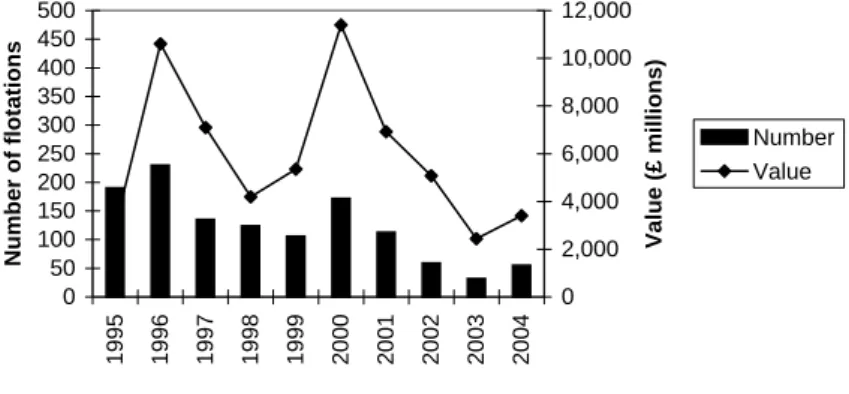
Figure 3.1 Equity new issues – main market.
Source:LSE – Primary Market Fact Sheet.
new shares are sold and that the company receives no cash. Some of the reasons follow:
. succession planning;
. diversification of holdings;
. venture capitalists and private investors seeking an
‘exit’ from their investment;
. equity carve-outs;
. privatisations of state-owned enterprises.
Succession is the cause of a number of flotations of small- and medium-sized companies. If younger mem- bers of the owner’s family have no interest in, or aptitude for, the business, the owner may sell the company. Flotations resulting from succession factors increased during the late 1990s, particularly in continen- tal Europe. Flotations may also occur when the second or third generation of family owners cannot get along.
This was reputed to be a factor leading to the 1995 flota- tion of the Gucci fashion business.
The shareholders may have financial needs that can only be met by flotation. For example, the owner may decide that he no longer wishes to have his entire wealth bound up in the company. By selling a portion, the owner is able to diversify his investments. This was the reason for the large (£2 billion plus) offering of Wellcome plc shares in 1992. The Wellcome Trust, which owned 74% of the company prior to the offer, sold Wellcome plc shares and used the funds raised to diversify its holdings. The di- versified holdings produced a higher income than Well-
come dividends, which the Trust used to increase its donations to medical research.
Equity carve-outs or spin-offs are a related type of offer- ing. In an equity carve-out, the parent company sells a portion (usually between 20% and 49%) of a subsidiary company to the public. An equity carve-out can raise cash for either the subsidiary or the parent while control remains with the parent.
Research indicates that the announcement of an equity carve-out will increase the parent company’s stock price by approximately 3%. The benefits of an equity carve- out include an increase in information to shareholders regarding the division and an increase in management accountability, focus and incentives. Investors believe that the subsidiary will perform better and, therefore, the value of the parent’s investment will increase.
For example, Dixons, a UK retailer of electronic equip- ment, took advantage of the Internet bubble by success- fully ‘carving out’ 20% of its holding in Freeserve, an Internet service provider in an August 1999 flotation.
Many companies are backed by development or venture capital firms at an early stage, or have undergone a man- agement buy-out backed by Venture Capitalists (VCs).
These financial investors typically will want to realise their investment (‘exit’) within 3 to 7 years. Flotation is often the optimal method of maximising proceeds. Com- pared with other companies that have conducted IPOs, VC-backed companies tend to be younger, have more equity in their capital structure, and generally attract
higher quality investment banks and auditors to work on their transactions.
An example of a particularly fast ‘exit’ via flotation was the case of Collins Stewart, a UK stockbroker bought by management from Singer and Friedlander in April 2000.
Collins Stewart’s management, backed by CVC Capital, Bank of Scotland and Parallel Ventures, paid £122 million for the company. In October 2000, 6 months after the purchase closed, the business was floated with a value of £326 million (or 316p per share). By the end of the first day’s trading the company’s share price was 365p, a further increase of 15%.
During the 1980s and 1990s, privatisation offerings from governments, first in the UK and then around the world,
Table 3.1 Largest privatisations to 2000.
Rank Date Company Country Amount
($m)
1 Nov-99 ENEL Italy 18,900
2 Oct-98 NTT DoCoMo Japan 18,000
3 Feb-87 NTT Japan 15,097
4 Nov-96 Deutsche Telekom Germany 13,330
5 Nov-97 Telstra Australia 10,530
6 Dec-90 Regional electricity UK 9,995
companies
7 Dec-89 UK water authorities UK 8,679
8 Dec-86 British Gas UK 8,012
9 Oct-93 Japan Railroad East Japan 7,312
10 Oct-97 France Telecom France 7,080
accounted for some of the largest flotations recorded, including C¼18 billion raised by the Italian Treasury in the sale of 35% of its interest in Enel, the electricity generator and supplier, in October 1999. At the time, the Enel offering was the largest ever privatisation or equity offering in the world. While privatisations have slowed from their previous pace, they continue to produce some of the largest IPOs and follow-on offerings.
Ancillary benefits of flotation
The flotation process forces a company’s management to formulate and articulate a clear business strategy, often for the first time. This clearly should be beneficial to the future success of the business. Along similar lines, the anticipation of public ownership leads many companies into improving their management and financial struc- ture. Fast-growing medium-sized companies often neglect the formal structures which will help them in their attempts to become large companies. The disci- pline of a public offering often helps in the creation of such structures.
Disadvantages of flotation
Flotation does bring about some disadvantages, although each company will perceive them differently. There are the costs involved: both the direct costs (in time and money) of the flotation process as well as the costs of underpricing of the offering (see below) and the costs of
increased disclosure to public shareholders (again, this is comprised of both time and money).
Other disadvantages include: the possibility that exist- ing shareholders and/or management will lose control of the company and the increased pressure imposed on management because of scrutiny by shareholders.
Methods of flotation
The British stock market is the third largest in the world by market capitalization, and has been so for a number of decades. The ‘Official List’ is the London Stock Ex- change’s (LSE) main market and home to corporate giants such as BPAmoco, GlaxoSmithKline and HSBC. It also hosts numerous much smaller companies such as Falcon Investments and World Trade Systems, with market capitalisations, as of April 2002, of £760,000 and
£900,000, respectively.
Issuers have a choice between the LSE’s main market and the Alternative Investment Market (AIM). AIM, which was established in 1995, is designed for smaller, more risky firms. The admission rules for companies joining AIM are less onerous than those for the LSE and ongoing regulation is lighter.
There are a number of different means by which a company can join the LSE or AIM. Depending on the issuer’s requirements, these vary from a placing to in- stitutional investors through global offerings to an offer
for sale direct to the public. Indeed, on larger offerings, tranches of the offer may be dealt with by each method.
In anOffer for Sale, shares are offered direct to the public through advertisements in the national press. Offers for sale were most commonly seen in privatisations and where companies have a high profile or a large customer base. In an offer for sale, the allocation of shares is usually weighted towards the individual investor, while placings and global offerings favour the institutional investor. In an offer for sale, the price of shares is set prior to orders for shares being taken. Soundings are taken from institu- tional investors regarding pricing, prior to the share price being set and the offer being advertised in the press.
Investors apply for shares by post or, more recently, over the Internet. Very few offers for sale occur these days.
When aPlacingis used, the company’s shares are sold to specific investors, typically institutions, but, on occa- sion, also to private individuals. The marketing of the issue is handled by the sponsor or broker who will decide on the target investors. The marketing is supported by the issue of a pathfinder prospectus (see below) and a series of presentations to individuals or groups of inves- tors (the ‘roadshow’). Individual (private) investors do not apply directly for shares as in an Offer, but must place an order through a stockbroker that is participating in the offering. Placings now dominate the UK market.
Global offerings are extensions of placings to target overseas investors. Such offerings can be achieved
without necessarily listing shares on an overseas ex- change. Box 3.1 is a copy of a newspaper advertisement announcing the Global Offering of Detica Group plc shares and its listing on the London Stock Exchange.
Similar announcements are published when a placing occurs. A fuller discussion of international equity offerings follows in Chapter 4.
If the shares of a company are already widely held then it is possible to introduce those shares to the market in a process logically called anIntroduction. This method is commonly seen where the company has no need for additional capital – e.g., on demutualisation of building societies.
Suitability for listing
When the regulators of new issues – the UK Listing Authority (UKLA) in the UK and the Securities Ex- change Commission (SEC) in the US – examine a com- pany seeking to float and list on a stock exchange it has to determine whether a firm is suitable for listing.
Typically, the regulator will examine the nature of the business – e.g., if the company is involved in illegal activities – as well as the following (which will be dis- closed in the offering prospectus):
. experienced management and directors in place;
. conflicts of interest between the business and its shareholders;
. conflicts of interest with a director’s private affairs;
. plans for the future and strategy;
. recently audited financial statements.
Box 3.1 Announcement of a new issue.
This notice is issued in compliance with the requirements of the Financial Services Authority (the FSA) and appears as a matter of record only. It does not constitute an offer or invitation to any person to subscribe for, or purchase, any securities of Detica Group plc in the United States or any other jurisdiction. The shares in Detica Group plc are not being registered under the US Securities Act of 1933, as amended (the Securities Act) and may not be offered or sold in the United States unless registered under the Securities Act or pursuant to an exemption from such registration. No public offer of shares in Detica Group plc will be made into the United States.
Application has been made to the FSA for the whole of the ordinary share capital of Detica Group plc, issued and to be issued, to be admitted to the Official List of the UK Listing Authority (admission) and to the London Stock Exchange plc (the London Stock Exchange) for such shares to be admitted to trading on the London Stock Exchange’s market for listed secur- ities. It is expected that admission of the ordinary shares of 2p each of Detica Group plc (the Shares) will become effective, and that dealings in the Shares will commence on 30 April 2002.
Detica Group plc
(incorporated and registered in England and Wales under the Companies Act 1985 with registered number 3328242)
Global offer of up to 9,050,389 ordinary shares of 2p each (the Global Offer)
at a price expected to be between 440p and 510p per ordinary share
Admission to the Official List of the UK Listing Authority and to trading on the London Stock Exchange’s market
for listed securities Sponsored by UBS Warburg Ltd.
Expected share capital immediately following admission (assuming no exercise of the over-allotment option and an offer
price of 475 pence, being the mid-point of the price range)
Authorised Issued and
fully paid up
Number Nominal Number Nominal
value value
Ordinary
35,000,000 £700,000 shares of 21,429,321 £428,586 2p each
Detica Group plc is an established UK information technology (IT) services company that provides consultancy and systems implementation services primarily to two markets: the Customer Relationship Management (CRM) market and the UK national security market.
Listing particulars relating to the Global Offer, which have been approved by the FSA as required by the Listing Rules made under section 74 of the Financial Services and Markets Act 2000, were published on 8 April 2002. UBS Warburg Ltd is acting for Detica Group plc in connection with the Global Offer and no-one else and will not be responsible to anyone other than Detica Group plc for providing the protections afforded to clients of UBS Warburg Ltd or for providing advice in relation to the Global Offer. Copies of the Listing Particulars are available for inspection at the Document Viewing Facility of the Financial Services Authority, 25 North Colonnade, London E14 5HS and may be collected free of charge during normal business hours on any weekday (Saturdays, Sundays and public holidays excepted) from the date of this notice up to and including 23 April 2002 from:
Linklaters Detica Group plc UBS Warburg Ltd One Silk Street Surrey Research Park 1 Finsbury Avenue
London Guildford London
EC2Y 8HQ Surrey GU2 7YP EC2M 2PP
9 April 2002
Corporate finance advisors assist companies to prepare for flotations by making recommendations for non- executive directors, sorting out any internal conflicts of interest, aiding in the development of future strategy and putting management in contact with other profes- sional advisors.
THE OFFERING PROCESS
There are two main components to any flotation or IPO:
. documentation and regulation;
. marketing, syndication, distribution and pricing.
As markets have developed and become more sophis- ticated, the personnel involved in a new issue have become specialists. Now, only a few people at the lead investment bank involved in the transaction will have a full understanding of the status of both the legal and marketing aspects of the offering.
Participants and roles
Preparing a company for flotation requires the involve- ment of a large number of players, each with a specific role to play. The leading participant, and generally the first advisor appointed, is a merchant bank or an invest- ment bank. Occasionally, other professional advisors, such as stockbrokers or chartered accountants, can take
this important role. The lead bank in a UK domestic IPO is called theSponsor.
The sponsor develops the structure of the offering, helps to appoint other participants (solicitors, public and investor relations advisors, an American Depository Receipt – ADR – bank and registrars) co-ordinates all aspects of the issue, leads the drafting of documentation, organises the verification process and is generally the primary underwriter. The sponsor also formally backs the company’s application for listing on the Stock Exchange.
The lead bank assembles a syndicate of banks and brokers to assist in the selling of the offering. Syndicate members are usually selected on the basis of their ability to distribute shares to investors and to provide company research following the offering. The size of the syndicate will depend on the size and structure of the offering and existing banking relationships which the issuer may have. In a ‘traditional’ UK offering, the appointed stock- broker handles communications with investors prior to the issue, assists in marketing the shares, arranges the sub-underwriting (see below) and is largely responsible for setting the issue price.
Two firms of solicitors work on new issues: the com- pany’s counsel and the solicitors who act for the banking syndicate, who are known asSolicitors to the Issue. The solicitors ensure that the documentation is accurate and draft the various legal agreements that are required (e.g., underwriting agreement). The Solicitors to the Issue
have responsibility for legal due diligence during the flotation. This will include a verification process on the statements made in the prospectus and advising the sponsor on the statutory aspects of the issue.
The issuer’s accountants – known as the Reporting Accountants – also have a role. They must ensure that the most recently audited financial statements are prop- erly presented in the prospectus, conduct financial due diligence, conduct an investigation of the company and produce a ‘long-form report’. In addition, the firm may be asked to produce a short-form report, as well as report on any profit forecast included in the listing particulars/
prospectus and examine the company’s working capital requirements. If a US public offering is being considered, the Reporting Accountants must prepare the company’s accounts according to the US Generally Accepted Accounting Principles (US GAAP).
It is common to hire public relations and investor rela- tions consultants. These advisors co-ordinate any adver- tising to be undertaken, media relations and press conferences. Following the flotation, the investor rela- tions advisor assists the company in the preparation of its interim and annual report and accounts, press re- leases related to the company’s results and any other significant events. The investor relations advisor will also organise regular presentations to investors and re- search analysts who follow the company.
While the lawyers and bankers work on the documenta- tion for the issue, the brokers, salesmen and syndicate
members are preparing the market and selling the offer- ing. This is all done within a fairly tight time frame with all-night sessions to meet certain deadlines not uncom- mon (see the outline flotation timetable in Figure 3.2).
The remainder of this section deals with the two main aspects of the new issue – Regulation and Documenta- tion, and Marketing, Syndication and Pricing.
Figure 3.2 provides a template for a flotation timetable.
Not all offers will be completed in the time allotted, nor will other offers require all the time that is available under this timetable.
Documentation and regulation
The main document delivered to investors in an equity offering is the prospectus. A prospectus contains infor- mation about the offering (price, number of shares on offer, subscription procedure), about the business of the company (industry, management and operations) and audited financial statements. The exact require- ments for the contents of a prospectus vary from juris- diction to jurisdiction.
In the UK, the main document that is submitted to the UKLA is referred to as the ‘Listing Particulars’. These contain all the information contained in the prospectus as well as some additional information of a more tech- nical nature that does not have a bearing on an investor’s investment decision.
Week Pre- work
-12-11-10-9-8 -7 -6 -5 -4 -3-2 -10+1Beyond Organisational and structural issues Appoint advisors Due diligence Prospectus drafting Regulatory review Draft other documents Syndicate presentation Pre-marketing Research released Marketing Roadshow Bookbuilding Final regulatory approval Pricing Allocation Stabilisation End of lock-up Figure3.2Outlineflotationtimetable.‘Pre-work’canbeginanywherefromafewweekstoyearsbefore startofthistimetable–mediumtintedareasarelegal,regulatoryanddocumentary;paletintedareas marketingactivities;whiledarktintedareasrepresentafter-pricingissues.
Due diligence and verification
Under securities legislation in most countries, the issuer assumes absolute responsibility that the information contained in the prospectus is accurate (see the declara- tion in Box 3.2 for the UK form). In addition, the man- agers of the offering have a separate responsibility to make a reasonable investigation to ensure the accuracy of the offering documents used in an IPO.
Thus, it is customary for the bankers and their counsel to conduct a due diligence examination of the com- pany’s business which might bear on the accuracy or fairness of any statement in the prospectus or might otherwise be of material interest to a potential pur- chaser. There is no prescribed routine or checklist for such an investigation; rather, its elements are usually discussed and agreed upon in advance by the bankers and the company, based on the nature of the particular offering.
In the UK, a process known asverificationtakes place. It is similar to due diligence in its thorough investigation of the company’s operations and financial statements.
However, it differs in that each statement in the pros- pectus is documented as a fact and the source of the information is collected and placed on file.
The completion of a thorough due diligence examina- tion brings two benefits to the lead investment bank:
first, it gives the bankers a deeper appreciation and under- standing of the business of the company, allowing the bank to tailor the marketing story for investors. Second,
Box 3.2 UK prospectus requirements
The persons responsible for listing particulars, the auditors and other advisors (banks, brokers and solicitors)
This section includes the following declaration:
‘The directors of [the issuer], whose names appear on page [ ], accept responsibility for the information contained in this docu- ment. To the best of the knowledge and belief of the directors (who have taken all reasonable care to ensure that such is the case) the information contained in this document is in accord- ance with the facts and does not omit anything likely to affect the import of such information.’
The shares for which application is being made
A description of the characteristics of the shares (e.g., voting rights), the number being offered, names of stock exchanges where listing is being sought are included.
The issuer and its capital
Name, registered office and head office of issuer. Description of share capital and any changes in prior 3 years. Controlling shareholders and any other holder of at least 3% of the capital.
The group’s activities
Description of the business of the company, including breakdown of divisional turnover, number of employees, R&D main invest- ments, etc.
The issuer’s assets and liabilities, financial position and profits and losses
Three years of financial results in a comparable table (balance sheet, income statement and cash flow statement together with the notes to the accounts); ‘working capital statement’ (see below).
The management
Directors of the issuer with details of previous work; aggregate remuneration paid to directors.
by conducting due diligence the managers of the offering are protected from lawsuits from disgruntled share- holders if the price drops dramatically in the market after the launch of the offering.
Marketing, syndication and pricing
The marketing of equity new issues is a sophisticated process which involves three stages: pre-marketing to prepare investors for the issue; formal marketing once
The recent development and prospects of the group
General information on the trend of the group’s business since the end of the financial year to which the last published annual accounts relate; this may include a profit forecast or estimate and the supporting grounds for the forecast or estimate (including the sponsor’s statement).
Working capital statement
Companies listing in the UK must produce a working capital statement attesting to the directors’ belief that the company will have sufficient working capital for 12 months following publica- tion of the prospectus.
Although the company directors are legally liable for the statement, they will rely on a Working Capital Report produced by the company’s accountants.
Forecasts
Forecasts are optional in UK prospectuses. Most companies include a forecast of earnings to the end of the fiscal year in which the prospectus is published. They will also include an anticipated dividend and calculate the anticipated dividend yield based on the new issue price and the anticipated dividend.
a preliminary prospectus has been printed; and, finally, pricing, allocation and distribution of the shares.
The initial phase is devoted to educating investors so that they understand the company and the industry in which it operates. Typically, a major research document is published by the brokers to the issue and distributed to investing institutions up to 8 weeks prior to the anticipated offering date. While the investors study the research report, the lead bank and investor relations consultants work with the company’s management to prepare the management for the second phase of market- ing – meeting the investors.
The second phase commences with the publication of a preliminary prospectus (referred to as a pathfinder pros- pectusin the UK). In most large offerings, the prelimin- ary prospectus is published approximately 4 to 5 weeks before the price of the issue is set. The preliminary pros- pectus includes nearly all the necessary information required to make an investment decision, except the share price. Usually, the lead bank will indicate a price range at this time, so that investors have an idea of the valuation being contemplated.
After the preliminary prospectus has been published, company management commence presentations to in- stitutional investors, known as a ‘roadshow’. The pro- gramme includes a combination of one-on-one meetings with the most important institutions and breakfast, lunch and dinner presentations to selected groups of fund managers and analysts.
In a Placing or Global Offering (more about which in Chapter 4), during the last stages of the marketing period prior to pricing, institutional investors are can- vassed by the banks and brokers involved, for their inter- est in purchasing shares. As the pricing date approaches, the indicated price range narrows. This allows the spon- sors of the issue to more accurately set the price in light of investor demand. Some use sophisticated computer software to model demand at specific price points and use this to set an ‘optimal issue price’.
Pricing a new issue is not an exact science, however.
Most flotations are priced in the expectation that the shares will begin trading at approximately 10% above the issue price. In IPOs of highly risky companies – e.g., Internet and biotechnology businesses – the level of underpricing is greater. In offerings where existing shares are already trading in the market, the offering process attempts to price the new shares being offered slightly below the existing share price. This is discussed in Chapter 5 (onsecondary offerings).
The third and final stage of the new issue marketing process is the allocation of shares to investors, once the price has been set and all orders placed. While the decision on price is fundamental to the success of the issue, the allocation policy has an important role, not only in the aftermarket, but also in the maintenance of a strong and stable shareholder base. Allocations are generally spread among three or four classes of investor:
a small group of core investors, other long-term in- vestors, private clients and, finally, short-term traders.
Short-term traders (orstags) purchase new issues in the hopes of selling the shares immediately for a small profit and provide immediate liquidity in the shares. It is important to control the allocation of shares to the
‘stags’ so as to ensure orderly trading during the first few days after issue.
If the offering is over-subscribed, the sponsor and brokers must determine how to allocate the shares. They have two options: to scale down allotments on apro ratabasis or make random allotments using a ballot. In a ballot, some or all of the applications may be ‘put into a hat’
and applications drawn at random to be granted part or all of the shares applied for. Applications not selected are unsuccessful and investors’ money is returned.
The allocation of shares from a new issue is made by means of an allotment letter. This entitles the recipient to a specified number of shares, subject to payment.
Underwriting
In an Offer for Sale the share price is set after negotiation between the bankers, brokers and the issuer. Once set, the issue is ‘underwritten’ and the formal selling period begins. Price setting in placings is similar to that in international offerings and is described in Chapter 4.
Underwriting guarantees the issuing company or selling shareholders the proceeds of the offering (less expenses).
If the underwriters – usually, the lead bank(s) – are not able to sell the shares to investors (whether a result of
mis-pricing, adverse market conditions or any other reason) they must purchase the shares not sold from the issuer at the issue price.
The underwriting period will vary, but it starts when the price is set (known as Impact Day in the UK) and con- tinues to the close of the subscription period (between 1 and 3 weeks). If the issuer is seeking to attract individual investors, it must leave the subscription period open for a sufficient length of time for the investors to respond to the offer.
To spread risk, it is common for the lead bank to ‘sub- underwrite’ among a group of banks, brokers and invest- ing institutions in order to spread the risk of failure. The sub-underwriting takes place immediately after the price has been set. Each sub-underwriter agrees to guarantee the sale of a small portion of the amount being raised, generally between 1 and 2%.