c h a p t e r s i x
F O O D A N D
B E V E R A G E D I V I S I O N
recognition lost during Prohibition. Recovery was further delayed by the Depression and the uncertainty and reordered national prior- ities that accompanied World War II.
In 1945, at the conclusion of World War II, well-documented major shifts in population and economic emphasis began to occur. Free- standing restaurants continued to compete ef- fectively with hotel foodservice. Movement was away from downtown and central busi- ness district hotels. Motels and motor hotels were built on highway and freeway inter- changes to take advantage of the mobility of the American family. Fast-food restaurants, too, affected the away-from-home eating habits of Americans. Consequently, many ho- tel companies saw as too great the cost of pro- viding high-quality competition in the face of these forces. The net effect was that many ho- tel guests and operators came to believe that
6.1 I N T R O D U C T I O N
In discussing the ways that hotel organiza- tions have changed, we pointed out that in earlier times food played a significant role in the organizational structure and product/
service mix of hotels. It has been speculated that the preeminent role played by hotel foodservice in society became significantly di- minished with the onset of Prohibition and during the 1920s. People stopped going to foodservice establishments where they couldn’t
“get a drink.” Prohibition gave rise to compe- tition from street restaurants that operated sub rosa as speakeasies. These restaurants were not constricted by the visible, public na- ture of hotel dining rooms. This diminished role was compounded in many ways by the depression years of the 1930s and the war years of the 1940s.
In general, it was difficult for most hotels’
foodservice to recover from the effects of
235
hotel foodservice was little more than a nec- essary evil. For many operations, this became a self-fulfilling prophecy, and hotel foodser- vice floundered for many years.
This situation has been reversed in recent years. Of the many factors mentioned earlier that forced organizational change (market segmentation, return on investment, demo- graphic shifts, and so forth), it seems that re- turn on investment has played a dominant role in this turnaround. The double-whammy issues of construction cost and return on in- vestment expectations of people outside the hospitality industry strongly suggest that space devoted to foodservice should con- tribute at least its share to the profit structure of the modern hotel service system.
As a result, hotels seem to be willing to try anything to capture additional revenue, prestige, and competitive advantage. Among the tactics addressed in several of the articles and essays included in this section are part- nering with restaurant companies, outsourc- ing a hotel’s foodservice, new catering and beverage management strategies, celebrity chefs, and rethinking the entire role of hotel food and beverage.
FOOD
O
ver 35 years ago, Allen Hubsch (1966) sug- gested a number of ways to revitalize hotel food and beverage service that have proved eerily prescient. Among his suggestions were:• Hotel food and beverage facilities must become profit centers—no more a neces- sary evil!
• Food and beverage management calls for new and increased professionalism and less reliance on the old chef–maître d’
model.
236
Chapter 6 Food and Beverage Division• Food and beverage outlets must become amenities that produce room-nights.
• Hotel food and beverage units must adopt street restaurant philosophies; mer- chandising, advertising, decor/ambience, menu, and service must compete with lo- cal competition.
• Food and beverage can be used to fill marginally profitable space in rentals, storage, or production areas.
• New food and beverage outlets can lever- age existing facilities like storage and kitchens by spreading fixed costs over a wider sales base.
Hubsch’s article, now considered a classic, is among the suggested readings for this section.
Robert H. Bosselman is the director of the Dedman School of Hospitality and Ded- man Distinguished Professor of Hospitality at Florida State University. From his perspec- tive, looking ahead to the future state of hotel food and beverage operations, Bosselman provides an in-depth analysis of the way the hotel food and beverage organization has changed over the last eight to ten years and offers tantalizing clues and examples that echo the prescriptions proposed by Hubsch.
He also addresses the structure of the organi- zation, interactions of food and beverage ele- ments within the lodging operation, operating ratios, and potential trends in this major—and expensive—operational component.
Dominic Provenzano is director of opera- tions of the Downtown Marriott at Key Cen- ter in Cleveland, Ohio. From the perspective of a previous position as director of food and beverage, he provides front-line detail of how Bosselman’s theory of food and beverage plays out for the food and beverage director.
In a major research effort that began in 1998, Laurette Dubé, Cathy Enz, Leo Re-
naghan, and Judy Siguaw of the Center for Hospitality Research at Cornell University studied the best practices of hotels in the U.S.
lodging industry. In their words, “The goal of this research was to surface and summarize practices of use and value to the entire lodg- ing industry” (Dubé et al., 1999, 7). Siguaw and Enz summarize several of the practices from that study that have been developed by hotels to achieve the “strategic charge of prof- itably meeting customer needs” (1999, 50).
The authors describe how top hotels integrate the ideas of restaurant design and conceptual- ization with all of the variables that affect the quality of the food and the experience for the guest.
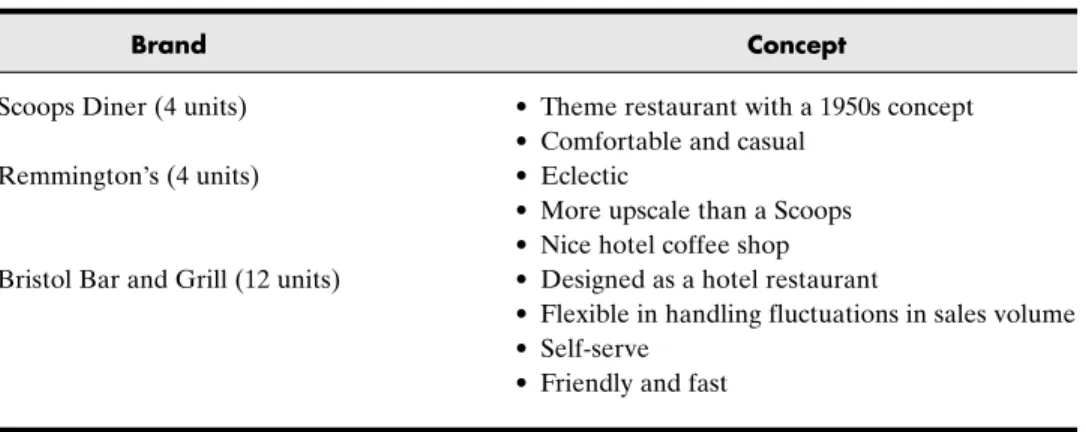
The concept of outsourcing was men- tioned earlier in the context of how some ho- tel companies are rethinking the role of hotel food and beverage and how to maximize in- vestments in facilities, furnishings, and equip- ment for foodservice outlets. According to Strate and Rappole (1997), because hotel restaurants have often been managed as a secondary function, owners and operators are questioning the conventional wisdom about how hotel food and beverage is conceived and managed. They state that this new focus on hotel foodservice results in innovative con- cepts and strategic alliances with well-known restaurant brands. In their article, they ana- lyze this trend outlining historic antecedents of the practice and use the Texas firm Bristol Hotel Company as a case study.
Few would argue that should a hotel choose to do its own foodservice, a first-class executive chef is essential to allow a hotel or- ganization to compete effectively for food and beverage business in today’s market. It is, however, fairly clear that chefs today do not have the dominant role they had a century ago. Given the importance of the food and beverage function, as established by the fore-
Section 6.1 Introduction
237
going articles, the chef is nevertheless an inte- gral part of the competitive strategy and a full-fledged department leader. He or she is no longer purely a technician. This individual must have developed a significant range of managerial skills to complement the technical and artistic training we have come to expect from an executive chef. The appearance of ultra-high-profile celebrity chefs adds an- other interesting variable to the food and bev- erage director’s mix of challenges. If a hotel commits much of its food and beverage strat- egy to the talents of one famous person, it can enjoy a significant competitive advantage but also become hostage to that person’s whims and personality. Many high-profile hotels in Las Vegas have “name” chef programs, and in many major population centers, top chefs have made their hotels destination venues due to their fame in the kitchen.
Patti Shock and her colleague John Ste- fanelli highlight the importance of the ban- quet and catering functions of hotel food and beverage in their piece, updated for this edi- tion. With the increased national attention and focus on the importance of conferences, conventions, meetings, and events of all kinds, foodservice professionals who specialize in planning and serving meals and beverages to large groups of people are increasingly important. The authors note, “Although on- premise catering is generally the second- largest source of revenue for most hotels, following sleeping rooms” and “often the highest visibility the hotel has on a local level,” banquets and catering are still too of- ten ignored by hotel school curricula. In this article, we partially address this lack.
Catered affairs represent a significant contribution to the profit picture of hotel food and beverage service. The efficacy of a hotel’s efforts in selling and servicing the group business market may very well be the
difference between profitability of the food and beverage function and some less desir- able outcome. Shock and Stefanelli explore the organization, personnel, and processes of the catering department and give the reader an in-depth view of catering execu- tives and banquet organizations. The article includes Internet addresses for additional information.
It is the revenue and visibility importance of the catering function that makes the ener- getic essay by Rich Benninger so intriguing.
From rising at 6:00 A.M. or so, thinking today is the day he will “get everything done” in the catering and convention services office of a 5,000-room resort hotel casino in Las Vegas, to hitting the sack after midnight, Benninger gives the reader an insider’s view of life in the fast lane of Vegas catering and convention services. As executive director of catering and convention services at the Caesar’s Palace Resort Hotel and Casino, Benninger is uniquely positioned to provide these insights.
BEVERAGE
I
n any hotel that has more than one formal bar, there is usually a separate function within the food and beverage department called bar or beverage management. Ideally, that office coordinates all matters that concern liquors, beers, and wines. The beverage manager is re- sponsibile for purchasing, receiving, storing, and issuing liquor, wine and beer inventory, and quite obviously has the managerial re- sponsibility to control that inventory.Additionally, the beverage manager:
• Hires, trains, schedules, and controls all beverage and bar personnel.
• Promotes the various beverage depart- ment services.
238
Chapter 6 Food and Beverage Division• Coordinates the requests of other depart- ments that require beverage services—for instance, banquet and catering, room service, chefs, management.
• Assures that his or her department is in compliance with federal, state, and local laws and regulations.
The beverage manager administers or manages up to four types of bars.
The front or public bar is that in which the guest can, if he or she so desires, interact with the bartender and other service personnel.
There are provisions for guest seating at the bar itself, which may be part of a restaurant or a separate room or area. Separate tables and stand-up areas may also be available for bev- erage service. A front bar may or may not in- corporate entertainment.
A service bar is a hidden bar designed for use by the hotel’s food and beverage service staff only. It may serve one or more foodser- vice areas and/or room service, and it is de- signed specifically for efficiency and economy of service. In most cases, speed is considered the essential ingredient in service bars. Ser- vice bars typically are centrally located in the back of the house, out of guest view.
Portable bars are designed for maximum flexibility and can be used in conjunction with beverage sales associated with guest activities anywhere in the hotel or on its grounds. This may be extended in resort areas to include recreational areas.
A new facility popular in many hotels is that of the in-room bar, mini-bar, or honor bar. While sometimes the responsibility for in- ventory of these bars rests with room service, the beverage manager in most cases is also deeply involved in their design, marketing, and control.
In many ways, the beverage manager’s job can be compared, in terms of historical
stereotype, to that of the housekeeper. Often the beverage manager has worked his or her way up through the ranks of beverage server and preparer and through experience, longevity, and interest becomes the beverage or bar manager. There is reason to believe that in many ways this pattern is changing.
Like many other areas of hotel management, the beverage management function now faces a range of issues that are more sophisticated and complicated than traditional beverage management problems of the past. It may be that the beverage managers of the future will have to bring to their job a level of manage- rial, organizational, and administrative so- phistication that was previously unnecessary.
The issues, responsibilities, and structural management of the hotel’s beverage function are analyzed and discussed by Valentino Lu-
Section 6.2 Managing Food and Beverage Operations in Lodging Organizations
239
ciani, professor of beverage management at the University of Nevada, Las Vegas. Lu- ciani’s essay, reprised here from the third edi- tion, draws on his industry experience, research, and teaching beverage management and provides a view of how the modern bev- erage manager has evolved from his or her historical counterparts.
The planning, preparation, service, and management of food and beverage in modern hotels have changed significantly since the first edition of this book was written. The es- says, research, and commentary presented here are chosen to illustrate the breadth and depth of this process of change. The reader who is interested in hotel food and beverage should be able to synthesize an accurate vi- sion of the practices and realities of this major operational division of modern hotels.
6.2 M A N A G I N G F O O D A N D B E V E R A G E O P E R AT I O N S I N L O D G I N G
O R G A N I Z AT I O N S
Robert H. Bosselman
Like the lodging industry in general, foodser- vice in the hotel market has improved its po- sition over the last few years. A typical characteristic is a market posting steady but not significant growth and emphasizing cost containment and innovation. As lodging food- service competes with the multitude of com- mercial foodservice operations for the consumer dollar, value remains the focus of both operators and consumers. A number of studies have identified food and beverage services as a primary contributor of value to a customer’s lodging experience.
This introductory essay discusses the mission and goals of food and beverage de- partments in lodging operations, the orga- nizational structure of such departments, interactions of food and beverage elements within the lodging operation, operating ratios, and potential trends in the area.
MISSION AND GOALS
“T
he goal of our food service operations is to provide the highest quality of food andservice in a sophisticated, comfortable ambi- ence, by friendly and professional staff, ensur- ing that every patron returns,” states the Four Seasons Hotel in Las Vegas. This statement, succinct and focused, exemplifies what lodg- ing operations nationwide are seeking. Most lodging executives identify food and beverage operations as one of the more complex areas to manage in the entire lodging arena. Lodg- ing foodservice not only involves the tradi- tional difficulties associated with both producing and serving food and beverages but also the performance of these functions every day, often 24 hours a day. The resulting labor costs and operational expenses prove burdensome for many lodging establishments.
In order for these food and beverage opera- tions to survive and thrive, they must draw not only guests of the lodging facility but also consumers from the external market of the lodging property. Hoteliers are analyzing their operations to identify ways of increasing the percentage of guests who stay to dine on- site, known as the capture rate.
In fact, the more profitable lodging food and beverage operations obtain more than 50 percent of their business from non-guests of the property. The hotel or motel guest is not a captive diner; he or she has many other op- portunities for dining. Yet, in order for a hotel property to be profitable, a significant per- centage of sales must be produced by food and beverage operations. To accomplish this, lodging facilities must successfully compete with the numerous chains and independent restaurants that offer a variety of services.
One advantage for full-service hotels is the banquet business, which can be a major rev- enue producer and operate at a high profit margin. It becomes critical for lodging opera- tors to research tourists’ specific food needs and wants, and how their specific operation
240
Chapter 6 Food and Beverage Divisioncan better serve these tourists. In addition, a clear, objective analysis of local competition is necessary to determine the segment and genre in which the hotel can compete and succeed.
If the hotel is competing with an estab- lished local competitor, then the hotel food- service operation must outdeliver on all levels of quality, service, and ambience. In a large hotel, it is also necessary not to compete di- rectly with another unit in the same hotel.
Units must be diverse to give different seg- ments of the market a choice; the ideal out- come is that hotel and local guests choose to dine in one of the hotel’s offerings. A strong food and beverage program that delivers a high-quality product and experience can be used as a competitive advantage as well as a sales tool for the lodging facility.
Many hoteliers choose not to compete in this environment. Instead, their strategy is to eliminate food and beverage operations altogether, or to lease food and beverage op- erations to outside companies, either chain- operated or an independent restaurant (see the article by Strate and Rappole elsewhere in this section). In particular, food and bever- age sales in motels and motor-hotel restau- rants continue to decline as a percentage of overall sales when compared to full-service hotels, primarily as a result of an increasing number of lower-priced lodging operations offering free breakfast and no other meal service. However, that free breakfast has be- come a competitive positioning statement for the property. Guests now expect it, and they expect quality, yet such lodging facilities must maintain their cost structure.
While the reader may start to think that hotel food services are not major players in the overall foodservice market, 2005 pro- jected sales were estimated at $25 billion,
according to the National Restaurant Associ- ation. There are five major hotel chains whose foodservice sales per hotel average more than
$2.3 million. At the top lies Sheraton Hotels, whose properties average well over $4.6 mil- lion in foodservice sales. It should be noted that a number of convention/resort hotels could do well over $30 million in annual food and beverage sales. Clearly, foodservice pro- fessionals have as much or more opportunity for success as in other segments of the food- service industry. With potential sales like those noted, lodging food services remain a critical partner with respect to both the rev- enue and profit of the property. A smart, re- sourceful manager makes the foodservice operation unique, thus attracting additional patrons to the lodging establishment. Thus, foodservice can be looked on as a means of gaining competitive advantage over other lodging operations.
The field of lodging has a long history of serving people food and drink during their travels. From the earliest days of the Roman Empire, when people traveled on foot, on an- imal, or in vehicles drawn by animals, to the modern age of air, rail, and car transportation, hotels and inns provided for their needs. In fact, early hotels were usually the center of community activity and often the only place one could eat away from home. The glamour years of the late nineteenth and early twenti- eth centuries produced grander hotel proper- ties, the so-designated palaces of the people, which solidified this perception of hotels as centers of public entertainment and as sources of food and drink for guests. This rep- utation continued well into the twentieth cen- tury, as hotels became the logical place to meet for entertainment and business discus- sion. Foodservice operations independent of hotels were rare even in the larger urban cen-
Section 6.2 Managing Food and Beverage Operations in Lodging Organizations
241
ters. It was not until the post–World War II era that independent restaurants and restau- rant chains grew in both number and influ- ence over the customer. As we enter the twenty-first century, lodging foodservice ac- counts for approximately 7 percent of the total foodservice market. From total domina- tion of the market to its role as a secondary player today, lodging foodservice has under- gone dramatic change. As properties struggle to decide whether or not to offer foodservice and, if so, the number of foodservice units and the level of service to offer, future managers must recall what the goals and mission of the foodservice operation should be:
1. To provide the appropriate level and de- gree of food and beverage service to the property’s guests.
2. To support the overall goal(s) of the property.
3. To assist the property in gaining a com- petitive advantage over other lodging establishments.
4. To function efficiently and effectively in order to produce a profit.
ORGANIZATIONAL CONSIDERATIONS
T
he organization of foodservice departments within lodging establishments varies depend- ing on the type of facility and, in the case of chain operations, corporate policies. Due to this degree of variety, categorizing lodging properties can be difficult. For example, a property located in a resort environment may also have extensive convention space. A prop- erty known primarily as a convention hotel has room enough to accommodate largegroups. Foodservice outlets likely include restaurant(s), lounge(s), banquet facilities, and room service. A resort property provides all the amenities that focus on guest enter- tainment and relaxation, with emphasis on specialty restaurant(s) and room service.
Unique problems may face resort managers with respect to seasonality of operations, lo- cation, and layout. The latter points are im- portant because the property itself, as well as individual food and beverage outlets, may be located in hard-to-access areas, which affects operational expenses.
An example of a resort is the Renaissance Sea World Resort in Orlando, Florida. David McKeever, director of restaurant operations, is responsible for three full-service restau- rants as well as banquet and conference ser- vices. David notes that his facilities aim for an upscale perspective, highlighted by regional and contemporary menu influences and char- acterized by upscale wine sales. He identifies the property clientele as wanting a relaxed environment in food and beverage services.
Lloyd Wentzell, vice president of food and beverage, provides a slightly different view of these services at the Riviera Hotel and Casino in Las Vegas. He notes that the food and beverage operation there is an amenity. The buffet and coffee shop are for in- house guests, and the (three) gourmet rooms are for guests including those who come to the shows at the hotel’s four entertainment venues. The snack bar in Nickel Town is used to bring visitors from nearby properties.
Room service is a necessary loss leader used to maintain resort hotel status.
Airport properties have grown with the increase in air travel. Quite often, travelers choose these properties based on the conven- ience factor. While occupancy rates are high during weekdays, weekend business tends to drag. There does not appear to be an empha-
242
Chapter 6 Food and Beverage Divisionsis on food and beverage operations in such facilities.
Economy properties are coming off a pe- riod of significant growth. This is the segment that often rejects offering foodservice opera- tions. Midscale brands such as Ramada Inn and Hampton Inn are noted for their aggressive growth in building new properties with little or no food services. Additionally, significant growth is expected in the lower-tier extended- stay market. However, some properties are at- tempting to redefine the concept of value to the customers. An example is Courtyard by Mar- riott, which combines comfortable lodging with downsized foodservice operations. All-suite properties remain one of the hottest concepts in the lodging field. While some units contain kitchen facilities, many offer complimentary food and beverage services—particularly at breakfast—for the busy traveler.
The Four Seasons Hotel in Boston demonstrates one example of how a hotel food and beverage operation can be organ- ized. The food and beverage division has four departments; food preparation, catering sales, stewarding, and sales outlets. The latter has five operations: private bars, room service, a full-service lounge, a fine dining restaurant, and banquet facilities. Each department has line employees who report to assistant man- agers who, in turn, report to department heads, who then report to a director of restau- rants and bars, who, in turn, reports to the di- rector of food and beverages. Regardless of the size of the lodging facility, food and bev- erages must be produced and served. How- ever, the increased size and complexity of some operations makes it critical that man- agers communicate well with all levels of em- ployees. The trend may be toward flatter organizational structures as well as to com- pletely separating out certain functions of the food and beverage area.
FOODSERVICE PERSONNEL
W
ho are the key people in the organization of lodging foodservice? Our attention here is on the operational players, those individuals most often responsible for the work of pleas- ing the guest while holding the line on costs.In most kitchen operations, an executive chef is responsible for management related to production activities. Depending on the size and complexity of the operation, the execu- tive chef may actually perform little in the line of food production. In a small operation, the chef may also be a part owner and per- form most of the food-related functions. One of the exciting trends today is the use of big- name chefs in hotel food services, often al- lowing them to create a signature room in the lodging property. The proper positioning of the restaurant in a niche market can also have a residual positive effect on average rate and occupancy. Marketing a celebrity chef as a primary component of a hotel may yield a competitive advantage among that specific hotel’s competitive set.
With the trend toward downsizing opera- tions, it would be the rare organization in lodging foodservice that employed numerous back-of-the-house employees engaged in a single function. Some examples of the past might include the sous-chef, the executive chef’s assistant and often the staff supervisor;
the saucier, or sauce cook; the garde-manger, the cook in charge of all cold food prepara- tion; the chef pâtissier, or pastry chef; and the banquet chef in charge of catering. Each of these positions would have had assistants. In addition, other jobs were steward, purchasing manager, storeroom clerk, and several janito- rial staff.
Some examples of how lodging foodser-
Section 6.2 Managing Food and Beverage Operations in Lodging Organizations
243
vice is organized today have been reported in studies of best practices. The Boulders, lo- cated in Arizona, created a food forager posi- tion to improve quality of products. Menus are designed around foods actually located, which saves time spent trying to find ingredi- ents to fit a menu while providing guests with a unique dining experience. The Greenbrier, in West Virginia, designed a formal three-year culinary apprentice program. This allows the resort to attract a continuous supply of tal- ented chefs as well as create a cooking school for guests (thus adding value to the guest ex- perience). The Pierre in New York City uti- lizes an independent consultant to manage purchasing. This frees the chef to focus on food production and has led to reduced food and labor costs.
The dining room can have an equal de- gree of complexity, depending on the opera- tion. There may or may not be a supervisor, often called a host or hostess, or a maître d’.
This individual greets guests and supervises the waitstaff. At the actual service level are the captains, servers, bussers, and cashiers. If a lounge operation is present, so are bartenders and cocktail servers. As one can readily imag- ine, working as a team is imperative.
In today’s cost control environment, food and beverage operations are trimming pay- rolls and consolidating job responsibilities to cut operational expenses. This cross-training of staff allows an individual to take on multi- ple responsibilities. The Breakers Hotel in Palm Beach, Florida, utilizes a cross-training program that allows the property to com- pletely reorganize its staff annually, facilitat- ing mobility of staff as well as improved service to guests. In the past, it was not un- common for the food and beverage operation to employ workers around the clock, as most items were made from scratch. With modern equipment and the use of more convenience
food items, such as preportioned meats, it is now rare to find butcher shops or pastry shops in hotels. Again, hotel operations are concentrating on quality, value, and cost. If the property can find a product on the mar- ket, the trend is to purchase rather than make from scratch.
There has been increased attention on the education level of chefs in lodging operations.
In recent years, traditional culinary arts pro- grams have expanded from two-year to four- year education programs, while traditional four-year hospitality institutions have ex- panded their curricula into culinary arts. Un- der the direction of the author (when he served there as department chair), the De- partment of Food and Beverage Management in the Harrah College of Hotel Administra- tion at the University of Nevada, Las Vegas, was the first four-year hotel administration degree program to offer a bachelor of science (B.S.) in culinary arts management. People who earn this degree can command reward- ing pay, but much is expected of them as well.
They must be able to produce high-quality products utilizing minimal resources. They must also direct all activities in the back of the house, including the training and supervision of employees. Their responsibility is the means by which a food and beverage unit pro- duces profit for its parent institution, the lodging facility.
OPERATIONAL INTERACTIONS
H
otels are complex institutions divided into separate operational areas, among them rooms, engineering, administrative, account- ing, human resources, and sales, in addition to244
Chapter 6 Food and Beverage Divisionfood and beverage. These divisions interact in every imaginable way 24 hours a day to pro- duce the guest experience. It is necessary that the strategy or mission of the operation as a whole be communicated to all levels of the or- ganization to ensure a consistent guest expe- rience. In order to maintain continuity within the organization, all strategic moves must be consistent with the mission of the operation and build toward the long-term goals of profit, quality, guest satisfaction/loyalty, and employee retention and growth.
Perhaps the best way to describe this in- teraction is to characterize food and beverage and other departments as mutually depend- ent. Direct interaction can be observed be- tween food and beverage and the front desk with respect to specific guest service issues.
Direct interaction can also be observed with the sales department and the convention/ban- quet department. Indirect interaction be- tween departments comes from areas such as rooms, in the form of overnight cleaning; en- gineering, in the form of maintenance and re- pair; and accounting, in the form of financial analysis. For example, food and beverage team members must communicate their reservation needs or restrictions to concierge and bell staffs. One example is announcing a new menu that has been initiated, or that a special activity will occur. Likewise, food and beverage depends on information submitted to them regarding occupancy, VIP guests, or demanding guests.
No matter the type of lodging property, it is critical for management and staff to meet regularly to discuss department interaction and better ways to service the guests. Another example with a special case to consider is a casino resort hotel. Historically, food and bev- erage has been perceived as an amenity for players. The casino and slot departments are
continually in contact with food and beverage units, particularly room service, to request special arrangements for their clients. These requests might range from amenities being delivered and set up in the guest room to sup- plying the gaming area with special foods and drinks.
The type of client sleeping in the guest rooms significantly affects the revenue-gener- ation potential of a lodging food and bever- age operation. Because a majority of food and beverage customers may be hotel guests, it is important to book the right type of people into the hotel. The sales mix of the hotel is a delicate balancing act. Sales staff must make sure they are contracting groups that maxi- mize hotel revenue per available room (Revpar). Do you know the utilization rate of the food and beverage outlets for the various market segments? Do business travelers eat more or drink more than the leisure/pleasure market? Which convention uses the food and beverage outlets more than others? The ball- room space must be managed closely to en- sure that the best business opportunities are maximized from the rooms and food and bev- erage perspectives. Groups with high demand for banquet space must meet room-night ob- ligations at a given rate and provide the nec- essary revenue in catering. Local niche opportunities must be explored when there is an opportunity to sell the ballroom when ho- tel guests are not utilizing it. It is possible that local catering sales can be a larger portion of the total catering dollars, particularly when the rooms mix changes to a larger proportion of transient guests. Your management and sales staff must know the answers to these types of questions. Sales personnel cannot just be concerned with achieving room-night quo- tas or generating revenue; they must know the impact of their decisions throughout the
Section 6.2 Managing Food and Beverage Operations in Lodging Organizations
245
hotel and how they affect its profitability.
When developing annual budgets, the team must take into consideration seasonality, group business and its particular needs, tran- sient guests, and regional events that may af- fect guest occupancy and mix.
The food and beverage manager must know who the customers are and how many patrons to expect. Information about hotel guests such as house counts, market mix re- ports, group commitment reports, and rival/departure patterns assists the food and beverage team in making decisions on sched- uling, food ordering, and whether or not to close a particular outlet.
Every hotel employee is a sales agent for the property’s food and beverage outlets. The staff must be trained to refer and recommend hotel services to guests. It is clear that the quality of food and beverage operations can affect overall hotel operations and profitabil- ity. Quality is particularly important for con- vention hotels and resort hotel properties.
Guests come to such properties for specific purposes. Therefore, a reputation as a high- quality food and beverage operation will at- tract customers. These operations generate word-of-mouth advertising from travel agents, corporate meeting planners, cab driv- ers, airline companies, and tourism offices.
While this reputation can attract guests, it is the responsibility of management to plan ef- fectively for their needs.
Imagine you run a hotel restaurant, oper- ate room service, provide food and beverages for employees, and now are also catering sev- eral types of meals/functions for different groups. Recall that the goal of the hotel prop- erty is to service its clientele. Therefore, each area of the hotel must complement the other in providing the service. Managers, particu- larly in food and beverage, must communicate
effectively and train constantly in order to maximize the goals of the lodging operation.
OPERATING RATIOS
M
any operating ratios are utilized by the food and beverage department. Controlling operational expenses is perhaps the biggest challenge facing food and beverage managers.Managers at every level must be controllers.
In addition, it is the duty of every food and beverage manager to maximize the revenue and profit potential of his or her specific unit.
An empty seat cannot be resold later. If a restaurant has a significant drop in sales on a given day or time of year, a strategy must be developed and implemented to fill that void and thus provide a new revenue source. Most hotels’ food and beverage operations have a minimum fixed cost that must be maintained in order to meet the needs of the hotel.
It is increasingly difficult to make a profit and provide high-quality service when rev- enue does not support the labor necessary for even minimum levels. The challenge is to maintain a strong revenue flow so that effi- ciencies of scale take place. The kitchen is the highest cost producer of any part of the food and beverage operation. The challenge of the kitchen manager or chef is to deliver a high- quality product, yet maintain close controls on food and labor costs.
The key for success in this area is to have a clear understanding of production manage- ment so as to reduce waste and spoilage, cre- ate dynamic menus that drive business, and continue to build an ongoing training pro- gram to instill the best practices into line as- sociates. In very large establishments, the kitchen manager or chef may find himself or herself using a computer more than a knife.
246
Chapter 6 Food and Beverage DivisionA number of club managers the author recently spoke with noted that operating ra- tios are important to keep expenses in check, as well as to monitor improvements or income contributions from one area of the property to another. They identified food cost and labor cost percentages as most important. A casino hotel controller from Las Vegas utilizes operating ratios such as cost per cover, percentage of sales, cost per employee, utilization rate (number of cov- ers/number of guests), revenue per occupied room, sales per hotel guest, average check, sales per employee, table turnover, inven- tory turnover, revenue per square foot, rev- enue per seat, cost per square foot, return on investment, covers per employee, average covers per day, and average sales per day. In- dustry professionals note that ratios are only tools and that it is more important to have a clear idea of what needs to be meas- ured and the impact of each variable on the overall operation.
What we can observe is that food and beverage managers utilize ratios to determine whether or not they have been successful in generating revenues and minimizing ex- penses. Such ratios can then be compared with figures from prior accounting periods of that operation. Let us examine some of the more common ratios.
Food and Beverage Sales per Available Room
$
Food and Beverage Occupancy Turns Number of Covers
Number of Seats
Total Food and Beverage Sales Number of Available Rooms
Sales per Available Seats
$
Average Check
$
Ratio of Beverage Sales to Food Sales Be
F v o
e o
ra d g
S e a
S le
a s
les 100 %
Food Cost Percentage F
F o
o o
o d
d S
C a
o le
st
s 100 % Labor Cost Percentage
100 % Note that costs are usually stated as a per- centage of sales. These percentages can then be compared with those of previous time frames. While the dollar values for costs are necessary to determine the percentages, it is difficult to compare dollars to dollars ex- pended per time period. Measures of revenue often tell management how much effort food and beverage staff have expended for the benefit of the operation. Those ratios combin- ing food and beverages can be broken down by category. Note from the comments pro- vided earlier that ratios utilized vary depend- ing on the operation. Your goal as manager is to gain the best information available to assist you in making decisions.
Individual units, such as catering, room service, coffee shop, and sit-down restaurants,
Food and Beverage Labor Cost Food and Beverage Sales Food and Beverage Sales Number of Covers Food and Beverage Sales Number of Available Seats
Section 6.2 Managing Food and Beverage Operations in Lodging Organizations
247
have different as well as similar factors. For example, average check is common to all, while a measure of seat turnover applies only to the coffee shop or the sit-down restaurant.
The accumulation of information should be as easy as possible for management. The use of point-of-sale technology enhances this process. Technology can also be applied to storeroom management, including inventory controls and purchasing. Labor management technology has contributed to attaining opti- mal staffing guidelines based on forecasts, group needs, and position qualifications. Use of the Internet is now a standard tool in mar- keting strategy, where the guest may book a reservation directly online. Managers should not spend all their time determining what the ratios are or what they mean. Management should be able to quickly ascertain what has occurred in the operation and take corrective action, if necessary.
TRENDS IN LODGING FOODSERVICE
I
n presenting trends, we must exercise cau- tion, as what works in one food and beverage operation may not in another. Recall that the goal of lodging food and beverage operations is to meet hotel guests’ desires, with attention paid to price, value, quality, service, and at- mosphere. Food and beverage managers are wise to study similar hotel operations as well as restaurant operations. Guest surveys are also essential to determining customer de- sires. Your objective should be to discover what customers want and need in terms of food and beverage products and delivery, and how your operation can better serve them.Hilton Hotels has added to its Vacation Station program. It provides children a canvas
bag with an insulated compartment to hold lunch or snacks, with a mesh-net drink holder on the side. Parents can order from a variety of Snack Pack selections via room service for pickup later. Radisson Hotels and Resorts teamed with a culinary school and supplier to create a low-carbohydrate menu. Sheraton Hotels has also introduced a Lo-Carb Life- style program in its restaurants, banquets, room service, lounges, and to-go snacks.
Holiday Inn Hotels and Resorts is testing use of a wireless electronic menu that allows a customer to view a list of options updated in real time. The consumer can find related nu- tritional information while searching for in- formation about the hotel itself. Also in an experimental phase is their new prototype restaurant, Kem’s Café, named for founder Kemmons Wilson. Guests can use the e-menu to order from a choice of comfort food.
Back at the Breakers Hotel in Palm Beach, management renovated their existing formal dining and casual dining restaurants, developing single-theme outlets to give guests choice of cuisine rather than choice dictated by guest attire. This has led to stronger hotel restaurant identities and an increased capture rate. Peacock Alley in New York’s Waldorf- Astoria Hotel replaced appetizers and main courses with a variety of dishes of in-between portion sizes and added more wines by the glass and half-bottle to complement the ex- panded possibilities of the new menu. This version of a tasting menu was developed in response to diners, who kept substituting dishes from the regular menu.
The concept of branding has also affected hotel food and beverage operations. For ex- ample, Country Inns and Suites has co- branded with established restaurant concepts (see Chapter 6.5 by Strate and Rappole). The restaurants average approximately 20 percent
248
Chapter 6 Food and Beverage Divisionof their business from hotel guests, and this cooperative arrangement eliminates the capi- tal cost of building a restaurant on site. Westin has teamed with established steakhouse chain operators The Palm and Shula’s Steak House in its properties. Doubletree also developed specialty steakhouses, but with their own pro- prietary concept, Spencer’s.
Another example of branding your own concept comes from the Riviera Hotel and Casino.They created Hound Doggies as an out- let that targets the walking traffic on Las Vegas Boulevard (the Strip). The location is only a few steps off the sidewalk and has been suc- cessful in drawing nonstaying guests into the property. They implemented this concept only after studies identified walking traffic as a po- tential market.The goal for the outlet was quite basic: Bring people in the door. Through the use of a 1950s theme, high-quality food, and low prices, the Riviera has exceeded its expectation of nonstaying guests. As the unit was not cre- ated specifically as a revenue-generating cen- ter, success is measured by its impact in other areas, such as increased slot play.
Some Four Seasons Hotels and Regent Hotels and Resorts are promoting the strate- gic use of a single food and beverage outlet coordinated with the concept of cuisine choices. This strategy has resulted in a more focused approach. In properties where it is implemented, the strategy has resulted in sig- nificant capture rates as well as increasing lo- cal traffic (nonstaying guests).
One of the more exciting trends in lodging foodservice operations is in hotel beverage operations, specifically hotel bars. In many large-city properties, hotel operators have found such facilities to be considerable mon- eymakers—as much as 50 percent bar profit margin. These bar operations are clearly driven by the youth and vitality of the new In-
ternet, or millennial, generation. The bars are seen as lively gathering places where business and personal time merge. Lodging chains are taking notice of such activity. Starwood pur- chased a stake in a company that initiated a popular bar chain. Even the names of the bar operations reflect a youthful vitality associ- ated with the location: Whiskey Blue, Skybar, and Whiskey Rocks. One concern associated with these bar operations can be their impact on traditional hotel guests. Many outsourced bar operations do not extend traditional amenities to lodging guests, such as billing to room, preferred seating, and even reserva- tions. In fact, the clientele of the bar may be quite different from the hotel guest.
In order for your lodging food and bever- age operation to succeed, sound marketing and keen observation of what people want must accompany high-quality food and ser- vice. While consumers choose your hotel for specific reasons, such as price or service, they seek more creativity in a food and beverage operation. If you cannot attract the hotel guest, you will find that attracting clientele from the local area is also difficult. Quite likely, each hotel has its own character that suggests a variation of food and beverage op- erations in different markets. Management is wise to remember that a food and beverage unit in a hotel serves the interests of the hotel as well as its own.
While some limited-service lodging oper- ations have entered into cooperative relation- ships with foodservice companies, the concept holds significant potential for the appropriate market. One example is where the hotel’s foodservice operation is marginal at best. The lodging property can concentrate its re- sources on rooms and lease the food and bev- erage service to an identifiable brand. Hotels should be aware, though, that restaurant com-
Section 6.2 Managing Food and Beverage Operations in Lodging Organizations
249
panies, for example, might not be familiar with room service or catering. In an extreme case of moving away from foodservice, some lodging properties limit services to in-room minibars and microwaves, with limited food items available for sale in the gift shop. The gift shop may even be transformed into a con- venience store.
We have observed that some properties sense a rebirth of simplicity in food and bev- erage operations. A good example is a coffee shop. Over the last ten years, the coffee shop concept has been abandoned in favor of higher-priced dining. But in letting a coffee shop be a coffee shop, you tap into the con- sumer’s consciousness of value as well as menu variety and fast service. While some find the concept boring, consumers often seek the comfort of knowing they can get a good meal at a good price day after day in your operation.
Room service is also seeing significant changes. In some properties, the concept of room service has been eliminated, while in others it has been revived. For example, menus are limited to particular concepts, such as pizza or Asian food. Food items are pack- aged to appear as though they came from a freestanding restaurant. In some cases, the lodging property has an agreement with a lo- cal restaurant to provide the room service.
Some lodging properties even list the room service phone number under the name of the food item (for example, pizza). The key, again, is to know your clientele. But the move to simpler menus, accompanied by lower prices, could bring room service back as a major con- tributor to overall operations. Some larger hotel operations are focusing on a tighter menu and faster service through room ser- vice. For example, one property has converted a freight elevator into a mobile kitchen unit,
thereby allowing service delivery within min- utes of an order. While this option may not be possible for all hotels, it again points out knowing what to offer your specific clientele.
Room service has seen a resurgence in certain lodging properties, primarily as a result of guest lifestyle. With more adults working and engaged in active lifestyles, convenience and accessibility become paramount. Room service fits the criteria of convenience and accessibility.
CONCLUSION
A
s you can see from the foregoing discussion, it can be difficult to pinpoint which trends may be most important to any individual ho- tel. What we cansay is some lodging proper- ties, notably chain properties and large-size properties, seem to be differentiating them- selves to provide excitement for their food and beverage clientele. These operations are essentially reinventing themselves in order to keep fresh and provide creative food and bev- erage opportunities for staff and guests. These operations view foodservice as integral to the overall success of the lodging operation.On the other hand, we can also see a trend toward reduced or even nonexistent foodservice, primarily in smaller properties and the lower-end chain lodging properties.
These operations view their business as strictly lodging and leave foodservice to someone else, now often a well-known na- tional brand restaurant.
250
Chapter 6 Food and Beverage DivisionIt should be obvious from reading this overview that an emphasis on cost control is likely a key strategy for lodging foodservices.
With increased competition from other food- service operations, hotels are finding it more difficult to generate revenues and increase customer counts. Attention to value and ser- vice is of significant concern to consumers.
Managers of lodging foodservice must utilize better control tools, such as sound forecasting techniques and menu analysis. Banquets, catering, and room service hold the most po- tential for profit generation in lodging food- service. These functions allow management the best opportunity for accurate forecasting and staffing. Beverage areas, such as lounges, continue to be profitable despite a trend to- ward less alcohol consumption throughout the population.
The probability of producing profit in ho- tel restaurants depends on their type and size.
There is no reason why a hotel cannot do well, but attention to detail is often lacking in some operations. It is clear that lodging food- service offers managers unique challenges in the dynamic world of foodservice manage- ment. Food and beverage operations may not be the major focus in a lodging property.
However, they may have significant impact on the customer’s perception of the quality of the entire property. Therefore, food and bev- erage operations in lodging properties can serve to differentiate top performers in the crowded lodging market and enhance guest loyalty for the specific property.
A food and beverage director in a major lodg- ing property must be ready for a variety of tasks each and every day. In one sense, this position requires two different individuals to keep the operation moving forward. One is the leader, or strategic visionary, looking ahead to the future of the operation (that may be just one or three months, or it could be one full year out). The other is the day-to-day manager, constantly moving through the or- ganization to be sure all events are proceed- ing according to plan and guests are treated beyond their expectations.
In this position, I have the responsibility of overseeing several departments: culinary, banquets, room service, specialty and theme restaurants, and all private bars. While an ideal day is spent on planning, more often than not I find myself in discussion with staff or guests. Regular meetings include the fol- lowing examples:
• (Daily) Banquet Event Orders (BEO) Meeting.Purpose: To go over BEO for the day.
• (Weekly) Food and Beverage Meeting.
Purpose: Review operations with depart- ment managers.
• (Weekly) Executive Meeting. Purpose:
Overview operations with all executive committee members and the general manager of the hotel.
• (Weekly) One-on-One Meetings.Purpose:
Meet with individual food and beverage departmental managers to establish
Section 6.3 As I See It: Hotel Director of Food and Beverage
251
goals and cover issues specific to each department.
• (Monthly) Staff Meeting. Purpose: Re- view operations by all department man- agers and general manager of the hotel.
• (Monthly) Employee Recognition Meet- ing. Purpose: Honor employees of the month at a luncheon.
To gain a better appreciation of the job of a director of food and beverage, we should look at an actual job description. Again, rec- ognize that all job descriptions are written as an ideal, and every day brings deviations from that ideal, given the unique daily circum- stances found in any dynamic lodging property.
Position: Director of Food and Beverage
Reports to: General Manager
Objectives:
1. Meet and exceed guests’ needs and ex- pectations by ensuring proper service standards, providing quality food and beverages, and managing all aspects of operations, resulting in an increasing guest satisfaction index (GSI) and de- creasing guest complaints.
2. Provide all guests with the highest quality food and beverage experience by working as a team with all food and beverage
6.3 A S I S E E I T : H O T E L D I R E C T O R O F F O O D A N D B E V E R A G E
Dominic Provenzano
outlets ensuring prompt, courteous, and professional services, resulting in increas- ing employee morale, decreasing em- ployee turnover rates, and lowering employee service times.
3. Seek profitability in the food and bever- age department by decreasing all costs, maximizing sales in all outlets, achieving budget and profit guidelines, creating pro- motions, and meeting and/or exceeding long and short range goals.
Specific Operations Functions:
• Provide the highest quality in food, bev- erage, and service in all food and bever- age outlets. Includes at least one daily walk-through of all food and beverage areas.
• Maintain existing programs and develop new programs ensuring the highest qual- ity of food and service. Consists of daily talks with all staff and managers, review- ing plate-ups in different outlets.
• Maintain a high-quality hotel image through effective housekeeping and sani- tation in the F&B operation.
• Maintain physical security for all F&B property and inventories.
• Maintain knowledge of local competition and current industry trends. Includes changing menus based on seasonality, product availability, and input from staff.
Specific Management Functions:
• Direct and coordinate the activities of all assigned personnel and departmental re- sponsibilities. Examples are daily contacts with staff and performance reviews.
• Maximize sales potential through aggres- sive marketing of each F&B unit. In-
252
Chapter 6 Food and Beverage Divisioncludes ongoing monitoring of business levels and review of daily performance.
• Achieve budgeted sales and maximum profitability.
• Maintain an appropriate level of commu- nity public affairs involvement.
• Maintain fair wage and salary administra- tion in the department in accordance with division policy.
Guest Relations
A major part of my job involves maintaining warm, hospitable guest relations in all guest contacts and positive employee relations in a supportive environment. I also try to in- crease guest satisfaction index scores (our feedback mechanism) and to lower guest complaints by ensuring prompt, courteous, and proper service and surveying guest com- ment cards to correct negative situations immediately.
It is also important to ensure that my di- vision is operating in compliance with all lo- cal, state, and federal laws and government regulations. To assure that our guests have a quality stay, I am also responsible for commu- nicating effectively within and between de- partments, ensuring good safety practices of employees and performing special projects as requested.
In trying to achieve or exceed budgeted sales goals, our division management team constantly seeks ways to operate within bud- geted guidelines by maintaining effective con- trols. This includes developing and forecasting accurate and aggressive long- and short-range financial objectives and monitoring them through daily, weekly, monthly, quarterly, and annual reviews of our performance.
General Functions
I am expected to perform special projects as requested and to maintain a high level of pro- fessional appearance, demeanor, ethics, and image of subordinates and myself. Part of our culture in this hotel concerns professional de- velopment of staff associates, and it is among my responsibilities to find ways to provide for this.
Section 6.4 Best Practices in Food and Beverage Management
253
As you can see, the job of a hotel food and beverage director requires a high-energy person who loves working with people in a variety of dynamic situations. The ability to lead a group of employees in pursuit of oper- ational goals is paramount. Students should actively seek experiences in their college ca- reer that provide opportunity to learn the skills mentioned in this article.
6.4 B E S T P R A C T I C E S I N F O O D A N D B E V E R A G E M A N A G E M E N T
Judy A. Siguaw and Cathy A. Enz
One critical attribute of successful hotel food and beverage outlets is their ability to appro- priately respond to the changing needs of the market while maintaining a profitable opera- tion. Yet few hotel food and beverage outlets excel at this fundamental strategy. Instead, generic restaurants that provide undistin- guished menu items and offer guests a poor value-for-money proposition frequently char- acterize hotel food service. Such hotel restau- rants fail to provide menu choices, ambience, or service desired by the dining-out market (let alone their guests), and therefore they frequently operate at a loss. Indeed, some an- alysts have declared that hotel restaurants by their nature will lose money (Hanson, 1984).
Recently, as part of a large, comprehen- sive study on best practices in the United States lodging industry conducted by Cornell University’s School of Hotel Administration (Dubé et al., 1999), we identified a group of best-practice food and beverage champions that had developed practices to successfully
accomplish the strategic charge of profitably meeting customer needs. The champions se- lected via an intense screening process are The Boulders, The Breakers, Country Inns &
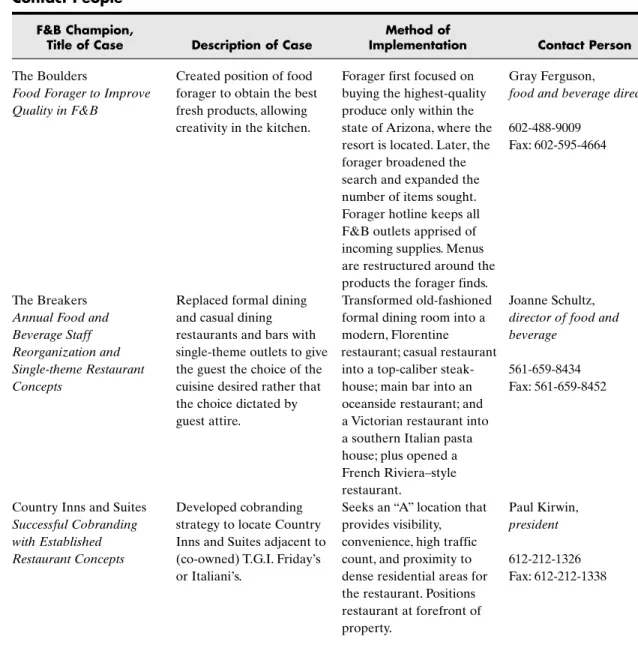
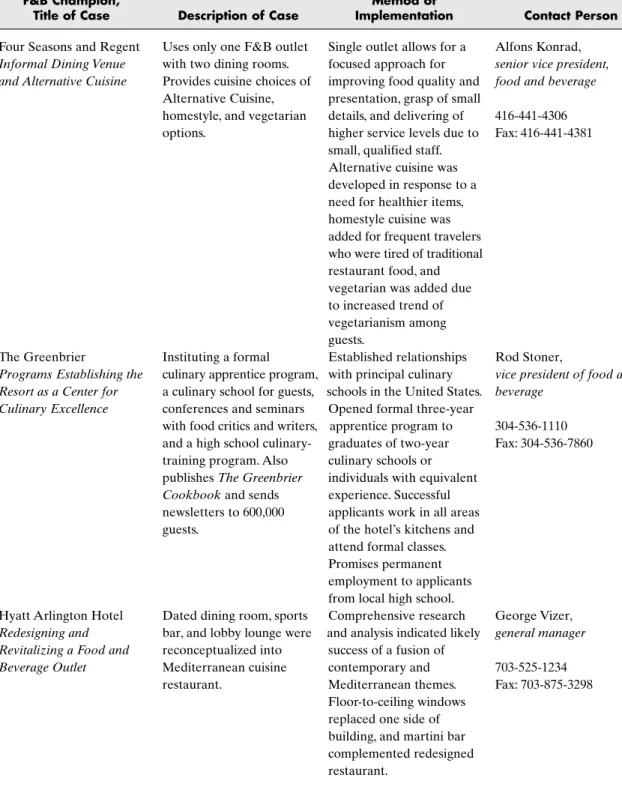
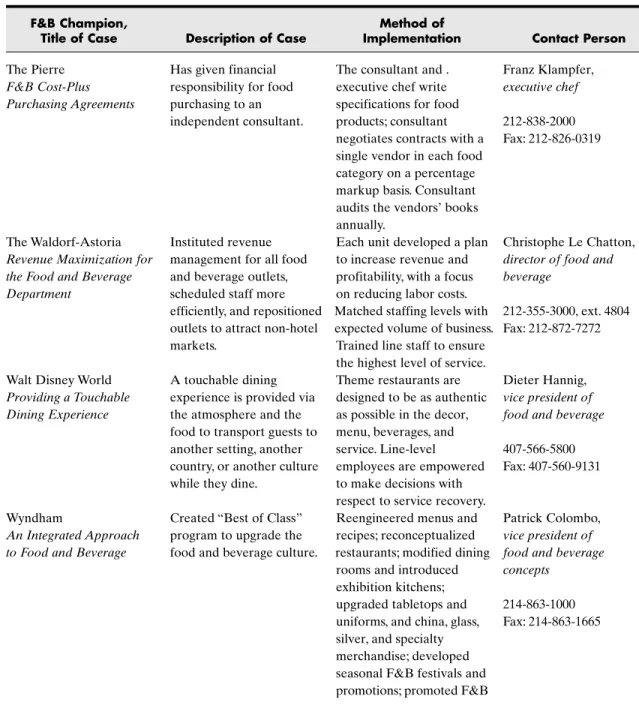
Suites, Four Seasons & Regent Hotels & Re- sorts, The Greenbrier, Hyatt Arlington Hotel, The Pierre, Walt Disney World Resorts and Theme Parks, The Waldorf-Astoria, and Wynd- ham Hotels and Resorts (see Table 6.1).
Through their best practices, this select group demonstrates the capability of executing the strategic mandate of making money while responding to the needs of their target mar- kets through revitalized food and beverage operations.
In the following pages we first present the several practices that have been used by our food and beverage champions to provide their outlets with a competitive advantage.
We then examine the measures of success and report the advice our champions give others on how to prosper with hotel food and bever- age service.
THE BEST PRACTICES
T
he best practices adopted by our champions can be broadly categorized into three areas.One group stresses providing a high-quality F&B product to their guests (comprising practices by The Boulders, Country Inns &
Suites, Four Seasons & Regent Hotels & Re- sorts, The Greenbrier, and Wyndham Hotels
254
Chapter 6 Food and Beverage Divisionand Resorts). A second group emphasizes the elements of restaurant concept and design in their best practices (namely, The Breakers Hotel, Hyatt Arlington Hotel, and Walt Dis- ney World Resorts and Theme Parks). Finally, The Pierre’s and The Waldorf-Astoria’s best practices focused primarily on controlling costs and generating additional revenue (see Table 6.2).
Table 6.1 Overview of Food and Beverage Best-Practice Champions
F&B Champions Practice Initiated, Developed Measure of Success The Boulders Food forager to improve quality Increased food quality, decreased food cost,
of restaurant offerings decreased waitstaff turnover, and increased prices, profits, and waitstaff gratuities
The Breakers Single-theme restaurant Increased revenues concepts
Country Inns & Cobranding of hotel and Increased customer satisfaction, reduced hotel Suites brand-name restaurant capital cost (from not building a hotel restaurant),
increased lunch and dinner business
Four Seasons & Single dining venue with broad Boosted capture rate of hotel guests; increased Regent Hotels & cuisine choices (and two dining local patronage, labor cost savings
Resorts rooms)
The Greenbrier Establishing resort as a center Maintained occupancy and reputation, retained for culinary excellence, including skilled kitchen staff, increased off-season a culinary-apprentice program business
Hyatt Arlington Reconceptualization and Doubled revenues and cover counts, received
Hotel redesign of dated dining room, rave reviews
sports bar, and lobby lounge
The Pierre Independent consultant made Decreased food and kitchen labor costs, reduced responsible for food purchases number of vendors
(with preferred-vendor program)
The Waldorf-Astoria Applying revenue-management Doubled cover counts, increased effectiveness of practices in all F&B outlets F&B marketing, improved customer satisfaction (plus staff training)
Walt Disney World Restaurants designed to provide Achieved high customer satisfaction and Resorts and Theme a touchable experience return rate
Parks
Wyndham Hotels Upgrade of organization’s food Achieved higher average checks, increased staff and Resorts and beverage culture earnings and retention, increased total sales,
wine sales, and profits
Section 6.4 Best Practices in Food and Beverage Management
255
Table 6.2 Food and Beverage Best-Practices Cases, Descriptions, Implementation, Contact People
F&B Champion, Method of
Title of Case Description of Case Implementation Contact Person The Boulders Created position of food Forager first focused on Gray Ferguson,
Food Forager to Improve forager to obtain the best buying the highest-quality food and beverage director Quality in F&B fresh products, allowing produce only within the
creativity in the kitchen. state of Arizona, where the 602-488-9009 resort is located. Later, the Fax: 602-595-4664 forager broadened the
search and expanded the number of items sought.
Forager hotline keeps all F&B outlets apprised of incoming supplies. Menus are restructured around the products the forager finds.
The Breakers Replaced formal dining Transformed old-fashioned Joanne Schultz, Annual Food and and casual dining formal dining room into a director of food and Beverage Staff restaurants and bars with modern, Florentine beverage
Reorganization and single-theme outlets to give restaurant; casual restaurant
Single-theme Restaurant the guest the choice of the into a top-caliber steak- 561-659-8434 Concepts cuisine desired rather that house; main bar into an Fax: 561-659-8452
the choice dictated by oceanside restaurant; and guest attire. a Victorian restaurant into a southern Italian pasta house; plus opened a French Riviera–style restaurant.
Country Inns and Suites Developed cobranding Seeks an “A” location that Paul Kirwin, Successful Cobranding strategy to locate Country provides visibility, president with Established Inns and Suites adjacent to convenience, high traffic
Restaurant Concepts (co-owned) T.G.I. Friday’s count, and proximity to 612-212-1326 or Italiani’s. dense residential areas for Fax: 612-212-1338
the restaurant. Positions restaurant at forefront of property.
Table 6.2 (Continued)
F&B Champion, Method of
Title of Case Description of Case Implementation Contact Person Four Seasons and Regent Uses only one F&B outlet Single outlet allows for a Alfons Konrad, Informal Dining Venue with two dining rooms. focused approach for senior vice president, and Alternative Cuisine Provides cuisine choices of improving food quality and food and beverage
Alternative Cuisine, presentation, grasp of small
homestyle, and vegetarian details, and delivering of 416-441-4306 options. higher service levels due to Fax: 416-441-4381
small, qualified staff.
Alternative cuisine was developed in response to a need for healthier items, homestyle cuisine was added for frequent travelers who were tired of traditional restaurant food, and vegetarian was added due to increased trend of vegetarianism among guests.
The Greenbrier Instituting a formal Established relationships Rod Stoner,
Programs Establishing the culinary apprentice program, with principal culinary vice president of food and Resort as a Center for a culinary school for guests, schools in the United States. beverage
Culinary Excellence conferences and seminars Opened formal three-year
with food critics and writers, apprentice program to 304-536-1110 and a high school culinary- graduates of two-year Fax: 304-536-7860 training program. Also culinary schools or
publishes The Greenbrier individuals with equivalent Cookbookand sends experience. Successful newsletters to 600,000 applicants work in all areas
guests. of the hotel’s kitchens and
attend formal classes.
Promises permanent employment to applicants from local high school.
Hyatt Arlington Hotel Dated dining room, sports Comprehensive research George Vizer, Redesigning and bar, and lobby lounge were and analysis indicated likely general manager Revitalizing a Food and reconce