Yunastiti Purwaningsih
• Economists call these short-run fluctuations in output and employment the business cycle .
• Recessions are actually as irregula r as they are
common. Sometimes they occur close together,
while at other times they are much farther apart.
• Ekspansi atau ledakan : periode dalam siklus bisnis dari lembah naik ke puncak, dimana pada periode itu output dan
kesempatan kerja meningkat.
• Kontraksi, resesi, atau
penurunan : periode dari puncak turun ke lembah, dimana selama periode itu output dan kesempatan kerja menurun.
Kegiatan perekonomian dalam memproduksi barang dan jasa, naik turun mengikuti siklus bisnis
Kegiatan perekonomian dalam
memproduksi barang dan jasa GDP (Gross Domestic Product) = PDB (Produk Domestik Bruto)
4
Economists call these short-run fluctuations in output and employment the business cycle
Kegiatan perekonomian dalam memproduksi barang dan jasa, naik turun mengikuti siklus bisnis
Kegiatan perekonomian dalam
memproduksi barang dan jasa GDP (Gross Domestic Product) = PDB (Produk Domestik Bruto)
5
Output gap: positif atau negatif
Economists call these short-run fluctuations in output and employment the business cycle
• For example:
– The United States fell into recession in 1982, only two years after the previous downturn.
– By the end of that year, the unemployment rate had
reached 10.8 percent—the highest level since the Great Depression of the 1930s.
– But after the 1982 recession, it was eight years before the economy experienced another one.
Economists call these short-run fluctuations in output and employment the business cycle
Economists call these short-run fluctuations in output and employment the business cycle
Contoh: Indonesia tahun 1998
Pertumbuhan Ekonomi
9
PDB dan komponennya
PDB dan komponennya
Real GDP Growth in the United States
Growth in Consumption and Investment When the economy heads
into a recession, growth in real consumption and investment
spending both decline. Investment spending, shown in panel (b), is considerably more volatile than consumption spending, shown in panel (a). The shaded areas
represent periods of recession.
Source: U.S. Department of Commerce.
PDB dan komponennya
Real GDP Growth in the United States
PDB dan komponennya
Real GDP Growth in the United States
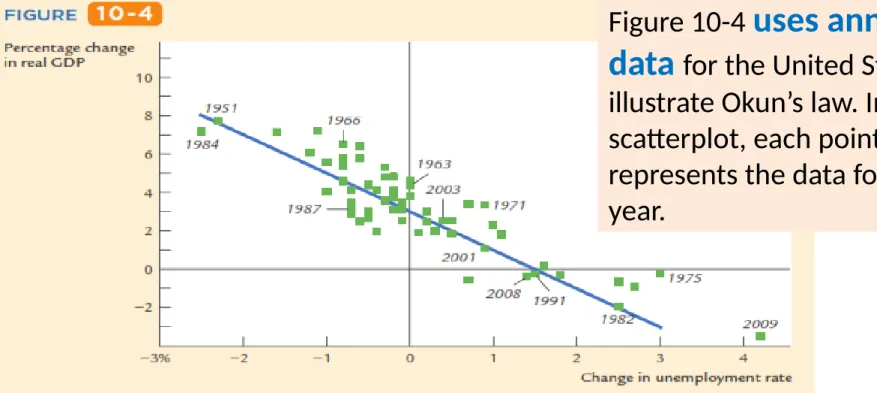
This negative relationship between unemployment and GDP is called Okun’s law, after Arthur Okun, the economist who first studied it.
Tingkat Pengangguran dan Hukum Okun
Figure 10-4 uses annual data for the United States to illustrate Okun’s law. In this scatterplot, each point
represents the data for one year.
Indonesia
This negative relationship between unemployment and GDP is called Okun’s law, after Arthur Okun, the economist who first studied it
if the unemployment rate remains the same, real GDP grows by about 3
percent; this normal growth in the production of goods and services is due to growth in the labor force, capital accumulation, and technological progress.
Tingkat Pengangguran dan Hukum Okun
This negative relationship between unemployment and GDP is called Okun’s law, after Arthur Okun, the economist who first studied it
In this case, Okun’s law says that GDP would fall by 1 percent, indicating that the economy is in a recession.
The declines in the production of goods and services that occur during recessions are always associated with increases in joblessness.
Tingkat Pengangguran dan Hukum Okun
Leading Economic Indicators
• Many economists, particularly those working in business and government, are engaged in the task of forecasting short-run fluctuations in the economy.
• Business economists are interested in forecasting to help their
companies plan for changes in the economic environment.
• Government economists are interested in forecasting for two reasons. – First, the economic environment affects the government; for example, the
state of the economy influences how much tax revenue the government collects.
– Second, the government can affect the economy through its use of monetary and fiscal policy.
• Economic forecasts are, therefore, an input into policy planning.
• One way that economists arrive at their forecasts is by looking at leading indicators, which are variables that tend to fluctuate in advance of the
overall economy.
• Forecasts can differ in part because economists hold varying opinions about which leading indicators are most reliable.
Leading Economic Indicators
The index of leading economic indicators.
This index includes ten data series that are often used to forecast changes in economic activity about six to nine months into the future. Here is a list of the series:
Leading Economic Indicators
The index of leading economic indicators.
1. Rata-rata produksi per pekerja per minggu di industri manufaktur 2. Rata-rata klaim asuransi pengangguran per minggu
3. Order baru untuk barang konsumsi dan bahan baku, yang disesuaikan dengan inflasi
4. Kinerja vendor, mengukur jumlah perusahaan yang menerima kiriman yang lambat dari supplier
5. Order baru untuk barang modal (bukan untuk pertahanan/militer) 6. Isu ijin pembangunan gedung baru
7. Indeks harga saham
8. Jumlah unag beredar dalam arti luas (M2), yang disesuaikan dengan inflasi
9. Spread suku bunga : spread hasil saham 10 tahun dan tagihan obligasi 3 bulan
10. Indeks ekspektasi konsumsi
Leading Economic Indicators
INDONESIA
• Long run:
Prices are flexible, respond to changes in supply or demand
• Short run:
many prices are “sticky” at some predetermined level
The economy behaves much
differently when prices are sticky.
In Classical Macroeconomic Theory :
(what we studied in chapters 3-8)
• Output is determined by the supply side:
– supplies of capital, labor – technology
• Changes in demand for goods & services (C, I, G ) only affect prices, not quantities.
• Complete price flexibility is a crucial assumption,
• So classical theory applies in the long run.
When prices are sticky
…output and employment also depend on demand for goods &
services, which is affected by:
fiscal policy (G and T)
monetary policy (M)
other factors, like exogenous changes
in C or I.
Variabel Kebijakan:
• Pemerintah: G dan T
• Bank Sentral (BS): M Variabel Eksogen:
• Rumah Tangga: C
• Perusahaan: I
The model of aggregate demand and supply
• the paradigm that most mainstream economists
& policymakers use to think about economic
fluctuations and policies to stabilize the economy
• shows how the price level and aggregate output are determined.
• shows how the economy’s behavior is different
in the short run and long run.
• The aggregate demand (AD) curve shows the
relationship between the price level and the quantity of output demanded.
• For this chapter’s intro to the AD/AS model,
we use a simple theory of aggregate demand based on the Quantity Theory of Money.
• Chapters 10-12 develop the theory of aggregate
demand in more detail.
The Quantity Equation as Aggregate Demand
• From Chapter 4, recall the quantity equation M V = P Y
and the money demand function it implies:
(M/P )
d= k Y where V = 1/k = velocity.
• For given values of M and V, these equations
imply an inverse relationship between P and Y:
An increase in the price level causes a fall in real money
balances (M/P ), causing a decrease in the demand for goods &
services: P (M/P) ↓ D for goods & services↓ Y ↓
M V = P Y
The money supply M and the velocity of money V determine the nominal value of output PY.
Once PY is fixed, if P goes up, Y must go down.
M V
tetap= P Y ↓
2 1
3
P1
P2
Y2 Y1
1
2
• M ↓ PY ↓ dengan P
tertentu Y ↓
• M ↓ geser AD kekiri
P1
Y2 Y1
• M PY dengan P
tertentu Y
• M geser AD kekanan
P1
Y1 Y2
• Recall from chapter 3:
In the long run, output is determined by factor supplies and technology
is the full-employment or natural level of output, the level of output at which the economy’s resources are fully employed.
“Full employment” means that
unemployment equals its natural rate.
Aggregate Supply in the Long Run
( , ) Y F K L
Y
• Recall from chapter 3:
In the long run, output is determined by factor supplies and technology
Aggregate Supply in the Long Run
Full-employment output does not depend on the price level,
so the long run aggregate supply (LRAS) curve is vertical:
( , )
Y F K L
Aggregate Supply in the Long Run
The LRAS curve is vertical at the full- employment level of output (Ybar).
Shifts in Aggregate Supply in the Long Run
P1
P1
Shifts in Aggregate Supply in the Long Run
• LRAS dan AD1 A:
P1 dan Ybar
P1
P1
• LRAS dan AD2 B:
P2 dan Ybar
• M P dan Y tetap (Ybar)
• M ↓ AD ↓ geser kiri: AD1 ke AD2;
LRAS tetap
Long-run effects of an increase in M
Y
P
AD1
AD2 LRAS
An increase in M shifts the AD curve to the
right.
P1 P2
In the long run, this increases the price level…
…but leaves output the same.
A B
• LRAS dan AD1 A: P1 dan Ybar
• M AD geser kanan: AD1 ke AD2 ; LRAS tetap
• LRAS dan AD2 B: P2 dan Ybar
• M P dan Y tetap (Ybar)
Y
The SRAS curve is horizontal:
The price level is fixed at a
predetermined level, and firms sell as much as buyers demand.
P
Shifts in Aggregate Demand in the Short Run
M AD geser kanan: AD1 ke AD2
SRAS tetap P tetap Y dari Y1 ke Y2
P
Short-run effects of an increase in M
Y P
AD1 AD2
…an increase in aggregate demand…
In the short run when prices are sticky,…
…causes output to rise.
SRAS
Y2 Y1
M AD geser kanan: AD1 ke AD2
SRAS tetap P tetap pada Pbar Y
dari Y1 ke Y2
P
We can summarize our analysis so far as follows:
• Over
long periods
of time,prices are flexible,
theaggregate supply curve is vertical
, andchanges in aggregate demand affect the price level but not output
.• Over
short periods
of time,prices are sticky
, theaggregate supply curve is flat
, andchanges in
aggregate demand do affect the economy’s
output of goods and services
.We can summarize our analysis so far as follows:
• Over long periods of time, prices are flexible, the aggregate supply curve is vertical, and changes in aggregate demand affect the price level but not output.
• Over short periods of time,
prices are sticky, the aggregate supply curve is flat, and changes in aggregate demand do affect the economy’s output of goods and services.
Jangka Panjang:
P fleksibel.
AS vertikal, ∆AD
∆P; Y tetap Jangka Pendek:
P tetap.
AS horinsontal,
∆AD P tetap; ∆Y
P1 A
P
Pada titik A: M ↓ AD ↓ geser kiri: AD1 ke AD2 AD2 dan SRAS titik B:
P tetap pada P1 dan Y ↓ dari Ybar ke Y1 (Y1<Ybar);
AD2 dan LRAS
kelebihan AS P turun sampai pada tingkat Y bar
titik C: P2 dan Y bar
Y1 P1
P2
The SR & LR effects of M > 0
Y P
AD1 AD2 LRAS
SRAS P2
Y2 A = initial
equilibrium
A
B B = new short-run C
eq’m after Fed increases M
C = long-run equilibrium
M Pada titik A:
……… titik B:
……… titik C: P2 dan Ybar
Y
P
• shocks : exogenous changes in aggregate supply or demand. pergeseran AD dan atau AS
• Shocks temporarily push the economy away from full- employment. Y menjauh dari Y FE
• An example of a demand shock: exogenous decrease in velocity. Contoh shock di AD: V ↓
• If the money supply is held constant, then a decrease in V means people will be using their money in fewer
transactions, causing a decrease in demand for goods
and services. M tetap, V ↓ (transaksi ↓) AD barang
dan jasa ↓
• One goal of the model of aggregate supply and aggregate demand is to show
how shocks cause economic
fluctuations
.• Another goal of the model is to evaluate
how
macroeconomic policy can respond to these shocks
.• Economists use the term
stabilization policy to refer to policy actions aimed at reducing the severity of
short-run economic fluctuations
.• Because output and employment fluctuate around their long- run natural levels,
stabilization policy
dampens thebusiness cycle by
keeping output and employment as
close to their natural levels as possible
.Consider an example of a demand shock: the introduction and expanded availability of
credit cards
.• Because credit cards are often a more convenient way to
make purchases than using cash, they
reduce the quantity of money that people choose to hold
.• This reduction in money demand is equivalent to
an
increase in the velocity of money
. When each person holds less money, the money demand parameter k falls.• This means that
each dollar of money moves from
hand to hand more quickly
, so velocity V (= 1/k) rises• If the money supply is held constant, the increase in velocity causes nominal spending to rise and the aggregate demand curve to shift outward. M tetap, V (transaksi ) AD barang dan jasa AD geser kanan
• In the short run, the increase in demand raises the output of the economy—it causes an economic boom. jangka pendek: AD barang dan jasa perekonomian boom
• At the old prices, firms now sell more output. Therefore, they hire more workers, ask their existing workers to work longer hours, and make greater use of their factories and equipment.
Pada P semula: perusahaan menjual banyak output meningkatkan pengerjaan dengan menambah jam kerja;
menambah pengerjaan mesin dan peralatan.
• Over time, the high level of aggregate demand pulls up wages and prices. As the price level rises, the quantity of output
demanded declines, and the economy gradually approaches the natural level of production. sepanjang waktu: AD yang
tinggi upah (w) dan harga (P); P jumlah agregat yang diminta ↓ perkeonomian secara perlahan menuju ke tingkat output alamiah (Ybar)
• But during the transition to the higher price level, the
economy’s output is higher than its natural level. selama transisi ke tingkat harga yang lebih tinggi, Y > Ybar
P1
Y1
Pada titik A: credit card
V AD geser kanan: AD1 ke AD2 AD2 dan SRAS titik B:
P tetap pada P1 dan Y dari Ybar ke Y1
(Y1>Ybar); AD2 dan
LRAS kelebihan AD P naik sampai pada tingkat Y bar titik C:
P2 dan Ybar
P2
Pada titik A: credit card V AD geser kanan: AD1 ke AD2 AD2 dan SRAS titik B: P tetap pada P1 dan Y dari Ybar ke Y1 (Y1>Ybar);
AD2 dan LRAS kelebihan AD P naik sampai pada tingkat Y bar
titik C: P2 dan Ybar
• What can the Fed do to dampen this boom and keep output closer to the natural level?
• The Fed might reduce the money supply to offset the increase in velocity. Offsetting the change in velocity would stabilize aggregate demand.
• Thus, the Fed can reduce or even eliminate the impact of demand shocks on output and employment if it can skillfully control the money supply.
• Whether the Fed in fact has the necessary skill is a more difficult question, which we take up in Chapter 18.
Pada titik A: credit card V AD geser kanan: AD1 ke AD2 AD2 dan SRAS titik B: P tetap pada P1 dan Y dari Ybar ke Y1 (Y1>Ybar); M di ↓ kan AD ↓ geser kiri: AD2 ke AD1 AD1 dan LRAS-SRAS titik A: P tetap pada P1 dan Y ↓ dari Y1 ke Ybar
P1
Y1
LRAS
AD2
SRAS The effects of a negative demand shock
Y P
AD1 P2
Y2 The shock shifts AD
left, causing output and employment to fall in the short run
B A Over time, prices C
fall and the
economy moves down its demand curve toward full- employment.
Pada titik A:
……… titik B:
……… titik C: P2 dan Ybar
P
Y
Over time, prices gradually become “unstuck.”
When they do, will they rise or fall?
rise fall
remain constant In the short-run
equilibrium, if then over time, the price level will
This adjustment of prices is what moves the economy to its long-run equilibrium.
Y Y
Y Y
Y Y
Cost shock AS P shock P
(Favorable supply shocks lower costs and prices)
• Pada titik A: AD dan SRAS1 P1 dan
Ybar
• SRAS ↓ dari SRAS1 ke SRAS2
• SRAS2 dan AD: titik B: P dari P1 ke P2 dan Y ↓ dari Ybar ke Y1 (Y1<Ybar)
• SRAS ↓ P dan Y
↓ stagflasi
P1 P2
Y1
SRAS ↓ karena ?
SRAS1
Y P
AD LRAS
Y2 The oil price shock
shifts SRAS up,
causing output and employment to fall.
A In absence of B
further price
shocks, prices will fall over time and economy moves back toward full employment.
SRAS2
CASE STUDY AS: The 1970s oil shocks
1 A
P
Y
P
2• Early 1970s: OPEC coordinates a reduction in the supply of oil.
• Oil prices rose 11% in 1973 68% in 1974 16% in 1975
• Such sharp oil price increases are supply shocks because they significantly impact production costs and prices.
CASE STUDY AS: The 1970s oil shocks
Stabilization policy
• def: policy actions aimed at reducing the severity of short-run economic fluctuations.
• Example: Using monetary policy to combat the
effects of adverse supply shocks:
Stabilization policy
with monetary policyP1 P2
• Pada titik A: AD dan SRAS1 P1 dan Ybar
• SRAS ↓ dari
SRAS1 ke SRAS2
• M di kan AD
geser kanan dari AD1 ke AD2
• AD2 - SRAS2 – LRAS: titik C: P dari P1 ke P2 dan Y tetap di Ybar
• SRAS ↓ dan M di
kan: P dan Y tetap
Stabilizing output with monetary policy
Y P
AD1
B SRAS2
A C
Y2
LRAS
AD2
But the Fed accommodates the shock by raising agg.
demand.
results:
P is permanently
higher, but Y remains at its full-employment level.
P1
P
2Y
Chapter Summary
1. Long run: prices are flexible, output and
employment are always at their natural rates, and the classical theory applies.
Short run: prices are sticky, shocks can push output and employment away from their natural rates.
2. Aggregate demand and supply:
a framework to analyze economic fluctuations
3. The aggregate demand curve slopes downward
4. The long-run aggregate supply curve is vertical,
because output depends on technology and factor supplies, but not prices.
5. The short-run aggregate supply curve is horizontal, because prices are sticky at predetermined levels.
6. Shocks to aggregate demand and supply cause
fluctuations in GDP and employment in the short run.
7. The Fed can attempt to stabilize the economy with monetary policy.
Chapter Summary