Forest Vocational Lands of Eastern Panamá Kaitlin Flahive
Student ID # 260400489 Panamá Field Study Semester, 2014
ENVR 451: Research in Panamá Supervisor: Javier Mateo
Professor: Ana Spalding TA: Victor Frankel
April 2014
Table of Contents
Contact Information 2
Executive Summary 3
Resumen Ejecutivo 5
Acknowledgements 7
Introduction
Host Details & Project Context Land-Use Theory: A Brief Introduction Tropical Deforestation in Panamá Determination of Study Region Study Question
Project Goals & Objectives Justification
8
8 8 10 11 12 12 13
Methods & Procedures
Ethical Considerations Methodology
(a) Data Collection
(b) Initial Data Preparation (c) Analysis
14
14 14 15 15 17
Results
Stage 1: Identification of FVL Stage 2: Forest Cover Definition
Stage 3: Identification of Forested & Unforested FVL Study Limitations
17
17 17 17 18
Discussion
Relevant Actors & Potential Significance of the Data
Drivers of Change: Conflicts, Complications, and Considerations Moving Forward: Policy Implications and Recommendations
19
19 23 25
Conclusions
Further Study Recommendations 26
26
References 28
Appendices
Appendix A: Charts & Figures Appendix B: Methodology Appendix C: Maps
Appendix D: TCPS 2:CORE Certification Appendix E: Schedule of Internship Activities
31
31 37 39 42 43
Contact Information
Host Institution
Smithsonian Tropical Research Institute Roosevelt Ave. – Tupper Building
Box 0843-03092
Balboa, Ancón, Panamá City Republic of Panamá
Telephone: 507-212-8000 Fax: 507-212-8148 Supervisors
Javier Mateo
Roosevelt Ave. – Tupper Building Box 0843-03092
Balboa, Ancón, Panamá City Republic of Panamá
Telephone: 507-212-8237
[email protected] Catherine Potvin
Roosevelt Ave. – Tupper Building Box 0843-03092
Balboa, Ancón, Panamá City Republic of Panamá
Telephone: 507-212-8237 [email protected] Researcher
Kaitlin Flahive
Bachelor of Arts, Environment and Development McGill University
Executive Summary
Forest Vocational Lands of Eastern Panamá Kaitlin Flahive
Smithsonian Tropical Research Institute: Roosevelt Ave- Tupper Building, Box 0843- 03092, Balboa, Ancón, Panamá City, Republic of Panamá
The magnitude and scale of recent socioeconomic development has caused much change to historical global land-cover. These trends of large-scale landscape alteration show minimal signs of halting, and consequently the areas of land-use and land-cover have become an important epicenter of academic research. Improvements in geographical information systems and remote sensing technologies have augmented such research studies, allowing for precise and spatially explicit measurements of land-cover, especially as they change over time.
As a nation Panamá is experiencing much rapid economic development, but as the cost of such development local ecosystems are being degraded daily. Eastern Panamá is one of the most diverse and poorly understood landscapes in not only Latin America but also the world. The area has a rich natural biodiversity as well as well as numerous ethnic groups with markedly different worldviews. However, due to the broader-scale socioeconomic development of the nation, most notably the imposition of large-scale development projects (i.e. the Bayano Dam) in the region, the biophysical and socioeconomic environments of the region are being substantially altered. Subsequent lack of clarity or poor enforcement of land tenure, land invasions, illegal logging and different world views about land management have been the catalysts for both deforestation and social conflict. As such, this region presents an important case for land- use studies in the hopes of improving the sustainability of livelihoods in the region, from both an environmental and a social perspective.
Specifically, this study utilizes GIS technologies to identify areas of specific land- cover in the Eastern Panamanian provinces of Darién and Panamá in the hope of improving the livelihood and environmental sustainability of the area. First, the forest vocational lands (FVL) of Eastern Panamá are identified, which can be understood as those lands that should be maintained under forest cover, or another form of sustainable land-cover, in order to prevent the occurrence of negative ecosystem externalities. Then, the lands of non-forest vocation are identified as potential sites of agriculture or other land-use conversion for human purposes. Finally, the FVL lands are compared with current forest cover in order to ascertain which areas may become sites of environmental and social conflict in the future. Finally, the study explores the importance of this information, as it will be applied in the sociocultural realm. An analysis of the relevant actors and their micro-foundational logics is then conducted in order to understand the human implications of this specialized research.
The study was conducted over a four-month period in Panamá City, in conjunction with the Smithsonian Tropical Research Institute (STRI) and McGill University. Technical data was obtained from Autoridad Nacional del Ambiente (ANAM), Empresa de Transmisión Eléctrica, S.A. (ETESA), Instituto de Investigación Agropecuaria de Panamá (IDIAP), and researchers at STRI in order to carry out the
of ANAM and STRI, in order to better understand the actors to whom this information will ultimately be useful and the relations between them.
The findings of this study point to an area of 8,850,882,676.89 m2, representing 44% of the study region, defined as FVL areas. Of this area, 52% is currently forested and 48% is currently under non-forest land-cover. Three maps were produced (See Appendix C) that explicitly depict the areas in a clear and accessible manner.
On a broader level, it is concluded that FVL information is most relevant in the governmental offices of ANAM and ANATI, at the local level of campesinos and indigenous groups, as well as to the Panamanian populace at large. Land-cover conversion, most notably deforestation, is seen to be a byproduct of the micro- foundational forces and trade-offs by which Eastern Panamánians maintain their livelihoods in such a rapidly changing environment. Further, in order to work towards a more sustainable future, both environmentally and socially, the offices of ANAM and ANATI must work together and in coordination with the locals. By taking into account these varying perspectives, a realistic and feasible land-use policy can be created.
However, the underlying causes of land-cover and land-use change are seen to be the structure of the Panamanian governance system and the consequent power dynamics at play in the nation. Thus, in the long-term, it is concluded that a more equitable and inclusive administrative system will alter the micro-logic of land conversion, thereby making sustainability a more achievable and durable goal.
It is the belief of this researcher that the information provided in this study should be seen in an optimistic light. The results point to conclusions, both positive and negative, about the environmental and social status of Eastern Panamá. There are, indeed, sizeable amounts of FVL areas that are currently unforested and thus having deleterious effects on the Panamanian socioecological landscape. However, the majority of these FVL areas (70%) are seen to already be under a form of forest-cover. Hence, although there is definitely much room for improvement, the gravity of which should not be taken lightly, there is much room for hope. It is not too late to make a real movement towards sustainability in Panamá. The mere presence of this and similar studies points to the creation of knowledge that is a critical first step in moving towards a more sustainable development trajectory. It is now up to the Panamanian government and people to make the decision to include such reports into a concerted and comprehensive effort toward environmental and social sustainability.
Resumen Ejecutivo
Tierras de Vocación Forestal de Panamá del Este Kaitlin Flahive
Smithsonian Tropical Research Institute: Roosevelt Ave- Tupper Building, Box 0843- 03092, Balboa, Ancón, Panamá City, Republic of Panamá
La magnitud y la escala de desarrollo socio-económico reciente ha causado muchos cambios al histórico de la cubierta terrestre mundial. Estas tendencias de la alteración del paisaje a gran escala muestran signos mínimos de detención, y por lo tanto las áreas de uso de la tierra y de la cubierta terrestre se han convertido en un epicentro importante de la investigación académica. Mejoras en los sistemas de información geográfica y tecnologías de sensores remotos han aumentado este tipo de estudios de investigación, lo que permite mediciones precisas y espacialmente explícitos de la cubierta vegetal, especialmente a medida que cambian con el tiempo.
Como nación Panamá está experimentando un gran desarrollo económico rápido , pero a medida que el costo de ese desarrollo los ecosistemas locales se están degradando a diario . Panamá del Este es uno de los más diversos y poco conocidos paisajes, no sólo de América Latina sino también del mundo. La zona tiene una rica biodiversidad natural, así como numerosos grupos étnicos con marcadamente diferentes visiones del mundo.
Sin embargo , debido al desarrollo socioeconómico más amplio a escala de la nación , en particular la imposición de proyectos de desarrollo a gran escala ( es decir, la presa de Bayano ) en la región , los entornos biofísicos y socioeconómicos de la región se están alterando sustancialmente . Tras la falta de claridad o de la deficiente aplicación de la tenencia de la tierra, invasiones de tierras , la tala ilegal y las diferentes visiones del mundo sobre el manejo de la tierra han sido los catalizadores de la deforestación y la conflictividad social . Como tal, esta región presenta un caso de importancia para los estudios de uso del suelo en la esperanza de mejorar la sostenibilidad de los medios de vida en la región, tanto desde el punto de vista social y medioambiental.
En concreto, este estudio utiliza las tecnologías SIG para identificar las áreas de la cubierta vegetal específico en las provincias panameñas orientales de Darién y Panamá, con la esperanza de mejorar las condiciones de vida y la sostenibilidad ambiental de la zona . En primer lugar, las tierras de vocación forestal (FVL) de Panamá Este se identifiquen, que se puede entender como aquellos terrenos que deben mantenerse bajo cubierta forestal , o de otra forma de la cubierta vegetal sostenible , con el fin de prevenir la aparición de externalidades ambientales negativas. Entonces, las tierras de vocación no forestal se identifican como sitios potenciales de la agricultura u otra conversión del uso de la tierra para fines humanos. Por último, las tierras FVL se comparan con cobertura forestal actual con el fin de determinar qué áreas pueden convertirse en sitios de conflicto ambiental y social en el futuro . Finalmente, el estudio analiza la importancia de esta información, ya que se aplicará en el ámbito sociocultural. Un análisis de los actores relevantes y sus lógicas de micro - fundacionales se lleva a cabo a continuación, con el fin de comprender las implicaciones humanas de la investigación especializada.
El estudio se realizó durante un período de cuatro meses en la ciudad de Panamá, en conjunto con el Instituto Smithsonian de Investigaciones Tropicales (STRI) y de la
Ambiente (ANAM), Empresa de Transmisión Eléctrica, SA (ETESA), Instituto de Investigación Agropecuaria de Panamá (IDIAP), y los investigadores de STRI con el fin de llevar a cabo el análisis. Además, una revisión de la literatura se llevó a cabo, tanto en la web y en las bibliotecas de la ANAM y STRI, con el fin de comprender mejor los actores a los que esta información le sea útil y en última instancia, las relaciones entre ellos.
Los resultados de este estudio apuntan a una superficie de m2 8,850,882,676.89, lo que representa el 44% de la región de estudio, que se define como áreas FVL. De esta superficie, el 52% está cubierta de bosques y el 48% se encuentra actualmente en no forestal de la cubierta vegetal. Se produjeron tres mapas (véase el Appendix C) que representan explícitamente las áreas de una manera clara y accessible
En un plano más general, se concluye que la información FVL es más relevante en las oficinas gubernamentales de la ANAM y ANATI, a nivel local de los campesinos y grupos indígenas , así como a la población panameña en general. La conversión de cubierta terrestre, sobre todo la deforestación , se ve que es un subproducto de las fuerzas micro fundacional y compensaciones por el cual los panameños orientales mantener sus medios de vida en un entorno que cambia tan rápidamente . Además, con el fin de trabajar en pro de un futuro más sostenible, tanto ambiental como socialmente , las oficinas de ANAM y ANATI deben trabajar juntos y en coordinación con los lugareños.
Al tomar en cuenta estos puntos de vista diferentes , una política realista y factible el uso del suelo puede ser creado. Sin embargo, las causas subyacentes de la cubierta vegetal y uso de la tierra son vistos como la estructura del sistema de gobierno panameño y la dinámica de poder consiguientes en juego en la nación. Por lo tanto , a largo plazo , se concluye que un sistema administrativo más equitativo e inclusivo alterará la lógica micro de la conversión de tierras , con lo que la sostenibilidad un objetivo más alcanzable y duradera.
Es la creencia de este investigador que la información proporcionada en este estudio debe ser visto bajo una luz optimista. Los resultados apuntan a conclusiones , tanto positivas como negativas , sobre el estado ambiental y social de Panamá Este . Hay , de hecho , cantidades considerables de FVL áreas que están actualmente desprovista y que tienen de este modo efectos perjudiciales sobre el paisaje socioecológico de Panamá . Sin embargo, la mayoría de estas áreas FVL (70%) se consideran estar ya bajo una forma de la cubierta forestal. Por lo tanto, aunque definitivamente hay mucho margen de mejora , la gravedad de lo que no debe tomarse a la ligera , hay mucho espacio para la esperanza . No es demasiado tarde para hacer un movimiento real hacia la sostenibilidad en Panamá. La mera presencia de este y otros estudios similares apunta a la creación de conocimiento que es un primer paso crítico en el avance hacia una trayectoria de desarrollo más sostenible. Ahora le toca al gobierno panameño y la gente a tomar la decisión de incluir estos informes en un esfuerzo concertado y global hacia la sostenibilidad ambiental y social.
Acknowledgements
First and foremost I would like to thank the project’s direct supervisor, Javier Mateo, without whom this project would not have been possible. Further, a great deal of thanks is owed to Catherine Potvin and the numerous members of her laboratory, including Gerardo Vergara and Divya Sharma, for their continual input and support. I would also like to extend much appreciation to Milton Solano, Lady Mancilla, and the Smithsonian Tropical Research Institute staff for their daily assistance during the entirety of this study.
Gratitude is also owed to Victor Frankel and Ana Spalding for their invaluable guidance and feedback. I would also like to thank Ana Maria Martinez at ANATI, Carlos Melgarejo at ANAM, Eric Candanedo and Jose Villarreal at IDIAP for their assistance with information and data contributions. Last, but certainly not least, I would like to thank the members of Panamá Field Study Semester 2014 for their unwavering support and assistance throughout the semester.
I. Introduction
Host Details & Project Context
The Smithsonian Tropical Research Institute is a Panamá-based division of the Smithsonian Institution focused on research in tropical biodiversity. The STRI campus provides a headquarters for researchers throughout the tropics to join together and conduct various projects to better understand tropical environments. The world-renowned institution acts as a platform from which these researchers conduct studies these unique and special settings. Since 1923 this institution has worked to better understand the immense heterogeneity and diversity of life in the tropics to better understand our role, as humans, in the biosphere. (STRI, 2014)
Ultimately, this internship project will augment and assist the research of my supervisor, Javier Mateo, who works in conjunction with STRI and McGill University.
Specifically, his work is focused on the forces and trade-offs surrounding land-use in multifunctional landscapes, specifically Eastern Panamá. By identifying the forest vocational lands of Eastern Panamá, improved land use planning and policies can be created in the hopes of working towards a more sustainable Panamá.
Land-Use Theory: A Brief Introduction
One of the most definitive features of any human society is its interaction with the land.
Economic and social development over time has been seen to have a marked impact on the landscape of an area (Foley, 2005). Thus, any analysis of the socioeconomic climate of a civilization and its concomitant interaction with the land will surely yield highly interrelated results. To study these changes and the plurality of interactions with the land that exists in today’s so-called ‘landscape mosaic’, there has been a movement towards a
better understanding of the exact ways in which humans have, and continue to, alter the land (Forman, 1995). ‘Land-use’ can be defined as the human utilization and alteration of
‘land-cover’, the biophysical features of the Earth (Lambin, 2001). In recent years, scientists have increasingly realized the utility of analyses of both current and changing land-use and land-cover, both through spatial landscape modeling and through socioeconomic and cultural studies. Augmented by the development of geographic information systems (GIS) technologies, mapping of land-cover changes over time have become commonplace for both academics and policymakers alike (Veldkamp & Lambin, 2001). Such products function to serve as a tool of both spatial comprehension and of policy planning and are thus useful in a wide variety of disciplines.
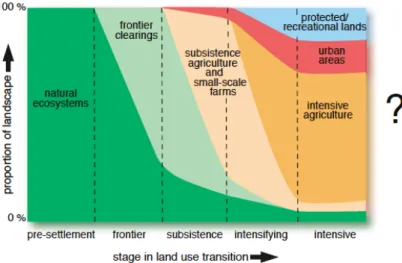
As depicted in Figure 1 (See Appendix A), Foley (2005) has isolated five distinct stages of the so-called ‘land-use transition’. Similar to economic and demographic transitions, this process outlines the general way in which areas move from the pre- settlement stage, in which the land-use is fully devoted to natural ecosystems, to the intensive land-use stage, in which land-use is divided between natural ecosystems, subsistence agriculture and small-scale farms, intensive agriculture, urban areas, and protected/recreational lands. This is by no means a fully comprehensive or unilinear transition, but is helpful in conceptualizing changes in land-use through time and societal development. Largely, there are six widespread pathways of land-use change occurring today by which this transition occurs: deforestation, (sub)urbanization, corridor construction, desertification, agricultural intensification and reforestation (Forman, 1995). By understanding the pathways and drivers of these processes, improvements can be made in planning for the future, both in the sociocultural realm and in the ecological
realm. Zoning, the process by which a local authority subjects a specific area to certain restrictions, is often one way by which such land-use planning can be applied and executed. Further, it is important to realize the importance of scale; the scale at which land-cover is analyzed has a significant impact on the information attained as well as any implications that are concluded upon. Hence it is important to undertake research efforts at various scales in order to fully comprehend the intricacies of the regions at hand.
Tropical Deforestation in Panamá
One of the most important land-use changes in the world today is deforestation, which is occurring at an alarmingly high rate and scale (Global Forest Watch, 2014). As the exact definition of ‘forest cover’ varies, usually by amount of canopy coverage, this category of land-use change is not yet academically standardized and thus must be defined in each case. For the purposes of this study, the process is here defined using the general IPCC definition of any “conversion of forest land to non-forest land” (IPCC Special Report 2000).
As with many environmental issues today, deforestation follows an Environmental Kuznets Curve (Bhattari & Hamming, 2001). Here, levels of deforestation are lowest in early and late stages of development and highest during the most rapid development stages (ibid). The Latin American tropics are now experiencing a period of rapid economic development and concurrently a period of high deforestation (CIA, 2014). As the fastest developing economy in Central America, Panamá is experiencing a period of dramatic, albeit highly uneven, development (CIA, 2014). Between 1990 and 2011, the country’s GDP grew at an average of over 6% per annum (World Bank, 2014).
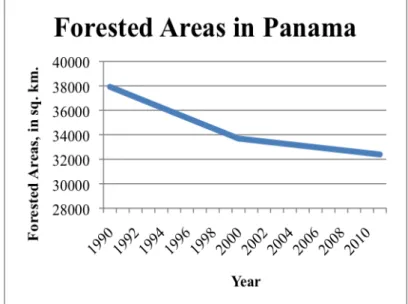
During the same years, as depicted in Figure 2 (See Appendix A), the country has seen a
5,528 square kilometer decrease in forested areas, representing 7.44% of the country’s total land area (ibid). From a preliminary understanding of the Panamanian landscape, it is clear that Panamá falls into the ‘intensifying’ stage of the land-use transition identified above. Subsistence agriculture and small-scale farms are being increasingly phased out in favor of more intensive agriculture, and frontier clearings are increasingly being devoted to agricultural purposes. Further, urbanization is taking place at a rapid pace and many lands are now being dedicated to protected/recreational purposes. In 2010, a full 17.3% of Panamanian greenhouse gas emissions were attributed to land-use change and forestry practices (Global Forest Watch, 2014).
In a recent Land-Use and Land-Cover Change Report, the most prominent proximate causes of tropical deforestation were identified to be (1) agricultural expansion, (2) infrastructure expansion, and (3) wood extraction (Geist & Lambin, 2001).
These causes, furthermore, are rooted in underlying economic, political/institutional, technological, cultural, and demographic factors that support the micro and therefore macro-economic rationale of deforestation (ibid). Understanding the local application of these drivers of change allows for changes in policy and practice in order to make a region’s land-use more sustainable in the long-term.
Determination of Study Region
With this in mind, the study region was here determined to be Eastern Panamá, as defined as the provinces of Panamá and Darién. This area is home to one of the most diverse and poorly understood areas in Central America today (Herlihy, 2003). As Herlihy describes, it is the “poster child for a remote, frontier and wilderness region with spontaneous Mestizo colonization, historic indigenous settlements, and diverse rain forest habitats”
(2003:316). Eastern Panamá is home to colonist settlers as well as members of the Emberá and Kuna indigenous communities with undefined land tenure. Since the creation of a hydroelectric dam in the 1970s in the Bayano Region and the consequent displacement of these numerous peoples, land scarcity has exacerbated social conflict and environmental degradation (Grupo Experimental de Cine Universitario de Panamá, 1974). This socioecological conflict has led to the creation of a complex multi-functional landscape in the area. There is hence a pressing need for the development of a better appreciation of the spatial nuances of this region, which this study directly addresses and seeks to explain in an effort to lessen the conflict and degradation currently ongoing in the region.
Study Question
Explicitly, this project spatially analyzes those ecosystem characteristics that make land suitable for forest cover and, using GIS technologies, seeks to answer the question of which lands of Eastern Panamá should be maintained under forest cover. These ‘forest vocational lands’ (hereafter FVL) can be defined as those areas that “due to their physical site features, such as soil, topography, and rainfall it receives, should be maintained under forest cover or another form of sustainable land use, that can avoid the occurence of negative externalities related to the soil (especially erosion) and water” (BID, xix).
Consequently, the remaining lands will be identified as locations for other land uses, most notably including agriculture. Next, this study will analyze which of these FVL areas are currently under forest cover and which are currently deforested in order to better understand Eastern Panamá’s current situation. After these lands are identified, there is a discussion of the potential implications of this information. The various actors and
organizations to which this information might be of interest will be studied and their perspectives and outlooks will be analyzed; hence the project will then answer the questions of not only where, but also who, why and how.
Project Goals & Objectives
The goals of this project, concretely, are to:
• Geographically analyze both the FVL and actual forest cover of Eastern Panamá, specifically the Darién and Panamá provinces
• Achieve an understanding of the potential implications and applications of the above information through an analysis of the relations between, and motivations behind, the actions of relevant actors
Justification
By achieving the goals outlined above, a better understanding of Eastern Panamá will be attained. More sustainable land-use planning and policies will hence be a direct result of the determination of the FVL and its broader Panamanian relevance. Further, by determining which lands should be held under forest cover and which lands are available for use in agricultural production allows Panamanian academics and authorities to ensure land-use in the region is not damaging or degrading the environment. In a similar vein, GIS work is currently being conducted in the laboratory of Catherine Potvin in order to identify the remaining national lands, which are under state control and may be parceled out to landless peasants, of Panamá. After these lands are identified, the information will be joined to the information determined here in order to understand which of these national lands should be held under forest-cover and which are available for conversion
into agricultural lands. From a sustainability perspective, this work is thus part of a broader plan working to improve the land-use and land-cover of Eastern Panamá.
II. Methods & Procedures
Ethical Considerations
It is important to note that all research and work for this internship was done in accordance with McGill University’s Code of Ethics. Further, although not explicitly involving human subjects, at the beginning of the project the researcher completed the Tri-Council Policy Statement: Ethical Conduct for Research Involving Humans Course on Research Ethics (TCPS 2: CORE) in order to ensure all work conducted was held to the highest ethical standards (See Appendix D).
Methodology
In 2007, the Inter-american Development Bank (BID) conducted a pilot study in the regions of Chiriquí, Veraguas, and Comarca Ngobé-Buglé in order to identify and analyze the region’s forest vocational lands (BID, 2007). This project lends itself well towards working to better understand the geographic complexities of the Eastern Panamá region, as the general methodology and data sources are similarly applicable and functional here. Hence, this study will analyze the suitability of the lands of Eastern Panamá for forestation utilizing a methodology derived from that of the Inter-american Development Bank Project, as outlined below. Several changes were made from the original methodology due to the lack of specific data, time, and other resources, but these changes do not decrease the veracity or the applicability of the study in Eastern Panamá
(a) Data Collection:
In order to carry out the analysis, data was collected from a variety of sources in Panamá City. Firstly, a digital copy of the 2007 pilot study as well as supplemental information about the study was obtained from the Autoridad Nacional del Ambiente. From this study, the rest of the necessary data was determined. In the following weeks, data was acquired from various sources, both physically and digitally, as summarized below.
Autoridad Nacional del Ambiente • Pilot Study
• Supplemental Pilot Study Information
Smithsonian Tropical Research Institute • Cartographic Base Map (Administrative Boundaries)
• Soil Cover Maps Empresa de Transmisión Eléctrica, S.A. • Rainfall Averages
Gerardo Vergara • Digital Elevation Map
• Land-Use and Land-Cover 2008 Instituto de Investigación Agropecuaria de
Panamá • Soil Maps
(b) Initial Data Preparation:
In order to ensure compatibility of data and precision of analysis, the acquired shapefiles were immediately projected into the Coordinate System NAD_1927_UTM_Zone_17N and clipped along the boundaries of the Panamá and Darién provinces. Additionally, the rainfall data from ETESA was available only in a digital format incompatible with ArcGIS, so it was transposed into a Microsoft Excel spreadsheet, from which a shapefile was created for importation into ArcGIS.
(c) Analysis:
Stage 1: Identification of FVL
(i) Topography: As outlined in the cartographic model (Figure 6 in Appendix B), the first stage of the analysis consisted of the division of a Digital Elevation Model (DEM) into
Appendix B). Following the 2007 BID study, the Llano areas, with a slope of less than 8%, were immediately identified as non-FVL areas. Similarly, the Fuerte Ondulado areas, with a slope of more than 30% were immediately identified as FVL areas. The Moderado Ondulado areas, with a slope of 8-15%, and the Ondulado areas, with a slope
of 15-30% were then made into a shapefile for further analysis.
(ii) Rainfall: Following the methodology outlined in Appendix B (Figure 7; Rainfall Methodology Explained), three intervals of rainfall intensity were determined from monthly and yearly rainfall averages at the numerous ETESA hydrometeorological stations in the study region. Three polygonal shapefiles were created: (1) Baja, of low rainfall intensity (2) Media, of medium rainfall intensity, and (3) Alta, of high rainfall intensity, which were kept and subsequently used for further analysis.
(iii) Soil: Here, a polygonal shapefile containing attribute data regarding land coverage of soil types, provided by STRI, was utilized. Specifically, a small literature review was conducted in order to determine the propensity for each type of soil to hold forest or other land-covers. Table 5 in Appendix B contains a detailed list of the categorization of the 8 relevant soil types.
(iv) FVL Determination: The three above analyses were hence joined together, as outlined in the cartographic model (Figure 8, Appendix B), to create a shapefile containing Eastern Panamá’s FVL and a shapefile containing Eastern Panamá’s non- FVL.
Stage 2: Forest Cover Definition
For this stage of the analysis, a 2008 forest cover shapefile, from ANAM via Gerardo Vergara, was utilized to determine the forested and unforested areas of the study region.
The attribute table contained a category of ‘Bosque’ that either contained a ‘SI’ or ‘NO’
response, from which two shapefiles were created. The first shapefile contained areas under forest cover and the second contained only areas that were under alternate unforested land covers.
Stage 3: Identification of Forested & Unforested FVL
The products of Stage 1 and Stage 2 were joined together in this stage of the analysis through a series of geoprocessing clips on ArcGIS in order to obtain shapefiles of both the Forested and Unforested FVL in the study region.
III. Results
Stage 1: Identification of FVL
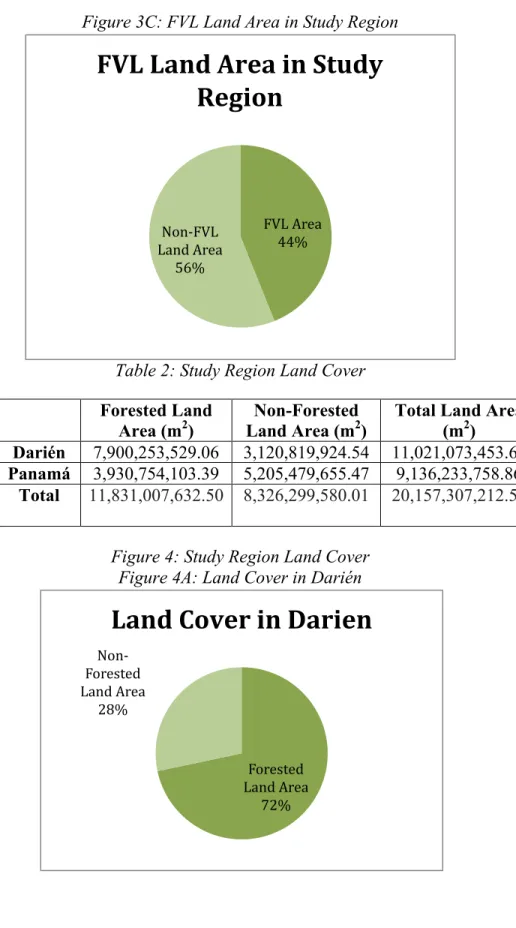
In this stage, as summarized in Table 1 in Appendix A, a total land area of 8,850,882,676.89 m2 was identified as FVL out of the 20,157,307,212.50 m2 study region, or 44% of the total. In the Darién province, 37% of the land was determined to be FVL and in the Panamá province, 52% was determined to be FVL (See Figures 3A-C, Appendix A). Here, a map was produced detailing the exact locations of these lands, as seen in Map 1 in Appendix C.
Stage 2: Forest Cover Definition
This stage of the study led to the identification of 11,831,007,632.50 m2 of forested land area, out of the 20,157,307,212.50 m2 study region, as detailed in Table 2 in Appendix A.
This represents 59% of the entire study region, as depicted in Map 2 in Appendix C.
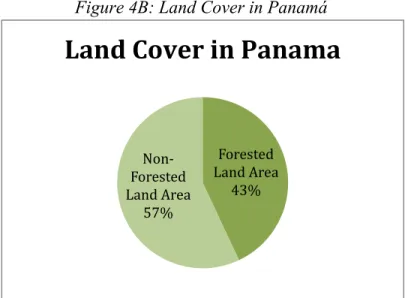
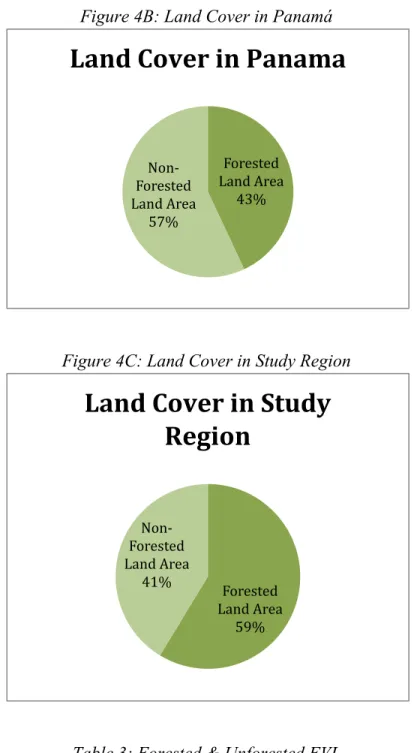
Specifically, 72% of the province of Darién and 43% of the province of Panamá were determined to under forest cover (Figures 4A-C, Appendix A).
Stage 3: Identification of Forested & Unforested FVL
The final stage of the analysis, it was concluded that of the 8,850,882,676.89 m2 FVL area, an area of 6,181,654,754.45 m2 is currently under forest cover and 2,669,227,922.44 m2 is currently unforested. Hence, as displayed in Figure 3, Appendix A and Map 3, Appendix C, 70% of the FVLs identified are currently under forest cover.
Study Limitations
Due to the context and the time frame of the study, numerous limitations were met. The most notable and influential limitation to this study was the availability of up-to-date data. Many study days were spent tracking data that turned out to be either non-existent or insufficient for the analysis. Furthermore, some data that was used in this study (most notably the most recent Panamanian land cover shapefile obtained from ANAM via Gerardo Vergara) is a few years old, hence leaving a margin for error due to the likelihood of changes since 2008. Additionally, due to the absence of specific information regarding the kinetic energy of rainfall and the presence of only monthly and yearly rainfall averages, the Arnoldus 1980 formula for rainfall intensity was deemed most appropriate for use in this study. This calculation is known to be an overestimate and therefore the rainfall intensity values calculated were overestimates, making the FVL shapefiles slightly larger. Indeed, it was the most applicable formula given the scope and context here, but presented the study with an important limitation.
The other most significant limitation to this study was the time-frame in which the study was conducted. This limited each phase of the study and prevented a more nuanced and precise identification of the FVL of Eastern Panamá from being
created. This limitation of this study thus points to the necessity for future works to be executed at a smaller-scale or over a larger study region.
IV. Discussion
The above identification of the FVL of Eastern Panamá is only the first step in working towards sustainable land-use practices in the study region. For this study to be effectively utilized, the results obtained need to enter the sociopolitical sphere where the information can be applied in a meaningful way.
The GIS results will here be analyzed in the context of present day Panamá.
Firstly, the relevant actors to whom this information may be consequential will be determined. Then there will be an investigation into the potential conflicts and complications that may arise from the various perspectives and logics at play.
Altogether, the study will analyze the drivers of change, both proximate and underlying, that are causing the large-scale land-cover changes in Eastern Panamá, thereby allowing for land-use policy and practice recommendations.
Relevant Actors & Potential Significance of the Data
(a) Government Organizations:
(i) Autoridad Nacional del Medio Ambiente (ANAM): ANAM, Panamá’s environmental
authority, operates under the mission of:
“liderar la administractión del ambiente, a través de procesos participativos, normativos y cientificos, integrando objectivos sociales y económicos, con el fin de garantizar el desarrollo sostenible de Panamá” (ANAM, 2014).
Hence, this organization functions to serve as a protector of the environment in order to ensure sustainable development into the future. As such, it would obviously have an
location of forest vocational lands. In order to ensure the development of the nation follows a sustainable course, the forest vocational lands identified above must be maintained under forest cover or a similar sustainable land-use. ANAM, then, has a clear role in ensuring that these lands are not converted into forms of unsustainable land-cover.
Further, because not all of the identified FVL are currently under forest cover, (See Map 3, Appendix C) there is an important role for ANAM in converting these lands into more sustainable land-use practices.
Thus, as the major environmental authority in Panamá, it is the responsibility of ANAM to find a way to maintain the FVL under forest cover and prevent the occurrence of negative ecosystem externalities. It also falls under the jurisdiction of ANAM to help integrate this scientific information with the socioeconomic sphere, joining together social and environmental goals in order to create a more sustainable Panamá.
(ii) Autoridad Nacional de Administracion de Tierras (ANATI): The mission of ANATI,
Panamá’s land authority, is:
“Dirigir, regular y asegurar el cumplimiento y aplicación de la política nacional de tierras, respetando los derechos de propiedad y la posesión de buena fe, mediante la regularización del catastro nacional, logrando la modernización de la administración y los servicios de tierra garantizando así, la seguridad jurídica y el mejoramiento de la calidad de vida de los poseedores en el Panamá urbano y rural” (ANATI, 2014).
Explicitly, this authority thus functions to oversee the Panamanian cadastre, coordinating both rural and urban land and property rights. Therefore, any social application of the utilization of FVL and non-FVL areas for their relevant vocations requires ANATI’s help. Firstly, there are a few options, from a land authority standpoint, for ensuring that FVLs are held under forestry in the future. The first would be to fence off the lands,
any conversion the land to non-forested land-uses. However, this seems exceedingly unrealistic in the context of today’s Panamá, as there are already inhabitants, both formal and informal, of the FVL areas. Another option is to allow the lands to be purchased and used, but under restrictions and limitations. If FVLs are, then, sold to and maintained by private enterprises, there must exist some restrictions/limitations on the land-cover maintenance.
There is also a role for ANATI in the realization of the lands determined to be non-FVL. Here, this is land that can be developed without the creation of larger ecosystem externalities. Specifically, agriculture is a hugely important land-use for both the rural and the urban peoples of Panamá as it gives sustenance to the nation at large. By isolating the non-FVL lands as potential sites for agriculture (i.e. zoning the area as an agricultural land-use zone), ANATI can feed this immense demand for land for food production without incurring ecosystem externalities.
(b) Campesinos:
These small-scale subsistence farmers formally and informally occupy much land in Eastern Panamá, relying on both agricultural and forested land. They often have ancestral ties to the land and have changed land-cover of their environments over generations (Heckadon-Moreno, 1993). This landscape alteration has largely been for subsistence purposes, but increasingly there has been an impact of production for sale in the market out of necessity. Land-use change over time has grown in scale and the effects of these processes are increasingly being realized at the local level (ibid). The threat of ecosystem degradation is real and thus the FVL and Non-FVL lands identified here will be critical in moving forward towards sustainability for this group. As such, the campesinos of Eastern
Panamá have an intimate knowledge of the land and will play an invaluable role in the application of this knowledge and the transition towards sustainable land-use in the region.
(c) Indigenous Groups:
As described above, Eastern Panamá is home to numerous indigenous groups and peoples. There are notable distinctions both between and amongst the Kuna and Embera groups, but they functionally hold similar relationships with the land. They rely on the land directly for subsistence livelihoods and hence have a vested interest in the longevity of ecosystems in the region. Although the dated idea of the ‘noble savage’ still persists in some literature, it is generally accepted that indigenous populations do exert a significant influence on land-cover, in Eastern Panamá and elsewhere (Nelson et al., 2001). Further, the populations of these peoples are small relative to the land, but are rising notably in recent years (World Bank, 2014). Similarly to recent changes in campesino land-use over time, the indigenous peoples of the area are increasingly realizing the unsu8stainability of some local practices and traditions (Nelson et al., 2001). Hence, in order to ensure the area develops in a sustainable fashion, indigenous groups must play an integral role. As important members of the Eastern Panamanian region, these communities and individuals must be provided access to the spatial information above. By giving the indigenous peoples of Eastern Panamá access to such information, the longevity of their livelihoods via the longevity of the environment enters their own hands.
(d) Panamanian populace:
As a nation, Panamá has gained much from its privileged geographic position and environment. Specifically, a huge percentage of the country’s GDP comes from activities
related to the Canal (World Bank, 2014). The functioning of the Canal, the basis of much of the nation’s well being, wholly depends on the health of the surrounding forests, giving the country a very unique perspective from which to view sustainability. If the environment surrounding the Canal degrades significantly, there will be a massive and immediate impact to the huge numbers of Panamanians that depend on the Canal’s economic activities. The maintenance of FVL lands under forest cover is vital, then, for the nation of Panamá at the large-scale.
There is reason for hope for broad-scale change in land-use surrounding the Canal region for the protection of this important resource. In the late 1970s academics and policy makers realized the importance of the watershed in supplying the Canal with sufficient fresh water to permit the 35-45 ships that traverse the Canal each day. Here, there was a large scale restructuring of land-use in the Canal’s watershed in order to maintain the necessary hydrological functioning of the Canal. Thus, there is a precedent to be followed for land-use change across a large and critical part of the Panamanian landscape, making this daunting task seem a little more achievable. (Carse, 2012).
Drivers of Change: Conflicts, Complications, and Considerations
As current occupants of Eastern Panamá, it is important to consider the everyday needs of campesinos, indigenous groups, and indeed the Panamanian populace at large. The
micro-level decisions regarding agricultural and infrastructure expansion as well as timber extraction and harvesting are rational decisions made out of necessity in order to support local livelihoods. For example, a campesino agriculturalist does not burn down a hectare of forest for the sole purpose of burning it down. He does it because it is a necessary means by which to achieve subsistence agricultural production. Thus, attention
must be paid to the underlying causes that create the circumstances for such degradation to be locally rational and in some cases even necessary.
These direct causes of landscape alteration stem from broader, more foundational aspects of Panamanian culture and society. Panamá is a country marked by huge levels of socioeconomic and political inequality (World Bank, 2014). As the CIA World Factbook describes, the country’s “strong economic performance has not translated into broadly shared prosperity” (CIA, 2014). Although categorized as an ‘upper middle income’
country, a full 26% of the population lives below the poverty line, as defined by the national standard (ibid). Panamá has a GINI index of 51.92, placing it in the top 20 countries worldwide with an unequal income distribution (World Bank, 2014). These inequalities manifest in the power dynamics apparent in the country, in which a small minority has much of the authority, both socially and politically, and ability to influence large-scale change in the region.
Such inequality and polarization is also apparent in the governance structure of Panamá. Government departments are including those of ANAM and ANATI as identified above, have completely separate governance structures and hence functional mechanisms (Aguilar-Alfu & Reddy, 2013). Although land-use is an important consideration in working towards the missions of these two organizations, there is very little (if any) cooperation and coordination between the two authorities. This has led to a marked absence of successful and meaningful policies preventing deleterious landscape alteration.
Further, the political system is set up such that every five years a new president comes into power, bringing with him/her a complete restructuring of each branch of the
government. This, combined with the major inconsistencies between party members through time, prevents real long-term change from being effective. Some of the most important and definitive policies and programs of one administration may be completely eliminated if the next administration deems them unimportant or unnecessary (Espino, March 2014). Within the confines of such an inconsistent governance system, it is hard to affect real long-term change from the top down. Thus, any sustainable land-use policy must seek to work within this present day institutional framework, taking into account both the local level actors as well as the broader ever-evolving governmental framework.
Moving Forward: Policy Implications & Recommendations
The identification of forest vocational lands is indeed a hugely important first step in the transition to more sustainable land use patterns in Eastern Panamá. However, an analysis of the surrounding socioeconomic climate shows points to a distinct need for greater cooperation between governmental, subnational, and local actors and organizations.
Specifically, at the administrative level, ANAM and ANATI must cooperate on the best means by which to ensure environmental sustainability via the maintenance of FVL under sustainable land-use practices. Neither of these organizations has priority, as the two groups stem from separate but comparable power structures. If they work together to achieve such goals, land can be divided equitably and sustainably.
V. Conclusions
Human processes are increasingly altering the landscapes of today’s world and Eastern Panamá is no exception to this rule. The micro-level rationality of deforestation and other land-cover conversions stems from the underlying institutional structure of Panamá, and continually functions to exacerbate such large-scale alteration in the region. Social and environmental consequences are increasingly being felt, creating a distinct need for deep-seeded policy change. The results of this study point to conclusions, both positive and negative, about the environmental and social status of Eastern Panamá. There are significant amounts of FVL areas that are currently unforested and thus having deleterious effects on the Panamanian socioecological landscape. However, the most of the areas identified as FVL (70%) are seen to already be under a form of forest-cover.
Hence, although there is definitely much room for improvement, the gravity of which should not be taken lightly, there is much room for hope. It is now up to the Panamanian government and people to make the decision to include such reports into a concerted and comprehensive effort toward environmental and social sustainability.
Further Study Recommendations
The results of this study point to several distinct recommendations for future study.
Firstly, it is important to undertake similar studies to identify FVL and Non-FVL areas in the rest of Panamá, at different scales, in order for the country to ensure land-use practices are sustainable moving into the future. Secondly, given that Non-FVL lands are suitable for agricultural practices, a further analysis of these lands would be informative in telling which types of agriculture would best fit which Non-FVL regions. Lastly, in order to more fully ascertain why these areas are being deforested, a study of land-use
changes over time in Eastern Panamá would be invaluable. Such projects would allow improved modeling of various future scenarios and would indubitably function to help determine the best mechanisms by which the region can move towards sustainable land- use practices.
References
Aguilar-Alfu, Alvaro and Reddy, Kedar. (2013). Update: A Guide to Panama’s Legal System and Research. Globalex. Retrieved April 2014 from:
http://www.nyulawglobal.org/globalex/Panama1.htm#ministries
Amado, A., G. Peterson St-Laurent, C. Potvin, and L. Llapur. Capítulo Conflictos territoriales: modelo para su resolución en preparación para la protección de bosques Panamá. In press.
Autoridad Nacional del Ambiente. (2014). Nuestra Esencia. Retrieved April 2014 from:
http://www.anam.gob.pa/index.php/homepage/getting-started Autoridad Nacional de Administracion de Tierras. (2014).Quiénes Somos?: Visión y
Misión. Retrieved April 2014 from:
http://www.anati.gob.pa/mquienessomos/mvisionymision
Arnoldus, H.M.J. (1980). An Approximation of the Rainfall Factor in the Universal Soil Loss Equation. In: Assessment of Erosion. John Wiley & Sons Ltd, Chichester, UK. 127-32.
Bhattari, Madhusudan and Hamming, Michael. (2001). Institutions and the
Environmental Kuznets Curve for Deforestation: A Crosscountry Analysis for Latin America, Africa and Asia. World Development. 29(6):995-1010.
Banco Interamericano de Desarrollo. (2007). Instrumentos para Implantar una Polítia Forestal Basada en el Concepto de Tierra de Vocación Forestal. Washington D.C.
Carse, Ashley. (2012). Nature as Infrastructure: Making and Managing the Panamá Canal Watershed. Social Studies of Science. 0(0):1-25.
Central Intelligence Agency. (2014). The World Factbook: Central America and Caribbean – Panamá. Retrieved March 2014 from:
https://www.cia.gov/library/publications/the-world-factbook/geos/pm.html.
Crepani, Edison, Medeiros, J.S., and Palmeira, A.F. (2004). Intensidade PluviométricaÑ Uma Maneira de Tratar Dados Pluvimétricos para Análise da Vulnerabilidade de Paisagens á Perda de Solo. Instituto Nacional de Pesquisas Espacias.
Espino, Ariel. (2014) Personal Communication. April 2014.
Foley, Jonathan. (2005). Global Consequences of Land Use. Science. 309:570-4.
Fookes, Peter. (1997). Tropical Residual Soils: A Geological Society Engineering Group
Forman, Richard T. T. (1995). Land Mosaics: The Ecology of Landscapes and Regions.
Cambridge University Press. Cambridge.
Geist, H.J., and Lambin, E.F. (2001). What drives tropical deforestation? A meta-analysis of proximate and underlying causes of deforestation based on subnational scale case study evidence. LUCC Report Series No. 4. University of Louvain,
Louvainla-Neuve.
Grupo Experimental de Cine Universitario de Panamá. (1974). La Quema (film). Aqui Bayano: Cambio.
Hall, Charles. (2006). Integrating Concepts and Models from Development Economics with Land-Use Changes in the Tropics. Environment, Development and
Sustainability. 8: 19–53.
Heckadon-Moreno, Stanley. (1993). Impact of Development on the Panama Canal Environment. Journal of Interamerican Studies and World Affairs. 35(3):129-49.
Herlihy, Peter. (2003). Participatory Research Mapping of Indigenous Lands in Darién, Panamá. Human Organization. 62(4):315-331.
Intergovernmental Panel on Climate Change. (2000). IPCC Special Report: Land-Use, Land-Use Change, and Forestry.
Nelson, G., Harris V., and Stone, S. (2001). Deforestation, Land Use, and Property Rights: Empirical Evidence from Darién, Panama. Land Economics. 77(2): 187- 205.
Lambin, E., Geist, H.J., Agbola, S.B., Angelsen, A., Bruce, J.W., Coomes, O.T., Dirzo, R., Fischer, G., Folke, C., George, P.S., Homewood, K., Imbernon, J., Leemans, R., Li, X., Moran, E., Mortimore, M., Ramakrishnan, P.S., Richards, J.F., Skanes, H., Steffen, W., Stone, G.D., Svedin, U., Veldkamp, T.A., Vogel, C., and Xu, J.
(2001). The Causes of and Land-Cover Change: Moving Beyond the Land Use Myths. Global Environmental Change. 11:261-9.
Lambin, E., Geist, H.J., and Lepers, E. (2003). Dynamics of Land-Use and Land-Cover Change in Tropical Regions. Annual Review of Environmental Resources.
28:205-41.
Potvin, C., Tschakert, P., Lebel, F., Kirby, K., Barrios, H., Bacariza, J., Caisamo, J., Caisama, L., Cansari, C., Casamá, J., Casamá, M., Chamorra, L., Dumasa, N,, Goldenberg, S., Guainora, V., Hayes, P., Moore, T. and Ruiz, J. (2006). A
participatory approach to the establishment of a baseline scenario for a reforestation Clean Development Mechanism project. Mitigation and Adaptation Strategies for
Smithsonian Tropical Research Institute. (2014). About STRI. Retrieved April 2014 from: https://www.stri.si.edu/english/about_stri/index.php
Veldkamp, A. and E.F. Lambin. (2001). Predicting Land Use Change. Agriculture, Ecosystems, and Environment. 85:1-6.
World Bank. (2014). Panamá: World Development Indicators. Retrieved March 2014 from http://data.worldbank.org/country/Panamá
World Resources Institute. (2014). Global Forest Watch. Retrieved April 2014 from:
http://www.wri.org/our-work/project/global-forest-watch
Appendices
‘ Appendix A: Tables and Figures
Figure 1: Land-Use Transition, from Foley 2005
Figure 2: Forested Areas in Panamá, Created with Data from World Bank
Table 1: FVL Land Areas FVL Land Area
(m2) Non-FVL Land
Area (m2) Total Land Area (m2)
Darién 4,075,297,218.84 6,945,776,234.76 11,021,073,453.60 Panamá 4,775,585,458.05 4,360,648,300.81 9,136,233,758.86
Total 8,850,882,676.89 11,306,424,535.60 20,157,307,212.50
Figure 3: FVL Land Areas Figure 3A: FVL Land Area in Darién
Figure 3B: FVL Land Area in Darién
FVL Area 37%
Non-‐FVL Land Area
63%
FVL Land Area in Darien
FVL Area 52%
Non-‐FVL Land Area
48%
FVL Land Area in Panama
Figure 3C: FVL Land Area in Study Region
Table 2: Study Region Land Cover
Figure 4: Study Region Land Cover Figure 4A: Land Cover in Darién
FVL Area 44%
Non-‐FVL Land Area
56%
FVL Land Area in Study Region
Forested Land Area
72%
Non-‐
Forested Land Area
28%
Land Cover in Darien
Forested Land
Area (m2) Non-Forested
Land Area (m2) Total Land Area (m2)
Darién 7,900,253,529.06 3,120,819,924.54 11,021,073,453.60 Panamá 3,930,754,103.39 5,205,479,655.47 9,136,233,758.86
Total 11,831,007,632.50 8,326,299,580.01 20,157,307,212.50
Figure 4B: Land Cover in Panamá
Figure 4C: Land Cover in Study Region
Table 3: Forested & Unforested FVL Forested FVL
Land Area (m2)
Unforested FVL Land Area (m2)
Total FVL Land Area (m2) Darién 3,706,645,399.76 368,651,819.08 4,075,297,218.84 Panamá 2,475,009,354.69 2,300,576,103.36 4,775,585,458.05
Total 6,181,654,754.45 2,669,227,922.44 8,850,882,676.89
Forested Land Area
43%
Non-‐
Forested Land Area
57%
Land Cover in Panama
Forested Land Area
59%
Non-‐
Forested Land Area
41%
Land Cover in Study
Region
Figure 5A: Forested and Unforested FVL in Darién
Figure 5B: Forested and Unforested FVL in Panamá
Forested FVL Land 91%
Unforested FVL Land
9%
Forested FVL in Darien
Forested FVL Land 52%
Unforested FVL Land
48%
Forested FVL in Panama
Figure 5C: Forested and Unforested FVL in Study Region
Forested FVL Land 70%
Unforested FVL Land
30%
Forested FVL in Study Region
Appendix B: Methodology
Figure 6: Topography Cartographic Model
Table 4: Slope Categorizations, by Percentage Slope, by Percentage Categorization
< 8% Llano
8 – 15% Moderado Ondulado
15 – 30% Ondulado
> 30% Fuerte Ondulado
Figure 7: Rainfall Cartographic Model
Rainfall Methodology Explained
Information about monthly and yearly rainfall averages was available only in a GoogleMaps format from the Empresa de Transmisión Eléctrica, S.A. website, so the first step of this analysis was to transpose the data into a Microsoft Excel document.
Following the 2007 BID Study (and Crepani et al., 2004;Arnoldus, 1980), rainfall intensity quantities were determined for each hydrometeorological station in Panamá as:
12 where MR = monthly rainfall average
Σ
[(MR)2/AR] AR = annual rainfall averagei=1
Then, the file was imported for use into ArcGIS as a .csv file from which a point shapefile was created using latitude and longitude coordinates. The shapefile was then interpolated into a raster file in order to assess the rainfall intensity of the entire study region. Then, as described above, three intervals were determined utilizing Jenks Natural Breaks Optimization classification, which divides classes by the minimize variance within classes and maximize variance between classes (maybe cite this). Once these classifications were obtained, the classified vector polygon was used to create three shapefiles: (1) Baja, of low rainfall intensity (2) Media, of medium rainfall intensity, and (3) Alta, of high rainfall intensity.
Figure 8: FVL Determination Cartographic Model
Table 5: Soil Classification, Derived from Fookes, 1997
Soil Type Classification
Alfisoles Forest-Cover
Entisoles Non-Forest Cover
Entisoles e Inceptisoles Non-Forest Cover
Inceptisoles Non-Forest Cover
Inceptisoles y Molisoles Non-Forest Cover
Inceptisoles, Alfisoles y Ultisoles Forest-Cover
Ultisoles y Alfisoles Forest-Cover
Appendix C: Maps
Map 1: Forest Vocational Lands
Map 2: Forest Cover
Map 3: Forested & Unforested FVL
Appendix D: TCPS 2: CORE Certification
Appendix E: Schedule of Internship Activities
Table 6: Schedule of Internship Activities
Table 7: Total Days Spent on Internship
Month Jan Feb March April Total
Days 6 9 5 15 35
Jan 9, 10 • Went to ANATI to meet Ana María Martinez
Jan 16, 17 • Watched documentary about Bayano Hydroelectric Complex creation to better understand history of study region
• Went to ANAM to obtain 2007 pilot study
• Met with Catherine to discuss project change
• Met Milton Solano, began initial data acquisition Jan 30 – Feb 7 • Went over 2007 study to understand methodology
• Data acquisition from STRI, ANAM…
Feb 10, 11 • Created a spreadsheet of rainfall data obtained from ETESA website in order to create a shapefile
• Went to IDIAP to look for soils data
Feb 17, 18 • Obtained IDIAP data on soil texture and depth
• Obtained and georeferenced USGS satellite data
• Researched Forestry Legislation
Feb 28 • Went to ANAM to research Panamanian Forestry Legislation Mar 20, 21 • Conducted internet and literature searches on means of soil
classification/categorization
• Researched ANATI and ANAM and their roles as government bodies
Mar 27 – Apr 11 • Began final written report
• Determined proxy for soil classification
• Complete research into scientific details of pilot study
• Complete the identification of FVL
• Analyze FVL in terms of current forest coverage Apr 18 - 25 • Finalized maps
• Completed Written Report
• Presentation of findings in final internship presentation