Fostering College Persistence Through a High School Mentor Program
Ann Y. Rubin, Mary C. Chappell, Julie F. Chase, Jonathan W. Stewart Peabody College, Vanderbilt University
Integrated White Paper Dr. Eve Rifkin August 1, 2023
Contents
I. Introduction ... 3
II. Problem of Practice ... 8
III. Review of the Literature ... 10
IV. Conceptual Framing ... 16
V. Project Questions ... 25
VI. Project Design ... 25
VII. Data Collection and Analysis Status Report ... 26
VIII. Findings ... 45
IX. Recommendations ... 57
X. Conclusion ... 70
References ... 71
Appendix A ... 91
Appendix B ... 92
Appendix C ... 93
Appendix D ... 94
Appendix E ... 97
Appendix F ... 101
Appendix G ... 105
Appendix H ... 106
Appendix I ... 114
Appendix J ... 115
Appendix K ... 116
I. Introduction
Many of today’s employers consider completing a bachelor’s degree as fundamental to their employment criteria, with 75% of available new job openings requiring a bachelor’s degree to apply (Trend, 2022). While this phenomenon is primarily due to the perception that compared to non-degree holders, those with a bachelor’s degree are more proficient with “hard and soft skills” (Groysberg et al., 2022, p. 2), the attainment of a bachelor’s degree is also linked to a more desirable life that entails higher income, stable employment, and fewer physical ailments (Oreopoulous & Petronijvec, 2013). In fact, while COVID-19 negatively impacted student enrollment in four-year college programs, the latest figures from the National Student
Clearinghouse Research Center (Berg et al., May 2023, Table 2) show approximately 7.9 million students enrolled in a public or private (non- or for-profit) four-year bachelor’s program in the Spring 2023 term. However, when we compare this to 2022 data from the National Center for Educational Statistics, 32.9% of college students never fulfill the four-year program, of which 24.1% are first-time first-year students and 25.7% are first-time bachelor program students (Hanson, 2022).
Consequently, those who fail to complete a four-year college degree have higher
unemployment rates and earn 33% less than bachelor’s degree recipients (Hanson, 2022, para 1).
Even when they attain employment, compared to non-college degree workers between the age of 20 to 69, male bachelor's degree holders acquire $900,000 more, and female bachelor’s degree holders make $630,000 more in median earnings (Social Security Administration, 2015). Beyond the unemployment and income statistics, students who drop out, particularly those in
disadvantaged populations, may needlessly experience insurmountable damage to their sense of belonging and individual abilities in the academic setting as they lose hope for a successful
future while also acquiring the responsibilities of student loan payments for an unfulfilled degree (Tretina & Hahn, 2022).
To increase four-year college enrollment and graduation of underprivileged and first- generation students, numerous higher education institutions and non-profit organizations have launched programs that specifically work with high-achieving students in this demographic eager to pursue higher education. Many of these programs are focused on mitigating the persistent achievement gap between low-income and affluent students and offer various academic and social supports, including subject-specific tutoring, college counseling, standardized test preparation, mentorship, and financial aid assistance that are critical in increasing a student’s chance of not only enrolling in college but also remaining and completing their higher education studies. One of these programs is Minds Matter National, Inc. (MMN).
Organizational Context
MMN is a nationally renowned 501(c)(3) organization that offers a volunteer-run mentoring program for “accomplished high school students from low-income backgrounds”
(Minds Matter Seattle, 2023a). After the 1991 launch of its first chapter in New York City, the organization expanded and currently has fourteen chapters nationwide (Minds Matter, 2022).
According to their FY16 annual report, there were 611 attending students (i.e., “mentees”), 1,251 program alumni (i.e., “graduated mentees” or “graduates”), and 1,700 active volunteers offering academic enrichment, college prep, as well as overall program facilitation. The program
continues to grow and was even featured in the New York Times gift-giving guide for its commendable work (Collins & Stephens, 2021).
Program Structure
While each chapter differs in size and organizational structure, they must follow a three-
year core program established by MMN, consisting of weekly sessions during the school year from the beginning of 10th grade to the end of 12th grade. However, since MMN does not support curriculum design, educational resources, or instructor training, each chapter has full autonomy in program implementation and tracking of student progress.
Weekly mentee sessions occur on Saturdays from September through May. In the
morning, mentees engage in a comprehensive academic program that differs by grade. Following a quick lunch break, they participate in mentoring and enrichment, focusing on college readiness and other activities (Minds Matter Seattle, 2023a). During the morning session, sophomore mentees alternate weekly between two hours of math or writing and critical thinking, junior mentees receive standardized test preparation, and senior mentees engage in college counseling and related programming, all led by volunteers, often with significant academic or professional experience in that subject or program area. When chapters are not in session from June to August, all rising junior and senior mentees attend fully paid self-selected summer academic or leadership programs at various institutions in the U.S. and abroad. Each chapter, not MMN, is responsible for program selection and incurred costs.
As mentioned, much of the programming is managed and run by local volunteers who first begin as mentors or instructors. As volunteers become more invested in each chapter’s work, they often step into executive positions more focused on programming and operational needs such as fundraising, recruitment, and grant writing. While smaller chapters rely solely on volunteers, some chapters have paid staff (often full-time) to manage daily operational
responsibilities. As these paid employees do not report to MMN but to chapter board directors, each chapter fully covers their salaries.
Minds Matter Seattle (MMSEA) Background
Launched in 2013, Minds Matter Seattle (MMSEA) is the eleventh chapter of the organization. Starting with just six mentees and ten volunteers in 2013, the number of mentees and volunteers has gradually increased each year. In academic year 2022-2023, the total number of mentees was 29 (with 13 sophomores, nine juniors, and seven seniors), mentors paired with these mentees was 57 (with 25 sophomore mentors, 18 junior mentors, and 14 senior mentors), and volunteers (not including board members) was 45 (V. Zamora, personal communication, July 10, 2023). The Seattle chapter will be even bigger next year, with 16 new sophomores joining the organization this fall (V. Zamora, personal communication, July 10, 2023).
MMSEA ensures that fundraising goes directly to mentee programming, meaning they must also rely on donated space to host their Saturday sessions. Originally, they utilized spaces at Perkins Coie LLP, where one of the founding members was a long-time employee. Currently, the program uses designated classrooms at Seattle University, which are rented to MMSEA free of charge. (See Appendix A for photos of Seattle University and spaces used by MMSEA).
Additionally, budgeting did not support paid staff. As a result, volunteers, often with minimal experience in education, oversaw all areas of programming and management of MMSEA. With minimal support from MMN, the group’s core volunteer members often spent innumerable hours preparing for their weekly Saturday sessions and handling various
administrative duties critical to running the robust program. While their volunteers were competent and brought a variety of skillsets from their diverse professional and personal
backgrounds, they were often overextended, juggling numerous roles within the organization in addition to daily jobs and other personal responsibilities.
To lower volunteer stress and improve overall programming, in May 2022, MMSEA
finally hired its first paid employee, Mr. Victor Jesus Zamora, as executive director of the Seattle chapter. As illustrated in Figure 1, the MMSEA Organizational Chart, Mr. Zamora now directs a volunteer group of three directors in charge of mentee and volunteer programming and
management and two vice presidents who strictly handle administrative duties related to external relations and strategy and operations. In addition, there are multiple managers and leads working on specific tasks under each director and vice president’s supervision. The chart uses arrows to indicate each manager’s team. The large organizational chart allows for leadership distribution so that individuals have smaller spans of direct responsibility. While this approach may appear overly ambitious for a small-scale organization like MMSEA that only meets weekly, it is more practical for the organization as every individual fulfilling these roles volunteers and has
obligations beyond MMSEA.
Figure 1
MMSEA Organizational Chart
EC Org Chart (effective June 2023)
Victor, Executive Director
Manager, Class of 2024 (Seniors) Manager, Class of
2025 (Juniors) Manager, Class of
2026 (Sophs)
Sophomore Volunteers (Instructors, Mentor
Leads) & Students
Junior Volunteers (Instructors, Mentor Leads) & Students
Senior Volunteers (Instructors, Mentor Leads) & Students
Manager, College Counseling
Manager, Summer Programs
Manager, Alumni Relations Director, Support
Programs
College Counselors
Alumni Council
Director, People
Manager, Student Recruitment
Lead, Student Engagement
Manager, Volunteer Recruitment
Lead, Volunteer Engagement Lead, Volunteer
Training &
Learning
Student Recruiters (temp)
Volunteer Recruiters (temp)
VP, Strategy &
Operations
Lead, Technology Lead, Strategic
Initiatives
Lead, Finances
Lead, Program Logistics
Lead, EC Ops VP, External
Relations
Lead, Marketing &
Communications
Manager, Fundraising
Lead, Events
Marcom volunteers
Event volunteers Summer Program
volunteers
Director, Program
Lead, Grants
Fundraising volunteers
Grant writing volunteers
Capstone Purpose
This capstone aimed to help MMSEA’s Executive Director to better understand their program through research-based inquiry and analysis. As the new executive director, Mr.
Zamora strives to offer active support vital to the chapter’s sustainability and future growth.
With MMSEA mentees (current and past), volunteers, executive committee members, and board directors as our key stakeholders, we gathered pertinent data that revealed the program’s overall impact and areas for improvement. Relevant data included mentee and mentor experience and academic achievement (both during and post-program participation). Such data gave us insight into curriculum and program needs, volunteer recruitment and training, and differentiation from other college preparation programs for determined and driven high school students.
II. Problem of Practice
Mr. Zamora has extensive experience in education and student support. He is a former college admissions officer in multiple colleges and has also worked in education and educational non-profits (Zamora [LinkedIn], 2023), making him ideal for this role. Being a first-generation student, Mr. Zamora understands the complexity of the college admission process, especially for young adults from low-income backgrounds. He is eager to enhance MMSEA’s programming, such as building stronger partnerships with local schools, improving tracking and analyses of mentee progress, and volunteer and executive committee member training that the organization had not previously targeted. While all that Mr. Zamora shared with our group was of great interest, our team of current and former educators, instructors, and curriculum specialists focused on Mr. Zamora’s interest in understanding and measuring the “success” of MMSEA mentees due to participating in the three-year program.
MMN and MMSEA measure success by a mentee’s acceptance to a college based on the institution's admissions competitiveness ranking (such as Barron’s), the amount of financial aid
received, and the academic rigor of the institution. Academic rigor encompasses challenge, complexity, depth of learning experiences, high standards, intellectual engagement, critical thinking, and mastery of content and skills. MMSEA uses the same success metrics to evaluate the quality of its college preparatory programming. In doing so, MMSEA maintains 100%
college enrollment for program participants and has received positive feedback from past mentees.
Nevertheless, there is a need for a clearer understanding of the program’s purpose and impact beyond college enrollment. The definition of success and its alignment with MMSEA’s stakeholders, including volunteers, organizers, and the Minds Matter National (MMN)
organization, requires examination. Additionally, the effectiveness of MMSEA’s programs in helping mentees achieve success needs assessment. These considerations led us to formulate key questions to determine the problem of practice: How does MMSEA, including mentees, mentors and stakeholders, view success? What constitutes success for MMSEA mentees? Does success equate to acceptance at a college of choice or is a mentee’s persistence to graduation considered success? How does it differ among stakeholders? Furthermore, are the current programs
effectively supporting mentees in achieving their goals? Addressing these questions will guide us in identifying potential programmatic changes that can better serve the needs of MMSEA
participants.
Mr. Zamora is seeking clarity on the purpose and impact of the program after college admission. He envisions a movement beyond getting students into college to ensure success through and after college for MMSEA mentees. Using his vision of success, we focused on persistence, a characteristic critical not only to enrollment, but to the completion of college. Our problem of practice is working with the organization to develop recommendations to help them
achieve this goal.
III. Review of the Literature Introduction
To conduct our literature review, we examined the importance of college completion, particularly for student populations served by MMSEA. Next, we reviewed persistence literature and the structures and psychological factors that drive individuals to persist toward challenging goals. We focused on college persistence to study the development of current thinking
surrounding what it means for students to persist in college. Finally, we reviewed factors that lead students to persist towards graduation and common obstacles that derail persistence, especially for first-generation or minoritized students.
The Importance of College Completion
College education has become increasingly prevalent over the years, with college enrollment directly from high school rising from 63% in 2000 to 73% in 2016 (Britton et al., 2022). Given the significant financial benefits of college education, we expect to see this positive trend continue. College graduates earn almost 50% more per year than non-college graduates and have more job stability (U.S. Bureau of Labor Statistics, 2023). Annual data gathered through the U.S. Census Bureau and Bureau of Labor Statistics’ Current Population Survey (IPUMS)
confirms this finding, with the median income of high school graduates in January 2022 at
$34,320 while college graduates earn a medium of $70,000 (Federal Reserve Bank of New York, 2023). (See Appendix B for expanded data, including differences in unemployment based on educational attainment between 1990 and 2022).
Despite the positive outcomes of a college degree, some have questioned the value of attending college. Caplan (2018) argued that much of higher education is not just wasteful but
harmful and that vocational education or on-the-job training may be better suited for many students. Similarly, Balliester and Elsheikhi (2018) suggested that there may be other ways to prepare for the workforce and that alternative education options, such as vocational training, apprenticeships, and online courses, may be more valuable. They noted that these alternatives benefit some students, particularly those uninterested in a bachelor’s degree or those lacking the financial means to pay for college. However, they cautioned that these pathways could
sometimes reinforce existing inequalities, such as tracking students into lower-paying jobs and perpetuating racial and gender disparities.
While some people doubt the effects of going to college, earning a college degree is linked with greater social and economic outcomes. Chetty et al. (2017) analyzed income mobility from U.S. colleges and found that access to colleges depended on parent income. However, future earnings outcomes were not based on socio-economic backgrounds when comparing students from the same universities. Institutional quality also correlated with economic mobility, as elite schools producing the highest rates of movement. They suggested that colleges could play a role in intergenerational mobility and called attention to colleges that drove upward movement the most.
While policymakers have focused on college access as a marker of success, more is needed to measure a complicated issue (Bettinger, 2015). A more meaningful measure is college graduation. Therefore, this literature review explores the role of persistence in college
graduation, factors that produce persistence, and supports that increase students’ likelihood of earning a degree. Despite the increasing enrollment numbers, maintaining persistence toward graduation has been challenging, with only 59.6% of students graduating within six years (Britton et al., 2022). This finding is particularly concerning for minoritized students who face
lower completion rates (Friedman & Mandel, 2009; McElrath & Martin, 2021). As such, there is a need to understand the drivers of persistence and how to support students in completing their degrees.
Conceptualization of Persistence
Persistence is often discussed within human motivation as it drives goal-oriented
behavior. Peterson and Seligman (2004) define it as the “voluntary continuation of goal-directed action despite obstacles, difficulties, or discouragement” (pp. 229-230). Their definition focuses on the idea that persistence is not a function of time; in other words, it does not matter how long one takes to achieve one’s goal. It requires facing and overcoming challenges in pursuit of a specific goal. Challenges and obstacles are deleterious to motivation, stifling progress toward the desired goal. Persistence is behavior that maintains motivation towards goal achievement after overcoming obstacles (Pajares, 2002). Persistence is a “continuous process that arises from resisting the urge to quit” (Moshontz & Hoyle, 2021, p. 1). To persist, one needs an attainment goal.
History of College Persistence Literature
Tinto’s Interactionalist Model is a well-known and widely recognized theory of college persistence that emphasizes academic and social integration in determining year-to-year retention (Tinto, 1975). The model hypothesizes that students will continue their studies when they
experience connectedness to their campus through interactions with college faculty, staff, and peers. Within this model, persistence in college refers to a student continuing at the same institution the following academic year.
Tinto proposed that academic and social integration lead to greater academic success.
Academic integration is how students engage with their coursework and meet the requirements
for degree completion (Tinto, 1975). Social integration is the degree of belonging students feel on their campus (Tinto, 1993). The Interactionalist Model suggests that academic and social integration are interrelated. Students who struggle academically may isolate themselves socially, negatively impacting academic performance and persistence (Tinto, 1993). Students who lack social and academic support may find obstacles insurmountable.
Moreover, integration also explores the correlation between student expectations of college and reality. Students arrive at college with specific expectations of their college
experience. Student persistence is affected by their expectations and perceptions of reality (Metz, 2004). If students feel they will do well in their classes or quickly make friends yet struggle to accomplish either, their ability to persist will decrease. This idea demonstrates the importance of Tinto’s model for persistence both before and during college.
Tinto’s model provides a framework that relies on academic and social development during college. However, his model has received criticism due to the underrepresentation of minoritized students in his models and because it does not consider the psychosocial aspects of the student (Metz, 2004; Robbins et al., 2004; Arnekrans, 2014). Tinto’s definition of college persistence too narrowly emphasizes a traditional student’s year-to-year progress within the same university. This conceptualization more closely relates to institutional retention, a goal of
universities, while persistence is an individual goal toward graduation, regardless of the pathway (Reason, 2009). Understanding college persistence in this way allows for a broader study of environmental and personal factors that influence persistence toward graduation, regardless of whether they continue consecutively or at the same university. Goals, self-efficacy, and outcome expectations from attending a university impact the persistence of individual students (Lent et al., 1994). Additionally, college preparedness, the university environment, student race and
ethnicity, financial backgrounds, and support structures, especially the interaction of these together, play essential roles in student progress and students’ ability to overcome obstacles (Robbins et al., 2004; Johnson, 2008; Gloria et al., 1999; Wright et al., 2013; Wei et al., 2011).
Considering these many factors complicates the college persistence narrative and creates challenges for colleges to support persistence in students (Reason, 2009).
Factors That Affect Persistence First-Generation College Status
First-generation college students (FGS) confront more obstacles than their peers because they lack the generational experience to provide support or expectations (Stewart et al., 2015).
Ramos-Sánchez and Nichols (2007) showed that FGS had more significant academic challenges than peers, even when controlling self-efficacy levels. In addition to lacking generational
experience, FGS typically intersects with other demographic and background characteristics associated with lower graduation rates from college (Garriot et al., 2017). Without prior examples of success and facing challenges while navigating complex university systems, the onset of an obstacle can significantly harm FGS experiences and make it less likely that they persist.
Racial and Ethnic Backgrounds
Minoritized students are also likely to face greater challenges and have stronger
responses to them (Gloria et al., 1999). For example, challenges affect Black and Latinx students most, especially when attending primarily White institutions (Fischer, 2007). These students may struggle with belonging on campus, face discrimination from instructors and university staff, and feel greater pressure to perform well if they do not feel represented within the student body (Gloria et al., 1999; Wei et al., 2011). These factors add additional difficulties to college, which
impacts how students respond to adversity. Further challenges like these may reduce students’
self-efficacy and affect their persistence.
College Preparedness
A primary predictor of college success is academic performance metrics prior to college, such as high school grades and entrance exams (Stewart et al., 2015). Stewart and colleagues (2015) found that students placed into remedial courses had worse outcomes than those who did not. While they did not find a gender variation, it did show a slightly significant difference in persistence based on ethnicity when controlling academic preparedness metrics like high school GPA and SAT scores. Students who must overcome more by starting further back are less likely to persist to college completion. Similarly, Friedman and Mandel (2009) found a statistically significant correlation between first-year college GPAs and high school performance metrics such as SAT scores and high school GPAs. They go further and examine students’ academic expectations and goal setting prior to college. Their findings show that students with positive expectations of themselves demonstrated greater persistence. Coupled with solid academics in high school, expecting to be successful helps students manage challenges.
Strong academic performance before college equates to greater college-level
preparedness, making encountering academic obstacles less likely (Friedman & Mandel, 2009).
Students who face fewer obstacles persisted at higher rates. Additionally, students with strong prior performances have greater self-efficacy and belief in their ability to overcome academic obstacles (Lent et al., 1994; Nagaoka et al., 2013). They are more well-equipped to push through setbacks when they arise in the future. Such students will also likely have strong study skills that support their persistence through challenging material (Nagaoka et al., 2013). These factors support students’ persistence and set students up for success in college.
University Environment and Support Structure
On an institutional level, the overall environment and available support services affect student persistence. Students attending schools that provide services such as first-year seminars and counseling have better grades and are more likely to return for their second year (Schnell &
Doetkott, 2003). These services are essential for vulnerable populations such as FGS and minoritized students who often encounter more significant academic challenges (Garriott et al., 2017; Gloria et al., 1999). Larger campuses can also make students feel lost and isolated when challenges arise, as finding support and building relationships with faculty is harder (Fischer, 2007). This final factor that affects persistence supports Tinto’s original model, which suggests that social connectedness improves levels of persistence.
IV. Conceptual Framing
Theoretical Framework: Social Cognitive Career Theory (SCCT)
Because MMSEA engaged with students before college matriculation, our work focused on college preparedness. Focusing on this pre-college phase required us to utilize a theoretical framework that considered prior outcomes and individual characteristics rather than being institution specific. This context and consideration lead us to the Social Cognitive Career Theory (SCCT) by Lent, Brown, and Hacket.
Social Cognitive Career Theory (1994) explains individual career development through career choices, career-related beliefs, and behaviors. According to SCCT, career development is a continuous process impacted by a person’s cognitive and sociocultural factors, firsthand experiences, and environmental influences (Lent et al., 2000). It centers on the mutually reinforcing relationship between personal, contextual, and behavioral factors (Garriott et al., 2017). While the theory’s original purpose focused on the entirety of the career development
process, its application to college persistence as a parallel process is prevalent in research (Garriott et al., 2017; Wright et al., 2013).
SCCT extends Bandura’s Social Cognitive Theory (SCT) of motivation by framing the individual, contextual, and behavioral interactions within a career or academic developmental context. With SCT, Bandura focused on the triadic interaction between the individual,
contextual, and behavioral aspects of motivation to show that people learn from their interactions with their environment (Bandura, 1986). SCT emphasizes the role of cognitive and sociocultural factors in shaping behavior and beliefs. The “interlocking mechanisms” within this process affect each other “bidirectionally,” contributing to overall learning and motivation to learn (Bandura, 1986; Lent et al., 1994). In this way, personal factors both impact and are impacted by the environment within which the person engages in activities and the overt behaviors of that person within the given context.
According to Lent et al. (1994), SCCT proposes four factors that influence career development: personal factors (self-efficacy, outcome expectations, and personal goals),
environmental factors (social support, barriers, and environmental culture), learning experiences, and personal performance attainment. As with Bandura’s theory, these factors are mutually reinforcing and interact in ways that make it more or less likely that a person achieves the desired performance attainment levels.
Self-Efficacy
Self-efficacy is an individual’s belief in their ability to accomplish a task or goal (Jacobs et al., 1984). Self-efficacy is an essential factor in Bandura’s SCT (1977). It impacts persistence because higher self-efficacy produces greater beliefs that one can achieve one’s goals, even when facing setbacks. Conversely, lower self-efficacy means the individual is more likely to give up
instead of confronting obstacles. Self-efficacy fluctuates depending on goal difficulty, prior experiences, and outcome expectations. While Jacobs and colleagues (1984) describe a direct correlation between high self-efficacy and persistence, significant setbacks reduce self-efficacy and lower future persistence (Zimmerman et al., 1992).
Self-efficacy is not a fixed quality; it is dynamic and influenced by mastery experiences, vicarious experiences, social persuasion, and physiological and emotional states (Bandura, 1997). Mastery experiences refer to how learners interpret their previous experiences. Successful task performance increases self-efficacy, while failure may do the opposite. Repeated successful experiences contribute to stronger self-efficacy (Bandura, 1997). Vicarious experiences are the learner’s interpretations of others’ experiences. Observing others, especially similar peers, or role models, successfully performing a task can increase an individual’s self-efficacy. This latter point is increasingly crucial for FGS and minoritized students who attend predominantly White institutions (Garriott et al., 2017; Gloria et al., 1999). Seeing others succeed can create a belief that similar success is possible for oneself (Bandura, 1986). Social persuasion involves
encouragement from others. Encouragement and positive feedback from others can enhance self- efficacy.
Conversely, discouragement and negative feedback can undermine it (Bandura, 1997).
Physiological and emotional states are the positive or negative responses to a task. Positive emotional states and lower stress levels can increase self-efficacy, while negative emotions and high stress can decrease it. Individuals often interpret their emotional and physiological states as indicators of their abilities (Bandura, 1997).
Any discussion of persistence must include an examination of self-efficacy, due to the strong relationship between the two. Self-efficacy predicts career-related outcomes, such as
choice, satisfaction, and success (Lent et al., 2000). In SCCT, this idea refers to how individuals react to performance outcomes related to their graduation goals. Self-efficacy can make students more likely to persist even when they face failures or challenges compared to their desired goals (Robbins et al., 2004). As described by Bean and Eaton, “When individuals believe they are competent, they gain self-confidence and develop higher levels of persistence at and
achievement of the task and develop higher goals for task achievement. We believe that as academic and social self-efficacy increase, academic and social integration also increase” (2001, p. 77).
Additionally, according to Zimmerman et al. (1992), students with higher self-efficacy demonstrate more effective learning strategies, better time management, and overcome more challenges in their academic pursuits. They also seek support when facing challenges, which develops a greater sense of belonging in the academic environment (Zimmerman et al., 1992).
Again, this is especially crucial for FGS and minoritized students who may feel disconnected from their university. Without self-efficacy, students who face struggles may not attempt to overcome them alone or with support.
Outcome Expectations
Outcome expectations predict career-related outcomes, such as career choice and
persistence (Lent et al., 2000). Observing the experiences of others, such as peers and family, can influence personal outcome expectations. Student experiences and support networks shape outcome expectations. For example, Mitchall and Jaegar (2018) found that parental
encouragement and openness to supporting their children in college reinforced positive outcome expectations for enrolling in university, even if the students were FGS. They found that for FGS, family encouragement provided sufficient support to persist even though families did not have
prior knowledge of the college experience. Students who enter school with positive framing have greater persistence and higher self-efficacy than their peers (Friedman & Mandel, 2009).
Goal Setting
Setting goals helps individuals to direct their behavior, effort, and attention toward desired outcomes (Locke & Latham, 2002). Goals provide a target that informs tasks, choices, and behaviors that will move a person towards reaching their goal. Beyond targeting effort, goals serve as reference points for performance, and setting challenging goals affects motivation, which affects persistence (Heath et al., 1999). This idea means people persist toward goals to gain the reward of success and avoid the loss of failure. How one perceives their ability to meet a goal becomes important within persistence literature as this aspect affects the extent to which they will persist. Higher goals inspire stronger effort if the person believes they can achieve them (Locke & Latham, 2002).
SCCT emphasizes the importance of career-related goals and interests in shaping
postsecondary outcomes. Students with clear career goals and interests are more likely to persist towards positive academic outcomes. (Lent et al., 1994). Goal setting can help students maintain motivation, monitor progress, and adjust their strategies to stay on track. SCCT also highlights feedback and learning experiences in shaping postsecondary outcomes. Students receiving feedback supporting their career goals and interests are more likely to persist and achieve positive outcomes (Lent et al., 1994). If students face obstacles or challenges, feedback and support related to their goals help them maintain their course.
Self-efficacy and outcome expectations also influence goals. Students with high self- efficacy and positive outcome expectations are more likely to set challenging goals (Brown et al., 2008). Challenging goals represent a risk, and a greater belief in self allows for greater risk-
taking towards more challenging work. Moreover, the human tendency towards loss aversion means that if individuals do not have high self-efficacy, they may set smaller goals to avoid the risk of failure (Heath et al., 1999). This concept may also affect current goals as students who face failure will alter their goals to match their current level of self-efficacy. To combat this, Heath, Larrick, and Wu (1999), referencing Bandura, suggest proximal goals as checkpoints that lead to a distal goal, such as college completion. For example, students could set a goal to earn a specific GPA in their first year or complete a challenging class to reach their ultimate graduation goal. These small wins develop greater self-efficacy and positive outcome expectations,
influencing students’ persistence when facing future challenges.
This relationship between self-efficacy, outcome expectations, and goal setting is mutually reinforcing. Persistence is grounded in the belief that effort will lead to more robust performances, leading to goal attainment (Friedman & Mandel, 2009). Students who believe they can complete a university degree and expect that completion to lead to positive outcomes are likely to persist when faced with challenges. Lent and colleagues assert this claim in their outlining of SCCT by stating that students with positive outcome expectations are more likely to persist and achieve positive outcomes (1994). Coupled with high self-efficacy, positive outcome expectations support students through their college experience.
Environmental and Personal Factors
SCCT emphasizes that both environmental and personal factors influence career development. Lent et al. (2000) found that social support and cultural factors can significantly influence career choice and development by shaping individuals’ beliefs about what careers are appropriate for them. In the context of postsecondary education, family and peer support impacts academic persistence among students (Zavatkay, 2015).
Student dropout in postsecondary education involves both individual and contextual factors. Tinto’s theoretical framework highlights social and institutional factors in shaping students’ decisions to persist or drop out of college (1975). Other factors, like socioeconomic background and employment outlooks can also influence students’ decisions (Dahling &
Thompson, 2010).
Zavatkay (2015) found that students who receive emotional and academic support from family and friends demonstrate greater persistence, reducing adverse effects of stress. Tinto (1975) suggested that academic services can help students face academic challenges, increasing their chances of success. Counseling, career, and extracurricular activities also help students navigate challenges and develop connections to their campuses.
For this project, we will apply SCCT to postsecondary outcomes and college persistence.
We will explore the interactions between personal factors like self-efficacy, outcome expectations, and performance goals to understand which factors affect persistence towards college graduation (Lent et al., 1994; Lent et al., 2000; Garriott et al., 2017; Wright et al., 2013).
Additionally, we will consider the importance of persistence on these factors concerning past performances as students either progress or fail to persist toward graduation.
Conceptualization of Persistence
For our capstone, persistence is the ability of students to continue in their studies to complete their degree or program, even in the face of difficulties such as academic challenges, financial constraints, institutional challenges, or personal issues (Brown et al., 2008). We decided to pursue a more generalized definition of persistence that allows students to complete their degrees in non-consecutive years or through transfers. This definition aligns with Reason (2009), who differentiated persistence as an individual trait and retention as the institutional goal
of student continuity year-to-year. It also aligns more directly with MMN and MMSEA’s goal of achieving 100% graduation from college for their mentees. So long as the student continues pursuing their bachelor’s degree, we consider them to be persisting.
Persistent students stay enrolled, complete their coursework, and graduate with a degree or credential at higher rates (Robbins et al., 2004). In addition, persistence is often related to greater academic achievement, satisfaction with the educational experience, and better post- graduation employment opportunities (Lent et al., 1994). However, persistence is not an outcome of college success but a factor (Reason, 2009). Students do not strive towards persistence but rather rely on persistence while pursuing their goals. Thus, in our framework, persistence is a driver of and is driven by the individual, behavioral, and environmental factors toward college graduation. Like the gears portrayed in Figure 2, an individual’s ability, and past performance, along with their outcome and expectations, are both impacted and propel their sense of self- efficacy, generating new goals that lead to performance attainment. At the same time, keeping these gears in place and maximizing their efficiency is the role of persistence, both as a belt that tightens the pieces together and a lubricant to keep their mechanism smooth.
Figure 2
Conceptual Framework
In summary, SCCT can be applied to postsecondary outcomes to understand the complex interactions between the multitude of factors that influence individuals’ postsecondary
experiences and outcomes. By emphasizing self-efficacy, outcome expectations, support, career- related goals, interests, and learning experiences, SCCT can help educators, counselors, and policymakers to support students’ postsecondary success.
As stated at the beginning of our literature review, college graduation should be the goal.
MMSEA has successfully achieved college admissions for their mentees, but to build the impact of their missions, they should focus on ensuring their mentees graduate from college
successfully. The students they serve require continued support once they begin the first semester of their college experience to manifest that success. While college admission should be
celebrated as a major milestone, the ultimate measure of success is graduation. Therefore, we recommend that MMSEA develop its programming to facilitate this ultimate measure of mentee success.
V. Project Questions Our project will answer the following questions:
1. How do MMSEA stakeholders understand persistence?
2. How does MMSEA foster persistence in mentees?
3. Given the answers to the first two questions, how should MMSEA set its short- and long- term organizational strategy to support persistence?
VI. Project Design
Our questions emerged from conversations with the Executive Director that focused on how students perform once they graduate from the program and progress through college.
Through our literature review, we determined that we should examine how MMSEA fosters college persistence in their mentees during the three years within the program so that mentees would be successful in their four years of college and beyond. Given the importance of
persistence in college success and the disparity of persistence between first-generation students (FGS) and non-FGS, we also wanted to know how persistence is understood within the
organization. We designed our project using an asset-based approach, examining how MMSEA currently fosters college persistence in their mentees. We then looked for opportunities for growth to make our recommendations to MMSEA so that they can design their short- and long- term strategies to achieve their goal of 100% college graduation.
We used qualitative methods through survey dissemination and follow-up interviews via Zoom. Our focus was to better understand the experiences of MMSEA’s mentees, both current enrollees and program graduates. We also sought to understand how their experiences related to college persistence.
Participation was non-randomized, and sampling was based on convenience and snowball
methods. To recruit graduated mentees, we initially enlisted Mr. Zamora to share a video message aimed at former MMSEA mentees to participate in our project. This approach only generated two responses, so we then followed up with targeted email and text messages from a team member with former connections to MMSEA to schedule individual appointments. For current mentees, a team member visited MMSEA at Seattle University’s Pigott Building while students were in session and gave the survey to mentees by grade level. (See Appendix A for photos of the Pigott Building taken on the day of the visit by a team member.) Our initial survey collection identified individuals willing to be interviewed. Mentees volunteered for follow-up interviews within the survey by indicating they were interested and providing their contact information. During those interviews, additional mentees and a few mentors were recommended to include in our interviews. The mentees that were identified by peers and subsequently
contacted by our team and agreed to be interviewed completed the survey after speaking with our team. The following section will discuss our data collection methods more in-depth, including survey and interview question design.
VII. Data Collection and Analysis Status Report Data Collection
While reviewing the literature, we identified several scales with high reliability and validity that had been developed to measure SCCT factors. We drew our survey and interview questions from those tools. We also considered MMSEA’s populations of interest and their potential interaction experience with several types of questions. After weighing this information, we tailored survey items and interview questions to an appropriate level and anticipated amount of completion time.
Parent Consent
Obtaining consent for minor mentees presented a challenge to access some participants.
Permission was required by the mentees’ parents or legal guardians before disseminating surveys and conducting interviews. We anticipated minor delays in gaining parental consent and took steps to facilitate this process. We also anticipated other barriers, including language differences, access to parental contact information, and Internet and technology access in the mentees’
homes. To solve these concerns, we provided Mr. Zamora with printed copies of the parental consent form (see Appendix C), along with electronic copies and fillable, web-capable forms.
Unfortunately, even with our extensive preparation, we ultimately experienced delays in obtaining parental and guardian consent using the forms. As a result, we opted to accept any form of approval we could document, such as email, text, or verbal authorization by the parent via Zoom. This combined approach allowed us to receive consent more readily while progressing in our interviews with mentees younger than eighteen.
Surveys
We constructed our survey by combining Schwarzer and Jerusalem’s General Self- Efficacy Scale (GSES, 1995, p. 37) with a revised version of McWhirter’s 1997 Perception of Barriers Scale recreated by McWhirter (POB, Luzzo & McWhirter, 2001, p. 65). The survey questions were organized by the six key factors identified in the conceptual framework: ability and past performance, self-efficacy, outcome expectations, goals, performance attainment, and persistence. In addition, we included a demographic questionnaire to capture this information on mentees. Finally, we included an open-ended prompt for participants to explain the meaning of
“persistence” based on their understanding and experience. (See Appendix D for the survey questions.)
On Saturday, March 25th, a team member visited the organization at Seattle University’s Pigott Building to explain the project’s purpose to current mentees. Mentees received designated time during their morning session to complete the survey. For mentee graduates, we created a short video for Mr. Zamora to share through MMSEA’s social media account to recruit and increase survey participants. This approach yielded responses from two program graduates, and after viewing the low response rate, we changed our approach to direct recruitment, which entailed emails, text messages, and phone calls from our team and Mr. Zamora. This approach was successful and resulted in ten (10) graduated mentee interviews. While this altered our plan, we felt justified in this decision. Although this approach resulted in collecting interview data before the survey, we requested each graduated mentee to complete the survey post-interview.
We acknowledged that reversing the collection may have altered survey responses.
Interviews
In addition to surveys, we designed interviews based on the measurement tools identified in the literature review. Our conceptual framework shows how self-efficacy, ability, past
performance, and outcome expectations work together to propel an individual forward to achieve their goals, in this case, a college graduation. We were particularly interested in understanding mentees’ perceptions of persistence and to what degree their self-efficacy played a role. We were also curious about MMSEA’s influences, including within mentor relationships, on their
attitudes and behaviors surrounding the meaning of persistence.
We structured our interview questions to learn about each interviewed mentee’s
experience during their three years at MMSEA and after leaving MMSEA. (See Appendix F for the interview questions.) Table 1 shows sample interview questions and their alignment with our framework.
Table 1
The Alignment of Sample Interview Questions to the Conceptual Framework
Interview Questions Conceptual Framework
1. Did/Do you feel prepared for the academic work of college?
a. What did you find particularly challenging?
b. What is/was easier than expected?
Ability and Past Performance Self-Efficacy
Outcome Expectations
2. When you were at MMSEA, how often did you talk about goals regarding college and after college graduation?
a. How often did your mentor help you set goals?
b. How often did they help you make progress towards those goals?
Goals
3. How has MMSEA influenced your approach to overcoming obstacles in your academic or personal life?
4. How has MMSEA impacted your sense of confidence and self-efficacy when it comes to achieving your goals?
Self-Efficacy Outcome Expectations
Goals
We conducted interviews via Zoom. One team member conducted the interview. At least one other team member attended the interview and took notes. During the interviews, only the team member conducting the interview remained on camera to reduce distractions for the interviewee during their conversation. We felt it necessary to engage as many team members as possible during each interview to serve as observers and note-takers to address any questions of potential bias or influence of an interviewer.Following the interviews, we retained the interview video, audio, and transcript for analysis.
To promote consistency, we utilized a standard interview protocol. (See Appendix E for
the interview protocol.) Additionally, to ensure that each mentee would share their stories as organically as possible, we did not alert mentees directly to the purpose of each question as it relates to the SCCT. Other note-taking and observational forms were also incorporated to supplement the prepared interview questions.
Program Data and Documents
To further triangulate our data, we requested program documents from Mr. Zamora.
These documents provided further insights into the information provided from the mentee interviews and survey data. Particularly, these documents provided data to help us answer our second research question about how MMSEA currently fosters persistence in mentees. We reviewed items surrounding mentee academic history, admissions criteria, curriculum, mentor recruitment and selection, orientation, and training, family engagement, communication policies, social activities, and additional supports. Table 2 demonstrates connections between the
requested documents and our conceptual framework. The documents listed provided additional information about how MMSEA’s current approach builds mentee self-efficacy, outcome expectations, ability and past performance, and goals.
Table 2
The Alignment of Requested Organizational Documents and the Conceptual Framework
CF Alignment Requested Document
Self-Efficacy
• Admissions and attendance policies
• Curricular Content
• Policy Documents
• Mental Health Training
• Non-structured Social Activities
Outcome Expectations
• Mentee and Mentor Orientation
• Mentor Training and Policies
• Parent/Family Engagement
• Mentee-Mentor Assignment Policies
• Program Communications
• Graduated Mentee Involvement Structures Ability and Past Performance • Mentee High School GPA
• Curricular Content
Goals • Mentor Interview, Selection, and Partnering
The documents outlined in red represent items we requested, but MMSEA did not have them codified in their policies. There was no evidence that mental health services were provided by MMSEA or that mentors and staff received training surrounding mental health for mentees.
There was also no evidence that MMSEA provides unstructured social time to support relationships within mentee cohorts. Saturday sessions are reserved for academic and college preparatory activities. Additionally, there was little evidence of structured interaction between current and graduated mentees to support cross-cohort support and further mentorship.
Anticipated Data Collection Alignment
We also addressed concerns regarding the confidentiality of interviewees, particularly with the previous social interactions and closeness amongst the graduates, mentors, and other adults. During interviews, it was common for mentees to identify siblings as current MMSEA mentees. We used this identification to find additional interviewees from the current mentee
population but only pursued if the current mentee designated interest in partaking in a follow-up interview. These measures were designed to facilitate the accuracy and trustworthiness of the answers to our project questions.
Data Analysis
Our data analysis process employed a two-fold approach, including inductive qualitative coding of interviews and quantitative analysis of the surveys.
Inductive and Deductive Combined Qualitative Coding
To analyze the interview data, we chose to employ a hybrid coding method that combines both inductive, bottom-up, and deductive, top-down methods, as outlined by Xu and Zammit (2020). Given the complexity of the interview data and the robustness of our conceptual
framework, it made sense to review each interview for specific thematic elements to identify the most prominent aspects of each participant’s story.
We randomly assigned five interviews to each of our four team members to review. This sampling created randomized pairs for each interview so that team members could calibrate across different data sets. Moreover, we ensured every team member had a distinct set of five interviews to reduce bias in the initial coding process. Our four team members reviewed the assigned interview transcripts and video to determine significant themes in each participant’s responses. During the coding process, the team members identified and tracked recurring themes that surfaced consistently across the interviews. These themes were derived directly from the data, enabling a comprehensive understanding of the participants’ experiences and perspectives.
Themes were named, color-coded, and counted to determine the presence and the number of times mentioned throughout the interview. Table 3 is an excerpt from an individual researcher’s
coded spreadsheet from “Lucy’s” interview. Table 4 illustrates the corresponding table tracking the themes and frequency of responses from “Lucy’s” interview.
Table 3
Excerpt of “Lucy’s” Coded Spreadsheet
Table 4
Identified Themes and Frequency of Themes from “Lucy’s” Interview
Following the individual coding of interviews, our team convened to discuss the
alignment of our initial themes. We identified recurrent and overlapping themes and sorted them
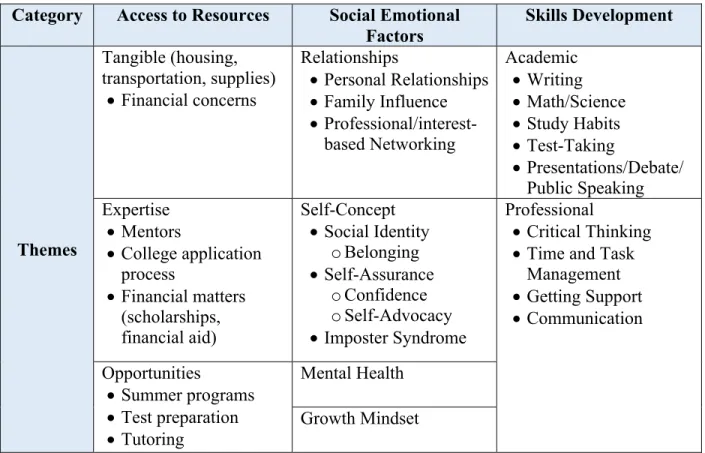
into three main categories: access to resources, social/emotional factors, and skill development.
Table 5 identifies the themes and their assigned categories.
Table 5
Codebook Categories and Themes Derived from Interview Qualitative Analysis Category Access to Resources Social Emotional
Factors
Skills Development
Themes
Tangible (housing, transportation, supplies)
• Financial concerns
Relationships
• Personal Relationships
• Family Influence
• Professional/interest- based Networking
Academic
• Writing
• Math/Science
• Study Habits
• Test-Taking
• Presentations/Debate/
Public Speaking Expertise
• Mentors
• College application process
• Financial matters (scholarships, financial aid)
Self-Concept
• Social Identity o Belonging
• Self-Assurance o Confidence oSelf-Advocacy
• Imposter Syndrome
Professional
• Critical Thinking
• Time and Task Management
• Getting Support
• Communication Opportunities
• Summer programs
• Test preparation
• Tutoring
Mental Health Growth Mindset
Determining Thematic Labels. Our coding process involved developing conceptual definitions and categories to identify and align themes within the data. In the case of
relationships, we identified this topic two-hundred and twenty-two (222) times and further broke it down into sub-themes: personal relationships, family influence, and networking. Personal relationships encompassed the internal communities within MMSEA, as well as relationships with family members, peers, teachers, and coaches. For example, we coded Mariam’s account of her experiences with both supportive and unsupportive teachers as “personal relationships.” She highlighted the impact of teachers on students, stating, “Teachers either make or break a student”
(Mariam, personal communication, April 19, 2023). She had positive experiences with her English Language Learner classes when she first arrived in the United States, recalling the encouragement she received. However, Mariam found some of the professors in college unapproachable and unkind, which led to struggles in her classes and eventually a decision to switch majors and leave the college (personal communication, April 19, 2023). Conversely, we categorized her father’s influence as a “family influence” code. She described his influence on her career choice. “My dad…he was disappointed that I’m not going to become a doctor because he really wanted to become a doctor. He is the main reason why I actually…the first (to choose that) career, in the first place. He was disappointed and didn’t believe that actually I would do it”
(Mariam, personal communication, April 19, 2023).
To ensure clarity and consistency in our coding, we developed conceptual definitions for each theme, as detailed in the codebook provided in Appendix H. We defined personal
relationships as “connections and interactions between individuals, such as the mentees and their families, friends, mentors, teachers, coaches.” When assigning the “family influence” code, we considered the impact of family dynamics, values, beliefs, attitudes, and behaviors on an individual’s development, choices, and well-being. We also considered the roles of cultural traditions, socioeconomic background, education experiences and expectations, and parenting styles in shaping family dynamics.
After defining and aligning our themes, we each returned to our coded transcripts and recorded them using the identified themes and categories. Figure 3 is a bar chart illustrating the total number of references per category. The graduated mentees referenced social-emotional factors more frequently than they referenced either access to resources or skill development.
Figure 3
Number of References to Category by Interviewee
We returned to the literature to explore the connections between our identified themes and SCCT factors on persistence. We employed a systematic approach to identify studies that examined the relationship between the themes we identified (access to resources,
social/emotional factors, and skill development) and the SCCT factors (ability and past
performance, self-efficacy, outcome expectations, goals, and attainment of goals). We included our codebook for reference in Appendix H. It summarizes the categories, themes, conceptual definitions for each theme, examples from the interviews, and literature that explains the connection between each theme and the SCCT factors.
268
764
258
0 100 200 300 400 500 600 700 800 900
Access to Resources Social Emotional Factors Skill Development
Number of References
Categories
The insights gained from the literature indicated that each of the themes identified in the interviews plays a significant role in fostering persistence for the MMSEA graduates. The narratives shared by the graduated mentees vividly illustrated how they utilized the skills
acquired both at MMSEA and independently outside of MMSEA to surpass social and academic hurdles and persist in their college journeys. They also demonstrated the complex and
overlapping nature of the SCCT factors.
Social Emotional Factors
Of these themes, social-emotional factors far outweighed the other two as demonstrated in Table 6. The themes in this category are relationships (including personal relationships, the influence of family, and networking), culture and diversity, mental health, and growth mindset.
Furthermore, we observed themes related to self-concept, such as social identity, belonging, self- assurance, and imposter syndrome. Table 6 provides the frequency of references to the themes categorized as social-emotional factors.
Table 6
The Frequency of References to Social-Emotional Themes
Category/Themes # of
References Social Emotional Factors 764 Total
Relationships 70
· Personal Relationships 38 · Family Influence 59
· Networking 55
Influence of Culture and Diversity 20
Self-Concept 5
· Social Identity 50
o Belonging 40
· Self-Assurance 97
o Confidence 81
o Self-Advocacy 40
· Imposter Syndrome 52
Mental Health 99
Growth Mindset 58
Access to Resources
We operationalized “access to resources” as the availability and utilization of tangible and intangible supports, opportunities, and assets that individuals can leverage to enhance their academic success. During the interviews, several themes emerged, including financial concerns, access to mentorship and expertise, and opportunities such as summer programs and test
preparation classes. As shown in Table 7, financial concerns were mentioned most frequently.
Table 7
The Frequency of References to Access to Resources Themes
Category/Themes # of
References
Access to Resources 268 Total
Tangible (housing, transportation, supplies) 33
· Financial concerns 63
Expertise 32
· Mentors 25
o College application process 34 o Financial matters (scholarships, financial aid) 21
Opportunities 23
· Summer programs 34
· Test preparation 3
Skill Development
Finally, skill development was a recurring theme that mentees attributed to their experience at MMSEA. Specifically, they discussed academic and professional skills that they utilized throughout their college experience and into their careers. Table 8 shows the
development of skills that were mentioned most frequently.
Table 8
The Frequency of References to Skill Development Themes
Skill Development 258 Total
Academic 68
· Writing 19
· Math/Science 11
· Study Habits 14
· Test-Taking 3
· Presentations/Debate/Public Speaking 14
Professional 37
· Critical Thinking 6
· Time and Task Management 32
· Getting Support 41
· Communication 13
Individual Researcher’s Factors Impacting Coding
As discussed above, each researcher developed their own coding themes during their initial transcript reviews. After alignment with the above themes, each researcher returned to their transcripts to adjust their codes to the new themes. During this process, it is important to note the subjectivity and individual biases that could affect the coding process. Ann, our lead researcher, is personally connected to MMSEA through her long-term involvement. She also has a personal connection to all the graduate interviewees who participated in MMSEA while she was a volunteer there. This personal connection may have impacted her coding, resulting in more occurrences of each theme in her transcripts as compared to the other three researchers.
Survey Analysis
We administered our survey to both graduated and current mentees. We received 35 responses, and of those, 28 students completed the entire survey. Of the 28 respondents, 61%
were sophomores or juniors (see Figure 4). Out of the total complete responses, 21 were from current mentees, representing 71% of all current mentees. The majority of all respondents
identified as female (61%) (see Figure 5), and more than half identified as Asian (56%) (see Figure 6).
Figure 4
Number of Survey Respondents by Graduation Year
Figure 5
Number of Survey Respondents by Gender Identity
Figure 6
Number of Survey Respondents by Racial/Ethnic Identity
For the survey, we separated responses by current mentees and graduated mentees. We reviewed the General Self-Efficacy Survey as outlined in the tool created by Schwarzer and Jerusalem (1995). We utilized this tool to inform and yield mentee data related to self-efficacy, which is a crucial aspect of our conceptual framework. We summed the ten items for each respondent to find their general self-efficacy score (GSES), with fifty (50) being the maximum possible value. This score is a validated measure of self-efficacy that is correlated to positive emotions and outlook regarding work. Self-efficacy is a crucial driver of persistence within the SCCT framework, and the GSES provides insight into students’ current levels.
To analyze the data, we then reviewed the mean and overall distribution of GSES disaggregated by grade level to determine if scores differed between mentee classes. It was not possible to determine if observed differences were statistically significant as the total number of respondents in each group was fewer than required for inferential statistics. Table 9 shows the mean GSES for current mentees by their projected graduation year.
Table 9
General Self-Efficacy Survey by Graduation Year
Additionally, we reviewed the response distributions of each item by summarizing the quartiles. As with the GSES, we disaggregated these responses by grade to determine response pattern differences across the different mentee classes. Finally, we reviewed each item’s mean and standard deviation to understand the response distribution better and to highlight specific aspects of self-efficacy and outcome expectations that appeared stronger than others. We completed this process for both the current and graduated mentees. The tables in Appendix I show the mean and standard deviations for current and graduated mentees.
For the final two questions (“What does the word ‘persistence’ mean?” [question 12] and
“Is persistence important to you? Why or why not?” [question 13]), we looked for themes and patterns in respondents' definitions of persistence and their examples to determine how aligned mentees are, both current and graduated, in their ideas of persistence. This process provided valuable data to inform our findings for our first research question regarding MMSEA’s organizational understanding of persistence.
The definition of persistence amongst current mentees was relatively universal. Of the eighteen (18) survey responses, phrases such as “to continue” and “keep going” were most common and appeared in sixteen (16) definitions, reflecting how most of these young people know that persistence is not short-term but requires a significant time commitment. Similarly, sixteen (16) respondents coupled persistence with “difficulty” and “challenges” that twelve (12)
mentees identified as requiring hard work and “trying (their) best.” Interestingly, only ten (10) mentees identified persistence as a means to achieve a goal or desired outcome with eight (8) mentees also understanding the negativity or disappointment that comes with being persistent.
However, when asked whether persistence is important or not, all respon