Journal of Multidisciplinary Engineering Science and Technology (JMEST) ISSN: 2458-9403 Vol. 8 Issue 3, March - 2021
www.jmest.org
JMESTN42353695 13706
Abstract—Many fraudulent schemes go unpublished or even detected. Therefore, effective preventive activities can be of great help in dealing with fraud. This study aims to analyze the factors that influence fraud prevention in the banking sector in Indonesia. This study uses primary data in distributing questionnaires to internal auditors, audit committees, who work in banks listed on the Indonesia Stock Exchange.
The sample selection used purposive sampling method. Data obtained by distributing questionnaires to 10 banks located in Jakarta, Indonesia. The results showed that internal auditors, internal control, audit committee, independent commissioners, management morality, and reliability of information systems have a significant effect on fraud prevention.
Keywords—Internal Control, Internal Auditor, Audit Committee, Independent Commissioner, Management Morality, Information System Reliability, Fraud Prevention
Introduction
Entering the global era, companies are required to be able to produce high quality products or services at low prices as well as quality and adequate services that are expected to provide satisfaction to customers.
To achieve this goal, companies face many problems, one of which is the problem of fraud. Cheating is an act in order to gain individual or group benefits in an organization. Cheating as an illegal act can take the form of cheating, hiding or breaking trust. Examples of cases of fraud that occurred in Indonesia were cases of PT. Kimia Farma, Tbk in 2009, Kimia Farma committed fraud by manipulating their financial statements. Kimia Farma's management reported a net profit of Rp. 132 billion, of which Rp. 99.56 billion was actually. (www.kompasiana.com, 2012) Another case, namely The Enron manipulating their financial statements, Enron hid the liabilities and losses that occurred which caused the profit on the income statement to increase high and the stock price to increase.
One of the ways to prevent fraud is to implement internal controls. The Internal Control System is a business system or social system carried out by a company with the aim of maintaining and directing the company's path in the form of an organizational structure, methods and measures so that it can run based on the objectives and programs of a company as well as encouraging efficiency and compliance with management policies. The Internal Control System has a function, namely rearranging previous resources for better use with the aim of obtaining maximum gains with a design approach that uses the principle of Cost-Benefit, (Fajarini, 2012).
The implementation of the Internal Control System in a company is aimed at avoiding deviations from procedures, trust in the results of a company's financial statements and legal compliance with company activities and the enforcement of regulations. This application is carried out by management in order to avoid risks (Fajarini, 2012) The implementation of internal control is usually supported by the availability of an internal auditor. The effectiveness of the internal audit activity is very helpful in dealing with fraud. Although management and the board are responsible for fraud prevention, internal auditors can provide assistance to management by providing provisions whether the organization has adequate internal controls and fosters an environment with adequate controls. The internal audit department has an important role in the company because it is a key element in the application of the accounting system by helping to provide an evaluation of the department's work.
Internal audit is an important part of the structure of Corporate Governance, namely in the supervisory activities taken by the board of directors and also the audit committee to ensure that the financial reporting process can be trusted (Briloff, 1994).
The audit committee is a component that has an important role in a financial reporting system by providing oversight of the participation of management and independent auditors in the process of implementing financial reports (Sugeng Pamudji, 2010). The audit committee should be "tuned" to a
Fraud Prevention In The Banking Sector In Indonesia:
What's Relating?
Reschiwati 1), Mukthia Daniza Putri 2), Choirul Anwar 3)
1),2)
Sekolah Tinggi Ilmu Ekonomi Y.A.I Jakarta Indonesia ; 3) Universitas Negeri Jakarta Indonesia [email protected]
Journal of Multidisciplinary Engineering Science and Technology (JMEST) ISSN: 2458-9403 Vol. 8 Issue 3, March - 2021
www.jmest.org
JMESTN42353695 13707
tone at the top of the organization as the first indicator of the functioning of the internal control system. In addition, the audit committee must be aware that the internal control system must be scaled to the organization.
Fraud prevention requires supervision. Supervision is one of the many components that are important in realizing good corporate governance. The board of commissioners is in charge of supervising the management of the company by management.
Generally, the board of commissioners has a better ability to supervise management such as the presentation of financial statements (Chtourou et al, 2001). The existence of independent commissioners has a positive impact in a company on company performance and value (Feng Yin, 2011). Independent commissioners have responsibility for the interests of shareholders, therefore independent commissioners will try to comply with corporate taxes and can prevent tax avoidance practices (S. R. Puspita, 2014)
The organization can never eliminate the risk of fraud. The risk of fraud is also related to management morality. There are always people motivated to commit fraud, and opportunities can arise for someone in any organization to override internal controls or collude with others to circumvent internal controls. Although every organization is prone to fraud, it is not cost effective to try to eliminate all risks of fraud. An organization may choose to design its controls to detect, rather than prevent, the risk of fraud.
Fraud can be prevented by implementing a reliable information system. The quality of the accounting information system is able to detect possible risks from an early age and also will not mislead decision makers when managing their organization. Accounting information systems that have good quality are able to detect if there are fraud irregularities in a company environment as quickly as possible and can be carried out by employees or top management, so that companies or agencies can prevent fraud more quickly, so as not to cause much harm to the company or agency. more broadly.
Research related to fraud prevention has been carried out, among others (Andreas & Natariasari, 2014). Research with Internal Audit (X) & Fraud Prevention (Y) variables focuses on analyzing the influence of the role of internal audit which consists of independence, professional skills, scope of work, audit work performance, and management of the internal audit department on fraud prevention. The results showed that the role of internal audit has an effect on fraud prevention. This means that the role of internal audit is getting better, so that fraud prevention will increase.
Gusnardi (2009) conducted research with the variables of the Audit Committee (X1), Internal Control (X2), Internal Audit (X3), GCG Implementation (X4), and Fraud Prevention (Y). This study concludes that the role of the audit committee, internal control, internal audit, and the implementation of good corporate governance has a significant effect on fraud
prevention in BUMN companies in Indonesia. From this research, it is revealed that the optimization of the role of the audit committee, the implementation of internal control, internal audit and the application of good corporate governance can prevent fraud prevention in BUMN in Indonesia.
Suginam (2017) conducted a Case Study at PT.
Tolan Tiga Indonesia. This study uses the variable Internal Audit (X1), Internal Control (X2), and Fraud Prevention (Y) which focuses on knowing the elements of illegal acts committed by people inside and outside the organization, to gain personal or group benefits. , and directly or indirectly harm other parties at the Head Office of PT. Tolan Three. From this research, it shows that internal audit and company internal control have a very big role in the company to control and evaluate the activities of company activities, especially in fraud prevention.
Rajagukguk T (2017) also conducted a case study at PT Perkebunan Nusantara IV with the title of research on The Effect of Internal Audit and Fraud Prevention on Financial Performance. This study uses Internal Audit (X1), Fraud Prevention (X2), and Financial Performance (Y) variables which focus on whether the information provided by Internal Audit has a major influence on information users such as shareholders, especially in companies in the form of limited liability companies. . Once a year, the General Meeting of Shareholders (GMS) will ask for accountability in the form of financial reports. From this financial report, it will be possible to predict whether there was fraud. So in the financial statements issued by the company is a reflection of the company's financial performance. The results of the study concluded that there was a significant effect of internal audit and fraud prevention on financial performance.
Kusumaningsih & Wirajaya (2017) conducted research on the factors that influence fraud in banking companies. Research with the variable proportion of the Komsaris Board (X), Audit Committee (X2), and Fraud (Y) aims to determine the factors that influence fraud in banking companies based on the fraud triangle theory, which is analyzed using logistic regression analysis techniques and obtained results that the financial target as measured by ROE in the previous period, the proportion of the independent board of commissioners and the size of the audit committee did not affect fraud. Personal financial need is measured by the presence or absence of share ownership of directors and / or commissioners, proven to reduce the occurrence of fraud in banking companies.
Research by Nur Cahyo & Sulhani ( 2017) empirically analyzes the influence of Audit Committee Characteristics, Internal Audit Characteristics, Whistleblowing System, Fraud Disclosure on Market Reactions Research with variable Audit Committee Characteristics (X1), Internal Audit Characteristics (X2), Whistleblowing System X3 ), Fraud Disclosure (X4), and Market Reaction (Y) resulted in the conclusion that (The effectiveness of the audit
Journal of Multidisciplinary Engineering Science and Technology (JMEST) ISSN: 2458-9403 Vol. 8 Issue 3, March - 2021
www.jmest.org
JMESTN42353695 13708
committee has a significant negative effect on the whistleblowing system; The effectiveness of internal audit does not have a significant effect on the whistleblowing system. Affects the whistleblowing system; the whistleblowing system has no effect on fraud disclosure; fraud disclosure has a significant negative effect on stock market reactions.
Saputra ( 2017) conducted research on the influence of the internal system, control, internal audit and the implementation of good corporate governance against bank fraud (a case study on a Sharia Bank, a state-owned company in Medan). This research is motivated by frauds (Fraud) that often occur in the banking world. Fraud cases that occur in the banking world can occur and be carried out by anyone external or internal to the banking sector itself. Internal control systems, internal audits and the implementation of Good Corporate Governance (GCG) are some of the very important things that banks use to be able to run their business properly without any illegal actions taken for profit only. This research was conducted to find out the effect of the internal control system, internal audit and the implementation of GCG on fraud in banking. The results of this study reveal that partially the internal control system has a significant negative effect on fraud, which means that the better the internal control system, the lower the level of fraud. Second, partially, internal audit has a significant negative effect on fraud, meaning that the better the internal audit in a company, the level of fraud (fraud) will decrease. Furthermore, partially the implementation of GCG has a negative and significant effect on fraud, which also means that the better the implementation of GCG, the lower the level of fraud.
Joseph, Albert, & Byaruhanga (2015) conducted a study entitled Effect of Internal Control on Fraud Detection and Prevention in District Treasuries of Kakamega County. This study uses variable Internal control (Y), Fraud prevention (X1), Fraud detection (X2) to determine the effect of internal control on fraud prevention and detection in the district treasury in Kakamega Regency. The results revealed that there was a significant and positive relationship between the adequacy of the internal control system and fraud prevention and detection in the district treasury in Kakamega Regency.
Research entitled Internal Control and Fraud Prevention in Nigerian Business Organization: A Survey of Some Selected Companies in Warri Metropolis was conducted by (Ozigbo & Orife, 2011), with variable Internal control (X), Fraud prevention (Y).
The aim of this study is to examine internal control and fraud prevention in Nigerian business organizations. The results of the study found that internal control has a significant relationship with fraud prevention, and internal control is a necessary safeguard that ensures the absence of business owners whose funds are used efficiently.
Literature Review Attribution Theory
Attribution theory according to Heider is a theory that explains a person's behavior. Attribution theory studies the process of how a person interprets an event, reason, or cause of behavior (Ishak, 2008).
Heider developed this theory by arguing that a person's behavior is determined by a combination of internal forces and external forces.
This study uses attribution theory because the test is carried out to obtain empirical evidence of the variables that affect fraud prevention. Good or bad and the effectiveness of the role and ability of the internal audit, audit committee, and board of commissioners in preventing fraud. The personal characteristics of the internal audit, audit committee and board of commissioners are internal factors that encourage activity. Personal characteristics include professional skepticism owned by both the internal auditors, the audit committee, and the board of commissioners. Personal attributes are also related to management morality to prevent possible fraud from occurring.
Fraud Prevention
Fraud according to Tuanakotta (2007) is an act of violating the law by parties from within or outside the organization, which directly harms other parties with the aim of obtaining personal or group benefits.
Conditions that create the possibility of fraud, namely:
(a) Pressure; (b) Opportunities; (c) Rationalization.
The increasing number of cases of fraud causes the company to suffer significant losses. If it is difficult to reduce or prevent fraud, it will cause fatal problems for the company. Therefore, proper action is needed for company management to prevent fraudulent acts.
Internal control
Internal control is a process designed to shape the confidence of the entity's board of commissioners, management and other personnel so as to produce three objectives, namely: (a) reliable financial reports;
(b) operations that run effectively and efficiently; (c) comply with applicable laws and regulations. Internal control aims to ensure company management in order to: 1) Achieve the goals set by the company; (2) Reliability on the results of financial statements by the company; and (3) The company's activities are in accordance with legal laws and regulations.
Internal Audit
Internal audit is managerial oversight that helps all members of management to effectively manage their responsibilities through providing analysis, providing useful assessments, recommendations and comments relating to the activities being reviewed by providing evaluation and measuring the control system. According to Sawyer (2005) opinion, Internal Audit is a systematic and objective assessment by internal auditors on different operations and controls in an organization in order to determine several things, namely: (1) the accuracy and reliability of financial and operational information; (2) Risk can be identified and minimized in a company; (3) Adhering to external regulations, internal policies and
Journal of Multidisciplinary Engineering Science and Technology (JMEST) ISSN: 2458-9403 Vol. 8 Issue 3, March - 2021
www.jmest.org
JMESTN42353695 13709
procedures that are obtained; (4) Fulfillment of satisfaction with operating criteria; (5) Resources have been used efficiently and economically.
Audit Committee
The audit committee is one of the committees created and has responsibility to the board of commissioners to provide assurance that the principles of Good Corporate Government have been applied and transparency and disclosure consistently and adequately by executives ((Tjager, 2003).
According to Alijoyo (2003). ), The function of the audit committee is to provide assistance to the board of commissioners in terms of making financial reports more quality, realizing company discipline to reduce opportunities for irregularities, increasing the function of internal audit or external audit more effectively, identifying various types that require attention from the board of commissioners or the board supervisor.
Independent Commissioner
Independent Commissioner is a member of the board of commissioners who is not affiliated with the board of directors, other members of the board of commissioners and controlling shareholder, is also free from various business relationships or other relationships that can affect the ability to behave independently or behave solely for the benefit of a company. Independent Commissioner Duties. The duties of independent commissioners are: (1) There is a guarantee of transparency and openness of the company's financial statements; (2) Provide fair treatment to minority shareholders and other stakeholders; (3) Fair and fair disclosure of transactions where there is a conflict of interest; (4) The company complies with applicable laws and regulations; (5) Ensuring the accountability of the company's organs. The powers of the Independent Commissioner are: (1) As the chairman of the audit committee and the nomination committee; (2) Based on rational and prudent considerations, the independent commissioner has the right to give ideas that are not the same as other members of the board of commissioners which must be recorded in the Minutes of Board Meetings. Commissioners and different ideas that are material, must be included in the annual report.
Management Morality
Management morality is an act of management that does not seek profit by behaving correctly (Kusumastuti, 2006). According to Wilopo (2006), the stages of moral development are a measure of a person's low and high moral values based on the development of his moral reasoning. The theory has a view on the level of moral reasoning. The higher stages of management or post-conventional morality make management have a broader view by not only seeing corporate or personal interests. Therefore, the higher the morality, the more management will avoid accounting fraud. Accounting fraud has an impact on the state and also worsens the business climate in Indonesia.
Information System Reliability
Accounting information can make it easier for companies to carry out accounting activities and also information obtained more quickly so that company operations can be carried out effectively and efficiently and are able to provide useful information results during the decision-making process. According to Mulyadi (2008) the objectives of accounting information systems are: (1 Provider of information for managers of new business activities; (2) Improving information both about the accuracy or structure of information that has been generated by the previous system; (3) Making improvements to accounting controls and internal checks , namely to improve the level of reliability (reliability) accounting information and to provide a complete record of the accountability and protection of company assets, (4) Reducing clerical costs in maintaining accounting records.
Internal Control with Fraud Prevention
The opportunity element in the factors causing fraud can be suppressed by internal control (Tuanakotta, 2007). There are five components to make the internal control system mechanism efficient and effective. In research conducted by (Amrizal, 2004), one thing that can help prevent fraud is to create a good internal control structure. The amount of information that has been discussed regarding motives for committing fraud has made management prudent so that fraud does not arise. Management is required to establish a sound and effective internal control structure, evaluate and implement components of internal control to prevent fraud in the entity.
Internal Audit and Fraud Prevention
Internal auditors have a major role in preventing fraud, namely by making efforts to eliminate or minimize the causes of fraud. There are three things that cause cheating, namely the element of desire, greed, and opportunity. To eliminate these three things, fraud awareness and examples are planted in new employees.
Audit Committee with Fraud Prevention
In carrying out its duties, the audit committee has the function of assisting the board of commissioners to (i) improve the quality of financial reports (ii) create a disciplined climate that can minimize the chances of irregularities in company management (iii) increase the effectiveness of internal and external audit functions, and (iv) identify things that require attention from the board of commissioners or the supervisory board (Alijoyo, 2003)).
Independent Commissioner with Fraud Prevention The increasing proportion of Independent Commissioners is expected to make supervisory performance more effective so that opportunities for fraud by company organs can be prevented.
Morality of Management with Fraud Prevention In the theory of moral development, Kohlberg (1969) argues that morals develop through three stages, namely the pre-conventional stage, the conventional stage, and the post-conventional stage.
Management morality at the post conventional stage shows the high moral maturity of management which
Journal of Multidisciplinary Engineering Science and Technology (JMEST) ISSN: 2458-9403 Vol. 8 Issue 3, March - 2021
www.jmest.org
JMESTN42353695 13710
becomes the basis and consideration of management in designing responses and attitudes to ethical issues.
Therefore, management morality has an influence on unethical behavior by the company. The higher the morality, the less cheating.
Information System Reliability with Fraud Prevention
The existence of a good accounting information system will make the company's management operations activities effective and efficient. The accounting information system is an information system within a company that can be used as a guide in assignments, obtained by collecting and processing transaction data which has the responsibility of preparing useful information for all users both inside (internal) and outside (external) of the company. The most important thing from the Accounting Information System is to support planning and control.
Research Design and Hypotheses
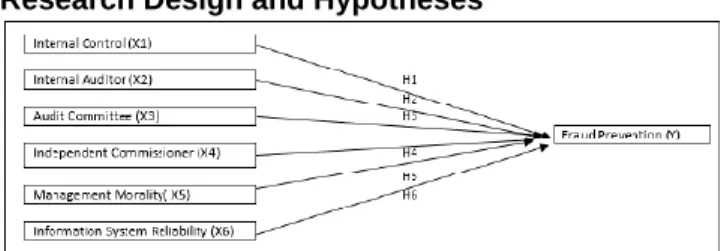
Figure 1 Reseach Design
H1: Internal control has a positive effect on fraud.
H2: Internal audit has a positive effect on fraud.
H3: The Audit Committee has a positive effect on fraud.
H4: Independent Commissioner has a positive effect on fraud.
H5: Management Morality has a positive effect on fraud.
H6: Reliability of Information Systems has a positive effect on fraud.
Research Methodology
Population, Sample and Respondents
The population in this study is all banking companies, which have been listed on the Indonesia Stock Exchange in 2020, namely 44 banks. The sampling technique used in this study was purposive sampling with the following criteria: (a) Companies in the banking sub-sector listed on the Indonesia Stock Exchange (IDX) for the period 2020; (b) The company was not delisted on the IDX during the research period; (c) It has a control structure, namely internal audit. Respondents are internal auditors, audit committee, and independent board of commissioners with the following criteria: (a) Have work experience or have held the position for at least three years of service; (b) Having a minimum educational background for Strata 1.Based on these criteria, 10 companies in the banking sector that were listed on the IDX 2020 were selected to be used as samples in this study with 100 respondents.
Operationalization of Variables Fraud Prevention
This variable is measured using an instrument quoted from the BPKP Pusdiklatwas (2008: 38) in Mulinda (2017) consisting of 5 indicators, namely: (1) Implementation of anti-fraud policies; (2) the values applied by the company; (3) strict HR screening; (4) Implementation of segregation of functions within the organization; (5) The role of an effective internal audit
& audit committee
Internal control
This variable is measured using an instrument quoted from COSO (2013) in Herawati (2014) with 5 dimensions, namely: (1) Control environment with 5 indicators, namely integrity and ethical values, independence of the board of directors, implementation of the supervisory function of the board of directors, division of authority and responsibility, Implementation of HR internal control responsibilities; (2) risk assessment with 2 indicators, namely risk identification and risk assessment, (3) control activities with 2 indicators, namely the selection of appropriate control activities and implementation of technology in control; (4) Information and communication with 2 indicators, namely reliable and relevant information and communication of internal control to external parties;
(5) Monitoring with 2 indicators, namely evaluation of internal control functions and continuous monitoring.
Internal Audit
This variable is measured using an instrument adopted from Boynton and Kell (1996) in Fitzsimmons
&Mona (2011) with 5 dimensions, namely: (1) Independence with 3 indicators, namely separate and independent audit, neutral audit assessment, internal audit. objective; (2) Professional Skills with 3 indicators, namely education and expertise, skills and proficiency, basic technical abilities; (3) Audit work scope with 3 indicators, namely assessment and evaluation of the effectiveness of internal control and quality of financial report information, evaluation of company control systems, quality of implementation in completing assigned responsibilities; (4) Implementation of work with 3 indicators, namely planning audits, reviewing and evaluating information, reporting the results of examinations, communicating results and follow-up actions; (5) Management of the internal inspection department with 3 indicators, namely the management of the audit department appropriately and the division of tasks, Determining the program for selecting and developing human resources, coordinating the internal audit efforts with external auditors.
Audit Committee
This variable is measured using instruments taken from Alijiyo (2003) in Sariah( 2010), consisting of 3 indicators, namely: (1) The objectives and benefits of establishing an audit committee with 2 indicators, namely financial statement supervision and independent supervision; (2) The responsibility of the audit committee with 3 indicators, namely Providing
Journal of Multidisciplinary Engineering Science and Technology (JMEST) ISSN: 2458-9403 Vol. 8 Issue 3, March - 2021
www.jmest.org
JMESTN42353695 13711
professional opinion on company information, Responsible for internal and external company activities and Responsible for overseeing all company activities; (3) The scope of work of the audit committee with 3 indicators, namely Audit committee charter, audit committee structure and audit committee membership requirements, audit committee meetings, performance and audit committee reports.
Independent Commissioner
This variable is measured using an instrument adopted from Appendix II of the Financial Services Authority Circular Letter No. 15 / SEOJK.05 / 2016 consists of 4 indicators, namely: (1) Reporting on findings; (2) Management Oversight of the running of the company; (3) Safeguarding against conflicts; (4) Supervision of the Board of Directors
Management Morality
This variable is measured using an instrument taken from the measurement of management morality derived from the moral measurement model developed by (Wilopo, 2006) in the form of an Accounting Ethics Dilemma Case which consists of 6 indicators, namely (1) Termination, (2) Bonus earning;
(3) company performance; (4) prevalence; (5) Sanctions; (5) Welfare Principle.
Information System Reliability
This variable is measured using 3 dimensions, namely: (1) Service Quality with 8 indicators, namely the implementation of company information systems, adequate communication networks, ability to handle problems and provide services, the accuracy of company information systems, can provide fast service, human resource skills and proficiency , The role of the company in handling information systems, adequate information systems; (2) System Quality with 4 indicators, namely Ease of Access, Speed of Access, Security, Informative Report Results.
Data analysis method
The data analysis technique used to test the hypothesis in this study is Structural Equation Modeling (SEM). use the help of SmartPLS 3.2.7 Software. The PLS (Partial Least Square) method of analysis techniques is as follows: (1) Analysis of the outer model, carried out with the aim of ensuring that the measurement used is appropriate as a measurement tool (valid and reliable). In the analysis of this model, it specifies the relationship between latent variables and their indicators. Analysis of the outer model can be seen from several indicators: (a) Convergent Validity, (b) Discriminant Validity, (c) Composite reliability, (d) Cronbach's Alpha; (2) Inner model analysis is usually also called (inner relation, structural model and substantive theory) which describes the relationship between latent variables based on the substantive theory. Inner model analysis can be evaluated by looking at the R-square for the dependent construct, the Stone-Geisser Q-square test for predictive relevance and the t test and the significance of the structural path parameter coefficients; (3) Hypothesis testing is seen from the t-
statistical value and probability value. To test the hypothesis by comparing the statistical value with the t-table for 5% alpha, the t-table value used was 1.96.
So that the criteria for acceptance / rejection of the hypothesis is that Ha is accepted and H0 is rejected when the t-statistic is greater than 1.96. To reject / accept the hypothesis using probability, Ha is accepted if the p value is less than 0.05.
Result
Characteristics of Respondents
60% of the respondents were 25-35 years old, 31.0% were 36-45 years old, and 9.0% were 46-55 years old. Based on gender, most of the respondents were female, namely 51%, and the remaining 49.0%
were male. In terms of education, most of the respondents had the last S1 education, namely 84.0%, and the remaining 16.0% had the latest S2 education. In terms of tenure, most respondents worked for 1-5 years, namely 42.0%, 6-10 years 29.0%, 11-15 years 19.0%, 16-20 years 7.0% The remaining 3.0% of respondents have a work period of more than 20 years.
Perception of Respondents
The categorization of the assessment is based on the respondents' score. The assessment categories are determined based on the number of measurement scales used, namely five classifications.
𝑃 =𝑋𝑚𝑎𝑘𝑠− 𝑋𝑚𝑖𝑛 𝑏
𝑃 = class length of each interval 𝑋𝑚𝑎𝑘𝑠 = maximum value
𝑋𝑚𝑖𝑛 = minimum value 𝑏 = number of classes
The classification of the assessment categories on the average value of the calculation is: Very not good (1 - 1.80); Not good (1.81 - 2.60); Less well (2.61 to 3.40);
Good (3.41 - 3.80); Very Good (3.81 - 5.00).
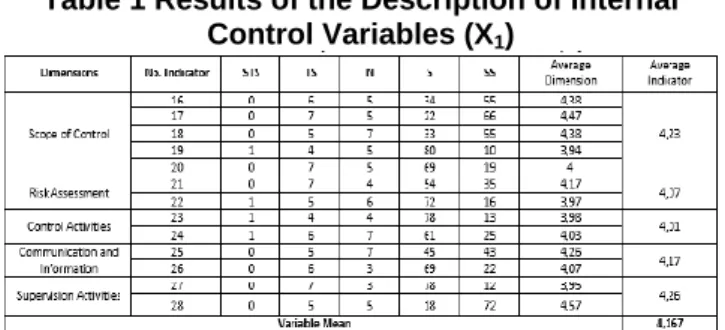
Table 1 Results of the Description of Internal Control Variables (X1)
From table 1 above, the respondent's response to the Internal Control variable (X1) produces a mean of 4.167 which indicates that respondents tend to respond very well to the Internal Control variable (X1).
The dimension that was rated the highest by respondents was Supervision Activities with an average of 4.26. And the lowest dimension assessed by respondents is Control Activities with an average of 4.01.
Journal of Multidisciplinary Engineering Science and Technology (JMEST) ISSN: 2458-9403 Vol. 8 Issue 3, March - 2021
www.jmest.org
JMESTN42353695 13712
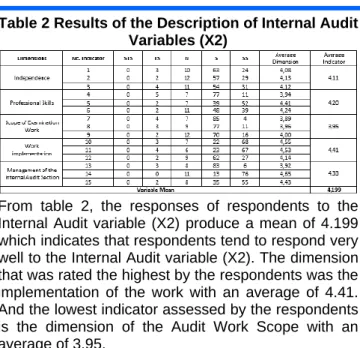
Table 2 Results of the Description of Internal Audit Variables (X2)
From table 2, the responses of respondents to the Internal Audit variable (X2) produce a mean of 4.199 which indicates that respondents tend to respond very well to the Internal Audit variable (X2). The dimension that was rated the highest by the respondents was the implementation of the work with an average of 4.41.
And the lowest indicator assessed by the respondents is the dimension of the Audit Work Scope with an average of 3.95.
Table 3 Results of the Variable Description of the Audit Committee (X3)
From table 3 above, the respondents' responses to the Audit Committee variable (X3) produce a mean of 4.166 which indicates that respondents tend to respond very well to the Audit Committee variable (X3). The dimension rated the highest by respondents was the Responsibility of the Audit Committee with an average of 4.33. And the lowest dimension assessed by respondents is the Scope of Work of the Audit Committee with an average of 3.93.
Table 4 Results of Variable Descriptions for Independent Commissioners (X4)
From table 4 above, the respondents' responses to the Independent Commissioner variable (X4) produce a mean of 4,170 which indicates that respondents tend to respond very well to the Independent Commissioner variable (X4). The indicator that was rated the highest by the respondents was item 38 concerning the kinds of active supervision on the Board of Commissioners and Directors with a mean of 4.32. And the lowest indicator is item 39 concerning the ability of the Board of Commissioners in carrying out supervisory duties and providing advice to the Board of Directors with an average of 4.04.
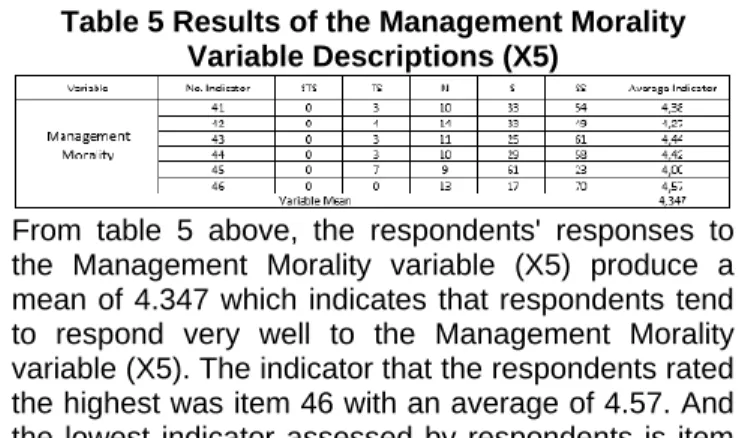
Table 5 Results of the Management Morality Variable Descriptions (X5)
From table 5 above, the respondents' responses to the Management Morality variable (X5) produce a mean of 4.347 which indicates that respondents tend to respond very well to the Management Morality variable (X5). The indicator that the respondents rated the highest was item 46 with an average of 4.57. And the lowest indicator assessed by respondents is item 45 with an average of 4.00
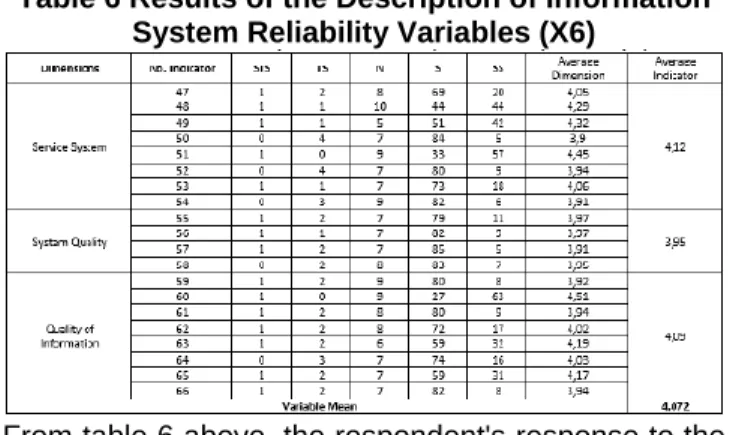
Table 6 Results of the Description of Information System Reliability Variables (X6)
From table 6 above, the respondent's response to the Information System Reliability variable (X6) produces a mean of 4.072 which indicates that the respondent tends to respond very well to the Information System Reliability variable (X6). The dimension that was rated the highest by the respondents was the Service System with an average of 4.12. And the lowest dimension assessed by respondents is System Quality with an average of 3.95.
Table 7 Results of Variable Description of Fraud Prevention (Y)
From table 7 above, the respondents' responses to the Fraud Prevention variable (Y) produce a mean of 4.276 which indicates that respondents tend to respond very well to the Fraud Prevention variable (Y). The indicator that was rated the highest by the respondents was "There is an independent audit committee & internal audit which is responsible for periodic evaluation" with an average of 4.51. And the lowest indicator assessed by respondents is the indicator "There is a separation of functions that creates conditions for mutual checks between functions, clear division of tasks and adequate supervision" with an average of 4.02.
Journal of Multidisciplinary Engineering Science and Technology (JMEST) ISSN: 2458-9403 Vol. 8 Issue 3, March - 2021
www.jmest.org
JMESTN42353695 13713
Evaluate the Outer Model
Evaluation of the measurement model is the test stage of evaluating the validity and reliability of a construct. Each of these will be explained as follows:
Figure 2 Outer Model construct
Convergent Validity Test
Evaluation of construct validity can be seen through the loading factor value and Average Variance Extracted (AVE). The construct can be said to meet the convergent validity test if it has a loading factor and the Average Variance Extracted (AVE) is greater than 0.5. Following are the results of the convergent validity test as follows:
Table 8 Testing Results of Convergent Validity of Internal Control Variables (X1)
Based on table 8 above, it is known that all indicators in all dimensions have a loading factor value and AVE is greater than 0.5 so that it can be said that all indicators are declared valid so that they can be used to measure Internal Control variables (X2)
Table 9 Results of Testing the Convergent Validity of Internal Audit Variables (X2)
Based on table 9, it can be seen that all indicators in all dimensions have a loading factor value and AVE is greater than 0.5. So that it can be said that all indicators are declared valid so that they can be used to measure the Internal Audit variable (X2).
Table 10 The Results of Testing the Convergent Validity of Audit Committee Variables (X3)
Based on table 10 above, it can be seen that all indicators in all dimensions have a loading factor value and AVE is greater than 0.5. So that it can be said that all of these indicators are declared valid so that they can be used to measure the Audit Committee variable (X3).
Table 11 The Results of Testing the Convergent Validity of Independent Commissioner (X4)
Based on table 11 above, it can be seen that all indicators have a loading factor value and AVE is greater than 0.5. So it can be said that all of these indicators are declared valid so that they can be used to measure the Independent Commissioner variable (X4).
Table 12 Test Results of Convergent Validity of Management Morality Variables (X5)
Based on table 12 above, it can be seen that all indicators produce loading factor values and AVE values are greater than 0.5. so that it can be stated that all of these indicators are declared valid so that they can be used to measure the Management Morality variable (X5).
Table 13 Test Results of Convergent Validity of Information System Reliability Variables (X6)
Based on table 13 above, it can be seen that all indicators in all dimensions have a loading factor value and AVE is greater than 0.5. so that it can be said that all indicators are said to be valid so that they can be used to measure the variable Information System Reliability (X6).
Journal of Multidisciplinary Engineering Science and Technology (JMEST) ISSN: 2458-9403 Vol. 8 Issue 3, March - 2021
www.jmest.org
JMESTN42353695 13714
Table 14 Test Results of Convergent Validity of Fraud Prevention Variables (Y)
Based on table 14 above, it can be seen that all indicators have a loading factor value and AVE is greater than 0.5. So it can be said that all of these indicators are said to be valid so that they can be used to measure the Fraud Prevention variable (Y).
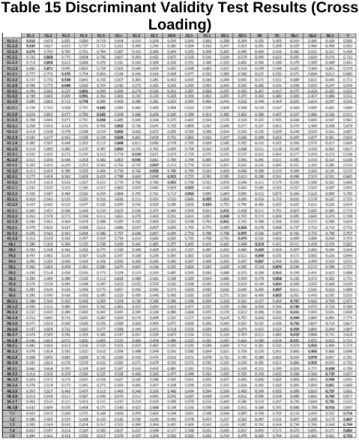
Discriminant Validity Test
Table 15 Discriminant Validity Test Results (Cross Loading)
Discriminant validity was tested by looking at cross loading. Valid criteria if the cross loading value in a corresponding variable is greater than the cross loading value of the indicator in other variables, then the indicator is declared valid. Based on table 16, it can be seen that all indicators of all variables have a loading value that is greater than the loading value of other variables. So it can be said that from the discriminant validity test, each indicator can measure the latent variable that corresponds to the indicator.
Construct Reliability
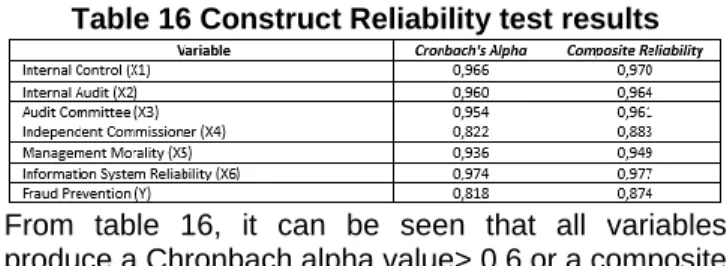
To test the construct reliability, look at Cronbach alpha and composite reliability. The test criteria for the test is to get a value> 0.7 on composite reliability and a value> 0.6 on Cronbach alpha, so the construct is declared reliable. The results of the composite reliability and Cronbach alpha output are as follows:
Table 16 Construct Reliability test results
From table 16, it can be seen that all variables produce a Chronbach alpha value> 0.6 or a composite reliability value> 0.7. Because the value of the Chronbach alpha value or the composite reliability value meets the criteria, all indicators are declared reliable in measuring the variable.
Inner Model Evaluation
The evaluation of the structural model or inner model is used to test the evaluation of goodness of fit which consists of the coefficient of determination, predictive relevance, and hypothesis testing. The following are the results of the inner model evaluation:
Table 17 Results of the Coefficient of Determination (R2)
Table 17 shows the Value of Adj. The r-square of the Fraud Prevention variable is 0.810 or 81.0%. These results show that the variety of Fraud Prevention (Y) variables can be explained by Internal Control (X1), Internal Audit (X2), Audit Committee (X3), Independent Commissioners (X4), Management Morality (X5), and Information System Reliability. (X6) of 81.0%. Or in other words the contribution of the influence of the Internal Audit variable (X1), Internal Control (X2), the Audit Committee (X3), the Independent Commissioner (X4), Management Morality (X5), and Information System Reliability (X6) on Fraud Prevention. (Y) at 81.0%. and the remaining 19.0% is the contribution of other variables outside of this study.
Table 18 Predictive Relevance Test Results (Q2)
The results in table 18 show that the Predictive Relevance (Q2) value is greater than 0 (zero) so that it can be said that the model is good enough.
Hypothesis test
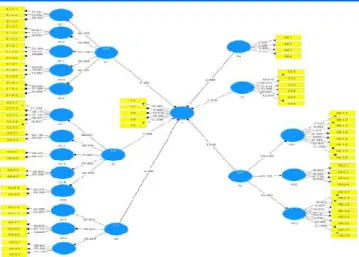
To test the hypothesis using the -T test, which functions to determine whether or not the influence of the independent variable on the dependent variable is present. The criterion of this test is that if the t-count value ≥ T-table (1.96) or p-value <significant alpha 5%
or 0.05 is obtained, it is said that there is a significant effect of the independent variable on the dependent variable. The results of the significance test and the model can be seen in the following figure and table.
Journal of Multidisciplinary Engineering Science and Technology (JMEST) ISSN: 2458-9403 Vol. 8 Issue 3, March - 2021
www.jmest.org
JMESTN42353695 13715
Figure 3 Inner Model construct
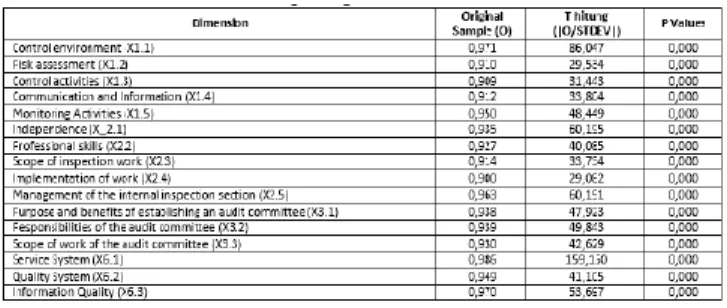
Table 19 Results of Testing the Significance of Dimensions on Variables
Based on the results, it can be seen that all dimensions produce a value of T count> 1.96 with a p- value of less than 0.05. This means that each dimension is able to measure the latent variable. It is also known from table 4:21 that the management dimension of the internal inspection section (X1.5) measures the Internal Audit variable (X2) the highest, the Control Environment dimension (X2.1) measures the Internal Control variable (X1) the highest, the audit committee responsibility dimension (X3.2) measures the Audit Committee variable (X3) the highest, and the Service System dimension (X6.1) measures the Information System Reliability variable (X6) the highest. This is proven by the result of the highest estimate among other dimensions.
Table 20 Hypothesis Testing Results
Conclusion and Discussion
The Internal Audit Effect Test (X1) on Fraud Prevention (Y) produces a T statistical value greater than 1.96 with a p-value less than 0.05. This indicates that Internal Audit (X1) has a significant effect on Fraud Prevention (Y) so that hypothesis 1 is fulfilled.
The resulting coefficient is positive, which means that the higher Internal Audit (X1) tends to increase Fraud Prevention (Y). This is in line with the theory of (Fraud Prevention, Fraud Detection, Fraud Investigation) (Amrizal, Fraud Prevention and Detection by Internal Auditors, 2004) which states that internal audit within a company can ward off the possibility of fraud risk
that could threaten the achievement of business entity objectives.
The Test of the Effect of Internal Control (X2) on the Prevention of Fraud (Y) produces a T statistical value greater than 1.96 with a p-value of less than 0.05.
This shows that there is a significant effect of Internal Control (X2) on Fraud Prevention (Y) so that hypothesis 2 is fulfilled. The resulting coefficient is positive, which means that the higher Internal Control (X2) it tends to increase Fraud Prevention (Y) This is in line with the theory of (Sawyer, 2005) that the internal control system in the company can ward off the possibility of the risk of fraud which could threaten the achievement of the business entity's objectives.
The Audit Committee Effect Test (X3) on Fraud Prevention (Y) produces a T statistical value greater than 1.96 with a p-value less than 0.05. This means that the Audit Committee (X3) has a significant effect on Fraud Prevention (Y) so that hypothesis 3 is fulfilled. The resulting coefficient is positive, which means that the higher the Audit Committee (X3) tends to increase Fraud Prevention (Y). This is in line with the theory (Amijaya, Dody, & Prastiwi, 2013), that the responsibility of the audit committee is to encourage the formation of an adequate internal control structure, make the financial reporting system more open, review the scope and provisions, costs, and independence as well as external audit objectivity.
The Test of the Effect of the Independent Commissioner (X4) on Fraud Prevention (Y) produces a statistical T value> 1.96 with a p-value <0.05. This means that there is a significant effect of the Independent Commissioner (X4) on Fraud Prevention (Y) so that hypothesis 4 is fulfilled. The resulting coefficient is positive, which means that the higher the Independent Commissioner (X4), the more likely it is to increase Fraud Prevention (Y) This is in line with the theory (KNKG, 2006) that the number of Independent Commissioner members must be able to guarantee the effectiveness and compliance of regulations laws and regulations in the implementation of supervision. So, the higher the transparency, the better the fraud prevention level.
The Test of the Effect of Management Morality (X5) on the Prevention of Fraud (Y) produces a statistical T value> 1.96 with a p-value <0.05. This means that there is a significant effect of Management Morality (X5) on Fraud Prevention (Y) so that hypothesis 5 is fulfilled. The resulting coefficient is positive, which means that the higher the Morality of Management (X5), the more likely it is to increase Fraud Prevention (Y). This is in line with (Wilopo, 2006) the stages of moral development are a measure of the low and high moral level of a person based on the development of moral reasoning. The theory has a view on the level of moral reasoning. The higher stages of management or post-conventional morality make management have a broader view by not only seeing corporate or personal interests alone ..;
The Test of the Effect of the Reliability of Information Systems (X6) on the Prevention of Fraud (Y) produces a statistical T value> 1.96 with a p-value
Journal of Multidisciplinary Engineering Science and Technology (JMEST) ISSN: 2458-9403 Vol. 8 Issue 3, March - 2021
www.jmest.org
JMESTN42353695 13716
<0.05. This means that there is a significant effect of Information System Reliability (X6) on Fraud Prevention (Y) so that hypothesis 6 is fulfilled. The resulting coefficient is positive, which means that the higher the Reliability of Information Systems (X6), it tends to increase Fraud Prevention. (Fraud) (Y) This is in line with the theory (Romney & Steinbart, 2009) which states that the function of information systems is one of which is a place to provide adequate control that is used as a guardian of organizational assets, one of which is organizational data, also ensures that the data is accurate, reliable, and right when used.
The results in this study are expected to provide implications and input for interested parties. For the development of research knowledge, it is hoped that it will add to the knowledge related to the factors that influence fraud in the company and assist the research development process of factors, as well as the 'red-flags' sign; others, which are able to detect fraud in the company. For company management It is hoped that the company will further improve its monitoring and internal control systems in order to avoid and reduce fraud committed by certain parties from within and from outside the company. In the future, the company will pay more attention and improve the quality of internal control in order to improve fraud prevention so that the company's goals can be achieved.
Reference
[1] Abdullahi, Rabiu, dan Noorhayati Mansor, 2015,
“Forensic Accounting And Frauds Risk Factors:
The Influence Of Fraud Diamond Theory,” The American Journal Of Innovative Research and Applied Sciences. 1(5): page 186-192
[2] Agoes, Sukrisno. (2013). Auditing, Petunjuk Praktis Pemeriksaan Akuntan Oleh Akuntan Publik, (4th ed,1). Salemba Empat, Jakarta.
[3] Alfred F. Kaunang, 2013, Pedoman Audit Internal:
Petunjuk Praktis Bagi Para Auditor Internal, Jakarta: PT Bhuana Ilmu Populer Kelompok Gramedia, hlm.5
[4] Alvin. A. Arens, Randal J. Elder, Mark S. Beasley, Amir Abadi Jusuf, 2011, Audit dan Jasa Assurance: Pendekatan Terpadu (Adaptasi Indonesia), Jakarta : Salemba Empat
[5] Amelia Destita Situmorang, 2017, “Hubungan Komite Audit dan Kualitas Pelaporan Keuangan,”
Jurnal Ilmu dan Riset Akuntansi, Vol.2, No.2 [6] Amin Widjaja Tunggal, 2007, Audit Manajemen,
Jakarta: Rineka Cipta
[7] Amin Widjaja Tunggal, 2012, Intisari Internal Audit, Jakarta: Rineka Cipta
[8] Amin Widjaja Tunggal, 2013, The Fraud Audit:
Mencegah dan Mendeteksi Kecurangan Akuntansi, Jakarta: Harvarindo
[9] Amrizal. (2004). Pencegahan dan Pendeteksian Kecurangan oleh Internal Auditor
[10] Arens, A. A. (2013). Jasa Audit dan Assurance Pendekatan Terpadu (Adaptasi Indonesia).
Jakarta: Salemba Empat.
[11] Atanasiu, Professor Phd. (2012). “The Relationship Between Internal and External Audit”. Journal of Economic Literature. Code M42 [12] Augusty Ferdinand, 2006, Metode Penelitian
Manajemen: Pedoman penelitian untuk Penulisan Skripsi, Tesis, dan Desertasi Ilmu Manajemen,
Semarang: Badan Penerbit Universitas Diponegoro
[13] Barra, R. (2010). The Impact of Internal Controls and Penalties on Fraud. The Impact of Internal Controls and Penalties on Fraud.
[14] Bastian, I. (2009). Akuntansi Sektor Publik.
Jakarta: Erlangga
[15] Belkaoui, Ahmed Riahi, 2001, Teori Akuntansi, Diterjemahkan oleh Marwata dkk., Jakarta:
Salemba Empat
[16] Boynton, W. C. (2006). Modern Auditing – Assurance Service and Integrity of Financial Reporting. John Willey & Sons, Inc.
[17] Chen et al. (2010). Are Family Firms More Tax Aggressive Than Non-Family.
[18] Chtourou et al. (2001). Corporate Governance and Earnings Management.
[19] Coram, Paul. (2006). “The Value of Internal Audit in Fraud Detection”. Journal of Economic Literature.
[20] COSO, 2013, Internal Control – Integrated Framework: Executive Summary, Durham, North Carolina
[21] Cristina, Bota- Avram. (2010). “Measuring and Assessment of Internal Audit’s Effectiveness”.
Journal of Economic Literature. Code M21, M40, M42
[22] Diaz Priantara, 2013, Fraud Auditing &
Investigation, Jakarta: Mitra Wacana Media [23] Eka Widyaningtias, 2014, “Pengaruh Sistem
Pengendalian Internal, Pemanfaatan Teknologi Informasi dan Kapasitas Auditor Internal Terhadap Kualitas Laporan Keuangan Bank Pembiayaan Rakyat Syariah se-Jabodetabek,”
Jurnal Ilmiah Mahasiswa UIN Syarif Hidayatullah Jakarta Vol.2, No.3
[24] Elsa Mulinda, 2017, “Pengaruh Audit Internal Terhadap Pengendalian Internal Penjualan E- Ticket dan Dampaknya Terhadap Pencegahan Fraud,” Jurnal Ilmu dan Riset Akuntansi, Vol.1, No.4
[25] EQ, Zainal Mustafa dan Toni Wijaya, 2012, Panduan Teknik Statistik SEM & PLS dengan SPS (Amrizal, 2004)S AMOS, Yogyakarta:
Cahaya Atma Pustaka
[26] Feng Yin, S. W. (2011). Determinants of audit committee meeting frequency
[27] Gusnardi, 2009, “Pengaruh Peran Komite Audit, Pengendalian Internal, Audit Internal dan Pelaksanaan Tata Kelola Perusahaan Terhadap Pencegahan Kecurangan,” Ekuitas Akreditasi No.
110/DIKTI/Kep/2009
[28] Hery, 2013, Auditing (Pemeriksaan Akuntansi I), Cetakan Pertama, Jakarta: Central of Academic Publishing Services
[29] Hery, 2017, Auditing dan Asurans, Jakarta:
Grasindo, hlm.238
[30] Ida Bagus Dwika Maliawan, Edy Sujana, I Putu Gede Diatmika, 2017, “Pengaruh Audit Internal dan Efektivitas Pengendalian Interen Terhadap Pencegahan Kecurangan (Fraud),” e-Journal S1 Ak Universitas Pendidikan Ganesha Jurusan Akuntansi Program S1, Vol.8, No.2
[31] Ikatan Akuntan Indonesia, 2012, Standar Akuntansi Keuangan, Cetakan Keempat, Buku Satu, Jakarta: Salemba Empat
[32] Ikatan Komite Audit Indonesia (IKAI), 2010, Komite Audit. www.ikai.co.id. Diakses 20 Juli 2018.
[33] Jensen, M. C. (1976). Theory of the firm:
Managerial behavior,agency cost and ownership structure.
Journal of Multidisciplinary Engineering Science and Technology (JMEST) ISSN: 2458-9403 Vol. 8 Issue 3, March - 2021
www.jmest.org
JMESTN42353695 13717
[34] K Dabbagoglu, 2012 “Fraud in Businessees and Internal Control System,” Journal of Modern Accounting and Auditing ISSN 1548-6583 July 8 (7): 983-989
[35] Karla M. Johnstone, Gramling, Audrey A., & Larry E, 2014, Auditing A Risk-Based Approach To Conductiong A Quality Audit, USA: South- Western Cengage Learning
[36] Komarudin Kartadinata, 2016, “Pengaruh Penerapan Pengendalian Internal Terhadap Kualitas Laporan Keuangan,” Jurnal Ilmu dan Riset Akuntansi, Vol.3, No.6
[37] Komite Nasional Kebijakan Governance (KNKG), 2008, Pedoman Umum GCG Indonesia, Jakarta [38] Konsorsium Organisasi Profesi Audit Internal,
2013, Standar Profesi Audit Internal (SPAI), Jakarta: Yayasan Pendidikan Audit Internal [39] Lawrence B. Sawyer, 2009, Internal Auditing,
Buku Satu, Edisi Lima, Jakarta: Salemba Empat, hlm.28
[40] Levinda Edvandini, Bambang Subroto dan Erwin Saraswati, 2014, “Telaah Kualitas Informasi Laporan Keuangan dan Asimetri Informasi Sebelum dan Setelah Adopsi IFRS,” Jurnal Akuntansi Multiparadigma, Vol.5, No.1
[41] Marshall B. Romney dan Paul John Steibart, 2015, Accounting Information Systems, 13th ed England: Pearson Educational Limited
[42] Michael A. Hitt, R. E. (2012). The Market for Corporate Control and Firm Innovation.
[43] Nurharyanto, 2011, “Memahami Fraud dan Melaksanakan Investigative Audit Pada Prusahaan /Korporasi (Teori dan Aplikasinya),”
Journal of Accounting and Economics, hlm.109- 117
[44] Petrascu, Daniel. (2014). “The Role of Internal Audit In Fraud Prevention and Detection”. Journal of Economic Literature.
[45] Pusat Pendidikan dan Pelatihan Pengawasan
Badan Pengawasan Keuangan dan
Pembangunan, 2008, Kode Etik dan Standar Audit Edisi Kelima, Bogor: Pusdiklatwas BPKP [46] Sawyer, D. S. (2005). Internal Auditing, Buku
Satu, Edisi Kelima. Salemba Empat.
[47] Sekaran, Uma & Bougie, Roger. (2010). Research Methods for Business: A Skill Building Approach.
John Wiley & Sons, Ltd. United Kingdom
[48] S. R. Puspita, a. P. (2014, Mar). Pengaruh Tata Kelola Perusahaan Terhadap Penghindaran Pajak [49] Suginam, 2017, “Pengaruh Peran Audit Internal dan Pengendalian Intern Terhadap Pencegahan Fraud,” Riset dan Jurnal Akuntansi, Vol.1, No.1 [50] Sukrisno Agoes, 2012, Auditing (Pemeriksaan
Akuntan) oleh Akuntan Publik, Jakarta: Lembaga [51] Sukrisno Agoes, 2013, Auditing: Petunjuk Praktis
Pemeriksaan Akuntan oleh Akuntan Publik, Edisi 4, Buku 2, Jakarta: Salemba Empat, hlm.204 [52] The Institute of Internal Auditors (2009). “IPPF -
Practice Guide : Internal Auditing and Fraud”.
[53] Theodorus M. Tuanakotta, 2010, Akuntansi Forensik dan Auditor Investigatif. Edisi ke 2, Jakarta: Lembaga Penerbit Fakultas Ekonomi Universitas Indonesia
[54] Theodorus M. Tuanakotta, 2013, Audit Berbasis ISA (International Standards on Auditing), Jakarta:
Salemba Empat
[55] Tri Siwi Nugrahani, 2015, “Pengaruh Dewan Komisaris dan Komite Audit Pada Kualitas Laporan Keuangan,” Jurnal Akuntansi Vol.1, No.3 [56] Tugiman, Hiro (2003). “Standar Profesional
Internal Audit”.
[57] Tugiman, H. (2006). Standar Profesional Audit Internal. Yogyakarta: Kanisius
[58] Usman, H. (2013). Manajemen: Teori, Praktik, dan Riset Pendidikan Ed.2. Jakarta: Bumi Aksara.
[59] W. Steve Albrecht dan Conan C. Albrecht, Chad O. Albrecht, Mark F. Zimbelman, 2012, Fraud Examination, Edisi 4, Mason ohio: South Western Cengage Learning
[60] Walter T. Harrison Jr, Charles T. Horngren, C.
William Thomas, Suwardy T, 2013, Akuntansi Keuangan-Edisi IFRS, Edisi Kedelapan, Jilid 2, Jakarta: Erlangga
[61] Yuanto Kusnadi, Kwong Sin Leong, Themin Suwardy, Jiwei Wang, 2015, Audit Committees and Financial Reporting Quality in Singapore, Available at SSRN 2467456
This is to certify that
RESCHIWATI
Has published a research paper entitled
FRAUD PREVENTION IN THE BANKING SECTOR IN INDONESIA: WHAT'S RELATING?
In JMEST, Volume. 8, Issue. 3 March – 2021
Registration No: JMESTN42353695 Date: 3/31/2021 Chief Editor,JMEST
FRAUD PREVENTION IN THE BANKING SECTOR IN
INDONESIA: WHAT'S RELATING?
by Turnitin Instructor
Submission date: 03-Mar-2021 04:09PM (UTC+1100) Submission ID: 1522950418
File name: FRAUD_PREVENTION_IN_THE_BANKING_SECTOR_IN_INDONESIA.docx (306.19K) Word count: 11124
Character count: 59413
7
9 11
13
13
26
26
39
39 46
53
56
66
2
7 9
10
15
20
22
23 24
24
31
38
41
52 55 64
65
68
2
3 7
7 7
10 11
13
15
17
20
21 26
30 31
32 33
34
36
44 45
2 2
2 2
2
2
11 12
15 16
19
19
37
48 50
51
62
63
2
2
2 3
5
5
15
15 22
29 35
60
61
2
2 5
5
10
12 16
18
18
18
18
59
2
2 9
11 17
22
33
47
2
3
3
4
6 6
6
6
6
14
16
34
43
4
4 4
2
2
4 4
4
4 4
4 4
4
1
1
1
1 29
42
1
1
1 1
28
28
1
1
1 1
28
1 1
25 67
1
1 3
54
1 1
29
40
1
2 3
3
5 7
7
8
8
8
8
16 17
27
49 58
2
2 2
5
5 6
17 18
27
57