FUNCTIONAL CHARACTERIZATION OF ODORANT RECEPTORS IN DISEASE VECTOR MOSQUITOES
By Patrick L. Jones
Dissertation
Submitted to the Faculty of the Graduate School of Vanderbilt University
in partial fulfillment of the requirements for the degree of
DOCTOR OF PHILOSOPHY in
Biological Sciences May, 2011 Nashville, Tennessee
Approved
Dr. Lawrence J. Zwiebel Dr. Kendal S. Broadie Dr. Brandt F. Eichman
Dr. Aurelio Galli Dr. Douglas G. McMahon
For My Parents, Kathleen and Kevin
ACKNOWLEDGEMENTS
First and foremost, I would to thank the Bill and Melinda Gates Foundation for their dedication to solving problems in global health. Without their generous financial support these works would not have been possible. In addition, these works would not have been possible without the guidance and help of my fellow lab members, our collaborators, and the greater Vanderbilt community. I would like to thank my committee members, my chair Dr. Douglas C. McMahon, Dr. Kendal S. Broadie, Dr. Brandt F.
Eichman, and Dr. Aurelio Galli for being available at all times over the years and helping me grow as a scientist. Thank you to the department of Biological Sciences members and support staff, which have always been available and provided great assistance over the years.
The Zwiebel lab has been my extended family over the years, and I would like to thank everyone for making this a great place to work and to put in long hours. I would like to thank Zhen Li for her sense of humor and for always being there to help whenever I needed it. I would also like to thank Chao Liu and Willi Honneger for being critical scientists and always adding to every discussion. Greg Pask, Jason Pitts, and David Rinker have been not only fantastic collaborators, but also great friends to me. I will cherish these friendships always. David Rinker was a driving force for the next- generation sequencing projects in the lab and laid the groundwork for high throughput screening and analysis, without which many of the described studies would not have been possible. Greg Pask has brought his skills of patch clamping to the lab and has been instrumental in progressing many research projects. Jason Pitts was instrumental in teaching me almost everything I know about molecular cloning, I would not be the scientist I am today were it not for his tutelage.
I would also like to thank the past and present members of the Zwiebel lab for their mentorship and friendship including Gray Camp, Poornima Murthi, Michael Rutzler, Lujuan Sun, Guirong Wang, and Pingxi Xu. Dr. Jonathon Bohbot was my bench mentor upon joining the lab and was a great collaborator on my first publication. Most importantly, I would like to thank Dr. Zwiebel. He has fostered an intense desire to question standing hypotheses and to push the field forward. He has always let me pursue my interests and has shaped me as a scientist. I am most grateful for everything his mentorship has encompassed.
I would like to thank the many friends I have made in Nashville, who have made the last few years memorable. My brother Christopher and my sister Emily have always provided the most encouraging words and “wisdom”. Last but not least, I would like to express my deepest gratitude to my loving parents, Kathleen and Kevin, who have always had unwavering confidence in me. I love you all dearly.
TABLE OF CONTENTS
Page
DEDICATION ... ii
ACKNOWLEDGEMENTS ... iii
LIST OF TABLES ... viii
LIST OF FIGURES ... ix
LIST OF ABBREVIATIONS ... xi
Chapter I. INTRODUCTION ... 1
Disease Transmission in Vector Mosquitoes ... 1
Chemical Ecology and Mosquito Behavior ... 2
Ultrastructure of Mosquito Olfactory System ... 5
Insect Chemosensory Receptors ... 7
Peripheral Proteins in Insect Chemosensation ... 11
Insect Repellents ... 12
Olfactory Processing ... 13
Significance of the Proposed Study ... 14
II. CONSERVATION OF INDOLE RESPONSIVE ODORANT RECEPTORS IN MOSQUITOES REVEALS AN ANCIENT OLFACTORY TRAIT ... 15
Preface. ... 15
Introduction ... 15
Methods ... 20
Mosquito Rearing ... 21
Molecular Cloning ... 21
Receptor Expression in Xenopus laevis Oocytes and Two-Electrode Voltage- Clamp Electrophysiological Recording ... 24
Cell Culture and Ca2+ Fluorometry ... 25
Gene Identification and Sequence Analyses ... 26
Results ... 27
OR2/OR10 Proteins are Highly Conserved in Mosquitoes ... 27
OR2/10 Clade Exhibits Overlapping Odor-Response Profiles ... 32
Indole is an Important Activating Compound of the Ae. aegypti and An. gambiae OR2/OR10 Clade ... 34
Discussion ... 35
III. FUNCTIONAL AGONISM OF INSECT ODORANT RECEPTOR ION CHANNELS ... 47
Preface ... 47
Abstract ... 47
Introduction ... 48
Methods ... 49
Cell Culture and Ca2+ Imaging ... 49
Chemicals ... 50
Characterization of Chemical Materials ... 50
Patch-Clamp Recording in HEK cells ... 51
Single Sensillum Recordings ... 52
Results ... 52
Discussion ... 64
IV. TRANSCRIPTOME PROFILING OF ANOPHELES GAMBIAE CHEMOSENSORY APPENDAGES REVEALS TISSUE- AND SEX-SPECIFIC SIGNATURES OF ODOR CODING ... 68
Preface ... 68
Abstract ... 68
Introduction ... 69
Methods ... 73
Mosquito Rearing ... 73
RNA Isolation and Sequencing ... 73
AgOr and AgObp Reannotations ... 73
Comparison of Tissue Expression Profiles ... 75
Results and Discussion ... 76
RNA sequencing and Gene Mapping ... 76
Gene Expression Profiling in Chemosensory Tissues ... 82
Chemosensory Gene Families ... 92
Diverse Roles for Chemosensory Tissues ... 99
Conclusion ... 104
V. PHARMACOLOGICAL CHARACTERIZATION OF AGORS ... 109
Preface ... 109
Introduction ... 109
Materials and Methods ... 112
Cell Line Generation ... 112
Calcium Fluorometry ... 113
Hit Identification ... 114
Results and Discussion ... 115
Screen Design ... 115
Agonist Hit Analysis ... 118
VUAA1 Structure/Activity Analysis ... 118
Conclusion ... 122
VI. CONCLUSIONS AND FUTURE DIRECTIONS ... 126
REFERENCES ... 132
LIST OF TABLES
Tables Page
CHAPTER II
1. Odor Characteristics ... 41 2. Relative Activity of Ae. aegypti and An. gambiae OR2/10 Towards Indole. ... 43
CHAPTER IV
1. An. gambiae RNA-seq Mapping and Abundance Data ... 106 2. Enhanced Gene Classes in An. gambiae Chemosensory Tissues. ... 107 S1. Complete An. gambiae Transcriptome Expression Data ... 108
Table S1. is available by request only to Dr. Laurence J. Zwiebel.
LIST OF FIGURES
Figure Page
CHAPTER I
1. Head of Female An. gambiae Mosquito. ... 4 2. Current Model of Insect Odorant Receptor Signaling. ... 9
CHAPTER II
1. The Or2/9/10 Clade Predates the Anophelinae/Culicinae Split ... 28 S1. OR2/9/10 are the Most Conserved Conventional Receptors in the Ae.
aegypti and An. gambiae Repertoires ... 31
2. Members of the OR2/10 Clade Exhibit Overlapping Sensitivities ... 33 3. Indole Activation Correlates With the Primary Structure
of the OR2/9/10 Protein ... 36
CHAPTER III
1 VUAA1 Evokes Macroscopic Currents In HEK293 Cells Expressing
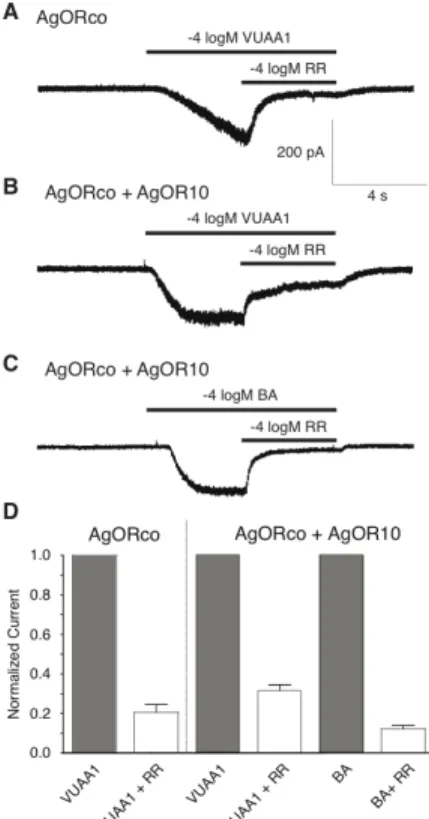
AgORco and its Orthologs ... 53 S1. VUAA1 And BA Responses are AgOR Specific ... 55 2. Ruthenium Red Blocks Inward Currents of AgORco Alone and in complex ... 58 3. AgORco is a Functional Channel and Responds to VUAA1 in Outside-Out
Membrane Patches ... 60 4. 9-Br-cAMP And 8-Br-cGMP Did Not Elicit Currents in AgORco or
AgORco+AgOR10 Cells ... 62 5. VUAA1 Activates Agorco-Expressing Neurons In Anopheles Gambiae
Females ... 65 S2. Channel-Like Currents Elicited By Application Of VUAA1 To Cells
Expressing Agorco Alone Or In Complex ... 67
CHAPTER IV
1. Read Coverage of An. gambiae Genome ... 77
2. Gene Expression in An. gambiae Female Antenna vs Body ... 79
3. An. gambiae Enhanced Gene Pairwise Tissue Comparison ... 81
4. Female Antennae vs. Palp Enhanced Gene Sets ... 83
5. Male Antennae vs. Palp Enhanced Gene Sets ... 84
6. Female vs. Male Antenna Enhanced Gene Sets ... 85
7. Female vs. Male Palp Enhanced Gene Sets ... 86
8. Sexual Dimorphism in An. gambiae Chemosensory Tissues ... 90
9. AgOr Expression Profile ... 93
10. AgIr Expression Profile ... 95
11. AgGr Expression Profile ... 97
12. AgObp Expression Profile ... 100
13. Sensilla-normalized AgOr and AgIr Expression Profiles ... 102
CHAPTER V 1. Representative Example of Raw Fluorescence Readout For a Novel AgOR10 Agonist ... 116
2. Z Factor Analysis of Pilot Experiments for EC80 Concentrations of 2- Ethylphenol and DMSO Control ... 119
3. The plate schematic and response intensity for a representative agonist hit revalidation ... 121
4. Representative Imine Series of Revalidated Hits From Primary Screen of AgOR10+Agorco ... 123
5. VUAA1 Analogs With Demonstrated Activity ... 125
LIST OF ABBREVIATIONS
AgOr An. gambiae odorant receptor
AgObp An. gambiae odorant binding protein
AgGr An. gambiae gustatory receptor
CO2 Carbon Dioxide
Cp Capitate Peg
cRNA Complementary RNA
HEK Human Embryonic Kidney cell
DEET N,N-diethyl-3-methylbenzamide
GPCR G-protein coupled receptor
ORN Olfactory Receptor Neuron
OSN Olfactory Sensory Neuron
ORco Odorant Receptor Co-Receptor
RT-PCR Reverse-transcriptase polymerase chain reaction
SSR Single sensillum Recording
TRP Transient Receptor Potential
VUAA Vanderbilt University Allosteric Agonist
CHAPTER I
INTRODUCTION
Disease Transmission in Vector Mosquitoes
Mosquito borne pathogens such as those causing yellow fever, dengue fever, and malaria constitute the largest threats to public health throughout most of the world (reviewed in Gardner and Ryman, 2010; Mackenzie, Gubler and Petersen, 2004, Snow et al., 2005). Malaria is by far the most devastating vector-borne disease and has significant consequences on the health and economy of affected nations, most of which are exceedingly poor (Sachs and Malaney, 2002). Eighty-seven countries are now classified as endemic for malaria, with more than 50% of the global population at risk (WHO, World Malaria Report 2010). Greater than 300- million human malaria cases are reported annually, which result in over 1 million deaths (Snow et al., 2005). In countries with a high disease burden, the estimated annual economic toll is a 1.3% growth penalty in gross domestic product (WHO, World Malaria Fact Sheet N94, 2010). While there are a number of mosquito species capable of transmitting human malaria, An. gambiae is the principal vector in Afro-tropical regions.
An. gambiae are hematophagous insects, and females require a blood-meal for completion of the gonadotrophic cycle (Clements, 1992).
termed anthropophily; conversely preference toward other animals is termed zoophily. This anthropophily serves as the foundation for transmission of the four species of Plasmodium responsible for human malaria (reviewed in Zwiebel and Takken, 2004). Malaria transmission occurs when a female bites an infected individual and acquires a parasite, which then matures within the mosquito and is passed on during a subsequent blood-meal. The process of pathogen transmission is analogous for females of a related sub-order of mosquitoes, the culicines, which includes the west nile virus vector, Culex pipiens quinquefasciatus, and the yellow fever virus vector, Aedes aegypti. It has been postulated that the anthropophilic tendencies of a mosquito species are largely dependent on the tuning of their olfactory system (Takken and Knols, 1999; Zwiebel and Takken, 2004).
Chemical Ecology and Mosquito Behavior
In insects, olfaction is an integral component of environmental information processing, and olfactory cues dictate, in large part, a diverse range of behaviors (Gillot, 2005). These behaviors include predator avoidance and kin selection as well as the locating oviposition sites, mates, and food sources (Hildebrand and Shepherd, 1997). While all mosquito species and sexes are known to take nectar-based sugar meals, only females of the anopheline and culicine lineages will take a blood-meal (Clements, 1992).
Furthermore, only a subset of these females will seek a human host.
Some species, such as An. gambiae are highly anthropophilic, and seldom take alternative blood-meals (Takken and Knols, 1999).
The host-seeking behavior of female An. gambiae is principally dictated by the sensory modality of olfaction, although thermosensation and vision have also been implicated (Takken and Knols, 1999). In lab and field experiments, mosquitoes are attracted to airborne human volatiles from a distance, and respond even after the physical presence of the host has been removed, strongly supporting the role of chemosensation in host-seeking (reviewed in Takken and Knols, 1999).
The host-seeking response is a complicated behavioral process, which is dependent on circadian and physiological states. Females in search of a blood meal are activated by odors at a distance, and then orient themselves to the source of the odor dependent on air turbulence and wind direction (Takken and Knols, 2010). Attraction is generally not induced by the presence of a unitary odorant, but rather by a collection of semiochemicals (Takken and Knols, 1999; Zwiebel and Takken, 2004, Smallegane et al., 2005).
The diversity of human skin volatiles is estimated to be 350 compounds, but it is not expected that all play a role in host-seeking (Bernier et al., 2000). The exact odors required to elicit a full host-seeking response in An gambiae have not been defined, but responses to multiple compounds including small-chain carboxylic acids, ammonia, and 1-octen-
Figure 1. Head of a female An. gambiae mosquito. Indicated are the three principal olfactory organs; the antennae, maxillary palps, and proboscis (Pitts and Zwiebel, 2006).
behaviorally and electrophysiologically (Cork and Park, 1996; Hall et al., 1984; Meijerink, Braks and Loon, 2001; Meijerink et al., 2000, Qiu et al, 2006). Attractive odors are produced not only by the host, but also by bacteria present upon the skin (reviewed in Smallegange, Verhulst and Takken, 2011). In addition to volatile organic compounds, many mosquito species are activated or attracted by carbon dioxide and heat, which act as synergistic attractants (Bowen, 1991; Mboera and Takken, 1997;
Takken & Knols, 1999). In addition to host-seeking, odorants play a role in oviposition. Various indoles, phenols and carboxylic acids are oviposition-site attractants for gravid female mosquitoes (Bentley et al., 1979; Kyorku et al., 1990, Millar et al., 1994; Allan and Kline 1998;
Blackwell and Johnson, 2000; Sumba et al., 2004).
Ultrastructure of Mosquito Olfactory System
The mosquito olfactory system is found on the three sexually dimorphic organs projecting from the head; the antennae, the maxillary palps, and the proboscis (McIver, 1982). The olfactory apparatus is contained within sensilla, microscopic hairs found on each of these organs that contain the dendrites of sensory neurons. Sensilla are porous extensions of the cuticle and are subdivided into categories based on properties of information detection: mechano-, thermo-, or chemosensory. The wall of each sensilla encloses the neuron in sensillar lymph, an aqueous solution that bathes
an olfactory sensory neuron (OSN) requires that odorants first pass through pores located on the sensillar cuticle, travel through the sensillar lymph, and finally contact chemosensory receptors present on the dendrite surface (Rutzler and Zwiebel, 2005).
Mosquito species possess 5 types of olfactory sensilla. These sensilla vary in the number of innervating OSNs and in their basic cuticle ultrastructure. Different sensilla types respond to divergent classes of odorants, but in some cases, sensitivities overlap between sensilla types.
The most stereotypic sensilla type is the club-like capitate peg (Cp) sensilla, which is only found on the maxillary palp. The maxillary palp is a sexually dimorphic olfactory organ that is the principal appendage for carbon dioxide (CO2) and 1-octen-3-ol detection in An. gambiae (Lu et al., 2007). There are approximately 70 Cp sensilla found on the An. gambiae female MP, and the Cp’s are not found upon any other organ. Contained within the club-like Cp sensilla are three neurons, two of which respond to human host odors, while the lamellate third neuron responds to carbon dioxide.
The antenna is by far the most complex olfactory organ, and contains 2 known olfactory sensilla types; the trichoid and grooved peg (GP) sensilla, (McIver, 1982). In Anopheles gambiae females, these sensilla types are non-uniformly distributed across the 13 antennal segments and their expression is not stereotypic. The distal 3 segments of the antennae are highly enriched for GP sensilla, which are activated by
some of the most attractive human odors, such as lactic acid and ammonia (Qiu et al., 2006). The molecular basis for this activation is currently unknown.
The least well understood chemosensory organ is the labellum, which is found at the end of the proboscis. As in other dipterans, the labellum is principally a gustatory organ, consistent with the proboscis’
role in both nectar- and blood-feeding (Clements, 1999). Upon the labellum are trichoid sensilla, which respond to a variety of human orders including butylamine and several ketones (Kwon et al., 2006).
Insect Chemosensory Receptors
Chemoreception of olfactory cues utilizes at least two, and possibly more, families of cell-surface receptor proteins, which are expressed on OSN’s.
Recently, an insect-specific family of ionotropic glutamate receptors was discovered, which are distinct from, but related to the NMDA, AMPA, and kainite receptors and were thus named ionotropic receptors (Irs) (Benton et al., 2009). IRs respond to a small class of acidic odors and are expressed in the coeloconic sensilla. Relatively little is known about the IRs in comparison to the classical odorant receptors (ORs), which decode most olfactory information (Qiu et al., 2006; Benton et al., 2009; Carey et al., 2010; Wang et al., 2010). ORs and IRs are expressed in independent OSNs, and there is currently no evidence to suggest that they are co-
expressed in the same sensilla. In addition the ORs are expressed at higher levels and on a much broader scale than the IRs (Pitts et al., 2011)
Upon their discovery in Drosophila melanogaster, insect ORs were classified as 7-transmembrane (TM) G-Protin coupled receptors (GPCRs), like their mammalian counterparts (Clyne et al., 1999; Vosshall et al., 1999, reviewed in Mombaerts 1999). Insect ORs, however, bear no resemblance at the amino acid level to GPCRs, and have an inverse GPCR topology, possessing an intracellular C-terminus and an extracellular N-terminus (Benton et al., 2006). In addition, more recent data suggests that insect ORs do not signal through g-protein based mechanisms and instead form heteromeric ion channel complexes (Wistrand, Kall, Sonnhammer, 2006; Smart et al., 2008; Sato et al., 2008;
Jones et al., 2011). A functional OR complex consists of a conventional odorant binding OR and a highly-conserved, broadly expressed and obligate OR co-receptor (ORco) (Neuhaus et al., 2005, Benton et al., 2006). The ORco is required for trafficking to the dendritic membrane as well as proper signal transduction (Benton et al., 2006). Each OSN expresses only a single conventional OR and ORco, with rare exception, and as a result follows the same one OR: one ORN architecture found in mammals (Dobritsa et al., 2003; Mombaerts, 2004). Recently, it was shown that the ORco can form a stand-alone ion channel capable of functional agonism by a synthetic agonist, although the in vivo implications of this are still unknown (Jones et al., 2011). When an OR is
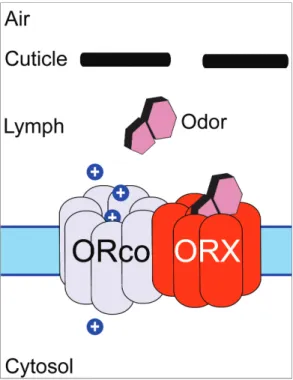
Figure 2. Current model of Insect Odorant Receptor Signaling. An odorant passes into the aqueous sensillar lymph from the air and interacts with a conventional ORx, which upon successful binding, ionotropically gates the ORco. ORco gating results in an influx of non-selective cations (Sato et al., 2008; Wicher et al., 2008; Jones et al., 2011)
heterologously expressed without an ORco, there is no discernible odorant-induced signal (Larrson et al., 2004; Sato et al., 2008; Wang et al., 2010)
The OR family of An. gambiae is remarkably divergent, consistent with the requirement to sense a diverse set of odorant ligands specific to their ecological niche (Hill et al., 2002). Between insect taxa there is also relatively little OR conservation, with one notable exception, the Orco, which is both genetically and functionally conserved (Krieger et al., 2003;
Jones et al., 2005). When comparing the ORco between two mosquito species, An. gambiae and Ae. Aegypti, it is 87% identical (Bohbot et al, 2007). There are 76 conventional ORs in An. gambiae (AgOrs) and these bind the odorant either alone or with the help of the ORco and provide coding specificity to each complex (Hill et al., 2002). Upon odor binding, it is hypothesized that the OR then ionotropically gates the ORco, causing a non-selective influx of cations, depolarizing the neuron (Sato et al., 2008;
Wicher et al., 2008; Jones et al., 2011). Using various heterologous methods, the tuning of greater than 50% of AgORs has been determined (Lu et al., 2007; Carey et al., 2010; Wang et al., 2010). The odor coding capacity (odor space) of An. gambiae has proven to be quite extensive, with each OR occupying a defined, but at times overlapping odor space, with varying specificities (Carey et al., 2010; Wang et al., 2010)
Peripheral Proteins in Insect Chemosensation
It has yet to be determined how the principally hydrophobic odorants known to elicit responses from ORNs, pass through the aqueous sensillum lymph and physically contact the ORs on the dendrite surface (Qiu et al., 2006). A family of odorant binding proteins (Obps), first characterized in the moth Antheraea polyphemus, are hypothesized to act, in part as shuttle proteins across this aqueous barrier and thus enhance the sensitivity of volatile chemosensation (Vogt and Riddiford, 1981).
OBPs comprise a family of small, soluble proteins, which are secreted into the sensillar lymph of insects by non-neuronal accessory cells located at the base of the sensilla (Galindo and Smith, 2001;
McKenna et al., 1994). While the precise role and mechanism of OBP function in insect systems has yet to be fully determined, it has been shown that OBPs are required for normal olfactory signal transduction in a subset of ORNs tested (Kim and Smith, 2001). OBPs are not, however, an absolute requirement for olfactory signal transduction in all cases, as OR response profiles in heterologous expression systems, which lack endogenous, con-specific, and in some cases any OBPs, closely mirror odorant responses from in vivo data (Hallem et al., 2004; Lu et al., 2007, Carey et al., 2010, Wang et al., 2010; Bohbot et al., 2011). While multiple hypothesis have been put forward to describe the role of OBPs, at the forefront lies the belief that OBPs function to facilitate the interaction of a
hydrophobic ligand with an OR by acting as an odorant shuttle/chaperone from the air/lymph interface to the ORN dendrite.
Insect Repellents
The molecular basis of repellent action remains largely unknown, and the few reports that describe repellent targets remain highly controversial.
Reports have suggested that rather than acting as a direct repellent, DEET, the benchmark standard for repellents, antagonizes the ORco, and as result, masks the presence of human odors (Ditzen et al., 2008).
Subsequently, others showed that the experimental design used in this study was flawed, and that DEET triggers an aversive through the bimodal activation of a subset of ORNs and through the agonism of specific Gustatory Receptors (GRs; Syed and Leal, 2008; Xia et al., 2008; Liu et al., 2010; Lee, Kim, and Montell, 2010). Citronella is the only other repellent with at least a partially defined molecular target. Citronella was shown to target a Transient Receptor Potential (TRP) channel responsible for heat detection in dipterans. Citronella, in ways that are still not entirely clear, targets a TRPA1 dependent pathway, and triggers an avoidance response (Katz, Miller and Hebert, 2008; Kwon et al., 2010). In addition, citronella also targets an ORco dependent pathway, although the conventional OR targets have yet to be defined (Kwon et al., 2010).
Despite its widespread use, DEET has demonstrated toxicity problems, minimal efficacy against some vector mosquito species, and decreasing
consumer acceptance (reviewed in Paluch, Barholomay and Coats, 2010).
For these reasons, there is widespread interest in developing next generation insect repellents, which would demonstrate increased efficacy, longer half-lives, and greater use compliance.
Olfactory Processing
Insects, like vertebrates, use cross-fiber (combinatorial) coding to encode the wide breadth of chemical information encountered (reviewed in Smith and Getz, 1994). As a result, each OR responds to more than one ligand, and one ligand can activate more than one OR. However, there are instances of labeled-line olfactory coding, although these are likely to be pheromone-specific (Anton and Hansson, 1995; Roche-King et al., 2000;
Datta et al., 2008). Sensation of an odorant is transmitted from the periphery to higher brain centers through an OSN. The axon of a bipolar OSN terminates on a dense cluster of neurons and glia, known as a glomerulus, in the antennal lobe (AL). In Drosophila, OSNs expressing the same OR converge on the same, stereotypic glomerulus in virtually all cases (Laissue et al., 1999; Vosshall, Wong and Axel, 2000; Fishilevich and Vosshall 2005; Cuotu, Alenius and Dickson, 2005). As a result, a given glomerulus receives direct olfactory input for a limited set of odorants, which must interact with the corresponding OR. However, there is also a complex network of excitatory and inhibitory horizontal
ORs via local neurons (reviewed in Vosshall and Stocker, 2007; and Masse et al., 2009; Olsen and Wilson, 2008).
Glomerular input is integrated into the electrical activity of the projection neurons (PNs), which send axons to the mushroom body and the lateral horn (reviewed in Vosshall and Stocker, 2007). The mushroom body is involved in long-term associative learning and memory, while the lateral horn is involved in experience-independent, immediate odor- decoding (reviewed in Masse et al., 2009). Information concerning olfactory processing at levels higher than these brain centers, however, is extremely limited. How olfactory signals are integrated in higher brain centers and ultimately dictate behaviors such as host seeking and oviposition are still largely unknown.
Significance of the Proposed Study
These studies have sought to define the expression and function of a subset of disease vector mosquito odorant receptors. As olfaction in mosquitoes is a principal determinant in dictating disease transmission behaviors, the ability to disrupt OR-based chemosensation would serve to reduce the vectorial capacity for An. gambiae and other medically important insects. The work described here not only strengthens the paradigm of insect olfaction, but demonstrates proof of concept for new compounds with broad implications for agricultural pest and disease vector control.
CHAPTER II
CONSERVATION OF INDOLE RESPONSIVE ODORANT RECEPTORS IN MOSQUITOES REVEALS AN ANCIENT OLFACTORY TRAIT
Preface
The following publication by Jones et al. appeared in Chemical Senses (Chem Senses 36(2) 149-160 (2011)). My contribution to this work included writing portions of the manuscript, creation and functional verification of cell lines AgOR10, AaOR10, AgOr2, AaOr2 and AaOR9. I was responsible for all of the odor tuning studies, and for the AxOR concentration response curves.
Introduction
In many parts of the world, a diverse spectrum of blood-feeding mosquitoes present a serious challenge to the economic and physical well being of human populations; each year, hundreds of millions of people contract mosquito-borne diseases including malaria, Dengue, lymphatic filiariasis, Rift Valley, West Nile, Chikungunya and other maladies (Snow et al., 2005; Weissenbock et al., 2009). The vectors for the majority of these disease-causing agents belong to the Anophelinae and the Culicinae sub-families, which include Aedes aegypti, Culex pipiens quinquefasciatus and the malaria vector mosquito, Anopheles gambiae
In spite of distinct evolutionary histories, these species share a number of general properties insofar as life cycle (Clements, 1999). The need to efficiently meet these complex ecological demands is, in part, the task of the mosquitoes sensory systems that acquire and process a wide array of environmental information pertaining to mating, resource acquisition and other aspects of the ecological niches occupied by these mosquitoes. Olfaction in particular, is a central component of this system as it facilitates nectar feeding (Davis, 1977; Foster and Hancock, 1994) and mating (Cabrera and Jaffe, 2007) as well as female specific behaviors including host seeking, blood-feeding (Takken, 1991) and oviposition (Bentley and Day, 1989).
The general ultrastructure of the olfactory apparatus of mosquitoes is largely conserved, as is the qualitative and quantitative characteristics of olfactory sensilla (McIver, 1982; Pitts and Zwiebel, 2006). At a physiological level, mosquitoes and other blood-feeding arthropods exhibit overlapping receptive fields for many aromatic compounds such as indole (Blackwell and Johnson, 2000; Jeanbourquin and Guerin, 2007; Harraca et al., 2009), 3-methyl-indole (sometimes referred to as skatole; Mboera et al., 2000; Jeanbourquin and Guerin, 2007; Harraca et al., 2009) and 4- methyl-phenol (4-MP; sometimes referred to as p-cresol; Blackwell and Johnson, 2000; Jeanbourquin and Guerin, 2007; Harraca et al., 2009;
Bentley et al.,1979). A variety of sensory modalities mediate the oviposition behavior of mosquitoes (O'Gower, 1963). Olfaction plays a
central role in facilitating both attraction to specific aqueous sites as well as stimulation of egg-laying behavior itself (Lindh et al., 2008; Ponnusamy et al., 2008). Indole and 4-MP are both derived from bacterial degradation (Isenberg and Sundheim, 1958; Lindh et al., 2008) of tryptophan (Elgaali et al., 2002) and tyrosine (Curtis et al., 1976), respectively. Indole is also a by-product of a wide variety of plants (Frey et al., 2000; Schmelz et al., 2003). An odor blend consisting of phenol, 4-MP, 4-ethylphenol, indole and 3-methylindole from grass infusion attracts female Culex quinquefasciatus (Millar et al., 1992; Du and Millar,1999). Of these, 3- methylindole alone mediates long-range attraction in several culicine species. Other aromatics such as 4-MP, a compound found in hay infusion (Bentley et al., 1979; Millar et al., 1992) and human-sweat (Cork and Park, 1996) also play an important role as an oviposition attractant for various mosquito genera including Aedes, Culex and Anopheles (Bentley et al., 1979; Blackwell and Johnson, 2000; Poonam et al., 2002).
In order to examine evolutionary aspects of odor sensitivity in vector mosquitoes, we have focused on a subset of their olfactory repertoire that defines precise ecological niches. Aromatics and heterocyclics occupy a large portion of the characterized odor space of An. gambiae (Carey et al., 2010; Wang et al., 2010) and play a role in attracting mosquitoes from various lineages in the context of host detection (Cork and Park 1996; Takken et al. 2001), larval behavior (Xia et
in particular is an aromatic heterocyclic organic compound that elicits strong responses in adult antennal trichoid sensilla of An. gambiae (Blackwell and Johnson 2000; Meijerink et al. 2000; Qiu et al. 2006) and activates olfactory receptor neurons (ORNs) in Ae. aegypti (Siju et al.
2010), Cx. quinquefasciatus (Hill et al., 2009, Syed and Leal 2009) and Cx. tarsalis (Du and Millar 1999).
At a molecular level, mosquito olfactory signal transduction begins on the surface of ORN dendrites that lie within antennal, labellar and maxillary palp sensilla. Although the precise mechanisms underlying this process are still emerging (Sato et al. 2008; Wicher et al. 2008), it is clear that odorant receptors (ORs) play a significant, if not central role. As is the case for all insect systems, mosquito ORs form heteromeric complexes of unknown stoichiometry, consisting of at least one conventional and one non-conventional OR (Benton et al. 2006).
Conventional ORs are thought to be the ligand binding components of the complex while the non-conventional OR is necessary for the proper function of this assembly (Rutzler and Zwiebel 2005; Benton et al., 2006).
Mosquito and other insect ORs, are encoded by large and highly divergent gene families that are unrelated to vertebrate ORs (Mombaerts 1999;
Benton et al. 2006).
The characteristic divergence of insect ORs is likely to reflect rapid changes in ecological and other life cycle considerations that help to drive speciation (Clark et al., 2007; Guo and Kim 2007; McBride 2007; Gardiner
et al., 2008; de Bruyne et al., 2010). Indeed, a phylogenetic comparison between conventional Ae. aegypti and An. gambiae Or genes demonstrate that with the exception of a subset of 12 Aedes/Anopheles presumably orthologous Or pairs most of the predicted proteins encoded by these genes share less than 20% amino-acid identity (Bohbot et al.
2007). This high level of divergence among conventional OR proteins may reflect both the evolutionary distance (Krzywinski et al. 2001a) and the diversity of chemical signals encountered by each species. As would be expected, genes encoding mosquito Or7 proteins, the ortholog of the non-conventional Drosophila melanogaster Or83b (DOr83b) which is the requisite functional partner of most conventional ORs (Larsson et al., 2004) are extremely conserved at both the amino-acid sequence (Melo et al., 2004; Xia and Zwiebel 2006; Bohbot et al., 2007) and functional levels (Jones et al. 2005).
Beyond the Or83b/Or7 orthologous group, the most closely related group of ORs between Ae. aegypti and An. gambiae is represented by the OR2/OR10 clade which shares an average of 69% or greater amino-acid identity (Bohbot et al., 2007). Recently, conserved members of the OR2/OR10 clade have been identified in the southern house mosquito Culex pipiens quinquefasciatus (Pelletier et al., 2010b). When viewed within the overall context of Or gene divergence, it is evident that strong selective pressure has maintained the high level of sequence conservation
constraints that require a set of common olfactory responses that predate the Anophelinae/Culicinae split ~150 million years ago (Krzywinski et al., 2001a). A prediction of this hypothesis would be that OR2/OR10 would share similar activation profiles between Ae. aegypti and An. gambiae and moreover, that additional members of this gene subfamily are present in the olfactory repertoire of other mosquito species.
To examine this question, we have used heterologous expression in two distinct systems to functionally characterize the odorant response profiles of OR2/OR10 members from Ae. aegypti and An. gambiae.
These studies establish broad and commonly held functional relationships between the OR2/OR10 clade’s amino-acid sequence and its odorant response profiles. We have also identified OR2/OR10 homologs from additional mosquito species across variable evolutionary distances. From a biological perspective, the functional conservation of the OR2/OR10 clade in both zoophilic and anthropophilic mosquitoes suggests that while the role of this group of ORs is not strictly associated with host selection, it is nonetheless crucial within the entire family of Culicidae. These studies provide an example of how comparative studies can inform our understanding of the role of ORs in the evolution of chemosensory pathways as well as reveal structure-function relationships of OR proteins in mosquito vectors.
Materials and Methods
Mosquito Rearing
Ae. aegypti (Costa Rica strain), An. gambiae sensu stricto (Suakoko strain), Anopheles quadriannulatus and Anopheles stephensi were reared as described in Fox et al., 2001. An. gambiae (SUA2La; MRA765), An.
quadriannulatus (SUAQUA; MRA-761) and An. stephensi (IV; MRA-314) were provided by The Malaria Research and Reference Reagent Resource Center (MR4). For stock propagation, 4- to 5-day-old female mosquitoes were blood-fed for 30–45 min on anesthetized mice, following the guidelines set by Vanderbilt Institutional Animal Care and Use Committee.
Molecular Cloning AqOr2 and AsOr2 cloning
PCR templates were prepared from 908 hand-dissected female antennae of Anopheles quadriannulatus and 561 hand-dissected female antennae of Anopheles stephensi mosquitoes. Collected tissues were used to generated total RNA using the RNeasy (Qiagen, Valencia, CA) protocol followed by cDNA synthesis using the BD Smart Race cDNA Amplification Kit (BD Biosciences Clontech) generating 5’ and 3’ cDNA pools. The same two degenerate primers and amplification protocols described above were used in subsequent PCR amplifications. Full length
PCR system 9700 (Applied Biosystems, Foster City, CA) under conditions as described in the BD Smart Race cDNA Amplification Kit and with Adaptor primer Universal Primer Mix (UPM) and AqOr2 specific RACE primers— 3’ RACE primer 1: TTCACCAGCTTCTACGCGACCTG and 5’
RACE primer 2: CAGCAGTGCGCACAGCATCATC. A second, nested PCR RACE amplification was carried out using AqOr2 specific RACE primers—3’ RACE primer 3: TCGTCCAGATAGCGGCCCTAAAGC and 5’
RACE primer 4: CAGCAGTGCGCACAGCATCATC both with UPM. All experimental-specific PCR products were gel-purified using QIAquick gel extraction reagents (Qiagen, Valencia, CA), cloned into the pCRII-TOPO cloning vector (Invitrogen, Carlsbad, CA) and subsequently sequenced in the DNA Core Facility at Vanderbilt University. The same procedure was applied for AsOr2 using the following RACE primers— 3’ RACE primer 1:
GTTCACCAGCTTCTACGCGACCTG and 5’ RACE primer 2:
CACAGCATCATCCCGAACGACAAG. A second, nested PCR RACE amplification was carried out using AsOr2 specific RACE primers—3’
RACE primer 3: ACTCTGTTCGCCGAGCTGAAGGAG and 5’ RACE primer 4: TCGAGCAAACACAGATGGGTGACG both with UPM. The complete nucleotide sequences has been deposited to GenBank (accession numbers: FJ008067, FJ008068, FJ008071 and FJ008072).
AqOr10 and AsOr10 cloning
AqOr10 and AsOr10 were amplified from the same cDNA pools as
described above using the following two degenerate primers: Forward primer 5'-CCTGTACCGGGCCTGGGGNAAVAT-3’ and reverse primer 5’- GAGGCGTTCAGCAGGGACTGRAACATYTC-3’. The PCR products were gel-purified using QIAquick gel extraction reagents, cloned into the pCRII-TOPO cloning vector and subsequently sequenced in the DNA Core Facility at Vanderbilt University. 5’ and 3’ missing fragments for AqOr10 and AsOr10 were amplified from the cDNA pools using the Advantage® 2 Polymerase Mixes and PCR Kit (Clontech) combined with touchdown PCR following the manufacturer procedure. RACE primers for AqOr10 included— 3’ RACE primer 1: AACGAGGTGCGGGAGGAAAGC and 5’ RACE primer 2: TTGATCTGCACCAGCCCGAACAG. A second, nested PCR RACE amplification was carried out using AqOr10 specific RACE primers—3’ RACE primer 3: ACCGTGGCTGAATGTGGATGAAAC and 5’ RACE primer 4: GCCAGGTTGGAGATGGACAGGAAG both with UPM. RACE primers for AsOr10 included— 3’ RACE primer 1:
ACGAGGTGCGTGAGGAAAGCATGG and 5’ RACE primer 2:
CGAACAGCGTGCTCGAGGTGAA. A second, nested PCR RACE amplification was carried out using AsOr10 specific RACE primers—3’
RACE primer 3: ACAGTGGACCGTGGCTCAATGTGG and 5’ RACE primer 4: GAAGTGGGCCCGTTTGGTGTACG both with UPM. In all cases, cDNA and genomic DNA sequences were amplified, cloned and sequenced. Full-length cDNA and genomic clones were obtained using
GenBank (accession numbers: FJ008069, FJ008070, FJ008073 and FJ008074).
Receptor Expression in Xenopus laevis Oocytes and Two-Electrode Voltage-Clamp Electrophysiological Recording
Full-length coding sequences of AaOr2, AaOr9, AaOr10, AgOr2 and AgOr10 were PCR amplified from antennal cDNA. PCR were first cloned into pENTR/D-TOPO (Invitrogen) and then subcloned into pSP64DV by means of the Gateway LR reaction (Lu et al., 2007). Complementary RNA (cRNA) was synthesized from linearized vectors using the mMESSAGE mMACHINE SP6 kit (Ambion). Mature healthy oocytes (stage V–VII) were treated with 2 mg ⁄ mL collagenase S-1 in washing buffer [96 mm NaCl, 2 mm KCl, 5 mm MgCl2 and 5 mm HEPES (pH 7.6)] for 1–2 h at room temperature. Oocytes were later microinjected with ~28 nL cRNA. After injection, oocytes were incubated for 3-5 days at 18°C in 1 X Ringer’s solution [96 mm NaCl, 2 mm KCl, 5 mm MgCl2, 0.8 mm CaCl2 and 5 mm HEPES (pH 7.6)] supplemented with 5% dialyzed horse serum, 50 mg ⁄ mL tetracycline, 100 mg ⁄ mL streptomycin and 550 mg ⁄ mL sodium pyruvate. Whole-cell currents were recorded from the Xenopus oocytes injected with corresponding cRNAs by using a two-electrode voltage clamp as described in Lu et al., 2007. The data was first analyzed using Clampfit. A Tukey multiple comparison test (P < 0.001) was used to compare the mean EC50 values of each OR-odorant couple.
Cell Culture and Ca2+ Fluorometry
To create a cell culture expression vector capable of co-expressing AgOR7 in conjunction with a conventional ORx, pcDNA5/FRT/TO (Invitrogen) was modified to create two individual expression cassettes each under the control of separate CMV/TetO2 promoters and BGH poly- adenylation signals. Flp-In™ T-REx™ 293 cell lines (Invitrogen) were transfected with the modified pcDNA5 plasmid along with POG44 (a plasmid encoding FLP recombinase) to facilitate site-specific recombination. Stable cell lines were selected using Hygromycin B (Invitrogen). Cells were maintained in DMEM (Invitrogen) supplemented with 10% Tetracycline-free FBS (HyClone).
For the fluorometric measurements of Ca2+ mobilization, stable lines expressing OR7/ORX were seeded at 20,000 cells/well in black wall, poly-lysine coated 384-well cell culture plates (Greiner) and treated with 0.3 ug/ul tetracycline (Sigma) overnight to induce OR expression. Cells were dye-loaded with 1.8uM Fluo-4 AM (Molecular Probes) for 45 minutes at 37C prior to each assay and Ca2+ mobilization was assayed in an FDSS6000 plate reader (Hammamatsu). Baseline readings were taken for 20s before automated addition of 2x10⁻³ M compound previously diluted in DMSO and assay buffer (20mM HEPES, 1x HBSS). Ratios were described as Maximum/Minimum response and each response was
triplicate per plate and 3 plates were run per cell line. Concentration response curves (CRCs) were run similarly.
Chemicals
All odorants were >99% pure or of the highest grade commercially available. Please see Supplemental Table 1 for a complete list of odorants used in this study including their corresponding CAS numbers.
Gene identification and sequence analyses
The primary amino-acid sequence of D. melanogaster Or43a protein was retrieved from GenBank (NP_523647). The CqOr10b, CqOr2 and CqOr9 genes were identified using the AaOR10 protein to tBLASTn query the Culex quinquefasciatus (Johannesburg strain) database located at the BROAD Institute Matches were manually annotated using ClustalW and refined using the Softberry Splice Site Prediction program. ClustalW was used to predict the exon/intron structures of each individual Or genes.
Deduced amino-acid sequences of mosquito Ors were aligned using ClustalW and the resulting data matrix was submitted to the MEGA4 software (Tamura et al. 2007). A Neighbor-joining tree was constructed using a pair-wise distance method and gaps handled by pair-wise deletion. Inferred relationships were tested by bootstrapping based on 10,000 pseudoreplicates.
Results
OR2/OR10 proteins are highly conserved in mosquitoes
Approximately 95%, of Ae. aegypti ORs share less than 20% amino-acid sequence identity with the An. gambiae OR repertoire (Figure S1) with Aedes or Anopheles specific Or gene expansions accounting for most of this diversity (Bohbot et al., 2007). Notwithstanding the extraordinary conservation of Ag/AaOr7 genes, a subset of five anopheline ORs stand out due to their unusually high sequence identity (above 50%) as compared to their homologs in Ae. aegypti. These OR homologs belong to the OR2/OR10, OR8 and OR11 protein groups, respectively. Both AaOR10/AgOR10 and AaOR2/AgOR2 share 71% amino-acid identity while all OR2s, AaOR9 and all OR10s share between 51% and 67%
amino-acid sequence identity. Of these, only OR2s and OR10s display 70- 79% amino-acid identity representing 0.02% of all 10,349 possible comparisons of the 131 AaORs with the 79 AgORs (Figure S1). It is noteworthy that AgOR9 (named numerically in order of discovery) is not part of this clade and the genome of An. gambiae appears to lack a homolog of AaOR9.
Figure 1. The Or2/9/10 clade predates the Anophelinae/Culicinae split. (A) Phylogenetic relationships of the mosquito OR2 (light grey shaded area), OR9 (medium grey shaded area) and OR2 (dark grey shaded area) clade of mosquitoes. Aa: Aedes aegypti; Cx: Culex quinquefasciatus; Ag: An. gambiae; Aq: An. quadriannulatus; As: An.
stephensi. The P-distance tree was generated using MEGA 3.1 using a Neighbor-joining model. Branch lengths are proportional to the scale of sequence distance indicated by the bar below the tree. Bootstrap values (%) are based on 10000 replicates. Gene structures are indicated by black
and whites boxes. Intron positions and protein lengths are indicated above the gene structure. Intron phases are indicated in bold below the gene structure. Complete cDNA sequence was characterized for AqOr2 whereas an incomplete genomic DNA sequence was obtained thus providing only the position of the first two introns. (B) Microsynteny and gene structure of Ae. aegypti Or2/10, Cx. quinquefasciatus Or2/9/10 and An. gambiae Or2/10 genes. Each filled black and white squares represents an exon. Distance between genes are indicated below individual contig
A survey of the Or2/Or10 genes was carried out in 3 additional species of the Anophelinae and the Culicinae lineages. Using bioinformatics and molecular approaches, Or2, Or9 and Or10 genes were identified from Cx.
pipiens quinquefasciatus, An. quadriannulatus and An. stephensi (Figure 1A). D. melanogaster OR43a (DOR43a) was also included in this phylogenetic analysis as it represents the closest Drosophila homolog to the mosquito OR2/OR10 group. An alignment of the amino-acid sequences was carried out (data not shown) to build a sequence-based phylogenetic tree (Figure 1A). All 5 mosquito species studied herein contain one member of the Or2 gene lineage and at least one member of the Or10 lineage, which has apparently expanded in the Culicinae subfamily resulting in an additional Or10 homolog (CxOr10b) in Cx.
quinquefasciatus. However, Or9 homologs were only identified in aedine mosquito species including Ae. aegypti and Cx. quinquefasciatus.
Sequence identity (Figure S1), commonalities in gene structure (Figure 1A) and conserved syntenic relationships (Figure 1B), are consistent with the phylogenetic analysis. Overall, insofar as primary protein sequence is concerned, OR9 is more similar to OR10 than to any of the OR2 predicted proteins (Figure 1A). For example, AaOr9 encodes a protein that is more similar to AaOR10 (69% amino-acid identity) than to AaOR2 (51% amino- acid identity).
Based on the unusual sequence similarity (Figure S1) and the phylogenetic relationships between OR2s, OR10s and AaOR9 (Bohbot et
Figure S1. OR2/9/10 are the most conserved conventional receptors in the Ae. aegypti and An. gambiae repertoires. Protein sequence identity matrix between 131 Ae. aegypti and 79 An. gambiae ORs. The first twelve ORs from each species share the highest identity level including OR7 and OR2/9/10. The pie chart displays the percentage of 10,349 possible comparisons of the 131 AaORs with the 79 AgORs based on amino-acid sequence identity levels.
al. 2007), we hypothesized that the OR2/OR10 paralogs would manifest distinct odorant response profiles while the potential Aa/AgOR2 and Aa/AgOR10 pairs would share common odorant sensitivity profiles. To further examine these questions we carried out a detailed functional characterization within the OR2/OR10 clade to assess odorant sensitivities using two heterologous expression systems.
OR2/10 clade exhibits overlapping odor-response profiles
In order to establish the receptive range for divergent members of the OR2/OR10 clade, stable lines of HEK cells functionally expressing either AaOR2, AgOR2, AaOR9, AaOR10 or AgOR10 along with AgOR7 were established and challenged with a 30 odor panel (Figure 2). As expected, the tuning curves of orthologous pairs (Ag/AaOR10 and Ag/AaOR2) were strongly concordant in their ability to detect a subset of compounds in this panel (Figure 2). There were no instances in which an odor activated one ortholog and failed to activate its heterospecific counterpart, although some differences in absolute response levels were observed.
When paralogs were compared, the OR2 and OR10 clades showed considerable overlap in their ability to detect the panel, which is consistent with their overall relatedness. The tuning curve of AaOR9 closely resembled that of the OR10 clade’s (Figure 2). There were a few odorants (Figure 2, arrows) for which one set of paralogs responded significantly more strongly than the other pair, and in these instances
Figure 2. Members of the OR2/10 clade exhibit overlapping sensitivities. Tuning curves of AaOR2, AgOR2, AaOR9, AaOR10, AgOR10 and AgOR8. The 30 odorants are ordered along the x axis, with those eliciting the strongest responses for the OR2/10 clade near the center. Benzaldehyde and 1-octen-3-ol (chemical structures shown) elicited the highest response for the OR2/10 clade and OR8, respectively.
Arrows indicate odorants for which AaOR9 responses are more similar to OR2s than to OR10s.
AaOR9 possessed an intermediate coding capacity in that it responded to virtually all activators of the 2/10 clade (Figure 2).
To further demonstrate that the specificity of the receptive capacity of these ORs, AgOr8, which has previously been shown to be an octenol receptor (Lu et al., 2007) with less than 20% amino-acid identity with OR2/10, was included in this survey. In HEK cells stably expressing AgOR7/AgOR8 proteins, odorant-induced responses were largely indifferent to the principal activators of the OR2/9/10 clade (Figure 2) and instead, closely mirrored the response profiles of AgOR8- expressing oocytes (Wang et al., 2010) and fly ORNs (Carey et al., 2010). All three expression systems manifested a significant proportion of the odorant responses directly recorded in vivo from AgOr8-expressing ORNs on the maxillary palp pegs of An. gambiae (Lu et al., 2007), which validates the use of cell-based OR expression. In all cases, control HEK-293 cells were indifferent to any odor tested (data not shown).
Indole is an important activating compound of the Ae. aegypti and An. gambiae OR2/OR10 clade
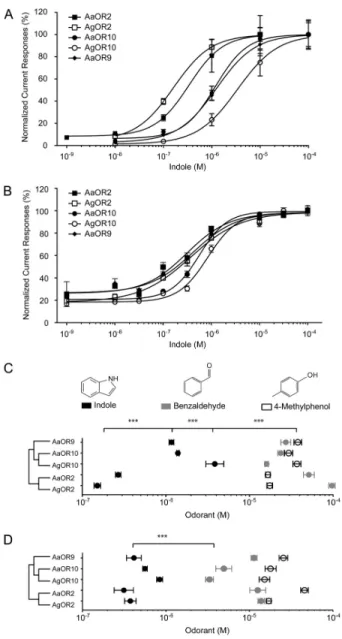
Our hypothesis was that sequence homology and divergence of the mosquito OR2/OR10 proteins would be reflected in their respective odorant sensitivities. Indeed, using the Xenopus oocyte expression system we observed significant sensitivity differences in response to indole between OR2/9/10 paralogs when expressed together with AgOR7 (Figure 3A). Several odorants including indole, 4-MP and benzaldehyde
have been identified as strong ligands for AgOR2 and AgOR10 in oocytes (Xia et al., 2008; Wang et al., 2010) as well as in the Drosophila empty neuron expression system (Carey et al., 2010). In the current study, AgOR2 and AaOR2 exhibited highest sensitivity to indole (Figure 3A and 4B; Supplemental Table 2) while AaOR9 and AaOR10 exhibited nearly identical responsiveness that were approximately 10-fold less sensitive than those observed for Aa/AgOR2 (Figure 3B). Of the paralogous ORs tested, AgOR10 was the least sensitive to indole (Figure 3A and 3B;
Supplemental Table 2) while we observed uniform, albeit relatively low sensitivity in response to benzaldehyde and 4-MP, each of which elicited reduced responses at high concentrations from
Discussion
The increasing availability of whole insect genomes has provided novel opportunities for examining the evolutionary concepts of orthology and paralogy (Zdobnov and Bork, 2007). Current paradigms put forward the view that orthologous proteins retain the same function while paralogs tend to develop new ones (Koonin, 2005). In terms of insect olfaction, this concept is best illustrated by the highly conserved, non-conventional OR subclade that was first described in terms of its original member Or83b from Drosophila (Vosshall, 2000). Subsequent homologs were identified as Or7 in mosquitoes (Hill et al., 2002, Melo et al., 2004; Xia and Zwiebel
Figure 3. Indole activation correlate with the primary structure of the OR2/9/10 protein. Normalized concentration-response curves of OR2s, OR9 and OR10s expressed in Xenopus oocytes (A) and in HEK cells (B) in response to indole (n = 4-7). Odorant concentrations were plotted on a logarithmic scale. (C) Scatter chart displaying three functional OR groups:
the OR2, AaOR9/AgOR10 and AaOR10 groups (n = 4-8) expressed in Xenopus oocytes. (D) Scatter chart displaying the sensitivity of the OR2/10 clade expressed in HEK cells in response to indole, 4-MP and benzaldehyde (n = 3-8). Three asterisks, P < 0.001 (ANOVA test with Tukey post test). The mean EC50 values and S.E.M of their scatter were determined using Prisall ORs tested. CRCs were also generated in HEK cells in order to examine whether sensitivity differences existed between AgOR10 and AaOR10 as well as to validate our oocyte-based assays. In
these studies, the OR2/10 clade was once again most sensitive to indole, followed by 4-MP and lastly benzaldehyde. Overall, the OR2/10 clade agonist rankings were comparable to those obtained using Xenopus oocytes (Figure 3C) further demonstrating the consistency of these analyses across multiple functional outputs.
hymenoptera (Robertson et al., 2010; Robertson and Wanner, 2006).
Members of the OR83b family are expressed in a majority of insect ORNs (Vosshall, 2000; Pitts et al., 2004), functionally conserved (Jones et al., 2005) and are required for general olfactory signaling (Larsson et al., 2004). Even so, these orthologous ORs are likely not to be directly involved in odorant recognition but rather are required for the proper translocation of the OR complex to the ORN dendrite membrane (Larsson et al. 2004) as well as functioning as a cation channel component of OR complexes (Sato et al. 2008; Wicher et al. 2008).
Despite an abundance of apparent OR ortho/paralogs in Drosophila (Clark et al., 2007; Guo and Kim, 2007; McBride, 2007; Nozawa and Nei, 2007; Gardiner et al., 2008) and mammalian systems (Branscomb et al.
2000; Ohara et al. 2009; Churcher and Taylor 2009; Dong et al. 2009) functional characterization of ortho/paralogs ORs are scarce in insects (Jones et al., 2005; Bohbot et al., 2007; Lu et al., 2007; Pelletier et al., 2010b) as well as in mammals (Krautwurst et al. 1998; Schmiedeberg et al. 2007). In one example of such an analysis the I7 receptors of mouse and rat manifest differential odorant response profiles despite sharing 94%
identity at the amino-acid level; the rat I7 receptor is more sensitive to octanal as compared to heptanal while mouse I7 displays the opposite sensitivities (Krautwurst et al. 1998). In addition, while the mouse Olfr43 and human OR1A1 orthologous pair selectively detect (S)-(−)-citronellol, a single amino-acid change between human OR1A1 and OR1A2 paralogs is
responsible for their differential response toward this compound (Schmiedeberg et al., 2007).
These few examples illustrate the caveats involved in predicting function solely from sequence alignments and phylogenetic analyses. In Drosophila, a recent study has examined the functional aspects of conserved classes of ORNs and associated Or genes across a range of species spanning ~40 million years of evolution (de Bruyne et al., 2010).
With notable differences, in vivo ORN responses were found to be largely conserved over this evolutionary time span and attributed to Or gene loss or duplication and were generally correlated with primary sequence conservation of homologous ORN/Or pairs. Furthermore, by comparing the limited amount of primary sequence divergence between orthologous Ors with similar functional characteristics as well as paralogous Ors with differential odorant response profiles, the authors identified the amino acid residues associated with general Or functionality as well as those linked to determining odorant specificity (de Bruyne et al., 2010). In mosquitoes OR2 (Pelletier et al., 2010a) and OR8 (Lu et al., 2007; Bohbot and Dickens, 2009), are the only instances of demonstrated functional orthology. Overall, these examples suggest that functional conservation is characteristic of orthologous ORs while functional divergence is associated with, but not limited to paralogous ORs.
Insect ORs are characteristically divergent with relatively few
examine the evolutionary basis for the limited instances of OR conservation that are present and likely to reflect a biological imperative, we have carried out a molecular and functional survey within OR2/OR10 proteins which is the most conserved of the conventional mosquito Or subclades. The species utilized for this analysis belong to the two major subfamilies covering over 97% of all mosquitoes (Walter Reed
Biosystematics Unit,
http://www.mosquitocatalog.org/default.aspx?pgID=2). Among the OR2/OR10 clade, we have identified various degrees of sequence conservation likely reflecting both orthologous and paralogous relationships from which we infer the following evolutionary model: the Or2 and Or9/Or10 genes form two distinct monophyletic lineages, the likely product of a gene duplication event that occurred prior to the Anophelinae and Culicinae divergence. A second gene duplication event followed within the Culicinae lineage, giving rise to the Or10 and Or9 subgroups. Furthermore, the presence of an Or9 lineage in both Aedes (AaOr9) and Culex (CxOr9) coincident with its absence from the An.
gambiae genome suggest the second duplication occurred prior to the separation of the Culex and Aedes genera ~38 MYA (Besansky and Fahey, 1997; Foley et al., 1998). Alternatively, it is also possible that Or9 was lost sometime in the anopheline lineage in which case it would be expected to be missing in some, but not necessary in all other anophelines besides An. gambiae. This hypothesis could be directly
Supplemental Table I. Characteristics of the panel of odorants used in this study. Odorant number, Common name, Chemical Abstracts Service (CAS) identification number, and chemical class are indicated.