THE FUTURE WAS A RIOT: CAUSES OF YOUTH UNEMPLOYMENT IN SPAIN AND CHALLENGES TO IMMIGRATION AND THE WELFARE STATE IN THE
ERA OF THE COMMON MARKET (1999-2016)
© 2018 Andrew M. Hayes
A thesis presented in partial fulfillment of the requirements for completion Of the Bachelor of Arts degree in International Studies
Croft Institute for International Studies Sally McDonnell Barksdale Honors College
The University of Mississippi
University, Mississippi May 2018
Approved:
___________________________________
Advisor: Professor Joshua Hendrickson ___________________________________
Reader: Professor William Schenck ___________________________________
Reader: Professor Joshua First
ii.
iii.
ABSTRACT
ANDREW MARK HAYES: The Future Was a Riot: Causes of Youth Unemployment in Spain and Challenges to Immigration and the Welfare State in the Era of the Common
Market (1999-2016)
(Under the direction of Joshua Hendrickson)
The purpose of this thesis is to exam the causes behind unusually high youth unemployment in Spain, even after the 2007-8 financial crisis has subsided. The primary means of investigating these causes is through constructing a set of empirical models and then using these models to perform several time-series regressions to find whether changes in educational patterns, demographics, and immigration have had any concrete effect on the youth unemployment rate and social capital. Some qualitative work is done; particularly in describing the legal structure surrounding unemployment and in the description of the Spanish welfare state. In my research, I find that a change in educational patterns does not deeply impact youth unemployment, nor do demographic shifts. The collapse of the Spanish economy (in particular the housing market) has had a far more determinative effect than any of these factors named. Levels of immigration do bear a positive relationship with youth unemployment, but only for a period, and have no measurable effect on social capital and may in fact aid social cohesion to a small degree, given enough time. In conclusion, the causes of high Spanish youth unemployment are not being dealt with well by the present government and further research into this area (particularly in to the effects of reforms undertaken in 2010 and 2012) is warranted before any policy prescriptions are formulated.
iv.
TABLE OF CONTENTS
INTRODUCTION. . . .1
CHAPTER I: THE LEGAL STATUS OF UNEMPLOYMENT. . . .8
CHAPTER II: DEMOGRAPHIC CHANGES AND ECONOMIC ACTIVITY. . . 24
CHAPTER III: EDUCATION AND YOUTH UNEMPLOYMENT. . . .34
CHAPTER IV: IMMIGRATION AND YOUTH UNEMPLOYMENT. . . ..52
CONCLUSION. . . .71
BIBLIOGRAPHY. . . 76
FULL REGRESSION RESULTS. . . .82
FIGURES. . . .85
1 Introduction
Beginning in 2007, the global financial market collapsed, destroying livelihoods, evaporating pension funds, and leaving dozens of economies languishing in a decade-long recession. As economists and politicians cautiously autopsy global structures that led to the collapse, it is clear that some countries have bounced back, a few even performing better now than they did prior to the crisis. However, the wide majority of European countries have barely staggered away from the economic wreckage of the late-2000s. One case in which this is particularly true has been that of Spain.
A full decade after the beginning of the crisis, unemployment rates in Spain still hover above 20%, second only to Greece among EU members. Youth fare even worse in the country, with national youth unemployment standing at 48.8%, coming third in the EU after Greece and Italy. For the purposes of this analysis, youth unemployment is defined as the percentage of those under the age of thirty who are seeking work but are unable to secure it, the definition used by the Spanish Ministry of Employment and Social Security.
In some regions of Spain, such as the rural province of Extremadura in the west, youth unemployment has soared to nearly 70% (Alonso and Masot, 2017). Even as greater distance is put between the events of the crisis and the present day, these unemployment rates remain well above what would be expected in a healthy economy.
It is clear that Spain’s ineffective labor market is fast becoming a structural problem as higher youth unemployment has become the “new normal.” However, Spain’s exorbitant youth unemployment, almost unmatched in its deterioration in the last ten years, begs the
2
question: why has youth unemployment in Spain become such a chronic structural problem?
Figure 1: Youth unemployment rate in Spain, compared with those of other nations This thesis proposes that Spanish cultural and policy changes have resulted in a situation in which Spanish youth are in the unenviable position of being both undertrained for the modern globalized marketplace while being poorly fitted for jobs available in Spain.
In addition, I posit that these changes in the Spanish youth labor market bear the markers of economic hysteresis and these changes represent structural deficiencies that will persist after the initial causes are removed.
In order to accomplish this, I present Spain in its appropriate historical and geographical context as a young democracy located in Southern Europe. Spain’s unique historical transition from relatively-poor dictatorship to first-world democracy with attendant social benefits structure, bypassing the slow growth of the economy along with
0 10 20 30 40 50 60
Youth Unemployment Rate
Year
Spanish Youth Unemployment, Compared
Spain Germany France Great Britain
3
social institutions observed in the rest of Western Europe, has brought about unique challenges that inform the present Spanish economic situation. In addition, cultural forces, such as demographic change and immigration, which guide youth decisions are analyzed.
In understanding the dynamics and flaws that have resulted in such a dire situation for Spain, we may gain greater understanding into the causes and effects of youth unemployment in advanced countries.
Methodology
The methodology employed consists of both quantitative and qualitative approaches. The backbone of this thesis’ quantitative analysis is time-series regressions of the youth unemployment rate on various independent variables that my hypotheses claim as potential causes of the Spanish youth unemployment problem, then tabulating the correlation between explanatory variables and youth unemployment. More specifically, I employ empirical analysis in order to negate some of the uncertainties associated with the kind of time-series data constituted by unemployment figures, in which it is difficult to ascertain whether or not a set of variables, both independent and dependent, are highly collinear or not.
In addition, I engage with existing arguments made regarding the structure of the Spanish welfare state. In doing so, I construct arguments to explain some non-quantifiable elements in the persistence of high unemployment among young Spaniards, even though such arguments will certainly not constitute the backbone of my research. Because this is my goal, I will focus on Spanish secondary sources (both in English and Spanish) in order to gain a better understanding of the cultural dynamics contributing to Spanish conceptions of and attitudes toward joblessness.
4
Literature Review
A significant wealth of literature already exists regarding the phenomenon of youth unemployment. A wide number of writers have informed and inspired the particular research question of this thesis. A series of studies conducted by Blanchflower and Freeman describe the prevalence of youth joblessness in late-stage capitalist countries. This research has been compiled in their book Youth Unemployment and Joblessness in Advanced Countries. A study by Gugliemo Caporale carried out for the OECD and the Italian Ministry of Labor from 2014 has been instructional in its attempts to explain the persistence of youth unemployment in European models. Extensive research has also been carried out by Dietrich and Möller on the connection between European business cycles and youth unemployment. I have also drawn upon the works of a 2015 study by Stephen Sacht regarding the broader Spanish labor puzzle and his analysis of the effects of labor market reforms in 2010 and 2012. A 2011 study on assimilation and unemployment with regards to immigrants in Spain by Silva and Vázquez-Grinno has been valuable in the construction of questions regarding the problems caused and faced by immigrants to Spain.
In addition, the book The New Generations of Europeans, edited by Wolfgang Lutz, has been useful in understanding the need for and public attitudes concerning mass immigration in the modern period. Beyond these more purely academic sources, I have also drawn upon the data and analysis of periodic surveys conducted by the EU and the OECD, as well as the World Values Survey.
A consistent missing element of these studies has been a lack of specific focus into Spanish youth unemployment; most of the studies listed above have focused on broader questions of unemployment in the country or of youth unemployment in Europe as a whole.
5
These studies, where they do focus on youth unemployment, often neglect to consider the factors across time that may have had a consequential effect on the employment situation of Spanish youth. To solve this problem, I study a range of potential causes for the youth unemployment crisis in modern Spain.
Chapter Outline
Chapter I details the construction and composition of the Spanish welfare state, beginning in the 1960s and continuing to the modern day. The main thrust of this chapter’s analysis lies in determining what effect the structure of the Spanish welfare state has contributed to the Spanish youth joblessness situation. Necessary historical context concerning the fall of Franco’s nationalist dictatorship and its corollary central planning are inserted as they are relevant to the discussion of Spain’s unique approach to the social safety net, but the primary purpose of this chapter is not to simply reconstruct the existing general history of this era. An additional analysis focuses on the efficiency of labor market reforms adopted in 2010 and 2012. In this chapter I find that some disadvantages are presented by the welfare state to young workers and that it is difficult to ascertain the results of reform efforts with data extending only through 2016.
Following Chapter I, Chapter II focuses on the effects of Spanish demographics on the unemployment problem, testing the hypothesis that the declining birth rate in Spain has resulted in fewer new businesses being created and a drop-off in entrepreneurship. In order to test this hypothesis, I use data regarding birth rates and data obtained from Spain’s National Institute of Statistics regarding the number of new licenses filed for businesses every year in the country and the part-time employment rate among young people. In this
6
chapter I find that the demographic shift in birthrates have not impacted economic development in any significant way.
In Chapter III, I explore the impact of education on the Spanish youth labor situation on two fronts. First, I test the hypothesis that inadequate training and education at the secondary level has produced a generation of Spanish workers unprepared to deal with the challenges of the modern global labor market. In order to test youth preparedness, I will use as variables Spanish PISA scores (internationally standardized tests measuring academic performance) and English-language acquisition, regressing these variables on youth unemployment. Secondly, I test the hypothesis that higher levels of university education have widened the gap between available jobs and the jobs for which university graduates are trained. In order to test this hypothesis, I use as an explanatory variable the percentage of students in majors divided by discipline (social sciences, hard sciences, humanities, etc.) over time. In this way, I find that reduced spending at the secondary level harms students’ employment chances and that this effect carries across sectors of the economy, though students who study STEM fields generally carry better odds of employment.
In Chapter IV, I discuss the impact of youth unemployment in Spain in the areas of immigration. Much attention in Spanish media has been devoted to the effects of large- scale immigration from Eastern Europe and Northern Africa into the country and attendant problems caused in the job market. I use this chapter to dissect the actual effects of immigration by comparing rates of immigration with youth unemployment rates. I also observe and measure the effect that immigration has had on social capital and what effect this might carry for young workers and the struggles that they face in seeking meaningful
7
employment. In this chapter, I find that immigration has some small and temporary effect on youth unemployment but no effect on social capital.
Following this final chapter, a brief conclusion sums up the findings of the prior chapters. Through this thesis, I hope to add to existing knowledge regarding the broader Southern European labor puzzle and to enhance understanding of the specific complexities and tendencies of Spanish youth unemployment and the effects that this labor market phenomenon have had on the country’s immigration patterns and welfare state.
8 Chapter I
The Legal Status of Unemployment in Spain and Challenges Posed by the Welfare State
Introduction
Before launching into the analysis of data regarding changes in youth unemployment brought about by changes in Spanish society and educational patterns, it is useful to examine the legal nexus that surrounds labor and unemployment in the Spanish state and, by extension, informs one aspect of the unemployment situation experienced by young people. It is no secret that the legal particularity of unemployment can deeply impact the choices made by both jobseekers and potential employers (Peinado and Serrano, 2017).
In order to analyze what effects the legal recognition of and provision for the unemployed may have on youth unemployment, it is key to describe both the motivating factors experienced by young people as well as the incentives presented to businesses within a labor market.
Similarly, it is impossible to discuss the specific structures and practices of a nation with regard to welfare systems and unemployment protections without first locating these aspects within their historical and geographical context. Understanding the common problems of economic crisis and unemployment across a region (in Spain’s case, that of Southern Europe) is helpful in both identifying the common traits that shape these issues as well as seeking out potential solutions to such problems that would function within a
9
specific cultural milieu (Contini, 2012). To that end, some significant cross-national comparison is necessary to diagnose the inadequacies that undermine Spanish efforts to curb job loss by reforms made to the welfare state. In this way, it will be possible to gain a fuller picture of pressures facing Spanish youth.
Theoretical Framework of the Spanish Welfare State
Compared to some of the more ample European benefits systems, such as the Nordic model, the provisions of the Spanish welfare state with regard to unemployment have been less extensively studied (Guogis, 2012). Historically speaking, the Spanish welfare state was underdeveloped by European standards (Pons and Rodríguez, 2012). The development of a social safety net that took place in the early twentieth century in Britain and Scandinavia did not come about in Spain until the 1960s and did not reach its full flowering until the 1980s (Royo, 234). Much of this could be attributed to the fact that Franco’s dictatorship granted little of the democratic impetus to court voters with welfare spending that was observed in other nations at the same time (Castles and Obinger, 2008).
Anti-Communist leanings and a Spanish society that still leaned heavily on the Catholic Church as its primary means of social support also influenced this calculus (Castles, 1994).
It was not until the socialist governments of Felipe González (1982-1996) that social spending began to swell in Spain as a percentage of GDP, eventually coming to eclipse that of Spain’s northern neighbors (Moreno, 149).
Despite the relative lack of intense study into the Spanish welfare state, it is important to locate the Spanish welfare state’s governing philosophy within a theoretical framework at the outset, with which it will be possible to analyze subsequent changes and reforms to the Spanish unemployment system according to the framework. Most scholars
10
agree that the Spanish approach to welfare is not the full-throated socialist egalitarianism observed in, say, Sweden, but rather a via media dubbed ‘conservative corporatism’
(Moreno and Sarasa, 1992). Hallmarks of this structural philosophy involve a system of welfare benefits that is tied to one’s status as a worker, pronounced income differentials, hierarchy among workers, a moderate provision of social rights, and a degree of social exclusion (Maguire et. al., 364). This philosophy often manifests itself through a deep reliance on transfer payments as a means of redistributing wealth.
Spain belongs to a specific family of nations whose approach to the provision of social welfare does not match the typical image of European welfare. This group of Southern European nations (defined for the purposes of analysis as Greece, Italy, Portugal, and Spain) are united by historical backgrounds, values systems, and institutional peculiarities. The researcher Maurizio Ferrera describes the Southern welfare state as having the following characteristics: (1) a highly fragmented and 'corporatist' income maintenance system, displaying a marked internal polarization (such as generous pensions accompanied by macroscopic gaps of protection), (2) a departure from corporatist traditions in the field of health care and the establishment (at least partially) of National Health Services based on universalistic principles, (3) a low degree of state penetration of the welfare sphere and a highly collusive mix between public and non-public actors and institutions, and (4) the persistence of clientelism and – in some cases – selective distribution of subsidies (Ferrera, 1996). Ferrera also suggests some factors to explain these peculiarities of the Southern model. Among these are the historical weakness of the state apparatus in this area of Europe, a history of authoritarian rule and ideological polarizations following democratization, in particular, the presence of a fractured Left in these countries.
11
It is possible to observe shared features of their welfare states that are applicable to the cases of Spanish youth. One important common trait is the division of workers within Southern economies into the categories of core workers, peripheral workers, and marginal workers (González and Miles-Touya, 2010). Core workers are specialized workers who enjoy significant protection from the risk of unemployment, such as doctors, lawyers, academics, and so forth. Peripheral workers are gainfully employed and educated workers with some protection against unemployment, but whose skills are not specialized and may be shifted among industries (such as an accountant). Finally, marginal workers are unskilled workers who primarily work on a temporary basis (not on contracts) and are consistently threatened by unemployment. For young workers in the Spanish case, moving into the realm of core workers is a persisting challenge, especially as specialized fields have become crowded in the last years (Parellada et. al., 2009).
The Spanish Contract System
The most important concept in Spanish labor law is that of the employment contract. The vast majority of salaried Spanish workers are employed on a contract of a fixed length and the procurement of such a contract is considered to be one of the hallmarks of middle-class economic achievement in Spanish society. The breach or rupture of a contract is considered to be a serious infraction and is typically met with a strong reprisal or penalty delivered to the offending party. This system of contract employment, designed to offer some level of protection to Spain’s growing cohort of white-collar workers, has its origins in the late 1960s and the economic populism espoused by the Franco regime (Palomares, 184). For years after its introduction, this system was lauded as a major step forward for Spanish professional workers.
12
However, in recent years, louder criticisms of this system have arisen, particularly among young people. As Spain has transitioned to a service-based economy, the number of people seeking permanent contracts has dramatically increased. Young professionals in Spain often enter into the workforce by working a temporary contract (typically of three years) that offers fewer benefits and salary guarantees than a full-time contract offered to more senior employees. Typically, full unemployment insurance is not offered to those employed by a temporary contract (de Cuyper et. al., 2009). Because of this, young people who are unable to secure a permanent contract following their first contracted period are less well-protected. Following the financial crisis, some politicians have grown concerned about the high potential for labor market rigidity created by the contract system, as well as the discomfort experienced by young workers, and have opted for reform.
The Spanish Pension System
Additionally, the pensions systems within the Southern model differ significantly from other European models in that it relies more heavily on transfer payments from young workers to their retired counterparts (Díaz-Giménez and Díaz-Saavedra, 2017). In other words, active labor market participants finance the benefits accruing to their parents, benefits that are often more comfortable than those enjoyed by workers elsewhere in Europe (Hughes, 49). While this setup is certainly not unusual, it is the generosity of this arrangement that has proven troublesome for new workers.
For young workers in the Spanish state, this welfare system has several negative features. In the first place, it prioritizes and to some degree “overprotects” pensioners from the hazards of old age at the expense of younger workers. In a country such as Spain that is experiencing a rapid aging of its population, the demographic forecast bodes poorly for
13
young workers, as they are required to subsidize the pensions of more retirees. Secondly, the heavy concentration of government spending on income maintenance programs has drawn away from other government programs that constitute a better-rounded social welfare state in other European countries, such as family benefits and services and public housing (Brie, 101). These commonplace programs remained underdeveloped in Spain by European standards and may be unavailable to young jobseekers as a means of support.
Finally, since the passage of the Non-Contributionary Pensions Act in 1990, Spain has taken a universalized approach to pensions and disability payments, regardless of income (Holzmann et. al., 2003). This is similar to what was present in much of Northern Europe until reforms were made to make their pension systems sounder, a step that has not yet been taken in Spain.
All of these factors place the modern young Spanish jobseeker in a catch-22 situation. For a mostly-educated young workforce that has attended university and subsequently attempts to join the workforce, the choice of employment may be unappealing. A skilled young worker who accepts a job will be forced to make a deep contribution to the pensions of less-skilled and older workers, an option some young people find less attractive than unemployment (Hill, 102). In addition, some significant doubt likely lingers in the minds of many young workers as to whether or not they will ever receive the retirement benefits they contribute toward now. This doubt warrant some hesitation before accepting a job on the mere reasoning that that money will provide for the same young workers in their own retirements. For some workers, this subtraction from their pay to fund an elusive retirement may be enough to cause them to pass on the first job offered to them.
14
For young people with solid family support and little debt, there is some economic sense in holding out for better-paid work in their field. However, the Spanish welfare state offers little recourse for other young people who find themselves out of work, due to the inadequacies of the Spanish social safety net outside of the pension structure and, as will be noted later in the chapter, unemployment protections that disadvantage entry-level workers. For young people who find themselves in this unattractive situation, the most common response is to rely on family aid. Indeed, the phenomenon of university-educated workers forced to live with their parents has been noted by many observers (Bergareche, 2011). This resulting state of limbo endured by young Spanish workers wreaks havoc on the prospects of young people and harms their ability to progress through traditional paths to advancement that are enjoyed by youth elsewhere.
Some Spanish youths who find themselves out of work enter into a “black market”
for unemployment, informally offering off-the-books labor in exchange for payment, without the protection offered to workers in the formal sector (Congregado et. al., 2010).
Despite the ominous-sounding term, this phenomenon typically does not encompass illegal activities, but rather forms of labor that allow Spanish youth to avoid the pension obligations of a contracted position. Many young Spanish workers take multiple forms of part-time work, at a restaurant or a bookstore, for example, and pursue further education, training, or search for a full-time contract (Dolado et. al., 2016). However, this ultimately neglects the investment of time made by the worker into his or her education.
Finally, a number of Spanish youth have taken advantage of the free movement of workers afforded to citizens of the European Union and have emigrated to countries with greater demands for labor, such as Germany, England, the Netherlands, and Finland
15
(Triandafyllidou and Gropas, 2014). Among those who remain in Spain, many choose to migrate to the country’s larger cities, such as Madrid, Barcelona, and Seville, often with only mixed success (Ayuda et. al., 2010). More jobs exist, especially for university graduates, in the larger cities, but the crowding of the local labor markets means that urban migration does not necessarily guarantee work for young people.
The Spanish welfare state fits with a Southern model of welfare that relies heavily on transfer payments. This has resulted in a pension structure that disadvantages young workers, a situation that is only likely to worsen as the national populations of Southern Europe continue to age. The concentration of income maintenance spending, originating in and better suited to a past era in which the Mediterranean family and religious authorities were greater sources of public welfare provision, has crowded out spending on family services and public housing, leaving some Spanish youth in a state of perpetual uncertainty.
Those unable to secure remunerative work often respond by taking informal or part-time labor, migrating to a more thriving labor market, or simply enduring a scant unemployment and relying on the support of family. A reform of the labor market in this regard would surely be helpful to young entry-level workers.
Unemployment protections in Spain and attempts at reform
Having examined the legal pressures that weigh on the decisions of workers in seeking and taking employment, it is worthwhile to analyze the strictures that influence the hiring patterns of companies and which may incentivize or discourage a company from taking on new employees. Specifically, it is valid to examine the status of unemployment benefits and contract law in the Spanish state and what effects recent reforms in this area have had on the situation faced by workers and employees.
16
In contrast to its universalist approach to pensions, the Spanish government ties unemployment insurance definitively to one’s class of work and prior salary. This inconsistency is sharp between different sectors of workers, with scrawnier benefits for marginal workers but ample benefits for professional contract workers. Such a setup is common across the industrialized world and is not necessarily burdensome for young workers (Aguirregabiria and Alonso-Borrego, 2014). The logic behind this arrangement is simple to understand: offering a share of an unemployed worker’s previous income as unemployment benefits incentivizes that worker to reenter the workforce as quickly as possible, and it would be unfeasible to promise all workers the same unemployment benefits. For young people, this counters the disincentive to employment presented by the pension system. However, as will be examined, the unemployment benefits promised to entry-level workers brings unfortunate disincentives to employers: a new worker is expensive to hire and easy to fire.
In the latter case, Spanish law guarantees up to 70% of one’s former salary in unemployment benefits, largely covered by the former employer under normal circumstances, for a period determined by the length of one’s employment (Arranz and Muro, 2004). This ratio of unemployment benefits to salary is one of the most comfortable in Europe, matching that offered in Scandinavia, and significantly higher than ratios of 60% in Italy and 53% in Germany (Keuschnigg, 2010). In addition, Spanish law does not stipulate a time limit on the reception of unemployment benefits, rather using the claimant’s length of employment as a determinant of one’s benefits eligibility period. For example, prior to 2010, an unemployed worker of ten years could claim benefits for up to fifteen months, rather than experiencing a cutoff in ten months (as in Sweden) or twelve
17
months (as in Germany). The unusually generous nature of Spanish unemployment benefits (especially compared to other Southern nations) makes the prospect of hiring a new employee a bit riskier than in Spain’s neighbors. Because of this, the benefits system has been blamed in recent years for some of the nation’s economic malaise and so attempts at reform have been made recently, tying these changes to unemployment benefits to reforms in Spanish contract law (Backus and Esteller-Moré, 2017).
The two most notable attempts at reforming the Spanish labor market took place in 2010 and 2012. The first reform, Ley 35/2010 (Law 35/2010), was adopted on September 17, 2010, by the governing center-left Spanish Workers’ Socialist Party (PSOE in Spanish) in an attempt to reduce the mounting unemployment rate, as well as improve their own political standing prior to the 2011 national elections. Among the reforms introduced in the bill were an obligation on employers to hire on a permanent basis those young people who successfully complete a temporary contract after three years of working for a company. On its surface, this part of the reform seems to allay some of the concerns about the contracting system. However, it has proven to be a bit of a double-edged sword for young people.
Rather than ensuring full employment for young people who successfully complete their contracts, it has given incentive to employers to exploit loopholes, such as firing a temporary employee days before the conclusion of their contract and paying the associated penalties rather than bringing on the worker on a permanent basis and being forced to augment the employee’s salary and benefits. However, the 2010 law did increase the penalty on companies that offer a series of temporary contracts to one employee, going some way to ending the practice of firing and rehiring an employee on a temporary basis.
18
In addition, the 2010 reform reduced the length of unemployment eligibility for all employees from 45 days per year worked to 33 days per year worked, bringing Spanish regulation in this area into alignment with that of most other European countries. The 2010 law also reduced the obligations experienced by companies to their fired workers if the company had reported consecutive losses. Companies were also made newly able to fire employees for missing 20% of workdays over a two-month period, a less stringent standard than that which had previously been in place. Finally, the government created a fund to help companies cover some of the indemnities faced by a company following the dismissal of an employee, known in Spanish as the Flexiseguridad (Flexisecurity) program, inspired by similar reforms pursued in Denmark in the mid-1990s and in Austria in 2006 (Muffels et. al., 2014). Despite the fact that these reforms did reduce the responsibility of the firm to its dismissed employees, thereby incentivizing firms to take the risk on more workers in the long run, its provisions for employers did little to encourage hiring in the throes of an economic crisis, lending instead to employers greater latitude in firing workers.
These muddled attempts at reform did little to curb rising unemployment among all classes of workers and the national unemployment rate continued to rise following 2010 reforms. Partially due to public dissatisfaction with this situation, the center-right People’s Party (PP) took power in December 2011 and initiated a second round of reform that was introduced in March 2012, known as Law 3/2012. This round of reforms reduced the mandatory severance payment to twenty days’ salary per year worked, further reducing the protections enjoyed by workers. However, greater allowances were mandated for benefits such as minimum paid absences; sixteen weeks are now permitted for maternity, fifteen days for marriage, and up to a week for a relative’s death, depending on the circumstances.
19
Among young workers, nevertheless, the legal situation improved little with this second spate of new practices, as incentives were put in place for firms to hire older workers over young workers (García-Pérez and Sánchez-Martín, 2015).
Unfortunately, it is infeasible to test the results of these reforms at the present time, especially with data only extending through the end of 2016. Too little time has elapsed since the passage of these attempted reforms for meaningful quantitative analysis to take place. Were a researcher to revisit the question of the effects of reforms on Spanish youth unemployment in a few years’ time, the question of what effect these reforms had could be more satisfactorily answered.
Some of the tone-deafness to needs of young workers can be partially explained by the political pressures faced by both of Spain’s major political parties, especially the PP, which receives much of its electoral support from older voters. However, the reduction of employment benefits and the lack of change for new workers brought about by the 2012 reforms did spark outrage among young people, culminating in the nationwide 15-M protests in March 2014 (Flesher Fominaya, 2015). Historically, the widespread welfare state, the role of the informal economy, and the important support offered within Spanish families had softened the blow of unemployment for young people and mollified them to some degree. However, during and immediately following the economic crisis, it became clear that young people were no longer lulled into complacency by pared-back guarantees of the state (Taibo, 2013). It is difficult to ascertain with present data what these reforms have done to improve the odds of employment for young people.
Before concluding, it is worthwhile to examine empirically the current legal situation of workers in Spain and compare it to that experienced by other European
20
workers. The OECD calculates at intervals the degree of legal protection offered to workers in a country, including collective bargaining rights, unemployment insurance, prevalence of severance pay, and other factors, giving scores to countries from 1.0 (few protections) to 3.5 (comfortable protections). Prior to 2010, Spain registered a score of 2.9, above the average for a Western European country. Following the 2012 reforms, Spain’s score had dropped to 2.0 for individual dismissals as of 2014, the most recent measurement. This is significantly lower than other European nations, such the Netherlands (2.8), Germany (2.5), and Sweden (2.4). Even among Southern European nations, Spain falls short in this dimension, compared to neighboring Portugal, which scored 3.0, Italy and France, which scored 2.6, and Greece, which scored 2.1 post-austerity (OECD, 2014).
In the years since the crisis, however, some analysts have commended the 2010 reforms as being necessary to make Spanish industry competitive in Europe (Guillén, 2013). The reduced “risk of employment” to firms has helped in some respects to reduce the youth unemployment rate from its peaks, but there is little chance that this generation of post-crisis workers will ever know the kind of protections enjoyed by their parents and grandparents. In addition, rigidity remains in a labor market that is clunky and inefficient.
Therefore, it seems for the present as though the Spanish government has missed a golden opportunity to pursue structural reforms and young people simply must make do with fewer jobs and skinnier benefits.
Conclusion
In conclusion, there are several structural barriers to employment for young people in the Spanish state. The Spanish welfare state and pensions system, which shares traits with other Southern models of welfare, is marked by its universalization of pensions as
21
well as a reliance on a more diverse mix of public and private social service providers. The system relies heavily on transfer payments and the subsidization of the retired by the working, which bodes poorly for young workers, especially in Spain, which has a steeply aging population. Likewise, the concentration of Spanish social spending in pensions and other income maintenance programs draws resources away from some social services, such as family allowances and public housing that are commonplace in the better-rounded social safety nets of other welfare families. In Spain, the welfare system as it stands is less capable of providing support to unemployed youth than those of its Northern neighbors, harming their future odds of gainful employment (Bande and Karanassou, 2014).
Additionally, current Spanish policy toward unemployment offers mixed incentives to hire and keep employees while pruning away prior protections that were previously enjoyed by Spanish workers before the financial crisis. Given the current political climate in Spain, it is unlikely that the prior protections will be tenably reinstated for present young workers (Navarro, 2015). It can be best summarized, then, that the Spanish unemployment insurance system is in a state of permanent austerity.
Before concluding, it is worth noting that there is definitely room for reform within the Southern welfare model and even within the Spanish welfare state itself. In fact, reforms pursued in Italy to that country’s pensions system by the second Prodi government in 2007 and 2008 helped the nation more steadily weather the financial crisis and largely avoid the string of defaults and stopgap funding measures that public providers faced in Spain (Magone, 331). In the Spanish case, in order to ease the pressures faced by young workers in the labor market, it is necessary for politicians to more squarely confront the
22
problems posed by an aging demographic and take measures to counteract these inconsistencies.
One concept that has been developed in the context of the Southern welfare model in the past two decades is that of the “family-serving” welfare mix that takes into account the changing nature of the Mediterranean family (Ferrera, 178). According to Ferrera, the family-serving model consists of a mix of public regulations and incentives, corporate arrangements, third-sector activism and private entrepreneurship to respond to the needs of new families (particularly women and single mothers). In parallel with labor market reforms introduced via social and territorial pacts, gradually establishing conditions of flexible security in the labor market, easing mobility and reabsorbing marginal workers, the family-serving mix may be a crucial ingredient for effectively reforming the Southern type of welfare and even for turning it, perhaps, into a proper model. The welfare state has been experimented with within the Spanish state in its regions of more devolved authority, the Basque Country and Catalonia, as well as elsewhere in Southern Europe (namely, by the Emilia-Romagna regional government in northern Italy) (Gallego and Subirats, 2012;
Longo et. al., 2015).
Dealing with labor market rigidity and underdeveloped protections for marginal workers remains the biggest challenge to meaningful reform. As it stands now, young people face great struggles in advancing their careers, maintaining steady employment, and gaining a financial stability that is necessary to achieve their personal goals, such as marriage, childrearing, and home ownership. The frozen welfare state of Spain (and, to a certain degree, that of most of the Old Continent) stands in the way of greater worker liberty. The realization of this form of social justice (in which people are free to pursue
23
their own interests within their homeland) is essential if welfare systems of solidarity characteristic of European societies are to be revitalized (Pisani-Ferry, 54).
24 Chapter II
Demographic Shifts in the Spanish Population and Its Relationship to Entrepreneurial Activity
Introduction
Among the various demographic changes that have taken place in Spanish society, one of the most visible is the steep decline in the Spanish birthrate (Martínez and Marín, 2014). Well into the 1980s, Spanish birthrates remained well above the European average.
A natalist social policy pursued by the Franco regime, coupled with traditional Catholic teachings regarding contraception and family planning, ensured that the birthrate within the country remained significantly above replacement rates into the 1980s. However, with the collapse of Franco’s government and his particular brand of nationalism within Spain, as well as a growingly irreligious population that disregarded dogmatic teachings on sexuality, Spain quickly matched pace with its northern neighbors with respect to birthrates and experienced one of the sharpest declines in fertility in Europe.
Accordingly, it has been suggested by some sociologists and economists that this demographic malaise may have at least partially contributed to a decline in new economic development within the country (Lacalle-Calderon et al., 2017). While the negative relationship between economic development and fertility rates has been a concretely- demonstrated one in modern sociology, it is a novel inquiry to posit that, within a developed
25
country, a gradual decline in fertility can ultimately harm economic development.
The purpose of this chapter is to examine empirically the causal relationship between changes in the Spanish birthrate and the creation of new businesses, using nationwide data from Spain since the year 1990.
In the examination of the dynamics of youth unemployment, it is generally unhelpful to examine the direct effects of birthrates on youth unemployment in itself. It has long been averred that a negative relationship between birthrate and youth unemployment would be paradoxical (Blanchflower and Freeman, 14). This is not to suggest that such a relationship is impossible, but rather that more thorough analysis might cause this relationship to dissipate.
The logic behind such a relationship is this: in an economic model that is experiencing diminishing fertility, successive generations of young people (dubbed for the purpose of analysis as “cohorts”) will be smaller and smaller as a result. All other things remaining equal, this would demand a lower mean unemployment rate among these young people as fewer people compete over the same number of jobs and same quantities of resources. However, there is a flaw in this logic. A priori, there is no reason to expect lower unemployment as a result of lower birthrates. Job creation might decline because there are fewer people to create them but the labor supply has also declined. The notion that the number of jobs available remains constant is not necessarily true. It is for this reason that business creation, measured as a calculation of the change in the number of total businesses in Spain from the previous year to the period in question, has been chosen as a substitute for youth unemployment in this chapter’s analysis.
26
An explanation of this decision is warranted, as this variable is not necessarily an intuitive indicator of youth employment status. However, it can nevertheless serve as a useful stand-in once the unique interaction between the creation of new businesses and the youth unemployment situation is accounted for.
In the first place, young Spanish workers are considered to be far more likely to start new businesses and be more productive in their existing jobs than their older counterparts (Ayala et al., 2017). This facet of job creation within the Spanish model may be reliably attributed to a handful of key factors. In the first place, young people face fewer economic entanglements. They are less likely to have held a long-term job and to have any established loyalty to a firm than an older worker, making them more likely to strike out on their own. Similarly, young people have fewer personal obstacles to starting their own businesses. The average young person will not have a spouse or children to support, making their decision to start a business less risky than that of an older worker with such personal commitments. Finally, young Spanish people are possessed of less personal debt than an older worker who has taken out loans for homes, cars, or any other encumbrance that would serve as a roadblock to the creation of a new business (Fisher, 2013).
A secondary effect is that new businesses are generally more likely to hire young people than established firms (Delfmann and Koster, 2016). This, too, can be attributed to a pair of important factors. This is primarily due to the fact that young people will typically accept a significantly lower salary and possess a skill level practically on par with older workers in the same field. Additionally, adapting the perspective of a worker, a young worker is more likely to choose to work for a new business that displays promise than an older worker who desires stability over profitability in the latter half of their careers. In this
27
way, the creation of a new business more directly impacts the employment situation of the young worker rather than that of the average worker.
Hypothesis testing
In order to test empirically the relationship between fertility and business creation, I have performed a series of time-series regressions using annual data available on business creation, measured by the change in the number of businesses in the country for each year, and the annual change in the birth rate per 1000 people twenty-five years prior to the time period in question, so that the changes in cohort size measured are reflective of the change in the number of young adults. In order to control for exogenous economic factors that likely influence job creation far more than birthrate and comparative youth cohort size, I have included annual GDP growth, in order to account for general economic trends within the Spanish economy, average annual interest rate, accounting for the relative difficulty of securing capital, annual inflation, and the Spanish labor regulations index, calculated by the OECD, whose stringency measures the degree of legal protection a worker enjoys, with a lower score representing a greater (more stringent) degree of legal protection offered to workers.
In order to test empirically the relationship between fertility and business creation, it is important to first deal with complications that arise from using time-series data, which can reasonably be expected to be correlated across time. In order to counteract this correlation, the regressions will be iterated across multiple periods. This will allow significant effects to present themselves without spurious correlation among the independent variables.
28
It is also worthwhile to consider the manipulation of the birthrate data into a more applicable form. Because the birthrate in Spain obviously declines seriously in the applicable period, it represents a trend variable that is not mean-reverting, violating one of the key assumptions of time-series analysis. Because of this, I have opted to use the year- on-year change in this variable, which eliminates the trend, provides the model an assumption-satisfying mean-reverting explanatory variable, and otherwise largely eliminates the need for more complicated analysis.
With all of these considerations, the resulting empirical model (known as model 2.1) is:
(2.1) Businessest+h = β0 + βδbirthratet + βδGDPt-1 + βinterestt-1 + βinflationt-1 + βlaborindext-1 + et+h
In this model, t is the time period, h is the number of periods iterated into the future (the number of regressions performed), and β0 is a constant that represents the number of businesses that would be created if the values of all other explanatory variables were set to zero and the other beta-terms represent the estimated change in the expected value of the number of businesses created (Businesses) if the value of the explanatory variable were to increase by a single unit. e is the error term, representing the difference between the predicted value for new businesses created and the actual value.
A key feature of this empirical model is the estimation of the effect of birthrates at various times in order to capture the effect of changes in birthrate on business creation over time rather than simply the immediate impact of these changes. This is done by setting the independent variables besides birthrate at a lag of one period and predicting the rate of
29
business creation several years into the future, then observing how closely these predictions match reality.
Results
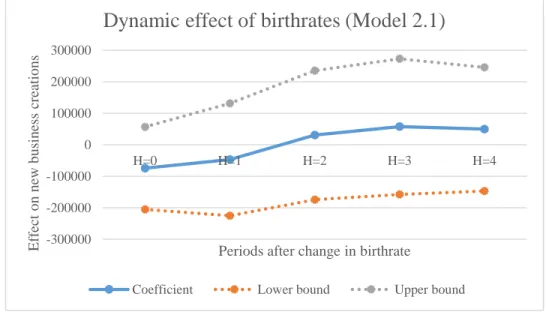
Performing the time-series regressions and examining the coefficients of the independent variables yields some interesting results. First, the primary independent variable of interest, birthrate, is statistically insignificant across all periods and has a positive coefficient. Because of this, we can reject the notion that prior changes in birthrates have a statistically significant effect on the number of businesses created in any given period of interest. The dynamic effect of the variable, mapped graphically, is as follows:
Figure 2: Effect of a change in birthrates on business creation
The full results of the regressions may be consulted at the end of this thesis in a table labeled “Regressions of Model 2.1.” The results of the control variables are found in this appendix.
-300000 -200000 -100000 0 100000 200000 300000
H=0 H=1 H=2 H=3 H=4
Effect on new business creations
Periods after change in birthrate
Dynamic effect of birthrates (Model 2.1)
Coefficient Lower bound Upper bound
30
In conclusion, then, changes in birthrates may be found to have a statistically insignificant effect on the creation of new businesses. The expected immediate impact of GDP growth (representing general economic trends) and interest rates are confirmed, while the OECD labor index and inflation have no statistically significant effect on the creation of new businesses.
Before leaving this section, it should be noted that once interest rate is dropped from the regression model, it is possible to have a barely statistically significant effect (at the 10% significance level) from changes in birthrate in the fourth future iteration.
However, though this coefficient is statistically significant, the coefficient is relatively small, even in a regression fine-tuned to expose greater results. Therefore, some small amount of a decrease in business development might be due to shrinking youth cohorts, but it is neither statistically consequential nor metrically feasible to serve as a base of analysis.
Interpretation of results
The most obvious interpretation of the trends observed in the model is that the paradox described by Blanchflower and Freeman holds true within the Spanish model:
increasingly small cohorts of young people competing over the same resources are not guaranteed to eventually secure more positive economic results for themselves. If changes in the Spanish population pyramid do not have a measurable effect on business development, then the spikes in youth unemployment would certainly suggest that any relationship between youth cohort size and business creation is marginal at best.
31
The demographic trend and smaller returning cohorts of young people can, however, serve as a partial explanation of greater entrepreneurialism among the young, who increasingly enter into informal and self-directed work, as was mentioned in Chapter I (Serrano Pascual and Martín- Martín, 2017). At the individual level, a young person living in the present day is more likely to be an only child than a young person who came of age twenty years ago and will likely have attended less crowded schools and university classes.
Accordingly, a young person in such a situation (which we must assume is growingly common in Spain) has access to more educational and financial resources than his predecessors.
It should be noted that this recent increase in entrepreneurial activity is at least partially due to the Spain’s adoption of the Euro in 1999 and the lower interest rates experienced by borrowers in the country over much of the following decade. With the new economic reality created for Spain by full membership in the Eurozone, the development of new businesses and the securing of the sizable loans necessary for large-scale economic activity became more easily-obtained, causing a massive boost in economic development within the country (Neal and García-Iglesias, 2013). Therefore, it may be reasonably inferred that the exogenous decision of the Spanish government to join the European currency union has had a measurable effect on the attitudes toward and outcomes of entrepreneurial activity in a relatively brief period. However, because all of the data in the model used in this chapter comes from 1999 onward, in a period in which the Euro was the accepted currency of Spain, this reality affects neither the veracity nor negates the interpretation of the results found.
32
This development among young people could go some way in explaining the relative lack of youth protest and mobilization in Spain that has puzzled some political scientists (Antentas, 2017). Beyond the highly-publicized 2011 anti-austerity protests in which high unemployment was only one ingredient in a cocktail of complaints that included government corruption, cuts to education spending, and bank failures, as well as greater support among the youth for the newly-formed left-wing populist party Unidos Podemos (Together We Can), young people have accepted largely docilely the superficial worsening of their economic situation. Beyond some psychosocial explanations that are beyond the scope of this chapter, such as an encroaching sense of hopelessness with regards to traditional politics, the finding that the shrunken cohorts that are coming of age will likely eventually secure an acceptable economic future can lend greater understanding to this apparent passivity among young people toward their slipping economic position in Spanish society.
In addition, as was mentioned in Chapter I, a third option has emerged in recent years for those young people who lack the necessary economic resources to turn toward self-directed economic activity and cannot afford to remain unemployed: emigration.
Many young Spaniards become low-income economic migrants to the more verdant pastures of employment in northern Europe, particularly in Germany, Sweden, and Great Britain (El País, May 6, 2014). Among those who stay in the country, home ownership and the starting of families are also often postponed. These changing practices among young people help us understand how they cope with the discomfort of the extended frictional unemployment presently featured in the Spanish model, this phenomenon will be discussed in greater detail in Chapter III.
33
We find that business creation has a unique interaction with the youth employment situation. In Spain itself, a paradox surrounding the economic outcomes among smaller youth cohorts is resolved: smaller cohorts are no more likely to generate greater economic activity than larger cohorts. The potential negative economic disadvantages of slowing birthrates seem to have been softened by a greater entrepreneurial activity noted among young Spaniards, owing partially to the greater amount of resources allocated to members of smaller cohorts on the aggregate, and the growing emigration of economically- disadvantaged Spanish youth to other parts of Europe. However, it is unlikely that the comparative benefits of a smaller youth cohort will be the experience of future cohorts that are presently children as youth cohort size stabilizes. Therefore, while present young adults in Spain should not necessarily participate in the popular pessimism over their overall economic state, the same optimism should not necessarily be shared by the young people who will succeed them in the university, in the workplace, and in the benefits lines.
34 Chapter III
The Effects of Education on Youth Unemployment and the Outcomes of Tertiary Education
Introduction
Moving on from these factors at play in the employment situation of Spanish youth, the focus of this third chapter is the examination of the effects of changing educational results and practices (both at the secondary and tertiary levels) on youth unemployment. In addition, the results of study into these phenomena will yield some insight into patterns of occupational outcomes following the conclusion of Spanish students’ education.
The reasons to examine this aspect of the Spanish youth employment situation are twofold. The first and more obvious reason to study the effects of education on youth unemployment is that educational background is the most reliable predictor of future economic success experienced by a student or a worker. In studying the educational patterns of Spanish youth, it is possible to determine correlation between variables of education and variables of employment in order to seek an explanation from education of prolonged high youth unemployment in the country. The second and less apparent reason to study education as a potential variable in the determination of youth unemployment is that the observation of trends in educational practices and outcomes over time allow a researcher to observe how young people react to their concurrent economic situation while
35
still students and to measure whether or not these changed practices carry any meaningful effect on unemployment within the youth population as a whole. It is with these dual focuses in mind that I intend to test hypotheses regarding the effectiveness of Spanish secondary and tertiary education with respect to youth unemployment.
Historically, Spanish youth suffered from a lack of competitiveness as a result of various inadequacies of their nation’s educational system. Under the Franco regime, nationalism trumped quality in Spanish curricula (Mar del Pozo Andrés and Braster, 2006).
For example, at a time when most European nations were implementing robust English- learning programs in their schools, the Francoist Ministry of Education sought to play up Spanish as a crucial language and restricted foreign language education and exposure. It was not until the passage of the General Law of Education of 1970 that the Spanish government assumed an educational model similar to those of its neighbors (Payne, 565).
Given this piecemeal history of the Spanish educational system, it is unsurprising that Spanish students lagged behind the rest of their European counterparts into the late twentieth century. It is worthwhile, therefore, to examine whether or not this disparity has contributed to the unprecedented spike in youth unemployment in the modern period. In order to test any hypotheses related to this question, it is prudent to divide the focuses of research into education along the lines of educational level; that is to say, to examine separately the effects of changes in secondary educational patterns (those observed among secondary or high school-age students) and tertiary educational patterns (those observed among students at universities, vocational colleges, seminaries, or other postsecondary institutions). Not only is this demarcation useful, given the different pressures and factors faced by secondary- and tertiary-level students, but also yielding of more meaningful
36
results as the researcher is more capable of zeroing in on causes and effects among the two groups when examining their situations separately.
Hypothesis testing
The first hypothesis to be tested concerns the effects of secondary education quality on the later employment outcomes of Spanish students. Specifically, the first tested hypothesis postulates that a factor in higher Spanish youth unemployment has been inadequate secondary education that leaves its graduates less capable of maintaining employment upon reaching adulthood. In order to perform the necessary regressions to isolate changes in youth unemployment that arise as a result of these changes in secondary education, it is first necessary to describe the dependent and independent variables that will be measured and regressed.
The dependent variable in this regression model regarding secondary education will be youth unemployment. Among the independent variables selected for the model are four primary variables of interest with relation to Spanish secondary education. The first of these is the national average score on the PISA exam. The Programme for International Student Assessment (PISA) is a standardized international measure of secondary-level achievement, testing such subjects as verbal reasoning, mathematics, and science. The test often serves as useful benchmark for academic progress at the national level, with higher scores representing greater mastery of given subject material. Spanish students have participated in the exam since its inception in 1999. Regressing changes in Spanish PISA scores on the youth unemployment rate, therefore, promises to grant some insight into how changes in student success translate into occupational success later in the students’ lives.
37
A second independent variable chosen as a representative for secondary education is the percentage of the Spanish federal government’s education budget allotted to secondary education. I believe that is a superior measure of secondary spending than other potential choices for independent variable (Euros spent per student, raw budgetary figures, etc.). Beyond not being swayed by exogenous factors such as inflation and student population, the variable of percentage of federal education budget focused on secondary education allows the researcher to gauge more accurately the amount of emphasis that was being placed on secondary education by education administrators and how this presence (or lack) of focus on secondary education has impacted secondary students as they prepare for the job market.
A third independent variable tied to a secondary education is the percentage of students learning English at the secondary level. More specifically, the independent variable chosen measures the percentage of students who achieve a bachillerato (similar to an A-level in Great Britain or perhaps an A.P. certification in the United States) in English or participate in intensive English-language education (which includes travel to an English-speaking country as part of the education). While this variable might seem somewhat arbitrary, it actually represents an important factor to the future success of a student. In a global workforce (and in the European workforce, more specifically), English- language skills are required or encouraged for most white-collar jobs (Tabuenca-Cuevas, 2016). The ability or failure of a student to speak the language confidently can have significant impact on their future success in the job market. The inclusion of this variable takes this measure of linguistic capital into account and goes some way in measuring the adequateness of foreign-language education in Spanish high schools.
38
A final independent variable of interest that is not necessarily related to secondary education but is nevertheless relevant to patterns of youth unemployment in present period concerns the fortunes of the Spanish construction industry. Specifically, the variable in question measures the number of housing starts undertaken each year in Spain since 1990.
In the past, during Spain’s economic boom of the late 1990s and early 2000s, spurred by the low interest rates afforded to consumers largely as a consequence of the country’s participation in the Eurozone, builders went on an unprecedented construction spree.
During this period, wages were relatively high for construction workers and projects were plentiful. As a result, a significant number of people (primarily young men) chose to forego university or even drop out of secondary education without a certificate in order to pursue lucrative careers as builders (Bielsa and Duarte, 2011). Since the beginning of the financial crisis, however, it would be hard to imagine an industry harder-hit in the country than the construction industry, the number of housing starts having petered from a peak of 747,000 in 2005 to a low of only 5,900 housing starts nationwide in 2015 (Ministerio de Fomento, 2016). This cratering of the construction market has deeply impacted youth unemployment, and so in order to more fully capture the effects of changes in secondary education on the youth unemployment situation, it is necessary to include a variable that represents the vitality of the industry that drew so many dropouts and early leavers from the educational system.
In addition to these variables regarding secondary education, there is a handful of more “atmospheric” explanatory variables that, while not directly related to secondary education, are necessarily included in order to capture a fuller picture of factors that inform youth unemployment. These include change in GDP (representing the general trends of the