How do you know they're not lying?" he asked, referring to the statistics I had cited regarding the rate of emotional abuse in the American adult population. When it comes to emotional abuse, it's unlikely that anyone even realizes that they has been misused as the definition of emotional abuse is considered to be so subjective.My research has not only been in the same area, it has evolved towards the topic of recognizing emotional abuse focusing on romantic narratives and media representation.
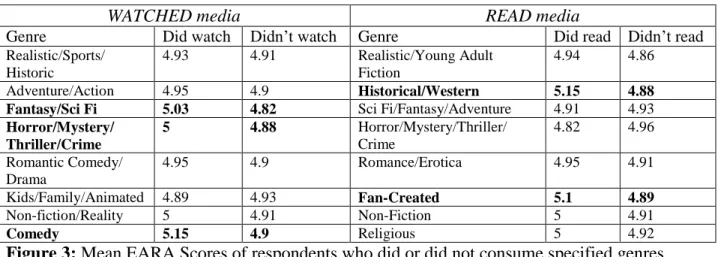
Another study in the literature—survey research by DeHart, Follingstad, and Fields (2010)—examined hypothetical emotional abuse rather than real-world actions. After analyzing the responses, it appears that critical thinking skills form an essential foundation for a person's Emotional Abuse Recognition Ability (EARA). Additionally, what elements of a person's identity or media habits contribute to the recognition or lack thereof of emotional abuse.
For a researcher interested in people's ability to recognize emotional abuse, specifically emotional abuse that occurs between intimate partners, there is a huge gap in the sociological. According to Karakurt and Silver, emotional abuse attacks the "emotional and psychological well-being of the victim" and therefore diminishes a victim's willingness to care for and stand up for themselves. The "discourse of romantic love" also reframes emotionally abusive actions by one's partner; rather than an unhealthy behavior, or one that threatens future escalation, emotional abuse becomes “a demonstration of genuine love and commitment” (Hayes and Jeffries, 2013: 61).
Most research on emotional abuse has focused on whether someone has been victimized, on the patterns in the population of those abused, and on the consequences of that abuse. However, in the script of romantic stories, recipients of psychologically aggressive actions tend not to react negatively, so readers are unlikely to recognize this emotional abuse from context. This measure is an amalgamation of the interview questions for the CDC's National Intimate Partner and Sexual Violence Survey, and the questionnaire used by DeHart, Follingstad, and Fields in examining how context contributes to defining emotional abuse (Black et already.
Respondents are also asked: "Would you accept this behavior in your own relationship?" with potential answers "yes" and "no", and then given a text box where they can answer, "why or why not?" The entirety of the EARA measure can be seen in Appendix A. One respondent who said they would not condone the behavior depicted in the vignette wrote: "I don't like the phrase 'it sucks to be you.' Another person who rejected the behavior said that they "hate people who talk during movies". The lack of emotional abuse in these vignettes explains why responses to them did not correlate with the emotional abuse vignettes, and further indicates the reliability of this measure. Therefore, the EARA score - if the measure is valid - will predict one's acceptance or non-acceptance of emotional abuse.
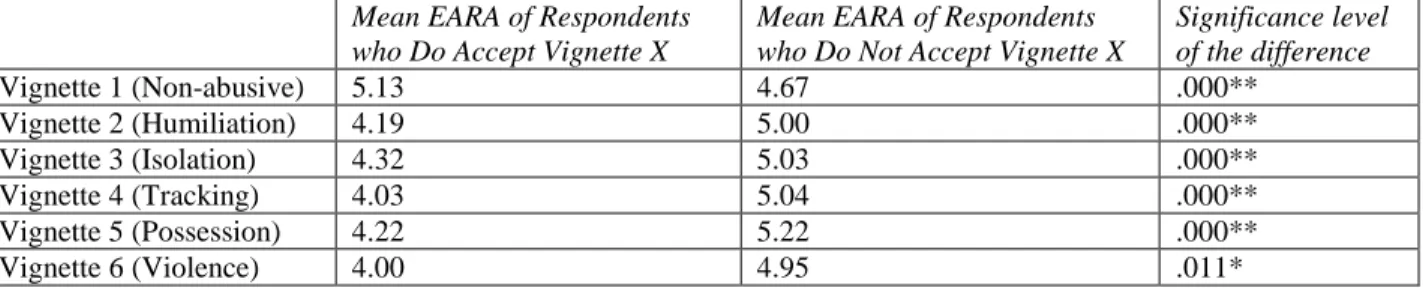
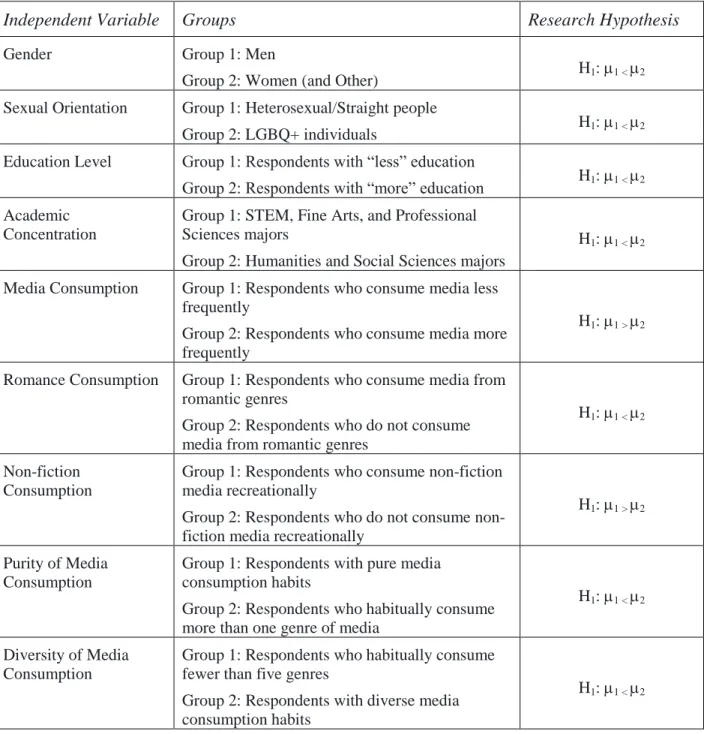
For each of the abusive vignettes, respondents who accepted the emotional abuse have a mean EARA score far lower than those who did not accept it. In addition, younger respondents would have a higher EARA score than older respondents; Karakurt and Silver found that younger people tend to be at a higher risk of emotional abuse than their older counterparts. However, when recoded into a new variable - "less than college" and "graduate" respondents together compared to "high school" and those with a "college degree" together in one group - the former group has a higher average EARA score than the latter (5.05 and 4.77, respectively, with a p = .02).
This theory of critical thinking is also illustrated in the comments; specifically in the answers to the question “why or why not?” after the last two vignettes, which contain the most intense emotional abuse.

Vignettes
Porter, at [email protected], or Human Subjects Research Committee Chair, Dr. If the content of this survey bothers you and you do not wish to be contacted by any of the above contacts, you may visit www. thehotline.org or call for help. We're watching Furious 7 because you picked last, and we're taking turns.
Question #1: Please select the level to which you agree or disagree with the statement below. Seriously, I know you failed history in high school, but it's still ridiculous, honey, I expected better from you.” Taylor sighed dramatically, shaking her head. Yes," said Taylor, answering Sam, "and shockingly, Sam gave the wrong answer again.
Question #3: Please select the degree to which you agree or disagree with the following statement. Are you sure you don't just want to cuddle with me?” Moving to the corner of the couch and brushing aside a corner of the blanket, Alex looked up at Charlie, batting thick eyelashes. This was a habit with the two of them, and Alex and Charlie knew how it would end.
Question #5: Please select the level to which you agree or disagree with the statements below. Question #7: Please select the level to which you agree or disagree with the statements below. Of course,” Harley said, pressing a kiss to the top of Parker's head and briefly tightening the grip of their intertwined fingers.
Question no. 9: Please select the degree to which you agree or disagree with the statement below. Harper pushed open the door to the bedroom he shared with Jordan and gasped, fear gripping her heart. Question no. 11: Please select the degree to which you agree or disagree with the statement below.
Media Usage
About You
If you have become upset about the content of this recording, you can contact the primary. Karen Porter, at [email protected], or the head of the Human Subjects Research Committee that approved this research (Dr. Stephen Byrne) at byrne.alfred.edu. Another possibility is to visit or call thehotline.org if you do not want to reach out to the above contacts.